Atomic Force Microscopy in Surface Characterization: A Comprehensive Guide for Biomedical Research and Drug Development
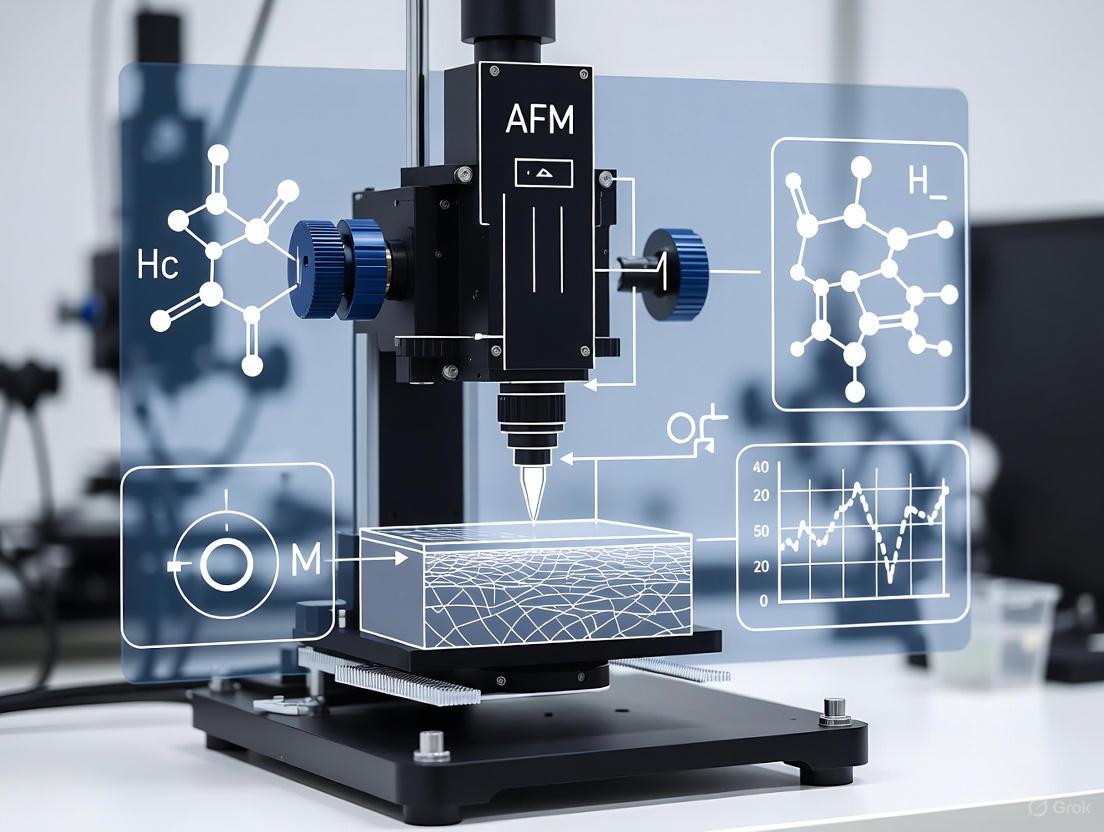
This article provides a comprehensive exploration of Atomic Force Microscopy (AFM) for nanoscale surface characterization, tailored for researchers and drug development professionals.
Atomic Force Microscopy in Surface Characterization: A Comprehensive Guide for Biomedical Research and Drug Development
Abstract
This article provides a comprehensive exploration of Atomic Force Microscopy (AFM) for nanoscale surface characterization, tailored for researchers and drug development professionals. It covers fundamental principles, advanced methodological applications in biomedicine, practical troubleshooting for soft matter analysis, and validation techniques for ensuring data reproducibility. The guide synthesizes current AFM capabilities—from high-resolution imaging and nanomechanical property mapping of cells and tissues to chemical characterization and quality control of biomedical materials—offering a practical framework to bridge theoretical knowledge and experimental implementation in biomedical research.
Understanding AFM: Core Principles and Nanoscale Exploration for Biomaterials
Atomic Force Microscopy (AFM) is a powerful scanning probe technique that provides nanoscale-resolution topographic imaging and quantitative characterization of material properties. Its operation is fundamentally based on detecting the force interactions between a sharp probe and the sample surface. Unlike optical or electron microscopes, AFM does not rely on lenses or light waves but instead physically senses the surface using a nanoscale tip, enabling it to operate in various environments, including liquid mediums, which is critical for biological and pharmaceutical research [1]. Understanding these probe-surface interactions is essential for leveraging AFM in advanced applications, such as the development of drug delivery systems and the characterization of nanomaterials [2] [1]. This document details the underlying principles, key experimental protocols, and specific applications of AFM force spectroscopy for a research audience engaged in surface characterization.
Fundamental Operational Principle
The core principle of AFM involves scanning a sharp probe attached to a flexible cantilever across a sample surface while monitoring the cantilever deflection caused by tip-sample interactions. These interactions are governed by forces including van der Waals, chemical, electrostatic, and magnetic forces, depending on the tip and sample properties.
- The Force-Distance Curve: The fundamental measurement in force interaction studies is the force-distance (F-D) curve [3] [4]. An F-D curve is recorded by moving the piezoscanner (and the attached probe) vertically towards the sample until contact is made (the "approach" segment), and then retracting it back (the "retract" segment). A standard F-D curve is graphically represented below, illustrating the key stages of the tip-sample interaction during a single approach-retract cycle.
The stages are:
- Approach (A-B): The tip moves towards the sample without interaction; no deflection.
- Snap-in (B): Attractive forces (e.g., van der Waals) cause the tip to jump into contact.
- Contact (C-D): The tip is in repulsive contact with the sample. The linear slope reflects sample elasticity (stiffer samples yield a steeper slope).
- Retraction (D-E): The piezo retracts. Adhesive forces can cause the tip to stick.
- Adhesion Peak (E): The maximum force needed to break the tip-sample adhesion.
- Release (E-F): The tip returns to its neutral position.
- From Deflection to Force: The raw data from an AFM measures cantilever deflection in volts. This is converted into a physical force (in newtons) using Hooke's law: ( F = kc \times d ) where ( F ) is the force, ( kc ) is the cantilever's elastic constant (spring constant), and ( d ) is the deflection distance [4]. The deflection signal in volts is first converted to meters using the detector sensitivity, which is obtained by measuring the slope of a force curve on a hard, non-deformable surface [3] [4].
Key Experimental Protocols in Force Spectroscopy
Protocol: Acquiring and Analyzing a Single Force Curve
This protocol is the foundation for all AFM force measurements, used to determine local mechanical properties like adhesion and stiffness [3] [4].
1. Objective: To obtain a single force-distance curve and extract quantitative nanomechanical properties.
2. Materials and Reagents:
- AFM Probe: A cantilever with a known spring constant (( k_c )) and a sharp tip (apex radius ~5-10 nm is ideal for high resolution) [5].
- Sample: Fixed to a clean, rigid substrate (e.g., mica, glass slide).
- Calibration Sample: A rigid, non-deformable sample (e.g., clean silicon wafer) for detector sensitivity calibration.
3. Equipment Setup:
- Atomic Force Microscope.
- Vibration isolation table.
- Software for data acquisition and analysis (e.g., commercial vendor software or open-source tools like
FC_analysis[4]).
4. Step-by-Step Procedure:
| Step | Action | Key Parameters & Notes |
|---|---|---|
| 1 | Cantilever Calibration | - Spring Constant (( k_c )): Determine via thermal tune or Sader method. - Detector Sensitivity (S): Acquire a force curve on a rigid calibration sample. The slope (in V/nm) of the contact region is the sensitivity [4]. |
| 2 | System Alignment | Align the laser beam on the cantilever's end and center the reflected spot on the position-sensitive photodetector. |
| 3 | Engage & Approach | Bring the tip into a gentle, controlled approach towards the sample surface until the feedback loop detects contact. |
| 4 | Force Curve Acquisition | At a specific XY location, command the Z-piezo to perform a complete extension and retraction cycle. Record the Z-displacement and cantilever deflection voltage. |
| 5 | Data Conversion | Convert the raw data (Z, DeflectionV) into a force-distance curve (Indentation, ForceN) using ( F = D \times (k_c / S) ) [4]. |
| 6 | Curve Analysis | - Adhesion Force: Measure the minimum force on the retract curve. - Elastic Modulus: Fit the indentation region of the approach curve with a contact mechanics model (e.g., Hertz, Sneddon, or JKR) to calculate the Young's modulus [4]. |
Protocol: Generating and Interpreting a Force Volume Map
For mapping the spatial distribution of mechanical properties, a grid of force curves is collected, creating a Force Volume (FV) map [4].
1. Objective: To create a quantitative map of mechanical properties (e.g., elasticity, adhesion) correlating with sample topography.
2. Workflow: The process involves systematically acquiring force curves at every point in a defined grid over the sample surface, followed by automated data analysis to create parametric images.
3. Data Analysis:
- Software: Use specialized software (e.g.,
FC_analysis[4]) to batch-process hundreds to thousands of force curves automatically. - Output Maps: The software generates images where the pixel intensity corresponds to a specific mechanical property (e.g., a Young's modulus map, an adhesion map), perfectly correlated with the topographic image.
Applications in Drug Development and Nanotechnology
AFM force spectroscopy provides critical insights in pharmaceutical and environmental research by quantifying nanomechanical properties.
Table 1: Applications of AFM Force Spectroscopy
| Application Area | Measured Parameters | Key Findings & Relevance |
|---|---|---|
| Nanoparticle Characterization for Drug Delivery [2] | Topography, size, stiffness (Young's modulus), adhesion. | Correlation of mechanical properties with cellular uptake and targeting efficiency. Enables rational design of nanoparticles with controlled properties. |
| Amorphous Solid Dispersion (ASD) Development [1] | Drug-polymer miscibility, phase separation, nano-scale homogeneity, surface stiffness. | Predicts physical stability and dissolution performance of ASDs, crucial for enhancing bioavailability of poorly soluble drugs. |
| Micro- and Nanoplastic (MNP) Detection [6] | Elastic modulus, surface roughness, morphological characterization of aggregates. | Distinguishes pristine from aged MNPs in environmental samples (e.g., groundwater). Roughness data indicates pollutant adsorption capacity. |
Table 2: Quantitative Data from AFM Force Spectroscopy Studies
| Sample Type | Measured Property | Quantitative Value | Experimental Conditions & Significance |
|---|---|---|---|
| Silicon AFM Probe [5] | Tip Apex Radius | 5 nm | Enables high-resolution, high-fidelity imaging of nanoscale features. |
| Silicon AFM Probe [5] | Tip Half-Cone Angle | 7.5° (High-Aspect-Ratio) | Allows probing of deep and confined nanostructures not accessible with standard probes (~30-70°). |
| Laboratory-aged Microplastics [6] | Surface Roughness | 1-2 orders of magnitude lower than field samples | Highlights the higher adsorption capacity of environmental MNPs towards pollutants compared to lab-aged particles. |
The Scientist's Toolkit: Essential Research Reagents and Materials
Table 3: Key Reagents and Materials for AFM Force Spectroscopy
| Item | Function & Application | Specification Notes |
|---|---|---|
| AFM Cantilevers | Senses force interactions; the key nanomechanical sensor. | - Material: Si for high resolution [5]. - Stiffness (( k_c )): Choose based on sample stiffness (softer samples require softer cantilevers, e.g., 0.1-1 N/m). - Tip Geometry: Ultra-sharp tips (5 nm radius) for resolution; high-aspect-ratio for deep trenches [5]. |
| Calibration Gratings | Verification of scanner accuracy and image resolution. | - Features: Known pitch and height (e.g., TGZ1-TGZ3 from NT-MDT). - Material: Rigid (silicon) with periodic structures. |
| Rigid Reference Samples | Calibration of detector sensitivity. | - Required: Clean, hard, and non-deformable. - Examples: Clean silicon wafer, sapphire, or mica. |
| Software Tools | Data analysis, curve fitting, and force volume map generation. | - Commercial: Vendor-specific software (Bruker, JPK, Park). - Open-Source: FC_analysis for flexible analysis of .txt force curves [4]. |
| Liquid Cell | Enables force measurements in physiological buffer. | - Critical for studying biological samples or drug delivery systems in their native, hydrated state [1]. |
Within the field of surface characterization research, Atomic Force Microscopy (AFM) stands apart from traditional microscopy techniques due to two transformative capabilities: the ability to function in liquid environments and the requirement for minimal sample preparation. These advantages are critical for investigating biological processes in physiologically relevant conditions and for obtaining accurate, artifact-free data on native sample properties. This document details the experimental protocols and applications that enable researchers and drug development professionals to leverage these capabilities, framing them within the broader context of a thesis on advanced surface characterization.
Core Advantages: Liquid Environment Operation and Minimal Preparation
The following table summarizes how AFM's core advantages compare to those of traditional electron microscopy techniques.
Table 1: Comparison of AFM and Traditional Electron Microscopy for Biological Research
| Feature | Atomic Force Microscopy (AFM) | Scanning/Transmission Electron Microscopy (SEM/TEM) |
|---|---|---|
| Operating Environment | Air, controlled atmosphere, or liquid medium (including buffer solutions) [7] | High vacuum required |
| Sample Preparation | Minimal preparation; no labeling, fixing, or conductive coating required [8] | Extensive preparation: dehydration, staining, fixation, and conductive coating |
| Sample Integrity | Studies biological samples directly in their natural environment; viable for living cells [7] | Sample is non-viable and may suffer from preparation artifacts |
| Information Obtained | 3D topography and simultaneous nanomechanical properties (e.g., elasticity, adhesion) [8] | Primarily 2D structural information (TEM) or surface topography (SEM) |
| Resolution | High atomic resolution; sub-nanometer lateral and vertical resolution [9] | Atomic to near-atomic resolution |
The capacity to operate in liquids allows for the study of biological samples—from single biomolecules to living cells—in an environment that closely mimics their native state [7] [10]. Furthermore, the lack of destructive preparation steps means that the measured properties are a true representation of the sample, not an artifact of the preparation process [8].
Experimental Protocols for Liquid Environment Imaging
Successful AFM imaging in liquid requires careful attention to probe selection, cantilever tuning, and the approaching procedure. The following protocol is adapted for biological samples such as proteins, cells, or bacterial films [10].
Probe and Mode Selection
- Probe Selection: The proper choice of AFM probe is crucial. For imaging in liquid, silicon nitride cantilevers are preferred due to their low spring constant, which allows for gentle imaging of soft biological samples. Sharp, oxide-sharpened silicon nitride tips (tip radius ~10 nm) are recommended for high-resolution imaging [10].
- Imaging Mode: For most soft biological samples, semi-contact (amplitude modulation or "tapping") mode is more suitable than contact mode. This mode minimizes lateral forces, reducing the risk of sample damage or detachment [10].
Cantilever Tuning in Liquid
Tuning the cantilever in a liquid environment presents unique challenges, as the resonance behavior differs significantly from that in air.
- Frequency Sweep: Perform a frequency sweep, typically between 5 kHz and 20 kHz. Unlike in air, the frequency response in liquid will show multiple peaks [10].
- Peak Selection: Auto-tuning is not recommended. Select the resonance peak manually by:
- Choosing a peak that is higher than the majority of others.
- Verifying the selected peak by landing the tip in contact mode and ensuring the peak height decreases when the tip is in contact with the sample.
- Noting that the proper peak is often consistent for the same type of cantilever and instrument setup [10].
- Feedback Signal: Use the RMS signal from the photodetector for feedback, as it is less noisy at low frequencies in liquid than the magnitude signal from a lock-in amplifier [10].
Approaching the Sample Surface in Liquid
Approaching the sample in semi-contact mode requires practice. The amplitude does not decrease monotonically.
- Initiate the approach. The amplitude will initially rise as the tip gets closer to the surface due to acoustic waves in the liquid.
- As the tip enters the liquid layer close to the sample, the amplitude will begin a mild decrease. This does not indicate contact.
- A sudden drop in amplitude signals that the tip has made contact with the sample. Set the feedback setpoint at this point [10].
Diagram 1: AFM Liquid Imaging Workflow
Applications in Biological and Medical Research
The combination of liquid operation and minimal preparation enables unique applications, particularly in drug development and disease research.
Studying Drug-Membrane Interactions
AFM can image the interaction between drugs and supported lipid bilayers (SLBs) in real-time. For instance, the antibiotic Azithromycin's interaction with SLBs has been visualized, providing direct insight into the compound's mechanism of action at the molecular level [7].
Direct Observation of Enzyme Activity
Conformational changes in the protein lysozyme during hydrolysis have been measured locally using AFM in tapping mode in liquid. Height fluctuations of about 1 nm were observed only when the substrate was present, and these fluctuations decreased upon adding an inhibitor, providing a direct readout of enzyme activity [7].
Nanomechanical Profiling for Disease Detection
AFM-based force spectroscopy can probe the mechanical properties of cells and tissues, which often change with disease.
Table 2: Key Experimental Parameters for Nanomechanical Characterization
| Parameter | Typical Value / Consideration | Biological Relevance |
|---|---|---|
| Cantilever Spring Constant (k) | 0.01 - 0.1 N/m (for soft cells) [9] | Must be appropriate to indent the sample without damage. |
| Indentation Depth | < 100 nm (for cells) [9] | Ensures measurement of the cell cortex, not the underlying substrate. |
| Indentation Rate | ~2 μm/s [9] | Minimizes viscoelastic effects for linear elastic modeling. |
| Theoretical Model | Hertz model (for conical or spherical tips) [9] | Used to calculate the elastic modulus (Young's modulus) from force curves. |
| Application Example | Distinguishing cancer cells from normal cells based on cell stiffness [8] | Cancer cells are often softer than their healthy counterparts. |
The Scientist's Toolkit: Essential Materials and Reagents
Table 3: Essential Research Reagent Solutions for Biological AFM
| Item | Function / Description |
|---|---|
| Silicon Nitride Probes | Soft cantilevers with sharp tips designed for minimal force and high resolution in liquid [10]. |
| Buffer Solutions (e.g., PBS) | Maintains physiological pH and ionic strength to keep biological samples (cells, proteins) viable and stable during imaging [7]. |
| Supported Lipid Bilayers (SLBs) | A model system formed on a mica substrate to simulate cell membranes for studying drug-membrane and protein-membrane interactions [7]. |
| Piezoelectric Cantilever Holder | Provides external excitation for oscillating the cantilever in tapping mode operation under fluid [11]. |
| Mica or SiO2/Si Substrates | Atomically flat, inert substrates ideal for adsorbing and imaging biomolecules like proteins, DNA, or vesicles [7] [11]. |
Diagram 2: AFM Core System Components
Achieving atomic-level resolution for biomolecular and cellular imaging
Atomic Force Microscopy (AFM) is a powerful tool for high-resolution imaging of biomolecules and cellular structures under near-physiological conditions. Traditional AFM has provided nanometer-scale resolution, but recent methodological advances have pushed its capabilities toward atomic-level resolution, particularly through techniques such as Localization AFM (LAFM) and computational integration with structural biology approaches. This application note details the protocols and methodologies enabling researchers to achieve quasi-atomic resolution for investigating biomolecular structure and dynamics, which is crucial for drug development and understanding biological function at the molecular level.
Advanced AFM Modalities for High-Resolution Imaging
Localization AFM (LAFM) for Super-Resolution Imaging
LAFM represents a breakthrough in AFM resolution, functioning as a super-resolution method that extracts topographic peak positions from individual particle observations. This technique overcomes the fundamental limitation of tip convolution that plagues conventional AFM imaging. LAFM merges multiple observations into a topography probability map that can reach quasi-atomic resolution on protein surfaces by restricting data content to true tip-sample interactions while eliminating data prone to tip convolution artifacts [12].
The recent development of a pipeline that transforms LAFM data into 3D probability density maps (.afm files) has enabled direct comparison with structural data from cryo-EM, X-ray crystallography, and NMR. This transformation allows AFM data to be readable by common structural biology software such as Chimera, effectively embedding AFM in the standard repertoire of structural biology methods [12].
High-Speed AFM (HS-AFM) for Dynamic Studies
HS-AFM enables the observation of biomolecules in dynamic action with temporal resolution of 1-100 frames per second. This capability is unique for directly watching proteins undergo functional conformational changes in near-native environments. HS-AFM operates with short cantilevers that have low hydrodynamic drag and large angular change when deflected, resulting in substantially higher sensitivity and less invasiveness than conventional AFM [12].
Experimental Protocols
LAFM Protocol for Quasi-Atomic Resolution
Sample Preparation:
- Surface Selection: Use freshly cleaved mica as the substrate for imaging. For membrane proteins, prepare supported lipid bilayers of controlled composition on the mica surface [12].
- Biomolecule Immobilization: Dilute the target biomolecule to appropriate concentration (typically 0.1-1 mg/mL) and apply 20 μL aliquot to the mica surface. Allow to adsorb for 1-5 minutes depending on adsorption kinetics [12].
- Buffer Conditions: Maintain physiological buffers (e.g., PBS or HEPES) at ambient temperature and pressure throughout imaging.
Data Acquisition:
- Cantilever Selection: Use short, stiff cantilevers with high resonant frequencies. Calibrate the spring constant using the thermal tune method [11].
- Image Acquisition: Collect multiple scans (typically 100-1000 particles) of the target biomolecules at high resolution (2.5 Å/pixel or better) [12].
- Peak Detection: Implement automated LAFM peak detection algorithms to extract true tip-sample interaction points while excluding convolution-prone data [12].
Data Processing:
- Image Alignment: Perform translational and rotational fine alignment of particles using local image expansion algorithms [12].
- 3D Volume Reconstruction: Allocate aligned LAFM detections into a 3D-volume space to generate 3D probability density maps [12].
- File Export: Save the final reconstructed data in .afm format for compatibility with structural biology visualization software [12].
AFMfit Flexible Fitting Protocol
Rigid Body Fitting:
- Initial Model Preparation: Obtain an initial atomic model from PDB or generate using AlphaFold2 if no experimental structure is available [13].
- Global Orientation Estimation: For each AFM image, perform rigid fitting to estimate the global orientation (3D rotation and translation) of the molecule [13].
- Similarity Scoring: Compute pixel-wise root mean square deviation (pixel-RMSD) between experimental AFM images and pseudo-AFM images generated from the model [13].
Flexible Fitting:
- Nonlinear Normal Mode Analysis: Use the NOLB method to explore flexible degrees of freedom without inducing structural distortions typical of linear normal modes at large amplitudes [13].
- Deformation Optimization: For each image, locate the best flexible deformations of the initial model using amplitudes of normal mode deformations [13].
- Conformational Ensemble Generation: Output a conformational ensemble representing the principal structural variations and their distribution across the dataset [13].
Validation:
- Principal Component Analysis: Project the conformational ensemble onto a low-dimensional subspace to interpret the major modes of motion [13].
- Cross-Validation: Validate against known structural transitions or complementary experimental data where available [13].
Quantitative Data Analysis
Table 1: Resolution Capabilities of Advanced AFM Techniques
| Technique | Spatial Resolution | Temporal Resolution | Sample Environment | Key Applications |
|---|---|---|---|---|
| Conventional AFM | 1-10 nm | Minutes to hours | Ambient or liquid | Topographical imaging, force spectroscopy |
| HS-AFM | 1-5 nm | 0.01-1 second | Physiological buffers | Protein dynamics, conformational changes |
| LAFM | 2.5-5 Å | Minutes to hours | Ambient or liquid | Quasi-atomic structure, surface topography |
| AFMfit | Domain-level (complementary) | Minutes (processing) | Computational integration | Conformational dynamics, flexible fitting |
Table 2: Computational Requirements for AFM Data Analysis
| Analysis Method | Processing Time | Hardware Requirements | Dataset Size | Output |
|---|---|---|---|---|
| LAFM 3D Reconstruction | Hours to days | Workstation with high RAM | 100-1000 particles | 3D probability density map (.afm file) |
| AFMfit Rigid Fitting | Minutes to hours | Standard desktop | 100-1000 images | Oriented structural models |
| AFMfit Flexible Fitting | Minutes to hours | Standard desktop | 100-1000 images | Conformational ensemble |
| MDFF with AFM constraints | Days to weeks | High-performance computing | Multiple AFM images | Atomistic models of dynamics |
The Scientist's Toolkit
Table 3: Essential Research Reagent Solutions for High-Resolution AFM
| Item | Function | Application Notes |
|---|---|---|
| Freshly cleaved mica | Atomically flat substrate | Provides clean, reproducible surface for biomolecule immobilization |
| Supported lipid bilayers | Native-like membrane environment | Essential for membrane protein studies; composition can be controlled |
| Short, stiff cantilevers (e.g., ScanAsyst-Air, NSC15/Al BS) | High-sensitivity force detection | Low hydrodynamic drag enables HS-AFM; requires precise spring constant calibration [11] |
| Physiological buffers (PBS, HEPES) | Maintain biological activity | Enable imaging under near-native conditions, preserving protein function |
| Bruker Dimension Icon AFM | Multimodal imaging platform | Supports integration of PeakForce tapping with higher eigenmode vibrations [11] |
| BioAFMviewer software | Data analysis and visualization | Enables flexible fitting and integration with structural data [14] |
| Chimera visualization software | 3D density map analysis | Reads .afm format files for comparison with cryo-EM and X-ray data [12] |
Workflow Visualization
Applications in Drug Development
The integration of high-resolution AFM techniques with computational methods provides unprecedented insights into biomolecular function that are directly relevant to drug development. The ability to observe dynamic conformational changes in membrane proteins, such as channels, transporters, and receptors, under near-physiological conditions offers unique opportunities for understanding drug mechanism of action and identifying novel binding sites [12] [14].
AFMfit has been successfully applied to study conformational dynamics in biologically significant systems including activated coagulation factor V (FVa) and transient receptor potential channel TRPV3, demonstrating the method's capability to reveal functional mechanisms relevant to pharmaceutical interventions [13]. The reconstruction of atomistic molecular movies of protein dynamics from HS-AFM data enables researchers to visualize functional conformational transitions with unprecedented detail, providing critical insights for structure-based drug design [14].
The integration of advanced AFM modalities such as LAFM and HS-AFM with computational frameworks like AFMfit has transformed AFM into a powerful tool for achieving atomic-level insights into biomolecular structure and dynamics. The protocols detailed in this application note provide researchers with a roadmap for implementing these cutting-edge techniques in their own laboratories. As these methods continue to evolve and become more accessible, they will undoubtedly play an increasingly important role in drug development and our fundamental understanding of biological processes at the nanoscale.
Atomic Force Microscopy (AFM) is a powerful scanning probe technique essential for nanoscale surface characterization research. Its operation relies on measuring the interaction forces between a sharp probe and the sample surface. The selection of an appropriate imaging mode is critical, as it directly influences data resolution, accuracy, and sample integrity. This application note details the three fundamental AFM modes—Contact, Non-contact, and Tapping Mode—providing a structured comparison, detailed protocols, and contextual guidance for researchers in materials science and drug development. Understanding the underlying principles, advantages, and limitations of each mode enables scientists to optimize experimental design for investigating a diverse range of samples, from soft biological materials to rigid industrial surfaces [15] [16] [17].
Core Principles and Comparative Analysis
AFM operates by scanning a sharp tip attached to a flexible cantilever across a sample surface. Deflections or oscillations of the cantilever, induced by tip-sample interactions, are detected via a laser beam reflected onto a photodiode. This system translates nanoscale forces into high-resolution topographical images [16] [17]. The fundamental modes differ primarily in how the tip interacts with the sample surface.
The table below summarizes the key operational parameters and typical applications for each primary AFM mode.
Table 1: Comparative Analysis of Fundamental AFM Modes
| Parameter | Contact Mode | Tapping Mode | Non-Contact Mode |
|---|---|---|---|
| Tip-Sample Interaction | Continuous physical contact [18] [19] | Intermittent contact (oscillating) [16] [18] | No contact; senses attractive forces [20] [17] |
| Forces Exerted | Higher normal and lateral (frictional) forces [19] | Minimal lateral forces [19] | Very low, attractive forces (van der Waals) [20] |
| Best For | Rigid, flat, and stable samples [18] | Soft, fragile, adhesive, or heterogeneous samples [16] [19] | Very soft, sticky, or delicate samples [20] |
| Key Advantage | Simple operation; high resolution; direct force measurement [18] [19] | High resolution on delicate samples; reduces sample damage [16] [19] | Minimal tip and sample wear; ideal for repeated imaging [20] |
| Primary Limitation | Can damage soft samples and distort loosely bound features [19] | Generally does not directly measure forces [19] | Lower resolution; can be challenging to maintain stable operation [20] [17] |
| Typical Environment | Air, liquid, vacuum [17] | Air, liquid, vacuum [17] | Primarily ultra-high vacuum, sometimes air [17] |
Table 2: Quantitative Performance Comparison of AFM Modes
| Performance Metric | Contact Mode | Tapping Mode | Non-Contact Mode |
|---|---|---|---|
| Lateral Resolution | ~1 nm [17] | ~1-5 nm [17] | >10 nm [17] |
| Vertical Resolution | <0.1 nm [17] | <0.1 nm [17] | ~0.1 nm [17] |
| Imaging Speed | Medium | Slow to Medium [21] | Slow |
| Force Control | Constant deflection [16] [19] | Constant amplitude [16] [19] | Constant amplitude/frequency shift [20] |
Operational Workflows
The following diagrams illustrate the fundamental operational principles and feedback loops for each primary AFM mode.
Detailed Experimental Protocols
Protocol for Contact Mode Imaging
Application Note: This protocol is optimized for measuring the surface roughness of rigid, flat samples, such as polished titanium implants for biomedical applications [21].
Materials and Reagents:
- Sample: Polished titanium specimen [21].
- AFM Probe: Sharp silicon nitride (Si₃N₄) tip for contact mode.
- Equipment: Atomic Force Microscope with contact mode capability.
Procedure:
- Sample Preparation: Mount the titanium specimen securely on the AFM sample stage using double-sided adhesive tape or a compatible mounting clip. Ensure the surface is clean and free of dust using a gentle stream of clean, dry air if necessary.
- Probe Installation: Carefully mount a contact-mode cantilever into the probe holder. Using the microscope's optical viewer, position the laser spot on the end of the cantilever and align the reflected beam to the center of the photodetector.
- Approach: Initiate the automated tip approach sequence to bring the tip into close proximity with the sample surface until the feedback system detects a repulsive force, indicating contact.
- Parameter Setup:
- Set the scan size to an area representative of the surface features of interest (e.g., 10 µm x 10 µm).
- Set the setpoint to maintain a constant cantilever deflection, which corresponds to a low applied force (typically 0.5-10 nN) to minimize sample damage.
- Adjust the feedback gains (proportional and integral) to ensure stable tracking without oscillation. Start with low gains and increase until the system is responsive but not noisy.
- Image Acquisition: Begin the raster scan. Monitor the trace and retrace signals to ensure they overlap, indicating good feedback. Adjust gains or setpoint if necessary.
- Data Collection: Acquire at least three images from different locations on the sample to ensure representativeness. Save the topography data.
- Retraction: Once imaging is complete, retract the tip fully from the surface.
Protocol for Tapping Mode Imaging
Application Note: This protocol is designed for imaging soft, adhesive, or fragile samples, such as polymer thin films or biological molecules, where lateral forces must be minimized [16] [19].
Materials and Reagents:
- Sample: Unbaked photoresist or a soft polymer film [20].
- AFM Probe: Etched silicon probe with a resonant frequency appropriate for the imaging environment (air or liquid).
- Equipment: Atomic Force Microscope with dynamic (tapping) mode capability.
Procedure:
- Sample Preparation: Securely mount the sample. For soft, sticky samples, ensure they are firmly fixed to prevent movement during scanning.
- Probe Installation: Mount a tapping-mode cantilever. Align the laser and photodetector as in the contact mode protocol.
- Tune Cantilever: Access the tuning menu. Command the cantilever to oscillate and perform a frequency sweep to identify its fundamental resonance frequency. Set the drive frequency to this resonant peak.
- Approach: Initiate the automated approach while the cantilever is oscillating. The system will detect a reduction in amplitude as the tip nears the surface.
- Parameter Setup:
- Set the scan size (e.g., 5 µm x 5 µm).
- Choose a drive amplitude and set a target amplitude setpoint that is typically 10-20% lower than the free-air amplitude. This setpoint controls the tip-sample interaction strength.
- Optimize the feedback gains for stable imaging without inducing oscillation.
- Image Acquisition: Begin scanning. Simultaneously collect height and phase images. The phase image provides contrast based on variations in the sample's mechanical properties.
- Data Collection: Acquire multiple images. The phase channel often reveals material heterogeneity not visible in topography alone.
Protocol for True Non-Contact Mode Imaging
Application Note: This protocol uses proprietary True Non-Contact Mode to image delicate samples with minimal tip wear, ideal for high-value samples or repeated measurements on the same location [20].
Materials and Reagents:
- Sample: Delicate, tall-featured sample (e.g., nanoimprint mold) or brittle material [20].
- AFM Probe: Sharp, high-resolution silicon probe.
- Equipment: Park Systems AFM with True Non-Contact Mode capability.
Procedure:
- Sample Preparation: Mount the sample securely, ensuring tall features are accessible.
- Probe Installation: Install a standard tapping-mode cantilever. Align the laser and detector.
- Tune Cantilever: Perform a frequency sweep to find the resonance peak. The system operates at a frequency on the steepest slope of the amplitude-frequency curve.
- Engage Non-Contact Mode: Initiate the approach. The proprietary Z-servo system will maintain the tip in the attractive force regime, avoiding the "bi-stability" jump to repulsive contact.
- Parameter Setup:
- Set the scan size.
- The system automatically maintains a constant amplitude in the attractive force region. The user may adjust the setpoint to control sensitivity.
- Image Acquisition: Begin scanning. The fast Z-servo will rapidly retract the tip when climbing tall, vertical features to prevent collision.
- Validation: To confirm non-contact operation, perform repeated scans on the same area. The image should remain sharp without degradation, indicating no tip or sample damage [20].
The Scientist's Toolkit: Essential Research Reagents and Materials
Table 3: Key Reagents and Materials for AFM Operation
| Item | Function/Application | Technical Notes |
|---|---|---|
| Silicon Nitride (Si₃N₄) Probes | Standard probes for contact mode and force spectroscopy in liquid. | Low spring constant; biocompatible; ideal for soft biological samples. |
| Silicon Probes | General-purpose probes for tapping and non-contact mode in air. | Defined resonant frequency; various stiffnesses and coating options. |
| Conductive Diamond-Coated Probes | For electrical modes like C-AFM and PFM. | High hardness and electrical conductivity; resistant to wear. |
| Magnetic Coated Probes | For Magnetic Force Microscopy (MFM). | Detects magnetic field gradients. |
| Calibration Gratings | Verification of lateral and vertical scanner accuracy. | Grids with known pitch and height (e.g., TGZ1-TGZ3). |
| PeakForce QNM Calibration Samples | Quantifying nanomechanical properties. | Samples with known modulus for calibrating force-curve-based measurements [19]. |
Advanced Operational Modes Derived from Core Techniques
The fundamental modes serve as a platform for advanced characterization techniques that map properties beyond topography.
- Lateral Force Microscopy (LFM): A derivative of contact mode that maps variations in surface friction by monitoring the torsional twisting of the cantilever [15] [18].
- PeakForce Tapping: A non-resonant mode that performs a force-distance curve at every pixel, enabling quantitative nanomechanical mapping (QNM) of properties like modulus and adhesion simultaneously with topography [15] [19].
- Magnetic Force Microscopy (MFM): A dual-pass technique where the first pass captures topography and the second pass, with the tip lifted, maps magnetic forces [18].
- Kelvin Probe Force Microscopy (KPFM): An electrical mode that maps the surface potential or work function of a sample, crucial for studying semiconductors and corrosion [22].
The selection of Contact, Non-contact, or Tapping Mode in AFM is a foundational decision that dictates the success of a surface characterization experiment. Contact mode offers simplicity and high resolution for rigid samples, while Tapping Mode provides a versatile solution for most soft and fragile materials by mitigating destructive lateral forces. Non-contact mode stands out for its ultimate gentleness, preserving both tip and sample integrity at the potential cost of some resolution. By applying the structured protocols and comparative analysis provided in this note, researchers can make informed choices, effectively operate the instrument, and extract robust, high-quality nanoscale data for their specific research needs.
Advanced AFM Techniques and Applications in Drug Development and Biomedical Research
High-resolution 3D Topographic Imaging of Pharmaceutical Particles and Implant Surfaces
Atomic force microscopy (AFM) has emerged as a critical tool for surface characterization in biomedical research, providing unprecedented nanoscale resolution of topographical features. Unlike conventional microscopy techniques, AFM generates three-dimensional topographic images by measuring force interactions between a nanoscale probe tip and the sample surface, enabling quantitative analysis without extensive sample preparation or conductive coatings [23]. This application note details standardized protocols for AFM characterization of pharmaceutical particles and implant surfaces, supporting quality control and functional performance prediction in product development.
The significance of AFM in pharmaceutical and implant sciences stems from its unique capability to operate under ambient or liquid physiological conditions, allowing label-free investigation of samples in their native states [24]. For pharmaceutical particles, AFM enables quantification of critical parameters including surface roughness, particle size distribution, and nanomechanical properties that influence drug dissolution and bioavailability [23]. For implant surfaces, AFM provides essential data on topography and roughness parameters that directly correlate with bioactivity and tissue integration potential [25] [26]. Furthermore, specialized AFM techniques such as single-cell force spectroscopy (SCFS) allow researchers to quantify minute adhesion forces between individual cells and implant surfaces at the piconewton range, providing predictive insights into implant bioactivity [25].
Experimental Protocols
Sample Preparation Methods
Pharmaceutical Particles:
- Prepare a dilute suspension of particles in appropriate solvent (typically 0.01-0.1% w/v)
- Deposit 10-20 μL aliquot onto freshly cleaved mica substrate
- Allow to air-dry or use gentle spin-coating (500-1000 rpm for 30-60 seconds) to achieve monolayer distribution
- For moisture-sensitive samples, utilize controlled humidity chamber (<25% RH) during preparation
Implant Surfaces:
- Clean implant samples sequentially in 70% ethanol, acetone, and deionized water using ultrasonic bath (5 minutes each)
- Dry under ultrapure nitrogen stream to prevent surface contamination
- Mount flat specimens directly onto magnetic AFM stubs using double-sided adhesive tape
- For curved implant surfaces, use specialized specimen holders to ensure stable horizontal positioning
AFM Imaging Procedures
Equipment Setup:
- Select appropriate AFM mode based on sample properties (see Table 1)
- Calibrate cantilevers using thermal tune method or reference samples
- For soft biological/pharmaceutical materials, use cantilevers with spring constant 0.1-5 N/m
- For rigid implant surfaces, use cantilevers with spring constant 10-40 N/m
Imaging Parameters:
- Set optimal scan size based on feature dimensions (typically 1×1 μm to 100×100 μm)
- Adjust scan rate to 0.5-2 Hz depending on scan size and resolution requirements
- Maintain consistent tracking force by optimizing setpoint between 0.5-1.0 V
- For rough implant surfaces, utilize large z-range systems (>100 μm) to accommodate steep topography [24]
Table 1: AFM Operational Modes for Surface Characterization
| Mode | Principle | Best Application | Key Parameters |
|---|---|---|---|
| Intermittent Contact | Cantilever oscillates at resonance frequency | Pharmaceutical particles, delicate samples | Amplitude, drive frequency, setpoint |
| Contact Mode | Constant physical contact with surface | Hard implant surfaces, high-resolution topography | Deflection setpoint, scan rate |
| Force Spectroscopy | Measures force-distance curves | Nanomechanical properties, adhesion forces | Approach/retract speed, trigger threshold |
| Nanomechanical Mapping | High-speed force curve collection | Mechanical property distribution, stiffness mapping | Maximum force, points per line, maps size |
Advanced Correlative Microscopy
For comprehensive implant characterization, integrate AFM with optical microscopy techniques:
- Mount AFM head on inverted optical microscope stage
- Use Bruker's DirectOverlay software or equivalent for image correlation [24]
- Identify regions of interest (ROIs) using optical microscopy (phase contrast or fluorescence)
- Transfer coordinates to AFM system for high-resolution topographic analysis
- Perform simultaneous data collection for dynamic processes in liquid environments
Key Applications and Data Analysis
Pharmaceutical Particle Characterization
Pharmaceutical particle analysis focuses on critical quality attributes including surface roughness, particle size distribution, and structural integrity. Implement particle analysis algorithms to automatically identify and quantify these parameters across multiple image regions.
Table 2: Quantitative AFM Analysis of Pharmaceutical Particles
| Parameter | Description | Significance in Pharma | Typical Range |
|---|---|---|---|
| Particle Height | Vertical distance from substrate to top of particle | Influences sedimentation rates, inhalation performance | 10 nm - 10 μm |
| Particle Diameter | Lateral dimension at half-maximum height | Determines dissolution surface area, flow properties | 50 nm - 20 μm |
| Surface Roughness (Ra) | Arithmetic average of absolute height values | Affects API dissolution, excipient adhesion | 0.5 - 100 nm |
| Size Distribution | Statistical spread of particle dimensions | Critical for dosage uniformity, batch consistency | CV < 15% target |
Implant Surface Analysis
Implant surface characterization requires comprehensive topographic analysis to predict biological response. Utilize both amplitude and spatial roughness parameters to fully describe surface features across multiple length scales.
Table 3: 3D Topography Parameters for Implant Surfaces
| Parameter | Type | Functional Significance | UV-Treated Zirconia (50 μm scan) [26] |
|---|---|---|---|
| Ra | Amplitude | Average roughness | 0.246 ± 0.006 μm |
| Rq | Amplitude | Root mean square roughness | 0.307 ± 0.004 μm |
| Rz | Amplitude | Ten-point height | 1.36 ± 0.048 μm |
| Rsk | Shape | Surface asymmetry (negative = valleys) | 0.337 ± 0.002 |
| Rku | Shape | Surface peakedness (<3 = spiky) | 2.64 ± 0.047 |
| Hybrid Parameters | Combination | Complex topographic features | Varies with modification |
Recent research demonstrates that ultraviolet photofunctionalization of zirconia implants significantly increases surface roughness across all measured parameters (P < 0.05), creating micro-rough surfaces that enhance osteoconductivity [26]. Similar principles apply to titanium and polymer implant surfaces.
Essential Research Reagent Solutions
Table 4: Key Materials and Reagents for AFM Characterization
| Item | Function | Application Notes |
|---|---|---|
| AFM Probes (Cantilevers) | Surface sensing and imaging | CSC17/ContGB-G for contact mode; AC160TSA for tapping mode |
| Mica Substrates | Atomically flat surface for particle deposition | Freshly cleaved before use; can be functionalized with APTES for better adhesion |
| Reference Samples | Instrument calibration | TGZ1/TGX1 grids for lateral calibration; PS-TRI-20P for height verification |
| Liquid Cells | Physiological environment imaging | Enable imaging in buffer solutions; temperature control options available |
| Software Packages | Image processing and data analysis | MountainsSPIP for comprehensive analysis; Gwyddion for open-source option |
Workflow Visualization
Quality Control and Statistical Considerations
For reliable quantitative analysis, implement rigorous quality control measures:
- Collect minimum of 3-5 images from different sample regions
- Use identical processing parameters within experimental groups
- For roughness measurements, ensure adequate sampling (minimum 256×256 pixels)
- Perform statistical analysis using appropriate tests (t-test for two groups, ANOVA for multiple groups)
High-speed AFM (HS-AFM) enables collection of statistically powerful datasets with measurement uncertainties sufficiently small to distinguish between similar samples, making it ideal for quality control applications [27]. For industrial applications, determine the minimum number of measurements required to account for sample variability through preliminary studies.
Troubleshooting Common Challenges
Image Artifacts:
- Streaking: Reduce scan rate or optimize feedback parameters
- Flat Features: Verify cantilever integrity and replace if damaged
- Irregular Patterns: Ensure proper sample mounting to prevent vibration
Soft Sample Damage:
- Reduce applied force by increasing setpoint voltage
- Switch to intermittent contact mode for delicate samples
- Use cantilevers with lower spring constants (0.1-2 N/m)
Poor Resolution:
- Verify tip sharpness with reference samples
- Optimize scan size to resolution ratio
- Ensure proper environmental isolation from vibrations
Standardized AFM protocols provide essential quantitative data for pharmaceutical and implant development, enabling correlation between nanoscale surface properties and macroscopic performance. The methodologies outlined in this application note establish robust frameworks for reproducible nanomechanical characterization, supporting quality by design initiatives in therapeutic product development. As AFM technology continues to advance, particularly with high-speed systems and automated analysis routines, its role in predictive characterization of biomedical surfaces will expand, offering unprecedented insights into structure-function relationships at the nanoscale.
Atomic Force Microscopy (AFM) has established itself as a cornerstone technique for characterizing the nanomechanical properties of soft materials, including biological cells, polymers, and nanomaterials. Its unique capability to operate under physiological conditions enables the investigation of mechanical properties such as elasticity, stiffness, and adhesion with high spatial resolution, providing insightful perspectives that are crucial for biomedical and pharmaceutical sciences [28] [29]. The mechanical phenotype of a cell or material is not merely a structural property but an active indicator of its state and function. For instance, cancer cells are notably softer than their healthy counterparts, and the stiffness of virus capsids has been correlated with infectivity [29]. This application note, framed within a broader thesis on AFM for surface characterization research, details the protocols and methodologies for quantitative nanomechanical property mapping, serving the needs of researchers, scientists, and drug development professionals.
Core Principles of AFM-Based Nanomechanical Mapping
Nanomechanical mapping with AFM is primarily achieved by analyzing force-distance (F-D) curves, which record the interaction force between the AFM tip and the sample surface as a function of their separation [30]. These two-dimensional arrays of F-D curves, often obtained using the force volume technique, form the fundamental dataset from which properties like elastic modulus (Young's modulus) and adhesion forces are extracted [28] [31] [29].
The process can be conceptually divided into two main approaches based on the analysis of different segments of the F-D curve:
- Analysis of the Approach Curve: The repulsive force during tip approach and indentation is used to determine elastic properties via contact mechanics models [28] [30].
- Analysis of the Retract Curve: The adhesive force observed during tip retraction is analyzed to quantify binding affinity and work of adhesion [28] [29].
Advanced methods continue to enhance these measurements. For example, Photothermal Off-Resonance Tapping (PORT) has recently been developed to increase the speed of force spectroscopy by at least an order of magnitude, enabling high-throughput, quantitative nanomechanical mapping [32].
Table 1: Primary AFM Nanomechanical Mapping Modes and Their Characteristics
| Mapping Mode | Fundamental Principle | Measurable Properties | Spatial Resolution | Typical Acquisition Speed | Best Suited For |
|---|---|---|---|---|---|
| Force Volume [31] [30] | Acquisition of a full F-D curve on each pixel of the surface. | Elasticity, Adhesion, Deformation | Nanoscale | Slow (minutes to hours) | Detailed point-by-point analysis of heterogeneous materials. |
| Nano-DMA (Nanorheology) [31] | Application of oscillatory signals to the tip while in contact with the sample. | Viscoelasticity (Storage & Loss Moduli) | Nanoscale | Medium to Fast | Characterizing time-dependent mechanical responses. |
| Parametric Modes (e.g., Bimodal AFM) [31] [32] | Excitation of the cantilever at resonance and monitoring parameters like amplitude and phase. | Relative Stiffness, Dissipation | High (sub-nm) | Very Fast (video rate) | High-speed imaging of subtle mechanical variations. |
| High-Speed PORT [32] | Photothermal off-resonance actuation for fast F-D curve acquisition. | Elasticity, Effective Stiffness | Nanoscale | Very Fast (High-Throughput) | Dynamic processes and large-area mapping. |
Table 2: Common Contact Mechanics Models for Analyzing Force-Distance Curves
| Model Name | Applicable F-D Curve Segment | Sample Type / Tip Geometry | Output Parameters | Key Assumptions & Notes |
|---|---|---|---|---|
| Hertz Model [28] [29] [30] | Approach | Elastic, isotropic, infinite half-space; Spherical tip. | Young's Modulus (Elasticity) | Small deformations, no adhesion. Most common baseline model. |
| Sneddon's Model [30] | Approach | Elastic, isotropic, infinite half-space; Conical or pyramidal tip. | Young's Modulus (Elasticity) | Extension of Hertz theory for sharp indenters. |
| Johnson-Kendall-Roberts (JKR) Model [28] [29] | Retract | Highly adhesive surfaces; Spherical tip. | Work of Adhesion, Young's Modulus | Strong adhesive forces, large tip radii. |
| Derjaguin-Müller-Toporov (DMT) Model [28] [29] | Retract | Low adhesion, stiff materials; Small tip radii. | Work of Adhesion, Young's Modulus | Weak adhesive forces outside the contact area. |
| Chen, Tu, Cappella Models [28] [29] | Approach | Thin samples on hard substrates. | Young's Modulus (Elasticity) | Account for the influence of the underlying rigid substrate. |
Experimental Protocols
Protocol: Sample and Probe Preparation
Objective: To reliably prepare biological cells and soft materials for AFM nanomechanical mapping. Materials: Cell culture facility, AFM, appropriate cantilevers, liquid cell (if applicable), chemical reagents for functionalization.
Sample Preparation:
- Adherent Cells: Culture cells directly on sterile, rigid substrates (e.g., glass-bottom Petri dishes) to ensure a firm support. Allow cells to adhere and spread for 24-48 hours. Perform measurements in an appropriate nutrient medium or buffer to maintain cell viability [30].
- Soft Synthetic Materials: Immobilize materials like hydrogels or polymers on a flat substrate (e.g., mica, glass) to prevent movement during measurement. This may involve spin-coating, drop-casting, or chemical grafting.
Probe Selection and Calibration:
- Selection: Choose a cantilever with a spring constant (k) similar to or slightly stiffer than the sample's expected stiffness. Use sharp tips for high-resolution maps and colloidal probes (sphere-ended) for quantitative, reproducible nanoindentation [30].
- Calibration:
- Spring Constant: Calibrate the cantilever's spring constant using the thermal noise method or the Sader method. Do not rely on manufacturer's estimates [30].
- Deflection Sensitivity: Perform a force curve on a hard, incompressible surface (e.g., clean glass or sapphire). Fit a linear regression to the contact region of the obtained curve to determine the inverse optical lever sensitivity (InvOLS) in nm/V [30].
Probe Functionalization (For Specific Adhesion Measurements):
Protocol: Force-Distance Curve Mapping (Force Volume)
Objective: To acquire a spatially resolved map of F-D curves for elasticity and adhesion analysis. Materials: Prepared sample and calibrated AFM.
Instrument Setup:
- Mount the sample and probe in the AFM.
- Engage the system in contact mode over a region of interest.
- Set the F-D curve acquisition parameters: z-length (typically 500 nm - 2 µm), velocity (0.5 - 5 µm/s for soft samples to avoid viscous effects), and trigger threshold (if used) [30].
Data Acquisition:
- Define a grid of points (e.g., 64x64 or 128x128) over the area to be mapped.
- At each pixel, the AFM will stop scanning, perform a single F-D curve measurement (recording both approach and retract cycles), and then move to the next pixel [31] [30].
- The total measurement time (T) can be estimated as: T = (Npixels × Tper_curve) + overhead. For example, a 64x64 grid with a 1 Hz curve rate will take approximately 68 minutes.
Data Processing Workflow:
- Convert Deflection to Force: Multiply the raw deflection (V) by the InvOLS and the spring constant (k) to get force (F) in Newtons:
F = Deflection_V × InvOLS_nm/V × k_N/nm[30]. - Convert Piezo Movement to Tip-Sample Separation: Reconstruct the actual tip position by accounting for cantilever bending.
- Baseline Correction: Subtract a linear fit from the non-contact portion of the curve to set the zero-force line [30].
- Contact Point Detection: Algorithmically identify the point of initial contact between the tip and the sample, which is critical for all subsequent analysis.
- Convert Deflection to Force: Multiply the raw deflection (V) by the InvOLS and the spring constant (k) to get force (F) in Newtons:
Protocol: Data Analysis for Elasticity and Adhesion
Objective: To extract quantitative mechanical parameters from processed F-D curves.
Elastic Modulus Determination (Nanoindentation):
- Isolate the indentation segment of the approach curve after the contact point.
- Select an appropriate contact mechanics model (see Table 2). For cells and soft gels, the Hertz model for a spherical indenter is often used [29] [30].
- The Hertz model relates force (F) and indentation (δ) as:
F = (4/3) × (E/(1-ν²)) × √R × δ^(3/2), where E is the Young's Modulus, ν is the sample's Poisson's ratio (often assumed to be 0.5 for incompressible materials), and R is the tip radius. - Perform a non-linear least-squares fit of the model to the experimental F-δ data. The fitted parameter is the reduced modulus, Er = E/(1-ν²), from which E is calculated [30].
Adhesion Force Measurement (Force Spectroscopy):
- Analyze the retract curve.
- Identify the minimum force value in the retract curve; the absolute value of this minimum is the maximum adhesion force (F_ad) [30].
- The work of adhesion (W_ad) can be calculated by integrating the area under the retract curve between the contact point and the final pull-off point.
- For single-molecule or single-cell force spectroscopy, the number and magnitude of unbinding "jumps" in the retract curve provide information on binding affinity and the number of receptor-ligand pairs [29] [30].
The Scientist's Toolkit
Table 3: Essential Research Reagent Solutions for AFM Nanomechanical Mapping
| Item / Reagent | Function / Purpose | Key Considerations |
|---|---|---|
| Silicon Nitride Cantilevers | Standard probes for biological and soft material imaging in liquid. | Low spring constants (0.01 - 0.1 N/m) are ideal for soft samples. |
| Colloidal Probes | Spherical tips for quantitative, reproducible nanoindentation. | Enable the direct application of Hertz model; available in various diameters (1-10 µm). |
| Functionalization Kits | For modifying tip surface with specific molecules (e.g., ligands, antibodies). | Typically involve linkers like PEG-silane for tip and substrate chemistry. |
| PBS Buffer | Standard physiological buffer for maintaining cell viability during measurements. | Prevents osmotic shock and provides a stable ionic environment. |
| Calibration Gratings | Used to verify the scanner's dimensional accuracy in X, Y, and Z. | Critical for ensuring spatial and vertical measurement accuracy. |
Workflow and Data Analysis Visualization
Diagram 1: Experimental and Data Analysis Workflow for AFM Nanomechanical Mapping. The process begins with sample and instrument preparation, proceeds through data acquisition via force volume mapping, and branches into distinct analysis pathways for elasticity and adhesion quantification.
Diagram 2: Key-Value Relationships in F-D Curve Analysis. The processed F-D curve is deconstructed into its approach and retract segments, each of which is analyzed with specific physical models to extract quantitative nanomechanical properties.
Force Spectroscopy for Biomolecular Interaction Studies and Binding Forces
Atomic force microscopy (AFM) based force spectroscopy has emerged as a powerful technique for quantifying interaction forces between biological molecules at the single-molecule level. This application note details the methodology and protocols for utilizing force spectroscopy to study biomolecular interactions, focusing on the precise measurement of binding forces between ligands and receptors, antibodies and antigens, and other interacting biological pairs. By providing quantitative data on the strength, kinetics, and thermodynamics of molecular interactions, force spectroscopy offers unique insights that are crucial for fundamental biological research and drug development initiatives. We present comprehensive experimental frameworks, data analysis procedures, and recent advancements that enhance the accuracy and throughput of force spectroscopy measurements, enabling researchers to elucidate molecular mechanisms underlying cellular processes and facilitate the development of novel therapeutic strategies.
Force spectroscopy represents a specialized application of atomic force microscopy that enables the investigation of specific interactions between individual molecules under physiological conditions. Unlike traditional AFM imaging that scans horizontally across sample surfaces, force-distance measurements rely exclusively on the vertical movement of the probe onto the sample, allowing direct quantification of interaction forces as a function of probe-sample distance [33]. This technique has revolutionized our ability to probe molecular recognition processes by providing unprecedented resolution at the nanoscale level, discharging ensemble averaging phenomena that often obscure rare events and heterogeneous behavior in bulk measurements [34].
The fundamental principle underlying force spectroscopy involves measuring the rupture force required to separate bound molecular pairs, yielding critical information about binding energy landscapes, interaction kinetics, and mechanical properties of biomolecular complexes. The technique has been successfully applied to diverse biological systems including ligand-receptor pairs, antigen-antibody complexes, DNA interactions, and cellular adhesion molecules [35] [36]. For drug development professionals, force spectroscopy offers a powerful platform for characterizing therapeutic binding interactions, assessing drug candidate efficacy, and understanding the mechanical aspects of pharmacologically relevant molecular complexes.
Theoretical Foundations
The Bell-Evans Model
Dynamic force spectroscopy (DFS) operates primarily based on the Bell-Evans model, which provides the theoretical framework for interpreting force spectroscopy data [35] [36]. According to this model, when an unbinding force (f) is applied to a pair of molecules, the height of the potential barrier (E) is reduced to E - fxb, where xb represents the potential barrier position. This reduction in potential barrier height increases the probability of bond rupture, with the rupture probability distribution described by:
P(f) = C exp{(f - f)xb/kBT} exp[1 - exp{(f - f)xb/kBT}] [35]
where P(f) is the probability distribution of the rupture force, f is the rupture force, f* is the most frequent rupture force, xb is the distance of the potential barrier position from the potential bottom, kB is the Boltzmann constant, T is the temperature, and C is a normalization constant.
The relationship between the modal rupture force (f*) and the loading rate (r0) is given by:
f* = kBT/xb {ln r0 + ln(toff(0)xb/kBT)} [35]
where toff(0) represents the lifetime of the molecular bond. This linear relationship between f* and the logarithm of the loading rate enables the determination of the potential barrier position (xb) from the slope and the bond lifetime (toff(0)) from the intercept [35].
Energy Landscapes and Molecular Interactions
The DFS approach allows researchers to characterize the energy landscape of molecular interactions, providing insights into the thermodynamic and kinetic parameters that govern binding events. By analyzing the relationship between rupture forces and loading rates, researchers can extract fundamental parameters including the natural lifetime of the bond and the spatial location of the energy barrier governing the interaction [35]. This information is particularly valuable for drug development, as modifications to molecular structures through mutations or pharmacological interventions often alter these energy landscapes in ways that can be quantitatively assessed through force spectroscopy.
Table 1: Key Parameters in Force Spectroscopy Theory
| Parameter | Symbol | Description | Typical Units |
|---|---|---|---|
| Rupture Force | f | Force required to separate molecular complex | pN |
| Modal Rupture Force | f* | Most frequent rupture force in distribution | pN |
| Loading Rate | r₀ | Rate at which force is applied | pN/s |
| Potential Barrier Position | xb | Distance from potential bottom to barrier | nm |
| Bond Lifetime | tₒff(0) | Natural lifetime of molecular bond without force | s |
| Boltzmann Constant | kB | Fundamental constant relating energy and temperature | J/K |
| Temperature | T | Absolute temperature at which measurement is performed | K |
Experimental Design and Setup
Research Reagent Solutions and Essential Materials
Table 2: Essential Materials for Biomolecular Force Spectroscopy
| Item | Function | Specifications |
|---|---|---|
| AFM Cantilever | Force sensing probe | Nominal spring constant: 20 nN/m (for standard measurements) to 100s of pN (for high-sensitivity measurements) [33] [37] |
| Functionalization Reagents | Covalent attachment of molecules to tip and substrate | Sulfo-SMCC, NHS-ester compounds, maleimide-activated proteins [35] |
| Substrate Materials | Platform for sample immobilization | Gold-coated surfaces, glass, mica [35] |
| Self-Assembled Monolayer (SAM) Reagents | Creates controlled surface chemistry | 1,10-decanedithiol/1-octanethiol mixtures [35] |
| Buffer Solutions | Maintain physiological conditions | Phosphate-buffered saline (PBS) or other appropriate biological buffers [35] |
| Purification Systems | Remove unbound molecules | Desalting columns, HPLC systems [35] |
Instrumentation Requirements
Modern AFM systems for force spectroscopy require several critical components to ensure accurate measurements. The system should include a precise positioning system capable of sub-nanometer resolution in the Z-axis, a sensitive photodetector for measuring cantilever deflection, and a stable feedback system for controlling applied forces [33]. For dynamic force spectroscopy, the implementation of a force feedback mechanism that maintains a constant loading rate is particularly valuable, as it compensates for the stretching of cross-linker molecules that would otherwise cause variations in loading rate during measurements [35]. Additionally, systems capable of high sampling rates (up to 100 kHz) are recommended to accurately capture rupture events, especially at high loading rates where fewer data points would be collected at lower sampling rates [35].
Step-by-Step Experimental Protocols
Probe and Sample Preparation
Objective: To functionalize AFM probes and substrates with the biomolecules of interest while maintaining their biological activity.
Cantilever Selection: Choose appropriate cantilevers based on the expected interaction forces. For adhesion measurements (force spectroscopy), highly flexible cantilevers are typically used to maximize sensitivity [33]. For nanoindentation experiments, select cantilevers with spring constants similar to the sample stiffness [33].
Surface Functionalization:
- Prepare gold-coated substrates by evaporating a thin gold film (100 nm) onto a freshly cleaved mica surface in high vacuum at 400°C [35].
- Flame-anneal the substrate using a hydrogen gas burner for 30 seconds [35].
- Immerse the substrate in a solution of 1,10-decanedithiol/1-octanethiol (1/100 ratio, 1 mM in ethanol) for 48 hours to form a closely packed self-assembled monolayer [35].
Biomolecule Immobilization:
- Activate proteins (e.g., avidin) using crosslinkers such as sulfo-SMCC (0.1 mg/mL) [35].
- Purify the activated proteins by desalting on a column and high-performance liquid chromatography (HPLC) [35].
- Immobilize the purified proteins onto the functionalized substrates and AFM tips following standard protocols for the specific biological system under investigation.
System Calibration
Objective: To accurately convert measured cantilever deflections into force values in newtons.
Light Lever Sensitivity Calibration:
- Approach the tip to an incompressible surface (e.g., clean glass or mica) and measure a force curve [33].
- Fit a straight line to the slope of the force curve in the region where the tip is in contact with the surface [33].
- Calculate the sensitivity factor (in nm/V) from the slope of this line, which represents how the photodetector responds to cantilever bending [33].
Cantilever Spring Constant Calibration:
- Apply the thermal noise method: measure the power spectral density of the cantilever's thermal fluctuations and fit to the simple harmonic oscillator model [36].
- Alternatively, use the Sader method, which is based on the known cantilever geometry and quality factor of the oscillation resonance [33].
- Note that estimated spring constants provided by commercial distributors can be "wildly inaccurate," making experimental calibration essential [33].
Force-Distance Curve Measurement
Objective: To acquire force-distance curves that capture the specific interactions between biomolecules.
Engage the AFM System:
- Perform a tip approach in contact mode until the system establishes feedback [33].
Acquire Reference Curves:
- Measure force curves on a non-functionalized area to establish baseline interactions and ensure proper system calibration [33].
Measure Interaction Curves:
Optimize Parameters:
- Adjust retraction speed based on the kinetics of the interaction being studied. Slower speeds allow observation of slower dissociation processes.
- Set appropriate trigger thresholds to ensure consistent contact forces before retraction.
Concurrent Force Spectroscopy Protocol
Objective: To measure multiple samples in a single experiment using one cantilever under the same calibration parameters, thereby eliminating interexperimental calibration errors [36].
Sample Patterning:
- Create distinct regions of different proteins or conditions on the same substrate using microfluidic patterning or other spatial organization techniques [36].
Coordinate Registration:
- Record the precise locations of different sample regions to enable automated navigation between them.
Alternating Measurements:
- Program the AFM to sequentially acquire force curves from different sample regions without retracting the cantilever or changing calibration parameters [36].
Data Tagging:
- Label each force curve with the sample identity and location for subsequent analysis.
This concurrent approach provides a 6-fold improvement in accuracy or a 30-fold increase in throughput compared to traditional atomic force spectroscopy [36].
Data Processing and Analysis
Data Preprocessing
Objective: To convert raw deflection and piezo position data into calibrated force-distance curves.
Force Calibration:
Distance Conversion:
- Account for cantilever bending and convert piezo extension into true tip-sample distance [33].
Baseline Correction:
Rupture Force Analysis
Objective: To extract quantitative parameters from force curves for statistical analysis.
Rupture Event Identification:
Histogram Construction:
- Compile all measured rupture forces into histogram distributions for each experimental condition [35].
- Use appropriate bin sizes to capture the distribution shape without excessive noise.
Modal Rupture Force Determination:
Dynamic Force Spectroscopy Analysis
Objective: To extract energy landscape parameters from loading rate-dependent measurements.
Multiple Loading Rate Experiments:
- Perform force spectroscopy measurements across a range of loading rates, typically from 10 pN/s to 10^5 pN/s [35].
Modal Force Determination:
- For each loading rate, determine the modal rupture force (f*) from the rupture force histogram [35].
Energy Landscape Reconstruction:
Table 3: Quantitative Parameters from DFS Analysis
| Loading Rate (pN/s) | Modal Rupture Force f* (pN) | Standard Deviation (pN) | Number of Events |
|---|---|---|---|
| 10 | 45.2 | 12.3 | 125 |
| 50 | 62.7 | 15.8 | 118 |
| 100 | 75.4 | 18.2 | 132 |
| 500 | 98.6 | 22.5 | 121 |
| 1000 | 112.3 | 25.7 | 127 |
| 5000 | 145.8 | 31.4 | 119 |
| 10000 | 168.9 | 35.2 | 123 |
Advanced Applications and Techniques
Single-Molecule Force Spectroscopy
Single-molecule force spectroscopy has enabled the investigation of mechanical properties of individual proteins and their responses to external forces. This approach has revealed fundamental insights into protein folding pathways, mechanical stability, and the energy landscapes governing these processes [36]. By engineering polyproteins containing multiple identical domains, researchers can obtain multiple unfolding events from a single molecule, providing improved statistics and unambiguous identification of single-molecule interactions [36]. This technique has been particularly valuable for studying the effect of disease-causing mutations and post-translational modifications on protein mechanical stability [36].
Nanoindentation of Biological Samples
Force spectroscopy enables nanoindentation experiments to measure mechanical properties of biological samples including cells, tissues, and extracellular matrix components. By analyzing the approach portion of force curves using appropriate contact mechanics models (e.g., Hertz model for spherical tips or Sneddon's law for pyramidal tips), researchers can extract quantitative parameters such as Young's modulus, which provides information about sample stiffness [33]. For biological materials, which rarely show ideal elastic behavior, more sophisticated viscoelastic models are often required to accurately characterize their mechanical properties [33].
Force Mapping
Force mapping, also known as force volume imaging, involves acquiring force-distance curves at multiple points across a sample surface to create spatial maps of mechanical properties or interaction forces [33]. This technique is particularly valuable for heterogeneous samples such as composite materials or biological tissues, where mechanical properties vary significantly at the micro- and nanoscale [33]. In biology, force maps can reveal the distribution of specific receptors on cell surfaces or variations in mechanical properties across cellular structures [33].
Troubleshooting and Technical Considerations
Common Issues and Solutions
Table 4: Troubleshooting Guide for Force Spectroscopy
| Problem | Possible Causes | Solutions |
|---|---|---|
| Tilted baseline in force curves | Laser interference, poor sample grounding, thermal drift | Apply baseline fitting to remove tilt [33] |
| Discontinuity in approach curve | Break-through of material on sample, force-induced movement of sample feature | Confirm whether feature represents expected sample behavior (e.g., lipid bilayer breakthrough) [33] |
| Multiple pull-off events in retract curve | Multiple receptor pairs breaking sequentially | Analyze each adhesion event separately; may provide information about multivalent interactions [33] |
| Unusual transient events in curves | Debris passing through laser path, particularly in liquid measurements | Discard affected curves as they can compromise analysis [33] |
| Large variation in measured unfolding forces between experiments | Calibration uncertainties in different cantilevers | Implement concurrent atomic force spectroscopy using same cantilever for all samples [36] |
| Histogram deformation at low loading rates | Insufficient sampling rate | Increase sampling rate to 100 kHz for accurate measurement of rupture forces [35] |
Technical Considerations for Accurate Measurements
Sampling Rate Optimization:
Crosslinker Considerations:
- Choose crosslinkers with appropriate length and flexibility for the specific biological system.
- Consider that long, flexible crosslinkers can affect the loading rate experienced by the molecular bond.
Specificity Controls:
- Perform blocking experiments with free ligands to confirm the specificity of measured interactions.
- Use appropriate negative controls (e.g., non-functionalized surfaces, mismatched molecular pairs).
Statistical Rigor:
- Collect sufficient events (typically hundreds) for each condition to ensure statistically meaningful results.
- Repeat experiments with different cantilevers and sample preparations to confirm reproducibility.
Future Perspectives
The field of AFM force spectroscopy continues to evolve with several promising developments on the horizon. The integration of AFM with complementary techniques such as fluorescence microscopy and infrared spectroscopy provides opportunities for correlative multimodal analysis, linking mechanical information with chemical and structural data [34]. Advances in high-speed AFM are enabling the investigation of dynamic biological processes with temporal resolution previously unattainable [34] [36]. Additionally, the development of increasingly sophisticated computational methods for data analysis is improving our ability to extract detailed information from complex force spectroscopy data, particularly for systems with multiple energy barriers or complicated energy landscapes.
For drug development professionals, these technological advances translate into enhanced capabilities for characterizing drug-target interactions, assessing the mechanical effects of pharmaceutical compounds on cellular systems, and developing novel therapeutic strategies based on mechanical manipulation of biological processes. The continued refinement of force spectroscopy methodologies promises to further establish this technique as an indispensable tool in the biophysical and pharmaceutical sciences.
Chemical Characterization Using Conductive AFM (C-AFM) and Kelvin Probe Force Microscopy (KPFM)
Atomic Force Microscopy (AFM) has evolved from a topographical tool into a multimetrological platform for nanoscale surface characterization. This application note details the use of two advanced electrical modes—Conductive AFM (C-AFM) and Kelvin Probe Force Microscopy (KPFM)—for chemical and functional characterization. These techniques are indispensable for researchers investigating material properties in domains ranging from energy harvesting devices to biological systems, providing quantitative maps of electronic transport and surface potential with nanoscale resolution [38]. Their integration within a broader AFM framework enables a comprehensive correlation between surface morphology and chemical functionality.
C-AFM and KPFM probe complementary electrical properties of surfaces. C-AFM measures local variations in conductivity and current distribution, typically using a continuous contact approach with a DC bias applied to a conductive probe [38]. In contrast, KPFM is a non-contact technique that measures the contact potential difference (CPD) between the probe and sample, providing a map of surface potential and work function [38]. The distinct operating principles and output parameters are summarized in Table 1.
Table 1: Comparative Overview of C-AFM and KPFM Techniques
| Parameter | Conductive AFM (C-AFM) | Kelvin Probe Force Microscopy (KPFM) |
|---|---|---|
| Primary Measured Quantity | Local conductivity / Current | Surface Potential / Work Function |
| Operating Mode | Contact Mode | Non-Contact or Tapping Mode |
| Typical Feedback Signal | Current | Contact Potential Difference (CPD) |
| Key Application | Mapping electronic transport properties, identifying conductive pathways [38] | Investigating work function, surface charge distribution, and dopant profiling [38] |
| Sample Requirements | Requires a conductive path to the back-contact; sample should not be excessively soft. | Can be used on insulating or conductive samples. |
| Probe Requirements | Conductive, coated probe (e.g., Pt/Ir or doped diamond) [39] | Conductive, coated probe (e.g., Pt/Ir or Si with conductive coating) |
Diagram 1: Experimental Workflow for C-AFM and KPFM. The protocol begins with sample and system preparation, followed by technique-specific operational pathways, and concludes with correlated data analysis.
Detailed Experimental Protocols
Protocol for Conductive AFM (C-AFM)
Principle: C-AFM operates in contact mode, maintaining a constant force between the conductive probe and the sample surface while a DC bias voltage is applied to the probe or sample. The resulting current flowing through the tip-sample junction is measured to create a nanoscale map of conductivity concurrently with topography [38].
Procedure:
- Sample Preparation: Mount the sample on a conductive substrate (e.g., metal puck or silicon wafer with a conductive coating). Ensure the sample surface is clean and free of contaminants. For soft materials, use minimal loading force to prevent damage [40].
- Probe Selection: Choose a conductive AFM probe with a coating such as Pt/Ir, doped diamond, or heavily doped silicon. Verify the probe's conductivity and integrity before engagement [39].
- System Setup: Calibrate the AFM's scanner in the x, y, and z directions using a traceable grating to ensure dimensional accuracy [38]. Connect the current-sensitive preamplifier. Shield the system from external electrical noise if necessary.
- Engagement and Imaging:
- Engage the probe with the surface in contact mode.
- Set the feedback parameters (setpoint, gains) to achieve stable tracking of the topography.
- Apply a DC bias voltage (typically between -10 V and +10 V, depending on the sample) to the sample, with the probe grounded, or vice-versa.
- Initiate the scan. The system will simultaneously record the topography (via the z-piezo displacement) and the local current, generating two co-registered images.
Protocol for Kelvin Probe Force Microscopy (KPFM)
Principle: KPFM operates in a two-pass (or one-pass with dual frequency) non-contact mode to nullify the electrostatic force between the probe and sample. An AC voltage is applied to the probe, and a feedback loop adjusts a DC bias to minimize the electrostatic force at the AC frequency. This nullifying DC voltage equals the contact potential difference (CPD), from which the work function can be derived [38].
Procedure:
- Sample Preparation: The sample can be insulating or conductive. Mount it securely on the sample stage. Surface cleanliness is critical for accurate work function measurement.
- Probe Selection: Use a conductive probe with a sharp tip and a conductive coating (e.g., Pt/Ir or Cr/Pt).
- System Setup: Calibrate the scanner and the photodetector sensitivity. Set the frequency for the AC bias voltage (the "lift" frequency) to be outside the topographical feedback bandwidth.
- Engagement and Imaging (Two-Pass Method):
- First Pass (Topography): Engage in non-contact (or tapping) mode. Scan a line to record the topographic profile.
- Second Pass (Potential): Retrace the same line at a preset lift height (e.g., 10-100 nm) above the surface. During this pass, the topographical feedback is disabled. The AC voltage is applied, and the feedback loop adjusts the DC bias to nullify the electrostatic force. This DC bias value (CPD) is recorded for each pixel.
- This two-pass sequence is repeated for the entire scan area, producing simultaneous topography and surface potential maps.
Table 2: Key Research Reagents and Materials
| Item | Function/Description | Example Specifications |
|---|---|---|
| Conductive AFM Probes | Coated cantilevers for electrical measurements. | Material: Pt/Ir, doped diamond, or conductive Si; Force Constant: 0.2-5 N/m; Resonant Frequency: ~70 kHz [39]. |
| Calibration Gratings | Provide traceable standards for spatial calibration of the AFM scanner in x, y, and z directions [38]. | Pitch: 1-10 µm; Height: 100-500 nm; Traceable to national measurement standards. |
| Conductive Substrates | Provide a back-electrical contact for the sample, essential for C-AFM and for grounding in KPFM. | Heavily doped Silicon wafers, Gold/Titanium-coated glass or mica. |
| Sample Preparation Materials | For mounting, embedding, or cross-sectioning samples. | Benzocyclobutene (BCB) polymer for embedding nanowires [38], epoxy resin. |
Application in Energy Materials: Nanowire Characterization
Semiconducting nanowires (NWs), particularly those based on III-V materials like GaAs, are prime candidates for next-generation energy harvesters. A multimetrological AFM approach is critical for their development [38].
Experimental Context: GaAs NWs with PIN junction structures were grown by Molecular Beam Epitaxy (MBE) and partially embedded in a benzocyclobutene (BCB) polymer matrix for stability. The top surfaces were exposed via etching for AFM characterization [38].
C-AFM Application: C-AFM was employed to directly measure the current-voltage (I-V) characteristics across the PIN junction. By positioning the conductive probe on individual nanowires and applying a bias ramp, the local diode behavior and charge transport efficiency can be quantified, revealing the effectiveness of carrier separation within the junction [38].
KPFM Application: KPFM mapped the surface potential along the axis of the nanowire. This measurement clearly reveals the different doped regions (p-type, intrinsic, n-type) as distinct potential levels, visualizing the built-in potential across the junction, which is the driving force for charge separation in solar cells [38].
Diagram 2: Correlated KPFM and C-AFM on a Nanowire PIN Junction. The AFM probe measures electrical properties at specific positions on the nanowire. KPFM reveals the surface potential profile across the different doping regions, while C-AFM characterizes the local current-voltage behavior.
Advanced Applications and Future Outlook
The capabilities of C-AFM and KPFM are continuously expanding. Electrochemical AFM techniques, which apply these methods in fluid cells with controlled potentials, are gaining importance for studying energy storage materials and their interfaces with electrolytes [41]. Furthermore, the integration of machine learning (ML) and artificial intelligence (AI) is set to revolutionize data analysis. AI algorithms can automate complex imaging processes, optimize scan parameters, and extract quantitative insights from vast C-AFM and KPFM datasets, facilitating high-throughput analysis [41] [39]. The trend towards correlative microscopy, combining AFM with techniques like fluorescence microscopy or spectral imaging, allows researchers to link nanoscale electrical properties with chemical identity [41]. Finally, advancements in probe technology and simulation software are pushing the boundaries of resolution and interpretability, making C-AFM and KPFM more powerful and accessible than ever [39] [42].
Atomic Force Microscopy (AFM) is a cutting-edge scanning probe microscopy technique that enables the visualization and mechanical characterization of surfaces with atomic or nanometer-scale resolution. Its operational principle lies in measuring the force interactions between a minuscule probe tip and the sample surface. In the life sciences, AFM has become an indispensable tool for investigating the structural and mechanical properties of biological systems, including live cells, tissues, and the rapidly evolving field of organoid technology. The ability to perform nanomechanical mapping of soft materials in near-physiological conditions provides invaluable data for understanding biological mechanisms, disease progression, and potential therapeutic interventions. This document details standardized protocols and application notes for these key biological applications, framed within the broader context of AFM for surface characterization research.
Application Notes
Live Cell Imaging
AFM provides a unique capability for high-resolution imaging of the surface of live cells under physiological conditions, going beyond topography to map mechanical properties.
- Key Insights: AFM unveils the structure and dynamics of biomolecules like proteins and nucleic acids, facilitating the comprehension of biological mechanisms at the nanoscale. The technique provides an in-depth analysis of surface roughness and morphological characterization [6] [23].
- Quantitative Data: The following table summarizes critical parameters and their biological significance in live cell imaging:
Table 1: Key Parameters in AFM Live Cell Imaging
| Parameter | Typical Range/Value | Biological Significance |
|---|---|---|
| Lateral Resolution | Nanometer scale | Resolves individual membrane proteins and cytoskeletal structures [23]. |
| Vertical Resolution | Sub-nanometer | Detects minute cell membrane fluctuations and vesicle formation. |
| Scanning Force | < 100 pN | Minimizes indentation and preserves cell viability during imaging. |
| Surface Roughness | Varies by cell type and state | Indicator of membrane complexity, blebbing, or presence of microvilli [6]. |
Tissue Mechanics
The mechanical properties of tissues are critical indicators of health and disease. AFM nanomechanics allows for the assessment of these properties in native or engineered tissues.
- Key Insights: AFM is extensively applied to measure tissue mechanics. The elastic modulus (Young's modulus) serves as a primary metric for tissue stiffness, which can change during processes like fibrosis or cancer progression [43] [44].
- Quantitative Data: Tissue stiffness can vary dramatically across tissue types and pathological states.
Table 2: AFM-Measured Elastic Modulus in Tissue Mechanics
| Tissue / Condition | Approximate Elastic Modulus (kPa) | Clinical/Research Relevance |
|---|---|---|
| Healthy Mammary Tissue | 0.1 - 1 kPa | Baseline for soft tissues. |
| Mammary Tumors | 1 - 10 kPa | Increased stiffness facilitates invasion and metastasis. |
| Brain Tissue | 0.1 - 1 kPa | Critical for neuronal development and function. |
| Cartilage | 103 - 104 kPa | Withstands compressive loads; degrades in arthritis. |
| Aged Microplastics (MNPs) | Characteristically higher than pristine | Altered mechanical properties affect environmental pollutant behavior [6]. |
Organoid Stiffness Assessment
Organoids are three-dimensional, self-assembled structures that model organs in vitro. Their mechanical properties are an emerging biomarker for development and disease.
- Key Insights: There has been a lack of a standardized protocol for organoid stiffness assessment. Quantifying the Young's modulus of organoids via AFM combines force-curve analysis with an optimized probe, which improves reproducibility and expands the capabilities of biomechanical research [43] [44].
- Quantitative Data: Stiffness measurement in organoids requires specific sample preparation and analytical models.
Table 3: Core Components of Organoid Stiffness Assessment
| Component | Description | Function in Protocol |
|---|---|---|
| OCT Embedding Medium | Optimal Cutting Temperature compound | A gel for embedding organoids to provide structural support during slicing [43]. |
| AFM with Liquid Probe | Cantilever with a calibrated spring constant and tip geometry (e.g., spherical probe). | Performs force-distance curves on the organoid surface in a physiological buffer. |
| Hertz Contact Model | A theoretical model of contact mechanics. | Analyzes the force-curve data to calculate the local Young's modulus [43]. |
| MultiFreq AFMSuite | Custom open software for AFM data analysis. | Supports the analysis of nanomechanical data, including elastic modulus [6]. |
Experimental Protocols
Protocol for Measuring Young's Modulus of Organoids
This protocol outlines the steps for quantifying the Young's modulus of organoids via AFM, from preparation to data analysis [43] [44].
I. Organoid Preparation and Sectioning
- Embedding: Transfer the mature organoid into a suitable mold and completely embed it with OCT gel. Ensure the organoid is positioned for the desired cross-sectioning.
- Cryo-sectioning: Solidify the OCT block and slice it into thin sections (e.g., 50-200 µm thickness) using a cryostat. The thickness must be sufficient to avoid the "bottom effect" during AFM indentation.
- Mounting: Transfer the organoid sections onto a glass slide or Petri dish compatible with the AFM stage. Carefully wash away residual OCT medium with a suitable buffer to expose the native organoid surface.
II. AFM Detection and Force-Curve Acquisition
- Probe Selection: Choose an AFM cantilever with an appropriate spring constant (typically 0.01 - 0.1 N/m for soft biological samples) and a spherical tip to avoid sample damage.
- Calibration: Calibrate the cantilever's spring constant and the optical lever sensitivity on a rigid surface (e.g., clean glass) prior to measurement.
- System Setup: Mount the sample on the AFM stage and immerse in a physiological buffer (e.g., PBS) to maintain hydration and biological activity.
- Data Acquisition: Approach the AFM probe to the surface of the organoid section. Acquire force-distance curves at multiple, predefined locations across the organoid surface to account for heterogeneity. A minimum of 50-100 curves per sample is recommended for statistical significance.
III. Force-Curve Analysis
- Data Pre-processing: Use AFM software (e.g., MultiFreq AFMSuite [6] or similar) to level and correct the baseline of each force curve.
- Model Fitting: Fit the approaching segment of the force curve with the Hertzian contact model. The model considers tip geometry, Poisson's ratio (typically assumed as 0.5 for incompressible biological samples), and indentation depth.
- Elastic Modulus Calculation: The software algorithm outputs the Young's modulus (in Pascals) for each force curve. Aggregate and statistically analyze the data from all measured locations to report a representative value and distribution for the organoid's stiffness.
Protocol for Nanomechanical Mapping of Heterogeneous Materials
This methodology is applicable to tissues, biomolecules, and environmental samples like micro- and nanoplastics (MNPs) [6] [23].
I. Sample Preparation
- Substrate Attachment: For tissues or cells, use a coated substrate (e.g., poly-L-lysine) to ensure adhesion. For particles in suspension (e.g., MNPs), deposit them on a freshly cleaved mica surface and allow them to adsorb.
- Washing: Gently rinse with a compatible solvent (e.g., ultrapure water or buffer) to remove loose material and salts.
II. Multifrequency AFM Imaging
- Probe Tuning: Select a sharp, calibrated probe. Tune the cantilever's fundamental resonance frequency and one or more higher eigenmodes.
- Topography Imaging: Acquire a high-resolution topographic image in the primary channel.
- Simultaneous Nanomechanical Mapping: Engage a multifrequency mode where the higher eigenmodes are sensitive to tip-sample interactions. The shift in these frequencies is recorded pixel-by-pixel to create a quantitative map of elastic modulus alongside the topography.
III. Data Processing and Analysis
- Image Leveling: Apply plane fitting or flattening algorithms to correct for sample tilt and scanner bow.
- Noise Filtering: Use spatial filters (e.g., low-pass or median filters) to remove high-frequency noise without distorting surface features.
- Particle & Roughness Analysis: Use particle analysis tools to quantify the size, shape, and distribution of structures. Calculate surface roughness parameters (e.g., Rq, Ra) from the topographic data.
- Mechanical Property Extraction: Convert the frequency shift data in the nanomechanical channel into an elastic modulus map using the appropriate physical model.
The Scientist's Toolkit
A range of specialized reagents, materials, and software is essential for successful AFM-based biological characterization.
Table 4: Essential Research Reagent Solutions for AFM in Biology
| Item | Function / Application |
|---|---|
| OCT Embedding Medium | A water-soluble gel used to embed organoids and tissues for stabilization during cryo-sectioning, preserving structural integrity for AFM measurement [43]. |
| Functionalized AFM Probes | Cantilevers with specific coatings (e.g., gold, silicon nitride) or tip geometries (spherical, sharp). Spherical tips are preferred for nanomechanics on soft cells and organoids to apply the Hertz model accurately and prevent piercing. |
| Calibration Gratings | Reference surfaces with known pitch and height (e.g., TGQ1, PG) used for lateral and vertical calibration of the AFM scanner, ensuring accurate dimensional measurements [23]. |
| Hertz Contact Model | The foundational theoretical model used to analyze force-indentation curves obtained from AFM, converting the data into a quantitative value for the Young's modulus (stiffness) [43]. |
| MultiFreq AFMSuite | Custom open software designed to support the analysis of multifrequency AFM data, facilitating the extraction of nanomechanical properties from complex samples [6]. |
| MountainsSPIP Software | A comprehensive commercial software suite for SPM/AFM image analysis, offering tools for roughness analysis, particle analysis, and critical dimension measurements [23]. |
The convergence of polymer science and molecular biology has unlocked new frontiers in the development of advanced biosensing platforms. Among these, polymer-DNA nanowires represent a promising class of nanomaterials that combine the programmable recognition properties of DNA with the structural and electronic properties of conductive polymers [45]. These hybrid nanostructures hold significant potential for applications in medical diagnostics, environmental monitoring, and drug development, where they can serve as highly sensitive recognition elements in biosensor devices [45] [46].
Atomic force microscopy (AFM) has emerged as an indispensable tool for the characterization of these functional nanomaterials, providing researchers with the capability to perform structural and mechanical analysis at the nanoscale. Unlike ensemble techniques that average properties across millions of molecules, AFM enables single-molecule visualization under physiologically relevant conditions, preserving the native structure and function of biological samples without requiring staining, labeling, or metal coating [46] [47]. This capability is particularly valuable for analyzing the structural integrity and assembly quality of polymer-DNA nanowires, where precise nanostructural control directly determines biosensing performance.
This case study details the application of AFM methodology for comprehensive characterization of polymer-DNA nanowires, providing detailed protocols for researchers engaged in surface characterization research and the development of novel biosensing platforms for pharmaceutical applications.
Experimental design
Research context and significance
The development of reliable biosensing platforms requires precise control over the structural properties of sensing elements at the nanoscale. For polymer-DNA nanowires, critical parameters including diameter uniformity, contour length, surface density, and mechanical properties directly influence biosensor performance metrics such as sensitivity, selectivity, and signal-to-noise ratio [45] [46]. AFM provides unique capabilities for quantifying these parameters through high-resolution imaging and force spectroscopy measurements.
Recent advances in AFM technology have significantly enhanced its applicability for biomaterial characterization. The development of PeakForce Tapping mode enables reliable imaging of soft, fragile biological samples with minimal damage while simultaneously mapping nanomechanical properties [46] [48]. Additionally, functionalized AFM tips can be employed as biosensors to probe specific molecular interactions at the single-molecule level, providing insights into binding kinetics and interaction forces relevant to biosensor operation [46].
For researchers in drug development, AFM characterization offers the ability to validate biosensor constructs before deployment in pharmaceutical screening applications, ensuring consistent performance and reliability in detecting target analytes ranging from small molecule drugs to protein biomarkers [45] [47].
Research reagent solutions
Table 1: Essential research reagents and materials for AFM analysis of polymer-DNA nanowires
| Reagent/Material | Function/Application | Specifications/Alternatives |
|---|---|---|
| Muscovite Mica | Atomically flat substrate for sample immobilization | V-1 grade; freshly cleaved before use [47] |
| Divalent Cations | Facilitate DNA adsorption to mica surface | MgCl₂, NiCl₂, or ZnCl₂; 1-10 mM concentration [49] [47] |
| AFM Cantilevers | Probe for imaging and force measurement | Silicon nitride cantilevers with sharp tips (spring constant: 0.01-0.5 N/m) [46] |
| Conductive Polymers | Nanowire backbone material | PEDOT, polyaniline, or polypyrrole [45] |
| DNA Sequences | Recognition elements | Functionalization with specific sequences (aptamers, complementary strands) [45] |
| Buffer Solutions | Maintain physiological conditions | Tris-EDTA, HEPES, or PBS; pH 7.4 [47] |
Instrumentation and software
The core instrumentation for this research includes an atomic force microscope equipped with PeakForce Tapping capability and a liquid cell for imaging in physiological buffers [46] [47]. Advanced systems may incorporate hybrid techniques such as AFM-infrared (AFM-IR) spectroscopy for complementary chemical analysis [48]. For data processing and analysis, specialized software such as Gwyddion (for topographic analysis) and custom pipelines incorporating deep learning algorithms (for automated tracing of molecular structures) are recommended [49].
Protocol for AFM analysis of polymer-DNA nanowires
Sample preparation and immobilization
Principle: Effective AFM imaging requires stable immobilization of polymer-DNA nanowires onto an atomically flat substrate while preserving their native structure and function. Mica surface provides the necessary flatness, while divalent cations bridge the negative charges of both mica and DNA to facilitate adsorption [47].
Table 2: Sample immobilization methods for AFM imaging
| Method | Procedure | Advantages | Limitations |
|---|---|---|---|
| Divalent Cation Method | 1. Freshly cleave mica disk2. Apply 20 μL of nanowire solution with 5 mM MgCl₂ or NiCl₂3. Incubate 2-5 minutes4. Rinse gently with ultrapure water to remove unbound material [47] | Simple, preserves biological activity, suitable for liquid imaging | Variable adsorption strength; potential induction of conformational changes in DNA [47] |
| Silanization Method | 1. Treat mica with aminosilane (e.g., APTES)2. Wash to remove unbound silane3. Apply nanowire solution in appropriate buffer4. Incubate 10-15 minutes5. Rinse to remove unbound material [47] | Strong, covalent immobilization; suitable for force spectroscopy experiments | More complex preparation; may alter surface properties |
| Cationic Surfactant Method | 1. Treat mica with cationic surfactant (e.g., DBAB)2. Rinse to form monolayer3. Apply nanowire solution4. Incubate 5-10 minutes5. Rinse to remove unbound material [47] | Uniform surface charge; good for controlled density | Potential interference with biological function |
Critical Step: Optimization of adsorption time and cation concentration is essential. Excessive adsorption can lead to overcrowding, while insufficient adsorption results in inadequate material for analysis [47]. For polymer-DNA nanowires, the divalent cation method with MgCl₂ is generally preferred as it provides adequate immobilization while minimizing structural perturbations.
AFM imaging protocol
Principle: AFM generates high-resolution topographic images by scanning a sharp tip across the sample surface and detecting cantilever deflection due to tip-sample interactions. For soft biological samples like polymer-DNA nanowires, gentle imaging modes that minimize lateral forces are essential to prevent sample damage [46] [47].
AFM Imaging Workflow
Step-by-Step Procedure:
Cantilever Selection: Choose silicon or silicon nitride cantilevers with nominal spring constants of 0.1-0.5 N/m for imaging in liquid. Ensure sharp tips (tip radius < 10 nm) for high-resolution capability [46].
System Calibration: Calibrate the cantilever sensitivity using a clean, rigid surface (e.g., silicon wafer). Determine the spring constant using the thermal tune method [47].
Sample Mounting: Place the prepared sample on the AFM stage. For imaging in liquid, ensure the fluid cell is properly sealed to prevent leakage during scanning.
Tip Approach: Engage the tip approach gradually to avoid crashing into the surface. Set appropriate engagement parameters to establish gentle contact.
Imaging Mode Selection:
- PeakForce Tapping Mode: Recommended for polymer-DNA nanowires. Set the peak force amplitude to 100-500 pN to ensure minimal sample deformation. Use a scan rate of 0.5-1.5 Hz for optimal resolution and stability [46] [47].
- Tapping Mode: Alternative for samples requiring higher scan speeds. Set drive amplitude slightly below resonance frequency with moderate setpoint [48].
- Contact Mode: Generally not recommended for soft samples due to high lateral forces, but may be used for rigid samples with low forces [46].
Parameter Optimization: Adjust feedback gains to ensure stable tracking without oscillation. Set scan size to capture multiple nanowires (typically 5×5 μm for overview, 1×1 μm for high-resolution).
Image Acquisition: Capture height, deflection, and phase images simultaneously. Acquire multiple images from different sample areas to ensure representative sampling.
Image Processing: Use AFM software or third-party tools (e.g., Gwyddion) to apply flattening, plane correction, and noise filtering as needed. Avoid excessive processing that may introduce artifacts.
Troubleshooting Tips:
- Poor image quality: Check tip sharpness, reduce scan speed, optimize feedback parameters.
- Sample movement: Increase adsorption time or cation concentration.
- Tip contamination: Perform plasma cleaning of tips before use or exchange contaminated tips.
Advanced AFM techniques
Single-Molecule Force Spectroscopy (SMFS): This technique functionalizes the AFM tip with specific ligands or receptors to probe interaction forces with polymer-DNA nanowires. It provides quantitative measurements of binding forces, adhesion properties, and mechanical responses at the single-molecule level [46] [48].
AFM-Infrared (AFM-IR) Spectroscopy: This hybrid technique combines the spatial resolution of AFM with the chemical identification capability of infrared spectroscopy, enabling nanoscale chemical mapping of polymer-DNA composites [48].
Results and data analysis
Structural characterization
AFM imaging provides quantitative data on the morphological properties of polymer-DNA nanowires, which are critical for optimizing their performance in biosensing applications.
Table 3: Key structural parameters for polymer-DNA nanowire characterization
| Parameter | Measurement Method | Typical Values | Biosensing Relevance |
|---|---|---|---|
| Diameter/Height | Cross-sectional analysis of height images | 2-10 nm (DNA), 10-50 nm (polymer-DNA) | Influences signal transduction; uniformity essential for reproducible response [46] [47] |
| Contour Length | Tracing along nanowire backbone | 100 nm - 5 μm | Determines available binding sites; affects diffusion limitations [49] |
| Surface Roughness | RMS calculation over defined areas | 0.2-1.5 nm | Impacts non-specific binding; smooth surfaces preferred for specific recognition [48] |
| Surface Density | Counting nanowires per unit area | 1-20 molecules/μm² | Optimizes sensor response; too dense causes steric hindrance [47] |
Representative Results: High-resolution AFM images should reveal uniform nanowire morphology with minimal branching or aggregation. The measured height of polymer-DNA nanowires typically exceeds the sum of individual components due to the hybridization process. Length distribution histograms provide quality control metrics for synthesis consistency [49] [47].
Mechanical property analysis
Principle: Force spectroscopy measurements enable quantitative assessment of nanomechanical properties, which influence the stability and durability of biosensing platforms.
Methodology:
- Approach the AFM tip to the nanowire surface at a defined location.
- Record force-distance curves by extending and retracting the tip while measuring cantilever deflection.
- Analyze multiple curves (typically 50-100) across different nanowire regions.
- Fit retraction curves to appropriate models (e.g., Hertz model for elastic response, Worm-like Chain for polymer unfolding) to extract mechanical parameters [46].
Table 4: Mechanical properties of polymer-DNA nanowires from force spectroscopy
| Property | Measurement | Typical Values | Functional Significance |
|---|---|---|---|
| Young's Modulus | Slope of force-indentation curve | 0.1-5 GPa | Determines mechanical stability; affects durability under flow conditions [46] |
| Adhesion Force | Minimum force in retraction curve | 50-500 pN | Indicates intermolecular interactions; influences non-specific binding [46] |
| Deformation | Maximum indentation depth | 0.5-3 nm | Reflects structural compliance; important for stress response [46] |
Functional characterization for biosensing
Binding Site Analysis: For biosensing applications, it is critical to verify the accessibility and functionality of DNA recognition elements on the nanowire surface. This can be accomplished through specificity assays using AFM to visualize the binding of target molecules to functionalized nanowires [45] [46].
Topological Assessment: DNA topology significantly influences biosensor performance. Recent advances in automated tracing pipelines enable quantitative analysis of molecular topology, including identification of crossing points and determination of over/under passing segments through height profiling [49].
Topology Analysis Pipeline
Applications in biosensing and drug development
The structural and mechanical data obtained through AFM analysis directly informs the design and optimization of polymer-DNA nanowires for specific biosensing applications in pharmaceutical research and development.
Molecular recognition platforms
Polymer-DNA nanowires functionalized with specific aptamer sequences can serve as recognition elements for protein biomarkers, small molecule drugs, or ions. AFM characterization ensures proper orientation and accessibility of these recognition elements [45]. For instance, researchers have developed molecularly imprinted polymer-based sensors that employ AFM for quality control of the imprinting process, verifying the creation of specific binding cavities complementary to the target analyte [45].
Signal transduction systems
The electrical properties of conductive polymer nanowires combined with the specific recognition capabilities of DNA create ideal platforms for electrochemical biosensors. AFM helps correlate structural features (e.g., diameter uniformity, interconnectivity) with electrochemical performance metrics (e.g., sensitivity, detection limit) [45]. High-resolution AFM imaging can identify structural defects that might compromise sensor function, enabling iterative improvements in fabrication protocols.
Drug delivery monitoring
Polymer-DNA nanostructures show promise as targeted drug delivery vehicles. AFM enables researchers to visualize the binding of these carriers to target receptors and assess structural changes during drug loading and release [46]. Single-molecule force spectroscopy can quantify the interaction forces between drug carriers and cellular receptors, providing insights into binding kinetics and selectivity [46].
AFM has established itself as a powerful methodology for the comprehensive characterization of polymer-DNA nanowires, providing unique insights into their structural, mechanical, and functional properties at the nanoscale. The protocols detailed in this application note enable researchers to obtain quantitative data critical for optimizing these hybrid materials for biosensing applications. As AFM technology continues to advance, with improvements in imaging speed, resolution, and hybrid characterization capabilities, its role in the development and validation of biosensing platforms is expected to expand further, particularly in pharmaceutical research and diagnostic applications where reliability and reproducibility are paramount.
Atomic Force Microscopy (AFM) has emerged as a pivotal technique in dental and biomedical applications, providing real three-dimensional surface imaging reconstruction that extends far beyond topological viewing to investigate fundamental surface properties [50]. This capability is particularly valuable in the field of dental material development, where understanding the complex nature of biomaterials requires sophisticated characterization tools. AFM technique serves as a key interdisciplinary tool that bridges fragmented disciplines including solid-state physics, microbiology, and dental sciences [51].
The nanomechanical characterization of tooth enamel represents a critical area of research due to enamel's role as the primary protective barrier for teeth. As the hardest tissue in the human body, dental enamel possesses remarkable mechanical properties derived from its highly organized microstructure [52]. The investigation of structural variations in enamel nanomechanical properties using techniques like quantitative Atomic Force Acoustic Microscopy (AFAM) has revealed significant insights into how microstructural locations affect mechanical performance [52]. This case study examines the application of AFM-based nanomechanical characterization techniques for evaluating tooth enamel properties to inform the development of advanced dental materials.
Background
Fundamental Principles of Atomic Force Microscopy
Atomic Force Microscopy operates by measuring atomic forces between a sharp tip and the sample surface, causing a cantilever to deflect. A piezoelectric scanner traces the tip across the surface while a laser beam bounces off the back of the cantilever onto a position-sensitive photodetector (PSPD). The cantilever deflections serve as input to a feedback circuit that maintains constant cantilever deflection by moving the scanner vertically, thereby generating a detailed topography map based on the piezo voltage [50]. This constant-force mode represents the most common AFM configuration, though constant-height mode finds applications in atomic-scale imaging of very flat surfaces or individual molecules [50].
The term "atomic force" encompasses several forces acting on the AFM cantilever, with van der Waals forces being most predominant under typical measurement conditions. The Lennard-Jones equation approximately describes the potential dependence on tip-to-sample separation distance, representing the competition between attractive and repulsive forces [50]. AFM operates in three primary scanning modes: contact mode (repulsive interaction regime), non-contact mode (attractive interaction regime), and intermittent-contact mode (operating in both regimes) [50].
Dental Enamel Microstructure and Composition
Dental enamel exhibits a complex hierarchical structure composed primarily of hydroxyapatite crystallites organized into prisms (approximately 5-6 μm in diameter) surrounded by protein-rich sheaths. This structural arrangement creates inherent anisotropy in mechanical properties [52]. The prismatic enamel demonstrates higher elastic modulus compared to the enamel sheath, with measurements of 109 ± 1 GPa and 96 ± 2 GPa, respectively, at the occlusal surface [52]. These property variations correlate with differences in mineral-to-organic content, with orientation differences arising from apatite crystal directions within the enamel microstructure [52].
AFM Advanced Modes for Nanomechanical Characterization
Phase-Contrast Imaging
Phase-contrast imaging in AFM detects differences in surface properties such as adhesion, viscoelasticity, and composition by monitoring the phase shift between the driven oscillation of the cantilever and its actual response during tapping mode operation [51]. This technique is particularly valuable for distinguishing between different components in complex biological samples like dental enamel, where variations in mineralization levels affect local mechanical properties.
Force-Distance Spectroscopy
Force-distance curves measure interaction forces between the AFM tip and sample surface as a function of their separation [51]. This technique provides quantitative information about surface adhesion, elasticity, and deformation characteristics at the nanoscale. For enamel characterization, this method enables mapping of local variations in mechanical properties across different microstructural features.
Quantitative Atomic Force Acoustic Microscopy (AFAM)
AFAM combines AFM with ultrasonic vibration to quantify nanomechanical properties including elastic modulus and stiffness [52]. This technique measures the shift in resonant frequency of the AFM cantilever when the tip is in contact with the sample, allowing calculation of elastic modulus based on the measured cantilever frequency and probe tip geometry [52]. AFAM has revealed significant variations in enamel properties based on orientation and location within the tooth.
Kelvin Probe Force Microscopy
Kelvin Probe Force Microscopy (KPFM) measures contact potential differences between the AFM tip and sample surface, providing information about surface potential and work function variations [51]. While less commonly applied to enamel characterization, this technique can detect changes in surface chemistry and electrical properties that may correlate with mechanical performance.
Experimental Protocols
Sample Preparation Protocol
Objective: To prepare human enamel specimens for AFM-based nanomechanical characterization.
Materials and Equipment:
- Extracted human molars (caries-free)
- Low-speed precision saw with diamond blade
- Mounting epoxy resin
- Polishing system with silicon carbide papers (grit 800-4000)
- Diamond suspension (1 μm, 0.25 μm)
- Ultrasonic cleaner
- Deionized water
- Ethanol (70%, 96%, 100%)
Procedure:
- Clean extracted teeth thoroughly with deionized water and store in 70% ethanol at 4°C.
- Section teeth buccolingually using a low-speed precision saw with diamond blade under water irrigation to obtain enamel slabs of approximately 2 × 2 × 1 mm.
- Embed enamel slabs in epoxy resin with the surface of interest oriented parallel to the mounting surface.
- Sequentially polish mounted samples using silicon carbide papers from 800 to 4000 grit under water irrigation.
- Polish further with diamond suspensions (1 μm followed by 0.25 μm) on polishing cloths.
- Clean samples in an ultrasonic cleaner for 5 minutes after each polishing step.
- Store final prepared samples in deionized water at 4°C until analysis (within 24 hours).
Quality Control:
- Examine samples under optical microscope at 100× magnification to ensure absence of visible defects or scratches.
- Verify surface roughness below 50 nm RMS using AFM tapping mode scan (5 × 5 μm area) before mechanical testing.
AFAM Measurement Protocol
Objective: To quantify nanomechanical properties of enamel microstructure using Atomic Force Acoustic Microscopy.
Materials and Equipment:
- Commercial AFM system with acoustic attachment
- Cantilevers with nominal spring constant of 40 N/m and resonant frequency of ~300 kHz
- Frequency generator
- Lock-in amplifier
- Vibration isolation table
- Calibration grid with known mechanical properties
Procedure:
- Mount prepared enamel specimen on AFM sample stage using double-sided adhesive.
- Select appropriate cantilever and install in holder according to manufacturer instructions.
- Engage cantilever in contact mode with set point of approximately 20 nN.
- Approach sample surface and engage feedback system.
- Activate acoustic module and set frequency generator to sweep range of 10-50 kHz around cantilever resonance.
- Measure contact resonance frequency at multiple locations (minimum 10) within each microstructural feature (prism core, sheath, interprismatic region).
- Record frequency values and convert to elastic modulus using appropriate contact mechanics models (e.g., Johnson-Kendall-Roberts or Hertz models).
- Perform measurements in both parallel and perpendicular orientations to enamel prisms to assess anisotropy.
Data Analysis:
- Calculate elastic modulus using the equation: E = (k × f²) / (2π × R), where k is cantilever spring constant, f is contact resonance frequency, and R is tip radius.
- Perform statistical analysis using ANOVA with post-hoc tests to compare mechanical properties across different microstructural regions (significance level p < 0.05).
- Generate spatial distribution maps of mechanical properties using interpolation algorithms.
Surface Roughness Analysis Protocol
Objective: To quantify surface alterations of dental materials after experimental treatments using AFM roughness measurements.
Materials and Equipment:
- AFM system operating in tapping mode
- Silicon cantilevers with resonant frequency of ~250 kHz
- Vibration isolation system
- Image analysis software
Procedure:
- Calibrate AFM system using reference sample with known topography.
- Mount sample and engage cantilever in tapping mode with free amplitude of approximately 1 V.
- Set scan size to 30 × 30 μm with resolution of 512 × 512 pixels.
- Acquire minimum of three images from different sample regions.
- Process images using plane fitting and flattening algorithms to remove background tilt.
- Calculate root mean square roughness (Rq) using the formula: Rq = √[1/N × Σ(zᵢ - z̄)²], where zᵢ is height at point i, z̄ is mean height, and N is total number of points.
- Perform fractal analysis by acquiring images at multiple scan sizes (e.g., 10 × 10 μm, 30 × 30 μm, 50 × 50 μm) and analyzing scaling behavior.
Data Interpretation:
- Compare Rq values between experimental groups using appropriate statistical tests.
- Correlate roughness parameters with other material properties or clinical performance measures.
- Evaluate fractal dimension from log-log plot of Rq versus scan size.
Data Presentation and Analysis
Quantitative Analysis of Enamel Nanomechanical Properties
Table 1: Elastic modulus of human dental enamel microstructure measured by AFAM
| Microstructural Region | Location | Orientation | Elastic Modulus (GPa) | Standard Deviation |
|---|---|---|---|---|
| Prism Core | Occlusal | Parallel | 109 | ±1 |
| Prism Core | Occlusal | Perpendicular | 56 | ±3 |
| Enamel Sheath | Occlusal | Parallel | 96 | ±2 |
| Enamel Sheath | Occlusal | Perpendicular | 49 | ±2 |
| Prism Core | DEJ | Parallel | 102 | ±2 |
| Prism Core | DEJ | Perpendicular | 52 | ±2 |
Table 2: Surface roughness development in dental enamel under acidic exposure
| Exposure Duration | Simulated Clinical Time | Microscale Roughness, Rq (nm) | Nanoscale Roughness, Rq (nm) | Morphological Changes |
|---|---|---|---|---|
| Baseline | - | 9.69 | 2.14 | Smooth, even surface |
| 24 hours | 1 year | 9.75 | 2.98 | Slight definition of dips |
| 120 hours | 5 years | 23.70 | 15.43 | Dips >200 nm diameter |
| 240 hours | 10 years | 42.70 | 31.26 | Severe destruction |
Table 3: Research reagent solutions for AFM-based enamel characterization
| Reagent/Material | Specifications | Function | Application Notes |
|---|---|---|---|
| Silicon Cantilevers | k = 10-40 N/m, f = 250-300 kHz | Surface topography and mechanical properties | Stiffer cantilevers preferred for contact mode |
| Diamond Suspensions | 1 μm, 0.25 μm particle size | Final polishing of enamel surfaces | Sequential use from larger to smaller particles |
| Sodium Bicarbonate Powder | < 50 μm particle size | Air-polishing simulation | Creates controlled surface roughness |
| Glycine Powder | < 50 μm particle size | Mild air-polishing agent | Minimizes surface damage compared to bicarbonate |
| Epoxy Resin | Low-shrinkage formulation | Sample mounting | Provides stable support during sectioning |
Experimental Workflow Visualization
Diagram 1: AFM nanomechanical characterization workflow for dental enamel
Diagram 2: AFM operational modes and applications in enamel characterization
Discussion
Interpretation of Nanomechanical Data
The data presented in this case study reveals significant variations in the nanomechanical properties of dental enamel based on microstructural location and orientation. The elastic modulus of prism cores (109 ± 1 GPa) exceeds that of enamel sheaths (96 ± 2 GPa) at the occlusal surface, reflecting differences in mineral content and organizational structure [52]. The approximately 50% reduction in elastic modulus when measured perpendicular to prism orientation versus parallel demonstrates the profound anisotropy of enamel mechanical properties, which must be considered in dental material development.
Surface roughness analysis demonstrates the progressive degradation of enamel under acidic conditions, with roughness values increasing from 9.69 nm to 42.70 nm over simulated 10-year exposure [53]. This quantitative data provides crucial insights for developing erosion-resistant dental materials that can withstand acidic oral environments, particularly in patients with conditions like gastroesophageal reflux disease (GERD) [53].
Implications for Dental Material Development
The nanomechanical characterization of natural enamel provides critical design parameters for developing biomimetic dental materials. Restorative materials should ideally match the anisotropic properties and mechanical heterogeneity of natural enamel to ensure compatible performance under masticatory loads. The advanced AFM modes described enable comprehensive evaluation of new materials beyond basic topography, providing insights into adhesion mechanisms, degradation resistance, and biomechanical compatibility [51].
Furthermore, understanding the progressive nature of enamel erosion at the nanoscale informs preventive strategies and early intervention approaches. The correlation between surface roughness and bacterial adhesion underscores the importance of maintaining smooth surface textures in dental materials to minimize plaque formation and secondary caries [54].
This case study demonstrates the critical role of AFM-based nanomechanical characterization in advancing dental material development. Through techniques including AFAM, force-distance spectroscopy, and phase-contrast imaging, researchers can obtain comprehensive understanding of structure-property relationships in dental enamel at the nanoscale. The quantitative data generated through these methods provides essential design criteria for developing next-generation dental materials that mimic the exceptional properties of natural enamel.
The integration of these advanced characterization techniques into dental materials research represents a significant step toward truly biomimetic restorative solutions. As AFM technology continues to evolve, with increasingly sophisticated modes and improved resolution capabilities, our understanding of enamel microstructure and mechanical behavior will further deepen, enabling continued innovation in dental material development.
Optimizing AFM Measurements: Troubleshooting Soft Matter Analysis and Data Processing
Atomic Force Microscopy (AFM) has emerged as a fundamental technique for characterizing soft biological materials, enabling researchers to investigate their structural and mechanical properties under physiologically relevant conditions. Unlike conventional microscopy techniques, AFM provides a unique capability for nanomechanical characterization without requiring extensive sample preparation, dehydration, or labeling that could alter native biological structures [8]. This application note details the practical implementation of three key AFM modes—intermittent contact mode, force modulation, and nanomechanical imaging—optimized for soft biological samples such as cells, biomolecules, and tissues. The protocols presented herein are designed to bridge the gap between theoretical knowledge and practical implementation, addressing key challenges in standardization and reproducibility within the field of soft matter nano-mechanics [55] [56]. By providing a structured framework for mode selection, experimental execution, and data analysis, this guide supports researchers in obtaining reliable, quantitative data that can enhance understanding of biological systems and contribute to drug development applications.
Key AFM operational modes for soft biological samples
Comparative analysis of AFM modes
AFM offers multiple operational modes suitable for probing soft biological matter, each with distinct principles, advantages, and limitations. Selecting the appropriate mode requires careful consideration of sample properties, environmental conditions, and the specific information required. The following table summarizes the fundamental characteristics of the three primary modes discussed in this application note.
Table 1: Comparison of Key AFM Modes for Soft Biological Samples
| AFM Mode | Fundamental Principle | Optimal Application for Soft Biological Samples | Key Advantages | Primary Limitations |
|---|---|---|---|---|
| Intermittent Contact (Tapping) Mode | Cantilever oscillates at resonance frequency, briefly touching the sample surface per cycle [8] [57] | High-resolution imaging of loosely bound or easily damaged proteins, cells, and biomolecules [57] | Minimizes lateral forces and sample damage; suitable for poorly adsorbed samples [8] | Slightly slower scan speeds than contact mode; more complex feedback system [8] |
| Force Modulation | Applies oscillatory stress to the sample while in contact and measures the resulting deformation [31] | Differentiating surface components with varying viscoelastic properties in heterogeneous samples like extracellular matrix or composite tissues [31] | Provides qualitative mechanical contrast simultaneous with topography; directly probes local stiffness [31] | Quantitative interpretation requires careful modeling; potential sample deformation [31] |
| Nanomechanical Imaging (Force Volume) | Collects arrays of force-distance curves across the sample surface to construct spatial property maps [55] [29] | Quantitative mapping of mechanical properties (Young's modulus, adhesion) of living cells, bacteria, and thin biological films [29] | Provides quantitative mechanical data; applies to a wide range of soft materials under physiological conditions [55] [29] | Time-consuming data acquisition; complex data analysis requiring appropriate contact mechanics models [55] |
Mode selection criteria
Selecting the optimal AFM mode depends on multiple factors related to the biological sample and research objectives. For high-resolution topographical imaging of delicate, loosely-bound samples such as individual proteins or membrane structures, intermittent contact mode is generally preferred due to its minimal lateral forces [8] [57]. When the research goal involves qualitative mechanical contrast to distinguish different components in heterogeneous biological systems like tissues or bacterial biofilms, force modulation offers simultaneous topographic and mechanical information [31]. For quantitative mechanical property mapping essential in mechanobiology studies—such as investigating cellular response to drugs or pathological conditions—nanomechanical imaging (force volume) provides the most comprehensive data, including Young's modulus and adhesion forces [55] [29].
Additional practical considerations include experimental timeframe and operator expertise. While force volume provides the most quantitative mechanical data, it requires significantly longer acquisition times and more complex data analysis compared to the other modes [55]. Environmental control is another crucial factor; all three modes can operate in liquid environments, enabling studies under physiologically relevant conditions [8].
Experimental protocols
Sample preparation guidelines
Proper sample preparation is critical for successful AFM characterization of soft biological materials. Biological samples must be firmly immobilized on a substrate to prevent detachment during scanning while maintaining their native structure and function. Commonly used substrates include freshly cleaved mica, glass coverslips, or functionalized surfaces (e.g., silanized glass or gold surfaces) depending on the sample characteristics [8]. For protein imaging, adsorption to mica surfaces often provides sufficient immobilization, while for cells, poly-L-lysine or extracellular matrix protein-coated substrates enhance attachment [29]. Sample concentration and distribution should be optimized to avoid overcrowding while ensuring regions of interest are accessible for imaging [57].
For imaging in liquid environments, which is essential for maintaining biological activity, the appropriate buffer system must be selected to preserve sample viability and structure. The buffer should match physiological conditions (pH 7.4, appropriate ionic strength) and may require additional components such as glucose for energy metabolism in living cell studies [8]. Throughout preparation and experimentation, care should be taken to minimize mechanical and thermal stresses that could alter sample properties.
Intermittent contact mode protocol
Equipment and Reagents: AFM with tapping mode capability; soft cantilevers (spring constant: 0.1-5 N/m); appropriate liquid cell if imaging in buffer; immobilized biological sample on substrate [55] [57].
Procedure:
- Cantilever Selection and Calibration: Choose a sharp-tipped cantilever with a resonant frequency appropriate for the imaging environment (air or liquid). Calibrate the cantilever's spring constant using thermal tuning or other appropriate methods [55].
- Engagement Approach: Approach the sample surface carefully while oscillating the cantilever at its resonant frequency. Set the drive amplitude to achieve sufficient oscillation (typically 2-100 nm) [57].
- Parameter Optimization: Adjust the setpoint ratio (imaging amplitude/free amplitude) to maintain a stable feedback loop while minimizing tip-sample interaction forces. A setpoint ratio between 0.7 and 0.9 is typically suitable for soft biological samples [55].
- Scanning Parameters: Set the scan rate to allow sufficient response time for the feedback system. For most biological samples, scan rates of 0.5-2 Hz are appropriate, depending on the sample stability and feature size [55].
- Data Acquisition: Collect height, amplitude, and phase data simultaneously. The phase signal can provide information on variations in sample composition, adhesion, and viscoelastic properties [8].
Troubleshooting Tip: If the image appears noisy or the tip loses tracking, reduce the scan rate and/or increase the setpoint ratio to decrease the interaction force. If phase contrast is weak, verify that the drive frequency is correctly tuned to the resonant peak [55].
Force modulation protocol
Equipment and Reagents: AFM with force modulation capability; cantilevers with moderate spring constants (0.5-5 N/m); firmly immobilized biological sample [31].
Procedure:
- Cantilever Selection: Choose a cantilever with a spring constant slightly stiffer than those used for intermittent contact imaging (typically 0.5-5 N/m) to ensure sufficient applied force while preventing excessive sample deformation [31].
- Contact Establishment: Engage the sample surface in contact mode with a minimal setpoint force to maintain stable contact without damaging the sample.
- Modulation Application: Apply a sinusoidal oscillation (typically 1-10 kHz) to the z-piezo or directly to the cantilever while scanning. The oscillation frequency should be well below the cantilever's resonant frequency for clear interpretation [31].
- Amplitude Optimization: Adjust the modulation amplitude to achieve a measurable response (typically 1-10 nm) while ensuring the tip remains in contact with the sample throughout the oscillation cycle.
- Data Collection: Simultaneously record topography, deflection, and the amplitude of the cantilever's response to the modulation. The response amplitude is inversely related to the local sample stiffness [31].
Troubleshooting Tip: If the response signal is saturated, reduce the modulation amplitude. If the tip loses contact during modulation, increase the setpoint force slightly or decrease the modulation amplitude [31].
Nanomechanical imaging (force volume) protocol
Equipment and Reagents: AFM with force volume or automated force curve mapping capability; soft cantilevers (spring constant: 0.01-0.5 N/m for cells, 0.1-1 N/m for stiffer tissues); calibrated cantilever; biologically active sample in appropriate buffer if needed [55] [29].
Procedure:
- Cantilever Selection and Calibration: Select an appropriate cantilever based on sample stiffness. Softer cantilevers (0.01-0.1 N/m) are suitable for measuring living cells, while moderately stiff cantilevers (0.1-1 N/m) may be needed for denser tissues or bacterial biofilms. Precisely calibrate the spring constant and optical lever sensitivity [29].
- Grid Definition: Define the spatial grid over which force-distance curves will be acquired. The grid density determines the spatial resolution of the mechanical map but directly impacts acquisition time [55].
- Force Curve Parameters: Set the maximum applied force (typically 0.5-2 nN for cells) to ensure sufficient indentation for accurate modulus calculation while avoiding sample damage. Adjust the approach/retract velocity to balance hydrodynamic effects and acquisition time [29].
- Data Acquisition: Automatically acquire force-distance curves at each point in the defined grid. Modern AFM systems can acquire hundreds to thousands of curves to generate a complete nanomechanical map [55].
- Data Analysis: Fit the approach portion of each force-distance curve with an appropriate contact mechanics model (e.g., Hertz, Sneddon, or Oliver-Pharr for thin samples) to calculate Young's modulus at each spatial location [29].
Troubleshooting Tip: If force curves show irregular features or adhesion spikes, check for sample contamination or reduce the maximum applied force. If the calculated moduli seem unrealistic, verify the cantilever spring constant calibration and optical lever sensitivity [55] [29].
Table 2: Key Parameters for Nanomechanical Characterization of Biological Samples
| Biological Sample Type | Recommended Cantilever Spring Constant | Typical Young's Modulus Range | Optimal Indentation Depth | Recommended Contact Mechanics Model |
|---|---|---|---|---|
| Mammalian Cells | 0.01-0.1 N/m [29] | 0.1-10 kPa [29] | 200-500 nm [29] | Hertz model (spherical tip) or Sneddon model (pyramidal tip) [29] |
| Bacteria | 0.1-0.5 N/m [29] | 10-1000 kPa [29] | 50-100 nm [29] | Hertz model [29] |
| Tissue Sections | 0.5-2 N/m | 1-100 kPa (highly tissue-dependent) | 100-300 nm | Sneddon model (pyramidal tip) |
| Protein Fibrils | 0.1-0.5 N/m | 1-10 GPa [58] | 5-20 nm | Oliver-Pharr method |
Data analysis and interpretation
Analytical approaches for nanomechanical data
Analysis of AFM nanomechanical data requires appropriate theoretical models to extract quantitative mechanical properties from force-distance measurements. The Hertz contact mechanics model is most commonly applied for soft biological samples, describing the relationship between applied force (F) and indentation (δ) for a spherical indenter as:
[ F = \frac{4}{3} \cdot \frac{E}{1-\nu^2} \cdot \sqrt{R} \cdot \delta^{3/2} ]
where E is Young's modulus, ν is the Poisson's ratio (typically assumed to be 0.5 for incompressible biological materials), and R is the tip radius [29]. For pyramidal tips, the Sneddon model is more appropriate. For thin samples on stiff substrates, modified models such as the Chen, Tu, or Cappella models should be employed to account for substrate effects [29].
When analyzing force modulation data, the storage and loss moduli (G' and G") can be extracted from the amplitude ratio and phase lag between the applied oscillation and the measured response, providing information about the sample's viscoelastic properties [31]. For all models, careful attention must be paid to the assumptions and limitations to ensure accurate interpretation of the measured mechanical properties.
Reporting standards
Comprehensive reporting of experimental parameters is essential for ensuring reproducibility and proper interpretation of AFM nanomechanical data. The following information should be documented: cantilever type, spring constant calibration method, tip geometry and radius, loading rate, maximum applied force, environmental conditions (temperature, buffer composition if applicable), contact mechanics model used for analysis, and any assumptions made (e.g., Poisson's ratio, sample thickness) [55]. Statistical measures including the number of measurements, mean values, standard deviations, and the statistical significance of observed differences should be reported alongside representative force curves and mechanical maps [55] [29].
Research reagent solutions
Table 3: Essential Research Reagents and Materials for AFM of Soft Biological Samples
| Item | Function/Purpose | Examples/Specifications |
|---|---|---|
| AFM Cantilevers | Transducer for measuring tip-sample interactions; different geometries for different modes | Sharp tips (nominal radius <10 nm) for high-resolution imaging [57]; spherical tips (1-5 μm radius) for quantitative nanomechanics to minimize local strain [29]; spring constants from 0.01 N/m (soft cells) to 1 N/m (stiffer tissues) [29] |
| Immobilization Substrates | Provide stable surface for sample attachment during scanning | Freshly cleaved mica for proteins and DNA [8]; glass coverslips functionalized with poly-L-lysine or extracellular matrix proteins for cells [29] |
| Buffer Systems | Maintain physiological conditions for biological activity during liquid imaging | Phosphate-buffered saline (PBS); Tris buffers; cell culture media with HEPES for live-cell imaging [8] |
| Calibration References | Verify cantilever calibration and instrument performance | Certified reference samples with known mechanical properties (e.g., poly dimethylsiloxane (PDMS) arrays with varying stiffness) [55] |
Workflow and decision pathway
The following diagram illustrates the systematic decision process for selecting and implementing appropriate AFM modes for soft biological samples.
The appropriate selection and implementation of AFM modes for soft biological samples enables researchers to extract valuable nanomechanical and structural information that is inaccessible with other techniques. By following the protocols and guidelines outlined in this application note, researchers can optimize their AFM experiments to address specific biological questions, particularly in drug development where understanding mechanical properties at the cellular and molecular level can provide crucial insights into therapeutic mechanisms. As AFM technology continues to evolve, emerging approaches including high-speed AFM for dynamic imaging and machine learning-assisted data analysis promise to further expand the capabilities of nanomechanical characterization in biological research [59] [31]. Through careful attention to experimental parameters, appropriate model selection, and comprehensive reporting, AFM can provide unique insights into the mechanical properties of soft biological systems under physiologically relevant conditions.
Cantilever Selection and Calibration for Accurate Force Measurements on Cells and Tissues
Atomic force microscopy (AFM) has become an indispensable technique for probing the nanomechanical properties of biological systems, including single cells and tissues [60]. The core principle of AFM involves using a microfabricated cantilever with a sharp tip as a force sensor and transducer [60]. The accuracy and reproducibility of these force measurements are fundamentally dependent on two critical factors: the appropriate selection of the cantilever and its precise calibration [55] [61]. This application note provides a detailed framework for researchers, scientists, and drug development professionals to execute reliable and quantifiable AFM-based nanomechanical characterization of soft biological matter, framed within the broader context of AFM for surface characterization research.
Cantilever Selection for Biological Applications
Selecting the appropriate cantilever is the first and most crucial step in designing a robust AFM experiment on cells and tissues. The mechanical properties of these samples—such as their low elastic modulus and high compliance—demand specific cantilever characteristics to ensure sensitive and accurate measurements without causing damage [55] [60].
Key Selection Criteria
The following parameters must be carefully balanced for optimal performance on soft biological samples.
- Spring Constant (k): The effective spring constant of the cantilever must be matched to the stiffness of the sample. Cells and tissues typically have Young's moduli in the kPa to low MPa range. Therefore, soft cantilevers with spring constants between 0.01 and 0.1 N/m are generally recommended [60]. A cantilever that is too stiff will not deflect sufficiently upon contact, leading to poor force sensitivity and potential sample damage. Conversely, a cantilever that is too soft may snap into contact with the sample uncontrollably.
- Tip Geometry: The shape and radius of the tip directly influence the contact mechanics and the spatial resolution of the measurement.
- Sharp Tips (2-20 nm radius): Used for high-resolution topographical imaging but generate very high local stresses, which can easily penetrate the cell membrane and underlying cytoskeleton. They are less suitable for bulk cell elasticity measurements.
- Colloidal Probes (1-10 µm diameter spherical particles): Are the preferred choice for reliable nanomechanical characterization of cells [60]. The large, well-defined radius of the sphere distributes stress more evenly, prevents sample indentation damage, and simplifies data analysis by allowing the use of the Hertzian contact model for a sphere.
- Resonance Frequency (f₀): A high resonant frequency is desirable to minimize the influence of environmental vibration noise. For dynamic or contact resonance modes, the operational frequency is tied to the cantilever's fundamental resonance. Cantilevers with a high resonant frequency enable faster data acquisition, which is critical for high-throughput measurements and for studying live cell processes [62].
- Reflective Coating: A thin, reflective metal (e.g., gold) coating on the top side of the cantilever enhances the reflectivity for the optical beam deflection system. However, this coating adds mass, which can alter the cantilever's spring constant and resonant frequency. For the most precise quantitative measurements, uncoated cantilevers may be preferable, though they require a more sensitive detection system.
Table 1: Cantilever Selection Guide for Different Biological Applications
| Application | Recommended Spring Constant | Recommended Tip Geometry | Rationale |
|---|---|---|---|
| Whole Cell Elasticity (YM) | 0.01 - 0.06 N/m | Spherical colloidal probe (2-5 µm) | Matches soft sample stiffness; provides well-defined contact for Hertz model; prevents cell damage [60]. |
| High-Resolution Cytoskeleton Imaging | 0.1 - 0.5 N/m | Sharp tip (~20 nm radius) | Provides high spatial resolution to resolve sub-cellular structures. Requires careful force control. |
| Glycocalyx Characterization | 0.02 - 0.08 N/m | Sharp tip (~10 nm radius) | Requires high resolution to probe the thin surface brush layer [60]. |
| Tissue-Level Mechanics | 0.05 - 0.2 N/m | Spherical colloidal probe (5-10 µm) | Accounts for higher heterogeneity and larger scale structures in decellularized ECM or tissues [60]. |
The Scientist's Toolkit: Essential Materials and Reagents
Table 2: Key Research Reagent Solutions for AFM on Cells and Tissues
| Item | Function/Description | Example Application |
|---|---|---|
| Soft AFM Cantilevers | Microfabricated silicon or silicon nitride levers with low spring constants (0.01-0.1 N/m). | Core sensor for all force spectroscopy and nanomechanical mapping experiments on cells. |
| Colloidal Probes | Cantilevers with a microsphere (e.g., silica, polystyrene) attached to the end. | Enables quantitative, reproducible elasticity measurements on cells using the Hertz model [60]. |
| NIST SRM 3461 | Standard Reference Material containing an array of pre-calibrated cantilevers. | Provides an artifact for traceable force calibration, validating spring constant determination methods [61]. |
| Positively-Charged Coated Coverslips | Glass coverslips coated with poly-L-lysine. | Provides electrostatic attachment for thin tissue slices (e.g., decellularized ECM) for AFM analysis [60]. |
| Cell Culture Media | Buffered media (e.g., DMEM, RPMI) supplemented with serum. | Maintains cell viability and physiological conditions during AFM measurements in liquid. |
Cantilever Calibration Protocols
Accurate calibration is paramount for converting the cantilever's deflection from volts to meters and, ultimately, to force (F = k × Δz). The spring constant calibration is often the largest source of uncertainty in quantitative AFM force measurements [63] [61].
Fundamental Calibration Workflow
The following diagram illustrates the critical decision points and pathways for accurate cantilever calibration.
Detailed Calibration Methodologies
Deflection Sensitivity Calibration
The deflection sensitivity (S, in nm/V) relates the photodetector voltage signal to the physical deflection of the cantilever.
- Procedure:
- Approach the cantilever onto a hard, rigid surface (e.g., clean sapphire, silicon wafer) in fluid (if measurements are to be performed in liquid).
- Obtain a force-distance curve. The slope of the contact region of the curve, where the cantilever is deflected without indenting the sample, is the inverse optical lever sensitivity (InvOLS). The deflection sensitivity is S = 1 / InvOLS.
- Perform this calibration at multiple locations on the surface and average the results to ensure accuracy.
Spring Constant Calibration
A. Thermal Tune Method
This is the most widely used method due to its ease and applicability in air and liquid.
- Principle: The spring constant is derived from the analysis of the thermal vibration spectrum of the free cantilever, based on the Equipartition Theorem [60].
- Protocol:
- Position the cantilever away from the sample surface (≥5 µm).
- Record the thermal oscillation power spectral density (PSD) of the cantilever.
- Fit the fundamental resonance peak in the PSD. The spring constant is calculated as k = kₛT /
- Advantages/Limitations: Fast and easy to perform. However, accuracy can be affected by the quality of the PSD fit, fluid damping in liquid, and the presence of higher modes. Uncertainty is typically ±10-15%.
B. Sader's Method
This is an alternative dynamic method that is particularly useful for rectangular cantilevers.
- Principle: The spring constant is determined from the plan view dimensions of the cantilever and its resonant frequency and quality factor in fluid (typically air) [63].
- Protocol:
- Obtain a top-down optical micrograph of the cantilever to measure its length and width accurately.
- Record the thermal PSD in air to determine the resonant frequency (f₀) and quality factor (Q).
- Calculate the spring constant using Sader's formula: k ∝ ρ w² L Q f₀ Γ, where ρ is the fluid density, w and L are the width and length of the cantilever, and Γ is a dimensionless function.
- Advantages/Limitations: Does not require contact with a surface. Provides good accuracy (can be <10% uncertainty with careful measurement of dimensions) but relies on knowing the cantilever's geometry [63].
C. Reference Cantilever Method (Using NIST SRM 3461)
For the highest degree of accuracy and metrological traceability, the reference cantilever method is recommended [61].
- Principle: A test cantilever of unknown spring constant is calibrated against a pre-characterized reference cantilever with a known, certified spring constant.
- Protocol:
- Obtain a NIST SRM 3461 unit, which contains an array of seven cantilevers with certified spring constants.
- Mount the SRM device as the sample.
- Use a stiff, well-calibrated AFM cantilever to perform a force-distance curve on one of the SRM reference cantilevers.
- The force applied by the test cantilever causes a measurable deflection of the reference cantilever. By applying Hooke's Law to both cantilevers, the spring constant of the test cantilever can be determined.
- Advantages/Limitations: Provides the highest accuracy and SI traceability, with uncertainties as low as ~5% [61]. It is a direct force comparison and can be used to validate other calibration methods. The process is more complex and requires a dedicated artifact.
Table 3: Comparison of Common Spring Constant Calibration Methods
| Method | Principle | Typical Uncertainty | Key Advantage | Key Limitation |
|---|---|---|---|---|
| Thermal Tune | Equipartition Theorem | ± 10% - 15% | Easy, fast, works in liquid. | Sensitive to fit parameters and fluid damping. |
| Sader's Method | Hydrodynamic response | < 10% (with care) | Non-contact; good accuracy. | Requires precise dimensional measurement [63]. |
| Reference Cantilever (NIST SRM 3461) | Direct force comparison | ~ 5% | Highest accuracy; provides SI traceability [61]. | More complex procedure; requires artifact. |
Experimental Protocol for Cell Mechanics
This protocol outlines the key steps for performing AFM-based nanomechanical mapping on adherent cells, integrating the selection and calibration guidelines above.
- Sample Preparation: Culture cells on sterile, rigid substrates (e.g., glass coverslips or plastic Petri dishes) until they reach the desired confluency. For the experiment, replace the culture medium with a buffered imaging medium (e.g., CO₂-independent medium or PBS) to maintain physiological pH.
- Cantilever Preparation: Select a soft cantilever (k ~ 0.01-0.06 N/m) with a colloidal probe. Calibrate the deflection sensitivity and spring constant using the Thermal Tune method in the experimental buffer. For publication-grade results, validate the calibration using the NIST SRM 3461.
- AFM Setup: Mount the cell culture dish on the AFM stage. Using an integrated optical microscope, navigate to a region of interest with isolated, well-spread cells.
- Measurement Parameter Optimization:
- Force Setpoint: Use a low setpoint (typically 0.5-2 nN) to ensure measurements are in the linear elastic regime and avoid plastic deformation or damage to the cell.
- Approach/Retract Velocity: Adjust the velocity (typically 1-10 µm/s) to be slow enough to minimize hydrodynamic and viscoelastic effects. The same velocity should be used for all comparative studies.
- Spatial Mapping: Define a grid (e.g., 16x16 or 32x32 points) over the cell surface for force volume mapping.
- Data Acquisition: Acquire force-distance curves at each point in the grid. Modern systems can automate this process, and throughput can be significantly enhanced using deep learning-powered image recognition to automatically target cells [62].
- Data Analysis: Fit the approach portion of each force-distance curve with an appropriate contact mechanics model (e.g., Hertz, Sneddon, or JKR model) to extract the Young's Modulus (YM). Generate a nanomechanical map by plotting the YM value as a function of spatial position [31].
Rigorous cantilever selection and calibration form the foundation of accurate and reproducible AFM nanomechanical measurements on cells and tissues. By adhering to the protocols outlined in this application note—selecting soft, colloidal probes, applying high-accuracy calibration methods like those based on NIST SRM 3461, and following a systematic experimental workflow—researchers can minimize uncertainties and generate reliable biomechanical data. This precision is critical for advancing our understanding of mechanobiology and for developing novel therapeutic strategies in drug development.
The unparalleled capability of Atomic Force Microscopy (AFM) to characterize surface topography and nanomechanical properties in near-physiological conditions makes it an indispensable tool in biological and drug development research [64]. For biomedical samples, which are often soft, fragile, and dynamically active, the integrity of the AFM data is profoundly contingent upon the sample preparation strategy [55]. Proper preparation techniques ensure that the biological specimen is stabilized against the scanning forces of the AFM tip, maintains its native conformation, and is presented on a suitable substrate to facilitate high-resolution imaging and force measurement [65]. This application note details standardized protocols for the embedding, mounting, and liquid environment setup of biological specimens, framed within the context of a thesis on AFM for surface characterization. The procedures are designed to guide researchers and scientists in achieving reproducible and reliable nanoscale characterization.
The Scientist's Toolkit: Essential Research Reagents and Materials
The following table catalogues the essential materials required for the effective preparation of biological specimens for AFM analysis.
Table 1: Key Research Reagent Solutions for AFM Biological Sample Preparation
| Item | Function and Importance |
|---|---|
| Muscovite Mica | An atomically flat, negatively charged substrate ideal for high-resolution imaging. It is commonly cleaved to create a fresh, clean surface for sample adsorption [66] [65]. |
| Divalent Cations (e.g., CoCl₂, NiCl₂, MgCl₂) | Used to electrostatically bridge the negatively charged mica surface and the biological sample (e.g., DNA, proteins). Co²⁺ is noted for facilitating strong adsorption with reduced salt precipitation compared to Ni²⁺ [66]. |
| Poly-L-Lysine (PLL) | A positively charged polymer adhesive used to coat substrates (e.g., mica, glass) to enhance the attachment of cells and other biological materials [65]. |
| Buffered Solutions (e.g., HEPES) | Essential for maintaining a stable pH in the liquid imaging environment, preserving the native state and activity of biological specimens [66]. |
| Silicon/Silicon Nitride Substrates | Alternative substrates to mica, often used for larger samples or when different surface properties are required [65]. |
| Cantilever Probes | Microfabricated tips on flexible cantilevers that physically probe the sample. Probes are selected based on mode of operation (e.g., contact, tapping) and sample stiffness [55] [64]. |
Substrate Selection and Functionalization
The choice and preparation of the substrate are critical first steps, as the substrate must provide a rigid, ultra-flat anchor for the specimen.
Substrate Preparation
- Mica Cleaving: For muscovite mica, use adhesive tape to peel apart the layers immediately before use. This exposes a fresh, atomically flat surface with a negative charge density of -1.0 to -1.7 mC m⁻², ideal for subsequent functionalization [66].
- Silicon/Glass Cleaning: Silicon wafers or glass discs should be thoroughly cleaned. A standard protocol involves sequential sonication in solvents (e.g., ethanol, acetone), followed by oxygen plasma treatment to remove organic contaminants and create a hydrophilic surface [65].
Surface Activation and Functionalization
Activation modifies the substrate's surface chemistry to promote strong and specific adsorption of the biological specimen.
- Divalent Cation Method: This is a straightforward and widely used method for adhering negatively charged molecules like DNA and many proteins to mica. Incubate the freshly cleaved mica with a solution of a divalent cation (e.g., 1-10 mM CoCl₂ or NiCl₂ in a buffer like HEPES, pH 7.4) for a few minutes [66]. The cations fit into the cavities on the mica surface, creating an electrostatic bridge for the sample.
- Amino-Silane Functionalization: Treat silicon or glass substrates with 3-aminopropyltriethoxysilane (APTES) to create a positively charged, amine-terminated surface that strongly attracts negatively charged biomolecules [66].
- Poly-L-Lysine Coating: Apply a solution of PLL to the substrate (mica, glass, or silicon) for several minutes, then rinse with deionized water and dry. This creates a uniform, positively charged monolayer that is excellent for immobilizing cells, tissues, and other large biological structures [65].
Specimen Immobilization Techniques
The immobilization strategy must be tailored to the specific type of biological specimen to ensure it remains fixed during scanning without deformation.
Immobilization of Biomolecules (DNA, Proteins)
For high-resolution imaging of individual molecules, the key is to achieve strong, uniform adhesion to the substrate.
- Protocol: Co²⁺-Mediated DNA Immobilization on Mica [66]
- Functionalization: Deposit 2 µL of a 0.1 M CoCl₂ solution (buffered to pH 7.4 with HEPES) onto freshly cleaved mica.
- Incubation: Incubate for 1-5 minutes.
- Rinse: Gently rinse the mica surface with a filtered imaging buffer (e.g., 12.5 mM NaCl, 12.5 mM HEPES, pH 7.4) to remove excess salts and prevent precipitation.
- Sample Deposition: Apply 2 µL of DNA solution (e.g., 10 nM) in the same imaging buffer to the functionalized mica.
- Adsorption: Allow the DNA to adsorb for 5-15 minutes.
- Final Rinse: Gently rinse again with the imaging buffer to remove unbound DNA.
- Imaging: Immediately mount the sample in the AFM liquid cell filled with imaging buffer.
Table 2: Comparison of Divalent Cations for Biomolecule Immobilization
| Cation | Ionic Radius (Å) | Binding Strength | Risk of Precipitation | Recommended Use |
|---|---|---|---|---|
| Co²⁺ | 0.72 | Strong | Low | High-resolution imaging in liquid; provides clean background [66]. |
| Ni²⁺ | 0.69 | Strong | High | Can be used but may lead to tip contamination and surface corrugation [66]. |
| Mg²⁺ | 0.72 | Weak (dynamic) | Low | Suitable for studying molecular dynamics (e.g., with High-Speed AFM) [66]. |
Mounting of Cells and Tissues
Larger, more complex specimens like living cells require protocols that ensure viability and prevent mechanical disruption.
- Protocol: Mounting Adherent Cells for AFM [64] [67]
- Substrate Preparation: Use a sterile glass or plastic culture dish compatible with the AFM stage. Coat the dish with an appropriate adhesive like PLL, collagen, or fibronectin to promote cell spreading and firm attachment.
- Cell Seeding: Seed cells onto the prepared substrate at a confluence that allows for imaging of individual cells (e.g., 30-50% confluence).
- Incubation: Allow cells to adhere and spread under standard culture conditions (e.g., 37°C, 5% CO₂) for the required time (typically 24-48 hours).
- Buffer Exchange: Before AFM measurement, carefully replace the culture medium with a suitable, CO₂-independent imaging buffer (e.g., HEPES-buffered saline) to maintain physiological pH outside a CO₂ incubator.
- Mounting: Secure the culture dish onto the AFM stage. For extended imaging, use a stage-top incubator to maintain temperature at 37°C.
Liquid Environment Setup
Imaging in liquid is paramount for maintaining the native structure and function of biological specimens.
Liquid Cell Assembly
The liquid cell forms a sealed chamber that houses the sample and buffer during imaging.
- Sealing: Place a rubber or silicone O-ring onto the substrate, surrounding the prepared sample.
- Probe Alignment: Carefully lower the AFM probe holder (containing the cantilever) onto the O-ring to create a liquid-tight seal.
- Buffer Injection: Use the cell's fluidic inlets and outlets to slowly inject the desired imaging buffer, ensuring no air bubbles are trapped in the chamber. The outlet tube should be directed to a waste container.
Buffer Conditions
The choice of buffer directly impacts sample viability and data quality.
- Composition: Use physiologically relevant buffers such as Phosphate Buffered Saline (PBS) or HEPES. Include essential ions (e.g., Na⁺, K⁺, Ca²⁺, Mg²⁺) if they are critical for the structural integrity of the sample [66] [64].
- Filtration: Always filter the buffer solution through a 0.2 µm membrane filter before use to remove particulate contaminants that could interfere with the AFM tip [66].
- pH Control: Maintain a stable pH (typically 7.4 for most biological studies) using an organic buffer like HEPES, especially when operating outside a CO₂ environment [66].
Quality Control and Troubleshooting
After preparation, inspect the sample to identify common issues before committing to lengthy AFM scans.
- Optical Inspection: Use the integrated optical microscope of the AFM to survey the sample. Look for areas of suitable particle dispersion for biomolecules, or well-spread and healthy cells [65].
- Common Artifacts and Solutions:
- Streaks in Images: Often caused by sample debris adhering to the AFM tip or poor sample-substrate adhesion. Ensure thorough rinsing and consider using a stronger adhesive [65].
- Poor Immobilization: If molecules or particles are moving, increase the concentration of the adhesive (e.g., Co²⁺, PLL) or the incubation time.
- Sample Damage: Use softer cantilevers (with lower spring constants) and minimize the imaging force, especially when scanning soft samples in contact mode [55].
Applications in Biomedical Research
Proper sample preparation enables a wide range of AFM applications critical for drug development and basic research.
- Nanoparticle Characterization for Drug Delivery: AFM characterizes the size, shape, and mechanical properties (stiffness, viscoelasticity) of nanoparticles, parameters that critically influence their cellular uptake and biodistribution [2].
- High-Resolution DNA-Protein Interactions: Techniques like Co²⁺-mediated adsorption allow visualization of DNA structures and their interactions with proteins at double-helix resolution, providing insights into genetic regulation and drug binding [66].
- Live-Cell Mechanobiology: By preparing living cells in a liquid environment, researchers can map nanomechanical properties (elasticity, adhesion) in real-time, studying cellular responses to drugs or pathogenic insults [64] [67].
- Virus-Cell Interactions: AFM can image viral particles and their initial interactions with host cell membranes in liquid, contributing to the understanding of infection mechanisms and the development of antiviral therapies [64].
Atomic Force Microscopy (AFM) is a powerful scanning probe technique that provides nanometer-scale resolution of surface topography and properties. However, raw AFM data invariably contains artifacts and distortions inherent to the scanning process. These imperfections arise from factors including scanner bow, thermal drift, tip-sample interactions, and electronic noise. Consequently, data processing is an indispensable step to transform raw data into accurate, quantitative, and reliable information. Within the broader context of surface characterization research, this application note details the three critical data processing steps—leveling, flattening, and lateral calibration—that researchers must master to ensure the validity of their findings. Proper execution of these protocols is fundamental for applications ranging from material science to biological research and drug development.
The following table summarizes the key objectives and primary causes of artifacts for each critical data processing step.
Table 1: Overview of Critical AFM Data Processing Steps
| Processing Step | Primary Objective | Common Causes of Artifacts |
|---|---|---|
| Leveling/Flattening | Correct for uneven background caused by scanner bow and thermal drift. [23] [68] | Scanner non-linearity, thermal effects during scanning, and electronic noise. |
| Lateral Calibration | Correct image distortions to ensure accurate dimensional measurements. [23] | Piezo scanner non-linearities, hysteresis, and creep. |
Experimental Protocols
Protocol: Image Leveling and Flattening
Image flattening is a required procedure to correct the uneven background ("tilt" and "bow") present in AFM images, which is crucial for accurate measurement of surface features like roughness and particle dimensions. [23] [68]
Detailed Methodology:
- Objective: To remove tilt and background curvature from an AFM image without altering the topographic features of interest.
- Materials & Software:
- AFM image data set (a matrix of height values).
- AFM image processing software (e.g., MountainsSPIP, Gwyddion, Gwyddion).
- Procedure:
- Step 1: Automated Feature Segmentation. Modern approaches propose a two-step scheme. First, convex and concave foreground features (the objects of interest) are automatically segmented with accurate boundary detection. The extracted features are used as exclusion masks to protect them during the subsequent background correction. [68]
- Step 2: Background Fitting and Subtraction. The data points in the unmasked background regions are fitted using a polynomial curve (for line-by-line leveling) or a polynomial surface (for whole-image flattening). The fitted background surface is then subtracted from the raw image to produce the flattened image. [68]
- Step 3: Handling Complex Backgrounds. For images with complex background trends, a sliding-window-based polynomial fitting can be employed. The size of the sliding window and the direction of fitting are critical parameters that influence the final flattened result. [68]
- Technical Notes:
- The traditional method involves manually excluding foreground features using rectangular masks, which is time-consuming and can be inaccurate. [68]
- The choice of polynomial order (e.g., 1st for plane, 2nd for parabola) should be minimized to avoid removing real surface features.
Protocol: Lateral Calibration
Lateral calibration ensures that the spatial dimensions in an AFM image are accurate, which is essential for measuring critical dimensions, particle sizes, and other lateral features. [23]
Detailed Methodology:
- Objective: To correct for lateral image distortions, including non-linearity and scaling errors.
- Materials:
- Calibration reference sample with known, traceable dimensions (e.g., a grating with a precise pitch).
- AFM instrument and image analysis software.
- Procedure:
- Step 1: Reference Image Acquisition. Image the calibration reference sample under the same scanning conditions (e.g., scan size, speed, resolution) used for the sample of interest.
- Step 2: Measurement and Comparison. Measure the known feature dimensions (e.g., the pitch of the grating) in the acquired reference image using the analysis software.
- Step 3: Calibration Factor Calculation. Calculate the calibration factor by dividing the known physical dimension by the measured dimension from the image.
- Step 4: Image Correction. Apply the calculated calibration factor to correct the lateral dimensions of the sample images. This can often be done automatically by the AFM software, which uses the data from the reference measurement to create a corrected scaling.
- Technical Notes:
- Regular calibration is recommended, as scanner performance can drift over time.
- The calibration reference should have feature sizes similar to those of the samples being studied.
Workflow Visualization
The following diagram illustrates the logical sequence and decision points involved in the AFM data processing pipeline.
Diagram 1: AFM Data Processing Workflow.
The Researcher's Toolkit
Table 2: Essential Research Reagents and Materials for AFM Data Processing
| Item/Solution | Function/Application |
|---|---|
| Calibration Reference Gratings | Certified samples with known pitch and step height for lateral and vertical calibration, ensuring measurement accuracy. [23] |
| AFM Image Processing Software | Software suites (e.g., MountainsSPIP) used for leveling, flattening, calibration, and quantitative analysis of surface roughness, particles, and nanomechanical properties. [23] |
| High-Quality AFM Probes | Sharp, cantilevers with well-characterized spring constants; essential for high-resolution imaging and accurate force spectroscopy. [37] [41] |
| Automated Segmentation Algorithms | Advanced software tools that use machine learning to automatically identify and mask surface features for optimized flattening, replacing manual methods. [68] [41] |
Future Trends
The field of AFM data processing is rapidly evolving, with Artificial Intelligence (AI) and Machine Learning (ML) poised to revolutionize traditional methods. The AFM community is actively developing AI for autonomous image processing, data analysis, and even operation. [41] A significant push towards data sharing and community resources is also underway, including the development of dedicated AFM data repositories. This will provide the large, annotated datasets needed to train robust neural networks for tasks like automated feature recognition and trend prediction, ultimately enhancing reproducibility and unlocking new computational approaches across laboratories. [41]
Atomic Force Microscopy (AFM) is a powerful tool for exploring the nanoscale world, providing topographical images of surfaces with atomic or nanometer-scale resolution [69] [23]. In AFM, a sharp probe tip scans the sample surface, and the resulting force interactions are measured to construct an image. However, a significant challenge in AFM imaging is the presence of noise, which degrades image quality and reduces the accuracy of critical measurements such as surface roughness, step height, and particle dimensions [69] [23] [70]. This noise can originate from various sources, including high-frequency stochastic vibrations caused by random factors during the scanning process, electrical noise in the sensor output, instability of mechanics from environmental influences, or internal electrical noise [71] [69]. For researchers in fields ranging from materials science to drug development, accurately interpreting surface structures at a sub-domain level requires effective pre-processing of AFM images to remove these noise components [72].
The process of noise removal, or denoising, is typically performed by filtering the surface data, often followed by adjusting vertex positions based on the filtered information [73]. Denoising can be executed in either the spatial domain or the frequency domain, with frequency-domain processing often proving superior for preserving edge sharpness in the final image [72]. This application note provides a detailed overview of three fundamental filtering techniques—Spatial Filters, Fourier Transforms, and Median Filters—within the context of AFM surface characterization. It includes structured experimental protocols and resource guidelines to assist researchers in implementing these methods effectively in their workflows.
Core Filtering Techniques: Principles and Applications
Spatial Filters
Spatial filtering techniques operate directly on the pixels of an image using a mask of a specific size that traverses the entire image [74]. These filters are broadly classified into linear and non-linear types based on their operation.
- Smoothing Spatial Filters: Used for blurring and noise reduction, smoothing filters work by averaging pixel values or using order statistics within a defined neighborhood. Linear smoothing filters (e.g., Mean Filters) replace the value of every pixel with the average of the grey levels in the neighborhood defined by the filter mask. Non-linear smoothing filters (Order Statistics Filters) replace the center pixel value with a value determined by ranking the pixels in the neighborhood, such as the median (Median Filter), minimum, or maximum [74].
- Sharpening Spatial Filters: Also known as derivative filters, these are designed to remove blurring and highlight edges. They operate based on the first and second-order derivatives of the image intensity, which are non-zero at the onset of grey level steps and ramps, thereby enhancing edge information [74].
Table 1: Overview of Common Spatial Filter Types and Their Characteristics in AFM
| Filter Type | Linearity | Primary Function | Key Advantages | Common Use Cases in AFM |
|---|---|---|---|---|
| Mean Filter | Linear | Noise reduction & blurring | Simple, fast computation | Reducing high-frequency electronic noise |
| Weighted Average | Linear | Noise reduction with better detail preservation | Prioritizes central pixels, reduces blunt averaging | Pre-processing for particle analysis |
| Median Filter | Non-linear | Noise reduction (especially impulse noise) | Preserves sharp edges; robust to outlier pixels | Removing "salt and pepper" noise without degrading edges [75] |
| Sharpening Filter | Linear | Edge enhancement & detail accentuation | Improves visibility of fine features and boundaries | Highlighting step edges and defects for critical dimension analysis |
Fourier Transforms
Fourier Transform (FT)-based methods are powerful frequency-domain techniques for noise removal. They work by converting the image from the spatial domain into the frequency domain, where noise components often appear as distinct, high-intensity pixels. These noisy frequencies can be identified and attenuated before reconstructing the image via an inverse Fourier transform [72].
The Power Spectral Density (PSD), a derivative of the FT, is particularly useful for characterizing surface roughness and identifying dominant wavelengths and periodicities resulting from tool vibrations or feed components in manufacturing [71]. PSD enables the derivation of surface roughness and provides valuable information on characteristic features composing the microstructure of thin films, which is crucial for optical and semiconductor applications [71]. For AFM images heavily contaminated with stripe noise—a common artifact from the scanning pattern—specialized FT-based protocols like DeStripe have been developed. DeStripe uses a divide-and-conquer strategy in the frequency domain to detect and remove high-density stripes without introducing significant artifacts, thereby enhancing molecular feature visualization [72].
Median Filters
The Median Filter is a highly effective non-linear, order-statistics filter. Its operation involves considering each pixel in the image and looking at its nearby neighbors. Instead of replacing the pixel value with the mean of neighboring pixel values, it replaces it with the median of those values [75]. The median is calculated by first sorting all the pixel values from the surrounding neighborhood into numerical order and then replacing the pixel under consideration with the middle pixel value [75].
This filter offers two main advantages [75]:
- Robustness to Outliers: The median is a more robust average than the mean, so a single very unrepresentative pixel in a neighborhood will not affect the median value significantly.
- Edge Preservation: Since the median value must be the value of one of the pixels in the neighborhood, the median filter does not create new unrealistic pixel values when the filter straddles an edge. This makes it much better at preserving sharp edges than the mean filter.
It is particularly effective for removing "salt and pepper" noise, where individual pixels have extreme, unrepresentative values. Its performance is optimal when less than half of the pixels in the smoothing neighborhood are affected by noise [75]. However, it can be computationally more expensive than linear filters due to the sorting operation required.
Table 2: Comparative Performance of Key Filtering Techniques for Common AFM Noise Types
| Noise Type / Artifact | Recommended Filter(s) | Performance Notes & Parameter Considerations |
|---|---|---|
| High-Frequency Random Noise | Mean Filter, Gaussian Filter | A larger kernel size increases smoothing but may cause unwanted blurring of fine details. |
| Stripe Noise | Fourier Transform (e.g., DeStripe protocol [72]) | Effectively targets periodic and directional noise patterns in the frequency domain. |
| "Salt and Pepper" / Impulse Noise | Median Filter [75] | Highly effective; kernel size should be selected to be larger than the expected noise spots. |
| Edge Preservation while Denoising | Median Filter [75], Robust Statistics Filters [73] | Median filter excels here; advanced robust statistics frameworks can also unify various non-linear filters [73]. |
| Mixed Noise (Periodic + Random) | Hybrid Methods (e.g., Wavelet + FT [70]) | Combines strengths of multiple techniques to address complex noise scenarios. |
Experimental Protocols for AFM Noise Filtering
Protocol: DeStripe for Removing Stripe Noise via Fourier Transform
The following protocol is adapted from the DeStripe method, designed for removing heavy and fine stripes from AFM images [72].
- Input Raw AFM Image: The process requires only the raw AFM topography image as input.
- Compute 2D Fourier Transform (FT): Convert the raw image from the spatial domain into its frequency-domain representation.
- Compute Logarithmic Spectrum (LogF): Calculate the logarithm of the amplitude of the frequency spectrum to better visualize the intensity distribution for the human eye.
- Calculate Heterogeneity Function (H): For each pixel in the LogF image, compute a heterogeneity value,
H(i,j), which combines normalized Laplacian (abrupt change in intensity) and normalized intensity itself. This function helps identify pixels potentially responsible for stripe noise. - Global Sampling of Noisy Pixels (Pn1): Perform a preliminary sampling of noisy pixels by thresholding the H value based on an internally determined reference value (
H_ref) extracted from the heterogeneity histogram. - Divide-and-Conquer Strategy: Separate the sampled noisy pixels (Pn1) into two groups:
- Central Region (C0): A circular disk centered on the frequency origin, where intensity variations are most dramatic.
- Off-Center Region (Pn2): The remaining sampled pixels.
- Noisy Pixel Detection & Intensity Restoration:
- For the central region, model the intensity distribution with an anisotropic Gaussian function to avoid false recruitment of noisy pixels.
- For the off-center region, use a local variance test within a small window around each candidate pixel to confirm it as noisy.
- Replace the intensity of confirmed noisy pixels in the complex FT spectrum with a value interpolated from their local neighborhood.
- Inverse Fourier Transform: Apply the inverse 2D Fourier transform to the corrected spectrum to reconstruct the denoised image in the spatial domain.
Protocol: Applying a Median Filter for Impulse Noise Removal
This protocol outlines the steps for implementing a standard median filter, ideal for removing "salt and pepper" or other impulse noise from AFM images [75] [23].
- Image Acquisition: Obtain the raw AFM topographic image.
- Select Kernel Size: Choose the dimensions of the neighborhood (kernel), typically a square of size 3×3, 5×5, or 7×7. A larger kernel will produce more severe smoothing [75].
- Iterate Over Image Pixels: Move the kernel so that its center traverses every pixel in the image.
- Local Operation at Each Pixel:
- For the current kernel position, collect all pixel intensity values from the neighborhood.
- Sort these values into numerical order.
- Identify the median value (the middle value in the sorted list).
- Pixel Value Replacement: Replace the value of the center pixel in the original image with the calculated median value.
- Output: The resulting image, after all pixels have been processed, is the denoised image.
Note: For heavily corrupted images, applying a smaller median filter (e.g., 3×3) multiple times can remove all noise with less loss of detail compared to a single application of a very large kernel [75].
Workflow for Filter Selection
The following diagram illustrates a logical workflow for selecting an appropriate filtering strategy based on the observed noise characteristics in the AFM image.
Filter Selection Workflow for AFM Noise
Essential Research Reagents and Materials
Successful implementation of AFM noise filtering protocols relies on both software tools and a proper understanding of the hardware setup. The following table details key solutions and their functions.
Table 3: Key Research Reagent Solutions for AFM Noise Filtering Experiments
| Solution / Material | Function / Role in Experiment | Example Specifications / Notes |
|---|---|---|
| AFM System with Piezoelectric Scanner | Generates raw topographic image data. The scanner's precision directly influences inherent noise levels. | Systems like Bruker Dimension Icon are used in advanced methods [11]. |
| Vibration Isolation Table | Passively minimizes transmission of ground and acoustic vibrations to the AFM, reducing low-frequency noise. | Essential for high-resolution imaging but may be insufficient for large-sample AFMs with low-resonance gantries [69]. |
| Squeeze Film Damping Vibration Sensor (SFDVS) | A non-contact sensor used to directly measure relative vibration between AFM head and sample for online noise decoupling. | Overcomes limitations of capacitive sensors/interferometers; works on samples with any conductivity/reflectivity [69]. |
| Specialized Denoising Software | Provides implemented algorithms for filters (Median, FFT) and advanced protocols (DeStripe). | Software like MountainsSPIP offers spatial filters, FFT, and particle analysis tools [23]. |
| Calibrated AFM Probes | The tip's sharpness and cantilever's spring constant affect image resolution and force sensitivity, influencing noise. | Probe selection (e.g., ScanAsyst-Air, NSC15/Al BS) depends on sample and mode [11]. Calibration of spring constant and InvOLS is critical. |
| Reference Sample (e.g., Grating) | A sample with known, well-defined features used to validate denoising performance and calibrate the AFM. | Used to verify that denoising does not distort actual topographic features [69]. |
The effective application of noise filtering techniques—Spatial Filters, Fourier Transforms, and Median Filters—is indispensable for achieving accurate and reliable surface characterization data from Atomic Force Microscopy. Each method has its strengths: Median filters excel at removing impulse noise while preserving edges, Fourier-based methods like DeStripe are unparalleled for tackling periodic stripe artifacts, and linear spatial filters provide a straightforward approach for general noise smoothing. The choice of filter must be guided by the specific noise type corrupting the image and the analytical goals of the research. As AFM technology continues to evolve, integrating these digital filtering protocols with novel hardware-based noise reduction strategies, such as real-time vibration decoupling, will further push the boundaries of resolution and accuracy in nanoscale surface metrology.
Within the framework of a broader thesis on Atomic Force Microscopy (AFM) for surface characterization research, the selection of appropriate data analysis software is paramount. This instrumentation is critical across diverse fields, including the development of amorphous solid dispersions (ASDs) for enhancing drug solubility and delivery [1]. AFM provides high-resolution topographical data and measures nanomechanical properties without requiring destructive sample preparation, but the extraction of meaningful, quantitative information relies heavily on sophisticated software tools [2] [1]. This application note details three specialized software packages—Gwyddion, MountainsSPIP, and TopoStats—providing researchers and drug development professionals with structured comparisons, experimental protocols, and workflow visualizations to inform their analytical strategies.
The landscape of AFM analysis software offers solutions ranging from comprehensive commercial platforms to specialized open-source toolkits. MountainsSPIP is a commercial software integrating the former SPIP package, providing an extensive suite for SPM image and force spectroscopy analysis [76] [77]. Gwyddion is a free, open-source, and modular program for SPM data visualization and analysis, supporting a vast array of file formats and available for all major operating systems [78] [79]. TopoStats is a Python-based toolkit specifically designed for the automated batch processing and tracing of individual biomolecules from AFM images [80] [81].
Table 1: Quantitative Comparison of Key Software Features
| Feature | Gwyddion | MountainsSPIP | TopoStats |
|---|---|---|---|
| License & Cost | Free & Open Source (GNU GPL) [78] | Commercial [76] | Free & Open Source [80] |
| Primary Focus | General SPM Data Visualization & Processing [78] | Comprehensive SPM & Force Spectroscopy Analysis [76] | Automated Biomolecule Tracing & Analysis [80] |
| Automation & Batch Processing | Via scripts and modules [78] | Powerful, no-code automation tools [76] [77] | Core function for batch processing [80] [81] |
| Particle & Feature Analysis | Standard grain marking functions [78] | Advanced analysis of particles/pores; 70+ parameters [76] | Specialized in tracing linear/circular biomolecules [80] |
| Force Spectroscopy | Limited third-party plugins [79] | Comprehensive tools for curves and force volume [76] | Not a primary function |
| Supported File Formats | Very wide range of SPM formats [78] [79] | All major SPM brands [76] | .spm, .ibw, .gwy, .tiff [81] |
| Traceability & Workflow | Standard processing history | Interactive, step-by-step analysis workflow [76] | Linear pipeline defined in configuration file |
Table 2: Analysis Capabilities Relevant to Drug Development
| Analysis Type | Gwyddion | MountainsSPIP | TopoStats |
|---|---|---|---|
| Surface Roughness | Standard statistical parameters [78] | ISO 25178 & ISO 4287 parameters [76] [77] | Not a primary function |
| Nanoparticle Characterization | Basic size and shape analysis | Advanced detection, classification, and statistics [76] | Contour length and height of molecules [80] |
| Tip Deconvolution | Available [78] | Advanced methods (e.g., Blind Reconstruction) [76] [77] | Not a primary function |
| Correlative Microscopy | Limited | Combine SPM with SEM, optical, etc. [76] | Not a primary function |
| Drug-Polymer Miscibility | Via phase image analysis | Via multi-channel and correlative analysis [76] | Not directly applicable |
Experimental Protocols
Protocol: Automated Molecule Tracing with TopoStats
Application: Statistical analysis of DNA minicircles, origami, or other biomolecules for conformational studies [80] [81].
Materials and Reagents:
- AFM: Atomic Force Microscope.
- Software: TopoStats installed in a Python environment [81].
- Data: Raw AFM image files (.spm, .ibw, .gwy, .tiff).
Procedure:
- Sample Preparation and Imaging: Prepare biomolecules on a suitable substrate (e.g., mica) and acquire topographic images using your AFM, ensuring a sufficiently large field of view to capture numerous individual molecules.
- Software Configuration: Create or modify the TopoStats configuration file (YAML format) to specify parameters such as:
- Input and output directories.
- Filtering settings (e.g., for scar removal and image flattening).
- Thresholding method for initial feature detection.
- Tracing parameters (for linear or circular molecules).
- Batch Processing: Execute TopoStats from the command line, pointing to the configuration file. The software will automatically:
- Load and pre-process all specified images.
- Identify and segment individual molecules.
- Trace the backbone of each detected molecule.
- Calculate statistical data (e.g., contour length, height, and curvature).
- Data Analysis: Review the output, which includes:
- Processed images at various stages (flattened, masked, traced).
- A table (e.g., CSV format) containing metrics for every traced molecule.
- Summary statistics and graphs for the entire dataset.
Protocol: Surface Texture and Particle Analysis with MountainsSPIP
Application: Quantifying surface topography, roughness, and particle distribution on pharmaceutical formulations like ASDs [76] [1].
Materials and Reagents:
- Software: MountainsSPIP (Expert or Premium edition recommended).
- Data: Multi-channel SPM files from any compatible AFM.
Procedure:
- Data Import and Leveling: Import the raw AFM data file. Apply standard leveling corrections (e.g., line leveling and plane subtraction) to remove sample tilt and scanner bow.
- Surface Texture Analysis:
- Navigate to the surface analysis module.
- Apply an S-Filter (according to ISO 16610) to separate roughness from form and waviness.
- Apply an L-Filter to define the cut-off for primary surface.
- Extract and record ISO 25178 parameters such as Sa (arithmetical mean height), Sq (root mean square height), and Sdr (developed interfacial area ratio) [76] [77].
- Advanced Particle Analysis:
- Select the "Particle & Grain Analysis" optional module.
- Define a threshold to detect particles, pores, or grains based on height or volume.
- Run the analysis to automatically quantify over 70 characteristics (area, volume, perimeter, etc.) for each detected feature.
- Use the classification tool to group particles into populations based on their properties and generate statistical graphics (histograms, scatter plots).
- Reporting: Use the software's document layout to organize original images, analysis steps, and result tables. Export the entire report as a PDF for documentation and sharing.
Protocol: Nanoscale Mechanical Property Mapping
Application: Measuring local Young's modulus, adhesion, or deformation of drug nanoparticles and polymer matrices to infer miscibility and stability in ASDs [2] [1].
Materials and Reagents:
- AFM: AFM capable of force spectroscopy and force volume imaging.
- Software: MountainsSPIP with the "Force Curve Analysis" optional module [76].
- Probes: Appropriate cantilevers with known spring constants.
Procedure:
- Data Acquisition: Collect a force volume dataset, which consists of an array of force-distance curves measured at regular intervals over the sample surface.
- Data Loading and Pre-processing: Load the force volume file in MountainsSPIP. Use the automated pre-processing to correct the baseline, normalize the data, and calibrate the deflection.
- Model Fitting and Parameter Extraction:
- For each force curve, fit an appropriate contact mechanics model (e.g., Hertz, DMT, JKR) to the retraction segment to calculate Young's modulus.
- Simultaneously, extract the adhesion force from the minimum of the retraction curve.
- Spatial Mapping and Correlation:
- The software automatically generates interactive parameter maps, visually representing the spatial distribution of Young's modulus and adhesion over the scanned area.
- Correlate these mechanical property maps with the simultaneous topographic image to identify different phases (e.g., drug-rich vs. polymer-rich domains) based on their mechanical signature.
Workflow Visualization
Diagram 1: Logical workflow for AFM data analysis with different software tools.
Research Reagent Solutions
Table 3: Essential Materials for AFM Characterization in Pharmaceutical Research
| Item | Function/Description | Example Manufacturers/Citations |
|---|---|---|
| AFM Probes | Silicon or silicon nitride tips on cantilevers; measure tip-sample interaction. Coatings enable electrical or magnetic modes. | Bruker, AppNano, Nanoworld, Mikromasch [79] |
| Mica Substrates | Atomically flat, negatively charged surface ideal for adsorbing and imaging biomolecules and nanoparticles. | Various suppliers (e.g., Ted Pella, Inc.) |
| Calibration Gratings | Samples with known periodic structures; essential for verifying the lateral and vertical accuracy of the AFM scanner. | Various suppliers (e.g., Bruker, NT-MDT) |
| MountainsSPIP Software | Comprehensive commercial platform for SPM image processing, particle analysis, and force spectroscopy. | Digital Surf [76] [77] |
| Gwyddion Software | Free and open-source software for SPM data visualization and basic analysis. | gwyddion.net [78] |
| TopoStats Package | Python-based toolkit for automated tracing and statistical analysis of biomolecules from AFM images. | GitHub: afm-spm/TopoStats [80] [81] |
Overcoming Challenges in Opaque Liquid Environments with Coated Active Probes
Atomic force microscopy (AFM) is a powerful tool for nanoscale topography imaging and characterization across diverse fields, including materials science, biology, and drug development. However, conventional AFM systems relying on Optical Beam Deflection (OBD) face significant limitations in opaque liquid environments due to light absorption and scattering, which prevent accurate laser detection. This constraint hinders research in biologically relevant media like blood, crude oil, and chemically corrosive solutions [82].
The development of coated active cantilever probes represents a transformative advancement, enabling high-resolution imaging in non-transparent liquids by eliminating the need for external optical systems. These probes integrate piezoresistive deflection sensing and thermomechanical actuation, protected by specialized coatings that withstand harsh chemical conditions [82]. This application note details the methodology, experimental protocols, and practical implementation of these probes within a comprehensive surface characterization research framework.
Technical Background and Key Advancements
Limitations of Conventional AFM Systems
Traditional AFM utilizes an OBD system where a laser beam reflects off the cantilever to a photodetector. This method requires optical transparency between the laser and probe, making it incompatible with opaque liquids. Additionally, laser alignment in liquid environments is challenging due to refractive index variations, and spurious structural resonances can interfere with measurements [82].
Coated Active Probe Technology
Active cantilever probes incorporate embedded piezoresistive sensors to measure deflection and integrated actuators for precise control. A critical innovation is the application of robust coatings (e.g., specific photoresist polymers) that protect the probe's functional components from electrical shorting and mechanical degradation in corrosive liquids, such as those with high acidity (e.g., 35% sulfuric acid) [82]. This enables reliable operation in previously inaccessible environments.
Table 1: Key Characteristics of Coated Active Probes vs. Conventional AFM Probes
| Feature | Conventional AFM Probes | Coated Active Probes |
|---|---|---|
| Deflection Sensing | Optical Beam Deflection (OBD) | Embedded Piezoresistive Sensor |
| Actuation | External piezo or photothermal | Integrated Thermomechanical Actuator |
| Liquid Environment | Transparent liquids only | Opaque and corrosive liquids |
| Laser Alignment | Required, can be complex | Not required |
| Probe Protection | Not typically coated | Specialized polymer coating |
Experimental Protocols
Protocol 1: Topography Imaging in Opaque Liquids
This protocol describes the procedure for obtaining nanoscale topographical images in opaque liquid environments using a coated active probe.
Equipment and Reagents
- AFM System: A custom-built or commercial AFM system with circuitry for reading piezoresistive signals and driving thermal actuation. The system should support tapping mode operation [82].
- Probe: Coated active cantilever probe with piezoresistive deflection sensing and thermomechanical actuation [82].
- Liquid Cell: A sealed liquid cell compatible with the AFM scanner and sample stage.
- Sample: Substrate with the material of interest (e.g., mica, silica) deposited or grown on its surface.
- Opaque Liquid: The liquid medium of interest (e.g., crude oil, whole blood, acidic solution).
Procedure
- Probe Installation: Mount the coated active probe into the AFM holder, ensuring electrical contact for the piezoresistor and actuator.
- System Setup: Connect the probe to the piezoresistive readout circuit and thermomechanical drive circuit. Disable or retract the OBD laser system if present.
- Liquid Cell Loading:
- Place the sample in the liquid cell.
- Gently inject the opaque liquid into the cell, avoiding bubble formation.
- Seal the cell to prevent leakage and evaporation.
- Engagement and Tuning:
- Approach the probe towards the sample surface until the piezoresistive signal indicates proximity.
- Engage in tapping mode by applying an AC signal to the thermal actuator to oscillate the cantilever at or near its resonant frequency.
- Tune the oscillation amplitude and set-point using the feedback controls based on the piezoresistive signal.
- Scanning and Data Acquisition:
- Initiate the scan over the desired area (e.g., 5 µm x 5 µm).
- The feedback system will maintain a constant oscillation amplitude by adjusting the probe height, generating the topography image.
- Image Processing: After scanning, apply standard AFM image processing (e.g., flattening) to the raw height data to obtain the final topography.
Protocol 2: Force Curve Measurements for Mechanical Properties
This protocol complements topography imaging by measuring local mechanical properties, such as Young's modulus, in liquid environments [9] [83].
Equipment and Reagents
- AFM System & Probe: Same as Protocol 1.
- Calibration Sample: A sample with known elastic modulus (e.g., mica, E ≈ 70 GPa) for calibrating the deflection sensitivity and tip radius [83].
Procedure
- System Calibration:
- Perform force curves on the calibration sample in the opaque liquid.
- Determine the deflection sensitivity (nm/V) from the slope of the contact region on a hard surface.
- Calculate the AFM tip radius by fitting the force curves on the calibration sample using its known Young's modulus.
- Sample Measurement:
- Navigate to the region of interest on the sample using the topographic image from Protocol 1.
- Acquire force curves at specific points by recording the cantilever deflection (via piezoresistive voltage) as the probe approaches, indents, and retracts from the surface.
- Data Analysis:
- Convert the deflection data to force using the cantilever's spring constant (F = k × deflection).
- Calculate indentation depth (δ) using the formula:
δ = (z - z₀) - (d - d₀), where z is piezo displacement and d is cantilever deflection [9]. - Fit the approach curve data to the Hertz model for a conical indenter to extract the Young's Modulus (E):
F = (2/π) * [E/(1-ν²)] * tan(α) * δ²where F is force, ν is Poisson's ratio (assumed to be 0.5 for soft materials), and α is the half-opening angle of the tip [9].
The Scientist's Toolkit: Research Reagent Solutions
Table 2: Essential Materials for AFM in Opaque Liquids
| Item | Function/Description | Example Use Case |
|---|---|---|
| Coated Active Cantilever Probe | Core component with self-sensing and self-actuation, coated for chemical protection. | Topography imaging in 35% sulfuric acid [82]. |
| Piezoresistive Readout Circuit | Electronics to bias the piezoresistor and measure its voltage change due to deflection. | Essential for all imaging and force measurements with active probes. |
| Thermal Actuation Drive Circuit | Electronics to apply AC voltage for oscillating the cantilever in tapping mode. | Enabling dynamic (tapping) mode operation without a laser. |
| Sealed Liquid Cell | A container that holds the sample and liquid medium on the AFM scanner. | Imaging crude oil/mineral interfaces to study wettability [82]. |
| Calibration Sample (e.g., Mica) | A hard, atomically flat sample with known properties for system calibration. | Calibrating deflection sensitivity and tip radius before measurements [83]. |
Workflow and System Architecture
The following diagram illustrates the integrated workflow and the fundamental operating principle of the coated active probe.
Diagram 1: Experimental workflow for opaque liquid AFM.
The core innovation is the probe's ability to function without external optics, as depicted in the system architecture below.
Diagram 2: Coated active probe system architecture.
Coated active AFM probes effectively overcome the fundamental challenge of imaging in opaque liquids, unlocking new possibilities for in-situ research in native biological and industrial environments. The detailed protocols and technical insights provided herein equip researchers with a robust framework for integrating this advanced technology into their surface characterization studies, thereby pushing the boundaries of nanoscale analysis in fields ranging from drug development to energy materials.
Validating AFM Data: Comparative Analysis, Reproducibility, and Standardization
Atomic Force Microscopy (AFM) has established itself as a cornerstone technique for nanoscale surface characterization, providing researchers with unparalleled three-dimensional topographic data. Its operational principle lies in measuring the force interactions between a minuscule probe tip and the sample surface, translating these measurements into high-resolution images [23]. For researchers and drug development professionals, AFM offers a unique capability to quantify critical surface properties under near-physiological conditions, making it particularly valuable for biological applications and material science [84]. Unlike conventional techniques that may average properties over larger areas, AFM provides spatially resolved measurements, enabling the correlation of local structure with function at the nanometer scale.
The versatility of AFM extends beyond simple topography to include sophisticated quantitative analyses. Surface roughness parameters, particle size distributions, and step height measurements form the fundamental quantitative toolkit for characterizing samples ranging from engineered nanomaterials to biological macromolecules. These measurements provide crucial insights into performance properties such as lubricity, adhesion, catalytic activity, and molecular interactions [85] [6]. With ongoing advancements in speed, resolution, and analytical software, AFM continues to evolve as an indispensable instrument for quantitative nanoscale metrology across diverse scientific disciplines.
Surface Roughness Quantification
Essential Roughness Parameters
Surface roughness analysis via AFM provides statistical parameters that quantitatively describe surface texture variability. These parameters are categorized based on their mathematical derivation and functional significance, offering complementary information about surface characteristics.
Table 1: Key Amplitude Parameters for Surface Roughness Characterization
| Parameter | Description | Functional Significance |
|---|---|---|
| Sa | Arithmetic mean height of the surface | General surface quality assessment; stable parameter less influenced by outliers [85] |
| Sq | Root mean square height of the surface | Standard deviation of height distribution; preferred for statistical analysis [85] |
| Sz | Maximum height of the surface | Sum of the maximum peak height and maximum valley depth; sensitive to scratches and contamination [85] |
| Ssk | Skewness of the height distribution | Describes asymmetry of surface height distribution; Ssk=0 (symmetric), Ssk>0 (peaks dominant), Ssk<0 (valleys dominant) [85] |
| Sku | Kurtosis of the height distribution | Describes sharpness of height distribution; Sku=3 (normal distribution), Sku>3 (peaked distribution), Sku<3 (bumpy distribution) [85] |
Hybrid and spatial parameters provide additional dimensions of surface characterization. The root mean square slope (Sdq) quantifies surface steepness, influencing properties like wettability and adhesion [85]. Spatial parameters such as RSm measure the mean width of profile elements, evaluating the horizontal size of grooves and grains [85]. For stratified surfaces, parameters like Rk (core roughness depth), Rpk (reduced peak height), and Rvk (reduced valley depth) derived from the material ratio curve are particularly valuable for evaluating friction, wear, and lubricity in engineered surfaces [85].
Experimental Protocol for Surface Roughness Measurement
Sample Preparation Requirements
- Samples must be securely fixed to the substrate to prevent movement during scanning
- Surface cleanliness is critical; use compressed air or inert gas to remove particulate contamination
- For soft materials, ensure appropriate mounting to minimize deformation
- Conductive coatings are generally avoided unless specifically required for charge dissipation
Measurement Procedure
- Cantilever Selection: Choose appropriate cantilevers based on sample properties. For soft materials, use cantilevers with low spring constants (0.1-5 N/m) to minimize sample deformation. For rigid surfaces, stiffer cantilevers (5-40 N/m) are suitable [55].
- Microscope Setup: Engage the AFM in tapping (intermittent contact) mode to minimize lateral forces, especially for soft surfaces [37]. Set the scan size to encompass a representative area of the surface.
- Parameter Optimization: Adjust the scan rate (typically 0.5-2 Hz), feedback gains, and setpoint to optimize image quality while maintaining tip integrity.
- Data Acquisition: Capture multiple images from different sample regions to ensure statistical significance. For heterogeneous surfaces, larger scan areas may be necessary.
- Image Processing:
- Apply flattening or leveling algorithms to correct for sample tilt and scanner bow [23]
- Use noise filtering (low-pass or median filters) to remove high-frequency noise without altering relevant topographic features [23]
- Verify that processing steps do not introduce artifacts that could affect parameter calculations
Data Analysis Workflow
- Import the flattened and filtered AFM topography image into analysis software (e.g., MountainsSPIP, Gwyddion, NanoScope Analysis)
- Select the evaluation area, excluding obvious artifacts or contaminants
- Calculate the required roughness parameters according to ISO 25178 standards for areal measurements [85]
- Generate the Abbott-Firestone curve to determine material ratio parameters when needed [85]
- Export numerical data and generate reports including both parameters and visual representations
Critical Considerations for Accurate Roughness Measurement
Several factors must be controlled to ensure the accuracy and reproducibility of AFM roughness measurements. Tip geometry significantly influences results, as tip convolution effects can obscure fine features and reduce measured roughness values, particularly for surfaces with high aspect ratio features [23]. Sharp tips (tip radius < 10 nm) are recommended for high-resolution roughness measurements. Scan size and resolution must be appropriate for the length scales of interest, with sufficient pixel density to capture relevant features without excessive noise [86].
When comparing surfaces, consistent measurement conditions (scan rate, setpoint, feedback parameters) are essential. For rough surfaces, ensure the scanner's Z-range is adequate to capture height variations without losing tracking. Statistical significance requires multiple measurements from different sample areas, with the number of replicates determined by surface homogeneity [86]. Researchers should note that AFM-based roughness values may differ from those obtained by profilometry, especially for surfaces with roughness exceeding 0.3 μm, where profilometry tends to report slightly higher values [86].
Particle Analysis Methodology
Quantitative Parameters for Particle Characterization
AFM enables comprehensive particle characterization through topographic imaging, providing quantitative data essential for nanomaterials research, pharmaceutical development, and quality control. The technique offers distinct advantages for analyzing particles at the nanoscale where optical methods reach resolution limits.
Table 2: Core Parameters for AFM Particle Analysis
| Parameter | Description | Application Context |
|---|---|---|
| Particle Height | Vertical distance from substrate to particle apex | Most accurate AFM dimension; minimal tip convolution effects [23] |
| Particle Diameter | Lateral dimension at defined height threshold | Subject to tip broadening artifacts; requires deconvolution [23] |
| Particle Density | Number of particles per unit area | Quantification of surface coverage and distribution uniformity |
| Interparticle Spacing | Mean distance between adjacent particles | Analysis of aggregation and spatial distribution patterns |
| Particle Volume | Calculated from height and diameter assumptions | Mass estimation and size distribution analysis |
Advanced particle analysis includes shape parameters such as aspect ratio, circularity, and form factor, which differentiate between spherical, elongated, or irregular morphologies. For complex samples, particle analysis extends to aggregate characterization, quantifying size distributions and surface packing density, which is particularly valuable for investigating micro- and nanoplastic environmental samples [6].
Experimental Protocol for Particle Analysis
Sample Preparation Strategies
- For nanoparticles, use freshly cleaved mica or silicon wafers with appropriate surface functionalization to ensure adhesion without aggregation
- Biological particles (e.g., viruses, proteins) may require chemical fixation (e.g., glutaraldehyde) to preserve structure while immobilized on substrates
- Employ controlled deposition methods (spin coating, drop casting with controlled concentration) to achieve appropriate surface density for individual particle analysis
- For suspended particles, use rinsing steps to remove non-adhered material while retaining the population of interest
Imaging Parameters for Optimal Particle Analysis
- Scan Mode Selection: Tapping mode is generally preferred to prevent particle displacement during imaging [23]
- Resolution Requirements: Set scan size and pixel density to ensure each particle is represented by sufficient pixels (typically ≥10 pixels per particle)
- Height Range Optimization: Adjust Z-range to capture full particle height without scanner saturation
- Multiple Area Imaging: Collect images from at least 3-5 different sample regions to account for distribution heterogeneity
Image Processing for Particle Analysis
- Apply flattening to correct for substrate tilt
- Use plane leveling or line-by-line correction to eliminate background curvature
- Employ noise reduction filters (median filters work well for particulate samples) while preserving edge features [23]
- Create a mask to exclude areas with artifacts or contamination
Particle Identification and Quantification
- Set appropriate threshold values based on height above substrate to discriminate particles from background roughness
- Apply watershed algorithms to separate touching or overlapping particles
- Validate automated detection with manual inspection to correct misidentification
- Export numerical data for statistical analysis including size distributions, population statistics, and spatial relationships
Addressing Challenges in Nanoparticle Metrology
AFM particle analysis confronts several technical challenges that require methodological considerations. Tip convolution effects broaden lateral dimensions, making height measurements more reliable than diameter for nanoparticles [23]. Using characterized tips with known radius of curvature enables deconvolution algorithms to improve diameter accuracy. Particle displacement during scanning can be minimized by optimizing scan parameters (reduced scan size, slower scan rates) and ensuring proper adhesion to the substrate.
For heterogeneous populations, adequate sampling (number of particles and measurement fields) is essential for statistical significance. Typically, measuring 200-500 particles provides robust size distribution data. Substrate contribution to height measurements must be considered, particularly for very flat substrates where substrate roughness may influence the first moment of height distribution. When analyzing soft particles (e.g., liposomes, polymer nanoparticles), minimal force imaging conditions are critical to prevent deformation, and height measurements may reflect compressed rather than native dimensions.
Step Height Measurements
Methodology for Accurate Height Determination
Step height measurements represent one of the most precise and routinely performed quantitative analyses in AFM, with applications in thin film characterization, microfabrication quality control, and biological layer thickness assessment. The fundamental principle involves profiling across a topographic discontinuity and measuring the vertical distance between adjacent planar regions.
Measurement Approaches
- Section Analysis: Single line profile across the step feature with manual placement of reference points on upper and lower terraces
- Averaged Profiles: Multiple parallel line profiles averaged to reduce noise and improve statistical reliability
- Surface Difference Method: Measuring height difference between two defined areas on either side of the step using plane fitting and statistical analysis
Key Parameters for Step Height Quantification
- Step Height: The primary measured value representing the vertical distance between upper and lower surfaces
- Step Edge Roughness: Lateral variations in the step edge position, important for quality assessment of fabricated structures
- Terrace Roughness: Surface quality of the areas adjacent to the step, which can influence measurement precision
- Edge Angle: The steepness of the transition, which may be affected by tip geometry
Experimental Protocol for Step Height Measurement
Sample Requirements
- Samples must contain a well-defined step feature with relatively smooth adjacent terraces
- Ideal step edges should be straight and continuous across the measurement area
- Substrate rigidity is important to prevent artificial height measurements due to compliance
Measurement Procedure
- Cantilever Selection: Use sharp tips with high aspect ratio to accurately profile step edges. Cantilevers with moderate spring constants (1-10 N/m) generally provide good tracking.
- Scan Orientation: Align the fast-scan direction perpendicular to the step edge to minimize thermal drift effects on height measurements.
- Scan Parameters:
- Set sufficient Z-range to encompass the full step height without scanner saturation
- Use slower scan rates near step edges to improve tracking
- Increase resolution (number of pixels) to better define the step transition region
- Data Acquisition: Capture multiple images at different locations along the step to assess uniformity and reproducibility.
Data Analysis Workflow
- Image Flattening: Apply first or second order flattening to each terrace separately to correct for tilt
- Profile Selection: Draw multiple perpendicular lines across the step feature, avoiding areas with defects or contaminants
- Height Calculation: For each profile, manually select stable regions on upper and lower terraces to compute the height difference
- Statistical Analysis: Calculate mean, standard deviation, and confidence intervals from multiple measurements (typically n≥10)
- Tip Effect Assessment: Evaluate step edge shape for evidence of tip convolution, which may cause rounding of sharp edges
Several factors contribute to measurement uncertainty in AFM step height analyses. Scanner calibration represents a fundamental requirement, with regular verification using characterized height standards (typically available with uncertainties <1%). Thermal drift during measurement can distort dimensional accuracy, particularly for slow scan rates; allowing thermal equilibration before measurement and using faster scan rates can minimize this effect.
Tip convolution artifacts affect the apparent edge shape but have less impact on height measurements, provided sufficient flat terrace areas are available for reference. For rough surfaces, the definition of step height becomes more complex, requiring statistical approaches with multiple measurements. Sample deformation from imaging forces can compress soft materials, leading to underestimated heights; this can be addressed by using minimal engagement forces and validating with complementary techniques when possible.
Measurement validation should include interlaboratory comparison when possible, and regular participation in proficiency testing programs. For critical applications, method validation using reference materials with certified step heights provides confidence in measurement accuracy. The expanded uncertainty budget should account for scanner calibration, reproducibility, tip effects, and environmental factors.
Essential Research Reagents and Materials
Table 3: Key Research Reagent Solutions for AFM Characterization
| Material/Reagent | Specification | Primary Function | Application Notes |
|---|---|---|---|
| Silicon Cantilevers | Nominal spring constant: 0.1-40 N/m, Resonance frequency: 1-300 kHz | Surface topography imaging | Softer cantilevers (0.1-5 N/m) for soft materials; stiffer (5-40 N/m) for rigid surfaces [55] [37] |
| Silicon Nitride Tips | Low spring constant (0.01-0.5 N/m) | Force spectroscopy & soft samples | Biocompatible; suitable for biological samples in liquid [55] |
| Freshly Cleaved Mica | Muscovite grade, V1 quality | Atomically flat substrate | Ideal for nanoparticle deposition and biomolecular imaging |
| Ultra-Flat Silicon Wafer | RMS roughness <0.2 nm, <100> orientation | Reference substrate | Reference samples for roughness calibration |
| Calibration Gratings | Certified step height, pitch dimensions | Scanner calibration | TGZ, TGQ series with characterized dimensions |
| Image Analysis Software | MountainsSPIP, Gwyddion, NanoScope Analysis | Quantitative data extraction | Enables roughness, particle, and step height analysis [23] |
| AFMFit Software | Open-source Python package | Conformational analysis | Interprets AFM data through flexible fitting of atomic models [84] |
Additional specialized reagents include functionalized substrates (e.g., AP-mica, SAMs) for specific particle adhesion requirements, buffer solutions for biological samples requiring physiological conditions, and vibration isolation systems essential for high-resolution measurements. For nanomechanical property mapping, reference samples with known elastic moduli (e.g., PDMS, polystyrene) are necessary for quantitative validation [31].
AFM provides researchers with a powerful suite of quantitative analysis techniques for comprehensive surface characterization at the nanoscale. The methodologies outlined for surface roughness quantification, particle analysis, and step height measurements form a foundational toolkit applicable across diverse research domains from materials science to biological applications. By adhering to standardized protocols, implementing appropriate controls, and understanding instrument limitations, researchers can extract highly reproducible and statistically significant quantitative data from AFM measurements.
The ongoing development of AFM technologies, including high-speed imaging, automated analysis routines, and advanced multimodal characterization, continues to expand the technique's capabilities for quantitative analysis. For drug development professionals specifically, these advancements enable more sophisticated characterization of drug delivery systems, biomaterial interfaces, and therapeutic nanoparticles under relevant physiological conditions. As standardization efforts progress and analytical software becomes more sophisticated, AFM is poised to remain an indispensable technique for quantitative surface characterization in both research and industrial applications.
Statistical Characterization and Validation of Nanomechanical Measurements
Atomic force microscopy (AFM) has become a dominant technique for characterizing mechanical properties at the nanoscale, enabling researchers to investigate materials ranging from polymers and biological samples to energy storage systems [31] [87]. The generation of spatially-resolved mechanical property maps, known as nanomechanical mapping, has seen significant advances since its inception over 30 years ago [31]. However, the field of nano-mechanics, particularly when applied to soft materials, faces substantial challenges in data reproducibility and standardization of measurement protocols [88]. Variations in sample preparation, measurement parameters, data analysis methods, and environmental conditions can lead to significant discrepancies in results between different laboratories or even within the same research group [88]. This application note provides a comprehensive framework for the statistical characterization and validation of nanomechanical measurements, offering detailed protocols to ensure reliable and quantifiable results for researchers in materials science, mechanobiology, and drug development.
Fundamental AFM Modes for Nanomechanical Mapping
AFM offers multiple operational modes for nanomechanical characterization, each with distinct principles, advantages, and limitations. Understanding these modes is essential for selecting the appropriate technique for specific research questions and ensuring valid statistical characterization.
Classification of Nanomechanical Mapping Techniques
The table below summarizes the primary AFM-based techniques for nanomechanical property mapping:
Table 1: Classification of AFM Nanomechanical Mapping Modes
| Mode Category | Specific Techniques | Measurable Properties | Lateral Resolution | Throughput |
|---|---|---|---|---|
| Force-Distance Curve Based | Force Volume, PeakForce QNM, PinPoint Nanomechanical Mode | Elastic Modulus, Adhesion, Deformation, Stiffness | Moderate (nanometers) | Low to Moderate |
| Parametric Methods | Bimodal AFM, Contact Resonance AFM, Multi-Harmonic AFM | Young's Modulus, Loss Modulus, Storage Modulus | High (sub-nanometer) | High |
| Nanoscale Rheology | AFM-nDMA, Nano-DMA | Storage Modulus (E'), Loss Modulus (E"), Loss Tangent (tan δ) | Moderate (nanometers) | Moderate |
Force-distance curve based methods, such as Force Volume and PeakForce QNM, involve acquiring force-distance curves at each pixel of the sample surface [89] [87]. These curves are then transformed into maps of mechanical parameters by fitting the data to contact mechanics models [31]. The PinPoint Nanomechanical Mode, for instance, enables simultaneous measurement of topographical data and force-distance curves at each pixel within the scan area, allowing quantitative visualization of pixel-by-pixel topographical height and Young's modulus across the entire scan surface [90].
Parametric methods, including bimodal AFM and contact resonance AFM, determine mechanical properties by driving the cantilever-tip system at its resonant frequency and recording oscillation parameters such as amplitude, phase shift, or frequency shifts at each surface point [31] [87]. These methods offer high spatial resolution and are compatible with high-speed imaging [87].
Nanoscale rheology techniques, such as AFM-nDMA, are inspired by macroscopic rheology measurements [31] [89]. In these modes, the tip is approached toward the sample to reach a predefined setpoint force value (typically 1-20 nN), after which an oscillatory signal is applied to either the cantilever or the z-piezo while the tip remains in contact with the sample [31]. The viscoelastic properties of the material are derived from the time lag between the tip's indentation and the applied force [31].
Experimental Workflow for Nanomechanical Characterization
The following diagram illustrates the comprehensive workflow for statistical characterization and validation of nanomechanical measurements:
Figure 1: Workflow for nanomechanical measurement validation. This comprehensive workflow encompasses sample preparation, probe selection, data acquisition, and processing stages essential for statistically valid nanomechanical characterization.
Critical Experimental Parameters and Optimization
Probe Selection and Calibration
Proper probe selection and calibration are fundamental for quantitative nanomechanical measurements. The choice of cantilever stiffness and tip radius significantly influences the accuracy of measured mechanical properties [90].
Table 2: Cantilever Selection Guidelines Based on Sample Mechanical Properties
| Sample Type | Young's Modulus Range | Recommended Cantilever Stiffness | Optimal Tip Radius | Suggested Contact Model |
|---|---|---|---|---|
| Soft Biological Samples | 0.1 - 100 kPa | 0.01 - 0.5 N/m | 10 - 50 nm | JKR, Hertz |
| Polymers & Hydrogels | 100 kPa - 10 GPa | 0.1 - 10 N/m | 5 - 20 nm | DMT, Hertz |
| Rigid Polymers & Composites | 1 - 50 GPa | 1 - 50 N/m | 2 - 10 nm | DMT |
| Hard Materials | > 50 GPa | > 10 N/m | < 10 nm | Hertz |
Cantilevers must be properly calibrated before quantitative measurements. The thermal noise method is commonly used for determining the spring constant of cantilevers [90]. Research demonstrates that even with the same indentation depth, cantilever tips with different radii yield inconsistent results for a sample's nanomechanical properties, showing a clear dependence of the measured Young's modulus on tip radius [90]. Similarly, the use of an excessively sharp tip for measuring soft films can lead to inaccurately high values of Young's modulus due to tip penetration into the surface [90].
Contact Mechanics Models
Selecting an appropriate contact mechanics model is essential for accurate quantification of mechanical properties. The table below compares the most commonly used models:
Table 3: Contact Mechanics Models for AFM Nanomechanical Analysis
| Model | Applicable Materials | Adhesion Consideration | Key Equations | Limitations |
|---|---|---|---|---|
| Hertzian Model | Elastic materials, negligible adhesion | No | E = (3/4) × [(1-ν²)/r¹/²] × [FSP^(2/3) - FATH^(2/3)] / [SepSP - SepATH]^(3/2) [90] | Underestimates modulus for adhesive contacts |
| DMT Model | Stiff materials (>1 GPa), low to moderate adhesion | Yes, outside contact area | E = (3/4) × [(1-ν²)/r¹/²] × [(FSP - FRMA)^(2/3) - (FRTH - FRMA)^(2/3)] / [SepSP - SepRTH]^(3/2) [90] | Less accurate for very soft, adhesive materials |
| JKR Model | Soft, highly adhesive materials | Yes, inside contact area | Includes additional adhesion terms in energy balance | Overestimates contact area for stiff materials |
The Hertzian model only considers elastic deformation and disregards any adhesion phenomenon between the AFM tip and sample surface [90]. The Derjaguin-Muller-Toporov (DMT) model is applicable to harder materials (Young's modulus > 1 GPa) with adhesion [90], while the Johnson-Kendall-Roberts (JKR) model is more suitable for soft, highly adhesive materials [89].
Advanced Statistical Characterization Methods
Power Spectral Density (PSD) Analysis
Power spectral density analysis decomposes surface topography into its spatial frequency components, allowing for the identification of dominant roughness scales [22]. PSD is calculated using the Fourier transform of the surface height variation:
[PSD(kx,ky) = \frac{1}{LxLy} \left| \int0^{Lx} \int0^{Ly} h(x,y) e^{-i(kxx + kyy)} dy dx \right|^2]
where (h(x,y)) represents the surface height, (kx) and (ky) are the spatial frequencies in the x and y directions, and (Lx) and (Ly) denote the scan dimensions along those axes [22]. PSD offers a robust and scale-invariant characterization of roughness, enabling comparison between surfaces with different morphologies or potential distributions [22]. In corrosion studies, PSD can monitor changes in roughness due to corrosion progression, such as the emergence of high-frequency components indicative of pitting [22].
Multimodal Gaussian and Histogram Analysis
AFM and SKPFM data often display complex statistical distributions arising from different surface features, such as oxides, metal substrate regions, and corrosion products [22]. These variations can be effectively analyzed using histogram-based methods, where the data distribution is fitted with multiple Gaussian functions to extract distinct populations. Given a histogram (p(z)) of surface heights or potential values, a multimodal Gaussian fit expresses the distribution as a sum of N individual Gaussian components:
[p(z) = \sum{i=1}^N \frac{Ai}{\sigmai \sqrt{2\pi}} \exp\left(-\frac{(z - \mui)^2}{2\sigma_i^2}\right)]
where (Ai) represents the amplitude of the i-th Gaussian, (\mui) is the mean value, and (\sigma_i) is the standard deviation, which reflects the degree of variation or heterogeneity within each population [22]. This approach enables statistical separation of overlapping surface features and provides quantitative insight into underlying material phases or corrosion products, independent of their spatial distribution [22].
The following diagram illustrates the advanced statistical analysis workflow for nanomechanical data validation:
Figure 2: Statistical analysis workflow for data validation. This workflow outlines the process from raw data preprocessing through advanced statistical analysis to final validation results.
The Scientist's Toolkit: Essential Research Reagents and Materials
Table 4: Essential Research Reagents and Materials for Nanomechanical Characterization
| Item | Specifications | Function/Application | Notes for Validation |
|---|---|---|---|
| AFM Probes | Various stiffness (0.01-100 N/m) and tip radii (2-50 nm) | Mechanical property mapping | Calibrate spring constant and sensitivity before use [90] |
| Flat Substrates | Silicon, mica, glass, atomically flat gold | Sample support | Roughness must be less than features of interest [88] |
| Surface Functionalization | Poly-lysine, APTES, polyethyleneimide | Promote sample adhesion to substrate | Choose based on sample charge and properties [88] |
| Calibration Samples | PDMS (1-2 MPa), LDPE (100-200 MPa), PS (1-3 GPa) [90] | Method validation and cross-platform comparison | Use samples with known, stable mechanical properties |
| Software Tools | PSD analysis, Gaussian fitting, statistical analysis packages | Data processing and validation | Implement standardized algorithms for reproducibility |
Detailed Experimental Protocols
Protocol for Reproducible Nanomechanical Mapping
Sample Preparation
- Select appropriate substrate based on sample requirements: mica and silicon wafers for films requiring high surface smoothness, glass for thicker films [88].
- Clean substrates thoroughly to remove contaminants before sample deposition [88].
- Ensure samples are adequately thick to prevent underlying substrate from affecting measurements (indentation should be <10% of total sample thickness) [88].
- For polymer samples, use spin coating or drop casting methods; for single macromolecules, use low solution concentration to ensure well-dispersed features [88].
- For biomolecules, promote binding between sample and substrate using surface modification techniques such as poly-lysine (on mica), polyethyleneimide (on glass), or APTES (on mica or silicon) [88].
Probe Selection and Calibration
- Select cantilever with appropriate stiffness based on sample mechanical properties (refer to Table 2).
- Calibrate cantilever spring constant using thermal noise method [90].
- Determine optical lever sensitivity by acquiring force-distance curves on a rigid sample (e.g., silicon or glass).
- Characterize tip radius using reference samples or electron microscopy if quantitative modulus measurements are required.
Measurement Optimization
- Select appropriate AFM mode based on research requirements (refer to Table 1).
- Optimize key parameters including force setpoint, loading rate, and contact time to minimize sample damage while ensuring sufficient signal-to-noise ratio.
- For force volume measurements, set pixel density and acquisition rate to balance spatial resolution and measurement time.
- Conduct measurements under controlled environmental conditions (temperature, humidity) to ensure reproducibility, especially for moisture-sensitive materials [88].
Data Processing and Analysis
- Apply necessary preprocessing steps (flattening, detrending) to raw data.
- Fit force-distance curves to appropriate contact mechanics model (refer to Table 3).
- Perform statistical analysis on derived mechanical properties using multimodal Gaussian fitting and PSD analysis where appropriate.
- Generate histograms and spatial maps of mechanical properties to identify heterogeneity and outliers.
Protocol for Statistical Validation of Nanomechanical Measurements
Intra-laboratory Reproducibility Assessment
- Perform repeated measurements on the same sample area (minimum n=5) using the same probe and parameters.
- Calculate coefficient of variation (CV) for measured mechanical properties.
- Accept measurements with CV < 15% for homogeneous samples, CV < 25% for heterogeneous samples.
Inter-laboratory Comparison
- Include reference samples with known mechanical properties in measurement series.
- Compare results obtained on reference samples across different instruments and operators.
- Establish acceptable deviation ranges based on reference sample properties (±20% for soft materials, ±15% for rigid materials).
Cross-validation with Complementary Techniques
- Where possible, validate AFM measurements using complementary techniques such as nanoindentation, tensile testing, or rheometry.
- Document and explain discrepancies between different measurement approaches.
Uncertainty Quantification
- Identify and quantify major sources of uncertainty including probe calibration, thermal drift, and model assumptions.
- Propagate uncertainties through calculations to determine confidence intervals for reported mechanical properties.
- Report measurements with appropriate significant figures based on uncertainty analysis.
Emerging Techniques and Future Directions
Recent advances in nanomechanical mapping have focused on improving quantitative accuracy, spatial resolution, and throughput [31]. High-speed techniques utilizing photothermal actuation can now achieve pixel rates up to 25 kHz, compared to 1-100 Hz with traditional methods [91]. This enables the characterization of dynamic processes and significantly increases statistical sampling capabilities [91].
Machine learning approaches are being integrated into nanomechanical analysis pipelines to enhance pattern recognition in heterogeneous materials and automate data processing [31] [22]. Additionally, there is growing capability for measuring viscoelastic properties and mapping these properties as a function of both frequency and temperature [89]. The development of nanomechanical tomography enables three-dimensional characterization of mechanical properties within materials, while volume imaging techniques allow detailed investigation of solid-liquid interfaces [31].
These advanced techniques, combined with the standardized protocols outlined in this application note, provide researchers with powerful tools for statistically robust nanomechanical characterization across diverse applications in materials science, biological research, and drug development.
Atomic Force Microscopy (AFM) has emerged as a pivotal technique in materials science and biomedical research, enabling the quantitative characterization of surface properties at the nanoscale. Its capability to provide three-dimensional topographic information with high lateral and vertical resolution, with minimal sample preparation, makes it an indispensable tool for investigating surface alterations induced by chemical treatments [67]. This application note details the use of AFM within a broader thesis on surface characterization, focusing on evaluating the surface changes of dental materials following exposure to bleaching agents. The protocols and data presented herein are designed to provide researchers and scientists with a standardized methodology for assessing the nanomechanical and topographical effects of various treatments, contributing to the development of safer and more effective cosmetic and restorative dental materials.
Background: Dental Bleaching Agents and Surface Alterations
Dental bleaching, one of the most prevalent cosmetic dental procedures, primarily utilizes peroxide-based agents such as hydrogen peroxide (H₂O₂) and carbamide peroxide [92] [93]. While effective at whitening, these agents can induce significant changes in the surface properties of both natural teeth and dental restorative materials.
In vitro studies consistently demonstrate that bleaching agents can lead to measurable mineral loss from dental enamel. A 2025 study reported that all tested bleaching protocols resulted in mineral loss, with a McInnes solution (36% HCl + 30% H₂O₂) causing the most significant decrease in calcium concentration, particularly after repeated applications [92]. Furthermore, bleaching agents can compromise mechanical properties; a nanoindentation study found that 30% hydrogen peroxide reduced the hardness and Young's modulus of enamel and dentin [94].
The surface roughness of dental composites is another critical parameter, as increases beyond the threshold of 0.2 μm can promote bacterial plaque retention and secondary caries [95]. Multiple studies confirm that both in-office (e.g., 35-40% H₂O₂) and at-home (e.g., 16% carbamide peroxide) bleaching agents can increase the surface roughness of composite resins, though the degree of change is influenced by the composite's composition and the specific bleaching regimen used [96] [95] [93]. Recent research into alternative, peroxide-free bleaching agents based on Phthalimidoperoxycaproic Acid (PAP+) suggests they may have a less deleterious effect on the surface and mechanical properties of restorative materials compared to traditional peroxide-based gels [93].
AFM Protocol for Surface Characterization Post-Bleaching
This protocol is optimized for the assessment of dental material surfaces after bleaching treatment, detailing the steps from sample preparation to data analysis.
Materials and Equipment
Table 1: Essential Research Reagent Solutions and Materials
| Item | Function/Description | Example Sources/Composition |
|---|---|---|
| Atomic Force Microscope | High-resolution 3D topographic imaging and nanomechanical property measurement. | Bruker Bioscope Model IIIA [97]; Scienta Omicron Infinity [98]. |
| AFM Cantilevers | Probes for surface scanning. Choice depends on measurement mode. | Conductive PtSi tip for Kelvin Probe Mode [98]; Silicon nitride with pyramidal tip for contact mode [97]. |
| Bleaching Agents | Chemical treatments under investigation. | In-Office: 30-40% Hydrogen Peroxide, McInnes Solution [92]. At-Home: 16% Carbamide Peroxide (e.g., Opalescence Regular) [96] [93]. Peroxide-Free: PAP+ based gel (e.g., HiSmile) [93]. |
| Sample Substrates | Materials for analysis. | Extracted human teeth (premolars, incisors) [92] [99] or resin composite discs (e.g., nanohybrid, microhybrid) [96] [93]. |
| Polishing System | Standardization of initial surface smoothness. | Sof-Lex polishing disks [93]. |
| Storage Medium | Environment for sample incubation between treatments. | Artificial saliva, distilled water, or 0.9% saline solution at 37°C [92] [96]. |
Sample Preparation Protocol
- Sample Fabrication and Selection: For composite materials, fabricate disc-shaped samples (e.g., 10 mm diameter × 2.5 mm thickness) using a stainless-steel mold and polymerize with an LED curing light according to manufacturer specifications [96] [93]. For natural teeth, select non-carious, intact extracted teeth. Clean and store them in a disinfecting solution.
- Surface Polishing: Polish the surface of all samples using a standardized ascending grit polishing system (e.g., Sof-Lex disks) to achieve a uniform initial surface finish [93].
- Baseline Measurement (Pre-treatment): Perform initial AFM scanning on a representative subset of samples to establish baseline topography and roughness.
- Bleaching Treatment:
- Group Allocation: Randomly divide samples into experimental and control groups.
- Treatment Application: Apply the bleaching gel uniformly to the sample surface according to the experimental design. Common protocols include:
- Inter-session Storage: Between bleaching sessions, store samples in a controlled medium (e.g., artificial saliva) at 37°C [92].
AFM Imaging and Analysis Protocol
- AFM Configuration:
- Mounting: Secure the treated sample on the AFM stage. For biological samples in liquid, use a glass-bottom dish [97].
- Cantilever Selection: Choose a sharp, high-resolution tip (e.g., carbon tip with ~1 nm radius) for high-resolution topography [98].
- Calibration: Calibrate the instrument and the spring constant of the cantilever prior to measurement.
- Image Acquisition:
- Operating Mode: Use Tapping Mode (or PeakForce Tapping) in air to minimize surface damage during scanning. For measurements in liquid, specific fluid cells are required [67].
- Scan Parameters: Set a scan size appropriate to the features of interest (e.g., 10 μm × 10 μm to 50 μm × 50 μm). Use a scan rate of 0.5-1.0 Hz and a resolution of 512 × 512 pixels.
- Replication: Acquire images from at least 3-5 different, randomly selected locations per sample to ensure representativeness.
- Image Processing:
- Quantitative Analysis:
- Surface Roughness: Calculate the arithmetic mean deviation (Ra) and the root mean square roughness (Rq) from the AFM height data. These are critical parameters for comparing surface smoothness before and after treatment [23] [99].
- Particle/Grain Analysis: If applicable, use grain analysis tools to quantify the size and distribution of filler particles in composites or surface crystallites.
- Nanomechanical Mapping (Optional): Using advanced modes like PeakForce QNM, simultaneously map properties such as Reduced Young's Modulus (Elasticity) and Adhesion to correlate topographic changes with mechanical property variation [67].
The following workflow diagram summarizes the key experimental and analytical steps:
Data Presentation and Analysis
The following tables consolidate quantitative findings from recent studies on the effects of dental bleaching, providing a reference for expected results.
Table 2: Effects of Bleaching on Enamel and Composite Mineral/Mechanical Properties
| Study Material | Bleaching Agent | Key Measured Outcome | Result | Citation |
|---|---|---|---|---|
| Human Premolar Enamel | McInnes Solution (36% HCl, 30% H₂O₂) | Calcium Loss (Spectrophotometry) | Greatest decrease at T2 (P=0.001) and T4 (P=0.04) | [92] |
| Human Premolar Enamel & Dentin | 30% Hydrogen Peroxide (24 hrs) | Nanomechanical Properties (Nanoindentation) | Enamel Hardness ↓ 13-32%, Young's Modulus ↓ 18-32% | [94] |
| Nanohybrid & Microhybrid Composites | Opalescence Regular (CP) vs. HiSmile (PAP+) | Nanohardness & Elastic Modulus | Significant reduction with Opalescence (p<0.05); No significant change with HiSmile | [93] |
Table 3: Effects of Bleaching on Surface Roughness (Ra) of Dental Composites
| Composite Material | Bleaching Protocol | Surface Roughness (Ra) Findings | Citation |
|---|---|---|---|
| Various Microhybrid & Nanohybrid Composites | 40% H₂O₂ (Office) | All composites showed significantly increased roughness (p < 0.05) vs. control. | [96] |
| Various Microhybrid & Nanohybrid Composites | 16% Carbamide Peroxide (Home) | Surfaces less affected than office bleach, but Ra still increased vs. control. | [96] |
| CQ-based Nanohybrid Composite | 16% Carbamide Peroxide (Home) | Ra significantly increased post-bleaching (p=0.038), exceeding 0.2 μm threshold. | [95] |
| Nanohybrid Composite | Opalescence Regular (CP) | Significant increase in surface roughness (p < 0.05). | [93] |
| Nanohybrid Composite | HiSmile (PAP+) | Insignificant change in surface roughness (p > 0.05). | [93] |
Discussion and Interpretation of AFM Data
AFM analysis provides direct, quantitative evidence of the surface alterations induced by dental bleaching agents. The increase in surface roughness (Ra) observed across multiple studies for peroxide-based gels [96] [95] [93] can be attributed to the oxidative degradation of the organic matrix in composites and the erosion of the inorganic mineral phase in enamel. The data suggests that the higher concentration and acidic nature of in-office bleaches often lead to more pronounced surface damage compared to at-home alternatives [92] [96].
The correlation between AFM topography and nanomechanical data is crucial. The observed reduction in nanohardness and elastic modulus after bleaching [94] [93] indicates a softening of the material surface, which is likely linked to the topographical changes seen in AFM images. This combination of increased roughness and reduced mechanical integrity can have clinical implications, potentially leading to increased wear, staining, and reduced longevity of dental restorations.
The emergence of peroxide-free alternatives like PAP+ presents a promising avenue. AFM-based studies indicate that these novel agents effectively whiten while causing minimal changes to surface topography and nanomechanical properties [93], highlighting the utility of AFM in developing and validating safer dental materials.
This application note establishes a robust AFM protocol for the comparative evaluation of surface changes in dental materials following treatment with bleaching agents. The synthesized data confirms that traditional peroxide-based bleaching agents can significantly alter the surface topography and mechanical properties of both natural teeth and synthetic composites. AFM stands as a critical tool in the dental materials research toolkit, providing nanoscale insights that are essential for advancing the development of effective and minimally invasive aesthetic treatments. The protocols outlined herein can be directly applied to evaluate new bleaching formulations, composite resin materials, and other surface-modifying interventions in both industrial and academic research settings.
Fractal Analysis for Quantitative Surface Roughness Characterization of Pharmaceutical Powders
Within pharmaceutical development, the surface topography of powder particles is a critical physical attribute that directly influences essential properties such as powder flow, compaction, dissolution, and stability. Atomic Force Microscopy (AFM) provides unparalleled nanoscale resolution for topographic imaging and mechanical property mapping, making it an indispensable tool for solid-state characterization [100]. This protocol details the application of fractal analysis to AFM-derived data for the quantitative description of surface roughness, moving beyond traditional parameters like Ra and Rq to a scale-independent descriptor that more comprehensively captures texture complexity [101] [102]. This document is structured within the broader context of an AFM surface characterization thesis, providing a standardized methodology for researchers.
Fractal dimension (D) serves as a quantitative measure of surface complexity. For a perfectly smooth, Euclidean surface, D=2.0, while values approaching 3.0 indicate surfaces with increasing irregularity and roughness at multiple scales of observation [103] [101]. This technique is particularly valuable for correlating particle morphology with functional performance, such as the adhesion in dry powder inhaler formulations [103] or the flowability of excipient blends [104].
Theoretical Background
The Fractal Concept in Surface Metrology
Fractal geometry, pioneered by Mandelbrot, describes the "apparent" or "natural" complexity of irregular structures commonly found in nature and manufactured materials [105]. Unlike Euclidean shapes, fractal objects exhibit self-similarity across a range of scales, meaning their statistical properties are preserved under magnification. The fractal dimension quantifies this complexity, with higher values corresponding to more intricate and rough surfaces [102] [105].
In pharmaceutical powders, surface roughness is not a single-scale phenomenon. Features ranging from nanometers to microns contribute to the overall texture and influence performance. Fractal analysis captures this multi-scale nature, whereas conventional roughness parameters are often scale-dependent and may overlook functionally relevant topographic details [101] [102].
Why Fractal Analysis for Pharmaceutical Powders?
The surface texture of pharmaceutical particles profoundly impacts critical quality attributes:
- Adhesion and Cohesion: The contact area between drug and carrier particles in dry powder inhalers is governed by surface roughness, which in turn dictates aerosolization and deposition efficiency [103] [106].
- Powder Flow and Packing: Smooth particles typically facilitate better powder flow and packing, crucial for content uniformity in tablet compression and capsule filling [103] [104].
- Dissolution Rate: A rougher surface area can increase the dissolution rate of poorly soluble drugs [103].
- Physical Stability: For amorphous drugs, surface roughness can influence the nucleation and growth of crystals, affecting physical stability [107].
Fractal analysis provides a single, robust parameter to quantify these surface characteristics for predictive modeling and quality control.
Measurement Techniques and Fractal Calculation
Atomic Force Microscopy (AFM) Imaging
AFM is the preferred technique for obtaining high-resolution, three-dimensional topographical data required for fractal analysis of pharmaceutical powders [101] [100].
Table 1: AFM Scan Modes for Surface Roughness Characterization
| Scan Mode | Principle of Operation | Best For | Pharmaceutical Application Examples |
|---|---|---|---|
| Contact Mode | The tip is in continuous contact with the surface, measuring cantilever deflection. | Hard, stable surfaces; allows for simultaneous friction force microscopy. | Measuring stiffness/elasticity maps (force modulation imaging) [100]. |
| Tapping Mode | The tip oscillates and taps the surface, minimizing lateral forces. | Soft, adhesive, or rough samples; standard for most powder imaging. | Imaging of delicate drug nanoparticles and cohesive powders with minimal sample disturbance [101] [100]. |
| Non-Contact Mode | The tip oscillates near the surface without making contact, sensing van der Waals forces. | Very soft or labile surfaces where even minimal contact is undesirable. | Non-invasive characterization of surface properties; requires a clean, dry sample [108]. |
Protocol: AFM Sample Preparation and Imaging
- Sample Fixation: Adhere a sparse monolayer of powder particles onto a freshly cleaved mica substrate or a silicon wafer using double-sided adhesive tape or a weak polymer glue. Use a gentle gas stream to remove loose, non-adhered particles.
- Probe Selection: Select a probe with a sharp tip (nominal radius < 10 nm) and a resonant frequency appropriate for the chosen imaging mode (e.g., 150-300 kHz for Tapping Mode in air).
- Image Acquisition: Acquire images of multiple particles from different batches. A minimum scan size of 5 µm x 5 µm is recommended to capture relevant surface features. Ensure a resolution of at least 512 x 512 pixels.
- Data Flattening: Apply a first- or second-order flattening algorithm to the raw data to remove sample tilt and scanner bow. This step is critical for accurate roughness and fractal analysis [108].
Fractal Dimension Calculation Methods
Two primary methods are commonly used to calculate the fractal dimension from AFM data:
1. Variation Method This algorithm, implemented in many AFM software suites, calculates the fractal dimension directly from the 3D surface profile [101].
- Principle: The method analyzes the scaling behavior of the root-mean-square (RMS) roughness as a function of the scan size or the scale of observation.
- Procedure:
- The surface is divided into boxes of varying size (ε).
- For each box size, the vertical variation in height is computed.
- A log-log plot of the cumulative variation versus the box size is created.
- The fractal dimension (D) is derived from the slope of the linear region of this plot: ( D = 3 - |slope| ) [101].
2. Area-Scale Analysis This method, aligned with newer standardization efforts, involves tiling the surface with triangles of varying areas and analyzing how the computed surface area changes with the scale of measurement [102].
- Principle: As the triangle size (scale) decreases, the measured surface area increases for a rough surface. The rate of this increase is related to the fractal dimension.
- Procedure:
- A virtual tiling of triangles of area (δ) is performed over the surface.
- The relative surface area at each scale (δ) is calculated.
- A log-log plot of relative area vs. scale is generated.
- The slope of this plot in a specific scale range is used to determine the fractal complexity and identify topographic transitions [102].
The following workflow diagram illustrates the integrated process from sample preparation to fractal analysis and data interpretation:
Quantitative Data and Correlations
Representative Fractal Dimension Data
Fractal analysis has been successfully applied to a range of pharmaceutical materials. The table below summarizes key findings from the literature.
Table 2: Fractal Dimensions (D) of Pharmaceutical Materials and Their Implications
| Material | Fractal Dimension (D) | Measurement Technique | Correlation with Functional Properties |
|---|---|---|---|
| Milled Alumina | 2.85 | Vapor Sorption Isotherms [103] | Used as a model material; higher D indicates increased surface roughness after milling. |
| Unmilled Alumina | 2.11 | Vapor Sorption Isotherms [103] | Baseline smooth surface compared to milled counterpart. |
| Typical Pharmaceutical Granules/Powders | 2.1 - 2.2 | AFM (Variation Method) [101] | Represents common, moderately rough processed particles. |
| Freeze-Dried Powders | Up to 2.5 (scale-dependent) | AFM (Variation Method) [101] | Highly irregular, porous structure; D is often dependent on the scan size. |
| Microcrystalline Cellulose (MCC) Compacts | Varies with material and compaction | Optical Profilometry & Area-Scale Analysis [102] | Higher relative area (complexity) correlates with higher tensile strength and brittle fracture index. |
| Spray-Dried Milk Powder | Lower D (more uniform) | Image Analysis of SEM [105] | Smoother surface compared to roller-dried powders, influencing flowability and solubility. |
Correlations with Performance Attributes
- Powder Flowability: A study on Microcrystalline Cellulose (MCC) demonstrated that fractal dimension is a primary factor influencing the angle of repose, a key indicator of powder flow. Higher fractal dimensions, indicating more complex particle boundaries and rougher surfaces, generally lead to poorer flowability [104].
- Particle-Particle Adhesion: In Dry Powder Inhaler (DPI) formulations, the adhesion between drug and carrier particles is strongly influenced by the carrier's surface roughness. A micro-rough surface (with intermediate fractal dimension) can reduce the contact area and thus adhesion, compared to either a macro-rough or a perfectly smooth surface, optimizing drug detachment during inhalation [103].
- Compaction Behavior: The surface fractal parameters of excipient compacts (e.g., MCC, spray-dried lactose) have been shown to correlate with their mechanical properties, such as tensile strength and brittle fracture index, which are critical for tablet formulation [102].
The Scientist's Toolkit: Research Reagent Solutions
Table 3: Essential Materials and Tools for AFM-Based Fractal Analysis
| Item / Reagent | Function / Application | Examples / Specifications |
|---|---|---|
| AFM with Tapping Mode | High-resolution 3D topography imaging of powder particles. | Park Systems NX series, Bruker Dimension Icon, other research-grade AFMs [100] [108]. |
| Sharp AFM Probes | Sensing tip for surface profiling. | RTESPA-150 probes (Bruker) for high-resolution Tapping Mode; nominal tip radius < 10 nm [107]. |
| Atomically Flat Substrates | Sample mounting for stable, low-background imaging. | Freshly cleaved muscovite mica, polished silicon wafers [109]. |
| Data Processing Software | Image flattening, roughness analysis, and fractal dimension calculation. | Gwyddion, GWS (Fractal Analysis), SPIP, or native AFM manufacturer software (e.g., Park Systems' SmartAnalysis) [101] [108]. |
| Standard Reference Samples | Verification of AFM lateral and vertical calibration. | Gratings with known pitch and height (e.g., TGZ01 - 10µm pitch, 180nm step). |
Advanced Protocol: Scale-Sensitive Fractal Analysis
Standard fractal analysis may sometimes yield a single value, but surface topography is often multi-scalar. Scale-sensitive fractal analysis provides a more nuanced view.
Protocol:
- Perform AFM imaging at multiple scan sizes (e.g., 1x1 µm², 5x5 µm², 20x20 µm²) on the same particle to probe different scale ranges.
- For each image, perform an area-scale analysis using specialized software to create a log-log plot of relative area versus scale.
- Identify the Smooth-Rough Crossover (SRC), which is the scale above which the surface appears smooth and below which it appears rough. This identifies the dominant scale of surface features [102].
- Calculate the fractal dimension or complexity parameters for specific scale ranges of interest (e.g., fine-scale roughness vs. large-scale waviness). This allows for the differentiation of surfaces that may have similar overall roughness (Sa) but different texture distributions [102].
This advanced approach is powerful for discriminating between pharmaceutical excipient compacts made from different materials (e.g., microcrystalline cellulose vs. dibasic calcium phosphate) and for linking specific scale ranges to material properties and processing history [102].
Atomic Force Microscopy (AFM) is a powerful tool for surface characterization, providing unparalleled nanoscale resolution for topographic imaging and mechanical property mapping. However, a comprehensive understanding of complex materials, especially in pharmaceutical and biological research, often requires correlating AFM data with complementary analytical techniques. This application note details protocols for integrating AFM-based nanoindentation with spectrophotometric methods, particularly AFM-infrared (AFM-IR) spectroscopy. This correlative approach provides a multidimensional characterization platform, linking nanomechanical properties with chemical composition and structure to advance drug development and materials science research. The synergy of these techniques addresses a critical need in the pharmaceutical industry for state-of-the-art tools that can deepen the understanding of the design-function relationship in drug delivery systems and maximize therapeutic efficacy [110] [111].
Theoretical Background and Synergistic Value
The correlation between AFM nanoindentation and spectrophotometry is grounded in the complementary nature of the physical properties they measure. AFM nanoindentation quantitatively probes mechanical properties such as elastic modulus, hardness, adhesion, and deformation at failure at the nanoscale. This is crucial for understanding the performance, stability, and processability of materials, from drug crystals to biological tissues [55] [111]. Spectrophotometric techniques, specifically AFM-IR, provide chemical identification, molecular structure, and thermal properties at a comparable lateral resolution. This combination allows researchers to directly link a material's mechanical behavior at a specific location to its chemical identity, uncovering structure-property relationships that are inaccessible to either technique alone [110].
For drug development professionals, this correlation is invaluable. It enables the detailed characterization of drug delivery vectors, where the nanomechanical properties of a particle can influence cellular uptake and release kinetics, while its chemical makeup determines therapeutic activity and targeting. Similarly, understanding polymorphism in drug compounds relies on distinguishing different crystalline forms, which have distinct mechanical properties and chemical signatures [110] [111].
Essential Research Reagent Solutions
The table below lists key materials and reagents essential for conducting correlated AFM nanoindentation and AFM-IR experiments.
Table 1: Key Research Reagent Solutions for Correlative AFM Experiments
| Reagent/Material | Function/Application | Examples & Notes |
|---|---|---|
| Functionalized AFM Probes | Mechanical probing and IR signal detection. | Silicon nitride cantilevers for nanoindentation in liquids; Sharp, metallized tips for AFM-IR [112] [113]. |
| Chemical Linkers | Immobilizing proteins or molecules of interest to probes and substrates. | APTES ((3-Aminopropyl) triethoxysilane) for surface amination; NHS-PEG-MAL for tethering proteins via covalent bonds [113]. |
| Protein Samples | Model systems for studying bio-nano interactions and protein-protein interactions. | Focal Adhesion Kinase (FAK), Protein Kinase B (Akt1) for drug target studies [113]. |
| Reference Surfaces | System calibration and validation of measurements. | Muscovite mica (atomically flat, hydrophilic); Germanium crystals (substrate for AFM-IR) [114]. |
| Drug Carrier Materials | Subjects for characterization of design-function relationships. | Polymer-based carriers, lipid nanocarriers, metal-based nanocarriers [110]. |
Detailed Experimental Protocols
Protocol for AFM Nanoindentation on Soft Matter and Biological Samples
This protocol provides a framework for reproducible nanomechanical measurements, optimized for soft materials like hydrogels, cells, and drug delivery vectors [55] [112].
Probe Selection and Calibration:
- Selection: Use soft, rectangular silicon nitride cantilevers (typical spring constant: 0.01 - 0.1 N/m) for biological samples to minimize damaging forces. For stiffer polymers, sharper, stiffer probes may be appropriate.
- Calibration: Determine the precise spring constant (k) of the cantilever using the thermal tuning method. Calibrate the optical lever sensitivity (InvOLS) on a rigid, non-deformable surface (e.g., clean silicon wafer) [115] [113].
Sample Preparation:
- Immobilization: For cells or protein shells, immobilize samples on a solid substrate (e.g., glass, polystyrene, or mica) using appropriate chemical functionalization (e.g., APTES for mica) or via hydrophobic interactions to ensure stability during indentation [112] [113].
- Environment: Perform measurements in a liquid environment (e.g., phosphate-buffered saline) to maintain physiological conditions and minimize adhesive capillary forces present in air [112].
Data Acquisition:
- Mapping: First, acquire a topographic image in a non-destructive mode (e.g., intermittent contact or quantitative imaging mode) to locate regions of interest.
- Force Curve Collection: Program a grid of indentation points over the area of interest. For each point, approach the tip until contact, apply a user-defined force (or indentation depth), and immediately retract. A typical force volume dataset consists of hundreds to thousands of individual force-distance curves [55] [115].
Data Analysis:
- Contact Point (CP) Identification: Accurately identify the point of initial contact between the tip and the sample. This critical step can be automated with high precision using machine learning models like the COBRA architecture, which integrates convolutional and recurrent neural networks [115].
- Model Fitting: Fit the retraction segment of the force curve with an appropriate contact mechanics model (e.g., Hertz, Sneddon, or JKR) to extract the Young's modulus (E). The choice of model depends on the sample geometry, tip shape, and adhesion forces [55] [114].
Protocol for Correlative AFM-IR Characterization of Drug Delivery Vectors
This protocol leverages AFM-IR to obtain chemical and thermal property maps that are spatially correlated with nanomechanical data from nanoindentation [110].
Sample Preparation:
- Deposit drug delivery vectors (e.g., nanoparticles, polymer films) on an IR-transparent substrate such as gold-coated glass or germanium.
- Ensure the sample is dry and thin enough for efficient IR absorption and thermal expansion.
Topographical and Mechanical Mapping:
- Use AFM in tapping mode to first obtain a high-resolution topographic image of the sample.
- Subsequently, perform nanoindentation mapping (as described in Section 4.1) on the same area to create a spatially resolved elasticity (Young's modulus) map.
AFM-IR Spectral and Map Acquisition:
- Spectral Mode: Park the AFM tip at a specific location of interest (e.g., a single nanoparticle) and tune the IR laser wavelength. The resulting spectrum identifies chemical composition at that nanoscale point.
- Map Mode: Set the IR laser to a specific wavelength corresponding to a molecular vibration of interest (e.g., carbonyl stretch). Scan the tip across the area while recording the IR absorption intensity, generating a chemical map that is perfectly co-located with the topography and mechanical maps.
Correlative Data Analysis:
- Use software to overlay the mechanical property map (e.g., Young's modulus) with the chemical map from AFM-IR. This direct correlation allows for the identification of how chemical heterogeneity drives variations in mechanical performance within a single drug delivery vector or composite material [110].
Data Presentation and Standardization
Presenting quantitative data from correlative studies in a structured format is key for comparison and reproducibility. The following table summarizes typical nanoindentation data that should be reported.
Table 2: Key Quantitative Parameters from AFM Nanoindentation Experiments on Biological and Soft Materials [55] [115] [112]
| Parameter | Description | Typical Range (Biological Samples) | Significance in Drug Development |
|---|---|---|---|
| Young's Modulus (E) | Resistance to elastic deformation; stiffness. | 0.1 kPa - 100 kPa (cells); MPa-GPa range for polymers/drug crystals. | Influences cell uptake of particles; affects tablet compressibility and dissolution. |
| Adhesion Force (F_ad) | Pull-off force between tip and sample. | Tens to hundreds of picoNewtons (pN). | Indicates bioadhesive properties; critical for powder flow and respirable particles. |
| Deformation at Failure | Sample deformation at the point of rupture. | Nanometers (nm) to hundreds of nm. | Reveals brittleness/ductility of drug shells and protein assemblies. |
| Spring Constant (k_s) | Stiffness of the particle or structure itself. | Varies widely with size and material. | A direct measure of structural integrity of viral vectors or nanocapsules. |
Workflow Visualization
The following diagram illustrates the integrated experimental workflow for correlating AFM nanoindentation with AFM-IR spectroscopy.
Correlative AFM Workflow
Emerging Trends and Advanced Integration
The field of correlative AFM is being transformed by automation and artificial intelligence. Recent developments show that Large Language Model (LLM) agents, such as the Artificially Intelligent Lab Assistant (AILA) framework, can automate complex AFM workflows from experimental design to results analysis [116]. Furthermore, machine learning models are now being deployed to automate the analysis of AFM nanoindentation data. For instance, the COBRA model uses convolutional and bidirectional long short-term memory layers to identify the contact point in force curves and screen out anomalous data with high precision, enabling robust, generalizable biomechanical analysis across diverse cell types [115]. The broader AFM community is also pushing for increased data sharing and the formation of dedicated data repositories, which will provide the large, annotated datasets needed to train the next generation of AI tools for nanomechanical characterization [41]. These advancements promise to standardize protocols, enhance reproducibility, and unlock new computational avenues for correlative analysis in surface characterization research.
Reporting Standards for Reproducible Nanomechanical Measurements of Soft Matter
Atomic force microscopy (AFM) enables high-resolution, spatially resolved mechanical characterization of soft materials at the nanoscale, offering significant advantages over conventional mechanical testing methods by requiring minimal sample preparation and allowing measurements under controlled environmental conditions [55] [56]. However, the field of soft matter nano-mechanics faces key challenges in standardization and reproducibility [55]. This document establishes a standardized framework for conducting reproducible nanomechanical measurements on soft matter using AFM, bridging the gap between theoretical knowledge and practical implementation. The protocols outlined herein are designed to guide researchers in executing consistent and comparable AFM measurements, with detailed methodologies for experiment execution, data analysis, and result reporting.
Key AFM Modes for Nanomechanical Characterization
Selecting the appropriate operational mode is fundamental to obtaining accurate nanomechanical data. Each mode offers distinct advantages and limitations for probing different mechanical properties [55] [31].
Table 1: Key AFM Modes for Nanomechanical Characterization of Soft Matter
| AFM Mode | Primary Measured Properties | Principles and Mechanisms | Trade-offs and Considerations |
|---|---|---|---|
| Force Spectroscopy [55] [29] [117] | Young's modulus, adhesion, binding affinity, viscoelasticity | Measures force-distance (f-d) curves through tip approach-retraction cycles on sample surface. | High quantitative accuracy but traditionally slow imaging speed. Requires appropriate contact mechanics model. |
| Intermittent Contact Mode [55] | Relative stiffness, viscoelasticity | Tip taps surface, with amplitude and phase shift sensitive to material properties. | Good for soft, adhesive samples but typically provides qualitative or semi-quantitative data. |
| Nanomechanical Imaging (e.g., PeakForce QNM) [118] [31] | Elastic modulus, adhesion, dissipation, deformation | Performs high-frequency force curves at each pixel using sub-resonance tapping. | High-resolution mapping at high speed. Requires precise real-time force control and calibration. |
| Force Modulation [55] | Stiffness, viscoelasticity | Applies small oscillation to cantilever while in contact; measures sample response. | Good for differentiating components in composite materials. Lower spatial resolution than other modes. |
Experimental Protocol: A Standardized Workflow
Pre-measurement Preparation
1. Cantilever Selection and Calibration
- Selection: Choose soft cantilevers (spring constants: 0.01 - 1 N/m) for soft biological samples to minimize indentation damage and improve force sensitivity [29]. For stiffer polymers, use cantilevers with spring constants of 0.1 - 10 N/m.
- Calibration: Perform thermal tune or other standardized methods to determine the precise spring constant (k) of the cantilever and the optical lever sensitivity (InvOLS). Document all calibration parameters and methods [55].
2. Sample Preparation
- Substrate: Use atomically flat substrates (e.g., freshly cleaved mica, silicon wafer) to minimize topographical crosstalk.
- Immobilization: Ensure samples are firmly immobilized to the substrate to prevent movement during measurement. For cells or biomolecules, use appropriate chemical functionalization or adhesive coatings.
- Environment: Perform measurements in liquid for biological samples to maintain physiological conditions. For all samples, control temperature and humidity if possible [55] [117].
Data Acquisition and Optimization
1. Parameter Optimization
- Force Setpoint: Use the minimum possible force to avoid sample damage while maintaining stable tip-sample interaction.
- Engagement Parameters: Set approach and retraction velocities to be slow enough to avoid hydrodynamic drag effects and capture viscoelastic responses, typically 0.5 - 2 µm/s for f-d curves [117].
- Scan Rate and Resolution: Adjust the scan rate and number of pixels to balance spatial resolution, signal-to-noise ratio, and acquisition time. For force volume maps, a 64x64 or 128x128 pixel array is common.
2. Data Collection and Validation
- Curve Sufficiency: Acquire a sufficient number of force curves per sample (minimum of three different locations with multiple curves each) to ensure statistical significance.
- Adhesion Validation: Check retraction curves for specific adhesion events in single-molecule force spectroscopy or for general adhesion mapping [29].
- Topography Correlation: Always acquire simultaneous height and mechanical property maps to correlate structure with function.
Data Analysis and Modeling
Contact Mechanics Models
Transforming raw force-distance data into quantitative mechanical properties requires fitting the data to an appropriate contact mechanics model [29] [31].
Table 2: Common Contact Mechanics Models for Data Analysis
| Model | Best Suited For | Key Assumptions and Parameters | Limitations |
|---|---|---|---|
| Hertz Model [29] | Elastic, isotropic, homogeneous materials; small deformations. | Paraboloidal tip, no adhesion, infinite sample thickness. | Does not account for adhesion or sample thickness effects. |
| Sneddon Model [29] | Elastic materials; various tip geometries (cone, pyramid). | Specific tip shape (e.g., conical), no adhesion. | More complex than Hertz; still neglects adhesion. |
| Johnson-Kendall-Roberts (JKR) [29] | Highly adhesive, soft contacts with large tip radii. | Strong adhesive interactions inside contact area. | Not suitable for low-adhesion scenarios. |
| Derjaguin-Müller-Toporov (DMT) [29] | Low-adhesion, stiff contacts with small tip radii. | Adhesive forces act outside contact area. | May underestimate force for very soft, adhesive samples. |
| Chen, Tu, Cappella Models [29] | Thin samples on hard substrates. | Accounts for substrate effect (bottom effect). | Requires knowledge of sample thickness. |
Advanced Analysis and Standardization
1. Viscoelastic Analysis:
- Perform stress relaxation or creep compliance tests by applying a constant indentation and monitoring the force decay over time, or by applying a constant force and monitoring the displacement [117].
- Use nano-DMA methods, where the tip applies a small oscillatory indentation, and the complex modulus (storage modulus E' and loss modulus E") is extracted from the amplitude ratio and phase lag between the drive and response signals [31].
2. Data Format Standardization:
- For integration with structural biology workflows, convert AFM surface height data into a standardized 3D format compatible with cryo-EM visualization tools (e.g., MRC/CCP4) using algorithms that project height data onto a 3D grid via Gaussian mixture models [119].
- This enables cross-validation with other structural techniques like cryo-EM and X-ray crystallography.
The Scientist's Toolkit: Essential Research Reagents and Materials
Table 3: Key Research Reagents and Materials for AFM Nanomechanics
| Item | Function/Application | Key Considerations |
|---|---|---|
| Soft Cantilevers (0.01 - 0.1 N/m) | High-force sensitivity for soft samples (cells, hydrogels). | Critical for minimizing sample damage; requires careful calibration [29] [117]. |
| Functionalized Tips | Measuring specific molecular interactions (e.g., ligand-receptor). | Tip chemistry must match target system (e.g., PEG linkers for bioconjugation) [29]. |
| Atomically Flat Substrates (Mica, Silicon) | Provides a flat, clean surface for sample immobilization. | Mica can be freshly cleaved; silicon wafers are easily cleaned with piranha solution. |
| Liquid Cell | Enables measurements in physiological or controlled environments. | Essential for studying biological samples in native states [55] [117]. |
| Calibration Grids | Verifies scanner movement, lateral dimension accuracy. | Use grids with known pitch and step height (e.g., TGZ1-TGZ3). |
Application Notes in Research
The standardized application of these protocols enables critical insights across diverse fields:
- Cancer Cell Mechanics: AFM nanomechanical mapping consistently shows that cancer cells are softer than their healthy counterparts, a discovery with potential prognostic applications [29].
- Antimicrobial Resistance (AMR): Studies on bacteria like E. coli reveal that exposure to antibiotics induces measurable changes in cellular elasticities and the conformational properties of surface biopolymers, providing a mechanical signature of AMR [29].
- Viral Infectivity: Stiffer virus capsids, as measured by AFM, have been correlated with reduced infectivity, informing new strategies to combat viral infections [29].
- Drug Delivery System Design: AFM provides essential insights into the physical properties of soft nanoparticles and the binding affinity of target moieties, guiding the design of innovative therapeutic approaches [29].
In the field of surface characterization research, particularly in Atomic Force Microscopy (AFM) and Scanning Probe Microscopy (SPM) at large, data analysis software forms the critical bridge between raw data collection and scientific insight. The choice between open-source and commercial software solutions represents a significant strategic decision for research teams, impacting everything from project timelines and costs to the verifiability and extensibility of results. This Application Note provides a structured comparison of open-source and commercial SPM data analysis tools, framed within the context of an AFM-based research environment. We present quantitative comparisons, detailed experimental protocols for benchmarking, and a clear framework to guide researchers, scientists, and drug development professionals in selecting the optimal software for their specific research requirements.
Capabilities and Limitations: A Comparative Analysis
The following tables summarize the core characteristics, strengths, and weaknesses of open-source and commercial SPM software, with a particular focus on the widely-used open-source tool Gwyddion.
Table 1: General Characteristics and Economic Factors
| Aspect | Open-Source Software (e.g., Gwyddion) | Commercial Software |
|---|---|---|
| Cost | Free of charge [78] | High licensing fees, often subscription-based [120] |
| Source Code | Publicly accessible [78] [120] | Protected and proprietary [120] |
| Customization | High; users can modify code and create custom modules [78] | Low to none; limited to vendor-provided features [120] |
| Primary Support | Community forums, mailing lists, documentation [121] [78] | Dedicated professional support from the vendor [120] |
| Development Model | Collaborative, driven by community and academic institutions [78] | Vendor-driven, based on market requirements and roadmap [122] |
| Funding Model | Donations, grants, institutional support [78] [120] | Software sales and licensing revenue [120] |
Table 2: Technical Features and Analytical Capabilities for SPM
| Aspect | Open-Source Software (Gwyddion) | Commercial Software |
|---|---|---|
| Core Functionality | Extensive data processing, statistical characterization, levelling, filtering, grain analysis [78] | Comprehensive suites covering measurement, analysis, and reporting |
| Advanced Modules | Includes uncommon and experimental processing methods [78]; active development of AI for data processing [78] | Highly polished, validated, and standardized analytical packages |
| Data Format Support | Supports a vast array of SPM data formats from various manufacturers [78] | Typically optimized for vendor's own instruments, with limited third-party support |
| Scripting & Automation | Supports Python integration and custom module development [78] | Often includes proprietary scripting languages or limited API access |
| Verifiability | High; algorithms can be inspected and verified against published methods [78] | Low; methods are often "black box" and cannot be independently verified |
| Ease of Use | Can be complex; requires steeper learning curve [121] | Generally features a more polished and user-friendly interface [121] |
Table 3: Suitability for Different Research Scenarios
| Research Scenario | Recommended Software Type | Rationale |
|---|---|---|
| Method Development & Novel Analysis | Open-Source | Customizability allows for implementation of novel algorithms [121] [78] |
| Regulated Environments (e.g., GxP) | Commercial | Guaranteed support, validation documentation, and audit trails [121] |
| Multi-Technique Correlative Studies | Open-Source | Flexibility to integrate and process diverse data formats [78] |
| High-Throughput/Standardized QC | Commercial | Streamlined workflows, reliability, and dedicated support reduce downtime [121] |
| Academic Research & Training | Open-Source | Low cost, educational value, and alignment with open science principles [78] |
Experimental Protocols for Software Evaluation and Benchmarking
Selecting software is not a one-size-fits-all process. The following protocols provide a framework for conducting a rigorous, evidence-based evaluation tailored to your research group's needs.
Protocol 1: Benchmarking Core Data Processing Performance
This protocol assesses the basic functionality, accuracy, and efficiency of different software in performing standard SPM data processing tasks.
I. Research Reagent Solutions
Table 4: Essential Materials for Software Benchmarking
| Item | Function/Description |
|---|---|
| Standard Reference Sample | A sample with known, well-characterized topography (e.g., a calibration grating with known pitch and step height). Essential for quantifying accuracy. |
| Multi-Format Dataset | A single scan of the reference sample saved in the software's native format and a standard open format (e.g., TIFF). Tests interoperability. |
| Artificially Degraded Dataset | A dataset with known artifacts (e.g., severe bow, scan line scars, noise). Tests the robustness of correction algorithms. |
| Computer System | A standardized workstation with specifications documented (CPU, GPU, RAM). Ensures performance comparisons are fair. |
| Stopwatch/Timing Software | For quantifying the time required to complete specific processing tasks. |
II. Methodology
- Data Import & Visualization:
- Action: Import the multi-format dataset into the software.
- Metrics: Record success/failure, time to import, and the fidelity of initial data rendering (e.g., correct color scale, scale bars).
- Basic Plane Correction:
- Action: Perform a sequence of standard plane leveling operations (e.g., line-by-line mean subtraction, plane fitting).
- Metrics: Measure the time taken. Quantify the residual tilt in the processed image. Assess the intuitiveness of the workflow.
- Advanced Filtering & Analysis:
- Action: Apply a non-local means filter or a Fourier filter to the artificially degraded dataset to remove noise.
- Metrics: Calculate the signal-to-noise ratio (SNR) improvement. Record the processing time.
- Roughness Analysis:
- Action: On a flattened region of the reference sample, calculate the root-mean-square (RMS) roughness (Rq/Sq).
- Metrics: Compare the computed Rq value against the known/certified value from the sample manufacturer or a value obtained from a trusted benchmark software. Document the deviation.
- Grain/Particle Analysis:
- Action: Use the software's automated tools to identify and analyze particles/grains in the image.
- Metrics: Compare the counted number of particles and their mean diameter against a manual, expert count. Record the rate of false positives and negatives.
III. Workflow Visualization
Protocol 2: Implementing a Custom Analysis Module in Gwyddion
This protocol outlines the process of extending an open-source tool's capabilities, a key advantage for novel research, using Gwyddion's module architecture.
I. Research Reagent Solutions
- Gwyddion Installation: The latest stable version of Gwyddion (e.g., 2.69) installed on the system [78].
- Development Tools: A C compiler (e.g., GCC), Python interpreter (for Python-based modules), and necessary build tools.
- Gwyddion Module Examples: The sample standalone module (
threshold-example) provided on the Gwyddion website [78]. - Documentation: Gwyddion's online documentation and user guide for API reference.
II. Methodology
- Environment Setup:
- Install Gwyddion and all its development headers/packages.
- Verify the development environment by compiling and running the provided
threshold-examplemodule.
- Module Conceptualization:
- Define the function of the new module (e.g., a custom surface segmentation algorithm based on a published method).
- Plan the inputs (data channel, parameters) and outputs (new data channel, results table).
- Module Development:
- Use the sample module as a template. Modern modules use
GwyParamsfor streamlined parameter handling [78]. - Implement the core algorithm in the main function. For the segmentation example, this would involve image thresholding and morphological operations.
- Define the module's metadata (name, menu path) and parameter specifications (sliders, checkboxes).
- Use the sample module as a template. Modern modules use
- Compilation and Integration:
- Compile the module into a shared library (
.so,.dll). - Place the compiled library in Gwyddion's modules directory. It will appear automatically in the software menus upon restart.
- Compile the module into a shared library (
- Validation:
- Test the module on a dataset with a known, expected outcome.
- Compare the results against those from a manual implementation or a different software to ensure accuracy.
III. Workflow Visualization
The choice between open-source and commercial SPM software is not about which is universally better, but which is more appropriate for a specific context. The following diagram synthesizes the information from this note into a logical decision pathway.
I. Software Selection Workflow
In conclusion, the landscape of SPM data analysis software offers powerful options in both the open-source and commercial domains. Open-source software like Gwyddion provides a cost-free, highly flexible, and transparent platform ideal for academic research, method development, and scenarios requiring custom solution building [78]. Its active development, including the ongoing work on Gwyddion 3.x and integration of AI, ensures it remains at the forefront of analytical capabilities [78]. Conversely, commercial software offers streamlined workflows, guaranteed professional support, and validated environments necessary for standardized quality control and regulated industries [121] [120]. The optimal choice is dictated by a careful consideration of the research objectives, operational constraints, and the strategic importance of verifiability and flexibility within the research lifecycle.
Conclusion
Atomic Force Microscopy has evolved into an indispensable tool for surface characterization in biomedical research and drug development, providing unprecedented nanoscale insights into material topography, mechanical properties, and biological interactions. By mastering foundational principles, applying advanced methodological techniques, implementing robust troubleshooting protocols, and adhering to validation standards, researchers can leverage AFM's full potential to drive innovation. Future directions point toward increased automation, standardized protocols for soft matter characterization, integration with spectroscopic methods for real-time chemical analysis, and expanded applications in organoid mechanics and drug delivery system optimization—ultimately accelerating the development of advanced therapeutics and biomaterials through nanoscale understanding.
References
- 1. Application of atomic force microscopy in the development ... [https://www.sciencedirect.com/science/article/abs/pii/S0022354924004842]
- 2. The potential of atomic force microscopy: from nanoparticle ... [https://pubmed.ncbi.nlm.nih.gov/41139129/]
- 3. Tech Note: A Practical Guide to AFM Force Spectroscopy ... [https://www.bruker.com/en/products-and-solutions/microscopes/bioafm/resource-library/a-practical-guide-to-afm-force-spectroscopy-and-data-analysis.html]
- 4. FC_analysis: a tool for investigating atomic force microscopy ... [https://bmcbioinformatics.biomedcentral.com/articles/10.1186/s12859-018-2265-4]
- 5. Batch fabrication of ultra-sharp atomic force microscope ... [https://www.nature.com/articles/s41378-025-00986-4]
- 6. Atomic Force Microscopy (AFM) nanomechanical ... [https://www.sciencedirect.com/science/article/pii/S2405665025000125]
- 7. Atomic Force Microscopy Application in Biological Research: A Review Study - PMC [https://pmc.ncbi.nlm.nih.gov/articles/PMC3700051/]
- 8. Atomic Force Microscopy on Biological Materials Related to Pathological Conditions - PMC [https://pmc.ncbi.nlm.nih.gov/articles/PMC6535871/]
- 9. The Applications of Atomic Force Microscopy to Vision Science - PMC [https://pmc.ncbi.nlm.nih.gov/articles/PMC3055745/]
- 10. Imaging of biological samples in liquid environment [https://www.ntmdt-si.com/resources/applications/imaging-of-biological-samples-in-liquid-environment]
- 11. Multifrequency AFM integrating PeakForce tapping and ... [https://www.beilstein-journals.org/bjnano/articles/16/142]
- 12. A structural biology compatible file format for atomic force ... [https://www.nature.com/articles/s41467-025-56760-7]
- 13. Deciphering conformational dynamics in AFM data using ... [https://pmc.ncbi.nlm.nih.gov/articles/PMC12479952/]
- 14. Dynamic Protein Conformations Modeled Using HS-AFM ... [https://www.technologynetworks.com/analysis/news/dynamic-protein-conformations-modeled-using-hs-afm-imaging-406088]
- 15. Soft matter analysis via atomic force microscopy (AFM) [https://www.sciencedirect.com/science/article/pii/S266652392300082X]
- 16. AFM Principle - How Does an Atomic Force Microscope ... [https://afm.oxinst.com/outreach/how-does-an-afm-microscope-work]
- 17. 7.2 Atomic force microscopy (AFM) techniques and modes [https://fiveable.me/surface-science/unit-7/atomic-force-microscopy-afm-techniques-modes/study-guide/JqZKNhf1PYV9RHzn]
- 18. AFM Modes Overview [https://www.nanosurf.com/en/support/afm-modes-overview]
- 19. Atomic Force Microscopy FAQs [https://www.bruker.com/en/products-and-solutions/microscopes/materials-afm/faq.html]
- 20. True Non-Contact™ Mode [https://www.parksystems.com/en/products/research-afm/AFM-modes/Imaging-modes/TrueNon-ContactMode]
- 21. Profilometry and atomic force microscopy for surface ... [https://www.sciopen.com/article/10.26599/NTM.2023.9130017]
- 22. A Review on Advanced AFM and SKPFM Data Analytics for ... [https://www.mdpi.com/2624-5558/6/4/58]
- 23. AFM image analysis: a comprehensive guide [https://www.digitalsurf.com/blog/demystifying-afm-image-analysis-a-comprehensive-guide/]
- 24. Atomic Force Microscopes for Life Science [https://www.bruker.com/en/products-and-solutions/microscopes/bioafm.html]
- 25. Profiling to Probing: Atomic force microscopy ... [https://www.sciencedirect.com/science/article/pii/S1742706123004580]
- 26. Analysis of Surface Roughness and Three-dimensional ... [https://pmc.ncbi.nlm.nih.gov/articles/PMC8375956/]
- 27. Quantitative atomic force microscopy: A statistical treatment ... [https://www.sciencedirect.com/science/article/pii/S030439912200078X]
- 28. Nanomechanical characterization of soft nanomaterial ... [https://www.sciencedirect.com/science/article/pii/S259000642500064X]
- 29. Nanomechanical characterization of soft nanomaterial ... [https://pubmed.ncbi.nlm.nih.gov/40018054/]
- 30. Measuring and Analyzing Force-Distance Curves with AFM [https://www.afmworkshop.com/newsletter/measuring-and-analyzing-force-distance-curves-with-atomic-force-microscopy?srsltid=AfmBOoo9JSIPYvjkNqseK04GjBX3uIToW4g8LZkTt72vZ3hh2ZFfURAd]
- 31. Advances in nanomechanical property mapping by atomic ... [https://pubs.rsc.org/en/content/articlehtml/2025/na/d5na00702j]
- 32. High‐Speed Quantitative Nanomechanical Mapping by ... [https://pmc.ncbi.nlm.nih.gov/articles/PMC12508714/]
- 33. Measuring and Analyzing Force-Distance Curves with AFM [https://www.afmworkshop.com/newsletter/measuring-and-analyzing-force-distance-curves-with-atomic-force-microscopy?srsltid=AfmBOopm4RNKZPIJpQVPA2xjiSi-m1ZCATIrmpnXrRhdCxbLLq9uy_ch]
- 34. Current and future perspectives of atomic force microscopy ... [https://www.aimspress.com/article/doi/10.3934/bioeng.2022020?viewType=HTML]
- 35. Force Measurement Enabling Precise Analysis by Dynamic ... [https://pmc.ncbi.nlm.nih.gov/articles/PMC3269697/]
- 36. Concurrent atomic force spectroscopy [https://www.nature.com/articles/s42005-019-0192-y]
- 37. 2.3.5. Surface Characterization Using Atomic Force ... [https://bio-protocol.org/exchange/minidetail?id=9149338&type=30]
- 38. Atomic force microscopy as a multimetrological platform for ... [https://pubs.rsc.org/en/content/articlehtml/2025/nr/d4nr05107f]
- 39. What Is AFM Probe Market Growth Driven By from 2025 to ... [https://www.linkedin.com/pulse/what-afm-probe-market-growth-driven-from-2025-kb8af/]
- 40. Recent Progress on the Characterization of Polymer ... [https://pmc.ncbi.nlm.nih.gov/articles/PMC12526613/]
- 41. What does 2025 have in store for AFM? - NuNano [https://www.nunano.com/blog/2025/1/26/what-does-2025-have-in-store-for-afm]
- 42. Advancing scanning probe microscopy simulations [https://www.sciencedirect.com/science/article/pii/S0010465524002649]
- 43. Protocol for measuring the Young's modulus of organoids ... [https://www.sciencedirect.com/science/article/pii/S266616672500231X]
- 44. Protocol for measuring the Young's modulus of organoids ... [https://pubmed.ncbi.nlm.nih.gov/40397577/]
- 45. Molecularly imprinted polymer-based sensors: Design and ... [https://www.sciencedirect.com/science/article/pii/S2666831925001092]
- 46. Biosensing, Characterization of Biosensors, and Improved ... [https://www.frontiersin.org/journals/nanotechnology/articles/10.3389/fnano.2021.798928/full]
- 47. Atomic force microscopy—A tool for structural and ... [https://pmc.ncbi.nlm.nih.gov/articles/PMC8272649/]
- 48. Recent Progress on the Characterization of Polymer ... [https://www.mdpi.com/2073-4360/17/19/2692]
- 49. Quantifying complexity in DNA structures with high ... [https://www.nature.com/articles/s41467-025-60559-x]
- 50. AFM advanced modes for dental and biomedical applications [https://www.sciencedirect.com/science/article/abs/pii/S1751616122003800]
- 51. AFM advanced modes for dental and biomedical applications [https://pubmed.ncbi.nlm.nih.gov/36195052/]
- 52. Measurement of Structural Variations in Enamel ... Nanomechanical [https://link.springer.com/chapter/10.1007/978-1-4419-9794-4_52]
- 53. Atomic force microscopy analysis of the surface alterations of ... [https://pmc.ncbi.nlm.nih.gov/articles/PMC8112109/]
- 54. Atomic force microscopy in vitro study of surface roughness ... [https://biomedical-engineering-online.biomedcentral.com/articles/10.1186/1475-925X-9-59]
- 55. A guide for nanomechanical characterization of soft matter ... [https://www.sciencedirect.com/science/article/pii/S2666166725002151]
- 56. A guide for nanomechanical characterization of soft matter ... [https://pubmed.ncbi.nlm.nih.gov/40449004/]
- 57. Atomic Force Microscopy to See the Invisible | The Scientist [https://www.the-scientist.com/atomic-force-microscopy-to-see-the-invisible-71969]
- 58. Atomic force microscopy [https://www.nature.com/subjects/atomic-force-microscopy/ncomms]
- 59. High-speed atomic force microscopy for nano-visualization ... [https://www.sciencedirect.com/science/article/abs/pii/S0079681608000464]
- 60. Force Sensing on Cells and Tissues by Atomic ... [https://pmc.ncbi.nlm.nih.gov/articles/PMC8955449/]
- 61. SRM 3461: An Accurate and Precise Force Calibration ... [https://www.nist.gov/news-events/news/2023/01/srm-3461-accurate-and-precise-force-calibration-artifact]
- 62. Deep learning-powered high-efficient atomic force ... [https://www.sciencedirect.com/science/article/abs/pii/S0006291X25014779]
- 63. Calibration of atomic force microscope cantilevers based ... [https://www.sciencedirect.com/science/article/pii/S2665917424007207]
- 64. Review: Advanced Atomic Force Microscopy Modes for ... [https://pmc.ncbi.nlm.nih.gov/articles/PMC9775674/]
- 65. A Guide to AFM Sample Preparation [https://www.azonano.com/article.aspx?ArticleID=6226]
- 66. Co 2+ -mediated adsorption facilitates atomic force ... [https://pubs.rsc.org/en/content/articlehtml/2025/nr/d5nr02314a]
- 67. Atomic Force Microscopy [https://www.mri.psu.edu/materials-characterization-lab/characterization-techniques/atomic-force-microscopy]
- 68. Automated image segmentation-assisted flattening of ... [https://www.sciencedirect.com/org/science/article/pii/S2190428618001028]
- 69. Online vibration noise decoupling in atomic force ... [https://www.sciencedirect.com/science/article/abs/pii/S0263224124023765]
- 70. Noise Reduction of Atomic Force Microscopy Measurement ... [https://www.mdpi.com/2079-9292/12/11/2422/review_report]
- 71. Selection of Methods of Surface Texture Characterisation ... [https://www.mdpi.com/1424-8220/22/3/791]
- 72. DeStripe: frequency-based algorithm for removing stripe ... [https://bmcstructbiol.biomedcentral.com/articles/10.1186/1472-6807-11-7]
- 73. Surface Denoising based on Normal Filtering in a Robust ... [https://arxiv.org/abs/2007.00842]
- 74. Spatial Filtering and its Types [https://www.geeksforgeeks.org/computer-vision/spatial-filtering-and-its-types/]
- 75. Spatial Filters - Median Filter [https://homepages.inf.ed.ac.uk/rbf/HIPR2/median.htm]
- 76. MountainsSPIP® image analysis software for scanning ... [https://www.digitalsurf.com/software-solutions/scanning-probe-microscopy/]
- 77. MountainsSPIP® - AFM & SPM analysis software from the ... [https://www.schaefer-tec.it/en/products/mountainsspip%C2%AE-afmspm-sem-optical-profilers-analysis-software-digital-surf]
- 78. Gwyddion – Free SPM (AFM, SNOM/NSOM, STM, MFM ... [https://gwyddion.net/]
- 79. AFMHelp.com [https://www.afmhelp.com/]
- 80. TopoStats – A program for automated tracing of ... [https://www.sciencedirect.com/science/article/pii/S1046202321000207]
- 81. TopoStats - Single molecule biophysics of DNA [https://pyne-lab.uk/topostats]
- 82. Lights Out! Nano-Scale Topography Imaging of Sample ... [https://www.mdpi.com/2079-4991/9/7/1013]
- 83. The interface between ice and alcohols analyzed by atomic ... [https://www.nanosensors.com/blog/the-interface-between-ice-and-alcohols-analyzed-by-atomic-force-microscopy/]
- 84. Deciphering conformational dynamics in AFM data using ... [https://www.nature.com/articles/s42003-025-08365-5]
- 85. Surface Roughness Measurement—Parameters [https://evidentscientific.com/en/applications/metrology/surface-roughness-measurement-portal/parameters]
- 86. Profilometry and atomic force microscopy for surface ... [https://www.sciencedirect.com/science/article/pii/S2790676023000353]
- 87. Advances in nanomechanical property mapping by atomic ... [https://pmc.ncbi.nlm.nih.gov/articles/PMC12379807/]
- 88. A guide for nanomechanical characterization of soft matter via AFM: From mode selection to data reporting - PMC [https://pmc.ncbi.nlm.nih.gov/articles/PMC12166430/]
- 89. Application Note: Nanomechanical Characterization with AFM | Bruker [https://www.bruker.com/en/products-and-solutions/microscopes/materials-afm/resource-library/an-160-nanomechanical-characterization-with-afm.html]
- 90. Quantitative Visualization of the Nanomechanical Young’s Modulus of Soft Materials by Atomic Force Microscopy - PMC [https://www.ncbi.nlm.nih.gov/pmc/articles/PMC8234525/]
- 91. High-Speed Quantitative Nanomechanical Mapping by ... [https://www.nanosurf.com/insights/high-speed-quantitative-nanomechanical-mapping-by-photothermal-off-resonance-atomic-force-microscopy]
- 92. Frontiers | Comparative analysis of enamel mineral content and... [https://www.frontiersin.org/journals/dental-medicine/articles/10.3389/fdmed.2025.1613733/full]
- 93. Peroxide-Free Bleaching Gel: Effect on the Surface and ... [https://www.mdpi.com/2076-3417/13/10/5935]
- 94. Nanoindentation study of human premolars subjected to ... [https://pubmed.ncbi.nlm.nih.gov/16154407/]
- 95. Meandros Medical And Dental Journal » Submission » Evaluation of... [https://dergipark.org.tr/en/pub/meandrosmdj/issue/94768/1646560]
- 96. Effects of Dental Bleaching Agents on the Surface Roughness ... [https://pmc.ncbi.nlm.nih.gov/articles/PMC10303374/]
- 97. Atomic Force Microscopy Protocol for Measurement of ... - PMC [https://pmc.ncbi.nlm.nih.gov/articles/PMC4854888/]
- 98. Atomic force microscopy observation of surface ... [https://pubs.rsc.org/en/content/articlehtml/2024/cp/d3cp05523j]
- 99. Effects of different remineralizing agents on color stability and surface ... [https://pubmed.ncbi.nlm.nih.gov/33852758/]
- 100. Advantages of AFM in the pharmaceutical industry [https://www.afmworkshop.com/applications/industry/pharmaceutical?srsltid=AfmBOoqEeuuAmrA-EsNjrL9YAwriaY7x-bz57lXKrngamAIsspdZxrLp]
- 101. Fractal analysis of pharmaceutical particles by atomic force ... [https://pubmed.ncbi.nlm.nih.gov/9706053/]
- 102. Differentiation of the surface topographies ... [https://www.sciencedirect.com/science/article/abs/pii/S0921509306009439]
- 103. Measuring Surface Roughness of Pharmaceutical Powders ... [https://pmc.ncbi.nlm.nih.gov/articles/PMC3066367/]
- 104. Using fractal dimension and shape factors to characterize ... [https://www.sciencedirect.com/science/article/abs/pii/S0032591020300577]
- 105. Fractal Analysis of the Microstructure and Functional ... [https://www.mdpi.com/2076-3417/15/18/10281]
- 106. Characterization of particle-interactions by atomic force ... [https://pubmed.ncbi.nlm.nih.gov/12669976/]
- 107. Amorphous characterization of pharmaceutical drug ... [https://www.sciencedirect.com/science/article/abs/pii/S0378517322003398]
- 108. Nano-scale Topography Measurements by AFM [https://www.parksystems.com/en/learning-center/lc-detail.learning843]
- 109. Characterization of crystalline drug nanoparticles using ... [https://pubmed.ncbi.nlm.nih.gov/12669972/]
- 110. Applications of AFM-IR for drug delivery vector ... [https://pubmed.ncbi.nlm.nih.gov/36521685/]
- 111. Advantages of AFM in the pharmaceutical industry [https://www.afmworkshop.com/applications/industry/pharmaceutical?srsltid=AfmBOop6Gmn1uKXT8z8b-RUevhOzb914I5sw6ezOLz7VT-ejqEoPGRZy]
- 112. AFM Nanoindentation Experiments on Protein Shells [https://pubmed.ncbi.nlm.nih.gov/30374872/]
- 113. Optimization of Protein-Protein Interaction Measurements for ... [https://pmc.ncbi.nlm.nih.gov/articles/PMC7015265/]
- 114. A novel nanoindentation protocol to characterize surface ... [https://link.springer.com/article/10.1557/s43578-021-00127-3]
- 115. Automated atomic force microscopy analysis using ... [https://www.sciencedirect.com/science/article/pii/S0006349525002838]
- 116. Evaluating large language model agents for automation of ... [https://www.nature.com/articles/s41467-025-64105-7]
- 117. Performing Accurate Force Measurements on Biological ... [https://www.bruker.com/en/news-and-events/webinars/2024/performing-accurate-force-measurements-on-biological-and-soft-matter.html]
- 118. Mechanical spectroscopy of materials using atomic force ... [https://www.sciencedirect.com/science/article/abs/pii/S1369702124001871]
- 119. A Standardized 3D Format for AFM in Structural Biology [https://www.azooptics.com/News.aspx?newsID=30530]
- 120. Difference between Open source Software and ... [https://www.geeksforgeeks.org/software-engineering/difference-between-open-source-software-and-commercial-software/]
- 121. Open-Source vs Commercial Tools for Data Science Services [https://codedrivenlabs.com/open-source-vs-commercial-tools-for-data-science-services/]
- 122. Open-Source Software versus Proprietary Software in 2025 [https://www.planetcrust.com/open-source-software-v-proprietary-software-2025/?utm_campaign=blog]