AFM Resolution Limits Decoded: From Nanoscale Imaging to Drug Discovery Applications
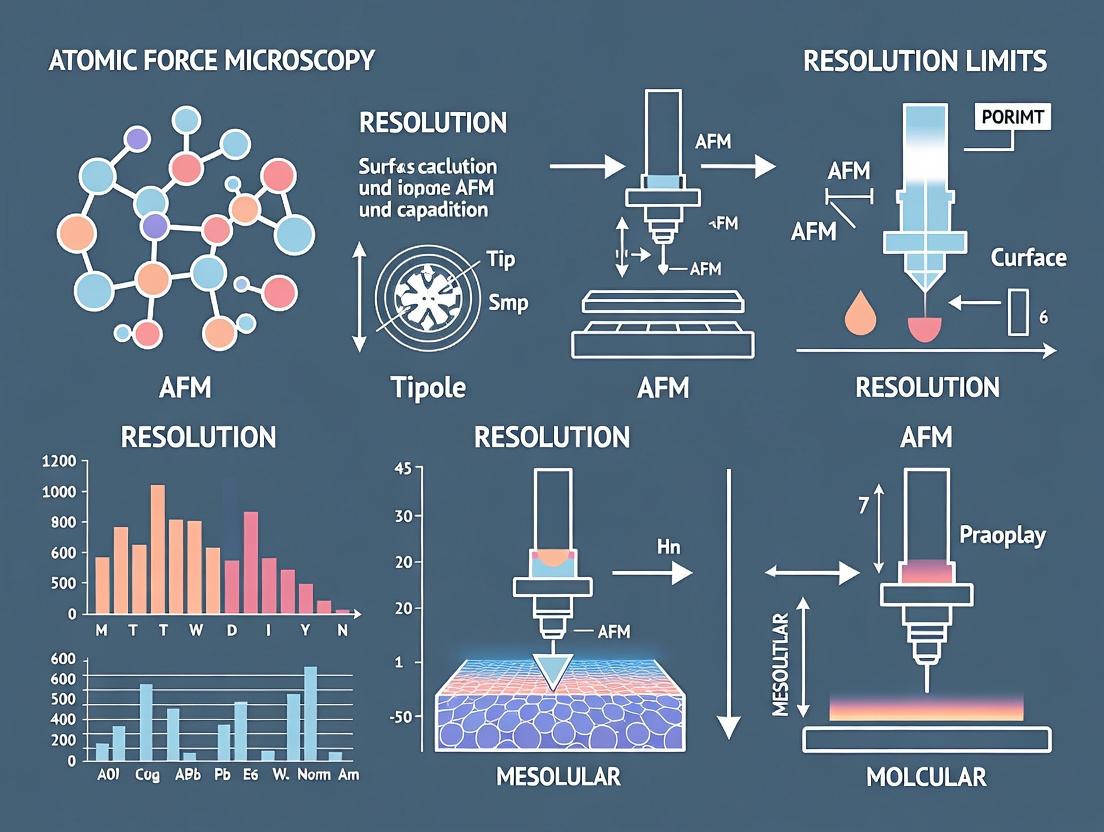
This comprehensive guide explains the fundamental resolution limits of Atomic Force Microscopy (AFM), distinguishing between lateral and vertical capabilities.
AFM Resolution Limits Decoded: From Nanoscale Imaging to Drug Discovery Applications
Abstract
This comprehensive guide explains the fundamental resolution limits of Atomic Force Microscopy (AFM), distinguishing between lateral and vertical capabilities. We detail the methodologies for achieving high-resolution imaging of biomolecules and cells, address common troubleshooting scenarios for suboptimal results, and provide a comparative analysis with complementary techniques like SEM and cryo-EM. Tailored for researchers and drug development professionals, this article serves as a practical resource for planning, executing, and validating AFM experiments in biomedical research.
Understanding AFM Resolution: The Core Principles Behind Nanoscale Imaging
Within the broader thesis on Atomic Force Microscopy (AFM) resolution limits and capabilities, understanding the distinct concepts of lateral and vertical resolution is fundamental. AFM provides three-dimensional topographical images of surfaces at nanometer-scale resolution. However, the term "resolution" in AFM is not monolithic; it is critically divided into lateral (in-plane) and vertical (out-of-plane) components, each governed by different physical principles and instrumental parameters. This in-depth guide elucidates these concepts for researchers and applied scientists.
Fundamental Principles
AFM operates by scanning a sharp tip attached to a flexible cantilever across a sample surface. Forces between the tip and the sample cause cantilever deflection, measured via a laser spot reflected onto a photodetector. A feedback loop maintains a constant interaction, generating a topographical map.
- Vertical Resolution: Defined as the smallest detectable change in height (Z-direction). It is primarily limited by the noise floor of the system's vertical sensors (e.g., laser noise, thermal drift, electronic noise) and can reach sub-angstrom (Å) levels.
- Lateral Resolution: Defined as the smallest distinguishable distance between two adjacent features in the XY-plane. It is predominantly determined by the physical dimensions of the probe tip—specifically the tip radius and aspect ratio—and the scan parameters.
Quantifying Resolution: Key Parameters and Data
The following table summarizes the core factors and typical performance metrics for lateral and vertical resolution.
Table 1: Lateral vs. Vertical Resolution Parameters
| Parameter | Lateral Resolution | Vertical Resolution |
|---|---|---|
| Primary Determinant | Tip geometry (radius, shape, aspect ratio) | System noise floor (sensor, thermal, acoustic) |
| Typical Range | 0.5 nm to 10s of nm (highly sample/tip dependent) | < 0.1 Å to ~1 Å |
| Key Influencing Factors | 1. Effective tip radius (R)2. Sample feature height/spacing3. Scan speed & pixel density4. Operational mode (e.g., tapping vs. contact) | 1. Z-sensor noise density2. Environmental vibration isolation3. Thermal drift stability4. Feedback loop gain & speed |
| Theoretical Limit | ~1/2 of tip radius (for point-like features) | Dictated by the Johnson-Nyquist noise of the deflection sensor |
Table 2: Representative Performance Data for Common AFM Probes
| Probe Type | Nominal Tip Radius | Typical Lateral Resolution* | Optimal Application |
|---|---|---|---|
| Silicon Nitride (Contact) | 20 - 60 nm | 5 - 15 nm | Soft biological samples in liquid |
| Single-Crystal Silicon (Tapping) | 5 - 10 nm | 1 - 3 nm | High-resolution imaging of polymers, nanoparticles |
| Super-Sharp Silicon (HR-ESP) | < 2 nm | < 1 nm | Atomic-step terraces, fine nanostructures |
| Carbon Nanotube Tip | ~1 nm (tube diameter) | < 1 nm (high aspect ratio) | Deep trenches, high-aspect-ratio features |
*Resolution is sample-dependent. Values represent best-case scenarios on ideal, high-contrast samples.
Experimental Protocols for Characterizing Resolution
To rigorously assess AFM resolution within a research framework, standardized protocols are employed.
Protocol 1: Vertical Resolution Measurement (Noise Floor Analysis)
- Engage the AFM tip on a rigid, atomically flat sample (e.g., freshly cleaved HOPG or mica).
- With the feedback loop active, acquire a "zero scan" (scan size set to 0 nm) for a period of 10-30 seconds.
- Record the Z-sensor (height) signal as a function of time.
- Calculate the root-mean-square (RMS) noise of the Z-signal over the measurement period. This RMS value, typically reported in pm or Å, defines the vertical noise floor, a direct measure of vertical resolution under those specific conditions.
Protocol 2: Lateral Resolution Assessment Using Reference Samples
- Sample Preparation: Use a calibration grating with known, periodic features. Common standards include:
- Periodic Line Gratings: e.g., 10 nm pitch, 100 nm depth.
- Nanoparticle Standards: e.g., monodisperse gold nanoparticles (5-30 nm diameter) immobilized on a flat substrate.
- Imaging: Image the standard sample using the probe and mode under investigation. Use a scan size that encompasses multiple features and a pixel resolution of at least 512x512.
- Analysis:
- For line gratings, perform a cross-sectional line profile. The ability to distinguish adjacent peaks defines lateral resolution.
- For nanoparticles, measure the Full Width at Half Maximum (FWHM) of the imaged particle. This width is a convolution of the actual particle size and the tip geometry, giving a practical measure of tip-broadening effects.
Visualizing the Determinants of AFM Resolution
The following diagrams, generated using DOT language, illustrate the key relationships governing resolution.
Factors Affecting AFM Lateral Resolution
Factors Affecting AFM Vertical Resolution
AFM Resolution Verification Workflow
The Scientist's Toolkit: Essential Research Reagents and Materials
Table 3: Key Materials for High-Resolution AFM Studies
| Item | Function & Relevance to Resolution |
|---|---|
| Standard Calibration Gratings (e.g., TGZ, TGQ series) | Precisely patterned silicon or silicon nitride samples with known pitch and depth. Critical for quantitative lateral resolution measurement and scanner calibration. |
| Atomically Flat Substrates (HOPG, Muscovite Mica, Au(111)) | Provide ultra-smooth surfaces for tip conditioning, system noise floor measurement (vertical resolution), and as substrates for nanoparticle standards. |
| Monodisperse Nanoparticle Standards (e.g., NIST-traceable Au or SiO₂ nanoparticles) | Provide known, isotropic features for assessing tip-broadening effects and practical lateral resolution. |
| High-Resolution AFM Probes (e.g., Super-sharp Si, carbon nanotube, qPlus sensors) | The primary tool for achieving high lateral resolution. Specialized geometries minimize tip convolution. |
| Acoustic Enclosure / Vibration Isolation Platform | Mitigates environmental noise that directly degrades vertical resolution and induces imaging artifacts. |
| Tip Cleaning & Decontamination Solutions (e.g., UV-Ozone cleaner, piranha etch) | Removes organic contaminants from probes that effectively increase tip radius and degrade lateral resolution. |
| Anti-vibration Table | Isolates the AFM from building and floor vibrations, essential for achieving the theoretical vertical noise floor. |
The distinction between lateral and vertical resolution is central to a nuanced understanding of AFM's capabilities and limitations. While vertical resolution is exceptionally high and limited primarily by instrumental noise, lateral resolution is a more complex parameter dictated by the tip-sample convolution. Within the thesis of AFM resolution, this necessitates a dual approach: meticulous environmental and instrumental control for vertical performance, and strategic probe selection and sample preparation for lateral characterization. For researchers in fields like drug development, where visualizing macromolecular complexes or nanoparticle drug carriers is key, this understanding informs experimental design, data interpretation, and the selection of appropriate AFM methodologies to extract reliable, high-fidelity nanoscale information.
This whitepaper examines the fundamental role of the Atomic Force Microscope (AFM) probe tip in determining the ultimate resolution and measurement capabilities of the instrument. Within the broader thesis of AFM resolution limits, the probe is not merely a passive tool but the central element defining interaction volume, force application, and signal generation. The geometric and material properties of the tip directly dictate the limits of spatial resolution, measurement accuracy, and the types of interactions that can be probed at the nanoscale, with critical implications for research in structural biology, biophysics, and pharmaceutical development.
Core Physical Principles
AFM imaging resolution is governed by the convolution of the tip geometry with the sample topography. The effective radius of curvature (R) of the tip apex is the primary determinant of lateral resolution, as it defines the minimum feature size that can be resolved. The aspect ratio and half-cone angle (θ) dictate accessibility to deep trenches and undercuts. The relationship between tip sharpness and force is critical: a smaller R concentrates force, increasing spatial resolution but also local pressure, which can lead to sample deformation or tip wear.
Table 1: Quantitative Impact of Tip Radius on Resolution & Force
| Tip Radius (nm) | Theoretical Lateral Resolution (nm) | Approx. Contact Pressure (GPa)* | Ideal Application |
|---|---|---|---|
| 1-2 | < 5 | 1.5 - 3.0 | Atomic-scale imaging, molecular resolution |
| 5-10 | 10 - 20 | 0.3 - 0.6 | High-res biomolecules (proteins, DNA) |
| 20-30 | 30 - 60 | 0.05 - 0.15 | Cells, large complexes, moderate topography |
| > 50 | > 100 | < 0.02 | Large-scale cellular topography |
*Pressure estimated for a typical applied force of 1 nN.
Experimental Protocols for Tip Characterization
Protocol 1: Tip Shape Reconstruction Using Characterized Samples
- Objective: To deconvolve the true tip geometry from AFM images.
- Materials: Tip characterization grating (e.g., TGT1 from NT-MDT, with sharp spikes of known height and apex radius < 10 nm).
- Methodology:
- Image the characterization sample in tapping mode with the tip to be characterized.
- Acquire a high-resolution (512x512 or 1024x1024 pixels) scan of the sharp spikes.
- Use blind tip reconstruction algorithms (e.g., provided by Gwyddion, SPIP, or vendor software). The algorithm uses the principle that the recorded image is a dilation of the sample by the tip; scanning known sharp features reveals the tip's shape.
- Extract quantitative parameters: apex radius (via circle fitting), cone angle, and aspect ratio.
Protocol 2: Direct Measurement of Tip Wear
- Objective: Quantify tip blunting during an experiment.
- Materials: Freshly cleaved mica surface, AFM with same tip pre- and post-experiment.
- Methodology:
- Prior to the main experiment, image a clean mica surface in tapping mode at a specific resolution and setpoint.
- Perform the planned imaging or force spectroscopy experiment on the target sample.
- Re-image the same area of mica under identical parameters.
- Analyze the apparent step heights and sharpness of atomic steps. A measurable reduction in step sharpness or change in noise indicates tip apex wear. Compare Fourier transforms of the images for changes in high-frequency content.
Visualization of AFM Resolution Determinants
Diagram 1: Factors Dictating AFM Resolution Limits
Diagram 2: Tip Selection and Validation Workflow
The Scientist's Toolkit: Research Reagent Solutions
Table 2: Essential Materials for High-Resolution AFM Studies
| Item | Function & Rationale |
|---|---|
| Silicon Probes (e.g., RTESPA-300) | High-frequency, sharp tips (R ~ 8 nm) for high-res tapping mode in air/liquid. Standard for biomolecular imaging. |
| Silicon Nitride Probes (e.g., SNL) | Softer, lower spring constant. Often gold-coated. Preferred for contact mode and force spectroscopy on soft samples. |
| Diamond-Coated Probes (e.g., CDT-NCHR) | Extreme wear resistance for scanning abrasive samples (ceramics, polymers, bone) without tip degradation. |
| Tip Characterizer (e.g., TGT1, HAHR) | Calibration grating with known sharp features (spikes/holes) essential for empirical tip shape reconstruction. |
| Functionalization Kits (e.g., PEG linkers, biotin) | Enable covalent modification of tip surfaces for Chemical Force Microscopy (CFM) or specific ligand-receptor binding studies. |
| Cleaved Mica Substrates | Atomically flat, negatively charged surface for adsorbing biomolecules (proteins, DNA, lipids) in a controlled orientation. |
| Calibration Gratings (e.g., PG, TGZ) | Samples with precise pitch and step heights for lateral (nm/px) and vertical (z-scanner) calibration of the AFM. |
| Vibration Isolation System | Active or passive isolation platform critical for achieving sub-nanometer vertical resolution by mitigating environmental noise. |
The pursuit of ultimate resolution in AFM is fundamentally a challenge in tip physics. The geometry and sharpness of the probe apex set an inescapable physical limit on measurable detail, while the tip's mechanical properties mediate the trade-off between resolution and sample preservation. Rigorous a priori selection and a posteriori characterization of the tip, as outlined in the provided protocols and workflow, are not ancillary but central to generating reliable, interpretable nanoscale data. For researchers in drug development, this understanding is paramount when imaging drug-target complexes, characterizing nanoparticle formulations, or probing the mechanical properties of cellular membranes, as the tip is the ultimate transducer of the nanoscale world.
This whitepaper, framed within a broader thesis on Atomic Force Microscopy (AFM) resolution limits and capabilities, examines the fundamental factors governing high-resolution imaging and force spectroscopy in biological applications. For researchers and drug development professionals, controlling tip-sample interaction forces, mitigating noise sources, and ensuring precise environmental control are paramount for achieving atomic-scale resolution and reliable nanomechanical data.
Core Fundamental Factors
Forces in AFM
The AFM probe interacts with the sample via a combination of forces that define resolution and potential sample deformation.
| Force Type | Typical Magnitude (in liquid) | Impact on Imaging/Measurement | Desired Control Method |
|---|---|---|---|
| Van der Waals | 10 pN - 1 nN | Primary attractive force; defines topography. | Use ultra-sharp tips (radius < 10 nm). |
| Electrostatic | Variable (pN - nN) | Can cause parasitic attraction/repulsion. | Conductive coatings, sample grounding, control of surface potential. |
| Capillary | ~10 nN (in air) | Dominant adhesive force in air; causes snap-in. | Operate in liquid or controlled humidity (<5% RH). |
| Solvation/Hydration | 10-100 pN | Oscillatory force in liquid; affects true surface detection. | Use appropriate ionic strength buffers. |
| Steric/Bridging | 10-500 pN | Polymer-mediated forces; can obscure hard surface. | Use passivating coatings (e.g., PEG, BSA). |
| Applied Loading Force | 10 pN - 10 nN | Directly induces elastic/plastic deformation. | Active cantilever deflection/oscillation control (e.g., PID). |
Noise fundamentally limits the signal-to-noise ratio (SNR), determining the smallest detectable feature or force.
| Noise Source | Spectral Characteristic | Typical Magnitude | Mitigation Strategy |
|---|---|---|---|
| Thermal (Brownian) Noise | White noise spectrum. | ~(kB T / kcant)^0.5 (~10-50 pm RMS) | Use higher stiffness cantilevers (k > 0.1 N/m) or lower temperature. |
| Detector Noise | White + 1/f (flicker) noise. | < 0.1 nm/√Hz | Use low-noise photodiode/electronics; optimize laser alignment. |
| Acoustic/Seismic Noise | Low frequency (< 1 kHz). | Can be > 1 nm RMS | Active/passive vibration isolation stages; acoustic enclosure. |
| Electronic Drift | Very low frequency (< 0.1 Hz). | nm/min scale | Use low-drift electronics; sample/tip thermal equilibration; closed-loop scanners. |
| Thermal Drift | Very low frequency. | nm/s - nm/min | Environmental temperature stabilization (±0.1°C); low-coefficient materials. |
Environmental Control
Essential for studying biological samples (e.g., proteins, membranes, live cells) under physiologically relevant conditions.
| Parameter | Target Range for Bio-AFM | Critical Impact on Measurement | Control Solution |
|---|---|---|---|
| Temperature | 20°C - 37°C (±0.1°C) | Sample viability, reaction kinetics, drift. | In-line sample heater/cooler with PID feedback. |
| Buffer Chemistry | pH 6.5 - 7.5, Ionic Strength 50-150 mM | Electrostatic screening, protein function, tip-sample force. | Continuous perfusion fluid cell with gas bubbling (95% O2/5% CO2). |
| Fluid Exchange | Flow rates: 0.5 - 2 mL/min | Maintains freshness, enables reagent introduction. | Microfluidic sample stage with laminar flow channels. |
| Humidity (for air) | < 5% RH or > 95% RH | Eliminates or standardizes capillary forces. | Environmental chamber with dry N2 or humidified air supply. |
| Acoustic Isolation | Vibration isolation to < 0.1 nm RMS. | Prevents tip/sample oscillation artifacts. | Active anti-vibration table inside acoustic hood. |
Experimental Protocols for High-Resolution Bio-AFM
Protocol 1: Sub-Molecular Resolution Imaging of Membrane Proteins
Objective: Resolve individual amino acid residues on a transmembrane protein (e.g., bacteriorhodopsin) in buffer.
- Sample Preparation: Use freshly cleaved mica functionalized with 0.01% Ni²⁺-NTA lipid bilayer to immobilize His-tagged proteins.
- Probe Preparation: Use ultra-sharp carbon nanotube tip or quartz-like carbon (qlc)-coated probe (k ≈ 0.1 N/m, f₀ ≈ 30 kHz in liquid). Plasma clean for 2 mins, then immerse in buffer.
- Environmental Setup: Mount sample in temperature-controlled fluid cell. Perfuse with 10 mM HEPES, 150 mM KCl buffer, pH 7.4. Stabilize at 25°C for 30 mins.
- Imaging Parameters: Operate in Amplitude Modulation (AC) mode. Set free amplitude A₀ ≈ 0.5 nm. Use amplitude setpoint A_sp ≈ 0.9 * A₀ to maintain minimal force (< 50 pN). Scan speed: 2-4 lines per second. Pixels: 512 x 512 over 20 nm area.
- Noise Mitigation: Engage active vibration isolation. Use scanner’s Z feedback loop with high gain to track topography.
Protocol 2: Single-Molecule Force Spectroscopy (SMFS) of Protein Unfolding
Objective: Measure the unfolding forces and dynamics of a multi-domain protein (e.g., titin I27 polyprotein).
- Sample & Probe Functionalization: Covalently attach polyprotein via Cys residues to gold-coated substrate using NHS/EDC chemistry. Functionalize gold-coated cantilever (k ≈ 20 pN/nm) with PEG linker terminating in maleimide group for specific attachment.
- Approach & Attachment: In relevant buffer (e.g., PBS), bring tip in contact with surface with 1 nN force for 1-2 seconds to allow covalent bond formation via maleimide-Cys reaction.
- Force-Ramp Acquisition: Retract tip at constant velocity (range: 100 nm/s - 4000 nm/s). Record deflection (force) vs. piezo displacement. Repeat 500-1000 times to gather statistics.
- Data Analysis: Convert deflection to force (F = k_cant * Δx). Identify sawtooth patterns characteristic of domain unfolding. Fit worm-like chain (WLC) model to each peak to extract contour length increase.
- Environmental Control: Maintain constant temperature (±0.5°C). For kinetic studies, vary pulling speed to probe energy landscape.
Visualization of AFM System and Noise Pathways
Title: AFM Feedback Loop and Noise Injection Points
Title: Force Balance at the AFM Tip-Sample Junction
The Scientist's Toolkit: Research Reagent Solutions
| Item | Function & Role in Control | Example Product/ Specification |
|---|---|---|
| Functionalized AFM Probes | Provides specific chemical termination for covalent binding or minimized non-specific adhesion. | Bruker MLCT-BIO-DC (k=0.03 N/m), Nanoworld Arrow-UHFAuD (Au coating, f0~65 kHz in liquid). |
| PEG Crosslinkers | Spacer molecule for SMFS; provides flexible tether, isolates unfolding forces from surface interactions. | NHS-PEG-Maleimide, 24-unit PEG, ~8 nm length (e.g., from BroadPharm). |
| Supported Lipid Bilayers (SLBs) | Mimics cell membrane environment; provides fluid, flat surface for embedding membrane proteins. | DOPC/DOPS/NTA-lipids mixture, formed via vesicle fusion on mica. |
| High-Stability Buffers | Maintains physiological pH and ionic strength with minimal drift; prevents tip/sample corrosion. | 10-50 mM HEPES or Tris, 50-150 mM KCl or NaCl, 1-10 mM MgCl2. |
| Passivating Agents | Coats surfaces to block non-specific protein adsorption to tip and substrate. | 1% Bovine Serum Albumin (BSA), 0.1% Pluronic F-127, or 1 mM β-mercaptoethanol. |
| Calibration Gratings | Quantifies scanner accuracy, tip shape, and imaging resolution. | TGZ01 (10 μm pitch), HS-100MG (100 nm grating), or DNA origami structures (~20 nm grid). |
| Active Vibration Isolator | Physically decouples the AFM from building and acoustic vibrations. | Halcyonics i4 (active) or Herzan TS-140 (active/passive) series. |
| Microfluidic Liquid Cell | Enables precise fluid exchange, temperature control, and reagent introduction during imaging. | Bruker MTFML or Asylum Research Fluid Cell PLUS with in-line heater. |
Within the context of Atomic Force Microscopy (AFM) research, the chasm between theoretical resolution limits and practical, achievable resolution in complex biological systems represents a critical challenge. This whitepaper examines the core physical principles defining AFM resolution, the factors that degrade performance in real-world environments—particularly in drug development applications—and provides actionable experimental protocols to bridge this gap.
Defining Resolution in AFM: Theory vs. Reality
The theoretical lateral resolution in AFM is often approximated by the effective tip radius, while vertical resolution is governed by sub-angstrom noise floors in the z-feedback system. In practice, variables such as sample compliance, tip-sample adhesion, thermal drift, and environmental noise dramatically degrade performance.
Table 1: Theoretical vs. Practical AFM Resolution Limits in Biological Imaging
| Resolution Parameter | Theoretical Limit (Ideal Conditions) | Practical Limit (Liquid, Bio-Sample) | Primary Degrading Factors |
|---|---|---|---|
| Lateral Resolution | ~1 nm (tip radius dependent) | 5 - 20 nm | Tip broadening, sample softness, adhesion, drift |
| Vertical Resolution | <0.1 Å (in vacuum) | 0.5 - 2.0 Å | Thermal noise, acoustic noise, fluid fluctuations |
| Temporal Resolution | Millisecond range (fast scanners) | Seconds to minutes | Scanner resonance, feedback stability, force sensitivity |
| Force Sensitivity | ~1 pN (ultra-short cantilevers) | 10 - 50 pN (in liquid) | Cantilever thermal noise, fluid damping, laser detection noise |
Core Experimental Protocols for Maximizing Practical Resolution
Protocol 3.1: High-Resolution Topography of Membrane Proteins in Liquid
Objective: Achieve sub-nanometer vertical resolution on soft, isolated membrane proteins (e.g., G-Protein-Coupled Receptors) for structural pharmacology studies.
- Sample Preparation: Deposit purified, reconstituted protein samples on freshly cleaved mica functionalized with Ni-NTA for His-tagged proteins. Use a buffer containing 10 mM HEPES, 150 mM KCl, 1 mM NiCl2, pH 7.4.
- Tip Functionalization: Use ultrasharp silicon nitride probes (nominal tip radius < 10 nm). Clean in UV-ozone for 15 minutes. For specific imaging, tips may be functionalized with PEG linkers and relevant ligands.
- Microscope Stabilization: Place the AFM in an active vibration isolation enclosure. Allow the stage and fluid cell to thermally equilibrate for 45 minutes before engagement.
- Imaging Parameters:
- Mode: PeakForce Tapping or High-Speed AFM in AC mode.
- Set-point: Minimized to maintain consistent contact with minimal deformation (typically 100-500 pN).
- Scan Rate: 1-3 Hz for 500nm x 500nm scans.
- Feedback Gains: Optimized to track topography without oscillating.
- Data Processing: Apply first-order flattening and low-pass filtering using Gwyddion software. Analyze particle heights and diameters from cross-sectional profiles.
Protocol 3.2: Quantitative Nanomechanical Mapping (QNM) of Live Cells
Objective: Correlate topographical features with local stiffness and adhesion properties at ~50 nm lateral resolution to assess drug-induced cytoskeletal changes.
- Cell Culture: Seed adherent cells (e.g., HEK293) on 35 mm plastic Petri dishes at 70% confluence. Culture in appropriate medium 24 hours prior.
- AFM Probe Calibration: Use silicon probes with a known spring constant (calibrated via thermal tune method, typically 0.1-0.5 N/m). Determine the optical lever sensitivity (OLS) on a rigid sapphire surface.
- Force Volume Mapping:
- Engage in contact mode in culture medium at 37°C using a bio-heater.
- Program a grid of 128 x 128 force curves over a 20 μm x 20 μm area.
- Set a maximum trigger force of 1 nN and a ramp rate of 1 kHz.
- Retraction distance: 1 μm to probe adhesion.
- Data Analysis: Use the Derjaguin–Muller–Toporov (DMT) model on each force curve's approach segment to calculate Young's Modulus. Extract adhesion force from retraction minima.
Visualizing the Resolution Optimization Workflow
Diagram Title: AFM Resolution Optimization Workflow & Degrading Factors
The Scientist's Toolkit: Key Research Reagent Solutions
Table 2: Essential Materials for High-Resolution Bio-AFM
| Item Name | Function / Rationale | Example Product/Catalog |
|---|---|---|
| Functionalized Mica Discs | Provides an atomically flat, chemically tunable substrate for immobilizing proteins and lipid bilayers. | Muscovite Mica, Ni-NTA Functionalized Mica (e.g., NanoAndMore) |
| Ultra-Short Cantilevers (USCs) | High resonance frequency enables faster scanning and reduced thermal noise, critical for HS-AFM. | BL-AC40TS (Olympus) or FastScan D (Bruker) |
| PEG Crosslinker Kits | For tip functionalization; provides a flexible spacer to conjugate specific ligands for molecular recognition. | Heterobifunctional PEG (e.g., Mal-PEG-NHS) |
| Supported Lipid Bilayer (SLB) Kits | Creates a fluid, biomimetic surface for reconstituting transmembrane proteins in a near-native environment. | POPC/DOGS-NTA(Ni) Lipid Kits (Avanti) |
| Active Vibration Isolation Table | Mitigates low-frequency building vibrations that blur images and degrade vertical resolution. | Herzan TS-140 or similar active isolator |
| Acoustic Enclosure | Dampens airborne noise that couples into the AFM head, inducing cantilever noise. | Custom or manufacturer-specific hood. |
| Bio-Heater & Fluid Cell | Maintains physiological temperature and allows imaging in buffered solutions for live-cell studies. | Petri Dish Heater (Bruker) or TempController (JPK) |
| Calibration Gratings | Verifies scanner accuracy and measures tip broadening effect for resolution validation. | TGZ1 (NT-MDT) or HS-100MG (Bruker) |
Bridging the gap between theoretical and practical AFM resolution demands a systems approach that concurrently addresses probe geometry, sample preparation, environmental control, and advanced dynamic imaging modes. For researchers framing their work within a thesis on AFM capabilities, rigorous reporting of these practical parameters—as detailed in the protocols above—is as critical as understanding the underlying theory. The integration of optimized reagents, precise protocols, and systematic error mitigation transforms AFM from a technique of idealized potential into a robust tool for driving discovery in structural biology and drug development.
In the context of atomic force microscopy (AFM) research, the term "sub-nanometer resolution" is a critical performance metric often cited by instrument manufacturers. However, for researchers in fields like structural biology and drug development, understanding its practical meaning for real-world samples is essential. This guide deconstructs the metric, separating marketing claims from experimentally achievable capabilities that directly impact your data.
Defining the Resolution Metric
In AFM, resolution is not a single value but is differentiated into two primary types:
- Lateral (XY) Resolution: The minimum distance between two adjacent features that can be distinguished.
- Vertical (Z) Resolution: The minimum detectable height difference, often synonymous with "noise floor."
"Sub-nanometer" literally means better than 1 nanometer (nm). For context, a DNA helix has a diameter of ~2 nm, and a carbon-carbon bond length is ~0.15 nm.
Table 1: Typical AFM Resolution Capabilities Under Ideal and Practical Conditions
| Resolution Type | Ideal Conditions (Ultra-Sharp Tip, Ultra-Flat Sample) | Practical Conditions (Biological Sample in Buffer) | Key Limiting Factor |
|---|---|---|---|
| Vertical (Z) | < 0.1 nm (thermal noise limit) | 0.1 - 0.5 nm | Detector noise, thermal drift, acoustic noise. |
| Lateral (XY) | ~0.5 nm (tip radius dependent) | 1 - 5 nm (often larger) | Tip geometry (convolution effect), sample softness, scan speed. |
The central thesis is that while the vertical resolution can consistently achieve sub-nanometer values, the true lateral resolution on non-ideal samples is predominantly governed by tip-sample convolution, not the instrument's intrinsic noise. This makes tip selection and sample preparation paramount.
Experimental Protocols for Validating Resolution
To assess sub-nanometer performance on your specific samples, the following methodologies are standard.
Protocol 1: Calibration and Vertical Resolution Measurement
- Sample: Use a certified grating with sharp, abrupt steps (e.g., 20 nm height, 10 μm pitch).
- Imaging Parameters: Engage in non-contact (tapping) mode in air. Set a slow scan rate (0.5-1 Hz) with 512-1024 points per line.
- Data Acquisition: Capture a minimum of 5 images at different locations.
- Analysis: Section analysis across a step edge. Calculate the root-mean-square (RMS) roughness of an atomically flat region (e.g., cleaved mica) within the same image. This RMS value (typically 0.1-0.2 nm) represents your operational vertical resolution.
Protocol 2: Assessing Lateral Resolution via Tip Convolution
- Sample: A characterized resolution test sample featuring sharp, isolated spikes or known periodic structures (e.g., TiO₂ nanostructures on mica, or a gold nanoparticle standard).
- Imaging Parameters: Image the test sample and your target sample using the same tip and identical imaging conditions (mode, setpoint, gains).
- Analysis: Measure the full width at half maximum (FWHM) of isolated features on the test sample. The minimum measurable FWHM approximates your effective lateral resolution, which is often 2-3x the nominal tip radius.
The Central Role of Tip-Sample Convolution
The following diagram illustrates the primary factors limiting true spatial resolution in AFM imaging.
Diagram Title: Factors Limiting True AFM Lateral Resolution
The Scientist's Toolkit: Key Research Reagent Solutions
Achieving meaningful sub-nanometer data requires more than a high-end microscope. The following materials are essential.
Table 2: Essential Materials for High-Resolution AFM Studies
| Item | Function & Importance |
|---|---|
| Ultra-Sharp AFM Probes (e.g., Carbon Nanotube tips, FIB-sharpened Si tips) | Minimizes lateral tip broadening, directly defining the achievable XY resolution. Critical for imaging fine nanostructures. |
| Atomically Flat Substrates (e.g., Freshly cleaved mica, HOPG) | Provides a reference surface for tip evaluation and vertical resolution calibration. Essential for adsorbing biomolecules. |
| Resolution Test Sample (e.g., Characterized nanoparticle standards, TiO₂ grating) | Empirically determines the effective lateral resolution of the tip-sample system prior to imaging precious samples. |
| Stable Imaging Buffers (e.g., PBS, HEPES with Mg²⁺ for membranes) | Maintains biological samples in their native state, preventing artifacts from dehydration or aggregation. |
| Vibration Isolation System (Acoustic enclosure, active table) | Reduces environmental noise to achieve the instrument's theoretical vertical (Z) resolution floor. |
| Advanced Imaging Mode (e.g., PeakForce Tapping, High-Res QI Mode) | Enables precise control of sub-100 pN forces, minimizing sample deformation and preserving true topography. |
Practical Workflow for High-Resolution AFM
The recommended experimental workflow to ensure valid sub-nanometer data acquisition is outlined below.
Diagram Title: Workflow for Valid Sub-Nanometer AFM Imaging
For your samples, "sub-nanometer resolution" is a meaningful metric primarily for vertical measurements, where modern AFMs reliably deliver angstrom-level precision. True lateral resolution, however, is sample and tip-dependent. It must be empirically validated using standardized protocols. By focusing on tip geometry, sample preparation, and controlled imaging forces, researchers can translate this key metric into reliable, high-fidelity nanoscale data critical for structural analysis and drug development.
Achieving High-Resolution AFM: Techniques and Protocols for Biomedical Research
Sample Preparation Best Practices for Maximizing Resolution on Soft Matter
Atomic Force Microscopy (AFM) is a pivotal tool for characterizing soft matter, including polymers, biomolecules, hydrogels, and lipid assemblies. Achieving high resolution is paramount for elucidating structure-function relationships. However, the inherent deformability and dynamic nature of soft materials present unique challenges. This guide details best practices in sample preparation, framed within the thesis that specimen preparation is the primary limiting factor for realizing the ultimate resolution capabilities of AFM on soft materials. Proper preparation minimizes artifacts, preserves native structure, and maximizes signal-to-noise, thereby pushing practical resolution toward theoretical instrument limits.
Critical Challenges in Soft Matter Preparation
- Surface Adhesion: Insufficient adsorption leads to drift or displacement by the tip.
- Deformation: Compressive and shear forces from the tip can distort features.
- Hydration State: Improper control leads to capillary forces, swelling, or desiccation.
- Surface Flatness: Excessive roughness obscures fine details.
- Contamination: Adventitious molecules mask the true sample surface.
Substrate Selection and Functionalization
The substrate must provide a flat, non-interfering platform that promotes sample adhesion.
Table 1: Common Substrates for Soft Matter AFM
| Substrate | Typical RMS Roughness | Key Advantages | Best For | Functionalization Example |
|---|---|---|---|---|
| Freshly Cleaved Mica | < 0.1 nm | Atomically flat, negatively charged, hydrophilic. | Nucleic acids, proteins, lipid bilayers, polymers. | APTES (3-aminopropyltriethoxysilane) for positive charge. |
| Highly Oriented Pyrolytic Graphite (HOPG) | ~ 0.2 nm | Atomically flat, chemically inert, conductive. | Organic molecules, polymers, some proteins. | Often used unmodified. |
| Silicon Wafer | < 0.5 nm | Very flat, widely available, compatible with silane chemistry. | Polymers, nanoparticles, self-assembled monolayers. | PEG-silane for anti-fouling, hydrophobic silanes. |
| Ultraflat Gold | ~ 1-2 nm | Conductive, enables thiol-based self-assembly. | Thiolated molecules, biosensors. | Alkanethiol SAMs for tailored surface chemistry. |
Protocol: APTES Functionalization of Mica
- Materials: Fresh mica discs, 2% (v/v) APTES in ultrapure Milli-Q water, nitrogen stream.
- Procedure: Cleave mica with adhesive tape. Apply 30 µL of APTES solution for 2 minutes. Rinse thoroughly with 5 mL of water, then 5 mL of ethanol. Dry gently under a stream of nitrogen. Use within 4 hours.
Deposition and Immobilization Techniques
Table 2: Sample Deposition Methods
| Method | Principle | Resolution Impact | Protocol Summary |
|---|---|---|---|
| Adsorption from Solution | Incubate substrate in dilute sample solution. | High risk of aggregates; coverage control is critical. | 1. Prepare 1-10 µg/mL sample in suitable buffer. 2. Incubate on substrate for 30s-30min. 3. Rinse gently with buffer/water to remove unbound material. 4. Blot edge and proceed to imaging. |
| Spin Coating | Spread sample by rapid rotation. | Excellent for thin, uniform films; can induce shear alignment. | 1. Apply 20-50 µL of sample solution to substrate. 2. Spin at 1000-5000 rpm for 30-60 seconds. 3. Dry in desiccator or image immediately under fluid. |
| Langmuir-Blodgett/Schaefer Transfer | Monolayer transfer from air/water interface. | Provides highly ordered, dense monolayers; technically demanding. | 1. Form monolayer at air/water interface in Langmuir trough. 2. Compress to target surface pressure. 3. Horizontally (Schaefer) or vertically (Blodgett) transfer onto substrate. |
| Vesicle Fusion | Rupture of lipid vesicles to form supported bilayers. | Essential for near-native planar lipid membrane studies. | 1. Prepare small unilamellar vesicles (SUVs) via sonication/extrusion. 2. Incubate SUV solution on hydrophilic substrate (e.g., mica). 3. Rinse extensively to remove unfused vesicles. |
Environmental Control and Imaging Medium
Liquid vs. Air Imaging: Liquid imaging (especially using tapping mode) is generally superior for soft matter. It eliminates capillary forces, reduces adhesion, and maintains hydration.
Buffer Considerations:
- Use low salt concentrations (e.g., 1-20 mM) to minimize electrostatic screening if adhesion is charge-mediated.
- Include divalent cations (e.g., 1-10 mM Mg²⁺ or Ni²⁺) to enhance binding of negatively charged samples (like DNA) to mica.
- For proteins, consider physiologically relevant buffers (e.g., PBS, HEPES) but assess salt-induced aggregation.
Key Experimental Protocols
Protocol: High-Resolution Imaging of DNA in Liquid
- Objective: Image plasmid or linear DNA to assess contour length and supercoiling.
- Substrate: APTES-mica (positively charged).
- Deposition: Mix 5 µL of 2 ng/µL DNA solution with 5 µL of 10 mM NiCl₂. Immediately deposit 10 µL onto APTES-mica for 2 minutes. Rinse with 1 mL of deionized water, blot edge.
- Imaging Medium: Deionized water or 10 mM HEPES buffer.
- AFM Mode: Tapping Mode in liquid.
- Tip: Ultra-sharp silicon nitride tip (k ~ 0.1 N/m).
- Parameters: Set drive frequency just below resonance; use low free amplitude (~5 nm) and low setpoint ratio (>0.8) for minimal force.
Protocol: Supported Lipid Bilayer (SLB) Formation and Protein Binding
- Objective: Form a fluid lipid bilayer and image membrane protein incorporation.
- Lipid Prep: Mix POPC with 1% biotinylated lipid. Prepare SUVs by extrusion through a 50 nm filter.
- Deposition: Incubate 0.5 mM SUV solution on clean mica in a fluid cell for 30 minutes at 60°C. Rinse with 20 mL of imaging buffer (e.g., 150 mM NaCl, 10 mM HEPES, pH 7.4).
- Protein Binding: Inject streptavidin (10 µg/mL) to bind biotin, rinse. Inject biotinylated protein of interest.
- AFM Mode: Tapping Mode in liquid.
- Parameters: Use a very soft cantilever (k ~ 0.06 N/m); optimize setpoint to avoid bilayer disruption.
The Scientist's Toolkit: Essential Research Reagents & Materials
Table 3: Essential Materials for High-Resolution Soft Matter AFM
| Item | Function & Rationale |
|---|---|
| Muscovite Mica (V1 Grade) | Provides an atomically flat, reproducible substrate for adsorption. |
| APTES (3-aminopropyltriethoxysilane) | Functionalizes mica/silicon with amine groups for electrostatic binding of negatively charged samples. |
| Probe-grade Organic Solvents (Chloroform, Methanol) | For preparing pure, contaminant-free lipid and polymer stock solutions. |
| Mini-Extruder with 50/100 nm Polycarbonate Membranes | Produces monodisperse, small unilamellar vesicles (SUVs) for consistent bilayer formation. |
| Ultra-low Binding Protein LoBind Tubes | Minimizes sample loss due to adsorption to tube walls, critical for dilute solutions. |
| High-Purity Salts (MgCl₂, NiCl₂, NaCl) | Controls ionic strength and mediates sample-substrate adhesion. |
| Soft AFM Cantilevers (k: 0.06 - 0.4 N/m) | Minimizes contact force, preventing sample deformation (e.g., Bruker SNL, Olympus BL-AC40TS). |
| Syringe Filters (0.02 µm, Anodized Alumina) | For final filtration of buffers to remove nanoparticulate contaminants. |
Visualizing Workflows and Relationships
AFM Sample Preparation Decision Workflow
Sample Immobilization Strategy Selector
Maximizing AFM resolution on soft matter is an exercise in meticulous interfacial science. The journey from solution to scanned image must be carefully controlled at each step—substrate engineering, sample deposition, and environmental conditioning. By systematically applying these best practices, researchers can transform AFM from a mere imaging tool into a quantitative nanoscale probe, directly testing the resolution limits imposed by sample, rather than instrument, properties. This rigorous approach to preparation is fundamental to unlocking precise structural insights in polymer science, biomolecular engineering, and pharmaceutical development.
Within the broader investigation of Atomic Force Microscopy (AFM) resolution limits and capabilities, selecting the optimal imaging mode is paramount. This technical guide provides an in-depth comparison of three foundational modes—Contact, Tapping, and PeakForce Tapping—framing their operational principles, experimental protocols, and quantitative performance within the context of maximizing resolution and minimizing sample perturbation for research in biophysics and drug development.
Core Principles and Quantitative Comparison
The fundamental difference between these modes lies in tip-sample interaction force and feedback control.
Contact Mode: The probe tip remains in constant physical contact with the sample surface. A feedback loop maintains a constant cantilever deflection (constant force) as it scans.
Tapping Mode (Intermittent Contact): The cantilever is oscillated at or near its resonant frequency, causing the tip to alternately contact the surface and lift off. The feedback loop maintains a constant oscillation amplitude.
PeakForce Tapping (Bruker proprietary): The cantilever is oscillated at a frequency well below resonance (typically 0.5-2 kHz), enabling direct control and measurement of the maximum force (Peak Force) applied during each tap. The feedback loop maintains this peak force at a user-set value.
The following table summarizes the key quantitative and operational characteristics of each mode, based on current literature and instrument specifications.
Table 1: Quantitative Comparison of AFM Imaging Modes
| Parameter | Contact Mode | Tapping Mode | PeakForce Tapping |
|---|---|---|---|
| Tip-Sample Interaction | Constant contact, high lateral force | Intermittent contact, lower lateral force | Precisely controlled transient contact |
| Primary Feedback Signal | Cantilever deflection (static) | Oscillation amplitude reduction | Peak Force (maximum force per cycle) |
| Typical Force Control | ~ 0.1 - 10 nN (indirect via deflection) | ~ 0.01 - 0.5 nN (indirect via amplitude) | ~ 10 - 100 pN (direct, quantitative) |
| Lateral (Shear) Force | High | Low | Very Low |
| Imaging Speed (typical) | Medium | Fast | Medium to Fast |
| Sample Damage Risk | High for soft/biological samples | Moderate to Low | Very Low |
| Fluid Imaging Suitability | Poor (high drag, meniscus forces) | Good (standard for bio-AFM) | Excellent (stable at low forces) |
| Simultaneous Property Mapping | Limited (Lateral Force) | Phase Imaging (qualitative) | Quantitative maps: Modulus (DMT), Adhesion, Deformation, Dissipation |
Table 2: Resolution and Capability Benchmarks on Standard Samples
| Mode | Molecular Resolution (in fluid) | Live Cell Imaging Viability | Quantitative Mechanical Data |
|---|---|---|---|
| Contact Mode | Possible on rigid crystals; not typical for biomolecules | Poor (cells often damaged or moved) | No (only frictional forces) |
| Tapping Mode | Yes (e.g., membrane proteins, DNA) | Good (standard protocol) | Qualitative (Phase) or semi-quantitative |
| PeakForce Tapping | Yes (superior on delicate samples) | Excellent (long-term health maintained) | Yes (nanomechanical properties at < 1 pN-nm force control) |
Detailed Experimental Protocols
Protocol 1: High-Resolution Imaging of Membrane Proteins in Buffer (Tapping Mode)
This protocol is standard for achieving sub-nanometer resolution on biological samples like the bovine mitochondrial F-ATP synthase rotor c-ring.
- Substrate Preparation: Adsorb freshly cleaved mica (V1 grade) in a petri dish. Inject 30 µL of 10 mM NiCl₂ solution onto mica for 2 minutes, rinse gently with ultrapure water, and dry under nitrogen.
- Sample Deposition: Dilute protein solution to ~10 µg/mL in imaging buffer (e.g., 10 mM Tris-HCl, 150 mM KCl, pH 7.5). Apply 30 µL to the functionalized mica surface for 10-15 minutes.
- AFM Fluid Cell Assembly: Rinse the sample with 1 mL of imaging buffer to remove loosely bound proteins. Mount the sample in the fluid cell and ensure no air bubbles are trapped.
- Cantilever Selection & Tuning: Use a silicon nitride cantilever with a nominal spring constant of ~0.1 N/m (e.g., Bruker SNL or Olympus RC800PB). Tune the resonant frequency in fluid (typically 5-30 kHz) using the AFM software's thermal spectrum method.
- Engagement & Imaging: Engage the tip with a low setpoint (~0.5 V). Adjust the setpoint to achieve an amplitude reduction of 5-15%. Scan at 512 x 512 pixels with a scan rate of 2-4 Hz. Continuously adjust feedback gains to optimize tracking.
Protocol 2: Nanomechanical Mapping of Live Mammalian Cells (PeakForce Tapping)
This protocol enables simultaneous topographical and quantitative elastic modulus mapping.
- Cell Culture: Seed cells (e.g., HEK293) on a 35 mm glass-bottom dish at 50% confluency 24 hours prior. Use standard culture medium.
- Imaging Medium: Before AFM, replace culture medium with a suitable, low-fluorescence, CO₂-independent imaging medium (e.g., Leibovitz's L-15) to maintain pH.
- Cantilever Selection & Calibration: Use a tipless cantilever (e.g., Bruker PNPL) with a polystyrene microsphere (2-5 µm diameter) attached via epoxy. Pre-calibrate the spring constant using the thermal tune method (typical k ~ 0.06 N/m).
- Force Curve Calibration: Perform a force curve on a rigid, clean area of the dish to define the tip-sample separation (zero position). Set the PeakForce Setpoint to a very low value (e.g., 50-150 pN).
- Engagement & Mapping: Engage onto the cell periphery. Set the PeakForce frequency to 0.25-1 kHz. Enable PeakForce QNM (Quantitative Nanomechanical Mapping) mode. The system will automatically fit the retract portion of each force curve using a Derjaguin-Muller-Toporov (DMT) model to calculate the reduced Young's modulus (E*). Scan at 128 x 128 or 256 x 256 pixels with a 0.5-1 Hz scan rate.
Protocol 3: Atomic Lattice Imaging of Mica (Contact Mode)
This protocol demonstrates the ultimate resolution limit of AFM on atomically flat, hard samples.
- Sample Preparation: Freshly cleave muscovite mica using adhesive tape to reveal an atomically clean, flat (001) surface.
- Cantilever Selection: Use a stiff, sharp silicon cantilever (k ~ 20-40 N/m, tip radius < 10 nm) to minimize jump-to-contact and wear.
- Engagement: Engage with a very low deflection setpoint (minimal force) in ambient air.
- Imaging Parameters: Set a low scan rate (0.5-1 Hz) over a small area (e.g., 5 x 5 nm). Use low integral and proportional gains to prevent oscillation. The feedback loop maintains constant deflection (force).
- Data Processing: Apply a 1st or 2nd order flattening to correct for sample tilt. The hexagonal lattice of the mica surface (0.52 nm spacing) should be resolved.
Visualization of Key Concepts
Title: Generalized AFM Feedback Loop Workflow
Title: Evolution of AFM Force Control Paradigms
The Scientist's Toolkit: Essential Research Reagent Solutions
Table 3: Key Materials for High-Resolution Biological AFM
| Item | Function / Purpose | Example Product / Specification |
|---|---|---|
| Freshly Cleaved Mica | Atomically flat, negatively charged substrate for adsorbing biomolecules. | Muscovite Mica V1 Grade (e.g., Ted Pella) |
| NiCl₂ or MgCl₂ Solution | Divalent cation solution for functionalizing mica to enhance protein adsorption. | 10-50 mM solution in ultrapure water. |
| Ultra-Sharp AFM Probes | For high-resolution topographical imaging. Critical tip radius < 5 nm. | Bruker ScanAsyst-Air (Tapping), Olympus AC240TS (Contact/Tapping) |
| Soft Bio-Cantilevers | For imaging and force spectroscopy on soft samples (cells, polymers). Spring constant: 0.01 - 0.1 N/m. | Bruker PNPL (PeakForce), Olympus BL-AC40TS (Tapping) |
| Calibration Gratings | For verifying scanner and probe accuracy in X, Y, and Z dimensions. | TGZ1 (8 µm pitch), TGQ1 (Quartz 3D), HS-100MG (Holographic) |
| CO₂-Independent Imaging Medium | Maintains pH for live cell imaging outside an incubator. | Leibovitz's L-15 Medium, HEPES-buffered saline. |
| Polybead Microspheres | For colloidal probe modification of cantilevers for single-cell force spectroscopy. | Polystyrene Microspheres, 2-10 µm diameter (e.g., Polysciences). |
| BSA or Casein | Used to passivate tips and fluid cells to reduce non-specific adhesion. | 0.1-1% w/v solution in relevant buffer. |
The choice between Contact, Tapping, and PeakForce Tapping modes directly defines the achievable resolution and experimental outcome within AFM capabilities research. Contact mode, while historically significant, is largely unsuitable for high-resolution studies of soft matter. Tapping mode remains the robust standard for routine high-resolution imaging in air and fluid with minimal damage. PeakForce Tapping represents a significant advancement, offering not only superior imaging stability on delicate samples but also the direct, quantitative mapping of nanomechanical properties. For researchers and drug development professionals pushing the limits of molecular and cellular biophysics, PeakForce Tapping provides the most comprehensive toolkit, fundamentally expanding the measurable parameters beyond simple topography to include quantitative mechanical data at the nanoscale.
Protocol for High-Resolution Imaging of Proteins, DNA, and Lipid Membranes
This whitepaper details advanced protocols for high-resolution imaging of biomolecular structures using Atomic Force Microscopy (AFM). It is framed within the ongoing thesis that AFM, when optimized for specific sample types and operated in suitable environments, can achieve sub-nanometer resolution, bridging the gap between structural biology and dynamic single-molecule biophysics. The methodology is critical for researchers and drug development professionals investigating molecular interactions, conformational changes, and membrane dynamics.
Core Imaging Principles & Resolution Context
AFM resolution is governed by tip sharpness, operational mode, environmental control, and sample preparation. The fundamental limit is the tip-sample convolution effect. True molecular resolution (<1 nm) requires the minimization of lateral forces and precise control of tip-sample interaction energy.
Table 1: AFM Operational Modes for Biomolecular Imaging
| Mode | Force Control | Best For | Typical Resolution (Height/Lateral) | Key Environmental Requirement |
|---|---|---|---|---|
| Contact Mode | Constant deflection | Lipid membranes, robust proteins | 0.1 nm / 2-5 nm | Liquid (buffered) |
| Amplitude Modulation (Tapping) | Constant amplitude damping | Proteins, DNA, soft samples | 0.1 nm / 1-3 nm | Air or Liquid |
| Frequency Modulation (Non-contact) | Constant frequency shift | High-resolution protein surfaces | 0.05 nm / <1 nm | Ultra-High Vacuum (UHV) or Liquid |
| PeakForce Tapping | Direct force control per tap | All, especially fragile complexes | 0.1 nm / 1-2 nm | Liquid (optimal) |
Table 2: Quantitative Performance Metrics by Sample Type
| Sample Type | Substrate | Optimal Buffer/Condition | Achievable Resolution (Lateral) | Key Measurable Parameter |
|---|---|---|---|---|
| dsDNA (plasmid) | Mica (AP-mica) | Ni²⁺ or Mg²⁺ containing, pH 7.5 | 2-3 nm (width) | Helix pitch, contour length |
| Monomeric Protein (e.g., BSA) | Mica or HOPG | PBS, 10-50 mM NaCl | 1-2 nm | Molecular diameter, height |
| Membrane Protein (2D crystal) | Mica-supported bilayer | Tris or HEPES, 150 mM KCl | 0.5-1 nm | Lattice spacing, pore diameter |
| Phospholipid Bilayer (DOPC) | Mica | 10 mM HEPES, 150 mM NaCl, 2 mM CaCl₂ | 0.5 nm (lipid headgroups) | Layer thickness, domain boundaries |
Detailed Experimental Protocols
Protocol 1: High-Resolution Imaging of dsDNA in Fluid
Objective: Visualize DNA topology and protein-DNA complexes.
- Substrate Preparation: Cleave fresh muscovite mica with adhesive tape. Deposit 40 µL of 10 mM NiCl₂ or 10 mM MgCl₂ solution onto mica for 2 min.
- Sample Adsorption: Dilute DNA to 0.5-2 ng/µL in deposition buffer (e.g., 10 mM HEPES, 10 mM NaCl, pH 7.5). Apply 30 µL to the mica, incubate for 2-5 min.
- Rinsing & Loading: Gently rinse with 2 mL of imaging buffer (e.g., 10 mM HEPES, 20 mM NaCl, pH 7.5) to remove unbound DNA and salts. Carefully load the mica disc into the liquid cell, avoiding bubbles.
- Imaging: Use a sharp nitride lever (k ≈ 0.1 N/m, f₀ ≈ 25 kHz). Engage in Amplitude Modulation or PeakForce Tapping mode in fluid. Set a low free amplitude (A₀ ≈ 1-2 nm) and maintain a setpoint amplitude ratio (A/A₀) > 0.8 to minimize force (<100 pN). Scan at 1-2 Hz.
Protocol 2: Imaging of Soluble Proteins on Functionalized Surfaces
Objective: Resolve individual globular proteins and subunits.
- Surface Functionalization:
- AP-mica: Incubate cleaved mica with 0.1% (v/v) 3-aminopropyltriethoxysilane (APTES) in ultrapure water for 30 min. Rinse thoroughly with water and dry under N₂.
- Supported Lipid Bilayer (for membrane proteins): Fuse small unilamellar vesicles (SUVs) onto mica to form a continuous bilayer.
- Protein Application: Dilute protein to 5-10 µg/mL in appropriate physiological buffer (avoid high concentrations of surfactants). Apply 50 µL to the functionalized surface for 10-30 min.
- Rinsing: Rinse gently with 2 mL of filtered imaging buffer to remove non-specifically bound protein.
- Imaging: Use a very sharp silicon tip (tip radius < 10 nm, k ≈ 0.3 N/m). Operate in PeakForce Tapping or Frequency Modulation mode in liquid. Apply extremely low imaging forces (50-100 pN). Use a slow scan rate (0.5-1 Hz) for high-resolution areas.
Protocol 3: Structural Imaging of Lipid Membranes and Domains
Objective: Visualize phase-separated lipid domains and protein incorporation.
- Bilayer Preparation via Vesicle Fusion:
- Prepare SUVs by extrusion through a 50 nm membrane.
- Inject SUV solution (0.1 mg/mL lipid in buffer with 2 mM CaCl₂) into a liquid cell mounted on freshly cleaved mica.
- Incubate for 1 hour at 60°C (for high-Tm lipids) or room temperature.
- Rinse extensively with imaging buffer to remove unfused vesicles.
- Imaging: Use a soft lever (k ≈ 0.06 N/m). Engage in Contact Mode or low-amplitude Tapping Mode. In Contact Mode, maintain a constant deflection with minimal force (<1 nN). Scan at 3-5 Hz to capture domain dynamics.
The Scientist's Toolkit: Research Reagent Solutions
| Item | Function & Rationale |
|---|---|
| Freshly Cleaved Muscovite Mica | Atomically flat, negatively charged substrate for adsorption. |
| Aminopropylsilatrane (APS) / AP-mica | Creates a stable, positively charged surface for DNA and protein tethering. |
| Supported Lipid Bilayer Kit (DOPC, DPPC, Cholesterol) | Provides a near-native, fluid environment for membrane protein reconstitution. |
| Ultra-Sharp Silicon Nitride Tips (e.g., MSCT-Bio) | High aspect ratio, sharp tips (<10 nm radius) for high-resolution imaging in liquid. |
| PeakForce Tapping AFM Cantilevers (e.g., ScanAsyst-Fluid+) | Optimized for precise, low-force control in physiological buffers. |
| High-Ionic Strength Imaging Buffer (e.g., HBSS + 2mM Mg²⁺) | Maintains biomolecular native state and minimizes non-specific tip interactions. |
| Fast-Scan AFM Scanner (e.g., 50+ µm range, >10 Hz) | Enables capture of dynamic processes and reduces thermal drift artifacts. |
Visualization of Protocols and Pathways
Title: Workflow for High-Resolution AFM Sample Preparation
Title: Factors Determining True Molecular Resolution in AFM
Atomic Force Microscopy (AFM) has transcended its role as a topographical imaging tool to become a dynamic force spectrometer, capable of probing biomolecular interactions at the single-molecule level. Within the broader thesis on AFM resolution limits, this whitepaper examines how advanced operational modes—specifically, Torsional Resonance (TREC) and High-Speed AFM (HS-AFM)—are systematically overcoming historical barriers of temporal and spatial resolution. For researchers in biophysics and drug development, these modes provide an unprecedented window into the structural dynamics and interaction kinetics that underpin biological function and therapeutic intervention.
Core Principles: TREC and High-Speed AFM
Torsional Resonance Mode (TREC)
TREC capitalizes on the torsional oscillation of a cantilever driven at its fundamental resonance frequency. The key innovation is the decoupling of topographic feedback (maintained via the vertical amplitude) from recognition imaging, which is derived from changes in the torsional amplitude. As the AFM tip, functionalized with a specific ligand, scans over a surface, binding events with immobilized target molecules cause a reduction in torsional oscillation. This allows for the simultaneous acquisition of high-resolution topography and a spatially correlated "recognition map."
Diagram: TREC Imaging Principle
High-Speed AFM (HS-AFM)
HS-AFM addresses the canonical speed-resolution trade-off by employing miniaturized cantilevers with high resonant frequencies and low spring constants, coupled with high-bandwidth detectors and fast feedback electronics. This enables video-rate imaging (typically 10-1000 frames per second), allowing for the direct observation of biomolecular processes—such as protein walking, conformational changes, and binding/unbinding events—in near-physiological conditions.
Quantitative Performance Comparison
The following table summarizes the key performance metrics of TREC, HS-AFM, and Conventional AFM, based on recent literature and commercial system specifications.
Table 1: Performance Metrics of Advanced AFM Modes
| Feature | Conventional AFM (Contact/AC Mode) | TREC Mode | High-Speed AFM |
|---|---|---|---|
| Spatial Resolution | ~1 nm (topography) | ~1 nm topography; <5 nm recognition mapping | ~2-5 nm (topography, dynamic) |
| Temporal Resolution | Seconds to minutes per frame | Seconds per frame | 10-1000 ms per frame |
| Force Control | Excellent (pN range) | Good (requires tuning) | Moderate (sub-100 pN possible) |
| Key Advantage | High-force precision, versatility | Simultaneous topography & specific binding mapping | Real-time visualization of dynamics |
| Typical Application | Static structure, force spectroscopy | Ligand-receptor mapping on cells, DNA-protein interaction | Myosin V walking, membrane pore dynamics, enzyme activity |
Experimental Protocols
Protocol for TREC-Based Recognition Imaging
This protocol outlines the procedure for mapping HER2 receptors on breast cancer cells using TREC with an anti-HER2 functionalized tip.
Materials: See "Scientist's Toolkit" below. Procedure:
- Cantilever Functionalization: Incubate tipless, gold-coated cantilevers in a 2 mM EG6-OH/EG3-CH3 thiol mixture (97:3 ratio) in ethanol for 1 hour. Rinse with ethanol and dry under nitrogen.
- Ligand Conjugation: Activate the PEG spacer's terminal hydroxyl groups by immersing the cantilever in a solution of 0.1 M DSC and 0.1 M NHS in DMSO for 2 hours. Rinse with DMSO and PBS. Immediately incubate the cantilever in 50 µg/mL anti-HER2 antibody in PBS at 4°C for 12 hours. Quench with 1 M ethanolamine-HCl (pH 8.5) for 10 minutes.
- Sample Preparation: Culture HER2-positive SK-BR-3 cells on a glass coverslip. Fix with 4% PFA for 10 minutes (optional for live-cell studies, use PBS buffer). Mount in the AFM fluid cell.
- TREC Imaging: Engage the functionalized cantilever in buffer. Set the driving frequency to the cantilever's torsional resonance (~1 MHz). Adjust the free torsional amplitude to ~1 nm. Engage in feedback using the vertical amplitude signal (setpoint ~95% of free amplitude). Scan at 1-2 lines/second. The recognition signal (torsional amplitude reduction) is recorded simultaneously with topography.
Diagram: TREC Experimental Workflow
Protocol for HS-AFM Imaging of Protein Dynamics
This protocol describes imaging the stepping motion of myosin V on an actin filament.
Materials: See "Scientist's Toolkit" below. Procedure:
- Sample Surface Preparation: Create a lipid bilayer (e.g., DOPC) containing 1% biotinylated lipids on a mica disc in the HS-AFM sample chamber. Incubate with 0.1 mg/mL streptavidin for 5 minutes, then rinse.
- Protein Immobilization: Inject biotinylated actin filaments, allowing them to bind to streptavidin. Rinse to remove unbound filaments.
- Imaging Buffer & Injection: Fill the chamber with imaging buffer (e.g., 50 mM KCl, 2 mM MgCl2, 1 mM ATP, 10 mM HEPES, pH 7.6). Inject myosin V molecules at low concentration.
- HS-AFM Imaging: Engage a small, high-resonance-frequency cantilever (e.g., BL-AC10DS). Optimize feedback gains for high-speed operation. Begin imaging at 5-10 frames per second. Initiate the walking process by exchanging buffer to include 1 mM ATP if not already present. Record a movie sequence (100-500 frames) of the myosin V movement along the actin track.
The Scientist's Toolkit: Key Research Reagent Solutions
Table 2: Essential Materials for TREC and HS-AFM Experiments
| Item | Function & Specification | Example Use Case |
|---|---|---|
| Gold-Coated, Tipless Cantilevers (e.g., MLCT-O10) | Substrate for thiol-based functionalization; enables ligand presentation. | TREC recognition imaging. |
| PEG-based Crosslinker (e.g., heterobifunctional EG6-OH/EG3-CH3 thiols) | Forms a flexible, non-interacting spacer between tip and ligand; reduces non-specific binding. | Coupling antibodies or receptors to the AFM tip. |
| Bioinylated Lipids & Streptavidin (e.g., DOPE-Biotin) | Forms a functional supported lipid bilayer (SLB) for oriented, non-denaturing protein immobilization. | HS-AFM sample preparation for membrane proteins or filamentous tracks. |
| Small, Fast Cantilevers (e.g., BL-AC10DS, ~10 µm long) | High resonant frequency (~1 MHz in liquid) and low spring constant (~0.1 N/m) enable high-speed, low-force imaging. | HS-AFM of biomolecular dynamics. |
| High-Speed Scanner & Controller | Specialized hardware with kHz feedback bandwidth to enable stable tip-sample tracking at high scan rates. | Core component of any HS-AFM system. |
| Photothermal Cantilever Excitation Kit | Drives cantilever oscillation locally at the tip, minimizing fluid disturbance and enabling clean resonance in liquid. | Essential for stable TREC and HS-AFM operation in fluid. |
Case Studies in Drug Development
Case 1: Mapping Drug Target Distribution. TREC has been used to quantify the nanoscale distribution and clustering of receptors like EGFR on cancer cell membranes. This reveals heterogeneity in receptor presentation that may correlate with drug resistance, information inaccessible to ensemble-averaging techniques like flow cytometry.
Case 2: Real-Time Enzymatic Inhibition. HS-AFM has visualized the real-time activity of a CRISPR-Cas9 complex on DNA. Researchers directly observed search kinetics, cleavage, and product release. This allows for the quantitative assessment of how small-molecule inhibitors alter these dynamic processes, providing a direct functional readout for drug screening.
TREC and High-Speed AFM represent two complementary vectors in the ongoing mission to expand AFM's resolution frontier—one enhancing chemical specificity, the other conquering temporal limitations. Framed within the thesis of AFM's evolving capabilities, these modes transition the technique from a static imager to a dynamic, information-rich analytical platform. For the drug development professional, this translates to the ability to visualize target engagement, map receptor landscapes, and quantify interaction kinetics at the fundamental scale where biology operates, thereby de-risking the pipeline from target validation to lead optimization.
This technical guide presents a case study within a broader thesis on the resolution limits and capabilities of Atomic Force Microscopy (AFM). Specifically, it examines AFM's role in elucidating the structural details of two biologically critical yet challenging targets: amyloid fibrils and membrane protein complexes. For researchers and drug development professionals, understanding these nanoscale architectures is paramount for deciphering disease mechanisms and developing targeted therapeutics.
AFM Operational Modes for High-Resolution Imaging
High-resolution AFM imaging of soft biological samples primarily utilizes dynamic modes to minimize sample disturbance.
- PeakForce Tapping (PFT): A key advancement where the probe periodically taps the sample with a controlled, ultra-low force. It simultaneously maps topography, adhesion, stiffness, and deformation at high resolution.
- High-Speed AFM (HS-AFM): Enables the visualization of dynamic processes, such as fibril growth or protein complex conformational changes, in near real-time (sub-100 ms temporal resolution).
- Frequency Modulation AFM (FM-AFM): Operates in non-contact mode in liquid, maintaining a constant oscillation frequency shift for exceptional resolution with minimal force.
Experimental Protocols for Sample Preparation and Imaging
Protocol for Amyloid Fibril Preparation and AFM Imaging
Objective: To resolve the quaternary structure and morphology of synthetic Aβ(1-42) fibrils.
- Fibrilization: Incubate 100 µM recombinant Aβ(1-42) peptide in 20 mM sodium phosphate buffer (pH 7.4) at 37°C with constant agitation (600 rpm) for 24-48 hours.
- Substrate Preparation: Cleave fresh Muscovite mica using adhesive tape. Functionalize with 10 µL of 0.1% poly-L-lysine for 2 minutes, then rinse with Milli-Q water and dry under nitrogen.
- Sample Adsorption: Dilute the fibril solution 1:100 in ultrapure water. Apply 20 µL to the mica surface for 2 minutes. Rinse gently with 2 mL of filtered Milli-Q water to remove unbound peptides.
- AFM Imaging: Use a silicon nitride cantilever (nominal spring constant ~0.1 N/m, resonance frequency ~30 kHz in liquid). Engage in PeakForce Tapping mode in buffer. Set a peak force amplitude <100 pN. Scan at a rate of 1-2 Hz with 512x512 pixel resolution.
Protocol for Membrane Protein Complex Reconstitution and Imaging
Objective: To image the oligomeric state of a purified G-protein coupled receptor (GPCR) in a lipid bilayer.
- Proteoliposome Reconstitution: Purify the target GPCR (e.g., β2-adrenergic receptor) in n-dodecyl-β-D-maltoside (DDM). Mix protein with a lipid mixture (e.g., POPC:POPG 3:1) at a 1:100 protein-to-lipid weight ratio. Remove detergent via dialysis or bio-beads incubation for 48 hours.
- Supported Lipid Bilayer (SLB) Formation: Fuse pre-formed proteoliposomes onto a freshly cleaved mica substrate in the presence of 2 mM CaCl₂. Incubate at 37°C for 1 hour, then rinse with imaging buffer to remove unfused vesicles.
- AFM Imaging: Perform imaging in the appropriate physiological buffer. Use an ultra-sharp carbon nanotube tip or a sharp silicon nitride tip (tip radius < 5 nm). Engage in contact mode or low-amplitude PFT mode. Apply minimal loading force (<50 pN) to prevent bilayer disruption.
Visualizing Workflows and Relationships
Diagram 1: Amyloid fibril formation and imaging workflow (79 chars)
Diagram 2: AFM's role in integrative structural biology (71 chars)
Table 1: AFM Performance Metrics for Biological Samples
| Sample Type | Optimal AFM Mode | Achievable Resolution (Lateral) | Achievable Resolution (Vertical) | Typical Scan Parameters (in liquid) | Key Measurable Parameters |
|---|---|---|---|---|---|
| Amyloid Fibrils | PeakForce Tapping, FM-AFM | 1-3 nm | 0.1-0.3 nm | Force: <100 pN, Rate: 1-2 Hz | Height, periodicity, twist, persistence length, mechanical modulus |
| Membrane Protein Complexes (in SLB) | Contact Mode, PFT | 2-5 nm | 0.2-0.5 nm | Force: <50 pN, Rate: 3-5 Hz | Complex diameter, oligomeric state, bilayer thickness, protein density |
| Single Membrane Proteins | High-Speed AFM, FM-AFM | 0.5-1.5 nm* | 0.1-0.2 nm | Force: ~10-20 pN, Rate: 5-10 fps (HS) | Conformational dynamics, diffusion coefficients, interaction lifetimes |
*Under ideal conditions with ultra-sharp probes.
Table 2: Case Study Data: Structural Parameters of Amyloid-β Fibrils
| Fibril Morphology | Average Height (nm) | Periodicity (nm) | Persistence Length (µm) | Young's Modulus (GPa) | Primary Reference Technique |
|---|---|---|---|---|---|
| Protofibrils | 1.5 - 3.0 | N/A | 0.05 - 0.3 | 0.5 - 2.0 | PFT-AFM |
| Mature Fibril (Type I) | 7.0 - 9.0 | 25 - 30 | 1.0 - 5.0 | 2.0 - 4.0 | PFT-AFM, CryoEM Correlated |
| Mature Fibril (Type II) | 9.0 - 11.0 | 40 - 50 | 3.0 - 8.0 | 3.0 - 6.0 | PFT-AFM, CryoEM Correlated |
The Scientist's Toolkit: Key Research Reagent Solutions
Table 3: Essential Materials for High-Resolution Bio-AFM
| Item | Function/Description | Example Product/Chemical |
|---|---|---|
| Ultra-Sharp AFM Probes | Critical for lateral resolution. Carbon nanotube tips or sharp silicon nitride tips minimize tip convolution. | Bruker ScanAsyst-Fluid+, Olympus BL-AC10DS, custom CNT tips. |
| Atomically Flat Substrates | Provide a clean, flat background for adsorbing samples. | Muscovite Mica (V1 Grade), Highly Oriented Pyrolytic Graphite (HOPG). |
| Functionalization Reagents | Chemically modify substrates to promote specific, gentle sample adsorption. | Poly-L-lysine, APTES (3-aminopropyl triethoxysilane), NHS-PEG-Biotin. |
| Lipids for Bilayer Formation | Create native-like lipid environments for membrane protein studies. | 1-palmitoyl-2-oleoyl-glycero-3-phosphocholine (POPC), POPG, cholesterol. |
| Detergents for Protein Solubilization | Solubilize and purify membrane proteins without denaturation. | n-Dodecyl-β-D-maltoside (DDM), Lauryl Maltose Neopentyl Glycol (LMNG). |
| Calcium Chloride (CaCl₂) | Promotes fusion of liposomes to mica to form supported lipid bilayers. | Molecular biology grade CaCl₂, filtered solution. |
| High-Purity Buffers | Provide physiological imaging conditions; must be particle-filtered (0.02 µm). | HEPES, PBS, Tris, filtered through Anotop syringe filters. |
Solving Common AFM Resolution Problems: A Troubleshooting Guide
Atomic Force Microscopy (AFM) remains a cornerstone technique in nanotechnology and life sciences, offering unparalleled nanoscale topographic imaging. Within the context of broader research into AFM resolution limits and capabilities, achieving optimal image quality is often confounded by ambiguous artifacts. Systematic diagnosis is required to isolate the root cause—be it the probe, sample, or scanner hardware. This guide provides a structured, technical approach for researchers to identify and remediate the primary contributors to poor resolution.
Core Principles of AFM Resolution
The lateral and vertical resolution of an AFM image is not defined by a single parameter but is a convolution of tip geometry, sample properties, scanner performance, and environmental conditions. The tip-sample interaction, governed by the van der Waals forces and described by the Hertzian contact model for elastic deformation, is paramount. A blunt tip or a soft sample will convolve their geometries, limiting detectable feature separation. Scanner nonlinearities, including hysteresis, creep, and thermal drift, distort the spatial fidelity of the raster scan.
Quantitative Diagnostic Parameters
Key measurable parameters must be assessed to diagnose resolution issues. The following table summarizes critical metrics, their ideal values, and implications of deviation.
Table 1: Key Diagnostic Parameters for AFM Resolution
| Parameter | Ideal/Expected Value | Indication of Problem | Likely Culprit |
|---|---|---|---|
| Tip Radius (nominal/measured) | < 10 nm for high-res | Broadened features, loss of fine detail | Tip: Wear, contamination |
| Aspect Ratio of Tip | > 5:1 | Sidewall artifacts, false steep slopes | Tip: Unsuitable geometry |
| Resonance Frequency (tapping mode) | Matches spec sheet (> 300 kHz) | Poor feedback, noise, low amplitude | Tip: Damaged or wrong type |
| Scanner Z Noise Floor | < 0.5 Å RMS | Excessive vertical noise, grainy image | Scanner: Electronic/mechanical noise |
| Hysteresis (XY & Z) | < 0.5% of scan size | Image distortion, bowing, mismatched features | Scanner: Piezo nonlinearity |
| Thermal Drift Rate | < 0.5 nm/min | Image stretching/shrinking over time | Environment/Scanner: Temp. instability |
| Sample RMS Roughness | Appropriate for scale | Flattening, clipping, lost detail | Sample: Preparation or inherent property |
| Modulus (for soft samples) | Known from literature | Deformation, smearing, inaccurate height | Sample/Tip: Excessive force |
Experimental Protocols for Diagnosis
Protocol 1: Tip Characterization and Validation
- Objective: Quantify tip shape and condition.
- Materials: Tip characterization sample (e.g., TipCheck or similar grating with sharp spikes of known dimension, radius < 5 nm).
- Method: Image the characterization sample in standard tapping mode. Acquire a high-resolution image (512x512 pixels) of the sharp spikes. Use the AFM software's tip reconstruction algorithm or offline analysis (e.g., using SPIP, Gwyddion) to generate a 3D model of the tip. Extract the tip end radius and sidewall angle.
- Interpretation: Compare the measured radius to the manufacturer's specification. A radius > 2x the nominal value indicates excessive wear or contamination, necessitating tip replacement or plasma cleaning.
Protocol 2: Scanner Calibration and Linearity Test
- Objective: Assess XY and Z scanner accuracy and linearity.
- Materials: Certified calibration grating with a precise pitch (e.g., 1 µm or 10 µm) and step height (e.g., 20 nm or 180 nm).
- Method: Image the grating over the full intended scan size (e.g., 1 µm, 10 µm, 90 µm). Perform both fast and slow scan axis measurements. Use the software's bearing analysis or cross-section tool to measure the average pitch and step height. Compare measured values to the grating's certificate.
- Interpretation: Calculate error: ((Measured - Certified) / Certified) * 100%. Consistent error across scales indicates a need for scanner calibration. Inconsistent error or bowing at larger scan sizes points to scanner nonlinearity/hysteresis, requiring a maintenance cycle or closed-loop scanner correction.
Protocol 3: Sample-Induced Artifact Identification
- Objective: Isolate sample-related convolution.
- Materials: Two distinct probes: a super-sharp tip (e.g., carbon nanotube tip, radius < 3 nm) and a standard silicon tip (radius ~10 nm).
- Method: Image the same region of the sample with both probes using identical scanning parameters (setpoint, gains, scan rate). Ensure the sample region has features known to be near the resolution limit (e.g., sub-10 nm particles or pores).
- Interpretation: If the super-sharp tip resolves distinct features that appear merged or absent with the standard tip, the limitation is tip-based. If both tips yield similarly poor resolution on the target sample but perform well on a rigid control sample (e.g., mica or HOPG), the limitation is sample-based (e.g., softness, deformation, excessive roughness).
The Scientist's Toolkit: Research Reagent Solutions
Table 2: Essential Materials for AFM Resolution Diagnosis & Experiments
| Item | Function & Explanation |
|---|---|
| High-Resolution Probes (e.g., Hi'Res-C, SSS-NCHR) | Silicon probes with ultra-sharp tip radius (< 5 nm) and high resonance frequency. Essential for maximizing intrinsic instrument resolution on hard samples. |
| Tip Characterization Sample (e.g., TGT1, TipCheck) | Nanostructured sample with sharp, sub-5 nm features of known geometry. Used to image and reconstruct the tip shape to verify condition. |
| Calibration Gratings (e.g., TGZ1, PG, HS-180MG) | Certified 2D or 3D structures with precise pitch and height. Critical for quantifying scanner linearity, calibration, and image pixel size accuracy. |
| Substrate for Sample Prep (e.g., Muscovite Mica, HOPG) | Atomically flat, clean, and inert surfaces. Provides a baseline for assessing tip performance and a stable substrate for adsorbing biomolecules or nanoparticles. |
| Sample Immobilization Reagents (e.g., APTES, Poly-L-Lysine) | Chemical linkers for electrostatic binding of samples (cells, DNA, proteins) to substrates, preventing drift and movement during scanning. |
| AFM Probe Cleaning Kit (e.g., UV-Ozone Cleaner, Plasma Cleaner) | Removes organic contamination from the tip apex, which can artificially increase tip radius and cause imaging artifacts. |
| Vibration Isolation Platform/Active Isolation Table | Mitigates environmental mechanical noise (floor vibrations, acoustics) that contributes to image blur and a heightened noise floor. |
| Acoustic Enclosure | Reduces airborne noise that can interfere with the cantilever's oscillation, especially critical in tapping mode for stable feedback. |
| Environmental Control System (Temp. & Humidity) | Stabilizes thermal drift and minimizes capillary forces in ambient conditions, crucial for long-duration, high-resolution scans. |
Diagnostic Workflow and Decision Pathways
The following diagram outlines the systematic decision process for diagnosing the root cause of poor AFM resolution.
Diagnosing the source of sub-optimal AFM resolution requires a methodical, parameter-driven approach that decouples the intertwined variables of tip, sample, and scanner. By employing standardized characterization protocols, utilizing certified reference materials, and following a structured diagnostic workflow, researchers can efficiently isolate the limiting factor. This not only saves valuable instrument and research time but also ensures that the data generated sits at the true capability limit of the technique, advancing the core thesis of understanding and pushing the boundaries of AFM resolution in nanotechnology and biological research.
Within the broader pursuit of pushing Atomic Force Microscopy (AFM) resolution limits for biological and materials research, the precise optimization of operational parameters is paramount. This guide details the critical interplay between setpoint, feedback gains, and scan rate, parameters that collectively determine image clarity, measurement fidelity, and sample preservation. For researchers in structural biology and drug development, mastering these adjustments is essential for resolving delicate nanostructures, from membrane proteins to lipid nanoparticles.
The theoretical resolution of an AFM is governed by tip geometry and thermal noise. However, the achievable resolution in practice is dominated by the dynamic interaction between the probe and the sample. Optimal parameter tuning minimizes disruptive forces, ensures the probe accurately tracks topography, and maximizes the signal-to-noise ratio. This process is the key to transitioning from blurred, artifactual images to clear, high-resolution data.
Core Parameter Definitions and Interdependence
Setpoint Ratio
The setpoint defines the desired feedback condition, typically expressed as a percentage of the free-air oscillation amplitude (tapping mode) or a target deflection (contact mode). It directly controls the average tip-sample interaction force.
Feedback Gains (Proportional and Integral)
Gains determine how aggressively the system responds to error (the difference between setpoint and measured signal). Proportional Gain (P) applies an immediate correction proportional to the error. Integral Gain (I) corrects for persistent, steady-state error.
Scan Rate
The speed at which the probe raster-scans the sample surface, usually given in Hz (lines per second). It must be balanced against the system's mechanical response time.
Table 1: Impact of Parameter Variations on Key Imaging Outcomes
| Parameter | Increased From Optimal | Decreased From Optimal | Primary Metric Affected |
|---|---|---|---|
| Setpoint Ratio | Lower forces, possible probe loss (tapping). Reduced contrast. | Higher forces, sample deformation/damage. Better tracking on steep slopes. | Sample integrity, True topography |
| Proportional Gain (P) | Oscillations, instability, noise amplification. | Slow response, topographic lag, blurring. | Tracking error, Image sharpness |
| Integral Gain (I) | Low-frequency oscillations, "ringing" on edges. | DC drift, failure to maintain setpoint on slopes. | Average force, Slope tracking |
| Scan Rate | Tracking loss, smearing, distortion. | Improved signal-to-noise, increased drift susceptibility. | Resolution fidelity, Throughput |
Table 2: Typical Parameter Ranges for High-Resolution Imaging in Air/Liquid
| Mode | Setpoint Ratio | P Gain Range | I Gain Range | Scan Rate (Hz) |
|---|---|---|---|---|
| Tapping (Air) | 0.7 - 0.9 | 0.5 - 2.0 | 0.05 - 0.5 | 0.5 - 2.0 |
| Tapping (Liquid) | 0.8 - 0.95 | 0.1 - 0.8 | 0.01 - 0.2 | 0.3 - 1.5 |
| Contact (Biol.) | 0.1 - 0.5 nA/V* | 1.0 - 5.0 | 0.5 - 2.0 | 1.0 - 5.0 |
*Or equivalent deflection force in nN.
Experimental Protocols for Systematic Optimization
Protocol 1: The "Gains First" Method for Tapping Mode
- Initial Setup: Engage on a featureless, stable area of the sample. Set a conservative scan rate (e.g., 1.0 Hz).
- Setpoint Selection: Lower the setpoint ratio until the probe just maintains stable oscillation without losing track. Increase slightly (5-10%) for a safe imaging force.
- P-Gain Optimization: With integral gain set to zero, increase P-gain until the system begins to oscillate (visible as high-frequency noise in the error signal). Reduce by 20-30%.
- I-Gain Optimization: Gradually increase I-gain until any low-frequency drift is corrected without introducing "ringing" at scan line edges.
- Scan Rate Adjustment: Incrementally increase scan rate until the error signal shows consistent tracking. If noise or distortion appears, reduce the rate.
Protocol 2: Calibrating Setpoint for Minimal Force in Liquid
Objective: To empirically determine the lowest sustainable setpoint for maximal sample preservation.
- Perform a force-distance curve to calibrate the sensitivity.
- Engage at a high setpoint (e.g., 0.95 ratio).
- On a scan line, gradually lower the setpoint while monitoring the amplitude and phase. Record the point where the phase signal sharply changes, indicating sustained contact.
- Set the operational setpoint 5-10% above this critical value.
- Re-optimize gains (P and I) for this new, lower-force setpoint.
Visualizing the Feedback Optimization Workflow
Title: AFM Feedback Loop Parameter Optimization Flowchart
The Scientist's Toolkit: Essential Research Reagent Solutions
Table 3: Key Materials for High-Resolution Biological AFM
| Item | Function / Rationale |
|---|---|
| Ultra-Sharp AFM Probes (e.g., AC40TS) | Silicon tips with ~2 nm tip radius for high spatial resolution in tapping mode. |
| Biolever Mini BL-AC40TS | Low spring constant cantilevers for minimal force in fluid imaging of soft samples. |
| Mica Substrate (Muscovite) | Atomically flat, negatively charged surface for adsorbing proteins and lipid bilayers. |
| NiCl₂ or MgCl₂ Solution (1-10 mM) | Divalent cations to promote electrostatic adhesion of biological samples to mica. |
| PBS Buffer (pH 7.4) | Physiological buffer for maintaining protein native conformation during imaging. |
| Liquid Imaging Cell (Closed/Sealed) | Chamber for stable fluid imaging, minimizing evaporation and thermal drift. |
| Vibration Isolation Platform | Active or passive isolation system to reduce environmental noise below 1 nm. |
| Sample-Tip Plasma Cleaner | Removes organic contaminants to ensure consistent hydrophilicity and adhesion. |
Achieving clarity in AFM imaging is not a passive outcome but an active process of balancing dynamic forces. As research pushes towards atomic-scale resolution of biomolecular complexes for drug discovery, a deep, practical understanding of the setpoint-gain-rate trinity becomes indispensable. The protocols and guidelines provided here form a systematic approach to parameter optimization, enabling researchers to extract the maximum resolving power from their AFM instruments while safeguarding delicate samples.
Atomic Force Microscopy (AFM) offers unparalleled nanoscale imaging and force measurement capabilities, pushing the boundaries of structural biology and biophysics. However, the fundamental thesis that "AFM resolution is ultimately limited by probe geometry, sample deformation, and signal-to-noise, not just detector sensitivity" is critically embodied in the phenomena of tip artifacts and contamination. This guide details their identification and remediation, which are prerequisites for validating high-resolution data in life sciences, particularly in drug development where molecular-scale interactions are studied.
Identification of Common Artifacts & Contamination
Artifacts arise from improper tip-sample interaction, while contamination refers to the physical adherence of material to the probe.
Table 1: Common AFM Artifacts and Their Signatures
| Artifact Type | Visual Signature in Image | Common Cause | Impact on Research |
|---|---|---|---|
| Double/Multiple Tip | Repeating, offset features; "ghost" images. | Cracked or contaminated tip apex. | False representation of feature size/spacing; invalid particle analysis. |
| Tip Broadening | Features appear wider than true dimensions; loss of sharp edges. | Tip radius >> sample feature size. | Overestimation of nanoparticle/ protein complex size; reduced lateral resolution. |
| Streaking/Spikes | Sudden, sharp lines extending from features. | Transient sticking or snapping of contaminant. | Obscures true topography; compromises roughness analysis. |
| Periodic Noise | Regular, wave-like patterns across scan. | Electronic interference or acoustic noise. | Masks genuine sample periodicity (e.g., membrane proteins). |
| Sample Deformation | Features appear lower/smoother than actual. | Excessive imaging force (in contact mode). | Misleading height measurements of soft samples (cells, vesicles). |
Table 2: Sources and Types of Probe Contamination
| Contaminant Source | Typical Composition | Effect on Probe & Data |
|---|---|---|
| Sample Residue | Salts, lipids, denatured proteins, nucleic acids. | Increased effective tip radius, altered adhesion/chemistry. |
| Adsorbed Hydrocarbons | Organic layers from air or improper storage. | Creates strong capillary forces, obscures true interaction forces. |
| Abrasion Debris | Material worn from sample (e.g., polymer fragments). | Changes tip shape dramatically; causes severe artifacts. |
Experimental Protocols for Identification
Protocol 3.1: Using Characterized Nanostructures for Tip Shape Validation
- Objective: Quantify effective tip shape and identify contamination.
- Materials: TipCheck gratings (e.g., NT-MDT TGZ1, TGX1) or sharp spike arrays (e.g., BudgetSensors HS-100MG).
- Method:
- Image the characterization standard in intermittent contact mode with a moderate scan rate (1-2 Hz).
- Collect high-resolution images (512x512 pixels or higher) of sharp, isolated features on the standard.
- Analyze the image using tip reconstruction software (e.g., Gwyddion's "Tip Shape" module) or perform a line profile over a sharp spike.
- A symmetrical profile indicates a clean, sharp tip. Asymmetry, broadening, or double peaks indicate a worn or contaminated tip.
Protocol 3.2: In-Situ Adhesion Force Mapping
- Objective: Detect inhomogeneous contamination via force spectroscopy.
- Materials: Functionalized probe (if applicable), sample substrate.
- Method:
- Engage the probe on a clean, flat area of the sample (or a reference like mica).
- Acquire a grid of force-distance curves (e.g., 16x16) over a small area (e.g., 1 µm²).
- Plot the adhesion force (pull-off force) for each curve as a 2D map.
- A uniform adhesion map suggests a clean or uniformly coated tip. Spatially variable adhesion suggests patchy contamination.
Remediation and Cleaning Strategies
Table 3: Probe Cleaning Protocols
| Method | Procedure | Efficacy & Best For | Risks & Considerations |
|---|---|---|---|
| UV-Ozone | Expose probe to UV light in oxygen atmosphere for 10-30 mins. | Organic hydrocarbons, some biofilms. | Less effective for thick inorganic salts; can degrade certain coatings. |
| Solvent Rinsing | Immerse tip in sequential solvents (e.g., acetone, ethanol, IPA, water) for 30-60 secs each. | Soluble organics and salts. | May weaken cantilever glue; capillary forces during drying can attract new contaminants. |
| Plasma Cleaning | Use low-power Argon or Oxygen plasma for 5-20 seconds. | Most organic and some inorganic contaminants. | Most effective method. Risk of damaging delicate coatings or silicon tips if over-exposed. |
| Mechanical Cleaning | Gently touch/scrape tip on a clean, hard surface (e.g., fresh mica) in AFM. | Large, loosely bound particles. | High risk of blunting or destroying the tip. Last-resort method. |
Protocol 4.1: Standard Plasma Cleaning Procedure
- Place the probe holder in a low-pressure plasma cleaner.
- Use an Argon/Oxygen mixture (80/20) at a low power setting (10-30 W).
- Run plasma for 10-15 seconds only. Longer times risk coating damage.
- Vent chamber with dry nitrogen or clean, dry air if available.
- Use the probe immediately for best results.
Preventive Measures and Best Practices
- Storage: Store probes in a clean, dry container (e.g., petri dish with desiccant) under mild vacuum or inert gas.
- Environment: Perform experiments in a clean air environment (laminar flow hood) when possible to minimize airborne hydrocarbons.
- Sample Preparation: Ensure samples are thoroughly rinsed to remove excess salts and buffers. Use high-purity solvents and water.
- Protocol Design: Start imaging with a low engagement force, gradually increasing. Regularly image characterization standards.
The Scientist's Toolkit: Essential Research Reagents & Materials
Table 4: Key Research Reagent Solutions for AFM Tip Integrity
| Item | Function & Explanation |
|---|---|
| Tip Characterization Standards (TGZ/TGX series) | Calibrated nanostructures with sharp features to quantitatively assess tip shape and radius. |
| Ultrapure Water (HPLC Grade) | Final rinsing agent to remove polar contaminants and salts without leaving residues. |
| Anhydrous, ACS Grade Solvents (Acetone, Ethanol) | Dissolve and remove organic contaminants from probes and sample substrates. |
| Oxygen/Argon Gas Cylinders | Source gas for plasma cleaning; high purity (>99.9%) is essential to avoid introducing new contaminants. |
| Freshly Cleaved Mica Substrates | Provides an atomically flat, clean reference surface for adhesion tests and gentle mechanical cleaning. |
| UV-Ozone Cleaner | Device for degrading organic contaminants via photo-oxidation; useful for pre-cleaning substrates and probes. |
| Plasma Cleaner (Tabletop) | Essential instrument for the most reliable, non-contact removal of contaminants from probes and substrates. |
Visualizations
Title: AFM Tip Integrity Verification Workflow
Title: Impact Chain of AFM Tip Issues
Managing Drift and Thermal Noise for Stable, High-Res Imaging
Atomic Force Microscopy (AFM) stands as a cornerstone technique in nanoscale characterization, enabling three-dimensional imaging and manipulation with sub-nanometer precision. However, the theoretical limit of AFM resolution is not dictated by diffraction but by instrumental and environmental noise. This whitepaper, framed within a broader thesis on the fundamental capabilities and limits of AFM, addresses the two primary adversaries of stable, high-resolution imaging: drift and thermal noise. Drift, the unwanted low-frequency movement of the probe relative to the sample, distorts spatial accuracy. Thermal noise, the high-frequency stochastic excitation of the cantilever, obscures fine topographic detail. Mastering these phenomena is paramount for researchers and drug development professionals seeking to visualize molecular complexes, protein aggregates, or cellular structures with true atomic-scale fidelity.
Deconstructing the Noise: Drift vs. Thermal Effects
Understanding the distinct origins and spectral signatures of drift and thermal noise is the first step toward mitigation.
Drift originates from slow, deterministic processes:
- Thermal Drift: Gradients and equilibration in the microscope assembly (scanner, tip, sample holder) cause expansion/contraction.
- Piezoelectric Creep: Hysteresis and relaxation in scanner piezos after large movements.
- Mechanical Relaxation: Stress relief in mechanical components and adhesive joints.
Thermal (Brownian) Noise is fundamental and stochastic, arising from the equipartition theorem. The mean square deflection of a cantilever at resonance is given by:
<z^2> = (k_B * T) / k, where k_B is Boltzmann's constant, T is temperature, and k is the cantilever spring constant.
The following table summarizes their key characteristics:
Table 1: Characteristics of Drift and Thermal Noise
| Parameter | Drift | Thermal Noise |
|---|---|---|
| Spectral Domain | Low-frequency (<1 Hz) | Broadband, peaking at cantilever resonance |
| Origin | Thermal gradients, creep, mechanical instability | Brownian motion of the cantilever in a heat bath |
| Primary Impact | Distortion, loss of positional accuracy, blurring | Limits minimum detectable force and vertical resolution |
| Dependence | Microscope design, material choices, temperature control | Cantilever properties (k, Q), temperature |
| Typical Magnitude | nm/min to Å/s range | fm/√Hz to pm/√Hz spectral density |
Experimental Protocols for Quantification and Mitigation
Protocol 1: Measuring System Drift via Marker Tracking
Objective: Quantify lateral (XY) and vertical (Z) drift rates under operational conditions.
- Sample Preparation: Use a sample with stable, sharp, and identifiable topographic features (e.g., a calibration grating, gold nanoparticles on mica).
- Imaging Parameters: Engage the probe in intermittent contact mode. Set a slow scan rate (e.g., 0.5 Hz) and a small scan size (e.g., 200 nm x 200 nm).
- Data Acquisition: Capture a time-lapse series of images without disengaging the probe or altering feedback parameters. Acquire 10-20 consecutive images over 30-60 minutes.
- Analysis: Use cross-correlation or particle tracking algorithms on the image stack. Plot the XY position of a specific feature and the average Z height of a stable region over time. Linear fits yield drift rates in nm/min.
Protocol 2: Characterizing Thermal Noise Spectrum
Objective: Measure the cantilever's thermal noise spectrum to determine its spring constant (k), quality factor (Q), and operational noise floor.
- Setup: Position the cantilever over a featureless, flat area of the sample (e.g., clean silicon or mica) without engaging.
- Data Acquisition: Use the AFM's thermal tune function or an external spectrum analyzer. Record the power spectral density (PSD) of the cantilever's deflection signal over a frequency range encompassing its fundamental resonance and several harmonics.
- Analysis: Fit the fundamental resonance peak to a simple harmonic oscillator model:
PSD(f) = (A / Q^2) / [ (f_0^2 - f^2)^2 + (f_0*f / Q)^2 ] + B, whereAis a scaling factor andBis the white noise floor. The spring constant can be calibrated via the equipartition method:k = k_B * T / <z^2>, where<z^2>is the mean square deflection integrated from the PSD.
Protocol 3: Active Drift Compensation Using Real-Time Image Correlation
Objective: Implement a software-level feedback loop to correct for XY drift during long-duration scans.
- Initial Scan: Acquire a high-quality reference image of a region with distinct features at the desired resolution.
- Define Region-of-Interest (ROI): Select a small, stable sub-region within the initial scan.
- Continuous Monitoring: During subsequent slow, high-resolution scanning of an adjacent or the same area, frequently image the defined ROI.
- Correction Algorithm: In real-time, calculate the offset between the current ROI image and the reference using 2D cross-correlation.
- Feedback: Apply a compensatory shift to the scanner's XY setpoint to null the measured offset. This protocol is often integrated into "closed-loop" or "drift-corrected" imaging modes.
Pathways to Stable, High-Resolution Imaging
The systematic approach to managing drift and noise involves a hierarchy of solutions, from hardware design to post-processing.
Diagram 1: Hierarchy of AFM Stability Solutions
The Scientist's Toolkit: Research Reagent Solutions
Successful high-res imaging relies on a combination of specialized hardware, consumables, and software.
Table 2: Essential Toolkit for Drift and Noise Management
| Item | Function & Relevance |
|---|---|
| Ultra-Low Noise Cantilevers | High-resonance frequency, high-stiffness (k > 20 N/m) probes reduce thermal noise amplitude. Monolithic silicon probes minimize intrinsic mechanical noise. |
| Active Vibration Isolation | Platform (e.g., air table, active piezo stage) dampens acoustic and floor vibrations (>1 Hz) that couple into measurements. |
| Thermal Isolation Chamber | Enclosure with passive (acoustic foam) and active (temperature-controlled) stabilization minimizes thermal drift sources. |
| Calibration Samples | Grating (2D/3D), nanoparticle standards, and atomically flat substrates (HOPG, mica) for drift measurement and scanner calibration. |
| Closed-Loop Scanner | Scanner with integrated position sensors (capacitive, strain gauge) corrects piezoelectric nonlinearities and creep in real-time. |
| Low-Temperature Stage | Cooling the microscope (to 4K or liquid N2 temperatures) drastically reduces thermal noise (∝√T) and drift. |
| Advanced Imaging Modes | High-speed, multi-frequency, and Peak Force Tapping modes optimize signal-to-noise and decouple topography from noise. |
| Post-Processing Software | Packages with drift-correction alignment, Fourier filtering, and noise analysis tools are essential for final data refinement. |
Atomic Force Microscopy (AFM) is a cornerstone technique for nanoscale characterization in materials science, biology, and drug development. Its utility hinges on quantitative accuracy, making rigorous calibration not just a recommendation but a prerequisite for meaningful data, especially in research pushing the limits of lateral and vertical resolution. This guide details the protocols essential for ensuring an AFM operates at its peak performance, directly impacting the validity of studies on molecular assembly, protein structures, and nanoparticle interactions central to therapeutic development.
Core Calibration Parameters and Quantitative Standards
AFM calibration involves verifying the scanner's movement in all three axes (X, Y, Z) against traceable standards. The following table summarizes key parameters, standards, and target accuracies based on current industry and metrology literature.
Table 1: Core AFM Calibration Parameters and Standards
| Parameter | Calibration Standard | Typical Specification (Nanometer Range) | Critical for Resolution Impact |
|---|---|---|---|
| X-Y Lateral Scale | 2D Gratings (e.g., TGZ1, TGQ1) | Pitch: 100 nm – 3000 nm ± 1-2% | Defines image dimensions; error distorts particle size and spacing. |
| Z Vertical Scale | Step Height Standards (e.g., PG, VGRP) | Height: 20 nm – 180 nm ± 1-3% | Essential for topographic height, roughness, and force measurements. |
| Z Scanner Linearization | Closed-loop Scanner or Laser Interferometry | Non-linearity < 0.5% over full range | Eliminates image bowing; ensures flat baselines for accurate step height. |
| Probe Radius (Tip Shape) | Tip Characterization Samples (e.g., TGT1) | Radius: 5 nm – 30 nm (sharp tips) | Limits lateral resolution; convolution effects must be deconvolved. |
| Cantilever Spring Constant | Thermal Tune, Sader Method, or Colloidal Probe | k: 0.01 – 100 N/m ± 10-15% | Critical for all quantitative force spectroscopy (e.g., ligand-binding). |
| Optical Lever Sensitivity | Force-Distance Curve on Rigid Surface | Defl. Sens.: nm/V ± 2-5% | Converts photodiode voltage to cantilever deflection; needed for force. |
| Scanner Orthogonality | 2D Grid or Square Array Patterns | Orthogonality error < 0.5 degree | Prevents image skew and shear distortion. |
Detailed Experimental Calibration Protocols
Protocol: X-Y Lateral Scale Calibration
- Objective: To accurately calibrate the scanner's lateral dimensions using a traceable grating.
- Materials: Traceable 2D pitch grating (e.g., NIST-traceable TGQ1), AFM with vibration isolation.
- Methodology:
- Sample Mounting: Clean the grating per manufacturer protocol (often piranha etch or solvent clean). Mount securely on the AFM stage.
- Imaging: Engage a sharp tip (k ~ 40 N/m). Acquire a minimum of 5 images at different scanner sizes (e.g., 10 µm, 5 µm, 2 µm) over different grating areas. Use a slow scan rate (0.5-1 Hz) to minimize distortion.
- Analysis: For each image, perform a 2D FFT or cross-sectional line profile analysis. Measure the average peak-to-peak distance for at least 10 periods in both fast- and slow-scan directions.
- Calculation: Calculate the measured pitch. The calibration factor = (Known Pitch) / (Measured Pitch in scanner units, e.g., µm/Volt or nm/pixel). Apply this factor to the scanner control software.
Protocol: Cantilever Spring Constant (k) Calibration via Thermal Tune Method
- Objective: To determine the spring constant of a cantilever in fluid or air by analyzing its thermal spectrum.
- Materials: AFM with thermal tune software, clean calibration dish.
- Methodology:
- Setup: Position the cantilever in the medium (air or liquid) without engaging the surface. Ensure no external vibrations or drifts.
- Data Acquisition: Acquire the thermal oscillation power spectral density (PSD). Use a sufficiently long acquisition time (~10 seconds) for good frequency resolution.
- Fitting: Fit the fundamental resonance peak in the PSD to a simple harmonic oscillator model. The software typically extracts the resonant frequency (f₀) and the quality factor (Q).
- Calculation: The spring constant is calculated using the Equipartition Theorem: k = kB T / ⟨z²⟩, where kB is Boltzmann's constant, T is temperature in Kelvin, and ⟨z²⟩ is the mean square deflection derived from the integrated area under the PSD curve after correcting for the detector sensitivity. Modern AFM software automates this calculation but requires an accurate optical lever sensitivity input.
Protocol: Probe Shape Deconvolution for True Lateral Resolution
- Objective: To characterize the tip geometry and understand its convolution with sample features.
- Materials: Tip characterization sample with sharp, sub-5 nm features (e.g., TGT1, carbon nanotubes dispersed on a flat substrate).
- Methodology:
- Imaging: Image the characterization sample in tapping mode. Ensure the scan angle is aligned with the tip's dominant asymmetry.
- Image Analysis: Use dedicated tip reconstruction software (e.g., blind tip estimation algorithm). The software treats the acquired image as a convolution of the true sample geometry and the tip shape, and iteratively estimates the tip profile.
- Application: The resulting tip shape model can be used to deconvolve subsequent images of unknown samples, revealing finer details and providing a more accurate representation of feature widths, especially critical near the AFM's resolution limits.
Visualization of Calibration Workflows
Title: Sequential AFM Calibration Protocol
Title: Factors Convoluting AFM Resolution
The Scientist's Toolkit: Key Research Reagent Solutions
Table 2: Essential Materials for AFM Calibration and High-Resolution Experiments
| Item | Function/Description | Example Use Case |
|---|---|---|
| Traceable Pitch Grating (TGQ/TGZ Series) | Certified 2D grid with known, NIST-traceable spacing. | Absolute calibration of X-Y scanner dimensions to ±1-2% accuracy. |
| Step Height Standard (VGRP/PG Series) | Silicon wafer with fabricated trenches of certified depth. | Calibration of vertical (Z) scanner scale and linearity. |
| Tip Characterization Sample (TGT1) | Sample with sharp, high-aspect-ratio features smaller than the tip. | Empirical determination of tip shape and effective radius for deconvolution. |
| Colloidal Probe Kits | Cantilevers with a glued, micron-sized spherical particle (e.g., silica). | Standardized geometry for quantifiable adhesion & force measurements in drug binding studies. |
| Functionalized Substrates | Gold, mica, or glass coated with specific chemical groups (e.g., COOH, NH2). | Immobilization of proteins, DNA, or drug compounds for molecular interaction AFM. |
| Bio-Compatible Cantilevers | Sharp, low-noise cantilevers with reflective gold coating for liquid use. | High-resolution imaging of soft biological samples (membranes, proteins) in buffer. |
| Vibration Isolation Platform | Active or passive system to dampen acoustic and floor vibrations. | Essential for achieving sub-nanometer resolution, especially in non-laboratory environments. |
| Advanced Deconvolution Software | Implements algorithms for blind tip estimation and image reconstruction. | Post-processing to extract truer sample geometry from tip-convoluted images. |
AFM Resolution in Context: Validation and Comparison with Other Techniques
Atomic Force Microscopy (AFM) resolution is not a single, fixed parameter but a complex characteristic dependent on tip geometry, operational mode, environmental conditions, and sample properties. Within the broader thesis of understanding AFM's ultimate capabilities, validation becomes the critical empirical bridge between theoretical limits and practical performance. This guide details the use of standardized reference samples and quantitative metrics to rigorously validate lateral, vertical, and temporal resolution, providing researchers with a framework for instrument qualification, performance benchmarking, and credible data reporting in fields from nanotechnology to biopharmaceuticals.
Core Resolution Metrics and Quantitative Benchmarks
Resolution validation requires moving beyond qualitative assessment to objective, numerical metrics. The following table summarizes the primary resolution types, their definitions, and target values for validation using appropriate reference samples.
Table 1: Core AFM Resolution Metrics and Validation Targets
| Resolution Type | Formal Definition | Key Validation Metric | Ideal Reference Sample Target Value (State-of-the-Art) |
|---|---|---|---|
| Lateral (X-Y) | Minimum distinguishable separation between two adjacent features in the plane of the sample. | Full Width at Half Maximum (FWHM) of a sharp edge step or diameter of a single, isolated particle. | ≤ 1 nm in contact mode; ≤ 0.5 nm in ultra-high vacuum non-contact mode. For biological samples in fluid: 1-2 nm. |
| Vertical (Z) | Minimum detectable height difference or surface roughness. | Noise Floor (RMS) measured on an atomically flat surface. | < 0.05 nm RMS in air; < 0.01 nm RMS in vacuum. |
| Temporal | Shortest time interval between two distinguishable measurement events. | Bandwidth of the feedback loop or data acquisition system. | Dependent on scan rate and pixels; effectively validated via imaging of dynamic processes. |
Reference Samples: Materials and Functions
Validation requires artifacts with known, stable, and precisely characterized dimensions. The "Scientist's Toolkit" below lists essential reference materials.
The Scientist's Toolkit: Essential Reference Samples for AFM Resolution Validation
| Item Name | Primary Function & Rationale | Key Characteristics |
|---|---|---|
| Silicon Calibration Grating (e.g., TGZ1, TGX1) | Validates lateral scale accuracy and linearity. Periodic structures provide known pitch (e.g., 3 µm, 10 µm) and step height. | SiO₂ on Si, pitch traceable to NIST. |
| Atomicly Flat Substrate (Muscovite Mica, HOPG) | Assesses vertical resolution (noise floor) and tip condition. Provides large, defect-free terraces for baseline noise measurement. | Freshly cleaved surface provides Ångström-level flatness. |
| Gold Nanoparticles on Flat Substrate | Quantifies tip broadening effect and true lateral resolution. Isolated, spherical particles of known diameter (e.g., 5-30 nm) act as point probes for the tip. | Monodisperse, citrate-coated AuNPs, commonly 10 nm or 20 nm diameter. |
| DNA on Mica (e.g., Plasmid DNA) | Biologically relevant resolution test. The known helical pitch (~3.4 nm) and diameter (~2 nm) of DNA provide a definitive benchmark for imaging soft samples. | Linearized or relaxed plasmid deposited with Mg²⁺ on AP-mica. |
| Nioprobe/Nanotopography Arrays | Comprehensive 3D resolution validation. Arrays of pyramidal or rectangular pits/tips with sub-100 nm features and defined depths/heights. | Si or SiO₂ structures fabricated by lithography. |
Experimental Protocols for Resolution Validation
Protocol 4.1: Lateral Resolution Validation Using Gold Nanoparticles
- Objective: Determine effective tip radius and correct for tip broadening artifacts.
- Materials: 10 nm or 20 nm nominal diameter gold nanoparticle solution, AP-mica or silicon substrate.
- Procedure:
- Sample Preparation: Dilute AuNP stock. Deposit 10 µL on substrate for 2 minutes. Rinse gently with ultrapure water and dry under clean nitrogen or argon flow.
- AFM Imaging: Image in tapping mode in air or fluid. Select a scan area (e.g., 500 x 500 nm) containing several isolated, spherical nanoparticles. Use a moderate scan rate (1-2 Hz) and a high pixel density (512 x 512 or higher).
- Data Analysis:
- Identify a well-isolated nanoparticle.
- Obtain a cross-sectional height profile.
- Measure the FWHM of the particle. The measured width (W) relates to the actual particle diameter (D) and the effective tip radius (R) via: W ≈ 2√(2RD) for R >> D.
- Calculate the effective tip radius. A sharp tip (R < 10 nm) will image a 10 nm particle with a width close to 10 nm.
Protocol 4.2: Vertical Resolution/Noise Floor Measurement
- Objective: Quantify the minimum detectable vertical signal, defining the instrument's Z-axis sensitivity.
- Materials: Freshly cleaved muscovite mica or HOPG.
- Procedure:
- Sample Preparation: Cleave mica with adhesive tape to reveal a fresh, atomically flat surface.
- AFM Imaging: Engage in tapping or contact mode in a vibration-isolated environment. Image a small area (e.g., 1 x 1 µm) with a slow scan rate (0.5-1 Hz) and high pixel density.
- Data Analysis:
- Flatten the image using a first- or second-order polynomial fit.
- Select a region devoid of steps or contaminants.
- Compute the Root Mean Square (RMS) Roughness (Rq) of this region. This value represents the vertical noise floor. For a well-tuned system in air, Rq on mica should be < 0.05 nm.
Protocol 4.3: Biological Resolution Validation Using DNA
- Objective: Validate performance for imaging soft, biological macromolecules.
- Materials: Linearized plasmid DNA (e.g., pBR322), 10 mM MgCl₂ or NiCl₂ solution, AP-mica.
- Procedure:
- Sample Preparation: Mix 10 µL of DNA solution (2-5 ng/µL) with 10 µL of 10 mM MgCl₂. Deposit onto AP-mica for 2-5 minutes. Rinse with ultrapure water and dry gently with nitrogen. Alternatively, image in a suitable buffer using fluid cell.
- AFM Imaging: Use tapping mode in air or fluid. Use a very soft cantilever (k < 1 N/m). Employ minimal imaging force (high amplitude setpoint).
- Data Analysis:
- Measure the apparent width (FWHM) of individual DNA strands.
- Measure the periodic variations along the strand, which correspond to the helical pitch (~3.4 nm).
- Successfully resolving the helical pitch indicates high lateral resolution on a soft sample.
Visualization of Workflows and Concepts
Title: AFM Resolution Validation Decision Workflow
Title: Key Factors Determining AFM Resolution
Data Interpretation and Reporting Standards
Validation data must be reported with complete metadata. Table 2 provides a template for reporting. Always include:
- Reference sample details (source, lot, nominal dimensions).
- All AFM operational parameters (mode, cantilever, scan rate, pixels, setpoint).
- Raw and processed data metrics (e.g., FWHM before/after deconvolution).
- Environmental conditions (temperature, medium: air/liquid/vacuum).
Table 2: Example Validation Data Report
| Parameter | Target Value (e.g., 10 nm AuNP) | Measured Value | Instrument/Conditions |
|---|---|---|---|
| Lateral (FWHM) | ~10-12 nm (sharp tip) | 15.2 nm ± 1.8 nm | Tapping Mode in air, OTESPA-R3 tip |
| Effective Tip Radius | < 10 nm | Calculated: 12.5 nm | Derived from AuNP FWHM |
| Vertical Noise (RMS) | < 0.05 nm | 0.034 nm | On mica in air, 1x1 µm scan |
| Feature Height | 10.0 nm (Nominal) | 9.8 nm ± 0.5 nm | Height of AuNP above substrate |
Systematic validation using traceable reference samples and quantitative metrics is non-negotiable for rigorous AFM research. It transforms resolution from a marketing specification into a documented, reproducible instrument performance characteristic. This practice is fundamental to advancing the thesis of AFM's capabilities, ensuring data integrity in material science, semiconductor metrology, and critical drug development applications like characterizing lipid nanoparticles or viral vectors.
Within the broader context of research into Atomic Force Microscopy (AFM) resolution limits and capabilities, a comparative analysis with established electron microscopy (EM) techniques is essential. This guide provides an in-depth technical comparison of AFM, Scanning Electron Microscopy (SEM), and Transmission Electron Microscopy (TEM), focusing on their respective resolution limits, common artifacts, and sample requirements. The objective is to equip researchers and drug development professionals with the knowledge to select the most appropriate high-resolution imaging technique for their specific material or biological sample.
Fundamental Principles and Resolution
The fundamental operating principles dictate the resolution capabilities and inherent limitations of each technique.
- Atomic Force Microscopy (AFM): A physical probe (tip) scans the sample surface, measuring interatomic forces (e.g., van der Waals) to map topography. Resolution is lateral (XY) and vertical (Z). True atomic resolution is possible under ideal conditions on flat, crystalline surfaces. The effective lateral resolution is fundamentally limited by tip geometry (tip radius, typically 1-20 nm).
- Scanning Electron Microscopy (SEM): A focused electron beam raster-scans the sample, and detectors collect emitted secondary electrons (SE) or backscattered electrons (BSE) to create an image of the surface. Resolution is primarily lateral and is governed by the electron spot size, which depends on the electron gun and lens system. It cannot directly measure height.
- Transmission Electron Microscopy (TEM): A high-energy electron beam is transmitted through an ultra-thin sample. Interactions (scattering, diffraction) are used to form an image or diffraction pattern. TEM provides the highest spatial resolution, revealing internal structure, crystallography, and atomic columns.
Table 1: Comparative Specifications: Resolution and Operational Parameters
| Parameter | Atomic Force Microscopy (AFM) | Scanning Electron Microscopy (SEM) | Transmission Electron Microscopy (TEM) |
|---|---|---|---|
| Primary Signal | Force interaction (physical probe) | Secondary/Backscattered Electrons | Transmitted/Scattered Electrons |
| Lateral Resolution | ~0.1 nm (ideal), ~1-20 nm (typical) | ~0.5 nm (high-end FE-SEM), ~1-3 nm (typical) | < 0.05 nm (aberration-corrected), ~0.1-0.2 nm (typical) |
| Vertical/Depth Resolution | ~0.01 nm | Not direct; pseudo-3D from tilt | Sample thickness dependent |
| Optimal Imaging Environment | Ambient air, liquid, vacuum | High vacuum (typically) | High/Ultra-high vacuum |
| Primary Output | 3D Topography, mechanical/electrical properties | 2D/3D-like surface morphology | 2D Projection of internal structure, crystallographic data |
| Key Limiting Factor | Tip radius/sharpeness, noise, feedback loop | Electron wavelength, aberrations, spot size | Electron wavelength, lens aberrations, sample thickness |
Artifacts: Origins and Identification
Artifacts are non-representative features in the image arising from the instrument-sample interaction or sample preparation.
Table 2: Common Artifacts and Their Causes
| Technique | Common Artifacts | Causes and Explanations |
|---|---|---|
| AFM | Tip convolution: Broadened features, "double-tip" ghosts. | Tip geometry replicates into image when tip radius > feature size. |
| Scanner hysteresis/piezo creep: Distortion, especially at scan edges. | Non-linear motion of piezoelectric scanner during rapid scanning. | |
| Feedback oscillation: Periodic ripples on features. | Overly aggressive feedback gain causes the tip to oscillate. | |
| Sample deformation: Indentations or dragging of soft material. | Excessive tip force during contact-mode imaging. | |
| SEM | Charging: Bright streaks, abnormal edge contrast on non-conductive samples. | Build-up of electrostatic charge under electron beam. |
| Beam damage: Melting, bubbling, or mass loss in sensitive materials. | Localized heating or radiolysis from the electron beam. | |
| Edge effect/excessive brightness: Unnaturally bright edges. | Increased electron emission from sharp topographical edges. | |
| Contamination: Dark, growing deposits on the scanned area. | Hydrocarbon polymerization on the sample by the electron beam. | |
| TEM | Sample preparation artifacts: Knife marks, chatter, crystallization. | Mechanical damage from ultramicrotomy or inadequate vitrification. |
| Beam damage: Atom displacement, mass loss, bubble formation. | Direct knock-on damage or radiolytic processes from high-energy e- beam. | |
| Contamination: Amorphous carbon buildup on the sample surface. | Polymerization of hydrocarbons in the vacuum onto the irradiated area. | |
| Charging: Image distortion or drift. | Charge accumulation in poorly conducting thin samples. |
Diagram 1: Taxonomy of Common Microscopy Artifacts
Sample Requirements and Preparation Protocols
Sample requirements are a critical differentiator, especially for biological and soft materials research.
Table 3: Comparative Sample Requirements
| Requirement | AFM | SEM | TEM |
|---|---|---|---|
| Sample State | Solid surface (can be immersed). | Solid, dry. | Solid, ultra-thin (< 100 nm typically). |
| Conductivity | Not required. | Required; non-conductives need coating. | Beneficial; non-conductives may charge. |
| Vacuum Compatibility | Not required (can operate in liquid). | Required (high vacuum). | Required (high/ultra-high vacuum). |
| Critical Constraint | Surface roughness, cleanliness. | Vacuum stability, conductivity. | Electron transparency, extreme thinness. |
Detailed Experimental Protocols
Protocol A: AFM Imaging of Lipid Bilayers in Liquid (Tapping Mode)
- Substrate Preparation: Clean freshly cleaved mica disk (1 cm diameter) using adhesive tape. Expose pristine, atomically flat surface.
- Sample Deposition: Deposit 20-50 µL of small unilamellar vesicle (SUV) solution (0.1 mg/mL lipid in buffer) onto the mica. Incubate for 10-30 minutes to allow vesicle fusion and bilayer formation.
- Rinsing: Gently rinse the substrate with 2-3 mL of imaging buffer (e.g., HEPES or PBS) to remove unfused vesicles and salts. Carefully blot the edges with filter paper.
- AFM Fluid Cell Assembly: Place the sample on the AFM scanner. Assemble the fluid cell, ensuring the O-ring seals properly. Fill the cell with clean imaging buffer to avoid bubbles.
- Tip Selection & Engagement: Use a sharp silicon nitride tip (nominal spring constant ~0.1 N/m, resonance frequency in liquid ~8-12 kHz). Engage the tip in fluid using the microscope's automated routine, minimizing engagement force.
- Optimization: Set a low scan rate (1-2 Hz). Adjust the setpoint to ~90% of the free oscillation amplitude to ensure minimal tip-sample force. Optimize feedback gains (proportional and integral) to achieve stable tracking without oscillation.
- Imaging: Acquire images (typically 512 x 512 or 1024 x 1024 pixels). Repeat scanning to verify reproducibility and check for tip-induced changes.
Protocol B: Negative Stain TEM for Protein Structure
- Grid Preparation: Glow discharge a carbon-coated copper TEM grid (300-400 mesh) for 30-45 seconds to render the surface hydrophilic.
- Sample Application: Apply 3-5 µL of purified protein solution (0.01-0.1 mg/mL) onto the grid. Allow to adsorb for 30-60 seconds in a humid chamber.
- Staining: Blot excess liquid with filter paper. Immediately apply 3-5 µL of negative stain (e.g., 2% uranyl acetate or 1% ammonium molybdate). Incubate for 30-60 seconds.
- Washing & Drying: Blot the stain, then gently wash with 2-3 drops of filtered, deionized water. Blot thoroughly. Air-dry the grid completely.
- TEM Imaging: Insert the grid into the TEM holder. Using low-dose techniques at an accelerating voltage of 80-120 kV, search for suitable areas at low magnification. Acquire images at nominal magnifications of 30,000x - 80,000x, ensuring adequate defocus (~1-2 µm underfocus) to generate phase contrast.
Protocol C: Critical Point Drying (CPD) for SEM of Biological Cells
- Fixation: Fix cell culture on a substrate (e.g., coverslip) with 2.5% glutaraldehyde in buffer for 1 hour at 4°C.
- Dehydration: Rinse with buffer, then dehydrate in a graded ethanol series (e.g., 30%, 50%, 70%, 80%, 90%, 100%, 100%) for 10-15 minutes per step.
- Transition Fluid: Transfer the sample to a CPD apparatus. Replace ethanol with a transition fluid, typically liquid carbon dioxide (CO₂). Flush the chamber several times to ensure complete ethanol displacement.
- Critical Point: Slowly raise the temperature above the critical point of CO₂ (31.1°C, 73.8 bar). The CO₂ transitions from liquid to gas without a meniscus, preventing surface tension-induced collapse.
- Venting: Slowly vent the gaseous CO₂ from the chamber, leaving a dried, undistorted sample ready for sputter coating and SEM observation.
Diagram 2: Preparation Workflow for Soft Materials
The Scientist's Toolkit: Essential Research Reagent Solutions
Table 4: Key Reagents and Materials for High-Resolution Microscopy
| Item | Function | Typical Application |
|---|---|---|
| Freshly Cleaved Mica | Atomically flat, negatively charged substrate for adsorption. | AFM of biomolecules (proteins, DNA, bilayers); substrate for TEM grid coating. |
| Uranyl Acetate (2% aqueous) | High-density negative stain for enhanced TEM contrast. | Negative staining of proteins, viruses, and macromolecular complexes. |
| Glutaraldehyde (2.5-5% in buffer) | Cross-linking fixative that preserves structure. | Primary fixation for biological SEM and TEM samples. |
| Osmium Tetroxide (1-2% in buffer) | Secondary fixative and stain; adds contrast and stabilizes lipids. | Post-fixation for SEM/TEM to preserve membrane structure. |
| Sputter Coater (Gold/Palladium) | Deposits a thin, conductive metal layer on non-conductive samples. | Preventing charging in SEM imaging of polymers, ceramics, or dried biologicals. |
| Ultramicrotome & Diamond Knife | Cuts ultrathin (50-100 nm) sections of embedded samples. | Sample preparation for TEM of cells, tissues, or polymers. |
| Silicon Nitride AFM Cantilevers | Low spring constant probes for imaging in liquid. | Tapping/AC mode AFM of soft biological samples in physiological buffer. |
| HEPES or Phosphate Buffered Saline (PBS) | Physiological buffers for maintaining biomolecular integrity. | Imaging medium for AFM in liquid; washing buffer for TEM/SEM preparation. |
The choice between AFM, SEM, and TEM hinges on the specific research question, the nature of the sample, and the type of information required. For research probing AFM's resolution limits, understanding that AFM excels in 3D topographic mapping under ambient or liquid conditions is key, but its lateral resolution is physically constrained by the tip. In contrast, TEM offers unparalleled spatial resolution for internal structure but demands destructive, complex sample preparation and high vacuum. SEM provides an excellent compromise for surface morphology at the nanoscale across large areas. Recognizing the characteristic artifacts and stringent sample requirements of each technique is vital for accurate data interpretation. A correlative microscopy approach, combining the strengths of these tools, often provides the most comprehensive nanoscale understanding, which is central to advancing research in materials science, structural biology, and drug development.
This whitepaper situates Atomic Force Microscopy (AFM) and Super-Resolution Fluorescence Microscopy (SRFM) within the critical research thesis on nanoscale resolution limits. While AFM provides exquisite topographical and mechanical data at molecular resolution, SRFM achieves nanoscale optical resolution for multiplexed biomolecular tracking. Their integration is increasingly essential for comprehensive structural-functional analysis in life sciences and drug development.
The quest to visualize and manipulate matter at the nanoscale defines modern biophysics and drug discovery. A core thesis in this domain examines the fundamental and practical resolution limits of AFM—a technique that maps surface properties through physical probe-sample interaction. In contrast, SRFM techniques, such as STORM, PALM, and STED, bypass the optical diffraction limit using clever optical and chemical tricks. Their strengths are not merely additive but complementary, offering a multidimensional view of biological systems.
Core Principles & Quantitative Comparison
Atomic Force Microscopy (AFM)
AFM uses a sharp tip on a cantilever to scan a surface. Forces between the tip and sample cause cantilever deflection, measured via a laser spot, to generate a topographical map. Key modes include Contact Mode, Tapping Mode, and force spectroscopy for mechanical property measurement.
Key Resolution Metrics:
- Lateral Resolution: 0.5 - 5 nm (dependent on tip radius).
- Vertical Resolution: < 0.1 nm.
- Measurement Environment: Optimal in liquid, ambient, or vacuum.
- Throughput: Low (minutes to hours per image).
- Sample Requirements: Must be immobilized on a flat substrate.
Super-Resolution Fluorescence Microscopy (SRFM)
SRFM encompasses techniques that achieve resolution beyond ~250 nm. They rely on the precise localization of single fluorophores (STORM/PALM) or on the selective deactivation of fluorescence in a predefined pattern (STED).
Key Resolution Metrics:
- Lateral Resolution: STORM/PALM: 20-30 nm; STED: 30-80 nm.
- Temporal Resolution: Milliseconds to seconds, suitable for live-cell imaging.
- Multiplexing: High (multiple target colors).
- Sample Requirements: Requires fluorescent labeling, often with specific photo-switchable dyes.
Table 1: Quantitative Comparison of Core Capabilities
| Parameter | Atomic Force Microscopy (AFM) | Super-Resolution Fluorescence (e.g., STORM/PALM) |
|---|---|---|
| Fundamental Limit | Tip-sample contact area | Single-molecule localization precision |
| Typical Lateral Resolution | 0.5 - 5 nm | 20 - 30 nm |
| Vertical Resolution | < 0.1 nm | ~500-700 nm (limited axial resolution) |
| Information Type | Topography, mechanics, adhesion, elasticity | Molecular identity, distribution, co-localization, dynamics |
| Live-Cell Compatible | Yes, but slow | Yes, with moderate to high speed |
| Multiplexing Capacity | Low (sequential functionalization) | High (spectral multiplexing) |
| Sample Preparation | Immobilization required; often minimal labeling | Extensive fluorescent labeling & optimization required |
| Throughput | Low | Medium to High |
Table 2: Complementary Data Outputs
| Biological Question | AFM Contribution | SRFM Contribution | Integrated Insight |
|---|---|---|---|
| Membrane Protein Organization | Oligomer height, mechanical properties, nanodomain stiffness. | Precise localization density, clustering statistics, diffusion dynamics. | Correlate mechanical hotspots with specific protein clusters. |
| Drug Binding & Effect | Measure changes in cell stiffness (Young's modulus), ligand-receptor unbinding forces. | Visualize drug target engagement, downstream signaling protein recruitment. | Link biomechanical response to specific molecular events. |
| Cytoskeleton Dynamics | Map filament topography and elasticity in fixed cells. | Track actin/microtubule turnover and associated proteins in live cells. | Understand how structural rigidity relates to dynamic polymerization. |
Experimental Protocols for Correlative Imaging
A powerful application is correlative AFM-SRFM, where the same sample is analyzed sequentially or simultaneously.
Protocol 3.1: Sequential Correlative AFM-STORM for Membrane Studies
Aim: Correlate nanoscale topography and stiffness of cellular membranes with the spatial distribution of a specific protein (e.g., GPCR clusters).
Materials: See "Scientist's Toolkit" below.
Method:
- Sample Preparation: Grow cells on #1.5 glass-bottom dishes. Fix with 4% PFA. Permeabilize with 0.1% Triton X-100. Block with 3% BSA.
- Immunolabeling: Incubate with primary antibody against target protein, followed by secondary antibody conjugated with a photoswitchable dye (e.g., Alexa Fluor 647).
- SRFM Imaging (STORM):
- Mount sample in STORM imaging buffer (contains thiols and oxygen scavengers to induce dye blinking).
- Acquire a widefield fluorescence image to locate the cell.
- Acquire a long sequence (10,000 - 50,000 frames) under high-power 640 nm laser illumination.
- Use single-molecule localization software (e.g., ThunderSTORM, Picasso) to reconstruct a super-resolution image with ~20 nm resolution.
- AFM Imaging:
- Carefully rinse the sample with PBS to remove imaging buffer.
- Mount the same dish on the AFM stage.
- Using the optical microscope integrated with the AFM, navigate to the exact cell imaged by STORM.
- Engage a sharp silicon nitride cantilever (k ~ 0.1 N/m) in contact or tapping mode in liquid.
- Acquire a high-resolution topographical image of the membrane area corresponding to the STORM field of view.
- Optionally, perform force-volume mapping to create a spatial stiffness (Young's modulus) map.
- Data Correlation: Use fiduciary markers (e.g., 100 nm gold nanoparticles) or distinctive cellular features to algorithmically align the STORM and AFM images into a single coordinate system.
Protocol 3.2: Live-Cell AFM with Post-Hoc STORM
Aim: To probe the dynamic mechanical response of a cell to a stimulus and later identify the nanoscale molecular reorganization underlying that response.
Method:
- Live-Cell AFM: Perform time-lapse AFM stiffness mapping on a live cell expressing a fluorescent marker (e.g., H2B-GFP for nucleus location) while applying a drug stimulus. Record changes in elasticity over time.
- Fixation & Stain: At the peak of the mechanical response, rapidly fix the cell with PFA. Then perform immunostaining for proteins of interest (e.g., actin, focal adhesion proteins) with STORM-compatible dyes.
- STORM Imaging: Image the fixed cell to obtain nanoscale distribution of the target proteins at the specific time point of the AFM measurement.
- Analysis: Correlate the spatial patterns of protein localization with the spatial map of mechanical properties recorded just prior to fixation.
Visualization of Workflows & Concepts
Diagram 1: Correlative AFM-SRFM Workflow (95 chars)
Diagram 2: Resolving Mechano-Molecular Causality (86 chars)
The Scientist's Toolkit: Essential Research Reagents & Materials
Table 3: Key Reagents and Materials for Correlative AFM-SRFM Experiments
| Item | Function | Example/Notes |
|---|---|---|
| Photoswitchable Dyes | Enable single-molecule localization in STORM/PALM. Must exhibit controlled blinking. | Alexa Fluor 647, Cy3B-Cy5 pair, PA-JF549. |
| STORM Imaging Buffer | Chemical environment that induces fluorophore blinking and reduces photobleaching. | Contains β-mercaptoethylamine (MEA) or cyclooctatetraene (COT), and an oxygen scavenger system (e.g., glucose oxidase/catalase). |
| Functionalized AFM Tips | Probes with specific coatings or tethered molecules for functional imaging. | Silicon nitride tips for topography; tips with PEG linkers & biotin/antibodies for force spectroscopy. |
| Gold Nanoparticles (100 nm) | Fiduciary markers for precise image correlation between AFM and optical images. | Sparse deposition on sample allows for sub-pixel alignment of datasets from different instruments. |
| #1.5 Glass-Bottom Dishes | Optimal for high-resolution optical microscopy and provide a flat substrate for AFM scanning. | Thickness: 170 ± 5 µm. Essential for correcting optical aberrations. |
| Poly-L-Lysine or APTES | Substrate coatings to improve cell or biomolecule adhesion for stable AFM imaging. | Ensures sample remains fixed during AFM scanning, preventing drift. |
| BSA (Bovine Serum Albumin) | Standard blocking agent to reduce non-specific binding of fluorescent antibodies. | Used at 1-3% in buffer during immunostaining protocols. |
| Oxygen Scavenging System | Critical for live-cell compatible STORM (e.g., MINFLUX) to reduce radical damage. | Protector RNACleanup; commercially available systems like "ROXS" or "PCA/PCD". |
The resolution limits of AFM, a central point of its defining thesis, are not a weakness but a definition of its unique physicochemical perspective. When these limits are viewed in tandem with the molecular specificity and dynamic range of SRFM, a powerful synergistic framework emerges. For the researcher and drug developer, this combination moves beyond simple imaging to enable direct testing of hypotheses connecting nanoscale structure, mechanical properties, and molecular function. The future of nanoscale bioanalysis lies not in declaring a single superior technique, but in the intelligent integration of complementary tools like AFM and SRFM.
This whitepaper provides a technical comparison of Atomic Force Microscopy (AFM) and Cryo-Electron Microscopy (Cryo-EM) for structural biology research. Framed within the ongoing discourse on AFM's resolution limits and capabilities, it examines core metrics of resolution, capacity for capturing dynamics, and experimental throughput. The analysis is intended to guide researchers and drug development professionals in selecting and integrating these complementary techniques.
Structural biology aims to determine the three-dimensional structures of biological macromolecules at atomic or near-atomic detail. For decades, X-ray crystallography was the dominant high-resolution technique. Recently, Cryo-EM has emerged as a primary method for solving structures of large, flexible complexes. Conversely, AFM, a scanning probe technique, provides unique capabilities for imaging under physiological conditions, measuring mechanical properties, and observing dynamics in real-time, albeit with different resolution constraints.
Core Technical Comparison: Resolution, Dynamics, and Throughput
Quantitative Comparison Table
Table 1: Core Technical Specifications of AFM and Cryo-EM
| Parameter | Atomic Force Microscopy (AFM) | Cryo-Electron Microscopy (Cryo-EM) |
|---|---|---|
| Typical Resolution Range | 0.5 - 10 nm (lateral); 0.1 nm (vertical) | 1.5 - 3.5 Å (0.15 - 0.35 nm) for single-particle analysis (SPA) |
| Sample Environment | Liquid (native), air, vacuum; Ambient temperature/pressure | Cryogenic (≈ -180°C); High vacuum |
| Temporal Resolution | Millisecond to second timescale for dynamics | Static "snapshot"; techniques like time-resolved Cryo-EM are emerging but complex |
| Throughput (Data Acquisition) | Low to medium (single molecules/complexes per image; slower scan speeds) | Very High (thousands to millions of particles per dataset) |
| Throughput (Structure Solution) | Not applicable in the traditional sense; 3D reconstruction requires specialized techniques (e.g., sub-volume averaging) | High (automated pipelines for particle picking, 2D/3D classification, and refinement) |
| Sample Preparation | Adsorption to flat substrate (e.g., mica, functionalized gold); Can be minimal. | Vitrification (plunge-freezing) in thin ice; Requires optimization of blotting conditions, ice thickness. |
| Key Measurable Outputs | Topography, mechanical properties (elasticity, adhesion), real-time conformational changes, forces. | 3D atomic model, conformational states via classification, local resolution maps. |
| Size Limitations | Best for surface features; tip geometry can limit access to deep crevices. | Size range from ~50 kDa to giant complexes; very small molecules remain challenging. |
Resolution Limits and Capabilities Explained: The AFM Context
AFM resolution is governed by the tip-sample convolution effect. The lateral resolution is limited by the radius of the probe tip (often 1-20 nm), while vertical resolution is sub-nanometer. Recent advances using ultrasharp tips (carbon nanotube or diamond-like carbon), high-speed AFM (HS-AFM), and sophisticated deconvolution algorithms have pushed lateral resolution to near 1 nm under liquid, enabling visualization of secondary structure features on proteins. The fundamental capability of AFM is not to compete with Cryo-EM in atomic modeling, but to provide functional resolution—correlating structure with mechanical properties and dynamics in a native-like membrane or solution environment.
Detailed Experimental Protocols
Protocol: High-Speed AFM for Observing Protein Dynamics
Objective: To visualize the real-time dynamics of membrane proteins (e.g., ion channels) under physiological buffer conditions.
- Substrate Preparation: Cleave a 3 mm muscovite mica disk using adhesive tape. Functionalize the surface with 10 µL of 0.01% poly-L-lysine for 2 minutes, then rinse with imaging buffer.
- Sample Adsorption: Incubate the purified protein sample (10-50 µL at 0.01-0.1 mg/mL) on the mica for 5-10 minutes. Rinse gently with imaging buffer to remove unbound protein.
- AFM Instrument Setup: Mount the substrate on the HS-AFM sample stage. Use ultra-short cantilevers (resonant frequency ~1-2 MHz in liquid). Engage the tip in contact or tapping mode in liquid.
- Imaging Parameters: Set a small scan size (e.g., 200 x 200 nm). Optimize scan rate (5-20 frames per second) and feedback gains to minimize tracking error while maintaining force (<100 pN).
- Data Acquisition: Record a movie sequence (1000+ frames). Apply line-scan correction and low-pass filtering during acquisition.
- Analysis: Use particle tracking and sub-nanometer motion analysis software to quantify conformational changes over time.
Protocol: Single-Particle Cryo-EM for High-Resolution Structure Determination
Objective: To determine a 3D structure of a purified protein complex at near-atomic resolution.
- Grid Preparation: Apply 3-4 µL of purified sample (≥ 0.5 mg/mL) to a glow-discharged holey carbon grid (Quantifoil or UltrAuFoil).
- Vitrification: Blot excess liquid with filter paper for 2-6 seconds in a vitrification device (e.g., Vitrobot) at >90% humidity, then plunge-freeze into liquid ethane.
- Screening & Data Collection: Screen grids in a 200-300 keV Cryo-TEM. Select areas with suitable ice thickness and particle distribution. Collect a dataset using automated software (e.g., SerialEM, EPU): 2,000-10,000 micrographs at a defocus range of -0.5 to -3.0 µm, with a total electron dose of 40-60 e⁻/Ų.
- Image Processing:
- Pre-processing: Patch motion correction and CTF estimation per micrograph (e.g., Relion, cryoSPARC).
- Particle Picking: Use template-based or neural network pickers (e.g., Topaz) to extract 500,000+ particle images.
- 2D Classification: Remove junk particles by averaging into 2D class averages.
- Ab-initio Reconstruction & 3D Classification: Generate initial models and classify particles into structural heterogeneity.
- High-Resolution Refinement: Refine selected homogeneous particles to generate a final map. Perform post-processing (sharpening, local resolution estimation).
- Model Building: Fit known atomic structures or perform de novo model building into the density map using Coot, followed by refinement in Phenix or Refmac.
Visualization of Workflows
Title: High-Speed AFM Workflow for Dynamics
Title: Single-Particle Cryo-EM Workflow for Structure
The Scientist's Toolkit: Essential Research Reagents & Materials
Table 2: Key Research Reagent Solutions for Featured Experiments
| Item/Category | Function in AFM Experiments | Function in Cryo-EM Experiments |
|---|---|---|
| Functionalized Substrates (e.g., PLL-mica, lipid bilayers on mica) | Provides a flat, adhesive surface for immobilizing biomolecules without denaturation. | Not typically used. |
| Ultra-Sharp AFM Probes (e.g., carbon nanotube tips) | Maximizes lateral resolution by minimizing tip-sample convolution. | Not applicable. |
| Imaging Buffers (e.g., HEPES, PBS with cations like Mg²⁺ or Ni²⁺) | Maintains physiological conditions and can promote specific binding to substrates. | Used during grid application, but most is blotted away before freezing. |
| Holey Carbon Grids (e.g., Quantifoil R 1.2/1.3, UltrAuFoil) | Not typically used. | Provides a support film with holes where vitrified ice forms, suspending particles. |
| Cryogen (Liquid ethane/propane mixture) | Not applicable. | Used for plunge-freezing. Its high heat capacity enables rapid vitrification, preventing ice crystal formation. |
| Glow Discharger | Used to hydrophilic mica (less common) or other AFM substrates. | Critical: Makes carbon grids hydrophilic, ensuring even sample spread and thin ice. |
| Optimization Reagents (e.g., detergents, glycerol, GraFix) | Used during sample prep to prevent aggregation. | Used to optimize particle distribution, stability, and orientation (e.g., amphipols, nanodiscs). |
| Negative Stain (e.g., Uranyl acetate) | Not typically used. | Used for rapid, initial sample quality assessment and grid screening prior to Cryo-EM. |
AFM and Cryo-EM are not mutually exclusive but serve complementary roles. Cryo-EM is unparalleled for determining high-resolution, static snapshots of molecular architectures, especially for large or flexible complexes refractory to crystallization. AFM, particularly HS-AFM, excels at probing functional dynamics, mechanical stability, and real-time processes at nanometer resolution under native conditions.
The future of structural biology lies in integrative approaches. A high-resolution Cryo-EM model can inform the interpretation of AFM topographical images and force spectroscopy data. Conversely, AFM-observed dynamics can guide Cryo-EM classification to identify biologically relevant conformational states. Understanding AFM's resolution limits and unique capabilities is essential for effectively deploying this synergy to answer complex biological questions in enzymology, membrane biology, and drug mechanism-of-action studies.
Within the ongoing thesis on Atomic Force Microscopy (AFM) resolution limits and capabilities, a central conclusion emerges: AFM’s unparalleled nanomechanical profiling is most powerful when correlated with complementary nanoscale imaging techniques. While AFM provides topographical, mechanical, and functional data at nanometer resolution, its chemical specificity and temporal resolution can be limited. Correlative microscopy integrates AFM with optical, electron, and super-resolution methods to overcome individual technique limitations, generating a multi-parametric, comprehensive nanoscale picture essential for advanced research in biophysics, materials science, and drug development.
The Core Principles of Correlation
Successful correlation requires precise spatial registration between datasets from different instruments. This involves coordinated sample preparation, the use of navigational markers, and sophisticated software alignment algorithms. The goal is to ensure that the same nanoscale feature is identifiable across all modalities, allowing data layers to be overlaid with high precision.
Key Correlative Modalities & Methodologies
AFM with Super-Resolution Fluorescence Microscopy (SRFM)
This combination marries AFM’s structural mechanics with SRFM’s (e.g., STORM, PALM) molecular specificity.
Experimental Protocol:
- Sample Preparation: Label the target protein or structure with appropriate photo-switchable fluorophores. Immobilize cells or biomolecules on a coverslip suitable for both optical microscopy and AFM.
- Fiducial Markers: Apply multicolor fluorescent beads (e.g., 100 nm TetraSpeck beads) at a low density to serve as registration landmarks.
- Imaging Sequence:
- First, acquire a super-resolution fluorescence map using the appropriate SRFM protocol (e.g., 10,000-50,000 frames for STORM).
- Without moving the sample, switch to the integrated AFM (or carefully transfer to a coupled AFM). Use the fiducial markers to locate the identical region of interest (ROI).
- Perform AFM imaging in the desired mode (e.g., Quantitative Imaging (QI) mode or PeakForce Tapping) to obtain topography and mechanical properties (elasticity, adhesion).
- Data Registration: Use software (e.g., CorrSpher, custom Matlab or Python scripts) to align the AFM and SRFM images based on the coordinates of the fiducial markers, achieving alignment precision often below 50 nm.
AFM with Scanning Electron Microscopy (SEM)
This pair provides high-resolution surface topology from SEM with functional, in-situ mechanical data from AFM.
Experimental Protocol:
- Sample Preparation: Prepare conductive samples or coat non-conductive samples with an ultra-thin (1-2 nm) conductive layer (e.g., Pt/Pd) if necessary, ensuring it does not alter surface mechanics significantly.
- Integrated Instrumentation: Use a correlative AFM-SEM system where the AFM is housed inside the SEM chamber.
- Imaging Sequence:
- Use SEM at low kV (e.g., 5 kV) to quickly navigate to the ROI.
- Engage the AFM probe and perform scanning under SEM observation. This allows real-time monitoring of tip-sample interaction and prevents tip crashes.
- Simultaneously collect SEM secondary electron images and AFM force-volume or topography data.
- Data Synthesis: Overlay the datasets using the shared coordinate system inherent to the integrated instrument.
AFM with Structured Illumination Microscopy (SIM)
SIM provides faster, diffraction-doubled resolution optical imaging suitable for live-cell correlation with AFM.
Experimental Protocol:
- Live-Cell Preparation: Culture cells expressing fluorescently-tagged proteins (e.g., GFP-actin) on bio-compatible substrates (e.g., glass-bottom Petri dishes).
- Environmental Control: Use a climate-controlled chamber (37°C, 5% CO₂) on an inverted microscope equipped with SIM and an integrated AFM.
- Dynamic Correlation:
- Acquire time-lapse SIM images of the dynamic fluorescent structure (e.g., cytoskeletal remodeling).
- At a critical time point, pause SIM acquisition and perform a rapid AFM force map over the same area to measure local stiffness or adhesion.
- Resume SIM imaging to monitor subsequent dynamics.
Table 1: Comparison of Correlative AFM Modalities
| Correlative Modality | Spatial Resolution | Key Complementary Data | Registration Precision | Primary Application |
|---|---|---|---|---|
| AFM + STORM/PALM | AFM: ~1 nm (Z), 5-10 nm (XY)STORM: 20-30 nm (XY) | Molecular specificity, single-protein localization | 20 - 50 nm | Nanoscale protein organization on cell membranes, mechanobiology of adhesion complexes. |
| AFM + SEM | AFM: ~1 nm (Z), 5-10 nm (XY)SEM: 1-5 nm (XY) | High-resolution surface topography, conductivity | < 10 nm (integrated system) | Nanomaterials characterization, fracture mechanics, semiconductor device analysis. |
| AFM + Live-cell SIM | AFM: ~1 nm (Z), 50-100 nm (XY)SIM: 100 nm (XY) | Dynamic protein distribution, live-cell imaging | 100 - 200 nm | Real-time correlation of cellular mechanics with cytoskeletal or organelle dynamics. |
Table 2: Representative Research Reagent Solutions for AFM-Optical Correlation
| Reagent / Material | Function & Role in Correlation |
|---|---|
| TetraSpeck Fluorescent Beads (100 nm) | Multi-color fiducial markers for precise software-based registration of optical and AFM images. |
| Photoswitchable/Dronpa-tagged Proteins | Enable super-resolution (PALM) imaging to visualize specific protein complexes later probed by AFM. |
| Functionalized AFM Probes (e.g., PEG-NTA tips) | Chemically-modified tips to map specific ligand-receptor (e.g., His-tag) binding forces on cells. |
| Bio-Compatible Substrates (e.g., μ-Dish Grid-500) | Glass-bottom dishes with an engraved coordinate grid for manual relocation of samples between instruments. |
| PDMS Sample Carriers | Soft, compliant mounts for cells that minimize vibration and facilitate transfer between microscope stages. |
Visualizing Workflows and Relationships
Correlative Microscopy General Workflow
Logical Relationship: From Question to Answer
Integrating AFM data within a correlative microscopy framework decisively addresses the intrinsic resolution and capability limits discussed in the broader thesis. It transforms AFM from a powerful standalone tool into the central node of a multimodal analytical network. For researchers and drug development professionals, this approach is indispensable for linking molecular identity with nanomechanical function, whether for mapping the biophysical properties of drug targets, characterizing advanced nanomaterials, or deciphering the mechanobiology of disease states. The future lies in increasingly seamless, automated, and quantitative integration, pushing the complete nanoscale picture into dynamic, sub-cellular realms.
Conclusion
Mastering AFM resolution requires a holistic understanding that spans from fundamental physics to meticulous practical application. By defining clear limits, implementing optimized methodologies, proactively troubleshooting artifacts, and contextualizing data within the broader microscopy landscape, researchers can reliably extract high-fidelity nanoscale information. For drug development, this translates to unprecedented insights into drug-target interactions, mechanisms of action at the single-molecule level, and the biophysical characterization of novel therapeutics. Future advancements in tip functionalization, high-speed imaging, and automated analysis promise to further push these limits, solidifying AFM's role as an indispensable tool for transformative biomedical discovery.