AFM Tapping Mode vs Contact Mode for High-Resolution Imaging: A Comparative Guide for Biomedical Researchers
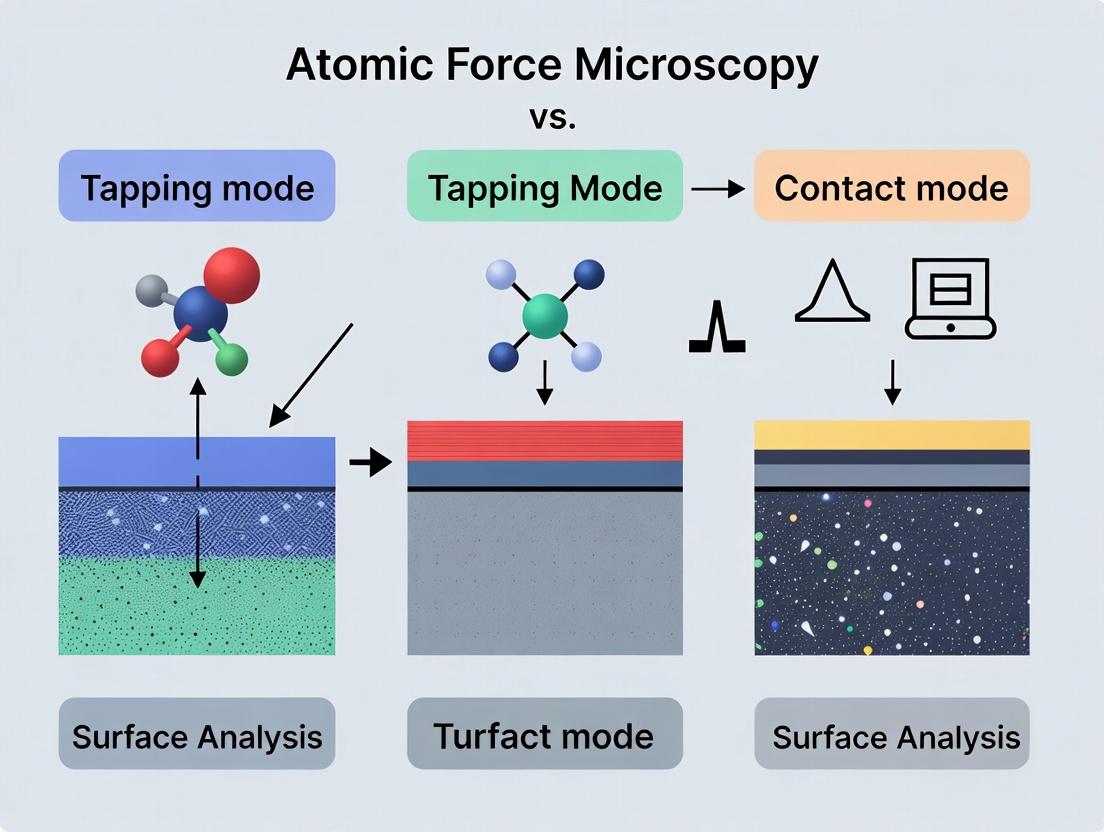
This article provides a comprehensive comparison of Atomic Force Microscopy (AFM) Tapping (Intermittent Contact) and Contact modes for achieving high-resolution imaging in biomedical and materials science.
AFM Tapping Mode vs Contact Mode for High-Resolution Imaging: A Comparative Guide for Biomedical Researchers
Abstract
This article provides a comprehensive comparison of Atomic Force Microscopy (AFM) Tapping (Intermittent Contact) and Contact modes for achieving high-resolution imaging in biomedical and materials science. It explores the foundational principles behind each mode's resolution limits, details methodological best practices for imaging delicate biological samples and nanostructures, offers troubleshooting guidance for common artifacts, and presents a direct validation of performance for key applications like protein visualization, lipid bilayer mapping, and polymer characterization. Aimed at researchers and drug development professionals, this guide synthesizes current knowledge to enable optimal mode selection for nanoscale structural analysis.
Understanding the Core Physics: How Tapping and Contact Modes Achieve Nanoscale Resolution
Atomic Force Microscopy (AFM) offers unparalleled nanoscale characterization, but the term "high resolution" is often used ambiguously. Within the broader thesis comparing Tapping Mode and Contact Mode AFM for high-resolution research, it is critical to define resolution parameters distinctly. This application note clarifies the fundamental differences between lateral and vertical resolution, details the instrumental limits of each, and provides protocols for their quantitative assessment. The choice between operational modes directly impacts which resolution metric is optimized for a given application, such as imaging delicate biological samples in drug development or rigid materials.
Defining Lateral vs. Vertical Resolution
- Lateral Resolution: The minimum distance at which two adjacent topographical features on the sample surface can be distinguished as separate entities. It is primarily limited by the tip apex geometry (radius and sidewall angle) and the operational mode.
- Vertical Resolution: The minimum detectable change in height (Z-direction). It is governed by the noise floor of the AFM's Z-feedback system (sensor and actuator) and environmental vibrations. Vertical resolution is typically sub-angstrom (<0.1 nm), far exceeding lateral resolution.
Quantitative Limits and Data Comparison
The following table summarizes typical resolution limits and key influences for Contact and Tapping Mode, based on current instrumental specifications and literature.
Table 1: AFM Resolution Limits and Influencing Factors
| Parameter | Contact Mode | Tapping Mode | Primary Limiting Factors |
|---|---|---|---|
| Lateral Resolution | ~0.2 - 2 nm | ~1 - 5 nm | Tip Apex Radius (1-20 nm commercially). Mode Effect: Contact can provide higher lateral resolution on flat, hard samples due to direct tip-sample tracking. Tapping may have lower lateral resolution due to tip convolution, especially on soft samples. |
| Vertical Resolution | < 0.1 nm | < 0.1 nm | Z-Sensor Noise Floor (typically ~0.02-0.05 nm RMS). Acoustic & Vibration Isolation. Both modes can achieve similar ultimate vertical resolution. |
| Optimal Application for High Resolution | Atomic lattice imaging on hard, flat samples (HOPG, mica); high friction/force spectroscopy studies. | Imaging of soft, adhesive, or easily damaged samples (proteins, polymers, live cells); samples in fluid. | |
| Key Artifact Source | Lateral shear forces can distort or damage samples. | Tip-sample convolution can broaden features. Intermittent contact can obscure sharp edges. |
Experimental Protocols for Assessing Resolution
Protocol 4.1: Calibrating and Measuring Lateral Resolution
Objective: To empirically determine the effective lateral resolution of an AFM tip in a specific mode. Materials: Reference grating with known, sharp, and high-aspect-ratio features (e.g., TGZ01 (NT-MDT) or similar silicon gratings with periodic pits or spikes). Procedure:
- Tip Selection: Mount a sharp, fresh tip (nominal radius <10 nm).
- Sample Mounting: Secure the reference grating on the AFM sample stage.
- Imaging: Image a 1 x 1 µm area of the grating in the chosen mode (Contact or Tapping). Use optimal parameters (minimal force/setpoint, adequate scan rate).
- Line Profile Analysis:
- Draw a line profile perpendicular across a sharp edge of a known feature.
- Measure the distance between the 10% and 90% height points of the edge (this accounts for tip broadening).
- This distance is an indicator of your effective lateral resolution for that tip/sample/mode combination.
- Validation: Image a standard with known sub-nm features (e.g., atomic lattice of HOPG) to confirm ultimate performance.
Protocol 4.2: Measuring Vertical Resolution (Noise Floor)
Objective: To quantify the Z-axis noise floor, defining the practical vertical resolution. Materials: An atomically flat, rigid sample (e.g., freshly cleaved mica or HOPG). Procedure:
- Sample Preparation: Clean and mount the flat sample.
- Engagement: Engage the tip on the sample using standard parameters.
- Data Acquisition: On a very small scan size (e.g., 0 nm or 10 nm x 10 nm), collect a "scan" or simply record the Z-sensor output over time (e.g., 10 seconds) without scanning. This measures the static height noise.
- Analysis:
- Plot the height data as a function of time.
- Calculate the Root Mean Square (RMS) roughness of this flat surface trace. This RMS value (typically 0.02-0.1 nm) represents your system's vertical resolution under those conditions.
- Environmental Note: Perform this test with and without active acoustic/vibration isolation to quantify its impact.
The Scientist's Toolkit: Essential Research Reagents & Materials
Table 2: Key Research Reagent Solutions for High-Resolution AFM
| Item | Function in High-Resolution AFM |
|---|---|
| HOPG (Highly Oriented Pyrolytic Graphite) | Atomically flat, conductive calibration standard for assessing ultimate lateral and vertical resolution. Provides a repeatable atomic lattice for tip performance validation. |
| Muscovite Mica (V1 Grade) | An atomically flat, negatively charged, easily cleavable surface. Essential for immobilizing biomolecules (e.g., DNA, proteins) and for noise floor measurements. |
| Silicon Nitride (Si₃N₄) & Silicon (Si) AFM Tips | Si₃N₄: Softer, often used for Contact Mode in fluid. Si: Stiffer, sharper, for Tapping Mode and high-resolution Contact Mode on hard samples. |
| PBS (Phosphate Buffered Saline) Buffer | Standard physiological buffer for imaging biological samples (proteins, cells) in liquid, maintaining native conformation and preventing dehydration. |
| Glutaraldehyde or Other Crosslinkers | Used for mildly fixing biological samples to the mica surface, preventing displacement by the scanning tip while preserving structure. |
| Reference Gratings (e.g., TGZ, PG series) | Standards with periodic structures of known pitch and height for quantitative calibration of lateral and vertical scanner movement, and tip shape characterization. |
| Vibration Isolation Platform | Active or passive isolation table critical for minimizing environmental noise, directly impacting achievable vertical resolution and image stability. |
Visualization of Resolution Determinants and Workflow
Diagram 1: Factors Determining AFM Resolution
Diagram 2: Protocol for Empirical Resolution Assessment
Application Notes
Atomic Force Microscopy (AFM) Contact Mode is a fundamental imaging technique where the probe maintains constant, direct contact with the sample surface. A feedback loop maintains a set cantilever deflection (constant force) as the tip scans. This mechanism provides high-resolution topographical data but inherently generates lateral (frictional) and normal forces, which can deform or damage soft samples. Within the thesis context comparing AFM modes, Contact Mode is the baseline static-force method, contrasted with dynamic (tapping) modes that minimize lateral forces by oscillating the tip.
Key Characteristics:
- Interaction: Continuous tip-sample contact.
- Forces: Significant normal and lateral (shear) forces are present.
- Feedback Parameter: Constant cantilever deflection (laser spot position on photodiode).
- Best For: Hard, rigid, well-adhered samples (e.g., semiconductors, ceramics, crystalline materials, dense polymers).
- Limitations: Potential for sample deformation, wear, and tip degradation on soft or loosely bound materials (e.g., biological cells, lipid membranes, some polymers).
Table 1: Comparison of Contact Mode vs. Tapping Mode Key Parameters
| Parameter | Contact Mode | Tapping Mode (Air) | Notes |
|---|---|---|---|
| Tip-Sample Interaction | Constant Contact | Intermittent Contact | Core mechanistic difference |
| Typical Force Range | 0.1 - 100 nN | 0.01 - 1 nN (peak repulsive) | Tapping mode forces are time-averaged and lower |
| Lateral (Shear) Forces | High | Significantly Reduced | Primary source of sample damage in contact mode |
| Normal Load | Directly Applied | Periodically Applied | Contact mode load is static |
| Imaging Resolution | Atomic possible on hard samples | Molecular/High on soft samples | Contact can achieve atomic resolution on crystals |
| Sample Deformation Risk | High for soft samples | Moderate to Low | Contact mode is contraindicated for delicate samples |
| Fluid Imaging Suitability | Excellent (standard) | Possible (requires specialized fluid tapping) | Contact mode is straightforward in liquid |
Table 2: Typical Experimental Parameters for Contact Mode on Different Sample Types
| Sample Type | Setpoint Force | Scan Rate | Cantilever Spring Constant | Key Consideration |
|---|---|---|---|---|
| Silicon / Mica | 0.5 - 5 nN | 1 - 2 Hz | 0.1 - 0.4 N/m | Use low force for atomic resolution. |
| Dense Polymer | 1 - 10 nN | 0.5 - 1 Hz | 0.2 - 0.6 N/m | Force must be below elastic limit. |
| Adhered Cell (Fixed) | 0.1 - 0.5 nN | 0.3 - 0.6 Hz | 0.01 - 0.1 N/m | Very low force, risk of detaching cell. |
| Protein Layer (on mica) | 0.05 - 0.2 nN | 0.5 - 1 Hz | 0.02 - 0.08 N/m | Lowest possible force to avoid displacement. |
Experimental Protocols
Protocol 1: High-Resolution Topography of a Hard, Flat Sample (e.g., Mica)
Objective: To obtain atomic or nanometer-scale topographic data using Contact Mode with minimal damage.
- Sample Preparation: Freshly cleave mica substrate using adhesive tape. Verify cleanliness under inert gas flow.
- Probe Selection: Mount a sharp, silicon nitride (Si₃N₄) tip on a cantilever with a low spring constant (e.g., 0.06 - 0.12 N/m). Calibrate the photodiode sensitivity on a clean, rigid sapphire surface.
- Engagement: Position the tip above the sample. Initiate automated engagement at a low force setpoint (~0.1 nN).
- Parameter Optimization: After contact, adjust the setpoint to the minimum value that maintains stable tracking (typically 0.5-2 nN). Set scan size to 1-5 µm initially. Use a slow scan rate (0.5-1 Hz) and a high feedback gain to optimize tracking.
- Imaging: Acquire images in both trace and retrace directions. Compare for consistency to rule out artifacts from stick-slip motion or damage.
- Analysis: Apply flattening (line-by-line) and plane correction algorithms. Measure step heights or feature dimensions.
Protocol 2: Measuring Lateral (Friction) Force on a Polymer Surface
Objective: To quantify lateral forces and map surface friction heterogeneity.
- Setup: Use a Contact Mode probe with a well-calibrated lateral force sensitivity. This requires a four-quadrant photodiode and prior calibration using the wedge method.
- Alignment: Center the photodiode laser spot and adjust the detector to ensure equal response in left and right quadrants for zero lateral force.
- Topography Scan: First, acquire a standard topographical image at low force and slow scan speed to map the region of interest.
- Friction Loop Acquisition: At a selected line scan, operate the AFM in "Lateral Force Microscopy (LFM)" mode. The system records the torsional twist of the cantilever (via left-right photodiode signal difference) during both forward and reverse scans.
- Data Processing: The difference between the forward and reverse LFM signals at the same location is proportional to the coefficient of friction, largely independent of topography. Plot this difference signal to create a friction map.
- Correlation: Overlay the friction map with the topography image to correlate material properties with surface features.
Diagrams
Contact Mode Feedback Mechanism
Contact vs Tamping Force Diagram
Key Imaging Decision Workflow
The Scientist's Toolkit
Table 3: Essential Research Reagent Solutions & Materials for Contact Mode AFM
| Item | Function & Rationale |
|---|---|
| Freshly Cleaved Mica Discs | An atomically flat, negatively charged substrate for adsorbing samples (proteins, DNA, vesicles) and for probe calibration. |
| Silicon Nitride (Si₃N₄) Probes (e.g., DNP or MLCT series) | Standard soft contact mode levers (0.06 - 0.6 N/m). Low spring constant minimizes sample damage. Hydrophilic surface aids in meniscus formation in air. |
| Sharpened Silicon Probes (e.g., CONT series) | Stiffer levers (0.1 - 1 N/m) for high-resolution on rigid samples. Very sharp tips (<10 nm radius) improve lateral resolution. |
| PBS (Phosphate Buffered Saline) Buffer (1x, pH 7.4) | Standard physiological medium for imaging biological samples in liquid, maintaining hydration and native state. |
| Glutaraldehyde Solution (0.1 - 2%) | A fixative for biological cells. Cross-links proteins to increase rigidity and adhesion, making samples more resilient to contact mode forces. |
| APTES ((3-Aminopropyl)triethoxysilane) | A silane coupling agent for functionalizing glass or silicon substrates to promote strong, covalent sample adhesion, reducing lateral displacement. |
| Ultrasonic Cleaner & Solvents (Acetone, Isopropanol) | For rigorous cleaning of substrates and probe holders to remove organic contaminants that cause drift and spurious deflection. |
| Calibration Gratings (e.g., TGZ series) | Samples with known pitch and step height for verifying the scanner's X, Y, and Z dimensional accuracy and calibrating lateral force sensitivity. |
Atomic Force Microscopy (AFM) offers unparalleled surface characterization at the nanoscale. For high-resolution research, particularly with delicate or loosely adsorbed samples, the choice between Contact Mode and Tapping Mode is critical. Contact Mode, while simple, exerts continuous lateral forces that can damage samples and degrade resolution. This application note details the Tapping Mode (AC Mode) mechanism, providing protocols and data to enable its effective implementation for high-resolution imaging in biological and materials science.
Fundamental Mechanism and Quantitative Parameters
In Tapping Mode, a cantilever is driven to oscillate at or near its resonant frequency. The amplitude of this free-air oscillation (A0) is set by the user. As the tip approaches the sample, intermittent contact causes energy loss, damping the oscillation to a lower setpoint amplitude (Asp). The feedback loop maintains Asp by adjusting the tip-sample distance (Z-height), thereby tracing the topography.
Table 1: Core Quantitative Parameters in Tapping Mode AFM
| Parameter | Symbol | Typical Range/Value | Function in Imaging |
|---|---|---|---|
| Free Air Amplitude | A0 | 10-200 nm | Reference oscillation level. Higher A0 reduces sample adhesion but can increase contact force. |
| Setpoint Amplitude | Asp | 40-90% of A0 | Dictates engagement force. Lower ratio = higher force, better resolution, but risk of damage. |
| Drive Frequency | f | ~50-400 kHz (depends on cantilever) | Ideally at or just below the resonant peak for stable phase contrast. |
| Quality Factor | Q | 100-500 (in air) | Measure of damping. Higher Q gives sharper resonance but slower response. |
| Phase Lag | δ | Degrees relative to drive | Sensitive to material properties; used for phase imaging. |
| Amplitude Setpoint Ratio | rsp = Asp/A0 | 0.4 - 0.9 | Primary control for imaging force. Critical parameter. |
Table 2: Comparison of Key Imaging Characteristics: Tapping vs. Contact Mode
| Characteristic | Tapping Mode (AC) | Contact Mode (DC) |
|---|---|---|
| Lateral Forces | Minimal/None (vertical oscillation) | High (tip drags across surface) |
| Normal Force | Intermittent, controlled by rsp | Continuous, controlled by deflection setpoint |
| Sample Damage Risk | Low (for optimal rsp) | High for soft, adhesive, or loosely bound samples |
| Fluid Imaging | Excellent (with reduced Q) | Challenging (capillary forces, high damping) |
| Scan Speed | Moderate to High | Can be very high (on robust samples) |
| True Atomic Resolution | Rare on hard surfaces | Possible on atomically flat, inert surfaces |
| Simultaneous Property Mapping | Yes (Phase, Amplitude) | Yes (Lateral Force, Friction) |
Experimental Protocols
Protocol 3.1: Optimizing Tapping Mode Parameters for High-Resolution Imaging of Protein Complexes
Objective: To achieve high-resolution topographical imaging of membrane proteins (e.g., GPCRs) in a lipid bilayer without displacement.
Materials: See "Scientist's Toolkit" (Section 6).
Procedure:
- Cantilever Selection & Mounting: Select a high-resonant frequency (~150-300 kHz in air), low spring constant (~20-40 N/m) silicon probe. Mount in holder securely.
- Laser Alignment & Detector Tuning: Align laser to the very end of the cantilever. Adjust the photodetector to obtain a sum signal of ~4-6 V and a vertical deflection near zero.
- Resonance Curve Acquisition: With the tip retracted (>5 μm from surface), perform an automatic frequency sweep to identify the fundamental resonant peak. Set the drive frequency (f) to the peak frequency.
- Set Free Air Amplitude (A0): Adjust the drive voltage to achieve a clean, stable oscillation with an A0 of 50-100 nm (as read by the RMS amplitude). Record this A0 value.
- Engagement: Set the amplitude setpoint ratio (rsp) to 0.8 (i.e., Asp = 0.8 * A0). Initiate automatic engagement.
- Setpoint Optimization: After engagement on a representative area, gradually lower the rsp in 0.02 increments. Monitor the image quality and phase signal. Stop when a stable, high-resolution image is obtained, or if evidence of sample deformation appears (streaking, moving features). For proteins, the optimal rsp is typically 0.70-0.85.
- Feedback Gains Adjustment: Set integral and proportional gains to achieve responsive but stable tracking. Gains are typically higher than in Contact Mode. Adjust until the error signal is minimal and non-oscillatory.
- Image Acquisition: Scan your area of interest. Use a slow scan rate (0.5-1.5 Hz) for high resolution to allow the feedback loop to track accurately.
Protocol 3.2: Quantitative Phase Imaging for Material Differentiation
Objective: To map nanoscale variations in viscoelasticity or adhesion alongside topography.
Procedure:
- Follow steps 1-6 of Protocol 3.1 to establish stable, non-destructive tapping.
- Record Reference Phase: On a featureless, hard area of the sample (e.g., mica or silicon), note the Phase Lag (δ) value. This is your reference for a "hard, inelastic" interaction.
- Image Acquisition with Phase: Enable simultaneous acquisition of Height and Phase channels. The phase signal is the shift between the drive and tip oscillation.
- Interpretation: Areas with a lower phase lag (more negative) than the reference indicate harder, more elastic interactions. Areas with a higher phase lag indicate softer, more dissipative (viscoelastic or adhesive) interactions.
- Calibration (Optional): For quantitative analysis, perform force-distance spectroscopy at multiple points to correlate phase shift with energy dissipation.
Visualizing the Tapping Mode Mechanism and Workflow
Diagram Title: Tapping Mode Feedback Loop Logic
Diagram Title: Tapping Mode Experimental Workflow
Key Research Reagent Solutions & Materials
Table 3: The Scientist's Toolkit for High-Resolution Tapping Mode AFM
| Item | Function & Importance in Tapping Mode |
|---|---|
| High-Frequency Silicon Probes (e.g., RTESPA, AC160 series) | Standard probes for air/liquid. High resonance frequency allows stable tapping at small amplitudes, crucial for high resolution. |
| Ultra-Sharp Silicon Probes (e.g., SSS-NCHR) | Feature a tip radius <5 nm. Essential for achieving true molecular/atomic-scale lateral resolution. |
| Mica Substrates (Muscovite) | Atomically flat, negatively charged surface. Ideal for preparing lipid bilayers, adsorbing proteins, or DNA for high-res imaging. |
| Calibration Gratings (e.g., TGQ1, PG) | Samples with known pitch and height. Used to verify scanner calibration and measure tip broadening effects. |
| Vibration Isolation System (Active or Passive) | Critical for stable oscillation and preventing noise. Tapping mode is sensitive to vertical noise disrupting the amplitude signal. |
| Acoustic Enclosure | Dampens air currents that can destabilize the low-mass, oscillating cantilever. |
| Liquid Cell | Allows imaging in buffer. Requires cantilevers with lower resonant frequency and careful tuning due to high damping (low Q). |
| Sample-Fixing Reagents (e.g., Aminosilanes, Poly-L-Lysine) | Used to immobilize samples (cells, particles) to prevent displacement by tip interaction. |
This document provides detailed application notes and protocols for Atomic Force Microscopy (AFM) parameter optimization. The content is framed within a broader thesis investigation comparing Tapping Mode and Contact Mode for high-resolution imaging, particularly in biological and soft material research. The superior vertical control and reduced lateral forces of Tapping Mode often make it the preferred method for high-resolution imaging of delicate samples, such as proteins, live cells, and lipid bilayers. However, achieving optimal resolution requires precise control of interdependent instrumental parameters.
Key Parameter Theory & Quantitative Data
Tip Geometry
The probe tip is the primary determinant of lateral resolution. A sharper tip yields higher resolution by reducing convolution artifacts.
Table 1: Common AFM Tip Geometries and Specifications
| Tip Type | Typical Radius of Curvature | Typical Half Cone Angle | Best For | Resolution Limit (approx.) |
|---|---|---|---|---|
| Silicon Nitride (Contact) | 20-60 nm | 35° | Contact mode on soft samples | 5-10 nm |
| Standard Silicon (Tapping) | 5-10 nm | 15-20° | General tapping mode | 1-5 nm |
| Super Sharp Silicon (Tapping) | < 2 nm | < 10° | High-res biomolecules | < 1 nm |
| Carbon Nanotube (Modified) | 1-3 nm (tube end) | N/A | Deep trenches, high aspect ratio | < 1 nm |
| Diamond-Coated | 20-30 nm | 20° | Hard, abrasive samples | 5-10 nm |
Spring Constant (k)
The cantilever's spring constant governs its mechanical response to forces. A higher k provides stability against snap-to-contact but may deform soft samples.
Table 2: Cantilever Spring Constant Guidelines
| Application | Recommended k (N/m) | Free Air Amplitude (nm) | Rationale |
|---|---|---|---|
| Soft Samples (cells, polymers) | 0.1 - 5 | 10-20 | Minimizes indentation force. |
| Medium Hardness (proteins, mica) | 5 - 40 | 15-30 | Balance of force and stability. |
| Hard Samples (silicon, crystals) | 20 - 80 | 20-40 | High stability, reduces noise. |
Oscillation Frequency
The drive frequency is typically chosen near the cantilever's resonant frequency (f0) for maximum sensitivity. Operating in air vs. liquid drastically changes f0.
Table 3: Frequency and Environmental Considerations
| Environment | Typical f0 range | Quality Factor (Q) | Setpoint Implication |
|---|---|---|---|
| Air / Vacuum | 70 - 400 kHz | High (100-500) | High Q allows low setpoints; sensitive to instability. |
| Liquid | 5 - 60 kHz | Low (1-5) | Low Q requires higher drive & setpoint; damped response. |
Setpoint Ratio
The setpoint defines the operating amplitude as a fraction of the free oscillation amplitude (A0). It directly controls the tip-sample interaction force.
Table 4: Setpoint Ratio and Imaging Regime
| Setpoint (A/A0) | Interaction Regime | Force Applied | Risk | Best Use Case |
|---|---|---|---|---|
| > 0.9 | Very Light Tapping | Minimal, attractive | Tip may lose tracking | Very soft, loosely bound samples |
| 0.7 - 0.9 | Light Tapping (Standard) | Low repulsive | Optimal for most high-res work | Proteins, DNA, lipid membranes |
| 0.5 - 0.7 | Moderate Tapping | Moderate repulsive | Possible sample deformation | Stable polymers, fixed cells |
| < 0.5 | Hard Tapping / Near Contact | High repulsive | High deformation/ damage | Robust materials only |
Experimental Protocols for Parameter Optimization
Protocol 1: Systematic Calibration for High-Resolution Tapping Mode
Objective: To establish baseline parameters for imaging a novel protein complex on mica. Materials: See "Scientist's Toolkit" below. Workflow:
- Cantilever Selection & Mounting: Choose a super-sharp silicon tip (k ~ 20-40 N/m, f0 ~ 300 kHz in air). Mount in holder under clean conditions.
- Laser Alignment: Align the laser spot on the cantilever end and maximize sum signal. Adjust photodiode to zero differential signal.
- Resonance Curve Acquisition:
- Isolate the scanner from vibrations.
- Perform an automated frequency sweep (e.g., ±50 kHz from manufacturer's listed f0).
- Identify the peak resonant frequency (f0) and calculate the Quality Factor (Q = f0 / Δf, where Δf is FWHM).
- Free Amplitude (A0) Setting: Set the drive frequency to f0. Adjust drive amplitude to achieve a free air amplitude (A0) of 15-20 nm as measured by the RMS amplitude.
- Engagement:
- Approach the sample surface slowly.
- Set the Setpoint Ratio to 0.8 (i.e., target amplitude = 0.8 * A0).
- Monitor the phase and amplitude signals during engage.
- In-situ Tuning (Critical):
- After engagement, reduce the setpoint ratio in small increments (0.05 steps) until a stable, non-destructive image is obtained. Monitor trace/retrace for consistency.
- Optimization Criterion: The lowest setpoint that provides stable tracking without visible deformation (checked via cross-section analysis on known features).
- Scan Parameter Setting: Set a slow scan rate (e.g., 0.5-1.0 Hz) for initial high-resolution imaging. Adjust based on image quality.
Title: Tapping Mode Parameter Optimization Workflow
Protocol 2: Comparative Imaging: Tapping Mode vs. Contact Mode
Objective: To directly compare resolution and sample integrity on a lipid bilayer. Materials: Supported lipid bilayer (SLB) sample, OMCL-RC800 (Contact) and OMCL-AC160 (Tapping) cantilevers. Workflow:
- Sample Preparation: Prepare SLB on freshly cleaved mica in appropriate buffer.
- Tapping Mode Imaging:
- Follow Protocol 1.
- Acquire a 1x1 µm image at optimized light tapping conditions (Setpoint ~0.85).
- Record deflection error signal.
- Contact Mode Imaging:
- Retract and switch cantilever to a soft contact lever (k ~ 0.1 N/m).
- Align laser and calibrate deflection sensitivity (nm/V) on a hard spot.
- Engage in contact mode with a low setpoint force (~100 pN).
- Acquire a 1x1 µm image in both height and deflection mode.
- Use a slow scan rate (1 Hz) to minimize shear forces.
- Analysis: Compare the apparent height of features, granularity of the surface, and signs of disruption (scratches, streaks) between modes.
Title: Tapping vs Contact Mode Comparison Protocol
The Scientist's Toolkit
Table 5: Essential Research Reagent Solutions & Materials
| Item | Function/Description | Example Product/Brand |
|---|---|---|
| Super Sharp Silicon Tips | High-resolution tapping mode imaging. Low radius of curvature maximizes true resolution. | Bruker RTESPA-300, Olympus AC240TS |
| Soft Contact Mode Cantilevers | Low-force contact imaging. Low spring constant minimizes sample deformation. | Bruker MLCT-Bio, Olympus OMCL-RC800 |
| Calibration Gratings | Verify scanner accuracy and tip sharpness. Grids with known pitch and height. | Ted Pella TGXYZ series, Bruker PG |
| Freshly Cleaved Mica Substrate | Atomically flat, negatively charged surface for adsorbing biomolecules. | Muscovite Mica V1 Grade |
| PBS Buffer (1x, pH 7.4) | Standard physiological buffer for imaging biomolecules and cells in liquid. | Gibco, Sigma-Aldrich |
| Liquid Imaging Cell | Enclosed chamber for imaging in buffer, preventing evaporation. | Bruker Fluid Cell, Asylum Research Blister |
| Vibration Isolation Table | Critical for high-resolution AFM to dampen environmental noise. | Newport, TMC, Herzan |
| Acoustic Enclosure | Further reduces air currents and acoustic noise interference. | Custom or commercial AFM hoods |
| Particle/DNA Sample | Known size standard for validating imaging performance. | Gold nanoparticles (10nm), λ-DNA |
Within the framework of advanced scanning probe microscopy for life sciences and materials research, the choice between Atomic Force Microscopy (AFM) operational modes presents a core dilemma. This application note examines the fundamental trade-off between achieving high spatial resolution, preserving sample integrity, and maintaining practical imaging speed, specifically within the context of tapping mode versus contact mode AFM. For researchers in biophysics, structural biology, and drug development, where visualizing delicate biomolecular complexes (e.g., membrane proteins, lipid bilayers, drug-protein aggregates) is paramount, understanding and mitigating this trade-off is critical for experimental success.
Quantitative Comparison of AFM Modes
Table 1: Core Performance Metrics of AFM Operational Modes
| Metric | Contact Mode | Tapping Mode (in air) | Tapping Mode (in fluid) | Notes / Conditions |
|---|---|---|---|---|
| Lateral Resolution | 0.1 - 1 nm | 1 - 5 nm | 1 - 3 nm | On hard, crystalline samples; dependent on tip radius. |
| Vertical Resolution | < 0.1 nm | ~0.1 nm | ~0.1 nm | Capable of sub-Ångström height discrimination. |
| Typical Imaging Force | 0.1 - 100 nN (direct, continuous) | 0.01 - 1 nN (intermittent, peak) | 0.001 - 0.1 nN (intermittent, peak) | Tapping mode forces are significantly lower and intermittent. |
| Typical Scan Speed | 1 - 10 Hz (line rate) | 0.5 - 2 Hz (line rate) | 0.1 - 1 Hz (line rate) | Speed is heavily dependent on feedback stability and sample. |
| Sample Damage Risk | High (lateral shear forces) | Moderate-Low | Very Low | Primary risk in contact mode is scraping/sweeping of adsorbates. |
| Fluid Imaging Suitability | Poor (high drag, meniscus) | Good | Excellent | Tapping mode in fluid is the gold standard for biological samples. |
| Feedback Parameter | Deflection (force) | Amplitude / Phase | Amplitude / Phase | Frequency modulation is also used in specialized modes. |
Table 2: Trade-off Matrix for Common Sample Types
| Sample Type | Optimal Mode for Resolution | Optimal Mode for Integrity | Recommended Compromise | Rationale |
|---|---|---|---|---|
| Hard Materials (Si, mica, graphene) | Contact Mode | Either | Contact Mode | Maximizes speed & resolution; shear forces are non-destructive. |
| Stiff Polymers / Films | Contact or Tapping | Tapping Mode | Tapping Mode (in air) | Reduces risk of deforming or displacing film structures. |
| Adsorbed Proteins / DNA (dry) | Tapping Mode | Tapping Mode | Tapping Mode (in air) | Eliminates lateral shear forces that displace loosely bound molecules. |
| Live Cells / Membranes | Not Applicable | Tapping Mode in Fluid | Tapping Mode in Fluid | Non-invasive imaging is mandatory; resolution is secondary to viability. |
| Lipid Bilayers (supported) | Tapping Mode in Fluid | Tapping Mode in Fluid | Tapping Mode in Fluid (low amplitude) | Preserves bilayer structure; high resolution of domain morphology possible. |
Experimental Protocols
Protocol 1: High-Resolution Imaging of Membrane Proteins in a Lipid Bilayer
Aim: To visualize the oligomeric state and surface topography of a purified membrane protein reconstituted into a supported lipid bilayer (SLB) with minimal structural disruption.
Materials: See "Scientist's Toolkit" below. Method:
- SLB Preparation: Deposit small unilamellar vesicles (SUVs) of DOPC/DOPE mixture onto a freshly cleaved mica substrate in a fluid cell. Incubate for 30 min at 37°C. Rinse extensively with imaging buffer (e.g., 150 mM KCl, 10 mM HEPES, pH 7.4) to remove unfused vesicles.
- Protein Reconstitution: Dilute the purified membrane protein in detergent. Inject into the fluid cell and incubate for 60 min on the SLB. Rinse with detergent-free imaging buffer to remove micelles and unincorporated protein.
- AFM Setup (Tapping Mode in Fluid):
- Mount a sharp, non-conductive silicon nitride tip (k ~ 0.1 N/m).
- Engage the tip in fluid far from the surface.
- Set drive frequency slightly below the tip's resonant frequency in fluid.
- Optimize the amplitude setpoint to the highest possible value that allows stable feedback (typically 85-90% of the free air amplitude). This minimizes imaging force.
- Set scan rate to 1-2 Hz. Adjust integral and proportional gains to achieve crisp feedback without oscillation.
- Imaging: Scan areas from 10x10 µm down to 200x200 nm to locate proteins. Collect height images at 512x512 or 1024x1024 resolution.
Protocol 2: Comparative Topography of a Polymer Blend Film
Aim: To compare the surface morphology of a PS-PMMA polymer blend imaged in contact vs. tapping mode, highlighting mode-induced artifacts. Method:
- Sample Preparation: Spin-coat a thin film (~100 nm) of PS/PMMA blend onto a silicon wafer. Anneal as required to induce phase separation.
- Contact Mode Imaging:
- Mount a standard silicon nitride tip (k ~ 0.3 N/m).
- Engage with a low setpoint force (~1 nN).
- Scan at 2-3 Hz line rate. Monitor the deflection error signal for signs of tip sticking or sample drag.
- Acquire height and deflection images.
- Tapping Mode Imaging (in air):
- On the same sample region, switch to tapping mode using a resonant silicon tip (k ~ 40 N/m, f0 ~ 300 kHz).
- Tune the resonance peak. Set amplitude setpoint to ~80% of free amplitude.
- Match the scan rate and area from the contact mode experiment.
- Acquire height and phase images.
- Analysis: Compare height profiles across identical features. Note any broadening, smearing, or displacement of soft PMMA domains in contact mode images, which indicate shear-induced deformation.
Visualization Diagrams
Diagram 1: The AFM Mode Selection Trade-off Triangle
Diagram 2: AFM Mode Selection Experimental Workflow
The Scientist's Toolkit
Table 3: Essential Research Reagents & Materials for High-Resolution Bio-AFM
| Item | Function & Rationale | Example Product / Specification |
|---|---|---|
| Freshly Cleaved Mica | Atomically flat, negatively charged substrate for adsorbing biomolecules and forming lipid bilayers. | Muscovite Mica, V1 or V2 Grade, 10mm discs. |
| Supported Lipid Bilayer (SLB) Components | Provides a near-native, fluid environment for membrane protein reconstitution. | 1,2-dioleoyl-sn-glycero-3-phosphocholine (DOPC), 1-palmitoyl-2-oleoyl-glycero-3-phosphocholine (POPC). |
| Ultra-Sharp AFM Probes | Maximizes lateral resolution by minimizing tip convolution effects. | Tapping: Hi'Res-C cantilevers (k~40 N/m). Fluid Tapping: SNL or MSNL probes (k~0.1 N/m, tip R<10 nm). |
| Biocompatible Imaging Buffer | Maintains biological activity and structure; minimizes non-specific tip adhesion. | 10-150 mM KCl or NaCl, 10-50 mM HEPES or Tris, pH 7.2-7.5, 2-10 mM MgCl2 (for DNA). |
| BSA or Casein | Used to passivate tips and fluid cells to reduce non-specific protein adsorption. | 0.1% w/v solution in imaging buffer for rinsing. |
| Cleanroom Wipes & Solvents | Critical for contaminant-free fluid cell assembly and sample preparation. | Isopropyl alcohol (IPA), acetone, filtered deionized water. |
| Vibration Isolation System | Essential for achieving sub-nanometer resolution by minimizing environmental noise. | Active or passive isolation table, acoustic enclosure. |
Practical Protocols: Selecting and Applying the Optimal Mode for Your Sample
Within the framework of evaluating Atomic Force Microscopy (AFM) operational modes for high-resolution research, a central thesis emerges: while tapping mode excels for soft, adhesive, or fragile samples by minimizing lateral forces, contact mode remains the superior and often necessary choice for achieving the highest possible resolution on atomically flat, hard, and electrically conductive substrates. This application note details the rationale, protocols, and materials for employing contact mode in these specific scenarios.
Theoretical Rationale and Data Comparison
Contact mode AFM maintains a constant, low deflection (force feedback) as the tip scans in continuous contact with the sample surface. This provides direct measurement of topography and, critically, enables simultaneous collection of lateral force (friction) and conductive current data. The limitations of tapping mode on ideal hard samples are summarized below.
Table 1: Quantitative Comparison of Contact vs. Tapping Mode on Hard, Flat Samples
| Parameter | Contact Mode Advantage on Hard/Conductive Samples | Tapping Mode Limitation |
|---|---|---|
| Lateral Resolution | Potentially atomic; direct tip-sample contact minimizes oscillation damping effects. | Limited by oscillatory amplitude/phase; can be lower on defect-free lattices. |
| Scan Speed | Can be very high on flat samples without risk of damage. | Limited by feedback loop responding to amplitude/phase. |
| Simultaneous Electrical Mapping | Direct current flow possible (C-AFM). | Not possible without specialized and complex modes (e.g., TUNA). |
| Friction/Fore Nanomechanics | Directly measurable via lateral force signal (LFM). | Not directly accessible. |
| Surface Contaminant Interaction | Tip can penetrate and clear thin, mobile layers (e.g., water). | Oscillating tip can hydrodynamically couple to fluid layers, reducing stability. |
Experimental Protocols
Protocol 1: Atomic Resolution Imaging of HOPG (Highly Oriented Pyrolytic Graphite) Objective: Achieve atomic lattice resolution and assess step-edge morphology.
- Sample Preparation: Cleave HOPG using adhesive tape to expose a fresh, atomically flat (0001) basal plane. Mount on a conductive metal puck using a double-sided adhesive.
- Probe Selection: Use a sharp, conductive probe (e.g., doped diamond-coated Si or Pt/Ir-coated cantilever). A high spring constant (k: 0.1 - 5 N/m) is recommended for stability.
- AFM Setup: Mount the probe. Engage in contact mode with a very low setpoint force (≈ 0.5 - 5 nN) to prevent sample damage.
- Imaging Parameters: Set a slow scan rate (1-2 Hz) for initial atomic-scale imaging. Optimize the integral and proportional gains to minimize noise while preventing oscillation. Enable both topography and lateral force signal channels.
- Data Collection: Capture images at various scan sizes (from 1 nm² to 10 μm²) to resolve both the atomic lattice and larger terraces.
Protocol 2: Conductive-AFM (C-AFM) on a Thin Crystal Surface Objective: Map nanoscale conductivity variations simultaneously with topography.
- Sample Preparation: Ensure the crystal (e.g., a transition metal dichalcogenide) is securely mounted to a conductive substrate. Electrical contact to the sample base is critical.
- Probe Selection: A heavily doped diamond-coated or metal-coated Si cantilever (k: 0.1 - 5 N/m) is mandatory.
- Electrical Setup: Connect the AFM's C-AFM module. The bias voltage is typically applied to the sample while the tip is grounded through a current-sensitive amplifier.
- AFM Engagement: Engage in standard contact mode with a low setpoint force.
- Simultaneous Imaging: Enable the current mapping channel. Apply a small bias voltage (e.g., 10-100 mV) and adjust the current sensitivity range. Collect topography and current maps simultaneously at a moderate scan rate (0.5-1 Hz).
Visualization
Contact Mode Selection Logic for High-Resolution
C-AFM Experimental Workflow & Data Flow
The Scientist's Toolkit: Key Research Reagent Solutions
Table 2: Essential Materials for Contact Mode on Hard Samples
| Item | Function & Rationale |
|---|---|
| HOPG Grade ZYB/ACI | Provides large, atomically flat terraces for calibration and supreme resolution imaging. Standard reference material. |
| Freshly Cleaved Mica Discs (V1 Grade) | An atomically flat, insulating substrate. Ideal for testing resolution and for depositing crystals for subsequent C-AFM. |
| Conductive Diamond-Coated Si Probes (CDT-NCHR) | Extremely hard, wear-resistant tips with high conductivity for long-life C-AFM and imaging abrasive surfaces. |
| Pt/Ir-Coated Silicon Probes (PPP-EFM) | Metal-coated conductive probes for high sensitivity current mapping and stable contact mode imaging. |
| Conductive Sample Mounting Tape | Provides both adhesion and an electrical path from the sample substrate to the AFM metal puck for C-AFM. |
| Vibration Isolation Platform | Critical for achieving atomic resolution by isolating the AFM from building and acoustic vibrations. |
| Acoustic Enclosure | Further minimizes air currents and acoustic noise that destabilize the low-force contact required for high resolution. |
Application Notes
Atomic Force Microscopy (AFM) operation mode selection is critical for sample integrity and data accuracy. Tapping Mode (also called intermittent contact or AC mode) is the unequivocal choice for imaging soft, adhesive, or fragile biological samples. This is due to its drastic reduction of lateral (shear) forces compared to Contact Mode. In Contact Mode, the tip maintains constant physical contact, which can compress, displace, or damage delicate structures and sweep away loosely adsorbed molecules. Tapping Mode oscillates the cantilever near its resonance frequency, allowing the tip to briefly "tap" the sample surface per cycle. This minimizes prolonged contact, reduces shear forces and sample adhesion issues, and enables high-resolution topographical imaging of sensitive materials.
For live cells, Tapping Mode in fluid is essential to monitor morphology without inducing stress or detachment. For isolated proteins, fibrils, or DNA, it prevents displacement and preserves native conformation. For soft polymers, it prevents tip-induced chain dragging. The principal trade-off is potentially slightly lower scan speeds and the need for careful optimization of imaging parameters (drive amplitude, setpoint ratio). However, for the stated sample classes, the preservation of sample integrity far outweighs these considerations, making Tapping Mode the default for high-resolution biological and soft matter research within the broader thesis context of optimizing AFM methodologies.
Protocols
Protocol 1: Imaging Immobilized Protein Complexes (e.g., Membrane Proteins) in Liquid
Objective: To obtain high-resolution topographical images of isolated protein complexes in near-native buffer conditions. Materials: AFM with fluid cell, tapping mode cantilevers (e.g., Bruker SNL, Olympus RC800PSA, nominal k ~0.1-0.6 N/m, f0 ~10-40 kHz in liquid), mica substrate (Muscovite V1), NiCl2 or MgCl2, appropriate buffer (e.g., HEPES, Tris), purified protein sample. Procedure:
- Substrate Preparation: Cleave mica disk with adhesive tape to create a fresh, atomically flat surface. Deposit 20-50 µL of 10-50 mM NiCl2 (for His-tagged proteins) or MgCl2 solution onto the mica. Incubate for 5 minutes. Rinse gently with 1 mL of imaging buffer to exchange cations but leave the surface positively charged for protein adsorption.
- Sample Immobilization: Apply 20-40 µL of protein solution (concentration ~0.5-5 µg/mL in imaging buffer) to the treated mica. Incubate for 10-30 minutes to allow adsorption.
- Fluid Cell Assembly: Rinse the substrate with 1-2 mL of imaging buffer to remove unbound protein. Mount the substrate in the fluid cell, ensuring no air bubbles are trapped. Inject 50-100 µL of clean imaging buffer to submerse the tip and sample.
- AFM Tuning & Engagement: Install a tapping-mode cantilever. In the liquid, tune the cantilever to find its resonance peak (frequency will drop significantly from air value). Set a medium drive amplitude (e.g., 50-150 mV). Engage using a high setpoint (low amplitude reduction, e.g., 90% of free amplitude).
- Imaging Parameters: After engagement, lower the setpoint to achieve stable imaging with minimal force (aim for 70-85% free amplitude). Use a slow scan rate (0.5-1.5 Hz) with 512x512 pixels. Continuously adjust the setpoint and drive amplitude to maintain a consistent, non-disruptive tip-sample interaction.
Protocol 2: Imaging Live Mammalian Cell Topography in Culture Medium
Objective: To image the surface morphology of living adherent cells without fixation. Materials: AFM with bioscell heater/controller if needed, tapping mode cantilevers for liquid (e.g., Bruker SCANASYST-FLUID+, nominal k ~0.7 N/m, f0 ~70-90 kHz in fluid), sterile culture dish (35 mm, glass-bottom preferred), cell culture, appropriate culture medium. Procedure:
- Cell Preparation: Seed cells onto the sterile culture dish 24-48 hours prior to imaging to achieve 50-70% confluence and firm adhesion.
- AFM Setup: Sterilize the cantilever and holder via UV exposure (15-20 min). Mount the holder on the AFM. Fill the dish with 2 mL of pre-warmed, CO2-equilibrated culture medium. Place the dish on the AFM stage. If available, activate stage heater and maintain at 37°C.
- Tip Approach & Tuning: Submerge the tip in medium. Tune to find the resonance peak. Use a low drive amplitude to start (e.g., 20-50 mV). Navigate the tip above a cell of interest using the optical microscope.
- Engagement & Imaging: Engage with a high setpoint (~95%). After contact, reduce the setpoint gradually until the tip tracks the surface. The final amplitude setpoint is often 80-90% of free amplitude. Use a very slow scan rate (0.3-1.0 Hz) with a lower resolution (256x256 or 512x512) to minimize cell stimulation. Continuously monitor cell viability via optical microscopy.
Data Tables
Table 1: Quantitative Comparison of Forces in Contact vs. Tapping Mode on Biological Samples
| Force Type | Contact Mode (Typical Magnitude) | Tapping Mode (Typical Magnitude) | Impact on Sample |
|---|---|---|---|
| Normal Force | 0.1 - 10 nN (directly applied) | 0.01 - 0.5 nN (intermittent) | Compression, indentation |
| Lateral (Shear) Force | High (continuous dragging) | Very Low (tip lifts off) | Sample displacement, deformation |
| Adhesive Force | High (tip in constant contact) | Moderate (reduced contact time) | Tip/sample sticking, damage on retraction |
| Hydration Force | Perturbed continuously | Minimally perturbed | Preserves near-native water layer |
Table 2: Recommended Tapping Mode Parameters for Different Sample Types
| Sample Category | Cantilever k (N/m) | Freq in Fluid (kHz) | Setpoint Ratio (rsp) | Scan Rate (Hz) | Key Consideration |
|---|---|---|---|---|---|
| Isolated Proteins | 0.1 - 0.4 | 5 - 25 | 0.75 - 0.9 | 0.8 - 1.5 | High rsp to prevent displacement |
| Live Mammalian Cells | 0.2 - 0.8 | 20 - 90 | 0.8 - 0.95 | 0.3 - 1.0 | Low drive amplitude, 37°C |
| Lipid Bilayers | 0.1 - 0.3 | 5 - 20 | 0.85 - 0.95 | 3 - 10 | Fast scan to capture dynamics |
| Soft Polymers (e.g., Hydrogels) | 0.5 - 2.0 | 30 - 60 | 0.7 - 0.85 | 0.5 - 1.2 | Medium rsp to track topography |
Diagrams
Title: Decision Flowchart for AFM Tapping Mode
Title: Protein Imaging Protocol Workflow
The Scientist's Toolkit: Key Research Reagent Solutions
Table 3: Essential Materials for Tapping Mode AFM on Biological Samples
| Item | Example Product/Brand | Function & Rationale |
|---|---|---|
| Tapping Mode Cantilevers (Liquid) | Bruker SCANASYST-FLUID+, Olympus RC800PSA, HQ:NSC18 | Low spring constant (0.1-1 N/m) minimizes normal force. Sharp tip (R < 10 nm) for high resolution. Coating for laser reflection. |
| Atomically Flat Substrate | Muscovite V1 Mica Disks | Provides an ultra-flat, easily cleavable surface for adsorbing and imaging biomolecules at nanometer scale. |
| Divalent Cation Solution | 10-50 mM NiCl2 or MgCl2 in ultrapure water | Treats negatively charged mica to create a positive surface for electrostatic immobilization of proteins/nucleic acids. |
| Biocompatible Imaging Buffer | HEPES, Tris, or PBS at physiological pH | Maintains sample stability and native conformation. Low salt may be used to reduce non-specific adhesion. |
| Live Cell Culture Dish | Glass-bottom 35 mm dish (e.g., MatTek) | Allows optical monitoring of cells during AFM scanning. Glass is flat for stable AFM engagement. |
| Cantilever UV Sterilizer | UV Lamp (e.g., BioForce) | Critical for live-cell AFM to sterilize the cantilever and holder, preventing contamination. |
| Stage Incubator | BioHeater/Controller (e.g., Bruker) | Maintains mammalian cells at 37°C and controls CO2 levels to preserve viability during long scans. |
This application note details protocols for achieving high-resolution imaging in Atomic Force Microscopy (AFM) Contact Mode. The discussion is framed within the central thesis comparing AFM Tapping Mode and Contact Mode for high-resolution research. While Tapping Mode (or AC mode) minimizes lateral forces and is preferred for soft samples, Contact Mode (DC mode) can provide superior true atomic-resolution imaging on rigid, well-ordered samples due to the continuous tip-sample interaction and direct force feedback. This protocol is designed for researchers, scientists, and drug development professionals aiming to resolve sub-nanometer features, such as crystal lattices, molecular arrays, or protein aggregates, on suitable substrates.
Core Parameter Optimization Table
The following table summarizes the critical parameters for high-resolution contact mode imaging, their optimal ranges, and their impact on image quality.
Table 1: Key Parameters for High-Resolution Contact Mode Imaging
| Parameter | Optimal Range for High Resolution | Functional Impact | Consequence of Improper Setting |
|---|---|---|---|
| Scan Rate | 0.5 - 2.0 Hz | Controls speed of tip traversal. | Too high: Blurring, sample damage. Too low: Thermal drift, long acquisition. |
| Integral Gain | 0.1 - 0.5 (set point-dependent) | Corrects for low-frequency error. | Too high: Oscillation & noise. Too low: Poor tracking, distortion. |
| Proportional Gain | 0.5 - 2.0 (set point-dependent) | Provides immediate error correction. | Too high: Instability. Too low: Slow response, phase lag. |
| Setpoint Force | 0.1 - 5 nN (as low as possible) | Defines loading force on tip. | Too high: Sample damage, reduced resolution. Too low: Loss of contact. |
| Scan Angle | 0° or 90° (to lattice direction) | Aligns fast-scan direction. | Misalignment: Moiré patterns, obscured true periodicity. |
| Feedback Loop Delay | Minimized (instrument-specific) | Time between error detection & correction. | High delay: Poor tracking, "shadowing" artifacts. |
| Samples per Line | 512 - 1024 | Defines pixel density. | Too low: Loss of detail. Too high: Noise amplification, large files. |
Detailed Experimental Protocol
Protocol 3.1: Pre-imaging Preparation and Calibration
- Tip Selection: Use a sharp, high-aspect-ratio silicon nitride (Si₃N₄) or silicon cantilever with a nominal spring constant of 0.01 - 0.1 N/m for soft samples, or a stiffer silicon tip (0.1 - 1 N/m) for atomic resolution on hard samples (e.g., mica, HOPG). Verify resonance frequency via thermal tune.
- Substrate Preparation: Cleave atomically flat substrates (e.g., Muscovite Mica, HOPG) immediately before use. For biological samples, adsorb molecules to the substrate from a dilute solution in an appropriate buffer, then rinse gently and dry with inert gas if imaging in air.
- System Isolation: Ensure the AFM is on an active or passive vibration isolation table within an acoustic enclosure to minimize environmental noise.
Protocol 3.2: Engagement and Initial Parameter Setting
- Approach: Engage the tip to the surface using the instrument's standard engagement routine, aiming for the lowest possible setpoint force to initiate contact.
- Initial Parameters:
- Set the scan size to 0 nm.
- Set a Scan Rate of 1.0 Hz.
- Set Integral and Proportional Gains to 0.1 and 0.5, respectively.
- Set Samples per Line to 512.
- Force Adjustment: After engagement, withdraw the tip slightly to reduce the deflection setpoint, thereby minimizing the applied force. Target an initial setpoint force of < 1 nN.
Protocol 3.3: Optimization Loop for High Resolution
- Begin scanning a small area (e.g., 500 x 500 nm). Observe the real-time deflection error signal.
- Increase Gains: Gradually increase the Proportional and then the Integral Gains until the feedback loop becomes slightly oscillatory (visible as high-frequency noise in the error signal). Then reduce both gains by ~20% to achieve stable, responsive tracking.
- Optimize Scan Rate: Increase the Scan Rate until the image begins to show blurring in the fast-scan direction or the error signal increases significantly. Reduce the rate by 20-30% for stable imaging.
- Minimize Force: Decrease the deflection Setpoint in small increments. After each reduction, allow the feedback to stabilize. Continue until the tip loses contact or tracking becomes unstable, then increase the setpoint slightly to the last stable value.
- Final High-Resolution Scan: Once stability is achieved, reduce the scan size to the target area (e.g., 50 x 50 nm for molecular resolution). Increase Samples per Line to 1024. Perform the final scan.
Protocol 3.4: Post-Processing and Validation
- Apply a first-order flattening (plane fit) to each scan line to remove tilt.
- Use a low-pass Fourier filter to remove high-frequency noise only if necessary, ensuring it does not alter genuine high-frequency spatial data.
- Measure feature dimensions and periodicities using cross-sectional analysis and 2D FFT.
Visualizing the Optimization Workflow
Title: Contact Mode High-Res Optimization Workflow
The Scientist's Toolkit: Essential Research Reagents & Materials
Table 2: Key Research Reagent Solutions and Materials
| Item | Function in High-Res Contact Mode Imaging |
|---|---|
| Muscovite Mica (V1 Grade) | Atomically flat, negatively charged substrate for adsorbing proteins, DNA, or lipids. Cleavable for fresh surfaces. |
| Highly Ordered Pyrolytic Graphite (HOPG) | Atomically flat, inert substrate for calibrating lateral dimensions and imaging organic molecules or nanomaterials. |
| Silicon Nitride Cantilevers (e.g., Bruzer MLCT-BIO) | Soft levers (0.01-0.1 N/m) for imaging soft biological samples with minimal deformation. |
| Sharp Silicon Cantilevers (e.g., Olympus AC40) | Stiffer levers (~0.1-0.5 N/m) with ultra-sharp tips (<10 nm radius) for atomic-scale resolution on hard surfaces. |
| PBS (Phosphate Buffered Saline) Buffer, pH 7.4 | Common physiological buffer for preparing and depositing biological samples without denaturation. |
| APTES ((3-Aminopropyl)triethoxysilane) | Silane coupling agent for functionalizing silicon/silicon oxide substrates to promote specific sample adhesion. |
| PLL (Poly-L-Lysine) Solution | Positively charged polymer for coating substrates to enhance adhesion of negatively charged cells or biomolecules. |
| Vibration Isolation Platform | Actively or passively damped table critical for isolating the AFM from building vibrations, enabling high-resolution. |
| Acoustic Enclosure | Minimizes air currents and acoustic noise that can destabilize the cantilever, especially for soft levers. |
Within the broader thesis comparing Atomic Force Microscopy (AFM) modes, Tapping Mode (intermittent contact) is often superior to Contact Mode for high-resolution imaging of soft, adhesive, or easily damaged samples, such as biological macromolecules, live cells, and polymer films. Contact Mode can induce substantial shear forces and sample deformation, while Tapping Mode minimizes these forces by vertically oscillating the cantilever, thereby enabling true atomic-scale resolution on a wider range of materials. This protocol details the systematic optimization of parameters critical for achieving high-resolution imaging in Tapping Mode.
Core Principles and Optimization Parameters
Table 1: Key Tapping Mode Parameters for Optimization
| Parameter | Typical Range (High-Res) | Functional Impact | Optimization Goal |
|---|---|---|---|
| Free Air Amplitude (A₀) | 0.5 - 1.5 V | Reference oscillation energy. | Set to a stable, mid-range value. |
| Setpoint Amplitude (Aₛₚ) | 70 - 95% of A₀ | Controls tip-sample interaction force. | Maximize while maintaining stable tracking. |
| Drive Frequency | Within ±1% of resonance | System sensitivity and response. | Tune to peak of resonance curve. |
| Scan Rate | 0.5 - 2.0 Hz | Data sampling vs. system tracking. | Balance for desired resolution and fidelity. |
| Integral & Proportional Gains | 0.1 - 0.8 (instrument dependent) | Feedback loop responsiveness. | Increase until just before oscillation. |
| Tips & Sample Prep | Sharp tips (k ~40 N/m, f₀ ~300 kHz) | Ultimate resolution limit. | Use high-frequency, sharp tips. |
Detailed Experimental Protocols
Protocol 1: Initial Setup and Cantilever Tuning
- Mount Sample and Cantilever: Use a sharp, high-resonance frequency probe (e.g., RTESPA-300 from Bruker, k ~40 N/m, f₀ ~300 kHz). Clean the sample substrate.
- Engage in Contact Mode: Briefly engage in a non-sensitive area to approach the surface.
- Switch to Tapping Mode & Tune: Withdraw the tip and initiate the tuning procedure. Automatically or manually sweep the drive frequency to find the resonance peak.
- Record Parameters: Note the resonant frequency (f₀) and quality factor (Q). Set the Free Air Amplitude (A₀) to ~1.0 V.
Protocol 2: Setpoint Optimization for Minimal Force
- Engage at High Setpoint: Engage with a Setpoint Ratio (Aₛₚ/A₀) of 95%.
- Image a Test Area: Scan a small area (e.g., 500 nm x 500 nm) at a slow scan rate (0.7 Hz).
- Decrement Setpoint: Gradually lower the setpoint ratio in 5% increments. Observe the phase image and trace/retrace fidelity.
- Identify Optimal Point: The optimal setpoint is the highest value (least force) where the phase image shows clear, consistent material contrast and trace/retrace are congruent. Record this value (e.g., 80%).
Protocol 3: Scan Rate and Feedback Gain Optimization
- Set Initial Gains: At the optimal setpoint, set integral and proportional gains to low values (e.g., 0.2).
- Optimize Gains: Increase both gains simultaneously until the feedback loop begins to oscillate (visible as high-frequency noise in the height channel). Reduce gains by ~20% from this point.
- Adjust Scan Rate: With optimized gains, increase the scan rate. The maximum usable rate is reached when features begin to elongate or smear. For high-resolution work, a rate of 0.5-1.0 Hz is typical for a 512x512 pixel image.
Protocol 4: High-Resolution Image Acquisition
- Define Final Scan Area: Navigate to the region of interest.
- Set Final Parameters: Implement all optimized parameters: Tuned f₀, A₀=1.0V, Aₛₚ=80% A₀, Scan Rate=0.8 Hz, Optimized Gains.
- Acquire Data: Collect a 512x512 or 1024x1024 pixel image. Ensure the "Capture" mode is set to "Height" and "Phase" at minimum.
- Validate: Check trace/retrace overlay for consistency. A mismatch indicates instability, requiring a slight setpoint decrease or gain adjustment.
Visualizing the Optimization Workflow
Title: Tapping Mode Parameter Optimization Workflow
The Scientist's Toolkit: Research Reagent Solutions
Table 2: Essential Materials for High-Resolution Tapping Mode AFM
| Item | Example Product/Brand | Function in Experiment |
|---|---|---|
| High-Res Tapping Mode Probes | Bruker RTESPA-300, Olympus AC240TS | Sharp tips (radius <10 nm) with high resonance frequency for high resolution and reduced noise. |
| Ultra-Flat Substrates | Freshly cleaved Mica (Muscovite), HOPG | Provides an atomically flat, clean surface for adsorbing samples and validating tip condition. |
| Sample Preparation Kit | Syringe Filters (0.02 µm), UV-Ozone Cleaner | Filters buffers to remove particulates. UV-Ozone cleans substrates to enhance hydrophilicity and sample adhesion. |
| Vibration Isolation | Active Anti-Vibration Table (e.g., Herzan) | Minimizes environmental mechanical noise, crucial for achieving atomic-level resolution. |
| Calibration Standard | TGQ1 (Bruker), 8-10 nm step height gratings | Verifies lateral and vertical scanner accuracy and checks tip sharpness/condition. |
| Viscous Damping Fluid | Fomblin Y LVAC 25/6 (for vacuum) | Used in environmental control systems to damp acoustic noise in fluid or vacuum imaging. |
This application note serves as a critical technical deep dive for the overarching thesis evaluating AFM operational modes. While the core thesis contrasts the fundamental principles, resolution limits, and sample compatibility of traditional Tapping Mode and Contact Mode, this document explores advanced derivatives and novel techniques that push the boundaries of high-resolution imaging. These methods—Multi-frequency AFM, PeakForce Tapping, and High-Speed AFM—address specific limitations of the foundational modes, offering pathways to higher resolution, quantitative nanomechanical mapping, and dynamic process observation, directly relevant to material science and biopharmaceutical research.
Multi-frequency AFM
Application Note
Multi-frequency AFM (MF-AFM) extends traditional single-frequency Tapping Mode by exciting and detecting multiple eigenmodes of the cantilever simultaneously. This allows the decoupling of topography from material properties with high spatial resolution. It is particularly powerful for resolving heterogeneous materials, such as polymer blends or protein complexes on cell membranes, where simultaneous mapping of modulus and adhesion is required.
Table 1: Performance Metrics of Multi-frequency AFM Techniques
| Technique Variant | Typical Frequency Bands | Spatial Resolution (Topography) | Property Mapping Capability | Best For Sample Type |
|---|---|---|---|---|
| Bimodal AM-FM | 1st (ω₁), 2nd (ω₂) mode | <1 nm (in ambient) | Elastic Modulus (via ω₂ shift), Dissipation | Stiff, heterogeneous materials |
| Intermodulation AFM | Multiple sidebands | Sub-nm | Full force reconstruction, Quantitative viscoelasticity | Soft materials, molecular assemblies |
| Contact Resonance | > 100 kHz (in contact) | <5 nm (lateral) | Nanoscale elastic & viscoelastic properties | Thin films, composite materials |
Experimental Protocol: Bimodal AM-FM Imaging of a Polymer Blend
Objective: To simultaneously map the topography and elastic modulus of a polystyrene-polyethylene (PS-PE) blend.
Materials & Reagents:
- Sample: Spin-coated PS-PE thin film on silicon wafer.
- AFM Probe: High-resonance-frequency silicon cantilever (e.g., k ~ 40 N/m, f₁ ~ 300 kHz, f₂ ~ 1.8 MHz).
- Equipment: AFM system with a lock-in amplifier capable of dual-frequency excitation and detection.
Procedure:
- Probe Calibration: Thermal tune the cantilever in air to determine its first (ω₁) and second (ω₂) eigenfrequencies, quality factors (Q₁, Q₂), and spring constant (k).
- Engagement: Engage on the sample in standard amplitude-modulation Tapping Mode using the first eigenmode (ω₁). Set free amplitude A₁₀ and operating amplitude A₁ (~0.8A₁₀).
- Dual-Actuation: Enable the second excitation signal at frequency ω₂. Set its excitation amplitude to a low value (typically 10-20% of A₁₀) to avoid crosstalk.
- Feedback Loop Configuration:
- Use the amplitude of the first mode (A₁) as the primary feedback parameter for topographic control.
- Use a Phase-Locked Loop (PLL) to track the resonance frequency shift (Δf₂) of the second mode.
- Image Acquisition: Scan the area (e.g., 1x1 µm²). Record the topography channel (from A₁ feedback) and the frequency shift channel (Δf₂).
- Data Conversion: Convert the Δf₂ map into a relative or quantitative elastic modulus map using appropriate theory (e.g., simple harmonic oscillator model or Sader-Jarvis method).
The Scientist's Toolkit: Key Research Reagent Solutions
| Item | Function in MF-AFM |
|---|---|
| Silicon Probes with High 2nd Mode (e.g., PPP-NCHAuD) | Provides a strong, high-frequency second eigenmode for sensitive property detection. |
| Calibration Grid (TGZ series) | Verifies spatial and height accuracy of the AFM scanner. |
| Reference Polymer Samples (e.g., PDMS, PS stiffness grids) | Enables quantitative validation of modulus measurements. |
| Lock-in Amplifier Module (external or internal) | Essential for demodulating multiple frequency signals simultaneously. |
Diagram Title: Multi-frequency AFM Operational Workflow
PeakForce Tapping
Application Note
PeakForce Tapping (PFT) is a Bruker proprietary mode that synchronizes tip-sample contact with the cantilever oscillation at sub-nanonewton force control (typically 10 pN to 10 nN). It directly measures the force-distance curve at each pixel, extracting topography, modulus, adhesion, deformation, and dissipation concurrently. Within the thesis context, PFT resolves the contact vs. tapping trade-off by offering the quantitative force control of contact mode with the low lateral forces and broad sample compatibility of tapping mode.
Table 2: PeakForce Tapping Performance and Outputs
| Parameter | Typical Range/Resolution | Measured Property | Key Advantage |
|---|---|---|---|
| Peak Force Setpoint | 10 pN – 100 nN | Applied normal force | Prevents sample damage, enables imaging of softest samples (e.g., live cells, hydrogels). |
| Modulus Range | 100 MPa – 100 GPa (via DMT model) | Elastic Modulus | Quantitative mapping on heterogeneous samples without a priori assumptions. |
| Adhesion Sensitivity | ±10 pN | Pull-off Force | Maps chemical or hydrophobic interactions at nm scale. |
| Imaging Rate (in liquid) | 0.5 – 2 lines/sec | Throughput | Suitable for dynamic biological processes. |
Experimental Protocol: Nanomechanical Mapping of a Lipid Bilayer with Embedded Proteins
Objective: To visualize membrane topography and map the mechanical contrast introduced by transmembrane protein domains.
Materials & Reagents:
- Sample: Supported Lipid Bilayer (SLB) with reconstituted membrane proteins (e.g., porins) on mica.
- AFM Probe: Sharp, nitride-lever silicon tip with nominal spring constant k ~ 0.1 N/m (e.g., SNL or ScanAsyst-Fluid+).
- Imaging Buffer: Appropriate physiological buffer (e.g., PBS or HEPES) to maintain protein activity.
- Equipment: AFM with PeakForce Tapping capability and fluid cell.
Procedure:
- Probe Calibration: In fluid, calibrate the spring constant using the thermal tune method. Calibrate the optical lever sensitivity (InvOLS) on a hard, clean surface (e.g., mica).
- Sample Mounting: Secure the SLB sample in the fluid cell and inject ~1 mL of imaging buffer.
- PeakForce Tapping Parameters:
- Set the Peak Force Setpoint to a low value (~50-100 pN).
- Adjust the PeakForce Frequency (typically 0.25-2 kHz) and Amplitude (~100-150 nm) for stable imaging.
- Enable all QNM (Quantitative Nanomechanical) Channels: Deformation, Adhesion, Modulus (DMT model), and Dissipation.
- Engagement & Scan: Engage the probe. Initiate a slow scan (e.g., 256x256 pixels over 2x2 µm). Continuously monitor the real-time force curves for consistency.
- Data Processing: Use analysis software to apply a plane fit to topography. Apply appropriate filters (median, low-pass) to property maps. Correlate topographic protrusions with local changes in modulus and adhesion to identify protein positions.
Diagram Title: PeakForce Tapping Per-Pixel Measurement Cycle
High-Speed AFM (HS-AFM)
Application Note
HS-AFM dramatically increases imaging rates (typically 1-10 frames per second) by employing small, fast cantilevers and optimized control electronics. It enables real-time observation of biomolecular dynamics, such as protein diffusion or conformational changes. This addresses a core limitation of both conventional tapping and contact modes—their slow temporal resolution—thereby adding a critical dimension to high-resolution research.
Table 3: High-Speed AFM Specifications and Capabilities
| System Component | Specification | Impact on Performance |
|---|---|---|
| Cantilever | Small (≤ 10 µm), low mass, f₀ ~ 1-5 MHz in liquid | Minimizes hydrodynamic drag, enables high scan speeds. |
| Scanner | Small-range, high-resonance frequency XY scanner (> 50 kHz) | Reduces tracking error at high speeds. |
| Frame Rate | 0.1 – 50 fps (dependent on scan size) | Captures biomolecular processes in near real-time. |
| Resolution (in liquid) | ~2 nm lateral, ~0.1 nm vertical temporal | Sufficient to track single protein movements. |
Experimental Protocol: Imaging Myosin V Walking on Actin Filaments
Objective: To visualize the stepwise movement of a single myosin V motor protein along an actin track.
Materials & Reagents:
- Sample: Actin filaments immobilized on mica in a buffer containing 1-10 nM myosin V, ATP (1 mM), and oxygen scavenger system (e.g., glucose oxidase/catalase).
- AFM Probe: Ultra-short cantilever (e.g., 6-7 µm long, k ~ 0.1-0.2 N/m, f₀ ~ 1-3 MHz in buffer).
- Imaging Buffer: Low-salinity buffer (e.g., 20 mM HEPES-KOH, pH 7.6, 25 mM KCl, 5 mM MgAc₂) to promote weak adsorption.
- Equipment: Dedicated HS-AFM system (e.g., RIBM or custom-built).
Procedure:
- Sample Preparation: Flow in actin filaments, allow adsorption. Rinse. Then flow in imaging buffer containing myosin V and ATP.
- Probe Tuning: In liquid, thermally tune the cantilever to identify its resonance frequency and set the driving frequency slightly below f₀ for amplitude modulation.
- Parameter Optimization for Speed:
- Set a small scan size (e.g., 150x150 nm²) to encompass a few actin filaments.
- Maximize the scan rate (e.g., 5-10 lines/ms).
- Use high feedback gains and low setpoint amplitude ratio (~0.9) for minimal tip-sample interaction while maintaining tracking.
- Data Acquisition: Start continuous scanning. Record a movie sequence (e.g., 1000 frames at 5 fps). Save raw data.
- Movie Processing: Apply line-by-line correction for scanner drift and thermal drift. Use image analysis software to track the centroid position of the myosin V head over time, generating displacement vs. time plots.
The Scientist's Toolkit: Key Research Reagent Solutions
| Item | Function in HS-AFM |
|---|---|
| Ultra-Short Cantilevers (USC-F0.3-k0.3) | Enables high resonant frequency in liquid for fast imaging. |
| Oxygen Scavenger System (Glucose Oxidase/Catalase/Glucose) | Prolongs biomolecule activity by reducing radical-induced damage. |
| Protocatechuate 3,4-Dioxygenase (PCD) / Protocatechuic Acid (PCA) | Advanced photo-stabilizer system for prolonged fluorescence-free observation. |
| Streptavidin 2D Crystals or DNA Origami | Reference samples for calibrating scanner speed and image distortion. |
Diagram Title: High-Speed AFM Workflow for Dynamics
Solving Common Challenges: Artifacts, Noise, and Damage in High-Res AFM
Within the broader thesis comparing Atomic Force Microscopy (AFM) Tapping Mode versus Contact Mode for high-resolution research, a critical evaluation of sample damage mechanisms is paramount. While both modes enable nanoscale visualization, their interaction forces differ significantly, leading to varying degrees of compressive, shear, and scratching artifacts. This document provides detailed application notes and protocols for identifying and mitigating these damage vectors, essential for researchers in biophysics, materials science, and drug development where sample integrity is non-negotiable.
Quantitative Comparison of Damage Mechanisms in AFM Modes
The following table summarizes key quantitative data from recent studies on force-induced sample damage.
Table 1: Force Regimes and Damage Profiles in AFM Operational Modes
| AFM Mode | Typical Vertical Force | Lateral (Shear) Force | Primary Damage Mechanism | Susceptible Sample Types | Reported Feature Height Reduction |
|---|---|---|---|---|---|
| Contact Mode | 1-100 nN | High (tip drags) | Scratching, Shear Deformation | Soft polymers, lipid bilayers, live cells, adsorbed proteins | 30-80% on hydrated polymers |
| Tapping Mode | 0.1-1 nN (intermittent) | Negligible | Localized Compression, Fatigue | Crystalline polymers, 2D materials, single molecules | 5-20% on soft biological samples |
| PeakForce Tapping | 10-100 pN (controlled) | Very Low | Compression (if setpoint too high) | Delicate hydrogels, viruses, extracellular vesicles | <5% with optimized parameters |
Protocols for Damage Assessment and Minimization
Protocol 1: Quantifying Compression Artifacts on Soft Films
Objective: To measure the apparent height reduction of a soft polymer or protein layer due to tip-sample compression in different AFM modes.
- Sample Preparation: Deposit a monolayer of known height (e.g., bovine serum albumin, BSA, ~4 nm dry) on a freshly cleaved mica substrate. Use a calibrated spin coater for uniform films.
- Reference Measurement: Image a rigid, non-compressible calibration grating (e.g., silicon with etched pillars) in Tapping Mode to determine the system's z-axis calibration and tip integrity.
- Experimental Imaging: Scan the same 5x5 µm area of the soft sample sequentially in:
- Contact Mode: Setpoint force minimized to maintain feedback (start at ~0.5 nN).
- Tapping Mode: Drive frequency at 90% of resonance; progressively lower amplitude setpoint.
- PeakForce Tapping: Start with a peak force of 50 pN, incrementally increase.
- Data Analysis: Using section analysis, measure the average apparent film height in each mode. Plot height versus applied force (or setpoint ratio). A decreasing height trend indicates compression.
Protocol 2: Visualizing Scratching and Shear Damage
Objective: To document irreversible surface modification caused by lateral forces.
- Sample Preparation: Prepare a smooth, homogeneous polymer film (e.g., polystyrene) by spin-coating onto silicon.
- Pre-Damage Baseline: Image a 10x10 µm area in Tapping Mode (low amplitude setpoint) to capture the pristine surface topography.
- Induced Damage Scan: On the same area, engage in Contact Mode with a deliberately high setpoint force (e.g., 20 nN) for 2-3 scans. Alternatively, reduce the Tapping Mode drive frequency to induce tip-sample dragging.
- Post-Damage Analysis: Re-image the entire area in Tapping Mode. Use image subtraction software to highlight differences. Calculate the scratched volume or area percentage of plowed material.
Protocol 3: Optimizing Parameters for Minimal Impact Imaging
Objective: To establish a workflow for finding the "gentlest" imaging parameters for an unknown delicate sample.
- Tip Selection: Use a sharp, high-frequency cantilever (e.g., 300 kHz, 40 N/m) for Tapping Mode, or a soft cantilever (0.1 - 1 N/m) for Force-Distance or PeakForce modes.
- Engagement: Engage with ultra-low setpoints in automatic mode, then switch to manual feedback adjustment.
- Parameter Ramp: After engagement, gradually reduce the amplitude setpoint (Tapping) or peak force (PeakForce) until the feedback loop becomes unstable.
- Setpoint Determination: Increase the setpoint/force slightly (10-20%) above the instability point. This is the minimum stable imaging point for that sample/tip combination.
- Validation: Perform a "double-pass" or "interleave" scan, where the trace records topography at the optimized setpoint, and the retrace records it at a significantly reduced force. A mismatch indicates deformation during the trace scan.
Visualization of Damage Assessment Workflow
Diagram Title: Workflow for Minimal-Force AFM Imaging
The Scientist's Toolkit: Essential Research Reagents & Materials
Table 2: Key Reagents and Materials for Damage-Minimized AFM
| Item Name | Category | Function & Rationale |
|---|---|---|
| Ultra-Sharp AFM Probes (e.g., SSS-NCHR) | Consumable | High resonance frequency (~300 kHz) allows lower amplitude operation in Tapping Mode, reducing energy transfer to sample. |
| Soft Cantilevers (0.1 - 1 N/m, e.g., MLCT-BIO-DC) | Consumable | Essential for Force Spectroscopy & PeakForce Tapping; low spring constant minimizes indentation at a given force. |
| Freshly Cleaved Mica Discs (V1 Grade) | Substrate | Provides an atomically flat, negatively charged surface for adsorbing biomolecules or polymers without topographic interference. |
| Calibration Gratings (TGT1, PG) | Calibration | Silicon gratings with known pitch and height are critical for verifying scanner and tip performance pre/post sample imaging. |
| BSA (Bovine Serum Albumin) | Protein Standard | A well-characterized, readily adsorbing protein used as a compressible reference sample for method calibration. |
| PBS Buffer (1x, pH 7.4) | Buffer | Standard physiological buffer for imaging hydrated biological samples in liquid, preventing dehydration artifacts. |
| Polystyrene Beads (100 nm) | Reference Sample | Monodisperse spheres serve as a non-deformable (in Tapping Mode) size reference on soft samples. |
| Vibration Isolation Platform | Equipment | Actively or passively dampens acoustic and floor vibrations, crucial for stable imaging at low forces. |
Atomic Force Microscopy (AFM) is indispensable for high-resolution nanoscale imaging in materials science and life sciences. The choice between Tapping Mode and Contact Mode is central to a broader thesis on achieving reliable high resolution. Tapping Mode, oscillating the probe, minimizes lateral forces and sample damage, making it preferable for soft biological samples. Contact Mode, with continuous tip-sample contact, can provide higher spatial fidelity on hard, flat surfaces but risks deformation and contamination. Both modes are critically susceptible to artifacts that compromise data integrity. This article details protocols to identify and eliminate three pervasive artifacts: tip contamination, double-tipping, and scanner hysteresis.
Artifact Identification, Quantification, and Mitigation Protocols
Tip Contamination
Description: Adherence of sample material or environmental contaminants to the probe tip, degrading resolution and causing image distortion. Identification: Non-reproducible features, sudden resolution loss, or "ghost" images repeated across scans. Quantitative Impact: Contamination can reduce nominal tip sharpness (radius <10 nm) to an effective radius exceeding 50 nm, drastically blurring true topography.
Table 1: Quantitative Impact of Tip Contamination on Measured Roughness (RMS)
| Sample Type | Nominal Tip Radius (nm) | Contaminated Tip Radius (nm) | Measured RMS (nm) Error |
|---|---|---|---|
| PS-b-PMMA Polymer | 8 | ~60 | +225% |
| Lipid Bilayer | 5 | ~40 | +180% |
| Silicon Grating | 1 | ~30 | +150% |
Experimental Protocol for Contamination Avoidance & Cleaning:
- Pre-Scan Preparation:
- Activate UV-Ozone cleaner for 20 minutes to remove organic contamination from tip and sample stage.
- For probes in Contact Mode, perform a brief (5 sec) plasma clean (Argon/O2) if available.
- In-Scan Monitoring:
- Engage at low setpoint (high amplitude reduction in Tapping Mode) and slowly increase feedback gains.
- Continuously monitor phase or amplitude signal for sudden, irreversible shifts.
- Post-Contamination Cleaning:
- For inorganic contaminants: On a clean silicon wafer, scan at high setpoint (low amplitude reduction) over a 1x1 µm area for 2-3 cycles.
- For organic contaminants: Soak the cantilever in a suitable solvent (e.g., ethanol, acetone) for 5 minutes, then dry with gentle, ultra-pure N2 flow.
- Verify tip shape by imaging a known sharp nanostructure (e.g., TGT1 grating) post-cleaning.
Double-Tipping or Tip Doubling
Description: Artifact arising from a probe with more than one protruding tip, causing each surface feature to be imaged multiple times. Identification: "Mirror" images, repeating patterns offset by a fixed distance, or directional "shadowing" on high-aspect-ratio features. Quantitative Impact: Primary and secondary tip height difference (ΔH) directly dictates artifact offset. A ΔH of 15 nm can generate a 20 nm phantom feature offset.
Table 2: Characterizing Double-Tipping Artifacts on Standard Samples
| Standard Sample | True Feature Size | Apparent Feature with Double Tip | Measured Offset (nm) |
|---|---|---|---|
| Gold Nanoparticles (30 nm) | Single peak | Twin peaks | 25.3 ± 3.2 |
| Silicon Nano-pillars (diameter 100 nm) | Single pillar | Overlapping pillars | 18.7 ± 2.1 |
| DNA strand (2 nm height) | Continuous strand | Parallel strands | 15.5 ± 4.8 |
Experimental Protocol for Detection and Elimination:
- Probe Selection: Use high-aspect-ratio, single-crystal silicon probes for Tapping Mode. For ultimate resolution in Contact Mode, use sharpened silicon nitride probes.
- Diagnostic Imaging:
- Image a standard sample with sharp, isotropic features (e.g., gold nanoparticles on mica or a characterized nanograting).
- Perform scans at 0° and 90° sample rotation. A double-tip artifact will rotate with the probe, not the sample.
- Data Analysis:
- Use line profile analysis across multiple isolated features.
- Apply 2D Fourier Transform to the image; distinct secondary peaks off the central axis indicate periodic doubling.
- Mitigation: Discard and replace the probe upon confirmation. No in-situ repair is possible.
Scanner Hysteresis
Description: Non-linear piezoelectric actuator response between forward and reverse scans, causing feature broadening and positional inaccuracy. Identification: Feature width or spacing measurements differ between trace and retrace scan directions. Quantitative Impact: On a 10 µm scan, hysteresis can introduce positional errors of 50-200 nm, severely affecting dimensional metrology.
Table 3: Scanner Hysteresis Error Across Scan Sizes
| Scan Size (µm) | Setpoint Voltage (V) | Positional Error, Trace (nm) | Positional Error, Retrace (nm) |
|---|---|---|---|
| 1 | 10 | 5.2 | 8.7 |
| 10 | 10 | 48.1 | 51.3 |
| 50 | 10 | 195.6 | 213.4 |
| 10 | 5 | 52.3 | 55.8 |
| 10 | 15 | 45.1 | 49.2 |
Experimental Protocol for Hysteresis Correction:
- Pre-Imaging Calibration:
- Use a calibration grating with precisely known pitch (e.g., 1 µm or 10 µm).
- Perform a slow, unidirectional scan over the entire intended working range of the scanner to map its non-linear response.
- Closed-Loop Scanner Activation:
- If available, always use a closed-loop scanner system. This employs internal capacitive sensors to measure and correct piezo displacement in real-time.
- Software Correction:
- Apply a scanner-specific hysteresis correction algorithm (often provided by the AFM manufacturer).
- Model the hysteresis loop using the Preisach or a polynomial model based on pre-calibration data.
- Imaging Protocol:
- For high-resolution scans (<5 µm), use only the trace or retrace data line, not the average, if hysteresis is significant.
- Limit scan size to the central 70-80% of the scanner's range where linearity is highest.
The Scientist's Toolkit: Research Reagent Solutions
Table 4: Essential Materials for High-Resolution AFM
| Item | Function | Recommended Example |
|---|---|---|
| Ultra-Sharp AFM Probes | High-resolution imaging with minimal artifact risk. | Tapping Mode: Olympus OMCL-AC240TS (Tip Radius <7 nm). Contact Mode: Bruker SNL (Silicon Nitride Lever, Tip Radius <2 nm). |
| Calibration Standards | Verify scanner accuracy and tip shape/integrity. | Budget Sensors: TGQ1 (for tip shape), TGXYZ1 (for 3D calibration). |
| UV-Ozone Cleaner | Removes organic contaminants from sample surface and probe. | Novascan PSD Series. |
| Vibrational Isolation System | Minimizes acoustic/floor noise for stable imaging. | Herzan or TMC acoustic enclosure + active/passive table. |
| Plasma Cleaner | Provides thorough, sterile cleaning of substrates. | Harrick Plasma PDC-32G. |
| High-Quality Substrates | Atomically flat, clean surfaces for sample deposition. | Muscovite Mica (V1 Grade), HOPG (Grade ZYB). |
| Vibration Analysis Software | Diagnoses environmental noise sources. | Bruker NanoScope Analysis or Gwyddion. |
Visualization of Artifact Identification Workflows
AFM Artifact Diagnostic Decision Tree (94 characters)
Hysteresis Correction Workflow (32 characters)
Artifact Context in AFM Mode Comparison (68 characters)
Reducing Thermal Drift and Environmental Noise for Stable, High-Magnification Imaging.
Within the broader evaluation of Atomic Force Microscopy (AFM) operational modes for high-resolution research, managing environmental stability is paramount. The thesis often centers on the comparative advantages of Tapping Mode (intermittent contact) versus Contact Mode for imaging delicate biological samples or molecular-scale features. While Tapping Mode reduces lateral forces and sample damage, both modes are critically susceptible to thermal drift and environmental noise. These factors introduce artifacts, limit true resolution, and compromise quantitative measurements. This application note provides protocols and solutions to mitigate these issues, enabling stable, high-magnification imaging essential for reliable comparisons between AFM modes in advanced research and drug development.
The following table summarizes primary noise sources, their impact on imaging, and quantitative goals for mitigation.
Table 1: Key Noise Sources, Impacts, and Mitigation Targets
| Noise Source | Primary Impact on AFM Imaging | Quantitative Mitigation Goal | Relevant to Mode |
|---|---|---|---|
| Acoustic Noise | Vertical and lateral vibration of cantilever/tip, causing image blur. | Reduce ambient vibration to <0.1 μm/s RMS velocity in 1-100 Hz range. | Both Tapping & Contact |
| Thermal Drift | Apparent spatial distortion, inaccurate feature sizing, poor tracking. | Achieve drift rates <0.3 nm/min (in-plane) after thermal equilibration. | Both Tapping & Contact |
| Air Currents/Temperature Fluctuation | Cantilever deflection noise, thermal expansion/contraction of components. | Stabilize ambient temperature to ΔT < 0.1°C over imaging period. | Both Tapping & Contact |
| Electromagnetic Interference (EMI) | Spurious electrical signals in photodetector or feedback loop. | Shield to reduce 50/60 Hz line noise to sub-picometer levels. | Both Tapping & Contact |
| Fluid Cell Noise (in liquid) | Damped but increased low-frequency noise from fluid dynamics. | Use cantilevers with low spring constants (0.01-0.1 N/m) to improve SNR. | Primarily Tapping Mode |
Experimental Protocols for Drift and Noise Characterization
Protocol 3.1: Quantifying Thermal Drift Rate
Objective: Measure the in-plane (X-Y) thermal drift rate of the AFM system prior to high-resolution imaging. Materials: AFM with standard silicon tip, calibration grating with sharp, well-defined features (e.g., TGZ01 or TGX1). Procedure:
- Mount the calibration sample and engage the tip in your chosen mode (Tapping or Contact).
- Locate a distinct, isolated feature (e.g., a step edge or an isolated pillar) at your target imaging resolution.
- Set the scan size to 0 nm (or perform a "point scan"). The tip will now be stationary relative to the scanner.
- Record the tip position (X, Y) output over time. Acquire data for 20-30 minutes at a sampling rate of 1 Hz.
- Plot X and Y position versus time. The slope of a linear fit to this data (in nm/min) is the instantaneous drift rate.
- Critical Step: System drift is considered stable for high-magnification imaging when the rate is below 0.5 nm/min for 10 consecutive minutes.
Protocol 3.2: Assessing Vibration Isolation Efficiency
Objective: Evaluate the performance of an active or passive isolation system. Materials: AFM, external seismometer or use of AFM's built-in vibration diagnostic, vibration isolation table. Procedure:
- With the AFM head installed but not engaged on a sample, use the internal diagnostics to measure the RMS amplitude of the cantilever deflection signal in the frequency band of 1-100 Hz. Alternatively, place a seismometer on the AFM stage.
- Record the baseline vibration level with the isolation system active (or passive system in place).
- Introduce a controlled vibration (e.g., gentle, repeated tapping on the lab bench at 1-2 m distance).
- Record the vibration level again.
- Calculate the Insertion Loss: IL = 20 * log10(Vunisolated / Visolated). Effective systems should provide >20 dB of isolation in the 5-100 Hz range.
Optimized Workflow for Stable, High-Magnification Imaging
Diagram Title: AFM High-Stability Imaging Workflow
The Scientist's Toolkit: Essential Reagent Solutions & Materials
Table 2: Key Research Reagent Solutions for AFM Stability
| Item | Function & Rationale |
|---|---|
| Low Thermal Expansion Calibration Grating (e.g., HOPG, TGQ1) | Provides atomically flat, inert reference for drift measurement and scanner calibration. Stable lattice constant minimizes artifact introduction. |
| UV-Curable Adhesive (e.g., Norland Optical Adhesive 63) | For rigid, fast, and minimal sample mounting. Cures quickly with minimal exothermic heat, reducing post-mounting drift. |
| Vibration Isolation Platform (Active or Passive) | Physically decouples AFM from building and acoustic vibrations. Essential for achieving sub-nanometer resolution. |
| Acoustic Enclosure | Reduces noise from air currents and sound waves that directly couple to the cantilever. |
| Temperature-Controlled Enclosure/Chamber | Encloses entire AFM to stabilize air and component temperature at ±0.1°C, mitigating thermal drift at its source. |
| Anti-static Gun & Ionizer | Neutralizes static charge on samples and components, which can cause sudden jumps and unstable tip-sample interaction. |
| High-Performance Cantilevers (e.g., Bruker RTESPA-150) | For Tapping Mode: High resonance frequency in air reduces sensitivity to low-frequency noise. For Contact Mode: Conductive coatings (Pt/Ir) allow for simultaneous electrochemistry with stable deflection. |
| Liquid Cell with Temperature Control | For in-fluid imaging, enables buffer exchange and temperature stabilization of the liquid environment, crucial for biological samples. |
Tuning Parameters for Mode-Specific Stability
Table 3: Tapping Mode vs. Contact Mode: Key Parameters for Stability
| Parameter | Tapping Mode Optimization for Stability | Contact Mode Optimization for Stability |
|---|---|---|
| Setpoint / Deflection | Use >80% of free amplitude to maintain tip in intermittent contact, minimizing energy dissipation and long-range forces. | Use the minimum deflection setpoint (normal force) necessary for tracking to reduce sample deformation and lateral forces. |
| Scan Rate | Keep < 1 Hz for high-mag. Ensures feedback loop can track topography without inducing oscillation. | Can often be slightly higher (1-2 Hz) as feedback is direct, but must be reduced if sample deforms. |
| Integral & Proportional Gains | Increase slowly until feedback rings; then reduce by 20-30%. High gains track better but amplify noise. | Use higher gains than in Tapping Mode for stiff samples. Lower gains for soft samples to prevent instabilities. |
| Cantilever Choice | High resonance frequency (f₀) in the relevant medium to increase bandwidth and reject noise. | Low spring constant (k) for biological samples to reduce force, or high k for rigid materials for stability. |
| Drift Compensation | Use real-time software correction if available, referencing a fixed feature. More critical due to slower scan rates. | Software correction is beneficial, but higher scan rates can sometimes mitigate drift visibility. |
Diagram Title: Mode-Specific Noise Mitigation Pathways
Tip Selection and Functionalization for Ultimate Resolution and Specificity
Within the broader context of selecting Atomic Force Microscopy (AFM) operational modes—tapping mode versus contact mode—for high-resolution research, the probe itself is the critical determinant of success. This application note details protocols for selecting and functionalizing AFM tips to achieve ultimate spatial resolution and chemical specificity, enabling researchers in drug development and biophysics to interrogate molecular-scale interactions.
Quantitative Comparison of AFM Modes and Tip Types
Table 1: Performance Metrics of AFM Modes with Optimized Tips
| Parameter | Contact Mode (Sharp Si₃N₄ Tip) | Tapping Mode (Ultra-Sharp Si Tip) | Tapping Mode (Functionalized Tip) | PeakForce Tapping (qPlus Sensor) |
|---|---|---|---|---|
| Lateral Resolution | 1-5 nm | 0.5-2 nm | 0.5-1.5 nm (topographic) | <0.5 nm (topographic) |
| Vertical Resolution | 0.1 nm | 0.05 nm | 0.05 nm | 0.02 nm |
| Typical Force Applied | 0.1-10 nN (high) | 0.01-0.5 nN (low) | 0.01-0.2 nN (low) | 1-50 pN (ultra-low) |
| Sample Damage Risk | High (lateral shear) | Moderate-Low | Low (with optimized amplitude) | Very Low |
| Specificity | None (topography only) | None (topography only) | High (via ligand-receptor) | High (via chemical force microscopy) |
| Optimal Application | Hard, flat surfaces in liquid | Soft, adhesive biological samples | Mapping specific binding sites (e.g., drug targets) | Atomic-scale imaging & quantitive force spectroscopy |
Table 2: Common Tip Functionalization Chemistries and Outcomes
| Functionalization | Linker Chemistry | Target Specificity | Measured Binding Force Range | Typical Resolution Achieved |
|---|---|---|---|---|
| Biotin | PEG-thiol or silane-PEG-NHS | Streptavidin | 50-200 pN (single bond) | 1-2 nm (localization) |
| His-Tag | Ni²⁺-NTA silane | 6xHis-tagged proteins | 50-150 pN | ~2 nm |
| Antibody | Heterobifunctional PEG (NHS- Maleimide) | Specific antigen (e.g., cell receptor) | 50-300 pN (multivalent) | 5-10 nm (due to Ab size) |
| Carboxyl Group | Silanization with COOH-terminated silane | Nonspecific electrostatic/maleimide coupling | N/A (adhesion mapping) | <1 nm (topographic) |
| CH₃ / CH₃-terminated | Self-assembled monolayers (SAMs) | Hydrophobic interactions | 0.1-1 nN | <1 nm (topographic) |
Experimental Protocols
Protocol 2.1: Cleaning and Activating Silicon Tips for Functionalization
Objective: To remove contaminants and create hydroxyl (-OH) groups for silane-based chemistry.
- Plasma Cleaning: Place tips in a plasma cleaner. Use oxygen plasma at 100 W for 60 seconds.
- Chemical Cleaning: Immediately immerse tips in a 3:1 (v:v) mixture of concentrated H₂SO₄ and 30% H₂O₂ (Piranha solution) for 10 minutes. CAUTION: Highly exothermic and corrosive.
- Rinsing: Rinse tips thoroughly in 3 successive baths of ultrapure water (18.2 MΩ·cm) for 2 minutes each.
- Drying: Dry tips under a stream of dry, ultra-pure nitrogen gas.
- Use: Proceed with functionalization immediately to prevent recontamination.
Protocol 2.2: Functionalization with Biotin-PEG-NHS for Streptavidin Specificity
Objective: To attach biotin ligands via a flexible PEG linker for specific binding studies. Materials:
- Cleaned silicon tips (from Protocol 2.1).
- 2 mg/mL Biotin-PEG-NHS linker (e.g., MW 3400 Da) in anhydrous DMSO.
- 10 mM ethanolamine hydrochloride in PBS, pH 8.5.
- Phosphate Buffered Saline (PBS), pH 7.4.
- Nitrogen glove box (low humidity preferred).
Procedure:
- In a low-humidity environment, place cleaned tips on a clean glass slide.
- Apply 5 µL of the Biotin-PEG-NHS solution directly onto the tip apex and cantilever. Ensure full coverage.
- Incubate in a sealed container with a desiccant for 2 hours at room temperature.
- Gently rinse the tips with PBS, pH 7.4, to stop the reaction and remove unbound linker.
- Quench any unreacted NHS esters by immersing tips in the ethanolamine solution for 10 minutes.
- Rinse 3x with PBS. Tips can be used immediately or stored in PBS at 4°C for up to 48 hours.
- Validation: Perform force-distance spectroscopy on a substrate coated with streptavidin. A characteristic sawtooth pattern with rupture forces of 50-200 pN indicates successful functionalization.
Protocol 2.3: High-Resolution Imaging of Membrane Proteins in Tapping Mode
Objective: To image reconstituted GPCRs in lipid bilayers with minimal disturbance.
- Tip Selection: Use an ultra-sharp silicon tip (nominal radius < 5 nm) in tapping mode.
- Sample Prep: Prepare a supported lipid bilayer (SLB) containing reconstituted, purified GPCR on a mica substrate.
- Imaging Buffer: Use a suitable physiological buffer (e.g., HEPES with Mg²⁺).
- Tapping Mode Parameters:
- Set drive frequency slightly below the resonant frequency in fluid.
- Adjust amplitude setpoint to maintain a 0.8-0.9 ratio of free amplitude to ensure minimal force.
- Use a scan rate of 1-2 Hz for a 1 µm x 1 µm area.
- Engage gently with a low free amplitude (~5 nm).
- Data Acquisition: Collect height and phase data simultaneously. Process with a first-order flattening algorithm.
Visualization
Diagram 1: AFM Tip Selection and Application Workflow
Diagram 2: Antibody Tip Functionalization Chemistry
The Scientist's Toolkit: Research Reagent Solutions
Table 3: Essential Materials for High-Resolution, Specific AFM
| Item | Supplier Examples | Function in Experiment |
|---|---|---|
| Ultra-Sharp Si AFM Probes (e.g., HQ:NSC15) | NanoAndMore, Bruker | Provides baseline topographic resolution < 2 nm in tapping mode. |
| qPlus Sensors (with metallic tips) | Omicron, Specs | Enables sub-Ångstrom resolution and simultaneous force spectroscopy in PeakForce mode. |
| Biotin-PEG-NHS Linkers (varying PEG length) | Iris Biotech, BroadPharm | Flexible tether for biotinylation; PEG reduces nonspecific adhesion. |
| Heterobifunctional PEG Linkers (NHS-Maleimide) | Creative PEGWorks | Enables controlled, oriented coupling of proteins via thiol groups. |
| Functionalization Kit (e.g., tip cleaner, silanes) | NanoAndMore | Provides standardized reagents for reliable, reproducible tip chemistry. |
| Supported Lipid Bilayer Kits | Avanti Polar Lipids | Creates a biologically relevant, fluid membrane substrate for protein studies. |
| Calibration Gratings (TGT1, 8-10 nm step height) | Bruker, NT-MDT | Essential for verifying tip sharpness and scanner calibration pre-experiment. |
| Vibration Isolation System (e.g., active table) | Herzan, TMC | Minimizes environmental noise critical for achieving atomic-scale resolution. |
1.0 Introduction and Thesis Context
Within the broader thesis comparing Atomic Force Microscopy (AFM) Tapping Mode and Contact Mode for high-resolution research in biophysical and drug development applications, the reliable quantification of instrumental resolution is paramount. Claims of sub-nanometer resolution require rigorous validation beyond manufacturer specifications. This document details application notes and protocols for using characterized reference nanostructures to perform objective, empirical calibration and verification of AFM resolution in both operational modes. This enables direct, quantitative comparison of their performance on identical samples.
2.0 Reference Nanostructures: Specifications and Selection
Reference nanostructures must possess known, stable, and well-characterized dimensions with features at or beyond the claimed resolution limit. The following table summarizes key quantitative data for commonly used standards.
Table 1: Quantitative Specifications of Common Reference Nanostructures
| Nanostructure Type | Typical Feature Size (Height/Step) | Typical Pitch/Spacing | Key Parameter for Resolution | Primary Use Case |
|---|---|---|---|---|
| Silicon Grating (TGZ1/2/3) | 18-22 nm (step height) | 3 µm (grating pitch) | Edge sharpness, step height | Z-axis calibration, tip convolution assessment |
| Periodic Line Gratings (HS-100MG) | ~100 nm (pitch) | 100 nm | Pitch accuracy, line width | Lateral (XY) resolution, tip geometry verification |
| DNA Origami (~145 bp 2D Raster) | ~2 nm (height), ~6 nm (width of DNA helix) | 15-30 nm (feature spacing) | Molecular-scale feature recognition | Ultimate lateral & vertical resolution, single-biomolecule imaging |
| Gold Nanoparticles on Flat Substrate | 5-30 nm (diameter) | Variable, can be dispersed | Particle diameter, inter-particle distance | 3D tip shape reconstruction, point resolution |
| Mica Cleavage Planes | 0.3 nm (atomic step) | N/A | Atomic step detection | Verifying true atomic-scale Z-resolution in contact mode |
3.0 The Scientist's Toolkit: Essential Research Reagent Solutions
Table 2: Key Research Reagent Solutions for Protocol Execution
| Item | Function/Explanation |
|---|---|
| TGZ Series Silicon Calibration Grating | Provides absolute height reference for Z-piezo calibration and analysis of tip broadening effects on sharp vertical edges. |
| HS-100MG or Equivalent Line Grating | Serves as a traceable lateral distance standard for calibrating XY scanner piezoelectricity and measuring spatial resolution. |
| Custom DNA Origami Nanostructures | Provides a biomolecular ruler with known, programmable dimensions to probe the ultimate resolution limit on soft, biological samples. |
| Colloidal Gold Nanoparticles (10nm ± 1nm) | Monodisperse particles for tip shape deconvolution and quantifying tip apex radius, critical for interpreting high-resolution data. |
| Freshly Cleaved Muscovite Mica (V1 Grade) | Provides an atomically flat, inert substrate for depositing reference samples and for testing atomic step resolution. |
| AFM Probes (HQ:NSC14/Al BS, Tap150Al-G) | High-resolution cantilevers: stiff (Contact Mode) and medium stiffness with sharp tips (Tapping Mode). |
| Deionized Water & HPLC-grade 2-Propanol | For cleaning substrates and probes to prevent contamination artifacts that degrade resolution. |
| 1x PBS Buffer (pH 7.4) or Imaging Buffer | Enables imaging of biological reference samples (e.g., DNA origami) in hydrated, near-native conditions. |
4.0 Experimental Protocols
Protocol 4.1: Calibration of Lateral (XY) Resolution Using a Periodic Line Grating
Objective: To determine the effective lateral resolution and calibrate the XY scanner using a grating with a known, sub-100 nm pitch.
Materials: HS-100MG grating, AFM with Tapping and Contact mode, appropriate probes, cleaning solvents.
Methodology:
- Sample Preparation: Clean the grating via sequential 5-minute sonication in 2-propanol and DI water. Dry under a gentle stream of clean nitrogen or argon.
- Mounting: Secure the sample firmly on the AFM sample stage using double-sided adhesive tape or a magnetic mount.
- Imaging Parameters:
- Tapping Mode: Set a low scan rate (0.5-1 Hz), use an auto-tuned drive frequency slightly below resonance, and optimize the amplitude setpoint to maintain stable oscillation with minimal force.
- Contact Mode: Set a low scan rate (1-2 Hz) and minimize the applied setpoint force (< 1 nN) to reduce lateral shear forces.
- Data Acquisition: Image a minimum of three different areas (e.g., 5 µm x 5 µm, 2 µm x 2 µm, 1 µm x 1 µm). Ensure multiple grating lines are captured.
- Analysis:
- Perform a 2D Fourier Transform (FFT) on a flattened image. The peak spacing in the FFT corresponds to the grating frequency.
- Measure the average center-to-center distance between 10 adjacent lines in a cross-sectional profile.
- Calculate the difference between the measured average pitch and the certified value (e.g., 100 nm). This quantifies the XY scaling error.
- Resolution Metric: The smallest discernible feature (e.g., top width of a line) in a cross-section provides an empirical measure of lateral resolution, influenced by tip geometry.
Protocol 4.2: Verification of Vertical (Z) and Ultimate Resolution Using DNA Origami
Objective: To validate sub-nanometer Z-resolution and molecular-scale lateral resolution on a biologically relevant standard.
Materials: DNA origami nanostructures (e.g., 2D rectangular raft) deposited on mica, imaging buffer (e.g., 1x PBS with 10 mM MgCl₂), liquid cell (if applicable), sharp probes (k ~5-40 N/m, tip radius < 10 nm).
Methodology:
- Sample Preparation: Deposit 5-10 µL of DNA origami solution (0.5-1 nM in appropriate cation-containing buffer) onto freshly cleaved mica. Incubate for 2 minutes. Rinse gently with 1 mL of imaging buffer to remove unbound structures. Load into liquid cell filled with imaging buffer.
- Imaging Parameters for Tapping Mode in Fluid:
- Use a low scan rate (1-2 Hz).
- Tune the cantilever resonance in fluid.
- Use a drive amplitude of 1-5 nm and a setpoint amplitude of 80-90% of the free amplitude to achieve gentle, intermittent contact.
- Imaging Parameters for Contact Mode in Fluid:
- Use a very low applied force (setpoint < 100 pN).
- Use a low scan rate (1-2 Hz) and engage with extreme caution to avoid sample displacement.
- Data Acquisition: Acquire multiple images (e.g., 2 µm x 2 µm, 500 nm x 500 nm) to locate well-isolated origami structures.
- Analysis:
- Measure the height of multiple origami rafts (known design height ~2 nm).
- Measure the center-to-center distance of individual DNA helices (known design spacing, e.g., 15-20 nm).
- Resolution Metric: The ability to clearly resolve individual helices and accurately measure their 2 nm height confirms Z-resolution. The smallest edge feature discernible on a helix defines the ultimate lateral resolution under biological imaging conditions.
5.0 Visualization of Workflows and Logical Relationships
Title: AFM Resolution Validation Workflow
Title: Protocol Context within AFM Thesis
Head-to-Head Comparison: Quantitative and Qualitative Performance Analysis
This application note provides a direct comparison between Atomic Force Microscopy (AFM) Tapping Mode and Contact Mode for high-resolution imaging of amyloid fibrils and individual proteins. The choice of mode profoundly impacts resolution, measured dimensions, and the prevalence of imaging artifacts. This study is framed within a broader thesis positing that for soft, biological samples like proteins, Tapping Mode in liquid generally provides superior resolution with minimized sample distortion, while Contact Mode can be advantageous for certain high-speed or high-adhesion scenarios but risks artifact generation.
Quantitative Data Comparison: Tapping Mode vs. Contact Mode
Table 1: Comparative Performance Metrics for Amyloid Fibril Imaging
| Parameter | Tapping Mode (in Liquid) | Contact Mode (in Liquid) | Notes / Implications |
|---|---|---|---|
| Typical Resolution (Lateral) | 1-3 nm | 3-8 nm | Tapping mode reduces lateral shear forces. |
| Typical Resolution (Vertical) | 0.1-0.5 nm | 0.5-1 nm | Tapping mode better tracks true topography. |
| Measured Fibril Height | 6-10 nm (closer to true) | 8-15 nm (often overestimated) | Contact mode can compress samples, leading to overestimation. |
| Measured Fibril Width | 10-15 nm | 15-25 nm | Convolution with tip geometry is exacerbated in contact mode. |
| Common Artifacts | Minimal compression; occasional tip contamination. | Sample deformation, streaking, plowing, adhesive drag. | Artifacts in contact mode directly degrade resolution. |
| Optimal Scan Rate | 1-2 Hz | 0.5-1.5 Hz | Higher rates possible in tapping but depend on feedback. |
| Typical Setpoint (%) | 70-90% of free amplitude | N/A | Critical for force control. |
| Typical Applied Force | 50-200 pN (intermittent) | 0.5-5 nN (continuous) | Direct force difference is orders of magnitude. |
Table 2: Artifact Incidence and Impact on Data Interpretation
| Artifact Type | Most Common Mode | Cause | Effect on Protein/Fibril Imaging |
|---|---|---|---|
| Sample Deformation/Compression | Contact | Continuous lateral force. | Reduced apparent height, widened width, lost detail. |
| Streaking/Plowing | Contact | High friction, sticky sample. | Elongated features in fast-scan direction. |
| Adhesive Drag | Contact | High meniscus/pull-off force. | "Tails" on features, distorted shapes. |
| Tip Contamination | Both (more in Tapping) | Non-specific binding to tip. | Repeated ghost features, blurred resolution. |
| Feedback Overshoot | Both | Poor PID tuning, high scan speed. | Oscillations, "double-edges" on fibrils. |
Experimental Protocols
Protocol 3.1: Sample Preparation of Amyloid-β (1-42) Fibrils for AFM Imaging
Objective: To deposit isolated, non-aggregated amyloid fibrils onto a freshly cleaved mica substrate.
- Reconstitution: Prepare 0.1 mg/mL Aβ(1-42) in 1% NH₄OH, then dilute to 10 µM in sterile PBS (pH 7.4).
- Incubation: Incubate at 37°C for 24-48 hours without agitation to form mature fibrils.
- Deposition: Dilute fibril solution 20x in ultrapure water. Pipette 30 µL onto a freshly cleaved V-1 grade mica disk.
- Adsorption: Allow adsorption for 10 minutes at room temperature.
- Rinsing: Gently rinse the mica surface with 2 mL of ultrapure water or imaging buffer to remove unbound material and salts.
- Drying (for air imaging): Blot edge and dry under a gentle stream of argon.
- Hydration (for liquid imaging): Immediately place the mica disk into the AFM liquid cell and fill with appropriate buffer (e.g., 20 mM HEPES, 150 mM KCl, pH 7.4).
Protocol 3.2: High-Resolution Tapping Mode AFM in Liquid
Objective: To image amyloid fibrils with minimal force and artifact generation.
- Probe Selection: Use a sharp, silicon nitride cantilever (e.g., Bruker SNL or Olympus RC800PSA) with a nominal spring constant of ~0.1 N/m and a resonant frequency of ~20-30 kHz in liquid.
- Mounting & Tuning: Mount the probe and the prepared sample in the liquid cell. Engage the laser and adjust the photodetector. Perform an auto-tune routine to find the resonant peak in fluid.
- Setpoint Optimization: Set the drive amplitude to achieve a free oscillation amplitude (A₀) of 5-10 nm. Begin engaging with a setpoint ratio (A_sp/A₀) of 0.8. After engagement, reduce the setpoint to the lowest stable value (typically 0.7-0.85) to minimize applied force.
- Feedback Parameter Tuning: Set integral and proportional gains as high as possible without inducing oscillation. Start with scan rates of 0.5-1 Hz for a 2 µm scan.
- Imaging: Acquire 512 x 512 pixel images at a line rate of 1-2 Hz. Continuously monitor the phase and amplitude error signals for signs of contamination or instability.
- Tip Check: Image a known standard (e.g., gold nanoparticles on mica) before and after the experiment to verify tip integrity.
Protocol 3.3: Contact Mode AFM in Liquid for Comparison
Objective: To image the same sample type under continuous contact for comparison of artifacts and resolution.
- Probe Selection: Use a very soft, silicon nitride cantilever (e.g., Bruker DNP-S or MLCT) with a spring constant of ~0.06 N/m to minimize force.
- Mounting & Deflection Calibration: Mount the probe and sample. Calibrate the deflection sensitivity on a hard surface (e.g., mica) in fluid.
- Force Setpoint: Engage with a very low deflection setpoint (~0.1-0.5 V). After engagement, adjust the setpoint to apply the lowest possible force that maintains tracking (target < 1 nN). Monitor the deflection error signal.
- Scan Parameters: Use a slower scan rate (0.3-0.8 Hz) to reduce lateral forces. Optimize feedback gains carefully.
- Friction Monitoring: Monitor the lateral deflection signal for signs of high friction or sticking.
Visualization of Workflows and Logical Relationships
Title: AFM Mode Selection Workflow for Protein Imaging
Title: Classification and Cause of Common AFM Artifacts
The Scientist's Toolkit: Key Research Reagent Solutions
Table 3: Essential Materials for High-Resolution AFM of Proteins
| Item / Reagent | Function / Rationale | Example Product/Catalog |
|---|---|---|
| V-1 Grade Muscovite Mica | Provides an atomically flat, negatively charged surface for protein adsorption. Can be functionalized. | Electron Microscopy Sciences #71850-01 |
| Silicon Nitride AFM Probes (Tapping) | Low spring constant, sharp tips for high-resolution imaging in fluid with minimal damage. | Bruker SNL-10 (k~0.06-0.35 N/m) |
| Soft Contact Mode AFM Probes | Very soft levers (k~0.06 N/m) to minimize applied normal force in contact mode. | Bruker MLCT-O10 (k~0.03 N/m) |
| HEPES or PBS Imaging Buffer | Provides physiological pH and ionic strength for biomolecular stability during liquid imaging. | Thermo Fisher Scientific #15630080 |
| Amyloid-β (1-42) Peptide | Standard protein for forming amyloid fibrils, a key model system in neurodegenerative disease research. | rPeptide #A-1170-1 |
| Ultrapure Water (≥18.2 MΩ·cm) | Used for sample rinsing and buffer preparation to prevent contamination by particulates or ions. | Milli-Q or equivalent system |
| AFM Calibration Standard | Grid or nanoparticle sample to verify lateral and vertical scanner calibration and tip sharpness. | Bruker #PG-0011 (Pitch Grating) |
| UV-Ozone Cleaner | For rigorous cleaning of AFM substrates and, in some protocols, probes to remove organic contaminants. | Novascan PSD-UV Series |
| Vibration Isolation Table | Critical for achieving high-resolution AFM images by isolating the instrument from environmental noise. | Kinetic Systems / TMC 63-500 Series |
This application note examines the use of Atomic Force Microscopy (AFM) for the nanoscale investigation of biological membranes and embedded proteins. The context is the ongoing academic and practical debate on the optimal AFM imaging mode—tapping versus contact—for achieving high resolution while preserving sample integrity, a central thesis in advanced biophysical research. For researchers in structural biology and drug development, understanding these modalities is critical for studying membrane protein function, lipid-protein interactions, and the effects of potential therapeutics.
AFM Mode Comparison: Tapping vs. Contact Mode for Membrane Studies
Core Challenge: Biological samples like lipid bilayers and membrane proteins are soft, dynamic, and often only weakly adsorbed to a substrate. Excessive lateral forces can displace or denature them.
| Parameter | Contact Mode | Tapping Mode | Implication for Membrane Studies |
|---|---|---|---|
| Tip-Sample Interaction | Constant physical contact, sliding motion. | Intermittent contact, oscillating tip. | Tapping mode drastically reduces lateral shear forces, preventing damage to fluid bilayers and protein extraction. |
| Applied Normal Force | Typically 0.1 - 10 nN. Can be challenging to maintain < 100 pN. | Effective force is controlled by amplitude setpoint; can be consistently < 100 pN. | Tapping enables stable imaging in sub-100 pN regime, crucial for non-destructive protein mapping. |
| Lateral (Shear) Force | High, due to sliding tip. | Negligible. | Contact mode can scrape off membranes or displace proteins; tapping preserves sample integrity. |
| Resolution in Liquid | Potentially atomic on hard crystals; compromised on soft samples by deformation. | High resolution on soft samples (e.g., ~1 nm on membrane proteins). | Tapping is superior for resolving individual proteins protruding from lipid bilayers in physiological buffers. |
| Sample Stability | Poor for weakly adsorbed samples (e.g., supported lipid bilayers). | Excellent, minimal sample displacement. | Enables long-term time-lapse studies of membrane processes. |
| Force Control & Feedback | Direct via deflection; sensitive to adhesion jumps. | Indirect via amplitude/phase; more stable in presence of adhesion. | Tapping feedback is more robust for heterogeneous samples with varying adhesion (e.g., lipid vs. protein domains). |
Conclusion for Thesis Context: While contact mode can provide exceptional resolution on rigid, well-anchored samples, tapping mode (or its derivative, PeakForce Tapping) is the unequivocal choice for high-resolution imaging of pristine lipid bilayers and native membrane proteins due to its superior force control and minimal invasive interaction.
Experimental Protocols
Protocol 3.1: Preparation of Supported Lipid Bilayers (SLBs) for AFM Imaging
Objective: To form a fluid, defect-free planar lipid bilayer on a mica substrate. Materials: See "Scientist's Toolkit" (Section 6). Procedure:
- Substrate Preparation: Cleave a fresh sheet of muscovite mica (~1 cm²) using adhesive tape. Immediately mount it on the AFM specimen disk using a double-sided adhesive.
- Vesicle Preparation: Dissolve lipids (e.g., DOPC with 10% DPPC for phase separation) in chloroform. Dry under argon stream to form a thin film. Desiccate for >1 hour. Rehydrate with imaging buffer (e.g., 150 mM NaCl, 10 mM HEPES, pH 7.4) to a final lipid concentration of 0.5 mg/mL. Vortex vigorously to create multilamellar vesicles (MLVs).
- Sonication: Sonicate the MLV suspension in a bath sonicator for 20-40 minutes until the solution clears, indicating formation of small unilamellar vesicles (SUVs). Centrifuge at 14,000 g for 10 min to remove titanium particles and large aggregates.
- Bilayer Formation: Deposit 40 µL of the SUV supernatant onto the freshly cleaved mica. Incubate for 10-15 minutes at room temperature.
- Rinsing: Gently rinse the mica surface with 2-3 mL of imaging buffer to remove excess vesicles, leaving an adsorbed SLB.
- Verification: Place the disk in the AFM liquid cell. Initially image in contact mode with minimal force to confirm large-scale bilayer continuity, then switch to tapping mode for high-resolution work.
Protocol 3.2: High-Resolution Tapping Mode AFM of Membrane Proteins
Objective: To image reconstituted membrane proteins within an SLB at sub-nanometer resolution. Sample: Proteoliposomes containing a membrane protein (e.g., bacteriorhodopsin) fused with an SLB. AFM Setup (Key Parameters):
- Cantilever: Ultra-sharp, non-contact silicon nitride tip (k ~ 0.1 N/m, f₀ ~ 30 kHz in liquid).
- Mode: Tapping Mode (or PeakForce Tapping) in fluid.
- Setpoints: Amplitude setpoint maintained at 85-90% of the free oscillation amplitude.
- Scan Parameters: Scan rate 2-4 Hz, 512 x 512 pixels.
- Drive Frequency: Slightly below the resonant peak for stable oscillation.
Procedure:
- SLB Formation: First, form a pure SLB as per Protocol 3.1 and locate a smooth, defect-free area.
- Proteoliposome Fusion: Introduce a dilute solution of proteoliposomes (in imaging buffer) into the AFM liquid cell. Allow to incubate for 30-60 minutes.
- Rinse & Image: Gently rinse the cell with 5 mL of imaging buffer to remove unfused proteoliposomes.
- Initial Scan: Begin scanning a large area (e.g., 5 x 5 µm) to locate protein incorporation events.
- High-Res Zoom: Zoom into a region with well-dispersed proteins. Reduce scan size to 200 x 200 nm. Optimize feedback gains and setpoint to achieve stable imaging of protein surfaces.
- Force Control: Continuously monitor the phase or amplitude error signal. Adjust the setpoint to the minimum value that maintains tracking to minimize imaging force. In PeakForce Tapping, set the peak force target to 50-100 pN.
Force Spectroscopy for Stability Measurements
Application: Quantifying the mechanical stability of membranes and the unbinding forces of protein-lipid or protein-drug interactions. Protocol 3.3: Force-Distance Curve Acquisition on Membranes
- Approach: Position the tip over the area of interest (e.g., lipid bilayer or protein surface).
- Trigger Setup: Set a trigger threshold (e.g., 0.5-1 nN) for the approach curve.
- Acquisition: Acquire multiple force curves (256-1024) at a fixed location or a grid. Use a moderate loading rate (e.g., 1 µm/s piezo velocity).
- Analysis: Identify breakthrough events (sudden tip penetration into the bilayer) in the approach curves. The magnitude of the breakthrough force is a measure of local bilayer mechanical strength and can be affected by lipid composition, phase, or drug incorporation.
| Measurement Type | Typical Force Range | Information Obtained |
|---|---|---|
| Bilayer Breakthrough | 5 - 20 nN | Membrane mechanical integrity, effect of cholesterol or anaesthetics. |
| Protein Unfolding | 50 - 300 pN | Stability of secondary/tertiary structure of extracellular domains. |
| Ligand Binding | 50 - 200 pN | Binding affinity and kinetics of drug candidates to membrane receptors. |
Visualizations
Title: AFM Mode Decision Workflow for Membrane Studies
Title: Force Control Effects on Membrane Sample Integrity
The Scientist's Toolkit: Research Reagent Solutions
| Item | Function & Explanation |
|---|---|
| Muscovite Mica (V1 Grade) | Atomically flat, negatively charged substrate for adsorbing lipid bilayers via cation bridging (e.g., Ca²⁺). |
| 1,2-dioleoyl-sn-glycero-3-phosphocholine (DOPC) | A unsaturated phospholipid forming fluid, disordered (Lₐ) phase bilayers at room temperature; the base matrix for many model membranes. |
| 1,2-dipalmitoyl-sn-glycero-3-phosphocholine (DPPC) | A saturated phospholipid forming rigid, ordered (Lₑ) gel phases; used to create phase-separated bilayers for studying domain formation. |
| Cholesterol | Sterol molecule that modulates membrane fluidity, thickness, and mechanical strength; critical for mimicking mammalian plasma membranes. |
| Proteoliposomes | Lipid vesicles with reconstituted, purified membrane proteins; the source for incorporating functional proteins into supported bilayers. |
| HEPES Buffer (pH 7.4) | Biological buffer maintaining physiological pH during imaging, minimizing drift and sample degradation. |
| Calcium Chloride (CaCl₂) | Divalent cation solution (e.g., 2 mM) used during SUV deposition to promote vesicle fusion and stable SLB formation on mica. |
| Biolever Mini Cantilevers | Ultra-sharp, low spring constant AFM probes (k ~ 0.1 N/m) designed for high-resolution tapping mode imaging in liquid. |
This application note is framed within a broader thesis comparing Atomic Force Microscopy (AFM) operational modes for high-resolution research in soft materials. The central thesis posits that while contact mode AFM provides superior quantitative nanomechanical data, tapping mode is indispensable for high-fidelity, non-destructive morphological characterization of polymer surfaces. This study directly tests this by characterizing a model polymer blend, emphasizing protocol selection based on the specific research question.
Application Notes: Mode Selection for Polymer Characterization
Objective: To correlate the nanoscale morphology of a polystyrene-poly(methyl methacrylate) (PS-PMMA) blend with its local mechanical properties, comparing data integrity from tapping mode and contact mode.
Key Findings:
- Tapping Mode: Produced unambiguous, high-resolution topographic images with clear phase contrast distinguishing PS (softer) and PMMA (harder) domains. Minimal sample deformation was observed.
- Contact Mode: Enabled direct quantitative measurement of adhesion force and deformation through force-volume mapping. However, lateral forces induced smearing of soft PS domains during scanning, distorting true morphology.
- Conclusion: The thesis is supported. An integrated protocol using tapping mode for morphology and contact mode (specifically force spectroscopy) on identified domains provides the most complete material characterization.
Table 1: AFM Operational Mode Comparison for PS-PMMA Blend
| Parameter | Tapping Mode (Air) | Contact Mode (Air) | Optimal Mode |
|---|---|---|---|
| Topographic Resolution | < 5 nm (lateral) | > 20 nm (lateral, on soft domains) | Tapping Mode |
| Phase Contrast Sensitivity | High (Clear material contrast) | Not Applicable | Tapping Mode |
| Quantitative Modulus (DMT) | Derived (Semi-quantitative via phase) | Directly Measured | Contact Mode |
| Adhesion Force Measurement | Indirect | Direct (Force-volume) | Contact Mode |
| Sample Deformation Risk | Very Low | High (for soft polymers) | Tapping Mode |
| Typical Scan Rate | 0.5 - 1.5 Hz | 0.2 - 1.0 Hz | Context-Dependent |
Table 2: Nanomechanical Properties of PS-PMMA Blend Domains (via Contact Mode Force Spectroscopy)
| Domain (Identified via Tapping Phase) | Reduced Young's Modulus (DMT Model) [MPa] | Adhesion Force [nN] | Deformation at 10 nN Load [nm] |
|---|---|---|---|
| Polystyrene (PS) Matrix | 2200 ± 350 | 8.5 ± 1.2 | 4.8 ± 0.7 |
| PMMA Inclusions | 4100 ± 550 | 5.2 ± 0.9 | 2.5 ± 0.4 |
Experimental Protocols
Protocol 1: Tapping Mode Morphology Characterization
Objective: To obtain high-resolution, non-destructive topographic and phase images of the polymer blend surface.
Materials: See "The Scientist's Toolkit" below. Method:
- Sample Preparation: Spin-cast a 1% wt/wt solution of PS/PMMA (70/30) in toluene onto a clean silicon wafer. Anneal at 120°C for 24 hrs under vacuum.
- Probe Selection: Mount a silicon cantilever (e.g., RTESPA-300) with a nominal spring constant of 40 N/m and resonance frequency of ~300 kHz.
- AFM Mounting: Secure the sample on the AFM magnetic puck.
- System Engagement: Use the optical lever system to align the laser on the cantilever. Set the photodetector sum to the manufacturer's specified value.
- Tuning: Auto-tune the cantilever to find its fundamental resonance frequency and amplitude.
- Parameter Optimization:
- Set the free air amplitude (A0) to 50 nm.
- Set the setpoint amplitude (Asp) to 40 nm (80% of A0). This is a conservative ratio to ensure gentle tapping.
- Optimize the feedback gains (Proportional and Integral) to track topography without oscillation.
- Imaging: Acquire a 5 µm x 5 µm scan at 512 x 512 pixels with a scan rate of 1.0 Hz.
- Data Acquisition: Record both the Height (topography) and Phase (material contrast) channels simultaneously.
Protocol 2: Contact Mode Force-Volume Mapping
Objective: To quantitatively measure adhesion and modulus at specific locations identified in Protocol 1.
Method:
- Probe Selection & Calibration:
- Mount a silicon nitride cantilever (e.g., DNP-10) with a nominal spring constant of 0.06 N/m.
- Precisely calibrate the spring constant using the thermal tune method.
- Determine the optical lever sensitivity (InvOLS) by acquiring a force curve on a rigid sapphire surface.
- Location Targeting: Use the AFM software to navigate to specific domains (PS or PMMA) identified in the tapping mode phase image.
- Force-Volume Setup:
- Define a 2 µm x 2 µm grid (16 x 16 points) over a region containing both phases.
- Set the trigger threshold to 5 nN.
- Set the maximum force to 10 nN.
- Set the extension and retraction velocity to 1.0 µm/s.
- Data Collection: Execute the force-volume map. The system will automatically approach, contact, and retract at each grid point, recording a force-distance curve.
- Data Analysis: Use analysis software (e.g., AtomicJ, NanoScope Analysis) to fit the retraction curve for adhesion force and the extension curve with the DMT model to extract Reduced Young's Modulus.
Diagrams
Title: Integrated AFM Protocol Workflow
Title: Thesis Logic: Mode Comparison & Synthesis
The Scientist's Toolkit: Research Reagent Solutions
Table 3: Essential Materials for Polymer AFM Characterization
| Item | Function & Specification | Rationale |
|---|---|---|
| Silicon Wafers (P-type, Boron-doped) | Ultra-flat, rigid substrate for sample casting. | Provides an atomically smooth background, eliminating substrate roughness from measurements. |
| PS-PMMA Blend (70/30 wt%) | Model immiscible polymer system. | Well-studied, exhibits clear phase separation for validating imaging and mechanical contrast. |
| Anhydrous Toluene (≥99.8%) | Solvent for polymer dissolution. | High purity prevents impurities from affecting polymer morphology during film formation. |
| RTESPA-300 Probe | Tapping mode cantilever (Si, ~300 kHz). | High resonance frequency and sharp tip are optimal for high-resolution tapping in air. |
| DNP-10 Probe | Contact mode cantilever (SiN, 0.06 N/m). | Soft spring constant allows sensitive force measurement without excessive sample indentation. |
| Sapphire Disk | Reference sample for calibration. | Inert, ultra-rigid surface for calibrating the optical lever sensitivity (InvOLS). |
| Particle-Free Nitrogen Gas | For sample drying and cleaning. | Removes dust without leaving residues; critical for preventing AFM tip contamination. |
| UV-Ozone Cleaner | Substrate surface preparation. | Creates a hydrophilic, chemically clean wafer surface for uniform polymer film adhesion. |
Within the broader thesis comparing Atomic Force Microscopy (AFM) Tapping Mode and Contact Mode for high-resolution research in material and biological sciences, the quantitative assessment of image quality and topographic accuracy is paramount. This application note details the protocols for acquiring and comparing three critical quantitative metrics: measured feature sizes (lateral and vertical), surface roughness values (Ra, Rq), and signal-to-noise ratios (SNR). These metrics are essential for researchers, scientists, and drug development professionals to validate imaging modes for applications such as nanoparticle characterization, polymer morphology, and membrane protein visualization.
Key Quantitative Metrics: Definitions and Importance
Measured Feature Size
This refers to the dimensional accuracy of topographic features. It is subdivided into lateral (width) and vertical (height) measurements. Accuracy is influenced by tip geometry, imaging mode, and sample deformation.
Surface Roughness
A statistical measure of surface texture. Common parameters include:
- Ra (Average Roughness): The arithmetic average of absolute deviations from the mean plane.
- Rq (Root Mean Square Roughness): The standard deviation of height values, more sensitive to peaks and valleys.
Signal-to-Noise Ratio (SNR)
Defined as the ratio of the power of the meaningful topographic signal to the power of the background noise. A higher SNR indicates a clearer, more reliable image.
Comparative Data: Tapping Mode vs. Contact Mode
The following table summarizes typical quantitative outcomes from controlled experiments imaging standard calibration gratings (e.g., TGZ1, TGQ1) and soft biological samples (e.g., supported lipid bilayers).
Table 1: Comparative Quantitative Metrics for AFM Imaging Modes
| Metric / Sample Type | Tapping Mode in Air | Contact Mode in Air | Tapping Mode in Fluid | Contact Mode in Fluid | Notes / Primary Influence |
|---|---|---|---|---|---|
| Lateral Feature Size (on rigid grating) | 98 ± 2% of nominal | 95 ± 5% of nominal | 97 ± 3% of nominal | 90 ± 8% of nominal | Tip wear & lateral forces. Tapping preserves tip integrity. |
| Vertical Feature Size (on rigid grating) | 99 ± 1% of nominal | 98 ± 2% of nominal | 99 ± 1% of nominal | 97 ± 3% of nominal | Normal force control. Tapping minimizes sample indentation. |
| Ra Roughness (on polymer film) | Low (0.30 ± 0.05 nm) | Artificially High (0.50 ± 0.15 nm) | Very Low (0.25 ± 0.04 nm) | High/Inconsistent (0.60 ± 0.20 nm) | Shear forces increase apparent roughness in Contact Mode. |
| SNR (on biological membrane) | Moderate-High (20-30 dB) | Low-Moderate (10-20 dB) | Very High (30-40 dB) | Low (<15 dB) in fluid | Reduced adhesive & damping forces in fluid Tapping maximize SNR. |
| Sample Deformation | Minimal | Significant | Negligible | Significant | Vertical force control is critical for soft samples. |
Detailed Experimental Protocols
Protocol 1: Calibration and Measurement of Feature Sizes
Objective: To accurately measure the lateral and vertical dimensions of known standards. Materials: AFM with both modes, Silicon calibration grating (e.g., TGZ1, 10µm pitch, 100nm step), PPP-NCHR Tapping Mode tips, CONTSCR Contact Mode tips.
- Sample Preparation: Securely mount the calibration grating on a metal puck using double-sided tape.
- Tip Installation: Install the appropriate tip for the mode being tested.
- System Alignment: Perform laser alignment and photodetector centering.
- Tuning (Tapping Mode Only): In air, engage the tip and perform an auto-tune to find the resonance frequency (~320 kHz for NCHR). Set the drive amplitude and adjust the setpoint to ~0.8 of the free amplitude.
- Engagement: Engage the tip onto the sample surface.
- Imaging:
- Scan a 10µm x 10µm area with 512 x 512 pixels.
- Contact Mode: Set a low, constant cantilever deflection (force < 5 nN).
- Tapping Mode: Maintain a consistent amplitude setpoint.
- Measurement:
- Apply a first-order flattening to the image.
- Use the section analysis tool. Draw a line profile perpendicular across 5 grating steps.
- Record the average lateral distance between peaks (pitch) and the average vertical step height.
- Compare to the nominal values provided by the manufacturer.
Protocol 2: Measurement of Surface Roughness (Ra, Rq)
Objective: To quantify the surface texture of a homogeneous sample in different modes. Materials: AFM, spin-coated polystyrene film (or similar uniform polymer), appropriate tips.
- Sample Selection: Choose a smooth, uniform area of the film without large contaminants.
- Imaging: Acquire a 1µm x 1µm image in each mode (Contact, Tapping in air; Tapping in fluid if applicable). Use a scan rate of 1-2 Hz and 256 x 256 pixels.
- Image Processing:
- Apply a zero-order flattening to the entire image.
- Apply a first-order plane subtraction to remove tilt.
- Do not use filtering (e.g., low-pass) that alters roughness statistics.
- Analysis:
- Select a representative 500nm x 500nm sub-area within the image.
- Use the software's roughness analysis function.
- Record the Ra (average roughness) and Rq (RMS roughness) values directly from the software's statistical output.
- Repeat for 3 different areas on the sample.
Protocol 3: Calculation of Signal-to-Noise Ratio (SNR)
Objective: To quantify image clarity on a featureless, smooth region. Materials: AFM, atomically flat surface (e.g., freshly cleaved mica), appropriate tips.
- Imaging: Acquire a 500nm x 500nm image of the flat surface using identical pixel dimensions (256 x 256) and scan rates for both modes.
- Data Extraction:
- Flatten the image using a first-order plane fit.
- Extract a single line profile (256 points) from the middle of the image.
- Calculation:
- Signal Power (Psignal): Calculate the variance of the line profile data.
P_signal = variance(profile_data). - Noise Estimation: Fit a polynomial (2nd order) to the line profile to model the underlying "flat" surface. Subtract this polynomial fit from the original data to obtain the noise vector.
- Noise Power (Pnoise): Calculate the variance of the noise vector.
P_noise = variance(noise_data). - SNR (in dB): Compute using the formula:
SNR (dB) = 10 * log10(P_signal / P_noise).
- Signal Power (Psignal): Calculate the variance of the line profile data.
- Comparison: Repeat for images taken in Tapping and Contact mode under similar environmental conditions.
The Scientist's Toolkit: Research Reagent Solutions
Table 2: Essential Materials for High-Resolution AFM Metric Comparison
| Item | Function & Importance |
|---|---|
| TGZ1 / TGQ1 Calibration Gratings | Provides known, periodic structures with certified pitch and step height for absolute calibration of lateral and vertical measurements. |
| Freshly Cleaved Mica Discs | Provides an atomically flat, negatively charged substrate for roughness and SNR baselines, and for adsorbing biomolecules. |
| PPP-NCHR AFM Probes | High-frequency, sharp silicon tips for high-resolution Tapping Mode in air and fluid. Consistent tip geometry is key for comparison. |
| CONTSCR AFM Probes | Silicon nitride cantilevers with low spring constants (∼0.2 N/m) for low-force Contact Mode imaging. |
| Polystyrene Beads (100 nm) | Monodisperse nanoparticles used as a soft sample standard to compare deformation and size measurement between modes. |
| Supported Lipid Bilayer Kits | Model biological membrane system for evaluating imaging performance on soft, fluid samples in physiological buffer. |
| Vibration Isolation Table | Critical for reducing environmental noise floor, which directly impacts SNR measurements, especially in Contact Mode. |
| Acoustic Enclosure | Minimizes air turbulence and acoustic noise, essential for stable Tapping Mode operation and high SNR. |
Visualizing the Experimental Workflow and Metric Relationships
Title: Workflow for Comparative AFM Metric Analysis
Title: Key Metrics, Influences, and Impacts
Within the broader thesis on optimizing Atomic Force Microscopy (AFM) for high-resolution research in biophysical and pharmaceutical contexts, the selection between Tapping Mode (TM-AFM) and Contact Mode (CM-AFM) is a fundamental, consequential decision. This document provides a structured, application-focused matrix and supporting protocols to guide researchers in selecting the appropriate imaging mode based on empirical sample properties and defined research goals.
Comparative Quantitative Data: Tapping Mode vs. Contact Mode
Table 1: Core Operational Parameters and Performance Metrics
| Parameter | Contact Mode (CM) | Tapping Mode (TM) | Primary Implication |
|---|---|---|---|
| Tip-Sample Force | High (10-1000 nN) | Low (0.1-1 nN) | Sample deformation & damage. |
| Lateral (Shear) Force | Significant | Nearly Eliminated | Integrity of soft, loosely adsorbed samples. |
| Imaging Medium | Liquid, Air, Vacuum | Liquid, Air, Vacuum | TM preferred for air imaging of soft samples. |
| Typical Resolution (Biological Samples) | Atomic Lattice (~0.1 nm) to ~1 nm | Molecular to ~1 nm | CM can achieve higher resolution on rigid samples. |
| Scan Speed | Generally Faster | Slower (due to feedback on amplitude) | Throughput and time-dependent sample changes. |
| Feedback Parameter | Deflection (Constant Force) | Amplitude (Constant Damping) | TM reduces frictional/drag forces. |
| Optimal Sample Stiffness | High (Young's Modulus >1 GPa) | Low to Moderate (MPa to GPa range) | CM suitable for hard materials; TM for soft. |
| Conductive Mode | Yes (C-AFM) | Yes (PeakForce TUNA, etc.) | Electrical characterization possible in both. |
Table 2: Decision Matrix Based on Sample Properties & Research Goals
| Sample Property / Research Goal | Recommended Mode | Rationale & Notes |
|---|---|---|
| Soft, Delicate, or Loosely Adsorbed (e.g., live cells, lipids, proteins) | Tapping Mode (in liquid preferred) | Minimizes lateral forces and adhesion, preserving sample integrity. |
| Hard, Rigid, Well-Adhered (e.g., mica, graphite, polymers, crystals) | Contact Mode or Tapping Mode | CM provides highest resolution; choice depends on need to avoid friction. |
| High-Resolution Lattice Imaging | Contact Mode (in liquid) | Superior signal-to-noise for atomic-scale periodicity on rigid substrates. |
| Monitoring Dynamic Processes in Liquid | Tapping Mode | Reduced sample perturbation allows for longer-term viability studies. |
| Quantitative Nanomechanical Mapping (Modulus, Adhesion) | Tapping Mode (specifically PeakForce Tapping) | Enables direct, quantitative force-property mapping at high scan rates. |
| Requirement for Simultaneous Electrical Characterization | Contact Mode (C-AFM) or Advanced Tapping Modes | CM provides continuous electrical contact; specialized TM modes also possible. |
| Imaging in Ambient Air with Hydrophilic Samples | Tapping Mode | Breaks through capillary meniscus, avoiding strong tip-sample adhesion. |
| Maximizing Scan Speed for Stable Samples | Contact Mode | Simpler feedback loop often allows faster rastering. |
Experimental Protocols
Protocol 1: Pre-Imaging Sample Characterization for Mode Selection
Objective: Determine key sample properties (adhesion, stiffness, stability) to inform mode choice. Materials: AFM with force spectroscopy capability, appropriate cantilevers, sample substrate. Procedure:
- Engage: Approach the tip to the sample surface in a clean, particulate-free area using a non-imaging mode (e.g., force spectroscopy mode).
- Force-Distance Curves: Acquire a grid (e.g., 5x5) of force-distance curves across a representative region of the sample.
- Adhesion Analysis: Measure the adhesion force (pull-off force,
F_ad) from the retraction curve. HighF_ad(>5 nN in air) suggests strong capillary/sample-tip interactions. - Stiffness Estimation: Analyze the slope of the contact region during approach. A shallow slope indicates a soft, compliant sample.
- Decision Point: If
F_adis high and/or sample compliance is high, proceed with Tapping Mode. IfF_adis low and the sample is rigid, Contact Mode is viable for high resolution.
Protocol 2: High-Resolution Imaging of Membrane Proteins in Buffer using Tapping Mode
Objective: Obtain topographical images of reconstituted membrane proteins without displacement. Materials: AFM with fluid cell, NP-S or similar sharp tapping-mode probes (k ~ 0.5-5 N/m, f0 ~ 50-150 kHz in liquid), buffer solution, freshly cleaved mica substrate with adsorbed proteins. Procedure:
- Cantilever Tuning: Immerse the cantilever in the imaging buffer. Use the thermal tune method to identify the fundamental resonance frequency (
f0) and calculate the spring constant. - Setpoint Optimization: Engage the tip with a drive amplitude (
A0) of 1-2 V and an initial setpoint ratio (rsp= Asp/A0) of ~0.85. After engagement, gradually lowerrspto the minimum stable value (typically 0.7-0.8) to minimize imaging force. - Feedback Parameter Adjustment: Set integral and proportional gains as high as possible without inducing oscillation. Use a scan rate of 1-2 Hz.
- Imaging: Acquire images at 512 x 512 or 256 x 256 resolution. Continuously monitor the phase or amplitude error signal for signs of tip contamination or sample damage.
- Post-Processing: Apply a first-order flattening or plane-fit to remove sample tilt. Use low-pass filtering if necessary to reduce high-frequency noise.
Protocol 3: Atomic Lattice Imaging of Mica in Liquid using Contact Mode
Objective: Achieve atomic-scale resolution of a crystalline substrate to calibrate scanner and verify tip integrity. Materials: AFM with fluid cell, ultra-sharp contact-mode probes (e.g., diamond-coated, k ~ 0.1 N/m), DI water or buffer, freshly cleaved muscovite mica. Procedure:
- Fluid Cell Assembly: Cleave mica, mount in fluid cell, and add imaging liquid. Inject the cantilever, ensuring no bubbles are trapped.
- Engagement Parameters: Set a low deflection setpoint (target force < 0.5 nN). Engage slowly to avoid crashing the tip.
- Feedback Optimization: Use high integral and proportional gains. Start with a very small scan size (e.g., 5 nm) and slow scan rate (5-10 Hz).
- Low-Force Imaging: After obtaining a stable image, gradually reduce the deflection setpoint further while adjusting gains to maintain tracking. The goal is to image with the minimal visible force (just above loss of contact).
- Data Acquisition: Capture images at 256 x 256 or higher resolution. The hexagonal lattice of mica (step height ~0.65 nm) should be clearly visible.
Visualizations
Title: AFM Mode Selection Decision Flowchart
Title: Tapping Mode Protocol for Protein Imaging
The Scientist's Toolkit: Key Research Reagent Solutions
Table 3: Essential Materials for AFM of Biological & Soft Materials
| Item | Function & Rationale |
|---|---|
| Freshly Cleaved Muscovite Mica | An atomically flat, negatively charged substrate ideal for adsorbing biomolecules (e.g., proteins, DNA, lipid bilayers) via cation bridging. |
| APTS- or PEI-Functionalized Mica/Silica | Chemically modified substrates providing alternative surface charges or functional groups for stronger, specific sample adhesion when needed. |
| NP-S or similar Silicon Nitride Probes | Sharp, low spring constant cantilevers (~0.1-0.6 N/m) optimized for Tapping Mode in fluid; minimal tip-sample interaction force. |
| DNP-S or SCANASYST-FLUID+ Probes | Proprietary probes with ultra-sharp tips and tailored spring constants for PeakForce Tapping, enabling quantitative nanomechanical mapping in liquid. |
| CONTSCR or similar Contact Mode Probes | Very low spring constant (~0.01-0.1 N/m) silicon nitride cantilevers for low-force Contact Mode imaging in liquid. |
| Imaging Buffer (e.g., HEPES, PBS) | Physiologically relevant salt solutions that maintain sample hydration and biological activity during liquid-cell imaging. |
| NiCl₂ or MgCl₂ Solutions (1-10 mM) | Divalent cations added to imaging buffer to promote electrostatic adsorption of negatively charged samples (like DNA) to mica. |
| Glutaraldehyde (0.1-0.5%) | A gentle crosslinking fixative used to slightly stabilize delicate samples (e.g., cells) without major morphological alteration for challenging imaging. |
Conclusion
Selecting between AFM Tapping Mode and Contact Mode for high-resolution imaging is not a one-size-fits-all decision but a strategic choice based on fundamental physics and sample-specific requirements. While Contact Mode can provide exceptional resolution on robust, flat samples, Tapping Mode is generally indispensable for preserving the integrity of soft, biological specimens without sacrificing nanoscale detail. The future of high-resolution AFM lies in advanced hybrid modes like PeakForce Tapping and high-speed implementations, which promise to further bridge the gap between resolution, sample protection, and quantitative property mapping. For biomedical and clinical research, particularly in drug delivery system characterization, protein aggregation studies, and cellular nanomechanics, mastering these modes is crucial for generating reliable, artifact-free data that can translate into meaningful scientific insights and therapeutic advancements.