Atomic Force Microscopy (AFM) for Semiconductor Surface Defects: A Complete Guide to Analysis, Optimization, and Advanced Applications
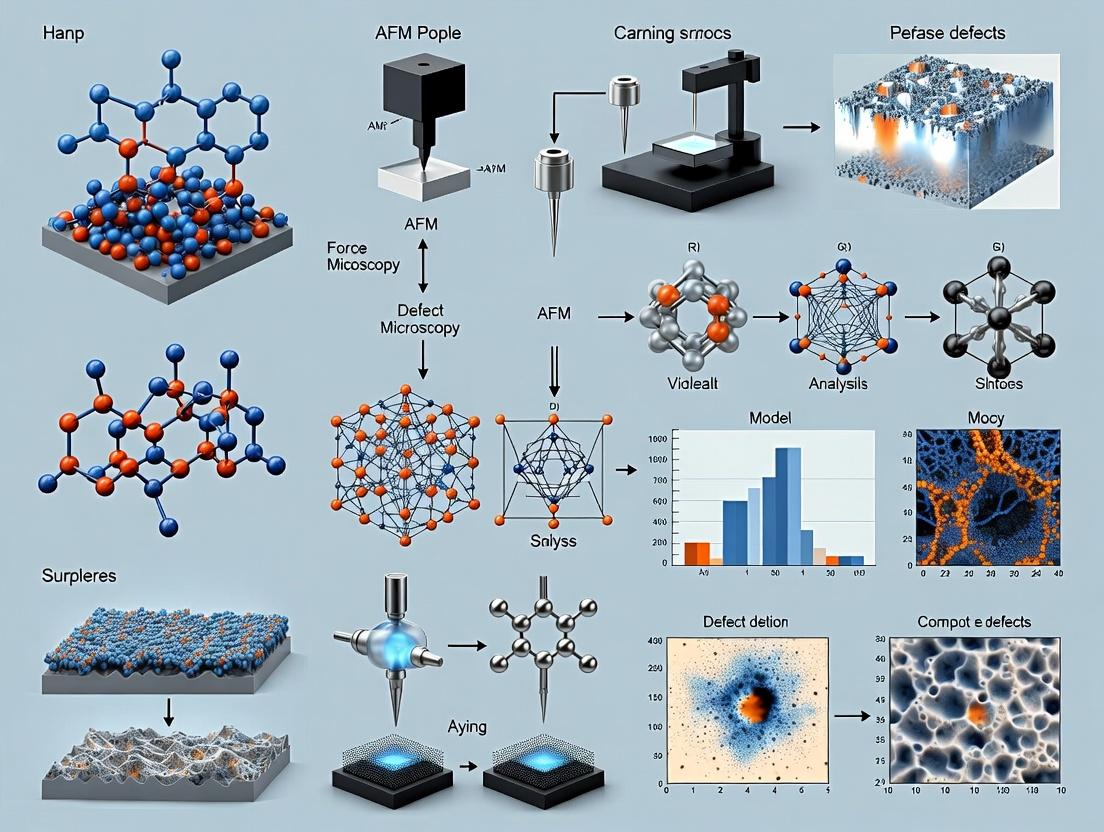
This comprehensive guide explores Atomic Force Microscopy (AFM) as an indispensable tool for analyzing semiconductor surface defects.
Atomic Force Microscopy (AFM) for Semiconductor Surface Defects: A Complete Guide to Analysis, Optimization, and Advanced Applications
Abstract
This comprehensive guide explores Atomic Force Microscopy (AFM) as an indispensable tool for analyzing semiconductor surface defects. We detail foundational AFM principles for defect identification, covering core operational modes like Contact, Tapping, and PeakForce Tapping. The article provides a step-by-step methodological workflow for defect characterization, addresses common troubleshooting and optimization challenges for reliable data, and validates AFM's capabilities through comparative analysis with techniques like SEM and TEM. Designed for researchers, scientists, and process engineers, this resource synthesizes current best practices to enhance yield and reliability in semiconductor manufacturing and advanced material development.
Understanding AFM Fundamentals: How Atomic Force Microscopy Reveals Semiconductor Surface Defects
This application note details the core operating principles of Atomic Force Microscopy (AFM) for probing nanoscale surface topography and mechanical properties. Within the broader thesis on AFM for semiconductor surface defect analysis, these principles form the foundational framework. They enable the correlation of topographic anomalies (e.g., pits, protrusions, pattern irregularities) with local variations in mechanical properties (e.g., modulus, adhesion, hardness), which is critical for identifying root causes of defects in advanced semiconductor fabrication processes.
Core Principles & Quantitative Data
Topography Probing Principle
AFM measures surface topography by scanning a sharp tip attached to a flexible cantilever across a sample. A laser beam reflected off the cantilever onto a photodiode detector monitors the tip's vertical deflection. In contact mode, a constant deflection (force) is maintained, and the scanner's vertical movement maps the topography. In tapping mode, the oscillating cantilever's amplitude or phase change due to tip-sample interaction is used as feedback.
Table 1: Key AFM Operational Modes for Semiconductor Analysis
| Mode | Feedback Parameter | Typical Force | Lateral Resolution | Best For Semiconductor Defects | Key Limitation |
|---|---|---|---|---|---|
| Contact | Constant Deflection | 0.1 - 100 nN | ~0.5 nm | Hard materials, frictional mapping | Sample damage, tip wear |
| Tapping (AM-AFM) | Amplitude Damping | 0.01 - 1 nN (peak) | ~1 nm | Soft/hard surfaces, particle contamination | Phase interpretation complexity |
| PeakForce Tapping | Peak Force (cyclic) | 10 - 500 pN | ~1 nm | High-res mechanical mapping on fragile structures | Optimization of oscillation parameters |
| Non-Contact (FM-AFM) | Frequency Shift | < 0.1 nN | Atomic resolution | Atomic-scale defects, ultra-sensitive surfaces | Requires ultra-high vacuum |
Mechanical Property Probing Principle
Mechanical properties are derived from force-distance (F-D) spectroscopy. The tip is brought into contact with the sample, and the cantilever deflection vs. Z-piezo displacement is recorded. The slope of the contact region indicates stiffness, and adhesion is measured from the pull-off force.
Table 2: Extracted Mechanical Properties from F-D Curves
| Property | Definition | Derived from F-D Curve | Typical Values (Semiconductors) | Relevance to Defect Analysis |
|---|---|---|---|---|
| Reduced Modulus (E*) | Sample stiffness | Slope of the unloading/loading curve | Si: ~130 GPa; SiO₂: ~70 GPa; Low-k dielectric: 5-20 GPa | Identifying material delamination, voids, or contamination. |
| Adhesion Force (F_ad) | Tip-sample attraction | Minimum force during retraction | 1 - 100 nN, varies with humidity & chemistry | Detecting organic residues or hydrophobic/hydrophilic regions. |
| Deformation (δ) | Sample indentation | Difference between piezo & tip motion | Sub-nm to nm scale | Assessing soft contaminants or porous material collapse. |
| Energy Dissipation | Work lost per cycle | Hysteresis area in F-D loop | eV to keV range | Mapping viscoelastic behavior of polymeric residues. |
Detailed Experimental Protocols
Protocol 3.1: Correlative Topography and Modulus Mapping for Defect Identification
Objective: To simultaneously map surface topography and elastic modulus of a semiconductor wafer to identify and characterize sub-surface defects.
Materials: See "The Scientist's Toolkit" below.
Method:
- Sample Preparation: Cleave a ~1 cm x 1 cm sample from the wafer. Use an air duster to remove loose particles. Mount on a magnetic stainless steel puck using double-sided carbon tape.
- Probe Selection & Mounting: Select a silicon probe with a nominal spring constant (k) of 0.4 - 40 N/m and a resonant frequency suitable for tapping or PeakForce mode. Calibrate the spring constant via the thermal tune method.
- System Setup: Load sample. Align laser on the cantilever's end and center the sum signal on the photodiode. Engage in tapping mode on a stable, defect-free region to find setpoint.
- Switch to Quantitative Nanomechanical Mapping (QNM/PeakForce): Transition to the proprietary mode (e.g., Bruker's PeakForce QNM, JPK's QI). Input the calibrated spring constant, deflection sensitivity, and tip radius. Set the PeakForce amplitude (typically 50-150 nm) and frequency (0.25-2 kHz).
- Parameter Optimization: Adjust the PeakForce setpoint to ensure gentle, repulsive contact (force < 1 nN for delicate features). Optimize scan rate (0.5-1 Hz) for a 5 µm x 5 µm area.
- Data Acquisition: Scan the area of interest. Acquire height, DMT modulus, adhesion, and deformation channels simultaneously.
- Analysis: Use the software's grain analysis or section tool to measure defect dimensions (from height). Correlate with modulus map: a subsurface void will appear as a topographic depression with a locally reduced modulus.
Protocol 3.2: Force-Volume Spectroscopy on a Suspected Defect
Objective: To acquire a grid of F-D curves over a region containing a suspected defect to quantitatively compare mechanical properties.
Method:
- Locate Defect: Use optical microscope or a large AFM scan to identify the defect coordinate.
- Define Grid: Over a 2 µm x 2 µm area encompassing the defect, define a 16x16 or 32x32 grid of measurement points.
- Set F-D Parameters:
- Z-length: 500 nm (ensures full approach-retract cycle).
- Approach/Retract Velocity: 500 nm/s to 1 µm/s.
- Trigger Mode: Relative trigger (e.g., trigger on a deflection of 1-5 nN).
- Dwell Time: 0 ms at maximum force to minimize creep.
- Acquisition: Run the force-volume scan. This may take 10-30 minutes.
- Offline Processing: Use the software to fit each F-D curve with an appropriate contact mechanics model (e.g., DMT, Hertz, Sneddon). Generate maps of derived modulus, adhesion, and deformation.
- Statistical Comparison: Use the software's ROI tool to select pixels from the defect and the surrounding reference material. Export data and perform a Student's t-test to determine if the modulus/adhesion difference is statistically significant (p < 0.05).
Diagrams
AFM Core Feedback Loop for Topography
Force-Distance Curve Analysis Workflow
Thesis Correlative Defect Analysis Logic
The Scientist's Toolkit: Research Reagent Solutions
Table 3: Essential Materials for AFM-Based Semiconductor Defect Analysis
| Item | Function & Relevance to Semiconductor Analysis |
|---|---|
| Silicon Probes (Tapping Mode) | Standard topography imaging. High resonance frequency for stability on flat, hard surfaces. |
| Diamond-Coated Probes (Contact Mode) | For wear-resistant scanning of rough surfaces or long-term frictional studies on hard films. |
| Silicon Probes with Conductive Coating (PtIr, Doped Diamond) | For electrical modes (SCM, SSRM) to correlate topographic defects with carrier concentration. |
| PeakForce Tapping Probes (e.g., Bruker ScanAsyst) | Silicon nitride probes with optimized geometry and reflective coating for high-sensitivity force control. Essential for QNM on delicate low-k dielectrics. |
| Calibration Gratings (e.g., TGZ1, PG) | Grids with known pitch and step height for verifying lateral and vertical scanner calibration, critical for defect sizing. |
| Reference Sample for Modulus (e.g., Polystyrene, PDMS) | Samples with known, homogeneous modulus for validating QNM/Force spectroscopy calibration and models. |
| Vibration Isolation Platform | Active or passive isolation table to minimize acoustic/floor vibrations, crucial for high-resolution (<1 nm) defect imaging. |
| Sample Mounting Accessories | Magnetic pucks, double-sided carbon tape, or vacuum chucks to ensure flat, rigid mounting of wafer pieces to prevent drift. |
| Particle-Free Air Duster | To remove environmental contaminants from the sample surface before loading into the AFM, avoiding artifact "defects." |
| Cleaning Solutions (IPA, DI Water) | For probe and sample cleaning protocols, though sample cleaning is often avoided to preserve the native defect state. |
This application note, framed within a broader thesis on Atomic Force Microscopy (AFM) for semiconductor surface defects analysis research, details three primary operational modes: Contact Mode, Tapping Mode, and PeakForce Tapping Mode. Each mode offers distinct advantages for imaging and characterizing nanoscale defects, contamination, and morphological irregularities critical to semiconductor yield and performance, with parallel applications in nanoscale biomaterial analysis for drug development.
Comparative Analysis of AFM Modes
The table below summarizes the key operational parameters, strengths, and limitations of each mode for defect analysis.
| Parameter | Contact Mode | Tapping Mode | PeakForce Tapping Mode |
|---|---|---|---|
| Tip-Sample Interaction | Constant physical contact, sliding. | Intermittent contact, oscillating at resonance. | Precisely controlled, periodic force "taps." |
| Lateral Forces | High, can distort or damage soft samples. | Negligible, minimized by vertical oscillation. | Very low, force control prevents damage. |
| Typical Force Control | Deflection (normal force) is constant via feedback. | Amplitude (or phase) is constant via feedback. | Peak Force is directly set and controlled (pN-nN). |
| Best for Defect Types | Hard, flat, electrically conductive surfaces. | Soft contaminants, polymer residues, sticky layers. | All defect types, especially for quantitative mapping. |
| Quantitative Data | Friction (LFM), topography. | Phase (material contrast), topography. | Adhesion, Modulus, Deformation, Dissipation maps. |
| Risk of Artifact/ Damage | High (scratching, particle sweeping). | Medium-Low. | Very Low. |
| Semiconductor Application | Limited due to high risk of damaging fragile nanostructures. | Common for post-CMP particles and photoresist patterns. | Ideal for advanced node patterning, EUV mask defects, low-k dielectric analysis. |
Detailed Experimental Protocols
Protocol 1: Contact Mode AFM for Scratch/Step Height Analysis on Wafer Surfaces
Objective: To quantify the depth and profile of deliberate scratches or step edges on a test semiconductor wafer.
- Probe Selection: Use a stiff cantilever (spring constant > 0.2 N/m) with a sharp Si3N4 tip to minimize wear.
- Mounting: Secure the wafer sample on a magnetic stub using a conductive adhesive tab.
- Engagement: Approach the surface in a clean, particle-free area using the automated engage routine.
- Feedback Parameter Optimization:
- Set
Setpointto achieve a low, stable deflection (~0.5-1.0 V). - Adjust
IntegralandProportionalgains to maintain tracking without oscillation.
- Set
- Scanning: Acquire a 50 µm x 50 µm topograph at a scan rate of 1.0 Hz and 512 samples/line resolution.
- Analysis: Use plane correction (1st or 2nd order). Draw a line profile across the scratch to measure depth (nm) and full width at half maximum (FWHM).
Protocol 2: Tapping Mode AFM for Nanoparticle Contamination Mapping
Objective: To image and localize sub-100 nm contaminant particles on a silicon oxide surface without dislodging them.
- Probe Selection: Use a standard silicon probe (frequency ~300 kHz, spring constant ~40 N/m).
- Tuning: Before engagement, tune the cantilever to find its resonance frequency (f0). Set the drive frequency to f0.
- Engagement & Setpoint: Engage with a high free amplitude (A0 ~ 100 nm). Reduce the
Setpoint(A/A0) to ~0.7-0.8 for stable imaging. - Dual-Channel Acquisition: Simultaneously acquire the Topography (height) and Phase channels. Phase contrast highlights material differences between particles and substrate.
- Scanning: Acquire a 10 µm x 10 µm image at a scan rate of 0.5 Hz, 512 samples/line.
- Analysis: Use particle analysis software to threshold the phase image, count particles, and determine their areal density (particles/µm²).
Protocol 3: PeakForce Tapping AFM for Quantitative Mechanical Property Mapping of Defects
Objective: To correlate topographic defects with changes in local mechanical properties (elastic modulus, adhesion).
- Probe Selection: Use a probe calibrated for quantitative nanomechanics (spring constant ~0.4 N/m, known tip radius).
- Frequency & Peak Force Setpoint: Set the PeakForce frequency to 1 kHz. Set the
Peak Force Setpointas low as possible while maintaining tracking (50-200 pN). - Multi-Channel Acquisition: Acquire channels for Height, Peak Force Error, DMT Modulus, and Adhesion.
- Scanning: Acquire a 2 µm x 2 µm image at a scan rate of 0.2 Hz, 256 samples/line for sufficient force curve sampling.
- Model Fitting: Ensure the Derjaguin-Muller-Toporov (DMT) model is selected for modulus calculation. Set the Poisson's ratio of the sample (~0.3 for silicon).
- Analysis: Overlay the modulus or adhesion map on the topography. Extract line profiles or region statistics to quantify property differences at defect sites vs. the pristine surface.
The Scientist's Toolkit: Key Research Reagent Solutions
| Item | Function in AFM Defect Analysis |
|---|---|
| Standard Silicon Probes (e.g., RTESPA-300) | General-purpose tapping mode imaging of semiconductor surfaces and contaminants. |
| SCANASYST-FLUID+ Probes | Specialized for PeakForce Tapping in liquid, essential for biological samples in drug development (e.g., protein aggregates on surfaces). |
| Diamond-Coated Probes (e.g., CDT-NCHR) | For contact mode or hard materials imaging; resistant to wear when scanning rough or abrasive surfaces. |
| Conductive Diamond Probes | For electrical modes (SCM, SSRM) to map doping or electrical properties of defects. |
| PFQNE-AL Probes | Designed for high-resolution PeakForce Tapping with a well-defined tip shape for accurate nanomechanical mapping. |
| VLSI Standards Calibration Gratings (e.g., TGZ1, TGX1) | For lateral (XY) and vertical (Z) calibration of the AFM scanner, ensuring quantitative measurement accuracy. |
| Nano-World ARROW-NCR Probes | Ultra-long cantilevers for imaging high-aspect-ratio structures like deep trench defects. |
| Anti-Vibration Table / Acoustic Enclosure | Critical infrastructure to isolate the AFM from building vibrations for stable, high-resolution imaging. |
Visualized Workflows
AFM Mode Selection Workflow for Defect Analysis
Force Curve Yields Quantitative Property Maps
Application Notes: Atomic Force Microscopy (AFM) for Semiconductor Defect Analysis
Within the context of advancing semiconductor surface defects analysis research, Atomic Force Microscopy (AFM) has emerged as a critical tool for non-destructive, three-dimensional nanoscale characterization. Its high resolution enables precise differentiation between common defect types, which is paramount for yield enhancement in manufacturing and for research into next-generation device materials. This analysis is particularly relevant for professionals in advanced materials science and nanotechnology-driven fields, including pharmaceutical development where semiconductor-based biosensors and lab-on-a-chip devices are employed.
AFM operates by scanning a sharp tip across a surface, measuring interatomic forces to map topography. This allows for the unambiguous identification of:
- Particles: Discrete, often spherical or irregular protrusions from the surface.
- Scratches: Linear depressions with characteristic depth profiles and sidewall angles.
- Pitfalls (Pits): Localized, often irregular cavities or voids in the substrate.
- Pattern Discrepancies: Deviations from intended photolithographic patterns, including line edge roughness (LER), bridging, and CD (critical dimension) variation.
The quantitative data derived from AFM, such as root-mean-square (RMS) roughness, defect density, and precise dimensional measurements, provides actionable metrics for process control and root-cause analysis.
Quantitative Defect Characterization Data
Table 1: Typical AFM Measurement Parameters and Defect Signatures
| Defect Type | Key AFM Measurable | Typical Scale (nm) | Characteristic AFM Signature | Primary Impact |
|---|---|---|---|---|
| Particles | Height, Diameter, Density | 20 - 500 | Abrupt, positive topographical change. Spherical or irregular shape. | Short circuits, leakage current, lithography focus errors. |
| Scratches | Depth, Width, Length, Sidewall Angle | Depth: 5-100; Width: 50-1000 | Continuous, linear trench. Cross-sectional profile shows V or U shape. | Conductive path interruption, particle traps, weakened structural integrity. |
| Pits | Depth, Diameter, Spatial Density | 10 - 200 | Localized, negative topographical change. May have steep or sloped sidewalls. | Reduced dielectric thickness, optical scattering, stress concentration points. |
| Pattern Discrepancies | Line Width (CD), LER (3σ), Sidewall Angle | LER: 1-5 nm; CD Variation: ±2-10% | Deviation from designed pattern edge. Quantified via statistical analysis of line profiles. | Device performance variability, timing errors, reduced operational windows. |
Experimental Protocols for AFM-Based Defect Analysis
Protocol 1: Defect Identification and Classification Workflow
Objective: To systematically identify, locate, and classify surface defects on a semiconductor wafer sample. Materials: Semiconductor wafer sample, AFM system (e.g., Bruker Dimension Icon, Park NX20), vibration isolation table, cleanroom wipes, tweezers. Procedure:
- Sample Preparation: Cleave or mount the wafer segment onto an AFM puck using a conductive adhesive tab. Use a clean, dry nitrogen stream to remove loose particles.
- Macro-Location: Use optical microscopy integrated with the AFM to locate the region of interest (e.g., a specific die or a suspected defect zone).
- AFM Setup: Select an appropriate probe (e.g., a high-resolution silicon tip with a resonant frequency of ~300 kHz for tapping mode). Engage the probe and set initial scan parameters.
- Broad Area Scan: Perform a relatively large scan (e.g., 20 μm x 20 μm) in Tapping Mode to identify potential defect sites. Set a moderate resolution (512 x 512 pixels).
- Defect Registration: Note the XY coordinates of any candidate defects (particles, scratches, etc.).
- High-Resolution Imaging: For each defect, perform a higher-resolution scan (e.g., 2 μm x 2 μm at 1024 x 1024 pixels) to obtain detailed topographical data.
- Data Acquisition: Capture height, amplitude, and phase images for each defect site.
- Initial Classification: Based on the 2D/3D topographical renderings, perform a preliminary classification (e.g., particle vs. pit).
Protocol 2: Quantitative Metrology of Defects
Objective: To extract quantitative dimensional data from identified defects. Materials: AFM system with completed scans from Protocol 1, AFM analysis software (e.g., Gwyddion, Bruker NanoScope Analysis). Procedure:
- Image Flattening: Apply a 1st or 2nd order flattening algorithm to the height image to remove sample tilt.
- Particle Analysis:
- Use a "Grain Analysis" or "Particle Analysis" tool. Set a threshold height to isolate the particle.
- Record the base diameter (at Full Width at Half Maximum, FWHM), maximum height, and volume.
- Scratch/Pit Analysis:
- Draw a perpendicular line profile across the defect.
- From the profile plot, measure: Maximum depth, Full Width at Half Maximum (FWHM) or width at top surface, and sidewall angle (using tangent fit).
- Pattern Discrepancy Analysis (for patterned wafers):
- Align a line profile along the feature edge.
- Use "Line Roughness" analysis to calculate Line Edge Roughness (LER) over a specified evaluation length, typically reported as 3σ (three times the standard deviation).
- Use "Step Analysis" to measure the Critical Dimension (CD) at multiple points along a line.
- Statistical Reporting: Compile measurements from multiple identical defects across the sample to calculate mean, standard deviation, and density (defects/cm²).
Diagram: AFM Defect Analysis Workflow
The Scientist's Toolkit: Key Research Reagent Solutions & Materials
Table 2: Essential Materials for AFM-Based Semiconductor Defect Analysis
| Item | Function/Application | Key Considerations |
|---|---|---|
| AFM Probes (Tapping Mode) | Silicon tips for high-resolution topographical imaging of delicate surfaces. | High resonance frequency (~300 kHz), sharp tip radius (<10 nm), consistent spring constant. |
| Conductive AFM Probes | For simultaneous topographical and electrical characterization (e.g., identifying conductive particles). | Pt/Ir or doped diamond-coated tips, low resistance. |
| Wafer Handling Tweezers | For cleaving and mounting wafer fragments without introducing contamination or damage. | Vacuum or smooth, non-marring tips. Cleanroom compatible. |
| Conductive Adhesive Tabs | To securely mount semiconductor samples to the AFM metal puck, ensuring electrical contact if needed. | Low outgassing, stable adhesion. |
| Cleanroom Wipes & Swabs | For gentle cleaning of the sample stage and puck to prevent particulate contamination. | Lint-free, solvent-compatible (e.g., IPA). |
| Vibration Isolation Table | Critical infrastructure to decouple the AFM from ambient floor vibrations for stable imaging. | Active or passive isolation system. |
| Reference Sample Gratings | Calibration artifacts (e.g., pitch, step height) for verifying the AFM's lateral and vertical scanner accuracy. | Traceable standards (e.g., from NIST). |
| Data Analysis Software | For image processing, quantitative measurement, and 3D visualization of AFM data. | Capabilities for grain, roughness, and statistical analysis. |
The Critical Role of Surface Roughness (Ra, Rq) and Step Height Measurements.
This application note is framed within a doctoral thesis investigating the use of Atomic Force Microscopy (AFM) for the analysis of surface defects in advanced semiconductor devices. As feature sizes shrink to the atomic scale, traditional optical inspection tools reach their limits. Surface roughness (quantified by parameters like Ra and Rq) and step height are no longer mere cosmetic metrics; they are critical indicators of process fidelity, directly influencing device performance, yield, and reliability. Precise measurement of these topographical features via AFM is essential for identifying defect origins in deposition, etching, and chemical-mechanical polishing (CMP) processes.
Quantitative Data: Impact of Roughness on Device Parameters
The following table summarizes key findings from recent literature on the relationship between surface topography and semiconductor device characteristics.
Table 1: Impact of Surface Roughness & Step Height on Semiconductor Properties
| Device/Structure | Topography Parameter | Measured Value Range | Impact on Device Performance | Primary Measurement Tool |
|---|---|---|---|---|
| High-k Metal Gate Stack | Ra (Interface) | 0.2 nm vs. 0.5 nm | ~15% change in effective oxide thickness (EOT); increased gate leakage current. | Tapping Mode AFM, TEM cross-section. |
| FinFET Sidewall | Rq (Line Edge Roughness) | < 1.0 nm (target) | Rq > 1.2 nm leads to significant variability in threshold voltage (Vt) and drive current. | High-resolution Tapping Mode AFM. |
| Cu Interconnects (post-CMP) | Ra (Field Region) | 0.3 - 1.0 nm | Ra > 0.7 nm correlates with increased scattering, leading to >10% rise in line resistance. | ScanAsyst or Contact Mode AFM. |
| Epitaxial SiGe Layer | Step Height (Terrace) | Target: 0.314 nm (monolayer) | Step height deviation > ±0.05 nm indicates misfit dislocation or poor epitaxial quality. | Atomic-resolution AFM in Contact Mode. |
| Photoresist Pattern | Sidewall Angle & Roughness | Rq < 2 nm (sidewall) | High sidewall Rq causes line-width roughness (LWR), degrading pattern transfer fidelity. | Tilt-compensated 3D-AFM. |
Experimental Protocols
Protocol 3.1: AFM Measurement of Ra and Rq for a CMP Wafer
Objective: To quantitatively assess the global and local roughness of a silicon oxide surface after chemical-mechanical polishing. Materials: See "The Scientist's Toolkit" (Section 5). Method:
- Sample Preparation: Cleave a 1cm x 1cm sample from the wafer. Use a filtered nitrogen gun to remove particulate contaminants. Mount securely on a magnetic or adhesive AFM sample disc.
- AFM Calibration: Calibrate the AFM scanner's lateral (XY) and vertical (Z) piezos using a traceable grating standard (e.g., 1μm pitch, 180nm step height).
- Image Acquisition:
- Mode: Tapping Mode (Air) or ScanAsyst Mode.
- Probe: Use a high-frequency silicon tip (e.g., 300 kHz).
- Scan Area: Acquire images at multiple scales: 10μm x 10μm (global), 1μm x 1μm (local).
- Resolution: Set to 512 samples/line for the 1μm scan.
- Scan Rate: 0.5 - 1.0 Hz.
- Data Processing (First-Order Plane Fit):
- Apply a first-order (linear) plane fit to the raw data to remove sample tilt.
- Apply no additional filtering for Ra/Rq calculation.
- Analysis:
- Select a representative, defect-free region.
- Calculate Ra (Arithmetic Average Roughness): Ra = (1/L) ∫\|Z(x)\| dx
- Calculate Rq (Root Mean Square Roughness): Rq = √[ (1/L) ∫ Z(x)² dx ]
- Report both values with scan size and analysis area noted.
Protocol 3.2: Step Height Measurement for a Shallow Trench Isolation (STI) Structure
Objective: To precisely measure the depth of an STI structure, critical for device isolation. Method:
- Sample & Tool Prep: As per Protocol 3.1. Use a sharp, high-aspect-ratio tip for accurate sidewall profiling.
- Image Acquisition:
- Mode: Tapping Mode.
- Scan Area: Orient the scan perpendicular to the trench. Use a 5μm x 5μm area encompassing several trenches.
- Resolution: Increase to 1024 samples/line for precise edge definition.
- Data Processing (Leveling):
- Apply a first-order plane fit.
- Use a "Line-by-Line" leveling function to correct for bow.
- Analysis (Step Height):
- Draw multiple cross-sectional line profiles (≥10) across the trench.
- For each profile, use the AFM software's step height tool. Manually define upper and lower plateau regions, ensuring they are free of artifacts.
- The software calculates the vertical distance between the average heights of the two plateaus.
- Report the average step height and standard deviation across all measurements.
Visualizations: AFM Defect Analysis Workflow
Title: AFM Surface Metrology Feedback Loop for Defect Analysis
Title: Correlation Chain: AFM Metrics to Device Failure
The Scientist's Toolkit: Essential Research Reagent Solutions
Table 2: Key Materials for AFM-Based Semiconductor Surface Analysis
| Item Name / Solution | Function / Purpose | Critical Specifications |
|---|---|---|
| Silicon AFM Probes (Tapping Mode) | High-resolution imaging of delicate surfaces without damage. | Frequency: 250-400 kHz; Force Constant: 20-80 N/m; Tip Radius: <10 nm. |
| Diamond-Like Carbon (DLC) Coated Probes | For scanning abrasive or hard materials (e.g., SiC, hardened films) to prolong tip life. | Extremely high wear resistance. |
| Scanner Calibration Gratings | Traceable calibration of AFM scanner in X, Y, and Z axes. Essential for quantitative data. | Certified pitch (e.g., 1.0 ± 0.01 μm) and step height (e.g., 180 ± 5 nm). |
| Particle-Free Nitrogen Gas Gun | Safe sample cleaning to remove ambient particulates prior to AFM scan. | 0.1 μm filtered, regulated pressure. |
| Vibration Isolation Platform | Mitigates environmental noise (floor vibration, acoustic) to achieve atomic-level resolution. | Resonance frequency < 1.0 Hz. |
| Sample Mounting Adhesive | Securely fixes small wafer fragments to the AFM sample disk without introducing topography. | Double-sided, low-outgassing, non-creeping adhesive. |
| Antistatic Gun / Source | Neutralizes static charge on insulating samples (e.g., oxides) that can attract particles or destabilize the AFM cantilever. | Ionizing, non-contaminating. |
| UV-Ozone Cleaner | For advanced sample prep to remove trace organic contaminants from surfaces. | Produces atomic-level clean surfaces for fundamental studies. |
This application note is framed within a thesis focused on leveraging Atomic Force Microscopy (AFM) for the comprehensive analysis of semiconductor surface defects. A core challenge in this field is balancing the need for ultra-high-resolution imaging with operational practicality. Traditional vacuum-based techniques, such as Scanning Electron Microscopy (SEM) or Transmission Electron Microscopy (TEM), offer high resolution but impose significant sample environment limitations. In contrast, modern AFM enables sub-nanometer resolution imaging under ambient conditions (or even in liquid), providing a unique and critical advantage for studying real-world semiconductor surfaces, organic contaminants, and thin film morphologies without complex sample preparation.
Comparative Quantitative Data: AFM vs. Vacuum Techniques
Table 1: Performance Comparison of Surface Analysis Techniques
| Feature / Parameter | Ambient AFM (e.g., Tapping Mode) | Vacuum SEM | Vacuum TEM | High-Vacuum AFM |
|---|---|---|---|---|
| Best Resolution (Vertical) | < 0.1 nm | ~ 0.5 nm | < 0.05 nm | < 0.05 nm |
| Best Resolution (Lateral) | ~ 0.5 nm | 0.4 - 1 nm | < 0.1 nm | ~ 0.2 nm |
| Operational Environment | Ambient, Liquid, Gas | High Vacuum (~10⁻⁶ mbar) | Ultra-High Vacuum (~10⁻¹⁰ mbar) | High Vacuum (~10⁻⁶ mbar) |
| Sample Preparation Complexity | Minimal | Moderate (conductive coating often required) | High (ultra-thin sectioning) | Moderate (cleaning, drying) |
| Measurement Throughput | Medium (min-hr/scan) | High (sec-min/scan) | Low (hrs for prep+imaging) | Low-Medium (min-hr/scan) |
| 3D Topography Data | Yes (Direct) | No (Inferred) | No | Yes (Direct) |
| Quantitative Mechanical Data | Yes (Modulus, Adhesion) | No | Limited | Yes (Modulus, Adhesion) |
| Electrical Characterization | Yes (SSRM, KPFM) | Limited (EDS) | Yes (EELS) | Yes (SSRM, KPFM) |
Detailed Application Notes
Application Note AN-1: In-situ Analysis of Post-CMP Wafer Defects
Objective: To identify and classify sub-nanometer haze and residual particles on a silicon wafer post-chemical mechanical planarization (CMP) without introducing vacuum-induced artifacts. Challenge in Vacuum: SEM may cause charging on insulating residues and cannot reliably measure step heights of shallow scratches (<1 nm). AFM Advantage: Operates in ambient air, allowing immediate analysis of wet wafers after a nitrogen dry. Tapping mode AFM provides true 3D topography, distinguishing between a 0.3-nm high adsorbed organic layer and a 0.8-nm deep scratch with clarity. Protocol: See Section 4.1.
Application Note AN-2: Characterization of Organic Photoresist Sidewall Roughness
Objective: Measure Line Edge Roughness (LER) and sidewall nanoscale imperfections of a 10-nm photoresist feature. Challenge in Vacuum: SEM electron beam can alter or damage organic resist materials, leading to inaccurate measurements. AFM Advantage: Ambient operation with a super-sharp tip (tip radius < 5 nm) enables non-destructive, high-resolution profiling of sensitive organic structures. PeakForce Tapping mode quantifies nanomechanical variation (elastic modulus) along the sidewall, correlating roughness with local material properties.
Experimental Protocols
Protocol P-1: Ambient AFM for Sub-nm Wafer Defect Mapping
Title: Protocol for Ambient Tapping Mode AFM Analysis of Semiconductor Wafers. Objective: To image and quantify topographical defects with sub-nanometer vertical resolution on a 300mm Si wafer.
I. Materials & Pre-imaging Sample Prep
- Sample: 300mm silicon wafer, post-CMP, stored in ISO Class 3 cleanroom.
- Cleaning: Use a critical point dryer or a gentle nitrogen gas stream to remove airborne particulates. Avoid touching the active surface.
- Mounting: Affix the wafer to a 200mm AFM puck using a double-sided carbon tab or a custom wafer holder. Ensure secure, vibration-free mounting.
II. Instrument Setup (Bruker Dimension Icon used as example)
- Scanner Calibration: Perform thermal and linearity calibration using a traceable pitch standard (e.g., 180 nm grating).
- Probe Selection: Install a high-resolution silicon tip (e.g., Bruker RTESPA-300, nominal tip radius < 8 nm, resonance frequency ~300 kHz).
- Environment: Conduct experiment on an active vibration isolation table within a cleanroom or acoustic enclosure. Record ambient temperature and humidity.
III. Imaging Parameters
- Mode: Tapping Mode in air.
- Scan Area: Start with a 50µm x 50µm scan to locate defects, then zoom to 5µm x 5µm and 1µm x 1µm regions of interest.
- Resolution: Set to 1024 x 1024 pixels for the 1µm scan, yielding a pixel resolution of ~1 nm.
- Scan Rate: 0.5 - 1.0 Hz.
- Setpoint: Adjust amplitude setpoint to ~80% of the free air amplitude for optimal engagement.
- Feedback Gains: Optimize Proportional (P) and Integral (I) gains to minimize image artifacts while tracking topography.
IV. Data Acquisition & Analysis
- Acquire both height and phase images.
- Flattening: Apply a 0th or 1st order flattening algorithm to the height image.
- Defect Analysis: Use particle analysis software to identify and count defects. Use cross-sectional analysis to measure scratch depth/particle height with sub-nm precision.
- Roughness Metrics: Calculate RMS (Rq) and Average (Ra) roughness over defect-free areas.
Protocol P-2: Correlative SEM-AFM Analysis for Deep Defect Investigation
Title: Protocol for Sequential Vacuum SEM and Ambient AFM on the Same Defect. Objective: To leverage SEM for rapid defect location and AFM for high-resolution 3D metrology and nanomechanical mapping.
- Initial SEM (Vacuum) Imaging:
- Load sample into FE-SEM.
- Locate region of interest (ROI) using low-dose imaging conditions.
- Capture secondary electron image and note stage coordinates or use navigational marks.
- Sample Transfer:
- Vent the SEM chamber and carefully unload the sample.
- Minimize exposure to ambient contaminants. Transfer directly to AFM.
- AFM (Ambient) Imaging:
- Mount sample on AFM stage.
- Use optical microscope or stage coordinates to relocate the exact SEM ROI.
- Perform high-resolution PeakForce Quantitative Nanomechanical Mapping (QNM) scan over the defect.
- QNM Parameters: Engage in PeakForce Tapping mode. Calibrate tip sensitivity and spring constant. Set PeakForce amplitude to 50-100 pN. Map DMT modulus and adhesion simultaneously with topography.
- Data Correlation: Overlay AFM topography and modulus maps with the SEM micrograph using software alignment tools to create a comprehensive defect profile.
Diagrams
Decision Workflow for Surface Defect Analysis
Ambient AFM Wafer Defect Analysis Workflow
The Scientist's Toolkit: Key Research Reagent Solutions
Table 2: Essential Materials for Ambient AFM Semiconductor Defect Studies
| Item / Reagent | Function & Relevance |
|---|---|
| High-Resolution AFM Probes (e.g., Si tip, < 8 nm radius) | Core sensor for achieving sub-nanometer lateral resolution. Coated (Pt/Ir) variants enable electrical modes. |
| Vibration Isolation Platform | Critical for stabilizing measurements to the sub-nm level in ambient environments with acoustic and floor vibrations. |
| Acoustic Enclosure | Further dampens airborne noise that can couple into the AFM head, reducing imaging artifacts. |
| Calibration Gratings (TGZ, PG, HS) | Traceable pitch and height standards (e.g., 180 nm pitch, 7 nm step) for daily verification of scanner and z-axis accuracy. |
| Critical Point Dryer | Prepares wet or rinsed samples without inducing surface tension artifacts (e.g., water marks) that mimic defects. |
| Particle/Nanoindentation Reference Samples (e.g., nanoparticles on Si) | Used to verify tip shape, particle analysis algorithms, and nanomechanical calibration. |
| Cleanroom Supplies (N2 gun, anti-static tweezers, carbon tabs) | Minimizes introduction of new contaminants during sample handling and mounting. |
| PeakForce QNM Calibration Kit | Includes a polystyrene/low-density polyethylene sample for calibrating the nanomechanical properties mapping (DMT modulus). |
AFM Operational Workflow: Step-by-Step Protocol for Semiconductor Defect Characterization
Sample Preparation Best Practices for Wafers and Processed Semiconductor Surfaces
This application note outlines critical sample preparation protocols for Atomic Force Microscopy (AFM) analysis within semiconductor defect research. Proper preparation is paramount to obtaining artifact-free, high-resolution data that accurately reflects surface topography and electronic properties.
Foundational Cleaning Protocols
Contaminants (particles, organic residues, native oxides) are the primary source of measurement artifacts. The following sequential cleaning procedures are recommended prior to AFM analysis.
Table 1: Standardized Cleaning Sequences for Various Surfaces
| Wafer/ Surface Type | Primary Contaminant Target | Recommended Protocol Sequence | Key Parameters & Notes |
|---|---|---|---|
| Virgin Silicon (Si) | Particles, organic films | 1. Piranha (H₂SO₄:H₂O₂ 3:1) soak2. SC-1 (NH₄OH:H₂O₂:H₂O 1:1:5) dip3. HF (1-2%) dip4. DI water rinse & N₂ dry | CAUTION: Piranha is highly exothermic. HF requires proper PPE. HF step removes native oxide. |
| Processed Wafers (with films) | Particles, light organics | 1. Modified SC-1 (diluted 1:1:50) or surfactant clean2. IPA rinse3. DI water megasonic rinse4. Spin-rinse-dry | Use diluted SC-1 to minimize attack on metal lines or porous low-κ dielectrics. Megasonic energy <100W. |
| III-V Compounds (GaAs, InP) | Native oxides, carbon | 1. Acetone soak (ultrasonic)2. Isopropanol (IPA) rinse3. HCl (36%) dip (e.g., 1 min for GaAs)4. DI water rinse & N₂ dry | HCl selectively removes oxide. Avoid basic solutions (NH₄OH) which can roughen surfaces. |
| Post-CMP Surfaces | Slurry particles, residues | 1. Alkaline surfactant clean (pH~10)2. Citric acid (1-5%) dip3. DI water megasonic rinse4. Marangoni drying | Citric acid chelates metal ions. Marangoni drying prevents watermarks. |
Protocol 1.1: Standard RCA-Based Clean for Si Surfaces
- Materials: Fume hood, PTFE wafer carriers, DI water supply, N₂ gun.
- SC-1 Solution: Prepare fresh by mixing NH₄OH (29%): H₂O₂ (30%): H₂O at 1:1:5 ratio at 70-80°C.
- Procedure:
- Piranha Clean: Immerse wafer in piranha solution for 10-15 minutes. Remove, rinse thoroughly with DI water.
- SC-1 Clean: Immerse wafer in SC-1 solution for 10 minutes to remove organic residues and particles. Rinse in flowing DI water for >2 minutes.
- Oxide Strip: Dip wafer in 2% Hydrofluoric Acid (HF) for 60 seconds to achieve a hydrophobic, hydrogen-terminated surface.
- Final Rinse & Dry: Rinse in DI water for 1 minute and dry immediately with a filtered, high-purity N₂ jet. Analyze promptly.
Protocol for Cross-Sectional AFM Sample Preparation
Analyzing cross-sections is essential for defect analysis in multilayer stacks and for measuring layer thickness/roughness.
Protocol 2.1: Cleaving and Mounting for Cross-Sectional AFM
- Materials: Precision wafer scribe, cleaving tool (for brittle materials), cyanoacrylate adhesive or crystal bond, low-outgassing metal specimen puck, optical microscope.
- Procedure:
- Scribing: Using a diamond scribe under a microscope, create a shallow, straight scribe line on the backside of the wafer along the desired cleave direction (e.g., <110> for Si).
- Cleaving: Place the wafer on a clean, flat surface with the scribe line aligned over a straight edge. Apply quick, downward pressure on the overhang to cleave. For delicate processed wafers, use a precision cleaving tool.
- Mounting: Affix the cleaved cross-section sample vertically to a metal puck using a minimal amount of adhesive (e.g., a tiny dot of cyanoacrylate at the base). Ensure the region of interest is at the top and unobstructed.
- Cure: Allow adhesive to fully cure. Inspect under an optical microscope to ensure the cross-section edge is clean and protruding sufficiently for AFM tip access.
Handling and Storage Best Practices
- Immediate Analysis: Ideally, prepared samples should be analyzed within hours to minimize recontamination or re-oxidation.
- Storage: If storage is necessary, place samples in a clean, dry nitrogen-purged desiccator or in a vacuum load-lock chamber (<10⁻³ Torr).
- Handling: Always use powder-free nitrile gloves and cleanroom tweezers with smooth, non-scratching tips. Handle wafers by the edges only.
The Scientist's Toolkit: Essential Research Reagent Solutions
Table 2: Key Reagents for Semiconductor Surface Preparation
| Reagent Solution | Typical Composition/Example | Primary Function in Preparation |
|---|---|---|
| Piranha (aka SPM) | H₂SO₄ : H₂O₂ (3:1 to 4:1) | Removes heavy organic contaminants and photoresist via powerful oxidation. |
| SC-1 (RCA-1) | NH₄OH : H₂O₂ : H₂O (1:1:5 to 1:2:7) | Removes organic films and lifts off particles through under-etching and electrostatic repulsion. |
| SC-2 (RCA-2) | HCl : H₂O₂ : H₂O (1:1:6 to 1:2:8) | Removes metallic ions and contaminants from the surface. |
| Diluted Hydrofluoric Acid (dHF) | HF : H₂O (1:50 to 1:100) | Selectively etches silicon dioxide and other metal oxides, creating a hydrophobic, passivated surface. |
| Semiconductor-Grade Solvents | Acetone, IPA, Methanol (ultra-high purity) | Dissolves and rinses away organic solvents and grease in initial cleaning steps. |
| Surfactant-based Cleaners | Tetramethylammonium hydroxide (TMAH) or proprietary formulations | Reduces surface tension and enhances particle removal, especially for post-CMP and patterned wafers. |
Visualization of Protocols and Relationships
Diagram Title: AFM Sample Prep Decision & Workflow for Semiconductor Defect Analysis
Diagram Title: Chemical Cleaning Target-Action-Result Pathway for AFM Prep
This application note provides a targeted guide for selecting Atomic Force Microscopy (AFM) probes to characterize common nanoscale defects on semiconductor surfaces. The selection is contextualized within a thesis focused on correlating surface defect morphology and electronic properties with device performance degradation. Optimal probe choice is critical for accurate topographical measurement, minimizing tip convolution, and enabling advanced electrical or mechanical property mapping.
Probe Parameter Selection Table
The following table summarizes the recommended probe characteristics for imaging and analyzing specific defect types prevalent in semiconductor manufacturing.
Table 1: AFM Probe Selection Guide for Semiconductor Surface Defects
| Defect Type | Key Measurable | Recommended Tip Radius | Recommended Coating | Recommended Resonance Frequency (in air) | Primary Imaging Mode |
|---|---|---|---|---|---|
| Gate Oxide Pinholes / Pits | Depth, sidewall angle, lateral dimensions. | Ultra-sharp (<10 nm) | Conductive Diamond-like Carbon (DLC) or PtIr | High (>300 kHz) | Tapping Mode, TUNA (for conductivity) |
| Chemical-Mechanical Polishing (CMP) Scratches | Depth profile, cross-sectional shape, roughness. | Medium (15-25 nm) Si or SiN | None (uncoated Si) or Al reflective | Medium-High (150-320 kHz) | Tapping Mode, Non-Contact Mode |
| Epitaxial Stacking Faults & Dislocations | Surface step height, strain-induced topography. | Ultra-sharp (<10 nm) | None (uncoated Si) for high resolution | Very High (>400 kHz) | Tapping Mode, PeakForce Tapping |
| Metal Contamination & Nanoparticles | Particle height, distribution, adhesion forces. | Medium-Sharp (~10-15 nm) | Conductive (PtIr) for identification | Medium (70-150 kHz) | Tapping Mode, Lift Mode (EFM/KPFM) |
| Lithography Line Edge Roughness (LER) | Sidewall profile, 3D roughness parameters. | High-Aspect Ratio, sharp tip (<10 nm radius) | Conductive Diamond or PtIr | High (>300 kHz) | Tapping Mode, 3D-AFM |
| Charge Trapping in Dielectrics | Surface potential variation, charge distribution. | Conductive tip (any radius, as needed for topography) | Doped Diamond or PtIr | Tuned to application (70-350 kHz) | Kelvin Probe Force Microscopy (KPFM) |
Experimental Protocols
Protocol 1: Imaging and Electrical Analysis of Gate Oxide Pinholes
Objective: To locate, topographically characterize, and assess the local conductivity of pinhole defects in a thin gate oxide layer. Materials: Conductive DLC-coated AFM probe, p-type Si wafer with thermal oxide, conductive AFM holder. Procedure:
- Probe Calibration: Perform thermal tuning to determine the exact resonance frequency and spring constant of the conductive probe.
- Topographic Survey: Engage in Tapping Mode at a scan rate of 0.5-1 Hz over a 5 µm x 5 µm area to identify defect locations.
- High-Resolution Imaging: Zoom into a region containing a suspected pinhole (1 µm x 1 µm). Optimize setpoint and drive amplitude for fine feature resolution.
- Conductive AFM (c-AFM) / TUNA Measurement: Switch to contact mode with a applied DC bias (e.g., +2V to sample). Scan the same area while measuring the current through the tip. Pinholes will show significantly higher current leakage.
- Data Correlation: Overlay the topography and current maps to confirm conductive spots correspond to topographical pits.
Protocol 2: Quantifying Lithography Line Edge Roughness (LER)
Objective: To obtain a three-dimensional profile of a photoresist line and calculate line edge roughness parameters (e.g., Ra, Rq). Materials: High-aspect ratio, conductive diamond-coated probe, semiconductor wafer with patterned photoresist lines. Procedure:
- Probe Alignment: Align the probe and scan axis precisely perpendicular to the line feature to ensure accurate sidewall tracking.
- 3D-AFM Scanning: Use Tapping Mode with a high-resolution scan (512 x 512 pixels) over a line segment (e.g., 2 µm length). Ensure the z-range is sufficient for the line height.
- Image Processing: Flatten the raw data using a first-order plane fit. Extract a cross-sectional profile at multiple points along the line.
- Edge Detection & Analysis: Use dedicated LER analysis software. For each profile, define the top and bottom thresholds (e.g., 10% and 90% of line height). The software extracts the edge points and calculates roughness statistics per industry standards (e.g., SEMI P49).
Visualization of Probe Selection Logic
Title: Decision Logic for AFM Probe Selection
The Scientist's Toolkit: Key Research Reagents & Materials
Table 2: Essential Materials for AFM-Based Defect Analysis
| Item | Function in Research |
|---|---|
| Conductive DLC-Coated Probe | Enables simultaneous topography and nanoscale electrical measurements (c-AFM, KPFM) on insulating layers. |
| Ultra-Sharp Silicon Probe (TIP <10 nm) | Minimizes tip convolution for accurate imaging of step edges, dislocations, and fine roughness. |
| High-Aspect Ratio Diamond Tip | Faithfully traces steep sidewalls of trenches and lines for 3D metrology and LER analysis. |
| Vibration Isolation Enclosure | Critical for achieving atomic-scale resolution by isolating the AFM from ambient acoustic and floor vibrations. |
| Sample Cleaning Kit (e.g., UV-Ozone, Solvents) | Ensures contamination-free surfaces to prevent artefactual defects and probe contamination. |
| Calibration Grating (e.g., TGZ1, PG) | Provides traceable standards for verifying lateral (X,Y) and vertical (Z) scanner accuracy and tip integrity. |
| Conductive Sample Mounting Tape | Provides electrical grounding for the sample during electrical modes (KPFM, EFM, c-AFM). |
| Anti-Static Gun | Neutralizes static charge on samples and equipment to prevent electrostatic attraction artefacts. |
Within the broader thesis on Atomic Force Microscopy (AFM) for semiconductor surface defects analysis, achieving high-fidelity imaging is paramount. The reliable identification and characterization of nanoscale defects—such as pits, particles, and pattern irregularities—directly depend on the precise optimization of three core operational parameters: scan rate, resolution (pixels per line), and setpoint (feedback force). Misconfiguration leads to artifacts, tip degradation, or missed critical data, compromising research on device failure mechanisms. This application note provides a current, detailed protocol for establishing optimal parameters for contact mode AFM imaging of semiconductor surfaces.
| Parameter | Typical Range for Semiconductor Imaging | Optimal Starting Point | Primary Effect on Image Quality | Risk if Too High | Risk if Too Low |
|---|---|---|---|---|---|
| Scan Rate (Hz) | 0.5 - 2.0 Hz | 1.0 Hz | Controls temporal resolution & tracking. | Tip drag, surface damage, distortion. | Thermal drift effects, long scan times. |
| Resolution (pixels) | 256 - 1024 px/line | 512 x 512 px | Defines spatial sampling density. | Very large files, slow scanning. | Loss of critical defect detail. |
| Setpoint (nN or V) | 0.5 - 10 nN (varies by mode) | 1-2 nN (Contact); 80-90% Amplitude (Tapping) | Controls tip-sample interaction force. | Surface/tip damage, compressed features. | Poor tracking, noise, tip instability. |
Experimental Protocol: Iterative Optimization for Defect Analysis
Protocol 1: Baseline Calibration on Reference Sample
Objective: Establish a damage-free, stable imaging baseline.
- Sample: Use a standardized grating (e.g., TGZ1 or TGX1) with known pitch (e.g., 3 µm).
- Cantilever Selection: Install a silicon nitride tip for contact mode (nominal k ~ 0.1 N/m) or silicon tip for tapping mode (nominal k ~ 40 N/m). Record the resonant frequency and spring constant.
- Initial Parameters:
- Setpoint: Engage at a very low force (setpoint voltage near free-air deflection).
- Scan Rate: 0.5 Hz.
- Resolution: 256 x 256 pixels.
- Scan Size: 5 µm x 5 µm.
- Optimization Sequence: a. Adjust Setpoint: Incrementally increase the force (lower setpoint voltage) until a stable trace/retrace loop is observed with minimal error signal. Target < 10% RMS error. b. Optimize Resolution: Increase to 512 x 512 pixels. Ensure the known feature dimensions are accurately reproduced. c. Adjust Scan Rate: Gradually increase the rate until the error signal shows signs of increase or image distortion appears. Use this as the maximum allowable rate.
- Validation: Measure the pitch of the grating. The value must be within ±2% of the certified value.
Protocol 2: Defect Imaging on Semiconductor Wafer
Objective: Image unknown defects with high fidelity and minimal artifact introduction.
- Locate Region of Interest (ROI): Use optical or integrated video microscopy to navigate to a pre-marked defect area.
- Perform Large-Area Survey:
- Use the Optimal Starting Point parameters from the table on a 20 µm x 20 µm area.
- Analyze for defect location and type.
- High-Resolution Defect Scan:
- Center the defect and reduce scan size to 2 µm x 2 µm.
- Increase Resolution to 1024 x 1024 pixels.
- Reduce Scan Rate by 50% (e.g., to 0.5 Hz) to ensure accurate tracking over steep defect edges.
- Fine-tune Setpoint: Slightly reduce the force (increase setpoint) if the defect appears "smeared," or increase it if the tip is losing contact.
- Data Acquisition: Capture both height and deflection/error signal images. The error signal often highlights defect edges with enhanced contrast.
Logical Workflow for Parameter Optimization
Diagram Title: AFM Parameter Optimization Workflow for Defect Imaging
The Scientist's Toolkit: Key Research Reagent Solutions
| Item | Function in Semiconductor AFM Analysis |
|---|---|
| Standard Calibration Gratings (TGZ/TGX Series) | Provides traceable vertical and lateral dimensional references for scanner calibration and parameter validation. |
| SiO₂/Si Wafers with Patterned Features | Used as control samples with known topography to test parameter sets before analyzing unknown defect wafers. |
| Particle Contamination Reference Samples | Samples with monodisperse polystyrene or silica spheres of known size (e.g., 100nm) for assessing imaging fidelity on particulate defects. |
| Deionized Water & Isopropyl Alcohol (IPA) | For safe sample cleaning to remove ambient contaminants without damaging semiconductor structures. |
| PFPE-Based Lubricant (for Tribology Studies) | Applied in controlled studies to simulate the effect of chemical-mechanical planarization (CMP) residues on surface imaging. |
| Soft Contact Mode Cantilevers (k ~ 0.1 N/m) | Minimize surface deformation during contact mode imaging of delicate structures or soft contamination. |
| High-Resonant Frequency Tapping Mode Tips (f > 300 kHz) | Enable stable imaging of steep, high-aspect-ratio semiconductor features with minimal lateral force. |
Atomic Force Microscopy (AFM) has evolved from a pure topographic imaging tool to a multifunctional platform for nanoscale characterization. Within semiconductor defect analysis, correlating a defect's topography with its electrical and mechanical properties is critical for understanding failure mechanisms, strain effects, and local performance variations. This application note details the integration of Conductive AFM (CAFM), Kelvin Probe Force Microscopy (KPFM), and nanoindentation for comprehensive defect analysis, framed within a thesis on advanced AFM methodologies for semiconductor surfaces.
Table 1: Comparison of Key AFM-Based Techniques for Defect Analysis
| Technique | Primary Measurand | Lateral Resolution | Key Output on Defects | Typical Application on Semiconductors |
|---|---|---|---|---|
| Conductive AFM (CAFM) | Local current (I) vs. voltage (V) | 5-20 nm | Defect conductivity, leakage current sites, I-V curves at nanoscale. | Mapping conductive filaments, oxide breakdown spots, dislocation conductivity. |
| Kelvin Probe Force Microscopy (KPFM) | Contact Potential Difference (CPD) | 20-50 nm | Surface potential, work function variation, trapped charge. | Imaging charge trapping at grain boundaries, doping variations, defect charge states. |
| Nanoindentation | Force (F) vs. displacement (δ) | 100-500 nm (tip radius dependent) | Reduced elastic modulus (Er), hardness (H), plasticity onset. | Measuring strain fields around dislocations, mechanical degradation of low-k dielectrics. |
Table 2: Typical Quantitative Data from Defect Measurements
| Defect Type | CAFM Current Range | KPFM ΔCPD Range | Nanoindentation Modulus Change | Implied Property |
|---|---|---|---|---|
| Single Dislocation (Si) | 1-10 pA (enhanced) | +20 to +100 mV | -5% to -15% (local softening) | Strain-induced band gap narrowing, local plasticity. |
| Grain Boundary (Perovskite) | 10 pA - 1 nA (leakage) | -50 to -300 mV | Not Typically Measured | Enhanced ion migration, non-radiative recombination. |
| Oxide Pinhole Defect | 10 nA - 1 µA (high) | +100 to +500 mV | -20% to -40% (void) | Direct conductive short, localized dielectric failure. |
| Ion Implantation Damage | Variable (dopant dependent) | -200 to +200 mV | +10% to +30% (hardening) | Amorphization, compressive/tensile strain, doping activation. |
Experimental Protocols
Protocol 3.1: Correlative CAFM and KPFM on Electronic Defects
Objective: To simultaneously map the topography, conductivity, and surface potential of a defect site (e.g., a stacking fault or grain boundary) on a semiconductor surface.
Materials & Sample Prep:
- Sample: Patterned semiconductor wafer (e.g., Si, GaN) or thin-film device (e.g., perovskite solar cell).
- Substrate Preparation: Clean via standard RCA protocol. For air-sensitive samples, use glovebox transfer.
- AFM Probe Selection:
- CAFM/KPFM: Pt/Ir-coated conductive probe (e.g., BudgetSensor ContE-G), force constant ~0.2-5 N/m, resonance frequency ~13-75 kHz.
- Calibrate deflection sensitivity and spring constant prior to measurement.
Procedure:
- Mounting: Secure sample on a grounded metal puck using conductive tape.
- Topography: Engage in intermittent contact (tapping) mode to obtain a high-resolution topographic image of the region of interest.
- Electrical Setup:
- Connect the conductive probe to a current amplifier (sensitivity: 1 pA - 100 nA).
- Connect the sample back-contact to a bias source. For KPFM, this is also the feedback input.
- Lift-Mode KPFM:
- Perform a primary topographic line scan.
- On the second pass (lift height: 10-50 nm), the probe follows the stored topography.
- Apply an AC voltage (ω, ~1-10 V) to the probe and use a lock-in amplifier to nullify the electrostatic force by applying a DC bias (VDC). This VDC equals the CPD.
- CAFM Measurement:
- Switch to contact mode with a low applied force (~10 nN) to maintain electrical contact and minimize tip wear.
- Apply a DC bias (e.g., ±1-5 V) to the sample.
- Map the local current simultaneously with topography. For I-V spectroscopy, position the tip over the defect and sweep bias.
- Data Correlation: Overlay CAFM current and KPFM CPD maps onto the topography using analysis software to pinpoint defect coordinates and properties.
Protocol 3.2: Nanoindentation on and around Mechanical Defects
Objective: To quantify the local elastic modulus and hardness at a strain field defect (e.g., dislocation cluster, edge of a trench structure).
Materials & Sample Prep:
- Sample: Prepared semiconductor surface. Must be ultra-clean to avoid tip contamination.
- AFM Probe Selection: Diamond-tipped nanoindentation probe (e.g., Berkovich or cube-corner geometry) mounted on a stiff cantilever (k > 100 N/m).
Procedure:
- Calibration:
- Perform indentation on a standard reference sample (e.g., fused silica) to calibrate tip area function and machine compliance.
- Site Selection:
- Use prior AFM topography to identify the defect and a reference "pristine" area.
- Indentation Matrix:
- Program a grid of indents (e.g., 5x5) covering the defect and surrounding material.
- Ensure sufficient spacing (≥ 20x indent depth) to avoid strain field overlap.
- Loading Protocol:
- Approach surface at a controlled rate (e.g., 10 nm/s).
- Execute a load function: linear load to a peak force (e.g., 100 µN) in 5s, hold for 2s to assess creep, unload in 5s.
- Record full load (P) vs. depth (h) curve.
- Analysis (Oliver-Pharr Method):
- Fit the unloading curve's initial portion to a power law: P = α (h - hf)m.
- Calculate contact stiffness S = dP/dh at maximum load.
- Determine contact depth hc.
- Compute reduced modulus (Er) and hardness (H) using calibrated area function.
- Mapping: Plot Er and H values spatially to visualize the mechanical property perturbation caused by the defect.
The Scientist's Toolkit
Table 3: Key Research Reagent Solutions & Materials
| Item | Function / Explanation |
|---|---|
| Pt/Ir-coated Si AFM Probes | Standard conductive probes for CAFM/KPFM. Coating provides electrical conductivity while maintaining sharpness. |
| Diamond-coated/Cube-Corner Probes | Essential for nanoindentation. Diamond ensures minimal wear during high-force contact on hard semiconductor surfaces. |
| Conductive Sample Mounting Tape | Provides electrical grounding path from sample back-contact to the AFM stage for CAFM/KPFM. |
| Fused Silica Reference Sample | Calibration standard for nanoindentation. Its well-defined modulus and hardness are used to calibrate the tip area function. |
| Current Amplifier (pA - nA range) | Converts the tiny currents measured in CAFM (pA to µA) into a measurable voltage signal. |
| Lock-in Amplifier | Core component for KPFM. Detects the first harmonic of the electrostatic force at frequency ω to determine the CPD with high sensitivity. |
| Vibration Isolation Enclosure | Critical for all high-resolution AFM measurements. Minimizes acoustic and floor vibrations to achieve stable tip-sample contact. |
| Glovebox Integration Kit | For measurement of air-sensitive samples (e.g., halide perovskites). Enables sample transfer from fabrication to AFM without air exposure. |
Visualized Workflows and Relationships
Title: Correlative AFM Defect Analysis Workflow
Title: Relationship of Techniques within Thesis Core
Within the broader thesis on Atomic Force Microscopy (AFM) for semiconductor surface defects analysis, this application note details protocols for investigating three critical failure modes: CMP residue, etch pits, and gate oxide integrity. These nanoscale defects directly impact device performance, yield, and reliability. AFM provides unparalleled 3D topography and electrical characterization essential for root-cause analysis.
Application Notes & Protocols
Case Study 1: CMP Residue Analysis
CMP residues—slurry particles, organic contaminants, and precipitates—cause electrical shorts and increase contact resistance. AFM morphological and electrical mapping is key for identification.
Quantitative Data Summary: CMP Residue Characterization
| Defect Type | Typical Size Range | AFM Mode Used | Key Measured Parameter | Impact on Device |
|---|---|---|---|---|
| Slurry Particles (e.g., SiO₂, CeO₂) | 50 nm - 200 nm | Tapping Mode, PeakForce Tapping | Height, Adhesion Force | Interlevel Shorts, High Contact Resistance |
| Organic Residue (Buffers, Inhibitors) | Monolayer - 50 nm | Contact Mode, Scanning Kelvin Probe Force Microscopy (SKPFM) | Surface Potential, Adhesion, Roughness (Rq) | Altered Work Function, Poor Epitaxial Growth |
| Metallic Contaminants (e.g., Cu, Al) | Nanoparticles - 100 nm | Torsional Resonance Mode (TR-TUNA), SKPFM | Conductivity, Corrosion Potential | Junction Leakage, Reduced Minority Carrier Lifetime |
Experimental Protocol: SKPFM for CMP Residue Identification
- Sample Preparation: Cleave a 1cm x 1cm sample from the wafer. Perform a standard SCI (NH₄OH/H₂O₂/H₂O) clean for 10 minutes at 65°C to remove adventitious carbon, then rinse in deionized water and dry with N₂. Do not use ultrasonic agitation.
- AFM Mounting: Secure the sample to a 15mm magnetic stainless steel puck using a double-sided carbon tab.
- Probe Selection: Use a conductive, Pt/Ir-coated cantilever (e.g., BudgetSensor Multi75E-G). Confirm resonance frequency (~75 kHz) and force constant (~3 N/m) via thermal tune.
- Topography Scan: Engage in PeakForce Tapping mode in air. Scan a 5µm x 5µm area at 512 samples/line resolution. Optimize PeakForce setpoint to minimize tip wear.
- SKPFM Measurement: On the same area, engage two-pass lift mode.
- First Pass: Record topography trace at a scan rate of 0.8 Hz.
- Second Pass: Retrace the topography at a lift height of 50 nm. Apply an AC voltage (V_ac = 2V, frequency ~10 kHz below resonance) and a DC bias to the tip. Use a lock-in amplifier to nullify the first harmonic, mapping the contact potential difference (CPD).
- Data Analysis: Correlate CPD maps with topography. Regions with differing CPD indicate residue composition variation (e.g., metallic vs. organic).
Case Study 2: Etch Pit Analysis
Etch pits are localized surface depressions caused by non-uniform wet or dry etching, leading to stress concentration and potential gate leakage.
Experimental Protocol: Tapping Mode AFM for Etch Pit Statistics
- Sample Preparation: Use as-received wafer. Optionally, perform a brief HF vapor etch (30 sec) to remove native oxide and enhance pit contrast.
- AFM Setup: Use a high-aspect-ratio silicon tip (e.g., Olympus AC160TS) in Tapping Mode. Set drive frequency to ~300 kHz.
- Image Acquisition: Scan multiple 10µm x 10µm and 2µm x 2µm areas across the wafer at 1024x1024 resolution. Maintain a scan rate ≤ 0.5 Hz for high fidelity.
- Quantitative Analysis: Use grain analysis software. Set threshold to isolate depressions >5nm in depth. Export data for each pit: X/Y location, Planar Area, Max Depth, Volume, and Full Width at Half Max (FWHM).
- Statistical Reporting: Compile data into a histogram distribution for pit depth and diameter. Calculate areal density (pits/cm²).
Case Study 3: Gate Oxide Integrity Assessment
Gate oxide integrity is compromised by local thinning, pinholes, and charge trapping sites. Conductive AFM (C-AFM) and Tunneling AFM (TUNA) are used for nanoscale electrical breakdown testing.
Quantitative Data Summary: C-AFM Oxide Breakdown Metrics
| Oxide Type (Thickness) | Typical Breakdown Voltage (C-AFM) | Breakdown Field (MV/cm) | Leakage Current Pre-BD | C-AFM Tip Bias Polarity |
|---|---|---|---|---|
| Thermal SiO₂ (2 nm) | 4 - 6 V | 20 - 30 | 1 - 10 pA | Substrate Grounded, Tip Negative |
| HfO₂ High-κ (5 nm) | 2 - 3 V | 4 - 6 | 10 - 100 pA | Substrate Grounded, Tip Negative |
Experimental Protocol: C-AFM for Localized Oxide Breakdown
- Sample & Probe Prep: Use a metal-oxide-semiconductor (MOS) capacitor test structure. Use a diamond-coated conductive probe (e.g., AD-2.8-AS) for durability. Clean the tip via sequential sonication in acetone, isopropanol, and DI water.
- System Configuration: Place the sample on a grounded metal chuck. Connect the tip to a source measurement unit (SMU) within the AFM. Ensure a Faraday cage is engaged.
- I-V Spectroscopy: Position the tip over a featureless oxide region. Disengage feedback. Ramp the tip bias from 0V to -8V (for SiO₂) at a rate of 0.5 V/s while recording current with a compliance set to 1 µA.
- Breakdown Point Detection: A sudden current jump (>3 decades) indicates dielectric breakdown. The SMU triggers immediately to compliance to prevent tip damage.
- Topographic Verification: Re-engage feedback in tapping mode and image the breakdown location to check for physical crater formation (typically 20-50 nm in diameter).
The Scientist's Toolkit: Research Reagent Solutions
| Item / Reagent | Function in Experiment |
|---|---|
| SC1 Cleaning Solution (Standard Clean 1: NH₄OH:H₂O₂:H₂O, 1:1:5) | Removes organic residues and particles from silicon surfaces prior to AFM analysis without etching the substrate. |
| Dilute Hydrofluoric Acid (HF, 0.5% vol.) or HF Vapor | Selectively removes native silicon dioxide to enhance topographic contrast of etch pits and sub-surface defects. |
| Conductive AFM Probes (Pt/Ir or Diamond-coated, Force Constant ~1-5 N/m) | Enables simultaneous topographic imaging and localized current measurement for SKPFM and C-AFM/TUNA. |
| Calibration Gratings (e.g., TGZ1, PG, HS-100MG) | Verifies scanner calibration in X, Y, and Z dimensions, and tip sharpness for accurate defect sizing. |
| Vibration Isolation Platform | Mitigates environmental acoustic and floor vibrations critical for achieving sub-nanometer resolution in AFM imaging. |
| Conductive Sample Mounting Tape (Carbon Tape) | Provides a secure, electrically grounded connection between the sample and the AFM puck for electrical measurements. |
Diagrams
AFM-SKPFM Workflow for CMP Residue
Defect Analysis Decision Logic
Solving AFM Challenges: Troubleshooting and Optimizing Measurements for Reliable Defect Data
This application note, framed within a broader thesis on Atomic Force Microscopy (AFM) for semiconductor surface defects analysis research, addresses three prevalent imaging artifacts. Accurate nanoscale metrology is critical for semiconductor process control and failure analysis, as well as for characterizing biomolecular interactions in drug development. We detail the identification, quantitative impact, and standardized protocols for mitigating double-tip effects, scanner hysteresis, and thermal drift.
Artifact Analysis and Quantitative Data
Table 1: Summary of Common AFM Artifacts and Their Impacts
| Artifact | Primary Cause | Key Symptom in Semiconductor Imaging | Typical Dimensional Error | Criticality for Defect Analysis |
|---|---|---|---|---|
| Double Tip | Contaminated or damaged probe with multiple effective tips. | Repeating "ghost" features, asymmetrical line edges. | Feature width overestimation by 20-50%; false defect counts. | High - leads to misclassification of dense nanostructures. |
| Scanner Hysteresis | Piezoelectric material nonlinearity and history-dependent motion. | Distortion in fast-scan direction, skewed features. | Lateral: Up to 10-15% of scan size; Vertical: 1-5% error. | Medium-High - compromises critical dimension (CD) measurement. |
| Thermal Drift | System temperature changes causing probe/sample displacement. | Image stretching/compression over time; unstable tracking. | Drift rates of 0.5-5 nm/min initially, stabilizing after 1-2 hours. | High - for long-duration scans (e.g., conductivity mapping). |
Experimental Protocols
Protocol 3.1: Identification and Verification of Double-Tip Artifacts
Objective: To confirm probe integrity and distinguish true nanoscale features from artifacts. Materials: AFM with standard tapping mode, Reference Sample (e.g., TGZ1 or TGX1 calibrant with sharp, isolated spikes), new/unused probe of known radius. Procedure:
- Initial Scan: Image the reference sample using standard tapping mode parameters (set point ~0.7V, drive frequency near resonance).
- Feature Symmetry Analysis: Scan a known isolated, sharp feature (e.g., a single spike on TGZ1) in both the forward and reverse fast-scan directions.
- Tip Characterization: If a double tip is suspected, perform a blind tip reconstruction using dedicated software (e.g., SPIP, Gwyddion) or scan a tip characterization sample with features sharper than the probe.
- Validation: Compare the image of an isolated feature with its mirror image in the fast-scan axis. Asymmetry indicates a damaged tip.
- Action: If a double tip is confirmed, immediately replace the probe. Routine verification should be performed at the start of each imaging session.
Protocol 3.2: Minimizing Scanner Hysteresis with Closed-Loop Control and Linearization
Objective: To achieve linear scanner motion for accurate dimensional metrology. Materials: AFM system equipped with closed-loop scanner (capacitive sensors) or open-loop scanner with linearization algorithms. Procedure:
- System Setup: Allow the AFM electronics and scanner to thermally equilibrate for 60 minutes.
- Scanner Calibration: Perform a vendor-specified calibration routine using a pitch standard (e.g., 1µm or 10µm grid).
- Open-Loop Mitigation: For systems without closed-loop sensors:
- Use a slow scan rate (e.g., 0.5-1 Hz) to reduce dynamic hysteresis.
- Implement a bidirectional scan and use the trace and retrace signals to assess hysteresis error.
- Apply a polynomial linearization model based on prior characterization data.
- Closed-Loop Operation: For equipped systems, always enable the closed-loop feedback during final data acquisition.
- Verification: Image a known 2D grating. Measure pitch in both X and Y axes at multiple locations. Variation should be <1%.
Protocol 3.3: Compensation for Thermal Drift
Objective: To stabilize the probe-sample position for long-term measurements. Materials: Vibration isolation table, acoustic enclosure, environmental chamber (optional but recommended), sample stage with thermal mass. Procedure:
- Initial Stabilization: Load the sample and probe, then allow the entire system to settle in the measurement environment for a minimum of 90 minutes.
- Drift Rate Measurement: Engage on a stable, identifiable feature. Use the "point spectroscopy" mode to track the (X, Y) position of this feature over 30 minutes, recording every 60 seconds.
- Modeling: Calculate the drift rate in nm/min for X and Y axes. Most software can use this to apply a compensatory scan offset.
- Optimal Scan Strategy: For high-resolution imaging, set the slow-scan direction to be opposite the primary drift direction. Use a moderate scan rate (~1 Hz) to average out low-frequency drift.
- Environmental Control: For drug development research (e.g., protein aggregation studies), use a temperature-controlled fluid cell or environmental chamber to minimize bulk thermal changes.
Visualization of Workflows
Diagram Title: Pre-Imaging Setup and Calibration Workflow for AFM Defect Analysis
Diagram Title: Diagnostic Decision Tree for Common AFM Artifacts
The Scientist's Toolkit: Research Reagent Solutions
Table 2: Essential Materials for Artifact-Free AFM Semiconductor Analysis
| Item | Function in Mitigating Artifacts | Example Product/ Specification |
|---|---|---|
| High-Aspect Ratio, Single-Crystal Silicon Probes | Minimizes double-tip risk, provides consistent geometry for defect sizing. | BudgetSensors Tap300GD-G (tip radius <10nm, resonant freq ~300 kHz). |
| Traceable Pitch Calibration Samples | Calibrates scanner linearity, verifies XY dimensions, identifies hysteresis. | NT-MDT TGZ1 (1µm pitch), TGX1 (10µm pitch), or NIST-traceable standards. |
| Tip Characterization Sample | Directly images probe shape to confirm single-tip condition. | NT-MDT TGG01 (sharp spikes) or Nanosensors SSS-SHR. |
| Acoustic and Vibration Enclosure | Reduces environmental noise, a contributor to both drift and image distortion. | Custom or manufacturer-provided passive isolation hood. |
| Active Temperature Control Stage | Actively stabilizes sample temperature to sub-°C level, drastically reducing thermal drift. | JPK BioCell, or stages with Peltier elements. |
| Closed-Loop Scanner AFM | Uses internal capacitive sensors to correct hysteresis and creep in real-time. | Bruker Dimension FastScan, Oxford Instruments Cypher ES. |
| Linearization Software | Applies mathematical correction to open-loop scanner data post-acquisition. | Gwyddion (open-source), SPIP, or vendor-specific packages. |
This application note is framed within a doctoral thesis investigating Atomic Force Microscopy (AFM) methodologies for high-resolution analysis of surface defects in next-generation, low-k dielectric and organic semiconductor films. A central challenge in this research is the unintentional induction of surface damage (scratching, deformation, material transfer) during imaging, which corrupts defect characterization data and hinders reliable material evaluation. This protocol details a systematic approach to optimize the critical AFM feedback parameters—setpoint and feedback gains (proportional, integral)—to enable nondestructive imaging of soft, adhesive surfaces prevalent in advanced semiconductor and biopharmaceutical thin-film applications.
Core Principles & Parameter Definitions
Successful AFM operation in intermittent contact (tapping) mode relies on a feedback loop that maintains constant oscillation amplitude. The optimization of this loop is paramount for soft film integrity.
- Setpoint Ratio (rsp): The ratio of the operational oscillation amplitude (Asp) to the free-air amplitude (A0). It directly controls the time-averaged tip-sample interaction force.
- Proportional Gain (P): Determines the immediate response of the z-piezo to an error signal (difference between Asp and actual amplitude). High P values can cause instability (ringing).
- Integral Gain (I): Corrects for persistent, steady-state error. High I values can cause overshoot and low-frequency oscillations.
- Damage Threshold: The critical combination of rsp and gains below which no permanent topographic alteration occurs. This is material-dependent.
Table 1: Empirical Damage Thresholds for Representative Soft Films
| Material System | Typical Elastic Modulus (MPa) | Recommended Max Setpoint Ratio (rsp) | Optimized Gain Range (P / I) | Primary Damage Mode Observed |
|---|---|---|---|---|
| PS-b-PMMA Block Copolymer | 2000 - 3000 | 0.85 - 0.90 | 0.4 - 0.6 / 4 - 6 | Layer Delamination |
| Spin-On Low-k Dielectric (porous SiCOH) | 5000 - 8000 | 0.75 - 0.82 | 0.3 - 0.5 / 3 - 5 | Pore Collapse |
| Amorphous Organic Semiconductor (e.g., TIPS-pentacene) | 1000 - 2000 | 0.90 - 0.95 | 0.5 - 0.7 / 5 - 8 | Molecular Displacement |
| Pharmaceutical Polymer Film (HPMC) | 100 - 1000 | 0.95 - 0.98 | 0.6 - 0.8 / 6 - 10 | Viscoelastic Grooving |
Table 2: Effect of Parameter Misadjustment on Image Quality & Surface Integrity
| Parameter | If Too HIGH | If Too LOW |
|---|---|---|
| Setpoint Ratio | High Force: Tip ploughing, film deformation, particle displacement. | Low Force/Loss of Contact: Instability, false "holes" in image, poor tracking. |
| Proportional Gain (P) | Oscillations/Ringing: "Ghost" features parallel to steps, noisy baseline. | Slow Response: Blurred step edges, failure to track steep features. |
| Integral Gain (I) | Low-Freq. Oscillations: "Pumping" or waves in the baseline topography. | Drift: Continuous z-drift during scan, inclined image planes. |
Experimental Protocols
Protocol 1: Determination of the Safe Imaging Window
Objective: To empirically establish the maximum allowable setpoint and gain parameters for nondestructive imaging on a new soft film.
Materials: See "Scientist's Toolkit" below. Method:
- Preparation: Mount the sample. Engage a soft, non-contaminating probe (k ≈ 1-10 N/m, f0 ≈ 70 kHz). Tune the probe in free air to obtain A0.
- Initial Engagement: Engage at a conservatively high rsp = 0.95 in a non-critical, large-scanned area. Use manufacturer-default gains.
- Setpoint Reduction Loop: a. Acquire a 1×1 µm image at current parameters. b. Decrease rsp by 0.05. c. Acquire a new image in the same location. d. Repeat steps b-c down to rsp ≈ 0.65.
- Damage Assessment: Perform a final, large-area (5×5 µm) scan at a very high rsp (0.5) over the test region. Compare all previous images to this final "destructive" scan. The highest rsp whose image shows no correlation with the destructive scan's permanent grooves is the Maximum Safe Setpoint.
- Gain Optimization at Safe Setpoint: a. Set rsp to the Maximum Safe Setpoint. b. Increase P gain until the error signal trace shows high-frequency ringing. Reduce P by 30%. c. Increase I gain until the baseline shows low-frequency oscillations. Reduce I by 30%.
Protocol 2: In-Situ Validation via Force-Distance Spectroscopy
Objective: To quantitatively verify that imaging parameters keep the tip-sample force within the elastic regime.
Method:
- After optimizing via Protocol 1, position the tip over a featureless area of the film.
- Perform a force-distance curve measurement to obtain the trigger point (snap-in) and withdraw (adhesion) parameters.
- Critical Check: The maximum deflection during the imaging feedback loop (observable on the scope) must be significantly less than the deflection at the trigger point of the force curve. This confirms operation in the repulsive but pre-snap-in regime, minimizing adhesive and lateral forces.
Visualization: Experimental Workflow & Feedback Logic
Workflow for AFM Feedback Parameter Optimization
AFM Feedback Loop & Damage Risk Logic
The Scientist's Toolkit: Research Reagent Solutions
Table 3: Essential Materials for Soft Film AFM Studies
| Item | Specification/Example | Function & Rationale |
|---|---|---|
| AFM Probes | Silicon, Tap150Al-G, k ≈ 5 N/m, f₀ ≈ 150 kHz | Standard tip for tapping mode on soft materials. Al coating enhances reflectivity. |
| Ultra-Soft AFM Probes | Silicon, OMCL-AC160TS-R3, k ≈ 1-10 N/m | Crucial for very soft films (<1 GPa). Lower spring constant reduces normal load. |
| Non-Coated Probes | Silicon, RTESPA-300, no Al coating | Eliminates risk of metal coating transfer onto sensitive organic surfaces. |
| Sample Mounting Tape | Double-sided conductive carbon tape | Provides secure, static-dissipative mounting without contaminating sample backsides. |
| Dust-Free Environment | Clean air hood or ionizing air blower | Prevents particulate contamination which causes tip crashes and imaging artifacts. |
| Calibration Grids | TGZ1 (10 µm pitch), HS-100MG (100 nm gratings) | Periodic gratings for verifying lateral (XY) and vertical (Z) scanner calibration. |
| Force Calibration Kit | BL-TR400PB (calibrated soft cantilever) | For quantitative force measurement and spring constant verification of the probe. |
| Software Modules | AFM vendor-specific "Phase Imaging" & "Force Volume" | Enables mapping of viscoelastic properties and spatially resolved adhesion/elasticity. |
Strategies for Reliable Imaging of High-Aspect-Ratio Structures and Steep Sidewalls
Application Notes
Atomic Force Microscopy (AFM) is indispensable for semiconductor surface defects analysis, particularly for characterizing high-aspect-ratio (HAR) features like deep trenches, vias, and finFETs. Traditional AFM tips cannot probe these vertical or re-entrant sidewalls, leading to tip convolution artifacts and unreliable defect data. This protocol details strategies for obtaining reliable three-dimensional topographical data from such challenging structures, a critical capability for process development and failure analysis in advanced node semiconductor manufacturing.
Key Challenges and Strategic Solutions Summary
| Challenge | Consequence for Defect Analysis | Solution Strategy | Key Quantitative Metric Target |
|---|---|---|---|
| Tip Geometrical Limitation | False positive/negative defect calls on sidewalls; inaccurate depth/width measurements. | Use of HAR-specific probes (e.g., needle, flared, CDR tips). | Tip Aspect Ratio > 5:1; Tip Radius < 5 nm for high resolution. |
| Tip Wear & Breakage | Data inconsistency across scans; increased cost per measurement. | Implement gentle engagement & optimized force control; use diamond-coated tips for durability. | Setpoint Ratio > 0.8; Scan Force < 20 nN. |
| Sidewall Inaccessibility | Missing data on vertical surfaces, hiding critical defects (e.g., striations, voids). | Employ 3D-AFM modes (e.g., tilting, multi-directional scan). | Sidewall Coverage Angle > 85°. |
| Scan Artifacts | Blurring, double-tip imaging, distorting defect morphology. | Calibrated scan rates and optimized feedback loops for HAR structures. | Scan Rate < 0.5 Hz for HAR features; Pixel Resolution ≥ 512x512. |
Experimental Protocols
Protocol 1: Probe Selection and Calibration for HAR Imaging
- Objective: To select and characterize an AFM probe capable of resolving defects on steep (>85°) sidewalls.
- Materials: AFM with 3D capability, HAR calibration grating (e.g., 1:10 aspect ratio trenches), set of HAR probes (needle, flared).
- Procedure:
- Mount a HAR calibration sample. Use an optical or electron microscope to locate a region with intact, clean trenches.
- Install a candidate HAR probe. Perform a laser alignment and tune the probe's resonant frequency.
- Engage on a flat area near the trench array using standard tapping mode parameters (Amplitude = 1 V, Setpoint = 0.7 V).
- Perform a preliminary 1 µm x 1 µm scan to locate trench edges.
- Switch to the instrument's dedicated 3D or multi-directional scan mode (e.g., PeakForce Tapping-HR, 3D FPM).
- Define a scan region that crosses several trenches. Set a slow scan rate (0.2 Hz) and high pixel density (512 lines).
- Optimize the feedback gains to maintain tip contact without excessive force. The goal is a stable error signal.
- Acquire the image. Process data using first-order flattening.
- Validation: Measure the trench depth and sidewall angle from the cross-section. A capable probe/tip will show a continuous, smooth sidewall profile. Compare with known grating specs. Tip qualification should be repeated after 2-3 critical samples.
Protocol 2: 3D Multi-Directional Scanning for Sidewall Defect Analysis
- Objective: To image and identify nanoscale defects on the sidewall of a semiconductor fin structure.
- Materials: AFM with multi-directional scanning hardware/software, finFET cross-section sample, diamond-coated HAR probe.
- Procedure:
- Load the sample. Tilt the stage or scanner (if available) to bring the sidewall surface closer to perpendicular to the probe's long axis.
- Follow Protocol 1 steps 2-4 to engage near a fin.
- In the 3D scan software, define a "vector" or "contour" scan path that traces down the top of the fin, across the sidewall, and along the base.
- Set the maximum allowable tip deflection (force limit) to a low value (e.g., 15 nN) to prevent tip damage.
- Configure the system to scan along this path from multiple approach angles (e.g., from left and right).
- Execute the scan. The system will merge data from multiple angles into a single 3D point cloud.
- Reconstruct the 3D surface using the instrument's software suite.
- Analysis: Isolate the sidewall face from the 3D reconstruction. Calculate surface roughness (Rq) and perform grain/particle analysis to identify and measure potential defect particles or etching striations.
Visualization: AFM Workflow for HAR Structure Defect Analysis
Title: AFM Workflow for HAR Defect Analysis
The Scientist's Toolkit: Research Reagent Solutions for HAR AFM
| Item | Function in HAR Imaging | Key Specification/Example |
|---|---|---|
| High-Aspect-Ratio AFM Probes | Physical tool for accessing deep trenches and imaging steep sidewalls. | NeedleSil (AR > 10:1); CDR-AI (flared tip for re-entrant profiles); diamond-coated variants for wear resistance. |
| 3D Calibration Gratings | Validate tip performance, calibrate Z-height, and verify 3D scan accuracy. | TGT1 (1D grating), 3D Trench arrays (e.g., 100 nm wide, 1 µm deep), characterized via SEM/TEM. |
| Diamond-Coated Tips | Enhance probe longevity when scanning hard, abrasive semiconductor materials (Si, SiO2, metals). | ~50-100 nm thick diamond coating on high-stiffness cantilevers (k > 40 N/m). |
| Vibration Isolation System | Minimize environmental noise for stable imaging at the slow scan rates required for HAR features. | Active or high-performance passive isolation platform (isolation frequency < 1 Hz). |
| Advanced 3D AFM Software Suite | Controls multi-directional scanning, fuses data from multiple angles, and reconstructs 3D surfaces. | Modules for vector probe control, point cloud registration, and sidewall topography extraction. |
| Critical Dimension (CD) Reference Materials | Provide traceable standards for width and sidewall angle measurements, linking defect analysis to process control. | NIST-traceable linewidth standards with certified vertical sidewalls. |
1. Introduction Within the critical research of Atomic Force Microscopy (AFM) for semiconductor surface defects analysis, contamination represents the primary source of non-correlative data and artifact generation. Nanoscale organic, ionic, and particulate contaminants on either the probe tip or the sample surface can obscure true topographical features, induce false interactions, and lead to erroneous conclusions regarding defect density and morphology. This application note details established and emerging protocols to ensure consistent, reliable AFM data by focusing on the two most critical components: the probe tip and the sample substrate.
2. Quantitative Overview of Common Contaminants & Effects The following table summarizes primary contamination sources and their documented impact on semiconductor AFM analysis.
Table 1: Common Contaminants in Semiconductor AFM and Their Effects
| Contaminant Class | Typical Source | Impact on AFM Analysis | Quantifiable Effect |
|---|---|---|---|
| Organic Residues | Photoresist, outgassed hydrocarbons, handling (fingerprints), pump oils | Adhesive meniscus forces, capillary bridging, false height measurements, distorted lateral features. | Can increase measured adhesion force by 10-100 nN in ambient conditions. |
| Ionic/Particulate | CMP slurry residues, airborne dust, cleanroom aerosols, improper drying. | Obscures true surface topography, causes tip contamination or damage, creates "fake" defects. | A 50 nm particle can be misinterpreted as a critical defect on a sub-10 nm roughness surface. |
| Water Layer | Ambient humidity adsorption on hydrophilic surfaces (e.g., silicon oxide). | Creates strong capillary forces, modulates electrostatic interactions, alters phase contrast in tapping mode. | Layer thickness ~1-10 nm at 30-70% RH, contributing dominant adhesive force component. |
| Metallic Ions | Etchant residues, deposition tools, electrochemical processes. | Can locally alter surface potential, affecting Kelvin Probe Force Microscopy (KPFM) measurements. | Concentrations as low as 10^12 atoms/cm² can shift contact potential difference by >50 mV. |
3. Experimental Protocols for Tip and Sample Cleaning
Protocol 3.1: Ultraviolet/Ozone (UV/O) Cleaning for Silicon/Silicon Oxide Wafers
- Objective: Remove trace organic contaminants via photo-oxidation.
- Materials: UV/Ozone cleaner (e.g., with 185 nm & 254 nm lamps), clean wafer holders, Class 100 cleanroom environment.
- Procedure:
- Place sample on holder within UV/O chamber. Ensure no physical shadows are cast on the active surface.
- Initiate plasma-free UV/O cycle. Typical parameters: 20-30 minutes exposure at ambient temperature and pressure.
- Upon completion, remove sample and proceed to analysis or storage in a clean, dry nitrogen environment within 10 minutes to minimize recontamination.
- Key Consideration: Prolonged exposure (>60 min) may grow a chemical oxide on some semiconductor materials.
Protocol 3.2: Solvent-Based Cleaning for AFM Silicon Nitride (Si₃N₄) Tips
- Objective: Dissolve organic residues from new or contaminated probes prior to high-resolution imaging.
- Materials: ACS Grade or higher Acetone, Ethanol, Isopropanol (IPA). Clean glass petri dishes. Critical Point Dryer (optional but recommended).
- Procedure:
- Acetone Soak: Immerse tip chip in acetone for 5 minutes with gentle agitation.
- Ethanol Rinse: Transfer chip to fresh ethanol for 2 minutes.
- IPA Rinse & Dry: Transfer chip to fresh IPA for 2 minutes.
- Final Drying: For best results, perform Critical Point Drying (CPD) using CO₂. Alternatively, use a gentle, ultra-pure nitrogen stream, directing flow away from the tip apex at an angle.
- Safety Note: Perform in a fume hood. Do not allow tips to air dry, as this can leave residues.
Protocol 3.3: In-Situ Plasma Cleaning for Ultra-High Vacuum (UHV) or Controlled Environment AFM
- Objective: Achieve atomically clean surfaces and tips for the most definitive defect studies.
- Materials: AFM integrated with Argon or Xenon plasma source, UHV system (<10⁻¹⁰ mbar base pressure).
- Procedure:
- Load sample and tip into UHV-AFM.
- After system pump-down and bake-out, introduce high-purity Ar gas to a pressure of ~1×10⁻⁵ mbar.
- Ignite plasma for 5-15 minutes, with sample and tip positioned in the plasma region.
- Evacuate process gas and allow stage to cool (if heated) before commencing imaging.
- Note: This is the gold standard for cleaning but requires specialized, expensive instrumentation.
4. The Scientist's Toolkit: Essential Research Reagent Solutions Table 2: Key Materials for AFM Contamination Mitigation
| Item | Function & Rationale |
|---|---|
| High-Purity IPA (≥99.9%, low residue) | Final rinse solvent for its low surface tension and rapid evaporation, minimizing water spots and particulates. |
| Piranha Solution (H₂SO₄:H₂O₂ 3:1) | CAUTION: Extremely hazardous. Used for aggressive organic removal and hydroxylation of oxide surfaces. For samples only, not tips. |
| SC-1 / RCA-1 Clean (NH₄OH:H₂O₂:H₂O 1:1:5 @ 75°C) | Standard clean for removing organic and some metallic contaminants from silicon wafers. |
| Critical Point Dryer (CPD) | Eliminates liquid-gas interface during drying to prevent capillary force-induced aggregation and pattern collapse on nanostructured samples. |
| UV/Ozone Cleaner | Dry, chemical-free method for ambient-pressure organic contaminant removal via generation of reactive atomic oxygen. |
| Argon Plasma Source | Provides ion bombardment to physically sputter away contaminants in vacuum environments for ultimate cleanliness. |
| Cleanroom-Grade Nitrogen Gun | Provides filtered, ultra-dry gas for particle-free drying of samples and tip holders. |
| Conductive Diamond-Coated AFM Tips | Resistant to wear and contamination buildup when scanning hard, abrasive materials like semiconductor coatings. |
5. Workflow and Decision Diagrams
AFM Contamination Mitigation Decision Workflow
Impact of Contamination on Semiconductor Defect Analysis Thesis
Application Notes and Protocols Within the broader thesis on advancing Atomic Force Microscopy (AFM) for semiconductor surface defects analysis, a critical challenge is the reliable discrimination between true structural defects and artifacts introduced by measurement noise. This document outlines protocols and analytical frameworks to address this pitfall, enabling higher-fidelity defect characterization crucial for semiconductor yield and, by methodological analogy, for nanoscale drug delivery system analysis.
1. Quantitative Data Summary: Common Noise Sources vs. Defect Signatures
Table 1: Characteristics of Measurement Noise vs. Real Nanoscale Defects
| Feature | Measurement Noise (Artifact) | Real Nanoscale Defect |
|---|---|---|
| Spatial Correlation | Random; non-repeating across scans. | Consistent location and topography across repeated measurements. |
| Dimension Scale | Often at the spatial limit of the tip radius or pixel resolution. | Can have defined, physically plausible dimensions (e.g., related to crystal lattice parameters). |
| Tip-Dependence | Morphology changes dramatically with different tips (e.g., shape, sharpness). | Morphology remains consistent across tips with adequate resolution. |
| Scan Parameter Dependence | Appearance/severity changes with scan speed, feedback gains, or force setpoint. | Topographic signature is stable across a range of valid imaging parameters. |
| Spectral Analysis (PSD) | Appears as high-frequency contributions across the Power Spectral Density plot. | Manifests as specific spatial frequency peaks or anomalies. |
Table 2: Key AFM Operational Parameters for Noise Mitigation
| Parameter | Typical Optimal Setting for Defect Imaging | Rationale & Pitfall |
|---|---|---|
| Scan Rate | 0.5 - 1.5 Hz | Too fast induces tracking lag (noise); too slow increases thermal drift. |
| Integral Gain | Set just below oscillation onset | High gain introduces high-frequency noise; low gain causes blurring. |
| Setpoint (Force) | As high as possible in non-contact/tapping mode | Minimizes tip-sample interaction; low setpoint increases noise and risk of damage. |
| Pixel Resolution | 512 x 512 or higher on small scan (<1µm) | Insufficient sampling aliases real features into noise-like patterns. |
| Temperature Stability | ΔT < 0.5°C/hour | Thermal drift mimics slow directional defects or causes misregistration. |
2. Experimental Protocols
Protocol A: Systematic Verification of Suspected Nanoscale Defects Objective: To confirm that a topographic feature is a real surface defect and not measurement noise. Materials: See Scientist's Toolkit below. Methodology:
- Initial Imaging: Image the region of interest (ROI) containing the suspected defect using standard Tapping Mode conditions (Resonant frequency ~300kHz, medium setpoint).
- Repeat Scan: Without moving the tip, perform a second scan of the exact same ROI. Compare feature location and morphology.
- Tip Characterization: Image a known sharp reference sample (e.g., Tip Check Sample). Analyze the tip shape via blind tip reconstruction if software allows.
- Parameter Variation Scan: Return to the ROI. Acquire two additional images: a. One with a 30% reduced scan rate. b. One with a 15% increased setpoint (lower force).
- Post-Processing & Analysis: a. Use software to align and subtract images from steps 1 and 2. A real defect will yield minimal residual (near noise floor). b. Calculate the Power Spectral Density (PSD) of the final image. Compare the spatial frequency of the suspected defect to the noise floor. c. If the feature persists with consistent shape across all scans (Steps 1, 2, 4a, 4b), it is confirmed as a real defect.
Protocol B: Multi-Tip Validation for Pit/Cave Defects Objective: To rule out tip-imaging artifacts that falsely appear as pits or caves. Methodology:
- Perform Protocol A, Steps 1-2.
- Deliberate Tip Change: Retract the probe and engage a new, sharply characterized tip from a different fabrication batch if possible.
- Relocate Feature: Use large-area scan landmarks to navigate back to the ROI. This may require patterned sample marks.
- Re-image: Acquire a new image of the ROI with the fresh tip.
- Analysis: Measure the lateral and depth dimensions of the suspected pit with both tips. A real pit will have congruent dimensions (<10% variation). A tip artifact will show significant dimensional change or disappear.
3. Visualization: Experimental Workflow and Signal Pathways
Title: AFM Defect Verification Workflow
Title: Defect vs. Noise Decision Pathway
4. The Scientist's Toolkit: Research Reagent Solutions & Essential Materials
Table 3: Essential Materials for AFM Defect Analysis
| Item | Function & Relevance to Pitfalls |
|---|---|
| High-Quality AFM Probes (Si, HQ-NSC) | Sharp, consistent tips (radius < 10 nm) are fundamental. Worn or poorly manufactured tips are a primary source of imaging artifacts mimicking defects. |
| Reference Calibration Gratings (e.g., TGZ1, TGX1) | For lateral (XY) and vertical (Z) scanner calibration. Ensures defect dimensions are measured accurately, not distorted by piezo nonlinearity. |
| Tip Characterization Sample (e.g., Sharp Spike Array) | Allows for post-scan tip shape assessment via blind reconstruction. Critical for Protocol B to confirm tip integrity. |
| Vibration Isolation System | Active or passive isolation table to minimize environmental mechanical noise, which obscures true nanoscale topography. |
| Acoustic Enclosure | Minimizes air currents and acoustic noise that couple into the cantilever, adding high-frequency measurement noise. |
| Temperature Stabilization Chamber | Encloses the sample/scanner to minimize thermal drift, which can be misinterpreted as slow surface deformation or cause misalignment in repeat scans. |
| PSD Analysis Software (e.g., Gwyddion, SPIP) | Open-source or commercial software capable of performing 2D Fourier analysis to generate Power Spectral Density plots, separating periodic defects from stochastic noise. |
AFM Validation and Complementary Techniques: Benchmarking Against SEM, TEM, and Optical Profilometry
This application note serves as a core technical chapter within a broader doctoral thesis investigating Atomic Force Microscopy (AFM) as a principal methodology for semiconductor surface defect analysis. The relentless drive for sub-5nm semiconductor nodes mandates the detection and classification of nanoscale defects—from particle contamination to epitaxial stacking faults and etch residues. While Scanning Electron Microscopy (SEM) has been the industry's workhorse for defect review, AFM offers complementary capabilities critical for next-generation device research. This document provides a quantitative comparison, detailed experimental protocols, and a toolkit for selecting and applying these techniques for precise defect classification.
Comparative Analysis: AFM vs. SEM
The following tables summarize the core quantitative and qualitative parameters for defect classification.
Table 1: Instrumental Parameter Comparison
| Parameter | Atomic Force Microscopy (AFM) | Scanning Electron Microscopy (SEM) |
|---|---|---|
| Lateral Resolution | 0.1 - 5 nm (Ambient/Liquid) | 0.4 - 5 nm (High Vacuum) |
| Vertical Resolution | < 0.05 nm | ~1-3 nm (for Tilt-based 3D) |
| Primary Data Type | 3D Topography, Mechanical, Electrical Properties | 2D Secondary Electron Image, Composition (with EDS) |
| Measurement Environment | Ambient Air, Liquid, Controlled Gas | High Vacuum Required |
| Sample Conductivity Need | Not Required | Required (or coating applied) |
| Maximum Field of View | ~150 x 150 µm | > 1 cm (with navigation) |
| Throughput | Low (minutes to hours per scan) | Very High (seconds per image) |
| Potential for Damage | Tip-induced (force, contact) | Electron-beam Induced (charging, heating, contamination) |
Table 2: Defect Classification Capabilities
| Defect Type | AFM Suitability & Classification Strength | SEM Suitability & Classification Strength |
|---|---|---|
| Topographic (Particles, Scratches, Bumps) | Excellent. Direct 3D height, volume, and shape analysis. | Good. 2D shape/size, best with stage tilt for 3D. |
| Sub-surface/Embedded | Poor (surface-sensitive only). | Good. Detectable via voltage contrast or material contrast. |
| Material/Compositional (Residues, Stains) | Indirect via Phase Imaging, Adhesion, or KPFM. | Excellent. Direct via EDS elemental mapping. |
| Electrical (Charge Traps, Leakage Sites) | Excellent. Via KPFM (surface potential) or CAFM (current). | Good. Via EBIC or voltage contrast, but requires special setup. |
| Mechanical (Soft Contaminants, Delamination) | Excellent. Via Force Spectroscopy (modulus, adhesion). | Poor. Risk of beam damage; no direct modulus measurement. |
Experimental Protocols
Protocol 1: AFM-Based Defect Classification Workflow for Semiconductor Wafers
Objective: To locate, image, and classify surface defects on a patterned semiconductor wafer using multiple AFM modes.
Materials: See "The Scientist's Toolkit" below.
Procedure:
- Sample Preparation: Cleave or use intact wafer. Use an ultra-high-purity nitrogen gun to remove loose particulates. Avoid solvents unless defect type is known to be insoluble.
- Defect Localization: Use integrated optical microscope or overlay with SEM/optical defect map coordinates to navigate to the region of interest (ROI).
- Tip Selection: Install an appropriate probe (e.g., PPP-NCHR for high-res imaging, SCM-PIT for electrical modes).
- Initial Topographic Survey:
- Mode: Tapping Mode (AC Mode).
- Set point: Aim for 0.7-0.8 V (to minimize tip force).
- Scan size: 20 x 20 µm to locate defect.
- Scan rate: 0.5-1 Hz.
- Obtain and flatten height data.
- High-Resolution Multi-Parameter Imaging:
- Zoom in on the defect (e.g., 2 x 2 µm).
- Simultaneously acquire Height, Phase, and Amplitude channels.
- Phase contrast highlights material differences (e.g., residue vs. silicon).
- Advanced Property Mapping (If Needed):
- For electrical classification: Switch to KPFM. Record surface potential map. A potential shift indicates charged defect or work function difference.
- For mechanical classification: Switch to Force Volume or PeakForce QNM. Record elastic modulus and adhesion maps.
- Data Analysis: Use analysis software to measure defect height, width, volume (from height), and correlate with phase/potential data for classification.
Protocol 2: SEM-EDS Correlation Protocol for Defect Review
Objective: To image a defect at high magnification and determine its elemental composition.
Procedure:
- Sample Preparation: Mount wafer/stub. If non-conductive, apply a thin (~5-10 nm) coating of Ir or Au/Pd using a sputter coater.
- Load and Pump Down: Insert sample, achieve high vacuum (<10⁻⁴ Pa).
- Low Magnification Navigation: Use stage and fast scan to locate the defect from a provided map.
- High-Resolution Imaging:
- Accelerating Voltage: 5-10 kV (optimize for surface detail vs. penetration).
- Probe Current: Adjust for signal-to-noise.
- Working Distance: Optimize for desired resolution (typically 5-10 mm).
- Acquire SEI image.
- Energy-Dispersive X-ray Spectroscopy (EDS) Acquisition:
- Position beam on the defect.
- Set live time to 60-100 seconds.
- Use appropriate accelerating voltage (typically 15 kV) to excite relevant elements.
- Acquire spectrum and generate elemental maps for key peaks (e.g., C, O, F, Al).
- Classification: Correlate SEI morphology with EDS elemental signature to classify defect (e.g., "Aluminum-containing particle," "Carbonaceous residue").
Decision and Workflow Visualization
Decision Workflow for AFM vs. SEM in Defect Classification
Correlative SEM-AFM Defect Analysis Workflow
The Scientist's Toolkit: Essential Research Reagents & Materials
Table 3: Key Solutions for AFM-Based Defect Analysis
| Item | Function in Experiment |
|---|---|
| High-Res Silicon Probes (e.g., PPP-NCHR) | Standard tip for high-resolution topographic and phase imaging in tapping mode. |
| Conductive Diamond-Coated Probes (e.g., CDT-NCHR) | For electrical modes (KPFM, CAFM) on rough or abrasive surfaces. |
| PeakForce Tapping Probes (e.g., ScanAsyst-Air) | For automated imaging with controlled, low force and simultaneous mechanical property mapping. |
| Ultra-High Purity Nitrogen Gun | For non-contact sample cleaning to remove ambient particulates without introducing residue. |
| Vibration Isolation Platform | Critical to achieve sub-nanometer vertical resolution by dampening environmental noise. |
| Sample Mounting Tape/Discs (Carbon Tape) | For secure, stable mounting of wafer pieces to AFM/SEM stubs to prevent drift. |
| Reference Sample (e.g., Grating, PS Nanoparticles) | For daily verification of scanner calibration and tip shape/condition. |
| Sputter Coater (Au/Pd or Iridium Target) | For applying thin conductive coatings to non-conductive samples for SEM only. This step is typically avoided for AFM. |
This application note details the integration of Atomic Force Microscopy (AFM) with Energy-Dispersive X-ray Spectroscopy (EDS) and Transmission Electron Microscopy (TEM) for comprehensive semiconductor surface defect analysis. As part of a broader thesis on AFM for semiconductor surface defect research, this protocol addresses the critical need to correlate nanoscale topographical data with sub-surface compositional and crystallographic information. This correlative approach is essential for root-cause analysis of process-induced defects, particle contamination, and structural failures in advanced semiconductor nodes (<7nm) and novel materials like high-k dielectrics and 2D transition metal dichalcogenides.
Table 1: Comparison of AFM, EDS, and TEM Capabilities for Defect Analysis
| Parameter | AFM | EDS (on SEM/FIB) | Cross-Sectional TEM |
|---|---|---|---|
| Primary Output | 3D Topography, Roughness, Modulus | Elemental Composition (Atomic %) | Lattice Structure, Crystallinity |
| Lateral Resolution | 0.5 - 5 nm | 0.1 - 1 µm (SEM-based) | 0.1 - 0.5 nm |
| Vertical Resolution | 0.05 - 0.5 nm | N/A (surface technique) | Atomic column resolution |
| Depth of Information | Surface (≤ 5 nm) | 0.5 - 3 µm (interaction volume) | Entire thin sample (~100 nm) |
| Key Metrics | Ra, Rq, Defect Height/Volume | Elemental Weight %, Line Scans | d-spacing, Dislocation Density |
| Sample Prep Complexity | Low (minimal) | Low to Medium | High (FIB lift-out required) |
| Data Acquisition Speed | Medium (minutes per scan) | Fast (seconds per point) | Slow (hours for alignment) |
Table 2: Common Defect Types and Optimal Correlative Approach
| Defect Type | Primary AFM Data | Correlative EDS/TEM Data | Integrated Insight |
|---|---|---|---|
| CMP Scratches/Residue | Scratch depth/width, particle height | EDS: Foreign element (Al, Ca, O) identification | Distinguish organic residue from abrasive particles |
| Epitaxial Stack Faults | Surface pit morphology, strain maps | TEM: Dislocation type (threading, misfit) | Link surface pit geometry to underlying dislocation core |
| Gate Oxide Pinholes | Local electrical leakage (CAFM) | TEM: Oxide thickness variation, crystalline defects | Correlate leakage site with local thinning or Ti diffusion |
| Metal Silicide Spikes | Abnormal grain protrusion | TEM/EDS: Si consumption depth, phase identification | Determine if spike is due to abnormal grain growth or local reaction |
Experimental Protocols
Protocol 1: AFM-EDS Correlation for Particulate Defect Analysis
Objective: Identify the composition of topographical defects (particles, residues) located via AFM. Materials: Semiconductor wafer with defects, AFM with large-range scanner, SEM with EDS, conductive tape, sample navigation markers.
AFM Pre-screening:
- Mount the wafer on the AFM stage. Use an optical microscope integrated with the AFM to locate regions of interest (ROIs) based on wafer inspection maps.
- Perform a large-area scan (e.g., 50x50 µm) in tapping mode to map general topography.
- Identify and mark coordinates of specific defects. Perform high-resolution scans (5x5 µm) to quantify defect height, full-width at half-maximum (FWHM), and volume.
- Export the AFM topography image and a file containing the stage coordinates of each defect.
Sample Transfer and Marker Registration:
- Carefully transfer the sample to the SEM stage. Use a compatible holder to maintain coordinate system integrity.
- If possible, apply micro-indentation markers near the ROI prior to AFM analysis. Use these as fiducial markers to align the AFM and SEM coordinate systems.
SEM/EDS Analysis:
- Navigate to the same defect coordinates in the SEM using the AFM data. Secondary electron (SE) imaging is used for topographical confirmation.
- At each defect location, acquire a high-resolution SE image.
- Perform EDS point analysis on the defect and the surrounding clean film. Use an acceleration voltage of 5-10 kV to minimize interaction volume for surface-sensitive analysis.
- Acquire an EDS elemental map (e.g., for C, O, Al, Si, Ti, Cu) over a small area surrounding the defect to visualize elemental distribution.
Data Correlation:
- Overlay the AFM topography map with the SEM image and EDS elemental maps using image registration software (e.g., ImageJ with plugins).
- Correlate defect height/profile (AFM) with its elemental signature (EDS) to classify defect origin (e.g., tall C-rich particle = photoresist flake; flat Al/O-rich defect = CMP slurry residue).
Protocol 2: AFM-TEM Correlation for Sub-Surface Defect Structure
Objective: Determine the sub-surface crystallographic structure of a surface defect identified by AFM. Materials: Semiconductor device cross-section, AFM, Focused Ion Beam (FIB) system, TEM grid holder, probe station.
AFM Analysis on Device Cross-Section:
- Sample Preparation: Prepare a FIB cross-section at a known device location, but do not perform the final "lift-out." Polish the cross-section face to a mirror finish.
- AFM on Cross-Section: Mount the sample with the cross-section face accessible. Using high-aspect-ratio tips, perform AFM scans along the polished cross-section to obtain topographical maps of the exposed layers and any defects intersecting the surface.
- Critical Measurement: Quantify layer thicknesses, defect depth, and any surface deformation (e.g., via PeakForce Tapping for modulus). Pinpoint the exact lateral position of the defect within the layer stack.
Targeted FIB Lift-Out and TEM Lamella Preparation:
- Using the AFM data as a guide, return the sample to the FIB. Precisely locate the defect observed in the AFM cross-section.
- Perform a standard in-situ lift-out procedure using the FIB, ensuring the defect is centered in the lamella. Thin the lamella to electron transparency (<100 nm) at the defect site.
TEM/STEM Analysis:
- Insert the TEM lamella into a (S)TEM. Acquire high-resolution TEM (HRTEM) images at the defect location to analyze lattice structure, dislocations, and grain boundaries.
- Perform Scanning TEM (STEM) with High-Angle Annular Dark-Field (HAADF) imaging for Z-contrast.
- Conduct STEM-EDS or Electron Energy Loss Spectroscopy (EELS) line scans across the defect interface for nanoscale compositional analysis.
3D Correlation:
- Create a 3D model by correlating the surface topography line profile from AFM (y-axis: height/depth, x-axis: lateral position) with the 2D internal structure from the TEM micrograph (y-axis: depth, x-axis: lateral position). This constructs a 2.5D representation of the defect.
Visualization Diagrams
The Scientist's Toolkit: Essential Research Reagents & Materials
Table 3: Key Materials for Correlative AFM-EDS/TEM Experiments
| Item | Function & Specification | Example Vendor/Product |
|---|---|---|
| Conductive Tapes/Carbon Paints | Sample mounting for SEM/EDS to prevent charging. Must be low-outgassing for high-vacuum compatibility. | Ted Pella Carbon Conductive Tape |
| Fiducial Markers | Precision nano-patterned grids or micro-indentations used for accurate coordinate registration between AFM, SEM, and FIB instruments. | SmartEtch Alignment Markers |
| High-Aspect-Ratio AFM Probes | Essential for imaging steep sidewalls of cross-sections and deep trenches. Tip radius < 10 nm for high resolution. | Bruker RTESPA-300, HQ:NSC18 |
| FIB Lift-Out Kit | Includes micromanipulator needles, gas injection system (GIS) for Pt/W deposition, and TEM grid holders for in-situ lamella transfer. | Thermo Fisher Scientific EasyLift |
| TEM Support Grids | Electron-transparent supports (e.g., Cu, Mo, Au) for holding FIB-lifted lamellas. Holey carbon grids are useful for background-free imaging. | EMS Quantifoil, Pelco Mo Grids |
| Image Registration Software | Software capable of aligning and overlaying multi-modal image data (AFM, SEM, EDS maps) based on fiducial markers or image features. | ImageJ with Correlia Plugin, Gwyddion |
| Static Control Kit | Ionizing blower, grounded straps, and mats to prevent electrostatic attraction of particles to the wafer surface during transfer between tools. | Simco-Ion, Meech Static Control |
The characterization of surface topography, including step heights and nanoscale roughness, is critical in semiconductor research for identifying defects, monitoring process fidelity, and predicting device performance. Atomic Force Microscopy (AFM) offers unparalleled vertical resolution and three-dimensional imaging at the nanoscale, making it indispensable for defect analysis. However, its limited field of view and potential for tip-convolution artifacts necessitate cross-validation with a complementary technique. Optical Profilometry (OP), with its rapid, non-contact measurement over large areas, provides an ideal comparative method. This application note details protocols for the quantitative cross-validation of step height and surface roughness (Sa, Sq) measurements between AFM and OP, ensuring data reliability within a comprehensive semiconductor surface defects thesis.
Experimental Protocols
Protocol 2.1: Sample Preparation and Selection
- Objective: Prepare semiconductor samples (e.g., Si wafers with etched features, thin film deposits) with features suitable for both AFM and OP analysis.
- Materials: Semiconductor wafer, cleanroom wipes, analytical-grade acetone and isopropanol, nitrogen gun, dust-free enclosure.
- Procedure:
- Cleaning: Perform a standard solvent cleaning sequence (acetone followed by isopropanol) under a fume hood. Rinse with high-purity IPA and dry with a filtered nitrogen gun.
- Feature Identification: Use an optical microscope to locate areas of interest (e.g., a patterned step, a region with visible texture). Mark the area lightly with a solvent-removable ink or note the stage coordinates.
- Mounting: Mount the sample on the appropriate puck/stage for AFM. For OP, ensure the sample lies flat on the motorized stage. Use double-sided tape or clay if necessary, avoiding tilt.
Protocol 2.2: Atomic Force Microscopy Measurement
- Objective: Acquire high-resolution topographic data of the identified region.
- Instrument: Tapping-mode AFM (e.g., Bruker Dimension Icon, Keysight 5500) with a sharp silicon tip (resonant frequency ~300 kHz, tip radius <10 nm).
- Procedure:
- Engagement: Load the sample, align the laser, and engage the tip on a non-critical area near the region of interest (ROI).
- Scan Parameter Setup:
- Scan Size: 10 µm x 10 µm to 50 µm x 50 µm, encompassing the feature.
- Resolution: 512 x 512 pixels or higher.
- Scan Rate: 0.5-1.0 Hz, optimized for stability.
- Setpoint: Adjust to achieve ~85% of the free-air amplitude.
- Data Acquisition: Acquire a minimum of three scans of the same ROI to assess reproducibility.
- Data Processing (Post-Scan):
- Apply a 0th or 1st order flattening to remove sample tilt.
- Use a plane subtraction or leveling function.
- For Step Height: Draw a line profile perpendicular to the step edge. Measure the height difference between the median levels of two plateaus.
- For Roughness: Select a representative, defect-free sub-area. Apply the built-in roughness analysis tool to calculate Sa (Arithmetic Average) and Sq (Root Mean Square). Exclude the step edge from the roughness calculation area.
Protocol 2.3: Optical Profilometry Measurement
- Objective: Acquire topographic data of the same physical region measured by AFM.
- Instrument: White-light interferometric (WLI) or phase-shifting interferometric (PSI) profilometer (e.g., Zygo NewView, Bruker ContourX).
- Procedure:
- Relocation: Using the marked location or stage coordinates, navigate to the same ROI under the OP microscope.
- Objective Selection: Choose an objective that balances field of view and lateral resolution (e.g., 10X or 20X Mirau objective).
- Parameter Setup:
- Field of View: Match the AFM scan size as closely as possible using the objective and zoom.
- Scan Length (Vertical): Set to exceed the total height variation of the sample.
- Resolution: Use the instrument's native camera resolution.
- Data Acquisition: Acquire the interferogram stack. Apply vibration isolation during measurement.
- Data Processing (Post-Scan):
- Use the instrument software to reconstruct the topography.
- Apply tilt removal and a mild noise filter (e.g., median filter 3x3).
- For Step Height: Extract a line profile from the same relative location as the AFM profile. Measure the median height difference.
- For Roughness: Mask the step edge to analyze the same plateau sub-areas as in AFM. Calculate Sa and Sq using identical cutoff wavelengths (if applicable).
Protocol 2.4: Data Alignment and Cross-Validation Analysis
- Objective: Compare quantitative parameters from both techniques.
- Tools: Image analysis software (e.g., Gwyddion, SPIP, MATLAB).
- Procedure:
- Correlation: Overlay AFM and OP images using visually identifiable features to confirm measurement of the same spot.
- Parameter Extraction: Record all step height and roughness (Sa, Sq) values from repeated measurements.
- Statistical Analysis: Calculate the mean, standard deviation, and percentage difference for each parameter from both instruments.
Table 1: Cross-Validation Results for Step Height on a Silicon Grating
| Sample Feature | AFM Step Height (nm) [Mean ± SD] | OP Step Height (nm) [Mean ± SD] | Percentage Difference | Notes |
|---|---|---|---|---|
| Grating Line 1 | 102.3 ± 1.2 | 105.1 ± 2.8 | +2.7% | OP may over-measure due to diffraction at steep edges. |
| Grating Line 2 | 98.7 ± 0.9 | 99.5 ± 1.5 | +0.8% | Good agreement within uncertainty. |
| Isolated Trench | 201.5 ± 2.1 | 195.8 ± 3.3 | -2.8% | AFM tip geometry can affect deep trench measurement. |
Table 2: Cross-Validation Results for Surface Roughness (Sa, Sq) on a Thin Film
| Measurement Area | AFM Sa (nm) | AFM Sq (nm) | OP Sa (nm) | OP Sq (nm) | Sa Diff. | Sq Diff. |
|---|---|---|---|---|---|---|
| Film Plateau A | 0.41 | 0.52 | 0.38 | 0.49 | -7.3% | -5.8% |
| Film Plateau B | 0.39 | 0.50 | 0.36 | 0.47 | -7.7% | -6.0% |
| Average | 0.40 | 0.51 | 0.37 | 0.48 | -7.5% | -5.9% |
Note: OP typically reports slightly lower roughness due to its lower lateral resolution filtering out high-frequency components.
Visualizations
Title: Cross-Validation Workflow for AFM and Optical Profilometry
Title: Technique Comparison & Synergy
The Scientist's Toolkit: Key Research Reagent Solutions
Table 3: Essential Materials for Cross-Validation Experiments
| Item | Function & Explanation |
|---|---|
| Reference Sample (e.g., PTI Grating) | A sample with known, certified step height (e.g., 100 nm). Used for initial calibration and validation of both AFM and OP instruments before measuring unknown samples. |
| Sharp AFM Probes (Tapping-Mode) | Silicon tips with high resonant frequency and low tip radius. Essential for achieving true nanoscale resolution and minimizing convolution artifacts that distort step edges. |
| Vibration Isolation Table | Critical for both techniques. AFM is highly sensitive to mechanical noise. OP interferometry requires stability to prevent fringe jumps and measurement errors. |
| Solvent Cleaning Kit (Acetone, IPA, N₂) | Ensures contamination-free surfaces. Particulates create artifacts in AFM scans and cause scattering errors in OP measurements. |
| Software for Data Correlation (e.g., SPIP, Gwyddion) | Enables the overlay, profile extraction, and direct comparison of datasets from different instruments, which is the core of the cross-validation process. |
Within the broader thesis of Atomic Force Microscopy (AFM) for semiconductor surface defects analysis, this application note focuses on its unparalleled capability for correlating nanoscale topographic defects with their local electronic and adhesive signatures. While macro-scale electrical tests provide bulk properties, AFM techniques like Conductive-AFM (C-AFM), Kelvin Probe Force Microscopy (KPFM), and PeakForce Quantitative Nanomechanical Mapping (PF-QNM) uniquely target individual defects—dislocations, grain boundaries, and point defect clusters—to elucidate their impact on carrier transport, work function, and interfacial adhesion critical for device reliability and performance.
Application Notes: Key Measurements and Quantitative Insights
AFM enables simultaneous topographical, electrical, and adhesion mapping, providing a direct correlation impossible with other techniques.
Table 1: Representative AFM-Based Measurements at Common Semiconductor Defect Sites
| Defect Type | AFM Mode | Measured Parameter | Typical Value at Defect vs. Bulk | Implication |
|---|---|---|---|---|
| Threading Dislocation (SiC, GaN) | C-AFM | Local Current (nA) | 0.1-10 nA (defect) vs. <0.01 nA (bulk) | Acts as conductive leakage pathway. |
| Grain Boundary (Perovskite, Poly-Si) | KPFM | Contact Potential Difference (mV) | +50 to +300 mV (defect) | Higher work function; carrier recombination site. |
| Oxide Pinhole (High-k dielectric) | C-AFM / PF-TUNA | Breakdown Voltage (V) | 1-3 V (defect) vs. >6 V (intact oxide) | Localized premature dielectric failure. |
| Surface Contaminant (Organic residue) | PF-QNM | Adhesion Force (nN) | 20-150 nN (defect) vs. 5-20 nN (clean surface) | Indicates unwanted adhesion affecting layer deposition. |
| Ion Implantation Cluster | SCM / SSRM | Carrier Concentration (cm⁻³) | ±1 order of magnitude change | Maps dopant activation non-uniformity. |
Table 2: Comparison of AFM Electrical & Adhesion Techniques for Defect Analysis
| Technique | Primary Measurand | Lateral Resolution | Key Advantage for Defects | Primary Limitation |
|---|---|---|---|---|
| Conductive AFM (C-AFM) | Local I-V Characteristics | ~10-20 nm | Direct current mapping at bias; finds leaky defects. | Tip wear; requires conductive coating. |
| Kelvin Probe Force Microscopy (KPFM) | Surface Potential (Work Function) | ~50-100 nm | Measures Volta potential without contact; identifies electronic states. | Slower scan speed; sensitive to ambient. |
| Scanning Capacitance Microscopy (SCM) | dC/dV (Carrier Concentration) | ~20-50 nm | Quantitative 2D carrier profiling. | Requires specialized models for quantification. |
| PeakForce QNM | Adhesion, Elastic Modulus | ~1-10 nm | Simultaneous nanomechanical & adhesion mapping at high res. | Requires precise calibration of tip geometry. |
Experimental Protocols
Protocol 1: Correlative Defect Analysis via AFM Topography, C-AFM, and KPFM
Objective: To identify a topographic surface defect (e.g., pit, particle) and characterize its local electrical conductivity and surface potential. Materials: See "Scientist's Toolkit" below. Procedure:
- Sample Preparation: Cleave or prepare semiconductor sample (e.g., GaN on Si). Use solvent cleaning (acetone, isopropanol) under nitrogen dry.
- AFM Mounting: Mount sample on a conductive metal puck using carbon tape.
- Topographic Imaging:
- Engage in tapping mode in air or controlled environment (N₂ glovebox for air-sensitive samples).
- Scan area (e.g., 5x5 µm²) at 512x512 resolution to locate defects.
- Use a non-conductive silicon tip (e.g., RTESPA-150).
- Switch to Electrical Modes:
- For C-AFM: Replace tip with a Pt/Ir-coated conductive probe (e.g., SCM-PIT). Engage in contact mode. Apply a DC bias (e.g., +1.0 V to sample) and perform a current map simultaneous with topography.
- For KPFM: Use a conductive, coated probe (e.g., SCM-PIT or Pt-coated). Engage in dual-pass mode: First pass: tapping mode for topography. Second pass: lift height of 20-50 nm to measure surface potential via feedback nullifying electrostatic force.
- Data Correlation: Overlay current and potential maps onto topography using analysis software to quantify values at defect coordinates.
Protocol 2: Quantifying Adhesion at Defect Sites with PeakForce QNM
Objective: To measure the adhesion force difference between a surface contaminant/defect and the pristine semiconductor surface. Procedure:
- Tip Calibration: Calibrate the AFM cantilever's deflection sensitivity on a clean, rigid substrate (e.g., sapphire). Perform thermal tuning to obtain spring constant (typically 0.4-5 N/m for PF-QNM).
- Tip Selection: Use a silicon tip with a well-defined geometry (e.g., ScanAsyst-Air, radius ~5-10 nm).
- Engage and Scan: Engage using PeakForce Tapping mode on the area of interest.
- Set PeakForce frequency to 0.25-2 kHz.
- Adjust the PeakForce Setpoint to ensure gentle, non-destructive contact (~1-10 nN).
- Adhesion Mapping: The system records the force-distance curve at each pixel. The adhesion force is extracted from the minimum force during retraction.
- Analysis: Use software to select regions of interest (defect vs. bulk) and generate histograms of adhesion force values for statistical comparison.
Visualizations
Title: AFM Multi-Mode Defect Analysis Workflow
Title: C-AFM Current Flow at a Conductive Defect
The Scientist's Toolkit: Research Reagent Solutions
Table 3: Essential Materials for AFM Defect Electrical/Adhesion Studies
| Item Name | Function & Specification | Example Product/Catalog |
|---|---|---|
| Conductive AFM Probes | Coated with Pt/Ir or doped diamond for stable current measurement and wear resistance. | Bruker SCM-PIT (Pt/Ir), DD-ACTA (diamond) |
| High-Res Silicon Probes | For high-res topography prior to electrical scans. | Olympus OMCL-AC240TS (Si), Bruker RTESPA-150 |
| Calibration Samples | For electrical & force calibration: grating for XY, potential reference, hard sample for modulus. | TGZ1 (grating), HOPG (potential), Sapphire (modulus) |
| Vibration Isolation | Active/passive isolation platform to reduce noise for high-res electrical mapping. | Herzan/Accurion TS-150, Tabletop active isolator |
| Environmental Chamber | Controls humidity, temperature, and gas (N₂, Ar) to prevent artifacts (e.g., water layer). | Bruker EC-AFM, Specs GmbH flow cell |
| Conductive Mounting Tape | Provides electrical contact between sample bottom and metal puck for C-AFM. | Carbon tape, copper tape |
| Cleaning Solvents | High-purity solvents for removing organic contaminants without leaving residue. | Electronic Grade Acetone & Isopropanol |
This Application Note provides a structured framework for selecting the appropriate Atomic Force Microscopy (AFM) modality and complementary techniques for semiconductor surface defect analysis. The selection is based on defect size, material properties, and the specific information required (morphological, electrical, mechanical). This guide is contextualized within a broader thesis on advancing AFM methodologies for next-generation semiconductor quality control and failure analysis.
Decision Matrix for Defect Analysis Tool Selection
The following table synthesizes current data (as of 2024) on the applicability of various AFM modes and correlative techniques for defect characterization.
Table 1: Tool Selection Matrix for Semiconductor Defect Analysis
| Defect Size Range | Material Class | Primary Information Needed | Recommended AFM Mode(s) | Complementary Technique(s) | Lateral Resolution | Key Measurable Parameters |
|---|---|---|---|---|---|---|
| > 1 µm | Si, SiGe, SiO₂, Metals | Morphology, Depth | Contact Mode, Tapping Mode | Optical Microscopy, SEM | 50-100 nm | Height, Width, Roughness (Ra) |
| 100 nm – 1 µm | Si, III-V, 2D Materials (MoS₂), High-k Dielectrics | 3D Topography, Nanomechanical Properties | PeakForce Tapping, Tapping Mode, PF-QNM | Scanning Electron Microscopy (SEM) | 5-20 nm | Modulus, Adhesion, Deformation, True Topography |
| 10 nm – 100 nm | Advanced Nodes (Si, FinFET channels), EUV photoresists | Electrical Potential, Carrier Transport, Trap States | Kelvin Probe Force Microscopy (KPFM), Conductive AFM (C-AFM) | Transmission Electron Microscopy (TEM), Scanning Spreading Resistance Microscopy (SSRM) | < 10 nm (electrical) | Surface Potential (mV), Current (pA), Work Function |
| < 10 nm (Atomic Scales) | All, especially sensitive interfaces | Atomic Structure, Chemical Identification, Single Dopant Imaging | Non-Contact AFM (nc-AFM) / Atomic Resolution, Torsional Resonance Mode | Scanning Tunneling Microscopy (STM), Atom Probe Tomography | < 1 nm | Atomic Lattice, Force Gradients, Chemical Contrast |
| Sub-surface (Variable) | Buried layers, Interfaces, MEMS structures | Mechanical Variation, Stiffness, Elasticity | Ultrasonic AFM (UAFM), Atomic Force Acoustic Microscopy (AFAM) | Picosecond Ultrasonic Microscopy, X-ray Tomography | 10-30 nm (lateral) | Elastic Modulus, Stiffness, Contact Resonance Frequency |
Experimental Protocols
Protocol 3.1: Correlative Analysis of Nano-scale Electrical Defects using KPFM and C-AFM
Objective: To spatially correlate surface potential anomalies with leakage current paths in a high-k metal gate stack.
Materials & Reagents:
- Sample: Patterned semiconductor wafer with HKMG stack.
- AFM Probe: Conductive diamond-coated probe (e.g., AD-2.8-AS) for C-AFM, Pt/Ir-coated silicon probe (e.g., SCM-PIT) for KPFM.
- Conductive substrate mount.
- Vibration isolation platform.
Procedure:
- Sample Preparation: Cleave a ~1 cm x 1 cm sample. Secure to metallic sample puck using conductive carbon tape.
- System Setup: Load sample into AFM. Install appropriate probe. Engage laser and adjust photodetector.
- Topography Imaging: First, perform Tapping Mode scan (5 µm x 5 µm) to identify area of interest and obtain reference topography.
- Kelvin Probe Force Microscopy (KPFM): a. Switch to dual-pass KPFM mode. b. First pass: Acquire topography trace in Tapping Mode. c. Second pass: Lift height = 20 nm. Apply an AC voltage (V_ac ~ 1-2 V, ω) to the probe. Use a nulling DC feedback loop to measure contact potential difference (CPD). d. Record CPD map.
- Conductive AFM (C-AFM): a. Retract and replace probe with a dedicated conductive probe. b. Engage in Contact Mode with a set force of 50 nN. c. Apply a DC bias (V_dc = 1-5 V) to the sample stage relative to the grounded probe. d. Simultaneously record topography and current map using a sensitive preamplifier (range: 1 pA to 1 µA).
- Data Correlation: Overlay KPFM (CPD) and C-AFM (current) maps using software co-localization features. Correlate regions of abnormal CPD with high leakage current spots.
Protocol 3.2: Nanomechanical Characterization of EUV Photoresist Defects using PeakForce QNM
Objective: To determine the mechanical root cause of line-edge roughness (LER) and collapse in extreme ultraviolet (EUV) photoresist patterns.
Materials & Reagents:
- Sample: EUV-exposed and developed photoresist line/space patterns on Si substrate.
- AFM Probe: Sharp silicon tip on nitride lever (spring constant k ~ 0.4 N/m, e.g., RTESPA-300).
- Calibration Sample: Polystyrene/low-density polyethylene (PS/LDPE) reference sample.
Procedure:
- Probe Calibration: a. Perform thermal tune to determine the probe's deflection sensitivity (nm/V) and spring constant. b. Engage on a clean, hard area (e.g., silicon) to calibrate the tip radius using a characterized sharp grating.
- Elastic Modulus Calibration: Image the PS/LDPE reference sample in PeakForce QNM mode. Use the Derjaguin–Müller–Toporov (DMT) model to fit force curves, ensuring the read modulus values match known standards (~2.2 GPa for PS, ~0.2 GPa for LDPE).
- Sample Measurement: a. Navigate to a region containing photoresist lines. b. Set PeakForce frequency to 1 kHz and amplitude to 50 nm. c. Optimize the PeakForce Setpoint to maintain gentle, consistent contact. d. Acquire a simultaneous multi-channel map (2 µm x 2 µm) capturing topography, DMT modulus, adhesion, and deformation.
- Analysis: Extract line profiles across resist features. Compare modulus and adhesion values at defect sites (e.g., line breaks, bridging) versus nominal regions.
Visualizations
Title: Decision Workflow for AFM Defect Analysis Tool Selection
Title: Experimental Workflows for Electrical & Mechanical Defect Analysis
The Scientist's Toolkit: Key Research Reagent Solutions
Table 2: Essential Materials for AFM-based Semiconductor Defect Analysis
| Item Name | Specification / Example | Primary Function in Analysis |
|---|---|---|
| Conductive AFM Probes | Diamond-coated Si (AD-2.8), Pt/Ir-coated (SCM-PIT) | Enables simultaneous topography and current/voltage mapping for electrical defect localization. |
| High-Resolution Silicon Probes | Tapping Mode Etched Silicon (RTESPA-300, Tap300) | Provides high lateral resolution for topography of nanoscale features with minimal damage. |
| PeakForce Tapping Probes | Silicon on Nitride Lever (ScanAsyst-Air, RTESPA-150) | Designed for precise force control in nanomechanical mapping modes like PeakForce QNM. |
| Calibration Samples | PS/LDPE Film, TGQ1 Grating, 8 um Pitch | Calibrates probe geometry, scanner dimensions, and quantitative mechanical/electrical outputs. |
| Conductive Mounting Tape | Carbon Tape, Silver Paste | Ensures electrical grounding for electrical AFM modes and secure sample fixation. |
| Vibration Isolation Platform | Active or Passive Isolator (Tabletop) | Minimizes environmental noise, essential for high-resolution imaging and sensitive measurements. |
| Reference Semiconductor Samples | Si Wafer with Known Oxide Thickness, Patterned Test Structures | Validates instrument performance and protocol accuracy before analyzing unknown samples. |
Conclusion
Atomic Force Microscopy stands as a uniquely versatile and powerful technique for semiconductor surface defect analysis, providing unparalleled 3D topographic and functional property data at the nanoscale. This guide has systematically detailed its foundational principles, practical application workflows, essential optimization strategies, and validated its role within the broader metrology ecosystem. The key takeaway is that AFM is not a standalone tool but a critical component of a correlative approach, filling gaps left by purely imaging-based techniques. Future directions point towards increased automation for high-throughput wafer-level inspection, advanced multimodal integration for real-time chemical and mechanical mapping, and the application of machine learning for automated defect recognition and classification. For researchers and engineers, mastering AFM directly translates to enhanced process control, accelerated root-cause analysis of failures, and the development of next-generation semiconductor devices with higher yield and reliability.