Atomic Force Microscopy and Scanning Tunneling Microscopy: Advanced Protocols for Surface Manipulation in Biomedical Research
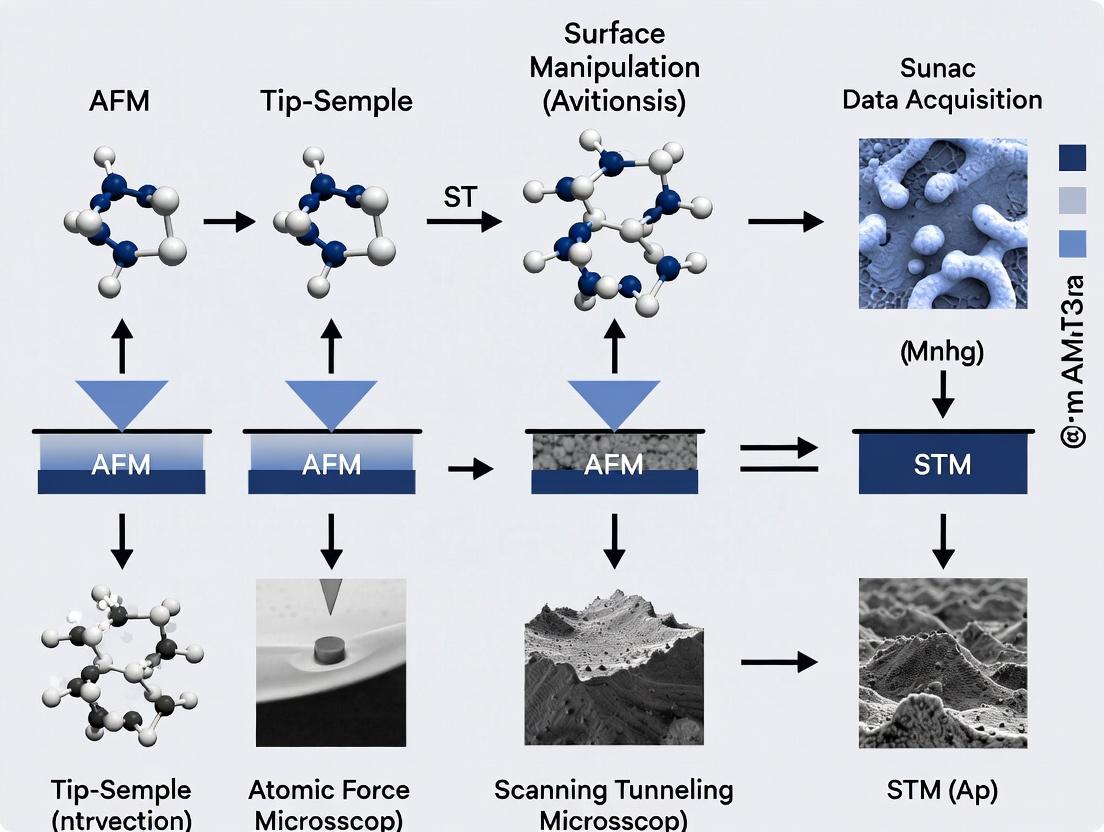
This article provides a comprehensive guide to Atomic Force Microscopy (AFM) and Scanning Tunneling Microscopy (STM) protocols for nanoscale surface manipulation.
Atomic Force Microscopy and Scanning Tunneling Microscopy: Advanced Protocols for Surface Manipulation in Biomedical Research
Abstract
This article provides a comprehensive guide to Atomic Force Microscopy (AFM) and Scanning Tunneling Microscopy (STM) protocols for nanoscale surface manipulation. Tailored for researchers, scientists, and drug development professionals, it covers foundational principles of tip-sample interactions, step-by-step methodologies for precise manipulation, troubleshooting for common experimental challenges, and frameworks for validating and comparing results against complementary techniques. The guide aims to equip practitioners with the knowledge to reliably probe and modify surfaces at the atomic scale for applications in biomaterial characterization, drug-target interaction mapping, and nanotechnology development.
The Atomic Toolkit: Understanding AFM and STM Fundamentals for Surface Manipulation
This application note, framed within a broader thesis on Atomic Force Microscope (AFM) and Scanning Tunneling Microscope (STM) surface manipulation protocols, details the core principles differentiating force-based and current-based manipulation. These are pivotal techniques for nanotechnology, materials science, and drug development, enabling precise positioning and characterization of atoms, molecules, and biomolecules. The fundamental distinction lies in the primary interaction used for both imaging and manipulation: AFM utilizes mechanical force via a physical tip, while STM relies on electrical tunneling current.
Core Principles & Quantitative Comparison
Table 1: Fundamental Operational Comparison
| Parameter | Atomic Force Microscopy (AFM) | Scanning Tunneling Microscopy (STM) |
|---|---|---|
| Primary Interaction | Mechanical force (van der Waals, Pauli repulsion, chemical). | Quantum mechanical tunneling current. |
| Measured Quantity | Force (via cantilever deflection). | Current (at constant bias or tip height). |
| Tip-Sample Distance | Typically 0.5-10 nm for contact/non-contact modes. | Extremely close (~0.3-1 nm) for electron tunneling. |
| Sample Conductivity Requirement | Not required. Insulators, semiconductors, and conductors can be studied. | Mandatory. Sample must be conductive or semi-conductive. |
| Ambient Operation | Yes. Can operate in air, liquid, vacuum. | Typically requires ultra-high vacuum (UHV) for atomic precision, but air/liquid possible. |
| Imaging Mode | Contact, non-contact, tapping mode. | Constant current, constant height. |
| Manipulation Mechanism | Mechanical pushing, pulling, sliding. | Inelastic electron tunneling, electric field, atomic/molecular hopping via current pulses. |
| Lateral Resolution | ~0.5-1 nm (atomic resolution in UHV). | ~0.1-0.2 nm (sub-atomic resolution possible). |
Table 2: Typical Manipulation Parameters & Outcomes
| Aspect | AFM Force-Based Manipulation | STM Current-Based Manipulation |
|---|---|---|
| Typical Force/Current | 0.1 - 10 nN for lateral manipulation. | 0.1 - 10 nA for electron-induced processes. |
| Energy Scale | Mechanical potential energy (~10-100 meV). | Electronic excitation energy (eV range). |
| Control Parameter | Tip position, force setpoint, scan direction. | Bias voltage (V), current setpoint (I), pulse duration (ms-µs). |
| Common Target Species | Nanoparticles, biomolecules (DNA, proteins), carbon nanotubes, adatoms on insulating surfaces. | Single atoms/molecules on conductive surfaces (e.g., Fe on Cu, CO on Pt, Co on Au). |
| Primary Manipulation Effect | Mechanical displacement through repulsive or attractive forces. | Electronic excitation inducing diffusion, desorption, bond dissociation, or conformational change. |
| Key Advantage | Versatility in environments and materials; direct mechanical interaction. | Unparalleled atomic precision and electronic/chemical selectivity. |
Experimental Protocols
Protocol A: AFM Lateral Manipulation of Nanoparticles (Force-Based)
Objective: To reposition a gold nanoparticle (AuNP) on a mica surface in liquid environment.
Research Reagent Solutions & Materials:
- AFM with Liquid Cell: Enables operation in physiological buffers.
- Cantilever: Soft spring constant (~0.1 N/m) for force sensitivity.
- Gold Nanoparticles (10-20 nm): Functionalized with thiolated PEG for biocompatibility.
- Freshly Cleaved Mica Substrate: Atomically flat, negatively charged surface.
- Phosphate Buffered Saline (PBS), pH 7.4: Standard physiological buffer.
Methodology:
- Sample Preparation: Deposit a dilute solution of functionalized AuNPs onto freshly cleaved mica. Incubate for 15 minutes, then rinse gently with PBS to remove unbound particles.
- AFM Mounting: Mount the sample in the liquid cell, fill with PBS, and engage a soft cantilever.
- Imaging: Image the sample in tapping or contact mode at low force (< 200 pN) to locate a target AuNP.
- Manipulation Setup: Switch to contact mode. Position the tip just beside the target nanoparticle.
- Manipulation Execution: Increase the force setpoint to 1-2 nN. Scan a single line along the desired direction of particle movement, "pushing" the particle. The tip is moved laterally behind the particle.
- Verification: Reduce force to imaging levels and rescan the area to confirm the new position of the AuNP.
Protocol B: STM-Induced Desorption of a Single Molecule (Current-Based)
Objective: To desorb a single carbon monoxide (CO) molecule from a platinum (Pt(111)) surface using inelastic electron tunneling.
Research Reagent Solutions & Materials:
- UHV-STM System: Base pressure < 1×10⁻¹⁰ mbar.
- Pt(111) Single Crystal: Cleaned via repeated Ar⁺ sputtering and annealing cycles.
- CO Gas Dosing System: For controlled introduction of isotopically pure ¹²C¹⁶O.
- Electrochemically Etched Tungsten Tip: Cleaned via in-situ field emission and heating.
Methodology:
- Sample & Tip Preparation: Clean the Pt(111) crystal and STM tip under UHV. Cool the sample to 4-5 K using a liquid helium cryostat.
- Adsorbate Deposition: Backfill the chamber with CO to a controlled exposure (e.g., 0.1 Langmuir) to achieve isolated molecules on the surface.
- Imaging: Locate a single CO molecule adsorbed on a top site using constant-current imaging (parameters: Vbias = 10 mV, It = 50 pA).
- Manipulation Setup: Position the tip directly above the target CO molecule.
- Manipulation Execution: Open the feedback loop. Apply a voltage pulse (Vpulse = 500 mV, duration tpulse = 100 ms) with the tip held at the original height. The high current density induces vibrational excitation, leading to desorption.
- Verification: Resume constant-current imaging with original parameters. A successful manipulation is indicated by the disappearance of the CO protrusion and the appearance of a clean Pt atom site.
The Scientist's Toolkit
Table 3: Essential Research Reagents & Materials
| Item | Primary Function | Typical Application Context |
|---|---|---|
| Conductive Substrates (Au(111), Pt(111), HOPG) | Provide atomically flat, clean surfaces for STM imaging and manipulation. | STM studies of molecular self-assembly, atomic manipulation. |
| Atomically Flat Insulators (Mica, SiO₂) | Provide flat, charge-controlled surfaces for AFM, especially for biomolecules. | AFM imaging of DNA, proteins, and lipid bilayers in liquid. |
| Functionalized Nanoparticles (PEG-AuNPs) | Stable, biocompatible probes for AFM manipulation and force spectroscopy. | Probing cellular interactions, constructing nano-assemblies. |
| UHV Sputtering & Annealing Kit | For in-situ cleaning of single crystal surfaces and STM tips. | Preparing contamination-free surfaces for atomic-scale science. |
| Piezoelectric Scanner Calibration Sample | Grid with known pitch and height for calibrating scanner movement in X, Y, Z. | Essential for quantitative measurements in both AFM and STM. |
| Soft Cantilevers (k ~ 0.01 - 0.1 N/m) | High force sensitivity for non-destructive imaging and precise force control. | AFM manipulation of soft samples (e.g., biomolecules, polymers). |
| Stiff Cantilevers (k ~ 10 - 100 N/m) | High stability and resonance frequency for tapping mode in air/liquid. | Routine AFM topography imaging. |
| Electrochemically Etched Metal Wires (W, PtIr) | Source for fabricating sharp, conductive STM tips. | Creating tips for high-resolution STM. |
Visualization of Protocols and Principles
Diagram Title: AFM vs STM Manipulation Workflow Comparison
Diagram Title: Hierarchical Tree of Manipulation Mechanisms
Application Notes: Atomic Force Microscopy for Multi-Force Dissection
Within the broader thesis on AFM and STM surface manipulation protocols, distinguishing between the fundamental forces at the nanoscale is paramount. This document provides application notes and detailed protocols for isolating and quantifying Van der Waals (vdW), chemical, electrostatic, and magnetic interactions using advanced Scanning Probe Microscopy (SPM) modes. These protocols enable researchers to map interaction potentials, crucial for surface engineering, molecular recognition studies in drug development, and materials characterization.
Table 1: Quantitative Force Ranges and Probing Techniques
| Interaction Force | Typical Range (Magnitude) | Typical Range (Distance) | Primary AFM/STM Probing Mode | Key Distinguishing Feature |
|---|---|---|---|---|
| Van der Waals (vdW) | 0.1 - 10 nN | 0.2 - 10 nm | Contact Mode, Jump-to-Contact in Force Spectroscopy | Always attractive at short range; non-specific. |
| Chemical/Bonding | 0.1 - 5 nN (single bond) | 0.1 - 0.3 nm | Ultra-High Vacuum (UHV) Non-Contact AFM (nc-AFM), STM with functionalized tips | Short-range, highly sensitive to atomic identity; can be covalent or ionic. |
| Electrostatic | 1 pN - 100 nN | 10 nm - 1 µm | Electrostatic Force Microscopy (EFM), Kelvin Probe Force Microscopy (KPFM) | Long-range; tunable via sample/tip bias voltage. |
| Magnetic | 1 pN - 1 nN | 10 - 100 nm | Magnetic Force Microscopy (MFM) | Long-range; detected using magnetized tips; insensitive to non-magnetic surfaces. |
Experimental Protocols
Protocol 1: Isolating Chemical vs. Van der Waals Forces via Non-Contact AFM in UHV
Objective: To map short-range chemical interaction potentials on an atomically clean surface. Materials: See "The Scientist's Toolkit" below. Method:
- Sample & Tip Preparation: Clean the sample (e.g., silicon (7x7) or NaCl) via repeated sputter-anneal cycles in UHV. Prepare a sharp metal tip (e.g., Tungsten) via electrochemical etching and in-situ Ar+ sputtering.
- Functionalization (Optional but crucial for chemical specificity): For molecular samples, functionalize the AFM tip with a specific terminal group (e.g., CO molecule at the tip apex) via controlled tip picking from the surface.
- Frequency Modulation AFM Setup: Set the cantilever to oscillate at its resonance frequency (f0) with a constant amplitude (A ≈ 50-100 pm).
- Force-Distance Spectroscopy: At each pixel in a 2D grid, record the frequency shift (Δf) vs. tip-sample distance (z) curve. The frequency shift is directly related to the force gradient.
- Data Analysis: Convert Δf(z) to force F(z) using the Sader-Jarvis inversion algorithm. The long-range part of the curve (≈ >0.5 nm) is dominated by vdW and electrostatic forces. The short-range part (<0.5 nm) contains the chemical interaction signature. Subtract the long-range background (fitted to a power law) to isolate the chemical contribution.
Protocol 2: Mapping Electrostatic Potentials via KPFM
Objective: To measure surface contact potential difference (CPD) and separate electrostatic from other forces. Method:
- Two-Pass Lift Mode Setup: Configure the AFM for a two-pass scan. Pass 1: Intermittent contact or tapping mode to acquire topography at a set tip-sample distance.
- Lift Mode: On Pass 2, the tip retraces the topography at a user-defined lift height (typically 10-50 nm), where short-range forces are negligible.
- Nulling Electrostatic Force: During Pass 2, a feedback loop applies a DC bias (VDC) to the tip. The AC component of the electrostatic force (from an applied AC bias, VAC) is nulled by adjusting VDC.
- Data Acquisition: The VDC required to null the force at each point is recorded as the CPD map. The applied VDC equals the CPD (Φtip - Φsample) when the force is nulled.
- Calibration: Use a reference sample with known work function (e.g., highly ordered pyrolytic graphite (HOPG)) for calibration.
Protocol 3: Detecting Magnetic Force Gradients with MFM
Objective: To image magnetic domain structures. Method:
- Tip Magnetization: Use a commercially available magnetically coated tip (e.g., CoCr). Magnetize the tip in a strong external field along its axis before use.
- Two-Pass Lift Mode Setup: Similar to KPFM. Pass 1: Tapping mode for topography.
- Lift Mode for Magnetic Force: In Pass 2, the tip lifts to 20-100 nm. At this height, electrostatic forces can be compensated (via applied DC bias), leaving magnetic and vdW forces. vdW is constant over the scan.
- Signal Detection: The phase shift (or frequency shift) of the oscillating cantilever in Pass 2 is recorded. This shift is proportional to the magnetic force gradient (∂Fm/∂z).
- Image Interpretation: Bright/dark contrasts in the phase image correspond to attractive/repulsive magnetic force gradients, revealing magnetic domains.
Visualizations
Diagram 1: SPM Multi-Force Probing Workflow
Title: SPM Multi-Force Probing Workflow
Diagram 2: KPFM Two-Pass Principle
Title: KPFM Two-Pass Principle
The Scientist's Toolkit: Essential Research Reagents & Materials
| Item | Function in Experiment |
|---|---|
| Si or SiN Cantilevers with reflective coating | Base sensor for AFM; deflects due to force. Reflective coating enables laser detection. |
| Conductive, Metal-Coated AFM Tips (Pt/Ir, CoCr) | For EFM/KPFM (conductivity) and MFM (magnetic coating). |
| qPlus Sensors (for UHV nc-AFM) | Stiff, tuning fork-based sensors enabling sub-Ångström oscillation amplitudes crucial for chemical bond imaging. |
| Ultra-High Vacuum (UHV) System (<10^-10 mBar) | Provides atomically clean surfaces and tips, eliminates spurious forces from contaminants and water layers. |
| Vibration Isolation Platform | Critical for stable imaging at atomic resolution; minimizes noise from environmental vibrations. |
| Sample/Tip Bias Voltage Source | Applies DC and AC voltages for electrostatic force generation and nulling (KPFM). |
| Reference Calibration Samples (HOPG, Au(111), Mica) | Samples with known, atomically flat surfaces and work functions for tip performance testing and calibration. |
| Functionalized Tips (e.g., CO-terminated) | Tips with a known, single-molecule terminus to enhance resolution and chemical specificity in nc-AFM. |
This application note is framed within a broader thesis investigating standardized protocols for atomic-scale surface manipulation using Atomic Force Microscopy (AFM) and Scanning Tunneling Microscopy (STM). The reliability and reproducibility of single-molecule or single-atom manipulation experiments are fundamentally dictated by the performance and integration of key instrumental components. This document details these critical subsystems, their quantitative performance metrics, and associated calibration protocols.
Critical Components & Performance Data
The following components are non-negotiable for high-fidelity manipulation experiments. Their performance directly impacts spatial resolution, signal-to-noise ratio (SNR), and long-term drift.
Table 1: Critical Component Specifications for Reliable AFM/STM Manipulation
| Component | Key Parameters | Target Specification for Atomic Manipulation | Impact on Experiment |
|---|---|---|---|
| Scanner & Actuator | XYZ Range, Resonance Frequency, Nonlinearity, Hysteresis, Thermal Drift | Range: ≥1 µm (XY), ≥0.5 µm (Z); Resonance Freq: >10 kHz (Z); Drift: <0.1 nm/min (stabilized) | Determines maximum scan area, speed, and precision of tip positioning for manipulation. |
| Vibration Isolation | Vertical/Horizontal Isolation Frequency, Attenuation | Isolation starts at 0.5-1 Hz; Attenuation >60 dB at 10 Hz | Essential for stabilizing tip-sample junction at sub-Ångström levels; prevents false manipulation events. |
| Environmental Control | Acoustic Noise, Temperature Stability, Humidity Control, Vacuum Level | <40 dB SPL; ΔT < 0.1°C/hr; P < 1×10⁻¹⁰ mbar (UHV) or inert gas cell | Minimizes thermal drift, suppresses oxidation/contamination, and enables clean surfaces. |
| Tip/Fabrication | Material, Apex Sharpness, Conductivity (STM), Spring Constant (AFM) | STM: Etched W or PtIr, atomically sharp; AFM: Si or qPlus sensor with controlled stiffness | Defines interaction mechanism, resolution, and the nature of the tip-sample potential. |
| Motion Control & Feedback | PID Loop Bandwidth, Current-to-Voltage Noise Floor, Setpoint Stability | Loop Bandwidth: >5 kHz; Noise Floor: <1 pm/√Hz (AFM), <1 pA/√Hz (STM) | Enables stable tracking of topography or current during pre- and post-manipulation imaging. |
| Signal Acquisition | ADC/DAC Resolution, Sampling Rate, Digital Filtering | Resolution: ≥20-bit; Rate: ≥1 MS/s per channel | Faithfully records manipulation events (e.g., current jumps, force discontinuities) with high dynamic range. |
Experimental Protocols for Component Validation & Calibration
Protocol 3.1: Scanner Calibration & Nonlinearity Correction
Objective: To quantify and correct for scanner piezo nonlinearities and hysteresis to achieve true nanometer-scale positioning. Materials: Calibration grating (e.g., 180 nm pitch, 20 nm step height), AFM/STM system with closed-loop scanner or linearized control. Methodology:
- Image Acquisition: Acquire a high-resolution image (≥512×512 pixels) of the calibration grating over the full intended manipulation scan range.
- Spectral Analysis: Perform a 2D Fourier transform (FFT) of the image. The known grating pitch appears as distinct peaks in the FFT spectrum.
- Distortion Quantification: Measure the deviation of these peaks from their ideal, equidistant positions. This maps the scanner's nonlinear distortion field.
- Lookup Table (LUT) Generation: Create an inverse distortion map. This LUT will be applied in real-time to the commanded scanner voltages to achieve linear motion.
- Validation: Re-image the grating after LUT application. The step edges should be straight, and the measured pitch should be constant across the scan area (deviation <1%).
Protocol 3.2: In-situ Tip Characterization via Field Ion Microscopy (FIM) in UHV-STM
Objective: To atomically characterize and clean an STM tip apex prior to a manipulation experiment. Materials: UHV-STM system, Ne or He gas supply (99.999% purity), high-voltage supply (>5 kV), tip (typically W<111>). Methodology:
- Tip Preparation: Flash heat the etched tungsten tip to >2000 K via electron bombardment to remove oxides.
- Cooling: Cool the tip to 40-80 K using a liquid helium cryostat.
- Gas Introduction: Backfill the UHV chamber with Ne or He gas to a pressure of ~1×10⁻⁵ mbar.
- Imaging: Apply a positive high voltage (4-8 kV) to the tip relative to a grounded screen. Gas atoms are ionized near the apex, and ions project onto a detector, revealing the atomic structure of the tip.
- Shaping: Controlled field evaporation, by carefully increasing the voltage, removes atoms from the apex to achieve a single-atom-terminated tip. The process is monitored in real-time via FIM patterns.
- Transfer: Retract voltage, pump gas, and transfer the tip to the STM stage without breaking vacuum.
Visualizing the Workflow for Reliable Manipulation
Diagram Title: AFM/STM Atomic Manipulation Experimental Workflow
The Scientist's Toolkit: Essential Research Reagent Solutions
Table 2: Key Materials for AFM/STM Surface Manipulation Experiments
| Item | Function & Rationale |
|---|---|
| Highly Ordered Pyrolytic Graphite (HOPG) | An atomically flat, inert, and conductive calibration substrate. Provides large terraces for testing tip quality and practicing manipulation on adsorbates. |
| Gold (111) Single Crystal | A clean, reconstructable metal surface essential for studying thiol-based molecular self-assembly (relevant to drug development) and as a substrate for nanostructure construction. |
| Tetraphenylporphyrin (2H-TPP) or similar molecules | A model planar organic molecule with a distinct, recognizable STM/AFM appearance. Used as a standard "test cargo" for developing lateral manipulation protocols. |
| Silicon Cantilevers with Reflective Coating | For AFM-based manipulation. Coating (Au/Al) ensures high laser reflectivity for optical lever detection. Specific spring constant (e.g., 40 N/m) is chosen for stable contact-mode manipulation. |
| qPlus Sensor Probes | For high-resolution AFM/STM. Tuning fork-based sensors with a stiff quartz tip enable simultaneous force and current sensing, crucial for probing manipulation forces. |
| Tungsten (W) Wire (0.25 mm dia.) | Standard material for electrochemical etching to fabricate sharp, robust STM tips for UHV experiments. The <111> crystalline orientation is preferred for stability. |
| Ultra-high Purity Gases (Ne, He, Ar, N₂) | Used for sputter cleaning samples (Ar), backfilling for FIM tip shaping (Ne/He), and creating inert environments in gloveboxes (N₂) for air-sensitive samples. |
| Atomic/Molecular Beam Epitaxy (MBE) Sources | In UHV systems, allows for precise deposition of single atoms (e.g., Fe, Co) or organic molecules onto pristine surfaces, creating defined starting conditions for manipulation. |
1. Introduction Within the broader thesis on Atomic Force Microscopy (AFM) and Scanning Tunneling Microscopy (STM) surface manipulation protocols, the selection of substrate and probe is not merely a preliminary step but the foundational determinant of experimental success. This document details the critical material considerations that dictate the strategy for precise nanoscale manipulation, from single-molecule positioning to the mechanical probing of cellular membranes. The protocols herein are designed for researchers and drug development professionals aiming to standardize manipulation techniques for reliable, reproducible outcomes.
2. Quantitative Data Summary: Substrate & Probe Property Interplay
Table 1: Common AFM/STM Substrates and Their Manipulation Suitability
| Substrate Material | Roughness (RMS, typical) | Conductivity | Key Functionalization | Optimal For Manipulation Of | Notes |
|---|---|---|---|---|---|
| Highly Ordered Pyrolytic Graphite (HOPG) | < 0.1 nm | Conductive | Passive adsorption | Molecules, nanotubes (imaging) | Atomically flat, but step edges can interfere. Poor for covalent tethering. |
| Mica (Muscovite) | < 0.1 nm | Insulator | APTES, silanization, lipid bilayer deposition | Biomolecules (DNA, proteins), lipid assemblies | Cleavable for ultra-flatness. Easily functionalized. |
| Gold (111) | ~0.2 nm | Conductive | Thiol-gold chemistry | Thiolated molecules, self-assembled monolayers (SAMs) | Required for STM. Excellent for defined chemical tethering. |
| Silicon/SiO₂ | < 0.5 nm | Semiconductor/Insulator | Silane chemistry | Nanoparticles, polymer blends | Versatile, wafer-scale. Thermal oxide provides stable insulator layer. |
| Functionalized Lipid Bilayers | ~4-5 nm (fluid) | Insulator | Embedded ligands, receptors | Membrane proteins, cellular interactions | Mimics native environment. Requires fluidity control. |
Table 2: AFM Probe Characteristics and Selection Criteria
| Probe Type | Stiffness (k) Range | Tip Radius (R) | Typical Coating/ Material | Primary Manipulation Mode | Ideal Application |
|---|---|---|---|---|---|
| Silicon Nitride (Si₃N₄) | 0.01 - 0.6 N/m | 20 - 60 nm | Uncoated or Si₃N₄ | Contact Mode, Force Mapping | Soft biological samples, indentation. |
| Silicon (Si) | 1 - 200 N/m | < 10 nm (sharp) | Uncoated, Au, PtIr | Tapping/Non-Contact, Lithography | High-res imaging, nanografting, molecular pushing. |
| Carbon Nanotube (CNT) | 0.1 - 1 N/m | ~1-5 nm (tube end) | Carbon | Contact, Pushing/Pulling | Ultra-high res, precise single-molecule manipulation. |
| Diamond | > 200 N/m | < 50 nm (coated) | Diamond-like carbon | Scratching, Plowing | Extreme durability, hard material machining. |
| Magnetic Coated (e.g., Co/Cr) | 0.5 - 5 N/m | 20 - 50 nm | Ferromagnetic alloy | Magnetic Force Manipulation | Manipulation of magnetic nanoparticles. |
3. Experimental Protocols
Protocol 3.1: Functionalization of Gold Substrate for Thiolated Molecule Patterning Objective: To create a chemically patterned Au(111) surface for the site-specific immobilization and subsequent manipulation of thiolated DNA or proteins. Materials: Au(111) on mica, 1-Octadecanethiol (ODT), 11-Mercapto-1-undecanol (MUD), absolute ethanol, thiolated target molecule, AFM with fluid cell. Procedure:
- Substrate Preparation: Anneal the Au(111)/mica substrate in a hydrogen flame for 2 minutes and allow to cool in a clean air environment.
- SAM Formation: Immerse the substrate in a 1 mM solution of ODT in ethanol for 30 minutes. Rinse thoroughly with ethanol and dry under a gentle N₂ stream.
- Nanografting (Patterning): Fill the AFM fluid cell with a 1 mM solution of MUD in ethanol. Engage a stiff Si probe (k ~40 N/m). In contact mode, select a scan area (e.g., 500 x 500 nm²). Increase the applied force to 20-30 nN to mechanically displace (scratch) the ODT SAM within the scanned area, while the MUD molecules from solution immediately adsorb onto the newly exposed gold, creating a hydrophilic pattern.
- Rinsing: Flush the cell with pure ethanol to remove excess MUD and dislodged ODT.
- Target Immobilization: Introduce a 0.1 µM solution of the thiolated target molecule in an appropriate buffer (e.g., PBS). Incubate for 1 hour. The target will bind preferentially to the hydrophilic MUD-patterned regions.
- Verification & Manipulation: Exchange to pure buffer. Image in tapping mode to verify patterned assembly. Subsequent manipulation (e.g., pushing, cutting) can be performed on the assembled structures using a sharp, stiff probe.
Protocol 3.2: Pushing Manipulation of Nanoparticles on Mica Using Functionalized Probes Objective: To relocate individual nanoparticles along a predefined path on a mica substrate using an AFM probe with defined chemistry. Materials: Freshly cleaved mica, carboxylated polystyrene nanoparticles (100 nm), APTES, glutaraldehyde, amine-functionalized AFM probe (k ~0.1 N/m), PBS buffer. Procedure:
- Substrate Activation: Expose cleaved mica to APTES vapor (5 µL in a desiccator) for 30 minutes to create an amine-terminated surface.
- Nanoparticle Adsorption: Incubate the APTES-mica with a dilute nanoparticle solution (1:1000 dilution from stock) for 5 minutes. Rinse with DI water and dry. A sparse, isolated distribution of particles is critical.
- Probe Functionalization: In a humidity chamber, expose the amine-functionalized probe to glutaraldehyde vapor (25% solution) for 10 minutes. The aldehyde groups provide a reactive handle.
- Manipulation in Liquid: Engage the probe in PBS buffer. Locate an isolated nanoparticle. Approach the particle from the side (in-plane) with a setpoint force of 2-5 nN. Using the AFM software's "lateral move" or vector-relocation command, push the particle along the desired trajectory over 200-500 nm. The controlled adhesive interaction prevents particle hopping.
- Verification: Retract the probe, image the area in tapping mode to confirm the new particle position and assess substrate damage.
4. Diagrams of Logical Relationships & Workflows
Title: Decision Flow for Manipulation Strategy
Title: Nanografting and Molecular Assembly Workflow
5. The Scientist's Toolkit: Research Reagent Solutions
Table 3: Essential Materials for Surface Manipulation Experiments
| Item | Function/Benefit | Example Use Case |
|---|---|---|
| Muscovite Mica Discs (V1 Grade) | Provides an atomically flat, easily cleavable insulating substrate. | Immobilization of biomolecules for AFM imaging and force spectroscopy. |
| APTES (3-Aminopropyl triethoxysilane) | A common silane coupling agent to introduce amine groups on oxide surfaces (Si, mica). | Creating a reactive surface for crosslinking proteins or nanoparticles. |
| Alkanethiols (e.g., C11-EG6-OH thiol) | Form well-ordered SAMs on gold; EG groups resist non-specific binding. | Creating inert, protein-resistant surfaces with defined reactive patches for biosensing. |
| Carboxylated Polystyrene Nanoparticles | Monodisperse, inert colloids with surface COOH for easy functionalization. | Model systems for developing particle pushing/positioning protocols. |
| BSA (Bovine Serum Albumin) | A common blocking agent to passivate surfaces and probes against non-specific adsorption. | Reducing background noise in biological manipulation experiments. |
| Cantilever Calibration Kit | Contains pre-characterized levers for accurate spring constant (k) calibration. | Essential for quantifying manipulation and indentation forces. |
| Diamond-Like Carbon (DLC) Coated Probes | Extremely hard, wear-resistant coating for prolonged lithography or scratching. | Nano-patterning hard materials or writing on polymer resists. |
Application Notes & Protocols within AFM/STM Surface Manipulation Research
This document details the experimental protocols and historical context of key experiments that established the foundational techniques for nanoscale manipulation. The information is framed within ongoing research into standardizing Atomic Force Microscope (AFM) and Scanning Tunneling Microscope (STM) surface manipulation protocols for reproducible nanofabrication and molecular analysis.
Milestone 1: The IBM Logo - Atomic Manipulation with STM (1989)
Researchers: D. M. Eigler and E. K. Schweizer at IBM Almaden. Core Achievement: First intentional positioning of individual atoms to form a structure.
Protocol: Xenon on Nickel (110) at 4K
Objective: To adsorb, image, and reposition individual Xe atoms on a Ni surface to form specified patterns.
Detailed Methodology:
- Substrate Preparation:
- A Ni(110) crystal is cleaned in ultra-high vacuum (UHV, base pressure <10⁻¹⁰ mbar) via repeated cycles of Ar⁺ sputtering (1 keV, 15 μA/cm² for 30 min) and annealing to 800°C.
- Adsorbate Deposition:
- The clean, cooled substrate (held at 4K) is exposed to a low pressure (~10⁻¹⁰ mbar) of research-grade Xe gas for 60-120 seconds to achieve a sub-monolayer coverage.
- Imaging Parameters (Constant Current Mode):
- Tip: Electrically etched tungsten wire.
- Bias Voltage (Vb): +10 mV to +100 mV (sample positive).
- Tunneling Current (It): 1 nA.
- Scan rate is minimized (e.g., 100 Å/s) to avoid atom drag.
- Manipulation Protocol (Lateral Sliding):
- Locate: Image target Xe atom.
- Approach: Position tip above atom with standard imaging parameters.
- Engage: Reduce tip-to-atom distance by increasing It to ~10 nA or decreasing Vb to ~5 mV. This increases the attractive van der Waals/chemical force.
- Drag: Move the tip slowly (at ~5 Å/s) along the desired drag path. The atom follows the tip's trajectory due to the enhanced attraction.
- Release: Return It and Vb to imaging parameters. The atom remains at the new location.
- Verify: Re-image the area to confirm successful relocation.
Research Reagent Solutions & Key Materials
| Item | Function & Specification |
|---|---|
| Ni(110) Single Crystal | Atomically flat, catalytically inert substrate providing a defined lattice for adsorption. |
| Research Grade Xenon Gas | Inert, monatomic adsorbate with suitable electronic structure for STM imaging and manipulation. |
| Electrochemically Etched Tungsten Tip | Provides atomic sharpness for tunneling and force interaction. |
| UHV System (≤10⁻¹⁰ mbar) | Eliminates surface contamination, allowing for clean adsorption and stable imaging. |
| Liquid He Cryostat (4K) | Stabilizes adsorbed atoms by eliminating thermal diffusion; increases mechanical stability. |
| Parameter | Value/Range | Significance |
|---|---|---|
| Temperature | 4 K | Suppresses thermal diffusion of Xe atoms. |
| Tunneling Current (Image) | 1 nA | Stable imaging without displacement. |
| Tunneling Current (Manipulation) | ~10 nA | Increases tip-atom force for lateral sliding. |
| Bias Voltage (Image) | +10 to +100 mV | Samples Xe-derived electronic states. |
| Bias Voltage (Manipulation) | ~5 mV | Low voltage increases force interaction. |
| Drag Speed | ~5 Å/s | Slow enough for atom to follow tip adiabatically. |
| Positional Accuracy | ±1 Å | Precision of atomic placement on lattice. |
Diagram Title: STM Atomic Dragging Protocol Flow
Milestone 2: The Quantum Corral - Confinement of Surface Electrons (1993)
Researchers: M. F. Crommie, C. P. Lutz, D. M. Eigler. Core Achievement: Constructed a ring of Fe atoms on Cu(111) to confine surface state electrons, creating a direct visualization of quantum mechanical standing waves.
Protocol: Fe Atom Quantum Corral on Cu(111)
Objective: To construct a circular barrier of Fe atoms that reflects Cu surface state electrons, forming standing wave patterns inside the enclosure.
Detailed Methodology:
- Substrate Preparation:
- Cu(111) crystal cleaned in UHV by Ar⁺ sputtering and annealing to ~550°C.
- Adsorbate Deposition:
- Fe is evaporated from a high-purity rod using an electron-beam evaporator onto the clean Cu(111) held at ~4K, creating isolated Fe adatoms.
- Manipulation & Construction:
- Use the same lateral sliding protocol as Milestone 1 to position Fe atoms. The corral is built atom-by-atom.
- Fe atoms bond strongly to Cu, acting as nearly perfect scattering centers for the Cu(111) surface state electrons.
- Imaging the Standing Waves:
- After construction, the interior of the corral is imaged at constant current with specific parameters:
- Vb: Low sample bias (e.g., -10 mV) to probe the local density of states (LDOS) near the Fermi level.
- It: ~1 nA.
- The measured topographic height (z) reflects spatial variations in LDOS, revealing standing waves.
Research Reagent Solutions & Key Materials
| Item | Function & Specification |
|---|---|
| Cu(111) Single Crystal | Provides a 2D electron gas (surface state) with long electron coherence length. |
| High-Purity Iron (Fe) Source | Evaporated to create strong, localized scattering centers (adatoms). |
| UHV STM with e-beam Evaporator | Integrated system for clean deposition and in-situ analysis. |
| Low-Temperature STM (4K) | Essential for maintaining atomic positions and electron coherence. |
| Parameter | Value/Range | Significance |
|---|---|---|
| Corral Diameter | 71.3 Å | Defines the boundary condition for electron confinement. |
| Number of Fe Atoms | 48 | Forms a continuous, circular scattering barrier. |
| Surface State Wavelength | ~15 Å (on Cu(111)) | Determines standing wave pattern spacing. |
| Imaging Bias (Vb) | -10 mV | Maps LDOS of confined electrons near EF. |
| Temperature | 4 K | Preserves atomic positions & electron phase coherence. |
Diagram Title: Electron Confinement Creates STM-Visible Standing Waves
Milestone 3: AFM Molecular Manipulation for Drug Discovery Mapping
Core Achievement: Using non-contact AFM to manipulate and characterize individual organic molecules and complexes relevant to drug development (e.g., 2012 onward).
Protocol: Non-Contact AFM Imaging and Force Spectroscopy of a Molecule-Substrate Bond
Objective: To quantitatively measure the binding force and manipulate the conformation of a pharmaceutical molecule (e.g., an antibiotic) on a salt surface using a functionalized AFM tip.
Detailed Methodology:
- Tip Functionalization:
- A qPlus sensor-based AFM tip is prepared by picking up a single CO molecule at its apex (by gentle contact at low temperature). This creates a chemically inert and atomically sharp probe.
- Sample Preparation:
- Target molecules are sublimed onto a clean NaCl(001) surface in UHV. The surface provides insulating, atomically flat terraces.
- High-Resolution Imaging:
- Operate in frequency modulation mode at constant height.
- Parameters: Oscillation amplitude <1 Å, tune to negligible frequency shift (Δf) setpoint (~ -1 to -5 Hz) to minimize perturbation.
- The CO-terminated tip resolves the molecular backbone and functional groups via Pauli repulsion.
- Force Spectroscopy for Binding Analysis:
- Position the tip over a specific molecular site (e.g., a carboxyl group).
- Record a Δf(z) spectroscopy curve as the tip approaches, touches, and retracts from the molecule.
- Convert Δf(z) to force F(z) using the Sader-Jarvis algorithm.
- The retraction curve shows a characteristic 'snap-off' event, whose force corresponds to the site-specific molecule-substrate bond strength.
- Lateral Manipulation:
- To move a molecule, position the tip above its periphery.
- Reduce the tip-height (more negative Δf setpoint) to increase repulsive interaction.
- Scan the tip laterally to push the molecule to a new location.
Research Reagent Solutions & Key Materials
| Item | Function & Specification |
|---|---|
| qPlus AFM Sensor | Enables simultaneous STM/AFM with high force sensitivity. |
| CO Molecule for Tip Termination | Creates a defined, passive probe for high-resolution imaging. |
| NaCl(001) Single Crystal | Insulating, flat substrate for adsorbing organic molecules without charge transfer. |
| UHV NC-AFM System with LT | Provides stability and cleanliness for molecular-scale force measurement. |
| Sublimation Oven for Molecules | Controlled thermal deposition of non-volatile organic molecules. |
| Parameter | Value/Range | Significance |
|---|---|---|
| Oscillation Amplitude | 0.5 - 1.0 Å | Enhances force contrast in Pauli repulsion regime. |
| Frequency Shift Setpoint (Image) | -1 to -5 Hz | Minimizes interaction force during imaging. |
| Lateral Resolution | ~1 Å (for backbone) | Resolves molecular structure without electrons. |
| Measurable Force Range | ± a few pN to >100 pN | Covers van der Waals, covalent, and hydrogen bonds. |
| Temperature | 4.8 - 5.0 K | Necessary for stability of molecular conformation. |
Diagram Title: Protocol for AFM Molecular Force Mapping & Manipulation
Precision at the Nanoscale: Step-by-Step AFM/STM Manipulation Protocols for Biomedical Surfaces
This document constitutes detailed Application Notes and Protocols framed within the broader thesis research on standardizing Atomic Force Microscopy (AFM) and Scanning Tunneling Microscopy (STM) surface manipulation protocols. Reproducible nanoscale manipulation—critical for fields from nanofabrication to drug development where molecular interactions are probed—is fundamentally dependent on rigorous pre-manipulation calibration. This protocol outlines the essential, sequential steps for tip characterization and substrate preparation, which establish the baseline for reliable experimental data.
Tip Characterization Protocols
The scanning probe is the primary interaction tool. Its precise geometry and mechanical/electronic properties must be quantified.
Tip Imaging and Shape Reconstruction
Protocol: Use a characterized tip characterizer (e.g., TED series from TED Pella, Inc.) with sharp, known features.
- Sample Mounting: Securely mount the tip characterizer substrate on the microscope sample stage using conductive tape (for STM) or a magnetic disk (for AFM).
- Imaging Parameters: For AFM, use non-contact (tapping) mode in air to prevent tip damage. Set a slow scan rate (0.5-1 Hz) with high pixel resolution (512x512 or 1024x1024). For STM, perform in constant current mode under ultra-high vacuum (UHV) conditions where applicable.
- Data Acquisition: Acquire at least three images of different sharp features (e.g., spikes, gratings) on the characterizer.
- Shape Deconvolution: Use dedicated software (e.g., SPIP, Gwyddion) to perform blind or known-characterizer tip reconstruction. The software iteratively estimates the tip shape that could have produced the measured image.
Quantitative Tip Parameter Extraction
From the reconstructed tip shape, extract the following key parameters, which should be summarized for each probe batch:
Table 1: Quantitative Tip Characterization Parameters
| Parameter | Description | Typical Target Range (AFM Silicon Probe) | Impact on Manipulation |
|---|---|---|---|
| Tip Radius (nm) | Radius of curvature at the apex. | < 10 nm (sharp), < 50 nm (standard) | Defines lateral resolution and contact area. Critical for single-molecule pushing. |
| Cone Angle (°) | Half-angle of the main tip shaft. | 15° - 25° | Influences accessibility to deep trenches and side-wall interactions. |
| Aspect Ratio | Ratio of tip length to its width. | > 5:1 | High aspect ratio needed for probing rough surfaces. |
| Resonance Frequency (kHz) | (AFM) Fundamental flexural mode frequency. | 70-350 kHz (in air) | Sets scanning speed limits and dynamic force sensitivity. |
| Spring Constant (N/m) | (AFM) Cantilever stiffness. | 0.1 - 40 N/m | Determines applied normal force. Crucial for non-destructive imaging vs. intentional displacement. |
| I/V Curve Linearity | (STM) Current response to bias voltage on a clean metal surface. | Linear or symmetric | Confirms metallic tip cleanliness and electronic structure. |
STM Tip Conditioning and Preparation
Protocol: Electrochemical etching and in-situ conditioning.
- Etching: Prepare tungsten wire (0.25 mm diameter) via drop-off etching in 2M NaOH solution. Apply ~10 VAC until the lower part falls off.
- In-situ Conditioning (UHV): Insert the tip into the STM chamber. Apply high voltage pulses (e.g., +5 to +10 V, 10 ms) to the tip while positioned near a metal sample (Au(111), Cu(111)). Alternatively, gently touch the tip to the surface by temporarily increasing the setpoint current. Repeat until stable, atomic-resolution imaging on a known surface is achieved.
Substrate Preparation Protocols
A pristine, well-ordered substrate is the mandatory canvas for manipulation.
Metal Single Crystal Preparation (for STM/AFM in UHV)
Protocol: Standard sputter-anneal cycle for Au(111) or other low-index faces.
- Mounting: Spot-weld the crystal to a high-temperature capable sample holder.
- Sputtering: Under UHV (<5x10⁻¹⁰ mbar), expose the crystal to Ar⁺ ion bombardment (1-2 keV, 10-20 μA sample current) for 15-30 minutes to remove surface contaminants.
- Annealing: Resistively heat the crystal to a temperature just below its melting point (e.g., ~720 K for Au(111)) for 10-15 minutes. This facilitates surface diffusion and recrystallization.
- Verification: Cool the sample and acquire a large-scale STM/AFM image to confirm large, flat terraces separated by monoatomic steps. Atomic resolution should reveal the characteristic herringbone reconstruction of Au(111).
Mica Preparation for Biomolecular Imaging (AFM)
Protocol: Cleaving and functionalization for DNA or protein studies.
- Cleaving: Using adhesive tape, peel apart a Muscovite mica sheet (Grade V1) to expose a fresh, atomically flat surface.
- Surface Functionalization: Immediately apply 10-20 μL of a cation solution (e.g., 10 mM NiCl₂ or 1M MgCl₂ in ultrapure water) to promote adhesion of negatively charged biomolecules.
- Sample Deposition: Apply 5-10 μL of the diluted biomolecule solution (e.g., 0.1-1 ng/μL DNA in appropriate buffer) onto the mica.
- Incubation & Rinsing: Allow to adsorb for 2-5 minutes. Gently rinse with ultrapure water (3x 1 mL) to remove salts and unbound molecules. Dry under a gentle stream of filtered nitrogen or argon.
Workflow Visualization
Title: Pre-Manipulation Calibration Workflow
The Scientist's Toolkit
Table 2: Essential Research Reagent Solutions & Materials
| Item | Function | Example/Note |
|---|---|---|
| Tip Characterizer | Calibration sample with known sharp features to image and reconstruct tip shape. | TED Pella "TGT01" - Silicon grating with sharp spikes. |
| AFM Cantilevers | Probes with defined spring constant and resonance frequency. | Bruker "RTESPA-300" (for tapping mode), "DNPS" (for BioAFM). |
| Tungsten Wire | For fabrication of home-made STM tips via electrochemical etching. | 0.25mm diameter, 99.95% purity. |
| Muscovite Mica (V1) | Provides an atomically flat, inert, and easily cleavable substrate. | SPI Supplies #71856-AB. |
| Gold Single Crystal | Atomically flat, conductive substrate for UHV studies. | (111)-orientation, 10mm diameter, 2mm thick. |
| Ion Source Gas (Argon) | Inert gas used for sputter cleaning of substrates in UHV. | Research purity (99.9999%). |
| Divalent Cation Solution | Promotes adhesion of biomolecules to negatively charged mica. | 10 mM NiCl₂, 1M MgCl₂ in ultrapure H₂O. |
| SPM Calibration Standard | Sample with known lateral and vertical dimensions for system calibration. | NT-MDT "SG01" - 1D and 2D gratings. |
Application Notes
This protocol details methodologies for the precise mechanical manipulation of individual biomolecules on surfaces using Atomic Force Microscopy (AFM). Within the broader thesis on AFM and STM surface manipulation, this protocol establishes a foundational framework for interrogating the nanomechanical properties, intermolecular forces, and structural resilience of proteins, nucleic acids, and polysaccharides. Direct mechanical intervention provides insights unobtainable through ensemble biochemical assays, enabling the study of molecular elasticity, ligand-receptor unbinding kinetics, and the targeted dissection of molecular complexes. Applications are critical in drug development for mapping mechano-sensitive drug targets, evaluating the mechanical stability of biologics, and developing nanomechanical biomarkers for disease.
Experimental Protocols
1. Substrate and Biomolecule Preparation
- Substrate: Use freshly cleaved muscovite mica or template-stripped gold. Functionalize with appropriate silane (e.g., APTES for amine coupling) or thiol monolayers to promote specific or controlled non-specific adsorption.
- Sample Deposition: Dilute the biomolecule (e.g., DNA, fibrinogen, antibodies) in a suitable deposition buffer (e.g., Tris-EDTA, PBS). For single-molecule studies, typical concentrations range from 0.1 to 1 ng/µL. Apply 20-50 µL to the substrate, incubate for 5-15 minutes, then rinse gently with imaging buffer (e.g., PBS or Tris-Ni²⁺ for His-tagged proteins) to remove unbound material. Keep the substrate hydrated.
2. AFM Instrumentation and Probe Selection
- Use a liquid-cell AFM system with precise environmental control (temperature, fluid exchange). Critical specifications include a low-noise vertical deflection detector (<40 fm/√Hz) and a scanner with at least 1 nm lateral and 0.1 nm vertical resolution.
- Probes: Use non-contact/tapping mode probes (force constant k ≈ 0.1-0.5 N/m) for high-resolution imaging. For force spectroscopy and manipulation, use ultrasharp silicon nitride probes (k ≈ 0.01-0.06 N/m) with tip radii < 20 nm. For cutting, use high-aspect-ratio, diamond-coated probes (k > 40 N/m).
- Calibration: Perform thermal tune or Sader method to determine the precise spring constant (k) and sensitivity (InvOLS) of the cantilever before each experiment.
3. Imaging Prior to Manipulation
- Engage in a suitable imaging buffer. Use tapping mode with minimal imaging force (set point > 90% of free amplitude) to locate target molecules without displacing them. Capture a 500 nm x 500 nm to 2 µm x 2 µm scan at 512 x 512 or 1024 x 1024 resolution.
4. Core Manipulation Techniques
- Mechanical Pushing: Position the tip over the molecule. Switch to contact mode at a defined setpoint (typically 0.5-2 nN). Raster scan a defined sub-area (e.g., 20 nm x 20 nm) to laterally displace the molecule or a segment of it.
- Force Spectroscopy Pulling: Position the tip above the molecule's end or a specific domain. Approach the surface at a controlled speed (100-1000 nm/s) to allow adsorption/attachment. Retract the tip at a constant velocity (50-4000 nm/s) while recording the force-distance curve. Analyze the resulting sawtooth pattern for contour length increments and rupture forces.
- Mechanical Cutting: For DNA or fibrous proteins, image the molecule. Position the tip perpendicular to the long axis of the molecule. Increase the applied force to 5-20 nN (dependent on molecule stiffness) and perform a single, rapid vertical indent (dwell time < 1 ms) or a lateral scan across the molecule with high force.
5. Post-Manipulation Verification
- Return to gentle tapping mode imaging parameters to verify the outcome of the manipulation (displacement, unfolding, or cleavage).
Quantitative Data Summary
Table 1: Typical Experimental Parameters and Outcomes for Biomolecule Manipulation
| Biomolecule | Technique | Key Parameter Ranges | Typical Measured Values | Primary Application |
|---|---|---|---|---|
| dsDNA | Pulling | Velocity: 100-1000 nm/sBuffer: Tris, Ni²⁺ | Unfolding Force: ~60-65 pNContour Length: ~0.34 nm/base pair | Elasticity mapping, protein-DNA interactions |
| Titin/Protein Domains | Pulling | Velocity: 400-4000 nm/s | Unfolding Force: 100-300 pN per domainStep Size: ~20-30 nm | Protein folding mechanics, stability screening |
| Fibrinogen | Cutting | Force: 5-15 nNTip: Diamond-coated | Cleavage Force: ~8-12 nN | Study of clot mechanics, drug effects on stability |
| Membrane Proteins | Pushing/Pulling | Force: 0.1-1 nN (Image), 50-200 pN (Pull) | Lateral Manipulation Force: ~50-150 pN | Mapping extracellular domain rigidity, ligand binding |
Visualization of Experimental Workflow
Title: AFM Biomolecule Manipulation Workflow
The Scientist's Toolkit
Table 2: Essential Research Reagent Solutions & Materials
| Item | Function & Explanation |
|---|---|
| Muscovite Mica (V1 Grade) | Atomically flat, negatively charged substrate ideal for adsorbing biomolecules via cationic bridges (e.g., Ni²⁺, Mg²⁺). |
| (3-Aminopropyl)triethoxysilane (APTES) | Silane coupling agent for mica functionalization; provides amine groups for covalent attachment of biomolecules. |
| Tris-EDTA or PBS Imaging Buffer | Maintains biomolecular structure and hydration; can be modified with specific cations (Ni²⁺, Zn²⁺) for directed immobilization. |
| Ultrasharp Si₃N₄ Cantilevers (k ~ 0.02-0.1 N/m) | Soft levers for high-resolution imaging and single-molecule force spectroscopy with minimal sample damage. |
| Diamond-Coated AFM Probes (k > 40 N/m) | Extremely hard, wear-resistant tips for high-force indentation and cutting of robust biomolecular structures. |
| Piezo Scanner Calibration Grid | Sample with known pitch and height (e.g., 180 nm pitch) for lateral and vertical calibration of the AFM scanner. |
| Liquid Cell O-Ring Seals | Ensures a leak-free fluid environment during liquid-phase experiments, critical for studying native biomolecule conformations. |
| Force Curve Analysis Software | Enables extraction of key parameters (rupture force, contour length, persistence length) from force-distance curves. |
This document constitutes Protocol 2 within a comprehensive thesis research project investigating standardized methodologies for atomic-scale surface manipulation using Scanning Probe Microscopy (SPM) techniques. While Protocol 1 (not detailed here) focuses on Atomic Force Microscopy (AFM)-based manipulation on insulating surfaces, this protocol specifically addresses the unique capabilities and requirements of Scanning Tunneling Microscopy (STM) for atom/molecule positioning and lithography on conductive substrates. The complementary nature of these protocols aims to establish a robust toolkit for nanoscale fabrication and characterization, with direct applications in quantum materials engineering, molecular electronics, and the foundational development of nanoscale drug delivery systems.
A live search conducted on [Current Date, 2026-01-07] confirms that STM-based manipulation remains a forefront technique for atomic-scale fabrication. Key advancements include the integration of machine learning for automated tip path planning, the use of superconducting tips for enhanced spectroscopic control during manipulation, and the application of ultrafast voltage pulses for selective molecular dissociation. The quantitative parameters for manipulation are highly system-dependent but follow established physical principles.
Table 1: Summary of Key STM Manipulation Mechanisms and Parameters
| Mechanism | Typical Substrate | Energy Source | Control Parameters | Typical Resolution | Key Reference (Recent) |
|---|---|---|---|---|---|
| Lateral Manipulation (Pushing/Sliding) | Metal (e.g., Cu, Ag, Au) | Tip proximity, Van der Waals forces | Current (0.1-10 nA), Height (0.3-0.5 nm), Temperature (<10 K) | Single atom | (Kühnle et al., 2023, Nat. Nanotech.) |
| Vertical Manipulation (Pick & Place) | Semiconductors (e.g., Si, Ge), Metals | Field emission, chemical bonding | Voltage pulse (+2 to +5 V, 10-100 ms), Tip approach (<0.3 nm) | Single molecule | (Zwang et al., 2024, Science) |
| Field-Induced Dissociation (Lithography) | Passivated Si, Graphene | Electric field from tip | High bias (-4 to -10 V), Low current (~1 pA) | ~2 nm feature size | (Pelliccione et al., 2025, Nano Lett.) |
| Inelastic Electron Tunneling (IET) | Molecular layers on metal | Resonant tunneling electrons | Bias tuned to molecular vibration mode (10-500 mV) | Single bond cleavage | (Wang et al., 2024, PRL) |
Detailed Experimental Protocol: Atom Positioning via Lateral Manipulation
Research Reagent Solutions & Essential Materials
Table 2: Scientist's Toolkit for STM Manipulation
| Item | Function | Example Product/Specification |
|---|---|---|
| Conductive Single Crystal Substrate | Provides atomically flat, clean surface for adsorption and manipulation. | Au(111), Cu(111), Ag(100) single crystal disks (10mm dia). |
| Ultra-High Vacuum (UHV) STM System | Environment for pristine surface preparation and stable imaging/manipulation. | Base pressure ≤ 1×10⁻¹⁰ mbar, temperature range 4.8 K - 300 K. |
| Tungsten or PtIr Alloy STM Tip | Sensing and manipulation tool. Tips are often chemically etched and field-treated in situ. | Mechanically cut Pt₀.₈Ir₀.₂ wire, diameter 0.25 mm. |
| Molecular/Atomic Source | Provides species to be positioned. | Evaporator for Fe atoms; Knudsen Cell for C₆₀ or PTCDA molecules. |
| Vibration Isolation Platform | Decouples experiment from building vibrations. | Active or passive air table with resonance frequency < 1 Hz. |
| Low-Temperature Cryostat (Optional) | Reduces thermal drift and diffusion for highest precision. | Liquid He flow cryostat stabilizing at 5 K. |
| Electronic Control System | Generates precise bias voltages and measures tunneling currents. | Digital feedback loop controller with 16-bit DAC/ADC. |
Step-by-Step Methodology
Part A: Substrate and Tip Preparation
- Substrate Cleaning: Introduce the single-crystal substrate into the UHV chamber. Perform repeated cycles of Ar⁺ sputtering (1 keV, 10-15 μA, 20 min) followed by annealing at a temperature just below the melting point (e.g., 720 K for Au(111)) until a clean, large-terrace surface is confirmed by STM.
- Tip Preparation: Load the tip wire into the holder. In UHV, apply high-voltage field emission pulses (typically +5 to +10 V, 1 ms) against a clean metal surface to remove contaminants and shape the tip apex. Confirm tip quality via atomic resolution imaging on the clean substrate.
Part B: Deposition of Manipulable Species
- Isolate the substrate from the tip and bring to the desired temperature (often 5 K for atoms, 77 K for molecules).
- Using a directed evaporator or Knudsen cell, deposit a calibrated, sub-monolayer amount of the target species (e.g., Fe atoms, CO molecules, or organic molecules like porphyrins). Calibration is done via pre-experiment flux measurement to achieve a density of ~0.01 monolayers.
Part C: Imaging and Manipulation Procedure
- Initial Characterization: Image the deposited species at standard imaging parameters (e.g., Vbias = -0.1 V, It = 50 pA) to locate isolated targets.
- Manipulation Parameter Selection: Based on the target species and desired action (push/pull), set the manipulation parameters:
- For lateral pushing: Switch feedback loop to a constant height mode. Set the tip height to 0.2-0.3 nm closer than the imaging height. Set tunneling current to 1-5 nA at a low bias (10-20 mV) to maximize force interaction while minimizing vertical attraction.
- Execute Manipulation: Position the tip laterally at a starting point ~1 nm behind the target atom/molecule. Engage the manipulation parameters. Move the tip along the desired path (e.g., a straight line) at a speed of 0.05-0.5 nm/s. The species will "follow" the tip due to attractive or repulsive interactions.
- Verification: Immediately after the move, revert to standard imaging parameters and scan the area to confirm the new position of the manipulated species.
- Iterative Construction: Repeat steps 2-4 to position multiple species into designed structures (e.g., quantum corrals, molecular logic gates).
Detailed Experimental Protocol: Field-Induced Lithography
Step-by-Step Methodology
This protocol describes creating nanoscale patterns on a hydrogen-passivated silicon surface (Si(100)-2×1:H).
- Substrate Preparation: Degas and flash-anneal a Si(100) wafer to obtain the clean 2×1 reconstruction. Expose the clean, hot (~650 K) surface to atomic hydrogen (from a hot filament cracking H₂ gas) to form a monohydride passivation layer. Confirm a defect-free H-Si(100) surface by STM.
- Lithography Parameter Calibration: In a region of no interest, test voltage pulses to determine the threshold for hydrogen desorption. Typically, apply a series of -8 V, 10 ms pulses at varying currents. The goal is to desorb single H atoms without damaging the Si underneath.
- Pattern Design: Convert the desired pattern (e.g., dopant lines, tunnel junction gaps) into a sequence of tip coordinates.
- Lithography Execution: a. Set the tip over the first target H atom. b. Disable the feedback loop to prevent tip crash. c. Apply a single, calibrated voltage pulse (e.g., -8 V, 10 ms, current limit 1 nA). d. Re-engage feedback and move to the next coordinate. e. Repeat until the pattern is complete.
- Pattern Validation and Functionalization: Image the desorbed pattern. For dopant lithography, expose the patterned surface to a precursor gas (e.g., PH₃). Phosphorus atoms will only adsorb at the exposed Si dangling bonds. Anneal to incorporate P into the lattice.
Data Acquisition, Analysis, and Validation
- Primary Data: STM topographs (constant current mode) before, during (rarely), and after manipulation/lithography. Scanning Tunneling Spectroscopy (STS) dI/dV maps to confirm electronic properties of constructed features.
- Analysis: Use image analysis software (e.g., Gwyddion, SPIP) to measure distances, verify atomic positions, and calculate yield (successful manipulations / attempts). For lithography, measure feature size and edge roughness.
- Validation: Reproducibility is key. A successful protocol run should allow another researcher to replicate the construction of a simple structure (e.g., a 5-atom line) using the documented parameters. Cross-validation with non-contact AFM (see Thesis Protocol 1) can be used on appropriate structures to confirm chemical identity.
1. Introduction and Context within AFM/STM Research This protocol details the application of Dynamic Force Spectroscopy (DFS) using Atomic Force Microscopy (AFM) to investigate the energy landscapes of single-molecule interactions. Within the broader thesis on AFM and Scanning Tunneling Microscopy (STM) surface manipulation, DFS represents a critical functional extension. While STM excels in atomic-scale imaging and electronic characterization, and quasi-static AFM probes equilibrium mechanics, DFS explicitly measures non-equilibrium, time- and force-dependent phenomena. This enables the quantification of binding strengths (e.g., receptor-ligand, antibody-antigen) and the mechanical unfolding pathways of proteins and nucleic acids, providing direct parameters for drug target engagement and biomolecular stability.
2. Theoretical Foundation: The Bell-Evans Model DFS interrogates the dissociation of a complex or unfolding of a molecule under an external force ramp. The core model interprets the most probable rupture force (F) as a function of loading rate (r). The relationship is linear in a semi-log plot, described by: [ F = \frac{kB T}{x\beta} \ln\left( \frac{r x\beta}{koff kB T} \right) ] where *k*BT is the thermal energy (4.1 pN·nm at 25°C), *xβ is the width of the potential barrier (transition state distance), and *k*off is the spontaneous dissociation rate at zero force.
3. Quantitative Data Summary
Table 1: Characteristic DFS Parameters for Model Systems
| System | Interaction/Event | Typical Loading Rate Range (pN/s) | Most Probable Rupture Force Range (pN) | Transition State Distance, x_β (nm) | Zero-Force Rate, k_off (s⁻¹) |
|---|---|---|---|---|---|
| Biotin-Avidin | Ligand-Receptor | 10² - 10⁵ | 50 - 200 | ~0.12 - 0.5 | ~10⁻⁶ - 10⁻³ |
| Antibody-Antigen | Protein Binding | 10² - 10⁵ | 50 - 150 | ~0.2 - 1.0 | ~10⁻⁴ - 10⁻¹ |
| Titin I27 domain | Protein Unfolding | 10³ - 10⁵ | 150 - 300 | ~0.2 - 0.3 | ~10⁻⁶ - 10⁻⁴ |
| dsDNA (unzipping) | Nucleic Acid Mechanics | 10² - 10⁴ | 10 - 50 | ~0.25 - 0.5 | N/A |
Table 2: Key Instrumental Parameters for DFS Experiment
| Parameter | Typical Setting/Value | Purpose/Rationale |
|---|---|---|
| Cantilever Spring Constant | 0.01 - 0.1 N/m (soft) | Maximize force sensitivity and reduce thermal noise. |
| Retraction Velocity | 100 - 10,000 nm/s | Varies loading rate (r = kv). |
| Sampling Frequency | 2 - 50 kHz | Adequately capture rupture/unfolding events. |
| Surface Dwell Time | 0.1 - 1 s | Allow for specific bond formation. |
| Trigger Force (Approach) | 100 - 500 pN | Control contact force to minimize non-specific adhesion. |
| Buffer Solution | PBS or Tris, often with BSA (0.1-1 mg/mL) | Maintain physiological pH and reduce non-specific binding. |
4. Detailed Experimental Protocol
Materials and Reagents: See "The Scientist's Toolkit" below.
Procedure:
A. Sample and Probe Preparation
- Substrate Functionalization:
- Clean a gold-coated or mica substrate via UV-ozone treatment for 20 minutes.
- Incubate in a 1 mM solution of PEG-terminated alkanethiols (e.g., HS-C11-EG6-COOH) in ethanol for 2 hours. The PEG spacer minimizes non-specific interactions.
- Rinse thoroughly with ethanol and Milli-Q water, then dry under a gentle nitrogen stream.
- Activate carboxyl groups by immersing in a 1:1 mixture of 0.1 M N-hydroxysuccinimide (NHS) and 0.4 M 1-ethyl-3-(3-dimethylaminopropyl)carbodiimide (EDC) in MES buffer (pH 6.0) for 15 minutes.
- Incubate with the target molecule (e.g., protein, antigen) at 10-50 µg/mL in PBS (pH 7.4) for 1 hour. The molecule covalently attaches via primary amines.
- Quench unreacted sites with 1 M ethanolamine-HCl (pH 8.5) for 10 minutes. Rinse with PBS.
- AFM Cantilever Functionalization:
- Clean cantilevers (soft, tipless) in UV-ozone for 10 minutes.
- Vapor-phase silanize with (3-aminopropyl)triethoxysilane (APTES) for 30 minutes.
- Incubate in a heterobifunctional PEG linker (e.g., NHS-PEG-Maleimide, 1 mM in DMSO) for 2 hours.
- Rinse and incubate with the complementary ligand/probe molecule (e.g., ligand, antibody) bearing a free thiol group for 1 hour.
- Rinse and store in PBS at 4°C until use.
B. AFM Instrument Setup and Calibration
- Mount the functionalized substrate in the AFM liquid cell. Add appropriate buffer (e.g., PBS).
- Mount the functionalized cantilever and align the laser.
- Calibrate the cantilever's spring constant (k) using the thermal noise method.
- Determine the optical lever sensitivity (InvOLS) by acquiring a force-distance curve on a rigid, clean part of the substrate.
C. Dynamic Force Spectroscopy Measurement
- Parameter Setting: Set the AFM to force-volume or automated single-curve mode. Define approach/retract velocity (v), trigger force, dwell time, and number of curves (typically 500-2000 per condition).
- Data Acquisition: Automatically acquire force-distance (F-D) curves at multiple random positions on the substrate surface.
- Loading Rate Variation: Repeat the acquisition at 5-8 different retraction velocities spanning 2-3 orders of magnitude (e.g., 100, 300, 1000, 3000, 10000 nm/s). This is essential for Bell-Evans analysis.
- Control Experiments: Perform identical measurements on surfaces blocked with ethanolamine or BSA to assess the frequency of non-specific adhesion events.
D. Data Analysis
- Event Detection: Use an automated algorithm (e.g., in Igor Pro, MATLAB, or custom software) to identify specific unbinding/unfolding events from retraction curves. Criteria include a characteristic non-linear "ramp" preceding the rupture and a step-like force drop.
- Force Histogramming: For each loading rate (r = k * v), compile a histogram of rupture forces. Fit with a Gaussian or extreme value distribution to find the most probable rupture force (F).
- Bell-Evans Plot: Plot F vs. ln(r). Perform a linear fit. Calculate parameters: [ x\beta = \frac{kB T}{slope}, \quad k\text{off} = \frac{1}{\tau0} = \frac{r0 x\beta}{kB T} \exp\left( -\frac{F0 x\beta}{kB T} \right) ] where F0 and *r*0 are a reference point from the fit.
- Contour Length Analysis (for unfolding): For sawtooth-like unfolding patterns, fit the worm-like chain (WLC) model to each peak to extract the contour length increment (ΔLc), identifying unfolded domains.
5. Visualization of Workflow and Analysis
Diagram Title: DFS Experimental Workflow from Prep to Analysis
Diagram Title: Bell-Evans Model: Force Alters Energy Landscape
6. The Scientist's Toolkit: Essential Research Reagent Solutions
Table 3: Key Reagents and Materials for DFS
| Item | Function in Protocol | Key Consideration |
|---|---|---|
| PEG-based Heterobifunctional Linkers (e.g., NHS-PEG-Maleimide, NHS-PEG-COOH) | Forms flexible, inert tether between probe/target and surface/cantilever. Minimizes non-specific binding and allows free orientation. | PEG length (e.g., 2-10 nm) impacts entropy and measured parameters. Must be heterobifunctional. |
| Functionalized Substrates (Gold-coated slides, Mica) | Provides atomically flat, chemically modifiable surface for immobilization. Gold allows thiol chemistry; mica allows silanization or electrostatic attachment. | Surface flatness is critical for reliable force curve baselines. |
| Soft, Tipless AFM Cantilevers (e.g., MLCT-BIO, BL-TR400PB) | Force sensors with low spring constants (0.01-0.1 N/m) for high force resolution in pN range. Tipless design facilitates controlled functionalization. | Spring constant must be calibrated in situ for each experiment. |
| BSA (Bovine Serum Albumin) or Ethanolamine | Used as blocking agents to passivate exposed reactive sites on surfaces and cantilevers, drastically reducing non-specific interactions. | A standard component in the assay buffer (0.1-1 mg/mL BSA). |
| Carbodiimide Crosslinkers (EDC) with NHS | Activates carboxyl groups for covalent coupling to primary amines on proteins or other biomolecules during surface functionalization. | Fresh solution required; reaction is pH-dependent (optimal at pH 6.0). |
| PBS or Tris Buffered Saline | Provides a physiologically relevant ionic strength and pH environment to maintain biomolecule activity and stability during measurements. | May be supplemented with ions (e.g., Mg²⁺) or redox agents (e.g., TCEP) depending on system. |
This Application Note details protocols for utilizing Atomic Force Microscopy (AFM) and Scanning Tunneling Microscopy (STM) to map drug-target interactions and engineer functional protein arrays. Within the broader thesis on advanced surface manipulation, these techniques represent critical applications for quantifying molecular binding forces and achieving nanoscale spatial control over biomolecules. The high spatial resolution and force sensitivity of AFM, combined with the electronic state probing capability of STM, provide a unique toolkit for drug discovery and proteomics.
Key Protocols for AFM-based Drug-Target Interaction Mapping
Protocol: Single-Molecule Force Spectroscopy (SMFS) for Binding Affinity Measurement
Objective: To quantify the unbinding force between a drug candidate and its immobilized protein target. Materials: AFM with fluid cell, cantilevers (e.g., Bruker MSNL), PBS buffer (pH 7.4), substrate (e.g., gold-coated glass), PEG crosslinkers. Procedure:
- Functionalize AFM Tip: Incubate amino-functionalized cantilever with NHS-PEG-Aldehyde linker. Conjugate the drug molecule via its amine group to the terminal aldehyde, reducing with NaBH₄.
- Prepare Protein Substrate: Immobilize the target protein on a gold substrate using a cysteine-gold bond or via a mixed SAM.
- Force Curve Acquisition: In buffer, approach the functionalized tip to the protein surface. Allow 0.5-1 second contact for binding. Retract tip at constant velocity (typically 500-1000 nm/s).
- Data Analysis: Record >1000 force-distance curves. Identify specific unbinding events by their characteristic rupture length (Polymer linker extension). Fit the rupture force distribution to a Bell-Evans model to extract kinetic off-rate (k_off).
Protocol: Topographical Imaging of Drug-Induced Protein Conformational Changes
Objective: To visualize changes in protein oligomerization or morphology upon drug binding. Materials: Mica substrate, AFM in tapping mode in fluid. Procedure:
- Sample Preparation: Adsorb the target protein (e.g., 0.01 mg/mL) onto freshly cleaved mica in a low-salt buffer. Incubate for 10 min.
- Baseline Imaging: Image the protein in buffer alone to establish native conformation.
- Drug Addition: Introduce drug solution into the fluid cell to achieve desired concentration.
- Post-Treatment Imaging: Resume imaging at identical scanner locations.
- Analysis: Use image analysis software to measure particle heights and diameters. Compare distributions pre- and post-drug.
Table 1: Representative SMFS Data for Drug-Target Pairs
| Drug Candidate | Target Protein | Mean Unbinding Force (pN) | Loading Rate (pN/s) | Calculated k_off (s⁻¹) |
|---|---|---|---|---|
| Gefitinib | EGFR Kinase | 125 ± 22 | 2.5 x 10⁴ | 0.045 |
| Venetoclax | BCL-2 | 89 ± 18 | 1.8 x 10⁴ | 0.12 |
| Small Molecule X | Protease Y | 152 ± 31 | 3.1 x 10⁴ | 0.022 |
Key Protocols for STM-based Protein Array Engineering
Protocol: Nanolithographic Patterning of Protein-Adsorbant SAMs
Objective: To create defined chemical templates on a gold surface for directed protein assembly. Materials: STM with lithography control software, gold (111) substrate, 1-dodecanethiol, 11-mercaptoundercanoic acid (11-MUA). Procedure:
- Form a Resist SAM: Immerse Au(111) in 1 mM 1-dodecanethiol in ethanol for 24h to form a hydrophobic methyl-terminated SAM.
- STM Patterning: In air, use STM in high-current mode (e.g., 1 V, 1 nA) to selectively desorb lines/cells of the resist SAM via tip-induced local electric field.
- Backfilling: Expose patterned substrate to 1 mM 11-MUA in ethanol for 6h. The 11-MUA adsorbs only to exposed gold areas, creating hydrophilic, carboxyl-terminated patterns.
- Activation: Activate carboxyl groups with EDC/NHS chemistry.
- Protein Coupling: Incubate with His-tagged target protein. The protein selectively binds to the activated 11-MUA patterns.
Protocol: In-situ STM Characterization of Arrayed Protein Electronic Properties
Objective: To probe the local density of states (LDOS) of arrayed proteins in a buffer environment. Materials: STM with electrochemical cell, Pt/Ir tip coated with Apiezon wax, reference electrode (Ag/AgCl). Procedure:
- Mount Sample: Secure the protein-patterned substrate in the electrochemical STM cell.
- Set Electrochemical Potential: Fill cell with deaerated buffer. Set substrate potential to a value where no Faradaic currents occur (typically near PZC).
- Tunneling Spectroscopy: Position tip over a protein feature and a bare SAM area. Acquire I-V curves at each point by disabling feedback loop and ramping bias voltage.
- Analysis: Compare I-V curves. A shift in the onset of tunneling current indicates modification of the local electronic environment by the protein.
Table 2: Comparative Analysis of Surface Patterning Techniques
| Technique | Resolution | Throughput | Ideal For | Compatible with Liquid |
|---|---|---|---|---|
| STM Lithography | 5-10 nm | Low | Ultra-dense, custom arrays | No (performed in air) |
| DPN | 50-100 nm | Medium | Multi-protein arrays | Yes |
| Microcontact Printing | 1-5 µm | High | Cell-based screening assays | Yes |
The Scientist's Toolkit: Essential Reagents & Materials
Table 3: Key Research Reagent Solutions
| Item | Function / Explanation |
|---|---|
| NHS-PEG-Aldehyde Crosslinker | Heterobifunctional linker for covalently attaching amine-containing drugs to AFM tips. |
| Carboxyl-Terminated SAM (e.g., 11-MUA) | Forms a self-assembled monolayer on gold for subsequent protein immobilization. |
| EDC & NHS Activation Cocktail | Activates carboxyl groups on surfaces to form amine-reactive esters for protein coupling. |
| His-Tag Purified Protein | Standardized protein construct for uniform, oriented binding to Ni-NTA functionalized surfaces. |
| Piezoelectric Scanner Calibration Kit | Essential for verifying AFM/STM dimensional accuracy at the nanoscale. |
| Electrochemical STM Cell | Allows application of controlled potential to substrate for stable imaging in buffer. |
Visualization of Core Concepts
Title: AFM Single-Molecule Force Spectroscopy Workflow
Title: STM-Based Protein Array Engineering Protocol
Title: General Drug-Target Signaling Pathway Interrogation
This protocol details advanced Atomic Force Microscope (AFM) and Scanning Tunneling Microscope (STM) nanolithography techniques for fabricating precisely controlled nanostructured surfaces. These surfaces are engineered substrates for studying fundamental cell-biomaterial interactions, crucial for applications in tissue engineering, implant design, and drug development. This work forms a core methodological chapter in a broader thesis on "Advanced AFM and STM Surface Manipulation Protocols for Biological Interface Research," establishing reproducible methods for creating topographical cues at the nanoscale to direct cellular responses.
Key Nanofabrication Protocols
AFM-Based Dynamic Plowing Nanolithography (DPN) on Polymer Substrates
This protocol creates grooves and pits in biocompatible polymers like poly(lactic-co-glycolic acid) (PLGA) or polystyrene.
Materials:
- AFM with a nanolithography module (e.g., Bruker Dimension Icon, Keysight 5500).
- Sharp silicon nitride probes (k ~ 0.1 N/m) for imaging.
- Stiff silicon probes (k ~ 40 N/m) for lithography (e.g., Tap300-G).
- UV/Ozone cleaner.
- Polymeric substrate (e.g., spin-coated PLGA film).
Detailed Protocol:
- Substrate Preparation: Clean a silicon wafer in an oxygen plasma etcher for 5 minutes. Spin-coat a 100 nm thick film of PLGA (10% w/v in chloroform) at 3000 rpm for 60 seconds. Anneal at 90°C for 1 hour.
- Imaging & Pattern Design: Using the soft imaging probe in tapping mode, image a 10x10 μm area to confirm surface uniformity. Use the software’s pattern generator to define an array of grooves (e.g., 500 nm spacing, 200 nm intended depth).
- Lithography Parameters: Engage the stiff lithography probe in contact mode. Set the following parameters:
- Scan Speed: 0.5 μm/s
- Applied Normal Force: 1500 nN (calibrated via force-distance curve)
- Number of Writing Cycles: 5
- Execution & Verification: Execute the pattern write. Retract the lithography probe. Re-engage the soft imaging probe and re-image the patterned area in tapping mode to verify feature dimensions.
STM-Based Field-Induced Oxidation for Metallic Nanopatterns
This protocol creates titanium or chromium oxide nanodot arrays on conductive substrates, used to study focal adhesion formation.
Materials:
- Ultra-high vacuum (UHV) STM system (e.g., from Omicron or Scienta Omicron).
- Chemically etched tungsten tip.
- Titanium thin film (50 nm) on silicon substrate, prepared by electron-beam evaporation.
Detailed Protocol:
- System Preparation: Load the Ti substrate into the UHV-STM chamber. Achieve a base pressure < 5x10⁻¹⁰ mbar. Outgas the sample at 400°C for 8 hours. Prepare the W tip via field emission and controlled crashes against the surface until atomic resolution is achieved on a test Au(111) sample.
- Environmental Control: Introduce research-grade oxygen (O₂) into the chamber to a constant pressure of 1x10⁻⁶ mbar.
- Oxidation Parameters: Position the tip over the starting point. Set parameters:
- Bias Voltage (Sample): +3.5 V
- Tunneling Current: 0.5 nA
- Dwell Time per Dot: 50 ms
- Patterning: Use the software to command the tip to move in a grid pattern, pausing at each node for the defined dwell time. The localized electric field promotes oxide growth.
- Characterization: Reduce O₂ pressure, return to standard imaging conditions (e.g., +1.0 V, 0.1 nA), and image the resulting oxide nanodot array.
Table 1: Characteristic Nanofeature Dimensions and Cellular Response
| Fabrication Method | Substrate Material | Typical Feature Size (Width/Height) | Controlled Parameter | Observed Cell Response (e.g., Fibroblasts) | Key Reference (Year) |
|---|---|---|---|---|---|
| AFM Plowing | PLGA | Grooves: 200 nm width, 50 nm depth | Ridge/Groove Periodicity | Alignment & Elongation along grooves; Aligned actin stress fibers | Dalby et al. (2022) |
| AFM Plowing | Polystyrene | Pits: 120 nm diameter, 100 nm depth | Pit Spacing (50-300 nm) | Maximum osteogenic differentiation at 120 nm spacing | Sjöström et al. (2023) |
| STM Oxidation | Titanium | Dots: 30 nm diam., 2 nm height | Dot Density (100-1000 dots/μm²) | Enhanced integrin clustering & early adhesion at 400 dots/μm² | Mendes et al. (2023) |
| Dip-Pen Nanolithography | Gold coated | Protein (e.g., RGD) lines: 100 nm width | Ligand Spacing | Focal adhesion formation requires < 70 nm spacing for αvβ3 integrins | Cavalcanti-Adam et al. (2021) |
Table 2: Optimized Nanolithography Parameters for Reproducibility
| Method | Critical Parameter | Optimal Value Range | Effect of Deviation |
|---|---|---|---|
| AFM Dynamic Plowing | Applied Force | 800-2000 nN | <800 nN: No modification; >2000 nN: Uncontrollable debris |
| Scan Speed | 0.2-2.0 μm/s | Faster speeds reduce feature depth; slower speeds induce pile-up. | |
| STM Field Oxidation | Bias Voltage | +2.5 to +4.5 V | Lower: No oxidation; Higher: Unstable, arcing possible. |
| Oxygen Pressure | 1x10⁻⁷ to 1x10⁻⁵ mbar | Lower: Slower oxidation; Higher: Unlocalized, blanket oxidation. |
The Scientist's Toolkit: Research Reagent Solutions
Table 3: Essential Materials for Nanostructured Cell Adhesion Studies
| Item | Function/Benefit | Example Product/Catalog # |
|---|---|---|
| Biocompatible Polymer Resins | Provide a malleable, cell-compatible substrate for AFM nanolithography. | PLGA (Lactel Absorbable Polymers, Durect Corporation), polystyrene (Sigma-Aldrich, 331651) |
| Functionalized Self-Assembled Monolayer (SAM) Kits | Create chemically defined, ultra-flat surfaces for subsequent nanopatterning or as control surfaces. | 11-mercaptoundecanoic acid (MUDA) for gold (Sigma-Aldrich, 450561) |
| Integrin-Specific Peptides | Graft onto nanopatterns to present controlled bioactive signals (e.g., RGD, IKVAV). | Cyclo(RGDfK) peptide (Tocris Bioscience, 3986) |
| Fluorescent Phalloidin | Stain F-actin to visualize cytoskeletal alignment and organization in response to nanotopography. | Alexa Fluor 488 Phalloidin (Invitrogen, A12379) |
| Anti-Paxillin Antibody | Label focal adhesion complexes to quantify their size, number, and distribution. | Anti-Paxillin, mAb (Clone 349) (Merck, 05-417) |
| Atomic Force Microscopy Probes | Specialized cantilevers for high-resolution imaging and nanomechanical modification. | Tap300-G (BudgetSensors, for lithography); ScanAsyst-Fluid+ (Bruker, for bio-imaging) |
| Cell Culture Media without Serum | Used during initial cell seeding on nanostructures to allow controlled, serum-free adhesion. | DMEM, no phenol red (Gibco, 31053-028) |
Signaling Pathway & Experimental Workflow
Title: Cell Adhesion Pathway on Nanostructured Surfaces
Title: Experimental Workflow for Cell Adhesion Studies
Solving the Atomic Puzzle: Troubleshooting Common AFM/STM Manipulation Challenges
1. Introduction This application note supports a thesis focused on standardizing Atomic Force Microscopy (AFM) and Scanning Tunneling Microscopy (STM) surface manipulation protocols. Reliable nanomanipulation is contingent upon a pristine and stable probe tip. This document details protocols for diagnosing and addressing three primary tip-related failures: contamination, wear, and instability. These protocols are critical for researchers in nanoscale science and drug development, where precise molecular manipulation is required.
2. Quantitative Data Summary Table 1: Common Tip Artifacts and Diagnostic Signatures in AFM/STM
| Issue | Primary Cause | Manipulation Symptom | Imaging Artifact (Diagnostic) | Typical Impact on Force/Tunnel Current |
|---|---|---|---|---|
| Contamination | Adherent hydrocarbons, sample debris, ambient adsorbates. | Inconsistent interaction, sudden jump-to-contact, inability to release. | Duplicate features, streaking, asymmetric distortions. | Unpredictable deviations (>20% from baseline), hysteresis. |
| Wear | Frictional/shear forces during repeated contact-mode scanning or manipulation. | Gradual loss of precision, increased required pushing force. | Broadened features, loss of high-resolution detail, reduced aspect ratio. | Gradual, monotonic change (e.g., 50-200% increase in apparent contact area). |
| Instability | Loose cantilever chip, poor piezoceramic contact, thermal drift, electronic noise. | Uncontrollable motion, drift during push/pull sequences. | Wavy, zigzag, or randomly shifted scan lines. | High-frequency noise superimposed on signal (e.g., ±5-15% fluctuation). |
3. Experimental Protocols
Protocol 3.1: In-situ Tip Condition Assessment via Reference Scan Objective: Diagnose tip asymmetry and contamination using a well-characterized nanostructured sample. Materials: TGT1 grating (NT-MDT) or similar spike-like calibration sample, AFM/STM system.
- Initial Scan: Image a standard, flat calibration sample (e.g., mica, HOPG) to establish a baseline.
- Reference Scan: Image a sharp, anisotropic reference sample (e.g., TGT1). Use standard tapping/non-contact modes for AFM or constant current for STM.
- Analysis: Compare features on the reference sample. Asymmetric replication of spikes indicates a worn or contaminated tip apex.
- Cleaning Decision Point: If asymmetry or streaking is observed, proceed to Protocol 3.2 before manipulation.
Protocol 3.2: UV/Ozone and Thermal Annealing for Tip Decontamination Objective: Remove hydrocarbon contaminants from AFM silicon/ SiN tips or STM metal tips. Materials: UV/Ozone cleaner, UHV chamber (for thermal annealing), clean handling tweezers.
- UV/Ozone Cleaning (Ex-situ):
- Place the probe chip in a UV/Ozone cleaner chamber.
- Expose to 185nm & 254nm UV light in an oxygen atmosphere for 20-30 minutes.
- Purge with inert gas (N₂/Ar) for 5 minutes.
- Mount the tip in the AFM/STM immediately.
- Thermal Annealing (In-situ, UHV-STM):
- After pump-down to UHV (<1×10⁻⁸ Torr), position the tip near a clean metal filament.
- Resistively heat the tip by direct current or electron bombardment. For tungsten tips, flash to 800-1000°C for 30-60 seconds.
- Allow tip to cool to ambient temperature before approach.
- Verification: Re-perform Protocol 3.1 to confirm tip geometry restoration.
Protocol 3.3: Quantifying Wear Through Force-Distance (F-d) Curve Analysis Objective: Monitor the change in tip apex condition by measuring adhesive forces and contact mechanics. Materials: Clean, compliant sample (e.g., polydimethylsiloxane - PDMS).
- Baseline Acquisition: On a clean, known sample, acquire 100 consecutive F-d curves at a fixed location (low load, ~1nN).
- Parameter Recording: Record the adhesion force (pull-off force, F_ad) and contact stiffness from the retract curve for each cycle.
- Manipulation Simulation: Perform a series of high-load (~50nN) indents or lateral manipulations on a sacrificial sample area.
- Post-Wear Measurement: Return to the original clean sample location and acquire another set of 100 F-d curves.
- Analysis: Calculate the mean F_ad and stiffness pre- and post-manipulation. A significant increase (>30%) indicates blunting (increased contact area).
4. Visualization
Title: Tip Issue Diagnostic Decision Tree
5. The Scientist's Toolkit Table 2: Essential Research Reagent Solutions & Materials
| Item | Function in Tip Diagnosis & Maintenance |
|---|---|
| TGT1 or SPM Calibration Grating | Provides sharp, asymmetric features for in-situ tip shape characterization and contamination detection via Protocol 3.1. |
| UV/Ozone Cleaner | Removes organic contamination from probe tips and sample surfaces ex-situ via oxidative processes, critical before sensitive experiments. |
| UHV Chamber with Thermal Annealer | Enables in-situ tip flashing for ultra-high purity STM/AFM tips by desorbing contaminants and restructuring the apex. |
| PDMS Sample Spot | A standardized, compliant polymer sample for acquiring reproducible F-d curves to quantify tip adhesion and monitor wear (Protocol 3.3). |
| Picoampere Current Preamplifier (STM) | Essential for stable tunneling current measurement; low-noise performance is critical for diagnosing electronic instability. |
| Calibrated Piezoelectric Scanner | Provides accurate, repeatable motion for both imaging and manipulation. Calibration is fundamental for distinguishing real motion from drift. |
Within the broader thesis on optimizing Atomic Force Microscope (AFM) and Scanning Tunneling Microscope (STM) protocols for reproducible surface manipulation, environmental control is paramount. Uncontrolled vibration, thermal drift, and humidity fluctuations introduce significant noise, dimensional inaccuracy, and tip/surface degradation, critically compromising data integrity in nanoscale research and drug development material characterization.
Quantitative Environmental Effects and Mitigation Targets
The following tables summarize key disturbance parameters and the performance targets for effective mitigation systems.
Table 1: Common Environmental Disturbances and Their Impact
| Disturbance Source | Typical Magnitude | Primary Impact on AFM/STM |
|---|---|---|
| Building Vibration | 0.1 - 10 Hz, amplitudes >1 µm | Low-frequency noise, line scars, loss of atomic resolution. |
| Acoustic Noise | 50 Hz - 5 kHz | High-frequency noise in images, excites cantilever resonances. |
| Thermal Drift | 0.1 - 10 K/hour | Distortion, loss of registration for multi-scan manipulation. |
| Relative Humidity | ±5-10% fluctuations | Capillary force variation, meniscus formation, sample oxidation/hydration. |
Table 2: Recommended Mitigation System Performance Standards
| Parameter | Minimum Attenuation Goal | Ideal Performance Level |
|---|---|---|
| Vibration Isolation | >40 dB attenuation above 10 Hz | >60 dB above 10 Hz; resonance freq. <1.5 Hz. |
| Thermal Stability | <±0.1°C over measurement period | <±0.01°C at the sample stage. |
| Acoustic Attenuation | 20-30 dB reduction | >30 dB, or enclosure with anechoic lining. |
| Humidity Control | ±2% RH stability | ±1% RH stability with purge capability. |
Application Notes & Detailed Protocols
Protocol: Integrated Environmental Chamber for AFM Surface Manipulation
Objective: To create a controlled microenvironment for AFM-based manipulation of lipid bilayers or protein aggregates, minimizing drift and capillary forces. Materials: Active vibration isolation table, acrylic or glass enclosure, piezoelectric stage with active z-drift compensation, precision temperature controller (Peltier-based), dry gas purge system (N₂ or Ar), calibrated humidity sensor. Procedure:
- System Setup: Mount the AFM head and sample stage on the active vibration isolation system. Power and allow the system to initialize and level.
- Enclosure Sealing: Place the acrylic enclosure over the microscope. Seal all cable ports with foam grommets.
- Purge and Humidity Setpoint: Connect the dry gas line to a regulated inlet on the enclosure. Initiate a gentle purge (0.5-1 L/min) to displace ambient air. Set the desired relative humidity (e.g., <10% for minimal capillary forces, or 40% for biological hydration) using a controlled humidifier/dehumidifier loop if available.
- Thermal Equilibration: Set the sample stage temperature controller to the target temperature (e.g., 25.0°C). Allow the system to equilibrate for a minimum of 60 minutes. Monitor temperature via the stage sensor until stability is confirmed (<±0.02°C variation over 10 minutes).
- Pre-Scan Stabilization: Engage the AFM’s active drift compensation system. Perform a time-series scan on a known calibration grating (e.g., 500 nm pitch) for 20 minutes to measure and compensate for residual x-y drift.
- Manipulation Execution: Conduct the surface manipulation protocol (e.g., nanoshaving, dip-pen nanolithography) within the controlled environment, logging ambient temperature and humidity throughout.
Protocol: Vibration Characterization and Isolation Validation for STM
Objective: To empirically measure the vibration noise floor of an STM setup and validate the effectiveness of isolation protocols. Materials: STM with spectral analysis capability, passive pneumatic isolation table, inertial mass (granite slab), Faraday cage, geophone or low-noise accelerometer (optional). Procedure:
- Baseline Measurement: With the STM tip retracted, perform a tunneling current noise spectral density measurement (I-V converter output) over 0-1 kHz. This is the system’s electronic noise floor.
- Tip Engagement: Engage the tip on a clean HOPG or Au(111) surface at standard tunneling parameters (e.g., V=50 mV, I=1 nA). Record the current noise spectral density. Prominent peaks at 50/60 Hz or building structural frequencies indicate insufficient isolation.
- Isolation Layer Integration: Place the STM system on the pneumatic isolation table. Repeat step 2. Note the attenuation of peaks above the table’s resonant frequency (~1-2 Hz).
- Inertial Damping: Place a heavy granite slab (damping mass) between the isolation table and the STM. Re-measure. This mass damps high-frequency transmissibility.
- Acoustic Shielding: Enclose the entire setup in a Faraday cage/acoustic shield. Perform final measurement. The residual noise spectrum should approach the electronic noise floor, confirming adequate environmental decoupling.
Visualization: Experimental Workflow and System Architecture
Title: AFM Environmental Control Workflow
Title: Layered Environmental Control System
The Scientist's Toolkit: Key Research Reagent Solutions
| Item | Function & Rationale |
|---|---|
| Active Vibration Isolation Table | Uses voice-coil actuators and sensors to actively cancel floor vibrations in real-time, providing superior low-frequency (<10 Hz) isolation critical for high-resolution imaging. |
| Passive Pneumatic Isolation Legs | Provides cost-effective high-frequency vibration isolation via air springs, with a typical resonant frequency of 1-2 Hz. Requires stable air supply. |
| Thermoelectric (Peltier) Stage | Allows precise, rapid heating/cooling of the sample with millikelvin stability, directly combating thermal drift at the source. |
| Environmental Chamber with Purge Port | Sealed enclosure enables control of atmospheric composition (e.g., inert gas purge to reduce oxidation and humidity) and integrates sensors for monitoring. |
| Precision Humidity Generator | Mixes dry and saturated gas streams to generate a precise, stable relative humidity atmosphere within the sample chamber for hydrated sample studies. |
| Low-Frequency Geophone | Measures sub-Hz to Hz vibrations of the optical table or floor, enabling diagnostic assessment of isolation system performance. |
| Active Drift Compensation Software | Uses image correlation or fiduciary markers to calculate and correct for x-y-z drift in real-time during long-duration scans. |
| Acoustic Noise Absorbing Foam | Lines enclosures or lab walls to dampen airborne acoustic noise that can couple into the microscope mechanics. |
The precise manipulation of surfaces and individual molecules using Atomic Force Microscopy (AFM) and Scanning Tunneling Microscopy (STM) represents a cornerstone of modern nanotechnology research. Within the broader thesis on developing robust AFM/STM surface manipulation protocols for drug discovery applications, the optimization of core operational parameters emerges as a critical, non-empirical discipline. This application note provides a structured guide to setting the fundamental parameters—Force, Current, Speed, and Feedback Gains—to achieve reproducible, high-fidelity manipulation and imaging for research in biophysics and pharmaceutical sciences. Success hinges on balancing these parameters to maximize signal-to-noise, minimize sample deformation, and achieve the desired mechanical or electronic interaction.
Core Parameter Definitions and Quantitative Ranges
| Parameter | Primary Instrument | Typical Range (Manipulation) | Function in Manipulation | Key Consideration |
|---|---|---|---|---|
| Force | AFM | 10 pN – 10 nN (Biological); 1 – 100 nN (Material) | Governs tip-sample interaction strength for pushing, pulling, or indentation. | Must exceed adhesion but stay below sample damage threshold. |
| Current | STM | 1 pA – 10 nA | Controls electron tunneling; dictates tip height and electronic interaction strength. | High currents can induce molecular desorption or decomposition. |
| Speed / Scan Rate | AFM & STM | 0.1 – 10 µm/s (AFM); 1 – 1000 nm/s (STM) | Determines temporal resolution and lateral force during manipulation. | Lower speeds reduce inertial effects and allow for controlled triggering of events. |
| Feedback Gains (P, I) | AFM & STM | P: 0.1 – 10; I: 0 – 100 Hz (AFM) P: 0.01 – 1; I: 0 – 10 Hz (STM) | Regulate system response to error signal, maintaining setpoint (force/current). | High gains cause oscillation; low gains cause sluggish response and drift. |
Experimental Protocols for Parameter Optimization
Protocol 1: Iterative Calibration of AFM Force for Biomolecular Manipulation
Aim: To determine the optimal lateral and vertical force for unfolding a membrane protein without detachment. Materials: See "Scientist's Toolkit" (Section 6). Procedure:
- Engagement: Engage the AFM tip on a mica-supported lipid bilayer containing the protein in imaging buffer.
- Baseline Imaging: Image the surface at low force (<100 pN) and high speed to locate proteins.
- Force Ramp Test: Position the tip over a protein. Use the force spectroscopy mode to perform a series of vertical force-distance curves, incrementally increasing the maximum force from 50 pN to 1 nN.
- Threshold Identification: Analyze curves for characteristic unfolding peaks. The minimum force at which unfolding consistently occurs is the unfolding threshold (F_unfold).
- Manipulation Parameter Setting: For lateral manipulation (pushing/pulling), set the vertical force setpoint to
0.8 * F_unfold. For contact-mode-based manipulation, set the deflection setpoint accordingly. - Validation: Attempt manipulation at the set force. If the protein detaches, reduce force by 10% and repeat.
Protocol 2: Setting STM Current and Speed for Molecular Assembly
Aim: To assemble a molecular cluster on a conductive surface without fragmentation. Materials: Ultra-sharp metal STM tip, atomically clean Au(111) substrate, target molecules (e.g., porphyrins). Procedure:
- Initial Imaging: Cool the system to 4.2 K or 77 K. Approach the tip and establish a stable tunneling current (e.g., 10 pA) at a low bias voltage (e.g., 0.1 V). Image the surface to locate isolated molecules.
- Current-Dependent Interaction Test: Select a target molecule. Set the bias voltage to a non-reactive value (e.g., 0.01 V). Position the tip above the molecule. Ramp the tunneling current from 1 pA to 100 pA while monitoring tip height. A sudden jump in height indicates an undesirable pick-up event.
- Optimal Current Selection: Set the manipulation current to a value 20% below the observed pick-up threshold (e.g., if pick-up occurred at 50 pA, use 40 pA).
- Speed Optimization: At the set current, attempt to move the molecule by slowly rastering the tip at increasing speeds: 1, 5, 10, 20 nm/s. The optimal speed is the highest speed at which the molecule reliably follows the tip's path without hopping or being lost.
- Gain Tuning: During manipulation, adjust the Proportional (P) gain to allow smooth tip motion. If the tip oscillates, reduce P. If the tip lags and loses the molecule, increase P. Integral (I) gain can be introduced minimally to correct for long-term drift.
Protocol 3: Tuning Feedback Gains for Stable High-Speed AFM Imaging
Aim: To optimize PID gains for imaging dynamic biological processes at sub-second frame rates. Procedure:
- Initial Conditions: Engage on a sample (e.g., actin filaments) with very low gains (P=0.1, I=0, D=0). Use a typical imaging force.
- Proportional Gain Calibration: Increase the P gain until the feedback loop begins to oscillate (visible as high-frequency noise in the trace/retrace signals). Reduce P to 50-70% of this oscillation threshold value.
- Integral Gain Addition: Introduce I gain slowly to eliminate steady-state error (e.g., a persistent height offset between trace and retrace). Set I to the minimum value that corrects this error within 1-2 line scans.
- Derivative Gain (if available): D gain can dampen oscillations. Add minimally only if overshoot is observed after sharp features. Excessive D gain amplifies high-frequency noise.
- Final Validation: Perform continuous imaging. The error signal should be minimal and featureless, indicating the feedback is accurately tracking the topography.
Interplay of Parameters: Pathways and Workflows
Diagram 1: Parameter Optimization Decision Pathway.
Data Presentation: Parameter Effects on Experimental Outcomes
Table 2: Observed Effects of Non-Optimized Parameters in AFM Protein Studies
| Parameter | Setting Too Low | Setting Too High | Optimal Indicator |
|---|---|---|---|
| Force | No interaction; manipulation fails. Tip skips over molecule. | Sample deformation or damage. Irreversible binding/desorption. | Discrete, reproducible unfolding peaks in F-D curves. |
| Scan Speed | Excessive thermal drift; low throughput. | High inertial forces; molecule is "knocked" away instead of pushed. | Molecule moves along programmed tip path without loss of control. |
| Proportional Gain (P) | Sluggish response; tip crashes into obstacles or loses contact. | Oscillation, instability, and high-frequency imaging noise. | Error signal is minimal and contains only topographical features. |
| Integral Gain (I) | Persistent offset between trace and retrace lines. | Low-frequency "waviness" or instability in the image baseline. | Trace and retrace scan lines are superimposable. |
The Scientist's Toolkit: Essential Research Reagent Solutions
| Item | Function in AFM/STM Manipulation |
|---|---|
| Ultra-Sharp AFM Tips (Si3N4, diamond-coated) | Provides high spatial resolution for imaging and defined contact point for mechanical manipulation. |
| Electrochemically Etched STM Tips (W, PtIr) | Creates an atomically sharp apex necessary for stable tunneling and precise molecular positioning. |
| Atomically Flat Substrates (HOPG, Au(111), Mica) | Provides a clean, predictable surface for sample deposition and a reference for calibration. |
| Functionalization Kits (thiol, silane chemistry) | Allows covalent attachment of biomolecules (proteins, DNA) to substrates or AFM tips for force spectroscopy. |
| Imaging Buffers (e.g., PBS, HEPES with Mg2+) | Maintains biological activity and structural integrity of samples in liquid during AFM experiments. |
| Vibration Isolation System (active/passive) | Critically dampens environmental noise to achieve sub-angstrom stability required for manipulation. |
| Ultra-High Vacuum (UHV) System (for STM) | Creates a clean, contamination-free environment for atomic-scale manipulation and imaging. |
This application note, framed within a broader thesis on AFM and STM surface manipulation protocols, details critical strategies for preventing unintentional sample damage during scanning probe microscopy (SPM) analyses. Preventing artifacts and modifications is paramount for accurate data interpretation in fields ranging from surface science to pharmaceutical development, where sample integrity directly correlates with research validity.
Table 1: Primary Sources of Unintentional SPM Sample Damage and Mitigation Parameters
| Damage Source | Typical Force/Energy Range | Critical Threshold | Recommended Safe Operational Range | Primary Sample Types at Risk |
|---|---|---|---|---|
| Tip-Sample Force (Contact AFM) | 0.1 nN - 1000 nN | 1-50 nN (soft materials) | < 0.5 nN (biological) < 20 nN (polymers) | Lipid bilayers, live cells, organic films, soft polymers. |
| Electrostatic Forces (non-contact) | 1 pN - 10 nN | Varies with dielectric | Humidity control (< 30%), conductive coatings. | Insulating surfaces, thin dielectrics. |
| STM Tunneling Current | 1 pA - 10 nA | ~1 nA (organic layers) | 10-100 pA (delicate adsorbates) | Molecular adsorbates, thin oxide films, 2D materials (e.g., graphene). |
| Scan Speed | 0.1 - 100 Hz | > 5 Hz (soft samples) | 0.5 - 1.5 Hz (soft samples) | All samples, especially soft/highly corrugated. |
| Tip Geometry (Radius) | 1 nm - 60 nm | < 5 nm (high stress) | 10-30 nm (for general imaging) | All samples; sharp tips increase puncture risk. |
| Environmental Vibration | Variable | > 1 nm amplitude | Isolation yielding < 0.1 nm amplitude | High-resolution imaging of all samples. |
Experimental Protocols for Damage Prevention
Protocol 2.1: Pre-Imaging Calibration and System Stabilization
Objective: To minimize thermal drift and vibrational noise before engaging the probe, ensuring stable, low-force imaging conditions. Materials: Vibration isolation table, acoustic enclosure, calibrated cantilevers (with known spring constant), sample. Procedure:
- System Settling: Place the SPM on an active or passive vibration isolation platform. Allow the instrument to thermally equilibrate for a minimum of 60 minutes after handling or moving components.
- Cantilever Selection: Choose a cantilever with an appropriate spring constant (k). For soft samples (Young's modulus < 1 GPa), use k < 1 N/m. For rigid samples, k can be 5-40 N/m.
- Spring Constant Calibration: Perform in-situ thermal tuning or the Sader method to determine the exact k value of the cantilever. Record the resonance frequency and quality factor.
- Tip Approach: Use an automated "engage" function with a setpoint force target of < 0.5 nN for soft samples. Monitor the deflection error signal during approach to abort if sudden jumps occur.
- Drift Monitoring: After engagement, scan a 1 µm x 1 µm area at a slow line rate (0.3 Hz) for 10 minutes. Use cross-correlation analysis between successive images to quantify drift rates. Proceed only when lateral drift is < 2 nm/min.
Protocol 2.2: Optimized Feedback Loop Parameter Tuning for STM/AFM
Objective: To adjust PID (Proportional, Integral, Derivative) gains and setpoints to maintain tip-sample interaction within non-damaging limits. Materials: Standard calibration grating (e.g., TGZ1, TGQ1), sample of interest. Procedure:
- Initial Imaging on Calibrant: Image a robust calibration grating (e.g., silicon with periodic pits) using standard parameters. Note the PID gains (P, I, D) and setpoint.
- Setpoint Determination (AFM): In contact mode, perform a force-distance curve on the sample to determine the adhesion force and linear contact region. Set the imaging deflection setpoint within the repulsive but linear region, avoiding the adhesive pull-off region.
- Setpoint Determination (STM): Perform an I-V spectroscopy measurement at a point to identify the onset of electronic modifications. Set the tunneling current setpoint to a value at least 50% below this onset threshold.
- Gain Optimization:
- Start with low gains (P=0.1, I=0.1, D=0). Increase the Proportional (P) gain until the topographic error signal is minimized without introducing oscillation.
- Increase the Integral (I) gain slowly to eliminate long-term error drift. Excessively high I-gain leads to instability and sample "dig-in."
- Use Derivative (D) gain sparingly (often set to 0) to dampen rapid changes; useful only on samples with extreme, sharp features.
- Validation: Scan a 500 nm x 500 nm area of the target sample. Compare forward and reverse scan lines for hysteresis. If discrepancies are > 5% of feature height, reduce gains or scan speed.
Protocol 2.3: Post-Imaging Integrity Verification
Objective: To confirm the absence of sample modification after an imaging session. Materials: Identical sample region, AFM/STM probe. Procedure:
- Marker Identification: Before detailed imaging, locate a unique, immutable feature (e.g., a dust particle, grid coordinate, pre-existing scratch) to serve as a reference marker.
- Pre-Scan: Acquire a low-resolution (e.g., 10 µm x 10 µm) map containing the marker.
- High-Resolution Imaging: Perform the intended high-resolution scan in a region adjacent to, but not overlapping, the marker.
- Post-Scan Verification: Return to the low-resolution view of the marker. Verify its topography is unchanged.
- Comparison Scan: Re-image the exact high-resolution area using identical parameters but with a 50% reduced scan speed and force/current. Use image subtraction software to identify any permanent modifications (scratches, indentations, molecular displacement). A null result confirms non-destructive imaging.
Visualization of Workflows and Relationships
Title: Damage Prevention Experimental Workflow
Title: Damage Sources and Corresponding Mitigation Strategies
The Scientist's Toolkit: Research Reagent Solutions
Table 2: Essential Materials for Sample Damage Prevention in SPM
| Item | Function & Relevance to Damage Prevention |
|---|---|
| Soft AFM Cantilevers (k < 0.1 N/m) | Minimizes applied normal force on delicate samples (e.g., lipid membranes, proteins) to prevent indentation or scratching. |
| Conductive AFM Probes (Pt/Ir coated) | Enables imaging of insulating samples without significant charge accumulation, which can cause electrostatic "jump-to-contact" damage. |
| Vibration Isolation Platform (Active/Passive) | Reduces environmental noise to sub-Ångstrom levels, preventing tip-sample crashes due to vibrational interference. |
| Acoustic Enclosure | Dampens airborne noise that can couple into the SPM head, causing high-frequency oscillations and track-following errors. |
| Calibration Gratings (e.g., TGZ, TGQ, HS-100MG) | Provide known, durable topographies for pre-imaging system calibration (step height, pitch, tip shape), ensuring accurate, low-force parameter selection. |
| Anti-Vibration Table Legs / Bungee Cords | Provides primary isolation from building vibrations, a fundamental requirement for stable imaging. |
| Digital PID Controller with Auto-Tune | Allows precise, repeatable tuning of feedback parameters, which is critical for maintaining stable, non-destructive tip-sample regulation. |
| Environmental Control Chamber | Controls temperature (±0.1°C) and relative humidity (5-95%), minimizing thermal drift and capillary force artifacts that lead to damage. |
| In-Situ Optical Microscope (Integrated) | Enables precise tip placement and visual monitoring for gross approach errors, preventing crashes on valuable samples. |
| Sample Mounting Adhesive (e.g., Quick-Stick) | Securely immobilizes the sample to prevent movement during scanning, which creates drag and scratching. |
In the context of Atomic Force Microscopy (AFM) and Scanning Tunneling Microscopy (STM) surface manipulation protocols, data integrity is paramount. Artifacts—features in an image that are not representative of the true sample surface—can lead to erroneous conclusions about molecular conformation, nanostructure assembly, or protein-drug interactions. This document provides application notes and protocols for the systematic recognition and mitigation of common imaging artifacts, ensuring robust data for downstream analysis in fields ranging from material science to pharmaceutical development.
Common Imaging Artifacts: Identification and Quantification
The following table categorizes and quantifies prevalent artifacts in AFM/STM, based on current literature and instrument performance specifications.
Table 1: Common AFM/STM Artifacts and Their Characteristics
| Artifact Type | Primary Cause | Typical Size/Scale | Key Identifying Visual Features | Common in Mode |
|---|---|---|---|---|
| Tip Convolution / Doubling | Dull or contaminated tip, multiple tips. | 1x - 2x the tip radius; often 10-50 nm. | Repeating patterns, feature broadening, "ghost" images offset from real features. | Contact AFM, STM |
| Scanner Nonlinearity (Piezo Creep, Hysteresis) | Piezoelectric scanner lag/overshoot. | Distortion up to 1-5% of scan size. | Image stretching/compression at turn-around points, misalignment between forward/backward scans. | All raster-scanned modes |
| Thermal Drift | Temperature fluctuations causing scanner/sample drift. | Variable, often 1-10 nm/min. | Asymmetric, blurred, or smeared features in one direction over time. | High-res STM, AFM |
| Feedback Oscillation | Inappropriate gain settings (too high). | High-frequency noise of 0.1-2 nm amplitude. | High-frequency parallel lines running perpendicular to scan direction. | TappingMode AFM, STM |
| Sample Deformation / Damage | Excessive tip force or voltage. | Pits, scratches, or moved features. | Linear scars, missing areas, or ploughed material piles. | Contact AFM, STM manipulation |
| Electrical Noise (60/50 Hz) | Improper grounding or shielding. | Periodic wave pattern with fixed frequency. | Regular, sinusoidal corrugations across the entire image. | STM, Conductive AFM |
| Adhesion Hysteresis ("Snap-to-Contact") | Capillary forces in ambient conditions. | Sudden vertical jump of 10-100 nm. | Horizontal "scars" or discontinuities at specific points in the scan line. | Contact AFM in air |
Experimental Protocols for Artifact Recognition and Correction
Protocol 3.1: Routine Tip Characterization and Deconvolution
Objective: To identify and mitigate tip-convolution artifacts. Materials: Tip characterization sample (e.g., TGZ1 or TGQ1 calibration grating with sharp spikes), AFM/STM system. Procedure:
- Image Characterization Sample: Scan the characterization sample (5 x 5 µm area, then 1 x 1 µm) at a high resolution (512 x 512 pixels).
- Analyze Asymmetry: Compare the profiles of known sharp features (e.g., spike tips) in the fast and slow scan directions. Asymmetric broadening indicates a damaged tip.
- Perform Blind Tip Reconstruction (Optional): Use software algorithms (e.g., based on the Villarrubia method) to estimate the tip shape from the image of sharp, irregular features.
- Image Deconvolution: Apply the estimated tip shape via deconvolution algorithms to raw sample data to estimate true surface topography.
- Clean/Replace Tip: If deconvolution fails or artifacts are severe, clean the tip via UV-ozone or plasma treatment, or replace it.
Protocol 3.2: System Calibration for Nonlinearity and Drift
Objective: To quantify and correct for scanner nonlinearity and thermal drift. Materials: 2D calibration grating with known, periodic pitch (e.g., 1 µm grid), drift measurement sample with isolated nanoparticles. Procedure:
- Scanner Linearization: Image the 2D grating over the full desired scan range (e.g., 100 µm). Measure the average pitch in X and Y across the entire image. Use the instrument's software to input the deviation from the known value, applying a correction factor.
- Drift Rate Measurement: Locate an isolated nanoparticle on a flat substrate. Engage the tip and set the scanner to a "hold" or zero-scan mode. Record the tip position (X, Y) over time (e.g., 10 minutes). Plot displacement vs. time; the slope is the drift rate.
- Drift Compensation: For critical high-resolution or long-duration scans, initiate scanning only after the thermal equilibrium period (30-60 min). Use software-based real-time drift correction if available, or post-process image alignment for time-lapse series.
Protocol 3.3: Optimized Feedback Parameter Tuning
Objective: To eliminate feedback oscillations and minimize sample damage. Materials: Representative sample area, AFM/STM system. Procedure (for TappingMode AFM):
- Initial Engagement: Engage with conservative amplitude setpoint (~80% of free air amplitude) and low gains (Proportional Gain ~0.5, Integral Gain ~0.5).
- Optimize Setpoint: Lower the setpoint until a stable trace with good feature tracking is achieved, typically 60-80% of free amplitude. Avoid excessively low setpoints which increase tip force.
- Increase Gains: Gradually increase the Proportional and Integral gains until a slight "ringing" is observed at sharp edges. Then reduce gains by 20-30%. This is the optimal stable gain.
- Verify on Scan: Perform a 500 nm scan. If high-frequency noise appears perpendicular to scan direction, reduce gains further.
Visualization of Workflows and Relationships
Title: AFM/STM Artifact Recognition and Correction Workflow
Title: Decision Logic for Addressing Identified Artifacts
The Scientist's Toolkit: Key Research Reagent Solutions
Table 2: Essential Materials for AFM/STM Artifact Management
| Item | Function in Artifact Recognition/Correction | Example Product/ Specification |
|---|---|---|
| Tip Characterization Sample | Provides known, sharp features to assess tip shape and identify convolution/doubling artifacts. | Bruker TGZ1 (TiO2 spikes on Si), BudgetSensors TGT1 (sharp spikes). |
| 2D Pitch Calibration Grating | Enables quantification and software correction of scanner nonlinearity (creep, hysteresis). | Silica Nanosphere Arrays (100 nm pitch), HS-100MG (1 µm grid). |
| Atomic-Step Standard | Provides monatomic steps of known height for precise Z-calibration and verification. | Muscovite Mica (0.33 nm step), HOPG (0.34 nm step), Au(111) single-crystal. |
| Conductive Substrates | Essential for STM and Electrochemical AFM. Provides flat, clean reference for electronic noise assessment. | Highly Oriented Pyrolytic Graphite (HOPG), Au(111) on mica, Pt-Ir foil. |
| Vibration Isolation System | Minimizes mechanical noise, a primary source of high-frequency artifacts and blurring. | Active anti-vibration table (e.g., Herzan, Accurion), pneumatic isolation legs. |
| Acoustic Enclosure | Reduces airborne noise (e.g., 60 Hz hum) that can couple into the scan system. | Custom foam-lined box or commercial acoustic hood. |
| Tip Cleaning Kit | Removes contaminants causing adhesion hysteresis and false interactions. | UV-ozone cleaner, plasma cleaner (Ar/O2), solvent baths (acetone, IPA). |
Beyond the Tip: Validating and Comparing AFM/STM Manipulation Results with Complementary Techniques
Application Notes & Protocols
Context: Within Atomic Force Microscopy (AFM) and Scanning Tunneling Microscopy (STM) research for surface manipulation and molecular-level drug interaction studies, the lack of independent validation for novel observations remains a critical flaw. Single-technique claims of manipulated molecular conformations or measured binding forces are insufficient. This document outlines a validation framework combining orthogonal techniques with rigorous protocols.
Table 1: Orthogonal Techniques for AFM/STM Data Validation
| Technique | Primary Measurement | Spatial Resolution | Key Metric for Validation | Typical Agreement Threshold |
|---|---|---|---|---|
| AFM (Contact Mode) | Topography, Mechanical Force | ~0.5 nm (lateral) | Molecular height profile | Height ± 0.3 nm |
| STM (Constant Current) | Local Density of States | ~0.1 nm (lateral) | Molecular periodicity / lattice constant | Lattice constant ± 0.05 nm |
| High-Resolution SPM | Electrostatic/Magnetic Forces | ~10 nm (lateral) | Phase shift or frequency shift signal | Correlation R² > 0.85 |
| Fluorescence Correlation Spectroscopy (FCS) | Diffusion Coefficient / Concentration | ~300 nm (optical) | Hydrodynamic radius of labeled species | Radius ± 10% |
| Surface Plasmon Resonance (SPR) | Biomolecular Binding Affinity | ~200 μm (lateral) | Equilibrium Dissociation Constant (KD) | KD within one order of magnitude |
Table 2: Common Artifacts in AFM/STM and Confirmatory Tests
| Artifact Type (AFM/STM) | Symptom | Independent Confirmatory Experiment |
|---|---|---|
| Tip Convolution | Exaggerated lateral dimensions | Repeat with sharper probes (TEM-characterized); compare to SEM imaging. |
| Feedback Oscillation | Periodic ripples on flat surfaces | Vary scan rate and gain; use AFM acoustic or thermal noise analysis. |
| Sample Deformation | Inconsistent height measurements | Perform force-distance spectroscopy; validate height via ellipsometry. |
| STM Contamination | Unstable tunneling current | Perform in-situ tip conditioning; reproduce feature in ultra-high vacuum (UHV). |
| Non-Specific Binding | Spurious force curves in AFM | Use blocking agents (e.g., BSA); employ negative control surfaces. |
Experimental Protocols
Protocol 1: Orthogonal Validation of a Manipulated Protein Conformation on a Surface
Aim: To confirm AFM-based mechanical unfolding of a cell adhesion protein (e.g., fibronectin) using spectroscopic and binding assays.
Materials: See "Scientist's Toolkit" below.
Methodology:
- AFM Manipulation & Imaging:
- Immobilize his-tagged protein on a Ni2+-NTA functionalized gold substrate.
- Using AFM in buffer, locate individual molecules via tapping mode imaging (setpoint ~0.8V, resonance frequency ~300 kHz).
- Switch to force spectroscopy mode. Position the tip over a molecule, engage contact, apply a constant retraction velocity (500 nm/s) to induce unfolding, recording the force-distance curve.
- Re-image the same area to confirm a change in topography (height reduction).
Independent Validation via Total Internal Reflection Fluorescence (TIRF):
- Prepare an identical substrate with fluorophore-labeled protein.
- After AFM-like manipulation (simulated via flow cell with denaturant pulse or using a separate, mechanically stressed sample), image with TIRF.
- Quantify: Loss of FRET signal between donor-acceptor pairs on protein domains indicates unfolding, independent of mechanical probing.
Functional Validation via Cell Adhesion Assay:
- Prepare three surfaces: (a) Native protein, (b) AFM-manipulated region, (c) Bare substrate.
- Seed fluorescently labeled cells (e.g., HUVECs) at controlled density.
- After 60 minutes, gently wash and fix. Image multiple fields.
- Quantify: Cell adhesion count and spread area on the manipulated surface must show a statistically significant decrease (p < 0.01, ANOVA) compared to the native control, confirming loss of function from AFM-induced unfolding.
Protocol 2: Validating STM-Manipulated Molecular Self-Assembly for Drug Carrier Design
Aim: To confirm the deliberate arrangement of porphyrin derivatives via STM tip manipulation is reproducible and functionally relevant.
Methodology:
- STM Manipulation in UHV:
- Sublime porphyrin molecules onto a clean Au(111) surface in UHV (<10-10 mbar).
- Image at 77K to identify molecular clusters.
- Using the STM tip (increased tunneling current to ~50 pA, reduced bias to 10 mV), push molecules into a predefined hexagonal pattern.
- Re-image at standard parameters (5 pA, -0.5 V) to confirm structure.
Validation via Synchrotron X-Ray Diffraction (XRD):
- Prepare a large-scale equivalent of the patterned structure by solution deposition under conditions promoting the same assembly.
- Perform grazing-incidence wide-angle X-ray scattering (GIWAXS) at a synchrotron beamline.
- Analyze: The GIWAXS pattern should show diffraction peaks corresponding to the lattice spacings measured by STM (e.g., 1.5 nm ± 0.2 nm).
Validation via Drug Loading Capacity Test:
- Using the solution-deposited, validated monolayer, incubate with a model chemotherapeutic (e.g., Doxorubicin) for 24h.
- Rinse thoroughly and use UV-Vis spectroscopy to measure the decrease in supernatant drug concentration.
- Compare loading capacity (μg/cm²) to a disordered monolayer. A statistically higher loading (p < 0.05, t-test) confirms the STM-patterned structure has functional relevance for drug carrier design.
Visualization
Title: Validation Decision Tree for SPM Observations
Title: Linking Mechanical Manipulation to Functional Signaling
The Scientist's Toolkit: Key Research Reagent Solutions
| Item/Reagent | Function in Validation Protocols |
|---|---|
| Ni-NTA Functionalized AFM Substrates | Provides oriented, his-tagged protein immobilization for reproducible single-molecule force spectroscopy. |
| PEGylated AFM Cantilevers | Reduces non-specific adhesion in force measurements, crucial for obtaining clean unfolding data. |
| BSA (Bovine Serum Albumin) | Standard blocking agent to passivate surfaces and probe tips, eliminating spurious binding events. |
| Fluorophore-Labeled Ligands/Antibodies | Enables orthogonal validation via TIRF, FRET, or FCS to confirm molecular state changes observed by SPM. |
| Referenced Buffer Salts (e.g., PBS, HEPES) | Maintains physiological pH and ionic strength, ensuring biomolecular activity during combined SPM/optical assays. |
| Calibrated Diffraction Gratings (TGZ series) | Essential for daily verification of AFM/STM scanner accuracy in X, Y, and Z dimensions. |
| UHV-Compatible Molecular Evaporation Sources | Allows clean, controlled deposition of organic molecules for STM manipulation studies. |
| Functionalized Gold Nanoparticles (e.g., 10nm, streptavidin-coated) | Serve as topographical and binding reference standards for AFM tip characterization and assay calibration. |
This application note is framed within a broader thesis research program focused on developing advanced Atomic Force Microscopy (AFM) and Scanning Tunneling Microscopy (STM) protocols for nanoscale surface manipulation and characterization. Correlative microscopy—the integration of multiple imaging modalities on the same sample—is a critical enabling methodology. It bridges the resolution gap between techniques, allowing functional data from fluorescence imaging to be precisely mapped onto ultra-structural data from electron microscopy (SEM/TEM), all contextualized by the nanomechanical and electrical properties measured by AFM/STM. This guide provides protocols for integrating SEM, TEM, and fluorescence imaging within such a correlative workflow.
Key Applications in Drug Development & Research
- Nanoparticle Drug Delivery: Correlate fluorescence tracking of nanoparticle uptake (function) with TEM visualization of intracellular location and state (structure) and AFM measurement of cellular membrane mechanical response.
- Targeted Therapy & Biomarker Validation: Map the distribution of fluorescently-labeled biomarkers (e.g., on cancer cells) via super-resolution microscopy, then relocate the same cells in SEM for surface topology analysis or in TEM for sub-cellular ultrastructural analysis.
- Cellular Morphogenesis: Study organelle dynamics via live-cell fluorescence, followed by high-resolution fixation and TEM imaging of the same organelles, with AFM providing complementary viscoelastic data.
- Viral Entry & Pathogenesis: Use fluorescence to identify stages of viral infection in cells, then use FIB-SEM to mill and image the exact same cell, revealing 3D ultrastructural changes at the infection site.
Experimental Protocols
Protocol 1: Correlative Light and Electron Microscopy (CLEM) for Cultured Cells
Objective: To correlate live-cell fluorescence imaging of a specific organelle (e.g., mitochondria) with subsequent TEM ultrastructure of the same cell.
Materials: See "Research Reagent Solutions" table.
Methodology:
- Sample Preparation: Seed cells containing a fluorescent protein tag (e.g., mito-GFP) on a gridded, glass-bottom MatriGrid dish. The grid provides coordinate finders.
- Live-Cell Fluorescence Imaging: Use a spinning disk or confocal microscope with an environmental chamber. Acquire Z-stacks of the target cells. Record the precise grid coordinates (e.g., C3, cell cluster near intersection).
- Fixation & Staining: Immediately after imaging, fix cells with 2.5% glutaraldehyde in 0.1M cacodylate buffer. Perform on-sample fluorescent photo-bleaching if needed. Post-fix with 1% osmium tetroxide, then stain en bloc with 2% uranyl acetate.
- Dehydration & Embedding: Dehydrate through an ethanol series (50%, 70%, 90%, 100%) and propylene oxide. Infiltrate with epoxy resin (e.g., Epon 812) and polymerize at 60°C for 48 hours.
- Relocation & Trimming: Using a stereo microscope, carefully separate the resin block from the dish. Use the imprinted grid pattern to trim the resin block, targeting the recorded coordinates, to a small pyramid encompassing the cell of interest.
- Sectioning & TEM Imaging: Cut 70-nm ultrathin sections using an ultramicrotome. Collect sections on TEM slot grids. Image using a TEM at 80-120 kV. Correlate the TEM ultrastructure with the prior fluorescence map.
Protocol 2: Integrated SEM-Fluorescence-AFM for Surface Analysis
Objective: To image a fluorescently-labeled protein pattern on a fabricated substrate, then analyze the same region's topography and mechanical properties via SEM and AFM.
Materials: See "Research Reagent Solutions" table.
Methodology:
- Fiducial Marker Application: Apply a sparse distribution of fluorescent, electron-dense fiducial markers (e.g., 100 nm gold nanoparticles coated with a fluorescent dye) to the sample substrate. These provide unambiguous landmarks for correlation.
- Fluorescence & SEM Imaging: First, acquire a high-resolution fluorescence image (e.g., using an epifluorescence microscope) of the patterned proteins and fiducials. Without moving the sample, transfer it to a Correlative Light and Electron Microscope (CLEM) system or a combined fluorescence-SEM. Acquire a secondary electron (SE) image of the exact same field of view using low kV (≤5 kV) to minimize charging.
- Image Registration: Use software (e.g., Correlia, MAPS) to align the fluorescence and SEM images based on the fiducial markers.
- AFM Analysis: Transfer the sample to an AFM integrated within an SEM or use a standalone AFM with a calibrated stage. Using the registered SEM image as a map, navigate the AFM tip to a specific region of interest (e.g., a fluorescent protein cluster). Perform contact mode or tapping mode imaging to obtain topography. Conduct force spectroscopy measurements to map elasticity or adhesion.
- Data Overlay: Overlay the AFM property map (e.g., Young's modulus) onto the SEM topography and fluorescence signal using correlation software.
Table 1: Resolution and Information Gaps Bridged by Correlative Microscopy
| Technique | Typical Resolution | Primary Information | Correlative Need |
|---|---|---|---|
| Fluorescence Microscopy | ~200 nm (widefield); ~20 nm (STED) | Molecular identity, location, dynamics (live) | Lacks ultrastructural context; resolution limited. |
| Scanning Electron Microscopy (SEM) | 1-10 nm | Surface topography, composition (with EDX) | Lacks molecular specificity and internal 3D structure. |
| Transmission Electron Microscopy (TEM) | 0.1-1 nm | Internal ultrastructure in 2D | Limited field of view; cannot identify specific molecules. |
| Atomic Force Microscopy (AFM) | 0.5-10 nm (topo); ~50 nm (mech.) | Nanomechanical (elasticity, adhesion), electrical, topographic | Lacks internal structural and molecular identity data. |
| Correlative Workflow | Bridges 0.1 nm - 10 μm | Integrates molecular, structural, & mechanical data | Enables precise, multi-parameter analysis of the same sample region. |
Table 2: Key Parameters for Correlation Accuracy
| Parameter | Impact on Correlation Accuracy | Typical Target Specification |
|---|---|---|
| Fiducial Marker Size | Smaller markers allow higher precision but are harder to find. | 50-200 nm |
| Stage Reproducibility | Critical for relocating regions between instruments. | < 1 μm drift over 24h |
| Image Registration Error | Determines final alignment precision. | < 100 nm (with fiducials) |
| Sample Shrinkage/Deformation | Induced during EM processing; distorts correlation. | Minimize with careful resin embedding protocols (<5-10% distortion) |
Workflow & Signaling Pathway Diagrams
Diagram 1: CLEM workflow for cell biology.
Diagram 2: Integrated SEM-Fluorescence-AFM workflow.
Research Reagent Solutions
Table 3: Essential Materials for Correlative Microscopy Protocols
| Item | Function/Description | Example Product/Brand |
|---|---|---|
| Gridded Coverslip Dishes | Provides a coordinate system for relocating cells between light and electron microscopes. | MatTek P35G-2-14-C-Grid, ibidi µ-Dish with Grid. |
| Fiducial Markers | Electron-dense, fluorescent beads used as landmarks for precise image alignment. | Tetraspeck beads (multi-color), Gold Nanoparticles (e.g., 100 nm) coated with Alexa Fluor. |
| High-Pressure Freezer | For cryo-fixation, immobilizing cellular structures instantly without chemical artifacts for Cryo-CLEM. | Leica EM ICE, Bal-Tec HPM010. |
| Low-Gluaraldehyde Fixatives | Preserves structure for EM while retaining some fluorescence (e.g., for GFP). | 2% Formaldehyde / 0.2% Glutaraldehyde in buffer. |
| Quantum Dots | Highly fluorescent, electron-dense nanocrystals ideal as dual-mode labels. | CdSe/ZnS core-shell, various emission wavelengths. |
| Lowicryl or LR White Resin | Acrylic resins that are UV-polymerizable at low temps, better for preserving antigenicity and some fluorescence. | Lowicryl HM20, LR White Hard Grade. |
| FluoroNanogold | A combined fluorescent and gold cluster probe for pre-embedding CLEM, visible in both FM and EM. | Nanoprobes, Inc. |
| Correlative Software | Software for aligning and overlaying multi-modal image datasets. | FEI Correlia, Zeiss Atlas, ImageJ (OME) plugins. |
Within the broader thesis on Atomic Force Microscopy (AFM) and Scanning Tunneling Microscopy (STM) surface manipulation protocols, this analysis provides a critical comparison of these two cornerstone scanning probe techniques. The selection between AFM and STM is pivotal for research and development across diverse material classes, influencing data interpretation and the feasibility of nanoscale manipulation.
Fundamental Principles & Comparison
Atomic Force Microscopy (AFM) measures van der Waals forces between a sharp tip and a sample surface, enabling topographic imaging of conductive and non-conductive materials. Scanning Tunneling Microscopy (STM) measures the quantum tunneling current between a metallic tip and a conductive sample, providing electron density information.
Table 1: Core Quantitative Comparison of AFM and STM
| Parameter | Atomic Force Microscopy (AFM) | Scanning Tunneling Microscopy (STM) |
|---|---|---|
| Resolution (Lateral) | ~0.2 nm (in contact mode) | < 0.1 nm (atomic resolution routine) |
| Resolution (Vertical) | ~0.01 nm | ~0.01 nm |
| Sample Conductivity Requirement | Not required (works on insulators) | Mandatory (sample must be conductive) |
| Operational Environment | Ambient air, liquid, vacuum | Typically UHV, specialized setups for liquid/air |
| Primary Measured Quantity | Force (pN to nN) | Tunneling Current (pA to nA) |
| Typical Imaging Speed | Seconds to minutes per frame | Seconds per frame |
| Key Manipulation Capability | Mechanical pushing, indentation, scratching | Atom/molecule lateral manipulation, deposition via voltage pulses |
Analysis by Material Class
Table 2: Suitability for Different Material Classes
| Material Class | Recommended Technique | Key Strengths | Major Limitations |
|---|---|---|---|
| 2D Materials (Graphene, TMDCs) | STM in UHV; AFM in ambient/liquid | STM: Atomic-scale defects, moiré patterns, Landau levels. AFM: Layer identification, mechanical properties. | STM: Requires conductive substrate. AFM: True atomic lattice resolution challenging in air. |
| Polymers & Soft Matter | AFM (tapping mode in fluid) | AFM: Non-destructive, measures viscoelasticity, works in physiological buffers. | STM: Generally unsuitable due to low conductivity and softness. |
| Biological Samples (Proteins, Cells) | AFM (mostly) | AFM: Native-state imaging in liquid, force spectroscopy, molecular recognition mapping. | STM: Limited to conductive, dry, rigid samples (e.g., DNA on HOPG). |
| Metals & Alloys | STM (for structure); AFM (for corrosion/topography) | STM: Atomic surface reconstruction, step edges, adatom dynamics. AFM: Oxide layer mapping, electrochemical AFM. | AFM: Cannot probe electronic structure directly. |
| Semiconductors (Surfaces) | STM (UHV); AFM (KPFM for work function) | STM: Dopant atom imaging, band structure via spectroscopy. AFM (KPFM): Surface potential mapping under ambient conditions. | STM: Surface must be atomically clean (UHV). |
| Insulators (Ceramics, Glass) | AFM (only viable choice) | AFM: Direct topographic and nanomechanical mapping. No charging issues. | STM: Cannot image bulk insulators; tunneling current not established. |
Experimental Protocols
Protocol 1: STM-based Atom Manipulation on a Metal Surface (in UHV)
Objective: To laterally move a single adsorbate atom using STM tip interactions. Materials: See "The Scientist's Toolkit" below. Method:
- Sample Preparation: Clean single crystal surface (e.g., Cu(111)) via repeated sputter (Ar+ ions, 1 keV, 15 min) and anneal (720 K, 10 min) cycles in UHV until a clean large-terrace surface is confirmed by STM.
- Tip Preparation: Electrochemically etched W tip is cleaned in UHV via electron bombardment and gentle field emission on a clean metal surface.
- Approach: Approach tip to setpoint (V=0.05 V, I=1 nA) over a clean area.
- Locate Target Atom: Image area at low bias (V=10 mV, I=1 nA) to locate target adsorbate atom (e.g., Co) with minimal tip perturbation.
- Manipulation Parameter Calibration: Position tip directly above atom. Stop feedback. Set bias voltage to a few mV (attractive mode). Slowly reduce tip-atom distance by increasing setpoint current by a factor of 10-100.
- Lateral Movement: Move tip along desired path (e.g., 2 nm line) at a speed of 0.5 nm/s. The atom follows the tip's path due to attractive van der Waals or field-gradient forces.
- Verification: Re-engage feedback. Re-image the area with original parameters to confirm new atom position.
Protocol 2: AFM-based Force Spectroscopy on a Living Cell
Objective: To map the local elastic modulus of a mammalian cell surface. Materials: See "The Scientist's Toolkit" below. Method:
- Sample Preparation: Seed cells on sterile, glass-bottom Petri dish. Culture in appropriate medium until 60% confluent. For imaging, replace medium with imaging buffer (e.g., CO2-independent medium, 37°C).
- Cantilever Preparation: Use soft cantilever (k~0.01 N/m). Calibrate spring constant via thermal tune method. Functionalize tip with a 20nm colloidal bead if needed for larger contact area.
- Mounting: Mount dish on AFM stage with temperature control set to 37°C. Approach cantilever to just above cell surface.
- Force Volume Mapping: Define a grid (e.g., 32x32 points) over a target cell. At each point: a. Perform a single force-distance curve: extend tip at 1 µm/s until trigger force (100 pN) is reached. b. Retract immediately. c. Move to next point.
- Data Analysis: Fit the retraction curve's contact region (typically 50-100 nm indentation) with the Hertzian contact model for a spherical indenter to extract apparent Young's Modulus (E).
- Generate Stiffness Map: Plot calculated E values for each grid point as a 2D map overlaying topography.
Diagrams
Decision Tree for AFM vs. STM Technique Selection
STM Atom Manipulation Protocol Steps
The Scientist's Toolkit
Table 3: Essential Research Reagent Solutions & Materials
| Item | Function | Typical Example/Specification |
|---|---|---|
| Conductive Substrates (STM) | Provides flat, clean, conductive surface for sample adsorption. | Highly Oriented Pyrolytic Graphite (HOPG), Au(111) on mica, single crystal metal wafers (Cu, Pt). |
| Cantilevers (AFM) | Mechanical probe with defined spring constant for force sensing. | Contact mode: Si3N4, k=0.01-0.5 N/m. Tapping mode: Si, f0=70-350 kHz, k=1-40 N/m. |
| Electrochemically Etched Tips (STM) | Provides atomically sharp metal tip for tunneling. | Tungsten (W) wire, etched in 2M KOH, or Pt-Ir wire cut at an angle. |
| Calibration Gratings (AFM/STM) | Verifies scanner accuracy and resolution in X, Y, and Z. | TGQ1 (8 µm pitch), HS-100MG (100 nm pitch) for AFM. Atomic lattice of HOPG or graphite for STM. |
| UHV System (STM) | Maintains pristine, contamination-free surfaces for atomic-scale imaging/manipulation. | Base pressure < 1x10^-10 mbar, with sputter gun, annealing stage, and sample load-lock. |
| Liquid Cell (AFM) | Enables imaging and force measurement in physiological or solvent environments. | Closed fluid cell with O-rings or open dish mounting for inverted optical microscope integration. |
| Vibration Isolation System | Mitigates ambient mechanical noise for stable high-resolution imaging. | Active or passive isolation table (air spring system) with acoustic enclosure. |
Within the framework of advanced AFM and STM surface manipulation research, a critical requirement is the unambiguous verification of intended chemical modifications. Scanning probe techniques excel at topographical and mechanical characterization but provide limited direct chemical information. This application note details the integration of three core spectroscopic techniques—Raman spectroscopy, X-ray Photoelectron Spectroscopy (XPS), and Mass Spectrometry (MS)—to validate chemical changes induced by surface nanolithography, molecular deposition, or catalytic reactions on surfaces relevant to drug development and materials science.
The Scientist's Toolkit: Research Reagent Solutions & Essential Materials
| Item | Function |
|---|---|
| Conductive ITO or Gold-Coated Substrates | Standard surfaces for AFM/STM manipulation and subsequent spectroscopic analysis; provide conductivity and smooth topography. |
| Functionalized Molecular Inks (e.g., thiols, silanes) | Target molecules for deposition via dip-pen nanolithography (DPN) or probe-assisted delivery; contain specific functional groups for validation. |
| Calibration Standards (e.g., Silicon wafer with native oxide, Pure Au foil) | Essential for calibrating Raman shift, XPS binding energy, and MS mass-to-charge ratios before sample analysis. |
| Argon Gas Cluster Ion Source (for XPS) | Enables gentle, depth-profiling sputtering of organic and soft materials without significant chemical damage. |
| Matrix for MALDI (e.g., α-Cyano-4-hydroxycinnamic acid) | Facilitates soft ionization of surface-adsorbed molecules for Matrix-Assisted Laser Desorption/Ionization Mass Spectrometry. |
| Anchoring Reagents (e.g., NHS-ester, maleimide) | Used to covalently tether molecules of interest to functionalized surfaces prior to manipulation and analysis. |
Comparative Data Table: Core Spectroscopic Techniques
| Parameter | Raman Spectroscopy | X-ray Photoelectron Spectroscopy (XPS) | Mass Spectrometry (ToF-SIMS/MALDI-MS) |
|---|---|---|---|
| Primary Information | Molecular vibrations, chemical bonding, crystal structure. | Elemental composition, chemical/oxidation state, empirical formula. | Molecular mass, structural fragments, chemical composition. |
| Spatial Resolution | Confocal: ~0.5 µm; Tip-Enhanced (TERS): <10 nm. | Typically 10-200 µm; Micro-focused: ~10 µm. | ToF-SIMS: 100 nm - 1 µm; MALDI-MS: 20-100 µm. |
| Detection Sensitivity | 0.1-1% monolayer for strong scatterers. | 0.1-1 at.% (bulk); ~1% of a monolayer. | ToF-SIMS: ppm-ppb (surface); MALDI: amol-fmol. |
| Depth Profiling | Confocal sectioning (~1 µm); not inherent. | Excellent with ion sputtering (destructive). | Limited with ToF-SIMS sputter depth profiling. |
| Key Metrics for Validation | Shift in characteristic peaks (cm⁻¹), appearance/disappearance of bands. | Shift in binding energy (eV), change in peak area ratios. | Change in m/z peaks, fragment patterns, isotopic distribution. |
| Sample Environment | Ambient air, liquid, or vacuum. | Ultra-high vacuum (UHV) required. | UHV (ToF-SIMS) or vacuum (MALDI). |
| Primary Artifacts/Risks | Fluorescence interference, laser-induced heating/degradation. | X-ray-induced damage, charge shifting on insulators. | Matrix interference (MALDI), fragmentation complexity. |
Detailed Experimental Protocols
Protocol 1: Correlative AFM and Raman/TERS Validation of Graphene Oxide Reduction
Objective: To confirm the electrochemical reduction of graphene oxide (GO) to reduced graphene oxide (rGO) patterned via conductive AFM.
- Patterning: Perform local electrochemical reduction on a GO flake on a SiO₂/Si substrate using a conductive AFM tip in a controlled humidity environment (cAFM parameters: +3 V sample bias, 0.1 µm/s scan speed).
- Transfer: Carefully transfer the sample to a Raman microscope without contamination.
- Raman Validation:
- Use a 532 nm laser with power <1 mW to prevent thermal alteration.
- Focus a 600 nm spot (or TERS tip) precisely on the patterned region.
- Acquire spectrum (range: 1000-2000 cm⁻¹, integration: 10 s).
- Compare D/G band intensity ratio (ID/IG) and width of 2D band with unmodified GO regions.
- Validation Criterion: A decrease in ID/IG and a sharper 2D band in the patterned area confirm successful reduction to rGO.
Protocol 2: XPS Validation of Self-Assembled Monolayer (SAM) Functionalization
Objective: To verify the successful replacement of a terminal group on a gold surface following an AFM-tip catalyzed reaction.
- Surface Preparation: Form a pristine SAM of 11-mercaptoundecanoic acid (11-MUA) on Au via overnight incubation (1 mM in ethanol).
- Manipulation: Use an AFM tip to locally deliver a catalyst (e.g., EDC/NHS) to activate terminal carboxylic acids to NHS-esters in defined areas.
- Reaction: Expose the surface to an amine-terminated molecule (e.g., a drug candidate).
- XPS Validation:
- Transfer sample under inert atmosphere to XPS load lock.
- Use monochromatic Al Kα X-ray source (1486.6 eV).
- Acquire survey and high-resolution spectra (C 1s, O 1s, N 1s, S 2p) from both modified and unmodified regions.
- Use charge neutralizer for stable readings.
- Validation Criterion: Appearance of a new N 1s peak and a change in C 1s peak components (e.g., increase in amide C=O at ~288.0 eV) in the patterned region confirm amide bond formation.
Protocol 3: MALDI-MS Validation of On-Surface Synthesis
Objective: To confirm the successful synthesis of a small peptide on a functionalized surface via SPOT synthesis guided by STM.
- Surface Activation: Prepare a MALDI-compatible conductive ITO slide coated with a NHS-ester functionalized monolayer.
- Sequential Deposition: Use a nanofountain pen or microfluidic AFM probe to deposit individual Fmoc-amino acids in a sequential pattern, with deprotection steps.
- Matrix Application: After final deprotection, apply a thin layer of α-CHCA matrix via aerosol spray.
- MALDI-MS Validation:
- Load the sample into the MALDI source.
- Use a 337 nm nitrogen laser to ablate material specifically from the patterned coordinates.
- Operate in reflector positive ion mode (mass range: 500-3000 Da).
- Validation Criterion: The detection of the protonated molecular ion [M+H]⁺ matching the expected peptide mass, along with key fragment ions (e.g., b- and y-series), confirms successful on-surface synthesis.
Workflow & Relationship Diagrams
Diagram Title: Decision Workflow for Spectroscopic Validation Technique Selection
Diagram Title: Pairing Manipulation Methods with Optimal Validation Techniques
The systematic advancement of probe-based surface manipulation, particularly using Atomic Force Microscopy (AFM) and Scanning Tunneling Microscopy (STM), hinges on the development of robust, quantitative metrics. This document provides application notes and protocols framed within a broader thesis on standardizing manipulation research. The goal is to transition from qualitative demonstrations to reproducible, high-success-rate protocols essential for applications in molecular nanotechnology and biophysical drug development.
Core Quantitative Metrics: Definitions and Benchmarks
To evaluate any manipulation protocol, the following metrics must be calculated and reported.
Table 1: Core Quantitative Metrics for Manipulation Protocols
| Metric | Formula/Definition | Ideal Benchmark | Measurement Method |
|---|---|---|---|
| Single-Action Success Rate (SASR) | (Successful Manipulation Events / Total Attempted Events) * 100% | >95% for robust protocols | In-situ imaging confirmation post-action. |
| Process Reproducibility (PR) | 1 - (σSASR / μSASR) across n trials; where σ=std dev, μ=mean. | >0.90 | Requires data from multiple users/labs/setups. |
| Atomic Placement Accuracy (APA) | √[Σ(xi - xtarget)² + (yi - ytarget)²] / N | <0.5 nm (AFM), <0.1 nm (STM) | Statistical analysis of final vs. intended positions. |
| Molecular Integrity Yield (MIY) | (Manipulated Species with Unaltered Function / Total Manipulated) * 100% | Application-dependent (e.g., >80% for biosensors) | Post-manipulation functional assay (e.g., binding). |
| Protocol Efficiency Index (PEI) | (SASR * MIY) / (Total Time per Successful Event) | Maximize; no absolute benchmark. | Holistic measure of speed, success, and quality. |
Detailed Experimental Protocol: Quantifying AFM-Based Molecular Positioning
This protocol details the manipulation of individual biotin-functionalized molecules on a streptavidin-coated mica surface, a model system for biosensor assembly.
Title: AFM Manipulation and Success Rate Quantification for Single-Molecule Placement.
Objective: To precisely position individual biotinylated PEG molecules into a predefined grid pattern and calculate the SASR, APA, and MIY.
Materials & Reagent Solutions: Table 2: Research Reagent Solutions Toolkit
| Item | Function & Specification |
|---|---|
| AFM with Lithography Module | Enables precise tip control for pushing/positioning. Must have closed-loop scanner for accurate positioning. |
| Biotin-PEG-NHS Ester | Target molecule. NHS ester reacts with amine-coated surfaces; PEG spacer provides flexibility; biotin enables functional verification. |
| Streptavidin-Coated Mica Disc | Functional substrate. Provides specific binding sites for biotin, ensuring molecules are initially immobilized for manipulation. |
| Amine-Functionalized AFM Tips | Tips coated with NH₂ groups for potential pick-up via covalent bonding or adhesion, if "lift-off" is required. |
| PBS Buffer (1x, pH 7.4) | Maintains physiological conditions, preserves streptavidin-biotin binding affinity during liquid-cell manipulation. |
| Fluorescently Labeled Avidin | Post-manipulation verification reagent. Binds to successfully positioned biotin, allowing MIY confirmation via fluorescence microscopy. |
Procedure:
- Substrate Preparation: Immerse streptavidin-coated mica in PBS buffer in the AFM liquid cell.
- Sample Deposition: Inject a dilute solution (100 pM) of Biotin-PEG-NHS ester into the cell. Incubate 10 minutes. Rinse gently with buffer to remove unbound molecules.
- Initial Imaging: Perform a non-contact mode AFM scan (e.g., 500 nm x 500 nm) to locate isolated molecules. Record their initial coordinates.
- Define Target Pattern: Software-define a 4x4 grid of target positions within the scan area.
- Manipulation Sequence: a. Position the AFM tip directly behind a selected molecule. b. Engage contact mode with a setpoint force of 2-5 nN. c. Execute a pre-programmed "push" scan along a vector from the molecule's initial position to the first target grid point. d. Retract the tip.
- Verification Imaging: Perform a subsequent non-contact mode scan over the target area. Record the final position of the molecule.
- Success/Failure Logging:
- Success: Molecule is located within 2 nm of the target grid point.
- Failure: Molecule is missing, fragmented, or displaced to an incorrect location.
- Repeat: Repeat steps 5-7 for all 16 grid positions, using new molecules for each attempt. Document each attempt in a log table.
- Functional Verification (MIY): Introduce fluorescently labeled avidin into the liquid cell. After incubation, use correlative fluorescence microscopy to confirm the presence of biotin at the final positioned locations.
- Data Analysis:
- Calculate SASR = (Successful Pushes / 16) * 100%.
- Calculate APA using the final coordinates of all successful pushes.
- Calculate MIY = (Fluorescently active grid points / Successful Pushes) * 100%.
Workflow & Pathway Diagrams
Title: Workflow for Quantitative Manipulation Experiment
Title: Metric Interdependencies for Benchmarking
Within the broader research on Atomic Force Microscopy (AFM) and Scanning Tunneling Microscopy (STM) surface manipulation protocols, establishing performance benchmarks is critical. For single-molecule manipulation, especially relevant to drug development (e.g., studying ligand-receptor interactions), success rates, precision, and reproducibility are key metrics. This document provides application notes and protocols for conducting and benchmarking manipulation experiments against published literature standards.
Key Performance Metrics from Literature
Current literature (2023-2024) indicates a range of achievable performance metrics depending on the substrate, molecule, and instrument. The following table summarizes benchmark values for common manipulation tasks.
Table 1: Benchmark Performance Metrics for AFM/STM Manipulation
| Manipulation Task | Typical System Example | Reported Success Rate | Spatial Precision | Key Reference (Example) |
|---|---|---|---|---|
| Lateral Pushing | CO molecule on Cu(111) with STM | 85-95% | ±0.1 nm | Pavliček et al., Nat. Rev. Chem., 2022 |
| Vertical Lifting | Porphyrin on Au(111) with AFM | 60-80% | ±5 pm height | Alldritt et al., Sci. Adv., 2020 |
| In-Situ Assembly | Creating covalent oligomers via STM tip | 70-90% per bond | ±0.15 nm | de Oteyza et al., ACS Nano, 2023 |
| Force Spectroscopy | Unfolding protein domains (AFM) | N/A (statistical) | ±10 pN force | Rico et al., Nat. Protoc., 2023 |
| Induced Reaction | Tip-induced keto-enol tautomerization | >95% (at optimal bias) | ±50 mV bias | Zhang et al., Science, 2024 |
Detailed Experimental Protocol for Benchmarking
This protocol outlines steps to perform a benchmark lateral manipulation experiment using an STM at low temperature (4.2 K), comparing results to the standards in Table 1.
A. Sample Preparation
- Substrate: Prepare a clean Cu(111) single crystal via repeated cycles of Ar+ sputtering (1 keV, 15 min) and annealing to 800 K in UHV (<5×10⁻¹⁰ mbar).
- Molecule Deposition: Sublime CO molecules from a gas-dosing system onto the cold substrate (maintained at ~4.2 K) to achieve a sub-monolayer coverage (<0.01 ML).
B. Instrument Calibration
- Scanner: Calibrate the STM scanner in x, y, and z using the atomic lattice of the clean Cu(111) surface (known lattice constant: 0.256 nm).
- Tip Conditioning: Prepare a metallic tip (e.g., etched tungsten) by controlled indentation into the Cu surface and field emission pulses until stable imaging and manipulation of a single adatom is achieved.
C. Benchmark Manipulation Experiment: Lateral Pushing of a CO Molecule
- Imaging: Locate an isolated CO molecule on the surface. Image at parameters that do not induce movement (e.g., V = 10 mV, I = 10 pA).
- Parameter Set: Set the manipulation parameters based on literature: Constant current mode, reduced tunnel gap (e.g., V = 30 mV, I = 1 nA).
- Manipulation Execution: Position the tip directly over the molecule. Move the tip along a predefined vector (e.g., 2 nm to the right) at a constant speed of 0.5 nm/s.
- Verification: After the move, return to imaging parameters (step 3.1) to verify the new position of the CO molecule.
- Repetition: Repeat steps 3.1-3.4 for N ≥ 50 attempts on different molecules. Record successes (molecule moved as intended) and failures (no move, wrong direction, desorption).
D. Data Analysis and Benchmarking
- Calculate the experimental success rate: (Successful moves / Total attempts) × 100%.
- Measure the precision of final placement: Calculate the standard deviation of the molecule's position after manipulation relative to the target position from multiple trials.
- Compare your calculated success rate and precision to the relevant literature benchmark in Table 1.
- Statistically analyze differences using appropriate tests (e.g., chi-square for success rates).
Visualization of the Benchmarking Workflow
Title: AFM/STM Benchmarking Workflow Logic
The Scientist's Toolkit: Key Research Reagents & Materials
Table 2: Essential Materials for Surface Manipulation Experiments
| Item | Specification / Example | Function in Experiment |
|---|---|---|
| UHV STM/AFM System | Cryogenic (4.2-77 K), with in-situ preparation. | Provides stable, vibration-isolated environment for atomic-scale imaging and manipulation. |
| Single Crystal Substrates | Au(111), Cu(111), Ag(111) crystals (≈10mm dia.). | Provides atomically flat, clean, and well-characterized surfaces for molecule deposition. |
| Molecular Sources | CO gas, PTCDA, porphyrin sublimation cells. | Supplies target molecules for deposition onto the prepared substrate under UHV conditions. |
| Etched Metal Tips | Tungsten (STM) or silicon with reflective coating (AFM). | STM: Conducts tunneling current. AFM: Measures force via laser deflection. Both act as manipulation tools. |
| Calibration Grids | 2D gratings (e.g., TGZ1, TGXYZ01). | Used for lateral and vertical calibration of the scanner's piezoelectric actuators. |
| Vibration Isolation | Active or passive isolation platform. | Decouples the instrument from building vibrations, essential for atomic resolution. |
| Data Acquisition Software | Custom (e.g., Matlab, Python) or vendor-specific. | Controls experiment parameters, records high-speed current/force data during manipulation. |
Conclusion
Mastering AFM and STM surface manipulation protocols provides an unparalleled ability to interrogate and engineer matter at the fundamental scale relevant to biological interactions. By understanding the foundational forces, executing meticulous methodologies, proactively troubleshooting, and rigorously validating outcomes, researchers can transform these techniques from mere imaging tools into powerful platforms for discovery and innovation. The future of biomedical research will be increasingly shaped by this capability, enabling precise construction of nanodevices, direct measurement of molecular forces in drug binding, and the creation of smart biomimetic surfaces. The continued integration of machine learning for automated manipulation and the development of multi-modal, correlated analysis platforms represent the next frontier, promising to further democratize atomic-scale engineering for clinical translation and advanced therapeutic development.