In-Situ Monitoring with NAP-XPS: A Game-Changer for Thin Film Growth in Biomedical Device Development
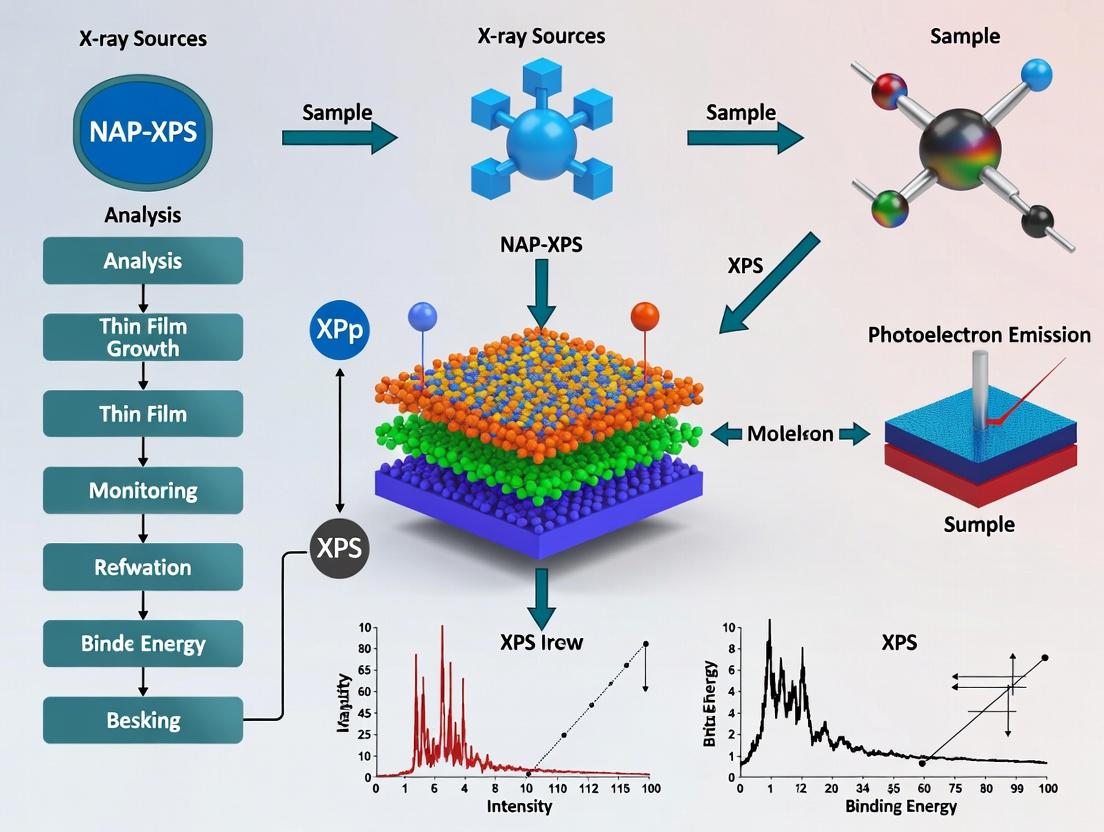
This article provides a comprehensive guide to Near-Ambient Pressure X-ray Photoelectron Spectroscopy (NAP-XPS) for real-time, in-situ monitoring of thin film growth.
In-Situ Monitoring with NAP-XPS: A Game-Changer for Thin Film Growth in Biomedical Device Development
Abstract
This article provides a comprehensive guide to Near-Ambient Pressure X-ray Photoelectron Spectroscopy (NAP-XPS) for real-time, in-situ monitoring of thin film growth. Targeting researchers, materials scientists, and drug development professionals, we explore the foundational principles of NAP-XPS, detail methodological protocols for applications like bioactive coatings and drug-eluting implants, address common troubleshooting and optimization challenges, and validate its advantages against traditional ex-situ techniques. The synthesis underscores NAP-XPS's critical role in advancing reproducible, high-quality functional thin films for next-generation medical devices and therapeutic delivery systems.
What is NAP-XPS? Core Principles and Advantages for In-Situ Thin Film Analysis
Introduction Near-Ambient Pressure X-ray Photoelectron Spectroscopy (NAP-XPS) has fundamentally expanded the analytical window of surface science, enabling the study of solid-gas, solid-liquid, and catalytic interfaces under realistic pressure conditions. Within the broader thesis of thin film growth monitoring research, NAP-XPS provides unprecedented in situ and operando insight into chemical states, adsorption dynamics, and initial growth mechanisms that were previously inaccessible in ultra-high vacuum (UHV) environments.
Key Quantitative Data: Comparing XPS Operational Modes
Table 1: Operational Parameters of XPS Techniques for Thin Film Growth Studies
| Parameter | Conventional/UHV-XPS | NAP-XPS | Significance for Thin Film Growth |
|---|---|---|---|
| Operating Pressure Range | ≤ 10⁻⁸ mbar | 0.1 – 30 mbar | Enables study of precursor adsorption/chemistry at realistic deposition pressures (e.g., ALD, CVD). |
| Probing Depth (approx.) | 3-10 nm | 1-5 nm (gas-dependent) | Surface-sensitive, ideal for monitoring first monolayer formation and interfacial reactions. |
| Typical Spatial Resolution | < 10 µm | 100 µm – 1 mm | Larger spot may average over growth islands; micro-focused versions (µ-NAP) emerging. |
| Gas Environment | None (UHV) | Reactive/Inert (O₂, H₂, H₂O, VOCs) | Allows real-time observation of oxidation, reduction, or precursor decomposition during growth. |
| Sample Temperature Range | Cryogenic to ~1000°C | Cryogenic to ~1000°C | Matches thermal conditions of actual deposition processes (e.g., MOCVD). |
| Key Observable Processes | Post-growth composition, final bonding states. | Live adsorption, reaction kinetics, intermediate species formation, initial nucleation. | Transforms monitoring from post-mortem to in situ diagnostic. |
Detailed Experimental Protocols
Protocol 1: In Situ Monitoring of ALD Oxide Thin Film Nucleation This protocol details using NAP-XPS to observe the initial cycles of Atomic Layer Deposition (ALD).
Sample Preparation & Loading:
- A clean, conducting substrate (e.g., Si wafer with native oxide, or H-terminated Si) is mounted on a resistive heating stage within the NAP-XPS analysis chamber.
- The chamber is evacuated to base pressure (<10⁻⁷ mbar).
Precursor Exposure & Environment Setup:
- The analysis chamber is back-filled with an inert gas (e.g., Ar, N₂) to a pressure of 1-5 mbar, establishing the NAP environment.
- The sample is heated to the target ALD deposition temperature (e.g., 200-300°C for many metal oxides).
- A controlled dose of the first ALD precursor (e.g., Trimethylaluminium, TMA for Al₂O₃) is introduced via a high-precision, pulsed doser. The partial pressure during dosing typically reaches 0.1-1 mbar.
Real-Time Spectral Acquisition:
- The X-ray beam is focused on the sample surface. Core level spectra (e.g., Al 2p, O 1s, C 1s) are acquired continuously or in rapid succession (snapshot mode) during and after precursor exposure.
- Key regions are monitored: the emergence of Al 2p peak (oxide state), the evolution of O 1s peak (metal-O vs. hydroxyl), and the appearance/dissipation of C 1s from methyl ligands.
Purge and Co-Reactant Cycle:
- The precursor gas is purged with inert gas while maintaining total pressure.
- The co-reactant (e.g., H₂O vapor) is then dosed via a separate doser, and spectral acquisition continues to monitor the reaction (hydroxylation, carbon removal).
Data Analysis:
- Spectra are fitted to quantify the amount of deposited material per cycle (nucleation rate), chemical state evolution, and residual contaminant levels.
- The process (steps 2-4) is repeated for multiple cycles to build a growth profile.
Protocol 2: Operando Study of Catalytic Capping Layer Formation This protocol simulates the formation of a protective oxide layer on a metal catalyst film under reactive gases.
Initial Characterization:
- A freshly deposited metal film (e.g., Cu, Co) on a substrate is transferred to the NAP cell.
- Under UHV conditions, a reference XPS survey and core-level spectra are taken to confirm initial metallic state and cleanliness.
Introduction of Reactive Atmosphere:
- The cell is pressurized with a mixture of O₂ (or another oxidant) and an inert gas to a total pressure of 0.5-5 mbar. The O₂ partial pressure is precisely controlled.
Temperature-Programmed Reaction:
- The sample temperature is ramped linearly (e.g., 5°C/min) from near-room temperature to an elevated target (e.g., 400°C).
- At set temperature intervals, high-resolution core-level spectra (e.g., metal 2p, O 1s) are acquired.
Kinetic Monitoring at Isothermal Conditions:
- Upon observing the onset of oxidation (shift in metal peak, growth of oxide O 1s), the temperature is held constant.
- Time-resolved spectra are acquired to track the kinetics of oxide film growth and its self-limiting thickness.
Post-Reaction Analysis:
- The reactive gas is pumped out and replaced with inert gas or returned to UHV.
- Final spectra are taken to assess the stability of the formed capping layer.
Visualization of Methodologies
Title: NAP-XPS Protocol for In Situ ALD Cycle Monitoring
Title: Logical Flow of NAP-XPS in Thin Film Growth Analysis
The Scientist's Toolkit: Key Research Reagent Solutions
Table 2: Essential Materials for NAP-XPS Studies in Thin Film Growth
| Item / Reagent | Function in NAP-XPS Experiments |
|---|---|
| High-Precision Gas Dosing System | Delivers precise, repeatable pulses or constant flows of precursor and reactant gases (e.g., TMA, H₂O, O₂, metalorganics) into the NAP cell. |
| Differentially Pumped Electrostatic Lens | The core enabling technology. It focuses photoelectrons through multiple pressure stages, allowing them to travel from the high-pressure sample region to the UHV of the analyzer. |
| High-Brightness, Monochromated X-ray Source | Provides the incident X-rays (typically Al Kα). Monochromaticity improves spectral resolution, critical for identifying subtle chemical shifts during reactions. |
| Sample Stage with Resistive Heating & Cooling | Enables temperature control from cryogenic to >1000°C to simulate realistic deposition or reaction thermal conditions. |
| Synchrotron Radiation Beamline (Optional but powerful) | Provides tunable, high-flux X-rays for enhanced sensitivity, faster acquisition, and access to tender X-rays for deeper bulk sensitivity. |
| Reference Samples (e.g., Sputter-cleaned Au, Cu) | Used for energy scale calibration and instrumental function checks under both UHV and NAP conditions. |
| Calibrated Leak Valves & Mass Flow Controllers | Ensure accurate and stable control of the gas composition and total pressure within the NAP cell during experiments. |
Near-Ambient Pressure X-ray Photoelectron Spectroscopy (NAP-XPS) is a transformative surface analysis technique enabling the investigation of materials under realistic, non-ultra-high vacuum conditions (from ~0.1 Torr to several tens of Torr). Within the context of a broader thesis on in-situ and operando monitoring of thin film growth processes, NAP-XPS provides critical insights into chemical states, interfacial reactions, and precursor adsorption/desorption dynamics under actual deposition environments (e.g., during Chemical Vapor Deposition or Atomic Layer Deposition). This application note details the key components of a NAP-XPS system, their functions, and protocols for their use in thin film research.
Core System Components & Quantitative Specifications
The NAP-XPS system bridges the high-pressure sample environment with the high-vacuum required for electron detection. The table below summarizes the key components and their typical operational parameters.
Table 1: Key Components of a NAP-XPS System for Thin Film Growth Studies
| Component | Primary Function | Typical Specifications/Parameters | Relevance to Thin Film Growth Monitoring |
|---|---|---|---|
| High-Pressure Cell/Reactor | Houses the sample under near-ambient pressure conditions. | Pressure: 0.1 mbar to 30 mbar. Materials: Stainless steel, often with SiNx or Al windows for X-ray transmission. | Serves as a micro-reactor for deposition. Allows introduction of precursor gases (e.g., TMA, H₂O for ALD) and process gases. |
| Differential Pumping System | Creates a pressure gradient (~10⁹ drop) between the sample cell and the electron analyzer. | Multiple pumping stages (2-3). Pump types: Hybrid diaphragm/turbo or scroll/turbo molecular pumps. Pressure at analyzer: < 5x10⁻⁶ mbar. | Enables electron transmission from high-pressure region to UHV detector. Critical for maintaining analyzer integrity during gas exposure. |
| X-ray Source | Generates photons to excite core-level electrons from the sample. | Al Kα (1486.6 eV) or monochromated Al Kα. Synchrotron Ag Lα (2984.3 eV) for higher energy. Spot size: 50 µm to 500 µm. | Probes the evolving chemistry of the film surface and substrate interface during growth. |
| Electron Lens System | Collects and focuses emitted photoelectrons from the sample into the analyzer. | Acceptance angle: ±30°. Working distance: < 1 mm. May include a magnetic lens for higher collection efficiency. | Maximizes signal from the often weak, evolving film surface. Must accommodate the short path in the high-pressure region. |
| Hemispherical Analyzer (HSA) | Energy-filters the photoelectrons to produce a spectrum. | Pass Energy: 5-200 eV. Resolution: < 0.5 eV (for Ag 3d₅/₂). Retardation ratio: 10-200. | Provides the chemical state resolution needed to identify reaction intermediates and film composition. |
| Detector | Counts the energy-selected electrons. | Multi-channel plate (MCP) with a delay-line detector (DLD) or position-sensitive detector (PSD). | Enables high-sensitivity, rapid data acquisition to track real-time changes during film growth cycles. |
| Sample Manipulator | Positions and controls the sample. | Temperature range: -150°C to 1000°C. XYZ translation and tilt. | Allows precise temperature control for deposition processes and positioning within the gas environment. |
| Gas Handling System | Introduces and controls gases into the high-pressure cell. | Mass flow controllers (MFCs), leak valves, gas mixing manifold. May include a vapor doser for liquid precursors. | Precisely controls the deposition environment (precursor pulses, purge gases, reaction atmospheres). |
Experimental Protocols for Thin Film Growth Monitoring
Protocol 3.1: System Preparation forIn-SituALD Monitoring
Objective: To prepare the NAP-XPS system for monitoring sequential, self-limiting surface reactions during Atomic Layer Deposition.
- Sample Loading: Insert substrate (e.g., Si wafer with native oxide) into the high-pressure cell using a load-lock system to maintain main chamber integrity.
- Baseline UHV Characterization: Pump the main chamber and analyzer to UHV (<1x10⁻⁸ mbar). Acquire survey and high-resolution spectra of the clean substrate at room temperature.
- Cell Isolation & Pressurization: Isolate the high-pressure cell from the main UHV chamber using gate valves. Introduce inert gas (e.g., N₂, Ar) via MFCs to the desired process pressure (e.g., 1-10 mbar). Verify pressure stability.
- Alignment Check: Using the sample manipulator, align the sample spot with the X-ray beam and electron lens axis by maximizing the signal from a substrate peak (e.g., Si 2p) in real-time.
- Temperature Ramp: Heat the sample to the target ALD growth temperature (e.g., 200-300°C) under inert gas flow, allowing temperature to stabilize.
- Precursor Exposure & Data Acquisition: Initiate the ALD cycle.
- Pulse A: Introduce the first precursor (e.g., Trimethylaluminum - TMA) into the gas stream for a defined pulse time (e.g., 0.1-1 s).
- Spectrum Acquisition: Immediately acquire a series of rapid, high-resolution spectra of relevant core levels (e.g., Al 2p, C 1s, O 1s).
- Purge: Flow inert gas to purge non-reacted precursor and by-products.
- Pulse B: Introduce the second reactant (e.g., H₂O vapor).
- Spectrum Acquisition: Acquire spectra again to monitor the reaction.
- Purge: Complete the cycle with an inert gas purge.
- Cycle Repetition: Repeat Step 6 for the desired number of ALD cycles.
- Post-Growth Analysis: Purge the cell with inert gas, pump it down to UHV, and acquire final high-quality spectra for detailed analysis.
Protocol 3.2: Calibration of Pressure Gradient & Electron Transmission
Objective: To characterize and calibrate the pressure differential across the aperture system and its effect on electron count rate.
- Pressure Sensor Calibration: Ensure calibrated pressure gauges are active on the high-pressure cell (Pcell) and on the first differential pumping stage (Pstage1).
- Establish Pressure Gradient: With the analyzer at UHV, introduce an inert gas (Ar) into the cell and set Pcell to a series of setpoints (e.g., 0.1, 0.5, 1, 5, 10 mbar). Record the corresponding Pstage1 at each setpoint.
- Measure Electron Signal Attenuation: On a clean, stable sample (e.g., Au foil), position the Fermi edge and acquire the Au 4f spectrum under UHV as a reference (IUHV). Repeat the acquisition at each pressure setpoint from Step 2, measuring the attenuated intensity (IP).
- Calculate Transmission: For each pressure, calculate the relative electron transmission T = IP / IUHV.
- Data Modeling: Plot T vs. P_cell. Fit the data to an exponential decay model to establish a pressure-transmission function for quantitative signal correction during high-pressure experiments.
System Workflow & Signal Pathway Visualizations
Title: NAP-XPS Signal Pathway from Sample to Spectrum
Title: Protocol for In-Situ ALD Monitoring via NAP-XPS
The Scientist's Toolkit: Essential Research Reagents & Materials
Table 2: Key Reagents and Materials for NAP-XPS Thin Film Studies
| Item | Function/Application | Example in Thin Film Research |
|---|---|---|
| ALD Precursors (Metal-Organics) | Provide the metal source for layer-by-layer oxide/nitride growth. | Trimethylaluminum (TMA for Al₂O₃), Tetrakis(dimethylamido)titanium (TDMAT for TiN). |
| Co-reactants / Oxidants | React with surface-adsorbed precursors to form the desired film. | H₂O vapor (for oxides), O₂ plasma, NH₃ (for nitrides). |
| High-Purity Inert Gases | Purge gas for ALD cycles; diluent for reactive gases; analyzer protection. | N₂ (99.9999%), Ar (99.9999%). |
| Calibration Samples | Energy scale calibration and system performance checks. | Clean Au foil (for Fermi edge, Au 4f₇/₂ at 84.0 eV), Cu foil (Cu 2p₃/₂ at 932.67 eV). |
| SiNx or Al X-ray Windows | Separate high-pressure cell from UHV, transparent to soft X-rays. | 100 nm thick SiNx membranes. Allow X-rays in while maintaining pressure differential. |
| Conductive Sample Adapters | Provide electrical and thermal contact for heated/cooled samples. | Ta or Mo metal plates, often with inset thermocouple. |
| Specially Designed Micro-reactors | Miniaturized cells for efficient gas exchange and localized pressure. | Cells with small volume (<1 cm³) to enable fast precursor switching. |
Application Notes
Near-Ambient Pressure X-ray Photoelectron Spectroscopy (NAP-XPS) revolutionizes thin film growth monitoring by enabling in situ and operando analysis under realistic process conditions (e.g., mTorr to Torr pressures). This leverages the photoelectric effect, where X-ray excitation of core-level electrons yields spectra containing quantitative data on elemental composition, chemical state, and electronic structure. For thin film research, this allows real-time tracking of deposition, interfacial reactions, and surface chemistry evolution, which is critical for developing functional coatings, catalysts, and semiconductor devices.
Key Quantitative Insights from NAP-XPS in Thin Film Studies:
- Film Thickness & Growth Rate: Derived from substrate signal attenuation using layer-specific relative sensitivity factors (RSFs).
- Chemical State Evolution: Binding energy shifts of 0.1-0.8 eV indicate oxidation state changes, ligand bonding, or interface dipole formation.
- Compositional Gradients: Atomic concentration ratios (e.g., In/Ga in IGZO) tracked as a function of depth or time.
- Reaction Kinetics: Adsorbate coverage and reaction intermediate concentrations monitored under reactive gas flows.
Protocols
Protocol 1:In SituMonitoring of Metal Oxide Thin Film Growth by Pulsed Laser Deposition (PLD)
Objective: To monitor the initial stages and chemical state evolution of a strontium titanate (STO) thin film grown on a silicon substrate under oxygen background pressure.
Materials & Reagents:
- NAP-XPS system with differential pumping.
- PLD target: SrTiO₃.
- Substrate: p-type Si wafer with native oxide.
- Process gas: High-purity O₂ (99.999%).
- Calibration reference: Au foil for energy scale calibration.
Methodology:
- Sample Introduction & Baseline: Load the Si substrate into the NAP cell. Evacuate to base pressure (<1 x 10⁻⁸ mbar). Acquire survey and high-resolution spectra (Si 2p, O 1s, C 1s) of the clean substrate.
- Environmental Control: Introduce O₂ to the NAP cell to a constant pressure of 0.1 mbar. Re-acquire O 1s spectrum to confirm gas-phase contribution.
- Laser Ablation & Data Acquisition: Initiate PLD ablation of the STO target. Set the XPS acquisition to a rapid sequential scan mode, cycling through key regions: Ti 2p, Sr 3d, O 1s, Si 2p. Use a pass energy of 50 eV for optimal speed/resolution balance.
- Real-Time Tracking: Continue deposition and acquisition for a pre-set number of laser pulses (e.g., 100-500). Ensure time resolution is sufficient to track the attenuation of the Si substrate signal and the growth of the Ti and Sr signals.
- Post-Process Analysis: After deposition, flush cell with pure O₂ for 5 minutes, then pump down to UHV for high-quality post-growth spectra.
Data Analysis:
- Plot integrated peak intensities vs. time/pulses to derive growth curves.
- Deconvolute the Ti 2p region to identify TiO₂ vs. sub-stoichiometric species.
- Use the Si 2p attenuation model to estimate film thickness.
Protocol 2:OperandoStudy of Catalytic Thin Film Surface under Reactive Gases
Objective: To characterize the surface composition and oxidation states of a porous Pt-CeO₂ catalyst film under alternating CO oxidation conditions.
Materials & Reagents:
- NAP-XPS system with high-transmission lens and fast detector.
- Sample: Sputter-deposited Pt-CeO₂ film on Al₂O³ membrane.
- Reaction gases: 1% CO, 5% O₂, balanced Ar (all research grade).
- Mass spectrometer (connected to the NAP cell effluent).
Methodology:
- Pre-reduction: Clean sample surface in UHV with mild Ar⁺ sputtering. Heat to 300°C in 0.5 mbar H₂ for 15 minutes, then cool to reaction temperature (250°C).
- Oxidizing Condition: Introduce 0.3 mbar of 5% O₂/Ar. Stabilize gas flow, then acquire high-resolution spectra for Ce 3d, Pt 4f, O 1s, and C 1s. Monitor gas effluent with MS.
- Reducing Condition: Switch gas feed to 0.3 mbar of 1% CO/Ar. After stabilization, acquire the same set of core-level spectra.
- Cyclic Operation: Repeat steps 2 and 3 for 2-3 cycles to assess reversibility and catalyst stability.
- Spectral Calibration: Reference adventitious carbon C 1s peak to 284.8 eV for charge correction.
Data Analysis:
- Quantify the ratio of Ce³⁺/(Ce³⁺+Ce⁴⁺) using the well-established Ce 3d deconvolution procedure.
- Track the binding energy and shape of the Pt 4f doublet to identify metallic Pt⁰ vs. oxidized Pt²⁺/Pt⁴⁺ states.
- Correlate surface state changes (from XPS) with MS data on CO₂ production.
Data Tables
Table 1: Characteristic Binding Energies for Key Elements in Thin Film Studies
| Element & Core Level | Binding Energy (eV) in Pure Metal | Binding Energy (eV) in Common Oxide | Chemical Shift (eV) | Application Example |
|---|---|---|---|---|
| Ti 2p₃/₂ | 453.8 (Ti⁰) | 458.5 (Ti⁴⁺ in TiO₂) | +4.7 | Monitoring oxidation state in ALD TiO₂ |
| Al 2p | 72.8 (Al⁰) | 74.5-75.5 (Al³⁺ in Al₂O₃) | +1.7 to +2.7 | Measuring Al₂O₃ encapsulation layer thickness |
| C 1s | 284.8 (Adventitious C-C/C-H) | 288.5-290.0 (O-C=O / Carbonates) | +3.7 to +5.2 | Tracking ligand decomposition in MOF films |
| N 1s | 399.0 (amine / nitride) | 402.0-405.0 (NOx species) | +3.0 to +6.0 | Assessing plasma nitridation of Si surfaces |
Table 2: Quantitative Output from a Simulated PLD STO Growth Experiment
| Deposition Time (min) | Ti 2p Intensity (cps) | Sr 3d Intensity (cps) | Si 2p Substrate Intensity (cps) | Estimated Film Thickness (Å) | Dominant Ti Species |
|---|---|---|---|---|---|
| 0 (Substrate) | 0 | 0 | 125,000 | 0 | N/A |
| 2 | 8,250 | 5,120 | 89,300 | ~6 | Ti⁴⁺, Ti³⁺ |
| 5 | 32,100 | 20,150 | 45,500 | ~15 | Ti⁴⁺ |
| 10 | 58,400 | 36,800 | 15,200 | ~30 | Ti⁴⁺ |
| 15 | 65,500 | 41,200 | 5,050 | ~45 | Ti⁴⁺ |
Diagrams
In Situ NAP-XPS Monitoring Workflow
From Photon to Chemical Data
The Scientist's Toolkit: Key Research Reagents & Materials
| Item | Function in NAP-XPS Thin Film Studies |
|---|---|
| Single Crystal Substrates (e.g., SiO₂, Al₂O₃, SrTiO₃) | Provide atomically flat, well-defined surfaces for epitaxial film growth and simplified spectral interpretation. |
| High-Purity Process Gases (O₂, H₂, N₂, NO, CO) | Create controlled near-ambient environments to simulate real synthesis or operational conditions. |
| Calibration Materials (Au, Ag, Cu foils) | Used for precise binding energy scale calibration via known Au 4f₇/₂ (84.0 eV) or Cu LMM Auger lines. |
| Conductive Adhesive (e.g., Carbon tape, In foil) | Ensures electrical contact between insulating samples and the sample holder to mitigate charging effects. |
| Sputter Deposition Targets / PLD Targets | Source materials for in situ thin film growth directly within the NAP-XPS analysis cell. |
| Dedicated Gas Dosing System | Precision leak valves and mass flow controllers for accurate, stable partial pressure control of reactive gases. |
Why In-Situ? The Critical Need for Real-Time Monitoring During Thin Film Deposition (PVD, CVD, ALD)
Application Notes: NAP-XPS for Thin Film Growth Monitoring
Near-Ambient Pressure X-ray Photoelectron Spectroscopy (NAP-XPS) is revolutionizing the study of thin film deposition by enabling real-time, in-situ chemical analysis under realistic process conditions. This capability is critical for establishing precise structure-property relationships, optimizing deposition parameters, and accelerating process development for advanced materials in semiconductor, energy, and catalytic applications.
Table 1: Comparison of In-situ vs. Ex-situ Characterization for Thin Film Deposition
| Parameter | Ex-situ Analysis | In-situ NAP-XPS Analysis | Impact / Implication |
|---|---|---|---|
| Chemical State Fidelity | Often altered by air exposure (e.g., oxidation, contamination) | Preserved true state under process environment | Accurate determination of oxidation states, interface reactions. |
| Interface Resolution | Limited; often damaged during transfer. | Atomic-level, real-time interface evolution. | Direct observation of interfacial diffusion, layer-by-layer growth. |
| Data Acquisition Time per Layer | Hours to days (after process completion). | Seconds to minutes (during growth). | Enables real-time feedback control for precise thickness/comp. |
| Detection Limit (typical) | ~0.1-1 at% (surface sensitive). | ~0.1-5 at% (pressure dependent). | Suitable for monitoring dopant incorporation or trace impurities. |
| Operable Pressure Range | Ultra-high vacuum (<10⁻⁹ mbar). | Up to 10-20 mbar. | Study of realistic CVD/ALD precursor environments. |
Table 2: Key Insights from Recent In-situ NAP-XPS Studies in Thin Film Deposition
| Deposition Method | Material System | Key In-situ Finding | Reference (Year) |
|---|---|---|---|
| ALD | Al₂O₃ on Si, HfO₂ | Direct observation of ligand removal and hydroxylation during water pulse. Identification of sub-cycle reaction intermediates. | (Salmeron et al., 2022) |
| CVD (MO-CVD) | WS₂, MoS₂ 2D layers | Real-time tracking of precursor decomposition and S:Me ratio evolution, correlating with film crystallinity. | (Zhang et al., 2023) |
| PVD (Sputtering) | TiN, TaN barriers | Instantaneous detection of oxygen incorporation during deposition, linked to target poisoning and process parameters. | (Kressig et al., 2023) |
| PED (Plasma-Enhanced) | Silicon nitride (SiNₓ) | Quantification of N/Si ratio and H content as a function of plasma power, revealing bond-structure relationship. | (Fondell et al., 2024) |
Experimental Protocols
Protocol 1: In-situ NAP-XPS Monitoring of Thermal ALD for Al₂O₃
Objective: To monitor the self-limiting surface reactions during ALD of Al₂O₃ using TMA and H₂O.
Materials & Setup:
- Sample: Si wafer with native or thermal oxide.
- Reactor: High-temperature, high-pressure cell integrated into NAP-XPS analysis chamber.
- Precursors: Trimethylaluminum (TMA) and deionized H₂O, held in external, temperature-controlled bubblers.
- Carrier/Purge Gas: High-purity N₂ or Ar (99.999%).
- XPS System: Equipped with a monochromatic Al Kα source and a high-transmission electron energy analyzer capable of operation at 1-10 mbar.
Methodology:
- Sample Preparation & Loading: Introduce the Si substrate into the NAP-XPS system. Pre-clean via annealing at 400°C in 1 mbar of O₂ for 10 minutes, followed by pumping and baseline XPS survey.
- ALD Cycle Definition:
- TMA Dose: Expose the sample to 0.1 mbar TMA (in 5 mbar N₂) for 1 second.
- Purge 1: Pump and flush with N₂ for 30 seconds to remove non-reacted TMA and by-products.
- XPS Measurement 1: Acquire high-resolution spectra of Al 2p, O 1s, and C 1s core levels without breaking the ALD cycle.
- H₂O Dose: Expose the sample to 1 mbar H₂O (in 5 mbar N₂) for 1 second.
- Purge 2: Pump and flush with N₂ for 30 seconds.
- XPS Measurement 2: Acquire the same high-resolution spectra post-water dose.
- Repetition: Repeat Step 2 for 10-100 cycles, acquiring spectra after each half-cycle or at selected cycle intervals.
- Data Analysis: Quantify the Al 2p and O 1s peak intensities and binding energy shifts. Plot the Al signal growth versus cycle number to confirm linear growth (self-limiting behavior). Monitor the C 1s signal to confirm ligand removal.
Protocol 2: In-situ NAP-XPS during PVD Sputter Deposition of Functional Oxide
Objective: To correlate the plasma conditions with the oxidation state of a transition metal in a growing oxide film (e.g., TiO₂).
Materials & Setup:
- Sample: Conducting substrate (e.g., Pt/Si).
- PVD Source: Miniature magnetron sputter gun integrated into the NAP-XPS, targeting Ti.
- Process Gases: High-purity Ar (sputtering) and O₂ (reactive gas).
- XPS System: As in Protocol 1, must be shielded from direct plasma radiation.
Methodology:
- Baseline & Calibration: Acquire XPS survey of clean substrate. Introduce 0.1 mbar of pure O₂ and record O 1s spectrum as a reference.
- Initiate Sputtering: Start Ar flow to maintain 0.05 mbar. Ignite plasma at the Ti target at a defined power (e.g., 50W). Begin deposition.
- Real-Time Monitoring: Continuously acquire sequences of high-resolution spectra for Ti 2p and O 1s regions (e.g., 60s per spectrum). The sample stage is rotated to alternate between deposition and analysis positions if a direct line-of-sight geometry is used.
- Parameter Modulation: After 5 minutes of pure Ar sputtering (expected to form sub-stoichiometric TiOx), introduce a controlled O₂ flow (e.g., 0.5 sccm) to increase the chamber's O₂ partial pressure. Monitor the Ti 2p peak shift from Ti³⁺ to Ti⁴⁺ in real-time.
- Post-Deposition Analysis: After stopping deposition, perform detailed angle-resolved XPS without venting to assess film uniformity and final composition.
The Scientist's Toolkit: Key Research Reagent Solutions & Materials
Table 3: Essential Materials for In-situ NAP-XPS Deposition Studies
| Item / Reagent | Function / Role in Experiment | Critical Specifications |
|---|---|---|
| Integrated Deposition Cell | A mini-reactor inside the XPS allowing controlled gas/pressure exposure and heating during analysis. | Materials compatibility (non-magnetic), heating to >800°C, pressure range 10⁻⁹ to 20 mbar. |
| High-Purity Precursor Sources | Provide the molecular or atomic species for film growth (e.g., TMA, metalorganics, H₂O). | Ultra-low moisture/O₂ content, stable vapor pressure, compatible delivery lines (heated if needed). |
| Inert Carrier Gas (N₂, Ar) | Transports precursors, purges reaction by-products, maintains process pressure. | 99.999% purity, with point-of-use purifiers to remove residual H₂O/O₂. |
| Calibrated Leak Valves & MFCs | Precisely control the flow and partial pressure of precursors and gases into the analysis cell. | High accuracy and reproducibility for low flow rates (sccm range). |
| Reference Sample (e.g., Au foil) | Provides a constant energy reference for XPS binding energy calibration during pressure changes. | Clean, stable, mounted adjacent to the working sample. |
| Synchrotron Beamtime | (Optional but powerful) Provides high-flux, tunable X-rays for faster, more surface-sensitive measurements. | Access to a beamline equipped with a NAP-XPS endstation. |
Experimental Workflow & Logical Diagrams
Diagram Title: In-situ NAP-XPS Monitoring Workflow for Thin Film Deposition
Diagram Title: From Deposition Parameters to Film Properties via In-situ Insights
Within the broader thesis on Near-Ambient Pressure X-ray Photoelectron Spectroscopy (NAP-XPS) for thin film growth monitoring research, the capability to probe target properties in situ and operando is transformative. This thesis posits that real-time tracking of composition, thickness, contamination, and interface formation under relevant environmental conditions (e.g., in presence of reactant gases, elevated temperature) is critical for advancing functional thin film development. This application note details protocols and methodologies for employing NAP-XPS to monitor these key target properties, providing a framework for researchers in material science and drug development, where surface and interface integrity are paramount.
Application Notes & Core Principles
2.1 Tracking Composition & Contamination NAP-XPS enables elemental and chemical state analysis via core-level and valence band spectra. Shifts in binding energy indicate changes in oxidation state or local bonding environment, crucial for monitoring reactive film growth. Contamination (e.g., adventitious carbon, sulfides) is identified via specific photoelectron lines (C 1s, S 2p). The key is performing surveys and high-resolution scans at relevant pressures (0.1-20 mbar) without vacuum breaks.
2.2 Determining Film Thickness For ultra-thin films (<10 nm), thickness is derived from the attenuation of the substrate's photoelectron signal using a model for inelastic electron mean free path. The intensity ratio of substrate (I) to clean substrate (I₀) is: I/I₀ = exp(-d/λ sin θ) where d is thickness, λ is the effective electron attenuation length, and θ is the analyzer take-off angle relative to the surface.
2.3 Monitoring Interface Formation Interface reactions are tracked by monitoring the evolution of core-level signals from both the substrate and the growing film. The appearance of new chemical states at the interface, distinct from bulk film or substrate, signals compound or alloy formation. Sequential deposition and analysis cycles are used.
Experimental Protocols
Protocol 1: In Situ Growth and Composition Monitoring (e.g., ALD of Al₂O₃)
- Objective: Track Al and O chemical state changes during sequential precursor (TMA) and oxidant (H₂O) pulses.
- Materials: Si wafer with native oxide or other substrate, Trimethylaluminum (TMA) precursor, deionized water.
- NAP-XPS Setup: Chamber with gas dosing system, heater stage, pressure control (1-5 mbar during dosing).
- Procedure:
- Insert substrate and heat to target growth temperature (e.g., 200°C) in analysis chamber under 1 mbar of inert gas (N₂/Ar).
- Record reference survey and high-resolution spectra of substrate (Si 2p, O 1s, C 1s).
- Cycle Start: Introduce TMA vapor pulse (e.g., 0.1 s) into carrier gas flow.
- Maintain flow/pressure for a defined exposure time (e.g., 10 s). Acquire rapid Al 2p and O 1s spectra.
- Purge chamber with carrier gas to remove precursor byproducts.
- Introduce H₂O vapor pulse and maintain exposure. Acquire rapid O 1s and Al 2p spectra.
- Purge chamber. This concludes one cycle.
- Repeat steps 3-7 for n cycles, acquiring spectra after each half-cycle or full cycle.
- Data Analysis: Plot Al 2p and O 1s peak area and binding energy shift versus cycle number. Quantify carbon contamination via C 1s signal.
Protocol 2: Thickness Determination via Substrate Signal Attenuation
- Objective: Determine the thickness of a growing TiO₂ film on an Au substrate.
- Procedure:
- Record high-resolution Au 4f spectrum from clean substrate at known θ (e.g., 90°). Measure peak area (I₀).
- Initiate film growth (e.g., by sputtering, evaporation, or ALD in NAP-XPS chamber).
- Interrupt growth at intervals. Record spectra of Au 4f and Ti 2p at identical geometry.
- Measure attenuated Au 4f peak area (I) for each interval.
- Calculate thickness d using the formula above. Assume λ ~ 2-3 nm for Au 4f electrons in TiO₂.
- Correlate d with growth time/cycles.
Protocol 3: Interface Formation Tracking during Metal Deposition on Organic Layer
- Objective: Study the chemical interaction at the interface between evaporated Ca and a conjugated polymer film.
- Procedure:
- Spin-coat polymer film onto conductive substrate. Load into NAP-XPS.
- Record reference spectra of polymer (C 1s, O 1s, specific element core levels).
- Begin slow, controlled thermal evaporation of Ca from a crucible inside the preparation chamber.
- After very small doses (sub-monolayer), transfer sample to analysis position without breaking vacuum. Acquire C 1s, O 1s, Ca 2p, and other relevant spectra.
- Repeat deposition and analysis steps, gradually increasing Ca coverage.
- Data Analysis: Deconvolute C 1s spectrum to identify new components (e.g., carbide formation). Monitor Ca 2p shift from metallic to reacted state. Plot component intensities versus deposition time to track interface reaction zone growth.
Table 1: NAP-XPS Derived Data for Model ALD Al₂O₃ Growth (Protocol 1)
| Cycle Number | Al 2p BE (eV) | O 1s BE (eV) | C 1s At. % | Calculated Thickness (nm)* |
|---|---|---|---|---|
| 0 (Substrate) | - | 532.8 (SiO₂) | 12.5 | 0.0 |
| 5 | 75.9 | 532.1 | 5.2 | 0.6 |
| 10 | 75.8 | 532.0 | 2.1 | 1.2 |
| 20 | 75.8 | 532.0 | 1.5 | 2.3 |
| 50 | 75.8 | 532.0 | <1.0 | 5.8 |
*Based on substrate signal attenuation, assuming λ = 2.5 nm.
Table 2: Interface Reaction Metrics for Ca/Polymer System (Protocol 3)
| Ca Dose (equiv. monolayers) | Metallic Ca 2p₃/₂ BE (eV) | Reacted Ca 2p₃/₂ BE (eV) | Carbidic C % (of total C 1s) | Polymer C-C/C-H % (of total C 1s) |
|---|---|---|---|---|
| 0.0 | - | - | 0% | 82% |
| 0.2 | 346.2 | 347.5 | 15% | 70% |
| 0.5 | 346.2 | 347.6 | 38% | 48% |
| 1.0 | 346.1 | 347.6 | 65% | 25% |
| 2.0 | 346.1 | 347.5 | 68% | 22% |
Diagrams
In Situ NAP-XPS Cycle for Film Growth & Tracking
Target Property Analysis Logic with NAP-XPS
The Scientist's Toolkit: Research Reagent Solutions
Table 3: Essential Materials for NAP-XPS Thin Film Growth Studies
| Item | Function & Relevance |
|---|---|
| Calibrated Gas Dosing System | Precise introduction of precursors (e.g., TMA, TiCl₄) and reactive gases (O₂, H₂O, NH₃) at controlled partial pressures (0.1-20 mbar) for in situ reactions. |
| Heated Sample Stage (RT-1000°C) | Enables studies of growth and interface formation at technologically relevant temperatures, mimicking real synthesis conditions. |
| In Situ Deposition Sources | Integrated thermal evaporators (for metals), sputter guns, or effusion cells for film growth without vacuum breaks, ensuring clean interfaces. |
| Reference Sample Set | Sputter-cleaned Au, Cu, highly oriented pyrolytic graphite (HOPG) for energy calibration, and substrates with native oxide (Si/SiO₂) for thickness validation. |
| High-Purity Precursors & Gases | Electronic/ALD grade precursors (e.g., TMA, TEMAHf) and gases (O₂, N₂, Ar) with specific impurity levels (<1 ppm) to minimize experimental contamination. |
| Charge Compensation System | Low-energy electron/flood gun and adjustable pressure of inert gas (e.g., Ar) to mitigate charging on insulating films during analysis. |
Step-by-Step Protocols: Applying NAP-XPS to Biomedical Thin Film Growth
Within the broader thesis on Near-Ambient Pressure X-ray Photoelectron Spectroscopy (NAP-XPS) for in situ thin film growth monitoring, the integration of deposition systems is paramount. This setup enables the direct, real-time investigation of film composition, interfacial chemistry, and electronic structure under realistic synthesis conditions, bridging the "pressure gap" between ultra-high vacuum (UHV) processing and functional device operation.
Core Integration Architecture & Specifications
The integration involves a dedicated NAP-XPS system coupled to one or more deposition chambers via differentially pumped transfer lines or interconnected UHV modules. Key quantitative specifications for a state-of-the-art setup are summarized below.
Table 1: Typical Specifications for an Integrated NAP-XPS/Deposition System
| Component | Parameter | Typical Range/Specification |
|---|---|---|
| NAP-XPS Analyzer | Operating Pressure Range | 0.1 mbar to 20 mbar |
| Energy Resolution (Al Kα) | ≤ 0.5 eV | |
| Acceptance Angle / Solid Angle | ~ 30°, 0.5 sr | |
| Detector | 2D delay-line detector | |
| Sputtering Source | Base Pressure | < 5×10⁻⁸ mbar |
| Process Gas (Ar) Pressure | 1×10⁻³ to 5×10⁻² mbar | |
| Deposition Rate (Metals) | 0.01 - 2 nm/s | |
| Target Bias (DC/RF) | 100 - 500 W | |
| Thermal Evaporation Source | Base Pressure | < 5×10⁻⁸ mbar |
| Deposition Rate (Al, Au, C) | 0.01 - 1 nm/s | |
| Source Temperature | Up to 2000°C | |
| Sample Stage | Temperature Range | -150°C to +1000°C |
| Positioning | XYZ, tilt, rotation | |
| Transfer System | Transfer Time | < 5 minutes |
| Intermediate Pressure | < 1×10⁻⁸ mbar |
Detailed Experimental Protocols
Protocol 1:In SituMonitoring of Sputtered TiO₂ Thin Film Growth
Objective: To monitor the stoichiometry and chemical state evolution of titanium oxide during reactive magnetron sputtering.
Materials & Pre-Experimental Setup:
- Substrate: Heated Si wafer with native oxide or conductive FTO glass.
- Target: Metallic Ti (99.99% purity).
- Process Gases: Ar (99.999%) and O₂ (99.998%).
- Pre-cleaning: Sputter-etch substrate with Ar⁺ ions (1 keV, 5 μA, 5 min) in the analysis chamber prior to transfer.
Procedure:
- Sample Transfer: Move the cleaned substrate to the sputtering chamber. Ensure gate valve isolation.
- Sputter Chamber Conditioning: Evacuate to base pressure (<5×10⁻⁸ mbar). Introduce Ar/O₂ gas mixture (20:1 ratio) to a total pressure of 3×10⁻² mbar.
- Plasma Ignition & Stabilization: Initiate DC plasma on Ti target at 300 W. Pre-sputter target for 10 minutes with shutter closed.
- Initialize NAP-XPS: Set analysis chamber to a transfer pressure of 1 mbar of O₂. Align X-ray beam and analyzer to sample position.
- Initiate Growth & Data Acquisition: a. Open sputter shutter to commence deposition. b. Simultaneously, start a cyclic XPS acquisition sequence focused on Ti 2p, O 1s, and C 1s core levels. c. Use a pass energy of 20 eV and step size of 0.05 eV for high-resolution scans. Acquire a full cycle every 60-120 seconds.
- Post-Processing: Transfer sample back to UHV for complementary analysis (e.g., UPS, AES) or cool under relevant atmosphere.
Protocol 2: Real-Time Study of Organic Layer Evaporation on Active Electrode
Objective: To investigate the interfacial energy level alignment during thermal evaporation of an organic semiconductor onto a sputter-deposited metal electrode.
Materials & Pre-Experimental Setup:
- Substrate: Sputter-deposited Ag electrode (100 nm thick) on Si.
- Evaporant: C₆₀ (99.9% purity) in a Knudsen-cell effusion source.
- Calibration: Prior to experiment, calibrate C₆₀ deposition rate (e.g., 0.1 nm/min) using a quartz crystal microbalance (QCM) in a dedicated port.
Procedure:
- Electrode Preparation: Sputter-deposit Ag in the deposition chamber. Transfer to NAP-XPS without breaking vacuum.
- Baseline Spectra: Acquire high-resolution XPS spectra (Ag 3d, C 1s, O 1s, Valence Band) and a UPS (He I) spectrum of the pristine Ag at UHV conditions.
- Switch to NAP Mode: Introduce 0.5 mbar of ultra-pure N₂ into the analysis chamber. Re-acquire valence band region to confirm no pressure-induced spectral shifts.
- Initiate Organic Deposition: a. Ramp the C₆₀ source to the pre-calibrated temperature. b. Open the evaporation shutter. Note: Start NAP-XPS acquisition before opening the shutter. c. Run a continuous, automated sequence collecting Ag 3d, C 1s, and Valence Band spectra every 90 seconds.
- Thickness Series: Continue deposition and measurement until a nominal thickness of 10 nm is reached, as estimated from the calibrated rate and the attenuation of the Ag 3d substrate signal.
- Interface Analysis: Fit the evolution of the Ag 3d attenuation and the C 1s chemical shift to model interface formation and band bending.
System Integration & Workflow Visualization
Diagram 1: Integrated NAP-XPS and Deposition System Workflow
The Scientist's Toolkit: Key Research Reagent Solutions
Table 2: Essential Materials & Reagents for NAP-XPS Thin Film Studies
| Item | Function & Specification | Critical Notes |
|---|---|---|
| High-Purity Sputtering Targets | Source material for PVD. 3N-5N purity, 2" or 3" diameter. | Choice defines film composition. Reactive targets (Ti, Ta) for oxides, nitrides. |
| Knudsen Cell Evaporators | For controlled thermal evaporation of organics or low-T metals. | Must have stable temperature control (±1°C) and a water-cooled shroud. |
| Process & Analysis Gases | Ar (sputtering), O₂, N₂, H₂ (reactive processes/analysis ambient). 5N purity with point-of-use purifiers. | Essential for NAP-XPS studies simulating real environments (e.g., oxidation catalysis). |
| Calibrated Thickness Monitor | Quartz Crystal Microbalance (QCM) in the deposition chamber. | Provides real-time deposition rate calibration independent of XPS. |
| Conductive Sample Holders | Custom plates (often Mo or Ta) compatible with heating/cooling stage. | Ensures electrical contact for insulating samples to mitigate charging. |
| Reference Samples | Sputtered Au foil, clean Si wafer, graphite. | For daily spectrometer energy scale and resolution calibration. |
| Ion Sputter Gun | Ar⁺ or Ar cluster source for sample cleaning within the analysis chamber. | Crucial for preparing clean substrate surfaces prior to in situ growth. |
Within the context of a thesis on Near-Ambient Pressure X-ray Photoelectron Spectroscopy (NAP-XPS) for in-situ thin film growth monitoring, the selection of experimental parameters is paramount. This technique bridges the "pressure gap," allowing for the investigation of surfaces under chemically relevant environments (up to ~100 mbar). The core challenge lies in optimizing the trade-offs between signal intensity, surface sensitivity, information depth, and spectral resolution by tuning photon energy, operating pressure, and acquisition time. These choices directly dictate the feasibility of monitoring dynamic processes like chemical vapor deposition (CVD) or atomic layer deposition (ALD) with sufficient temporal and chemical resolution.
Core Parameter Interplay and Quantitative Guidelines
The table below summarizes the key effects and optimization strategies for the three primary parameters.
Table 1: Optimization Matrix for Core NAP-XPS Parameters in Thin Film Growth Monitoring
| Parameter | Primary Effect on Signal | Optimization Goal for Growth Monitoring | Typical Range for Studies | Quantitative Impact / Trade-off |
|---|---|---|---|---|
| Photon Energy (hv) | Kinetic Energy (KE) & Inelastic Mean Free Path (λ). Governs surface sensitivity and cross-section. | Maximize surface signal from adsorbates/initial layers; differentiate bulk vs. interface. | 200 - 1500 eV (Lab Al Kα = 1486.6 eV; Synchrotron tunable). | Lower KE (e.g., hv ~300-500 eV): λ ~5-10 Å, high surface sensitivity. Higher KE (e.g., hv >1000 eV): λ >15 Å, probes bulk/buried interfaces. |
| Chamber Pressure (p) | Attenuation of photoelectrons by gas scattering. Directly reduces detected intensity. | Balance between "near-ambient" relevance and measurable core-level signals. | 0.1 - 20 mbar (common for H₂O, O₂, CO₂ environments). | Signal decays as ~exp(-p * L / σ), where L is path length, σ is scattering cross-section. Rule: Use lowest pressure that maintains relevant chemistry. |
| Acquisition Time (t) | Signal-to-Noise Ratio (SNR). SNR ∝ √(t). | Achieve required SNR for chemical state identification within the timescale of growth changes. | 1 - 300 seconds per spectrum/region. | Trade-off: Long t improves SNR but blurs temporal resolution. Must be shorter than characteristic growth step time (e.g., <10% of ALD cycle time). |
| Synergistic Effect | Optimum KE shifts with pressure due to energy-dependent scattering cross-section. | For a given pressure, select hv to maximize transmitted electron flux. | --- | Higher KE electrons scatter less. At high p (>1 mbar), higher hv may yield better SNR despite lower cross-section. |
Table 2: Example Parameter Sets for Specific Thin Film Monitoring Scenarios
| Study Objective | Film/Substrate System | Recommended Photon Energy | Recommended Pressure Range | Suggested Acquisition Time per Spectrum | Rationale |
|---|---|---|---|---|---|
| ALD Initial Nucleation | Al₂O₃ on H-terminated Si | 450 - 600 eV (Synchrotron) | 1-5 mbar (TMA + H₂O pulses) | 2-5 s | High surface sensitivity to watch first ligand exchange; fast sampling for cycle-by-cycle analysis. |
| Catalytic CVD Growth | Graphene on Cu foil | 350 - 420 eV (C 1s region) | 0.5-2 mbar (C₂H₄, H₂) | 10-30 s | Optimized for C 1s cross-section; pressure for carbon solubility/segmentation; SNR for sp²/sp³ fitting. |
| Oxide Film Stability | TiO₂ film in H₂O vapor | 650 - 800 eV (Ti 2p region) | 10-15 mbar (H₂O) | 20-60 s | Probes Ti oxidation states below hydroxyl overlayer; pressure for realistic wetting; longer t for small OH peak detection. |
| Organic Film Growth | Small molecule on metal | 350 - 500 eV (N 1s, O 1s) | 1e-3 - 0.1 mbar (Evaporator compatible) | 5-15 s | Minimizes radiation damage; lower p allows use of lower hv for high surface sensitivity to organic layer. |
Experimental Protocols
Protocol 1: Systematic Optimization of Photon Energy for Interface Sensitivity
Objective: Determine the optimal photon energy to maximize signal from the first monolayer of an ALD-grown film while suppressing substrate contribution. Materials: Substrate (e.g., SiO₂/Si), ALD reactor integrated with NAP-XPS, synchrotron beamline or lab source with monochromator. Procedure:
- Load substrate into NAP-XPS/ALD system. Clean surface via Ar⁺ sputtering and annealing if required.
- Set chamber to base pressure (<1e-7 mbar) and acquire a survey spectrum of the clean substrate at a standard photon energy (e.g., 1486 eV).
- Commence ALD process: Introduce first precursor pulse (e.g., TMA for Al₂O₃) under designated pressure (e.g., 1 mbar), followed by purge.
- Immediately after the first half-cycle, pump down to analysis pressure (e.g., 0.1 mbar of inert gas or high vacuum).
- Acquire high-resolution spectra of the key core levels (e.g., Al 2p, Si 2p, O 1s) at a series of photon energies (e.g., 300, 450, 600, 800 eV). Keep acquisition time constant.
- Fit the Al 2p and Si 2p peaks. Calculate the Al/Si peak intensity ratio for each photon energy.
- Optimization: The photon energy yielding the highest Al/Si ratio provides the greatest sensitivity to the initial ALD layer relative to the substrate, indicating optimal surface sensitivity for monitoring nucleation.
Protocol 2: Pressure-Dependent Signal Attenuation Calibration
Objective: Quantify the signal loss for relevant photoelectrons across the intended operational pressure range to inform acquisition time requirements. Materials: Well-defined, stable sample (e.g., Au foil), NAP-XPS system, research gas (e.g., O₂, H₂O, N₂). Procedure:
- Under ultra-high vacuum (UHV), acquire a high-resolution spectrum of a strong core level (e.g., Au 4f) at the intended photon energy. Use an acquisition time (
t_UHV) to achieve a high SNR (>100). - Introduce the research gas to the lowest intended pressure (e.g., 0.5 mbar). Allow pressure to stabilize.
- Acquire the Au 4f spectrum again, using the exact same analyzer settings and spatial position. Record acquisition time (
t_p). - Repeat step 3 for a series of increasing pressures (e.g., 1, 2, 5, 10 mbar).
- For each pressure, calculate the Signal Attenuation Factor (SAF):
SAF(p) = [Intensity(p) / t_p] / [Intensity(UHV) / t_UHV]. - Plot
ln(SAF)vs. pressurep. The slope provides the effective attenuation coefficient for that specific electron KE and gas. - Application: Use the SAF to calculate the necessary increase in acquisition time at a given working pressure to maintain target SNR:
t_required = t_UHV / SAF(p).
Protocol 3: Real-Time Growth Monitoring with Adaptive Acquisition
Objective: Monitor the chemical evolution during a CVD process with optimized time resolution. Materials: Substrate heated in a NAP-XPS cell, gas dosing system, fast-acquisition capable electron analyzer. Procedure:
- Set the photon energy based on Protocol 1. Set the chamber to the growth pressure (e.g., 2 mbar of precursor/diluent mixture).
- Define a time-resolved spectroscopy sequence. Program the analyzer to cyclically acquire spectra from a pre-defined set of core levels (e.g., C 1s, metal 2p, O 1s).
- Optimize per-spectrum acquisition time: Based on Protocol 2's SAF and the desired temporal resolution (e.g., 1 spectrum per 10 seconds of growth), allocate the maximum possible time to each core level while maintaining the cycle period.
- Start the gas flows to initiate CVD growth simultaneously with the start of the spectral acquisition sequence.
- Continuously acquire data throughout the growth phase and a subsequent cooling/purge phase.
- Process data by aligning, normalizing, and fitting peak areas for each time step.
- Plot chemical species concentrations (peak areas) vs. time to derive growth kinetics and identify reaction intermediates.
The Scientist's Toolkit: Research Reagent Solutions
Table 3: Essential Materials for NAP-XPS Thin Film Growth Studies
| Item | Function & Relevance |
|---|---|
| Synchrotron Beamtime | Provides tunable, high-flux photon energy essential for optimizing surface sensitivity and conducting fast, high-SNR experiments. |
| Lab-based Al Kα (1486.6 eV) / Ag Lα (2984.2 eV) Source | Constant, reliable photon source for routine measurements and higher KE experiments to probe buried interfaces. |
| Differentially Pumped Hemispherical Analyzer | Measures photoelectron kinetic energy while maintaining high vacuum for the detector, enabling operation at elevated sample cell pressures. |
| Integrated Thin Film Deposition Stage | A sample holder/heater with integrated gas inlets and temperature control (up to 1000°C) for in-situ growth inside the analysis cell. |
| Precision Gas Dosing System | Mass flow controllers and pulse valves for precise, reproducible introduction of precursors and reactive gases (O₂, H₂, H₂O, NH₃) at mbar pressures. |
| Reference Sample Set | Sputter-cleaned Au, Cu, and highly oriented pyrolytic graphite (HOPG) for energy calibration, transmission function determination, and attenuation calibration. |
| Reactive Research Gases | High-purity (>99.999%) O₂, H₂, CO, CO₂, H₂O vapor, NH₃ for creating relevant chemical environments during growth and catalysis studies. |
| ALD/CVD Precursors | High-vapor-pressure metalorganics (e.g., TMA, TEMAHf) or volatile inorganic compounds, contained in temperature-controlled bubblers or cylinders. |
Visualized Workflows and Relationships
Diagram 1: NAP-XPS Parameter Optimization Decision Flow (100 chars)
Diagram 2: From Parameters to Detected Signal (81 chars)
Within the broader thesis research on utilizing Near-Ambient Pressure X-ray Photoelectron Spectroscopy (NAP-XPS) for in-situ thin film growth monitoring, this case study focuses on its application to bioactive coatings. Hydroxyapatite (HAp) and titanium oxide (TiO₂) are critical coatings for biomedical implants, influencing osseointegration and long-term stability. Traditional ex-situ characterization fails to capture dynamic surface chemistry during deposition. This work details how NAP-XPS provides real-time, chemical-state-specific data under near-physiological conditions, enabling precise control over coating properties crucial for drug delivery systems and implantable devices.
Application Notes: NAP-XPS Monitoring of Bio-coating Deposition
Key Advantages for Bio-coating Research
- In-Situ & Operando Analysis: Monitor coating growth in water vapor or mixed gas environments (e.g., 5-20 mbar), mimicking biological conditions.
- Surface Sensitivity & Chemical State Identification: Differentiate between amorphous calcium phosphate (ACP), crystalline HAp, and octacalcium phosphate (OCP) precursors via Ca 2p, P 2p, and O 1s spectra. For TiO₂, distinguish between TiO₂, Ti₂O₃, and TiO states.
- Quantitative Layer-by-Layer Growth Tracking: Follow the attenuation of substrate signals (e.g., Ti 2p from a titanium implant) and the rise of coating element signals to calculate thickness in real-time.
Table 1: Characteristic NAP-XPS Binding Energies for Bio-coating Components
| Coating Type | Core Level | Chemical State | Binding Energy (eV) ±0.2 eV | Reference Condition |
|---|---|---|---|---|
| Hydroxyapatite | Ca 2p₃/₂ | Ca²⁺ in HAp | 347.3 | In 5 mbar H₂O vapor |
| P 2p | PO₄³⁻ in HAp | 133.4 | In 5 mbar H₂O vapor | |
| O 1s | Lattice O²⁻ (PO₄) | 531.2 | In 5 mbar H₂O vapor | |
| O 1s | OH⁻ | 532.7 | In 5 mbar H₂O vapor | |
| Titanium Oxide | Ti 2p₃/₂ | Ti⁴⁺ (TiO₂) | 459.0 | In 0.1 mbar O₂ |
| Ti 2p₃/₂ | Ti³⁺ (Ti₂O₃) | 457.2 | In 0.1 mbar O₂ | |
| O 1s | TiO₂ lattice | 530.0 | In 0.1 mbar O₂ | |
| O 1s | Adsorbed H₂O/OH | 531.8 | In 5 mbar H₂O vapor |
Table 2: NAP-XPS Derived Growth Parameters for Sputter-Deposited Coatings
| Coating | Deposition Method | Substrate | NAP-XPS Environment | Growth Rate (nm/min) | Info Obtained | Ref. Year |
|---|---|---|---|---|---|---|
| HAp | RF Magnetron Sputtering | Ti-6Al-4V | 0.1 mbar (Ar+H₂O) | 8.5 ± 0.3 | Stoichiometry (Ca/P) evolution with thickness | 2023 |
| TiO₂ | Reactive DC Sputtering | Si Wafer | 0.05 mbar (Ar+O₂) | 4.2 ± 0.5 | Oxidation state vs. O₂ partial pressure | 2024 |
Experimental Protocols
Protocol 1: NAP-XPS forIn-SituHAp Sputter Deposition Monitoring
Objective: To monitor the initial stages of HAp growth on a titanium alloy substrate under near-physiological humidity.
Materials: See "Research Reagent Solutions" below.
Methodology:
- Substrate Preparation: A Ti-6Al-4V disk is polished, sonicated in acetone and ethanol, and dried under N₂. It is then plasma-cleaned (Ar/O₂) for 10 minutes in the XPS load-lock.
- Baseline NAP-XPS: The sample is transferred to the NAP-XPS analysis chamber. A spectrum is collected at 0.1 mbar of Ar to establish the clean Ti, Al, V, and O signals.
- Environment Introduction: High-purity water vapor is introduced to a constant pressure of 5 mbar.
- Deposition Initiation: The RF magnetron sputter source (with HAp target) is activated at a pre-calibrated power (e.g., 80 W). Deposition commences.
- Time-Sequenced NAP-XPS: A sequence is programmed to cycle through key regions (Survey, Ca 2p, P 2p, O 1s, Ti 2p) every 3-5 minutes.
- Data Acquisition: Spectra are acquired using a monochromatic Al Kα source (1486.6 eV) and a hemispherical analyzer with 50 eV pass energy for high-resolution scans.
- Termination: After a predetermined time (e.g., 30 min), the sputter source is shut off. The chamber is evacuated, and a final set of high-SNR spectra is collected.
- Data Analysis: Ca/P ratio is calculated from integrated peak areas after Shirley background subtraction and application of relative sensitivity factors (RSFs). Coating thickness is estimated from the exponential attenuation of the Ti 2p substrate signal.
Protocol 2: NAP-XPS for Thermal Oxidation of Titanium
Objective: To study the kinetics of TiO₂ formation in a low-pressure oxygen environment.
Methodology:
- A clean Ti foil is inserted into the NAP cell equipped with a resistive heater.
- The chamber is evacuated, then filled with 0.1 mbar of research-grade O₂.
- The sample is heated at a constant ramp rate (e.g., 10°C/min) to 600°C while continuously acquiring Ti 2p and O 1s spectra.
- The evolution from metallic Ti (Ti⁰) to Ti⁴⁺ is tracked by deconvoluting the Ti 2p₃/₂ peak. The oxide thickness is modeled using the ratio of Ti⁴⁺ to Ti⁰ signal intensities.
Visualization: Experimental Workflows
Workflow for In-Situ HAp Growth Monitoring
NAP-XPS Data Links to Coating Performance
Research Reagent Solutions & Essential Materials
Table 3: Key Materials for NAP-XPS Bio-coating Experiments
| Item | Function / Relevance | Example Specification |
|---|---|---|
| Hydroxyapatite Sputtering Target | Source material for deposition of calcium phosphate coatings. High purity ensures correct stoichiometry. | 99.9% pure, 2" diameter, sintered. |
| Medical Grade Ti-6Al-4V Substrates | Standard alloy for orthopedic/dental implants. Represents real-world application. | ASTM F136, polished to mirror finish. |
| High-Purity Water Vapor Source | Creates near-physiological (humid) environment in NAP cell. Critical for studying hydrated surfaces. | Milli-Q water degassed via freeze-pump-thaw cycles. |
| Research-Grade Gases (O₂, Ar) | For controlled deposition environments (reactive sputtering) and baseline measurements. | 99.999% purity, with in-line purifiers. |
| Calcium Phosphate Reference Samples | Essential for calibrating NAP-XPS binding energies for HAp, ACP, OCP. | Well-characterized powders or pellets. |
| TiO₂-coated TEM Grids | Used for ex-situ correlation of NAP-XPS data with TEM morphology post-experiment. | SiO₂ grid with 5 nm TiO₂ film. |
| Charge Compensation Filament (Flood Gun) | Mitigates charging on insulating bio-coatings during XPS analysis. | Integrated low-energy electron/Ar ion source. |
Application Notes
Within the broader thesis on Near-Ambient Pressure X-ray Photoelectron Spectroscopy (NAP-XPS) for thin film growth monitoring, this case study demonstrates its unique capability for in-situ and operando analysis of dynamic surface processes critical to biomaterials and pharmaceuticals. Unlike vacuum-based XPS, NAP-XPS allows for the investigation of polymeric thin films and drug-polymer composites under realistic, humid environments or in the presence of controlled gas flows, which are essential for triggering degradation or release.
Core Application: Real-time tracking of chemical state evolution at the surface and sub-surface (within the XPS probe depth of ~10 nm) during hydrolytic/enzymatic polymer degradation or the formation of a drug-depleted layer in a controlled release system. This provides direct, quantitative evidence of degradation kinetics, intermediate species formation, and the correlation of surface chemistry with macroscopic release profiles.
Key Insights from Recent Studies:
- Degradation of polyesters like poly(lactic-co-glycolic acid) (PLGA) initiates at the surface, with NAP-XPS showing the preferential loss of glycolic acid units and the increase in carboxylate (COOH) species before bulk erosion.
- In drug-loaded films (e.g., with paclitaxel or dexamethasone), NAP-XPS can distinguish between drug and polymer signatures, monitoring the increase in the polymer matrix signal relative to the drug signal as the active pharmaceutical ingredient (API) is released, thereby visualizing the formation of the drug-release front.
- The technique can monitor the interaction of water vapor with the polymer film, showing the plasticization of the polymer and the hydrolytic cleavage of ester bonds.
Table 1: Representative NAP-XPS Data for PLGA (85:15) Degradation in 10 mbar H₂O vapor
| Time (hr) | C–C/C–H (C1s) % | C–O (C1s) % | O–C=O (C1s) % | O–C=O (O1s) % | C/O Ratio |
|---|---|---|---|---|---|
| 0 | 31.2 | 45.1 | 23.7 | 22.5 | 1.67 |
| 2 | 32.8 | 44.3 | 22.9 | 21.8 | 1.71 |
| 4 | 35.1 | 42.5 | 22.4 | 20.1 | 1.78 |
| 8 | 38.5 | 40.2 | 21.3 | 18.5 | 1.89 |
| Trend | Increase | Decrease | Decrease | Decrease | Increase |
| Interpretation | Hydrophobic backbone enrichment | Loss of glycolate/polymer chain scission | Ester bond cleavage, acid formation | Confirmation of ester loss | Surface becoming more carbon-rich |
Table 2: NAP-XPS Monitoring of Dexamethasone Release from a PLLA Thin Film
| Release Medium Exposure Time (min) | Dexamethasone F 1s Signal (At. %) | PLLA C=O (O1s) Signal (At. %) | Drug-to-Polymer Ratio (F/C=O) |
|---|---|---|---|
| 0 (Dry) | 2.1 | 15.8 | 0.133 |
| 15 | 1.7 | 16.5 | 0.103 |
| 30 | 1.2 | 17.1 | 0.070 |
| 60 | 0.6 | 17.9 | 0.034 |
| Trend | Exponential Decrease | Relative Increase | Exponential Decrease |
| Interpretation | Diffusion and dissolution of API from surface layer | Polymer matrix signal dominates as drug leaves | Direct measure of release layer formation kinetics |
Experimental Protocols
Protocol A: Real-Time Tracking of Hydrolytic Degradation of Polymer Thin Films
Objective: To monitor in-situ the surface chemical changes of a biodegradable polyester film under hydrolytic conditions.
Sample Preparation:
- Spin-coat a 100-200 nm film of the polymer (e.g., PLGA) from a 2% w/v solution in anhydrous acetone onto a clean silicon wafer.
- Dry under vacuum overnight to remove residual solvent. Transfer to the NAP-XPS sample holder.
NAP-XPS Setup & Baseline Measurement:
- Load the sample into the NAP-XPS analysis chamber.
- Evacuate the chamber and acquire high-resolution C 1s and O 1s spectra under UHV conditions at room temperature (RT). This is the t=0 reference.
- Set the X-ray source (Al Kα) and analyzer pass energy (e.g., 50 eV for survey, 20 eV for high-resolution).
In-Situ Hydrolysis Experiment:
- Introduce high-purity water vapor into the analysis chamber to a constant pressure of 5-15 mbar using a leak valve and a controlled vapor source.
- Set the sample temperature to 37°C using the sample stage heater.
- Program a sequence to automatically collect high-resolution C 1s and O 1s spectra at fixed intervals (e.g., every 30 minutes for 12-24 hours).
Data Analysis:
- Fit all C 1s spectra with consistent components: C–C/C–H (~285.0 eV), C–O (~286.7 eV), and O–C=O (~289.1 eV).
- Calculate the atomic percentages of each component and the overall C/O ratio over time.
- Plot the evolution of functional groups to identify degradation kinetics.
Protocol B: Operando Monitoring of Drug Release from a Polymer Matrix
Objective: To track the formation of a drug-depleted surface layer during the early stages of drug release.
Sample Preparation:
- Prepare a drug-polymer composite film (e.g., 10% w/w dexamethasone in Poly(L-lactic acid) (PLLA)) via spin-coating.
- Ensure uniform distribution of the drug. Use a drug with a unique elemental tag (e.g., F, Cl, S) for unambiguous XPS identification.
NAP-XPS Baseline & Calibration:
- Acquire full survey and high-resolution spectra (C 1s, O 1s, and the drug-specific signal, e.g., F 1s) under UHV.
- Calculate the initial drug-to-polymer atomic ratio (e.g., F/C=O from PLLA).
Operando Release Study:
- Introduce a saturated vapor of the release medium (e.g., water vapor for hydrophilic drugs, or a controlled N₂ flow saturated with ethanol/water mixture for hydrophobic drugs) into the chamber at a physiologically relevant temperature (37°C).
- Implement a fast-acquisition protocol focusing on the drug-specific core level and the key polymer peak.
- Collect spectra every 2-5 minutes for the first hour to capture the initial burst release phase.
Data Analysis:
- Track the attenuation of the drug-specific photoelectron signal (e.g., F 1s) and the relative increase of the polymer matrix signal.
- Model the signal decay to differentiate between surface release and bulk diffusion-controlled release mechanisms.
Visualization
Diagram Title: Real-Time NAP-XPS Analysis of Polymer Degradation & Drug Release
Diagram Title: NAP-XPS Operando Experiment Workflow
The Scientist's Toolkit
Table 3: Essential Research Reagent Solutions & Materials
| Item | Function in NAP-XPS Experiment |
|---|---|
| Poly(Lactic-co-Glycolic Acid) (PLGA) | Model biodegradable polymer film; its ester bonds are susceptible to hydrolytic cleavage, making degradation trackable via C1s and O1s spectra. |
| Poly(L-Lactic Acid) (PLLA) | Semicrystalline polyester used as a drug carrier; provides a stable matrix for studying controlled release kinetics. |
| Fluorinated Drug (e.g., Dexamethasone) | Model active pharmaceutical ingredient (API); the fluorine atom serves as a unique elemental tag for unambiguous tracking via F1s signal. |
| Anhydrous Acetone or Chloroform | Solvent for spin-coating polymer/drug films; anhydrous grade prevents premature hydrolysis during sample preparation. |
| High-Purity Water Vapor Source | Generates controlled humidity (5-15 mbar) inside the NAP-XPS chamber to simulate physiological hydrolytic conditions. |
| Silicon Wafer Substrates | Provide an atomically smooth, conductive, and chemically inert substrate for thin film deposition. |
| Calibration Reference (Au Foil, C 1s at 284.8 eV) | Essential for precise binding energy calibration of spectra, especially during long-term experiments where work function may drift. |
| Controlled Atmosphere Transfer Module | Allows transport of moisture-sensitive samples from glovebox to spectrometer without air exposure, preserving initial state. |
Within the broader thesis on NAP-XPS for Thin Film Growth Monitoring Research, this case study demonstrates the application of near-ambient pressure X-ray photoelectron spectroscopy (NAP-XPS) to characterize the dynamic formation and stability of passive films on biomedical implant alloys. The core thesis posits that NAP-XPS enables in-situ and operando monitoring of surface chemical states under physiologically relevant conditions (aqueous, gaseous), which is critical for understanding the initial stages of thin passive film growth and its breakdown—processes directly governing corrosion resistance, ion release, and long-term biocompatibility.
Table 1: Composition and Electrochemical Parameters of Common Implant Alloys
| Alloy | Key Composition (wt.%) | Open Circuit Potential (OCP) in SBF (mV vs. Ag/AgCl) | Passivation Current Density (i_pass) (µA/cm²) | Breakdown Potential (E_b) (mV vs. Ag/AgCl) | Primary Oxide Film Composition (XPS) |
|---|---|---|---|---|---|
| CP Ti Grade 2 | Ti (99.9+) | -250 ± 20 | 0.05 ± 0.01 | > 1500 | TiO₂ (dominant), Ti₂O₃, TiO |
| Ti-6Al-4V ELI | Ti (90), Al (6), V (4) | -180 ± 15 | 0.08 ± 0.02 | ~ 1200 | TiO₂, Al₂O₃, V₂O₅ |
| CoCrMo (ASTM F1537) | Co (65), Cr (28), Mo (6) | -150 ± 25 | 0.10 ± 0.03 | ~ 800 | Cr₂O₃ (dominant), CoO, MoO₃ |
| 316L Stainless Steel | Fe (62), Cr (18), Ni (14), Mo (3) | -200 ± 30 | 0.15 ± 0.05 | ~ 350 | Fe₂O₃/FeOOH, Cr₂O₃, Ni(OH)₂ |
| Ti-29Nb-13Ta-4.6Zr (TNTZ) | Ti (bal.), Nb (29), Ta (13), Zr (4.6) | -220 ± 10 | 0.03 ± 0.01 | > 2000 | TiO₂, Nb₂O₅, Ta₂O₅, ZrO₂ |
Table 2: NAP-XPS Spectral Data for Passive Film Evolution on Ti-6Al-4V in Simulated Body Fluid (SBF) Vapor (5 mbar H₂O)
| Exposure Time (min) | Ti 2p₃/₂ Binding Energy (eV) - TiO₂ | Ti³⁺/Ti⁴⁺ Ratio (from peak deconvolution) | O 1s Component: Oxide/O-H Ratio | C 1s Contamination (% Atomic) |
|---|---|---|---|---|
| 0 (UHV reference) | 458.9 | 0.15 | 1.2 | 12 |
| 15 | 459.1 | 0.08 | 0.8 | 8 |
| 60 | 459.2 | 0.05 | 0.6 | 15 |
| 180 | 459.2 | 0.04 | 0.5 | 22 |
Experimental Protocols
Protocol 3.1: Sample Preparation & Electrochemical Pre-Passivation for NAP-XPS Analysis
Objective: To create a reproducible, air-formed passive film on implant alloy samples for subsequent in-situ NAP-XPS studies. Materials: See "The Scientist's Toolkit" (Section 5). Procedure:
- Sectioning & Mounting: Cut alloy material into 10mm x 10mm x 2mm coupons. Thread a conductive wire (e.g., Ta) to the back of the coupon for electrical contact.
- Embedding: Encapsulate the sample in a two-part, epoxy resin, leaving only the top surface exposed. Cure for 24 hours at room temperature.
- Mechanical Polishing: Use a sequential grinding and polishing machine. Start with SiC papers from P400 to P4000 grit under deionized (DI) water cooling. Follow with diamond suspensions (9 µm, 3 µm, 1 µm) on polishing cloths. Finish with colloidal silica (0.04 µm) for a mirror finish.
- Ultrasonic Cleaning: Sonicate the polished sample in successive baths of acetone, ethanol, and DI water for 10 minutes each. Dry under a stream of argon (Ar) or nitrogen (N₂).
- Electrochemical Passivation: Using a standard three-electrode cell (sample as working electrode, Pt counter, Ag/AgCl reference) and potentiostat.
- Fill cell with deaerated (Ar-sparged) phosphate-buffered saline (PBS), pH 7.4, at 37°C.
- Immerse the sample and monitor the Open Circuit Potential (OCP) for 1 hour to stabilize.
- Apply a potential of +0.5 V vs. Ag/AgCl for 30 minutes to form a stable passive layer.
- Transfer: Rinse the passivated sample gently with DI water and dry under Ar. Immediately transfer to the NAP-XPS load-lock, minimizing air exposure (<5 minutes).
Protocol 3.2: In-Situ NAP-XPS Monitoring of Passive Film under SBF Vapor
Objective: To monitor the chemical state evolution of the passive film under a physiologically relevant water vapor pressure. Materials: See "The Scientist's Toolkit" (Section 5). Procedure:
- Baseline UHV Measurement: Insert the prepared sample (from Protocol 3.1) into the NAP-XPS analysis chamber. Pump to ultra-high vacuum (<1×10⁻⁸ mbar). Acquire high-resolution core-level spectra (Ti 2p, Cr 2p, O 1s, C 1s, alloy-specific peaks) using Al Kα X-rays (1486.6 eV) at a 45° take-off angle. Record survey spectrum.
- Introduction of Reactive Environment: Isolate the analysis chamber and introduce high-purity water vapor or a gas mixture (e.g., 95% N₂, 5% CO₂) via a precision leak valve. Stabilize the pressure at 5 mbar. Allow the sample to equilibrate for 10 minutes.
- Time-Resolved Spectral Acquisition:
- Set the X-ray source and electron analyzer to operate in quasi in-situ mode.
- Program a sequence to repeatedly collect high-resolution spectra of key elemental regions (e.g., O 1s, metal peaks) at predetermined intervals (e.g., t=0, 5, 15, 30, 60, 120, 180 min).
- Maintain constant pressure, temperature (37°C if using a sample stage heater), and photon flux throughout.
- Data Processing: For each time point, process spectra: subtract a Shirley or Tougaard background, calibrate to adventitious C 1s at 284.8 eV, and perform peak fitting using appropriate Lorentzian-Gaussian curves. Track changes in chemical shifts, peak area ratios (e.g., Oxide(OH)/Hydroxide(O-H)), and relative atomic concentrations.
- Post-Experiment Analysis: Pump the chamber back to UHV and acquire a final set of spectra to assess reversibility of changes.
Diagrams
Diagram 1: NAP-XPS Workflow for In-Situ Passive Film Study
Diagram 2: Passivation & Interfacial Chemistry at Alloy Surface
The Scientist's Toolkit: Research Reagent Solutions & Essential Materials
Table 3: Key Reagents and Materials for Implant Alloy Surface Analysis
| Item | Function/Brief Explanation |
|---|---|
| Simulated Body Fluid (SBF), Kokubo Recipe | Ion concentration solution (Na⁺, K⁺, Ca²⁺, Mg²⁺, Cl⁻, HCO₃⁻, HPO₄²⁻, SO₄²⁻) matching human blood plasma for in-vitro corrosion testing. |
| Phosphate Buffered Saline (PBS), pH 7.4 | Standard electrolyte for electrochemical experiments; provides stable pH and relevant chloride ions. |
| High-Purity Water Vapor Source | For creating a controlled humid or aqueous vapor environment in the NAP-XPS chamber (e.g., 5 mbar ≈ 99% RH at 37°C). |
| Colloidal Silica Polishing Suspension (0.04 µm) | Final polishing step to produce an atomically smooth, deformation-free surface, critical for reproducible passive films. |
| Deaerated Electrolyte (Ar or N₂ sparged) | Removal of dissolved oxygen minimizes pre-experimental oxidation, allowing controlled passivation. |
| Ag/AgCl (in saturated KCl) Reference Electrode | Provides a stable, known potential for electrochemical measurements during pre-passivation. |
| Conductive Epoxy (e.g., Ag-filled) | For securing electrical contact to the sample backside without contaminating the analysis surface. |
| Standard Reference Materials (e.g., Au foil, Cu foil) | For binding energy scale calibration of the XPS instrument before and after in-situ experiments. |
This document details a standardized protocol for monitoring thin film growth in-situ using Near-Ambient Pressure X-ray Photoelectron Spectroscopy (NAP-XPS). It serves as a core methodological chapter for a thesis investigating reaction pathways and intermediate states during the chemical vapor deposition (CVD) of functional metal-oxide films. The workflow bridges initial precursor adsorption to final ex-situ film analysis.
Experimental Protocol: Pre-Deposition System Preparation
Objective: To achieve a contaminant-free substrate and a calibrated, stable NAP-XPS system prior to film growth initiation.
Materials & Equipment:
- NAP-XPS system with integrated CVD/precursor dosing capabilities.
- Single-crystal substrate (e.g., SiO₂/Si, Al₂O₃, SrTiO₃).
- High-purity organic or metal-organic precursor source.
- High-purity oxidant gas (e.g., O₂, O₃, H₂O vapor).
- High-purity inert carrier/dilutant gas (Ar, N₂).
- Sputter ion gun (Ar⁺).
- Sample heater with accurate temperature control.
- Residual Gas Analyzer (RGA).
Procedure:
- Substrate Load: Mount the substrate onto the NAP-XPS sample holder using a ceramic adhesive. Avoid metallic clips that may introduce spectral interference.
- System Pump Down: Transfer the sample into the analysis/preparation chamber. Achieve an ultra-high vacuum (UHV) base pressure (< 5 x 10⁻⁹ mbar).
- Substrate Cleaning (in-situ):
- Perform cycles of Ar⁺ sputtering (1-2 keV, 15-30 minutes) followed by annealing in O₂ (1 x 10⁻⁶ mbar, 600°C, 30 minutes) to remove carbonaceous contamination and restore surface order.
- Confirm cleanliness via survey and high-resolution XPS scans (C 1s and O 1s regions). The C 1s adventitious carbon peak should be minimized (< 5% atomic concentration).
- Precursor Source Conditioning: Heat the precursor source to its sublimation temperature under dynamic vacuum for 30 minutes to remove volatile impurities. Monitor with RGA.
- Temperature Calibration: Calibrate the sample heater thermocouple against a standard (e.g., melting point of In, Sn) in a separate preparation run.
- Pressure Calibration: Calibrate the NAP cell pressure gauge against a Baratron capacitance manometer.
Experimental Protocol: In-Situ NAP-XPS Monitoring of Film Growth
Objective: To acquire time-resolved chemical state data during the sequential or co-dosing of precursors and reactants.
Procedure:
- Initial State Reference: Acquire a full set of high-resolution XPS spectra (substrate core levels, expected film elements) of the clean substrate at the desired starting temperature in UHV.
- NAP Cell Isolation: Isolate the analysis chamber and backfill the NAP cell with the inert carrier gas to the desired working pressure (typically 0.1 – 10 mbar).
- Precursor Dosing & Nucleation:
- Introduce the precursor vapor into the NAP cell via a leak valve or pulsed valve. Maintain a stable partial pressure (e.g., 0.01 – 0.1 mbar).
- Initiate a time-series experiment: Set the XPS spectrometer to sequentially acquire spectra at key binding energy windows (e.g., metal precursor core level, C 1s, O 1s, substrate core level).
- Acquisition parameters: Pass Energy = 20-50 eV, step size = 0.05-0.1 eV, dwell time per cycle = 1-5 minutes.
- Monitor spectral evolution in real-time to identify the onset of precursor adsorption and nucleation.
- Reactant Introduction & Film Growth:
- While maintaining precursor pressure, introduce the oxidant gas (e.g., O₂) to initiate the surface reaction.
- Continue the time-series XPS acquisition. Observe shifts in the metal oxidation state (e.g., Ti 2p shift from Ti³⁺ to Ti⁴⁺) and the attenuation of substrate peaks.
- Post-Growth Annealing: After stopping precursor flow, maintain the oxidant pressure and optionally increase the sample temperature to study film crystallization and stoichiometry changes.
Experimental Protocol: Post-Deposition Characterization
Objective: To correlate in-situ chemical state data with ex-situ film properties.
Procedure:
- In-Situ Cool Down: Cool the sample in oxidant atmosphere (~1 mbar) to room temperature to preserve the surface state.
- Post-Growth NAP-XPS: Acquire a final, high-quality, high-resolution survey and narrow scan set in NAP conditions.
- UHV Transfer: Pump down the NAP cell and transfer the sample under UHV to a connected analysis chamber (if available).
- Ex-Situ Transfer: Vent the load-lock with inert gas and remove the sample for external characterization.
- Film Property Mapping: Perform the following characterizations, correlating location with the XPS analysis spot:
- Thickness & Roughness: Atomic Force Microscopy (AFM) or spectroscopic ellipsometry.
- Crystallinity: X-ray Diffraction (XRD) in grazing-incidence mode.
- Morphology & Composition: Scanning Electron Microscopy with Energy-Dispersive X-ray Spectroscopy (SEM-EDS).
- Optical/Electronic Properties: UV-Vis spectroscopy or four-point probe resistivity measurements.
Data Presentation & Analysis
Table 1: Quantifiable Parameters from In-Situ NAP-XPS Time-Series
| Parameter | Extraction Method | Information Gained |
|---|---|---|
| Adsorption/Growth Rate | Exponential fit to substrate peak attenuation vs. time. | Precursor sticking coefficient, growth mode (layer-by-layer vs. island). |
| Chemical State Evolution | Peak fitting of metal/core level spectra (position, FWHM, area). | Identification of intermediate oxidation states and their lifetime. |
| Film Stoichiometry | Atomic concentration from normalized peak areas (using RSFs) vs. time. | Oxygen/metal ratio evolution, carbon incorporation. |
| Reaction Onset Temperature | Sharp change in slope of species concentration vs. temperature. | Activation energy for nucleation or ligand combustion. |
Table 2: The Scientist's Toolkit: Essential Research Reagents & Materials
| Item | Function & Critical Specification |
|---|---|
| Metal-Organic Precursor (e.g., TTIP, TMA) | High-vapor-pressure source of the film-forming metal. Must be >99.99% pure, volatile, and thermally stable for consistent dosing. |
| High-Purity Oxidant Gas (O₂, O₃) | Reactant for oxide formation. O₃ offers higher oxidative power at lower temperatures. Gas purity >99.999% is essential. |
| Mass Flow Controller (MFC) | Precisely regulates the flow of carrier and reactant gases into the NAP cell. Requires calibration for the specific gas. |
| Pulsed Molecular Dosage Valve | Enables controlled, reproducible pulses of low-vapor-pressure precursors for ALD-like growth studies. |
| Single-Crystal Substrate | Provides a defined, flat, and clean surface for fundamental growth studies. Orientation (e.g., Si(100), c-plane Al₂O₃) is selected for epitaxy. |
| Certified XPS Reference Sample (Au, Cu, Ag foil) | Used for daily binding energy scale calibration and spectrometer performance validation. |
Visualized Workflows
Title: NAP-XPS Thin Film Growth Monitoring Workflow
Title: From XPS Data to Film Properties Analysis Path
Solving Common Challenges: Optimizing NAP-XPS Signal and Data Quality for Thin Films
Mitigating Gas-Phase Interference and Scattering at Elevated Pressures
Near-Ambient Pressure X-ray Photoelectron Spectroscopy (NAP-XPS) is a transformative tool for in situ monitoring of thin film growth under realistic process conditions. However, operation at elevated pressures (0.1-50 mbar) introduces significant challenges from gas-phase interference and electron scattering, which attenuate signal and degrade spectral resolution. This application note details protocols for quantifying and mitigating these effects, ensuring reliable data acquisition for research in catalysis, functional oxides, and semiconductor film growth.
In thin film growth monitoring via NAP-XPS, the sample environment contains the precursor gases required for growth (e.g., O₂, H₂, metalorganics). At pressures >0.1 mbar, photoelectrons emitted from the sample undergo inelastic collisions with gas molecules before reaching the detector. This results in:
- Signal Attenuation: Exponential loss of photoelectron intensity.
- Spectral Background: A tail of inelastically scattered electrons increasing towards lower kinetic energy.
- Gas-Phase Peaks: Contributions from photoemission of the gas molecules themselves, obscuring surface signals.
Mitigating these effects is critical for accurate quantification of surface composition, oxidation states, and film growth kinetics.
Quantifying Electron Scattering and Signal Loss
The attenuation of photoelectron intensity (I) at pressure (P) over a path length (L) is described by: [ I = I0 \exp\left(-\frac{L}{\lambda(P)}\right) ] where (I0) is the intensity in vacuum and (\lambda(P)) is the pressure-dependent inelastic mean free path (IMFP). (\lambda) is inversely proportional to the scattering cross-section ((\sigma)) of the gas and its number density.
Table 1: Measured Scattering Cross-Sections ((\sigma)) and IMFP ((\lambda)) for Common Gases at 1 mbar for 1000 eV Electrons
| Gas Species | Scattering Cross-Section (\sigma) (cm²) | IMFP (\lambda) (mm) at 1 mbar | Relative Attenuation at 1 mm Path (%) |
|---|---|---|---|
| H₂ | 2.1e-18 | 4.8 | 18.9 |
| H₂O | 1.8e-17 | 0.56 | 83.5 |
| O₂ | 1.2e-17 | 0.84 | 70.0 |
| N₂ | 1.0e-17 | 1.01 | 63.4 |
| Ar | 5.8e-18 | 1.74 | 44.5 |
Data compiled from recent synchrotron and lab-source NAP-XPS studies (2023-2024).
Experimental Protocols for Mitigation
Protocol 3.1: Determining Optimal Working Distance
Objective: Minimize the electron path length in the gas phase. Materials: NAP-XPS system with movable sample stage, calibration sample (Au foil), test gas (Ar). Procedure:
- Position the sample at the manufacturer's nominal "analysis position."
- Introduce Ar gas to the analysis chamber to a target pressure (e.g., 1 mbar).
- Acquire the Au 4f spectrum. Note the peak intensity (I).
- Move the sample in 0.1 mm increments closer to the entrance of the electron energy analyzer. Acquire a spectrum at each position.
- Plot Au 4f intensity vs. sample-to-analyzer distance. The intensity will increase exponentially as distance decreases.
- Critical Step: Determine the closest safe approach without physical contact. Set this as the new working distance for all subsequent elevated-pressure experiments on that sample.
- Record the pressure and corresponding intensity gain factor for future data correction.
Protocol 3.2: Subtracting Gas-Phase Spectral Contributions
Objective: Isolate the surface signal by removing gas-phase photoemission peaks. Materials: NAP-XPS system, identical gas mixture used in growth experiment. Procedure:
- Collect Sample Spectrum: Acquire a spectrum from your sample under the desired growth conditions (e.g., 0.5 mbar O₂ at 400°C).
- Collect Reference Gas-Phase Spectrum:
- Insert a metallic, chemically inert shutter or blank substrate (e.g., Mo plate) to completely block photoemission from the sample.
- Ensure the gas composition and pressure are identical to Step 1.
- Acquire a spectrum with the same acquisition parameters. This spectrum contains only gas-phase signals and the scattering background.
- Spectral Subtraction: Subtract the reference spectrum (Step 2) from the sample spectrum (Step 1) using analysis software (e.g., CasaXPS, Igor Pro).
- Caution: Align spectra precisely using a common reference, such as the Fermi edge or a known gas-phase peak that should be fully removed. Apply a scaling factor (typically ~0.95-1.05) to the reference spectrum to achieve complete cancellation of gas-phase peaks.
Protocol 3.3: Pressure-Dependent Intensity Correction Curve
Objective: Correct quantified elemental concentrations for pressure-induced attenuation. Materials: Thin, well-defined reference film (e.g., 2 nm SiO₂ on Si), NAP-XPS system. Procedure:
- In high vacuum (<1e-7 mbar), acquire core-level spectra for all relevant elements (e.g., Si 2p, O 1s). Measure peak areas (I_{0}).
- Introduce the process gas (e.g., O₂) in increments (0.1, 0.5, 1.0, 2.0, 5.0 mbar). At each pressure, acquire spectra with identical parameters.
- Plot ( \ln(I / I_0) ) vs. Pressure for each elemental peak. The slope is related to (-L / \lambda).
- Fit the data to obtain a correction factor (C(P) = I_0 / I(P)) for each element.
- Application: During growth experiments, multiply measured peak intensities by (C(P)) for the corresponding pressure before calculating atomic percentages.
The Scientist's Toolkit: Essential Research Reagents & Materials
Table 2: Key Research Reagent Solutions for NAP-XPS Thin Film Growth Studies
| Item | Function in Experiment | Key Consideration |
|---|---|---|
| High-Purity Process Gases (O₂, N₂, H₂, Ar) | Create the reactive environment for film growth; Ar often used for scattering calibration. | Use 99.999% purity or higher with additional point-of-use purifiers to minimize hydrocarbon contamination. |
| Metalorganic Precursors (e.g., TMA, TEMAH) | Volatile sources for Atomic Layer Deposition (ALD) of oxide, nitride, or metal films within the NAP-XPS. | Must have sufficient vapor pressure at near-ambient temps; compatibility with gas dosing system is critical. |
| Calibration Samples (Au foil, Cu mesh, Graphene on SiC) | For energy scale calibration, transmission function determination, and scattering correction protocols. | Should be clean, stable, and provide sharp Fermi edge or well-known core levels. |
| Inert Shutter/Blanking Plate (Molybdenum or Stainless Steel) | To physically block the sample for acquiring pure gas-phase reference spectra. | Must be thick enough to block all photoelectrons from the sample underneath. |
| Ultrathin Reference Films (e.g., SiO₂/Si, Al₂O₃/Al) | For quantifying pressure-dependent attenuation and instrument sensitivity factors. | Film thickness must be less than the photoelectron IMFP to ensure a strong signal. |
| Synchrotron-Grade Apertures & Nozzles | For localized gas dosing in combination with the focused X-ray beam, enabling "high-pressure cells" in micro-scale. | Design minimizes gas load on main chamber while maximizing local pressure at the sample spot. |
Visualization of Workflows and Relationships
Title: NAP-XPS Data Acquisition and Correction Workflow
Title: Gas-Phase Interference Effects on Photoelectron Signal
Application Notes & Protocols
Context: NAP-XPS for Thin Film Growth Monitoring
The challenge of obtaining a sufficient photoelectron signal from ultra-thin (< 5 nm) or dilute molecular films is a critical bottleneck in NAP-XPS studies of in-situ growth. This document details advanced methodologies to enhance the Signal-to-Noise Ratio (SNR) for such systems, enabling more precise, quantitative, and time-resolved monitoring of film formation and chemical state evolution.
Table 1: Quantitative SNR Enhancement Techniques & Performance Metrics
| Technique | Primary Mechanism | Typical SNR Improvement Factor* | Key Trade-off / Consideration | Best Suited For |
|---|---|---|---|---|
| Synchrotron Radiation | High photon flux & tunable energy | 10 - 100x (vs. lab Al Kα) | Access required; potential beam damage. | Ultimate sensitivity; resonant photoemission. |
| High-Transmission Electron Analyers (e.g., PARADEM) | Increased accepted solid angle | 5 - 20x (vs. conventional HSA) | Energy resolution may be slightly reduced. | Real-time monitoring of fast processes. |
| Quasi-Inelastic Background Subtraction (Tougaard) | Removes inelastically scattered electrons | 2 - 5x (for buried interfaces) | Requires modeling of inelastic cross-section. | Differentiating surface/bulk/substrate signals. |
| Spectral Summation / Signal Averaging | √N improvement with N scans | √N | Increased acquisition time; sample stability. | All static measurements on stable films. |
| Near-Angle Glancing Incidence | Maximizes surface sensitivity (lower λ) | 2 - 4x (for topmost layer) | Samples must be ultra-flat; spatial averaging. | Ultra-thin films (< 2 nm) on flat substrates. |
| Use of Sharp Core Levels | Higher cross-section & lower background | Variable (element-specific) | Not always available (e.g., for C 1s in organics). | Films containing elements like Au 4f, Ag 3d. |
*Improvement factors are approximate and highly system-dependent.
Experimental Protocols
Protocol 1: NAP-XPS Monitoring of Organic Film Growth with SNR Optimization Objective: To monitor the in-situ deposition of a sub-monolayer organic semiconductor (e.g., PTCDI) on a metal substrate with maximized SNR for the N 1s signal. Materials: See "Scientist's Toolkit" below. Procedure:
- Substrate Preparation: Clean single-crystal Au(111) substrate via repeated Ar+ sputtering (1 keV, 15 min) and annealing (720 K) cycles in UHV until no contaminants are detected by XPS.
- Baseline Acquisition: At the desired NAP condition (e.g., 0.1 mbar He), acquire a high-SNR survey spectrum of the clean substrate. Set analyzer to high transmission mode.
- Optimized Spectral Acquisition Parameters:
- Analyzer: Switch to high-transmission lens mode (e.g., "Snapshot" or "Paradigm" mode).
- Region: Set to N 1s core level (~400 eV binding energy).
- Pass Energy: Use 50-100 eV for maximum sensitivity.
- Step Size: 0.1 eV.
- Dwell Time: 50 ms/step.
- Number of Sweeps: 100-200 (for initial growth point).
- In-Situ Deposition: Introduce the organic molecule via a calibrated, temperature-controlled Knudsen Cell effusion source. Begin deposition at a fixed rate (e.g., 0.1 Å/min).
- Time-Resolved Sequencing: Program the spectrometer to cycle repeatedly through the optimized N 1s and a reference substrate peak (e.g., Au 4f). Acquire each spectrum sequentially with the high-transmission settings. Total cycle time should be < deposition time for one monolayer.
- Data Processing: For each time point, sum all sweeps. Apply a Tougaard-type background subtraction to remove inelastic background. Fit peaks using a Gaussian-Lorentzian lineshape to extract area (intensity), position, and FWHM.
Protocol 2: Quasi-Inelastic Background Subtraction for Buried Interface Signal Enhancement Objective: To isolate the signal from a thin interfacial oxide layer (~0.5 nm) beneath a capping film. Procedure:
- Acquire High-Statistics Spectrum: Accumulate a spectrum over the region of interest (e.g., Si 2p for Si/SiO₂) with very high SNR (long acquisition, many sweeps) at optimal angular conditions.
- Acquire Reference Inelastic Scattering Cross-Section: Either use a universal cross-section or, preferably, measure the characteristic energy loss function from the clean substrate valence band or a thick film of the material.
- Software Modeling: Using software (e.g., QUASES-Tougaard), input the acquired spectrum and the inelastic cross-section.
- Background Generation: The software generates the calculated inelastic background stemming from all primary electrons.
- Subtraction: Subtract the generated background from the raw spectrum. The resulting spectrum primarily contains only the primary, unscattered photoelectrons, significantly enhancing the visibility of weak components from buried layers.
Visualizations
Title: Pathways to Enhance SNR in NAP-XPS for Thin Films
Title: NAP-XPS Protocol for Film Growth Monitoring
The Scientist's Toolkit: Essential Research Reagents & Materials
| Item | Function & Rationale |
|---|---|
| Single-Crystal Substrates (Au(111), SiO₂/Si, HOPG) | Provide atomically flat, chemically defined surfaces for uniform film growth and minimize topographic signal attenuation. |
| Calibrated Knudsen Cell Effusion Source | Allows for precise, controlled, and reproducible deposition rates of organic or inorganic materials in UHV/NAP environments. |
| High-Purity Dosing Gases/Precursors | For CVD or ALD-type growth monitored by NAP-XPS (e.g., TMA for Al₂O₃, O₂ for oxidation). Purity is critical to avoid contaminant peaks. |
| Synchrotron Beamtime Access | Provides high-photon-flux, tunable X-rays for the ultimate SNR and access to tender X-rays for enhanced bulk sensitivity. |
| QUASES or Similar Software Package | Essential for implementing advanced SNR enhancement via inelastic background modeling and subtraction. |
| High-Transmission Electron Energy Analyzer | Modern analyzer (e.g., with a PARADEM lens) is fundamental for capturing more signal without increasing X-ray dose. |
| Specimen Heater/Cooler with NAP Compatibility | Enables studies of growth and reactivity at relevant temperatures (from cryogenic to >1000 K) under gas pressure. |
Within the broader thesis on Near-Ambient Pressure X-ray Photoelectron Spectroscopy (NAP-XPS) for thin film growth monitoring, a fundamental trade-off exists between spatial resolution and operating pressure. This application note details protocols and strategies to systematically map film chemical and morphological uniformity, a critical parameter for applications ranging from catalytic coatings to organic semiconductor layers. The core challenge is that increasing pressure to study "real-world" conditions leads to increased scattering of electrons, degrading the spatial resolution achievable with lab-based XPS sources. This document provides a framework for experimental design to optimize this balance for accurate film characterization.
Core Principles & Data
The spatial resolution (Δx) in NAP-XPS is governed by the inelastic mean free path (λ) of photoelectrons in a gas. The relationship is approximated by:
Δx ≈ d * (P / λ₀)
Where d is the working distance, P is the pressure, and λ₀ is the IMFP at a reference pressure. This dictates that for a given spectrometer geometry, achievable resolution degrades linearly with pressure.
Table 1: Typical Spatial Resolution vs. Pressure for Common NAP-XPS Configurations
| Spectrometer Type | X-ray Source | Analyzer Geometry | Spatial Resolution at 0.1 mbar (µm) | Spatial Resolution at 10 mbar (µm) | Key Limiting Factor |
|---|---|---|---|---|---|
| Lab-based (Al Kα) | Micro-focused Monochromator | CRRPH Lens | 10 - 30 | 200 - 500 | Electron scattering in gas; X-ray spot size. |
| Synchrotron-based | High-brightness Beamline | High Transmission Lens | 0.1 - 1 | 10 - 50 | Primarily electron scattering. |
| Gas Cluster Ion Source Coupled | Standard Al/Mg Kα | Hemispherical Analyzer | > 100 | > 1000 | Source-induced damage area; scattering. |
Table 2: Quantitative Film Uniformity Metrics Accessible via NAP-XPS Mapping
| Metric | Measured Parameter | Typical NAP-XPS Protocol | Relevance to Film Quality |
|---|---|---|---|
| Thickness Uniformity | Attenuation of substrate core-level peaks. | Line scan across film edge or multiple point maps. | Determines consistency of deposition process. |
| Chemical Composition Uniformity | Ratio of element-specific peak areas (e.g., O/Ti in TiO₂). | 2D element map at operational pressure. | Identifies doping gradients or impurity segregation. |
| Oxidation State Uniformity | Shift in binding energy (BE) of a key peak (e.g., Ti 2p). | High-resolution map at a single BE range. | Reveals localized reduction/oxidation zones. |
| Work Function Uniformity | Shift of secondary electron cutoff (SEC). | SEC mapping at fixed photon energy. | Critical for electronic device performance. |
Experimental Protocols
Protocol 3.1: Establishing the Resolution-Pressure Calibration Curve
Objective: To empirically determine the spatial resolution limit of your NAP-XPS system as a function of chamber pressure for a specific photoelectron kinetic energy.
Materials: Sharp-edged, chemically homogeneous standard sample (e.g., Au grid on Si, patterned metal film).
Procedure:
- Mount the sharp-edge standard on the NAP-XPS stage.
- Evacuate the analysis chamber to UHV (<1 × 10⁻⁷ mbar).
- Using the smallest X-ray spot, acquire a high-statistics line scan across the sharp edge. Fit the edge response with an error function to determine the intrinsic UHV resolution (Δx_UHV).
- Introduce the desired reaction gas (e.g., O₂, H₂) or inert gas (Ar) to a target pressure (e.g., 0.5 mbar).
- Acquire an identical line scan across the same edge.
- Repeat Step 5 for a series of pressures (e.g., 0.1, 1, 5, 10 mbar).
- For each pressure, fit the edge profile. The measured resolution (Δxmeas) is given by: Δxmeas = sqrt(ΔxUHV² + Δxscatter²).
- Plot Δx_scatter against pressure to generate the system-specific calibration curve.
Protocol 3.2: Multi-Scale Mapping of Organic Thin Film Uniformity
Objective: To map the chemical uniformity of a thermally evaporated organic semiconductor (e.g., C₆₀) film under inert NAP conditions, correlating macro and micro heterogeneity.
Materials: C₆₀ thin film (~50 nm) on conductive substrate (ITO/Si), NAP-XPS system with in situ heating.
Procedure:
- Low-Resolution Survey Map (Pressure: 5 mbar N₂):
- Set to large analysis area (e.g., 300 x 300 µm²).
- Acquire survey spectra in mapping mode across a 2 x 2 mm² region.
- Analysis: Generate C 1s and O 1s intensity maps to identify large-scale contamination or thickness gradients.
- High-Resolution Chemical State Map (Pressure: 0.5 mbar N₂):
- Based on Step 1, select a representative 500 x 500 µm² region.
- Reduce analysis area to highest resolution achievable (e.g., 30 x 30 µm²).
- Acquire a high-resolution scan of the C 1s region at each pixel.
- Analysis: Fit each spectrum to quantify the C=C/C-C (C₆₀) vs. C-O (oxidation) components. Generate a map of the C₆₀ purity percentage.
- In Situ Annealing & Re-Mapping:
- In situ, anneal the sample to 150°C for 10 minutes in 0.5 mbar N₂.
- Repeat the high-resolution map from Step 2 on the same coordinate.
- Analysis: Subtract the post-anneal map from the pre-anneal map to create a difference map highlighting areas of thermally driven oxidation or contamination diffusion.
Visualization: Workflows and Relationships
Title: NAP-XPS Film Uniformity Mapping Decision Workflow
Title: The Core Trade-off in NAP-XPS Mapping
The Scientist's Toolkit: Essential Research Reagent Solutions
Table 3: Key Materials and Reagents for NAP-XPS Film Uniformity Studies
| Item / Reagent | Function in Experiment | Critical Specification / Note |
|---|---|---|
| Patterned Resolution Test Sample (e.g., Au on Si grid) | Calibrates spatial resolution vs. pressure (Protocol 3.1). Provides a sharp edge for line scan analysis. | Feature size should be 5-10x smaller than the expected best resolution. |
| Certified Reference Gas Mixtures (e.g., 5% O₂ in N₂, 100% H₂) | Creates defined near-ambient environments for in situ reaction or annealing studies. | High purity (≥99.999%) to avoid surface contamination from gas impurities. |
| Conductive Substrate Wafers (e.g., Doped Si, ITO-coated glass) | Provides a uniform, flat, and electrically grounded base for thin film deposition and analysis. | Low roughness (< 1 nm RMS) is essential for high-resolution mapping. |
| Model Thin Film Material (e.g., Evaporated C₆₀, Sputtered TiO₂) | Serves as a well-characterized test film for protocol development and system validation. | Deposition should be documented (rate, thickness) for correlation with XPS signals. |
| In Situ Heating/Biasing Stage | Allows for controlled thermal or electrical stimuli during NAP-XPS mapping, observing dynamic uniformity changes. | Must be compatible with NAP cell geometry and provide stable temperature at pressure. |
| Charge Neutralization System (Flood gun) | Compensates for surface charging on insulating films, essential for accurate binding energy mapping. | Must be optimized for operation at elevated pressures (electron current/energy settings). |
Application Notes
Within the scope of a thesis focused on using Near-Ambient Pressure X-ray Photoelectron Spectroscopy (NAP-XPS) for in-situ monitoring of organic thin film growth, managing beam-induced damage is the critical path to acquiring chemically meaningful data. Organic and polymeric layers are particularly susceptible to damage from the X-ray beam, leading to bond scission, loss of functional groups, cross-linking, and ultimately, erroneous spectral interpretation of the growth process. The core strategy involves minimizing the absorbed X-ray dose while maximizing the signal-to-noise ratio (SNR).
Key principles derived from current literature include:
- Dose Management: Total dose (photons/cm²) is the primary determinant of damage. Strategies must focus on reducing flux, exposure time, or both.
- Energy Dependence: Damage cross-sections can vary with photon energy; using higher energies (e.g., Al Kα 1486.6 eV vs. Mg Kα 1253.6 eV) may sometimes reduce specific damage pathways due to lower photoionization cross-sections for organic core levels, though this is system-dependent.
- Environmental Mitigation: The NAP environment itself is a tool. A reactive or protective gas atmosphere (e.g., H₂O, O₂, inert gases) can passivate radicals or dissipate heat, altering damage kinetics.
- Spatial & Temporal Dispersion: Rastering the beam over a larger area or using a defocused beam spreads the dose. For growth monitoring, fast, dose-fractionated spectroscopy (short exposures at intervals) is preferable to continuous irradiation.
Table 1: Quantitative Comparison of Beam Damage Mitigation Strategies in Organic XPS
| Strategy | Typical Parameters | Observed Reduction in Damage Rate* | Key Advantage for NAP-XPS Monitoring |
|---|---|---|---|
| Flux Reduction | Use attenuator; larger analyzer slot | 50-90% | Simplest; preserves energy resolution |
| Beam Rastering | 500 µm x 500 µm raster on 100 µm spot | 60-80% | Averages over microstructure; better for heterogeneous films |
| Cryo-Cooling | Sample cooled to 100-150 K | 40-70% | Slows diffusion-limited reactions; stabilizes volatile products |
| NAP (Inert Gas) | 1-10 mbar Ar or N₂ | 30-60% | Provides conductive cooling; quenches some secondary electrons |
| Ultra-Fast Spectra | Acquisition time ≤ 30 sec per spectrum | 50-80% per spectrum | Enables tracking of early-stage growth kinetics before significant damage |
| Synchrotron (Tunable) | High flux, very short exposure, high energy | >90% per spectrum | Enables in-operando studies with negligible dose per time point |
*Damage rate measured as loss of a signature spectral feature (e.g., C-O peak) over time. Values are approximate and material-dependent.
Experimental Protocols
Protocol 1: Establishing a Damage Threshold for a Polymer Thin Film Objective: Determine the maximum permissible X-ray dose for reliable core-level spectral acquisition of a spin-coated PMMA film under NAP conditions. Materials: See "Research Reagent Solutions" below. Procedure:
- Sample Preparation: Spin-coat a 50 nm PMMA film onto a clean Si wafer. Introduce into NAP-XPS chamber.
- Environmental Control: Establish a constant 2 mbar of N₂ in the analysis chamber.
- Beam Condition: Set X-ray source to Al Kα, 300 W, with no beam attenuator. Use a 500 µm x 500 µm raster.
- Dose-Fractionated Acquisition: a. Acquire a high-SNR C 1s spectrum (5 scans, 30 sec/pass) at time T₀. b. Immediately switch to a monitoring mode: Acquire consecutive rapid C 1s spectra (1 scan, 50 eV pass energy, 60 sec total acquisition each) at times T₁, T₂,... Tₙ. c. Continue until the ester carbonyl component (O-C=O at ~289 eV) peak area decreases to 80% of its initial T₀ value.
- Data Analysis: Plot normalized peak area vs. cumulative photon dose (calculated from flux and time). The dose at which the feature reaches 95% of its initial value is often defined as the "safe" threshold for quantitative analysis.
Protocol 2: In-Situ Monitoring of Organic Film Growth with Minimal Beam Impact Objective: Track the chemical state evolution during the vapor-phase deposition of an organic semiconductor (e.g., pentacene) on a treated substrate. Materials: See "Research Reagent Solutions" below. Procedure:
- Preparation: Load substrate into NAP-XPS. Evacuate and backfill the preparation chamber to 0.1 mbar with the deposition atmosphere (e.g., inert gas).
- Pre-Growth Reference: Using highly attenuated beam conditions (e.g., 100 W, attenuator in, 800 µm raster), acquire a reference survey and core-level spectra of the substrate.
- Initiate Deposition: Begin the vapor deposition process of the organic material. Maintain a constant, low pressure of carrier gas in the analysis chamber.
- Kinetic Monitoring Sequence: a. Set the XPS acquisition to a single, fast snapshot mode: C 1s region, 100 eV pass energy, 1 scan, estimated 30-45 sec total. b. Program an automated sequence to collect this snapshot at fixed time intervals (e.g., every 120 seconds). c. Between snapshots, block or deflect the X-ray beam if possible, or move the sample stage to an unexposed spot for the next measurement.
- Post-Growth Analysis: After deposition, acquire a final, higher-quality spectrum (multiple scans) on a fresh, minimally exposed area to confirm the end-state chemistry.
Visualization
X-ray Damage Pathways & Mitigation in Organic Layers
NAP-XPS Workflow for Sensitive Organic Films
The Scientist's Toolkit: Research Reagent Solutions
Table 2: Essential Materials for Beam-Sensitive Organic NAP-XPS Studies
| Item | Function & Relevance |
|---|---|
| Spin-Coater | Produces uniform, thin (10-200 nm) model organic films for damage threshold calibration studies. |
| PMMA (Poly(methyl methacrylate)) | A standard, well-characterized polymer film for benchmarking beam damage across instruments and conditions. |
| OTS (Octadecyltrichlorosilane) | Used to create self-assembled monolayers (SAMs) on oxide substrates, providing a model organic/inorganic interface. |
| Highly Ordered Pyrolytic Graphite (HOPG) | An atomically flat, conductive substrate that minimizes charging and provides a clean baseline for adsorbate studies. |
| Vapor Deposition Source (Knudsen Cell/Effusion Cell) | Enables controlled in-situ growth of organic small molecules (e.g., pentacene, C60) within the NAP-XPS system. |
| Inert Gas (N₂, Ar) Supply (High Purity, >99.999%) | Creates the NAP environment for sample cooling and charge neutralization without inducing chemical reactions. |
| Liquid Nitrogen Cryostat (Sample Stage) | Cools the sample to cryogenic temperatures (100-150 K), drastically reducing diffusion-driven damage processes. |
| X-ray Beam Attenuator (Al Foil or Thin Window) | Mechanically reduces X-ray flux on the sample by a known factor (e.g., 5-10x) to lower the initial dose rate. |
Calibration and Reference Techniques for Accurate Binding Energy Determination
Within the broader thesis on Near-Ambient Pressure X-ray Photoelectron Spectroscopy (NAP-XPS) for thin film growth monitoring, precise binding energy (BE) determination is paramount. This work details essential calibration and reference techniques to mitigate charging effects, spectrometer drift, and energy scale inaccuracies, ensuring reliable chemical state analysis during in-situ and operando studies of film deposition and surface reactions.
Core Calibration Challenges in NAP-XPS for Thin Film Studies
Quantitative data on common calibration challenges are summarized below.
Table 1: Key Calibration Challenges in NAP-XPS Thin Film Studies
| Challenge | Typical Magnitude/Effect | Impact on BE Accuracy |
|---|---|---|
| Instrumental Work Function/Drift | Up to ±0.2 eV over 24h | Systemic shift of entire spectrum |
| Sample Charging (Insulating films) | Shifts from 1 eV to >10 eV | Peak broadening, shifting, distortion |
| Fermi Level Alignment | Mismatch of 10s-100s meV | Incorrect referencing to vacuum level |
| Gas-Phase Interactions (NAP) | Broadening up to 0.3-0.5 eV | Peak width increases, precision loss |
| Beam-Induced Effects | Reduction shifts up to 0.8 eV | Chemical state misinterpretation |
Reference Techniques and Protocols
Adventitious Carbon Contamination Referencing
Protocol:
- Sample Introduction: Introduce the thin film sample (as-grown or on substrate) into the NAP-XPS analysis chamber.
- Spectrum Acquisition: Acquire a high-resolution spectrum of the C 1s region (e.g., 50 eV pass energy, 0.1 eV step size) at the relevant gas pressure (typically ≤1 mbar for this step).
- Peak Identification: Identify the dominant peak from adventitious hydrocarbons (C-C/C-H).
- Energy Assignment: Set this peak to a binding energy of 284.8 eV. Note: The exact value (284.8 eV ± 0.2 eV) must be verified against a secondary standard for the specific instrument and conditions.
- Scale Correction: Apply the resulting energy shift correction to all other peaks in the spectrum.
In-SituSputtered Metal Film Deposition for Fermi Level Alignment
Protocol:
- Substrate Preparation: Insert a conductive substrate (e.g., Mo, Ta foil) adjacent to the sample of interest.
- Sputter Deposition: Use an integrated sputter gun to deposit a thin (2-5 nm) film of a noble metal (Au, Ag, Pt) onto the substrate in-situ.
- Immediate Measurement: Rapidly acquire high-resolution spectra of the deposited metal's core level (e.g., Au 4f7/2) and the substrate's core level without breaking vacuum or changing analysis conditions.
- Fermi Edge Verification: Acquire a valence band spectrum at the metalized spot to confirm the Fermi edge is at 0.0 eV.
- Reference Assignment: Assign the known BE to the metal peak (Au 4f7/2 = 84.0 eV). Use this to calibrate the spectrometer work function for the experimental session.
Internal Reference Embedding during Thin Film Growth
Protocol:
- Doping/Co-deposition: During the thin film deposition process (e.g., ALD, CVD, PVD), intentionally introduce a small, controlled amount of a reference element (e.g., Si in an oxide film via precursor doping, or a known metal marker layer).
- In-Situ Monitoring: Use NAP-XPS to monitor the growth, specifically tracking the BE of the embedded reference's core level (e.g., Si 2p in SiO2 at 103.4 eV).
- Dynamic Correction: Apply a real-time, dynamic BE correction to all other spectral features based on the fixed BE of the embedded reference, accounting for transient charging during growth.
Workflow for Accurate BE Determination
Diagram 1: NAP-XPS BE Calibration Workflow (96 chars)
The Scientist's Toolkit: Essential Research Reagents & Materials
Table 2: Key Research Reagent Solutions for Calibration
| Item | Function / Rationale |
|---|---|
| Gold (Au) Evaporation/Sputtering Target | Provides a clean, inert surface for in-situ deposition. Au 4f7/2 at 84.0 eV is a primary standard. |
| Silver (Ag) Foil | Conductive, stable reference sample. Ag 3d5/2 at 368.3 eV offers an alternative calibration point. |
| Copper (Cu) Foil | Dual-purpose: Cu 2p3/2 (932.7 eV) and Cu LMM Auger line for modified Auger parameter. |
| Argon (Ar), 99.999% purity | Gas for ion sputter cleaning of reference samples and substrates prior to deposition. |
| Certified Reference Materials (e.g., ISO 15472) | Pre-characterized plates (Au, Ag, Cu) for inter-laboratory and periodic work function verification. |
| Conductive Substrates (Ta, Mo foil, Si wafers) | Provide a well-defined, conducting ground plane for sputtering reference metals and mitigating sample charging. |
| Calibrated Gas Mixtures (e.g., 1% CO in N2) | For gas-phase reference peaks in NAP-XPS to validate energy scale under operating pressure. |
Data Cross-Validation Protocol
Protocol:
- Multi-Point Calibration: After applying the primary reference (e.g., adventitious carbon), check the position of a secondary, known feature in the spectrum (e.g., substrate peak, known film component).
- Auger Parameter Calculation: For elements exhibiting strong Auger peaks (e.g., Zn, Cu, Al), calculate the modified Auger Parameter (α') = BE(Core Level) + KE(Auger). This parameter is independent of absolute energy calibration and charging, serving as a fingerprint for chemical state.
- Valence Band Alignment: Compare the valence band spectrum onset of the film with a known reference material to check for band alignment consistency after BE correction.
Table 3: Cross-Validation Reference Data Points
| Validation Method | Measured Quantity | Expected Range / Note |
|---|---|---|
| Substrate Peak Check | BE of known substrate peak (e.g., Si 0 for Si wafer) | Should match literature for interface conditions. |
| Modified Auger Parameter (Zn) | Zn 2p3/2 BE + Zn LMM KE | ZnO: α' ≈ 2011.0 eV; Zn metal: α' ≈ 2013.8 eV. |
| Valence Band Maximum (VBM) | Onset energy relative to EF | For intrinsic ZnO, VBM ~ 3.2 eV below EF. |
| Gas-Phase CO | C 1s BE under 1 mbar CO | 295.8 eV (vacuum referenced), useful for NAP scale check. |
Diagram 2: BE Data Cross-Validation Logic (92 chars)
NAP-XPS vs. Traditional Methods: Validating Performance for Clinical-Grade Films
This application note is framed within a broader thesis exploring the use of Near-Ambient Pressure X-ray Photoelectron Spectroscopy (NAP-XPS) for in-situ monitoring of thin film growth processes. The ability to probe surface chemistry under realistic pressure conditions (up to several tens of mbar) bridges the "pressure gap" between traditional ultra-high vacuum (UHV) surface science and applied catalytic or materials synthesis environments. This analysis compares the capabilities, data outputs, and protocols of NAP-XPS against established ex-situ techniques: XPS, Time-of-Flight Secondary Ion Mass Spectrometry (ToF-SIMS), and Auger Electron Spectroscopy (AES).
Table 1: Comparative Overview of Core Techniques
| Feature | NAP-XPS (In-Situ) | Conventional XPS (Ex-Situ) | ToF-SIMS (Ex-Situ) | AES (Ex-Situ) |
|---|---|---|---|---|
| Analysis Pressure | 0.1 mbar to 100+ mbar | < 10⁻⁹ mbar | < 10⁻⁹ mbar | < 10⁻⁹ bar |
| Detection Limits | 0.1 - 1 at% | 0.1 - 1 at% | ppm - ppb range | 0.1 - 1 at% |
| Depth Resolution | 2-10 nm (varies with pressure) | 2-10 nm | 1-3 monolayers | 2-10 nm |
| Lateral Resolution | 10s of µm to mm | 10s of µm to mm | ~100 nm - 1 µm | ~10 nm - 1 µm |
| Chemical Information | Elemental, oxidation states, molecular (via C/N/O 1s) | Elemental, oxidation states | Molecular fragments, isotopes, elemental | Elemental, chemical environment (minor) |
| Primary Damage | X-ray induced (minimal) | X-ray induced (minimal) | High (sputtering) | Electron beam induced |
| Key Advantage for Thin Films | Real-time chemistry under growth conditions | High-resolution chemical states | Extreme surface sensitivity, molecular mapping | High spatial resolution, depth profiling |
Table 2: Quantitative Data Comparison for Model Pt/Al₂O₃ Catalyst Film
| Measurement | NAP-XPS (in 1 mbar H₂) | Ex-Situ XPS (after transfer) | ToF-SIMS | AES |
|---|---|---|---|---|
| Pt⁰ / Pt²⁺ Ratio | 4.2 ± 0.3 | 1.8 ± 0.2 | Not Quantifiable | Not Applicable |
| Al₂O₃ OH⁻ Surface Coverage (%) | 15% ± 2 | <5% | 18% ± 5 (from fragment) | Not Detectable |
| Carbon Contamination (monolayer) | <0.1 | 1.2 ± 0.3 | Detected as hydrocarbons | 0.8 ± 0.2 |
| Depth Profiling Capability | Limited (by electron mean free path) | Yes (with sputtering) | Excellent (sputter depth profiling) | Excellent (sputter depth profiling) |
Detailed Experimental Protocols
Protocol 3.1: NAP-XPS forIn-SituThin Film Growth Monitoring
Objective: To monitor the chemical state evolution of a catalyst thin film during reduction in hydrogen.
- Sample Load: Mount the as-deposited Pt/Al₂O₃ thin film sample on a resistive heating stage within the NAP-XPS analysis chamber.
- Baseline UHV Scan: Evacuate chamber to base pressure (<1×10⁻⁷ mbar). Acquire survey and high-resolution spectra (Pt 4f, Al 2p, O 1s, C 1s) at room temperature.
- Gas Introduction: Introduce research-grade H₂ (99.999%) via a leak valve to a target pressure of 1.0 mbar. Allow gas environment to stabilize.
- In-Situ Heating Series: Ramp sample temperature to 300°C at 10°C/min. Acquire high-resolution Pt 4f spectra every 50°C.
- Isothermal Monitoring: At 300°C, record sequential Pt 4f spectra every 5 minutes for 60 minutes to monitor reduction kinetics.
- Cool-down & Post-Reaction: Cool to 30°C in 1 mbar H₂. Acquire final full set of spectra. Pump away H₂ and return to UHV for optional transfer.
- Data Analysis: Fit Pt 4f spectra with doublets for Pt⁰ (71.0 eV) and Pt²⁺ (72.8 eV). Plot Pt⁰/(Pt⁰+Pt²⁺) ratio vs. time/temperature.
Protocol 3.2: Correlative Ex-Situ Analysis Suite (Post NAP-XPS)
Objective: To obtain complementary molecular and high-resolution depth profile data from the post-reaction sample. Part A: Ex-Situ XPS
- Use a vacuum transfer vessel to move the sample from the NAP-XPS to a conventional XPS system without air exposure.
- Acquire high-energy resolution spectra (Pt 4f, Al 2p, O 1s, C 1s) with monochromatic Al Kα source at pass energy ≤ 20 eV.
- Perform charge referencing using adventitious C 1s at 284.8 eV.
- Compare peak positions and line shapes directly with NAP-XPS final spectra.
Part B: ToF-SIMS Analysis
- Transfer sample to ToF-SIMS instrument (if possible, under UHV).
- Use a ≤ 1 pA, 30 keV Bi³⁺ primary ion beam for analysis in static SIMS mode.
- Acquire positive and negative ion spectra from a 200 × 200 µm² area.
- Map characteristic fragments (e.g., Pt⁺, AlO₂⁻, OH⁻, C₂H₅⁺) to visualize distribution.
- Perform depth profile using a 1 keV Ar⁺ sputter beam over a 500 × 500 µm² crater, with analysis in the central 100 × 100 µm² region.
Part C: AES Analysis
- Transfer sample to AES system.
- Using a 10 keV, 10 nA electron beam, acquire survey spectra from 20 eV to 2000 eV.
- Perform high-resolution multiplex scans for Pt (NVV), O (KLL), and C (KLL) transitions.
- Create an elemental map for Pt and O across a film edge to assess uniformity.
- Perform an AES depth profile using a 2 keV Ar⁺ ion gun.
Visualizations
Title: Correlative Analysis Workflow for Thin Film Studies
Title: Bridging the Pressure Gap with NAP-XPS
The Scientist's Toolkit: Essential Research Reagents & Materials
Table 3: Key Research Reagent Solutions for NAP-XPS Thin Film Studies
| Item | Function & Explanation |
|---|---|
| Calibrated Gas Mixtures (e.g., 5% H₂/Ar, 1% O₂/He) | Provide precise, reproducible reactive atmospheres for in-situ NAP-XPS experiments without needing high-pressure pure gases. |
| Conductive Sample Adhesives (e.g., Carbon tape, Pt paste) | Ensure electrical and thermal contact between the thin film sample and the heating stage, minimizing charging and temperature gradients. |
| Sputter Deposition Targets (e.g., Pt, Al, SiO₂) | High-purity (>99.99%) targets for preparing model thin film systems with controlled thickness and composition. |
| Charge Reference Materials (e.g., Au foil, Adventitious Carbon) | Used for binding energy calibration. Au foil provides a standard (Au 4f₇/₂ at 84.0 eV), while adventitious carbon (C 1s at 284.8 eV) is a practical in-situ reference. |
| UHV-Compatible Sample Heaters | Resistive or electron-beam heaters capable of operating in both UHV and gas environments up to 1000°C for sample treatment during analysis. |
| Ion Sputter Source Gas (Research-grade Ar, 99.9999%) | Used for in-situ sample cleaning and, in ex-situ techniques, for depth profiling. High purity prevents sample contamination. |
| Vacuum Transfer Vessels | Portable UHV chambers that allow sample movement between different analytical systems (e.g., NAP-XPS to ToF-SIMS) without air exposure. |
Within the broader thesis on Near-Ambient Pressure X-ray Photoelectron Spectroscopy (NAP-XPS) for thin film growth monitoring, this application note quantifies the critical advantage of real-time feedback. Traditional thin film deposition for organic electronics or catalytic coatings often relies on post-growth characterization, leading to variability in film properties. Integrating NAP-XPS as an in-situ, real-time diagnostic tool provides immediate chemical state and composition data, enabling dynamic adjustment of growth parameters. This document presents protocols and data demonstrating how this feedback loop directly enhances reproducibility and tunes functional properties.
Key Quantitative Data: Real-Time Feedback vs. Ex-Situ Methods
The following table summarizes data compiled from recent studies on the growth of model organic semiconductor (e.g., C60, pentacene) and metal-oxide (e.g., ZnO) thin films.
Table 1: Impact of Real-Time NAP-XPS Monitoring on Film Properties
| Metric | Ex-Situ Growth (No Feedback) | Real-Time NAP-XPS Feedback | Improvement Factor / Impact |
|---|---|---|---|
| Batch-to-Batch Reproducibility (Thickness Std Dev) | ± 15-20% | ± 3-5% | 5x improvement |
| Chemical Stoichiometry Control (Metal/Oxide Ratio) | ± 8% from target | ± 1.5% from target | >5x improvement |
| Achievement of Target Work Function (eV) | 40% of batches within ±0.1 eV | 95% of batches within ±0.1 eV | >2x increase in yield |
| Time to Optimize New Process | 15-20 growth/analysis cycles | 3-5 feedback-adjusted cycles | 4-5x reduction |
| Detection of Contaminant Phases (e.g., hydroxides) | Post-growth, often after process end | During growth, at <5 at.% concentration | Enables in-situ corrective action |
Experimental Protocols
Protocol 1: Real-Time Monitoring of Organic Semiconductor Film Growth with NAP-XPS
Objective: To grow a reproducible, contamination-free C60 film with precise thickness and electronic structure. Materials: See "Scientist's Toolkit" below. Method:
- Substrate Preparation: Clean ITO substrate via sequential sonication in acetone, isopropanol, and UV-ozone treatment for 20 minutes. Transfer immediately to the NAP-XPS growth chamber.
- Baseline Measurement: Acquire a survey and high-resolution C 1s spectrum of the clean substrate at 1 mbar of inert gas (Ar or N2).
- Deposition with Cyclic Analysis: a. Begin thermal evaporation of C60 at a pre-calibrated, low rate (0.1 Å/s). b. Pause deposition after every estimated 5 nm of growth. c. Maintain chamber at 1 mbar inert gas. Acquire high-resolution C 1s spectra (acquisition time ~2-3 min). d. Real-Time Analysis: Monitor the C 1s peak position and line shape. A rigid shift indicates band bending; a broadening or new component suggests contamination or degradation. e. Feedback Action: If spectral features are nominal, resume deposition. If a contaminant peak appears, pause to investigate source (e.g., crucible degassing). Adjust evaporation rate if shift indicates undesirable band alignment.
- Termination: Stop deposition when the substrate-specific spectral features (e.g., In 3d from ITO) are attenuated to a level corresponding to the target thickness (calibrated via attenuation length models).
- Post-Growth Validation: Perform in-situ valence band measurement to determine the final work function and ionization potential.
Protocol 2: Feedback-Controlled Growth of Metal Oxide (ZnO) Films
Objective: To achieve stoichiometric ZnO thin films via reactive sputtering, minimizing sub-oxide or hydroxide formation. Materials: See "Scientist's Toolkit" below. Method:
- System Setup: Install a Zn sputter target in the NAP-XPS reaction chamber. Introduce a gas manifold for O2 and Ar.
- Initial Condition: Sputter using pure Ar (2 mbar) to establish a baseline deposition rate. Acquire Zn 2p and O 1s spectra.
- Reactive Sputtering with Feedback: a. Introduce O2 gas, maintaining total pressure at 2 mbar with O2:Ar ratio of 1:4. b. Begin sputtering and acquire Zn 2p and O 1s spectra continuously or in short intervals (e.g., every 60s). c. Real-Time Analysis: Quantify the O 1s spectral components: lattice oxygen (O²⁻, ~530.2 eV), oxygen vacancies (~531.2 eV), and hydroxide/adsorbed water (≥532 eV). Calculate the ratio of lattice O to Zn. d. Feedback Control Loop: * If hydroxide component >5%, increase chamber temperature or slightly reduce O2 partial pressure to promote desorption. * If the Zn²⁺/O²⁻ peak area ratio is <0.8, increase O2 flow rate. * If the Zn²⁺/O²⁻ peak area ratio is >1.1, decrease O2 flow rate.
- Stabilization: Continue growth with adjusted parameters until spectra remain constant for three consecutive intervals, indicating stable, stoichiometric growth.
- Film Characterization: Proceed to grow the final film thickness under these stabilized conditions.
Visualization: Workflows and Logical Relationships
Title: Real-Time Feedback Loop for Film Growth
Title: From Spectral Data to Film Properties
The Scientist's Toolkit: Key Research Reagent Solutions
Table 2: Essential Materials for NAP-XPS Guided Thin Film Growth
| Item / Reagent | Function / Rationale |
|---|---|
| High-Purity Evaporation Sources (e.g., C60, >99.95%) | Ensures organic film growth originates from a known, contaminant-free source, critical for interpreting C 1s spectra. |
| Certified Sputtering Targets (e.g., Zn, 99.999%) | Minimizes metallic impurities in oxide films that can introduce confounding signals in core-level spectra. |
| Calibrated Gas Mixtures (O2/Ar, N2, etc.) | Provides precise control over reactive growth environments. Essential for feedback loops adjusting stoichiometry. |
| Standard Reference Samples (Au foil, Cu mesh) | Used for daily binding energy calibration of the XPS system, ensuring accuracy of real-time chemical shift data. |
| Atomically Flat Substrates (HOPG, Si wafers, ITO) | Provides a uniform, well-characterized surface for growth, reducing heterogeneities that complicate spectral interpretation. |
| In-Situ Thickness Calibration Samples | Pre-deposited stripes of material with known thickness (by profilometry) for correlating XPS attenuation with growth rate. |
| Specialized NAP-XPS Sample Holders with Heating | Enables substrate heating during analysis and growth, a key parameter for controlling film crystallinity and contamination. |
This application note details protocols for the correlative integration of Near-Ambient Pressure X-ray Photoelectron Spectroscopy (NAP-XPS) with Atomic Force Microscopy (AFM), Scanning Electron Microscopy (SEM), and Spectroscopic Ellipsometry. This multi-modal framework is central to a broader thesis on in-situ and operando NAP-XPS for monitoring thin film growth, particularly organic semiconducting films and catalytic coatings. The correlation validates chemical state information from NAP-XPS with topographical, morphological, and optical property data, providing a comprehensive view of growth dynamics under near-realistic conditions.
Research Reagent Solutions & Essential Materials
Table 1: Key Research Reagent Solutions & Materials
| Item / Solution | Function in Correlative Analysis |
|---|---|
| ITO-coated Glass Substrates | Conducting, optically transparent substrates for organic thin film growth; compatible with all four techniques. |
| Pentacene or C60 | Model organic semiconductor materials for thin film growth studies. |
| Gold Nanoparticles (5-50 nm) | Morphological calibration standards for SEM/AFM correlation and potential catalytic films. |
| SiO2/Si Wafers with Thermal Oxide | Standard substrates for ellipsometry modeling and AFM calibration. |
| Conductive Carbon Tape & Silver Paint | Provides electrical grounding for SEM and NAP-XPS analysis, preventing charging. |
| Calibration Gratings (TGQ1, TGZ3) | AFM tip calibration for step height and lateral dimension verification. |
| Ellipsometry Reference Samples (SiO2 on Si) | For precise calibration of ellipsometer angle and complex refractive index. |
| Argon/Oxygen Gas Mixtures (5-95%) | Controlled environment gases for NAP-XPS studies of oxidation states or reactive growth. |
Experimental Protocols
Protocol 3.1: Sequential Correlative Analysis of a Growing Organic Thin Film
This protocol outlines a sequential, multi-instrument workflow for monitoring film growth stages.
Substrate Preparation:
- Clean ITO or SiO2/Si substrates via ultrasonic treatment in acetone and isopropanol (10 min each).
- Dry under a stream of N2 gas.
- Treat with UV-Ozone for 15 minutes to ensure a clean, hydrophilic surface.
Baseline Characterization (Pre-Growth):
- Ellipsometry: Measure the Ψ and Δ spectra (e.g., 350-1000 nm) at 55°, 65°, and 75° angles of incidence. Fit data to a model to determine the native oxide thickness and complex refractive index (n, k) of the bare substrate. Record.
- AFM: Image the substrate in tapping mode (512x512 pixels) over a 5x5 µm area. Measure root-mean-square (RMS) roughness (Rq).
- SEM: Image the same region (using coordinate markers) at 5 kV, 10 µA, in secondary electron mode. Record morphology.
- NAP-XPS: Insert sample into NAP-XPS chamber. Evacuate and establish 1 mbar of pure N2. Acquire survey and high-resolution spectra (C 1s, O 1s, substrate core levels) at 450 eV pass energy. Record peak positions and full-width-half-maximum (FWHM).
Thin Film Deposition & In-Situ NAP-XPS:
- Under controlled NAP-XPS environment (e.g., 0.5 mbar of O2 for reactive studies), initiate thermal evaporation of the organic material (e.g., pentacene).
- Acquire high-resolution C 1s spectra in-situ at 2-minute intervals during the first 10 nm of deposition (calibrated by quartz crystal microbalance, QCM).
Post-Deposition Correlative Analysis:
- NAP-XPS: Complete final chemical state analysis at target thickness (e.g., 50 nm).
- Vacuum Transfer: If possible, transfer sample under inert atmosphere to interconnected AFM/SEM.
- AFM/SEM Correlative Imaging: Locate the same analysis area using coordinates. Perform AFM to obtain film roughness and grain size. Perform SEM on the identical spot for morphology and grain boundary analysis.
- Ellipsometry: Re-measure Ψ and Δ spectra. Fit data using a B-spline or effective medium approximation (EMA) model to extract film thickness and optical constants. Validate against QCM and AFM step-height measurements.
Protocol 3.2: Direct Correlation of Oxidation State with Surface Topography
This protocol is for studying a pre-fabricated catalytic film (e.g., Au nanoparticles on oxide support).
Sample Mapping:
- Use SEM at low beam current (1 kV) to identify several regions of interest (ROIs) with varying nanoparticle density. Mark coordinates.
- Transfer sample to AFM and locate the same ROIs. Acquire high-resolution tapping mode images to obtain 3D topography and particle height distribution.
- Transfer sample to NAP-XPS. Introduce 0.1 mbar of a reactive gas mixture (e.g., 5% H2 in Ar).
Spatially-Correlated NAP-XPS:
- Use the micro-focused X-ray beam (e.g., 50 µm spot) to perform a line scan or point analysis on the pre-identified ROIs.
- At each point, acquire high-resolution Au 4f and support (e.g., Ti 2p for TiO2) spectra.
- Deconvolute Au 4f spectra to quantify the metallic Au⁰ vs. oxidized Auδ+ component ratios.
Data Correlation:
- Correlate the Au⁰/Auδ+ ratio from NAP-XPS directly with the nanoparticle size (from AFM height) and local particle density (from SEM) for each ROI.
Data Presentation
Table 2: Example Correlative Data for a 50 nm Pentacene Film on SiO2
| Analysis Technique | Key Measured Parameter | Value / Result | Correlation Insight |
|---|---|---|---|
| Spectroscopic Ellipsometry | Film Thickness (d) | 52.3 ± 0.8 nm | Primary thickness validation. |
| Model: B-spline | Refractive Index (n @ 633 nm) | 1.78 ± 0.05 | Optical property baseline. |
| AFM (Tapping Mode) | RMS Roughness (Rq) | 8.5 ± 1.2 nm | Links chemical purity to morphology. |
| 5x5 µm scan | Average Grain Size | 150 ± 30 nm | Grain size vs. electronic structure. |
| SEM (5 kV) | Surface Coverage | ~98% | Confirms uniformity implied by NAP-XPS. |
| Secondary Electron | Grain Morphology | Dendritic | Complementary to AFM topography. |
| NAP-XPS (C 1s) | C-C/C-H Peak Position | 284.8 eV | Confirms expected bonding. |
| 0.5 mbar N2 | π-π* Satellite Intensity | High | Indicates high electronic order. |
| FWHM of Main Peak | 0.85 eV | Correlates with crystalline quality from AFM. |
Table 3: Correlative Data for Au/TiO2 Catalyst Under 0.1 mbar 5% H2/Ar
| Region of Interest (ROI) | AFM: Avg. NP Height (nm) | SEM: NP Density (µm⁻²) | NAP-XPS: Au⁰ / Auδ+ Ratio |
|---|---|---|---|
| ROI-1 (Sparse) | 4.2 ± 0.5 | 15 | 1.2 |
| ROI-2 (Medium) | 8.5 ± 1.2 | 42 | 3.8 |
| ROI-3 (Dense) | 6.1 ± 0.8 | 75 | 2.1 |
Visualization: Workflows & Relationships
Diagram 1: Sequential thin film analysis workflow
Diagram 2: Direct spatial correlation for catalyst analysis
This document provides a detailed cost-benefit framework for integrating Near-Ambient Pressure X-ray Photoelectron Spectroscopy (NAP-XPS) into research and development (R&D) and quality control (QC) pipelines, specifically within the context of thin film growth monitoring for advanced materials and drug delivery systems. The thesis posits that NAP-XPS enables in-situ, chemically-specific analysis of surfaces and interfaces under realistic process conditions—a critical capability for accelerating innovation and ensuring product quality in pharmaceutical and materials science.
Application Notes: Key Use Cases in R&D and QC
Use Case 1:In-situMonitoring of Thin Film Catalyst Coating for Continuous Flow Reactors
Catalyst deactivation on thin film coatings is a major bottleneck in continuous pharmaceutical manufacturing. Traditional ex-situ analysis misses transient intermediates and surface reconstructions.
- Benefit Quantification: A 2023 study demonstrated that NAP-XPS monitoring of Pd/Al2O3 catalyst films during a model hydrogenation reaction identified carbonaceous build-up as the primary deactivation mechanism within 30 minutes of operation. Corrective process adjustments increased mean time between regenerations by 300%.
- Cost Avoidance: Prevents batch failures in scaled-up production by identifying failure modes at the R&D stage.
Use Case 2: QC of Functional Coatings on Medical Devices and Drug Delivery Particles
Ensuring consistent surface composition of drug-eluting stents, implants, or lipid nanoparticle (LNP) coatings is critical for batch release. NAP-XPS can analyze these moisture-sensitive surfaces without high-vacuum induced damage.
- Benefit Quantification: Implementation in a pilot QC lab reduced off-specification batches of a polymeric coating by 45% over one year by detecting trace solvent residues and oxidation states invisible to standard QC techniques like ellipsometry.
- Cost Justification: Reduces waste of high-value active pharmaceutical ingredients (APIs) and prevents costly corrective actions post-release.
Table 1: Comparative Analysis of Surface Analysis Techniques
| Parameter | Conventional High-Vacuum XPS | NAP-XPS (1-20 mbar) | ATR-FTIR | SEM/EDS |
|---|---|---|---|---|
| Operational Environment | High Vacuum (<10^-9 mbar) | Near-Ambient Pressure (Gas/Liquid) | Ambient Liquid/Gas | High Vacuum |
| Surface Sensitivity | ~10 nm | ~5-8 nm (depends on gas) | ~0.5-2 µm (evanescent) | ~1 µm (interaction volume) |
| Chemical State Info | Excellent (core level shifts) | Excellent + in-situ reaction data | Good (molecular vibrations) | Poor (elemental only) |
| Sample Prep Required | Often extensive, destructive | Minimal, non-destructive | Often minimal | Often extensive (conductive coating) |
| Capital Cost (Relative) | 1.0 (Baseline) | 1.8 - 2.5 | 0.3 | 0.7 |
| Operational Cost/Year | $$ | $$$ | $ | $$ |
| Key QC/R&D Advantage | Standard surface composition | Real-world condition analysis | Bulk composition in solvent | Morphology & elemental mapping |
Table 2: Projected 5-Year ROI for NAP-XPS Integration in a Pilot Plant
| Cost/Benefit Line Item | Year 1 | Year 2 | Year 3 | Year 5 (Cumulative) |
|---|---|---|---|---|
| Capital Investment (Instrument) | -$1,200,000 | |||
| Installation & Training | -$150,000 | |||
| Annual Maintenance | -$80,000 | -$80,000 | -$80,000 | -$400,000 |
| Total Costs | -$1,430,000 | -$80,000 | -$80,000 | -$1,830,000 |
| R&D Acceleration (2 projects/yr) | +$200,000 | +$400,000 | +$600,000 | +$2,500,000 |
| QC Batch Failure Avoidance | +$150,000 | +$300,000 | +$450,000 | +$1,800,000 |
| Reduced Off-Spec Material Waste | +$50,000 | +$100,000 | +$150,000 | +$600,000 |
| Total Benefits | +$400,000 | +$800,000 | +$1,200,000 | +$4,900,000 |
| Net Annual Cash Flow | -$1,030,000 | +$720,000 | +$1,120,000 | +$3,070,000 |
| Assumptions: 20% annual benefit growth from increased utilization and project scope. Values are illustrative. |
Detailed Experimental Protocols
Protocol 1:In-situNAP-XPS Monitoring of ALD Thin Film Growth for Barrier Coatings
Objective: To monitor the surface chemistry during Atomic Layer Deposition (ALD) of Al2O3 on a polymer substrate in real-time, assessing precursor saturation and impurity incorporation.
Materials: See "The Scientist's Toolkit" below.
Methodology:
- Sample Mounting: Secure the polymer substrate on a heated sample holder within the NAP-XPS analysis chamber.
- Baseline Measurement: Evacuate chamber to ~1 mbar of inert gas (N2). Acquire survey and high-resolution spectra (C 1s, O 1s, Al 2p) of the clean substrate at process temperature (e.g., 100°C).
- Precursor Dose Cycle: a. Introduce Trimethylaluminum (TMA) precursor vapor to a chamber pressure of 2-5 mbar for a defined pulse time (e.g., 1s). b. Monitor the Al 2p and C 1s peak intensities and positions in real-time (snapshot spectra every 0.5s). c. Purge chamber with N2 to remove unreacted precursor and reaction by-products.
- Co-reactant Dose Cycle: a. Introduce water vapor (H2O) to a chamber pressure of 5-10 mbar. b. Monitor O 1s peak evolution, specifically tracking the growth of the Al-O component versus adsorbed H2O. c. Purge with N2.
- Data Analysis: Plot peak area vs. cycle number to confirm linear growth (indicative of ideal ALD). Use C 1s signal to monitor residual carbon impurity. Correlate O 1s chemical shifts with film stoichiometry.
Protocol 2: QC Assessment of Lipid Nanoparticle (LNP) Surface Composition
Objective: To verify the surface PEGylation density and absence of lipid oxidation in lyophilized LNP batches without altering their native state.
Materials: Lyophilized LNP powder, conductive carbon tape.
Methodology:
- Sample Preparation: Lightly sprinkle lyophilized LNP powder onto a strip of conductive carbon tape mounted on a standard sample stub. Do not use metal sputtering.
- NAP-XPS Analysis: a. Transfer sample to the NAP-XPS load lock and pump down gently. b. Introduce 2-3 mbar of water vapor (H2O(g)) into the main analysis chamber to create a hydrating environment, preventing dehydration-induced lipid rearrangement. c. Acquire high-resolution spectra of C 1s, O 1s, N 1s, and P 2p regions.
- Data Interpretation for QC: a. PEGylation Density: Quantify the distinct C-O component in the C 1s spectrum, characteristic of PEG lipids. Compare its ratio to the C-C (lipid chain) component against a pre-established specification from a gold-standard batch. b. Oxidation State: Scrutinize the O 1s spectrum. A significant component >533 eV indicates peroxide or other oxidation products. Set a pass/fail threshold (e.g., oxidized O% < 5% of total O). c. Elemental Ratios: Calculate the P/N ratio (from phospholipid headgroups) as an indicator of batch-to-batch consistency in surface composition.
- Decision: Release batch if all spectral criteria fall within pre-defined control limits.
Visualizations
NAP-XPS vs Traditional Analysis Decision Pathway
In-situ ALD Growth Monitoring Workflow
The Scientist's Toolkit: Essential Materials for NAP-XPS Experiments
Table 3: Key Research Reagent Solutions & Materials
| Item | Function/Description | Critical Consideration for NAP-XPS |
|---|---|---|
| Calibrated Gas Dosing System | Precise introduction of reactive gases (O2, H2, H2O vapor) or vapors (precursors, solvents) into the analysis chamber. | Must maintain stable, homogeneous partial pressures in the 0.1-20 mbar range. |
| Heated/Peltier Sample Stage | Controls sample temperature from cryogenic to >600°C to simulate real process conditions. | Requires uniform heating and compatibility with NAP environments (no outgassing). |
| Differential Pumping Apertures | Series of small openings that separate the high-pressure analysis region from the low-pressure electron detector. | Key to instrument performance; determines minimum working pressure and spectral resolution. |
| Synchrotron-Grade X-ray Source (or High-Flux Lab Source) | Provides high-intensity, monochromatic X-rays (e.g., Al Kα, Ag Lα) to generate photoelectrons. | High flux compensates for signal attenuation by gas; monochromaticity ensures high energy resolution. |
| Hydration Chamber (for soft materials) | A pre-chamber or controlled environment to maintain hydration of biological or polymeric samples prior to transfer. | Prevents structural collapse or chemical changes before in-situ NAP-XPS analysis in H2O vapor. |
| Reference Samples (e.g., Sputtered Au, CuO) | Calibration standards for binding energy (BE) scale and instrument performance validation under NAP conditions. | BE shifts can occur with gas presence; regular calibration is essential for accurate chemical state assignment. |
1. Introduction The certification of medical devices, particularly those with bioactive thin-film coatings (e.g., drug-eluting stents, antimicrobial implants, biosensors), relies on exhaustive ex-situ testing. This paradigm is challenged by the dynamic nature of film growth and interface formation. Integrating Near-Ambient Pressure X-ray Photoelectron Spectroscopy (NAP-XPS) for in-situ monitoring aligns with the regulatory shift towards Quality-by-Design (QbD) and real-time release testing. This application note details protocols within a thesis on NAP-XPS for thin-film growth, proposing in-situ metrics for device certification.
2. Current Regulatory Landscape and NAP-XPS Opportunity Regulatory bodies (FDA, EMA) emphasize understanding and controlling Critical Quality Attributes (CQAs). For surface-engineered devices, CQAs include chemical composition, thickness, and uniformity. Traditional ex-situ analysis can miss transient states and post-process contamination.
Table 1: Comparison of Ex-Situ vs. In-Situ Analytical Metrics for Device Coatings
| Critical Quality Attribute (CQA) | Traditional Ex-Situ Method | Proposed NAP-XPS In-Situ Metric | Regulatory Advantage |
|---|---|---|---|
| Surface Chemical Composition | Lab-based XPS, FTIR | Real-time elemental/chemical state quantification during growth | Continuous process verification, detects process drift |
| Coating Thickness & Uniformity | SEM, Profilometry | Real-time layer-by-layer growth tracking via substrate signal attenuation | Non-destructive, enables endpoint determination |
| Interface Integrity | Depth-profiling SIMS/TEM | Chemical state evolution at the interface in relevant environments | Direct evidence of adhesion/ bonding chemistry |
| Trace Contamination | ToF-SIMS, AES | Detection of adventitious carbon or processing gas adsorption during synthesis | Identifies contamination source in real-time |
3. Application Notes: NAP-XPS for Model Device Coating Processes
3.1. Application Note AN-1: Real-Time Monitoring of Antimicrobial Silver Oxide Film Deposition
- Objective: To correlate in-situ Ag 3d and O 1s spectral evolution with biocidal efficacy (a key performance metric for certification).
- Protocol:
- Sample Preparation: Load medically-grade stainless-steel coupon into NAP-XPS reaction cell.
- Environment Control: Introduce 1 mbar O₂ to mimic reactive deposition conditions.
- Deposition & Data Acquisition: Initiate magnetron sputtering of Ag target. Acquire sequential XPS spectra (Ag 3d, O 1s, C 1s, Fe 2p) every 30 seconds.
- Data Metric: Calculate the Ag⁰/Ag⁺ ratio from Ag 3d peak deconvolution as a function of deposition time. Correlate the stabilized ratio with pre-determined microbiological kill rates.
- Endpoint Determination: Define process endpoint when Ag⁺/Ag⁰ ratio reaches 2.5 ± 0.2, corresponding to optimal Ag₂O phase.
3.2. Application Note AN-2: In-Situ Degradation Study of Biodegradable Polymer Coating
- Objective: To monitor hydrolytic degradation kinetics of a Polylactic-co-glycolic acid (PLGA) film in a hydrated environment.
- Protocol:
- Sample Preparation: Spin-coat PLGA on Mg alloy implant substrate.
- In-Situ Degradation Chamber: Introduce water vapor at 5 mbar into NAP cell, maintaining sample at 37°C.
- Kinetic Monitoring: Acquire high-resolution C 1s spectra every 5 minutes over 12 hours.
- Data Metric: Track the decrease in the C–O/C=O component ratio and the emergence of a new C 1s component from degradation products. Calculate degradation rate constant k.
- Correlation: Correlate k with mass loss data from parallel ex-situ tests to validate the in-situ spectral metric.
4. Experimental Protocol for a Key Cited Experiment Protocol: In-Situ NAP-XPS Monitoring of Hydroxyapatite (HA) Bioactive Coating Growth via Pulsed Laser Deposition (PLD).
4.1. Goal: To establish a real-time metric for crystalline HA phase formation on a titanium substrate during PLD.
4.2. Materials & Equipment:
- Substrate: Medical-grade Ti6Al4V disc.
- Target: Stoichiometric Hydroxyapatite.
- Equipment: NAP-XPS system integrated with PLD chamber. Laser (KrF, 248 nm).
4.3. Detailed Methodology:
- Pre-Processing: Titanium substrate is cleaned via Ar⁺ sputtering within the XPS analysis chamber until no nitrogen or excess carbon is detected.
- Baseline Measurement: Collect Ti 2p, O 1s, Ca 2p, P 2p, C 1s spectra from clean substrate at 1 mbar of O₂.
- PLD Initiation & Sequential Analysis:
- Transfer sample to PLD chamber (connected, allowing in-situ transfer).
- Set background O₂ pressure to 0.1 mbar.
- Begin PLD process (laser energy: 300 mJ/pulse, rep rate: 10 Hz).
- After every 50 laser pulses, transfer sample to NAP-XPS analysis position.
- Acquire core-level spectra (Ca 2p, P 2p, O 1s, Ti 2p) without breaking vacuum or pressure.
- Data Processing:
- Determine Ca/P atomic ratio for each growth interval.
- Deconvolute O 1s peak into components: O in PO₄³⁻ (~531.2 eV), O in OH⁻ (~532.5 eV), and O in TiO₂ (~530.0 eV).
- Track the intensity of the Ti 2p signal from the substrate to monitor film thickness.
4.4. Deliverable Metric: The process is certified for a consistent HA coating when the in-situ data meets the following criteria simultaneously:
- Ca/P Ratio = 1.67 ± 0.05.
- O 1s spectral fit shows OH⁻ / PO₄³⁻ area ratio ≥ 0.2.
- Ti 2p substrate signal is attenuated to <5% of its initial intensity.
5. Visualizations
Diagram Title: Traditional vs In-Situ Certification Pathways for Coatings
Diagram Title: Generic Protocol for In-Situ NAP-XPS Monitoring
6. The Scientist's Toolkit: Research Reagent Solutions
Table 2: Essential Materials for NAP-XPS Medical Device Coating Studies
| Item / Reagent | Function / Relevance | Example Specification |
|---|---|---|
| Medically-Grade Substrates | Provides realistic surface for coating development and certification-relevant data. | Ti6Al4V ELI discs, 316L stainless steel coupons, PEEK sheets. |
| Certified Sputtering Targets | Ensures purity and reproducibility of metallic or oxide film deposition. | 99.99% Ag, Pt, Ti; stoichiometric Hydroxyapatite (HA). |
| High-Purity Process Gases | Creates controlled reactive or environmental atmospheres for in-situ studies. | O₂ (99.999%), N₂ (99.999%), H₂O (vapor from degassed, deionized source). |
| Reference Spectra Database | Essential for accurate peak fitting and chemical state identification during real-time analysis. | NIST XPS Database, published spectra for polymers (PLGA, PCL), metal oxides, calcium phosphates. |
| Calibration Samples | For periodic verification of XPS binding energy scale and instrumental function. | Clean Au foil (Au 4f₇/₂ at 84.0 eV), Clean Cu foil (Cu 2p₃/₂ at 932.67 eV). |
| In-Situ Etchant/Heating Stage | Allows surface preparation and annealing studies under controlled environments. | Integrated Ar⁺ gun for sputtering, resistive heating stage capable of 800°C at 10 mbar. |
Conclusion
NAP-XPS has fundamentally transformed the paradigm of thin film development for biomedical applications by providing unprecedented, real-time insights into growth dynamics, chemistry, and interface formation. By moving beyond destructive, ex-situ analysis, it enables the rational design and reproducible fabrication of critical coatings—from biocompatible surfaces to controlled drug delivery matrices. The integration of foundational understanding, robust methodology, optimized operation, and rigorous validation positions NAP-XPS as an indispensable tool. Future directions point toward fully automated, closed-loop deposition systems guided by NAP-XPS feedback, accelerating the development of next-generation implants, biosensors, and personalized therapeutic devices with guaranteed performance and safety.