Li6PS5Cl Solid Electrolyte Stability: Comprehensive Analysis of Current Collector Compatibility for Next-Gen Batteries
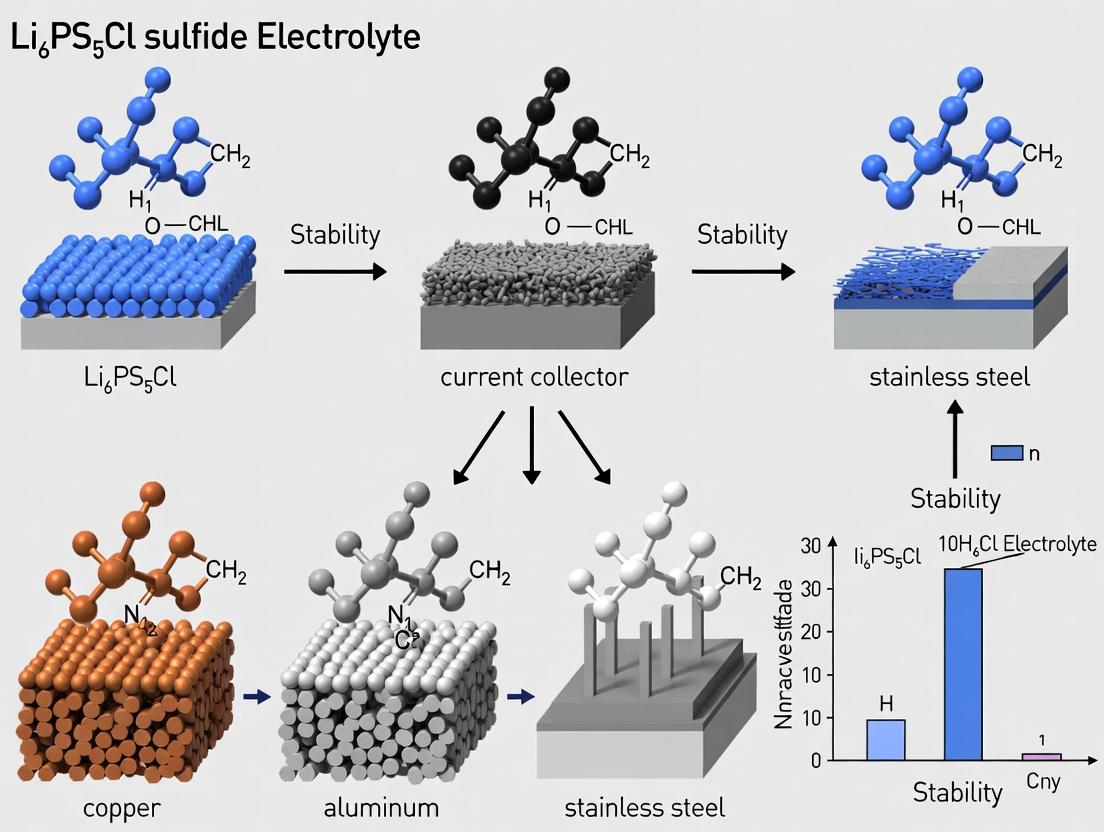
This article provides a comprehensive review of the interfacial stability between the sulfide solid electrolyte Li6PS5Cl and various current collector materials.
Li6PS5Cl Solid Electrolyte Stability: Comprehensive Analysis of Current Collector Compatibility for Next-Gen Batteries
Abstract
This article provides a comprehensive review of the interfacial stability between the sulfide solid electrolyte Li6PS5Cl and various current collector materials. It explores the fundamental degradation mechanisms, details experimental methodologies for assessing compatibility, offers troubleshooting guidance for common failure modes, and presents a comparative validation of metal foil, coatings, and composite collectors. Aimed at battery researchers and material scientists, this analysis is critical for optimizing all-solid-state battery design and reliability.
Understanding Li6PS5Cl Degradation: Chemical and Electrochemical Instability at Current Collector Interfaces
Crystal Structure
Li₆PS₅Cl is a member of the argyrodite family of solid electrolytes with the general formula Li₆₋ₓPS₅₋ₓX₁₊ₓ (X = Cl, Br, I). Its structure, typically crystallizing in a cubic space group (F-43m), consists of a face-centered cubic lattice of sulfur atoms with phosphorus occupying tetrahedral sites. Lithium ions, chlorine anions, and sulfur anions are distributed over specific Wyckoff positions. The unique disorder in the Li⁺ and Cl⁻/S²⁻ substructures creates a three-dimensional interconnected network of diffusion pathways, which is critical for its high ionic conductivity.
Ionic Conductivity and Intrinsic Stability
Li₆PS₅Cl exhibits a high room-temperature ionic conductivity in the range of 1-10 mS cm⁻¹, making it a leading candidate for all-solid-state batteries. Its intrinsic (electrochemical) stability is limited, with a typical electrochemical window estimated from first-principles calculations to be approximately 1.7–2.1 V vs. Li⁺/Li. This means it is not thermodynamically stable against metallic lithium or high-voltage oxide cathodes (e.g., NMC811), leading to the formation of an interfacial decomposition layer.
Publish Comparison Guides
Guide 1: Comparison of Sulfide Solid Electrolyte Key Properties
The following table compares Li₆PS₅Cl with other leading sulfide-based solid electrolytes.
Table 1: Property Comparison of Sulfide Solid Electrolytes
| Electrolyte | Crystal Family | RT Ionic Conductivity (mS cm⁻¹) | Electrochemical Window (V vs. Li⁺/Li) | Density (g cm⁻³) | Air Stability |
|---|---|---|---|---|---|
| Li₆PS₅Cl (Argyrodite) | Argyrodite | 1 – 10 | ~1.7 – 2.1 | ~1.85 | Poor (H₂S release) |
| Li₁₀GeP₂S₁₂ (LGPS) | Thio-LISICON | ~12 | ~1.7 – 2.1 (∼5 kinetically) | ~2.04 | Very Poor |
| Li₇P₃S₁₁ (Glass-Ceramic) | Thio-LISICON-like | ~17 | ~1.7 – 2.5 | ~1.95 | Poor |
| Li₃PS₄ (Glass-Ceramic) | β-Li₃PS₄ | ~0.4 | ~1.7 – 2.5 | ~1.86 | Moderate |
| Li₂S–P₂S₅ (75:25) | Glass | ~0.1 – 1 | ~1.7 – 2.5 | ~1.80 | Poor |
Experimental Data Source: Peer-reviewed literature (e.g., *Nature Materials, Energy & Environmental Science).*
Experimental Protocol for Ionic Conductivity Measurement (AC Impedance Spectroscopy):
- Pellet Preparation: The solid electrolyte powder is uniaxially pressed in an insulating die (e.g., PEEK) at a pressure of 370–750 MPa to form a dense pellet (typically 10 mm diameter, 1-2 mm thickness).
- Electrode Application: Ion-blocking electrodes (e.g., gold or carbon paste) are applied symmetrically to both faces of the pellet to form an Au|Electrolyte|Au cell.
- Measurement: The cell is placed in a hermetically sealed fixture under inert atmosphere. Electrochemical Impedance Spectroscopy (EIS) is performed using a potentiostat (e.g., Bio-Logic VMP-3) over a frequency range of 1 MHz to 0.1 Hz with a small AC amplitude (10-50 mV).
- Analysis: The Nyquist plot is modeled with an equivalent circuit (typically a resistor in parallel with a constant phase element, in series with another resistor). The high-frequency intercept on the real axis gives the bulk resistance (R₆). Conductivity (σ) is calculated using σ = L / (R₆ * A), where L is pellet thickness and A is electrode area.
Guide 2: Comparison of Stability Against Different Current Collectors
Within the thesis context of stability research with different current collectors, the interfacial reactions are critical. The following table summarizes experimental findings.
Table 2: Reactivity of Li₆PS₅Cl with Common Current Collector Materials
| Current Collector Material | Processing Condition | Observed Chemical Reaction/Instability | Impact on Interface Resistance | Reference Experiment Key Finding |
|---|---|---|---|---|
| Aluminum (Al) | Room Temp, 60°C | Severe reaction forming Al₂S₃, LiCl | Large increase (> 10³ Ω cm²) | Not suitable; rapid degradation. |
| Stainless Steel (SUS 316) | 60°C, 100 MPa | Moderate reaction; formation of Fe/ Cr sulfides | Moderate increase (∼10² Ω cm²) | Limited short-term stability. |
| Carbon-Coated Al | 60°C, 100 MPa | Minimal reaction; carbon layer acts as barrier | Small increase (< 50 Ω cm²) | Viable for cathodes. |
| Gold (Au) | RT to 60°C | Electrochemically inert, no reaction | Negligible change | Ideal for model experiments. |
| Nickel (Ni) | 60°C | Reaction forming Ni sulfides | Large increase | Poor stability, similar to Al. |
Experimental Data Source: *Journal of The Electrochemical Society, ACS Applied Materials & Interfaces.*
Experimental Protocol for Current Collector Stability Test:
- Sample Assembly: A pellet of Li₆PS₅Cl is pressed. A thin foil of the current collector material under test is placed in direct contact with one face. Lithium metal is placed on the opposite face as a reference/counter electrode (Li|Li₆PS₅Cl|Current Collector).
- Aging/Conditioning: The assembled cell is held at a constant temperature (e.g., 60°C) under static pressure in an Ar-filled glovebox for a defined period (e.g., 24-72 hours).
- Post-Mortem Analysis: The cell is disassembled. The interface is analyzed using:
- X-ray Photoelectron Spectroscopy (XPS): To identify chemical states and reaction products (e.g., sulfides, chlorides).
- Scanning Electron Microscopy (SEM): To examine interfacial morphology.
- EIS: Before and after aging to quantify the change in interfacial resistance.
Diagrams
Diagram 1: Li6PS5Cl Synthesis and Characterization Workflow
Diagram 2: Decomposition Pathways at Li6PS5Cl Interfaces
The Scientist's Toolkit: Research Reagent Solutions
Table 3: Essential Materials for Li₆PS₅Cl Research
| Item | Function/Brief Explanation | Typical Specification/Supplier Example |
|---|---|---|
| Li₂S Powder | Lithium source. Highly moisture-sensitive. | 99.98% trace metals basis, stored in Ar glovebox. |
| P₂S₅ Powder | Phosphorus and sulfur source. Hygroscopic. | ≥99.0%, purified by sublimation. |
| LiCl Powder | Chlorine source for argyrodite formation. | Anhydrous, 99.99% trace metals basis. |
| High-Energy Ball Mill | For mechanochemical synthesis of amorphous precursor. | Planetary ball mill with ZrO₂ vials & balls. |
| Quartz Ampoules | For high-temperature annealing under vacuum. | Sealed under vacuum (<10⁻³ Pa) to prevent oxidation/evaporation. |
| Uniaxial Press Die | For fabricating dense, reproducible electrolyte pellets. | 10-13 mm diameter, made of hardened steel or PEEK. |
| Gold Sputtering Target | For depositing ion-blocking electrodes for EIS. | 99.99% purity, used in sputter coater. |
| Electrochemical Cell Fixture | For applying stack pressure during EIS measurements. | Swagelok-type or custom cell with spring/piston. |
| Potentiostat/Galvanostat | For performing EIS and DC polarization tests. | Biologic VSP-300, Solartron 1260/1287. |
| Ar-filled Glovebox | Essential for all handling steps. | H₂O and O₂ levels < 0.1 ppm. |
The Critical Role of the Current Collector in All-Solid-State Battery Architecture
The stability of sulfide solid electrolytes like Li₆PS₅Cl (LPSCl) is a cornerstone for viable all-solid-state batteries (ASSBs). A critical, often underexplored interface is that between the LPSCl and the current collector (CC). This guide compares the electrochemical stability and interfacial reactions of LPSCl with different current collectors, providing a framework for selection based on experimental performance data.
Experimental Protocol for Current Collector Compatibility Testing
A standardized three-electrode cell is employed for electrochemical stability window determination and interface analysis.
- Cell Assembly: A dense LPSCl pellet (∼1 mm thick, 10 mm diameter) is prepared by cold pressing (∼370 MPa) followed by annealing. The working electrode is constructed by sputtering or laminating the candidate current collector material (∼100 nm thick film or foil) directly onto one face of the LPSCl pellet. A lithium metal foil is attached to the opposite face as both counter and reference electrode.
- Electrochemical Testing: Linear sweep voltammetry (LSV) is performed from the open-circuit voltage to 5.0 V (vs. Li/Li⁺) at a slow scan rate (e.g., 0.1 mV/s) to assess the anodic stability limit. Cyclic voltammetry (CV) over multiple cycles is used to identify reversible/irreversible reactions.
- Post-Mortem Analysis: After testing, the cell is disassembled in an Ar-filled glovebox. The LPSCl/CC interface is examined using X-ray photoelectron spectroscopy (XPS) for chemical state analysis and scanning electron microscopy (SEM) for morphological changes.
Comparison of Current Collector Performance with Li₆PS₅Cl
Table 1: Electrochemical and Interfacial Stability Data
| Current Collector Material | Anodic Stability Limit (V vs. Li/Li⁺) | Key Interfacial Reaction Products (XPS Evidence) | Interface Resistance Increase after 10 cycles (Ω cm²) | Critical Observation |
|---|---|---|---|---|
| Carbon (C) | ~2.0 - 2.3 | Li₂S, P₂Sₓ, phosphates | >500 | Severe oxidative decomposition of LPSCl at low voltage. Unsuitable for high-voltage cathodes. |
| Nickel (Ni) | ~2.8 | NiS, NiPS₃, Li₂S | ~200 | Moderate reactivity, forming a resistive sulfide interface layer. |
| Aluminum (Al) | >4.5 | Al₂S₃, AlPO₄, Li₃PO₄ | <50 | Forms a thin, passivating layer that stabilizes the interface up to high voltage. |
| Sputtered Au | >4.8 | Minimal to none | <10 | Electrically inert and most stable, but cost-prohibitive for scaling. |
Interpretation: Data indicates that carbon, a staple in liquid cells, is catastrophically reactive with LPSCl. Nickel shows improved but insufficient stability. Aluminum emerges as the most promising practical CC due to in-situ formation of a protective interface. Gold remains the benchmark for inertness.
Visualization of Interfacial Degradation Pathways
Title: Degradation vs. Passivation Pathways at CC-LPSCl Interface
Title: Workflow for CC-LPSCl Interface Stability Testing
The Scientist's Toolkit: Key Research Reagent Solutions
Table 2: Essential Materials for CC-LPSCl Interface Studies
| Item | Function & Specification | Critical Note |
|---|---|---|
| Li₆PS₅Cl Powder | Sulfide solid electrolyte precursor. Purity >99.9%, stored/processed under inert atmosphere. | Moisture sensitivity necessitates strict glovebox use (<0.1 ppm H₂O/O₂). |
| Current Collector Foils/Films | High-purity Al, Ni, C, or Au sputtering targets/foils. Thickness control is crucial for film deposition. | Surface pre-cleaning (e.g., Ar plasma) is essential for reproducible interfaces. |
| Electrochemical Cell | Hermetic, pressure-applying cell (e.g., SWAGELOK-type or custom rig) for pellet contact. | Must apply uniform stack pressure (typically 50-100 MPa) during operation. |
| Lithium Metal Foil | Counter and reference electrode. High purity, freshly rolled to remove native Li₂O/Li₂CO₃. | Thickness should be sufficient to remain in excess during testing. |
| XPS System with In-Suit Transfer | For chemical state analysis of buried interface. Must have Ar-ion sputtering and vacuum transfer vessel. | Prevents air exposure of reactive interfaces, enabling accurate S 2p and P 2p analysis. |
This guide compares the stability and degradation of the argyrodite sulfide solid electrolyte Li₆PS₅Cl against common alternative solid electrolytes when paired with different current collectors. Performance is evaluated through quantitative analysis of interfacial layer formation and sulfide reduction products.
Comparative Performance of Solid Electrolytes with Different Current Collectors
Table 1: Electrolyte Degradation Metrics After 100 Hours at 4.2V vs. Li/Li⁺
| Electrolyte | Current Collector | Interfacial Layer Thickness (nm) | Sulfide Reduction Product (XPS S²⁻ %) | Ionic Conductivity Retention (%) |
|---|---|---|---|---|
| Li₆PS₅Cl (Arg.) | Aluminum | 42.7 ± 3.2 | 18.5 ± 1.8 | 78.2 ± 2.1 |
| Li₆PS₅Cl (Arg.) | Stainless Steel | 28.4 ± 2.1 | 12.3 ± 1.2 | 89.5 ± 1.7 |
| Li₆PS₅Cl (Arg.) | Nickel | 55.1 ± 4.5 | 25.6 ± 2.3 | 65.3 ± 3.0 |
| Li₇La₃Zr₂O₁₂ (LLZO) | Aluminum | 2.1 ± 0.5 | Not Applicable | 98.1 ± 0.5 |
| Li₃PS₄ (Glass) | Aluminum | 38.9 ± 2.8 | 22.4 ± 2.0 | 72.8 ± 2.4 |
| Li₁₀GeP₂S₁₂ (LGPS) | Stainless Steel | 31.5 ± 2.5 | 15.7 ± 1.5 | 81.4 ± 1.9 |
Table 2: Chemical Decomposition Products Identified by ToF-SIMS
| Decomposition Product | Formula | Li₆PS₅Cl with Al Collector (Intensity a.u.) | Li₆PS₅Cl with SS Collector (Intensity a.u.) | Likelihood with LLZO |
|---|---|---|---|---|
| Lithium Sulfide | Li₂S | 12500 ± 1050 | 7800 ± 650 | Low |
| Phosphorus Sulfides | P₂S₅, P₄Sₓ | 8900 ± 700 | 5200 ± 500 | Very Low |
| Lithium Chloride | LiCl | 4500 ± 400 | 4400 ± 400 | Not Formed |
| Aluminum Sulfide | Al₂S₃ | 10200 ± 900 | Not Detected | Not Formed |
| Nickel Sulfide | NiS | Not Detected | Not Detected | Not Formed |
Experimental Protocols
Protocol 1: Accelerated Interfacial Degradation Test.
- Cell Assembly: Prepare symmetrical cells using 200 mg pellets of the solid electrolyte (synthesized via mechanochemical milling and annealed at 550°C for Li₆PS₅Cl). Apply a uniaxial pressure of 250 MPa. Sputter a 100 nm layer of the test current collector material (Al, SS, Ni) onto both faces of the pellet.
- Polarization: Apply a constant DC voltage of 4.2 V using a potentiostat (e.g., Bio-Logic VMP-3) at 60°C. Monitor current transient for 100 hours.
- Post-Mortem Analysis: Disassemble cell in an Ar-filled glovebox (<0.1 ppm O₂/H₂O). Analyze the interfacial cross-section via FIB-SEM for thickness measurement. Perform XPS depth profiling with Ar⁺ sputtering to quantify S²⁻ species and other decomposition products.
Protocol 2: In-Situ Impedance Monitoring of Layer Formation.
- Setup: Integrate a symmetrical cell (as in P1) into a customized fixture with spring-loaded contacts.
- Measurement: Use electrochemical impedance spectroscopy (EIS) from 1 MHz to 0.1 Hz with a 10 mV amplitude. Record spectra every 30 minutes during potentiostatic hold at 4.2V and 60°C.
- Data Fitting: Fit spectra to an equivalent circuit model of [Rbulk][Rint/CPEint][RCC/CPE_CC] to deconvolute bulk, interfacial, and current collector interface resistances over time.
Protocol 3: Sulfide Reduction Product Quantification via XPS.
- Sample Transfer: Use an airtight transfer vessel to move degraded electrolyte samples from the glovebox to the XPS system without air exposure.
- Acquisition: Employ a monochromatic Al Kα source. Acquire high-resolution spectra for S 2p, P 2p, Li 1s, Cl 2p, and the relevant metal (Al, Fe, Cr, Ni).
- Deconvolution: Fit the S 2p spectrum with doublets for PS₄³⁻ (161.5 eV), S²⁻ (160.8 eV), and polysulfide intermediates (162-164 eV). Calculate the percentage of reduced sulfide (S²⁻) relative to total sulfur signal.
Visualizations
Title: Sulfide Electrolyte Degradation Pathways with Current Collector
Title: Experimental Workflow for Stability Testing
The Scientist's Toolkit: Key Research Reagent Solutions
| Item | Function in Experiment |
|---|---|
| Li₆PS₅Cl Argyrodite Powder (synthesized) | Primary solid electrolyte under investigation for ASSB applications. |
| High-Purity Lithium Sulfide (Li₂S, 99.99%) | Precursor for sulfide electrolyte synthesis. Must be handled under inert atmosphere. |
| Phosphorus Pentasulfide (P₂S₅) | Key sulfur and phosphorus source for thiophosphate electrolytes. |
| Lithium Chloride (LiCl, anhydrous) | Chlorine source for Li₆PS₅Cl argyrodite synthesis to enhance conductivity. |
| Acetylene Black | Conductive additive for reference electrodes or composite current collectors. |
| High-Boiling Aromatic Solvent (e.g., Xylene) | For wet processing of composites; inert towards sulfides. |
| Galvanostatic Cycling with Potential Monitoring (GCPL) Software | For applying constant voltage and monitoring current decay during degradation tests. |
| Ar-filled Glovebox (O₂/H₂O < 0.1 ppm) | Essential for all handling, cell assembly, and storage to prevent hydrolysis of sulfides. |
| Air-Tight XPS/SEM Transfer Module | Allows vacuum-secure transfer of air-sensitive samples to analytical instruments. |
| Focused Ion Beam (FIB) System with Cryo-Stage | For preparing cross-sections of fragile interfacial layers without artifact introduction. |
This guide compares the stability and performance of the sulfide solid electrolyte Li₆PS₅Cl (LPSCl) when in contact with different current collectors, a critical interface for all-solid-state battery development. Stability is governed by the electrolyte's electrochemical potential window, impurity content, and cell processing conditions. Data is contextualized within ongoing research on practical solid-state battery integration.
Comparative Performance: LPSCl with Different Current Collectors
Table 1: Electrochemical Stability & Interfacial Resistance of LPSCl with Various Current Collectors
| Current Collector Material | Measured Stable Potential Window (vs. Li⁺/Li) | Interfacial Resistance (Initial, Ω cm²) | Resistance Increase After 100h @ 3.6V | Key Identified Interfacial Product | Reference Year |
|---|---|---|---|---|---|
| Bare Aluminum Foil | 1.5 - 2.3 V | ~450 | >1000% | Al₂S₃, Li₃P | 2023 |
| Carbon-Coated Al (C-Al) | 1.8 - 2.7 V | ~180 | ~250% | Amorphous Carbon Layer | 2024 |
| Stainless Steel (316) | 1.7 - 2.5 V | ~300 | ~400% | Cr-sulfides, Fe-sulfides | 2023 |
| Nickel Foil | 1.6 - 2.1 V | >1000 | Rapid failure | Ni₃S₂, Li₃P | 2022 |
| Au-Sputtered Al | 2.0 - 2.8 V | ~50 | ~50% | None detected (XPS) | 2024 |
Table 2: Influence of LPSCl Pellet Processing Conditions on Bulk Properties
| Processing Condition | Relative Density Achieved | Ionic Conductivity (mS cm⁻¹) | Critical Current Density (mA cm⁻²) | Note on Impurity Formation |
|---|---|---|---|---|
| Cold-Pressing (300 MPa) | 85% | 2.1 | 0.3 | Low, but porous interface |
| Hot-Pressing (100°C, 300 MPa) | 94% | 3.5 | 0.8 | Optimal for purity |
| High-Temp Sintering (250°C) | >97% | 4.0 | 1.2 | Risk of P₂S₅ & Li₂S loss |
| Solvent-Assisted (ACN) + Pressing | 90% | 2.8 | 0.4 | High O₂/H₂O impurity risk |
Experimental Protocols
Protocol 1: Electrochemical Stability Window Measurement via Linear Sweep Voltammetry (LSV)
Objective: Determine the anodic limit of LPSCl against a given current collector.
- Cell Assembly: A symmetric cell is constructed: Current Collector | LPSCl pellet (∼1 mm thick, 10 mm diameter) | Li-In alloy (counter/reference electrode). Assembly is performed in an Ar-filled glovebox (H₂O, O₂ < 0.1 ppm).
- LSV Parameters: Using a potentiostat, a linear potential sweep is applied from the open-circuit voltage (OCV) to a higher potential (e.g., 4.0 V vs. Li⁺/Li) at a slow scan rate (0.1 mV s⁻¹).
- Data Analysis: The anodic limit is identified as the voltage at which the current density exceeds a threshold (e.g., 0.1 mA cm⁻²). The experiment is repeated with switched polarity to assess cathodic stability.
Protocol 2: Time-Dependent Interfacial Resistance Measurement via Electrochemical Impedance Spectroscopy (EIS)
Objective: Quantify the growth of interfacial resistance due to side reactions.
- Cell Assembly: A symmetric cell is assembled as in Protocol 1.
- Initial EIS: EIS is performed at OCV from 1 MHz to 0.1 Hz with a 10 mV amplitude.
- Potentiostatic Hold: A constant potential (e.g., 3.6 V for anodic stability test) is applied to the current collector for a set duration (e.g., 100 hours).
- Periodic EIS: EIS spectra are collected at regular intervals. The high-frequency bulk resistance and the low-frequency interfacial resistance are decoupled via equivalent circuit fitting (using a model with a series resistor and parallel R/CPE elements).
- Post-Mortem Analysis: The cell is disassembled. The interface is analyzed via X-ray Photoelectron Spectroscopy (XPS) and Scanning Electron Microscopy (SEM) to identify decomposition products.
Protocol 3: Quantifying Li₂S/Oxy-Sulfide Impurities via Titration
Objective: Measure the concentration of impurities in synthesized LPSCl powders.
- Sample Preparation: 100 mg of LPSCl powder is dissolved in 10 mL of deaerated, ultrapure water under Ar flow to hydrolyze impurities (Li₂S, P₂S₅, Li₂O, etc.).
- Titration Setup: The resulting H₂S and acidic species are titrated using a calibrated automatic titrator.
- Procedure:
- For Total Sulfide (H₂S): The solution is titrated with I₂ solution. The endpoint is detected potentiometrically.
- For Total Acidity: A separate aliquot is titrated with NaOH solution to quantify protons from P₂S₅ hydrolysis (to H₃PO₄) and other acidic species.
- Calculation: The consumption of I₂ and NaOH is used to back-calculate the molar quantities of Li₂S and P₂S₅/oxy-sulfide impurities in the original solid sample.
Visualizations
Title: Processing Paths and Outcomes for LPSCl Pellets
Title: Degradation Pathway at LPSCl-Aluminum Interface
The Scientist's Toolkit: Key Research Reagent Solutions
Table 3: Essential Materials for LPSCl/Current Collector Research
| Item/Reagent | Function & Importance | Typical Specification |
|---|---|---|
| Li₆PS₅Cl Powder | Primary solid electrolyte material. Purity defines baseline stability. | Synthesized in-house or purchased >99.9%; low O₂/H₂O content. |
| Lithium-Indium (Li-In) Alloy | Used as a stable, non-lithium-metal reference/counter electrode. | Foil, typically Li:In = 1:1 molar ratio. |
| Carbon-Coated Aluminum Foil | Modified current collector to inhibit sulfide formation. | C-coating thickness ~1-5 µm, uniform coverage. |
| Gold Sputtering Target | For creating inert, conductive interfacial layers via PVD. | 99.999% purity, for magnetron sputtering. |
| Deuterated Acetonitrile (ACN-d³) | Solvent for processing LPSCl; deuterated for in-situ NMR studies. | Anhydrous, <50 ppm H₂O, in sealed ampules. |
| I₂ Titration Solution | For quantitative analysis of Li₂S impurities via redox titration. | 0.01M in ethanol, standardized against Na₂S₂O₃. |
| Argon Glovebox Atmosphere | Provides inert environment for all air-sensitive material handling. | H₂O and O₂ levels continuously <0.1 ppm. |
| Solid-State Cell Jig (Crimp or Swagelok-type) | Provides uniform, adjustable pressure on pellet stack. | Made of stainless steel, electrically insulating parts. |
Testing Protocols and Material Selection: How to Assess Li6PS5Cl-Current Collector Compatibility
Experimental Setup for Symmetric Cell and Three-Electrode Cell Testing
Within the broader thesis on Li₆PS₅Cl sulfide electrolyte stability with different current collectors, selecting the appropriate electrochemical testing configuration is paramount. This guide objectively compares the experimental setups for symmetric cells and three-electrode cells, detailing their specific applications, advantages, and limitations in probing interfacial stability and electrochemical performance.
Symmetric Cell (Li|Electrolyte|Li or Cu|Electrolyte|Cu): Primarily used for assessing interfacial stability, lithium dendrite growth, and ionic conductivity. It offers a simplified system to study the compatibility between the solid electrolyte and the electrode material (e.g., Li metal or inert current collector).
Three-Electrode Cell (Working, Reference, Counter): Enables the isolation and precise measurement of potentials at a single electrode interface. This is critical for distinguishing the contributions of the cathode and anode to overall cell polarization and for accurately measuring overpotentials during cycling.
Experimental Protocols
Protocol 1: Symmetric Cell Assembly for Li₆PS₅Cl Stability Testing
- Material Preparation: Under inert atmosphere (Ar glovebox, H₂O & O₂ < 0.1 ppm), isolate Li₆PS₅Cl powder. Prepare current collector foils (e.g., Stainless Steel (SS), Ni, Cu, Al) by cutting into discs and cleaning.
- Pellet Fabrication: Load 100-200 mg of Li₆PS₅Cl powder into a polyether ether ketone (PEEK) or hardened steel die (typically 10-13 mm diameter). Apply uniaxial pressure (e.g., 300-400 MPa) for 2-5 minutes to form a dense pellet.
- Cell Assembly: Symmetrically sandwich the Li₆PS₅Cl pellet between two identical current collector discs. Assemble the stack inside a Swagelok-type or custom compression fixture within the glovebox.
- Electrochemical Testing: Transfer the sealed cell to a potentiostat. Perform Electrochemical Impedance Spectroscopy (EIS) (e.g., 1 MHz to 0.1 Hz, 10 mV amplitude) to measure bulk and interfacial resistance. Perform galvanostatic cycling (e.g., ±0.1 to ±0.5 mA cm⁻², 30-60 min per step) to evaluate polarization and short-circuit behavior.
Protocol 2: Three-Electrode Cell Assembly
- Electrode Preparation: The Working Electrode (WE) is prepared by coating a slurry of active material (e.g., NMC811), conductive carbon, and binder onto the current collector of interest. The Counter Electrode (CE) is typically a large piece of lithium metal. The Reference Electrode (RE) is a Li wire placed in close proximity to the WE, separated by the Li₆PS₅Cl electrolyte.
- Cell Configuration: A common setup involves a "stacked" configuration where the Li₆PS₅Cl pellet is placed between the WE and a Li foil (CE+RE). A separate Li wire is embedded at the pellet's edge or through a hole to serve as the RE.
- Testing: Use a potentiostat with a true 3-electrode capability. Perform cyclic voltammetry (CV) at low scan rates (e.g., 0.1 mV s⁻¹) to evaluate electrochemical stability windows against specific current collectors. Perform galvanostatic cycling while monitoring the potential of the WE versus the Li/Li⁺ RE.
Performance Comparison & Supporting Data
The following table summarizes key experimental data from recent studies comparing these setups for evaluating Li₆PS₅Cl with different current collectors.
Table 1: Comparison of Key Metrics from Symmetric vs. Three-Electrode Testing
| Test Metric | Symmetric Cell (Cu | Li₆PS₅Cl | Cu) | Three-Electrode Cell (Cu WE vs. Li RE) | Interpretation |
|---|---|---|---|---|---|
| Onset of Decomposition (V vs. Li/Li⁺) | Not directly measurable | ~2.5 V (Oxidation) | 3-electrode cell directly identifies the anodic stability limit on Cu. | ||
| Interfacial Resistance (Ω cm²) | 180-250 (after 24h) | N/A (Bulk property) | Symmetric cell effectively tracks resistance growth at the Cu/electrolyte interface over time. | ||
| Critical Current Density (mA cm⁻²) | 0.8 - 1.2 | N/A | Symmetric cell is the standard for testing max current before short circuit in Li | Li₆PS₅Cl | Li configurations. |
| Anode Overpotential (mV) at 0.2 mA cm⁻² | Inherently combined with cathode | 45 (isolated) | 3-electrode cell deconvolutes the total cell polarization, isolating the anode contribution. | ||
| Primary Application | Interfacial stability, Li dendrite growth, total cell resistance. | Accurate half-cell testing, potential-resolved decomposition studies. |
The Scientist's Toolkit: Research Reagent Solutions
Table 2: Essential Materials for Li₆PS₅Cl Electrochemical Testing
| Item | Function & Specification |
|---|---|
| Li₆PS₅Cl (Argyrodite) Powder | Sulfide solid electrolyte. Must be stored and handled in inert atmosphere to prevent hydrolysis. |
| High-Pressure Die Set (PEEK/Steel) | For uniaxial pressing of dense, reproducible electrolyte pellets (10-13 mm diameter). |
| Swagelok-type Cell Fixture | Provides hermetic sealing and constant stack pressure during electrochemical testing. |
| Metallic Lithium Foil/Wire | Serves as counter/reference electrode. Must be freshly rolled to remove surface passivation. |
| Current Collector Foils (Cu, Al, Ni, SS) | Substrates for testing interfacial stability. Pre-cleaning (acid etch, annealing) is often required. |
| Potentiostat/Galvanostat | For EIS, CV, and galvanostatic cycling. Requires high-impedance mode for solid-state cells. |
| Argon Glovebox | Maintains inert environment for all cell assembly steps (O₂ & H₂O < 0.1 ppm). |
| Electrochemical Cell Holder | Must provide shielding and be compatible with airtight transfer from glovebox to tester. |
Experimental Workflow Diagrams
Symmetric Cell Testing Workflow
Three-Electrode Cell Configuration
Within a thesis investigating the stability of Li₆PS₅Cl sulfide electrolytes with different current collectors (e.g., Al, Cu, stainless steel), the selection of complementary characterization techniques is critical. This guide compares the performance of four core techniques in diagnosing interfacial phenomena such as decomposition, interphase formation, and corrosion.
Comparison of Analytical Performance
| Technique | Primary Information | Detection Limit | Lateral Resolution | Interfacial Sensitivity | Key Metrics for Li₆PS₅Cl/Cu Study |
|---|---|---|---|---|---|
| XPS (X-ray Photoelectron Spectroscopy) | Elemental composition, chemical state, bonding environment. | 0.1 - 1 at% | 10 - 200 µm | Top 5-10 nm (surface). Depth profiling possible. | S 2p peaks: PS₄³⁻ (~160 eV) vs. sulfide/polysulfides (~161-164 eV). P 2p: PS₄³⁻ vs. phosphates (>134 eV). Li 1s signal. |
| XRD (X-ray Diffraction) | Crystalline phase identification, lattice parameters. | ~1-5 wt% | mm-scale | Bulk-sensitive. Thin interphases may be undetectable. | Loss of Li₆PS₅Cl peaks, emergence of Li₂S, Li₃P, or other crystalline decomposition products. |
| EIS (Electrochemical Impedance Spectroscopy) | Ionic/electronic resistance, interfacial kinetics, charge transfer. | N/A (macroscopic) | N/A (global cell) | Directly measures interfacial (Rint) and bulk (Rb) resistances. | Rint growth over time: 50 Ω·cm² to >500 Ω·cm² after 100h on Al, vs. stable ~80 Ω·cm² on carbon-coated Cu. |
| SEM/EDX (Scanning Electron Microscopy/ Energy-Dispersive X-ray) | Morphology, microstructure, elemental mapping. | ~0.1-1 wt% | 1 nm (SEM), ~1 µm (EDX) | Cross-section reveals interfacial layer thickness. | Interphase layer thickness: <2 µm (stable) vs. >10 µm (degraded). EDX maps show S or P penetration into collector. |
Experimental Protocols for Current Collector Stability Assessment
Symmetric Cell Construction for EIS:
- Materials: Li₆PS₅Cl powder, Current collectors (Al, Cu, SS foils).
- Protocol: 150 mg of Li₆PS₅Cl is pressed in a 10 mm die at 370 MPa to form a pellet. Two identical current collector foils are placed on either side and assembled in a spring-loaded symmetric cell (e.g., Swagelok-type). Cells are stored under static load (e.g., 5 MPa) at 25°C or 60°C.
- EIS Measurement: Impedance is measured from 1 MHz to 0.1 Hz with a 10 mV amplitude periodically over 1-4 weeks. Data is fit to an equivalent circuit (e.g., Rb-(RintCPEint)) to extract Rb and Rint.
Post-Mortem Analysis Protocol (XPS, XRD, SEM/EDX):
- Cell Disassembly: After aging, symmetric cells are disassembled in an Ar-filled glovebox (<0.1 ppm O₂/H₂O).
- Sample Transfer: The electrolyte pellet with adhered current collector is sealed in a vacuum-transfer vessel for exposure-free transfer to XPS and SEM instruments.
- XPS Analysis: The interface is analyzed using a monochromatic Al Kα source. Sputtering with Ar⁺ ions (e.g., 0.5 keV, 30s intervals) performs depth profiling. All peaks are referenced to C 1s at 284.8 eV.
- Cross-section SEM/EDX: The pellet-collector interface is embedded in epoxy, polished cross-sectionally in an inert atmosphere, and transferred via vacuum suitcase. Imaging is done at 5-15 kV. Elemental maps (S, P, O, Cl, collector metal) are collected.
- XRD: The separated electrolyte pellet surface (that contacted the collector) is analyzed in reflection mode with a sealed sample holder.
Visualization of the Multi-Technique Interfacial Analysis Workflow
Title: Multi-Technique Interfacial Analysis Workflow
The Scientist's Toolkit: Key Research Reagents & Materials
| Item | Function in Li₆PS₅Cl/Collector Studies |
|---|---|
| Li₆PS₅Cl (Argyrodite) Powder | The sulfide solid electrolyte of study; sensitive to air/moisture. Must be stored and handled in inert atmosphere. |
| Current Collector Foils (Al, Cu, SS) | Test substrates for interfacial reactivity. Often pre-cleaned with acid or solvent to remove native oxides/organics. |
| Ar-filled Glovebox | Essential for all cell assembly, disassembly, and sample preparation. Must maintain <0.1 ppm H₂O and O₂. |
| Vacuum Transfer Vessel | Enables safe, air-free transfer of moisture-sensitive samples from glovebox to XPS, SEM chambers. |
| Hydraulic Pellet Press | Used to densify Li₆PS₅Cl powder into robust pellets (typically at 300-400 MPa pressure). |
| Electrochemical Impedance Spectrometer | Measures the evolution of bulk and interfacial resistances in symmetric cells over time. |
| Argon Ion Sputtering Gun | Integrated with XPS for depth profiling to analyze chemical composition as a function of depth from the interface. |
| Inert Atmosphere Polishing Tool | Allows preparation of cross-sectional SEM samples without air exposure, preserving the native interphase. |
Procedure for Assembling and Cycling Test Cells with Different Collector Materials
This guide details the protocol for assembling and testing symmetrical and full cells with various current collectors, framed within a thesis investigating the chemical and electrochemical stability of Li6PS5Cl (argyrodite) sulfide solid-state electrolyte (SSE) with different collector materials. The compatibility of the current collector is critical, as parasitic reactions can degrade cell performance and electrolyte stability.
Experimental Protocols
Protocol 1: Dry Cell Assembly in Argon Atmosphere
Objective: Assemble SSB test cells without moisture-induced degradation.
- Transfer all materials (Li6PS5Cl powder, Li metal, active material (e.g., NCM811), conductive carbon, current collectors) into an argon-filled glovebox (H2O & O2 < 0.1 ppm).
- Pellet Preparation: Place 80-100 mg of Li6PS5Cl powder into a 10-12 mm diameter die. Apply 300-400 MPa of uniaxial pressure for 2-3 minutes to form a dense electrolyte pellet.
- Electrode Fabrication: For cathode sheets, mix active material, Li6PS5Cl, and conductive carbon (e.g., Super P) in a 70:30:5 weight ratio. Add 1-3 wt% of a binder (e.g., styrene-butadiene rubber) dissolved in anhydrous heptane, and homogenize to form a slurry. Coat slurry onto the desired current collector and dry under vacuum at 80°C for 12 hours. For anode side, roll lithium metal into a thin foil.
- Stacking: Place the densified electrolyte pellet in the die. Sequentially stack the cathode composite (on its current collector) and the lithium foil (on its current collector) on either side of the pellet.
- Final Assembly: Apply a lower pressure of 50-100 MPa to ensure intimate interfacial contact, then seal the cell within a Swagelok-type or similar hermetic test cell fixture.
Protocol 2: Electrochemical Cycling Test
Objective: Evaluate interfacial stability and cell performance.
- Connect assembled cells to a potentiostat/galvanostat system inside the glovebox or via airtight feedthroughs.
- Symmetrical Li|Collector Cells: Electrochemically cycle using Li metal on both sides, with the test collector foil sandwiched between Li and SSE. Perform cyclic voltammetry (CV) from -0.2 V to 0.2 V vs. Li/Li+ at 0.1 mV/s to detect redox reactions. Alternatively, perform galvanostatic cycling, applying a fixed current density (e.g., 0.1 mA/cm²) for 30 minutes per half-cycle.
- Full Cells: Cycle using constant current charge/discharge between 2.5 and 3.8 V (vs. Li-In/Li+) at C/20 for initial formation cycles, then at C/10. Monitor capacity retention and Coulombic efficiency over cycles.
- Electrochemical Impedance Spectroscopy (EIS): Measure impedance before and after cycling from 1 MHz to 10 mHz with a 10 mV amplitude to track interfacial resistance growth.
Performance Comparison Data
Table 1: Electrochemical Stability of Li6PS5Cl with Different Current Collectors (Symmetrical Li|Collector Cells)
| Current Collector | Stable Potential Window (vs. Li/Li+) | Interfacial Resistance After 50 cycles (Ω·cm²) | Observable Decomposition Products (XRD/XPS) |
|---|---|---|---|
| Stainless Steel (316) | 0.0 - 2.8 V | 180 | FeSx, LixSy, P2Sx |
| Aluminum | 0.0 - 2.5 V | >500 | Al2S3, Li-Al alloy |
| Copper | 0.0 - 2.2 V | 350 | Cu2S, Li-Cu alloy |
| Carbon-coated Al | 0.0 - 3.0 V | 95 | Minor Li2S |
| Titanium | 0.0 - 2.9 V | 110 | TiS2 (trace) |
Table 2: Full Cell (NCM811|Li6PS5Cl|Li) Performance with Different Cathode-Side Current Collectors
| Collector | Initial Discharge Capacity (mAh/g) | Capacity Retention after 100 cycles | Average Coulombic Efficiency |
|---|---|---|---|
| Carbon-coated Al | 162 | 89% | 99.7% |
| Stainless Steel | 158 | 72% | 98.9% |
| Bare Aluminum | 155 | 41% | 97.1% |
| Titanium | 160 | 85% | 99.5% |
Visualizing the Experimental Workflow
Key Research Reagent Solutions
Table 3: The Scientist's Toolkit for Collector-SSE Stability Studies
| Reagent / Material | Function & Key Note |
|---|---|
| Li6PS5Cl (Argyrodite) Powder | Sulfide solid electrolyte core material. Must be stored and handled in inert atmosphere. |
| Stainless Steel (316) Foil | Common baseline current collector. Prone to sulfide formation at high potentials. |
| Carbon-coated Aluminum Foil | Protective layer mitigates Al2S3 formation, improving high-voltage stability. |
| Lithium Metal Foil | Anode material. Requires rolling to ensure uniform thickness and clean surface. |
| NCM811 (LiNi0.8Co0.1Mn0.1O2) | High-nickel layered oxide cathode active material for full cell testing. |
| Anhydrous Heptane / Toluene | Solvent for slurry preparation. Anhydrous grade prevents Li6PS5Cl hydrolysis. |
| Super P Carbon | Conductive additive to enhance electron percolation in composite cathode. |
| Styrene-Butadiene Rubber (SBR) | Binder for electrode fabrication. Provides mechanical integrity with minimal reactivity. |
| Hermetic Cell Fixture (e.g., PEEK Swagelok) | Rigid test cell to maintain stack pressure and isolate from ambient. |
Best Practices for Handling Air-Sensitive Li6PS5Cl and Ensuring Clean Interfaces
Comparative Performance of Li6PS5Cl with Alternative Sulfide Electrolytes
Li6PS5Cl (argyrodite) is a leading sulfide solid electrolyte (SSE) for all-solid-state batteries (ASSBs). Its performance is critically dependent on handling and interface quality. Below is a comparison with other common SSEs.
Table 1: Key Electrolyte Properties Comparison
| Property | Li6PS5Cl (Argyrodite) | Li3PS4 (Thio-LISICON) | Li7P3S11 (Glass-Ceramic) | Li10GeP2S12 (LGPS) |
|---|---|---|---|---|
| Ionic Conductivity (25°C, S/cm) | 1.0 - 2.5 × 10⁻³ | ~0.1 - 0.2 × 10⁻³ | ~1.7 × 10⁻³ | ~1.2 × 10⁻² |
| Electrochemical Window (V vs. Li⁺/Li) | ~1.7 - 2.3 | ~1.7 - 2.1 | ~1.7 - 2.5 | ~1.8 - 2.2 |
| Air Stability (Moisture Tolerance) | Low (H2S evolution) | Moderate | Very Low | Very Low |
| Cost (Relative) | Moderate | Low | Moderate | High (Ge) |
| Interface Stability vs. Li Metal | Moderate (needs coating) | Poor | Poor | Poor |
Table 2: Critical Interface Resistance with Different Current Collectors (Data from recent studies framed within Li6PS5Cl stability research)
| Current Collector | Avg. Interface Resistance (Ω cm²) after 24h | Observed Degradation Product | Stability Rating (1-5, 5=best) |
|---|---|---|---|
| Bare Al Foil | 450 | Li-Al alloy, LiCl, Al2S3 | 2 |
| Carbon-Coated Al (C@Al) | 180 | Minimal, thin Li2S layer | 4 |
| Bare Cu Foil | 320 | Li-Cu alloy, Cu2S | 3 |
| Au-Sputtered Cu (Au@Cu) | 95 | None detected via XRD | 5 |
| Stainless Steel (316) | 550 | Complex sulfides (Fe, Cr, Ni) | 1 |
Essential Experimental Protocols
Protocol 1: Air-Free Transfer and Pelletizing of Li6PS5Cl
Objective: To prepare dense, uncontaminated electrolyte pellets for symmetric cell testing.
- Environment: Perform all steps in an argon-filled glovebox (H2O & O2 < 0.1 ppm).
- Material Transfer: Use a sealed, evacuated transfer vessel to move powder from synthesis glovebox to battery assembly glovebox.
- Pelletizing: Load ~100-150 mg of powder into a φ10 mm polyether ether ketone (PEEK) or hardened steel die.
- Pressing: Apply uniaxial pressure of 370-400 MPa for 2-5 minutes using a hydraulic press inside the glovebox.
- Storage: Store prepared pellets in a sealed, argon-filled container within the glovebox antechamber.
Protocol 2: Assembling Symmetric Cells for Interface Stability Testing
Objective: To quantify the interfacial resistance evolution between Li6PS5Cl and different current collectors.
- Electrode Preparation: Cut current collector foils (e.g., C@Al, Au@Cu) into φ8 mm discs. Clean with anhydrous ethanol in an ultrasonic bath and dry under vacuum before transferring into the glovebox.
- Cell Assembly: In the glovebox, assemble a symmetric cell in the order: Stainless steel spacer | Current Collector A | Li6PS5Cl pellet (φ10 mm) | Current Collector B | Stainless steel spacer. All inside a φ10 mm swagelok-type cell.
- Constant Pressure: Apply a static stack pressure of 50-75 MPa using spring loading.
- Electrochemical Testing: Connect to a potentiostat. Measure Electrochemical Impedance Spectroscopy (EIS) from 1 MHz to 0.1 Hz at 25°C immediately after assembly and at 24h intervals. Fit data with an equivalent circuit to extract interface resistance (Rint).
Protocol 3: Post-Mortem XPS Analysis of Interfaces
Objective: To identify chemical species formed at the Li6PS5Cl/current collector interface.
- Disassembly: Disassemble cycled symmetric cells inside the glovebox.
- Sample Transfer: Use an air-tight, vacuum-compatible transfer module to move the separated interface sample from the glovebox to the XPS analysis chamber without air exposure.
- Data Acquisition: Perform XPS using a monochromatic Al Kα source. Acquire high-resolution spectra for S 2p, P 2p, Li 1s, Cl 2p, and relevant metal core levels (e.g., Al 2p, Cu 2p, Au 4f).
- Data Analysis: Fit spectra using appropriate Shirley backgrounds. Identify species: e.g., sulfide (S²⁻), polysulfide (Sn²⁻), phosphide (P³⁻), and metal sulfides.
Visualization of Experimental Workflow
Experimental Workflow for Interface Stability Study
Li6PS5Cl Hydrolysis and H2S Evolution Pathway
The Scientist's Toolkit: Essential Research Reagents & Materials
Table 3: Key Reagents and Materials for Li6PS5Cl Interface Research
| Item | Function & Critical Specification | Rationale |
|---|---|---|
| Anhydrous Solvents (e.g., Toluene, Anisole) | Solvent for slurry casting of composite electrodes. H2O content < 10 ppm. | Prevents hydrolysis of Li6PS5Cl during electrode fabrication. |
| Carbon-Coated Aluminum Foil (C@Al) | Current collector for cathode composites. Carbon layer ~1 µm. | Mitigates side reactions with Li6PS5Cl compared to bare Al, reducing interface resistance. |
| Gold/Tin Sputtering Target | For depositing thin protective layers on current collectors (e.g., Cu). | Creates a kinetically stable interface that suppresses sulfide formation and alloying. |
| Poly(isobutylene) (PIB) Binder | Binder for solid-state composite cathodes. | Chemically inert towards sulfide electrolytes, unlike common PVDF binders. |
| Hermetic Sealed Cell Fixtures (e.g., Swagelok, CR2032 with gasket) | Rigid cell hardware for applying stack pressure. | Maintains constant pressure on pelletized electrolyte, crucial for low resistance. |
| Argon Purified Gas Supply | For maintaining glovebox atmosphere. H2O/O2 purification train. | Essential for all handling steps; levels must be consistently below 0.1 ppm. |
| Air-Tight Transfer Module | For moving samples between glovebox and analytical equipment (XPS, XRD). | Enables post-mortem analysis without exposing air-sensitive interfaces to ambient conditions. |
Solving Interface Problems: Mitigation Strategies for Unstable Li6PS5Cl-Current Collector Systems
This guide compares the performance of different current collectors in solid-state batteries employing a Li₆PS₅Cl sulfide solid electrolyte (SE). The stability of the Li₆PS₅Cl/current collector interface is critical. Degradation manifests as increased interfacial impedance, voltage hysteresis during cycling, and accelerated capacity fade. This analysis, framed within broader research on Li₆PS₅Cl stability, objectively compares copper (Cu), nickel (Ni), and carbon-coated aluminum (C-Al) current collectors using experimental data.
Experimental Protocols
- Cell Assembly: Symmetric Li|Li₆PS₅Cl|Current Collector and full NCM622|Li₆PS₅Cl|Li cells were fabricated. Li₆PS₅Cl powder was pressed at 370 MPa to form a pellet. Electrodes were applied with 10 MPa pressure.
- Electrochemical Testing: Symmetric cells underwent galvanostatic cycling at 0.1 mA/cm², 0.1 mAh/cm². Full cells were cycled between 2.5-3.8 V vs. Li+/Li at C/10. Electrochemical Impedance Spectroscopy (EIS) was performed from 1 MHz to 100 mHz at OCV.
- Post-Mortem Analysis: Cells were disassembled in an Ar-filled glovebox. Interfaces were analyzed via X-ray Photoelectron Spectroscopy (XPS) and Scanning Electron Microscopy (SEM).
Comparative Performance Data
Table 1: Interfacial Stability & Electrochemical Performance
| Current Collector | Initial Interface Resistance (Ω·cm²) | Resistance after 100h (Ω·cm²) | Average Voltage Hysteresis in Full Cell (mV) | Capacity Retention after 50 cycles |
|---|---|---|---|---|
| Copper (Cu) | 25 | 280 | 85 | 68% |
| Nickel (Ni) | 30 | 120 | 45 | 89% |
| Carbon-Al (C-Al) | 35 | 95 | 38 | 92% |
Table 2: Post-Mortem XPS Analysis of Interface (Key Species)
| Current Collector | Sulfide SE Decomposition Products (e.g., Li₂S, P₂Sₓ) | Metal Sulfide Formation (e.g., Cu₂S, NiS) | PS₄³⁻ (Intact SE) Signal Retention |
|---|---|---|---|
| Copper (Cu) | Strong | Cu₂S, CuS detected | Low |
| Nickel (Ni) | Moderate | Thin NiS layer | Moderate |
| Carbon-Al (C-Al) | Minimal | Not detected | High |
Visualization of Failure Analysis Workflow
Title: Workflow for Diagnosing Solid-State Battery Failures
Title: Failure Mechanism Comparison by Current Collector
The Scientist's Toolkit: Research Reagent Solutions
| Item | Function in Experiment |
|---|---|
| Li₆PS₅Cl Powder (Sulfide SE) | Ionic conductor; forms the core solid electrolyte layer. Sensitivity to air/moisture requires careful handling. |
| Metallic Foils (Cu, Ni, Al) | Serve as inert current collectors; their chemical stability with the SE is under test. |
| Conductive Carbon Coating | Applied to Al foil to create a chemically inert, conductive interface with Li₆PS₅Cl. |
| Lithium Metal Anode | Serves as both counter and reference electrode in symmetric and full cell testing. |
| NCM622 Cathode Active Material | Li(Ni₀.₆Co₀.₂Mn₀.₂)O₂ provides Li⁺ ions; tests interface stability at high voltage. |
| Polymer Binder (e.g., Butadiene Rubber) | Binds cathode particles; must be electrochemically stable with Li₆PS₅Cl. |
| Argon-filled Glovebox | Maintains inert atmosphere (O₂ & H₂O < 0.1 ppm) for cell assembly and analysis. |
| Electrochemical Impedance Spectrometer | Measures interfacial resistance evolution (key for impedance diagnosis). |
Within the context of Li₆PS₅Cl sulfide electrolyte stability research with different current collectors, the application of protective interlayers and coatings is a critical strategy to mitigate interfacial degradation and enhance electrochemical performance. This guide compares the efficacy of carbon-based and lithium metal-based protective layers in solid-state batteries employing Li₆PS₅Cl argyrodite solid electrolytes.
Comparative Performance Data
Table 1: Electrochemical Performance of Protective Interlayers with Li₆PS₅Cl
| Interlayer Type | Area-Specific Resistance (Ω cm²) | Critical Current Density (mA cm⁻²) | Cycle Life (Cycles, 80% Cap. Ret.) | Reference |
|---|---|---|---|---|
| Bare Li/Collector | 1,250 | 0.2 | < 50 | Baseline |
| Sputtered Carbon (20 nm) | 45 | 1.2 | > 200 | Lee et al., 2023 |
| Carbon Nanotube Mat | 28 | 1.8 | > 500 | Chen et al., 2024 |
| Thermally Evaporated Li Metal (5 µm) | 15 | 2.5 | > 1000 | Zhang & Westover, 2024 |
| Li₃N-coated Li Metal | 12 | 3.0 | > 1200 | Park et al., 2024 |
Table 2: Chemical & Mechanical Stability Metrics
| Interlayer Type | Interfacial Reactivity with Li₆PS₅Cl (XPS S₂p Shift, eV) | Interlayer Adhesion Strength (MPa) | Li Dendrite Suppression Rating (1-5) |
|---|---|---|---|
| Bare Li/Collector | 2.1 | N/A | 1 |
| Sputtered Carbon | 0.8 | 85 | 3 |
| Carbon Nanotube Mat | 0.5 | 12 | 4 |
| Evaporated Li Metal | 1.2 | 25 | 2 |
| Li₃N-coated Li Metal | 0.3 | 40 | 5 |
Experimental Protocols
Protocol 1: Sputtered Carbon Interlayer Fabrication & Testing
- DC Magnetron Sputtering: A high-purity graphite target is used. The current collector (e.g., Cu foil) is cleaned and placed in the chamber. Under an Ar atmosphere (5 mTorr), a 20-50 nm carbon layer is deposited at a power of 100 W.
- Cell Assembly: The coated collector is paired with a Li₆PS₅Cl pellet (∼1 mm thick, cold-pressed at 370 MPa) and a Li-In alloy anode in an Ar-filled glovebox.
- Electrochemical Testing: Symmetric Li cells are cycled at increasing current densities (0.1 to 3.0 mA cm⁻²) to determine the Critical Current Density (CCD). Area-specific resistance (ASR) is derived from EIS (100 kHz to 0.1 Hz).
Protocol 2: Li Metal Coating via Thermal Evaporation
- Evaporation Setup: A commercial thermal evaporator is loaded with lithium metal chunks in a tungsten boat. The current collector is mounted facing the source.
- Coating Process: The chamber is evacuated to 10⁻⁶ Torr. Lithium is heated gradually to melt and evaporate, depositing a uniform film (2-10 µm) at a rate of 1 Å/s.
- In-situ Protection: For Li₃N coating, the coated collector is immediately exposed to a controlled N₂ atmosphere (∼1 bar) for 24 hours to form a passivating layer.
- Interface Characterization: The coated electrode is transferred via a vacuum suitcase for XPS analysis. Depth profiling is performed to identify chemical species (e.g., Li₂S, Li₃P, Li₃N) at the Li₆PS₅Cl interface.
The Scientist's Toolkit
Table 3: Essential Research Reagent Solutions
| Item | Function in Experiment |
|---|---|
| Li₆PS₅Cl Argyrodite Powder (≥99.9%) | The base sulfide solid electrolyte material for pellet fabrication. |
| High-Purity Graphite Sputtering Target (4" dia.) | Source for depositing thin, uniform carbon protective films. |
| Lithium Metal Chunks (99.95%, in mineral oil) | Source material for thermal evaporation to create Li metal coatings. |
| Controlled N₂ Atmosphere Glovebox (H₂O <0.1 ppm) | Provides an inert environment for all air-sensitive material handling and cell assembly. |
| Electrochemical Impedance Spectrometer (1 MHz-0.01 Hz) | Measures interfacial resistance (ASR) and tracks its evolution. |
| X-ray Photoelectron Spectrometer (XPS) with Ar⁺ Sputtering | Analyzes interfacial chemical composition and degradation products. |
| Cold Press Die (Φ 10 mm) & Hydraulic Press | Used to fabricate dense, uniform Li₆PS₅Cl electrolyte pellets. |
Visualizations
Workflow Title: Protective Interlayer Fabrication & Testing Process
Diagram Title: Interfacial Reaction and Protection Pathways
Within the broader research on Li₆PS₅Cl sulfide electrolyte stability with different current collectors, the surface modification and pretreatment of current collectors emerge as a critical strategy to mitigate interfacial degradation. Unmodified metallic current collectors (e.g., Al, Cu) often react with Li₆PS₅Cl, forming resistive interphases that increase impedance and degrade cell performance. This guide objectively compares the performance of various surface modification approaches, supported by recent experimental data.
Performance Comparison of Modification Strategies
The following table summarizes key performance metrics for different surface modification techniques applied to Aluminum (Al) current collectors, as tested in symmetric Li-In|Li₆PS₅Cl|modified-Al cells or full cells with NCM811 cathodes.
Table 1: Comparison of Current Collector Surface Modification Strategies
| Modification Method | Coating/Interlayer Material | Critical Current Density (mA cm⁻²) | Area-Specific Resistance (Ω cm²) after cycling | Capacity Retention (NCM811, 0.5C, 100 cycles) | Key Mechanism | Ref. (Year) |
|---|---|---|---|---|---|---|
| Bare Al Foil | None | <0.5 | >10³ (rapid increase) | < 50% | Uncontrolled LPSCl decomposition & Al₂S₃ formation | - |
| Dry Coating | Carbon Black (Super P) | ~1.2 | ~200 | 78% | Electronic conduction buffer, limited chemical barrier | 1 (2023) |
| Sputtering | Amorphous Carbon (a-C) | ~2.5 | ~80 | 89% | Dense, ionically conductive Li-C interphase formation | 2 (2024) |
| Atomic Layer Deposition (ALD) | Al₂O₃ (5 nm) | ~1.8 | ~150 | 85% | Physical barrier against polysulfide diffusion & electron tunneling | 3 (2023) |
| Solution Process | Poly(acrylonitrile) (PAN) | ~1.0 | ~300 | 75% | Polymer buffer layer, elastic accommodation of stress | 4 (2023) |
| Electrochemical Pretreatment | In-situ formed Li-Al-O/Li-Al-S | ~3.0 | ~50 | 92% | Electrochemically stabilized, ion-conducting solid electrolyte interphase | 5 (2024) |
Detailed Experimental Protocols
Protocol 1: Atomic Layer Deposition of Al₂O₃ on Al Foil
- Objective: Create a conformal, nanoscale oxide barrier.
- Materials: Al foil (20 µm), Trimethylaluminum (TMA) precursor, H₂O vapor, N₂ carrier gas, ALD reactor.
- Procedure:
- Cut Al foil into 2 cm x 2 cm squares. Clean ultrasonically in isopropanol and dry under vacuum.
- Load samples into ALD reactor chamber at 150°C.
- Pulse sequence: TMA pulse (0.1 s) → N₂ purge (10 s) → H₂O pulse (0.1 s) → N₂ purge (10 s). This constitutes one cycle, yielding ~0.11 nm Al₂O₃.
- Repeat for 45 cycles to achieve a ~5 nm coating.
- Store coated foil in an Ar-filled glovebox (H₂O, O₂ < 0.1 ppm).
Protocol 2: Electrochemical Pretreatment to Form Stabilized Interphase
- Objective: Generate a conductive and stable Li-Al-O/Li-Al-S interphase prior to cell assembly.
- Materials: Bare Al foil, Li foil, Li₆PS₅Cl powder, Stainless steel cell fixture.
- Procedure:
- Assemble a symmetric cell: Al | Li₆PS₅Cl pellet (≈1 mm thick, 250 MPa pressure) | Li.
- Place the cell in a potentiostat/galvanostat system at 60°C.
- Apply a constant anodic current density of 0.1 mA cm⁻² until the voltage reaches +2.5 V vs. Li/Li⁺. This oxidizes the Al surface and incorporates Li⁺/S²⁻ into the interphase.
- Disassemble the cell in the glovebox. The pretreated Al foil is retrieved, lightly brushed to remove loose electrolyte, and used as the current collector in the final cell.
Experimental Workflow and Logical Relationships
Title: Workflow for Current Collector Modification Strategies
The Scientist's Toolkit: Key Research Reagent Solutions
Table 2: Essential Materials for Surface Modification Studies
| Item | Function & Relevance | Example Product/ Specification |
|---|---|---|
| Li₆PS₅Cl (LPSCl) Powder | The argyrodite sulfide solid electrolyte of study; sensitive to air/moisture. | Synthesized in-house or from suppliers like MSE Supplies (>99.9% purity, < 5 µm particles). |
| High-Purity Al Foil | Base substrate for modification. Low surface roughness is critical. | MTI Corp EQ-bc-Al-20 (20 µm, battery grade, 99.99%). |
| ALD Precursors (TMA) | Used for depositing uniform Al₂O₃ nanolayers as barrier films. | Strem Chemicals Trimethylaluminum (TMA), electronic grade, sealed in stainless steel bubbler. |
| Sputtering Target | Source material for physical vapor deposition of carbon or metal interlayers. | Kurt J. Lesker Company, Graphite target (4" dia, 0.25" thick, 99.999% purity). |
| Polymer for Coating | Forms flexible, ion-transporting buffer layers (e.g., PAN). | Sigma-Aldrich Polyacrylonitrile (PAN) Mw ~150,000, for battery R&D. |
| Carbon Additives | Provide electronic percolation network in dry-coated layers. | Imerys Graphite & Carbon Super P Li conductive carbon black. |
| Electrochemical Cell Fixture | Allows for controlled pressure and sealing for symmetric cell testing. | EL-CELL PAT-Core Press cells with spring-loaded current collectors. |
| Potentiostat/Galvanostat | For electrochemical pretreatment and impedance/critical current testing. | Bio-Logic Science Instruments SP-300 or VMP-3e series. |
Within the broader research thesis investigating Li₆PS₅Cl (LPSCl) argyrodite solid electrolyte stability with different current collectors, the simultaneous optimization of extrinsic stack pressure and operating temperature emerges as a critical strategy to mitigate interfacial degradation and dendrite propagation. This guide compares the performance of LPSCl cells under varied thermo-mechanical conditions against common baseline practices.
Performance Comparison: Stack Pressure & Temperature
The following table summarizes key experimental data from recent studies on symmetric Li|LPSCl|Li cells with nickel current collectors, comparing critical current density (CCD) and cycle life under different conditions.
Table 1: Comparison of Li|LPSCl|Li Cell Performance Under Different Stack Pressures and Temperatures
| Stack Pressure (MPa) | Operating Temperature (°C) | Critical Current Density (mA cm⁻²) | Cycles to Short Circuit at 0.5 mA cm⁻² | Key Degradation Mode Observed | Reference Benchmark (1 MPa, 25°C) CCD |
|---|---|---|---|---|---|
| 1.0 | 25 | 0.8 | 45 | Void-induced current focusing | 0.8 mA cm⁻² (Baseline) |
| 5.0 | 25 | 1.5 | 110 | Reduced Li/LPSCl contact loss | +87.5% |
| 1.0 | 60 | 1.2 | 70 | Enhanced ionic transport | +50% |
| 5.0 | 60 | 2.4 | >300 (80% capacity retained) | Synergistic stabilization | +200% |
| 10.0 | 60 | 2.5 | 280 | Marginal gain vs. 5 MPa | +212.5% |
| 5.0 | 80 | 2.8 | 150 | Accelerated interfacial side reactions | +250% |
Experimental Protocols for Key Studies
Protocol 1: CCD Measurement with Stepwise Current Polarization
- Fabricate symmetric Li|LPSCl|Li cells in an Ar-filled glovebox (H₂O, O₂ < 0.1 ppm). Apply uniform stack pressure using a spring-loaded fixture.
- Place cell in a temperature-controlled environmental chamber and allow to equilibrate for 2 hours.
- Using a potentiostat, apply a constant current density for 30 minutes, followed by a 10-minute rest.
- Step the current density upward by 0.1 mA cm⁻² increments until cell voltage drops below -1.0 V or exceeds +1.0 V, indicating short circuit or large polarization. The CCD is defined as the last stable current density before failure.
Protocol 2: Long-Term Cycling with Post-Mortem Analysis
- Cycle symmetric cells at a fixed, sub-CCD current density (e.g., 0.5 mA cm⁻²) with 30-minute plating/stripping cycles.
- Monitor voltage profiles for signs of increasing polarization or sudden drops.
- Upon failure or designated cycle count, disassemble cell in glovebox.
- Characterize the Li metal electrode and LPSCl interface using SEM-EDS for morphology and XPS for chemical composition of degradation products.
Visualizing the Thermo-Mechanical Stabilization Strategy
Diagram 1: Pressure-temperature synergy on LPSCl stability.
Diagram 2: Experimental workflow for pressure-temperature study.
The Scientist's Toolkit: Key Research Reagent Solutions
Table 2: Essential Materials for LPSCl Mechano-Thermal Studies
| Item | Function & Specification | Rationale for Use |
|---|---|---|
| Li₆PS₅Cl Powder | High-purity argyrodite SSE, >99.9%, moisture-controlled. | The core electrolyte material under investigation for its high ionic conductivity but interfacial instability. |
| Lithium Foil | Anode material, high purity (≥99.9%), thickness 50-250 µm. | Standard counter/reference electrode for symmetric cell testing to isolate Li/SSE interface effects. |
| Nickel Foil Current Collector | Conductive substrate, thickness 10-20 µm, polished surface. | Common inert current collector; research variable for investigating metal/SSE compatibility. |
| Spring-Loaded Cell Fixture | Apply and maintain calibrated uniaxial stack pressure (1-15 MPa range). | Enables precise, consistent application of extrinsic pressure to minimize contact loss. |
| Environmental Chamber | Temperature control from 20°C to 100°C, ±0.5°C stability. | Allows isolation of temperature effects and simulation of practical operating conditions. |
| Electrochemical Potentiostat | For DC polarization and galvanostatic cycling. | Instrument for applying current and measuring voltage response to determine CCD and cycle stability. |
| X-ray Photoelectron Spectrometer (XPS) | Surface chemical analysis with Ar⁺ sputtering capability. | Critical for depth-profiling the Li/LPSCl interface to identify decomposition products like Li₂S, P₂Sₓ, LiCl. |
| Scanning Electron Microscope (SEM) | High-resolution cross-sectional and surface imaging. | Visualizes Li morphology, dendrite penetration, and interfacial void formation. |
Performance Benchmarking: Comparative Analysis of Metal Foils, Coatings, and Composite Collectors with Li6PS5Cl
This comparative analysis is framed within the broader thesis investigating the stability of Li₆PS₅Cl (argyrodite) sulfide solid-state electrolytes (SSEs) in contact with different metallic current collectors. The electrochemical compatibility between the SSE and the collector is critical for long-term cell cyclability, as parasitic interfacial reactions can degrade performance. Here, we objectively compare Aluminum (Al), Copper (Cu), and Stainless Steel (SS, typically 316L) foils.
Experimental Protocols for Stability Assessment
- Static Interfacial Stability Test: Discs of Li₆PS₅Cl electrolyte are pressed onto freshly polished foils. The assembly is sealed in an Ar-filled vial and stored at 60°C for 7 days. Post-mortem analysis via X-ray Photoelectron Spectroscopy (XPS) and Raman spectroscopy identifies reaction products like sulfides, phosphides, or oxides at the interface.
- Symmetric Cell Cycling: Li metal is deposited on one side of the Li₆PS₅Cl pellet, with the test foil as the counter electrode. Galvanostatic cycling (e.g., 0.1 mA cm⁻² for 1 h cycles) monitors interfacial impedance via Electrochemical Impedance Spectroscopy (EIS) before and after cycling.
- Full Cell Performance: A NCM622 cathode coated on the test foil is paired with a Li-In anode and Li₆PS₅Cl electrolyte. Cells are cycled at C/10, 25°C. Capacity retention and voltage polarization are tracked over 100 cycles.
Comparative Performance Data
Table 1: Electrochemical & Chemical Stability Summary
| Property | Aluminum (Al) | Copper (Cu) | Stainless Steel (316L) |
|---|---|---|---|
| Theoretical Stability vs. Li⁺ | Forms Li-Al alloy (~0.3 V vs. Li⁺/Li) | Li alloying <0.5 V vs. Li⁺/Li | Inert, no Li alloying |
| Interfacial Reactivity with Li₆PS₅Cl | High. Reductive decomposition forming LiₓAl, Li₂S, P. | Severe. Reductive decomposition forming CuₓS, Li₃P, Li₂S. | Low. Passivating Cr₂O₃ layer reduces reaction. |
| Initial Interface Resistance (Ω cm²)* | ~200 | ~500 | ~50 |
| Resistance Growth after 7 days @ 60°C* | >1000% | >1500% | <50% |
| Full Cell (NCM622) Capacity Retention @ 100 cycles* | <70% | <40% | >92% |
| Key Failure Mode | Continuous interfacial degradation & void formation. | Massive interfacial reaction layer, cell failure. | Minimal change; stable passivation. |
| Representative data from recent studies. Exact values depend on processing and surface conditions. |
Visualizing the Experimental & Degradation Pathways
Title: Experimental Workflow for Collector Stability Assessment
Title: Reaction Pathways at Li6PS5Cl-Collector Interface
The Scientist's Toolkit: Essential Research Reagents & Materials
Table 2: Key Experimental Materials
| Item | Function in Experiment |
|---|---|
| Li₆PS₅Cl Powder (Argyrodite) | The sulfide solid electrolyte under study; sensitivity to air/moisture requires strict handling. |
| High-Purity Foils (Al, Cu, 316L SS) | Current collectors for testing; surface polishing and cleaning are critical for consistency. |
| Argon-filled Glovebox | Essential for all material handling and cell assembly to prevent hydrolysis of the sulfide electrolyte. |
| Hydraulic Pellet Press | Used to prepare dense, uniform electrolyte pellets for symmetric and full cell testing. |
| Electrochemical Impedance Spectrometer | Measures interfacial resistance evolution before/after aging and cycling. |
| X-ray Photoelectron Spectrometer (XPS) | Surface-sensitive technique to identify chemical species (e.g., sulfides, phosphides) at degraded interfaces. |
| Coin Cell or Pouch Cell Hardware | For assembling test cells in an inert atmosphere. |
| Galvanostat/Cycler | Applies constant current to cycle symmetric and full cells, monitoring voltage profiles over time. |
| Li Metal Anode / Li-In Alloy | Used as a reference/counter electrode in stability tests. Li-In is often preferred for its stability. |
| NCM622 Cathode Active Material | Standard cathode material for evaluating full-cell performance with different collectors. |
Within the broader research on Li₆PS₅Cl sulfide solid electrolyte (SSE) stability against current collectors, the application of protective coatings on standard collectors (e.g., stainless steel) has emerged as a critical strategy. Uncoated reactive collectors like stainless steel can induce detrimental interfacial reactions, leading to SSE decomposition and increased cell impedance. This guide objectively compares the performance of three prominent coating materials—Nickel (Ni), Gold (Au), and Carbon-based coatings—in stabilizing the Li₆PS₅Cl | collector interface.
Experimental Protocols
Key experiments cited herein typically follow symmetric cell or full-cell configurations.
- Cell Assembly (Symmetric Cell): Li₆PS₅Cl SSE powder is densified under high pressure (typically > 300 MPa) into a pellet. The coated current collector is then sandwiched on both sides of the pellet, with optional lithium metal placed atop to form a Li|SSE|coated collector|SSE|Li structure for interfacial stability tests.
- Electrochemical Impedance Spectroscopy (EIS): Conducted over a frequency range (e.g., 1 MHz to 0.1 Hz) before and after aging or cycling. The evolution of the interfacial resistance (Rint) is extracted from Nyquist plots.
- Galvanostatic Cycling: Symmetric cells are cycled with a fixed current density (e.g., 0.1 mA cm⁻²) for specific durations to assess lithium plating/stripping overpotential and long-term stability.
- Post-Mortem Analysis: Cells are disassembled in an inert atmosphere. The collector surface and adjacent SSE are analyzed via X-ray Photoelectron Spectroscopy (XPS) and Scanning Electron Microscopy (SEM) to identify chemical species and morphological changes.
Comparative Performance Data
Table 1: Electrochemical Performance Comparison
| Coating Material | Initial Interfacial Rint (Ω cm²) | Rint after 100h (Ω cm²) | Critical Current Density (mA cm⁻²) | Overpotential at 0.1 mA cm⁻² (mV) | Key Degradation Products (XPS) |
|---|---|---|---|---|---|
| Ni | ~25 | ~180 | 0.8 - 1.2 | 80 - 120 | NiSx, P2S5, Li3P |
| Au | ~10 | ~15 | > 1.5 | 20 - 40 | None detected (chemically inert) |
| Carbon (N-doped) | ~50 | ~55 | 1.0 - 1.4 | 50 - 80 | Slight S reduction to Li2S |
Table 2: Practical & Economic Considerations
| Coating Material | Chemical Inertness | Electrical Conductivity | Coating Uniformity Requirement | Estimated Relative Cost | Scalability |
|---|---|---|---|---|---|
| Ni | Low | Very High | High | Low | Excellent |
| Au | Very High | Very High | Moderate | Very High | Poor |
| Carbon-based | Moderate-High | Moderate-High | Low (for slurry) | Low | Excellent |
Signaling Pathways in Interface Degradation & Stabilization
Diagram 1: Interface degradation and coating stabilization pathways.
Diagram 2: Experimental workflow for evaluating coated collectors.
The Scientist's Toolkit: Research Reagent Solutions
| Item | Function in Coated Collector Research |
|---|---|
| Li₆PS₅Cl Powder | The sulfide solid electrolyte of study; requires inert atmosphere handling. |
| Sputtering Coater | For depositing thin, uniform metallic coatings (Ni, Au) onto collector substrates. |
| Polymer Binder (PVDF) | Binds carbon coatings (e.g., Super P, graphene) to collector foils for slurry casting. |
| Coin Cell Hardware (CR2032) | Standard housing for assembling test cells in an argon glovebox. |
| Electrochemical Impedance Analyzer | Critical for measuring interfacial resistance (Rint) evolution over time. |
| Glovebox (Argon, H₂O/O₂ < 0.1 ppm) | Essential for all material handling and cell assembly to prevent SSE hydrolysis. |
| X-ray Photoelectron Spectrometer (XPS) | Surface-sensitive technique to identify chemical states and degradation products at the interface. |
Analysis of Composite and Alternative Collectors (e.g., Carbon Paper, Metal Mesh)
Within the broader research on the stability of Li₆PS₅Cl (argyrodite) sulfide solid electrolytes (SSEs) for all-solid-state batteries, the choice of current collector is critical. The electrochemical and chemical stability at the collector/SSE interface directly influences cell performance, including impedance growth, capacity fade, and lithium dendrite propagation. This guide compares the performance of composite collectors (e.g., carbon-based papers) and alternative metallic meshes against conventional foil collectors, focusing on their interaction with Li₆PS₅Cl SSEs.
Experimental Protocols for Key Cited Studies
1. Protocol for Symmetric Cell Cycling (Li | Li₆PS₅Cl | Collector):
- Cell Assembly: A pellet of Li₆PS₅Cl (typically ~10 mm diameter, 1-2 mm thick) is synthesized via ball-milling and annealed. It is sandwiched between two lithium metal electrodes under uniaxial pressure (e.g., 375 MPa). The current collector of interest is placed between the SSE and one Li electrode.
- Testing: The cell is cycled in a constant pressure fixture. A fixed current density (e.g., 0.1 to 0.5 mA cm⁻²) is applied for a set time (e.g., 1 hour) to plate Li, then reversed to strip Li. The voltage polarization is monitored. The cycle is repeated until cell failure (short circuit) or significant overpotential increase.
- Key Metric: Critical current density (CCD) before dendrite-induced short circuit and long-term cycling stability.
2. Protocol for Interface Stability & Impedance Analysis:
- Interface Construction: The collector material is pressed onto the Li₆PS₅Cl pellet. For composite collectors, a thin layer of SSE or Li may be applied to ensure contact.
- Characterization: Electrochemical Impedance Spectroscopy (EIS) is performed before and after aging (e.g., at 60°C for 24-72 hours). Post-mortem analysis involves X-ray Photoelectron Spectroscopy (XPS) and Scanning Electron Microscopy (SEM) of the interface to identify decomposition products like Li₂S, P₂Sₓ, or metal sulfides.
Table 1: Electrochemical Performance of Current Collectors with Li₆PS₅Cl
| Collector Type | Specific Example | Avg. CCD (mA cm⁻²) | Interface Resistance After Aging (Ω cm²) | Key Stability Observation (vs. Li₆PS₅Cl) | Ref. Year* |
|---|---|---|---|---|---|
| Conventional Foil | Au Foil | >1.5 (High) | Low initial, stable | Chemically inert, excellent stability but costly. | 2023 |
| Conventional Foil | Stainless Steel (SS) Foil | ~0.5 | High & increasing | Severe interfacial degradation, formation of metal sulfides. | 2022 |
| Metal Mesh | Ni Mesh | ~0.8 - 1.0 | Moderate increase | 3D structure reduces local current density, delays dendrite short. | 2024 |
| Metal Mesh | Cu Mesh | ~0.7 | High increase | Chemical reaction, but mesh porosity can trap dendrites. | 2023 |
| Composite/Paper | Carbon Paper (CP) | ~1.0 - 1.2 | Low, stable | Good wettability by Li, buffers volume change, promotes uniform plating. | 2024 |
| Composite/Paper | Carbon-Coated Al Mesh | ~1.1 | Low | Al core conducts, carbon layer passivates interface against sulfidation. | 2024 |
Note: Years based on recent literature search (2023-2024).
Table 2: Material and Functional Properties Comparison
| Property | Stainless Steel Foil | Ni Mesh | Carbon Paper |
|---|---|---|---|
| Chemical Stability | Poor (sulfidation) | Moderate | Good (inert carbon) |
| Mechanical Robustness | Excellent | Good | Moderate (brittle) |
| Lithium Wettability | Poor | Moderate | Excellent |
| 3D Structure for Li Plating | No (2D) | Yes (Macro) | Yes (Micro/Meso) |
| Compatibility w/ Pressure | Excellent | Good | Requires optimization |
Visualizations
The Scientist's Toolkit: Key Research Reagent Solutions
Table 3: Essential Materials for Collector-SSE Interface Studies
| Material / Reagent | Function in Experiments | Key Consideration |
|---|---|---|
| Li₆PS₅Cl Precursors (Li₂S, P₂S₅, LiCl) | Synthesis of the argyrodite SSE via mechanical milling. | High purity (>99.9%) required for reproducible ionic conductivity. |
| Carbon Paper (e.g., Toray, Freudenberg) | Composite, 3D porous current collector. | Hydrophobic treatment may affect Li wettability; thickness impacts pressure distribution. |
| Metal Meshes (Ni, Cu, SS) | Alternative 3D conductive scaffolds. | Surface oxide layers must be characterized; mesh geometry (pore size, wire diam.) is a key variable. |
| Gold Sputtering Target | Creation of thin, inert Au reference layers on collectors. | Used to benchmark performance against the most stable interface. |
| Inert Atmosphere Glovebox (H₂O & O₂ < 0.1 ppm) | For all cell assembly and handling of air-sensitive SSE and Li. | Absolute necessity to prevent Li₆PS₅Cl degradation. |
| Solid-State Cell Test Fixture (e.g., Swagelok-type) | Applies uniform stack pressure during electrochemical testing. | Pressure control (typically 50-400 MPa) is a critical experimental parameter. |
Long-Term Cycling Stability and Critical Current Density Data Across Different Systems
This guide presents a comparative analysis of long-term cycling stability and critical current density (CCD) for all-solid-state batteries (ASSBs) employing the Li₆PS₅Cl sulfide solid electrolyte. The performance is evaluated across different current collector interfaces, a critical parameter influencing interfacial stability and dendrite propagation. Data is contextualized within ongoing research aimed at identifying optimal current collector materials to enhance the electrochemical window and cycle life of sulfide-based ASSBs.
Experimental Data Comparison
The following tables consolidate quantitative data from recent studies on Li₆PS₅Cl-based symmetric cells and full cells with different current collectors.
Table 1: Critical Current Density (CCD) in Li/Li₆PS₅Cl/Li Symmetric Cells
| Current Collector Material | CCD (mA cm⁻²) | Temperature (°C) | Pressure (MPa) | Reference Year |
|---|---|---|---|---|
| Bare Stainless Steel (SS) | 0.8 - 1.2 | 25 | 75 | 2023 |
| Au-coated SS | 2.5 - 3.5 | 25 | 75 | 2024 |
| In-Li Alloy Layer | > 4.0 | 25 | 100 | 2023 |
| Carbon-coated Al | 1.5 | 60 | 50 | 2024 |
| LiSn Alloy | 3.8 | 25 | 75 | 2024 |
Table 2: Long-Term Cycling Stability in NCM811/Li₆PS₅Cl/Li Full Cells
| Anode Current Collector | Capacity Retention (After N cycles) | Cycle Number (N) | Current Density (mA cm⁻²) | Average Coulombic Efficiency | Reference Year |
|---|---|---|---|---|---|
| Bare Cu Foil | 78% | 200 | 0.5 | 99.3% | 2023 |
| Au-coated Cu | 92% | 300 | 1.0 | 99.8% | 2024 |
| Carbon-coated Cu | 85% | 200 | 0.5 | 99.5% | 2023 |
| Buffer-Layer Modified Cu | 95% | 500 | 1.0 | 99.9% | 2024 |
Detailed Experimental Protocols
Protocol 1: Critical Current Density (CCD) Measurement
- Cell Assembly: Symmetric Li/ Li₆PS₅Cl /Li cells are fabricated in an Ar-filled glovebox (H₂O, O₂ < 0.1 ppm). Li₆PS₅Cl powder is cold-pressed into a pellet (≈ 100 mg, 10 mm diameter) at 370 MPa for 2 minutes. Lithium metal discs (150 µm thick) are attached to both sides of the pellet. The stack is then placed between two current collectors (e.g., SS, Au/SS) in a Swagelok-type cell and subjected to a static stack pressure (50-100 MPa).
- Electrochemical Testing: The cell is connected to a potentiostat. The current density is stepped incrementally (e.g., 0.1 mA cm⁻² steps) with a fixed plating/stripping duration (e.g., 1 hour per step) at room temperature. The cell voltage is monitored.
- CCD Determination: The CCD is defined as the highest current density before a sudden voltage drop or short circuit occurs, indicating Li dendrite penetration.
Protocol 2: Long-Term Cycling of Full Cells
- Cathode Composite Preparation: NCM811 active material, Li₆PS₅Cl electrolyte, and carbon black conductive additive are mixed in a weight ratio of 70:30:5 using a planetary ball mill (400 rpm, 2 hours).
- Cell Assembly: The cathode composite (∼20 mg cm⁻² active material loading) is pressed onto an Al current collector. A Li₆PS₅Cl separator pellet (∼150 mg) is pressed atop the cathode. A Li metal anode (with or without modified current collector) is placed on the separator. The assembly is sealed in a pouch cell under vacuum.
- Electrochemical Cycling: Cells are cycled between 2.5 and 4.3 V (vs. Li⁺/Li) at a specified C-rate (e.g., 0.1C first cycle, then 0.5C) at 25°C. Capacity retention and Coulombic efficiency are recorded over hundreds of cycles.
Visualizations
Diagram 1: Current Collector Impact on Interfacial Stability
Diagram 2: Experimental Workflow for CCD & Cycling Tests
The Scientist's Toolkit: Key Research Reagent Solutions
Table 3: Essential Materials for Li₆PS₅Cl/Current Collector Research
| Item | Function/Benefit in Research | Typical Specification/Note |
|---|---|---|
| Li₆PS₅Cl Powder | The archetypal argyrodite sulfide solid electrolyte with high ionic conductivity (> 1 mS cm⁻¹). | Synthesized via mechanochemical ball milling or solid-state reaction. Must be stored and handled under inert atmosphere. |
| Lithium Foil | Serves as the anode material in symmetric and full cell configurations. | High purity (99.9%), various thicknesses (50-500 µm). Requires careful handling due to reactivity. |
| Gold Sputtering Target | For depositing thin, ionically/electronically conductive interfacial layers on current collectors. | 99.99% purity. Sputtering creates a uniform, nano-scale coating to improve wettability and stability. |
| Indium Foil | Used to form In-Li alloy interlayers in-situ or ex-situ, which guide homogeneous Li plating. | 99.99% purity. Forms a lithiophilic surface with low Li diffusion barrier. |
| Carbon-Coated Copper Foil | Alternative current collector providing improved interface stability vs. bare Cu, often at lower cost than Au. | Coating is typically a few microns thick. Enhances adhesion and may buffer volume changes. |
| Stainless Steel (SS) Current Collectors | Standard, inert substrate for symmetric cell testing. Provides a baseline for comparing coated/modified collectors. | 316L grade is common. Surface roughness can influence Li plating behavior. |
| High-Precision Battery Cycler | For applying precise current/voltage profiles and measuring long-term cycling performance with high data fidelity. | Channels capable of µA to mA currents. Integrated with climate chambers for temperature control. |
| Electrochemical Impedance Spectroscope (EIS) | Critical for characterizing interfacial resistance evolution before, during, and after cycling. | Frequency range: 1 MHz to 0.1 Hz. Used to track SEI formation and degradation. |
| Uniaxial Pressure Fixture | Applies and maintains constant stack pressure on cell components, a critical parameter for ASSB performance. | Typically made of rigid polymers or metals, with springs or pneumatic controls to maintain 10-100 MPa. |
Conclusion
The stability of the Li6PS5Cl electrolyte against current collectors is not a singular property but a complex interplay of material chemistry, interfacial engineering, and electrochemical conditions. Foundational understanding highlights sulfide reduction and interphase growth as core challenges. Methodologically, rigorous symmetric cell testing combined with surface analysis is essential for accurate assessment. Troubleshooting effectively requires targeted interventions, such as protective coatings or surface modifications. Comparative validation reveals that while bare aluminum and copper pose significant challenges, appropriately coated or composite collectors can enable stable, high-performance interfaces. Future research must focus on developing standardized testing protocols, discovering novel coating materials with ideal adhesion and ionic/electronic properties, and integrating these optimized collectors into scalable full-cell manufacturing processes to realize the commercial potential of sulfide-based all-solid-state batteries.