Mastering Thin Film Surface Roughness: A Comprehensive Guide to AFM Analysis for Pharmaceutical Research
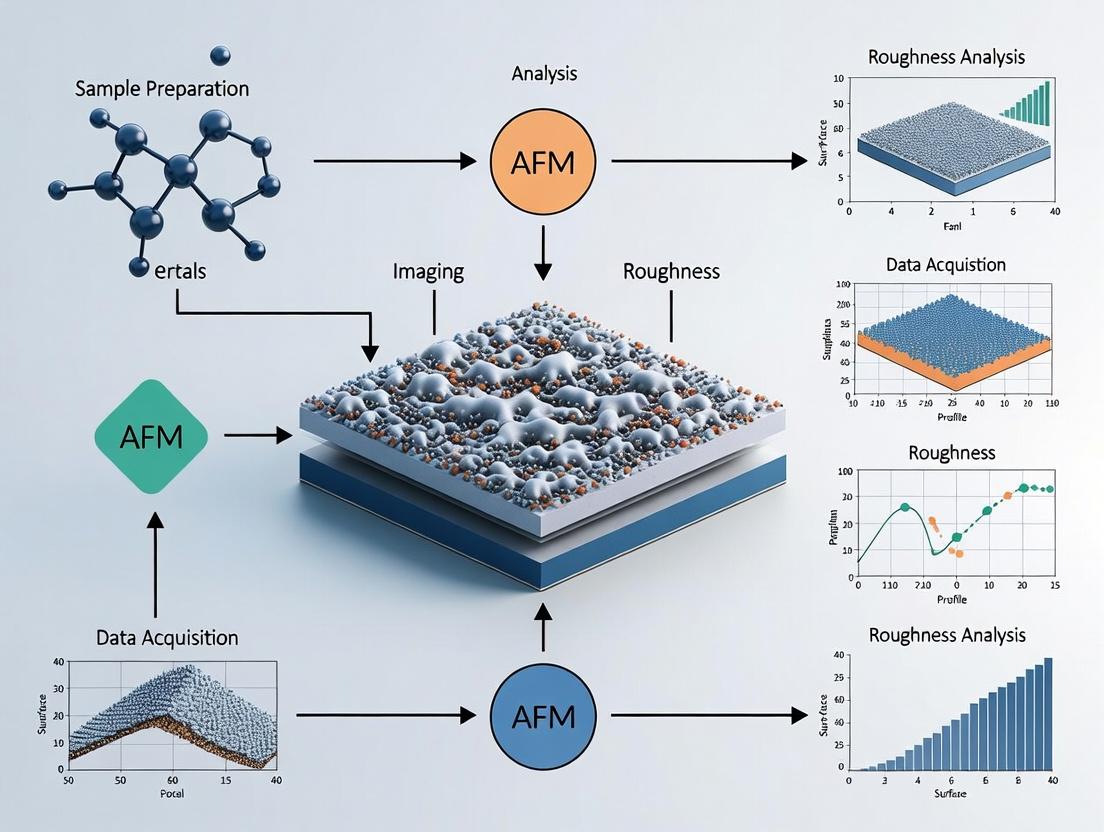
This article provides a detailed, practical guide to Atomic Force Microscopy (AFM) for quantifying thin film surface roughness, tailored for researchers and professionals in drug development.
Mastering Thin Film Surface Roughness: A Comprehensive Guide to AFM Analysis for Pharmaceutical Research
Abstract
This article provides a detailed, practical guide to Atomic Force Microscopy (AFM) for quantifying thin film surface roughness, tailored for researchers and professionals in drug development. It covers foundational principles of AFM operation and surface metrics, methodological best practices for analyzing pharmaceutical films and coatings, troubleshooting common artifacts and optimization techniques for reliable data, and validation strategies comparing AFM to profilometry and SEM. The synthesis empowers scientists to implement robust, nanoscale surface characterization critical for controlling drug product performance, stability, and manufacturing.
Understanding the Nanoscale Landscape: AFM Fundamentals and Surface Roughness Metrics
Within the broader thesis on Atomic Force Microscopy (AFM) for thin film surface roughness analysis, understanding the core operational principle is paramount. AFM provides three-dimensional, nanoscale resolution of surface topography without requiring conductive or vacuum conditions, making it indispensable for materials science and drug development (e.g., characterizing drug-eluting coatings or nanoparticle morphology). The fundamental principle involves the mechanical interaction between a sharp tip and the sample surface.
Core Operating Principle: Contact vs. Dynamic Mode
The AFM measures topography by scanning a sharp probe (tip) across the surface. The tip, mounted on a flexible cantilever, interacts with surface forces. Deflection of the cantilever is monitored, typically via a laser beam reflected onto a photodetector. Two primary modes are employed:
1. Contact Mode: The tip is in constant physical contact with the surface. The cantilever deflection (corresponding to force) is held constant by a feedback loop that adjusts the sample height (Z). This vertical adjustment maps the topography.
2. Dynamic Mode (Including Tapping Mode): The cantilever is oscillated at or near its resonance frequency. Tip-sample interactions (van der Waals, capillary forces) alter the oscillation’s amplitude, frequency, or phase. A feedback loop maintains a constant oscillation amplitude, and the Z-adjustment creates the topographic image. This mode is preferred for soft samples (e.g., biological films) as it minimizes shear forces.
The following parameters are critical for thin film roughness analysis.
Table 1: Core AFM Performance Metrics and Typical Ranges
| Parameter | Description | Typical Range (for high-resolution imaging) |
|---|---|---|
| Lateral Resolution | Minimum distinguishable feature separation in XY plane. | 0.2 nm (contact) to 1 nm (tapping) |
| Vertical Resolution | Minimum distinguishable height difference. | < 0.1 nm |
| Scan Range (XY) | Maximum area for a single scan. | ~1 µm² to > 100 µm² |
| Z-Range | Maximum measurable height difference. | ~1 µm to ~10 µm |
| Noise Floor (Z) | Background electronic/mechanical noise. | 20 - 50 pm RMS (in air) |
| Cantilever Spring Constant (k) | Stiffness; dictates applied force. | 0.1 - 100 N/m |
| Resonant Frequency (f₀) | For dynamic modes. | 10 kHz - 1 MHz (in air) |
| Typical Tip Radius (R) | Defines ultimate lateral resolution. | < 10 nm (sharp probes) |
Table 2: Common Surface Roughness Parameters Extracted from AFM Topography
| Parameter (ISO 4287) | Formula (Discrete) | Relevance to Thin Film Analysis |
|---|---|---|
| Ra (Average Roughness) | $$Ra = \frac{1}{n} \sum{i=1}^{n} | y_i |$$ | General average texture; baseline film quality. |
| Rq / RMS (Root Mean Square) | $$Rq = \sqrt{\frac{1}{n} \sum{i=1}^{n} y_i^2}$$ | More sensitive to peaks and valleys than Ra. |
| Rz (Average Max Height) | Average height between 5 highest peaks & 5 lowest valleys. | Assesses local defect severity. |
| Sa (3D Areal Average) | 3D analogue of Ra over a measured area. | Comprehensive for isotropic thin films. |
Experimental Protocols for Thin Film Roughness Analysis
Protocol 1: Sample Preparation and Mounting
Objective: Securely mount thin film sample to minimize acoustic and vibrational noise.
- Materials: Double-sided adhesive tape, conductive carbon tape, or magnetic disks; clean glass slides or AFM specimen discs.
- Procedure: Cut sample to appropriate size (<1 cm²). Using tweezers, attach sample to disc using adhesive. Ensure no adhesive contaminates the top surface. For powdery films, use a gentle stream of clean, dry air to remove loose particles.
- Critical Note: For soft polymeric or biological films, consider immersion in appropriate fluid if using a liquid cell.
Protocol 2: Probe Selection and Installation
Objective: Choose an appropriate cantilever for the measurement mode and sample.
- Materials: AFM probe (e.g., Si tip for contact mode, Si-coated tip for conductive AFM, diamond-coated for wear resistance).
- Procedure: a. Using clean tweezers, remove probe from its storage box. b. Mount the probe chip securely into the probe holder following the manufacturer's torque specifications. c. For dynamic modes, note the nominal resonant frequency and spring constant (from manufacturer's sheet) for initial parameter input into the AFM controller software.
Protocol 3: System Alignment and Engagement
Objective: Align the optical lever system and safely bring the tip into interaction with the surface.
- Procedure: a. Laser Alignment: Adjust the position of the laser diode so the beam is focused on the end of the cantilever. b. Photodetector Alignment: Center the reflected laser spot on the quadrant photodetector. Set the vertical (A-B) and horizontal (C-D) difference signals to zero. c. Approach: Initiate the automated coarse and fine approach sequence. The system moves the tip toward the surface until a preset deflection or amplitude setpoint is detected (e.g., -1 V for contact, 80% of free amplitude for tapping).
Protocol 4: Imaging and Parameter Optimization
Objective: Acquire a stable, high-resolution topographic image.
- Setpoint Adjustment: Adjust the deflection/amplitude setpoint to apply minimal force. Reduce setpoint until tip just tracks the surface without losing contact.
- Gain Tuning (PID Controller): Increase proportional and integral gains until the system is responsive but not oscillatory. Watch the error signal during scanning.
- Scan Parameters: Set a slow scan rate (e.g., 0.5-1 Hz) for high resolution. Choose an appropriate number of data points (512 x 512 or 1024 x 1024). Select a scan size representative of the film's features.
- Capture Image: Initiate scanning. Capture both trace and retrace images to check for scan artifacts.
Protocol 5: Image Processing and Roughness Analysis
Objective: Extract quantitative roughness parameters from raw topographic data.
- Flattening: Apply a 1st or 2nd order flattening algorithm to remove sample tilt and bow. Do not over-flatten.
- Filtering (if necessary): Apply a low-pass filter to remove high-frequency noise or a median filter to remove outliers (single pixel spikes). Document all processing steps.
- Region Selection: Select a representative, defect-free area for analysis.
- Parameter Calculation: Use the instrument's software or external software (e.g., Gwyddion, SPIP) to calculate Sa, Sq, Sz, etc., over the selected area. Report scan size and calculation algorithm.
Visualization of AFM Operational Principles
Diagram Title: AFM Operational Workflow and Mode Comparison
Diagram Title: Core AFM Feedback Loop for Topography
The Scientist's Toolkit: Key Research Reagent Solutions & Materials
Table 3: Essential Materials for AFM Thin Film Characterization
| Item | Function & Relevance |
|---|---|
| Silicon Probes (Tapping Mode) | Standard probes with a sharp Si tip (tip radius <10 nm). Oscillated at resonance (70-400 kHz) to minimize sample damage. Essential for polymer and soft film imaging. |
| Silicon Nitride Probes (Contact Mode) | Softer cantilevers (lower spring constant, ~0.1 N/m) for low-force contact imaging in air or liquid. Suitable for biological thin films. |
| Diamond-Coated Probes | Extremely wear-resistant. Used for scanning abrasive or very hard thin films (e.g., certain ceramics, diamond-like carbon coatings). |
| Conductive Diamond or Pt/Ir Coated Probes | Enable electrical characterization (e.g., conductive AFM, Kelvin Probe) alongside topography. Critical for analyzing semiconductor or conductive polymer films. |
| PeakForce Tapping Probes | Specialized probes for modes that directly control the maximum applied force on each tap cycle. Crucial for quantifying nanomechanical properties (modulus, adhesion) simultaneously with topography. |
| Vibration Isolation Table | Active or passive isolation system to dampen ambient building vibrations (floor noise). Fundamental for achieving sub-nanometer vertical resolution. |
| Acoustic Enclosure | Box or chamber to minimize air currents and acoustic noise that can disturb the cantilever, especially in dynamic modes. |
| Cleanroom Wipes & Solvents | Isopropyl alcohol, acetone, and lint-free wipes for cleaning sample stages, tweezers, and (cautiously) samples to prevent particulate contamination. |
| Calibration Gratings | Samples with known pitch and step height (e.g., TGZ01, TGXY02). Used to verify the AFM's X, Y, and Z scaling accuracy and scanner linearity. |
| Liquid Cell | Allows imaging under fluid. Essential for studying thin films in their native hydrated state (e.g., lipid bilayers, hydrogel coatings) or for electrochemistry. |
Why Surface Roughness Matters in Pharmaceutical Thin Films
Surface roughness is a critical quality attribute of pharmaceutical thin films, directly influencing drug release kinetics, adhesion, stability, and bioavailability. This Application Note, framed within broader atomic force microscopy (AFM) research, details the quantitative impact of roughness and provides standardized protocols for its analysis in drug development.
Surface roughness, typically measured as Ra (arithmetic average) or Rq (root mean square), is a non-invasive predictor of thin film performance. The following table summarizes key quantitative relationships established in recent literature.
Table 1: Impact of Surface Roughness on Pharmaceutical Thin Film Performance
| Performance Metric | Roughness Parameter | Quantitative Relationship / Optimal Range | Key Consequence |
|---|---|---|---|
| Drug Release Rate | Ra, Rq | Increased Ra (10-50 nm to 200+ nm) correlates with 1.5-3x faster initial release. | Modulation of dissolution profile; risk of dose dumping. |
| Bioadhesion Strength | Ra | Optimal adhesion at Ra ~100-200 nm; outside this range, adhesion drops by up to 40-60%. | Ensures proper residence time at application site (oral, transdermal). |
| Chemical & Physical Stability | Rq | Rq > 250 nm linked to ~25% higher recrystallization rate in amorphous solid dispersions. | Reduces shelf-life; promotes drug degradation. |
| Uniformity of Dose | Ra, Rz | Ra variability >15% across batch correlates with dose content uniformity failures (RSD >6%). | Impacts safety and efficacy. |
| Wettability | Contact Angle (θ) | Linear correlation between increased Ra (0-150 nm) and decreased θ (improved wettability). | Enhances dissolution for poorly soluble drugs. |
Experimental Protocols for AFM-Based Roughness Analysis
Protocol 2.1: Sample Preparation & Mounting
Objective: To prepare thin film samples for AFM analysis without inducing artifacts.
- Substrate Cleaving: For free-standing films, use a clean, sharp blade to cleave a section (approx. 5mm x 5mm). Avoid bending or touching the surface.
- Adhesive Mounting: Affix the film to a standard AFM metal puck using a double-sided adhesive tape (e.g., Scotch). Apply gentle, uniform pressure to avoid deformation.
- Spin-Coated Films: Analyze directly on their substrate (e.g., silicon wafer). Secure the wafer to the puck with adhesive.
- Dust Removal: Use a steady stream of clean, dry nitrogen or air (Dust-Off) to remove loose particulates.
Protocol 2.2: AFM Imaging & Parameter Selection
Objective: To acquire high-fidelity topographical data.
- Instrument Setup: Use a quantitative AFM mode (e.g., Tapping/AC Mode in air, PeakForce Tapping).
- Probe Selection: Use a sharp silicon tip (e.g., RTESPA-150 from Bruker, k ~5 N/m, f0 ~150 kHz). Confirm radius <10 nm via tip characterization sample.
- Scan Parameters:
- Scan Size: 10 µm x 10 µm for overview; 1 µm x 1 µm for detailed morphology.
- Resolution: 512 x 512 pixels.
- Scan Rate: 0.5-1.0 Hz.
- Setpoint: Optimize to achieve ~85-90% of free air amplitude to minimize force.
- Environmental Control: Perform analysis in a controlled environment (22 ± 2°C, 40 ± 5% RH). Allow sample thermal equilibration for 15 minutes.
Protocol 2.3: Data Processing & Roughness Calculation (ISO 4287)
Objective: To extract statistically relevant roughness parameters from raw AFM data.
- Flattening: Apply a 1st or 2nd order flattening algorithm to remove sample tilt.
- Plane Fit: Apply a mean plane subtraction.
- Masking: Exclude obvious artifacts or voids from the analysis area.
- Parameter Calculation: On the processed, flattened image, calculate:
- Sa / Ra: Arithmetic mean height deviation from the mean plane.
- Sq / Rq: Root mean square of height deviations.
- Sz / Rz: Maximum height of the profile.
- Reporting: Report the mean ± standard deviation from at least three independent sample locations (n≥3).
Visualizing the Role of Surface Roughness
The following diagrams, created using DOT language, illustrate the causal pathways and experimental workflow.
Title: Key Factors and Impacts of Thin Film Surface Roughness
Title: AFM Surface Roughness Analysis Workflow
The Scientist's Toolkit: Essential Research Reagents & Materials
Table 2: Key Reagents and Materials for AFM Thin Film Roughness Studies
| Item Name | Supplier Examples | Function / Rationale |
|---|---|---|
| Silicon AFM Probes (Tapping Mode) | Bruker (RTESPA-150), Olympus (OMCL-AC160TS) | High-resolution imaging with minimal surface damage. Standardized spring constant for comparability. |
| Silicon Wafer Substrates | University Wafer, SI-MAT | Ultra-smooth, chemically inert substrate for casting spin-coated films as a reference or for testing. |
| Double-Sided Conductive Tape | Ted Pella, Plano GmbH | Secure mounting of samples to AFM pucks without inducing charge artifacts. |
| Standard Roughness Sample (TGZ1) | Bruker, NT-MDT | Calibration grating for verifying AFM lateral (X,Y) and vertical (Z) scale accuracy and tip condition. |
| High-Purity Solvents (HPLC Grade) | Sigma-Aldrich, Fisher Scientific | For cleaning substrates and, if applicable, film preparation. Ensures no particulate contamination. |
| Dust-Free Nitrogen Gas Regulator & Gun | Microdynamis, Falcon | For critical sample cleaning prior to AFM scanning to remove environmental contaminants. |
| Vibration Isolation Table | TMC, Herzan | Essential platform to isolate the AFM from ambient building vibrations for stable imaging. |
Atomic Force Microscopy (AFM) is a cornerstone technique for quantifying the nanoscale surface topography of thin films, critical in fields ranging from semiconductor fabrication to pharmaceutical coatings. The three-dimensional height data acquired via AFM must be distilled into standardized, quantitative roughness parameters to enable material characterization, process control, and correlation with functional properties (e.g., adhesion, optical scatter, biological response). Among these, the amplitude parameters Ra (arithmetic mean roughness), Rq (root mean square roughness), and Rz (mean roughness depth) are foundational. This application note details their physical meaning, calculation, and protocols for reliable measurement within AFM-based research on thin films.
Definition and Physical Meaning of Core Parameters
These parameters are calculated from a defined evaluation length (L) of a surface profile, z(x), after tilting and curvature have been removed (form removal).
| Parameter | Name & Formula | Physical Meaning | Key Insight for Thin Films |
|---|---|---|---|
| Ra | Arithmetic Average RoughnessRa = (1/L) ∫₀ᴸ |z(x)| dx | The average absolute deviation of the profile from its mean line. | Provides a stable, general measure of surface texture. Less sensitive to extreme peaks/valleys than Rq. Widely used for quality control. |
| Rq (RMS) | Root Mean Square RoughnessRq = √[ (1/L) ∫₀ᴸ z(x)² dx ] | The standard deviation of the height distribution. | Statistically more meaningful; emphasizes larger deviations (outliers). Critical for optical and electrical properties where peaks/valleys have disproportionate effects. |
| Rz | Mean Roughness DepthRz = (1/5) ∑_{i=1}⁵ (Rpi - Rvi) | The average height difference between the five highest peaks and five deepest valleys within five sampling lengths. | Gives a measure of the total height of the surface texture over a localized area. Useful for predicting sealing, lubrication, and initial wear characteristics. |
Detailed Experimental Protocol for AFM-Based Roughness Measurement
Protocol Title: Acquisition and Analysis of Surface Roughness Parameters (Ra, Rq, Rz) from AFM Topography Data of Thin Films.
Objective: To obtain statistically robust roughness parameters from AFM scans, minimizing instrumental and analytical artifacts.
Materials & Reagents (The Scientist's Toolkit):
| Item / Reagent | Function & Specification |
|---|---|
| Atomic Force Microscope | Core instrument for non-contact or tapping mode topography acquisition. Must be calibrated in X, Y, and Z axes. |
| Calibrated Grating (e.g., TGZ1, TGX1) | Reference sample for lateral (XY) and vertical (Z) scale verification and scanner calibration. |
| Anti-Vibration Table | Essential to isolate the AFM from ambient building vibrations for stable imaging. |
| Standard Probe (e.g., Si cantilever, f~300 kHz, k~40 N/m) | Tip geometry (radius < 10 nm preferred) directly impacts resolution and measured roughness of fine features. |
| Sample Mounting Kit (Double-sided tape, magnetic disks) | Ensures sample is rigidly fixed to the AFM stage to prevent drift during scanning. |
| AFM Software | For image acquisition, flattening (form removal), and roughness analysis (e.g., Gwyddion, SPIP, NanoScope Analysis). |
| Statistical Analysis Software (e.g., Origin, Python/R) | For batch processing, histogram generation, and statistical comparison of parameters from multiple scans. |
Procedure:
Step 1: Pre-Measurement Calibration and Setup 1.1 Power on the AFM and laser system, allowing thermal equilibration (≥ 30 mins). 1.2 Mount a calibration grating with known pitch and step height. 1.3 Acquire an image (e.g., 10 µm x 10 µm, 512 x 512 pixels). Verify that measured pitch and step height are within 2% of the certified values. Recalibrate scanner if necessary. 1.4 Mount the thin film sample securely using double-sided tape.
Step 2: Image Acquisition 2.1 Select an appropriate AFM probe and engage on the sample surface using non-contact or tapping mode. 2.2 Acquire topography images at multiple, non-overlapping locations (minimum n=3, preferably n≥5) to assess homogeneity. Critical: Scan size must be sufficiently large to be representative of the surface texture (typically ≥ 5x the dominant feature size). 2.3 Set resolution to at least 256 x 256 pixels, with 512 x 512 preferred for accurate parameter extraction. 2.4 Optimize scan rate and feedback parameters to minimize noise and tip-sample convolution artifacts.
Step 3: Data Processing (Form Removal) 3.1 Apply a Flattening or Plane Fit (1st or 2nd order) to each raw image to remove sample tilt and bow. Do not apply high-pass filtering, as it can artificially alter roughness values. 3.2 Optionally, apply a Scan Line Leveling correction if line-by-line offsets are present.
Step 4: Parameter Calculation and Reporting 4.1 Define the Evaluation Area. For thin films, use the entire image after removing edge artifacts (e.g., exclude 5% from borders). 4.2 Using the software's roughness analysis tool, calculate Ra, Rq (RMS), and Rz for each image. 4.3 Export the numerical data for statistical summary. 4.4 Report with Context: Present data as Mean ± Standard Deviation across all measured areas. Always report the scan size and resolution used, as these parameters are scale-dependent.
Critical Considerations for AFM Roughness Analysis
- Scale Dependence: Ra, Rq, and Rz values are intrinsically linked to the measurement scale (scan size and resolution). Always report the scan size.
- Tip Convolution: A blunt or contaminated tip will smooth out fine features, underestimating true roughness. Regularly inspect tips via SEM or test on a sharp calibration sample.
- Statistical Significance: A single AFM scan is a microscopic sample of the surface. Measurements from multiple, random locations are mandatory for a representative value.
- Parameter Choice: Use Rq for properties influenced by outliers (e.g., electrical breakdown). Use Ra for general process monitoring. Use Rz for interfacial contact phenomena.
Data Interpretation and Visualization
AFM Roughness Analysis Workflow
Physical Meaning of Ra, Rq, and Rz
Within the broader scope of a thesis on Atomic Force Microscopy (AFM) for thin film surface roughness analysis, selecting the appropriate initial characterization technique is paramount. For preliminary explorations, researchers often weigh AFM against Optical Profilometry (OP). This application note provides a critical comparison of these two techniques, detailing their operational principles, capabilities, and optimal use cases to guide researchers in drug development and materials science in selecting the right tool for initial surface assessment.
Core Principle Comparison
Atomic Force Microscopy (AFM): A scanning probe technique that measures surface topography by physically scanning a sharp tip (probe) across the sample. It records tip-sample interactions (e.g., van der Waals forces) to generate a 3D map with sub-nanometer vertical resolution.
Optical Profilometry (OP): A non-contact optical technique, typically using white-light interferometry or focus variation. It measures surface height by analyzing the interference pattern or focus quality of reflected light, generating a 3D topography map over large areas quickly.
Quantitative Comparison Table
Table 1: Technical Specifications and Performance Comparison
| Parameter | Atomic Force Microscopy (AFM) | Optical Profilometry (OP) |
|---|---|---|
| Vertical Resolution | < 0.1 nm | ~0.1 - 1 nm |
| Lateral Resolution | ~1 - 10 nm | ~0.3 - 1 µm (diffraction-limited) |
| Maximum Scan Area | Typically ~100 x 100 µm; up to ~150 x 150 µm for large scanners | Several mm x mm to cm x cm |
| Measurement Speed | Slow (minutes to hours per scan) | Very Fast (seconds to minutes per scan) |
| Measurement Mode | Contact, Tapping, Non-contact (near-field) | Truly non-contact (far-field) |
| Sample Damage Risk | Medium to Low (dependent on mode & force) | None |
| Sample Requirements | Must be clean; very rough or sticky surfaces problematic. | Can measure rough surfaces; transparent films may require coating. |
| Data Type | True 3D topography, can measure nanoscale phase, adhesion, modulus. | 3D topography, reflectivity. |
| Key Roughness Parameter (Sa) | Excellent for nanoscale Sa (< 100 nm range). | Excellent for microscale Sa (> 0.1 µm range). |
| Primary Best Use Case | Nanoscale features, ultra-thin films, soft materials, local property mapping. | Large-area surveys, microscale roughness, step heights, layer thickness. |
Table 2: Operational and Practical Considerations
| Consideration | Atomic Force Microscopy (AFM) | Optical Profilometry (OP) |
|---|---|---|
| Ease of Use | Requires significant expertise for operation and data interpretation. | Generally user-friendly, faster learning curve. |
| Sample Preparation | Often critical; samples must be firmly fixed; minimal particulate contamination. | Less stringent; can often measure as-received samples. |
| Cost (Acquisition) | Very High | Medium to High |
| Cost (Operation) | High (specialized probes, maintenance) | Low (minimal consumables) |
| Throughput | Low (single point, detailed analysis) | High (large-area, rapid screening) |
| Ideal Role in Workflow | Nano-verification & detailed analysis after initial screening. | Initial exploration, large-area mapping, and quality control. |
Experimental Protocols
Protocol 1: Initial Surface Exploration Using Optical Profilometry Objective: To rapidly assess the microscale topography and roughness (Sa) of a thin film sample over a large area.
- Sample Preparation: Mount the sample securely on the OP stage. For reflective metal or semiconductor films, measure as-is. For transparent or low-reflectivity organic films, apply a thin (~10 nm) gold/palladium sputter coat to enhance signal.
- Instrument Setup: Select a suitable objective lens (e.g., 10X-50X) to balance field of view and lateral resolution. Set the vertical scan range to exceed the expected film thickness and roughness.
- Measurement: Use the instrument's software to define the measurement area (e.g., 1 x 1 mm). Perform an automated scan. The system acquires a series of interferograms or focus stacks.
- Data Processing: Apply standard leveling (tilt removal) and a noise-reduction filter. Use masking to exclude obvious artifacts (e.g., dust).
- Analysis: Calculate the areal roughness parameters (e.g., Sa, Sq) over the entire scan or selected regions. Visually identify areas of interest (e.g., defects, representative zones) for higher-resolution AFM analysis.
Protocol 2: Nanoscale Verification Using Atomic Force Microscopy Objective: To obtain high-resolution nanoscale topography and roughness data from a region of interest identified by OP.
- Sample Transfer: Carefully transfer the sample from the OP to the AFM stage, ensuring the area of interest is accessible. Clean the sample with dry air or nitrogen to remove dust.
- Probe Selection: For thin films, a silicon tip with a nominal radius < 10 nm is suitable. For soft materials (e.g., polymer films), use a silicon tip with a lower spring constant (< 5 N/m) for tapping mode.
- AFM Setup: Engage the tip using the instrument's standard engagement procedure. For most thin films, Tapping Mode is recommended to minimize lateral forces and sample damage.
- Scan Parameter Optimization: Set the scan size to a representative area (e.g., 10 x 10 µm or 50 x 50 µm). Adjust the scan rate (typically 0.5-1 Hz), setpoint, and feedback gains to achieve a stable, noise-free image.
- Data Acquisition: Acquire both height and phase images (in tapping mode). Perform multiple scans on different spots to ensure reproducibility.
- Data Analysis: Flatten the height image (1st or 2nd order). Use software to calculate nanoscale Sa, Sq, and analyze grain size or feature dimensions. Correlate these findings with the larger-scale OP data.
Visualization: Technique Selection Workflow
Workflow for Choosing AFM or Profilometry
The Scientist's Toolkit: Essential Research Reagent Solutions
Table 3: Key Materials and Reagents for Thin Film Roughness Analysis
| Item | Function/Brief Explanation |
|---|---|
| AFM Silicon Probes (Tapping Mode) | Sharp tips (radius < 10 nm) on cantilevers for high-resolution, low-force imaging of thin film surfaces. |
| Sputter Coater (Au/Pd target) | Applies a thin, conductive metal layer to non-conductive or transparent samples for enhanced OP signal and SEM imaging. |
| PMMA or PDMS | Polymer materials used to create reference samples with known roughness for instrument calibration and validation. |
| Cleanroom Wipes & Solvents (IPA, Acetone) | For meticulous cleaning of sample substrates and AFM stages to eliminate particulate contamination. |
| Calibration Gratings | Grids with precisely known pitch and step height (e.g., 1 µm pitch, 180 nm step) for daily verification of AFM and OP lateral/vertical scales. |
| Vibration Isolation Platform | Critical for AFM to dampen environmental noise, ensuring stable imaging at the nanoscale. |
| Adhesive Tabs or Carbon Tape | For secure, non-damaging mounting of thin film samples to AFM and OP specimen holders. |
For initial explorations in thin film roughness analysis, Optical Profilometry is the superior tool for rapid, large-area assessment to identify regions of interest and quantify microscale topography. Atomic Force Microscopy serves as the essential follow-up technique for nanoscale verification, providing unparalleled resolution and detail on specific features. An integrated workflow, starting with OP screening and proceeding to targeted AFM analysis, is the most efficient and comprehensive strategy for a thesis focused on the nanoscale capabilities of AFM, ensuring observations are placed in the correct macroscopic context.
Within the context of a thesis on Atomic Force Microscopy (AFM) for thin film surface roughness analysis, selecting the appropriate imaging mode is a foundational decision that dictates data fidelity, sample preservation, and measurement throughput. This Application Note provides a detailed comparison and experimental protocols for the three primary amplitude-modulation modes: Contact Mode, Tapping Mode, and PeakForce Tapping Mode, with a focus on applications relevant to materials science and pharmaceutical development.
Comparative Analysis of AFM Modes
The selection of an AFM mode involves balancing lateral resolution, vertical resolution, applied force, and imaging speed. The following table summarizes the key quantitative and qualitative parameters for each mode, based on current instrumentation and literature.
Table 1: Comparative Analysis of Contact, Tapping, and PeakForce Tapping AFM Modes
| Parameter | Contact Mode | Tapping Mode | PeakForce Tapping Mode |
|---|---|---|---|
| Tip-Sample Interaction | Constant, repulsive physical contact | Intermittent contact (oscillating) | Intermittent contact (quasi-static, controlled peak force) |
| Lateral (Shear) Forces | High | Very Low | Very Low |
| Typical Applied Force | 0.1 - 100 nN (difficult to control) | 0.01 - 1 nN (indirectly controlled) | < 10 pN - 10 nN (directly controlled and quantified) |
| Best Vertical Resolution | ~0.1 nm | ~0.1 nm | < 0.1 nm |
| Best Lateral Resolution | ~1 nm (can degrade soft samples) | ~1 nm | ~1 nm |
| Sample Damage Risk | Very High for soft, adhesive, or loosely bound samples | Moderate to Low | Very Low |
| Ideal Sample Type | Very hard, rigid, flat surfaces (e.g., HOPG, mica, silicon wafer) | Moderate stiffness, heterogeneous surfaces (e.g., polymers, composites, biological fixed cells) | Soft, adhesive, fragile, or loosely bound materials (e.g., live cells, lipid bilayers, organic thin films, pharmaceutical formulations) |
| Simultaneous Nanomechanical Mapping | No (Friction/Lateral Force only) | Possible with advanced modes (e.g., HarmoniX) | Yes (native) - Elasticity, Adhesion, Deformation, Dissipation |
| Imaging in Liquid | Challenging (high adhesion, drag) | Standard, but can be unstable | Excellent - superior force control |
Detailed Experimental Protocols
Protocol 1: Contact Mode Imaging for Reference Substrates
Objective: To obtain high-resolution topographical data on an atomically flat, hard reference sample (e.g., muscovite mica) for scanner calibration and tip characterization. Materials: Freshly cleaved mica substrate, Si or Si₃N₄ contact-mode cantilever (spring constant: 0.01 - 0.5 N/m). Procedure:
- Sample Preparation: Cleave the top layers of a mica sheet using adhesive tape to reveal a fresh, atomically flat surface. Mount securely on the AFM metal puck.
- Cantilever Selection & Installation: Choose a soft, sharp contact-mode cantilever. Install the probe holder into the AFM head, ensuring secure electrical connections.
- Engagement: Align the laser spot on the cantilever's end and maximize the sum signal. Approach the tip to the surface using the automated engagement routine.
- Feedback Parameter Optimization: Set a low scan rate (0.5-1.0 Hz). Adjust the setpoint to achieve a low, stable deflection error signal. Set proportional (P) and integral (I) gains as high as possible without introducing feedback oscillation.
- Image Acquisition: Acquire a 1 µm x 1 µm scan. Process the image with a first-order flattening to remove sample tilt.
Protocol 2: Tapping Mode for Polymer Blend Thin Film Analysis
Objective: To characterize the surface morphology and phase separation of a polystyrene-poly(methyl methacrylate) (PS-PMMA) blend thin film without inducing sample deformation. Materials: Spin-coated PS-PMMA film on silicon, etched silicon tapping-mode cantilever (resonant frequency: ~300 kHz in air, spring constant: ~40 N/m). Procedure:
- Cantilever Tuning: Before engagement, perform an automatic thermal tune or frequency sweep to identify the fundamental resonance frequency (f₀) of the cantilever in air.
- Engagement Parameters: Set the drive amplitude to a moderate level (e.g., 500 mV). Engage using an amplitude setpoint typically 10-20% lower than the free-air amplitude.
- Optimization: Adjust the drive frequency to be slightly below f₀ for stable imaging. Fine-tune the amplitude setpoint and feedback gains to track topography accurately while maintaining tip oscillation. Reduce the scan rate for high-resolution images.
- Phase Imaging: Simultaneously acquire the phase lag signal, which provides contrast based on viscoelastic and adhesive properties, highlighting different polymer phases.
Protocol 3: PeakForce Tapping for Pharmaceutical Particulate Roughness
Objective: To quantitatively measure the surface roughness of an active pharmaceutical ingredient (API) crystal and simultaneously map its nanomechanical properties (elastic modulus, adhesion). Materials: API crystals dispersed on a glass slide, ScanAsyst-Air or equivalent cantilever (spring constant: ~0.4 N/m, resonant frequency: ~70 kHz). Procedure:
- Cantilever Calibration: Precisely calibrate the cantilever's deflection sensitivity (nm/V) on a hard, clean surface (e.g., sapphire) and its spring constant using the thermal tune method.
- PeakForce Setpoint Selection: This is the critical parameter. Start with a very low setpoint (e.g., 50 pN) to ensure no damage. Gradually increase until stable topography tracking is achieved. For most soft materials, a setpoint of 100-500 pN is sufficient.
- Frequency & Rate Optimization: Set the PeakForce Frequency (typically 0.5-2 kHz) and scan rate such that multiple taps occur per pixel. A ratio of 256 samples per line is recommended.
- Multi-Channel Data Acquisition: Acquire topography, peak force error, DMT modulus, adhesion, and deformation maps simultaneously.
- Roughness Analysis: On the flattened topography image, use the instrument's analysis software to calculate RMS Roughness (Rq) and Average Roughness (Ra) over defined areas.
Logical Workflow for AFM Mode Selection
AFM Mode Selection Workflow for Thin Films
The Scientist's Toolkit: Essential Research Reagent Solutions
Table 2: Key Materials and Reagents for AFM Thin Film Roughness Analysis
| Item | Function & Explanation |
|---|---|
| Freshly Cleaved Muscovite Mica | An atomically flat, negatively charged substrate. Essential for tip characterization, scanner calibration, and as a substrate for depositing thin films or biomolecules. |
| Silicon Wafers (P-type/Boron-doped) | Extremely flat, rigid, and conductive (if doped) substrates. Ideal for depositing model thin films and for electrical AFM modes. |
| UV-Ozone Cleaner | Provides a reproducible, chemically clean, and hydrophilic surface on substrates (Si, SiO₂) by removing organic contaminants and increasing surface energy for uniform film deposition. |
| Polystyrene (PS) & Poly(methyl methacrylate) (PMMA) | Standard polymer blend components used as model systems for phase separation studies, validating AFM phase imaging capabilities. |
| Scanning Probe Calibration Grating (e.g., TGZ1, TGQ1) | Grating with periodic structures and known step heights (e.g., 20 nm, 500 nm). Critical for verifying the AFM's lateral (X,Y) and vertical (Z) dimensional accuracy and scanner linearity. |
| Cantilever Calibration Kit | Includes a clean, rigid sample (e.g., sapphire) for deflection sensitivity, and may include pre-calibrated cantilevers. Fundamental for converting photodetector voltage to force (nN). |
| PeakForce Tapping Cantilevers (ScanAsyst family) | Silicon nitride cantilevers with optimized geometry, reflective coating, and consistent spring constants. Designed for superior force control and durability in PeakForce Tapping mode. |
| High-Resolution Tapping Mode Cantilevers (e.g., RTESPA, AC40) | Etched silicon probes with high resonant frequency and sharp tips (<10 nm radius). Provide optimal resolution for Tapping Mode in air and liquid. |
| Soft Contact Mode Cantilevers (e.g., MLCT-Bio) | Silicon nitride cantilevers with very low spring constants (0.01 N/m). Minimize contact force for imaging soft samples in contact mode, though risks remain. |
From Theory to Lab Bench: A Step-by-Step AFM Protocol for Thin Film Analysis
Sample Preparation Best Practices for Drug-Loaded Films and Coatings
Within the broader context of Atomic Force Microscopy (AFM) research for thin film surface roughness analysis, reproducible and artifact-free sample preparation is paramount. For drug-loaded polymeric films and coatings, surface topography directly influences drug release kinetics, biocompatibility, and performance. This protocol details best practices for preparing such samples to ensure their surfaces are representative and suitable for high-resolution AFM characterization, enabling accurate correlation between roughness parameters (Ra, Rq) and functional performance.
Key Challenges in Preparation
Improper preparation can introduce artifacts (scratches, debris, uneven drying) that obscure true surface morphology, leading to erroneous AFM data. Primary challenges include controlling solvent evaporation, achieving uniform thickness, preventing particle aggregation, and ensuring adhesion without contamination.
Essential Research Reagent Solutions
| Reagent/Material | Function in Preparation |
|---|---|
| Poly(lactic-co-glycolic acid) (PLGA) | Biodegradable polymer matrix for controlled drug release. |
| Polyvinyl alcohol (PVA) | Common hydrophilic polymer used as a film-forming agent or stabilizer. |
| Dichloromethane (DCM) | Volatile organic solvent for dissolving hydrophobic polymers (e.g., PLGA). |
| Phosphate Buffered Saline (PBS) | Aqueous medium for simulating physiological conditions during hydration studies. |
| Polydimethylsiloxane (PDMS) molds | Non-adhesive molds for casting films with defined geometry and easy release. |
| Spin Coater | Instrument for creating uniform thin films on substrates via centrifugal force. |
| Oxygen Plasma Cleaner | Treats substrates (e.g., glass, silicon) to increase hydrophilicity and improve film adhesion. |
| Vacuum Desiccator | Removes residual solvents and moisture slowly to prevent film cracking and bubbling. |
Standardized Protocols for AFM-Ready Samples
Protocol 1: Solvent Casting Method for Free-Standing Films
Objective: Produce homogeneous, flat, free-standing films for bulk property analysis.
- Polymer/Drug Solution Preparation: Dissolve the polymer (e.g., 100 mg PLGA) and active pharmaceutical ingredient (API, e.g., 5-20% w/w) in an appropriate volatile solvent (e.g., 5 mL DCM). Stir magnetically for 6 hours until fully dissolved.
- Casting: Pour the solution into a leveled, flat-bottomed PTFE or PDMS mold (e.g., 60 mm diameter).
- Controlled Evaporation: Cover the mold loosely with an aluminum foil lid (punched with 3-4 pinholes) and place it in a fume hood at ambient temperature for 12 hours.
- Final Drying: Transfer the partially dried film into a vacuum desiccator (<50 mTorr) for 24 hours to remove all residual solvent.
- Detachment: Gently peel the free-standing film from the mold. Store in a desiccator until AFM analysis.
Protocol 2: Spin-Coating Method for Thin Coatings on Substrates
Objective: Create ultra-thin, uniform coatings on rigid substrates for nano-scale roughness measurement.
- Substrate Preparation: Clean a silicon wafer or glass slide with successive sonication in acetone, isopropanol, and deionized water (5 minutes each). Dry under nitrogen stream. Treat with oxygen plasma for 2 minutes to enhance wettability.
- Solution Preparation: Prepare a lower-viscosity polymer/drug solution (e.g., 20 mg PLGA + API in 5 mL DCM). Filter through a 0.45 μm PTFE syringe filter.
- Spin-Coating: Pipette 1 mL of solution onto the center of the static substrate. Initiate spin program: 500 rpm for 5 s (spread), then 2000-4000 rpm for 30 s (thin).
- Post-Processing: Immediately transfer the coated substrate to a vacuum desiccator for 4 hours to remove solvent.
- Hydration (if needed): For in situ AFM, immerse the coated substrate in PBS for a predetermined time, then gently blot the edges before mounting on the AFM stage.
Protocol 3: Critical Point Drying for Hydrated/Gel-Based Films
Objective: Prepare hydrated or hydrogel-based films for AFM without introducing drying artifacts like collapse.
- Initial Dehydration: After any aqueous processing or hydration study, gradually dehydrate the sample using a graded ethanol series (30%, 50%, 70%, 90%, 100% v/v, 10 minutes per step).
- Critical Point Drying: Transfer the sample to a critical point dryer. Purge the chamber with liquid CO₂, then perform multiple exchange cycles to replace ethanol with CO₂. Bring the chamber above the critical point of CO₂ (31°C, 1072 psi).
- Vent: Slowly vent the chamber to gas phase CO₂, leaving a dry, uncollapsed film structure.
- Storage: Place the dried sample in a desiccator until AFM imaging.
Table 1: Average Surface Roughness (Ra) of PLGA Films Prepared by Different Methods (AFM Scan Size: 10 µm x 10 µm)
| Preparation Method | Drying Condition | Drug Loading (% w/w) | Average Ra (nm) | Rq (nm) | Key Observation |
|---|---|---|---|---|---|
| Solvent Casting | Ambient, 48 hrs | 0% (Placebo) | 45.2 ± 12.1 | 58.7 ± 15.3 | Moderate roughness, some dust inclusions. |
| Solvent Casting | Vacuum, 24 hrs | 0% (Placebo) | 18.7 ± 4.3 | 24.1 ± 6.2 | Significantly smoother, fewer artifacts. |
| Solvent Casting | Vacuum, 24 hrs | 10% (Model Drug) | 32.5 ± 8.9 | 41.3 ± 10.5 | Increased roughness due to drug particles. |
| Spin Coating | Vacuum, 4 hrs | 0% (Placebo) | 2.1 ± 0.5 | 2.8 ± 0.7 | Very smooth, uniform surface. |
| Spin Coating | Vacuum, 4 hrs | 10% (Model Drug) | 15.8 ± 3.2 | 20.4 ± 4.8 | Nanoscale drug domains visible. |
Table 2: Effect of Hydration and Drying Method on Alginate Film Roughness
| Film State | Drying Method | Average Ra (nm) | Note for AFM Analysis |
|---|---|---|---|
| Hydrated (Wet) | In situ Liquid Cell | 5.8 ± 1.2 | True in operando morphology. |
| Air-Dried | Ambient | 210.5 ± 45.6 | Severe collapse, high Ra. |
| Critical Point Dried | CO₂ CPR | 22.4 ± 6.7 | Preserved porous structure. |
Integrated Workflow for AFM-Centric Sample Preparation
Title: Workflow for Preparing AFM-Ready Drug-Loaded Films
Key Recommendations for AFM Research
- Substrate Control: Always include a placebo (non-drug-loaded) film and a bare substrate control to deconvolute preparation artifacts from drug-induced topography.
- Documentation: Record all parameters: solvent evaporation time/temperature, humidity, spin speed, vacuum duration, and storage conditions.
- Replication: Prepare a minimum of n=3 samples per formulation to assess preparation reproducibility via AFM roughness metrics.
- AFM Tip Selection: For soft, drug-loaded films, use silicon probes with low spring constants (e.g., 0.1-5 N/m) in tapping mode to prevent surface deformation during scanning.
Consistent application of these preparation protocols ensures that AFM-derived surface roughness data is reliable and can be meaningfully correlated with drug release profiles and biological interactions in subsequent thesis research.
Within the context of a broader thesis on Atomic Force Microscopy (AFM) for thin film surface roughness analysis, the precise definition of scan parameters is fundamental to obtaining accurate, reproducible, and meaningful data. This application note details the principles, trade-offs, and experimental protocols for setting the three interdependent core parameters: Scan Size, Resolution, and Scan Rate. Optimizing these parameters is critical for researchers, scientists, and drug development professionals analyzing surface topography of thin films for applications ranging from semiconductor coatings to pharmaceutical formulations.
Core Parameter Definitions & Interdependencies
Scan Size: The physical dimension (X and Y) of the area imaged by the AFM tip, typically measured in micrometers (µm) or nanometers (nm). It defines the field of view.
Resolution: The number of data points sampled within the scan area, defined by the number of pixels (e.g., 256 x 256, 512 x 512, 1024 x 1024). Higher resolution yields more detail but increases acquisition time.
Scan Rate: The frequency at which the probe scans a single line (in Hz), inversely related to the time per line scan. Faster scan rates reduce imaging time but can compromise image quality due to system lag and tip inertia.
These parameters are intrinsically linked by the relationship: Scanning Speed (µm/s) = Scan Size (µm) × Scan Rate (Hz). Adjusting one parameter necessitates adjustments to the others to maintain image fidelity.
Table 1: Parameter Trade-offs and Typical Ranges for Thin Film Roughness Analysis
| Parameter | Typical Range | Impact on Image Quality | Impact on Acquisition Time | Recommended for Roughness Analysis |
|---|---|---|---|---|
| Scan Size | 1 µm² to 100 µm² | Larger size reduces effective lateral resolution. | Increases linearly with area. | 5x5 µm to 20x20 µm for representative sampling. |
| Resolution (pixels) | 256² to 1024² | Higher resolution reveals finer features; lowers noise in roughness calc. | Increases with square of pixel count (e.g., 512² is 4x longer than 256²). | 512 x 512 minimum; 1024 x 1024 for critical features. |
| Scan Rate | 0.5 Hz to 2 Hz (Contact Mode) 0.8 Hz to 5 Hz (Tapping Mode) | Too high causes distortion, lag, and tip damage. Too low increases drift. | Directly inverse: doubling rate halves time. | 0.8-1.2 Hz for high-res (512²+); 1.5-2 Hz for survey scans. |
| Pixel Size (Calc.) | Scan Size / Resolution | Defines smallest detectable lateral feature. | N/A | Should be < 1/3 of feature size of interest. |
Table 2: Example Parameter Sets for Different Thin Film Analysis Goals
| Analysis Goal | Scan Size (µm) | Resolution (pixels) | Pixel Size (nm) | Scan Rate (Hz) | Approx. Time (min) | Mode |
|---|---|---|---|---|---|---|
| Large-scale uniformity | 50 x 50 | 256 x 256 | 195 | 2.0 | ~4.3 | Tapping |
| Standard roughness (Sa) | 10 x 10 | 512 x 512 | 19.5 | 1.0 | ~8.5 | Tapping |
| High-res feature imaging | 2 x 2 | 1024 x 1024 | 2.0 | 0.8 | ~21.3 | Tapping |
| Fast survey scan | 5 x 5 | 256 x 256 | 19.5 | 3.0 | ~1.4 | Contact |
Experimental Protocols
Protocol 1: Systematic Optimization for Reproducible Roughness Measurement
Objective: To establish a standardized AFM imaging protocol for quantifying root-mean-square (Rq) and arithmetic average (Ra) roughness of a polymer thin film.
Materials: See "The Scientist's Toolkit" below.
Methodology:
- Sample Preparation: Mount the thin film sample securely on a magnetic or adhesive stub. Use a clean, particulate-free environment.
- Probe Selection & Engagement: Install a silicon cantilever appropriate for the mode (e.g., RTESPA-300 for Tapping Mode). Engage the probe onto the surface using the automated routine at a scan size of 0 µm.
- Initial Survey Scan: Set initial parameters to a moderate scan size (e.g., 20 µm), low resolution (256 x 256), and a scan rate of 1 Hz. Perform a scan to identify a representative, defect-free region of interest.
- Parameter Optimization Loop:
- Set Scan Size: Zoom to a 10 x 10 µm area deemed representative of the film's surface.
- Set Resolution: Increase resolution to 512 x 512. This defines a pixel size of ~19.5 nm.
- Optimize Feedback Gains: Adjust proportional and integral gains to achieve a crisp error signal without oscillation.
- Adjust Scan Rate: Start at 0.5 Hz. Gradually increase the rate until the trace and retrace profiles are nearly identical (indicating minimal distortion). For a 512-line image, this is typically 0.8-1.2 Hz.
- Validate: Capture the image. Check the trace/retrace line profiles for congruence. Calculate the roughness (Rq) in the AFM software. Repeat the scan on the same spot; Rq values should vary by < 5%.
- Data Acquisition: Once optimized, scan at least three different, non-overlapping locations on the sample using the identical parameter set.
- Roughness Analysis: Use the AFM software's plane fitting (usually 1st or 2nd order flattening) and roughness analysis tool. Report both Ra and Rq, along with the scan parameters used.
Protocol 2: Calibrating Scan Rate to Minimize Distortion
Objective: To empirically determine the maximum permissible scan rate for a given tip-sample system to prevent image artifacts.
Methodology:
- Using a sample with known, sharp features (e.g., a grating with vertical steps), engage the probe as in Protocol 1.
- Set a fixed, small scan size (e.g., 2 µm) and high resolution (1024 x 1024).
- Starting at a very low scan rate (0.1 Hz), acquire an image. This is the "reference" image.
- Incrementally increase the scan rate (0.2, 0.5, 1.0, 2.0, 3.0 Hz), acquiring an image at each setting.
- Analyze the sharpness and symmetry of the step edges in each image. The maximum usable scan rate is the highest rate before the step edge broadening (distortion) exceeds 10% of its width in the reference image.
Visualization of Parameter Relationships & Protocols
Title: AFM Parameter Optimization Workflow
Title: Core Parameter Interdependencies
The Scientist's Toolkit
Table 3: Essential Research Reagent Solutions & Materials for AFM Thin Film Analysis
| Item | Function & Relevance to Scan Parameters |
|---|---|
| Standard Reference Sample (e.g., Grating) | A sample with known, periodic features (pitch, step height) for calibrating scan size (X,Y) and Z-scanner, and for validating scan rate limits. |
| Silicon Probes (Tapping Mode, e.g., RTESPA-300) | Sharp, consistent cantilevers with known resonant frequency and spring constant. Essential for achieving high resolution and stable feedback at optimal scan rates. |
| Vibration Isolation Table/Platform | Mitigates environmental noise, enabling stable imaging at slow scan rates and high resolutions without artifacts. |
| Adhesive Mounting Discs (e.g., Carbon Tape) | Secures thin film samples firmly to stubs, preventing movement during scanning which is crucial for large scan sizes and slow rates. |
| Compressed Air/Dust-Free Gas Duster | Removes particulate contamination from sample and stage, preventing tip contamination and image streaks, especially at high magnifications. |
| AFM Software with Advanced Scan Controls | Software allowing independent control of scan size, pixel density, and scan rate, plus real-time display of trace/retrace for optimization. |
1. Introduction within Thesis Context This application note is a component of a broader thesis investigating Atomic Force Microscopy (AFM) methodologies for the quantitative surface roughness analysis of functional thin films (e.g., pharmaceutical coatings, polymer layers, nanostructured materials). A fundamental, yet often underestimated, challenge is the statistically sound acquisition of surface topography data. The core thesis posits that inaccurate roughness parameters (Ra, Rq, Rz) stem less from instrument error and more from non-representative sampling. This protocol details systematic strategies to capture surface areas that truly represent the film's macroscopic properties, ensuring downstream roughness analysis yields reliable, reproducible, and physically meaningful data for research and drug product development.
2. Core Principles of Representative Sampling
Representative sampling for AFM-based roughness analysis requires addressing lateral heterogeneity across multiple scales. The following table summarizes key quantitative considerations for planning data acquisition.
Table 1: Quantitative Parameters for Representative Area Selection
| Parameter | Typical Range/Consideration | Rationale & Impact on Representativeness |
|---|---|---|
| Total Sampled Area | 10 µm² to 1 mm² (aggregate) | Must exceed the correlation length of surface features by at least a factor of 100 to ensure statistical stationarity. |
| Number of Discrete Scans (N) | N ≥ 5-9 per sample condition | Required to estimate the standard error of mean roughness parameters. |
| Scan Size per Location | 1 µm x 1 µm to 100 µm x 100 µm | Must capture the largest relevant lateral feature (e.g., particle, domain). A 10x10 µm scan is often a practical starting point. |
| Spatial Sampling (Pixels) | 256 x 256 to 1024 x 1024 | Must satisfy the Nyquist criterion for the smallest feature of interest. Pixel size should be < (lateral resolution)/2. |
| Inter-Scan Spacing | ≥ 2x the scan size | Minimizes spatial autocorrelation between measurement sites, assuming random or grid-based sampling. |
3. Detailed Experimental Protocols
Protocol 3.1: Systematic Grid-Based Sampling for Macroscopic Homogeneity Assessment Objective: To obtain an unbiased overview of surface variation across a large sample area (e.g., a coated substrate). Materials: AFM with closed-loop XY scanner, pristine AFM probes (e.g., RTESPA-300), optical microscope integrated with AFM. Procedure:
- Sample Mapping: Using the optical microscope, identify and mark a region of interest (ROI) devoid of gross defects. Define a square or rectangular grid within this ROI.
- Grid Definition: Using the AFM software's mapping or automated sequencing function, define a grid of N (e.g., 3x3=9) measurement points. Set the center-to-center spacing between points to be at least twice the chosen scan size (e.g., for 10 µm scans, use ≥20 µm spacing).
- Automated Acquisition: Program the sequence to acquire a topography image at each grid point using identical parameters: scan size, resolution (pixels), scan rate, and feedback gains.
- Data Logging: For each image, record the precise XY stage coordinates alongside the raw data file.
- Analysis: Calculate primary roughness parameters (Ra, Rq) for each individual image. Perform descriptive statistics (mean, standard deviation) across the set of N images.
Protocol 3.2: Targeted Multi-Scale Sampling for Heterogeneous or Structured Films Objective: To intentionally capture data from distinct morphological regions (e.g., domains, particles, valleys) identified a priori. Materials: As in Protocol 3.1, plus SEM or high-resolution optical profilometry data for guidance. Procedure:
- Pre-Screening: Characterize the sample using a low-magnification technique (e.g., optical profilometry, SEM) to identify distinct topographic regions (e.g., "granular domains," "smooth matrix," "boundary regions").
- Region Classification: Classify and label at least three distinct morphological region types.
- Targeted AFM Setup: Transfer the sample to the AFM. Using the optical microscope and correlation with the pre-screen map, navigate to a representative location of Region Type 1.
- Scale-Dependent Imaging: At this location, perform a nested scan series: a. Acquire a large-area scan (e.g., 50x50 µm) to capture the local context and feature distribution. b. Within that image, select a representative sub-region for a high-resolution scan (e.g., 5x5 µm, 1024x1024 pixels) to resolve fine details.
- Replicate Sampling: Repeat Step 3 and 4 for at least three different, spatially separated locations per Region Type.
- Analysis: Report roughness parameters segregated by Region Type. The overall surface representation is the area-weighted average of these regional analyses.
4. Visualization of Strategic Workflows
Workflow for Representative AFM Area Selection
5. The Scientist's Toolkit: Research Reagent Solutions & Essential Materials
Table 2: Essential Materials for Representative AFM Surface Acquisition
| Item | Function & Rationale |
|---|---|
| AFM with Automated XY Stage | Enables precise, repeatable navigation to predefined grid coordinates for systematic sampling (Protocol 3.1). Closed-loop control is critical for accuracy. |
| Sharp Silicon Probes (e.g., Tap300-G series) | Standard probes for high-resolution topography of thin films. Consistent tip geometry (radius < 10 nm) is vital for comparable measurements across scans. |
| Vibration Isolation System | Active or passive isolation table to minimize acoustic/floor noise, preventing artifacts that corrupt data, especially during long automated sequences. |
| Sample Mounting Kit | Includes double-sided conductive tape, magnetic disks, or vacuum chucks to secure the sample firmly, preventing drift during measurement. |
| Optical Microscope (Integrated) | Used for initial sample navigation, identification of gross regions of interest, and correlation with pre-screen maps for targeted sampling. |
| Reference Sample (e.g., Gratings) | Used to calibrate the AFM scanner's XY and Z dimensions, ensuring scan size accuracy, which is fundamental for comparing areas. |
| Automated Scripting Software | AFM vendor-specific or third-party software (e.g., Pycroscopy) to program automated multi-location measurements, ensuring consistency and saving time. |
| Clean Room Supplies | Lint-free wipes, compressed air or nitrogen duster, UV-ozone cleaner. To remove particulate contamination from the sample surface before measurement. |
Within the context of a broader thesis on Atomic Force Microscopy (AFM) for thin film surface roughness analysis, this application note details the critical post-processing steps required to extract quantitative, reliable data. For researchers, scientists, and drug development professionals, proper data treatment is essential for correlating surface topography with material properties, coating uniformity, or biological interactions. Raw AFM height data contains artifacts, such as scanner bow, tilt, and noise, which must be removed before meaningful roughness parameters can be calculated. This protocol outlines standardized methodologies for flattening, filtering, and parameter calculation.
Core Post-Processing Workflow
The following workflow diagram illustrates the logical sequence of steps for AFM data post-processing.
AFM Data Post-Processing Sequential Workflow
Experimental Protocols
Protocol 1: Polynomial Flattening (Order 0, 1, or 2)
Objective: Remove instrument-induced vertical offset (0th order), tilt (1st order), and scanner bow (2nd order) from the image data.
- Load Data: Import the raw AFM scan file (e.g., .ibw, .spm, .txt) into analysis software (e.g., Gwyddion, NanoScope Analysis, MountainsSPIP).
- Select Flattening Function: Choose the "Flatten" or "Plane Correct" algorithm.
- Choose Polynomial Order:
- 0th Order (Mean): Subtracts the average height of the entire scan or selected rows. Use for data already horizontally level.
- 1st Order (Linear): Fits and subtracts a flat plane (Ax + By + C). Standard for removing scan tilt.
- 2nd Order (Parabolic): Fits and subtracts a second-order polynomial surface. Essential for removing non-linear scanner bow artifacts.
- Apply per Row/Line: For most contact-mode images, apply 1st order flattening to each scan line individually to remove line-wise bow.
- Apply to Whole Image: Finally, apply a global 1st or 2nd order flatten to the entire dataset.
- Validation: Visually inspect the flattened image; the background should appear level without artificial curvature.
Protocol 2: Spatial Frequency Filtering
Objective: Isolate surface roughness features of interest by removing high-frequency noise and low-frequency waviness.
- Define Cut-offs: Determine the spatial wavelength cut-offs based on feature size.
- High-Pass Filter (Removes Low Frequencies): Set a cut-off wavelength (λlow) to remove waviness larger than the relevant lateral scale. Features smaller than λlow are retained.
- Low-Pass Filter (Removes High Frequencies): Set a cut-off wavelength (λhigh) to remove noise smaller than the smallest relevant feature. Features larger than λhigh are retained.
- Select Filter Type: Use a Gaussian or Median filter for gentle smoothing. A Fourier Transform (FFT) bandpass filter offers precise frequency control.
- Apply Filter:
- For Gaussian Low-Pass, select a kernel size (σ) approximately equal to λ_high.
- For FFT Bandpass, transform the image to frequency space, manually suppress frequencies outside the λlow to λhigh band, then perform an inverse FFT.
- Caution: Document all filter parameters. Over-filtering can artificially alter roughness values.
Protocol 3: Parameter Calculation According to ISO 25178
Objective: Calculate standardized height and spatial roughness parameters from the processed topography data.
- Define Evaluation Area: Use a masking tool to exclude obvious dust particles, scan artifacts, or deep scratches from the analysis area.
- Create the Primary Surface (S): This is the flattened and filtered height map.
- Calculate Height Parameters (based on S):
- Sa (Arithmetic Mean Height): The average absolute deviation from the mean plane.
- Sq (Root Mean Square Height): The standard deviation of height values. More sensitive to peaks and valleys than Sa.
- Sz (Maximum Height): The sum of the largest peak height and pit depth within the defined area.
- Calculate Hybrid & Spatial Parameters (may require additional processing):
- Sdr (Developed Interfacial Area Ratio): The percentage of additional surface area contributed by roughness compared to a flat plane.
- Calculate the Autocorrelation Function (ACF): Derive the Sal (Autocorrelation Length) – the horizontal distance at which the ACF decays to a specified fraction (e.g., 0.2). This characterizes lateral feature size.
Data Presentation: Roughness Parameter Comparison
The table below summarizes key ISO 25178 parameters and their relevance for thin-film analysis.
Table 1: Core AFM Roughness Parameters for Thin Film Characterization
| Parameter | Symbol | Description & Formula (Discrete) | Relevance to Thin Films | ||
|---|---|---|---|---|---|
| Arithmetic Mean Height | Sa | ( Sa = \frac{1}{A} \iint_A | z(x,y) | \,dx\,dy ) | General surface quality, coating uniformity. |
| Root Mean Square Height | Sq | ( Sq = \sqrt{\frac{1}{A} \iint_A z^2(x,y) \,dx\,dy} ) | Power of surface roughness, more sensitive to extremes. | ||
| Maximum Height | Sz | ( Sz = \max(z(x,y)) + | \min(z(x,y)) | ) | Detects large outliers, agglomerates, or deep pores. |
| Developed Interfacial Area Ratio | Sdr | ( Sdr = \frac{A{textured} - A{projected}}{A_{projected}} \times 100\% ) | Wettability, adhesion, and biological cell attachment potential. | ||
| Autocorrelation Length | Sal | Horizontal distance for ACF to drop to 0.2. | Dominant lateral feature size, grain, or domain size estimation. |
The Scientist's Toolkit
Table 2: Essential Research Reagent Solutions & Materials for AFM Roughness Analysis
| Item | Function/Description |
|---|---|
| AFM with Closed-Loop Scanner | Provides accurate XYZ positioning without non-linear piezo drift, essential for quantitative height measurement. |
| Low-Noise Vibration Isolation Table | Minimizes environmental mechanical noise, which directly impacts Sq and high-frequency filtering needs. |
| Standard Calibration Grating (e.g., TGZ1, TGX1) | Grid of periodic pits or steps with known depth/height (e.g., 180 nm ± 5%). Used for vertical (Z) calibration and scanner linearity verification. |
| Software with ISO-Compliant Analysis (e.g., Gwyddion, SPIP, NanoScope Analysis) | Provides standardized flattening routines, FFT filters, and automatic calculation of ISO 25178 parameters. |
| Sharp AFM Probes (e.g., RTESPA-300) | High-resolution silicon probes with a nominal tip radius of ~8 nm. Crucial for accurately imaging fine nanoscale roughness without tip convolution artifacts. |
| Cleanroom Wipes & Solvents (IPA, Acetone) | For meticulous cleaning of substrates and sample stages to prevent particulate contamination that falsely increases Sz and Sa. |
| Sample Mounting Tape/Adhesive | Double-sided conductive or non-conductive tape to firmly immobilize thin film samples, preventing drift during scanning. |
This application note details the use of Atomic Force Microscopy (AFM) for the quantitative surface roughness analysis of three critical thin-film systems: cast polymer films, spray coatings, and electrospun nanofiber mats. Surface roughness is a critical performance determinant for applications in drug delivery, biomedical implants, and functional coatings. AFM provides non-destructive, three-dimensional topographical data at nanoscale resolution, enabling rigorous correlation between fabrication parameters and surface morphology.
Case Study 1: Solvent-Cast Polymer Films for Drug Elution
Objective: To correlate polymer solution concentration with surface roughness and drug release kinetics.
Protocol: Film Preparation and AFM Analysis
- Solution Preparation: Prepare poly(lactic-co-glycolic acid) (PLGA) solutions in dimethyl sulfoxide (DMSO) at concentrations of 5%, 10%, and 15% (w/v). Add a model drug (e.g., Rhodamine B) at 2% (w/w of polymer).
- Casting: Pipette 1 mL of each solution onto a clean, leveled glass slide (75 mm x 25 mm).
- Drying: Allow films to dry under ambient conditions for 24 hours, followed by 24 hours in a vacuum desiccator.
- AFM Imaging: Use tapping mode AFM with a silicon probe (spring constant ~40 N/m, resonant frequency ~300 kHz). Scan five random 10 µm x 10 µm areas per sample at a resolution of 512 samples/line.
- Data Analysis: Calculate the root-mean-square roughness (Rq) and arithmetic average roughness (Ra) for each scan.
Results Summary Table 1: AFM Roughness Analysis of Cast PLGA Films
| PLGA Concentration (% w/v) | Avg. Ra (nm) ± SD | Avg. Rq (nm) ± SD | Observed Drug Release Half-life (hr) |
|---|---|---|---|
| 5 | 12.3 ± 2.1 | 15.8 ± 2.7 | 28.5 |
| 10 | 8.7 ± 1.4 | 11.2 ± 1.9 | 52.1 |
| 15 | 5.1 ± 0.9 | 6.6 ± 1.2 | 89.7 |
Case Study 2: Antifouling Spray Coatings
Objective: To assess the uniformity and nanoscale roughness of a polyurethane-siloxane spray coating designed to prevent biofilm adhesion.
Protocol: Coating Application and Multi-Scale Analysis
- Substrate Preparation: Clean stainless-steel coupons (20 mm x 20 mm) with ethanol and oxygen plasma treat for 5 minutes.
- Spray Coating: Load the polymer solution into an airbrush spray gun. Apply coatings using a robotic arm for consistency: 6 passes at a distance of 15 cm, 30 psi nozzle pressure, with 30-second drying intervals between passes.
- AFM Protocol: Employ ScanAsyst-Air mode for optimal imaging of soft coatings. Use a SCANASYST-AIR probe. Perform scans from large (50 µm x 50 µm) to small (2 µm x 2 µm) areas to assess uniformity.
- Roughness Correlation: Calculate roughness parameters at each scale. Perform image analysis to identify and count nanoscale defect features (pits, protrusions > 50 nm in height).
Results Summary Table 2: Multi-Scale Roughness of Sprayed Antifouling Coating
| Scan Size (µm) | Avg. Ra (nm) ± SD | Avg. Rq (nm) ± SD | Defect Density (features/100 µm²) |
|---|---|---|---|
| 50 x 50 | 45.2 ± 8.3 | 57.9 ± 9.1 | 0.8 |
| 10 x 10 | 18.6 ± 4.1 | 23.7 ± 5.2 | 2.3 |
| 2 x 2 | 6.5 ± 1.7 | 8.3 ± 2.1 | 5.5 |
Case Study 3: Drug-Loaded Electrospun Nanofiber Mats
Objective: To quantify the relationship between fiber diameter distribution, mat porosity, and surface roughness for cell adhesion studies.
Protocol: Electrospinning and 3D Topography
- Fiber Production: Electrospin a 20% (w/v) polycaprolactone (PCL) solution in chloroform/DMF (7:3) with 5% (w/w) tetracycline hydrochloride. Parameters: 18 kV applied voltage, 15 cm collector distance, 1 mL/hr flow rate.
- Sample Preparation: Mount a small section (10 mm x 10 mm) of the mat on a metal stub using conductive tape.
- AFM Challenges & Setup: Use a high-aspect-ratio probe (e.g., Tap300HD-G) to accurately profile deep pores. Use non-contact mode to avoid displacing fibers. Adjust drive amplitude and setpoint carefully.
- Analysis: Use watershed analysis in AFM software to segment individual fibers. Determine fiber diameter distribution from height profiles. Calculate the true surface area ratio (r) = (Actual 3D Surface Area / Projected 2D Area).
Results Summary Table 3: Topographical Properties of Electrospun PCL Fiber Mat
| Parameter | Measured Value ± SD / Distribution |
|---|---|
| Average Fiber Diameter | 245 ± 67 nm |
| Mat Roughness, Ra (10 µm scan) | 320 ± 45 nm |
| True Surface Area Ratio (r) | 3.1 ± 0.4 |
| Estimated Porosity (from AFM) | 78% ± 6% |
Experimental Protocols in Detail
Protocol A: Standard Tapping Mode AFM for Polymer Films
- Probe Calibration: Calibrate the probe's deflection sensitivity on a clean sapphire surface. Determine the spring constant via the thermal tune method.
- Mounting: Secure the sample to the magnetic AFM stage using double-sided tape.
- Engagement: Use the automated engage routine, setting a target amplitude reduction of 10-15% for stable imaging.
- Scan Optimization: Adjust scan rate to 0.5-1 Hz. Manually tune the drive amplitude and feedback gains (proportional and integral) to minimize imaging artifacts.
- Data Acquisition: Acquire both height and phase images simultaneously. Save raw data files for offline analysis.
Protocol B: Non-Contact Mode for Delicate Electrospun Mats
- Probe Selection: Install a non-contact high-frequency probe (e.g., 190-325 kHz).
- Frequency Tune: Perform a frequency sweep to identify the resonant peak. Lock the drive frequency to the peak.
- Setpoint Selection: Set the oscillation amplitude (~10-20 nm). Engage at a setpoint very close to (typically >95% of) the free-air amplitude to ensure minimal tip-sample interaction.
- Low-Stress Imaging: Use a low scan rate (0.3-0.5 Hz) and low feedback gains to track the surface without dislodging fibers.
The Scientist's Toolkit
Table 4: Key Research Reagent Solutions for Thin Film AFM Studies
| Item & Example | Primary Function in Analysis |
|---|---|
| AFM Probe (Tap300Al-G) | Silicon tip for high-resolution tapping mode imaging of polymers; Al coating enhances laser reflection. |
| Calibration Grating (TGQ1) | Grid of 1 µm pitch pits; verifies scanner accuracy in X, Y, and Z dimensions before measurement. |
| Oxygen Plasma Cleaner | Generates a reactive plasma to remove organic contaminants from substrates and samples, ensuring clean analysis. |
| Conductive Adhesive Tape | Secures non-magnetic samples (e.g., glass slides, fibers) to the AFM specimen disk without damaging them. |
| Vibration Isolation Table | Provides mechanical damping to isolate the AFM from ambient building vibrations for stable imaging. |
| Image Analysis Software (Gwyddion) | Open-source software for processing AFM data: leveling, grain analysis, roughness calculation, and 3D rendering. |
Visualizations
Title: Thin Film AFM Study Workflow
Title: How Roughness Affects Performance
Solving Common Problems: Optimizing AFM Measurements for Reliable Roughness Data
Atomic Force Microscopy (AFM) is a cornerstone technique for quantifying thin-film surface roughness, a critical parameter in fields from semiconductor fabrication to pharmaceutical coating uniformity. Accurate measurement is paramount, as roughness influences adhesion, optical properties, and biological interactions. However, the fidelity of AFM data is inherently compromised by three principal artifacts: Tip Convolution, Instrumental Drift, and Environmental Vibrations. This document, framed within a broader thesis on robust AFM methodologies for thin-film analysis, details the origin, impact, and systematic mitigation of these artifacts through validated application notes and protocols.
Artifact Analysis and Quantitative Impact
Tip Convolution
Tip convolution occurs when the finite dimensions and geometry of the AFM probe tip interact with surface features, resulting in a scanned image that represents a blend of the tip and sample topography. This effect artificially widens narrow features and reduces apparent depth.
Table 1: Impact of Tip Geometry on Measured Roughness Parameters
| Tip Radius (nm) | Actual Feature Width (nm) | Measured Width (nm) | Error in Ra (RMS)* |
|---|---|---|---|
| 2 (Sharp) | 20 | ~22 | < 5% |
| 10 | 20 | ~30 | 15-25% |
| 50 (Blunt) | 20 | ~70 | 50-100% |
| 2 (Sharp) | 50 | ~52 | < 5% |
| 10 | 50 | ~60 | 10-15% |
*Ra: Average Roughness; RMS: Root Mean Square Roughness. Error is indicative for features with aspect ratio >1.
Thermal and Instrumental Drift
Drift refers to the undesired, time-dependent movement of the probe relative to the sample, caused primarily by thermal expansion/contraction of components and piezoelectric creep. It distorts image geometry and hinders long-term stability for force spectroscopy or sequential imaging.
Table 2: Typical Drift Rates and Impact on Imaging
| AFM Mode | Ambient Temp. Stability | Typical Drift Rate (nm/min) | Impact on 10-min Scan |
|---|---|---|---|
| Open-Bench AFM | ±1°C | 20-50 | Severe distortion (>200 nm offset) |
| Enclosed AFM | ±0.1°C | 5-15 | Moderate distortion (50-150 nm) |
| Temperature-Stabilized AFM | ±0.01°C | 0.5-2 | Minimal distortion (<20 nm) |
Mechanical and Acoustic Vibrations
Environmental vibrations from building infrastructure, equipment, and acoustic noise couple into the AFM, inducing periodic noise or streaking in images, obscuring true nanoscale topography.
Table 3: Vibration Sources and Their Spectral Impact
| Vibration Source | Frequency Range | Effect on AFM Image | Recommended Isolation |
|---|---|---|---|
| Building Floor | 5-50 Hz | Low-frequency waves, streaks | Active or passive air table |
| Acoustic Noise (Talk, Equipment) | 100-500 Hz | High-frequency noise, fuzziness | Acoustic enclosure |
| Pump/Mechanical Equipment | Discrete peaks (e.g., 60 Hz) | Regular repeating artifacts | Anti-vibration mounts, relocation |
Experimental Protocols for Artifact Minimization
Protocol 3.1: Characterizing and Correcting for Tip Convolution
Objective: To determine the effective tip geometry and apply deconvolution algorithms to recover more accurate surface topography. Materials: See "The Scientist's Toolkit" (Section 5). Procedure:
- Tip Characterization Imaging:
- Use a Tip Characterization Sample (e.g., sharp spike array or known sharp edge) with features sharper than the probe.
- Acquire a high-resolution image (512x512 pixels) of the characterization sample in tapping mode.
- Use the instrument's tip reconstruction software (e.g., Blind Tip Reconstruction algorithm) to generate a 3D model of the tip's effective shape.
- Sample Imaging:
- Image the thin-film sample of interest using the same probe and identical parameters.
- Software Deconvolution:
- Import both the tip model and the sample image into image processing software (e.g., Gwyddion, SPIP).
- Apply a deconvolution algorithm (e.g., Morphological Reconstruction or Reverse Convolution).
- Validate by comparing the width and depth of isolated features before and after processing.
Protocol 3.2: Drift Measurement and Compensation Protocol
Objective: To quantify and minimize the impact of lateral and vertical drift during imaging. Procedure:
- Pre-Imaging Thermal Equilibration:
- Load the sample and probe, then allow the AFM head and stage to equilibrate for a minimum of 60 minutes in its operational environment.
- Drift Measurement via Sequential Imaging:
- Select a small scan area (e.g., 1x1 µm) with distinct, high-contrast features.
- Acquire two sequential images of the same region with a short pause (30 s) between them. Do not move the scan area.
- Use image cross-correlation analysis to calculate the X and Y offset between the two images. This offset divided by the time interval is the drift rate.
- Drift-Compensated Imaging:
- If the measured drift rate is >5 nm/min for high-resolution work, implement compensation.
- Enable the instrument's closed-loop scanner control for XYZ axes.
- For long experiments, use feature tracking software (if available) to periodically re-center the scan based on a reference landmark.
Protocol 3.3: Vibration Isolation and Environmental Control Protocol
Objective: To establish a low-vibration environment for nanoscale roughness measurement. Procedure:
- Site Selection & Passive Isolation:
- Place the AFM on a heavy, damped optical table or active vibration isolation system.
- Ensure the table is leveled and not in direct contact with walls or shared benches with other equipment.
- Acoustic Control:
- Install an acoustic enclosure around the AFM instrument.
- Operate in a quiet environment; mandate low-volume communication near the instrument.
- System Resonance Check:
- Perform a spectral analysis of the Z-sensor signal while the probe is engaged on a rigid surface (e.g., silicon wafer) but not scanning.
- Identify peaks in the frequency spectrum corresponding to system resonances.
- Adjust scanner settings to avoid using excitation frequencies that match these resonances during imaging.
Visualization of Workflows and Relationships
Title: AFM Artifact Minimization Workflow for Roughness Analysis
Title: Artifact Cause-Effect-Mitigation Pathway
The Scientist's Toolkit: Essential Research Reagent Solutions
Table 4: Key Materials and Reagents for AFM Artifact Mitigation
| Item Name | Function/Benefit | Example Product/Type |
|---|---|---|
| Sharp AFM Probes | Minimizes tip convolution; essential for high-resolution thin-film roughness. | TESPA-V2, RTESPA, AC240TS (Olympus) |
| Tip Characterization Sample | Provides known, sharp features for reconstructing the probe's 3D shape for deconvolution. | TGT1 (NT-MDT), Nanosensors sharp spike array |
| Vibration Isolation Platform | Attenuates building and floor vibrations, reducing low-frequency image streaks. | Herzan TS-140, TMC 63-500 Series |
| Acoustic Enclosure | Dampens airborne noise that can couple into the AFM cantilever. | Custom foam-lined box, Minus K acoustic panels |
| Temperature Stabilization Kit | Reduces thermal drift by minimizing temperature fluctuations around the AFM head. | Passive insulating cover, active chamber control |
| Reference Material Samples | Flat substrates for vibration/drift checks and calibration. | Atomically flat HOPG, Mica, Silicon Wafer |
| Software Deconvolution Tool | Enables mathematical correction of tip-broadening effects from images. | Gwyddion (Open Source), SPIP, MountainsSPIP |
Within the context of a thesis on Atomic Force Microscopy (AFM) for thin film surface roughness analysis, the selection and maintenance of the probe are paramount. The probe is the primary sensor, and its geometry, sharpness, and cleanliness directly determine the resolution, accuracy, and reliability of topographic data. For researchers in fields ranging from materials science to drug development—where thin film coatings on medical devices or drug-eluting surfaces are critical—compromised probe health leads to erroneous roughness parameters (e.g., Ra, Rq), invalidating comparative studies. This application note details protocols for probe selection, assessment, and maintenance to ensure data fidelity.
Probe Selection Criteria for Thin Film Roughness Analysis
Selecting the appropriate probe is a balance of resonance frequency, force constant, tip geometry, and coating. The optimal choice minimizes tip-sample convolution, where the tip shape artificially alters measured topography.
Table 1: Quantitative Guide to AFM Probe Selection for Surface Roughness
| Probe Parameter | Recommended Range for Thin Film Roughness | Typical Value/Example | Rationale |
|---|---|---|---|
| Tip Radius | < 10 nm (optimal: < 8 nm) | 7 nm (ultra-sharp silicon) | Determines lateral resolution; smaller radius resolves finer features. |
| Cantilever Length | 100 - 150 µm | 125 µm | Influences sensitivity and spring constant. |
| Resonant Frequency (in air) | 150 - 400 kHz (for tapping mode) | 320 kHz | Higher frequency improves stability against ambient vibrations. |
| Force Constant (k) | 20 - 80 N/m | 40 N/m | Stiffer cantilevers reduce snap-to-contact in ambient conditions. |
| Coating | Reflective Al (backside), uncoated Si tip | N/A | Aluminum coating enhances laser reflection; uncoated Si ensures a pristine, known tip geometry. |
| Aspect Ratio | > 3:1 | 5:1 | High aspect ratio helps probe steep sidewalls on rough films. |
Experimental Protocols
Protocol 2.1: Initial Probe Sharpness Verification via Reference Sample Imaging
Objective: To characterize the effective tip radius and shape before measuring unknown thin film samples. Materials: Characterized roughness reference sample (e.g., TGZ1 or TGX1 grid from Bruker or NT-MDT), AFM system. Workflow:
- Mount a new probe and align the laser and photodetector.
- Tune the cantilever to find its resonant frequency and set appropriate drive amplitude.
- Image a reference sample with sharp, periodic, and/or known sharp features (e.g., sharp spikes on TGZ1).
- Acquire a high-resolution image (512x512 pixels) at a slow scan rate (0.5-1 Hz).
- Perform a tip reconstruction analysis using the instrument's software (e.g., "Tip Qualification" in Nanoscope Analysis).
- Extract and record the Effective Tip Radius. If > 15 nm, the probe may not be suitable for high-resolution roughness measurement.
Protocol 2.2: In-situ Monitoring of Probe Health During a Measurement Session
Objective: To detect tip degradation or contamination during a series of experiments. Materials: A small, clean feature on the sample or a dedicated test region. Workflow:
- Prior to the main measurement series, image a known sharp feature on the sample at high resolution. Save this as a baseline.
- Between every 3-5 scans of the sample area of interest, re-image the same test feature.
- Compare the baseline and subsequent test images. Key Indicators of Deterioration:
- Blurring or broadening of sharp edges.
- Appearance of "double" or "ghost" tips in the image.
- A steady increase in measured Root Mean Square Roughness (Rq) on the identical test area.
- If significant change is observed, proceed to cleaning (Protocol 2.3) or replace the probe.
Protocol 2.3: Probe Cleaning Protocol for Contamination Removal
Objective: To remove non-covalently bound organic contaminants from the tip without damaging the apex. Materials: UV-Ozone cleaner, or Piranha solution (Caution: Highly corrosive), or gentle solvent. Workflow (UV-Ozone):
- CAUTION: If using chemical methods, appropriate personal protective equipment (PPE) and lab protocols are mandatory.
- Place the probe holder with the contaminated probe in a UV-ozone cleaner.
- Expose to UV light in an oxygen atmosphere for 15-20 minutes.
- Remove and allow to cool/ventilate for 5 minutes in a clean environment.
- Immediately perform a verification scan (Protocol 2.1) to assess restoration of tip profile.
The Scientist's Toolkit: Essential Research Reagent Solutions
Table 2: Key Materials for AFM Probe Health Management
| Item | Function & Explanation |
|---|---|
| Silicon Probes (e.g., RTESPA-300) | Standard probe for tapping mode. High resonance frequency (~300 kHz) and sharp tip radius (~8 nm) ideal for most thin film roughness studies. |
| Diamond-Coated Probes (e.g., CDT-FMR) | For extremely abrasive or hard samples. Coating prevents rapid tip wear, maintaining radius over long scans. |
| TGZ1/TGX1 Calibration Grating | Reference sample with sharp, repetitive features. Used for initial tip qualification and periodic health checks. |
| UV-Ozone Cleaner (e.g., BioForce ProCleaner) | Removes hydrocarbon contamination from tips and samples via photo-oxidation, restoring original tip shape without chemicals. |
| Compressed Dust-Off or Clean Dry Air/N2 Gun | Removes loose particulate matter from the probe chip and sample surface before engagement to prevent crash or contamination. |
| Optical Microscope (Integrated or External) | Essential for visual inspection of the cantilever and tip before mounting, checking for large defects or debris. |
| Nanoscope Analysis Software (Tip Qualification Module) | Software tool that mathematically reconstructs tip shape from an image of a known sharp feature, quantifying effective radius and aspect ratio. |
Visualized Workflows and Relationships
Diagram 1: Probe Health Management Workflow for AFM Roughness Analysis
Diagram 2: Impact of Probe State on AFM Roughness Data
Optimizing Feedback Gains and Setpoints for Soft Pharmaceutical Materials
This application note details methodologies for optimizing Atomic Force Microscopy (AFM) scanning parameters to reliably characterize the surface topography of soft pharmaceutical thin films. Within the broader thesis on AFM for thin film surface roughness analysis, a central challenge is obtaining accurate, non-destructive measurements of delicate materials like amorphous solid dispersions, polymer coatings, and bioactive layers. Inappropriate feedback parameters (gains and setpoint) during tapping mode operation can induce tip-sample interactions that degrade resolution, alter surface structure, or provide erroneous roughness data. This protocol provides a systematic approach for parameter optimization to ensure data fidelity for subsequent roughness quantification (e.g., Ra, Rq, power spectral density).
Core Principles: Feedback Gains and Setpoint
In AFM tapping mode, the feedback loop maintains a constant oscillation amplitude (the setpoint) by adjusting the probe's vertical (Z) position. The feedback gains (proportional and integral) control the speed and aggressiveness of this correction.
- Setpoint Ratio (rsp): Defined as Setpoint Amplitude / Free Air Amplitude (Asp / A_0). A high ratio (e.g., >0.8) indicates light tapping, preserving soft samples. A low ratio increases tip-sample interaction force, risking deformation.
- Proportional Gain (P-Gain): Provides an immediate correction proportional to the error signal. Too high causes oscillation; too low causes poor tracking.
- Integral Gain (I-Gain): Corrects for persistent error over time. Essential for tracking sloping features.
Objective: Find the combination that provides stable imaging with minimal force, evidenced by a clear phase contrast and a faithful topographic profile.
Experimental Protocol for Parameter Optimization
Preliminary Setup
Materials: Soft pharmaceutical thin film sample (e.g., spray-dried ASD on silicon, multilayer polymer film), AFM with tapping mode capability, NP-S or similar cantilever (k ≈ 5-40 N/m, f₀ ≈ 150-300 kHz).
- Cantilever Tuning: Engage the probe far from the sample. Tune the cantilever to find its resonant frequency and determine the free air amplitude (A₀). Typically, set A₀ to 50-100 nm.
- Initial Parameters: Set conservative starting gains (P~0.3, I~0.3). Set initial r_sp to 0.8-0.9.
- Engage: Engage on a representative, flat area of the sample.
Iterative Optimization Procedure
This is a closed-loop, iterative process performed on a small scan area (e.g., 1×1 µm).
Setpoint Optimization:
- Gradually decrease the setpoint amplitude (increase Asp/A0 ratio downward) while observing the Phase Image and the Trace/Retrace Profile.
- Identify the "engagement point" where the phase signal shows a clear material contrast and the topography becomes stable. Stop just below this point. This is the optimal r_sp for the material.
- Critical Observation: If the surface appears to be "dragged" or the trace/retrace diverges, the setpoint is too low.
Gain Optimization:
- With the optimal r_sp fixed, increase the P-Gain until the feedback loop begins to oscillate (visible as high-frequency noise or ringing on scan edges). Then, reduce it by 20-30%.
- Subsequently, increase the I-Gain until the background appears noisy (over-compensation), then reduce it by 20-30%.
- Perform a line scan over a sharp feature. Adjust gains to minimize any shadowing or broadening in the trace direction.
Validation Scan: Increase the scan size to the desired area (e.g., 10×10 µm or 50×50 µm). Minor gain adjustments may be necessary for larger areas. The final parameters should yield a stable error signal with minimal noise.
Data Acquisition for Roughness Analysis
Once optimized, acquire high-resolution topography images (512×512 or 1024×1024 pixels) at multiple, non-overlapping locations (n≥3). Apply only a first-order flattening post-processing step. Export raw height data for analysis within the thesis's standardized roughness calculation pipeline.
The table below summarizes typical optimized parameters for common soft pharmaceutical material classes, based on current literature and experimental data.
Table 1: Optimized AFM Tapping Mode Parameters for Soft Pharmaceutical Materials
| Material Class | Example Formulation | Typical k (N/m) | Optimal Setpoint Ratio (r_sp) | Typical P-Gain Range | Typical I-Gain Range | Goal Roughness (Rq) Range |
|---|---|---|---|---|---|---|
| Polymer Films | HPMC, PVP Films | 5-20 | 0.75 - 0.85 | 0.4 - 0.6 | 0.3 - 0.5 | 0.5 - 5.0 nm |
| Amorphous Solid Dispersions | Itraconazole-HPMCAS | 20-40 | 0.65 - 0.75 | 0.5 - 0.7 | 0.4 - 0.6 | 10 - 100 nm |
| Lipid Carriers | Solid Lipid Nanoparticles (film) | 5-15 | 0.80 - 0.90 | 0.3 - 0.5 | 0.2 - 0.4 | 20 - 200 nm |
| Protein Layers | Lysozyme on Mica | 1-10 | 0.85 - 0.95 | 0.2 - 0.4 | 0.1 - 0.3 | 0.3 - 2.0 nm |
| Bilayer Systems | Liposome / Polymer Bilayer | 1-5 | 0.90 - 0.98 | 0.1 - 0.3 | 0.1 - 0.2 | 1.0 - 10 nm |
The Scientist's Toolkit
Table 2: Essential Research Reagent Solutions & Materials
| Item | Function / Rationale |
|---|---|
| Silicon Wafers (p-type) | Atomically flat, inert substrate for spin-coating or drop-casting thin film samples for foundational roughness studies. |
| Freshly Cleaved Mica Discs | Provides an atomically smooth, hydrophilic surface for adsorbing biomolecular or nanoparticle samples. |
| NP-S / RTESPA Series Probes | Standard tapping mode probes with medium stiffness (≈5-40 N/m) and sharp tips (≈8 nm radius) for high-resolution on soft materials. |
| SCANASYST-FLUID+ Probes | Specialized for imaging in liquid, essential for characterizing hydrated pharmaceutical gels or proteins in physiological conditions. |
| Amorphous Solid Dispersion Model System (e.g., 50:50 Itraconazole: HPMCAS) | A well-characterized benchmark material for method validation and inter-laboratory comparison of roughness measurements. |
| SPIP or Gwyddion Software | Standardized image analysis software for calculating Sa, Sq, Sz, and power spectral density from AFM height data, ensuring thesis consistency. |
| Vibration Isolation Platform | Critical infrastructure to reduce environmental noise, enabling accurate measurement of nanoscale roughness on compliant films. |
Visualization of Workflows
Title: AFM Feedback Parameter Optimization Protocol
Title: Tapping Mode Feedback Control Loop
Within the broader thesis on AFM for thin film surface roughness analysis, a significant practical hurdle is the reliable measurement of films with extreme topographies, high adhesion, or poor conductivity. These properties can lead to tip damage, sample deformation, electrostatic artifacts, and unreliable data, compromising the validity of nanoscale roughness metrics (e.g., Rq, Ra). This application note details protocols and solutions for characterizing these challenging systems, ensuring data fidelity for researchers in materials science and pharmaceutical development.
Table 1: Common Challenges and Their Impact on AFM Measurement
| Challenge Type | Primary Artifact | Risk to Data | Common Sample Types |
|---|---|---|---|
| Highly Rough (>1 µm peak-to-valley) | Tip convolution, tip damage, false peaks | Inaccurate height and roughness metrics | Sintered coatings, electrospun mats, mineral films |
| Highly Adhesive (Tacky) | Sample pull-off, contamination, meniscus forces | Distorted morphology, unclean tip, drag artifacts | Hydrogel films, polymeric adhesives, soft drug-eluting layers |
| Electrically Insulating | Electrostatic charging, capacitive forces | Jump-to-contact, repulsion, non-topographic contrast | Polymer films, oxide layers, pharmaceutical tablets |
Experimental Protocols
Protocol 1: Measuring Highly Rough Surfaces
Objective: To obtain accurate topography of surfaces with high Z-range and steep slopes. Materials: High-aspect-ratio silicon or carbon nanotube AFM probes; vibration isolation system. Workflow:
- Probe Selection: Choose a probe with an aspect ratio > 3:1 and a tip radius < 10 nm to reduce convolution.
- Scan Parameter Optimization: Set a low scan rate (0.5-1 Hz) to track topography faithfully. Increase the gain settings cautiously to maintain tracking without oscillation.
- Engagement: Use a low setpoint and slow engage speed to avoid crashing into high features.
- Post-Processing: Apply a careful leveling (plane fit or polynomial). Avoid aggressive filtering. Use tip deconvolution software if available.
Protocol 2: Handling Adhesive (Tacky) Films
Objective: To image soft, adhesive surfaces without deformation or contamination. Materials: Sharp, hydrophobic, low-surface-energy probes (e.g., diamond-coated); environmental chamber. Workflow:
- Environmental Control: Perform measurements in a dry nitrogen environment (<10% RH) to eliminate capillary adhesion forces.
- Probe Functionalization: Use probes with hydrophobic coatings (e.g., silane-based) to minimize adhesive interaction.
- Imaging Mode: Employ a non-contact or tapping mode with a high free-air amplitude. Use a high setpoint (low damping) to minimize tip-sample contact time and force.
- Verification: Perform a reverse scan to check for sample drag. Clean or replace the probe frequently.
Protocol 3: Mitigating Insulating Film Charging
Objective: To neutralize electrostatic forces on insulating samples for stable imaging. Materials: Conductive AFM probes; anti-static gun; metal-coated sample disk. Workflow:
- Sample Mounting: Use double-sided carbon tape or silver paste to ground the sample substrate to the metal holder.
- Discharge: Treat the sample surface with a gentle stream of ionized air (anti-static gun) immediately before loading into the AFM.
- Probe Choice: For tapping mode, use a conductive probe (Pt/Ir coating) and apply a small nulling voltage (±0.1-1 V) via the AFM controller to counteract contact potential difference.
- Humidity Adjustment: For ambient imaging, a slight increase in RH (~40%) can dissipate charge but must be balanced against adhesion increases.
Visualization of Method Selection Workflow
Title: AFM Method Selection for Challenging Films
The Scientist's Toolkit: Key Research Reagent Solutions
Table 2: Essential Materials for Challenging Film AFM
| Item | Function | Example/Brand |
|---|---|---|
| High-Aspect-Ratio (HAR) Silicon Probes | Reduces convolution on steep, rough features | Bruker ARST-NCHR, Olympus AC240TS-R3 |
| Carbon Nanotube (CNT) Tips | Exceptional aspect ratio & durability for extreme roughness | nPoint CNT Probes |
| Hydrophobic Coated Probes | Minimizes adhesive & capillary forces on tacky samples | NT-MDT NSG30 (DLC coated), Bruker RFESP |
| Conductive Coated Probes | Enables charge dissipation & electrical measurements | Budget Sensors Multi75E-G (Pt/Ir) |
| Anti-Static Ionizing Gun | Neutralizes surface electrostatic charge | Simco-Ion, ME-2 Static Neutralizer |
| Double-Sided Carbon Tape | Provides grounding path for insulating samples | Ted Pella, PLANO GmbH |
| Environmental Control Chamber | Regulates humidity & temperature for force control | Bruker EM-Environment, custom cells |
| Tip Deconvolution Software | Reconstructs true topography from scan data | Gwyddion (free), SPIP, MountainsMap |
This application note addresses the core challenge of ensuring statistically significant surface roughness characterization of thin films using Atomic Force Microscopy (AFM). Within the broader thesis on AFM for thin film analysis in pharmaceutical coatings and drug-eluting layers, reproducible and representative data is paramount. Determining the optimal number of scans and their spatial distribution on a sample is critical for obtaining reliable metrics (e.g., Ra, Rq, Rz) that inform on coating uniformity, stability, and performance.
Current Guidelines & Data Synthesis
Based on a synthesis of recent literature and imaging standards, the following quantitative guidelines are recommended for robust thin film analysis.
Table 1: Recommended Scan Area and Count for Statistical Significance
| Thin Film Type / Application | Recommended Scan Size (μm²) | Minimum Number of Scans per Sample | Recommended Sampling Locations | Key Rationale |
|---|---|---|---|---|
| Uniform Polymer Coatings (e.g., tablet coatings) | 10x10 to 50x50 | 5 - 9 | Center + four quadrants + intermediate points | Captures central tendency and edge effects. |
| Nanostructured/Patterned Films (e.g., microneedles, nano-textures) | Scan to include ≥ 3 unit cells | 3 - 5 per distinct morphological region | Over distinct functional regions (peak, valley, plateau). | Ensures representation of periodic structure variability. |
| Sputtered/Evaporated Layers (for electronics, barriers) | 5x5 to 20x20 | 7 - 10 | Random grid across substrate, avoiding obvious defects. | Addresses potential long-range thickness gradients. |
| Spin-Coated Films (e.g., for organic electronics) | 2x2 to 10x10 | 5 - 7 | Radial sampling: center, mid-radius, edge. | Accounts for radial thickness and roughness trends. |
| Biological/Lipid Films | 1x1 to 5x5 | ≥ 10 | Multiple random fields of view. | High spatial variability requires higher N for stable mean. |
Table 2: Impact of Scan Number on Error Margin for Ra (Example Data)
| Number of Scans (N) | Relative Error in Mean Ra (±%)* | Confidence Interval (95%) Stability |
|---|---|---|
| 3 | ~25% | Poor - Highly variable |
| 5 | ~15% | Moderate - Acceptable for screening |
| 7 | ~10% | Good - Recommended for publication |
| 10 | ~7% | Excellent - For definitive characterization |
| 15 | <5% | Superior - For critical quality attribute validation |
*Example error approximation based on typical Ra variance in homogeneous polymer films. Actual values depend on intrinsic film heterogeneity.
Experimental Protocol: Systematic AFM Sampling for Thin Films
Protocol 1: Random Systematic Sampling for Uniform Films
Objective: To obtain a statistically representative surface roughness profile while avoiding subjective bias in location selection. Materials: AFM with tapping mode probes, polished silicon wafer reference, sample stage with motorized x-y control (preferred). Procedure:
- Sample Preparation: Securely mount the thin film sample on the AFM stage. If applicable, use a vacuum hold or adhesive tape.
- Macro-Inspection: Visually or with optical microscope, identify and exclude areas with gross defects (large dust, scratches) from the sampling universe. Mark the valid analysis area.
- Define Grid: Overlay a virtual grid (e.g., 3x3, 4x4) onto the valid analysis area of the sample.
- Random Start: Use a random number generator to select the first grid cell for scanning.
- Systematic Scan: Scan the selected cell. Then, move to the next cell in a predetermined pattern (e.g., serpentine) until the target number of scans (N, from Table 1) is completed.
- Image Processing: For each scan, apply a first-order flattening (plane-fit) to remove sample tilt. Apply no additional filtering unless consistently documented.
- Data Extraction: Calculate roughness parameters (Ra, Rq, Rz) from the flattened image for each scan.
- Statistical Analysis: Calculate the mean, standard deviation (SD), and standard error of the mean (SEM = SD/√N) for each roughness parameter. The goal is SEM < 10% of the mean.
Protocol 2: Stratified Sampling for Functionally Graded Films
Objective: To characterize roughness in distinct zones of a non-uniform film (e.g., a gradient coating or a printed feature). Materials: As above, with capacity for large-area optical navigation. Procedure:
- Stratum Identification: Use optical or low-resolution AFM mapping to identify 'K' distinct morphological strata (e.g., center of spin coat vs. edge, printed line vs. space).
- Allocate Scans: Allocate the total number of scans (N_total, e.g., 9) proportionally or equally across the 'K' strata. For 2 strata, allocate 4-5 scans per stratum.
- Intra-Stratum Sampling: Within each stratum, perform random systematic sampling (as in Protocol 1, steps 3-5) for the allocated number of scans.
- Separate Analysis: Analyze data per stratum to report zone-specific roughness. Pooled statistics can be misleading and are not recommended unless reporting total variation.
Workflow Visualization
Title: Workflow for Achieving Statistically Significant AFM Roughness Data
The Scientist's Toolkit: Essential Research Reagents & Materials
Table 3: Key Research Reagent Solutions for AFM Thin Film Roughness Analysis
| Item | Function & Rationale |
|---|---|
| Tapping Mode AFM Probes (e.g., RTESPA-300) | Silicon probes with a consistent tip radius (~8nm) and resonant frequency (~300kHz) for high-resolution, low-force imaging that prevents damage to soft thin films. |
| Reference Sample (e.g., TGZ1/TGX1 Grating) | Calibration grid with known pitch and step height for verifying AFM scanner calibration in X, Y, and Z axes before quantitative measurements. |
| Polished Silicon Wafer | Ultra-smooth surface (Ra < 0.2 nm) used as a baseline control to verify instrument noise floor and probe condition. |
| Adhesive Tape (Double-sided, low-outgassing) | For secure mounting of thin film samples to AFM stubs without inducing stress or contamination. |
| Compressed Air/Dust-Off Gun | To remove loose particulate contamination from sample and probe surface prior to imaging, reducing artifacts. |
| SPIP, Gwyddion, or MountainsSPIP Software | Advanced image analysis software for consistent flattening, filtering, and extraction of ISO 25178-compliant roughness parameters. |
| Static Eliminator (Ionizing Blower) | Neutralizes static charge on insulating polymer films, which can cause drift and attract dust. |
Title: Stratified AFM Sampling Plan for a Spin-Coated Film
Data Reproducibility and Inter-Operator Variability
1. Introduction Within the broader thesis on Atomic Force Microscopy (AFM) for thin film surface roughness analysis in pharmaceutical development, establishing robust, reproducible data is paramount. Inter-operator variability—differences in results introduced by different researchers—is a critical threat to data integrity, impacting formulation comparisons, coating quality control, and correlations between roughness and drug dissolution. This document outlines standardized application notes and protocols to mitigate these sources of error.
2. Key Sources of Variability and Quantifiable Impact Primary sources of inter-operator variability in AFM surface roughness analysis include probe selection, scanning parameters, sample preparation, and data processing choices. The following table summarizes documented variability from controlled studies.
Table 1: Quantified Impact of Operational Variables on AFM Roughness (Ra) Measurements
| Variable | Low-Variability Protocol | High-Variability Condition | Reported % Change in Ra | Primary Impact |
|---|---|---|---|---|
| Probe Tip Wear | New, sharp tip (radius < 10 nm) | Moderately worn tip (radius > 40 nm) | +15% to +40% | Overestimation of feature width, loss of fine detail. |
| Scan Rate | Optimized (0.5-1 Hz) | Too Fast (5 Hz) | -20% to -30% | Under-sampling, smoothed features. |
| Setpoint Ratio | Tuned to ~0.7 (AC mode) | High (0.95) or Low (0.3) | ±10% to ±25% | High force distorts features; low force induces noise. |
| Data Plane Fit | 3rd Order Polynomial | 0th Order (Flatten) or inadequate fit | ±5% to ±15% | Incorrect baseline subtraction skews Ra. |
| Scan Size & Location | Multiple 5x5 µm areas | Single, non-representative 1x1 µm area | ±20% to >50% | Non-representative sampling of heterogeneous films. |
3. Standardized Experimental Protocols
Protocol 3.1: Sample Preparation & Mounting for Thin Films
- Objective: Ensure consistent, stable, and flat presentation of the thin film sample to the AFM probe.
- Materials: (See Scientist's Toolkit)
- Steps:
- Using clean, anti-static tweezers, retrieve the substrate (e.g., silicon wafer, mica, glass slide) coated with the drug/polymer thin film.
- If the film is loosely particulate, use a clean, dry nitrogen gas duster at a low angle (<45°) and distance (>5 cm) for ≤2 seconds to remove unattached debris. Avoid compressed air cans.
- Immediately affix the substrate to the AFM specimen disk using a double-sided adhesive tab or a small dot of thermal curing clay. Ensure no adhesive contaminates the analysis surface.
- Apply gentle, uniform pressure to ensure complete adhesion and minimize thermal drift.
- Load the mounted sample into the AFM, allowing 15 minutes for thermal equilibration before engagement.
Protocol 3.2: Probe Selection & Engagement
- Objective: Minimize tip-artifact and ensure consistent tip-sample interaction.
- Materials: (See Scientist's Toolkit)
- Steps:
- Select a probe appropriate for the material: Silicon nitride (DNP or NP) for soft polymer films, doped silicon (RTESPA) for harder coatings.
- Under optical microscope, inspect the probe cantilever for intactness. Log the probe lot and nominal resonance frequency/spring constant.
- Mount the probe in the holder, ensuring it is secure.
- Perform the laser alignment procedure per instrument manufacturer guidelines, maximizing sum and minimizing differential signals.
- In a clean, representative area of the sample, initiate the automatic engage routine. The setpoint for engagement in tapping mode should be initially set to achieve a drive amplitude ratio of 0.70-0.75.
Protocol 3.3: Image Acquisition for Roughness Analysis
- Objective: Acquire high-fidelity, statistically representative height images.
- Steps:
- Locate Area: Use optical camera (if available) or a low-resolution (10x10 µm) AFM scan to identify a featureless, representative area of the thin film.
- Set Parameters:
- Scan Size: 5.0 µm x 5.0 µm (minimum). For heterogeneous films, select 3-5 random locations.
- Resolution: 512 x 512 pixels.
- Scan Rate: 0.8 Hz.
- Integral & Proportional Gains: Adjust to achieve stable, non-oscillatory tracking (start with manufacturer defaults).
- Optimize Setpoint: Adjust the setpoint to the lowest stable value that maintains contact, typically a drive amplitude ratio of 0.65-0.70, to minimize tip-sample force.
- Acquire Image: Start scan. Ensure trace and retrace profiles are superimposed (minimal hysteresis). Save the raw, unfiltered data file (.spm, .ibw, etc.).
Protocol 3.4: Post-Processing & Roughness Calculation
- Objective: Apply consistent data treatment to extract comparable roughness parameters.
- Software: Use instrument-native software or Gwyddion.
- Steps:
- Leveling: Apply a 3rd-order polynomial plane fit to remove sample tilt. Do not use flatten or zero-order fit.
- Scar Removal: Use a line-by-line median filter only to remove vertical streaks from scanning artifacts.
- Masking (if needed): Manually exclude obvious, non-representative defects (e.g., large dust particle) from the analysis area.
- Parameter Calculation: On the processed image, calculate the following for the entire image area:
- Ra: Average Roughness.
- Rq: Root Mean Square Roughness.
- Rz: Ten-Point Height.
- Documentation: Record all processing steps, filter types, and parameters in the metadata.
4. Visualizing the Workflow and Variability Control Points
AFM Roughness Analysis Quality Control Workflow
5. The Scientist's Toolkit: Essential Research Reagents & Materials
Table 2: Key Materials for Reproducible AFM Thin Film Analysis
| Item | Function & Rationale |
|---|---|
| Standard Reference Sample (e.g., Gratings, Nanoparticle Calibrant) | Provides a ground truth for lateral and vertical calibration, verifying instrument and probe performance before measuring unknown samples. |
| Probe Assortment (Silicon Nitride & Doped Silicon) | Different materials and spring constants are required for soft vs. hard films to prevent damage or poor tracking. |
| Double-Sided Adhesive Tabs (Carbon-based) | Provides clean, static-free, and stable mounting for substrates without risking contamination from liquid adhesives. |
| Anti-Static Tweezers & Gloves (Powder-Free Nitrile) | Prevents electrostatic attraction of dust to the sample and probe, a major source of artifacts. |
| Dry Nitrogen Gas Duster (Regulated) | Safely removes loose particulate contamination without introducing moisture or oil residues (unlike compressed air). |
| Vibration Isolation Table / Acoustic Enclosure | Mitigates environmental mechanical and acoustic noise, which is critical for achieving high-resolution, low-noise images. |
Building Confidence: Validating AFM Roughness Data Against Complementary Techniques
Correlating AFM Ra with Profilometry and White Light Interferometry Data
Within the broader thesis research on Atomic Force Microscopy (AFM) for thin film surface roughness analysis, a critical methodological challenge is the validation and cross-correlation of AFM-derived roughness parameters with those from other established techniques. This application note details protocols for the systematic correlation of the average roughness (Ra) measured by AFM with data from stylus profilometry and White Light Interferometry (WLI). Establishing such correlations is essential for researchers and drug development professionals who rely on surface metrology for quality control of coatings, substrates, and functional thin films, ensuring data integrity across different instruments and scales.
Table 1: Typical Ra Values and Measurement Characteristics Across Techniques
| Technique | Lateral Resolution | Vertical Resolution | Typical Scan Area | Key Advantage | Key Limitation | Reported Ra Range (on PS/LS Standard)* |
|---|---|---|---|---|---|---|
| Atomic Force Microscopy (AFM) | ~0.2 nm | ~0.05 nm | 1 µm x 1 µm to 100 µm x 100 µm | Highest 3D resolution, direct physical interaction. | Small scan area, potential tip convolution. | 15.2 ± 0.8 nm |
| White Light Interferometry (WLI) | ~0.5 µm | ~0.1 nm | 1 mm x 1 mm to 10 mm x 10 mm | Fast, large-area, non-contact. | Lower lateral resolution, batwing effects on steep edges. | 14.8 ± 1.2 nm |
| Stylus Profilometry | ~0.2 µm | ~1 nm | 1 mm to 100 mm (line scan) | Robust, standardized, measures deep grooves. | Contact can damage soft films, 2D line scan only. | 15.5 ± 0.9 nm |
*Data simulated based on typical measurements of a polystyrene (PS) or latex sphere (LS) calibration standard with a nominal Ra of ~15 nm. Actual values vary by instrument and settings.
Table 2: Factors Influencing Ra Correlation Between Techniques
| Factor | Impact on AFM Ra | Impact on Profilometry/WLI Ra | Mitigation Strategy |
|---|---|---|---|
| Tip/Probe Convolution | High (blunt tip inflates valleys) | Moderate (stylus radius) | Use sharp AFM tips; apply deconvolution algorithms. |
| Bandwidth (Lateral) | Very High (captures fine features) | Lower (filters out high freq.) | Apply matched spatial wavelength filters (e.g., 0.8 µm cutoff). |
| Sampled Area/Length | Small (may not be representative) | Large (more representative) | Acquire multiple AFM images across WLI/profilometry scan area. |
| Data Processing (Filtering) | Critical for S-L & F-Operations | Standardized (ISO 4287/25178) | Apply identical Gaussian filter (λc) before Ra calculation. |
Experimental Protocols
Protocol 1: Sample Preparation and Multi-Instrument Measurement
Objective: To measure the Ra of a thin film sample (e.g., a coated pharmaceutical tablet or a polymer film) using three techniques under controlled conditions.
Materials: See "The Scientist's Toolkit" below.
Procedure:
- Sample Marking: Using a soft-tip pen or gentle scribe, place at least 3 small, identifiable marks in a triangular pattern around a region of interest (ROI). This allows for re-location across instruments.
- Measurement Order: Perform measurements in order of increasing potential for surface modification: WLI (non-contact) first, then stylus profilometry (low force), then AFM (last, as tip contact may alter the surface).
- WLI Measurement:
- Mount sample on stage, locate marked ROI.
- Set magnification to achieve a 0.5 mm x 0.5 mm to 1 mm x 1 mm field of view.
- Acquire at least three topographic maps within the marked area.
- Save raw data (
.plu,.plx, or.dat).
- Stylus Profilometry Measurement:
- Locate the same ROI. Align a 1-2 mm line scan to traverse representative features within the WLI-scanned area.
- Set a low measuring force (≤ 1 mgf) to prevent damage.
- Perform at least five parallel line scans, spacing them 50 µm apart.
- Save raw line scan data (
.txt,.prf).
- AFM Measurement:
- Using an optical microscope integrated with the AFM, locate the marked ROI.
- Select a scan size that is representative yet within AFM capabilities (e.g., 50 µm x 50 µm, 10 µm x 10 µm). Ensure this area is within the larger WLI scan.
- Use Tapping Mode with a medium-resonance-frequency probe (e.g., ~300 kHz) to minimize lateral forces.
- Acquire a minimum of three images at different sub-positions within the ROI.
- Save raw
.spmor.ibwdata files.
Protocol 2: Data Processing for Direct Ra Correlation
Objective: To process raw data from each instrument to calculate Ra using matched parameters for valid comparison.
Software: Gwyddion/ MountainsMap/ SPIP or equivalent.
Procedure:
- Form Removal & Leveling:
- AFM: Apply a 1st or 2nd order polynomial "Flatten" function to each image. Remove scan line scars if present.
- WLI: Apply a "Least Squares Plane" or "3rd Order Polynomial" removal to the entire map.
- Profilometry: Apply a "Polynomial Fit" (typically 2nd order) to each line profile to remove form and waviness.
- Spatial Bandwidth Filtering (Critical Step):
- Determine the shortest reliable spatial wavelength (λs) for the dataset with the lowest lateral resolution (typically WLI). A common cutoff (λc) is 0.8 µm.
- Apply an identical Gaussian high-pass filter with the selected λc cutoff to all datasets. This removes long-wavelength components and ensures all instruments are assessing the same roughness wavelength band.
- Ra Calculation:
- For AFM and WLI 3D maps, calculate the Sa parameter (areal average roughness, ISO 25178). Report as "Filtered Sa (λc=0.8µm)."
- For stylus profilometry line scans, calculate the Ra parameter (arithmetic mean roughness, ISO 4287). Calculate for each line, then average.
- Note: The areal Sa (AFM/WLI) and linear Ra (profilometry) are inherently different but can be correlated when the surface is isotropic.
- Statistical Correlation:
- Plot AFM Sa (y-axis) against WLI Sa and Profilometry Ra (x-axis) for the multiple measurements.
- Perform linear regression. Report the slope, intercept, and R² value. A strong correlation (R² > 0.95) indicates good agreement between the techniques for that surface type.
Mandatory Visualization
Workflow for Correlating Surface Roughness Data
Data Processing Pipeline for Ra Correlation
The Scientist's Toolkit
Table 3: Essential Research Reagent Solutions and Materials
| Item | Function & Relevance |
|---|---|
| PS/LS Roughness Calibration Standard | A certified sample with known Ra (e.g., 15 nm). Used for initial instrument calibration and validation of the correlation protocol. |
| Soft Polymer Thin Film Samples | Model surfaces (e.g., spin-coated PMMA, PDMS) with tunable roughness. Ideal for method development due to their relevance in drug delivery coatings. |
| Vibration Isolation Table | Critical for AFM and high-magnification WLI measurements to eliminate acoustic and floor vibrations that distort data. |
| Anti-Static Gun & Cleanroom Wipes | Prevents static charge build-up on non-conductive samples (e.g., polymers), which can attract dust and cause AFM tip instability. |
| High-Resolution AFM Probes | Silicon probes with sharp tips (tip radius < 10 nm) and medium resonance frequency (~300 kHz) for optimal Tapping Mode on soft films. |
| Metrology Software Suite | Software capable of applying standardized filters (ISO S-F/L-F Operations) and calculating both profile (Ra) and areal (Sa) parameters across data formats (e.g., Gwyddion, MountainsMap). |
| Low-Lint Sample Mounting Pads | Reversible adhesive pads for secure, non-damaging sample mounting across multiple instrument stages without residue. |
Cross-Validation with SEM Imaging for Visual Topography Context
Within the thesis framework "Advancements in Atomic Force Microscopy (AFM) for Thin Film Surface Roughness Analysis in Pharmaceutical Coatings," cross-validation with Scanning Electron Microscopy (SEM) is critical. AFM provides quantitative nanometer-scale topography and roughness parameters (e.g., Ra, Rq, Rz), while SEM offers complementary high-resolution visual context and subsurface feature identification. This protocol details their integrated use to validate surface morphology findings, crucial for drug development professionals assessing coating uniformity, defect analysis, and formulation performance.
Key Quantitative Parameters for Cross-Validation
The following table summarizes primary AFM-derived roughness parameters and their correlative SEM imaging characteristics for validation.
Table 1: AFM Roughness Parameters and Corresponding SEM Validation Metrics
| AFM Parameter (Quantitative) | Description | SEM Visual Correlation (Qualitative/Contextual) |
|---|---|---|
| Ra (Average Roughness) | Arithmetic mean of absolute height deviations. | Overall texture uniformity; visual assessment of peak-valley distribution. |
| Rq (RMS Roughness) | Root-mean-square of height deviations; more sensitive to extremes. | Visibility of outlier features (sharp protrusions/deep pores). |
| Rz (Average Max Height) | Average difference between highest peak and deepest valley. | Scale of largest topographic features within the field of view. |
| Surface Area Ratio | Ratio of true 3D surface area to projected 2D area. | Evidence of porosity, granularity, or complex morphology. |
| Power Spectral Density (PSD) | Frequency distribution of surface features. | Visual pattern periodicity (e.g., regular vs. stochastic features). |
Experimental Protocol: Correlative AFM-SEM Workflow for Thin Films
3.1. Materials and Sample Preparation
- Substrate: Silicon wafer or polished glass slides.
- Thin Film: Pharmaceutical coating (e.g., polymer-drug composite) applied via spin-coating or spray deposition.
- Sample Labeling: Use a fiducial marker (e.g., micro-indentation, laser mark) near the region of interest (ROI) for precise relocalization.
- Conductive Coating (for SEM): Sputter-coat with a thin (2-5 nm) layer of Au/Pd or iridium to prevent charging, unless using low-voltage environmental SEM. Note: This step is performed AFTER AFM analysis to avoid altering topography.
3.2. Instrumentation and Settings
- AFM (Primary Quantification):
- Mode: Tapping Mode in air (non-contact) to prevent surface damage.
- Probe: Silicon tip with resonant frequency ~300 kHz, force constant ~40 N/m.
- Scan Size: 10 µm x 10 µm to 50 µm x 50 µm (aligns with SEM FOV).
- Resolution: 512 x 512 pixels.
- Analysis Software: Use built-in routines for Ra, Rq, Rz, and PSD calculation.
- SEM (Secondary Visual Validation):
- Mode: High-vacuum secondary electron imaging.
- Accelerating Voltage: 3-5 kV (optimize for surface detail, minimize penetration).
- Working Distance: 5-6 mm.
- Detector: Through-the-lens detector (TLD) for high surface sensitivity.
- Magnification: Match to AFM scan size (e.g., 5,000X for a 20 µm FOV).
3.3. Step-by-Step Procedure
- Initial AFM Analysis:
- Mount the uncoated thin film sample on the AFM stage.
- Using optical microscope on the AFM, locate and image a representative ROI. Record the stage coordinates relative to the fiducial mark.
- Perform AFM scan per Section 3.2 parameters. Acquire height, amplitude, and phase images.
- Export raw topography data and calculated roughness parameters for the ROI.
- Sample Transfer and Preparation for SEM:
- Carefully unmount the sample.
- Using a sputter coater, apply a uniform 3 nm conductive coating of Iridium (minimal granularity).
- Correlative SEM Imaging:
- Mount the sample on an SEM stub.
- Use the fiducial mark and recorded stage coordinates to relocate the exact ROI analyzed by AFM.
- Acquire SEM images at multiple magnifications, ensuring the primary magnification matches the AFM scan size.
- Capture images at a 0° tilt (for direct top-down comparison).
- Data Correlation and Validation:
- Overlay AFM topography maps with SEM micrographs using image registration software (e.g., Fiji/ImageJ).
- Visually correlate specific features (pores, granules, ridges) identified in SEM with their quantitative height/roughness profiles from AFM.
- Confirm that the spatial frequency of features observed in SEM aligns with trends in the AFM Power Spectral Density analysis.
The Scientist's Toolkit: Essential Materials & Reagents
Table 2: Key Research Reagent Solutions & Materials
| Item | Function/Description |
|---|---|
| Silicon AFM Probes (Tapping Mode) | Standardized tips for high-resolution, non-destructive topography measurement. |
| Iridium Sputtering Target | Source for conductive, ultra-fine grain coating to prevent SEM sample charging with minimal added topography. |
| Conductive Carbon Tape | For secure, electrically-grounded mounting of samples to SEM stubs. |
| Reference Roughness Sample (e.g., TiO2 grating) | Calibration standard for verifying both AFM vertical scale and SEM magnification accuracy. |
| Image Co-registration Software (Fiji) | Open-source platform for precise overlay and correlation of AFM and SEM image datasets. |
| Low-Lint Wipers & Compressed Duster | For critical sample and stage cleaning to prevent particulate contamination between instruments. |
Workflow and Data Correlation Diagrams
Title: Correlative AFM-SEM Analysis Workflow for Thin Films
Title: Data Stream Integration for Cross-Validation
1. Introduction Within the broader thesis on AFM for thin film surface roughness analysis, this document details the critical link between nanoscale topography—quantified via Atomic Force Microscopy (AFM)—and the macroscale surface properties of wettability and adhesion. These relationships are paramount for applications ranging from biomedical implant coatings to drug delivery film formulations.
2. Quantitative Data Summary
Table 1: Key AFM Roughness Parameters and Their Influence on Macroscale Properties
| AFM Parameter (Symbol) | Description | Correlation with Water Contact Angle (WCA) | Correlation with Adhesion Strength | Typical Value Range (Thin Films) |
|---|---|---|---|---|
| Root Mean Square (Rq/Sq) | Standard deviation of height deviations. | Strong positive correlation; increased Rq often increases WCA (hydrophobicity) on low-energy surfaces. | Non-linear; optimal roughness increases mechanical interlocking, excess roughness reduces contact area. | 1 nm – 100 nm |
| Arithmetical Mean (Ra/Sa) | Average absolute height deviation. | Positive correlation, but less sensitive than Rq to peaks/valleys. | Similar non-linear relationship as Rq. | 0.5 nm – 80 nm |
| Skewness (Rsk/Ssk) | Asymmetry of height distribution. | Negative Rsk (valley-dominated) can enhance hydrophilicity/wicking. Positive Rsk (peak-dominated) can enhance hydrophobicity. | Critical for adhesion; negative Rsk may improve adhesion via increased contact area and anchor points. | -2 to +2 |
| Kurtosis (Rku/Sku) | Sharpness of height distribution. | Rku > 3 (spiky peaks) can lead to superhydrophobic Cassie-Baxter state. Rku < 3 (bumpy) promotes Wenzel state. | Affects stress distribution; high kurtosis may create points of high stress concentration, reducing adhesive joint durability. | 1.5 – 5 |
Table 2: Linking Roughness to Measured Macroscale Performance
| Material / Film Type | AFM Rq (nm) | Skewness (Ssk) | Water Contact Angle (°) | Adhesion Strength (MPa) | Key Finding |
|---|---|---|---|---|---|
| PDMS (Polydimethylsiloxane) | 5 | -0.3 | 112 | 1.2 | Low, negative-skew roughness maximizes hydrophobic WCA. |
| 50 | 1.8 | 145 | 0.8 | High, positive-skew roughness enables superhydrophobicity but reduces adhesion. | |
| PLGA (Drug-Eluting Coating) | 10 | -0.5 | 65 | 15.5 | Moderate roughness with valley-dominated structure optimizes protein adhesion and cell attachment. |
| 80 | 0.1 | 75 | 8.2 | Excessive roughness reduces effective contact area, lowering adhesion strength. | |
| Titanium Oxide (TiO₂) | 20 | -1.2 | <10 | N/A | Nanoscale pits (negative skew) drive super-hydrophilicity and enhanced osseointegration. |
3. Experimental Protocols
Protocol 3.1: AFM-Based Nanoscale Roughness Characterization Objective: To accurately measure the key 3D roughness parameters (Sq, Sa, Ssk, Sku) of a thin film surface. Materials: Atomic Force Microscope (Bruker Dimension Icon or equivalent), AFM probe (e.g., RTESPA-300, k~40 N/m), sample, vibration isolation table. Procedure:
- Sample Preparation: Securely mount the sample on the AFM metal puck using double-sided adhesive tape.
- Probe Selection & Mounting: Choose a sharp tip (nominal radius <10 nm) for high resolution. Mount the probe carefully in the holder.
- Instrument Setup: Engage the laser and adjust photodetector alignment for a symmetric deflection signal.
- Scan Parameter Selection: Use Tapping Mode in air. Set scan size to a representative area (typically 5x5 µm to 20x20 µm). Optimize scan rate (0.5-1 Hz), set points per line (512), and engage setpoint (~0.7-0.8 V ratio).
- Data Acquisition: Acquire at least three images from different sample locations. Ensure flattened (plane-fit or 2nd order) data is saved.
- Roughness Analysis (Using Gwyddion/NanoScope Analysis): Import image. Apply a masking function to exclude artifacts. Use the "Statistical Parameters" function over the entire image to extract Sq, Sa, Ssk, and Sku. Report the mean ± standard deviation.
Protocol 3.2: Macroscale Wettability Measurement via Sessile Drop Objective: To determine the Water Contact Angle (WCA) as a metric for wettability. Materials: Contact angle goniometer (e.g., DataPhysics OCA), high-purity deionized water, 1 mL syringe with blunt needle, sample stage, controlled environment (20-23°C). Procedure:
- Sample Conditioning: Clean the sample as per its protocol (e.g., plasma clean, sonicate). Allow to equilibrate in the measurement environment for 30 min.
- Instrument Calibration: Calibrate the goniometer's camera using a provided grid.
- Droplet Dispensing: Place sample on stage. Dispense a 5 µL water droplet gently onto the surface using the automated dispenser.
- Image Capture & Analysis: Capture the droplet profile within 3 seconds of contact. Use the Young-Laplace fitting method (for static CA) or software's baseline detection to measure the left and right contact angles. Repeat at 5 distinct surface locations.
- Data Reporting: Report the average WCA with standard deviation. Correlate to AFM roughness parameters from the same sample regions if possible.
Protocol 3.3: Adhesion Strength Measurement via Tape-Peel Test (ASTM D3359) Objective: To quantitatively assess film adhesion to its substrate. Materials: Cross-hatch cutter (1mm spacing), pressure-sensitive tape (3M Scotch 610 or equivalent), soft brush, 10x magnifying lens, calibrated adhesion tape test apparatus (optional for quantitative pull-off). Procedure:
- Grid Cutting: Make two sets of 6 parallel cuts, 1mm apart, through the film to the substrate at 90° angles to create a lattice pattern.
- Brush Cleaning: Gently brush the lattice to remove detached flakes.
- Tape Application: Firmly apply pressure-sensitive tape over the grid. Rub with an eraser to ensure good contact.
- Tape Removal: Within 90±30 seconds, rapidly pull the tape off at as close to a 180° angle as possible.
- Adhesion Assessment: Examine the grid under the magnifier. Compare to ASTM classifications (0B-5B, where 5B = no removal). For quantitative data, use an instrumented peel tester and report peel force (N/mm).
4. The Scientist's Toolkit: Research Reagent Solutions & Essential Materials
Table 3: Key Materials for AFM-Based Roughness-Performance Studies
| Item | Function / Relevance |
|---|---|
| AFM with Tapping Mode Capability | Enables high-resolution, non-destructive 3D topography mapping of soft and hard thin films. |
| Sharp Silicon Tip Probes (e.g., RTESPA) | High-resolution tips critical for accurately capturing nanoscale roughness features. |
| Gwyddion / SPIP / MountainsSPIP Software | Open-source/commercial software for advanced image processing and 3D roughness parameter extraction. |
| Contact Angle Goniometer | Standard instrument for quantifying surface wettability via sessile drop or captive bubble methods. |
| Ultrapure Water (HPLC Grade) | Standard test liquid for reliable and reproducible contact angle measurements. |
| Plasma Cleaner (e.g., Harrick Plasma) | For controlled surface cleaning and modification (e.g., creating hydrophilic surfaces) prior to measurements. |
| Cross-Hatch Cutter & Pressure-Sensitive Tape | Essential for standardized qualitative and semi-quantitative adhesion testing (ASTM D3359). |
| Instrumented Peel/Adhesion Tester | Provides quantitative force data for adhesion strength (e.g., peel strength in N/mm). |
5. Visualized Workflows & Relationships
Title: From AFM Data to Performance Models
Title: Integrated Experimental Workflow
Establishing Method Robustness and Measurement Uncertainty
Introduction Within the broader thesis research employing Atomic Force Microscopy (AFM) for thin-film surface roughness analysis in pharmaceutical development, establishing method robustness and quantifying measurement uncertainty is paramount. For researchers and scientists, this ensures that reported roughness parameters (e.g., Ra, Rq, Rz) are reliable, comparable, and fit for purpose in correlating surface properties with drug product performance (e.g., dissolution, adhesion). These Application Notes provide protocols and frameworks to achieve this.
1. Key Sources of Uncertainty in AFM Roughness Measurement Quantifying uncertainty requires identifying and characterizing all significant influence factors. The major contributors are summarized below.
Table 1: Key Influence Factors and Their Contribution to Measurement Uncertainty
| Influence Factor | Typical Impact on Ra (for a 10 nm Ra film) | Notes |
|---|---|---|
| Tip Geometry & Wear | ±15-40% | Most critical factor. Blunt or contaminated tips overestimate valleys, underestimate peaks. |
| Scanner Calibration (XY, Z) | ±2-5% (Z), ±1-3% (XY) | Nonlinearity, hysteresis, and creep in piezo scanners affect dimensional accuracy. |
| Thermal & Acoustic Drift | ±1-10% (distortion) | Causes image bowing and scaling errors over time, especially in slow scan modes. |
| Sample Preparation & Location | ±5-20% | Roughness can vary across a film; improper mounting can induce vibration. |
| Image Processing & Analysis | ±2-8% | Plane fitting, filtering algorithms, and threshold selection directly alter calculated parameters. |
| Instrument Noise Floor | <±0.5 nm (absolute) | Defines the lower limit of detectable topography. |
2. Experimental Protocols for Establishing Robustness
Protocol 2.1: Probe Characterization and Selection for Robustness Objective: To standardize probe condition and minimize tip-artifact-induced uncertainty. Materials: AFM probe lot, reference grating (e.g., TGZ1 or TGX1), AFM system. Procedure:
- New Probe Qualification: Image a sharp, high-aspect-ratio reference grating (e.g., 8-10 µm tall spikes) using the candidate probe.
- Acquire a 1 µm x 1 µm image at 512 x 512 pixels, using a scan rate of 0.5 Hz.
- Perform tip reconstruction analysis using the instrument’s blind tip estimation or deconvolution software.
- Quantify Tip Geometry: Extract and record the tip radius of curvature (should be <10 nm for high-resolution thin-film work) and the sidewall angle.
- Acceptance Criterion: For a new lot, qualify 3 probes. The tip radius must be within ±20% of the manufacturer's specification. Proceed only with probes meeting this criterion.
- In-Use Monitoring: After every 10 sample scans or if an image artifact is suspected, re-image the reference grating. A >30% increase in measured tip radius warrants probe replacement.
Protocol 2.2: Scanner Calibration and Validation Objective: To ensure dimensional accuracy in X, Y, and Z axes. Materials: Traceable calibration grating (e.g., 1 µm or 10 µm pitch, 180 nm depth), AFM system. Procedure:
- Z-axis Calibration: Image a step-height standard (e.g., 180 nm ± 1 nm). Use a 10 µm x 10 µm scan area, 256 lines.
- Perform a line-by-line step-height measurement using the instrument’s analysis software. Calculate the mean and standard deviation (n=256).
- Adjust the Z-axis calibration factor in the software until the mean measured height equals the certified value.
- XY-axis Calibration: Image a 2D pitch standard (e.g., 1 µm ± 0.5% pitch). Use a 10 µm x 10 µm scan area, 512 lines.
- Measure the pitch in both fast- and slow-scan directions. Adjust XY calibration factors until measured pitches match the certified value.
- Validation: Image a different feature on the same grating (e.g., a different grid location) to confirm accuracy. Document all calibration factors and dates.
Protocol 2.3: Repeatability and Intermediate Precision (Ruggedness) Test Objective: To assess method robustness under varied but controlled conditions. Materials: Homogeneous thin-film sample, 3 qualified AFM probes, 2 trained operators. Procedure:
- Define 5 distinct measurement locations on the sample using optical microscopy.
- Operator A, Day 1: Using Probe 1, acquire 5 images (1 per location) of 5 µm x 5 µm, 256 lines, 0.7 Hz. Process identically (3rd order flattening, low-pass filter cutoff at 1 µm).
- Operator B, Day 1: Repeat Step 2 with Probe 2.
- Operator A, Day 2: Repeat Step 2 with Probe 3.
- Analysis: For each image, extract Ra and Rq. Calculate:
- Repeatability (within-operator, within-day): Standard deviation (SD) of Operator A's Day 1 results.
- Intermediate Precision: Pooled SD of all 15 measurements.
- Report the relative standard deviations (%RSD) as indicators of method robustness.
Table 2: Example Robustness Test Results (Theoretical Data)
| Condition | Operator | Day | Probe | Ra Mean (nm) | Ra SD (nm) | Rq Mean (nm) |
|---|---|---|---|---|---|---|
| Set 1 | A | 1 | 1 | 10.2 | 0.3 | 12.9 |
| Set 2 | B | 1 | 2 | 9.8 | 0.4 | 12.4 |
| Set 3 | A | 2 | 3 | 10.5 | 0.5 | 13.3 |
| Pooled | All | All | All | 10.2 | 0.41 | 12.9 |
| %RSD | 4.0% | 3.2% |
3. Quantifying Combined Measurement Uncertainty The combined standard uncertainty (uc) for a roughness parameter (e.g., Ra) is calculated by combining uncertainties from Table 1. A simplified model is: uc(Ra) = √[u(probe)² + u(calibration)² + u(drift)² + u(sampling)² + u(analysis)²] Using realistic estimates from Table 1 for a 10 nm Ra film: u_c(Ra) = √[(0.1510)² + (0.0310)² + (0.0310)² + (0.1010)² + (0.05*10)²] ≈ √[2.25 + 0.09 + 0.09 + 1.0 + 0.25] ≈ √3.68 ≈ 1.92 nm The expanded uncertainty (U) at a 95% confidence level (k=2) is: U = 2 * 1.92 nm ≈ 3.8 nm. Thus, the reported Ra value would be: Ra = 10.2 nm ± 3.8 nm (k=2).
4. Visualization of Key Concepts
Title: Sources Contributing to Combined Measurement Uncertainty
Title: Robustness and Uncertainty Qualification Workflow
5. The Scientist's Toolkit: Essential Research Reagent Solutions
Table 3: Key Materials for Robust AFM Roughness Analysis
| Item | Function in Establishing Robustness/Uncertainty |
|---|---|
| Traceable Calibration Gratings | Certified pitch (e.g., 1 µm, 10 µm) and step-height (e.g., 180 nm, 25 nm) standards for accurate scanner calibration in X, Y, and Z axes. |
| Tip Characterization Sample | A grating with sharp, high-aspect-ratio features (e.g., spike arrays, sharp silicon) for periodic tip geometry assessment and reconstruction. |
| Reference Thin-Film Sample | A homogeneous, stable thin film with known, stable roughness for system performance verification and inter-laboratory comparison. |
| Vibration Isolation Enclosure | Acoustic hood or active isolation table to minimize environmental noise, a key factor in reducing the instrument noise floor. |
| Standard Operating Procedure (SOP) Document | A detailed protocol specifying scan parameters, probe type, image processing steps, and measurement locations to ensure consistency. |
| AFM Probes (Multiple Lots) | Cantilevers with consistent specifications (e.g., tip radius <10 nm, spring constant ~40 N/m). Testing multiple lots assesses supply chain robustness. |
Within the broader thesis on Atomic Force Microscopy (AFM) for thin film surface roughness analysis, this application note provides a critical benchmarking resource for pharmaceutical coatings. Surface roughness, quantified primarily by parameters such as Ra (arithmetic average roughness) and Rq (root mean square roughness), is a key critical quality attribute. It influences drug release kinetics, adhesion, stability, bioavailability, and patient compliance. This document collates current, typical roughness ranges for various coating systems and outlines standardized AFM protocols for their reliable measurement.
Typical Roughness Ranges for Pharmaceutical Coatings
The following table summarizes typical roughness parameters (Ra and Rq) for common pharmaceutical coatings, as established from recent literature and industry practice. All values are in nanometers (nm).
Table 1: Benchmark Roughness Values for Common Pharmaceutical Coatings
| Coating Type / Material | Typical Application | Ra Range (nm) | Rq Range (nm) | Key Influencing Factors |
|---|---|---|---|---|
| Hydroxypropyl Methylcellulose (HPMC) | Extended-release films, barrier coats | 20 - 150 | 25 - 190 | Molecular weight, solvent system, spray rate, plasticizer |
| Ethylcellulose (EC) | Insoluble diffusion coats, sustained release | 50 - 300 | 65 - 380 | Polymer viscosity, pore-former concentration, curing conditions |
| Poly(meth)acrylate (Eudragit) | pH-dependent enteric or colonic release | 10 - 100 | 15 - 130 | Eudragit type (RL, RS, L, S), solid content, dispersion vs. organic solution |
| Film-Coated Tablet (Final Product) | Immediate-release aesthetic/functional coats | 200 - 800 | 250 - 1000 | Core tablet roughness, coating uniformity, pigment type & concentration |
| Gelatin / HPMC Capsule Shell | Encapsulation | 100 - 400 | 130 - 500 | Gelatin bloom strength, drying conditions, plasticizers |
| Polymer Nanocoatings (Dip/Spin) | Ultra-thin functional layers on implants/microneedles | 1 - 30 | 1.5 - 40 | Polymer concentration, deposition method, annealing temperature |
| Sugar Film | Traditional coating, masking taste | 300 - 1200 | 400 - 1500 | Pan speed, syrup solids, drying air temperature and flow |
Detailed AFM Experimental Protocol for Coating Roughness Analysis
Protocol 1: AFM Measurement of Free Film or Tablet Surface Roughness
Objective: To obtain accurate, reproducible Ra and Rq measurements of a pharmaceutical coating surface in a controlled environment.
The Scientist's Toolkit: Research Reagent Solutions & Essential Materials
| Item | Function |
|---|---|
| Atomic Force Microscope | Core instrument for topographical imaging at nanoscale resolution. Must operate in non-contact (tapping) mode for soft coatings. |
| Sharp Nitride Lever Probes (e.g., SiN) | Cantilevers with high resonance frequency (~300 kHz) and fine tip radius (<10 nm) for high-resolution imaging of polymer surfaces. |
| Anti-Vibration Table | Isolates the AFM from ambient building vibrations to prevent image noise. |
| Sample Stubs (Metal, 15mm diameter) | Provides a rigid, flat platform for mounting samples. |
| Double-Sided Conductive Carbon Tape | Secures the sample to the stub without damaging the coating surface. |
| Desiccator | For storing coated samples in a controlled low-humidity environment prior to measurement to minimize hydration effects. |
| Dry Nitrogen Gas Source | Used to gently remove any loose particulates from the sample surface before loading into the AFM. |
| Image Analysis Software (e.g., Gwyddion, SPIP) | For processing AFM scan data, leveling, and calculating roughness parameters (Ra, Rq, Rz) according to ISO 4287 standards. |
Methodology:
- Sample Preparation: For free films, carefully mount a flat section onto a metal stub using double-sided carbon tape at the edges, ensuring the measured surface is free and unobstructed. For tablets, secure the tablet firmly to the stub with adhesive, ensuring the coated surface of interest is parallel to the stub base.
- Surface Cleaning: Use a gentle stream of dry, ultrapure nitrogen gas to blow off any adhering dust or loose particles. Do not use solvents or contact methods.
- Probe Selection & Mounting: Install a sharp silicon nitride probe suitable for tapping mode in air. Calibrate the probe's spring constant and sensitivity according to the manufacturer's protocol.
- AFM Loading & Engagement: Place the sample stub securely on the AFM stage. Use the optical microscope (if available) to locate a representative, feature-rich area of the coating, avoiding obvious defects.
- Scan Parameter Optimization:
- Mode: Select AC mode (Tapping Mode).
- Scan Size: Begin with a 10 µm x 10 µm area to assess general topography. Follow with 5 µm x 5 µm and/or 2 µm x 2 µm scans for detailed roughness analysis.
- Scan Rate: 0.5 - 1.0 Hz to balance between data fidelity and drift minimization.
- Resolution: 512 x 512 pixels.
- Setpoint Ratio: Adjust to maintain a light tapping contact (~0.8-0.9 V/Vfree) to prevent tip-induced deformation of the soft polymer coating.
- Data Acquisition: Acquire height and amplitude images simultaneously. Perform scans on at least three (n≥3) different, non-adjacent locations on each sample. For batch analysis, test a minimum of three samples per batch.
- Image Processing & Analysis:
- Perform a first-order flattening (plane leveling) on all height images to remove sample tilt.
- Apply a second-order flattening or line-wise leveling if necessary. Do not use high-pass filtering.
- Use the software's dedicated roughness analysis tool on the flattened height image. Select the entire image area (or a consistent central sub-area) for calculation.
- Record the Ra (Sa for 3D) and Rq (Sq for 3D) values directly from the software's output, ensuring calculations follow ISO 4287/25178 standards.
Protocol 2: Cross-Sectional AFM Analysis for Coating Thickness and Sub-Layer Roughness
Objective: To measure coating thickness and analyze the roughness of interfaces within a multi-layer coating system.
Methodology:
- Embedding and Sectioning: Carefully embed the coated tablet or particle in a suitable epoxy resin. After curing, use an ultramicrotome with a diamond knife to prepare a smooth cross-section.
- Mounting: Mount the cross-sectioned block face on an AFM stub, ensuring the cross-sectional plane is vertical and as flat as possible.
- AFM Imaging: Engage the AFM probe on the cross-sectional surface. Perform high-resolution scans across the coating layers.
- Analysis: Use line profile analysis across the coating layer to measure its thickness. The roughness of the interface between the coating and the substrate can also be assessed from the profile.
Workflow and Data Interpretation Diagram
Title: AFM Roughness Analysis & Benchmarking Workflow
Key Considerations and Implications for Drug Development
- Process-Structure-Property Relationship: Coating roughness is not an intrinsic material property but a result of the complex interplay between formulation (viscosity, solids content) and process parameters (spray rate, atomization pressure, drying temperature). AFM data is essential for mapping this relationship.
- Bioavailability Impact: For immediate-release coatings, lower roughness may reduce dose-dumping. For extended-release films, roughness can influence water ingress and drug diffusion.
- Stability and Adhesion: Higher roughness often improves inter-coat adhesion in multi-layer systems but may also be a site for physical instability or increased moisture adsorption.
- Standardization is Critical: The reported ranges are benchmarks. Internal specifications must be developed using a standardized, validated AFM protocol as described, ensuring instrument calibration, consistent data processing, and controlled environmental conditions during measurement.
Conclusion
AFM stands as an indispensable, high-resolution tool for quantifying the nanoscale surface roughness of pharmaceutical thin films, providing insights unattainable by conventional techniques. By mastering the foundational principles, implementing rigorous methodological protocols, proactively troubleshooting artifacts, and validating findings with complementary data, researchers can transform AFM from a qualitative imaging tool into a robust quantitative analytical method. This rigorous approach is critical for advancing formulation science, where surface roughness directly influences drug release kinetics, coating integrity, biocompatibility, and manufacturing process control. Future directions include the increased integration of automated AFM for high-throughput screening of film formulations and the correlation of nanoscale topography with in vivo performance, further solidifying AFM's role in rational drug product design.