Nanoscale Biomechanics Unlocked: A Comprehensive Guide to AFM Mechanical Property Measurement for Biomedical Research
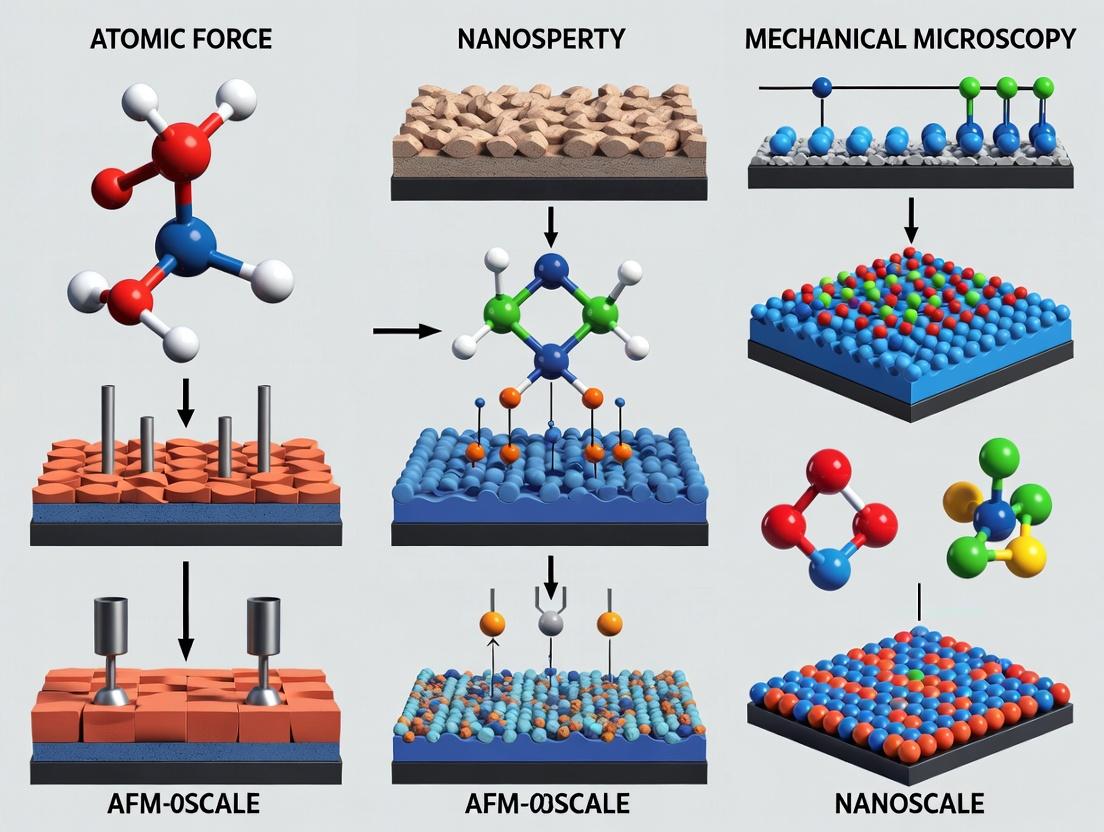
This article provides a detailed guide to Atomic Force Microscopy (AFM) for nanoscale mechanical property measurement, tailored for researchers, scientists, and drug development professionals.
Nanoscale Biomechanics Unlocked: A Comprehensive Guide to AFM Mechanical Property Measurement for Biomedical Research
Abstract
This article provides a detailed guide to Atomic Force Microscopy (AFM) for nanoscale mechanical property measurement, tailored for researchers, scientists, and drug development professionals. It covers foundational principles, key methodologies (Force Spectroscopy, Force Volume, QI/PeakForce), and their applications in cell mechanics, tissue engineering, and drug response studies. The guide addresses common troubleshooting and optimization challenges in sample preparation, probe selection, and data analysis. Finally, it examines validation strategies and compares AFM with techniques like optical tweezers, nanoindentation, and Brillouin microscopy. The conclusion synthesizes key takeaways and discusses future implications for personalized medicine, mechanobiology, and clinical diagnostics.
Understanding the Fundamentals: How AFM Probes Nanomechanics for Biomedical Discovery
Within the broader thesis on Atomic Force Microscopy (AFM) for nanoscale mechanical property measurement, the force-distance (F-D) curve is the fundamental data object. It is the quantitative record of the interaction between the AFM probe tip and the sample surface. This application note details the core physical principles governing tip-sample interactions, the translation of these interactions into F-D curves, and the protocols for their acquisition and analysis in biological and materials science contexts, including drug development applications like studying ligand-receptor binding or cellular elasticity.
Core Physical Principles
The AFM tip, mounted on a compliant cantilever, interacts with the sample surface via a combination of forces. The balance of these forces dictates the cantilever deflection, which is measured and converted into force.
- Repulsive Forces (Contact Regime): At very small separations (typically <0.5 nm), the Pauli exclusion principle leads to a steeply rising repulsive force. This is the core of contact-mode imaging and nanoindentation.
- Attractive Forces (Non-Contact Regime):
- Van der Waals (vdW) Forces: Ever-present, short-range electromagnetic forces between atoms/molecules. Dominant in ambient air.
- Capillary Forces: In ambient air, a water meniscus forms between tip and sample, creating a strong, often dominant, adhesive force.
- Electrostatic Forces: Arise from surface charges or applied biases.
- Solvation/Hydration Forces: In liquid, layers of ordered solvent molecules create oscillatory forces.
- Specific Binding Forces: e.g., antibody-antigen, biotin-streptavidin. These are short-range and highly specific.
The total tip-sample interaction potential is the sum of these components, and its negative gradient gives the force.
From Interaction to Curve: The Force-Distance Cycle
An F-D curve is recorded by moving the piezoelectric scanner vertically, bringing the tip toward the sample, into contact, and then retracting it. The cantilever deflection (converted to force, F) is plotted against the scanner position (Z).
Figure 1: Force-Distance Curve Workflow
Key Regions of the F-D Curve:
- Approach (A-B): The tip moves toward the surface. A flat line indicates no interaction. A downward jump (B) indicates a "snap-to-contact" due to attractive forces overcoming cantilever stiffness.
- Contact (B-C): Tip is in repulsive contact. The slope reflects the sample's elastic modulus (if stiff) or the combined sample-cantilever compliance. Loading can be linear or follow a specific function (e.g., ramp).
- Retraction (C-D): The piezo retracts. The curve often follows the loading path if behavior is elastic.
- Adhesion (D-E): At point D, the tip remains adhered to the sample while the piezo retracts, bending the cantilever downward. The minimum force (E) is the adhesion force or pull-off force.
- Detach (E-A): At E, the restoring force of the cantilever exceeds the adhesion force, and the tip "snaps-out" back to its free state.
Quantitative Data from F-D Curves
Table 1: Key Quantitative Parameters Extractable from F-D Curves
| Parameter | Symbol | Description | Typical Range (Biological Samples) | Significance |
|---|---|---|---|---|
| Young's Modulus | E | Elastic stiffness, from contact slope (Hertz/Sneddon models). | 0.1 kPa (cells) - 100 GPa (bone) | Tissue health, cell state, material hardness. |
| Adhesion Force | F_adh | Minimum force on retraction (pull-off force). | 10 pN - 100 nN | Surface energy, specific binding strength, presence of biofilms. |
| Adhesion Work | W_adh | Area under the adhesion "snap-out" peak. | 10⁻²⁰ - 10⁻¹⁵ J | Energy of interaction, bond rupture energy. |
| Deformation | δ | Sample indentation at max load. | 1 nm - 5 μm | Sample compliance, penetration depth. |
| Rupture Length | L_rup | Distance from start of retraction to snap-out. | 1 - 1000 nm | Length of stretched molecules (e.g., proteins, polymers). |
| Penetration Force | F_pen | Force at initial yield (for soft layers). | 10 pN - 10 nN | Membrane tension, capsule stiffness. |
Experimental Protocols
Protocol 5.1: Standard F-D Curve Acquisition on Biological Cells in Liquid
Objective: To map the apparent Young's modulus and adhesion of living cells under physiological conditions.
Materials: See "The Scientist's Toolkit" (Section 7.0).
Procedure:
- Probe Functionalization (If needed): Coat cantilever with 50 nm gold via sputtering. Immerse in 1 mM alkanethiol solution (e.g., for hydrophobic tips) or PEG-linker/biotin solution for 1 hour for specific binding studies. Rinse and store in buffer.
- Sample Preparation: Seed cells on a sterile, rigid substrate (e.g., glass coverslip) in a culture dish. Allow to adhere for 24h in standard incubator.
- AFM Setup: Mount the coverslip in the liquid cell. Add appropriate, degassed cell culture medium or PBS. Mount the cantilever. Align the laser and set the photodiode sum to ~4-6 V.
- Thermal Tuning: In liquid, engage the cantilever far from the surface. Record the thermal noise spectrum. Fit the spectrum to a simple harmonic oscillator model to determine the actual spring constant (k) and the sensitivity (InvOLS).
- Approach & Engagement: Approach the surface slowly (~1 µm/s) until the setpoint (deflection trigger of ~0.5-1 nN) is reached to establish gentle contact.
- F-D Curve Parameter Setup:
- Ramp Size: 1000-2000 nm (to capture full adhesion profile).
- Ramp Rate: 0.5-1.0 Hz (to minimize viscous effects).
- Trigger Force: 0.5-2 nN (for live cells to avoid damage).
- Points per Curve: 2048-4096.
- Acquisition: Define a grid (e.g., 32x32 points) over a single cell or area of interest. Initiate the automated F-D curve mapping.
- Retraction: After mapping, retract the probe, replace with fresh medium, and return cells to incubator for viability checks.
Protocol 5.2: Single-Molecule Force Spectroscopy (SMFS)
Objective: To measure the unbinding force of a specific ligand-receptor pair.
Procedure:
- Tip Functionalization: Use a PEG-crosslinker with one end binding the gold-coated tip and the other end conjugated to the ligand (e.g., a small molecule drug).
- Substrate Functionalization: Immobilize the receptor (e.g., target protein) on a freshly cleaned, APTS-functionalized mica surface via NHS-EDC chemistry.
- Control Surface: Prepare a second surface with a non-specific protein or blocked linker.
- Acquisition in Buffer: Perform F-D curves on both surfaces with identical parameters (low trigger force ~100-200 pN, moderate speed 0.5-1 µm/s).
- Data Filtering & Analysis: Collect 1000+ curves. Filter for specific binding events based on rupture length (consistent with PEG tether) and shape. Plot a histogram of rupture forces. The most probable force is the unbinding force. Perform the same experiment with a drug candidate to assess relative binding strength.
Data Analysis & Pathway
Figure 2: F-D Curve Analysis Logic
The Scientist's Toolkit
Table 2: Essential Research Reagent Solutions for AFM Nano-mechanics
| Item / Reagent | Function / Purpose | Key Considerations |
|---|---|---|
| AFM Probes (MLCT-Bio) | Silicon nitride cantilevers with reflective gold coating. Low spring constant (0.01-0.1 N/m) for soft samples. | k must be calibrated (thermal method). Tip shape (pyramidal vs. spherical) defines contact model. |
| Gold Coating Kit | For sputter-coating tips to enable thiol-based functionalization. | Requires 5-50 nm coating; too thick affects tip geometry and sensitivity. |
| PEG Crosslinkers | Flexible, long-chain polymers (e.g., NHS-PEG-NHS) to tether molecules to the tip. | Provides a known, flexible tether for SMFS; separates specific from non-specific adhesion. |
| Alkanethiols (e.g., 1-Octadecanethiol) | Forms a self-assembled monolayer (SAM) on gold for hydrophobic or passivated surfaces. | Used for hydrophobic force measurements or to create non-adhesive backgrounds. |
| NHS-EDC Chemistry Kit | Standard carbodiimide crosslinking for covalent immobilization of proteins on amine-functionalized surfaces. | Must quench reaction to avoid over-crosslinking, which can denature proteins. |
| Aminopropyltriethoxysilane (APTS) | Silane used to functionalize glass/mica with amine (-NH2) groups for protein attachment. | Requires strict anhydrous conditions during deposition for uniform monolayers. |
| Poly-L-Lysine | Positively charged polymer for electrostatic adsorption of cells or negatively charged biomolecules to substrates. | Simple and effective for cell immobilization; may slightly alter local mechanical environment. |
| Calibration Gratings (TGZ1/TGQ1) | Reference samples with known pitch and height for scanner calibration in X, Y, and Z. | Critical for accurate indentation depth and Young's modulus calculation. |
| Colloidal Probe Kit | Micron-sized silica or polystyrene spheres attached to cantilevers to create a well-defined spherical tip. | Simplifies contact mechanics (Hertz model); ideal for homogenous, soft materials. |
Application Notes in Nanoscale AFM Research
Atomic Force Microscopy (AFM) has evolved from topographical imaging to a sophisticated platform for quantifying nanomechanical properties. Within the context of a thesis on AFM mechanical property measurement, the interplay of elasticity, adhesion, viscoelasticity, and stiffness is critical for deciphering the structure-function relationships in materials and biological systems. For drug development, these properties at the nanoscale can inform on cell response to therapeutics, ligand-receptor binding kinetics, and the mechanical behavior of polymer-based drug delivery vehicles.
Quantitative nanomechanical mapping (QNM) and force spectroscopy are primary modes. QNM allows for the simultaneous acquisition of topography and property maps (elasticity, adhesion), while force-volume or single-point spectroscopy provides deep viscoelastic and stiffness characterization. Recent advancements in high-speed AFM and fluid-phase measurements have enabled the study of dynamic processes, such as live cell mechanical changes upon drug exposure or real-time polymer degradation.
Table 1: Representative Nanoscale Mechanical Properties of Select Materials
| Material/System | Young's Modulus (Elasticity) [kPa or GPa] | Adhesion Force [nN] | Loss Tangent (tan δ) | Stiffness [N/m] | Measurement Mode & Probe |
|---|---|---|---|---|---|
| Mammalian Cell (Cytoplasm) | 1 - 100 kPa | 0.05 - 2 nN | 0.1 - 0.5 | - | Force Spectroscopy, spherical tip (Ø5µm) |
| Collagen Fibril | 2 - 5 GPa | 0.5 - 5 nN | ~0.01 | - | PeakForce QNM, sharp tip (k~40 N/m) |
| PMMA Polymer | 2 - 3 GPa | 10 - 50 nN | 0.05 - 0.1 | - | Force Volume, sharp tip |
| Lipid Bilayer | 100 - 1000 MPa | 0.1 - 0.5 nN | - | - | Force Spectroscopy |
| Silicon AFM Cantilever | ~170 GPa | - | - | 0.1 - 100 N/m | - |
| Antibody-Coated Surface | - | 50 - 500 pN (specific) | - | - | Single-Molecule Force Spectroscopy |
Table 2: Key AFM Operational Parameters for Property Measurement
| Property | Primary AFM Mode | Key Derived Parameter | Typical Loading Rate | Critical Environmental Control |
|---|---|---|---|---|
| Elasticity (E) | Force Spectroscopy, PeakForce Tapping, QNM | Slope of force curve retract, DMT/Sneddon model fit | 0.1 - 10 µm/s | Temperature, Fluid Medium |
| Adhesion | Force Spectroscopy, Adhesion Mapping | Minimum force on retract curve | 0.1 - 1 µm/s | Humidity, Surface Cleanliness |
| Viscoelasticity | Force Spectroscopy (creep/relaxation), Dynamic Modes | Storage/Loss Moduli, Relaxation Time Constant | Variable, step-hold | Temperature, Fluid Medium |
| Stiffness (k) | Thermal Tune, Sader Method, Reference Sample | Cantilever Resonance Frequency, Deflection Sensitivity | N/A | Vacuum for thermal method |
Detailed Experimental Protocols
Protocol 1: Combined Elasticity and Adhesion Mapping of Live Cells Using PeakForce QNM
Objective: To spatially map the apparent Young's modulus and adhesion forces of adherent mammalian cells in culture medium. Materials: See "Scientist's Toolkit" below. Method:
- Probe Calibration: Perform thermal tune method in air to determine the precise spring constant (k) of the cantilever. Calibrate the optical lever sensitivity (InvOLS) on a clean, rigid sapphire surface in the same medium to be used.
- Sample Preparation: Plate cells on a sterilized glass-bottom Petri dish. Allow adhesion for 24h in appropriate culture conditions.
- AFM Mounting: Mount the dish on the AFM stage. Engage the calibrated probe in fluid over a bare glass region.
- Parameter Setup: Set PeakForce frequency to 0.25-1 kHz and amplitude to 100-150 nm. Set PeakForce Setpoint to 0.5-2 nN to minimize cell deformation.
- Mapping: Define a scan area (e.g., 50x50 µm) encompassing cell and substrate. Initiate PeakForce QNM scan. The system automatically captures a force curve at every pixel.
- Data Analysis: Use the accompanying software (e.g., NanoScope Analysis) with the DMT model to fit the retract portion of each force curve. Generate modulus and adhesion maps. Exclude data from the substrate area for cell-specific analysis.
Protocol 2: Quantifying Viscoelasticity via Force-Ramp Stress Relaxation
Objective: To measure the viscoelastic relaxation time constant (τ) of a soft material at a single point. Method:
- Approach: Position the probe above the region of interest. Use a slow approach velocity (1 µm/s) to avoid impact.
- Indentation: Execute a rapid "force ramp" to a predefined trigger force (e.g., 2 nN) with a fast loading rate (10 µm/s).
- Hold: Immediately upon reaching the trigger force, maintain a constant cantilever deflection (constant indentation depth) for a hold period (e.g., 5-10 seconds).
- Data Recording: Record the force required to maintain constant depth over the hold time. This force will decay as the material relaxes.
- Fitting: Fit the decaying force data, F(t), to a multi-exponential or standard linear solid model: F(t) = F₀ + Σᵢ Fᵢ exp(-t/τᵢ), where τᵢ are relaxation time constants.
Protocol 3: Single-Molecule Adhesion Force Spectroscopy
Objective: To measure the specific unbinding force between a ligand (on the tip) and a receptor (on the sample). Method:
- Functionalization: Covalently attach the ligand of interest (e.g., biotin) to a PEG-linked tip. Prepare a substrate with the corresponding receptor (e.g., streptavidin).
- Approach/Retract Cycling: In relevant buffer, program the AFM to perform thousands of approach-retract cycles at a single location. Use a moderate retract velocity (500-1000 nm/s).
- Adhesion Event Detection: Collect all force curves. Use algorithms to detect curves with adhesion "pull-off" events in the retract phase.
- Histogram Analysis: Compile the rupture force magnitudes from all adhesive events into a histogram. Fit with Gaussian distributions; the mean peak value corresponds to the most probable unbinding force. Use a Worm-Like Chain (WLC) model to confirm single-molecule events based on the force-distance profile.
Diagrams
Title: AFM Nanomechanical Measurement Workflow
Title: Force Curve Analysis for Key Properties
The Scientist's Toolkit
Table 3: Essential Research Reagent Solutions for AFM Nanomechanical Studies
| Item | Function & Rationale |
|---|---|
| Functionalized AFM Probes (e.g., biotin-PEG tips, antibody-conjugated tips) | Enable specific molecular recognition and adhesion force measurements. The PEG spacer allows free ligand movement. |
| Calibration Gratings (TGZ, PG, HS-100MG) | Standard samples with known pitch and height for scanner calibration, and polystyrene for relative modulus calibration. |
| Colloidal Probes (Silica/Polystyrene spheres, Ø1-10µm, glued to tipless levers) | Provide defined geometry (sphere) for quantitative Hertz/Sneddon model fitting of elasticity on soft samples. |
| Cell Culture Media (Phenol Red-free) | Maintains cell viability during live-cell AFM; absence of phenol red prevents optical interference with laser. |
| PBS Buffer (1x, filtered) | Standard isotonic buffer for biological measurements; filtering removes particulates that can contaminate the tip. |
| BSA (Bovine Serum Albumin, 1% w/v) | Used as a blocking agent to passivate surfaces and probes, minimizing non-specific adhesion. |
| Glutaraldehyde (0.1-2%) | A fixative for cross-linking cells or tissues to preserve structure for prolonged or high-resolution mechanical mapping. |
| PDMS Samples (of known modulus) | Soft polymer standards (e.g., 0.1-3 MPa) for validating elasticity measurements on compliant materials. |
Within the framework of a thesis on nanoscale mechanical property measurement, the selection of Atomic Force Microscopy (AFM) operational mode is a fundamental methodological determinant. Accurate quantification of properties such as Young's modulus, adhesion, and viscoelasticity in biological samples (e.g., cells, tissues, biomaterials) and soft materials hinges on the appropriate use of Contact Mode or Dynamic (Tapping) Mode. This application note delineates their principles, comparative mechanics-specific applications, and provides detailed protocols for reliable data acquisition in nanomechanics research.
Operational Principles & Mechanistic Comparison
Core Principles
- Contact Mode: The tip is in constant, repulsive contact with the sample surface. A feedback loop maintains a constant deflection (constant force) or allows it to vary (constant height). Forces are measured directly via cantilever deflection (Hooke's Law: F = -kΔz). This mode provides direct force measurement but involves significant lateral shear forces.
- Dynamic (Tapping) Mode: The cantilever is oscillated at or near its resonant frequency. Tip-sample interactions (van der Waals, capillary, mechanical forces) alter the oscillation's amplitude, phase, and frequency. These changes are used for imaging and property mapping, minimizing lateral forces. Mechanics are derived from the interaction's effect on the oscillator's dynamics.
Quantitative Comparison for Mechanical Characterization
Table 1: Comparative Analysis of AFM Modes for Nanomechanics
| Parameter | Contact Mode | Dynamic (Tapping) Mode |
|---|---|---|
| Primary Mechanical Output | Direct normal & lateral force; Topography from height feedback. | Amplitude/Phase shift; Frequency shift; Derived modulus from DMT, JKR, or Sneddon models. |
| Typical Applied Force | 0.1 nN – 100 nN (higher risk of sample deformation). | 0.01 nN – 10 nN (lower, intermittent contact). |
| Lateral (Shear) Force | High, due to tip drag. | Negligible, due to vertical oscillation. |
| Best for Measuring | High-modulus materials (polymers, composites), friction (LFM), adhesion force curves, hard biological samples (bone, mineralized tissue). | Soft, adhesive, or fragile samples (live cells, proteins, gels), viscoelasticity (via phase lag), mapping of modulus variations. |
| Spatial Resolution | Atomic/molecular on hard, flat samples; compromised on soft samples by deformation. | High on heterogeneous surfaces; nanoscale mechanical mapping possible (PF-QNM, AM-FM). |
| Sample Risk | High for soft, loosely bound, or mobile samples (scratching, sweeping). | Low, gentler for delicate samples. |
| Fluid Imaging | Challenging due to large hydrodynamic drag and meniscus forces. | Standard; performed routinely in physiological buffers for live-cell mechanics. |
Detailed Experimental Protocols
Protocol: Nanomechanical Mapping of Live Cells using Dynamic Mode (PeakForce QNM)
Application: Quantifying stiffness and adhesion of mammalian cells in culture.
I. Sample & Probe Preparation
- Cells: Plate cells on sterile, rigid substrates (e.g., glass-bottom dishes) 24-48 hrs pre-experiment. Maintain in appropriate CO~2~ and temperature during imaging.
- Probe Selection: Use a sharp, silicon nitride tip on a soft cantilever (k ~ 0.01 - 0.1 N/m). Calibrate spring constant (thermal tune) and optical lever sensitivity pre-experiment.
- Fluid Exchange: Replace medium with imaging buffer (e.g., CO~2~-independent, HEPES-buffered) to minimize pH drift.
II. Instrument Setup
- Engage on a cell-free region of the substrate in Fluid Tapping Mode to find surface.
- Switch to PeakForce QNM or equivalent quantitative nanomechanical mapping mode.
- Set Peak Force Setpoint to 50-300 pA (ensuring minimal indentation, typically < 250 nm).
- Set Peak Force Frequency to 0.25-2 kHz (optimize for sample response).
- Adjust scan size (typically 10x10 µm to 50x50 µm) and rate (0.5-1.0 Hz).
III. Data Acquisition & Processing
- Capture simultaneous channels: Height, DMT Modulus, Adhesion, Deformation.
- Perform at least 3 replicate scans on different cells/areas.
- Process modulus data: Apply a DMT or Sneddon contact model in the analysis software. Use a Poisson's ratio assumption (e.g., ν = 0.5 for cells). Filter data by adhesion or deformation to remove invalid points (e.g., from substrate).
- Segment cell body from substrate and nucleus (if visible) for regional statistical analysis.
Protocol: Adhesion & Stiffness Force Spectroscopy using Contact Mode
Application: Measuring point-specific adhesion forces and elastic modulus on a heterogeneous polymer blend.
I. Sample & Probe Preparation
- Sample: Prepare a smooth, dry film of the polymer blend by spin-coating.
- Probe Selection: Use a tip with known geometry (e.g., spherical colloid probe for defined contact) and a medium stiffness cantilever (k ~ 0.1 - 5 N/m). Calibrate as above.
- Functionalization (Optional): For specific adhesion, coat tip with relevant ligand using chemistry (e.g., silanization, PEG linker).
II. Force-Volume Imaging Setup
- Engage on the sample in Contact Mode with minimal setpoint force.
- Switch to Force Volume mode.
- Define a grid (e.g., 32x32 points) over the area of interest.
- Set trigger threshold to a low force (~1-5 nN) to avoid excessive indentation.
- Set approach/retract velocity (0.5-2 µm/s) and z-length (500-1000 nm).
III. Data Acquisition & Processing
- Acquire force-curve arrays across the grid.
- Use automated curve analysis software to fit retraction curves for adhesion force (minimum force) and approach curves for elastic modulus (using appropriate contact model; e.g., Hertz, Sneddon).
- Generate spatial maps of adhesion and modulus. Correlate features with topography.
Visualized Workflows
Diagram 1: Contact Mode Force Volume Protocol.
Diagram 2: Dynamic Mode Live Cell Mechanics Protocol.
The Scientist's Toolkit: Essential Materials & Reagents
Table 2: Key Research Reagent Solutions for AFM Nanomechanics
| Item | Function in Experiment | Example/Notes |
|---|---|---|
| Soft Cantilevers (Si₃N₄) | Minimize indentation force on soft samples; essential for live-cell QNM. | Bruker MLCT-Bio-DC (k=0.01 N/m), Olympus RC800PSA. |
| Sharp, Stiff Cantilevers (Si) | High-resolution imaging and force spectroscopy on stiff materials. | BudgetSensors ContGD-G (k=0.2 N/m), NanoWorld ARROW-NCR. |
| Colloidal Probe Tips | Defined geometry (sphere) for quantifiable contact mechanics; used in adhesion studies. | SiO₂ or PS beads (2-20 µm) attached via epoxy. |
| Functionalization Kits | Modify tip surface chemistry for specific ligand-receptor adhesion measurements. | PEG linker kits, silane chemistry (APTES), biotin-streptavidin systems. |
| HEPES-Buffered Imaging Medium | Maintains physiological pH without CO₂ control during live-cell AFM. | Gibco CO₂-Independent Medium. |
| Calibration Gratings | Verify scanner movement and tip geometry/sharpeness pre/post experiment. | TGXYZ (for XYZ), TGT1 (sharp tip check). |
| Polymer Reference Samples | Known modulus samples for validating contact model and calibration. | PDMS sheets (0.1-3 MPa), Bruker PS-LDPE Reference Sample. |
Biomechanical properties at the nanoscale, measurable via Atomic Force Microscopy (AFM), are now recognized as a fundamental "biomechanical signature" governing cellular behavior, tissue homeostasis, and disease progression. This signature integrates cellular mechanics (e.g., stiffness, viscoelasticity) and extracellular matrix (ECM) mechanical cues (e.g., rigidity, topography). Perturbations in this signature drive pathologies from fibrosis to cancer metastasis. This document provides Application Notes and Protocols for AFM-based research within this paradigm, framed for drug development and discovery.
Application Notes & Data Synthesis
Key mechanical alterations across pathophysiological states are summarized below.
Table 1: Nanomechanical Signatures in Health vs. Disease States (AFM Data)
| Cell/Tissue Type | Pathophysiological State | Apparent Elastic Modulus (Young's Modulus) | Key Notes & Method |
|---|---|---|---|
| Mammalian Cell (General) | Healthy, Normal | ~0.5 - 2 kPa | Varies by lineage; typically probed via AFM indentation on live cells. |
| Cardiac Fibroblast | Healthy (Quiescent) | ~1 - 3 kPa | Baseline stiffness. |
| Cardiac Fibroblast | Activated (Fibrosis) | ~5 - 15 kPa | Myofibroblast differentiation, increased actin stress fibers. |
| Breast Epithelial Cell (MCF-10A) | Normal, Non-Malignant | ~1 - 2 kPa | Baseline epithelial phenotype. |
| Breast Cancer Cell (MDA-MB-231) | Metastatic, Malignant | ~0.3 - 0.7 kPa | Softer phenotype associated with increased invasiveness. |
| Liver Tissue (Slice) | Healthy | ~1 - 4 kPa | AFM on fresh ex vivo tissue sections. |
| Liver Tissue (Slice) | Fibrotic/Cirrhotic | ~10 - 25 kPa | Massive ECM collagen deposition and crosslinking. |
| Artery Wall | Healthy, Elastic | ~20 - 50 kPa | Compliant, functional vasculature. |
| Artery Wall | Atherosclerotic | ~100 - 500 kPa | Localized stiffening due to plaque formation and calcification. |
Table 2: Key Research Reagent Solutions Toolkit
| Reagent / Material | Primary Function in Biomechanics Research |
|---|---|
| Polyacrylamide (PA) Hydrogels | Tunable substrate (1-50 kPa) for mimicking ECM stiffness to study mechanotransduction. |
| Cytochalasin D (Actin Disruptor) | Depolymerizes F-actin to probe the contribution of the cytoskeleton to cellular stiffness. |
| Y-27632 (ROCK Inhibitor) | Inhibits Rho-associated kinase (ROCK) to reduce actomyosin contractility, softening cells. |
| TGF-β1 (Cytokine) | Potent inducer of myofibroblast differentiation and ECM production, increasing stiffness. |
| Collagen I, Matrigel | Natural ECM coatings for cell culture to provide physiologically relevant adhesion cues. |
| Blebbistatin (Myosin II Inhibitor) | Inhibits non-muscle myosin II, reducing cellular tension and adhesion forces. |
| Crosslinking Agents (e.g., Genipin) | Induce ECM stiffening by crosslinking collagen, used to model fibrotic environments. |
| Fluorescent Beads (for TFM) | Embedded in hydrogels for Traction Force Microscopy to quantify cellular contractile forces. |
Experimental Protocols
Protocol 1: AFM Nanoindentation on Adherent Live Cells Objective: Quantify the apparent Young's modulus of single cells in culture.
- Cell Preparation: Seed cells at sub-confluent density on appropriate culture dishes 24-48 hours prior. Use glass-bottom dishes for optimal AFM access.
- AFM Probe Selection: Use colloidal probes (silica sphere, 5-10 µm diameter) or silicon nitride tips with a spring constant of ~0.01-0.1 N/m. Calibrate the spring constant via thermal tune method.
- System Setup: Mount probe and calibrate. Place cell culture dish on the AFM stage with integrated live-cell imaging (phase-contrast or epifluorescence). Maintain environment at 37°C and 5% CO2.
- Measurement: Identify a cell via optical image. Position the probe over the perinuclear region (avoiding nucleus center and very thin edges). Program a force curve with a trigger force of 0.5-2 nN, approach/retract velocity of 1-5 µm/s, and a dwell time of 0-100 ms at maximum indentation. Acquire ≥ 50 force curves per cell over multiple cells (n≥30).
- Data Analysis: Fit the retract curve (or the approaching curve post-contact) with the Hertz/Sneddon contact model appropriate for the probe geometry (e.g., spherical model). Calculate the apparent Young's Modulus (E).
Protocol 2: Fabrication of Tunable Stiffness Polyacrylamide Hydrogels Objective: Create ECM-mimetic substrates of defined rigidity for mechanosensing studies.
- Preparation of Glass Coverslips: Activate 25 mm round coverslips with 0.1 M NaOH for 5 min, rinse, and treat with (3-Aminopropyl)trimethoxysilane (APTMS) for 5 min. Coat with 0.5% glutaraldehyde for 30 min, rinse, and dry.
- Polymerization Mix: Prepare two separate solutions. Solution A: 40% acrylamide (monomer). Solution B: 2% bis-acrylamide (crosslinker). Mix A and B in varying ratios to achieve desired final stiffness (e.g., 5% A + 0.1% B for ~1 kPa; 10% A + 0.3% B for ~12 kPa). Add 1/100 volume of 10% APS (ammonium persulfate) and TEMED to initiate polymerization.
- Gel Casting: Immediately pipette 20-30 µL of the mix onto an activated coverslip. Quickly place a functionalized (e.g., with Sulfo-SANPAH) hydrophobic coverslip on top to create a flat gel sandwich. Allow to polymerize for 30 min.
- Functionalization: Carefully separate the top coverslip. Activate the gel surface with 0.5 mg/mL Sulfo-SANPAH under UV light (365 nm) for 10 min. Rinse and coat with desired ECM protein (e.g., 0.1 mg/mL collagen I) overnight at 4°C.
- Validation: Verify stiffness using AFM force spectroscopy across multiple gel locations.
Protocol 3: Assessing Mechanotransduction via YAP/TAZ Nuclear Translocation Objective: Visualize and quantify stiffness-dependent YAP/TAZ signaling.
- Cell Plating: Plate cells (e.g., MSCs, epithelial cells) on hydrogels of varying stiffness (Protocol 2) and on rigid glass controls.
- Culture & Treatment: Culture for 24-48 hours. Include treatment arms with cytoskeletal drugs (e.g., 10 µM Y-27632 for 2 hours) if required.
- Immunofluorescence: Fix cells with 4% PFA, permeabilize with 0.1% Triton X-100, and block with 5% BSA. Incubate with primary antibody against YAP/TAZ (1:200) overnight at 4°C. Incubate with fluorescent secondary antibody (1:500) and phalloidin (for F-actin) for 1 hour. Mount with DAPI-containing medium.
- Imaging & Quantification: Acquure high-resolution confocal images. Use image analysis software (e.g., ImageJ/FIJI) to define nuclear and cytoplasmic regions based on DAPI and actin signals. Calculate the nuclear-to-cytoplasmic (N/C) ratio of YAP/TAZ fluorescence intensity for ≥ 50 cells per condition.
Mandatory Visualizations
Title: Stiffness-Driven Mechanotransduction via YAP/TAZ Pathway
Title: Integrated Workflow for Mechanobiology Studies
Within the broader thesis on atomic force microscopy (AFM) for nanoscale mechanical property measurement, this document provides detailed application notes and protocols for core instrumentation. The accurate quantification of Young's modulus, adhesion, and viscoelasticity of biological samples (e.g., cells, tissues, drug delivery particles) hinges on a fundamental understanding of these components. This guide is tailored for researchers and drug development professionals implementing high-resolution mechanical assays.
Core Instrumentation Components
Cantilevers and Probes
The cantilever-probe system is the primary force sensor and indenter in AFM-based nanomechanics.
Key Parameters and Selection Criteria:
| Parameter | Typical Range/Type | Impact on Mechanical Measurement |
|---|---|---|
| Spring Constant (k) | 0.01 - 100 N/m | Must be matched to sample stiffness. Softer samples (e.g., cells) require soft cantilevers (0.01 - 0.1 N/m) for sufficient sensitivity without deformation. |
| Resonant Frequency (f₀) | 1 - 300 kHz in liquid | Determines operational speed and noise floor. Higher f₀ allows faster imaging but often correlates with higher k. |
| Tip Geometry | Spherical (colloidal), Conical, Pyramid | Defines contact mechanics model. Spherical tips (2-20 µm radius) are preferred for reliable Hertz model analysis on soft samples. |
| Tip Radius (R) | 2 nm (sharp) to 20 µm (colloidal) | Critical for stress calculation. Larger, well-defined radii provide more reproducible contact mechanics. |
| Coating | Uncoated Si₃N₄, Gold, Diamond | Affects adhesion and durability. Uncoated Si₃N₄ is standard for bio-apps; diamond-coated for rigid samples. |
Protocol 1: Cantilever Spring Constant Calibration (Thermal Tune Method)
- Mounting: Secure the cantilever chip in the holder under the desired medium (air or liquid).
- Laser Alignment: Align the laser spot on the cantilever's free end to maximize sum signal and minimize the deflection signal.
- Thermal Spectrum Acquisition: Command the AFM to record the power spectral density (PSD) of the cantilever's thermal fluctuations over a bandwidth >> f₀ (e.g., 0-500 kHz).
- Fit & Calculate: Fit the resonant peak in the PSD to a simple harmonic oscillator model. The spring constant is calculated using the equipartition theorem: k = k_B T /
- Verification: Record the calculated k value and its uncertainty (typically 10-15%). For critical measurements, validate against a reference cantilever of known stiffness.
Piezo Scanners
Piezo-electric scanners provide precise 3D positioning of the sample or tip.
Performance Characteristics for Nanomechanics:
| Characteristic | Specification | Relevance to Mechanical Mapping |
|---|---|---|
| XY Scan Range | 10 µm to >100 µm | Determines maximum area for property mapping (e.g., a single cell vs. cell cluster). |
| Z-Range (Extension) | Typically 2-15 µm | Must accommodate sample topography and indentation depth. |
| Closed-Loop Noise Floor | < 0.5 Å RMS (in Z) | Directly limits depth resolution in force-distance curves. Essential for detecting sub-nm deformations. |
| Non-linearity & Hysteresis | < 0.5% with closed-loop control | Crucial for accurate lateral positioning in grid-based mapping and precise depth control during indentation. |
| Z-Response Time | Sub-millisecond | Affects the maximum achievable force curve acquisition rate for high-throughput screening. |
Protocol 2: Scanner Calibration and Linearity Verification
- Lateral (XY) Calibration: a. Image a calibration grating with a known, periodic pitch (e.g., 1 µm or 10 µm). b. Perform a 2D FFT on the image. The peak spacing in the FFT corresponds to the imaged periodicity. c. Calculate the correction factor: True Pitch / Measured Pitch from image cross-section. Apply this factor to the scanner's XY calibration.
- Vertical (Z) Calibration: a. Approach onto a rigid, flat surface (e.g., sapphire or cleaned silicon) until a preset deflection is reached. b. Acquire a force-distance curve. The slope in the contact region should be nearly vertical. c. Any slope deviation indicates miscalibration. Adjust the Z sensor gain until the contact line is >85° from the distance axis.
- Creep/Hysteresis Test: a. Command a 1 µm Z-step and hold for 60 seconds, recording the position sensor output. b. The drift after the step (creep) should be < 1% of the step size for quantitative indentation.
Photodetectors
The position-sensitive photodetector (PSPD) converts cantilever deflection into a voltage signal.
Quantitative Signal Analysis:
| Signal/Parameter | Typical Value | Role in Force Measurement |
|---|---|---|
| Sensitivity (InvOLS) | 10 - 100 nm/V | Converts voltage to deflection (nm). Must be measured in situ on a rigid sample. |
| PSPD Noise Density | 10-30 fm/√Hz | Fundamental limit to force resolution. Lower noise enables smaller force detection. |
| Force Resolution | ~1-10 pN (in liquid) | Calculated as k * Deflection_Noise. Critical for detecting weak bio-adhesion events. |
| Bandwidth | > 10 x f₀ | Must capture cantilever dynamics without phase lag for dynamic modes (e.g., tapping mode mechanics). |
Protocol 3: In-Situ Photodetector Sensitivity (InvOLS) Calibration
- Approach: Engage on a rigid, clean, flat sample in the same medium as the experiment.
- Force Curve Acquisition: Acquire a slow, high-resolution force-distance curve (e.g., 0.1 µm/s). The curve will show a flat non-contact region, a vertical contact line, and a sloped region after the tip is in full contact with the sample (due to scanner movement).
- Slope Analysis: In the post-contact ("loading") portion of the curve, fit a line to the Deflection (V) vs. Scanner Position (nm) data. This slope (in V/nm) is the inverse optical lever sensitivity (InvOLS).
- Calculation: The sensitivity (nm/V) = 1 / InvOLS. Store this value; all subsequent deflection measurements (in V) are multiplied by this factor to obtain deflection in nm. Note: This calibration is medium and laser alignment-specific and must be repeated if either changes.
Integrated Workflow for Nanomechanical Property Mapping
Title: AFM Nanomechanical Mapping Protocol Workflow
The Scientist's Toolkit: Essential Research Reagents & Materials
| Item | Function in AFM Nanomechanics |
|---|---|
| Silicon Nitride Cantilevers (MLCT-BIO) | Soft, triangular levers with reflective gold coating. Standard for force spectroscopy on biological samples in liquid. |
| Colloidal Probe Kits | Kits containing microspheres (e.g., 5-20 µm silica, polystyrene) and epoxy for attaching to tipless levers. Creates defined spherical contact geometry. |
| Calibration Gratings (TGZ & HG series) | TGZ (height) for Z calibration, HG (lateral) for XY calibration. Certified pitch and step height traceable to NIST. |
| UV/Ozone Cleaner | Cleans cantilevers and sample substrates to remove organic contaminants, minimizing unwanted adhesive forces. |
| Functionalization Kits (e.g., PEG Linkers) | Enable tip or particle conjugation with ligands, antibodies, or drug compounds for single-molecule or specific adhesion force measurements. |
| Temperature & CO₂ Control Stage | Maintains live cell viability during extended mechanical mapping experiments (37°C, 5% CO₂, humidity). |
| Poly-L-Lysine or Cell-Tak | Substrate coatings to promote cell or tissue adhesion to the measurement substrate without altering intrinsic mechanics. |
| Standard Buffer Solutions (e.g., PBS) | Provide physiological ionic strength and pH for measurements on biological specimens. Often supplemented with serum or HEPES. |
Methodology in Action: Step-by-Step AFM Protocols for Cells, Tissues, and Biomaterials
Atomic Force Microscopy (AFM)-based force spectroscopy is a cornerstone technique in the broader thesis of nanoscale mechanical property research. It enables the quantitative, spatially resolved measurement of biomechanical properties of live cells—a critical parameter in understanding cell physiology, pathology, and response to therapeutic agents. For researchers and drug development professionals, these measurements provide insights into mechanisms of disease (e.g., cancer metastasis, fibrosis) and can serve as a functional biomarker for drug efficacy or toxicity.
Core Strategies: Single-Point vs. Mapping
The two primary operational modes serve complementary purposes within a research workflow.
Single-Point Force Spectroscopy (SPFS): Involves acquiring force-distance (F-D) curves at a pre-selected, discrete location on the cell (e.g., nucleus, peri-nuclear region, edge). It is optimal for high-temporal resolution studies, such as monitoring dynamic mechanical changes in response to a stimulus (drug, cytokine) over minutes to hours at the same spot.
Force-Volume Mapping (FVM) or PeakForce QNM: Involves acquiring an array of F-D curves over a defined XY grid to create a spatial map of mechanical properties (e.g., Young's modulus, adhesion) superimposed on topography. This is essential for assessing heterogeneity within a single cell or across a population.
Table 1: Typical Mechanical Properties of Common Live Cell Types Measured by AFM
| Cell Type | Approx. Young's Modulus (kPa) | Key Experimental Condition (Tip, Rate) | Primary Application in Research |
|---|---|---|---|
| Mammalian Fibroblast | 1 - 10 kPa | Spherical tip (5µm), 1-2 µm/s | Baseline mechanobiology studies, wound healing models |
| Epithelial Cell (e.g., MCF-10A) | 0.5 - 3 kPa | Pyramidal tip, 0.5-1 µm/s | Carcinogenesis, epithelial barrier function |
| Breast Cancer Cell (e.g., MDA-MB-231) | 0.2 - 1.5 kPa | Spherical tip (5µm), 1 µm/s | Metastasis research (correlation of softness with invasiveness) |
| Cardiomyocyte | 10 - 50 kPa | Sharp tip (MLCT-Bio), 5-10 µm/s | Cardiotoxicity screening, heart disease models |
| Neuron (soma) | 0.5 - 2 kPa | Spherical tip (10µm), 0.5 µm/s | Neurodevelopment, neurodegeneration |
| Red Blood Cell | 10 - 30 kPa (Membrane) | Sharp tip, 0.1 µm/s | Malaria research, blood disorders |
Table 2: Comparison of Single-Point vs. Mapping Strategies
| Parameter | Single-Point Spectroscopy | Force Mapping |
|---|---|---|
| Spatial Resolution | Single, user-defined point | 2D array (e.g., 64x64 points over 50x50 µm²) |
| Temporal Resolution | High (ms-sec per curve, hours monitoring) | Low (minutes to hours per map) |
| Primary Output | Time-series of modulus, adhesion at one spot | Topography, modulus, adhesion, dissipation maps |
| Data Density | High temporal, low spatial | Low temporal, high spatial |
| Best For | Kinetic studies, drug response at a specific locale | Cell heterogeneity, morphological correlation, lamellipodia vs. nucleus stiffness |
| Common Tip | Sharp tip (for precise location) or spherical | Spherical tip (for indentation model validity) |
Detailed Experimental Protocols
Protocol 4.1: Live Cell Preparation and AFM Setup
Objective: To prepare a stable, viable sample for mechanical interrogation.
- Cell Culture: Plate cells on sterile, glass-bottom dishes (e.g., 35 mm Petri dish with 14 mm glass well) at a density yielding ~60-70% confluency at time of experiment.
- Media Exchange: Prior to AFM measurement, replace culture media with a low-fluorescence, CO2-independent, phenol red-free imaging medium, supplemented with 10-20mM HEPES buffer to maintain pH 7.4 outside an incubator.
- AFM Environmental Control: Mount the dish on the AFM stage equipped with a temperature controller (set to 37°C). Use a petri dish heater or stage-top incubator. A perfusion system is optional but recommended for long-term drug studies.
- Cantilever Selection and Calibration:
- For Mapping: Use tipless cantilevers with attached colloidal probes (e.g., 5-10 µm diameter silica or polystyrene spheres). Typical spring constant: 0.01 - 0.1 N/m.
- For Single-Point: Use sharp, silicon nitride tips (MLCT-Bio, ~20nm radius) for precise location, or spherical tips for modulus accuracy. Spring constant: 0.01 - 0.06 N/m.
- Calibrate the spring constant using the thermal tune method. Calibrate the optical lever sensitivity (InvOLS) on a clean, rigid part of the glass substrate.
Protocol 4.2: Single-Point Force Spectroscopy on a Live Cell
Objective: To monitor the temporal evolution of mechanical properties at a selected cellular region.
- Positioning: Using the AFM optical camera (integrated or inverted microscope), position the tip above the region of interest (ROI), e.g., the cell nucleus.
- Parameter Setting:
- Setpoint/Trigger Force: 0.5 - 1 nN (to limit indentation, typically <500 nm).
- Approach/Retract Velocity: 0.5 - 5 µm/s.
- Sampling Rate: Ensure at least 512 points per F-D curve.
- Pause Time at Surface: 0 ms (to minimize creep) or up to 100 ms (to probe relaxation).
- XY Closed-Loop: CRITICAL. Engage the XY closed-loop feedback to lock the tip position and compensate for stage drift during long-term experiments.
- Acquisition: Initiate a continuous F-D curve acquisition at the fixed XY position. Acquire curves at a frequency of 0.2 - 1 Hz for the desired duration (e.g., 30 minutes baseline, then add drug and monitor for 60 minutes).
- Data Processing: Batch-process all F-D curves using a Hertzian contact model (e.g., Sneddon for a conical/pyramidal tip or Hertz for a spherical tip) to extract the apparent Young's modulus (E). Fit only the approach curve's loading segment. Plot E as a function of time.
Protocol 4.3: Force-Volume Mapping of Live Cells
Objective: To acquire a spatially resolved map of cellular mechanical properties.
- Scan Area Definition: Define a scan area (e.g., 50x50 µm²) encompassing the whole cell or a specific region.
- Grid and Parameter Setting:
- Pixel Resolution: 64x64 or 128x128 pixels.
- Trigger Force: 0.3 - 0.8 nN.
- Approach/Retract Velocity: 5 - 20 µm/s (to balance data quality and acquisition time).
- Tip Velocity/Rate: This parameter is critical for viscoelastic properties; keep it consistent across experiments.
- Acquisition: Initiate the force-volume scan. The AFM will perform an F-D curve at every pixel in the grid. Total acquisition time should be minimized (<30 mins) to maintain cell viability and reduce drift.
- Data Processing & Map Generation: Use the AFM vendor's software or open-source tools (e.g., AtomicJ, Nanoscope Analysis) to:
- Apply the appropriate contact model to each F-D curve.
- Exclude curves taken on the substrate (using a modulus or adhesion threshold).
- Generate 2D maps of topography, Young's modulus, adhesion force, and energy dissipation.
- Perform statistical analysis on selected regions (e.g., nucleus vs. cytoplasm).
Visualized Workflows and Pathways
Title: AFM Force Spectroscopy Workflow for Live Cells
Title: Mechanotransduction Pathway Activated by AFM
The Scientist's Toolkit: Research Reagent Solutions
Table 3: Essential Materials for Live Cell Force Spectroscopy
| Item | Function/Description | Example Product/Type |
|---|---|---|
| Functionalized Colloidal Probe | Spherical tip for accurate Hertz model fitting; can be coated with ligands (e.g., RGD peptides) to measure specific adhesion. | 5µm SiO2 bead glued to tipless cantilever (Novascan). |
| Bio-Friendly Cantilever | Soft, reflective cantilever for force sensitivity in liquid. | MLCT-Bio (Bruker), Biolever (Olympus), qp-Bio (Nanosensors). |
| CO2-Independent Live Cell Medium | Maintains pH and health of cells outside an incubator during long scans. | Leibovitz's L-15 Medium, FluoroBrite DMEM + 20mM HEPES. |
| Stage-Top Incubator | Maintains temperature at 37°C and optionally controls CO2. | PeCon, Tokai Hit, or custom-built Petri dish heater. |
| Pharmacological Agents | Modulators of cytoskeleton or mechanosignaling for functional studies. | Cytochalasin D (actin disruptor), Y-27632 (ROCK inhibitor), GsMTx4 (Piezo blocker). |
| Fluorescent Dyes (Optional) | For correlative AFM-Fluorescence. Label actin, nucleus, or live/dead markers. | Phalloidin (post-fix), SiR-Actin (live), Hoechst 33342, Calcein-AM/PI. |
| Analysis Software | For batch processing F-D curves and generating maps. | Nanoscope Analysis, JPK DP, AtomicJ (open-source), IRIS. |
Within the broader thesis on Atomic Force Microscopy (AFM) for nanoscale mechanical property measurement, the evolution from traditional Force Volume mapping to advanced, high-speed quantitative imaging modes represents a paradigm shift. This application note details the operational principles, protocols, and applications of PeakForce Quantitative Nanomechanical Mapping (PeakForce QNM) and the subsequent Quantitative Imaging (QI) mode, which are critical for correlating topography with nanomechanical properties in soft, biological, and composite materials relevant to life sciences and drug development.
Principles and Evolution
Force Volume is the classical method for generating maps of mechanical properties. It involves performing a complete force-distance curve at each pixel in a grid, leading to long acquisition times (often hours) and potential sample drift. The data analysis is performed offline.
PeakForce QNM revolutionized this approach by integrating a high-frequency, sub-nanometer amplitude tapping motion (PeakForce Tapping) where the tip briefly contacts the sample at the peak force of each cycle. This allows for the direct, real-time calculation of mechanical properties like modulus, adhesion, dissipation, and deformation at imaging speeds comparable to TappingMode AFM. A feedback loop maintains a constant peak force, protecting both tip and sample.
Quantitative Imaging (QI) Mode, a further development, employs a different, highly linear piezoelectric actuator for tip movement, enabling even faster acquisition of full force-distance curves at every pixel without sacrificing data richness. While similar in output to PeakForce QNM, QI mode offers advantages in raw data fidelity and the ability to apply more complex, post-processing contact mechanics models.
Table 1: Comparison of Key AFM Mechanical Property Mapping Modes
| Feature | Force Volume | PeakForce QNM | Quantitative Imaging (QI) Mode |
|---|---|---|---|
| Core Principle | Full force-curve at each pixel. | PeakForce Tapping with on-board property calculation. | High-speed acquisition of full force-curves at each pixel. |
| Imaging Speed | Very Slow (0.1 - 0.01 Hz/line) | Fast (0.5 - 2 Hz/line) | Fast to Very Fast (1 - 10 Hz/line) |
| Data Output | Raw force curves for post-processing. | Real-time maps: Modulus, Adhesion, Deformation, Dissipation. | Raw force curves & real-time maps; advanced post-processing. |
| Lateral Resolution | High (limited by drift) | High (< 10 nm typical) | High (< 10 nm typical) |
| Force Control | Quasi-static, high loads possible. | Dynamic, constant low peak force (sub-100 pN to ~10 nN). | Dynamic, constant low peak force. |
| Best For | Rigid samples, historical analysis. | Soft materials (live cells, polymers, hydrogels), routine high-res mapping. | Heterogeneous materials, advanced model fitting, maximal data depth. |
| Primary Vendor | Generic/Bruker | Bruker | Nanosurf |
Table 2: Typical Measurable Properties and Relevant Models
| Property | Description | Common Contact Model | Typical Sample |
|---|---|---|---|
| Reduced Modulus (E*) | Sample stiffness/elasticity. | DMT, Sneddon | Polymers, biomedical scaffolds, single cells. |
| Adhesion Force | Maximum pull-off force. | - | Proteins, membranes, adhesives. |
| Deformation | Sample indentation depth at peak force. | - | Soft hydrogels, vesicles. |
| Dissipation/Energy Loss | Hysteresis in approach-retract cycle. | - | Viscoelastic materials (cytoskeleton). |
| Sample Height | Topography from peak force setpoint. | - | All samples. |
Experimental Protocols
Protocol 1: PeakForce QNM on Live Mammalian Cells
Objective: To map the topography and elastic modulus of adherent live cells in physiological buffer.
- Sample Preparation: Culture cells (e.g., HEK293, fibroblasts) on a sterile glass-bottom Petri dish or coverslip. Prior to measurement, replace medium with a suitable imaging buffer (e.g., CO2-independent medium, PBS, or HEPES-buffered saline). Maintain temperature at 37°C using a live-cell heater stage.
- Cantilever Selection & Calibration:
- Use a soft, triangular silicon nitride cantilever (e.g., Bruker ScanAsyst-Fluid+ or equivalent) with a nominal spring constant (k) of 0.1 - 0.7 N/m.
- Thermal Tune: Perform thermal noise calibration in fluid to determine the exact spring constant (k) and the optical lever sensitivity (InvOLS).
- Tip Characterization: Image a known, sharp grating (e.g., TGT1) to determine the tip radius (R) for accurate modulus fitting. Input R into software.
- Microscope Setup: Mount the dish on the heater stage. Engage the tip in fluid away from cells to find resonance and set the PeakForce Tapping frequency (typically 0.5-2 kHz). Optimize the integral and proportional gains for stable tracking.
- Parameter Optimization:
- Peak Force Setpoint: Start high (~1 nN) over the substrate, then reduce to the lowest possible value (typically 50-200 pN) that maintains stable imaging on the cell. This minimizes sample deformation.
- PeakForce Frequency & Amplitude: Use default/recommended values (e.g., 250 nm amplitude). Adjust if necessary for stability.
- Scan Rate: 0.5 - 1 Hz for a 256x256 pixel image.
- Data Type Selection: Enable simultaneous capture of Height, DMT Modulus, Adhesion, and Deformation channels.
- Image Acquisition: Locate a cell of interest and begin scanning. Monitor the modulus channel to ensure plausible values (0.1 - 100 kPa for most mammalian cells). Adjust setpoint if deformation exceeds ~10% of cell height.
- Post-processing & Analysis: Use the instrument software to apply a plane fit to the height image. Apply a modulus threshold to exclude data from the hard substrate. Use analysis tools to calculate average modulus per cell or map regional variations (e.g., nucleus vs. cytoplasm).
Protocol 2: QI Mode on a Polymer Blend
Objective: To quantitatively differentiate the mechanical phases in a polystyrene-low density polyethylene (PS-LDPE) blend.
- Sample Preparation: Prepare a smooth, flat surface of the polymer blend via hot pressing or microtoming. Affix the sample firmly to a steel sample puck using double-sided adhesive tape.
- Cantilever Selection & Calibration:
- Use a medium-stiffness cantilever (e.g., Tap300-G, k ~ 40 N/m) with a sharp silicon tip.
- Calibrate the spring constant (k) via the thermal method or Sader method.
- Determine the tip radius (R) by imaging a sharp calibration grating.
- Microscope Setup: Mount the sample. Engage in air and find a clean area.
- QI Mode Parameter Optimization:
- Setpoint Force: Choose a force (e.g., 5-20 nN) sufficient to induce measurable indentation in both phases without damaging the tip.
- Pulse Parameters: Set the QI pulse frequency (typically 1-4 kHz) and Z-length (e.g., 50 nm). Ensure the pulse is sufficiently long to capture the full approach-retract cycle.
- Scan Rate & Points: Adjust scan rate (e.g., 1-2 Hz) and number of pixels (e.g., 256x256) for desired resolution and field of view.
- Model Selection: Pre-select the Sneddon (conical) or DMT (spherical) model for real-time modulus calculation.
- Image Acquisition: Acquire simultaneous QI Height and Modulus maps. The different polymer domains should be clearly distinguished in the modulus channel.
- Advanced Post-processing (QI Advantage): Export the array of all force curves. Use advanced software (e.g., Nanosurf's Analysis Studio) to re-process the entire dataset using a different contact model (e.g., Oliver-Pharr), apply more sophisticated fitting routines, or extract additional parameters like creep or relaxation time constants for viscoelastic analysis.
Diagrams
PeakForce QNM Cycle at One Pixel
Evolution of AFM Quantitative Modes
The Scientist's Toolkit
Table 3: Essential Research Reagent Solutions for Bio-AFM Mechanical Testing
| Item | Function & Description | Example Product/Brand |
|---|---|---|
| Soft, Bio-Compatible Cantilevers | Tips with low spring constant for sensitive force measurement on soft samples without damage. Coating (e.g., gold, silica) can be used for functionalization. | Bruker ScanAsyst-Fluid+, Olympus BL-AC40TS, NanoWorld Arrow-UHF |
| Live Cell Imaging Buffer | Physiological, CO2-independent medium that maintains cell viability, pH, and osmotic pressure during extended imaging. | Leibovitz's L-15 Medium, Live Cell Imaging Buffer (Thermo Fisher) |
| Cantilever Calibration Kit | Samples for calibrating tip radius (sharp gratings) and spring constant (reference cantilevers of known k). | Bruker RTESPA-Cal, BudgetSensors TGXYZ, MikroMasch HS-100MG |
| Sample Mounting Adhesive | Double-sided, high-tack tape or UV-curable glue to firmly immobilize samples (especially tissues or hydrogels) to pucks. | Scotch Double-Sided Tape, NOA 63 (Norland Optical Adhesive) |
| Temperature & Gas Control System | Stage-top incubator with heater and CO2/air gas mixer to maintain live cells at 37°C and 5% CO2 during imaging. | Petri dish heater (Bruker, JPK), Stage-top incubator (Okolab) |
| Polymer/Composite Reference Samples | Samples with known, homogeneous mechanical properties (e.g., PDMS of defined modulus) for validating instrument performance and model accuracy. | Bruker PFQNM-Samples (PS-LDPE), Arrayed PDMS elastomer kits (Elastocon) |
| Advanced Analysis Software | Software capable of batch-processing thousands of force curves, applying various contact models, and extracting statistical data. | Bruker NanoScope Analysis, Nanosurf Analysis Studio, AtomicJ, Gwyddion |
This application note details sample preparation protocols for Atomic Force Microscopy (AFM)-based nanomechanical property measurement. Consistent sample preparation is paramount for obtaining reliable, high-resolution data. We focus on three pillars: substrate adhesion, physiologically relevant buffer conditions, and cellular viability.
Adhesion Protocols
Strong, uniform substrate adhesion is critical to prevent sample detachment during AFM scanning forces.
Cell Adhesion for Suspension Cells
Protocol: Functionalization of AFM substrates (e.g., glass-bottom dishes) with concanavalin A (Con A).
- Clean substrate with 2% Hellmanex III, rinse with deionized water, and dry under nitrogen.
- Activate surface with oxygen plasma for 2 minutes.
- Incubate with 0.5 mg/mL Con A in PBS for 30 minutes at room temperature.
- Wash 3x with PBS to remove unbound Con A.
- Immediately seed cells in appropriate culture medium. Con A binds to glycoproteins on the cell membrane, providing non-specific but strong adhesion.
Protein or Extracellular Matrix (ECM) Immobilization
Protocol: Covalent attachment via amine-silane chemistry.
- Substrate cleaning and plasma activation (as above).
- Incubate with 2% (3-aminopropyl)triethoxysilane (APTES) in acetone for 5 minutes.
- Rinse with acetone and cure at 110°C for 10 minutes.
- Incubate with 2.5% glutaraldehyde in PBS for 30 minutes.
- Wash with PBS.
- Incubate with protein/ECM solution (e.g., 10 µg/mL collagen IV in PBS) for 1 hour.
- Quench unreacted aldehydes with 1 M ethanolamine hydrochloride (pH 8.5) or 1 mg/mL sodium borohydride for 5 minutes.
- Wash thoroughly with PBS or imaging buffer.
Table 1: Common Adhesion Strategies
| Sample Type | Substrate Coating | Concentration | Incubation Time | Key Mechanism |
|---|---|---|---|---|
| Adherent Cells | Poly-L-Lysine | 0.01% w/v | 20 min | Electrostatic |
| Suspension Cells | Concanavalin A | 0.5 mg/mL | 30 min | Glycoprotein binding |
| Tissue Sections | APTES-Glutaraldehyde | 2% / 2.5% | 5 min / 30 min | Covalent linkage |
| Isolated Proteins | APTES-Glutaraldehyde | 2% / 2.5% | 5 min / 30 min | Covalent linkage |
| Lipid Bilayers | Mica | N/A | N/A | Electrostatic/Mica cleavage |
Buffer Conditions
Maintaining physiological conditions is essential for preserving native structure and function.
Standard Physiological Buffer Formulation
Hepes-Buffered Saline (HBS) for AFM Imaging:
- Formula: 20 mM HEPES, 150 mM NaCl, 5 mM KCl, 1 mM CaCl₂, 1 mM MgCl₂, pH 7.4.
- Preparation: Dissolve all components in ultrapure water (18.2 MΩ·cm). Adjust pH with NaOH. Filter sterilize (0.22 µm). Osmolarity should be verified (~300 mOsm/kg).
- Purpose: Provides ionic strength and divalent cations crucial for membrane integrity and protein folding without phosphate, which can crystallize on the tip.
Viability-Enhanced Buffer
For prolonged scans (>30 mins), supplement with:
- 5 mM Glucose (energy source).
- 1% (v/v) Fetal Bovine Serum (FBS) or 0.5% Bovine Serum Albumin (BSA) to reduce non-specific tip adhesion.
Table 2: Buffer Composition and Impact on Nanomechanics
| Buffer Component | Typical Concentration | Primary Function | Impact on AFM Measurement |
|---|---|---|---|
| HEPES | 10-25 mM | pH Stabilization | Prevents pH drift during long scans. |
| NaCl | 120-150 mM | Osmolarity/Ionic Strength | Maintains cell turgor; affects electrostatic interactions. |
| Ca²⁺/Mg²⁺ | 0.5-2 mM each | Membrane Integrity, Cofactors | Critical for cell adhesion and stiffness; deficiency softens cells. |
| Glucose | 5-25 mM | Metabolic Substrate | Enhances viability; prolonged stiffness stability. |
| BSA | 0.1-1% w/v | Passivation Agent | Reduces tip-sample adhesion noise. |
Viability Assessment & Maintenance
Continuous viability is non-negotiable for live-cell mechanics.
Integrated Protocol for Live-Cell AFM
- Culture on AFM Dish: Seed cells 24-48 hours prior to experiment to reach 50-70% confluence.
- Buffer Exchange: Gently replace culture medium with pre-warmed (37°C) imaging buffer (Section 2.1).
- On-Scope Viability Maintenance:
- Use a stage-top incubator or environmental chamber maintaining 37°C and 5% CO₂ (if using CO₂-bicarbonate buffers).
- For air-buffered systems (HEPES), temperature control alone is sufficient.
- For experiments >1 hour, consider a perfusion system for buffer exchange.
- Viability Check: Pre- and post-scan, assess viability by adding 2 µM Calcein-AM (viability dye) and 1 µM Ethidium homodimer-1 (death dye) to the buffer. Incubate 15 min and image via epifluorescence.
Table 3: Viability Reagents and Protocols
| Reagent | Working Concentration | Incubation Time | Function & Readout |
|---|---|---|---|
| Calcein-AM | 1-2 µM | 15-20 min | Live-cell stain (green fluorescence). |
| Propidium Iodide (PI) | 1-5 µM | 5-10 min | Dead-cell stain (red fluorescence). |
| Trypan Blue | 0.4% | 2-3 min | Offline counting; excludes dead cells. |
| MTT Assay | 0.5 mg/mL | 2-4 hours | Post-experiment metabolic activity check. |
The Scientist's Toolkit: Research Reagent Solutions
| Item | Function in AFM Sample Prep |
|---|---|
| Glass-bottom Petri Dishes | Substrate for high-resolution optical-AFM correlation. |
| APTES ((3-Aminopropyl)triethoxysilane) | Primer for covalent functionalization of glass/silicon surfaces. |
| Glutaraldehyde (25%) | Crosslinker for covalently immobilizing proteins to aminated surfaces. |
| Concanavalin A (Con A) | Lectin for immobilizing suspension cells via membrane glycoproteins. |
| Poly-L-Lysine (PLL) | Promotes electrostatic adhesion of cells and tissue sections. |
| HEPES Buffer (1M stock) | pH buffering for live-cell imaging without a CO₂ incubator. |
| Calcein-AM | Cell-permeant esterase substrate for fluorescent live-cell labeling. |
| BSA (Fraction V) | Used for passivation of AFM tips and substrates to reduce non-specific adhesion. |
| Oxygen Plasma Cleaner | Activates substrate surfaces for uniform functionalization. |
| Stage-top Incubator | Maintains temperature (and CO₂) for live-cell experiments during AFM scans. |
Experimental Workflow and Pathway Diagrams
Diagram 1: AFM Sample Prep Workflow
Diagram 2: Thesis Context of Prep Protocols
Detailed Experimental Protocol: Force-Volume Mapping on Live Cells
Objective: To measure spatial variability of Young's modulus across a live cell surface.
- Sample Prep: Follow integrated protocol (Section 3.1) using HeLa cells on PLL-coated dish in HBS + 5mM Glucose + 0.5% BSA.
- AFM Setup: Mount dish on heated stage (37°C). Use a silicon nitride cantilever (k ≈ 0.01 N/m) calibrated via thermal tune.
- Tip Passivation: Incubate cantilever in 0.5% BSA in PBS for 15 minutes to minimize adhesion.
- Engage: Engage in contact mode at a low setpoint (≤ 1 nN) over the nucleus.
- Force-Volume Programming:
- Set a 50 x 50 point grid over a 20 µm x 20 µm area.
- Set ramp size to 2 µm.
- Set ramp frequency to 1 Hz.
- Trigger force to 1 nN.
- Execution: Start the force-volume acquisition. The system will automatically perform an approach-retract cycle at each point.
- Post-processing: Use analysis software (e.g., Bruker Nanoscope Analysis, JPK DP) to fit the retract curve with the Hertz/Sneddon model for a pyramidal tip to extract Young's Modulus (E) at each pixel.
- Viability Check: After mapping, add Calcein-AM/PI to confirm >95% viability. Discard data if viability <80%.
This application note details the critical parameters for probe selection in Atomic Force Microscopy (AFM) within the context of a broader thesis on nanoscale mechanical property measurement. Accurate quantification of properties such as Young's modulus, adhesion, and viscoelasticity in materials ranging from polymers to biological cells hinges on the precise choice of cantilever and tip. This guide provides a framework for researchers, scientists, and drug development professionals to optimize probe selection for specific nanomechanical assays.
Cantilever Spring Constants
The spring constant (k) of a cantilever determines its sensitivity to force and its operational regime. Selecting an appropriate k is paramount to avoid sample damage, achieve sufficient indentation depth, and remain within the linear force range of the detector.
Table 1: Cantilever Spring Constant Selection Guide
| Application | Typical Spring Constant Range | Rationale | Common Mode |
|---|---|---|---|
| Contact Mode Imaging | 0.01 - 0.5 N/m | Low force for minimal sample deformation. | Static force. |
| Tapping Mode Imaging | 1 - 40 N/m | Stiff enough to overcome adhesion; resonant frequency optimized. | Dynamic, amplitude modulation. |
| Soft Biological Samples (Cells, Biomolecules) | 0.01 - 0.1 N/m | Forces << 1 nN to prevent puncture or excessive indentation. | Force Spectroscopy, PF-QNM. |
| Polymer & Compliant Materials | 0.1 - 5 N/m | Balance between measurable indentation and material recovery. | Force Volume, Creep/Relaxation. |
| Stiff Materials (Metals, Ceramics) | 10 - 200 N/m | High force required for measurable indentation; prevents instability. | Nanoindentation, modulus mapping. |
| High-Speed AFM | 0.1 - 0.3 N/m (Fast) | Low mass and high resonant frequency for rapid tracking. | Dynamic, off-resonance tapping. |
Protocol: Calibration of Cantilever Spring Constant via Thermal Tune Method
Objective: To determine the accurate spring constant (k) of an AFM cantilever using the thermal fluctuation method.
Materials:
- AFM with a thermally isolated enclosure.
- Cantilever of interest.
- AFM software with thermal tune module.
Procedure:
- Mounting: Secure the cantilever chip in the probe holder and mount it in the AFM head.
- Laser Alignment: Align the laser spot onto the end of the cantilever and adjust the photodiode to achieve a sum signal near maximum and a low vertical deflection (V) reading.
- Environmental Isolation: Ensure the AFM is in a quiet, draft-free environment. Close the acoustic hood.
- Acquire Thermal Spectrum: Engage the probe far from the surface (~5-10 µm). Access the thermal tune module. Acquire the power spectral density (PSD) of the cantilever's thermal fluctuations over a sufficient frequency range (e.g., 0-500 kHz).
- Fit the Data: Fit a simple harmonic oscillator (SHO) model to the resonance peak in the PSD to obtain the resonant frequency (f₀) and the quality factor (Q).
- Calculate k: The software typically uses the Equipartition Theorem method: k = kB * T / <δ²>, where kB is Boltzmann's constant, T is absolute temperature, and <δ²> is the mean square deflection. This is derived from integrating the fitted PSD after correcting for the detector sensitivity (invOLS).
- Verify: Compare the calculated k with the nominal range provided by the manufacturer. Significant deviations (>50%) may indicate improper invOLS calibration or probe damage.
Tip Geometry
Tip geometry defines the contact mechanics model required for data analysis and dictates spatial resolution.
Table 2: AFM Tip Geometry Selection Guide
| Tip Type / Shape | Typical Radius | Aspect Ratio | Best For | Key Consideration |
|---|---|---|---|---|
| Standard Silicon Nitride (DNP) | 20 - 60 nm | Low (~3:1) | General imaging, force curves on flat samples. | Blunt radius can overestimate contact area. |
| Sharp Silicon (SSS-NCHR) | 2 - 10 nm | High (>5:1) | High-resolution imaging, measuring small features. | Prone to wear; requires careful calibration. |
| Colloidal Probes (SiO₂, PS) | 1 - 25 µm | N/A (sphere) | Quantifying adhesion, surface energy; well-defined Hertzian contact. | No lateral resolution; large contact area. |
| Cube Corner/ Berkovich | 20 - 100 nm (end radius) | Very High | Nanoindentation on stiff materials; plastic deformation studies. | Complex geometry requires specific models (Oliver-Pharr). |
| Carbon Nanotube Tips | 1 - 3 nm (end radius) | Extremely High | Ultra-high resolution imaging, deep trench probing. | Fragile, difficult to functionalize reproducibly. |
| Pyramid (Standard) | 10 - 30 nm | Moderate (~4:1) | Widely used in tapping mode; good all-around geometry. | Assumption of a perfect pyramid is often inaccurate. |
Protocol: Blind Tip Reconstruction for Geometry Characterization
Objective: To reconstruct the three-dimensional shape of an AFM probe tip by analyzing an image of a known, sharp calibration sample.
Materials:
- AFM with capable analysis software (e.g., Gwyddion, SPIP, NanoScope Analysis).
- Tip characterization sample (e.g., TGT1 grating with sharp spikes, TurboTrack).
- Probe to be characterized.
Procedure:
- Image Characterization Sample: Using the probe in question, acquire a high-resolution, non-damaging image (tapping mode recommended) of the sharp-featured calibration sample. Ensure the scan size captures multiple sharp features.
- Data Export: Export the topographical image as a
.xyzor.ascmatrix file. - Software Analysis: Import the image into the tip reconstruction software.
- Select Algorithm: Choose the "Blind Tip Reconstruction" or "Tip Estimation" function, typically based on the algorithm by Villarrubia.
- Run Reconstruction: The software iteratively compares the image features (which are a convolution of the tip and sample shape) to deduce the tip shape that could have created such an image.
- Output: The output is a 3D model of the tip apex. Extract key parameters: effective end radius (via fitting), cone angle, and aspect ratio.
- Apply to Data: Use the reconstructed tip shape to deconvolve subsequent images of unknown samples for more accurate topography or to correct contact area in force curve analysis.
Probe Functionalization
Functionalization modifies the tip surface chemistry to enable specific molecular recognition or to measure particular interactions.
Table 3: Common Tip Functionalization Strategies
| Functionalization Target | Common Chemistry/Probe | Immobilization Protocol | Application in Nanomechanics |
|---|---|---|---|
| Non-Specific Adhesion | Silanization (APTES), Protein A/G | Vapor-phase or solution-phase silanization. | Measuring generic cell adhesion, surface hydrophobicity. |
| Ligand-Receptor (e.g., Biotin-Avidin) | Biotinylated PEG linker | Thiol-gold bonding on gold-coated tip, followed by biotin-PEG-disulfide incubation. | Single-molecule force spectroscopy (unbinding forces, kinetics). |
| Antigen-Antibody | Antibody (IgG) | PEG linker with NHS ester coupling to amine-functionalized tip. | Mapping receptor distribution on cell surfaces, immunomechanics. |
| Cell Receptor Specific | RGD peptide, E-Cadherin | Maleimide-thiol coupling via PEG linker. | Measuring integrin or cadherin-mediated cell adhesion forces. |
| Hydrophobic/Hydrophilic | Alkanethiols (CH₃, OH termini) | Self-assembled monolayer (SAM) on gold-coated tip. | Quantifying hydrophobic interactions and hydration forces. |
| Enzymatic Activity | Substrate molecule | Covalent coupling via appropriate crosslinker (e.g., glutaraldehyde, EDAC). | Measuring force-dependent enzymatic cleavage (e.g., by proteases). |
Protocol: Functionalization with PEG Linker for Single-Molecule Force Spectroscopy
Objective: To attach biotin molecules to an AFM tip via a flexible PEG linker for specific interaction with avidin/streptavidin surfaces.
Materials:
- Gold-coated AFM cantilevers.
- Ethanol (absolute).
- Biotin-PEG-NHS ester (e.g., Biotin-PEG₂₇-SGA) or Biotin-PEG-disulfide.
- Anhydrous DMSO.
- Phosphate Buffered Saline (PBS), pH 7.4.
- Ethanolamine hydrochloride (1M, pH 8.5).
- UV-Ozone cleaner or plasma cleaner.
Procedure: Part A: Tip Cleaning and Activation
- Clean gold-coated cantilevers in a UV-Ozone cleaner for 20 minutes or under low-power oxygen plasma for 30 seconds.
- Immediately immerse the cantilevers in absolute ethanol for 5 minutes to remove organic contaminants. Dry under a gentle stream of nitrogen or argon.
Part B: Linker Attachment For NHS ester chemistry (amine-functionalized tip required first):
- Prepare a 1-5 mM solution of Biotin-PEG-NHS in anhydrous DMSO.
- Place a 10-20 µL droplet of the solution on a clean parafilm surface. Invert the cantilever chip and gently lower it onto the droplet, ensuring the tip is immersed. Incubate for 2 hours at room temperature in a humid chamber.
- Carefully rinse the cantilever by dipping it sequentially in fresh DMSO and then PBS.
- Deactivate unreacted NHS esters by incubating the tip in 1M ethanolamine (pH 8.5) for 10 minutes.
- Rinse thoroughly with PBS and store in PBS at 4°C until use.
The Scientist's Toolkit: Research Reagent Solutions
Table 4: Essential Materials for AFM Nanomechanics
| Item | Function & Rationale |
|---|---|
| Cantilevers (Multiple k values) | Core sensing element. Having a range (0.01 - 200 N/m) allows adaptation to sample stiffness. |
| Tip Characterization Sample (TGT1) | Essential for accurate tip geometry determination via blind reconstruction, critical for quantitative analysis. |
| Gold-Coated Cantilevers | Provides a thiol-reactive surface for robust, oriented functionalization of biomolecules. |
| PEG Crosslinkers (e.g., NHS-PEG-Maleimide) | Spacer molecule that decouples the functional moiety from the tip, allowing free orientation and reducing nonspecific binding. |
| Biotin, Streptavidin, Avidin | Model high-affinity interaction pair for validating single-molecule force spectroscopy protocols. |
| Calibration Gratings (PG, HS) | For lateral (nm/volt) and vertical (nm/volt) scanner calibration, ensuring dimensional accuracy. |
| Clean Room Wipes & Compressed Air/Duster | For critical cleaning of sample stage, chip holder, and optics to reduce contamination and laser noise. |
| Liquid Cell with O-Rings | Enables nanomechanical measurement in controlled fluid environments (buffer, media) for biological samples. |
| Vibration Isolation Table | Fundamental infrastructure to reduce environmental noise to levels below the piconewton force detection limit. |
Decision and Experimental Workflows
Diagram Title: AFM Probe Selection Decision Workflow
Diagram Title: Single-Molecule Force Spectroscopy Protocol Flow
This set of Application Notes is framed within a broader thesis on Atomic Force Microscopy (AFM) mechanical property measurement at the nanoscale. AFM provides unique, label-free insights into the biomechanical properties of living systems, which are crucial biomarkers of physiological and pathological states. The following sections detail protocols and data for key applications in oncology, cardiology, microbiology, and pharmacology.
Cancer Cell Stiffness
The mechanical phenotyping of cells via AFM is a critical tool in cancer research. Malignant transformation and metastasis are consistently correlated with decreased cell stiffness due to cytoskeletal reorganization.
Table 1: AFM-Measured Young's Modulus of Cancer vs. Normal Cells
| Cell Type | Tissue Origin | Average Young's Modulus (kPa) | Reported Range (kPa) | Key Pathological Implication |
|---|---|---|---|---|
| Normal Mammary Epithelial | Breast | 3.2 | 1.8 - 4.5 | Baseline stiffness |
| Metastatic Breast Cancer (MDA-MB-231) | Breast | 0.5 | 0.3 - 0.9 | High invasiveness, EMT |
| Benign Breast Tumor (MCF-7) | Breast | 1.8 | 1.2 - 2.5 | Less invasive phenotype |
| Normal Hepatocyte | Liver | 10.5 | 8.0 - 13.0 | Baseline stiffness |
| Hepatocellular Carcinoma | Liver | 2.1 | 1.0 - 3.5 | Associated with poor differentiation |
| Normal Prostate Epithelial | Prostate | 7.4 | 5.5 - 9.0 | Baseline stiffness |
| Metastatic Prostate Cancer (PC-3) | Prostate | 1.2 | 0.7 - 1.8 | Correlation with migration |
Cardiomyocyte Contractility
AFM can measure the beating force and rhythm of isolated cardiomyocytes, providing a direct functional readout for cardiotoxicity screening and disease modeling.
Table 2: AFM-Measured Contractility Parameters in Cardiomyocytes
| Condition / Model | Average Contraction Force (nN) | Beat Frequency (Hz) | Duration of Contraction (ms) | Notes |
|---|---|---|---|---|
| Healthy Rodent Ventricular CM | 15 - 40 | 1 - 3 (spontaneous) | 150 - 300 | Baseline function, species-dependent |
| Human iPSC-derived CM | 5 - 20 | 0.5 - 1.5 (spontaneous) | 200 - 400 | Model for disease & screening |
| Doxorubicin-Treated (24h, 1µM) | ↓ 40-60% | ↓ 30-50% | ↑ 20-40% | Acute cardiotoxicity model |
| Hypertrophic Model (PE-induced) | ↑ 50-100% | ↓ or unchanged | ↑ 20-30% | Increased force, prolonged duration |
| Heart Failure Model (in vitro) | ↓ 50-70% | Arrhythmic | Highly variable | Dysregulated calcium handling |
Bacterial Biofilms
AFM quantifies the mechanical heterogeneity and adhesion properties of biofilms, which dictate their resilience to antibiotics and mechanical clearance.
Table 3: Mechanical Properties of Bacterial Biofilms by AFM
| Bacterial Species / Condition | Average Elastic Modulus (kPa) | Adhesion Force (nN) | Topography (RMS Roughness, nm) | Key Feature |
|---|---|---|---|---|
| Staphylococcus aureus (early biofilm) | 25 - 50 | 0.5 - 2.0 | 50 - 100 | Initial attachment, softer |
| S. aureus (mature biofilm) | 100 - 500 | 2.0 - 8.0 | 200 - 500 | High rigidity from matrix |
| Pseudomonas aeruginosa (wild-type) | 50 - 200 | 1.0 - 4.0 | 150 - 400 | Alginate-dependent stiffness |
| P. aeruginosa (alginate mutant) | 10 - 30 | 0.3 - 1.0 | 100 - 250 | Softer, less adhesive |
| Biofilm + Vancomycin (sub-MIC) | ↑ 20-40% | ↑ 10-30% | Variable | Stress-induced hardening |
| Biofilm + DNase I | ↓ 40-70% | ↓ 50-80% | Reduced | Degradation of eDNA matrix |
Drug-Induced Cytoskeletal Changes
Pharmacological agents targeting the cytoskeleton induce quantifiable mechanical changes, which AFM can monitor in real-time.
Table 4: AFM-Measured Effects of Cytoskeletal Drugs on Cell Mechanics
| Drug (Target) | Cell Type | Concentration / Time | % Change in Modulus | % Change in Adhesion | Functional Outcome |
|---|---|---|---|---|---|
| Cytochalasin D (F-actin) | Fibroblast | 1 µM, 30 min | ↓ 70 - 80% | ↓ 40 - 60% | Disrupted cortical actin, severe softening |
| Jasplakinolide (F-actin) | Epithelial | 100 nM, 1 h | ↑ 100 - 200% | ↑ 20 - 50% | Actin hyper-polymerization, stiffening |
| Nocodazole (Microtubules) | Endothelial | 10 µM, 2 h | ↓ 20 - 30% | Minimal Change | Loss of microtubule network support |
| Paclitaxel (Microtubules) | Ovarian Cancer | 100 nM, 24 h | ↑ 30 - 50% | Variable | Microtubule stabilization, bundling |
| Y-27632 (ROCK/Actomyosin) | Smooth Muscle | 10 µM, 1 h | ↓ 50 - 60% | ↓ 30 - 40% | Reduced actomyosin contractility |
Detailed Experimental Protocols
Protocol 3.1: AFM Nanoindentation for Cancer Cell Stiffness
Objective: Quantify the apparent Young's modulus of live, adherent cancer and normal cells. Materials: See "Scientist's Toolkit" below. Procedure:
- Cell Preparation: Seed cells on 35mm glass-bottom dishes at 50-70% confluence 24h before experiment. Use complete medium.
- AFM Probe Selection: Use colloidal probes (silica bead, 5µm diameter) on tipless cantilevers (nominal k ~0.1 N/m). Calibrate spring constant via thermal tune.
- System Setup: Mount dish on AFM stage with temperature control (37°C) and CO₂ (if not in buffered medium). Use optical microscope to locate cells.
- Approach & Indentation: Approach cell surface at 1-2 µm/s. On contact, perform force curve with 500 nm indentation depth, 1 Hz frequency.
- Mapping: Acquire a grid (e.g., 10x10 points) over the perinuclear region of each cell. Test ≥20 cells per condition.
- Data Analysis: Fit the retract curve's contact region with the Hertz/Sneddon model for a spherical indenter to extract Young's modulus.
Protocol 3.2: Cardiomyocyte Contractility Measurement
Objective: Measure spontaneous contraction force and kinetics of single cardiomyocytes. Procedure:
- Cell Preparation: Plate iPSC-derived cardiomyocytes or isolated primary cells on fibronectin-coated dishes. Allow 48-72h for adhesion and syncing.
- Probe Selection: Use soft, tipless cantilevers (k ~0.01 N/m). Coat with PEG to minimize adhesion.
- Positioning: Position the probe over the center of a contracting cell, using high-speed video for guidance.
- Recording: Engage gently (~200 pN setpoint). Record the deflection signal at high sampling rate (≥1 kHz) for 60+ seconds.
- Analysis: Use custom scripts to detect peaks (contractions). Calculate beat rate, force (ΔDeflection * k), and contraction/relaxation times.
Protocol 3.3: Bacterial Biofilm Mechanics & Adhesion Mapping
Objective: Map the elastic modulus and adhesion forces across a mature biofilm. Procedure:
- Biofilm Growth: Grow biofilms in flow cells or on PDMS coupons for 48-72h in appropriate medium.
- Sample Transfer: Carefully transfer coupon to AFM liquid cell with fresh, minimal medium to maintain viability.
- Probe Functionalization: Use sharpened silicon nitride probes (k ~0.3 N/m). For adhesion, functionalize with specific ligands (e.g., fibronectin) or use bare tip.
- Force Volume Imaging: Acquire a grid (e.g., 64x64 points) over an area (e.g., 50x50 µm). At each point, record a full force-distance curve (1 µm extend, 1 Hz).
- Analysis: Batch-process curves. Extract adhesion force from retract curve (min force) and modulus from extend curve fit. Generate spatial maps.
Protocol 4.4: Real-Time Monitoring of Drug Response
Objective: Track temporal changes in cell mechanics following drug perturbation. Procedure:
- Baseline Measurement: Seed cells, locate a healthy cell, and perform an initial stiffness map (as in Protocol 3.1).
- Drug Administration: Without moving the probe, carefully add pre-warmed drug solution to the dish medium to achieve final concentration. Mix gently.
- Time-Lapse Indentation: Program the AFM to repeatedly perform single indentations (or small 3x3 maps) at the same cell location every 2-5 minutes for 1-2 hours.
- Control: Monitor a vehicle-treated cell in parallel.
- Analysis: Plot Young's modulus vs. time. Fit curves to determine rate of mechanical change (τ).
Diagrams
Title: Signaling Pathways Linking Oncogenic Activity to Cell Softening
Title: Workflow for AFM Cardiomyocyte Contractility Assay
Title: Biofilm Matrix Components Drive Mechanical Resilience
Title: Integrating AFM Applications into a Cohesive Research Thesis
The Scientist's Toolkit: Research Reagent Solutions
Table 5: Essential Materials for AFM Biomechanics Studies
| Item | Function in Experiment | Example Product / Specification |
|---|---|---|
| Colloidal AFM Probes | Spherical tip for reliable nanoindentation on soft cells; minimizes stress concentration. | Nanosensors qp-BioAC (CB10, 5µm bead) |
| Soft Cantilevers (Tipless) | For contractility measurements; low spring constant prevents cell inhibition. | Bruker MLCT-O10 (k ~0.01 N/m) |
| Bio-compatible Liquid Cell | Allows imaging & indentation in physiological buffer with temperature control. | Bruker Petri Dish Heater or JPK BioCell |
| Cell Culture Dish, Glass Bottom | High optical clarity for combined AFM & fluorescence microscopy. | MatTek P35G-1.5-14-C |
| Extracellular Matrix Coating | Promotes healthy, adherent cell growth for consistent measurements. | Corning Matrigel or Fibronectin (1-5 µg/cm²) |
| Live-Cell Fluorescent Dyes | Visualize cytoskeleton (e.g., actin) concurrently with AFM measurement. | SiR-actin (Cytoskeleton, Inc.) for live staining |
| Pharmacological Agents | Perturb cytoskeleton for mechanistic studies or create disease models. | Cytochalasin D (actin disruptor), Y-27632 (ROCK inhibitor) |
| Calibration Samples | Verify AFM probe spring constant and lateral sensitivity. | Bruker TGXYZ01 (for thermal tune) & PS bead sample |
| CO₂-Independent Medium | Maintains pH during extended AFM experiments outside incubator. | Leibovitz's L-15 Medium |
| Data Processing Software | Batch analysis of force curves to extract modulus & adhesion. | JPK DP, Bruker NanoScope Analysis, or custom Igor Pro/Matlab scripts |
Optimizing AFM Nanomechanics: Solving Common Problems and Enhancing Data Quality
Within the context of nanoscale mechanical property measurement via Atomic Force Microscopy (AFM), the accuracy of quantitative data is fundamentally limited by the precise calibration of two parameters: the cantilever spring constant (k) and the optical lever sensitivity (Deflection Sensitivity, S). Inaccurate calibration leads to systematic errors in force, elasticity, and adhesion measurements, compromising research in drug development, where interactions at the single-molecule or cellular level are critical. This document provides application notes and detailed protocols to address these persistent challenges.
Core Calibration Parameters: Theory and Challenge
The force (F) exerted by the AFM tip is calculated as F = k × δ, where δ is the cantilever deflection. The deflection is determined from the photodetector voltage (V) by δ = V / S. The primary challenge is that k and S are not inherent manufacturer specifications; they are system-dependent and must be determined empirically for each cantilever and experimental setup.
Table 1: Summary of Common Calibration Methods and Their Quantitative Outputs
| Method | Parameter Calibrated | Typical Reported Accuracy/Precision Range | Key Challenges |
|---|---|---|---|
| Thermal Tune | Spring Constant (k) | ±10% - 20% (in air). Can be worse in liquid. | Sensitive to fit bandwidth, piezo movement, and fluid damping. Assumes equipartition theorem holds. |
| Sader Method | Spring Constant (k) | ±5% - 10% (for rectangular levers). | Requires accurate knowledge of cantilever dimensions (L, W) and quality factor (Q). Limited to rectangular geometries. |
| Added Mass (Cleveland) | Spring Constant (k) | ±5% - 10%. | Tedious; requires deposition of microspheres or droplets, risking cantilever damage. |
| Static/Direct | Deflection Sensitivity (S) | ±1% - 5% (on rigid sample). | Requires a non-compliant, atomically smooth reference sample (e.g., sapphire, clean silicon). Sensitivity changes in liquid. |
| Reference Lever | Both k & S | Varies with reference lever accuracy (±2% - 10%). | Requires a pre-calibrated reference cantilever. Risk of damage to reference during force-curve acquisition. |
Experimental Protocols
Protocol 3.1: Combined Calibration of Deflection Sensitivity and Spring Constant on a Rigid Surface
Objective: To determine S and k for a rectangular cantilever in air.
Materials:
- AFM with thermal tune capability.
- Ultra-rigid, smooth calibration sample (e.g., single-crystal sapphire).
- Rectangular silicon or silicon nitride cantilever.
Procedure:
- Mounting and Laser Alignment: Mount the cantilever and align the laser onto the cantilever's end. Adjust the photodetector to obtain a symmetric sum signal with a maximum vertical deflection (A-B) signal.
- Approach and Engagement: Approach the tip to the rigid calibration sample and engage in contact mode using minimal setpoint.
- Deflection Sensitivity (S) Measurement:
- Acquire a force-distance curve on the rigid surface.
- Obtain the slope (m) of the contact region of the retract curve in units of [V/nm]. The Deflection Sensitivity is S = m.
- Note: Perform this at multiple points on the sample and average to account for minor sample tilt or contamination.
- Spring Constant (k) via Thermal Tune:
- Retract the tip at least 10 µm from the surface.
- Record the thermal fluctuation spectrum of the cantilever's first resonant frequency.
- Fit the power spectral density (PSD) to a simple harmonic oscillator model.
- Calculate k using the equipartition theorem method: k = kB T / <δ^2>, where kB is Boltzmann's constant, T is temperature, and <δ^2> is the mean square deflection derived from the integrated PSD area, converted to meters using the previously measured S.
Protocol 3.2:In-situSpring Constant Calibration in Fluid using the Sader Method
Objective: To determine k for a rectangular cantilever directly in a liquid environment.
Materials:
- Liquid cell AFM setup.
- Rectangular cantilever (geometry must be known from SEM or manufacturer specs).
- Appropriate buffer solution.
Procedure:
- Immerse and Align: Fill the liquid cell and allow thermal equilibrium (~30 min). Perform laser alignment in fluid.
- Thermal Spectrum Acquisition: With the tip freely oscillating in the fluid far from any surface, acquire a high-resolution thermal tuning spectrum of the first resonance peak.
- Parameter Extraction:
- Measure the resonant frequency (ffluid) and quality factor (Qfluid) from the thermal peak.
- Obtain the plan view dimensions: length (L) and width (W).
- Calculation: Apply the Sader formula: k = 0.1906 × ρ_fluid × W² × L × Q_fluid × Γ_i(Re) × (2π f_fluid)³ Where ρ_fluid is the fluid density and Γ_i(Re) is the imaginary component of the hydrodynamic function, dependent on the Reynolds number (often provided via look-up tables or online calculators).
Visualization of Calibration Workflows
Figure 1: AFM Cantilever Calibration Decision Workflow (78 characters)
Figure 2: Thermal Tune Calibration Logic Path (44 characters)
The Scientist's Toolkit: Essential Research Reagents & Materials
Table 2: Key Reagents and Materials for AFM Cantilever Calibration
| Item | Function/Application | Example/Notes |
|---|---|---|
| Sapphire Disc | Ultra-rigid, atomically smooth substrate for accurate deflection sensitivity (S) calibration. | Provides a non-deformable surface for linear slope measurement. Must be kept meticulously clean. |
| Silicon Wafer | Alternative rigid, flat substrate for S calibration. | Piranha-cleaned (Caution: extremely hazardous) or plasma-cleaned wafer provides a suitable surface. |
| Pre-Calibrated Reference Cantilevers | For absolute calibration of both k and S via the reference lever method. | Available from NIST-traceable suppliers (e.g., Bruker, Asylum). Handle with extreme care to avoid damage. |
| Microspheres (SiO₂, Polystyrene) | For added-mass (Cleveland) method or functionalization for specific force spectroscopy. | Used to add known mass or to create a well-defined colloidal probe tip geometry. |
| AFM Calibration Gratings (TGZ series) | For lateral force calibration and scanner piezocalibration. | Characterized pitch and height provide spatial reference for the AFM scanner. |
| High-Purity Solvents (IPA, Acetone) | For cleaning substrates and cantilever chips prior to use. | Removes organic contaminants that can affect calibration and measurements. |
| Buffer Salts & Solutions | For creating physiologically relevant liquid environments for in-situ calibration. | Phosphate-buffered saline (PBS), HEPES. Must be filtered (0.02 µm) to remove particulates. |
Within the broader thesis on Atomic Force Microscopy (AFM) mechanical property measurement at the nanoscale, three persistent experimental challenges critically compromise data fidelity: surface drift, sample softness, and non-specific adhesion. These interrelated issues introduce significant artifacts in force-distance spectroscopy, nanoindentation, and imaging modalities, leading to erroneous calculations of Young's modulus, adhesion forces, and viscoelastic parameters. For researchers and drug development professionals quantifying cellular mechanics or biomaterial properties, systematic mitigation of these artifacts is paramount for correlating nanomechanical function with biological or pharmacological activity.
Table 1: Common Artifacts and Their Quantitative Impact on AFM Measurements
| Issue | Typical Manifestation | Quantifiable Impact on Measurement | Common Range in Biological Samples |
|---|---|---|---|
| Surface Drift | Linear shift in baseline, hysteresis in approach/retract curves. | Z-piezo displacement error: 0.1 - 10 nm/min. Force error: > 50 pN/min on stiff samples. | Thermal drift rate: 0.3 - 5 nm/min (ambient). Liquid cell reduces to 0.1 - 1 nm/min. |
| Sample Softness | Excessive indentation, substrate effect, nonlinear fitting errors. | Overestimated E if Hertz model applied >10% indentation. Substrate effect if indentation >20% of sample height. | Young's Modulus (E): 0.1 kPa (cells) to 100 GPa (bone). Typical cell indentation: 200-500 nm on ~5 µm thick cell. |
| Non-specific Adhesion | Adhesion "pull-off" force, multiple unbinding events, cantilever snap-on. | Adhesion force (F_ad) adds to applied load. Can range from 10 pN to >100 nN. Skews contact point determination. | In buffer: 50-500 pN. In air: 10-100 nN. With PEG passivation: Reduces by 60-90%. |
Table 2: Mitigation Strategies and Their Efficacy
| Strategy | Target Issue | Protocol Modification | Typical Efficacy (Reduction) |
|---|---|---|---|
| Thermal Equilibration | Surface Drift | 1-2 hour equilibration in liquid/air post-mounting. | Drift reduction: 70-90%. |
| Closed-Loop Scanners | Surface Drift | Use of integrated capacitive sensors for real-time position correction. | Drift reduction: >95%. |
| Stiffer Cantilevers | Sample Softness | Use cantilevers with k > 0.1 N/m for soft samples (<10 kPa). | Reduces indentation by factor of k2/k1. |
| Extended Hertz/Sneddon Models | Sample Softness | Use models accounting for finite thickness (e.g., Dimitriadis model). | Corrects E overestimation by up to 80% for thin samples. |
| Chemical Passivation | Non-specific Adhesion | Incubate tip/sample with PEGylated silanes (e.g., mPEG-silane) or BSA. | Adhesion force reduction: 60-95%. |
| Buffer Optimization | Non-specific Adhesion | Use >50 mM monovalent salts (e.g., NaCl) or additives like Tween-20 (0.01-0.1%). | Adhesion reduction: 50-80%. |
Experimental Protocols
Protocol 3.1: Drift Characterization and Correction
Objective: Quantify and minimize lateral (XY) and vertical (Z) thermal drift prior to mechanical mapping.
- Sample & System Preparation: Mount sample. Engage the AFM tip in contact mode on a stable, feature-rich region (e.g., a grid or sharp edge).
- Drift Measurement: Acquire a time-lapse series of 10 images (256x256 pixels) over 20 minutes at a slow scan rate (0.5 Hz). Use the same scan area (e.g., 1 µm²).
- Data Analysis: Use cross-correlation analysis between consecutive images to calculate XY drift rate (nm/min). Plot the Z sensor position vs. time with feedback off to calculate Z drift rate.
- Correction: Allow system to equilibrate until drift is < 0.5 nm/min. For long experiments, use closed-loop scanning or implement post-acquisition frame alignment software.
Protocol 3.2: Accurate Modulus Measurement on Ultra-Soft Hydrogels/Cells
Objective: Obtain substrate-independent Young's modulus for soft, thin samples.
- Cantilever Selection: Use a colloidal probe (2-10 µm sphere) or a sharp tip with a low nominal spring constant (0.01 - 0.1 N/m). Precisely calibrate k and the inverse optical lever sensitivity (InvOLS) on a rigid surface in the same medium.
- Force Volume Mapping: Program a force curve array (e.g., 32x32) over the region of interest. Set maximum trigger force (Fmax) to limit indentation depth (δ). A practical rule: δmax < 10-20% of sample thickness (measure via optical microscopy or AFM topography).
- Model Fitting: For each force curve, fit the extending segment using an appropriate contact mechanics model.
- For a spherical tip: Use the Dimitriadis model (finite thickness correction):
F = (4/3) * (E/(1-ν²)) * √R * δ^(3/2) * (1 + 1.133χ + 1.283χ² + 0.769χ³ + 0.0975χ⁴)where χ = √(Rδ)/h, and h is sample thickness. - For a pyramidal/conical tip: Use the Sneddon model with bottom-effect correction.
- For a spherical tip: Use the Dimitriadis model (finite thickness correction):
- Validation: Perform indentation at varying F_max to confirm E is independent of δ. Report the average E from the linear, substrate-independent region of the E vs. δ plot.
Protocol 3.3: Tip and Sample Passivation for Minimized Non-specific Adhesion
Objective: Functionalize AFM tips and samples to reduce spurious adhesive forces.
- Materials: Ethanol, (3-Aminopropyl)triethoxysilane (APTES), mPEG-NHS ester (e.g., MW 5000), phosphate buffer saline (PBS), bovine serum albumin (BSA).
- Silane-PEG Functionalization (Gold-Coated Tips): a. Clean tips in UV-ozone for 15 min. b. Vapor-phase silanization with APTES for 1 hour. c. React with mPEG-NHS ester (2 mM in PBS, pH 7.4) for 2 hours at room temperature. d. Rinse thoroughly with PBS and store in buffer.
- BSA Blocking (Alternative): Incubate tip and sample in 1% (w/v) BSA solution in measurement buffer for 30 minutes. Rinse gently with buffer before measurement.
- Efficacy Test: Acquire 100+ force curves on a clean glass slide in PBS. Histogram the adhesion force (Fad). Successful passivation yields a narrow distribution with mean Fad < 100 pN.
Visualization Diagrams
Title: Causes, Effects, and Mitigation of AFM Surface Drift
Title: Workflow for Robust Nanomechanical Measurement on Soft Samples
The Scientist's Toolkit: Research Reagent Solutions
Table 3: Essential Materials for Addressing AFM Sample Issues
| Item | Function/Benefit | Typical Specification/Example |
|---|---|---|
| Closed-Loop AFM Scanner | Integrates capacitive sensors for real-time position feedback, drastically reducing piezo creep and thermal drift artifacts. | Scanner with < 0.1 nm resolution and > 0.99% linearity. |
| PEGylation Kit | Provides reagents (silanes, NHS-PEG) for covalently grafting hydrophilic, protein-resistant polymer brushes onto tips and samples, minimizing non-specific adhesion. | Heterobifunctional PEG (e.g., NHS-PEG-Silane), MW 3000-5000 Da. |
| Colloidal Probes | Spherical tips (2-20 µm diameter) simplify contact mechanics, provide defined geometry for modulus fitting, and reduce sample damage/puncture on soft materials. | Silica or polystyrene microspheres attached to tipless cantilevers. |
| Calibration Gratings | Rigid, nanostructured surfaces (e.g., TGZ01, PDMS pillars) for accurate cantilever spring constant (k) and deflection sensitivity calibration in relevant media. | Pitch: 3 µm, Height: 180 nm (for soft lever calibration). |
| Low-Adhesion Cantilevers | Commercially available probes pre-coated with hydrophilic, anti-fouling layers (e.g., PEG, diamond-like carbon). | e.g., BL-PEG probes, k ~ 0.01-0.1 N/m. |
| Bio-Friendly Buffers with Additives | Measurement buffers formulated to screen electrostatic interactions and reduce hydrophobic adhesion. | PBS with 50-150 mM NaCl, or HEPES with 0.01% (v/v) pluronic F-127 or Tween-20. |
| Temperature-Stabilized Stage | Encloses the AFM to minimize air currents and thermal fluctuations, the primary cause of long-term drift. | Active or passive isolation stage with stability of ±0.1°C. |
| Finite-Thickness Fitting Software | Enables use of advanced contact models (Dimitriadis, etc.) to correct for substrate effect when indenting thin samples. | Integrated in analysis suites (e.g., AtomicJ, NanoScope Analysis) or custom MATLAB/Python scripts. |
Accurate mechanical property measurement at the nanoscale using Atomic Force Microscopy (AFM) is fundamental for advancing research in material science, nanotechnology, and biophysics, particularly in drug development where understanding cellular and macromolecular mechanics is critical. This document details the primary sources of artifacts—noise, tip contamination, and substrate effects—that compromise data integrity in AFM-based nanomechanics, framed within a broader thesis on achieving high-fidelity nanoscale measurements. Protocols and best practices are provided to identify, mitigate, and correct for these artifacts.
Understanding and Mitigating Data Artifacts
Noise Artifacts
Noise introduces random fluctuations into force-distance (F-D) curves and topographical images, obscuring true sample properties.
Sources:
- Thermal Noise: Intrinsic vibration of the cantilever.
- Acoustic/Environmental Noise: Building vibrations, air currents, and sound.
- Electronic Noise: From the AFM detector, amplifier, and laser.
Quantitative Impact Summary: Table 1: Common Noise Sources and Their Typical Impact on Force Measurement.
| Noise Source | Typical Amplitude (for a 0.1 N/m cantilever) | Effect on Force Resolution | Primary Mitigation Strategy |
|---|---|---|---|
| Thermal (in air) | 0.2 - 0.4 nm RMS | ~ 4-8 pN | Enclose system, use softer cantilevers |
| Acoustic (unisolated) | 1 - 10 nm RMS | ~ 20-200 pN | Active/passive vibration isolation table |
| Electronic (Detector) | 0.05 - 0.2 mV RMS | Variable | Signal averaging, shielding, better alignment |
Protocol 2.1.1: Baseline Noise Characterization
- Setup: Engage the AFM tip in contact with a hard, clean substrate (e.g., freshly cleaved mica).
- Data Acquisition: Record a force-distance curve at a location away from sample features. Set a relatively slow approach velocity (e.g., 100 nm/s).
- Analysis: In the non-contact region of the retract curve (baseline), calculate the root-mean-square (RMS) deviation of the deflection signal.
- Interpretation: Compare the measured RMS noise to the theoretical thermal noise limit: Noise_min = sqrt(4k_B T B / (π k f_0 Q)), where k_B is Boltzmann's constant, T is temperature, B is bandwidth, k is spring constant, f_0 is resonance frequency, and Q is quality factor.
Protocol 2.1.2: Force Curve Averaging for Noise Reduction
- Acquire multiple F-D curves (n ≥ 32) at the exact same pixel location.
- Align all curves by their contact point.
- Compute the point-wise arithmetic mean.
- The signal-to-noise ratio improves by a factor of √n.
Tip Contamination Artifacts
Adhesion of material to the probe tip alters its geometry, chemistry, and mechanical interaction, leading to inconsistent and erroneous measurements.
Common Contaminants: Hydrocarbon layers, adsorbed proteins, sample debris, capillary water layers.
Quantitative Impact Summary: Table 2: Effects of Tip Contamination on Measured Parameters.
| Contaminant Type | Typical Artifact in F-D Curve | Impact on Elastic Modulus (E) | Impact on Adhesion Force |
|---|---|---|---|
| Hydrocarbon Slime | Multiple adhesion peaks, increased snap-off distance | Overestimation (blunted tip) | Drastic increase and hysteresis |
| Particulate Debris | Sudden jumps in contact line, irregular shape | Severe overestimation (smaller effective radius) | Unpredictable increase/decrease |
| Protein Layer | Altered adhesion profile, change over time | Variable | Biological specificity lost, increased noise |
Protocol 2.2.1: Tip Cleaning and Validation Materials: UV-Ozone cleaner, Piranha solution (CAUTION: Extremely corrosive), ethanol, plasma cleaner.
- Dry Cleaning (Standard): Expose cantilever chip to UV-ozone for 15-20 minutes. This removes organic contaminants.
- Wet Cleaning (Aggressive): For silicon tips only, immerse in fresh Piranha solution (3:1 H2SO4:H2O2) for 10-60 seconds. Rinse copiously with DI water and ethanol. Warning: Handle with extreme care.
- Plasma Cleaning: Use argon or oxygen plasma for 30-60 seconds.
- Validation: Image a known, sharp nanostructure (e.g., TiO2 nanoparticle aggregate, silicon spike array). A clean tip will produce a consistent, sharp image. A contaminated tip will show "double tips" or broadening.
Protocol 2.2.2: In-Situ Adhesion Monitoring for Contamination Check
- Periodically measure adhesion force on a clean, homogeneous reference sample (e.g., clean silicon wafer).
- Establish a baseline adhesion value with a known-clean tip.
- A significant increase (>20%) in adhesion or a change in the F-D curve shape indicates likely contamination.
Substrate Effects Artifacts
The mechanical properties of the supporting substrate can dominate the measurement, especially for thin or soft samples.
Primary Effects:
- Stiff Substrate Effect: For a soft sample on a hard substrate, the measured modulus increases sharply as indentation depth approaches sample thickness.
- Adhesion to Substrate: Sample-substrate adhesion can constrain deformation, increasing apparent stiffness.
- Surface Roughness: Creates varying contact geometry, leading to scatter in data.
Quantitative Impact Summary: Table 3: Substrate Effect Guidelines for Elastic Modulus Measurement.
| Sample Thickness (h) | Max Safe Indentation (δ) | Rule of Thumb | Dominant Artifact if Exceeded |
|---|---|---|---|
| > 10x tip radius (R) | δ ≤ 0.1 h | Indent <10% of thickness | Stiff substrate effect dominates |
| 2R < h < 10R | δ ≤ 0.05 h | Use ultra-low force, validate with model | Combined substrate & roughness effect |
| Very thin film (h < R) | δ < h/3 | Must use thin-layer contact mechanics model | Measurement reflects substrate properties |
Protocol 2.3.1: Experimental Isolation of Substrate Effects
- Sample Preparation: Prepare identical material at varying thicknesses (e.g., spin-coated polymer layers).
- Measurement: Perform indentations across the thickness series using identical tips and parameters.
- Analysis: Plot apparent Young's Modulus (E) vs. indentation depth normalized by thickness (δ/h).
- Interpretation: A constant E independent of δ/h indicates minimal substrate effect. A rising E with δ/h confirms a substrate artifact.
Protocol 2.3.2: Selection of an Appropriate Contact Mechanics Model
- Determine Sample Thickness (h) and approximate Tip Radius (R).
- If h >> R and sample is homogeneous: Use Hertz model (for spherical tip) or Sneddon model (for conical/pyramidal tip).
- If h is comparable to R or sample is a thin layer: Use a thin-layer model (e.g., Dimitriadis, Johnson-Kendall-Roberts (JKR) for adhesive contact on a layered half-space).
- Validate: Fit the same data with both a bulk and a thin-layer model. The physically appropriate model will provide a more consistent fit across indentation depths.
Visual Summaries
Title: AFM Artifact Diagnostic and Mitigation Workflow
Title: Data Processing Path for AFM Nanomechanics
The Scientist's Toolkit: Research Reagent Solutions
Table 4: Essential Materials for AFM Nanomechanical Studies.
| Item | Function/Description | Example Product/Chemical |
|---|---|---|
| Silicon Nitride Probes | Standard for force spectroscopy in liquid; biocompatible, moderate spring constants. | Bruker MLCT (Biolever), Olympus RC800PSA |
| Ultra-Sharp Silicon Probes | For high-resolution imaging and precise indentation on hard materials. | NanoWorld ARROW-NCR, BudgetSensors ContAl |
| Calibration Gratings | For lateral (XY) and vertical (Z) scanner calibration, tip shape estimation. | TGZ1 (HSE), HS-100MG (Honeycomb) |
| Reference Elastic Samples | For direct calibration of tip radius and cantilever sensitivity. | PDMS sheets, Agarose gel (known %) |
| Cleaning Solvents | For sample and tip substrate degreasing. | HPLC-grade Ethanol, Acetone |
| UV-Ozone Cleaner | For removing organic contamination from tips and substrates. | Novascan PSD Series, Jelight 42 |
| Piranha Solution | Extreme caution. For stripping all organic matter from silicon surfaces/tips. | 3:1 v/v Sulfuric Acid (H2SO4) : Hydrogen Peroxide (H2O2) |
| Plasma Cleaner | For surface activation and cleaning via ionized gas. | Harrick Plasma PDC-32G |
| Functionalized Beads | For specific ligand-receptor binding studies (single-molecule force spectroscopy). | Polystyrene beads with -COOH, -NH2, streptavidin coating |
| Mica Substrates | Atomically flat, negatively charged surface for biomolecule deposition. | V1 Grade Muscovite Mica |
| Cell Culture Medium | For maintaining physiological conditions during live-cell mechanical testing. | DMEM, PBS with Ca2+/Mg2+ |
Within the broader thesis on Atomic Force Microscopy (AFM) for nanoscale mechanical property measurement, the accurate quantification of properties like Young’s modulus, adhesion, and deformation hinges on selecting an appropriate contact mechanics model. This application note provides researchers, scientists, and drug development professionals with a protocol-driven framework for choosing between the prevalent Hertz, Sneddon, DMT, and JKR models, based on material properties, experimental conditions, and measurable parameters.
Contact Mechanics Models: Theory and Applicability
The core models describe the relationship between force (F) and indentation (δ) for an elastic contact, modified by adhesive forces.
Non-Adhesive Models
Hertz Model: The foundational model for purely elastic, non-adhesive contact between two isotropic solids. It assumes small strains, frictionless contact, and that the contact radius is much smaller than the radius of the tip.
- Force-Indentation Relation: F = (4/3) E√R δ^(3/2)*
- E: Reduced Young’s Modulus
- R: Effective tip radius
Sneddon Model: A generalization for non-adhesive, axisymmetric indentation by probes of different shapes (e.g., conical, parabolic). Hertz is a specific case for a parabolic tip.
- Conical Tip Relation: F = (2/π) E tan(α) δ²
- α: Half-angle of the cone
Adhesive Models
DMT (Derjaguin-Muller-Toporov) Model: Extends Hertzian mechanics by accounting for long-range adhesive forces outside the contact area. Assumes the contact profile remains Hertzian, and adhesion is significant for small tips, stiff materials, and low surface energies (e.g., stiff polymers, mineral surfaces).
- Relation: F = (4/3) E√R δ^(3/2) - 2πRΔγ*
- Δγ: Work of adhesion
JKR (Johnson-Kendall-Roberts) Model: Accounts for strong, short-range adhesive forces acting within the contact area, leading to a larger contact area than Hertz. Applicable for large, soft samples with high surface energy (e.g., cells, hydrogels, elastomers).
- Relation: F = (4/3) E√R δ^(3/2) - 4√(πRΔγ E δ^(3/2))
Table 1: Quantitative Comparison of Key Contact Models
| Model | Adhesion Considered | Typical Application Range (Sample) | Key Assumptions & Limitations | Critical Parameter Outputs |
|---|---|---|---|---|
| Hertz | No | Stiff materials (E > 1 GPa), dry conditions | Non-adhesive, elastic, small strain, parabolic tip. | Reduced Young’s Modulus (E) |
| Sneddon | No | Stiff materials, varied tip geometry (cone, pyramid) | Non-adhesive, elastic. Shape-specific. | Reduced Young’s Modulus (E) |
| DMT | Yes (outside contact) | Small tips, stiff but adhesive materials (E ~MPa-GPa), low Δγ | Adhesive forces do not deform profile. Small adhesion, small tip radius. | E, Work of Adhesion (Δγ) |
| JKR | Yes (inside contact) | Soft, highly adhesive materials (E ~kPa-MPa), large tips | Strong adhesion dominates. Large, compliant samples. | E, Work of Adhesion (Δγ) |
Table 2: Model Selection Guide Based on Experimental Parameters
| Experimental Condition / Observation | Recommended Model | Rationale |
|---|---|---|
| No pull-off force observed, dry environment | Hertz or Sneddon | Adhesion is negligible. |
| Significant pull-off force, stiff sample (cell wall, bone), small tip (R < 50 nm) | DMT | Adhesion present but contact area is Hertz-like. |
| Significant pull-off force, soft sample (living cell, gel), large tip (R > 1 µm) | JKR | Adhesion significantly enlarges contact area. |
| Indentation > 10-20% of sample height | Adhesive model + finite thickness correction | Substrate effect must be considered. |
| Time-dependent creep/relaxation observed | Viscoelastic extension (e.g., SLS to JKR) | Material behavior is not purely elastic. |
Experimental Protocol for Model Selection and Fitting
This protocol outlines the steps for acquiring and analyzing AFM force-distance curves to extract mechanical properties.
Protocol 3.1: AFM Nanoindentation and Adhesion Measurement
Objective: To collect force-distance data on a nanoscale sample for subsequent fitting with contact models. Materials: See "The Scientist's Toolkit" below. Procedure:
- Sample Preparation: Immobilize the sample (e.g., cells, polymer film, biomaterial) on a rigid substrate (e.g., glass, mica) in an appropriate physiological or controlled environment buffer.
- Probe Selection & Calibration: a. Select a cantilever with a spring constant (k) appropriate for the sample stiffness (softer samples require softer levers, e.g., 0.01-0.1 N/m). b. Calibrate the cantilever’s spring constant using the thermal tune method. c. Determine the tip’s effective radius (R) via blind reconstruction from a known, sharp calibration grating or SEM imaging.
- Data Acquisition: a. Position the tip above a region of interest. b. Set approach/retract parameters: speed (0.5-10 µm/s), force trigger setpoint (to achieve desired indentation, typically 100-500 nm for soft samples), and data points per curve (≥512). c. Acquire a force map (e.g., 32x32 points) over the area or multiple single-point curves (>50) for statistical robustness.
- Raw Data Processing: a. Convert photodetector voltage vs. piezo position data to force vs. tip-sample separation. b. Define the contact point using an automated algorithm (e.g., change in slope, variance). c. Subtract the baseline. For adhesive cases, baseline the retract curve separately. d. Convert separation to indentation (δ) by subtracting the cantilever deflection from the piezo movement post-contact.
Protocol 3.2: Model Fitting and Validation Workflow
Objective: To systematically fit processed force-indentation data and validate the chosen model. Procedure:
- Initial Inspection: Visually inspect retract curves for adhesion hysteresis (pull-off force, Fad). A symmetric approach/retract suggests Hertz/Sneddon.
- Preliminary Fitting: a. Fit the non-adhesive loading curve (approach) with the Hertz model. Note the residual error. b. If residuals are random and low, adhesion may be negligible. Proceed with Hertz/Sneddon based on tip shape. c. If residuals show a systematic trend or Fad is observed, proceed to adhesive models.
- Adhesive Model Selection: a. Calculate the transition parameter: μ = (R Δγ² / (E² z₀³))^(1/3), where z₀ is equilibrium distance (~0.2 nm). If μ < 0.1, use DMT; if μ > 5, use JKR (Maugis-Dugdale is exact for all μ). b. Empirically: Fit both DMT and JKR to the loading data. Visually assess which model better fits the initial curvature near the contact point. JKR typically shows a steeper initial rise.
- Full-Curve Fitting (for Adhesive Cases): Fit both the loading and unloading portions of the curve simultaneously using the chosen adhesive model to extract E and Δγ.
- Statistical Validation: a. Compare the R² value and root-mean-square error (RMSE) across models. b. Perform a Chi-squared test or F-test to determine if the more complex model (JKR/DMT) provides a statistically significant improvement over Hertz. c. Ensure extracted parameters are physically plausible (e.g., E for mammalian cells is 0.1-100 kPa).
- Reporting: Report the chosen model, all fitted parameters with confidence intervals, sample size (n), and the statistical justification for model selection.
Visualization of the Model Selection Logic
Diagram Title: AFM Contact Model Selection Logic Flow
The Scientist's Toolkit: Essential Research Reagents & Materials
Table 3: Key Materials for AFM Nanoindentation Experiments
| Item | Function & Description |
|---|---|
| AFM with Liquid Cell | Enables force spectroscopy measurements in physiological or controlled fluid environments, crucial for biological samples. |
| Soft Cantilevers (0.01-0.6 N/m) | Colloidal probe (sphere-tipped) or sharp silicon nitride tips. Softer levers prevent sample damage and improve force sensitivity on soft materials. |
| Calibration Gratings (e.g., TGZ1, HS-100MG) | Used for tip shape characterization via blind reconstruction or scanning electron microscopy (SEM). |
| Sample Substrates (Glass, Mica, PDMS) | Rigid, atomically flat surfaces for sample immobilization. Functionalized (e.g., poly-L-lysine, APTES) for cell attachment. |
| Physiological Buffer (e.g., PBS, DMEM) | Maintains viability and native mechanical state of biological samples (cells, tissues) during measurement. |
| Polymer Gel Standards (e.g., PAAm, PDMS) | Samples with known Young’s modulus (kPa to MPa range) for validation of the entire measurement and fitting pipeline. |
| Data Analysis Software | Proprietary (AFM vendor) or open-source (e.g., AtomicJ, ForceMetric, custom Python/Matlab scripts) for batch processing and model fitting. |
Optimizing Speed, Resolution, and Force for Reliable Biological Measurements
Within the broader thesis of Atomic Force Microscopy (AFM) for nanoscale mechanical property research, a critical triad governs data reliability: imaging speed, spatial resolution, and applied force. Optimizing these interdependent parameters is paramount for investigating dynamic biological processes and delicate structures—from living cell membranes to single proteins—without inducing artifacts or damage. This application note provides contemporary protocols and analyses for researchers and drug development professionals seeking to quantify biomechanical properties with high fidelity.
The Optimization Triad: Quantitative Framework
Recent advancements in high-speed AFM (HS-AFM) and quantitative imaging modes (e.g., PeakForce Tapping) have redefined the boundaries of this triad. The following table summarizes key performance metrics and trade-offs based on current-generation instrumentation.
Table 1: Performance Parameters for AFM Biomechanical Measurement Modes
| Measurement Mode | Optimal Speed (Frames/sec) | Lateral Resolution | Force Control | Primary Application |
|---|---|---|---|---|
| Contact Mode | 0.1 - 1 | ~1 nm | Poor (High) | Hard, fixed samples |
| Tapping Mode | 0.5 - 2 | ~2 nm | Moderate | Topography of live cells |
| PeakForce Tapping | 1 - 10 | ~2 nm | Excellent (<10 pN) | Real-time modulus mapping |
| HS-AFM | 10 - 50 | ~3-5 nm | Good (<50 pN) | Protein dynamics |
| Force Spectroscopy | N/A (Point-by-point) | N/A | Exceptional (<1 pN) | Single-molecule unfolding |
Detailed Experimental Protocols
Protocol 1: High-Speed Modulus Mapping of Living Cells Using PeakForce Tapping
Objective: To map the elastic modulus of live endothelial cells in culture with sub-second temporal resolution.
Materials & Reagent Solutions:
- AFM System: Bruker BioFastScan II or equivalent, with PeakForce Tapping capability.
- Cantilevers: Bruker ScanAsyst-Fluid+ probes (k ≈ 0.7 N/m).
- Cell Culture: HUVEC cells (Passage 3-5) in complete endothelial growth medium.
- Imaging Buffer: Phenol Red-free CO2-independent medium, supplemented with 25 mM HEPES.
- Calibration Samples: Bruker PDMS arrays with known modulus (0.5-2 MPa).
Procedure:
- Probe Calibration: Determine the exact spring constant (k) using the thermal tune method in fluid. Calibrate the optical lever sensitivity on a clean, rigid glass substrate in imaging buffer.
- Sample Preparation: Seed cells on a 35 mm glass-bottom dish. Prior to imaging, replace medium with 2 mL of pre-warmed (37°C) imaging buffer.
- AFM Mounting: Mount the dish on the scanner stage equipped with a stage-top incubator (37°C). Engage the probe in fluid.
- Parameter Optimization:
- Set the PeakForce Setpoint to 100-300 pN. Start low and increase only until a stable image is obtained to minimize cell perturbation.
- Adjust the PeakForce Frequency to 2 kHz.
- Set scan rate to 0.8 Hz for a 256x256 pixel image (approx. 1.3 sec/line, 5.5 min/frame).
- Enable Real-Time Modulus Fitting using the DMT model. Set Poisson's ratio to 0.5 (assumed incompressible).
- Data Acquisition: Select a region containing cell periphery and nucleus. Initiate simultaneous acquisition of height, error, and elastic modulus (DMTModulus) channels.
- Validation: After cellular imaging, immediately image the PDMS calibration array under identical settings to verify modulus accuracy.
Protocol 2: Single-Molecule Force Spectroscopy for Drug Binding Kinetics
Objective: To measure the binding force and dissociation kinetics between a therapeutic monoclonal antibody (mAb) and its membrane protein target.
Materials & Reagent Solutions:
- AFM System: JPK NanoWizard 4 XP or equivalent, with acoustic noise isolation.
- Cantilevers: BLI-TR400-SA (BioLever, k ≈ 0.02 N/m), functionalized with Protein A/G.
- Ligand: Purified therapeutic mAb (1 mg/mL in PBS).
- Substrate: Supported lipid bilayer containing reconstituted target protein (e.g., GPCR).
- Buffer: PBS with 1% BSA (to reduce non-specific adhesion).
Procedure:
- Probe Functionalization:
- Glutaraldehyde vapor treatment of cantilever for 5 minutes.
- Incubate tip in 50 µg/mL Protein A/G solution for 30 minutes.
- Quench with 1 M ethanolamine HCl (pH 8.5) for 10 minutes.
- Incubate in 10 µg/mL mAb solution for 15 minutes. Rinse in PBS.
- Sample Preparation: Form a supported lipid bilayer with 1% biotinylated lipid on a mica disc. Attach His-tagged target protein via a Ni-NTA lipid headgroup.
- Force Curve Acquisition:
- Engage in contact mode at minimal force.
- Set a 500 nm approach/retract distance.
- Approach velocity: 1000 nm/s. Retract velocity: 100-10000 nm/s (for kinetic analysis).
- Trigger force: 50 pN. Dwell time on surface: 0.1 s.
- Collect >1000 force-distance curves at different random locations.
- Data Analysis:
- Use automated algorithms (e.g., JPK Data Processing) to detect adhesion events in retract curves.
- Fit the last rupture event (assumed single bond) with the Worm-Like Chain (WLC) model to obtain contour length.
- Plot rupture force vs. log(retract velocity). Fit to the Bell-Evans model to extract the zero-force dissociation rate (k_off) and the transition state distance (Δx).
The Scientist's Toolkit: Research Reagent Solutions
Table 2: Essential Materials for AFM Nano-Mechanical Biology
| Item | Function & Critical Note |
|---|---|
| BioLever Mini Cantilevers | Low spring constant (0.01-0.1 N/m) for high force sensitivity in spectroscopy. Note: Requires UV ozone cleaning before functionalization. |
| PEG-based Crosslinkers | Heterobifunctional linkers (e.g., NHS-PEG-Maleimide) for oriented, flexible tethering of biomolecules to tip, reducing nonspecific binding. |
| Supported Lipid Bilayer Kits | Create a fluid, biologically relevant substrate that minimizes nonspecific tip adhesion, crucial for membrane protein studies. |
| Stage-Top Incubator | Maintains live cells at 37°C, 5% CO2 during imaging. Note: Acoustic and thermal drift are key performance differentiators. |
| Modulus Calibration Samples | Grids of PDMS or polymer spots with certified Young's modulus, essential for validating quantitative nanomechanical mapping results. |
| Functionalization Stations | Humidity-controlled chambers for reproducible tip chemistry, preventing droplet evaporation during incubation steps. |
Visualizing Experimental Workflows
Diagram 1: Biomechanical AFM Workflow Logic
Diagram 2: Optimization Trade-Offs in Biomechanical AFM
Validating AFM Data: Cross-Technique Comparisons and Benchmarking in Biophysics
This application note is framed within a broader thesis focused on elucidating the nanoscale mechanical properties of biological systems—such as cells, membranes, and extracellular vesicles—and their direct correlation with molecular composition and activity. The integration of Atomic Force Microscopy (AFM), which provides high-resolution topography and quantitative mechanical data, with fluorescence microscopy modalities (Confocal, TIRF, Super-Resolution) bridges the critical gap between structure/function and mechanics. This correlative approach is indispensable for modern research in mechanobiology, drug delivery, and cellular biophysics, offering a multi-parametric view of living systems.
Application Notes
Key Applications in Nanoscale Research
- Mechanotransduction Pathways: Directly correlating force-induced cytoskeletal rearrangements (via AFM force spectroscopy) with the localization and dynamics of fluorescently-tagged proteins (e.g., integrins, focal adhesion kinases) using TIRF or super-resolution.
- Drug Delivery & Nanoparticle Uptake: Mapping the stiffness and adhesion properties of cell membranes during nanoparticle internalization (AFM) while simultaneously tracking nanoparticle location and endocytic pathway markers (Confocal/STORM).
- Nuclear Mechanics & Gene Regulation: Probing the mechanical properties of the nucleus and chromatin (AFM) while imaging epigenetic markers or transcription factor recruitment using super-resolution techniques like STED.
- Bacterial Biofilm Studies: Correlating the viscoelasticity and adhesive forces of biofilms (AFM) with the spatial organization of matrix components and bacterial sub-populations (e.g., expressing stress-response GFP fusions) via Confocal.
Table 1: Comparative Analysis of Integrated Microscopy Techniques
| Technique | Spatial Resolution | Key Measurable (AFM) | Key Measurable (Fluorescence) | Optimal Correlative Output |
|---|---|---|---|---|
| AFM-Confocal | ~200 nm (Fluo), ~1 nm (AFM) | Elastic Modulus (kPa), Adhesion Force (pN) | 3D volumetric localization, Co-localization analysis | Maps of stiffness vs. organelle/probe position. |
| AFM-TIRF | ~100 nm (axial, Fluo), ~1 nm (AFM) | Force Curves on adhesion sites, Membrane tension | Dynamics of surface-proximal events (e.g., vesicle fusion, adhesion assembly) | Real-time correlation of force application with sub-membrane protein dynamics. |
| AFM-STORM | ~20 nm (Fluo), ~1 nm (AFM) | Nanoscale topography, Ultrastructural mechanics | Molecular-scale architecture (e.g., actin network) | Super-resolved protein organization overlaid on nanomechanical maps. |
| AFM-STED | ~50 nm (Fluo), ~1 nm (AFM) | Local stiffness at sub-organellar level | Nanoscale distribution of labeled targets below diffraction limit | Direct correlation of mitochondrial stiffness with OXPHOS complex density. |
Table 2: Exemplar Quantitative Findings from Recent Studies (2023-2024)
| Biological System | AFM Measurement | Fluorescence Modality | Key Correlative Finding | Reference (Type) |
|---|---|---|---|---|
| Live Cardiomyocytes | Apparent Young's Modulus at Z-disc | TIRF (α-actinin-EGFP) | Local stiffness peaks (15 ± 3 kPa) precisely co-localize with α-actinin bands. | Preprint (BioRxiv) |
| Lipid Nanoparticles | Adhesion force to model membranes | Confocal (pHrodo dye) | High-adhesion events (>100 pN) correlated with 89% of acidic endosome colocalization. | Research Article |
| Actin Cortex | Cortical tension via tether pulling | STORM (LifeAct-SiR) | Nanoscale actin density clusters correlate with regions of highest tension variance. | Research Article |
| Cancer Spheroids | Stiffness gradient from core to periphery | Confocal (HIF-1α mCherry) | Hypoxic core (HIF-1α high) is 2.8x softer than proliferative periphery. | Research Article |
Experimental Protocols
Protocol: Correlative AFM and TIRF for Live-Cell Mechanotransduction
Aim: To apply controlled nanoscale forces to live cells while imaging the dynamics of fluorescently-labeled focal adhesion proteins.
Materials: See "Scientist's Toolkit" (Section 5).
Methodology:
- Sample Preparation:
- Plate cells expressing Paxillin-EGFP or similar adhesion protein on #1.5 glass-bottom dishes.
- Allow cells to adhere and form focal adhesions (typically 24-48 hrs). Maintain in appropriate imaging medium.
- System Setup & Alignment:
- Mount dish on integrated AFM-TIRF stage. Use fluorescent nanobeads (100 nm) to perform precise overlay calibration.
- Define a coordinate system common to both instruments. Software (e.g., JPK DirectOverlay, Bruker MIRO) is typically used.
- TIRF Imaging Initiation:
- Set TIRF angle to achieve ~100 nm evanescent field depth. Acquire a time-lapse baseline of protein dynamics (e.g., 10 fps for 30s).
- AFM Force Measurement:
- Engage a colloidal probe (sphere diameter 2-5 µm) or a sharp tip (for higher spatial resolution) onto a region of interest (ROI) identified by bright TIRF signal.
- Perform force-volume mapping or single-point force spectroscopy. Acquire arrays of force-distance curves.
- For stimulation, apply a constant force (0.5-5 nN) or a dynamic loading regimen for a defined period.
- Synchronous Correlative Acquisition:
- Continue TIRF imaging throughout AFM engagement, force application, and retraction.
- Trigger acquisition via a shared TTL signal to ensure precise temporal correlation.
- Data Analysis:
- AFM: Process force curves to extract Young's Modulus (using Hertz, Sneddon, or JKR models), adhesion force, and energy dissipation.
- TIRF: Analyze changes in fluorescence intensity, area, and spatial distribution of the adhesion protein before, during, and after force application.
- Correlation: Overlay spatial maps and plot mechanical parameters versus fluorescence kinetics from the identical XY location.
Protocol: AFM and STORM for Fixed-Cell Nanoscale Correlation
Aim: To correlate the nanoscale topography and mechanics of the actin cytoskeleton with its super-resolved molecular architecture.
Methodology:
- Sample Preparation & Fixation:
- Culture cells on glass coverslips. Fix with 4% PFA for 10 min. Permeabilize with 0.1% Triton X-100.
- Label actin filaments with phalloidin conjugated to a photoswitchable dye (e.g., Alexa Fluor 647).
- Mount in a STORM imaging buffer containing oxygen scavengers (e.g., GLOX) and thiols (e.g., MEA).
- Sequential Imaging:
- Step 1 - AFM in Liquid: Perform PeakForce Tapping or contact mode imaging in PBS to obtain high-resolution topography and DMT modulus maps of the fixed cytoskeleton.
- Step 2 - Coordinate Registration: Using fiducial markers (e.g., gold nanoparticles, TetraSpeck beads), capture a widefield fluorescence image and the AFM overview map to establish transformation coordinates.
- Step 3 - STORM Imaging: Without moving the sample, switch to the STORM microscope. Acquire a long sequence of widefield images (50,000-100,000 frames) under high-power 640 nm laser to generate the super-resolution reconstruction.
- Data Processing & Overlay:
- Reconstruct the STORM image using localization software (e.g., ThunderSTORM, Insight3).
- Use the fiducial-based transformation matrix to overlay the STORM image with the AFM topographical and modulus maps with nanometer precision.
- Correlate local stiffness values with local actin filament density and network geometry.
Visualization Diagrams
Diagram 1: Correlative microscopy workflow from sample to analysis.
Diagram 2: Simplified mechanotransduction pathway probed by AFM-Fluorescence.
The Scientist's Toolkit
Table 3: Essential Research Reagents & Materials for AFM-Fluorescence Correlation
| Item | Function & Relevance in Correlative Experiments |
|---|---|
| #1.5 Glass-Bottom Dishes | Optimal for high-NA objective lenses and AFM tip access. Essential for all live-cell TIRF/Confocal-AFM. |
| Functionalized AFM Probes | Colloidal Probes (SiO₂, Polystyrene): For distributed force application on cells. Sharp Tips (Si₃N₄): For high-res topography. Fluorescently-Coated Tips: For visual tip positioning. |
| Fiducial Markers (TetraSpeck Beads, Gold Nanoparticles) | Critical for precise spatial overlay of AFM and fluorescence images. Provide fixed reference points. |
| Photoswitchable Dyes (Alexa Fluor 647, CF680) | Essential for STORM/dSTORM super-resolution imaging. Allows single-molecule localization. |
| Live-Cell Fluorescent Tags (EGFP, mCherry, HaloTag) | For genetically-encoded labeling of proteins of interest. Enables dynamics studies under AFM perturbation. |
| Oxygen Scavenging STORM Buffer (GLOX + MEA) | Creates a reducing environment to induce dye photoswitching and prolong fluorophore longevity for SR imaging. |
| Soft-Agar or PDMS Mounting Spacers | For mounting fixed samples in liquid for AFM, preventing compression before fluorescence imaging. |
| Calibration Gratings (e.g., TGZ series) | For verifying the spatial accuracy and scaling of both AFM and optical systems. |
Application Notes
Within the context of a broader thesis on Atomic Force Microscopy (AFM) for nanoscale mechanical property measurement, understanding the complementary capabilities of optical tweezers (OT) and magnetic tweezers (MT) is essential. These single-molecule force spectroscopy (SMFS) techniques each occupy distinct niches in the experimental landscape, defined by their force range, spatiotemporal resolution, and throughput. AFM excels in providing high-resolution topographical imaging alongside mechanical probing, but OT and MT offer unique advantages for specific biological and biophysical applications, particularly in studying molecular motors, polymer dynamics, and protein-nucleic acid interactions. The selection of an appropriate technique is dictated by the specific biological question, required force sensitivity, timescale of interest, and the need for multiplexing.
Quantitative Comparison
Table 1: Comparison of Key Performance Metrics for Single-Molecule Force Spectroscopy Techniques
| Feature | Atomic Force Microscopy (AFM) | Optical Tweezers (OT) | Magnetic Tweezers (MT) |
|---|---|---|---|
| Typical Force Range | 10 pN – 10 nN | 0.1 pN – 1 nN | < 0.1 pN – 100 pN |
| Force Resolution | ~1-10 pN | ~0.1 pN | ~0.01 pN (in differential measurement) |
| Spatial Resolution | ~0.5 nm (vertical) | ~0.1-1 nm (bead position) | ~1-10 nm (bead position) |
| Temporal Resolution | ~0.1-1 ms | ~1-100 µs | ~1-10 ms |
| Throughput | Low (typically single molecule/experiment) | Low to Medium (can be parallelized) | High (massively parallel, 100s of molecules) |
| Stiffness (k) | 10 – 100,000 pN/nm (varies with cantilever) | 0.001 – 1 pN/nm (tunable via laser power) | ~10⁻⁵ – 0.1 pN/nm (very soft) |
| Key Application | High-force unfolding, surface mapping, stiffness imaging | Molecular motor stepping, folding/unfolding at low force | Twist/torque spectroscopy, long-timescale dynamics |
| Perturbation | High (direct contact) | Medium (photon momentum/heat) | Very Low (magnetic field) |
Table 2: Research Reagent Solutions for Single-Molecule Mechanics
| Item | Function & Explanation |
|---|---|
| Functionalized Microspheres | Polystyrene or silica beads coated with streptavidin/avidin or other chemical groups to tether biomolecules (for OT and MT). |
| Polyethylene Glycol (PEG) Linkers | Flexible polymer spacers that reduce non-specific surface interactions and allow proper biomolecule folding and manipulation. |
| Digoxigenin/Anti-Digoxigenin | A robust antibody-antigen pair used for specific, oriented tethering of molecules to surfaces or beads. |
| Biotin/Streptavidin | High-affinity binding pair ubiquitously used for strong, stable tethering in all three techniques. |
| Passivating Agents (BSA, Casein) | Proteins used to block surfaces and minimize non-specific adhesion of beads or biomolecules. |
| DNA Handles | Double-stranded DNA segments (often ~500-1000 bp) that link the molecule of interest to the bead/surface, providing a known elastic element. |
Experimental Protocols
Protocol 1: Magnetic Tweezers for Single-Molecule Torque Spectroscopy
Objective: Measure the twist-dependent elongation and supercoiling dynamics of a single DNA molecule.
- Surface Preparation: Functionalize a glass flow cell surface with anti-digoxigenin antibodies. Passivate with BSA solution.
- Molecule Tethering:
- Synthesize a DNA construct with multiple biotin labels at one end and multiple digoxigenin labels at the other.
- Incubate the construct with streptavidin-coated superparamagnetic beads (diameter ~1-3 µm).
- Inject the bead-DNA complex into the flow cell, allowing the digoxigenin end to bind to the surface.
- Magnetic Field Application: Place a pair of permanent magnets or electromagnetic coils above the flow cell. The vertical gradient pulls the bead upward, applying tension. Horizontal rotation of the magnets applies torque.
- Data Acquisition: Use in-line microscopy with a CCD camera to track the bead's x, y, and z position in real-time. The vertical extension reports on DNA elongation; the rotation angle reports on introduced supercoils.
- Analysis: Relate bead height change to the number of turns applied to generate a rotation-extension curve, identifying transitions to plectonemic supercoiled states.
Protocol 2: Optical Tweezers for Protein/RNA Unfolding
Objective: Measure the forced unfolding pathways and energies of an RNA hairpin or small protein domain.
- Tether Assembly: Create a chimeric molecule where the RNA/protein of interest is flanked by long (~1 kbp) dsDNA handles. Label one handle end with biotin, the other with digoxigenin.
- Instrument Alignment: Trap two silica or polystyrene beads (diameter ~1-2 µm) in two independent, highly focused laser beams (optical traps) within a microfluidic chamber.
- Tether Formation:
- Flow in streptavidin-coated beads and attach one to the first trapped bead via the biotinylated handle.
- Flow in anti-digoxigenin-coated beads and attach the second trapped bead via the digoxigenin handle.
- The molecule of interest is now suspended between the two beads.
- Force Ramp Experiment: Move one optical trap relative to the other at a constant velocity (force-ramp mode) or maintain a constant trap separation (force-clamp mode).
- Recording: Monitor the bead displacement from the trap center, which is directly proportional to the restoring force (via the trap stiffness). Sudden increases in tether length indicate unfolding events.
- Analysis: Plot force vs. extension. Use Worm-Like Chain (WLC) models to fit the polymer elasticity and determine unfolding forces and step sizes.
Visualizations
Title: Magnetic Tweezers Experimental Workflow
Title: Technique Selection Logic for Nanomechanics
Benchmarking Against Nanoindentation and Micropipette Aspiration
Within the context of a broader thesis on Atomic Force Microscopy (AFM) mechanical property measurement at the nanoscale, benchmarking against established techniques is paramount. Nanoindentation and Micropipette Aspiration (MA) are two cornerstone methods for assessing the mechanical properties of materials and biological samples. This application note details protocols for comparative studies, providing researchers with frameworks to validate and contextualize AFM-derived nanomechanical data against these established benchmarks.
Quantitative Comparison of Techniques
Table 1: Core Characteristics of Nanomechanical Measurement Techniques
| Parameter | Atomic Force Microscopy (AFM) | Nanoindentation | Micropipette Aspiration (MA) |
|---|---|---|---|
| Typical Force Range | 10 pN – 100 nN | 1 µN – 500 mN | 0.1 – 10 nN |
| Displacement Resolution | ~0.1 nm | ~0.01 nm | ~10 nm |
| Spatial Resolution | <10 nm (lateral) | >100 nm (lateral) | ~1 µm (pipette radius) |
| Sample Environment | Air, Liquid, Controlled Atmosphere | Primarily Air | Liquid (physiological buffer) |
| Primary Measured Output | Force vs. Indentation Depth | Load vs. Displacement | Aspiration Length vs. Pressure |
| Common Mechanical Models | Hertz, Sneddon, JKR | Oliver-Pharr, Hertz | Theortical membrane models (e.g., Young's modulus from a half-space) |
| Key Strengths | High spatial resolution, imaging capability, works in liquid. | High force/displacement precision, standardized analysis (ISO 14577). | Direct measurement of cellular cortical tension, physiologically relevant for suspended cells. |
| Key Limitations | Tip geometry calibration critical, small sampling volume. | Limited to relatively stiff materials (>kPa), surface sensitivity. | Primarily for suspended cells/spheres, requires membrane tethering. |
Table 2: Representative Mechanical Property Values Across Techniques
| Sample Type | AFM Young's Modulus | Nanoindentation Hardness | MA Cortical Tension |
|---|---|---|---|
| Polyacrylamide Gel (8 kPa) | 7.5 ± 2.1 kPa | N/A (too soft) | N/A |
| Polystyrene | 3.2 ± 0.5 GPa | 0.20 ± 0.03 GPa (Vickers) | N/A |
| Living Macrophage (Cell) | 5.8 ± 1.9 kPa | N/A (too soft, liquid env.) | 0.25 ± 0.07 mN/m |
| Bone Osteon | 22.4 ± 6.7 GPa | 0.65 ± 0.08 GPa | N/A |
| Red Blood Cell | ~26 kPa (membrane) | N/A | 0.006 ± 0.002 mN/m |
Experimental Protocols
Protocol 1: AFM Force Spectroscopy on Soft Hydrogels (Benchmark vs. Nanoindentation)
Objective: To measure the elastic modulus of a soft polymer hydrogel and validate against nanoindentation on stiffer analogs.
- Sample Preparation: Prepare polyacrylamide gels of known stiffness (e.g., 1-50 kPa) on glass-bottom dishes. For nanoindentation counterpart, prepare a stiffer, non-hydrated polymer sample (e.g., PDMS block).
- AFM Calibration: Perform thermal tune or direct method to determine the optical lever sensitivity (OLS). Perform a cantilever spring constant calibration (thermal noise or Sader method). Characterize tip geometry using a characterized tip or blind reconstruction.
- AFM Measurement: Engage the cantilever (e.g., silicon nitride, k=0.1 N/m) in fluid over the gel surface. Program a force map (e.g., 16x16 points over 50x50 µm area). At each point, approach at 1 µm/s, apply a maximum force of 1-5 nN, hold for 0.1s, and retract. Obtain >100 force-distance curves.
- Data Analysis: For each curve, fit the retract or approach segment (excluding adhesion) with the Hertz contact model for a spherical indenter to extract the Young's modulus (E). Report the mean and standard deviation.
Protocol 2: AFM vs. Micropipette Aspiration on Suspended Cells
Objective: To correlate local cell stiffness (AFM) with global cortical tension (MA).
- Cell Preparation: Culture suspended cells (e.g., THP-1 monocytes or red blood cells). For AFM, immobilize cells lightly on a poly-L-lysine coated dish. For MA, keep cells in suspension in physiological buffer.
- Micropipette Aspiration: a. Pull and forge a glass micropipette to a diameter ~70-90% of the cell diameter. b. Mount pipette on a manipulator connected to a precision pressure regulator and water manometer. c. Capture a cell at the pipette tip and apply incremental negative pressure steps (ΔP, 10-100 Pa). d. Measure the steady-state aspiration length (L) into the pipette at each pressure. e. For a constant cortical tension (T) model, plot L vs. ΔP. The slope is related to T: L = (Φ * Dp * ΔP) / (2πT), where Φ is a geometric factor.
- AFM Measurement on Immobilized Cells: Using a colloidal probe (e.g., 5 µm silica sphere, k=0.06 N/m), perform force mapping on the cell's apical surface in medium. Apply the Hertz or Sneddon model for a spherical indenter to extract an apparent Young's modulus at low strain (<10%).
- Correlation Analysis: Plot the population-averaged cortical tension (MA) against the population-averaged apparent Young's modulus (AFM) for cells under different treatments (e.g., cytoskeletal drugs).
Protocol 3: Nanoindentation on Homogeneous Materials
Objective: To establish a baseline for AFM on standard materials.
- Sample Preparation: Use a standard reference material (e.g., fused silica, aluminum). Ensure a smooth, clean, and level surface.
- Nanoindentation Setup: Mount a Berkovich or spherical indenter tip. Calibrate the frame stiffness and tip area function using fused silica.
- Measurement: Perform an array of indentations with a defined loading schedule (e.g., 5s load, 2s hold, 5s unload) to a specified depth (e.g., 500 nm). Ensure sufficient spacing to avoid interaction.
- Analysis: Apply the Oliver-Pharr method to the unloading curve to extract hardness (H) and reduced modulus (Er). Convert Er to sample Young's modulus using known tip Poisson's ratio.
- AFM Benchmark: Perform AFM force spectroscopy (Protocol 1) on the same or a comparable sample using a stiff diamond-like carbon tip.
The Scientist's Toolkit
Table 3: Essential Research Reagent Solutions & Materials
| Item | Function in Benchmarking Experiments |
|---|---|
| Polyacrylamide/Bis-acrylamide Gels | Tunable, homogeneous soft substrates for AFN and technique validation. |
| Functionalized Silica/Polystyrene Microspheres | For colloidal probe AFM cantilevers to ensure defined geometry for cell/soft material testing. |
| Reference Sample Kit (Fused Silica, PMMA, PS) | Calibrated materials with known modulus/hardness for cross-technique instrument validation. |
| Live Cell Imaging Medium (Phenol-red free) | Maintains cell viability during prolonged AFM or MA measurements without interfering signals. |
| Cytoskeletal Modulators (e.g., Latrunculin A, Jasplakinolide) | Drugs to perturb actin network, used to demonstrate technique sensitivity to biological changes. |
| Borosilicate Glass Capillaries (for MA) | Raw material for fabricating micropipettes with precise tip diameters. |
| Precision Pressure Regulator & Manometer | Provides controlled and measurable suction pressure for micropipette aspiration. |
| Calibrated AFM Cantilevers (e.g., MLCT, PNP-DB) | Probes with well-defined spring constants and geometries for quantitative force spectroscopy. |
| Nanoindenter Tips (Berkovich, Spherical) | Standardized tips for bulk nanoindentation, enabling direct comparison to literature values. |
Benchmarking Workflow and Data Correlation
Title: Cross-Technique Benchmarking Workflow for AFM Validation
Title: Relationship Between MA Global Tension and AFM Local Modulus
Within the broader thesis on Atomic Force Microscopy (AFM) mechanical property measurement at the nanoscale, a critical challenge is bridging high-resolution mechanical mapping with functional cellular biomechanics. AFM provides exquisite nanoscale force measurement and indentation data but is limited in throughput and can be invasive. This application note details how Brillouin Microscopy (BM) and Traction Force Microscopy (TFM) serve as powerful, complementary tools to AFM-based research. BM offers label-free, non-contact mapping of longitudinal modulus via Brillouin light scattering, while TFM quantifies the dynamic forces cells exert on their substrate. Together, they provide a multi-scale mechanical portrait, from inherent material properties (BM) to active cellular force generation (TFM), contextualizing and validating nanoscale AFM findings.
Core Principles and Quantitative Comparison
Brillouin Microscopy measures the frequency shift of inelastically scattered light from spontaneous acoustic phonons (GHz range) within a material. The Brillouin frequency shift (νB) is directly related to the longitudinal elastic modulus (M') via the relation: νB = (2n/λ) √(M'/ρ), where n is refractive index, λ is laser wavelength, and ρ is density.
Traction Force Microscopy involves culturing cells on a flexible, fluorescently tagged substrate (e.g., polyacrylamide gel). Displacements of embedded fiduciary markers caused by cellular tractions are tracked. Traction stresses (τ) are computationally reconstructed from displacement fields using inverse methods, often based on elastic continuum theory (τ = G ∙ ∇d, where G is substrate shear modulus and d is displacement).
Table 1: Comparison of BM, TFM, and AFM Techniques
| Feature | Brillouin Microscopy (BM) | Traction Force Microscopy (TFM) | Atomic Force Microscopy (AFM) |
|---|---|---|---|
| Measured Parameter | Brillouin shift (GHz); Longitudinal Modulus (MPa-GPa) | Traction Stress (Pa-kPa); Displacement Field (µm) | Young's Modulus (kPa-GPa); Adhesion Force (pN-nN) |
| Spatial Resolution | ~0.5 - 1 µm (diffraction-limited) | ~1 - 5 µm (marker density dependent) | < 1 nm (topography); ~10-100 nm (mechanics) |
| Temporal Resolution | Seconds to minutes per pixel/spectrum | Seconds to minutes per frame (traction dynamics) | Milliseconds per point (force curve) |
| Contact Mode | Non-contact (optical) | Indirect (via substrate deformation) | Direct physical contact |
| Throughput | Moderate (confocal/raster scanning) | High (widefield imaging) | Low (point-by-point mapping) |
| Key Strength | Label-free, 3D volumetric elasticity, non-invasive | Maps active cellular force vectors, dynamic | Nanoscale resolution, direct force quantification |
Table 2: Representative Quantitative Data from Combined Studies
| Cell/Model System | BM Longitudinal Modulus | TFM Peak Traction Stress | AFM Apparent Young's Modulus | Key Insight |
|---|---|---|---|---|
| MDA-MB-231 Breast Cancer Cells | 3.5 - 4.2 GPa (nucleus) | 150 - 300 Pa | 1.5 - 3.5 kPa (cytoplasm) | Nuclear rigidity (BM) correlates with higher tractions but is orders of magnitude stiffer than cytoskeletal/global stiffness (AFM). |
| Primary Cardiac Fibroblasts | 3.8 GPa (nucleus, control) → 4.5 GPa (stiffened) | 50 Pa (control) → 120 Pa (stiffened) | 5 kPa (control) → 12 kPa (stiffened) | Pharmacologically induced nuclear stiffening (BM) increases cell contractility (TFM) and global cell stiffness (AFM). |
| 3D Collagen Matrix (1.5 mg/ml) | ~2.8 GPa (fibril-level) | N/A (cell-free) | 50 - 100 Pa (bulk, indentation) | BM probes micromechanical fibril properties, while AFM measures macroscale network mechanics. |
Detailed Experimental Protocols
Protocol 3.1: Correlative BM-TFM on Live Cells
Objective: To simultaneously map intracellular mechanical properties and substrate traction forces in adherent cells.
Materials: See "The Scientist's Toolkit" (Section 5).
Workflow:
- Substrate Preparation (Day 1):
- Prepare TFM substrates: Create ~12 kPa polyacrylamide gels (e.g., 7.5% acrylamide, 0.1% bis-acrylamide) on 35mm glass-bottom dishes covalently coated with 0.2 µm red fluorescent beads.
- Functionalize gel surface with 0.1 mg/mL sulfo-SANPAH and UV crosslink. Coat with 10 µg/mL fibronectin in PBS for 1 hour at 37°C.
- Cell Seeding and Preparation (Day 2):
- Seed cells at low density (e.g., 5x10³ cells/dish) in complete medium. Allow to adhere and spread for 4-6 hours.
- Replace medium with live-cell imaging medium (low fluorescence, HEPES-buffered).
- Correlative Imaging Session (Day 2):
- TFM Baseline Image: Using a confocal or epifluorescence microscope with environmental control (37°C, 5% CO₂), acquire a z-stack of the bead layer beneath the cell of interest ("force-loaded" state).
- Brillouin Mapping: Without moving the dish, switch to the Brillouin microscope. Using a 660 nm single-frequency laser, acquire Brillouin spectra over a raster-scanned region encompassing the cell. Typical settings: 20 mW power at sample, 10-20 ms integration time per point, 0.5 µm step size.
- TFM Released State: Gently trypsinize or detach the imaged cell using a focused stream of trypsin/EDTA. Immediately acquire an identical z-stack of the bead layer ("null" force state).
- Data Processing:
- BM: Fit Brillouin spectra (Lorentzian or Voigt) to extract ν_B at each pixel. Convert to longitudinal modulus using known or assumed density and refractive index.
- TFM: Register "loaded" and "null" bead images. Compute displacement field using Particle Image Velocimetry (PIV). Reconstruct traction stress field using Fourier Transform Traction Cytometry (FTTC) with the known substrate shear modulus.
- Correlation: Align BM elasticity maps and TFM traction maps using fiduciary markers or cell outlines. Perform spatial correlation analysis.
Title: Correlative Brillouin and Traction Force Microscopy Workflow
Protocol 3.2: Validating BM Elasticity with AFM on Bio-Hydrogels
Objective: To establish a correlation between BM-derived longitudinal modulus and AFM-derived Young's modulus on a tunable material.
Materials: See "The Scientist's Toolkit" (Section 5).
Workflow:
- Hydrogel Fabrication: Prepare a series of polyacrylamide or alginate hydrogels with varying stiffness (e.g., 2, 5, 10, 20 kPa target Young's modulus) in identical glass-bottom dishes.
- Brillouin Measurement: For each gel, perform Brillouin raster scanning (≥ 3 regions) using a 532 nm laser. Use a low power (<15 mW) and 5 ms integration to avoid heating. Calculate average ν_B and longitudinal modulus (M').
- AFM Force Spectroscopy: On the same gel regions, perform AFM force mapping using a spherical tip (e.g., 5 µm silica bead). Acquire ≥ 100 force-distance curves per gel at 1 nN trigger force. Fit the retract curve with the Hertz model (spherical tip) to extract apparent Young's Modulus (E).
- Cross-Correlation: Plot M' (BM) vs. E (AFM) for all gel formulations. Perform linear regression analysis to establish a conversion or scaling factor for the material system.
Signaling Pathway Integration in Mechanobiology Studies
The integration of BM and TFM is powerful for probing mechanotransduction pathways. For instance, the YAP/TAZ pathway is a key mechanosensitive signaling cascade.
Title: Mechanotransduction from BM/TFM to YAP/TAZ Signaling
The Scientist's Toolkit
Table 3: Essential Research Reagents and Materials
| Item | Function in BM/TFM Experiments | Example Product/Note |
|---|---|---|
| Polyacrylamide Gel Kit | Forms the tunable, flexible substrate for TFM. | CytoSoft plates or lab-made from 40% Acrylamide/Bis-acrylamide mix. |
| Fluorescent Microspheres (0.2 µm) | Fiduciary markers embedded in TFM gel for displacement tracking. | Crimson FluoSpheres (625/645 nm); stable fluorescence. |
| Extracellular Matrix Protein | Coats gel surface for cell adhesion. | Fibronectin, Collagen I, or Laminin. Critical for specific integrin engagement. |
| Sulfo-SANPAH (Sulfosuccinimidyl 6-(4'-azido-2'-nitrophenylamino)hexanoate) | Photoactivatable heterobifunctional crosslinker for covalent ECM protein attachment to polyacrylamide gels. | Essential for stable coating, prevents gel peeling during TFM. |
| Live-Cell Imaging Medium | Maintains cell health during prolonged optical measurements. | Phenol-red free medium with HEPES and low autofluorescence. |
| Brillouin Microscope | Core system for label-free mechanical mapping via spectral analysis. | Custom-built or commercial (e.g., Tandem Scanning’s Brillouin module). Requires a single-frequency laser and high-contrast spectrometer/VIPA etalon. |
| AFM with Spherical Tip Probe | Provides nanoscale reference Young's modulus measurements. | MLCT-BIO-DC probes with 5-20 µm attached silica bead for hydrogel indentation. |
| Rho/ROCK Pathway Inhibitor (Y-27632) | Pharmacological tool to disrupt actomyosin contractility, used as a negative control in TFM/BM correlation studies. | Validates that traction forces (TFM) and cytoskeletal-induced stiffness (BM) are actomyosin-dependent. |
Statistical Validation and Reproducibility Standards for Clinical and Pre-clinical Research
The integration of Atomic Force Microscopy (AFM)-based nanomechanical property measurement into clinical and pre-clinical research necessitates rigorous statistical validation and reproducibility standards. This document provides application notes and protocols to ensure that AFM-derived biomechanical data—such as Young's modulus, adhesion force, and viscoelastic parameters—meet the stringent requirements for translational research and drug development.
Foundational Statistical Standards for Nanomechanical Data
Core Principles
- Pre-registration of Analysis Plans: For studies using AFM to assess drug efficacy (e.g., compound effects on cell or tissue stiffness), the primary endpoint (e.g., median Young's modulus of a cell population), statistical test, and sample size justification must be pre-registered.
- Blinding & Randomization: During in vitro or ex vivo AFM experiments, sample preparation and measurement order must be randomized, and the operator should be blinded to treatment groups when feasible.
- Sample Size & Power: Studies must be designed with adequate statistical power. Pilot data from AFM measurements is required to estimate effect size and variance for formal power analysis.
Quantitative Data Standards for AFM Studies
The following table summarizes minimum reporting standards for AFM biomechanical studies in pre-clinical research.
Table 1: Minimum Statistical Reporting Standards for AFM Nanomechanical Studies
| Parameter | Description | Reporting Requirement |
|---|---|---|
| Sample Size (n) | Number of independent biological replicates (e.g., cells, tissue samples). | Must be clearly stated for each experimental group. Justification (power analysis) required. |
| Data Points (N) | Total number of technical measurements (e.g., force-indentation curves). | Reported separately from n. Must detail spatial sampling strategy on single cells/tissues. |
| Central Tendency | Measure for typical value (e.g., median Young's modulus). | Use median for non-normally distributed biomechanical data; mean only if normality is validated. |
| Dispersion | Measure of data spread (e.g., IQR, SD). | Use interquartile range (IQR) with median; standard deviation (SD) with mean. 95% Confidence Intervals recommended. |
| Normality Test | Assessment of data distribution. | Specify test used (e.g., Shapiro-Wilk, D'Agostino-Pearson). Results must inform choice of statistical test. |
| Statistical Test | Test used for group comparisons. | Report exact test (e.g., Mann-Whitney U, Kruskal-Wallis with Dunn's post-hoc). Provide exact p-values. |
| Effect Size | Magnitude of the observed difference. | Report appropriate measure (e.g., Cohen's d, Glass's Δ, or non-parametric rank-biserial correlation). |
Application Notes: Protocol for a Typical Pre-clinical AFM Mechano-Pharmacology Study
Aim: To statistically validate the effect of a novel anti-fibrotic drug candidate on the stiffness of primary human hepatic stellate cells (HSCs) using AFM.
Experimental Design & Sample Preparation Protocol
- Cell Culture: Plate primary human HSCs (passage 3-5) on collagen-coated 35 mm Petri dishes. Use a minimum of n=3 independent donor cell lines.
- Treatment: Treat cells with vehicle (DMSO 0.1%) or the drug candidate at two concentrations (e.g., 1 µM and 10 µM) for 48 hours. Include a positive control (e.g., 5 ng/mL TGF-β1).
- Blinding: Label plates with a randomized alphanumeric code by a separate lab member. The AFM operator is blinded to the code-key until after analysis.
AFM Measurement Protocol
- Instrument Calibration:
- Perform thermal tuning to determine the spring constant (k) of each cantilever prior to each experiment. Report the mean k and its SD.
- Calibrate the optical lever sensitivity (OLS) on a clean, rigid surface (e.g., glass) in the experimental medium.
- Measurement Settings:
- Probe: Use a spherical tipped probe (e.g., 5 µm diameter silica bead) to avoid indentation artifacts. Specify manufacturer and catalog number.
- Force Setpoint: 0.5 - 1 nN (to maintain linear elastic regime).
- Approach/Retract Velocity: 1 µm/s.
- Sampling: Acquire 10-15 force curves per cell, from at least 15-20 randomly selected cells per treatment condition per donor (N ~ 150-300 curves per group).
- Environment: Maintain at 37°C and 5% CO₂ using an environmental chamber.
Data Analysis & Statistical Validation Protocol
- Raw Data Processing:
- Convert force-distance curves to force-indentation (δ) curves using a baseline correction and contact point detection algorithm (specify software and method).
- Fit the extended Hertz model for a spherical indenter to the loading curve to extract the Young's modulus (E). Specify the model equation, Poisson's ratio assumed (e.g., 0.5), and fitting range (e.g., 20-80% of max force).
- Data Aggregation:
- For each cell, calculate the median Young's modulus from all curves acquired on that cell. This median value represents a single biological data point (n).
- Do not treat all force curves (N) as independent biological replicates.
- Statistical Testing Workflow:
- Test the aggregated cell-level data (median E per cell) for normality using the Shapiro-Wilk test (α=0.05).
- If data is non-normal (common for biomechanics), use the Kruskal-Wallis test (non-parametric ANOVA) followed by Dunn's post-hoc test with adjustment for multiple comparisons (e.g., Bonferroni).
- Report effect size between groups using rank-biserial correlation.
Diagram: AFM Mechano-Pharmacology Experimental & Analysis Workflow
The Scientist's Toolkit: Key Research Reagent Solutions
Table 2: Essential Materials for AFM-Based Mechano-Pharmacology Studies
| Item | Function / Rationale | Example / Specification |
|---|---|---|
| Functionalized AFM Probes | To apply controlled force and measure sample deformation. Spherical tips minimize local strain and better mimic cell-scale interactions. | Silicon nitride cantilevers with 5µm colloidal silica sphere (e.g., Novascan or Bruker). Spring constant: ~0.01-0.1 N/m. |
| Bio-Compatible Calibration Standard | To validate AFM system accuracy and perform comparative measurements under physiological conditions. | Polyacrylamide hydrogels with known, tunable elastic modulus (e.g., 1 kPa, 10 kPa, 50 kPa). |
| Live-Cell Environmental Chamber | To maintain cell viability (37°C, 5% CO₂, humidity) during prolonged AFM measurements, ensuring physiological relevance. | Petridish-based stage-top incubator with gas mixing and temperature control (e.g., from Ibidi or Tokai Hit). |
| Specialized Analysis Software | To batch-process thousands of force curves, apply contact models, and extract mechanical parameters with consistent settings. | Open-source: AtomicJ, ForceR. Commercial: Bruker NanoScope Analysis, JPK DP. |
| Positive Control Reagents | To validate the experimental system's ability to detect known mechanical changes. | Pro-fibrotic cytokine (e.g., recombinant human TGF-β1). Cytoskeletal disruptors (e.g., Latrunculin A, Cytochalasin D). |
| Statistical Software Package | To perform appropriate non-parametric tests, power analysis, and generate rigorous data visualizations (e.g., box plots). | R (with ggplot2, coin packages), GraphPad Prism (with explicit non-parametric test selection). |
Reproducibility Protocol: Inter-laboratory Validation of AFM Stiffness Measurements
To enable reproducible findings across labs, a standardized cross-validation protocol is proposed.
Shared Reference Material Protocol
- Material: A commercially available, stable polymer hydrogel with a certified Young's modulus range (e.g., 15 ± 3 kPa).
- Protocol: Each participating lab performs AFM measurements on the shared reference material using their standard protocol and probes.
- Perform 3 independent measurement sessions.
- Acquire 100 force curves per session on random locations.
- Use the Sneddon model (for a pyramidal tip) or specified model for analysis.
- Data Submission: Labs submit the median session value and the IQR of all curves for each session.
Table 3: Hypothetical Inter-Lab Validation Results for a 15 kPa Reference Sample
| Laboratory | Median E (Session 1) | Median E (Session 2) | Median E (Session 3) | Grand Median (IQR) | Within-Lab CV |
|---|---|---|---|---|---|
| Lab A | 14.8 kPa | 15.2 kPa | 14.5 kPa | 14.8 kPa (0.6) | 2.3% |
| Lab B | 16.1 kPa | 17.0 kPa | 16.4 kPa | 16.5 kPa (0.9) | 2.8% |
| Lab C | 13.9 kPa | 14.5 kPa | 13.5 kPa | 14.0 kPa (1.0) | 3.6% |
| Pooled Result | - | - | - | 15.1 kPa (1.8) | - |
Reporting Checklist for Reproducibility
A mandatory checklist must accompany all publications:
- AFM probe type, tip geometry, and spring constant calibration method specified.
- Contact mechanical model and fitting parameters explicitly stated.
- Raw data or representative force curves deposited in a public repository (e.g., Zenodo, Figshare).
- Full statistical analysis code (e.g., R script) provided.
- Environmental conditions during measurement reported.
- Sample size (n) and number of data points (N) clearly differentiated.
Diagram: Reproducibility Pathway for AFM Research
Integrating these statistical validation and reproducibility standards into the workflow of AFM-based nanomechanical research is critical for generating robust, translatable data in clinical and pre-clinical contexts. Adherence to these protocols will enhance the reliability of biomechanical insights in drug development and disease mechanism studies.
Conclusion
AFM nanomechanical measurement has evolved from a specialized technique to a cornerstone of quantitative biophysics and biomedical research. By mastering the fundamentals, applying robust methodologies, optimizing against common pitfalls, and validating through comparative analysis, researchers can reliably translate nanoscale mechanical properties into profound biological insights. The future lies in high-throughput mechanophenotyping for drug screening, correlative multi-modal imaging to link structure and function, and the development of standardized protocols for clinical diagnostics. As AFM becomes more accessible and integrated, its role in unraveling disease mechanisms—from metastasis to neurodegeneration—and in guiding the development of novel biomaterials and therapeutics will only expand, bridging the gap between nanoscale measurement and macroscopic clinical outcomes.