Single Crystal vs Nanoparticle Catalysts: A Comprehensive Guide to Mechanisms, Applications, and Performance Optimization
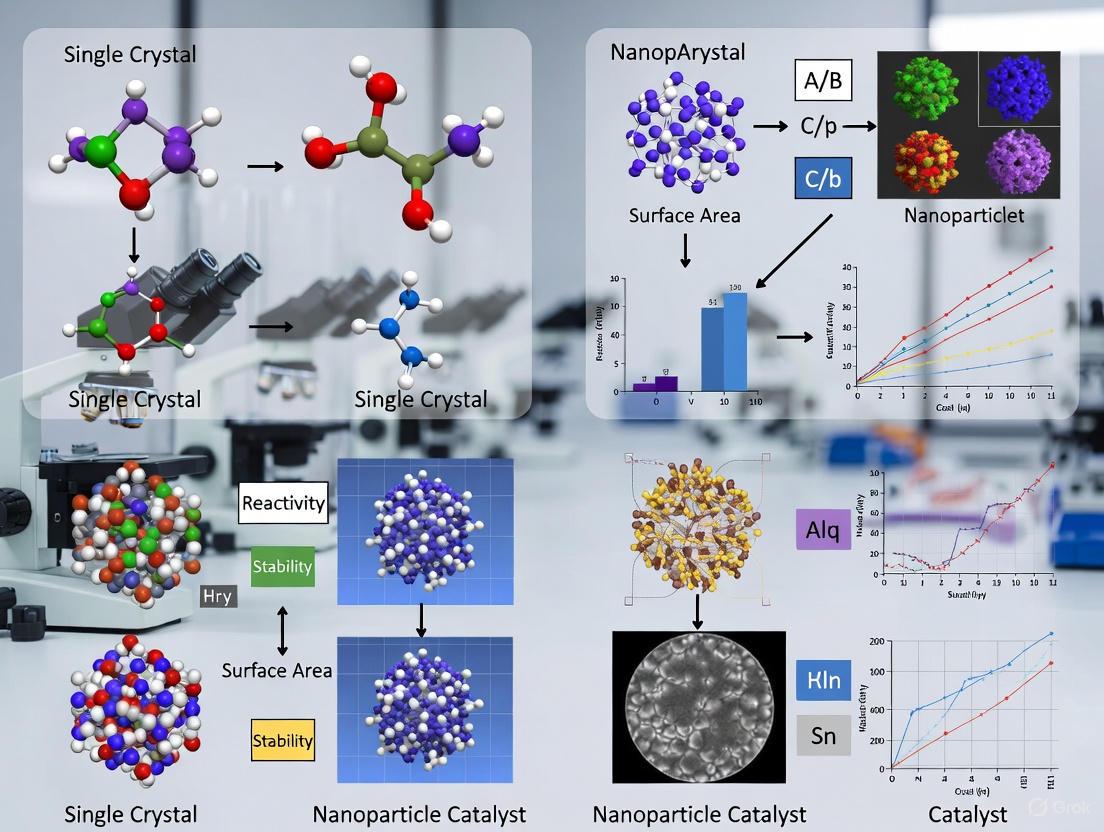
This article provides a comprehensive analysis of single crystal and nanoparticle catalysts, contrasting their fundamental properties, synthesis methodologies, and performance in biomedical and industrial applications.
Single Crystal vs Nanoparticle Catalysts: A Comprehensive Guide to Mechanisms, Applications, and Performance Optimization
Abstract
This article provides a comprehensive analysis of single crystal and nanoparticle catalysts, contrasting their fundamental properties, synthesis methodologies, and performance in biomedical and industrial applications. It explores the unique catalytic mechanisms arising from well-defined surfaces versus high surface-area nanostructures, including the emerging role of single-atom catalysts. The content delves into practical synthesis and characterization techniques, addresses common challenges in stability and selectivity, and offers a rigorous comparative evaluation of catalytic efficiency, atom utilization, and reactivity. Aimed at researchers and drug development professionals, this review synthesizes cutting-edge innovations to guide the selection and optimization of catalysts for advanced applications, from targeted drug delivery to sustainable chemical synthesis.
Defining the Catalytic Landscape: From Single Crystal Surfaces to Nanoscale Architectures
In the field of catalysis, the precise structural characterization of materials is paramount, as their performance is intrinsically linked to atomic-scale arrangement. For researchers exploring single-crystal versus nanoparticle catalysts, a fundamental challenge lies in accurately distinguishing between materials with crystalline long-range order and those comprising dispersed nanoparticles. This distinction dictates critical properties such as active site availability, stability, and selectivity in catalytic applications ranging from chemical synthesis to drug development [1] [2].
While single crystals offer well-defined, uniform active sites ideal for fundamental studies, nanoparticle dispersions provide high surface-area-to-volume ratios and unique catalytic properties due to their size and shape effects [1]. However, characterizing these systems presents significant technical challenges, as no single technique provides a complete structural picture. This guide objectively compares the capabilities of leading characterization methodologies, supported by experimental data, to enable researchers to select optimal protocols for their specific catalytic systems.
Comparative Analysis of Characterization Techniques
Technical Principles and Capabilities
Different characterization techniques probe distinct aspects of material structure, each with unique strengths and limitations for analyzing crystallinity and dispersion.
Table 1: Core Principles of Key Characterization Techniques
| Technique | Fundamental Principle | Structural Information Obtained | Primary Applications |
|---|---|---|---|
| Wide-Angle X-ray Scattering (WAXS)/XRD | Measures scattering at wide angles from atomic electrons | Crystalline domain size, crystal structure, phase identification, lattice parameters [3] | Quantifying crystallinity in catalysts, phase composition |
| Small-Angle X-ray Scattering (SAXS) | Examines scattering at small angles (near beam) | Overall nanoparticle size, shape, and size distribution regardless of crystallinity [3] | Size distribution of nanoparticle dispersions, aggregation state |
| Analytical Disc Centrifugation (ADC) | Separates particles by size under centrifugal force | Hydrodynamic size distribution based on sedimentation velocity [4] | High-resolution size analysis of mixed dispersions |
| Scanning Mobility Particle Sizing (SMPS) | Measures electrical mobility diameter of aerosolized particles | Size distribution of aerosolized nanoparticles after nebulization [4] | Characterization of colloidal systems after phase transfer |
| Electron Microscopy (EM) | Direct imaging using electron beams | Direct visualization of particle size, shape, and morphology [4] [3] | Qualitative analysis of nanoparticle morphology and dispersion |
Performance Comparison: Resolution and Accuracy
Experimental studies directly comparing these techniques reveal significant differences in their ability to resolve complex nanoparticle systems.
Table 2: Experimental Performance Comparison for Binary Nanoparticle Mixtures*
| Technique | Able to Resolve 1:1 Mixture of Au (∼20 nm) & Ag (∼70 nm) NPs | Size Resolution | Key Limitations |
|---|---|---|---|
| Dynamic Light Scattering (DLS) | No - unable to resolve bimodal distribution [4] | Low - suitable for monomodal distributions only | Limited resolution for polydisperse systems; assumes spherical particles |
| Analytical Disc Centrifugation (ADC) | Yes - provides quantitative size data [4] | High - excellent size resolution | Requires predefined particle density; limited to dispersions |
| Scanning Mobility Particle Sizing (N+SMPS) | Yes - independent of particle density [4] | High - matches ADC resolution | Requires aerosolization; potential for artifact formation |
| Scanning Electron Microscopy (SEM) | Yes - provides semi-quantitative data [4] | Very high - direct visualization | Small sampling area; potential sample preparation artifacts |
| SAXS/WAXS Combination | Yes - provides bulk quantitative data [3] | High for crystallite size (WAXS) & overall size (SAXS) | Complex data analysis; requires specialized expertise |
*Data adapted from comparative studies of metallic nanoparticle dispersions [4]
The combination of SAXS and WAXS is particularly powerful for catalyst characterization, as it simultaneously quantifies both the crystalline domains (via WAXS) and the overall nanoparticle size (via SAXS). This is crucial for understanding catalysts where crystalline cores may be embedded in amorphous shells or supports [3]. The discrepancy between SAXS and WAXS size measurements can reveal the degree of crystallinity within nanoparticles, a critical parameter for catalytic performance.
Experimental Protocols for Comprehensive Characterization
Integrated SAXS/WAXS Methodology for Catalyst Characterization
Protocol Objective: Simultaneously quantify size distribution and degree of crystallinity in nanoparticle catalysts [3].
Materials and Reagents:
- Nanoparticle powder sample (e.g., CeO₂ catalysts)
- Appropriate dispersant solvent (if required for SAXS)
- Standard sample holders for SAXS (capillary/cell) and WAXS (flat plate)
Experimental Workflow:
- Sample Preparation: For dispersible nanoparticles, prepare stable dispersion at appropriate concentration to minimize interparticle interactions. For powdered catalysts, load directly into sample holders.
- SAXS Data Collection: Collect scattering intensity at small angles (typically 0.1-5°). Multiple exposure times may be necessary to ensure adequate signal-to-noise.
- WAXS Data Collection: Collect wide-angle scattering pattern encompassing major diffraction peaks (typically 5-80° 2θ for laboratory instruments).
- Data Analysis - SAXS: Fit intensity curve using appropriate model (e.g., lognormal size distribution) accounting for particle shape, size distribution, and interparticle interactions.
- Data Analysis - WAXS: Perform line-broadening analysis of diffraction peaks or whole-pattern fitting to determine crystalline domain size distribution.
- Comparative Analysis: Calculate the median sizes from the sixth-momentum integral (SAXS) and fourth-momentum integral (WAXS). The discrepancy provides information on crystallinity and size dispersivity.
Critical Considerations: The presence of NP-NP interaction effects can complicate SAXS analysis and must be accounted for in modeling. For WAXS, the choice between individual peak fitting and whole pattern fitting depends on the complexity of the crystal structure and quality of the diffraction data [3].
Figure 1: Integrated SAXS/WAXS characterization workflow for simultaneous analysis of nanoparticle size and crystallinity [3].
Nebulization with SMPS for Dispersion Characterization
Protocol Objective: Characterize colloidal nanoparticle dispersions with high size resolution independent of particle density [4].
Materials and Reagents:
- Nanoparticle dispersion (e.g., Au-PVP ~20 nm, Ag-PVP ~70 nm)
- Newly developed nebulizer (e.g., TSI model 3485 prototype)
- Scanning Mobility Particle Sizer (SMPS)
- Appropriate solvents and standards for calibration
Experimental Workflow:
- Dispersion Preparation: Sonicate nanoparticle dispersion for 5 minutes immediately before analysis to ensure deagglomeration.
- Nebulization: Feed dispersion into nebulizer operating at optimized conditions to produce droplets containing single nanoparticles.
- Drying and Charge Neutralization: Pass aerosol through diffusion dryer and neutralizer to produce dried, charge-equilibrated particles.
- Mobility Sizing: Direct aerosol through SMPS system consisting of Differential Mobility Analyzer (DMA) and particle counter.
- Data Analysis: Convert electrical mobility distribution to particle size distribution using appropriate inversion algorithms.
- Validation: Compare results with ADC or EM data to confirm accuracy.
Critical Considerations: This method minimizes the problem of non-volatile residue formation that plagues traditional aerosol-based characterization methods. The technique is particularly valuable for analyzing complex, polydisperse systems where density-based methods like ADC face limitations [4].
The Scientist's Toolkit: Essential Research Reagents and Materials
Table 3: Key Research Reagents and Materials for Nanoparticle Characterization
| Reagent/Material | Function/Application | Example Use Cases | Critical Parameters |
|---|---|---|---|
| Poly(N-vinylpyrrolidone) (PVP) | Stabilizing agent for metallic nanoparticles [4] | Prevents agglomeration of Au, Ag nanoparticles during synthesis and characterization | Molecular weight, concentration, binding affinity |
| Polymer-grafted Nanoparticles | Model systems for studying dispersion behavior [5] | Fundamental studies of nanoparticle assembly and crystallization | Grafting density, polymer molecular weight, compatibility |
| Cerium Oxide (CeO₂) Nanoparticles | Model catalyst for characterization studies [3] | SAXS/WAXS methodology development for crystalline catalysts | Size, morphology, surface functionality |
| Polyolefin Precipitants (PP/PE) | Inducing nanoparticle crystallization for analysis [6] | Controlled assembly of 3D nanoparticle crystals from dilute solutions | Molecular weight (<8 KDa), concentration, solubility |
| Specific Gases (H₂, CO) | Modifying nanoparticle morphology and structure [2] | Reversible structural variation studies in catalytic nanoparticles | Gas purity, pressure, treatment temperature and duration |
Distinguishing between crystalline long-range order and nanoparticle dispersion requires a multifaceted analytical approach, as no single technique provides a complete structural picture. For comprehensive catalyst characterization, the combination of SAXS and WAXS offers distinct advantages in simultaneously quantifying overall nanoparticle size and crystalline domain size [3]. For specialized applications requiring high resolution of complex dispersions, nebulization with SMPS provides exceptional capability independent of particle density [4].
The choice of characterization methodology should be guided by specific research questions regarding the catalyst system. Studies focusing on structure-property relationships in single-crystal catalysts may prioritize WAXS/XRD for precise crystallographic information, while research on nanoparticle dispersions may emphasize SAXS and SMPS for accurate size distribution analysis. As catalytic materials continue to evolve in complexity, including emerging classes like integrative catalytic pairs and single-atom catalysts [1], these fundamental characterization principles will remain essential for advancing both fundamental understanding and practical applications in catalysis research.
In the field of catalysis, the fundamental properties of a material dictate its functionality and efficiency. For researchers and scientists, particularly those developing catalysts for applications ranging from industrial synthesis to drug development, understanding the core physicochemical properties of catalytic materials is paramount. This guide provides a structured comparison between two prominent classes of materials: single crystals, with their long-range, ordered atomic structure, and nanoparticles, characterized by their high surface area and nanoscale dimensions. The performance of these materials is objectively compared based on three critical properties: surface area, quantum effects, and surface plasmon resonance. The discussion is framed within ongoing research investigating whether well-defined single crystal facets or the highly tunable, defect-rich surfaces of nanoparticles offer superior catalytic platforms.
Comparative Analysis of Key Properties
The distinct behaviors of single crystals and nanoparticles arise from fundamental differences in their physical and electronic structures. The table below provides a comparative overview of these key properties.
Table 1: Comparative analysis of key physicochemical properties in single crystals vs. nanoparticles.
| Property | Single Crystals | Nanoparticles |
|---|---|---|
| Surface Area | Low specific surface area; well-defined, atomically flat facets. | Very high specific surface area; large surface-to-volume ratio [7]. |
| Quantum Effects | Absent; bulk electronic structure with continuous energy bands. | Pronounced size-dependent quantum effects due to quantum confinement; discrete energy levels in small nanoclusters [7] [8]. |
| Surface Plasmon Resonance (SPR) | Generally absent in bulk form. | Exhibited by noble metal nanoparticles (e.g., Au, Ag, Cu); tunable LSPR based on size, shape, and composition [9] [10]. |
| Primary Catalytic Sites | Ordered terraces and steps of specific crystal facets (e.g., {100}, {111}) [10]. | Corners, edges, and high-index facets; under-coordinated surface atoms [10]. |
| Structural Tunability | Limited to the selection of pre-defined crystal facets. | Highly tunable; size, shape, and composition can be precisely controlled to tailor properties [11] [10]. |
Surface Area and Surface Effects
The surface area of a catalyst directly correlates with the number of available active sites for a reaction.
- Nanoparticles are defined by their high specific surface area and massive surface-to-volume ratio [7]. This means a significant fraction of their atoms is situated on the surface, leading to enhanced chemical reactivity. These surface atoms have fewer direct neighbors than atoms in the bulk, which lowers their binding energy and can significantly affect material properties, such as reducing the melting point [7]. In catalysis, this high surface density of atoms often results in higher activity per unit mass. However, a key challenge is the strong attractive interactions between nanoparticles, which can lead to agglomeration or aggregation, effectively reducing the available surface area and compromising performance [7].
- Single Crystals, in contrast, possess a much lower specific surface area. Their primary advantage lies in their well-defined, atomically flat facets (e.g., {100}, {110}, {111}), which allow for precise mechanistic studies. Researchers can correlate specific reaction pathways and selectivities to particular atomic arrangements on the surface [10]. This makes them invaluable model systems for understanding surface chemistry without the complicating factors of high surface area and heterogeneous sites.
Quantum Confinement and Electronic Effects
When material dimensions shrink to the nanoscale, quantum mechanical effects become dominant.
- Nanoparticles exhibit quantum confinement when their size approaches the exciton Bohr radius of the material [7]. This confinement leads to the discretization of energy levels, profoundly altering their electronic, optical, and magnetic properties. For example, semiconductor nanoparticles (quantum dots) experience a size-tunable bandgap [7] [11]. In metallic systems, this can cause non-magnetic bulk materials like Pd, Pt, and Au to become magnetic at the nanoscale [7]. The catalytic properties are also directly impacted, as quantum confinement modifies electron affinity—the ability to donate or accept electrical charges—which is a cornerstone of catalytic activity [7]. The electronic structure evolves from discrete energy levels in sub-nanometer clusters to semi-discrete bands in quantum-sized small particles (~2 nm, ~10³ atoms) [8].
- Single Crystals display a bulk-like electronic structure with continuous energy bands. They do not exhibit quantum confinement effects, and their electronic properties are intrinsic to the material itself, not tunable by size.
Surface Plasmon Resonance
Surface Plasmon Resonance (SPR) is a unique optical phenomenon exhibited by certain nanomaterials.
- Nanoparticles of noble metals (e.g., Au, Ag, Cu) support Localized Surface Plasmon Resonance (LSPR), which is the collective, resonant oscillation of conduction electrons when excited by light [9] [10]. This effect leads to two primary catalytic enhancement mechanisms under illumination:
- Near-field enhancement: The LSPR concentrates electromagnetic fields on the nanoparticle surface, creating highly localized "hot spots" that can enhance reactions [10].
- Hot-carrier generation: The decay of plasmons generates highly energetic (hot) electrons and holes that can be transferred to adsorbates, driving chemical transformations [10]. The LSPR is highly tunable; the resonance wavelength can be controlled by varying the nanoparticle's size, shape, and composition [10]. In catalytic applications, research shows that for plasmonic nanoparticles, the abundance of hot carriers and electric field enhancement at edges and corners can dominate over the traditional crystal facet effect observed in dark conditions [10].
- Single Crystals do not exhibit LSPR in their bulk form. While a crystal's surface can influence plasmonic behavior in nanostructures derived from it, the SPR phenomenon itself is a definitive property of nanostructures, not bulk single crystals.
Experimental Data and Protocols
To illustrate the comparison with experimental data, this section summarizes key findings and methodologies from recent studies on shaped nanoparticles, which bridge the concepts of crystalline facets and nanoscale properties.
Experimental Comparison of Shaped Gold Nanoparticles
Gold nanoparticles with different shapes but similar size and LSPR wavelength provide an excellent model system to decouple facet effects from plasmonic effects.
Table 2: Experimental data on electrocatalytic CO₂ reduction performance of shaped Au nanoparticles [10].
| Nanoparticle Shape (Exposed Facet) | Faradaic Efficiency for CO (Dark) | Faradaic Efficiency for CO (Light) | Key Finding Under Illumination |
|---|---|---|---|
| Rhombic Dodecahedron ({110}) | ~94% (at -0.67 VRHE) | ~94% | No plasmonic enhancement; performance dictated by facet. |
| Nanocube ({100}) | ~69% (at -0.67 VRHE) | Increased | Moderate plasmonic enhancement. |
| Octahedron ({111}) | ~51% (at -0.67 VRHE) | ~100% (Doubled) | Strong plasmonic enhancement; hot carriers dominate over facet. |
Detailed Experimental Protocol
The following workflow details the synthesis and testing of shaped nanoparticles for plasmonic catalysis studies, as referenced in the data above [10].
Diagram 1: Experimental workflow for synthesis and testing of shaped plasmonic nanocatalysts.
Title: Plasmonic Catalyst Synthesis and Testing Workflow
Key Steps in the Protocol:
- Synthesis of Shaped Nanoparticles: Utilizing seed-mediated growth methods in the presence of surfactants like cetyltrimethylammonium bromide (CTAB) to produce monodisperse Au nanocubes (NCs {100}), rhombic dodecahedra (RDs {110}), and octahedra (OCs {111}) [10].
- Physicochemical Characterization:
- Electron Microscopy (SEM/TEM): To confirm uniform shape and size (~60 nm in the referenced study).
- HRTEM and SAED: To verify the single-crystalline nature and identify the d-spacing of the exposed facets.
- X-ray Diffraction (XRD): To confirm the face-centered cubic (FCC) crystal phase.
- UV-Vis-NIR Spectroscopy: To measure the LSPR wavelength and ensure a single, sharp resonance peak for each shape.
- Electrocatalytic Testing: Depositing the nanoparticles on a carbon support to form a working electrode. Performance is evaluated in a CO₂-saturated electrolyte using a standard three-electrode system (e.g., Ag/AgCl reference, Pt counter) [10].
- Plasmonic Activation: Illuminating the electrode with a light source (e.g., laser, LED) tuned to the LSPR wavelength (e.g., ~540 nm for Au NPs) while applying an electrochemical potential.
- Product Analysis: Quantifying gas products (e.g., CO, H₂) using gas chromatography (GC) and liquid products via proton nuclear magnetic resonance (¹H NMR) to calculate Faradaic efficiency and partial current densities.
The Scientist's Toolkit: Essential Research Reagents and Materials
Table 3: Key reagents, materials, and equipment for experiments with single crystal and nanoparticle catalysts.
| Item | Function / Description | Example Use Case |
|---|---|---|
| Single Crystal Electrodes | Well-defined, atomically flat surfaces with specific Miller indices (e.g., Pt(111), Au(100)). | Model studies to probe facet-dependent reaction mechanisms without nanoscale effects. |
| Metal Precursor Salts | Source of metal ions for nanoparticle synthesis (e.g., HAuCl₄, AgNO₃). | Reduction to form metallic nanoparticles in solution-phase synthesis. |
| Shape-Directing Surfactants | Molecules that selectively adsorb to specific crystal facets, guiding growth. | CTAB for synthesizing Au nanorods or nanocubes [10]. |
| Electrochemical Workstation | Instrument for applying controlled potentials/currents and measuring electrochemical response. | Conducting electrocatalytic tests (e.g., LSV, chronoamperometry) for CO₂RR or HER. |
| In-situ/Operando Characterization Cells | Specialized reactors allowing analysis of catalysts under working conditions. | Performing in-situ XAS or XRD to monitor electronic and structural changes during reaction [11]. |
| Gas Chromatography (GC) | Analytical instrument for separating and quantifying gas-phase species. | Analyzing products of gas-involving reactions (e.g., CO₂RR, methane oxidation). |
The choice between single crystal and nanoparticle catalysts is not a matter of declaring one universally superior, but rather of matching the material's properties to the application's requirements. Single crystals are the quintessential model system, providing unparalleled fundamental insight into the intrinsic activity of specific crystal facets. In contrast, nanoparticles offer practical advantages through their high surface area and tunable properties, including quantum confinement and surface plasmon resonance, which can be harnessed to achieve activity and selectivity that may not be possible with bulk crystals. Contemporary research, as evidenced by studies on shaped nanoparticles, reveals a complex interplay where nanoscale effects like plasmonic hot-carrier generation can even override the traditional influence of crystal facets. The future of catalyst design lies in the sophisticated engineering of nanoparticles, leveraging the foundational understanding provided by single crystal studies to create next-generation catalytic materials for energy conversion and pharmaceutical development.
Single-atom catalysts (SACs), featuring isolated metal atoms stabilized on solid supports, represent a revolutionary advancement that bridges the gap between homogeneous and heterogeneous catalysis. They combine the high activity and selectivity of molecular homogeneous catalysts with the easy separation and reusability of traditional heterogeneous catalysts [12]. This new class of materials achieves nearly 100% atom utilization efficiency, dramatically altering the electronic properties and catalytic performance compared to nanoparticles (NPs) and clusters [13]. The following sections provide a detailed, data-driven comparison of SACs against nanoparticle catalysts, outline key experimental protocols for their study, and visualize their unique properties and synthesis pathways.
{width="760"}
Performance Comparison: SACs vs. Nanoparticle Catalysts
The table below summarizes key performance metrics for SACs and nanoparticle (NP) catalysts across various reactions, highlighting the distinct advantages and trade-offs of each catalyst type.
| Catalytic Reaction | Catalyst Type | Key Performance Metrics | Remarks on Selectivity/Stability |
|---|---|---|---|
| CO-SCR (NO Reduction) [13] | Ir1/m-WO3 (SAC) | 73% NO conversion, 100% N2 selectivity at 350°C | Superior N2 selectivity under specific conditions |
| Fe1/Al2O3 (SAC) | ~100% NO conversion, ~100% N2 selectivity at 400°C | Excellent activity and selectivity at higher temperatures | |
| Chlorine Evolution (CER) [14] | NiN3O-O (SAC) | 75 mV overpotential, 95.8% selectivity for Cl2 | Performance comparable to noble-metal-based electrodes |
| Propane Dehydrogenation [12] | Pt Single Atom on Cu | High selectivity & stability for >120 h at 520°C | Surpasses Pt nanoparticle catalysts under identical conditions |
| Catalytic Ozonation [15] | CoNC-1000 (Isolated Co-SA) | High OUE & TOF; Long-term stability in real wastewater | Nonradical pathway with high adaptability to complex water matrices |
| CoNC-800 (Co-SA with Co-NPs) | Lower OUE & TOF | Radical pathway with inferior reactivity and ozone utilization |
Experimental Protocols for SAC Synthesis and Characterization
Detailed Synthesis Protocol: ZIF-8-Derived M-N-C SACs
This is a common and scalable method for preparing SACs with metal-nitrogen-carbon (M-N-C) structures [16].
Preparation of Metal-doped ZIF-8 Precursor:
- Function: ZIF-8, a zeolitic imidazolate framework, serves as a porous host to trap and disperse metal atoms.
- Procedure: Dissolve zinc nitrate hexahydrate and a small quantity of the target metal salt (e.g., copper nitrate for Cu-SACs) in methanol. In a separate container, dissolve 2-methylimidazole in methanol.
- Mixing: Rapidly pour the 2-methylimidazole solution into the metal salt solution under vigorous stirring. Continue stirring for several hours at room temperature.
- Aging and Centrifugation: Allow the mixture to age, then recover the resulting crystalline precipitate (e.g., Cu-ZIF-8) by centrifugation. Wash the solid thoroughly with methanol and dry overnight.
High-Temperature Pyrolysis:
- Function: Converts the MOF precursor into a nitrogen-doped carbon support while reducing the metal cations to stable, atomically dispersed sites.
- Procedure: Place the dried precursor in a tube furnace. Pyrolyze under an inert atmosphere (e.g., argon or nitrogen) at a predetermined temperature (typically 800-1000°C) for 1-3 hours [15] [16].
- Critical Control: Temperature is crucial. Higher temperatures (e.g., 1000°C) can vaporize aggregated nanoparticles, yielding purer SACs, but may also reduce metal loading [15].
Acid Washing:
- Function: Removes unstable and aggregated metal nanoparticles, leaving behind the strongly anchored single atoms.
- Procedure: Treat the pyrolyzed material with an acid solution (e.g., sulfuric acid) at an elevated temperature (e.g., 80°C) for several hours. Filter, wash, and dry to obtain the final SAC [15] [16].
{width="760"}
Essential Characterization Techniques
Confirming the atomic dispersion and understanding the electronic structure of SACs requires advanced characterization.
- Aberration-Corrected HAADF-STEM: Directly images isolated heavy metal atoms as bright dots against the darker support [15] [13].
- X-ray Absorption Spectroscopy (XAS):
- Extended X-ray Absorption Fine Structure (EXAFS): Provides chemical evidence for the absence of metal-metal bonds, confirming atomic dispersion. The dominant peak is typically from the metal-nitrogen/oxygen coordination shell [15].
- X-ray Absorption Near Edge Structure (XANES): Reveals the oxidation state and electronic configuration of the metal single atoms [12].
- In Situ/Operando Spectroscopy: Monitors the dynamic changes of the SACs under real reaction conditions, providing insights into the true active sites and reaction mechanisms [12].
The Researcher's Toolkit: Essential Reagents and Materials
| Item | Function/Description |
|---|---|
| Zeolitic Imidazolate Framework-8 (ZIF-8) | A metal-organic framework (MOF) used as a sacrificial template and precursor to create a high-surface-area, nitrogen-doped carbon support [16]. |
| Metal Salts (e.g., Cu, Co, Ir) | Source of the catalytic metal atoms. The type and concentration are carefully controlled to prevent aggregation [16]. |
| Polydopamine | An alternative nitrogen-rich polymer precursor that can be used to synthesize SACs, offering flexibility in design [16]. |
| Inert Gas (Ar/N2) | Creates an oxygen-free atmosphere during high-temperature pyrolysis to prevent unwanted oxidation and control the carbonization process [15] [16]. |
Synergistic Systems: Co-existence of Single Atoms and Nanoparticles
A cutting-edge frontier involves designing catalysts where SACs and nanoparticles co-exist to create synergistic effects [17] [18].
- Electronic Modulation: Nanoparticles can electronically perturb nearby single-atom sites, altering their spin state and binding with reactants. This can be beneficial or detrimental, depending on the reaction [15].
- Tandem Catalysis: The nanoparticle and single atom can catalyze different steps in a reaction sequence, improving overall efficiency [17] [18].
- Stabilization: Single atoms can act as anchoring sites for nanoparticles, preventing their agglomeration and enhancing the catalyst's durability [17].
{width="760"}
SACs have firmly established themselves as a distinct and valuable class of catalysts, successfully bridging the homogeneous and heterogeneous worlds. While they demonstrate unparalleled atomic efficiency and selectivity for numerous reactions, their future development hinges on overcoming challenges related to scalable synthesis, long-term stability under harsh industrial conditions, and increasing active site density [19] [13]. The emerging paradigm of hybrid SAC-NP systems offers a promising pathway to engineer catalysts with superior activity, selectivity, and stability by leveraging the unique strengths of both single atoms and nanoparticles [17] [18]. As synthesis and characterization techniques continue to advance, the transition of SACs from an academic curiosity to an industrially relevant technology is steadily progressing [19] [12].
Electronic Structure and Coordination Environments in Nanoparticles vs. Single Sites
In catalytic science, the geometric and electronic structures of active sites dictate catalyst performance, influencing activity, selectivity, and stability. This guide provides a comparative analysis of two dominant catalyst classes: traditional metallic nanoparticles (NPs) and emerging single-atom catalysts (SACs). Framed within broader research on single-crystal versus nanoparticle catalysts, this comparison examines how atomic dispersion fundamentally alters coordination environments and electronic properties. Nanoparticles feature metallic ensembles and surface sites with varied coordination, while SACs comprise isolated metal atoms on supports, offering well-defined, uniform coordination environments. Understanding these distinctions is crucial for rational catalyst design in energy conversion, environmental remediation, and chemical synthesis [1] [13] [20].
Fundamental Structural and Electronic Comparisons
Nanoparticles are nanoscale metal particles, typically ranging from 1 to 100 nanometers, containing tens to thousands of atoms. Their catalytic activity stems from under-coordinated surface atoms and terraces, presenting a distribution of active sites. The electronic structure of nanoparticles is characterized by continuous band structures, where catalytic properties are influenced by collective electronic phenomena such as d-band centers and ensemble effects [13] [21] [20]. Their coordination environments are inherently heterogeneous, including corner, edge, and facet sites with different coordination numbers and geometries, which complicates establishing clear structure-activity relationships [13].
Single-Atom Catalysts (SACs) consist of isolated metal atoms stabilized on solid supports, often through heteroatom coordination (e.g., N, O, S) in materials like nitrogen-doped carbon or metal oxides. This configuration achieves maximum atom utilization efficiency, approaching 100%. SACs possess discrete molecular-like electronic structures, characterized by distinct energy levels rather than continuous bands. This makes their catalytic behavior highly sensitive to the local coordination environment—including the identity, number, and arrangement of coordinating atoms [22] [13] [23]. The well-defined, uniform nature of their active sites allows for precise mechanistic studies and tuning of catalytic properties.
Table 1: Comparative Overview of Nanoparticles and Single-Atom Catalysts.
| Feature | Nanoparticles (NPs) | Single-Atom Catalysts (SACs) |
|---|---|---|
| Active Site | Metallic ensembles, surface sites | Isolated, dispersed metal atoms |
| Atomic Utilization | Low (only surface atoms participate) | High (theoretically ~100%) |
| Coordination Environment | Heterogeneous (varied CNs on corners, edges, facets) | Homogeneous, well-defined (e.g., M-N(_4)) |
| Electronic Structure | Metallic band structure | Molecular-like, discrete energy levels |
| Typical Supports | Metal oxides, carbon, ceramics | N-doped carbon, MOFs, functionalized oxides |
| Structure-Activity Relationship | Complex, based on size/shape | More precise, based on coordination chemistry |
| Key Strengths | Versatility, suitable for multi-step reactions | High selectivity, maximal efficiency, tunability |
Coordination Environment and Engineering Strategies
The local coordination environment of a metal active site is a primary determinant of its catalytic performance, influencing reactant adsorption, activation energy, and intermediate stabilization.
Coordination in Nanoparticles
In nanoparticles, the coordination environment is intrinsically tied to the particle's size and shape. Coordination Number (CN) varies significantly across different surface sites: atoms on terraces have higher CNs (e.g., CN=9 on an fcc(111) facet), while those at edges (lower CN) and corners (lowest CN) are often more active but can also be prone to overly strong binding leading to poisoning or sintering. Engineering strategies focus on morphology control to expose specific crystal facets and the creation of bimetallic alloys or core-shell structures to tailor the electronic structure of surface atoms through ligand and strain effects [21] [20].
Coordination in Single-Atom Catalysts
SACs offer unparalleled precision in coordination engineering. The most common motif is the symmetric M-N(_4) site, analogous to molecular macrocyclic complexes. Recent advances focus on breaking this symmetry to optimize electronic properties [23].
Key Engineering Strategies for SACs:
- Heteroatom Doping: Partial substitution of nitrogen in the M-N(4) plane with atoms of different electronegativity (e.g., S, P, B) creates an asymmetric electronic field. This tunes the d-band center of the metal, enhancing the adsorption and activation of reactants like O(2) for the oxygen reduction reaction (ORR) [22] [23].
- Axial Coordination: Introducing a fifth ligand above or below the M-N(_4) plane further distorts the electronic density. This can break the scaling relations that limit the performance of symmetric sites, particularly in reactions involving multiple intermediates [23].
- Dual-Metal Sites: Creating structures with two adjacent but not-bonded metal atoms (e.g., Ni–Fe, Pt–Fe) enables electronic synergy. The second metal site can modulate the orbital filling of the first, optimizing intermediate binding energies. More complex structures involve directly bonded bimetallic sites or those bridged by non-metal atoms (O, N, S), which can enable cooperative catalysis in multi-step reactions [1] [23].
Table 2: Experimental Data Comparing Catalytic Performance.
| Catalyst | Reaction | Key Performance Metric | Conditions | Reference |
|---|---|---|---|---|
| Ir1/m-WO3 (SAC) | CO-SCR (NO reduction) | 73% NO Conversion, 100% N(_2) Selectivity | 350 °C, GHSV=50,000 h⁻¹ | [13] |
| 0.3Ag/m-WO3 (SAC) | CO-SCR (NO reduction) | ~73% NO Conversion, 100% N(_2) Selectivity | 250 °C, GHSV=50,000 h⁻¹ | [13] |
| Cr0.19Rh0.06CeOz (SAC) | CO-SCR (NO reduction) | 100% NO Conversion, 100% N(_2) Selectivity | 200 °C, GHSV=6,500 h⁻¹ | [13] |
| Fe1/CeO2-Al2O3 (SAC) | CO-SCR (NO reduction) | 100% NO Conversion, 100% N(_2) Selectivity | 250 °C, GHSV=30,000 h⁻¹ | [13] |
| Pt1/FeOx (SAC) | CO Oxidation | Higher Turnover Frequency (TOF) than Au NPs | Not Specified | [13] |
| Conventional Pt NPs | Oxygen Reduction Reaction (ORR) | Baseline Activity | Acidic Media | [22] |
| M-N-C SACs (Heteroatom-doped) | Oxygen Reduction Reaction (ORR) | Reduced overpotential, enhanced 4e⁻ selectivity vs. NPs | Acidic Media | [22] |
Experimental Characterization and Computational Modeling
Key Characterization Techniques
Resolving the structure of catalytic sites requires advanced spectroscopy and microscopy.
- Aberration-Corrected HAADF-STEM: Directly images isolated heavy metal atoms on lighter supports, confirming atomic dispersion [24] [13].
- Synchrotron-Based X-Ray Absorption Spectroscopy (XAS): Provides average information on oxidation state (XANES) and local coordination (EXAFS), including bond lengths and coordination numbers, for both NPs and SACs [24] [23].
- Solid-State NMR Spectroscopy: A powerful technique for characterizing the local environment of suitable nuclei, such as (^{195})Pt. It can distinguish between different coordination geometries (e.g., square-planar Pt(II)) and quantify site homogeneity in SACs, offering molecular-level precision that complements XAS [24].
- In situ/Operando Characterization: Monitoring catalyst structure under reaction conditions (e.g., using operando XAS or NMR) is crucial to identify the true active sites and understand deactivation mechanisms like sintering or poisoning [22] [24].
Computational Modeling
Computational methods, particularly Density Functional Theory (DFT), are indispensable for interpreting experimental data and establishing structure-activity relationships.
- Modeling Nanoparticles: Requires representing a distribution of active sites. Calculations often focus on extended surfaces (as models for facets) and small clusters (as models for corners/edges) to understand size and shape effects. Key challenges include modeling ensemble effects, the dynamic nature of catalysts under reaction conditions, and the influence of the support and solvent [21].
- Modeling SACs: Typically involves a periodic slab or a molecular cluster model with a single metal atom in a defined coordination environment. DFT is highly effective for calculating the adsorption energies of reaction intermediates, proposing mechanisms, and explaining how heteroatom doping or axial coordination tunes electronic structure [22] [23].
- Emerging Tools: Machine Learning (ML) is being integrated into nanocatalysis research to navigate complex parameter spaces, predict stable structures, and accelerate the discovery of new catalysts [22] [21].
The Scientist's Toolkit: Essential Reagents and Materials
Table 3: Key Research Reagent Solutions for Catalyst Synthesis and Study.
| Reagent/Material | Function in Research | Example Application |
|---|---|---|
| Metal-Organic Frameworks (MOFs) | Sacrificial templates and precursors for porous carbon supports. | ZIF-8 used to create N-doped carbon for anchoring Pt, Fe, or Co single atoms [23]. |
| Heteroatom Dopants (e.g., KSCN, PPh(_3)) | Sources of heteroatoms (S, O, P) to create asymmetric coordination in SACs. | KSCN used to synthesize Fe(1)-N(4)SO(_2)/NC sites [23]. |
| Metal Acetylacetonates (e.g., Pt(acac)(_2)) | Common metal precursors for the synthesis of both nanoparticles and SACs. | Co-loaded with Fe(acac)(3) in ZIF-8 to create Fe-N(4)/Pt-N(_4) sites [23]. |
| Ammonia (NH(_3)) | Used in thermal treatment to create nitrogen functionalities on carbon supports. | Pyrolysis under NH(_3) creates N-doped carbon from polymer precursors [23]. |
| Triphenylphosphine (PPh(_3)) | Molecular precursor for phosphorus doping. | Encapsulated in MOF cages to create Co-SA/P catalysts with P coordination [23]. |
Experimental Workflows
Synthesis of Asymmetrically Coordinated Single-Atom Catalysts
A common strategy for creating SACs with asymmetric coordination involves pyrolyzing a metal-impregnated precursor.
Detailed Protocol:
- Precursor Preparation: A porous support, such as the metal-organic framework ZIF-8, is selected for its high surface area and nitrogen content [23].
- Impregnation: The support is immersed in a methanol solution containing both the metal precursor (e.g., ferrocene, FeCp(_2)) and a heteroatom precursor (e.g., potassium thiocyanate, KSCN, for S/O doping). The mixture is stirred to ensure uniform dispersion [23].
- Drying: The solvent is slowly evaporated to obtain a dry, homogeneous precursor powder where the metal and dopant are distributed within the MOF pores.
- Thermal Activation (Pyrolysis): The precursor is placed in a tube furnace and heated to a high temperature (e.g., 950 °C) under an inert atmosphere (N(2) or Ar) for a set time (e.g., 3 hours). This step carbonizes the organic framework, reduces the metal, and incorporates the heteroatom into the carbon matrix, forming the stable asymmetric coordination site (e.g., Fe(1)-N(4)SO(2)) [23].
- Post-processing: The resulting solid may be acid-washed to remove any unstable metal aggregates, leaving only the atomically dispersed species.
Workflow for Probing Coordination Environments via Solid-State NMR
Solid-state NMR is a powerful technique for characterizing coordination environments, especially for NMR-active metals like (^{195})Pt.
Detailed Protocol:
- Sample Preparation: The catalyst powder (e.g., Pt single atoms on N-doped carbon, Pt@NC) is packed into a solid-state NMR rotor [24].
- Data Acquisition: Using state-of-the-art ultra-wideline NMR methodology under static conditions or with magic-angle spinning (MAS) at low temperatures and fast repetition rates, the broad (^{195})Pt NMR spectrum is acquired. This can take from several hours to days, depending on Pt concentration [24].
- Spectral Analysis: The observed "powder pattern" is characterized by its tensor parameters: the isotropic chemical shift (δ(_{iso})), the span (Ω), and the skew (κ). These parameters are reporters of the local Pt environment, including oxidation state, geometry, and ligands [24].
- Modeling and Simulation: To account for site heterogeneity, the experimental spectrum is fitted using Monte Carlo simulations that model a distribution of chemical shift tensors. Inputs from DFT calculations help constrain possible coordination structures [24].
- Structural Insight: The final output is a quantitative assessment of the Pt-site distribution and homogeneity, describing coordination environments with molecular precision and tracking changes induced by synthesis or reaction conditions [24].
The distinction between nanoparticles and single-atom catalysts represents a fundamental divide in catalyst architecture, with direct consequences for electronic structure and coordination environment. Nanoparticles leverage metallic ensemble effects and a distribution of sites, making them versatile for complex reactions. In contrast, SACs offer ultimate atomic efficiency and a precisely tunable, molecular-like active site, enabling exceptional selectivity and activity for specific transformations. The choice between these platforms depends on the reaction of interest: NP ensembles may be superior for complex, multi-step reactions requiring different sites, while SACs are ideal for reactions where a specific, optimized interaction with a single intermediate is rate-determining. Future research will focus on bridging these paradigms—for instance, by designing single-atom alloys or integrative catalytic pairs that combine the advantages of both sites to drive more efficient and sustainable chemical processes [1] [13].
Synthesis, Characterization, and Application-Driven Catalyst Design
The pursuit of optimal catalyst performance has driven the development of sophisticated synthesis strategies that precisely control material architecture across multiple length scales. In contemporary catalysis research, particularly in the evolving comparison between single-crystal and nanoparticle catalysts, synthesis methodology has become a critical determinant of catalytic behavior. Bottom-up approaches construct materials from molecular or atomic precursors, enabling precise control over atomic composition. Conversely, top-down methods break down bulk materials to nanoscale dimensions, often favoring high-volume production. Uniting these paradigms, spatial confinement strategies have emerged as a powerful method to engineer local microenvironments within host matrices, significantly altering catalyst stability and reactivity.
The fundamental distinction between these synthetic philosophies lies in their starting points and control mechanisms. Bottom-up synthesis offers unparalleled precision in creating tailored active sites, including single atoms and defined nanoclusters, but faces challenges in scalability and structural uniformity. Top-down techniques provide more straightforward nanocrystal production but often lack the fine control over atomic coordination. Spatial confinement hybridizes these concepts by creating nanoscale reactors within porous frameworks or layered structures, where the confined space itself becomes a design parameter that stabilizes metastable states and enhances catalytic selectivity. This guide systematically compares these three strategic approaches, providing researchers with a quantitative framework for selecting synthesis methodologies based on desired catalytic performance metrics.
Comparative Analysis of Synthesis Techniques
Table 1: Fundamental Characteristics and Applications of Synthesis Techniques
| Synthesis Technique | Fundamental Principle | Typical Catalytic Structures Formed | Key Advantages | Primary Limitations |
|---|---|---|---|---|
| Bottom-Up | Assembly from molecular/atomic precursors | Single atoms, sub-nanometer clusters, nanoparticles, thin films | Atomic-level precision, high compositional control, uniform dispersions | Scalability challenges, potential metastable phases, complex synthesis protocols |
| Top-Down | Physical or chemical breakdown of bulk materials | Nanoparticles, nanorods, quantum-sized particles | Simplicity for some materials, compatible with high-volume production | Limited control over atomic structure, surface defects, broad size distribution |
| Spatial Confinement | Restriction of catalyst growth/operation within nanoscale spaces | Zeolite-encapsulated metals, layered structure composites, MOF-encapsulated catalysts | Enhanced stability, unique selectivity, suppressed leaching, stabilized intermediates | Complex host synthesis, potential diffusion limitations, reduced accessibility |
Table 2: Quantitative Performance Comparison of Catalysts Prepared by Different Techniques
| Synthesis Technique | Catalyst Example | Reaction Performance | Stability Metrics | Experimental Evidence |
|---|---|---|---|---|
| Bottom-Up (Single Atoms) | Pt Single Atoms on TiO₂ [25] [8] | Higher selectivity in hydrogenation vs. nanoparticles | Variable thermal stability, potential aggregation | CO-DRIFTS, HAADF-STEM, XAS confirmation of isolated sites |
| Bottom-Up (Core-Shell) | Au-Pd Core-Shell NPs [26] | ~3.5× higher activity than monometallic Pd in selective hydrogenation | Structural stability in liquid phase | Colloidal synthesis with precise structural control |
| Spatial Confinement | FeOF in GO membrane [27] | Near-complete pollutant removal for >2 weeks in flow-through operation | Significantly reduced fluoride ion leaching (primary deactivation cause) | Angstrom-scale rejection of organic matter, sustained radical availability |
| Spatial Confinement | Zeolite-confined sites for lactide production [28] | Enhanced reaction rates and stereochemical control | Stable cyclic transition states | DFT calculations showing reduced energy barriers in confined spaces |
Methodological Deep Dive: Experimental Protocols and Workflows
Bottom-Up Synthesis: Controlled Formation of Supported Platinum Structures
The preparation of defined platinum structures on titania support exemplifies the precision achievable through bottom-up methodologies. The Strong Electrostatic Adsorption (SEA) approach enables controlled deposition of Pt single atoms, sub-nanometer clusters, and nanoparticles by varying precursor loading [25]. The protocol begins with functionalization of the TiO₂ (anatase) support surface to create specific charge characteristics. A tetraammineplatinum(II) nitrate (TAPN) precursor solution is prepared with concentrations ranging from 0.04 to 5.00 wt.% Pt relative to the support mass. The precisely controlled pH adjustment ensures optimal electrostatic interaction between the precursor complex and support surface. Following immersion and stirring, the material is washed, dried, and subjected to thermal treatment (300°C under flowing air) to decompose the precursor and form the final Pt structures. Critical characterization involves HAADF-STEM for direct imaging of metal species, X-ray photoelectron spectroscopy for chemical state analysis, and CO chemisorption with DRIFTS to distinguish between single atoms, clusters, and nanoparticles based on their distinct CO adsorption signatures.
Spatial Confinement: Fabrication of FeOF-Graphene Oxide Catalytic Membranes
The creation of spatially confined catalysts represents a hybrid approach that leverages both bottom-up assembly and confinement principles. For the iron oxyfluoride (FeOF) catalytic membrane system [27], the synthesis begins with the preparation of FeOF catalysts through a solvothermal method where FeF₃·3H₂O is heated in methanol medium at 220°C for 24 hours in an autoclave. Simultaneously, single-layer graphene oxide (GO) is prepared via modified Hummers' method. The catalytic membrane is fabricated by intercalating the pre-synthesized FeOF catalysts between layers of graphene oxide through vacuum-assisted filtration, creating aligned nanochannels with angstrom-scale dimensions. The confinement effect is precisely controlled by manipulating the interlayer spacing through GO concentration and filtration parameters. The resulting membrane operates in flow-through mode, where pollutants encounter confined FeOF catalysts that activate H₂O₂ to generate hydroxyl radicals (*OH) while the membrane channels simultaneously reject natural organic matter via size exclusion. Performance validation includes long-term pollutant degradation experiments, elemental leaching analysis via ICP-OES/IC, and radical trapping with EPR spectroscopy.
Computational Guidance: DFT Analysis of Confined Catalysis
Density functional theory (DFT) calculations provide crucial theoretical support for understanding spatial confinement effects [28]. For zeolite-based systems, the workflow employs the Vienna ab initio simulation package (VASP) with the PAW method and GGA-PBE functional. A plane-wave cutoff energy of 450 eV is typically used with Gamma-point sampling. The zeolite framework is modeled using cluster or periodic approaches, with reaction pathways and energy barriers calculated for both confined and open environments. This approach has revealed that spatial confinement significantly reduces energy barriers for key reactions like lactide formation by stabilizing cyclic transition states and suppressing side reactions. Computational guidance is now being integrated with emerging natural language processing (NLP) techniques to accelerate catalyst screening, as demonstrated in SA catalyst selection for Na-S batteries [29].
Visualization of Synthesis Pathways and Confinement Effects
Synthesis Technique Decision Pathway
The Scientist's Toolkit: Essential Reagents and Materials
Table 3: Key Research Reagents and Materials for Advanced Catalyst Synthesis
| Reagent/Material | Function in Synthesis | Specific Application Examples | Critical Considerations |
|---|---|---|---|
| Tetraammineplatinum(II) nitrate (TAPN) | Metal precursor for precise deposition | Preparation of Pt single atoms, clusters, and nanoparticles via SEA [25] | Concentration controls final metal size (single atoms at low loading) |
| Graphene Oxide (GO) | 2D confinement matrix | Creating angstrom-scale channels for FeOF catalyst confinement [27] | Layer spacing determines molecular exclusion properties |
| Zeolites (e.g., H-Beta) | Microporous crystalline host | Spatial confinement for lactide production [28] | Pore topology dictates transition state stabilization |
| Polyvinylpyrrolidone (PVP) | Colloidal stabilizer and shape-directing agent | Synthesis of Au-Pd core-shell nanoparticles [26] | Molecular weight affects binding strength and nanoparticle morphology |
| Sodium Citrate | Reducing agent and capping ligand | Controlled synthesis of gold nanoparticle cores [26] | Concentration and temperature determine final nanoparticle size |
| Ascorbic Acid | Mild reducing agent | Selective reduction in Pd overgrowth on Au cores [26] | pH sensitivity requires careful control during reduction |
| Metal-Fluoride Precursors (FeF₃·3H₂O) | Catalyst precursor for highly active phases | Synthesis of iron oxyfluoride (FeOF) catalysts [27] | Solvothermal conditions required for crystalline phase formation |
The comparative analysis presented in this guide demonstrates that bottom-up, top-down, and spatial confinement strategies each occupy distinct yet complementary roles in advanced catalyst synthesis. Bottom-up approaches provide the precision necessary for creating well-defined active sites at atomic scales, particularly valuable for fundamental mechanistic studies and applications requiring maximum atomic efficiency. Top-down methods offer practical pathways for nanoscale catalyst production, though with more limited control over atomic coordination. Spatial confinement has emerged as a particularly powerful strategy for enhancing catalyst stability—a critical limitation in many practical applications—while maintaining and often enhancing catalytic activity.
The most promising future developments lie in the strategic integration of these approaches, such as creating precisely defined active sites through bottom-up synthesis and subsequently stabilizing them within confined environments. This hybrid philosophy leverages the respective strengths of each methodology while mitigating their individual limitations. Furthermore, the growing integration of computational guidance, including both first-principles calculations and emerging machine learning approaches [29], promises to accelerate the discovery and optimization of next-generation catalytic materials. As the distinction between single-crystal and nanoparticle catalysts continues to blur with advancing characterization and synthesis capabilities, the methodological framework presented here provides researchers with a rational foundation for selecting and implementing synthesis strategies tailored to specific catalytic challenges.
In the field of catalysis, the fundamental debate between using well-defined single crystals versus complex nanoparticles as model systems continues to drive research innovation. Single crystals provide perfectly defined surfaces for understanding atomic-level reaction mechanisms, while nanoparticles offer the high surface areas and complex active sites required for industrial applications. Bridging the knowledge gap between these domains requires sophisticated characterization techniques that can reveal structural, electronic, and morphological properties across multiple length scales. This guide examines four powerful characterization methods—HAADF-STEM, XAS, XRD, and BET surface area analysis—that enable researchers to correlate catalyst structure with performance, thereby accelerating the development of next-generation catalytic systems.
Technique Fundamentals and Comparative Analysis
Core Principles of Each Characterization Method
HAADF-STEM (High-Angle Annular Dark-Field Scanning Transmission Electron Microscopy) is an advanced imaging technique that uses a focused electron beam scanned across a specimen. It collects high-angle, incoherently scattered electrons using an annular detector, producing images where intensity is approximately proportional to the square of the atomic number (Z-contrast), allowing heavy elements to appear brighter than light ones [30] [31]. This technique provides atomic-resolution imaging with easily interpretable contrast and is particularly valuable for locating heavy metal atoms or nanoparticles on lighter supports.
XAS (X-ray Absorption Spectroscopy) measures the absorption coefficient of a material as a function of X-ray energy, providing information about the oxidation state, coordination chemistry, and local electronic structure of elements. It is element-specific and can be performed under operando conditions [32] [33] [34].
XRD (X-ray Diffraction) analyzes the diffraction patterns produced when X-rays interact with crystalline materials, providing information about crystal structure, phase composition, lattice parameters, and crystallite size. It is a bulk technique that averages structural information over the entire sample volume [32] [33].
BET Surface Area Analysis (named after Brunauer, Emmett, and Teller) determines the specific surface area of porous materials by measuring the quantity of gas molecules (typically nitrogen) adsorbed as a monolayer on the material surface. It provides crucial information about catalyst porosity and available surface sites [33].
Table 1: Technical Capabilities and Limitations of Characterization Techniques
| Technique | Spatial Resolution | Element Specificity | Key Information Obtained | Main Limitations |
|---|---|---|---|---|
| HAADF-STEM | Atomic-scale (~0.05 nm) [30] | No (but Z-contrast) | Atomic structure, particle size/distribution, defects | Light elements difficult to observe [30]; requires high vacuum |
| XAS | None (bulk average) | Yes | Oxidation state, local coordination environment, electronic structure | Limited spatial information; requires synchrotron source |
| XRD | None (bulk average) | No | Crystal structure, phase identification, crystallite size | Requires crystalline materials; amorphous phases not detected |
| BET Analysis | None (bulk average) | No | Specific surface area, pore volume, pore size distribution | Surface chemistry information limited |
Performance Comparison in Catalyst Characterization
Each characterization technique provides unique insights into catalyst properties, and their combined application offers a comprehensive understanding of structure-property relationships. The following table illustrates how these techniques address different aspects of catalyst characterization, with examples from recent research.
Table 2: Application of Characterization Techniques in Catalyst Analysis
| Technique | Single Crystal Studies | Nanoparticle Catalyst Studies | Complementary Data |
|---|---|---|---|
| HAADF-STEM | Limited application | Visualizes nanoparticles (7-8 nm) and atomic dispersion [33]; identifies single atoms & clusters [34] | Combined with EELS for elemental analysis [30] |
| XAS | Reference spectra | Identifies Fe-N coordination in Fe-N-C catalysts [34]; determines valence states [33] | Complements XRD for amorphous phases |
| XRD | Long-range order analysis | Identifies metallic Co phases (JCPDS #15-0806) [33]; monitors structural evolution during synthesis [33] | Combined with XAS for operando studies [32] |
| BET Analysis | Limited application (low surface area) | Measures high surface areas (e.g., 1261 m²·g⁻¹ for ZIF-derived catalysts) [33] | Correlates surface area with catalytic activity |
Experimental Protocols and Methodologies
HAADF-STEM Imaging Protocol
Sample Preparation: Disperse catalyst powder in ethanol via ultrasonication. Deposit onto holy carbon TEM grids. Allow to dry completely [33] [34].
Instrument Conditions: Use aberration-corrected STEM. Typical convergence semi-angle α: ~25 mrad at 200 kV. Detector inner semi-angle β1: ~50 mrad. Detector outer semi-angle β2: ~200 mrad [30].
Image Acquisition: Align instrument optics carefully. Acquire images in synchronism with incident probe position. Integrate intensities from high-angle scattered electrons [30].
Data Interpretation: Interpret image contrast based on Z-dependence (intensity ∝ Z¹‧⁷ to Z²). Identify heavy elements as brighter regions. Use ABF-STEM simultaneously for light element detection [31].
XAS Measurement Procedure
Sample Preparation: Prepare uniform catalyst thin layer on appropriate substrate. Optimize thickness to achieve optimal absorption edge step.
Data Collection: Collect data at synchrotron facility. Measure X-ray absorption near-edge structure (XANES) and extended X-ray absorption fine structure (EXAFS). Use appropriate reference compounds for calibration [33] [34].
Data Analysis: Process data using standard software (e.g., Athena, Artemis). Extract oxidation state information from XANES edge position. Determine coordination numbers and bond distances from EXAFS Fourier transforms [34].
XRD Analysis Methodology
Sample Preparation: Grind powder samples to uniform consistency. Load into sample holder ensuring flat surface.
Measurement Parameters: Use Cu Kα radiation (λ = 1.5418 Å). Typical 2θ range: 5-90°. Step size: 0.01-0.02°. Counting time: 1-2 seconds per step [33].
Data Analysis: Identify crystalline phases using reference databases (e.g., JCPDS). Apply Scherrer equation for crystallite size determination: D = Kλ/(βcosθ), where K is shape factor (~0.9), λ is X-ray wavelength, β is FWHM, and θ is Bragg angle [33] [35].
BET Surface Area Measurement
Sample Preparation: Degas sample under vacuum at elevated temperature (typically 150-300°C) for several hours to remove contaminants.
Measurement: Measure nitrogen adsorption isotherms at 77 K. Record adsorption points at relative pressures (P/P₀) from 0.05 to 0.3.
Data Analysis: Apply BET equation to adsorption data in relative pressure range 0.05-0.3. Calculate monolayer volume. Determine specific surface area using cross-sectional area of nitrogen molecule (0.162 nm²) [33].
Research Reagent Solutions and Essential Materials
Table 3: Essential Research Materials for Advanced Catalyst Characterization
| Material/Reagent | Function in Characterization | Application Examples |
|---|---|---|
| Holy Carbon TEM Grids | Sample support for electron transparency | HAADF-STEM sample preparation [33] |
| Zeolitic Imidazolate Frameworks (ZIFs) | Precursors for well-defined catalyst supports | Synthesis of metal-N-C catalysts [33] |
| Ethylene Glycol | Reducing agent and solvent in polyol synthesis | Preparation of uniform Pt nanoparticles [36] |
| Nitrogen Gas (99.999%) | Adsorptive for surface area measurements | BET surface area analysis [33] |
| Reference Compounds (FePc, Fe foil) | Standards for calibration and comparison | XAS measurements for valence state analysis [34] |
Visualization of Characterization Workflows
Integrated Characterization Approach for Catalyst Development
Integrated Characterization Workflow for Catalyst Development
Technique Selection Logic for Catalyst Analysis
Technique Selection Logic for Catalyst Analysis
The comprehensive characterization of catalysts requires a multi-technique approach that leverages the complementary strengths of HAADF-STEM, XAS, XRD, and BET analysis. While single crystal studies continue to provide fundamental insights into reaction mechanisms, the advancement of nanoparticle catalysts demands characterization methods that can resolve complex structural and electronic features across multiple length scales. The integration of these techniques enables researchers to establish robust structure-activity relationships, guiding the rational design of next-generation catalysts with enhanced performance and stability. As characterization methodologies continue to advance, particularly with the development of in situ and operando capabilities, our ability to correlate catalyst structure with function under realistic working conditions will dramatically improve, accelerating the development of efficient catalytic processes for energy and environmental applications.
In the realm of biomedicine, the precise engineering of catalytic materials at the atomic and nanoscale has opened new frontiers in targeted therapeutic and diagnostic applications. The fundamental distinction between single crystal and nanoparticle catalysts lies in their structural configuration and resulting physicochemical properties. Single crystal catalysts, characterized by a long-range, continuous ordered structure, provide uniform surface active sites ideal for consistent catalytic behavior. In contrast, nanoparticles are discrete entities with high surface-to-volume ratios, often exhibiting quantum confinement effects and a high density of low-coordination surface sites. This structural dichotomy creates a fascinating trade-off: while single crystals offer precision and reproducibility, nanoparticles provide versatility and high reactivity. Within nanoparticle categories, a further distinction exists between single-atom catalysts (SACs), where isolated metal atoms are anchored on supports, and nanoparticle catalysts (NPCs), which consist of metal clusters. Single atoms demonstrate maximized atomic efficiency and unique electronic properties due to their low coordination environment, whereas nanoparticles benefit from cooperative effects between adjacent metal atoms [8]. This comparative analysis examines how these distinct catalyst architectures perform across three critical biomedical applications: targeted drug delivery, hyperthermia therapy, and biosensing platforms, providing researchers with experimental data and methodologies to guide material selection for specific biomedical challenges.
Performance Comparison Tables
Table 1: Comparative Performance of Catalyst Types in Biomedical Applications
| Application | Catalyst Type | Key Performance Metrics | Advantages | Limitations |
|---|---|---|---|---|
| Targeted Drug Delivery | Iron Oxide Nanoparticles (IONPs) | • Drug loading capacity: Varies with surface functionalization• Enhanced permeability and retention (EPR) effect: Passive tumor targeting• Magnetic guidance: External field-responsive delivery [37] | • High saturation magnetization for targeting• Biocompatible with proper coating• Multi-functional platform | • Potential biocompatibility and toxicity issues• Agglomeration without surface modification• Limited drug loading capacity |
| Thermosensitive Nanocarriers | • LCST/UCST behavior: Phase transition at 39-42°C• Drug release: Triggered by mild hyperthermia [38] | • Spatiotemporal control of drug release• Minimal off-target effects• Combination therapy capability | • Complex synthesis procedures• Potential polymer toxicity• Heat distribution challenges in tissues | |
| Hyperthermia Therapy | Magnetic Nanoparticles (MNPs) | • SAR (Specific Absorption Rate): Determines heating efficiency• Intrinsic Loss Power (ILP): Standardized comparison metric• Heating temperature: 41-46°C for therapeutic effect [39] | • Deep tissue penetration• Precise temperature control• Minimal invasiveness | • Potential overheating risks• Optimization of magnetic properties needed• Challenges in uniform heat distribution |
| Single-Atom Catalysts | • Atom utilization: ~100% efficiency• Coordination environment: Tunable electronic properties [8] [40] | • Maximum atomic efficiency• Tailorable electronic structure• Unique catalytic selectivity | • Synthesis stability challenges• Potential metal leaching• Limited to specific catalytic reactions | |
| Biosensing | Electrochemical Biosensors | • Sensitivity: Enhanced by nanostructured electrodes• Specificity: Biorecognition element dependent• Response time: Short with proper design [41] [42] | • High sensitivity and specificity• Rapid response times• Compatibility with miniaturization | • Fouling in complex media• Enzyme instability• Calibration drift over time |
| Optical Biosensors | • Detection limit: PPM to PPB range achievable• Signal transduction: Plasmonic, fluorescent, colorimetric [42] | • High detection sensitivity• Multiplexing capability• Real-time monitoring | • Instrument complexity• Interference from ambient light• Higher cost than electrochemical |
Table 2: Experimental Performance Data for Catalyst Systems in Biomedical Applications
| Catalyst System | Composition/Structure | Application | Performance Results | Experimental Conditions |
|---|---|---|---|---|
| IONPs-based System | Fe₃O₄ with polymer coatings (chitosan, dextran, PEG) [37] | Drug Delivery & MRI | • High saturation magnetization (80-92 emu)• Enhanced contrast in T2-weighted MRI• Successful drug transport with minimal loss | • In vivo studies using U87MG xenografted tumor model• MRI analysis at various time points |
| MOF-Derived Co/NC Catalyst | Co single atoms + Co nanoparticles on N-doped carbon [40] | Photothermal CO₂ Methanation | • CO₂ conversion: 39.3%• CH₄ production rate: 21.6 mmol g⁻¹ h⁻¹• CH₄ selectivity: 94.3% | • Concentrated solar light (1.55 W cm⁻²)• Xenon lamp simulation• Fresnel lens concentration |
| Self-healing Cu SAC | CuN₄ to CuN₁O₂ reconstruction with ZrO₂ clusters [43] | Electrocatalytic CO₂ Methanation | • Faradaic efficiency: 87.06% at -500 mA cm⁻²• 80.21% at -1000 mA cm⁻²• <3% activity decay over 25h | • Membrane electrode assembly (MEA) electrolyzer• Stability test at 500 mA cm⁻² |
| Thermosensitive Liposomes | DPPC-based lipids (Tm ≈ 41.5°C) [38] | Drug Delivery + Hyperthermia | • Rapid drug release at 41-42°C• Enhanced tumor permeability• Synergistic effect with hyperthermia | • Localized heating via MR-HIFU• In vivo tumor models |
| Electrochemical Biosensors | Nanostructured electrodes with enzymes [41] [42] | Glucose Monitoring | • CAGR of 7.00-9.1% in market growth• High specificity in complex media• Continuous monitoring capability | • Point-of-care testing conditions• Various biological samples |
Experimental Protocols and Methodologies
Synthesis and Functionalization of Iron Oxide Nanoparticles (IONPs)
The preparation of IONPs for biomedical applications requires precise control over size, morphology, and surface properties to ensure optimal performance and biocompatibility. The co-precipitation method represents the most common approach, involving the simultaneous precipitation of Fe²⁺ and Fe³⁺ ions in a basic aqueous solution under inert atmosphere. The critical parameters include temperature (70-80°C), pH (8-14), and the Fe²⁺/Fe³⁺ ratio (typically 1:2). Following synthesis, surface functionalization is essential to improve stability and biocompatibility. Coating with organic polymers like chitosan, dextran, polyethylene glycol (PEG), or polyvinyl alcohol creates a protective layer that reduces agglomeration and prevents recognition by the immune system. For targeted drug delivery, IONPs are further functionalized with specific ligands (e.g., antibodies, peptides) that recognize biomarkers on target cells. The drug loading capacity is determined by incubating the functionalized IONPs with the therapeutic agent, followed by purification to remove unbound drugs. quantification of drug loading is typically performed using UV-Vis spectroscopy or HPLC [37].
Evaluation of Hyperthermia Efficiency in Magnetic Nanoparticles
The assessment of heating efficiency in magnetic nanoparticles for hyperthermia applications follows standardized protocols to enable meaningful comparisons between different systems. The specific absorption rate (SAR) is the key parameter, defined as the amount of heat generated per unit mass of magnetic material under an alternating magnetic field (AMF). Experimentally, MNPs are dispersed in an aqueous medium at a known concentration and exposed to an AMF with specific frequency (f) and amplitude (H). The temperature rise is monitored using a fiber-optic thermometer to avoid interference with the magnetic field. The SAR value is calculated using the formula: SAR = C × (ΔT/Δt) × (msuspension/mmagnetic), where C is the specific heat capacity of the suspension, ΔT/Δt is the initial slope of the temperature versus time curve, msuspension is the mass of the suspension, and mmagnetic is the mass of the magnetic material in the suspension. To enable comparison between different experimental conditions, the intrinsic loss power (ILP) is calculated by normalizing the SAR with respect to the field parameters: ILP = SAR/(f × H²). This normalized parameter accounts for variations in AMF conditions and allows direct comparison of the intrinsic heating efficiency of different MNPs [39].
Fabrication and Characterization of Electrochemical Biosensors
The development of electrochemical biosensors for medical diagnostics involves the precise integration of biological recognition elements with transducer surfaces. The protocol begins with substrate preparation, typically using glassy carbon or highly oriented pyrolytic graphite (HOPG) as support material. The substrate undergoes rigorous cleaning through physical polishing with alumina slurry (¼ μm to 0.04 μm grain size) followed by chemical treatment with nitric acid to create nanometrical variations in electrode roughness that stabilize nanoparticle deposition. For nanoparticle-based biosensors, size-selected nanoparticles are deposited onto the substrate at extremely low loadings (150-500 ng cm⁻²) to minimize agglomeration and ensure reproducible results. The biological recognition element (enzyme, antibody, DNA strand) is then immobilized onto the electrode surface using various techniques including physical adsorption, covalent bonding, or cross-linking with glutaraldehyde. Performance characterization involves measuring sensitivity, detection limit, selectivity, and stability. Amperometric measurements are conducted at fixed potentials while recording current response to analyte addition, with calibration curves established using standard solutions. Selectivity is assessed by challenging the biosensor with potential interferents commonly found in the sample matrix [44] [41].
Signaling Pathways and Experimental Workflows
Catalyst-Driven Therapeutic Pathways
Nanoparticle Synthesis & Characterization Workflow
The Scientist's Toolkit: Essential Research Reagents and Materials
Table 3: Essential Research Reagents and Materials for Biomedical Catalyst Studies
| Category | Specific Materials | Function/Purpose | Key Characteristics |
|---|---|---|---|
| Support Materials | Glassy Carbon | Electrode substrate for biosensors | • High conductivity• Chemical inertness• Polishing capability to mirror finish [44] |
| Highly Oriented Pyrolytic Graphite (HOPG) | Support for nanoparticle deposition | • Atomically flat surface• Excellent for STM characterization• High electrical conductivity [44] | |
| Coating Polymers | Chitosan | Biopolymer coating for IONPs | • Biocompatibility• Mucoadhesive properties• Functional groups for conjugation [37] |
| Polyethylene Glycol (PEG) | Surface functionalization | • "Stealth" properties reduce immune recognition• Improved circulation time• Biocompatibility [37] | |
| Dextran | Polysaccharide coating for IONPs | • Hydrophilicity• Biodegradability• FDA-approved for some applications [37] | |
| Magnetic Components | Iron Oxide (Fe₃O₄, γ-Fe₂O₃) | Core material for hyperthermia & drug delivery | • Superparamagnetism at nanoscale• High saturation magnetization• Biodegradability [37] |
| Thermosensitive Materials | DPPC (Dipalmitoylphosphatidylcholine) | Lipid for thermosensitive liposomes | • Phase transition temperature ~41.5°C• Enhanced permeability above Tm [38] |
| PNIPAM (Poly(N-isopropylacrylamide)) | Thermoresponsive polymer | • LCST ~32°C (adjustable to 40-42°C)• Reversible phase transition• Tunable drug release properties [38] | |
| Characterization Reagents | Argon Ions (Ar⁺) | Surface cleaning in UHV | • Sputtering to remove top atomic layers• Surface preparation for deposition [44] |
| Nitric Acid (HNO₃) | Substrate cleaning and etching | • Removal of metal contaminants• Creating nanoscale roughness for nanoparticle stabilization [44] |
The comparative analysis of single crystal and nanoparticle catalysts for biomedical applications reveals a complex landscape where structural characteristics directly determine functional performance. Single-atom catalysts exhibit exceptional atomic efficiency and precisely tunable electronic properties, making them ideal for specific catalytic reactions where selectivity is paramount. Their well-defined coordination environments enable fundamental studies of reaction mechanisms, though challenges remain in stabilizing these structures under physiological conditions. In contrast, nanoparticle catalysts offer versatile platforms for multi-functional applications, combining targeting, imaging, and therapeutic capabilities within a single system. The choice between these catalyst architectures ultimately depends on the specific biomedical application: SACs show exceptional promise for precise catalytic transformations in biosensing, while nanoparticles provide superior functionality for combined hyperthermia and drug delivery applications. Future research directions should focus on hybrid systems that leverage the advantages of both single-atom and nanoparticle catalysts, potentially through core-shell structures or precisely controlled spatial distributions. Additionally, the development of standardized evaluation protocols across research groups will be essential for meaningful comparison of catalytic performance in biologically relevant environments. As the field advances, the integration of computational design with experimental synthesis will enable rational development of next-generation catalytic systems tailored to address the complex challenges in biomedicine.
The pursuit of sustainable energy solutions and industrial processes has positioned catalytic technologies at the forefront of scientific research. Within this domain, a fundamental debate centers on the optimal catalyst architecture, pitching precisely engineered single-crystal surfaces against highly dispersed nanoparticle catalysts. Single-crystal catalysts offer well-defined, uniform active sites and superior stability, enabling detailed mechanistic studies and highly selective reactions [45]. In contrast, nanoparticle catalysts, particularly single-atom catalysts (SACs) and clusters, provide maximized atom utilization and high surface energy, often leading to exceptional activity [46] [8]. This review provides a objective comparison of these catalytic paradigms across two critical applications: carbon dioxide (CO₂) hydrogenation and photocatalytic water splitting, framing the analysis within broader research on catalyst structure-performance relationships.
Single-Crystal Catalysts: Defined Surfaces for Fundamental Understanding
Single-crystal catalysts are characterized by their long-range ordered structure and well-defined surface geometries. Their primary advantage lies in the ability to establish precise structure-activity relationships by correlating specific crystal facets with catalytic behavior [45].
Synthesis and Surface Engineering
The synthesis of single-crystal materials focuses on achieving high crystalline perfection and specific surface terminations. Techniques include chemical transport methods, advanced crystal growth, and meticulous surface preparation to expose desired crystal planes such as (100), (110), or (111) facets [45] [47]. Surface and interface engineering allows researchers to tailor active sites for specific reaction pathways, while in situ characterization provides insights into reaction mechanisms under operational conditions [45].
Nanoparticle Catalysts: Atomic Dispersion for Maximum Efficiency
Nanoparticle catalysts encompass a spectrum of structures from single atoms to nanoclusters. Single-atom catalysts (SACs) represent the ultimate limit of small size, featuring isolated metal atoms on a support, which maximizes atom utilization and creates unique electronic structures [46] [8].
Structural Hierarchy and Definitions
The distinction between different nanoparticle configurations is crucial for understanding their catalytic properties:
- Single Atoms (SAs): Isolated metal atoms anchored to a support material, creating uniform, low-coordination active sites [8].
- Sub-Nanoclusters (SNCs): Small assemblies of 2 to ~10 atoms that form discrete energy levels but lack full band structure [8].
- Quantum-Sized Small Particles (QSSPs): Nanoparticles of ~1-2 nm diameter (containing ~10³ atoms) that begin to exhibit quantum size effects [8].
- Large Nanoparticles: Structures >10 nm where electronic properties approach those of bulk materials [8].
Table 1: Structural and Electronic Properties of Different Catalyst Types
| Catalyst Type | Typical Size Range | Number of Atoms | Electronic Structure | Coordination Environment |
|---|---|---|---|---|
| Single Atom | Atomic scale | 1 | Discrete atomic orbitals | Uniform, low-coordination |
| Sub-Nanocluster | < 1 nm | < 10² | Discrete energy levels | Mixed, highly unsaturated |
| Quantum Particle | 1-2 nm | ~10³ | Semi-discrete bands | Heterogeneous |
| Single Crystal | Macroscopic | > 10¹⁵ | Periodic band structure | Well-defined, uniform |
Application 1: Carbon Dioxide Hydrogenation
CO₂ hydrogenation to value-added chemicals represents a promising pathway for carbon utilization. Different catalyst architectures promote distinct reaction pathways and products.
Single-Atom and Cluster Catalysts for CO₂ Conversion
SACs have demonstrated remarkable performance in CO₂ conversion due to their high catalytic efficiency and unique electronic properties. They show great promise in CO₂ electroreduction, hydrogenation, and dry reforming [46]. The maximal atom utilization efficiency of SACs makes them particularly attractive for reactions involving expensive noble metals.
A critical consideration is the dynamic structural evolution of metal single-atoms under reaction conditions. For instance, Cu single-atoms in a Cu–N–C catalyst can agglomerate into clusters during CO₂ reduction reaction (CO₂RR), with the clusters actually serving as the active species for enhanced ethanol production [48]. This transformation is driven by the applied potential and the synergistic adsorption of CO and H, creating Cu–(CO)ₓ moieties that facilitate sintering [48].
Metal-Organic Framework Confined Nanoparticles
A hybrid approach involves confining metal nanoparticles within metal-organic frameworks (MOFs). This strategy prevents nanoparticle agglomeration while maintaining high catalytic activity. Recent progress in MNPs@MOFs has shown promise for CO₂ hydrogenation to methanol, though challenges remain in scalability and stability [49].
Table 2: Performance Comparison of Catalysts in CO₂ Hydrogenation
| Catalyst System | Reaction Type | Main Products | Key Advantages | Limitations |
|---|---|---|---|---|
| Single-Atom Catalysts (SACs) | Electroreduction, Hydrogenation | CO, Formate, CH₄ | High atom efficiency, uniform sites, tunable electronic structure | Potential aggregation, limited active site diversity |
| Metal Clusters | CO₂ Reduction | C₂+ Products (e.g., Ethanol) | Multiple adjacent sites for C-C coupling, high activity | Structural instability, dynamic evolution |
| MOF-Confined Nanoparticles | Hydrogenation to Methanol | Methanol | Controlled microenvironment, prevented agglomeration | Mass transfer limitations, complex synthesis |
| Single Crystal Surfaces | Fundamental Studies | Varies by facet | Definitive mechanistic understanding, high stability | Low surface area, limited industrial relevance |
Experimental Protocols for CO₂ Reduction Studies
Methodology for Cu Single-Atom Structural Evolution Study [48]:
- Catalyst Synthesis: Prepare Cu–N–C SACs via pyrolysis of copper-containing precursors with nitrogen-rich carbon supports.
- Electrochemical Testing: Perform CO₂ reduction in a H-cell electrochemical reactor with CO₂-saturated electrolyte.
- Operando Characterization: Apply operando X-ray absorption spectroscopy (XAS) to monitor the Cu coordination environment during reaction.
- Electron Microscopy: Use identical-location transmission electron microscopy to visualize structural changes before and after reaction.
- Product Analysis: Quantify gaseous and liquid products using gas chromatography and nuclear magnetic resonance spectroscopy.
Application 2: Photocatalytic Water Splitting
Photocatalytic water splitting represents a direct route to renewable hydrogen production, with catalyst architecture playing a decisive role in efficiency and stability.
Nanoparticle-Based Z-Scheme Systems
Recent breakthroughs in nanoparticle photocatalysts have demonstrated remarkable efficiencies. A landmark study achieved a 10.2% apparent quantum yield at 450 nm using a Z-scheme system integrating n-type CdS and BiVO₄ with a [Fe(CN)₆]³⁻/[Fe(CN)₆]⁴⁻ redox mediator [50].
Key innovations in this system include:
- Core-shell Pt@CrOₓ cocatalysts on CdS that promote oxidation while suppressing undesirable side reactions [50].
- Cobalt-mediated facet engineering of BiVO₄ to create surface-bulk asymmetry and enhance oxygen evolution kinetics [50].
- Dual oxide coating strategy (TiO₂ on CdS and SiO₂ on BiVO₄) to inhibit deactivation mechanisms and dramatically improve stability [50].
This system also enabled separate hydrogen and oxygen production in a two-compartment reactor, addressing the challenging gas separation problem inherent to conventional water splitting [50].
Single-Crystal and Structured Photocatalysts
While less common in practical water splitting applications due to limited surface area, single-crystal materials provide fundamental insights into charge separation and surface reaction mechanisms. Research on MNb₂O₆ nanomaterials (where M = Mn, Cu, Ni, Co) has revealed how crystallographic orientation and facet engineering influence charge carrier dynamics [47]. These materials typically exhibit orthorhombic or monoclinic crystal structures with tunable bandgaps ranging from ~2.0 to 3.0 eV, making them promising visible-light-active photocatalysts [47].
Table 3: Performance Comparison of Catalysts in Photocatalytic Water Splitting
| Catalyst System | Light Absorption | Hydrogen Evolution Rate | Stability | Key Features |
|---|---|---|---|---|
| CdS/BiVO₄ Z-Scheme [50] | Visible (up to 450 nm) | High (10.2% AQY at 450 nm) | Dramatically improved with oxide coatings | Separate H₂/O₂ production, redox mediator |
| MNb₂O₆ Nanomaterials [47] | Visible (2.0-3.0 eV bandgap) | Up to 146 mmol h⁻¹ g⁻¹ in composites | Chemically robust | Tunable band structures, various morphologies |
| g-C₃N₄-based Systems [47] | Visible (~2.7 eV bandgap) | Moderate | Thermally stable to ~600°C | Metal-free, facile synthesis |
| TiO₂-based Systems [47] | UV (~3.2 eV bandgap) | Low to moderate | Excellent photochemical stability | Wide availability, non-toxic |
Experimental Protocols for Z-Scheme Water Splitting
Methodology for Efficient n-type Sulfide System [50]:
- Photocatalyst Synthesis:
- Synthesize hexagonal CdS nanoparticles hydrothermally from Na₂S and Cd(NO₃)₂.
- Grow decahedral BiVO₄ with cobalt-mediated facet control for enhanced oxygen evolution kinetics.
- Co-catalyst Deposition:
- Deposit Pt nanoparticles on CdS via photodeposition from H₂PtCl₆.
- Create core-shell Pt@CrOₓ structures by chromia photodeposition from K₂CrO₄.
- Decorate CdS with Co₃O₄ nanoparticles via hydrothermal treatment with cobalt acetate.
- Surface Protection:
- Apply protective TiO₂ coating on CdS and SiO₂ coating on BiVO₄ to suppress deactivation.
- Photocatalytic Testing:
- Conduct overall water splitting in a two-compartment reactor with [Fe(CN)₆]³⁻/[Fe(CN)₆]⁴⁻ redox mediator.
- Use visible light irradiation (≥420 nm) under ambient conditions.
- Product Analysis:
- Quantify H₂ and O₂ evolution using gas chromatography.
- Calculate apparent quantum yield using monochromatic light at 450 nm.
Structural Dynamics and Stability Considerations
A critical challenge in catalyst design, particularly for nanoparticle systems, is structural evolution under operational conditions. The dynamic nature of catalytic active sites presents both challenges and opportunities.
Transformation Between Single Atoms and Clusters
Extensive research has revealed reversible transformations between single atoms and clusters depending on reaction environment:
- Applied Potential: Cu SAs agglomerate to clusters under negative potential during NO₃⁻ and CO₂ reduction, enhancing C₂H₅OH and NH₃ production [48].
- Gas Atmosphere: Pt SAs stabilize in O₂ atmosphere but transform to clusters in H₂ or CO + O₂ mixtures during CO oxidation [48].
- Thermal Conditions: Metal clusters can undergo redispersion into SAs stabilized by N-dopants under pyrolysis conditions, forming stable M–N–C structures [48].
These transformations create actual active sites that may differ from the as-synthesized catalyst structure, complicating the identification of true catalytic centers but offering opportunities for in situ catalyst optimization.
Stability Enhancement Strategies
Various approaches have been developed to stabilize catalyst structures:
- Strong Metal-Support Interactions (SMSI): Tuning electronic states and charge transfer between catalyst and support [8].
- Oxide Protection Layers: Applying TiO₂ or SiO₂ coatings to inhibit corrosion and undesirable side reactions [50].
- Anchoring Sites: Engineering support surfaces with specific binding sites to immobilize single atoms or clusters [8].
The Scientist's Toolkit: Essential Research Reagents and Materials
Table 4: Key Research Reagent Solutions for Catalyst Development and Testing
| Reagent/Material | Function/Application | Examples/Notes |
|---|---|---|
| Redox Mediators | Electron transfer in Z-scheme systems | [Fe(CN)₆]³⁻/[Fe(CN)₆]⁴⁻ for water splitting [50] |
| Co-catalysts | Enhance specific half-reactions | Pt@CrOₓ for HER; Co₃O₄ for OER [50] |
| Sacrificial Agents | Consume photogenerated carriers | Na₂S, Na₂SO₃ for evaluating HER activity [50] |
| Support Materials | Anchor active sites, provide stability | N-doped carbon, CeO₂, TiO₂, Al₂O₃ [8] [48] |
| Precursor Salts | Catalyst synthesis | Metal nitrates, chlorides, acetates for hydrothermal synthesis [50] [47] |
| Structure-Directing Agents | Control morphology and facet exposure | Cobalt salts for facet-controlled BiVO₄ [50] |
The comparison between single-crystal and nanoparticle catalysts reveals a complex landscape where optimal selection depends critically on the specific application and performance priorities. Single-crystal catalysts provide fundamental understanding, exceptional stability, and precise control over active sites, making them invaluable for mechanistic studies and highly selective transformations. Conversely, nanoparticle catalysts, particularly SACs and engineered clusters, offer superior activity, maximized atom efficiency, and tunable electronic properties, driving advances in efficiency-critical applications like photocatalytic water splitting.
Future research directions should focus on bridging these paradigms—developing well-defined nanoparticle systems that retain structural precision while maximizing active site density. The dynamic nature of catalytic structures under operational conditions necessitates increased emphasis on operando characterization and computational modeling to identify true active sites. Furthermore, integration of machine learning approaches for predicting catalyst stability and optimizing reaction pathways shows significant promise for accelerating catalyst development [46] [51]. As the field advances, the distinction between single-crystal and nanoparticle catalysts may blur, giving rise to hybrid architectures that harness the advantages of both approaches for transformative industrial and energy applications.
Diagram 1: Catalyst architecture landscape and key applications. Single-crystal catalysts offer defined sites and stability, while nanoparticles provide high atom utilization and dynamic behavior, each suited to different applications like CO₂ hydrogenation or water splitting.
Diagram 2: Z-scheme water splitting mechanism with CdS-based hydrogen evolution photocatalyst (HEP) and BiVO₄-based oxygen evolution photocatalyst (OEP) connected by redox mediator, achieving 10.2% quantum yield through coordinated component design.
Overcoming Stability, Selectivity, and Synthesis Challenges
Preventing Agglomeration and Ostwald Ripening in Metallic Nanoparticles
In the fields of heterogeneous catalysis and nanomedicine, metallic nanoparticles (MNPs) provide exceptional performance due to their high surface-to-volume ratios and unique electronic properties. However, their metastable nature makes them susceptible to deactivation pathways such as agglomeration and Ostwald ripening, especially at elevated temperatures or in complex chemical environments. Agglomeration involves the adhesion and fusion of particles into larger aggregates, while Ostwald ripening is a mass transfer process where larger particles grow at the expense of smaller ones, driven by differences in solubility related to particle size [52] [53]. These processes degrade catalytic activity and selectivity by reducing the active surface area and can be particularly detrimental in precision applications like drug delivery and single-atom catalysis [54] [15].
Understanding and mitigating these degradation mechanisms is a central challenge in the broader thesis comparing single-crystal and nanoparticle catalysts. While single-crystal surfaces offer well-defined, stable active sites, they lack the tunable electronic properties and high atom efficiency of nanoparticles. Nanoparticle catalysts, especially ultra-small clusters and single atoms, can exhibit superior activity but require deliberate stabilization strategies to prevent sintering and ripening. This guide objectively compares the experimental performance of various stabilization strategies, providing researchers with a foundational resource for developing robust nanocatalytic systems.
Mechanisms of Nanoparticle Degradation
Agglomeration: Mechanisms and Driving Forces
Crystal agglomeration is a multi-step process prevalent in crystallization, storage, and pharmaceutical preparation. The mechanism typically involves three stages: (1) particle collision induced by fluid motion or Brownian dynamics; (2) particle adhesion via weak interaction forces such as van der Waals forces, hydrogen bonding, or electrostatic interactions; and (3) consolidation and growth of the formed aggregates, where crystalline bridges can form between particles, strengthening the agglomerate [53]. Intermolecular non-bonding interactions, such as hydrogen bonding and π-π stacking, can create specific "bridges" between crystal faces, leading to highly stable agglomerates [53]. The operating environment significantly influences agglomeration; parameters like higher supersaturation, temperature, and specific stirring conditions can increase particle collisions and intensify agglomeration [53].
Ostwald Ripening: Classical and Alternative Pathways
Ostwald ripening is a thermodynamically-driven process where atoms detach from smaller, higher-energy particles, diffuse across the support or through the medium, and re-attach to larger, more stable particles [52]. The classical Lifshitz-Slyozov-Wagner theory predicts a power-law growth for the average particle radius, ⟨R⟩, described by ⟨R⟩ ∝ t1/n, where n is a rate exponent whose value indicates the rate-limiting step. In supported metal nanoparticle systems, the established values are n=3 for kinetically-limited ripening and n=4 for diffusion-limited ripening [52].
Emerging research suggests ripening may not be limited to single-atom (monomer) transport. A debated but potential pathway involves the exchange of dimers (pairs of metal atoms), which could alter the predicted ripening kinetics [52]. Furthermore, the physical state of the nanoparticle is critical; a recent 2025 study directly compared organic crystalline and amorphous nanoparticle dispersions, finding that amorphous nanoparticles underwent rapid ripening on the timescale of minutes, while crystalline nanoparticles showed no ripening over weeks. This suggests a metastable zone with a free energy barrier may prevent ripening in crystalline dispersions near equilibrium [55].
Comparative Analysis of Stabilization Strategies
Experimental data from recent literature demonstrates the efficacy of various approaches to stabilize nanoparticles. The following table summarizes the performance of different strategies in preventing agglomeration and Ostwald ripening.
Table 1: Comparison of Stabilization Strategies for Metallic Nanoparticles
| Stabilization Strategy | Experimental System | Key Performance Metric | Result | Experimental Conditions |
|---|---|---|---|---|
| Strong Metal-Support Interaction (SMSI) | Pt on Se-decorated C [56] | Average Pt nanoparticle size increase after heating to 700°C | Increased from 1.6 nm to only 2.2 nm | In situ TEM heating, 30 min hold |
| Electronic Metal-Support Interaction | Co Single Atoms (SA) & NPs on N-doped C [15] | Population of Co NPs after high-temperature synthesis | 0.85 wt% (CoNC-800) vs. Negligible (CoNC-1000) | Calcination at 800°C vs. 1000°C |
| Strong-Weak Dual Interface | Pt on Anatase & Rutile TiO₂ [57] | Mass activity for Hydrogen Evolution Reaction (HER) vs. commercial Pt/C | 8.8 times higher mass activity | 0.5 M H₂SO₄ electrolyte |
| Additive-Based Stabilization | HPMC additive for Anthranilic Acid [53] | Effect on crystallization and transformation | Inhibited nucleation/growth, increased form transformation time | Solution crystallization |
| Vitamin Conjugation (VC-MNPs) | Vitamin C-conjugated AuNPs [54] | Oxidative stress attenuation ability | Superior to free vitamin C | In vitro bioactivity studies |
Strategy 1: Engineering Metal-Support Interactions
The interface between a nanoparticle and its support is critical for immobilizing active sites. Enhancing the metal-support interaction (MSI) is a primary method to suppress sintering.
- Se-Decorated Carbon Supports: Conventional carbon supports exhibit weak interactions with metals like Pt, leading to poor thermal stability. Decorating carbon with selenium (Se) creates a Pt–Se–C covalent linkage that acts as a molecular anchor. This strategy demonstrated extraordinary sinter resistance, limiting the growth of sub-2 nm Pt nanoparticles to only 0.6 nm after exposure to 700°C. The fcc crystal structure and facets of the Pt nanoparticles were well preserved, which is remarkable given the theoretical Tammann temperature for such small particles is below 400°C [56].
- Strong-Weak Dual Interfaces: A sophisticated approach involves using heterogeneous supports to create different interfacial interactions simultaneously. In a Pt@anatase&rutile-TiO₂ system, the strong Pt-anatase TiO₂ interface enhances hydrogen adsorption and prevents Pt migration, while the weak Pt-rutile TiO₂ interface facilitates hydrogen desorption. This synergy simultaneously boosts reaction rate and stability, suppressing Ostwald ripening and agglomeration during the hydrogen evolution reaction [57].
Strategy 2: Compositional Tuning with Single Atoms and Additives
Strategies that modify the chemical environment around nanoparticles can introduce kinetic barriers to their growth.
- Synergy with Single-Atom Sites: The coexistence of single-atom (SA) sites and nanoparticles (NPs) on a support can create complex interplays. In cobalt-based catalysts, the electronic communication between Co NPs and adjacent Co-N₄ SA sites was found to alter the catalytic reaction pathway. While this can be detrimental to some reactions, it exemplifies how tailoring the electronic environment can control catalyst stability and selectivity. Isolating SAs from NPs (e.g., in CoNC-1000) can induce a more efficient nonradical reaction regime, improving long-term functional stability [15].
- Functional Additives and Capping Agents: Additives are widely used in solution-based synthesis and processing to prevent agglomeration. They function via several mechanisms:
- Steric Hindrance: Polymers like hydroxypropyl methyl cellulose (HPMC) adsorb onto crystal surfaces, creating a physical barrier that prevents particles from approaching closely [53].
- Electrostatic Repulsion: Ionic surfactants can impart surface charges that generate repulsive forces between particles.
- Surface Modification: Additives can selectively bind to specific crystal faces, altering growth rates and morphology to produce less agglomerative crystal shapes [53]. In nanomedicine, vitamins like folate and biotin are conjugated to MNPs to enhance steric stability and receptor-mediated targeting, which also reduces uncontrolled aggregation [54].
Experimental Protocols for Stability Assessment
Protocol: In Situ TEM for Sintering Resistance Analysis
Objective: To directly observe the sintering behavior (agglomeration and Ostwald ripening) of supported nanoparticles at high temperature with atomic-scale resolution.
- Apparatus: Transmission Electron Microscope (TEM) or Scanning TEM (STEM) equipped with an in situ heating holder.
- Sample Preparation: Disperse the catalytic powder (e.g., Pt/Se/C) in ethanol via ultrasonication. Deposit a drop of the suspension onto a TEM grid with a lacey carbon film [56].
- Experimental Procedure:
- Insert the sample grid into the in situ heating holder.
- Pump the column to high vacuum.
- Ramp the temperature to a target value (e.g., 200°C, 500°C, 700°C, 900°C).
- Hold at each temperature for a set period (e.g., 30 minutes) to reach equilibrium.
- Acquire high-resolution (HR)TEM or HAADF-STEM images and electron energy loss spectra at each temperature step.
- Quickly zoom out to low magnification after capturing images to minimize electron beam effects [56].
- Data Analysis:
- Measure the size of over 200 nanoparticles from images at each temperature to calculate the average size and size distribution [56].
- Perform Fast Fourier Transform (FFT) on particle images to analyze crystallinity and monitor the persistence of crystal facets [56].
- Use energy-dispersive X-ray (EDS) elemental mapping to track the distribution of stabilizer elements (e.g., Se) during heating [56].
Protocol: Quantifying Agglomeration in Crystallization
Objective: To measure the degree of crystal agglomeration during solution crystallization and evaluate the effectiveness of anti-agglomeration additives.
- Apparatus: Crystallization reactor with temperature control and agitator; particle size analyzer (e.g., laser diffraction) or automated image analysis system.
- Sample Preparation: Prepare a saturated solution of the target compound (e.g., niacin, anthranilic acid) in a selected solvent [53].
- Experimental Procedure:
- Induce crystallization by cooling or adding anti-solvent at controlled rates.
- Vary parameters like stirring speed, cooling rate, and additive concentration (e.g., HPMC).
- Withdraw slurry samples at regular intervals.
- For image analysis, use a microscope with a flow cell to capture images of the particles in the slurry.
- Data Analysis:
- Agglomeration Degree (Ag): Use automated image analysis to classify aggregated crystals based on shape and calculate the Ag and agglomeration distribution (AgD) for each particle fraction from the crystal size distribution (CSD) [53].
- Particle Size Distribution (PSD): Analyze the PSD using laser diffraction. A broader PSD or a secondary mode of large particles indicates significant agglomeration.
Visualization of Mechanisms and Workflows
Nanoparticle Degradation Pathways and Inhibition
The following diagram illustrates the primary degradation pathways for nanoparticles and the corresponding points of intervention for stabilization strategies.
Diagram 1: Pathways of nanoparticle degradation and stabilization. Red nodes indicate degradation processes, blue nodes show stabilization strategies, and green lines show the points where prevention strategies inhibit the degradation pathways.
Strong-Weak Dual Interface Engineering Workflow
This diagram outlines the experimental workflow for creating and testing a catalyst with a strong-weak dual interface for enhanced stability and activity.
Diagram 2: Synthesis workflow for a dual-interface Pt@A&R-TiO2 catalyst.
The Scientist's Toolkit: Essential Research Reagents and Materials
Table 2: Key Reagents and Materials for Nanoparticle Stabilization Research
| Reagent/Material | Function in Research | Exemplary Use Case |
|---|---|---|
| Selenium (Se) Powder | Covalent linker for metal-support interaction | Creating Pt–Se–C linkages to anchor Pt nanoparticles on carbon supports [56]. |
| Hydroxypropyl Methyl Cellulose (HPMC) | Steric hindrance additive / crystal growth modifier | Inhibiting nucleation and agglomeration of organic crystals like anthranilic acid [53]. |
| Metal-Organic Frameworks (ZIF-67) | Precursor for N-doped carbon supports | Deriving Co/NC catalysts with coexisting single-atom sites and nanoparticles [40]. |
| Vitamins (B-Complex, C, D) | Biocompatible capping and targeting agents | Conjugating with AuNPs for improved stability and oxidative stress attenuation [54]. |
| Anatase & Rutile TiO₂ Heterostructure | Dual-interfacial support material | Engineering strong-weak interfaces for simultaneous high activity and stability in HER [57]. |
| Chloroplatinic Acid (H₂PtCl₆·6H₂O) | Pt nanoparticle precursor | Synthesizing supported Pt nanocatalysts via in-situ reduction methods [57]. |
Enhancing Stability and Durability of Single-Atom Catalysts under Operational Conditions
Single-atom catalysts (SACs) represent a pioneering frontier in catalytic science, bridging the gap between homogeneous and heterogeneous catalysis by featuring isolated metal atoms anchored on support materials. The fundamental distinction between SACs and traditional nanoparticle or single crystal catalysts lies in their maximized atom utilization efficiency and uniformly distributed active sites with well-defined coordination environments. While this atomic dispersion confers exceptional catalytic activity and selectivity, it simultaneously introduces profound stability challenges, as isolated metal atoms possess high surface energy that drives aggregation into thermodynamically more stable clusters or nanoparticles under operational conditions [17] [1]. This instability constitutes a significant bottleneck for the practical deployment of SACs in industrial applications, particularly in demanding environments such as electrocatalysis, photocatalysis, and high-temperature thermal processes.
The stability challenge positions SACs in a critical comparison with traditional nanoparticle and single crystal catalysts. Nanoparticle catalysts, while often exhibiting lower initial activity, typically demonstrate superior structural stability due to their more favorable thermodynamic configuration [17]. Single crystal catalysts offer well-defined surface structures but suffer from limited active sites and poor atom economy. Within this comparative framework, developing strategies to enhance SAC stability without compromising their exceptional activity has emerged as a paramount research objective. This guide systematically compares stabilization methodologies, provides experimental protocols for stability assessment, and delineates the intricate interplay between single atoms and nanoparticles that governs catalyst durability.
Comparative Analysis of Stabilization Strategies and Performance Metrics
Table 1: Comparison of Primary SAC Stabilization Strategies and Their Impact on Catalytic Performance
| Stabilization Strategy | Mechanism of Action | Key Experimental Findings | Impact on Stability | Impact on Activity |
|---|---|---|---|---|
| Optimized Coordination Environment | Strong covalent bonding between metal atoms and support (e.g., N, S, O) | Pt-S coordination in Pt SAs-MoS2 (EXAFS coordination number: 4.0) maintains structure under HER conditions [58] | High (Anchoring effect prevents migration) | Maintains high activity (ηHER: 20 mV @10 mA cm⁻²) |
| Electronic Modulation via External Fields | Oriented external electric fields polarize charge distributions | Positive OEEFs (Vg = +40 V) significantly improve HER performance (Tafel slope reduction from 117 to 51 mV dec⁻¹) [58] | Moderate (Dynamic, requires continuous field application) | Highly enhanced (Dependent on field strength and direction) |
| Nanoparticle-Single Atom Co-existence | Electronic communication between NPs and SAs modulates electronic structure | Co NPs electronically disrupt adjacent Co-N₄ sites, altering O₃ activation pathway in catalytic ozonation [15] | Variable (Can be positive or negative depending on NP density) | Can enhance but may alter reaction pathway selectivity |
| High-Temperature Synthesis & Annealing | Vaporizes surface-aggregated NPs, transforms them to stable M-Nx sites | CoNC-1000 (1000°C calcination) showed negligible Co NPs compared to CoNC-800 [15] | High (Removes unstable aggregates) | Preserved (Maintains active site integrity) |
Table 2: Quantitative Stability Performance Comparison of Catalyst Systems
| Catalyst System | Operational Conditions | Stability Metric | Performance Retention | Reference System Comparison |
|---|---|---|---|---|
| Pt SAs-MoS2 with OEEF | HER, Acidic electrolyte | Duration: 20 hours | ~95% activity retention with continuous +40V gate [58] | Traditional Pt/C: ~80% retention under identical conditions |
| CoNC-1000 (SA-rich) | Catalytic ozonation, Wastewater treatment | Multiple cycles | Maintained high COD removal over 5 cycles [15] | CoNC-800 (NP-rich): Progressive activity decline |
| Independent Co-N₄ sites | Catalytic ozonation, Complex water matrices | Long-term operation | High adaptability, maintained performance in real petrochemical wastewater [15] | Radical-pathway catalysts: Rapid deactivation in complex matrices |
Experimental Protocols for Assessing and Enhancing SAC Stability
Protocol for External Electric Field Modulation of SAC Stability
Principle: Applied electric fields significantly polarize charge distributions at single-atom sites, altering adsorption energies and reaction pathways while potentially stabilizing metal centers against aggregation [58].
Methodology:
- Device Fabrication: Construct a 4-electrode microcell with back-gate electrode configuration using 275 nm SiO₂ as the dielectric layer.
- Catalyst Integration: Deposit Pt single atoms on mechanically exfoliated few-layer MoS₂ (<5 nm) via UV light-assisted reduction.
- Field Application: Apply precisely controlled gate voltages (Vg) ranging from -60 V to +60 V during electrochemical testing.
- In Situ Characterization: Simultaneously monitor electronic transport properties (Ids) and electrochemical performance.
- Stability Assessment: Perform chronoamperometry at fixed overpotential with continuous gate voltage application, monitoring activity retention over extended periods (typically 20+ hours).
Key Parameters:
- Gate leakage current must be maintained at negligible levels (<1% of operational current)
- Electric field strength: ~1-2 V/nm based on dielectric thickness
- Electrolyte: 0.5 M H₂SO₄ for HER testing
- Temperature control: 25±0.5°C to isolate field effects
Validation: HAADF-STEM imaging pre- and post-operation confirms retention of atomic dispersion under positive OEEF, with corresponding EXAFS showing absence of Pt-Pt coordination [58].
Protocol for Controlled Formation of SAC-Nanoparticle Hybrid Systems
Principle: Deliberate introduction of nanoparticle components can electronically stabilize single-atom sites through metal-support interactions, though optimal NP density is critical to avoid detrimental electronic disruptions [15].
Methodology:
- Precursor Preparation: Dissolve cobalt salt (e.g., Co(NO₃)₂) and nitrogen-rich carbon precursor (e.g., melamine) in solvent.
- Temperature-Programmed Synthesis:
- CoNC-800: Calcination at 800°C in inert atmosphere (N₂/Ar)
- CoNC-900: Calcination at 900°C in inert atmosphere
- CoNC-1000: Calcination at 1000°C in inert atmosphere
- Acid Leaching: Treat materials with mild acid (e.g., 0.5 M H₂SO₄) to remove surface-aggregated nanoparticles while preserving anchored single atoms.
- Characterization Suite:
- ICP-MS for elemental analysis and metal loading quantification
- AC-HAADF-STEM for direct visualization of atomic dispersion
- XPS and soft XAS for electronic structure analysis
- XRD to identify crystalline nanoparticle phases
- Magnetometry to quantify ferromagnetic NP content
Stability Assessment:
- Accelerated degradation testing through potential cycling (-0.2 to 1.0 V vs. RHE, 1000+ cycles)
- High-temperature treatment in reactive atmospheres
- Long-term operation in real reaction environments (e.g., petrochemical wastewater)
Key Finding: CoNC-1000 with minimal NPs (0.35 wt.% Co) demonstrated superior stability and ~2.5-fold higher TOF compared to NP-rich counterparts in catalytic ozonation [15].
The Scientist's Toolkit: Essential Reagents and Materials for SAC Stability Research
Table 3: Essential Research Reagents and Materials for SAC Stability Studies
| Reagent/Material | Function in Stability Research | Specific Application Examples |
|---|---|---|
| 2D Support Materials (MoS₂, WSe₂, graphene) | Provide defined anchoring sites with tunable electronic properties | MoS₂ support for Pt SAs enables strong metal-support interaction [58] |
| Nitrogen Precursors (Melamine, Polydopamine) | Create coordination environments (M-Nx) to stabilize metal atoms | Nitrogen-doped carbon matrices in CoNC-T series [15] |
| Metal Salts (Chlorides, Nitrates, Acetylacetonates) | Single atom precursors with controlled reducibility | Co(NO₃)₂ for Co SACs; H₂PtCl₆ for Pt SACs [58] [15] |
| Gate Dielectrics (SiO₂, HfO₂, Al₂O₃) | Enable application of oriented external electric fields | 275 nm SiO₂ dielectric layer in micro-device for OEEF application [58] |
| Acid Leaching Solutions (H₂SO₄, HCl) | Selective removal of unstable nanoparticles while preserving single atoms | Mild H₂SO₄ treatment to remove surface-aggregated Co NPs [15] |
| In Situ/Operando Cells | Real-time monitoring of structural stability under operational conditions | Electrochemical microcell with simultaneous transport measurement [58] |
Stability Mechanisms and Pathway Visualizations
The pursuit of stable single-atom catalysts requires a multifaceted approach that recognizes the complex interplay between atomic dispersion, support interactions, and operational environment. The comparative analysis presented herein demonstrates that no single stabilization strategy universally surpasses others; rather, the optimal approach depends on the specific application constraints and degradation mechanisms. Coordination environment optimization provides robust anchoring but may limit accessibility, while external field modulation offers dynamic control but requires continuous energy input. The deliberate integration of nanoparticle components presents a particularly nuanced strategy, where electronic communications between NPs and SAs can either enhance or diminish stability depending on NP density and spatial distribution [15].
For researchers navigating the transition from fundamental studies to practical applications, the experimental protocols and characterization methodologies outlined provide a rigorous framework for stability assessment. The emerging understanding that carefully controlled NP-SA coexistence can create synergistic effects challenges the traditional paradigm that exclusively prioritizes perfect atomic dispersion [17]. This refined perspective, coupled with advanced stabilization strategies such as OEEF modulation [58], points toward next-generation SACs that maintain their exceptional activity while achieving the durability required for industrial implementation. As the field progresses, the integration of artificial intelligence-assisted design and high-throughput experimental validation will likely accelerate the discovery of optimal stabilization configurations tailored to specific catalytic transformations and operational environments.
Strategies for Increasing Metal Loading and Accessible Active Site Density
The pursuit of high-performance catalysts is a central theme in modern materials science, particularly in the context of clean energy and environmental remediation. This research is often framed by a comparison between two dominant paradigms: single-crystal catalysts, prized for their well-defined, uniform surface structures that facilitate fundamental mechanistic studies, and nanoparticle catalysts, which offer high surface area and a greater number of potential active sites but often suffer from heterogeneity and instability. A critical limitation for many advanced catalysts, including single-atom catalysts (SACs), is their low density of accessible active sites, which restricts their overall catalytic activity and practical utility. The inherent high surface energy of individual metal atoms makes them prone to agglomeration into nanoparticles during synthesis or operation, a thermodynamic driver described by the Gibbs-Thomson effect [59]. This review objectively compares recent strategic advances to overcome this limitation, focusing on methods to dramatically increase metal loading and the density of accessible active sites, thereby enhancing the performance of catalysts for applications such as electrocatalysis and environmental purification.
Strategic Approaches and Performance Comparison
Several innovative strategies have emerged to break the traditional trade-off between metal loading and atomic dispersion. The table below summarizes the core approaches, their key findings, and resulting performance metrics.
Table 1: Comparison of Strategies for Enhancing Metal Loading and Active Site Density
| Strategy | Exemplary Material | Key Finding | Metal Loading & Site Density | Performance Outcome | Experimental Support |
|---|---|---|---|---|---|
| Cascade Anchoring Synthesis [59] | Fe-SAC-x | A universal chelation-based method prevents atom aggregation, enabling record loadings. | Fe: 41.31 wt%Mn: 35.13 wt%Ag: 27.04 wt% | Fenton-like reaction rate constants 1-2 orders of magnitude higher than conventional SACs. | In-situ XAS, HAADF-STEM, ICP-AES |
| MOF-Derived Coordination Control [60] | Co-N-C (F)-1000 | High-temperature pyrolysis optimizes the formation of isolated Co-N₄ single-atom sites. | Optimal Co loading: 0.12 wt% with high Co-N₄ site density. | 100% HCHO removal at 25°C; stability maintained for 280 hours. | TEM, XPS, HCHO oxidation testing |
| Exploiting Natural Kagome Lattices [61] | FeSn Kagome surface | The intrinsic 2D crystal structure provides a high density of naturally dispersed active Fe atoms. | Atomic utilization of 25% within the Kagome layer. | Superior electrocatalytic N₂ reduction with a limiting potential of 0.31 V. | First-principles DFT calculations |
| Gravimetric Site Density Quantification [62] | Fe–NC & FeNi–NC | CO cryo chemisorption can quantify accessible metal sites; Ni can block site formation. | FeNi-NC had a lower accessible Fe site density than Fe-NC. | Identical Fe site nature but different density directly impacts ORR activity. | CO chemisorption, XAS, Mössbauer spectroscopy |
Analysis of Strategic Trade-offs
The data reveals distinct strategic trade-offs. The cascade anchoring and Kagome lattice approaches focus on maximizing the absolute number of active metal atoms, either synthetically or by design of the parent material. In contrast, the MOF-derived strategy emphasizes the precision and accessibility of specific coordination sites (Co-N₄), which can yield exceptional per-site efficiency and stability even at moderate overall metal loadings. The gravimetric quantification work [62] highlights a critical, often-overlooked distinction: the total metal content in a catalyst is not synonymous with the density of accessible and functional active sites, underscoring the need for advanced characterization to validate these strategies.
Detailed Experimental Protocols
To facilitate replication and further research, this section details the key experimental methodologies cited in the comparison.
This protocol describes a versatile method for preparing single-atom catalysts with ultrahigh metal loadings.
Primary Research Reagent Solutions:
- Metal Precursor: Aqueous solution of metal salt (e.g., Fe salt for Fe-SAC).
- Chelating Agent: Oxalic acid (OA) solution.
- Polymer Network Source: Melamine or other C/N precursors.
- Solvent: Deionized water.
Step-by-Step Workflow:
- Precursor Mixing: Dissolve the chosen metal salt and oxalic acid in deionized water under vigorous stirring to form a stable metal-OA chelate complex.
- Polymerization Introduction: Add melamine to the solution. The concurrent formation of an entangled polymer network provides a solid substrate that anchors the metal complexes.
- One-Step Calcination: Transfer the mixed precursor to a furnace and pyrolyze in an inert atmosphere (e.g., N₂ or Ar) at a specified high temperature (e.g., 800-1000 °C). This pyrolysis step carbonizes the polymer network, firmly embedding the metal atoms in the carbon matrix in an atomically dispersed form.
- Product Recovery: The resulting solid is collected as the high-loading SAC, often requiring no further purification or nanoparticle removal steps.
This protocol outlines the synthesis of a catalyst with a high density of accessible Co-N₄ sites for HCHO oxidation.
Primary Research Reagent Solutions:
- Cobalt Source: Co(NO₃)₂·6H₂O in deionized water.
- Zinc Source: Zn(OAc)₂ in deionized water.
- Organic Ligand: 2-methylimidazole in ethanol or water.
- Washing Solvents: Ethanol and deionized water.
Step-by-Step Workflow:
- ZIF-67 Precursor Synthesis: Dissolve Co(NO₃)₂·6H₂O and Zn(OAc)₂ in 40 mL deionized water. In a separate container, dissolve 2-methylimidazole in a solvent.
- Mixing and Stirring: Rapidly combine the two solutions and stir vigorously for 12 hours at room temperature to form a zeolitic imidazolate framework (ZIF) precursor.
- Centrifugation and Washing: Collect the resulting precipitate by centrifugation and wash repeatedly with ethanol to remove unreacted species.
- High-Temperature Pyrolysis: Dry the purified precursor and calcine it in an inert atmosphere at a optimized temperature of 1000 °C. This critical step converts the MOF into a nitrogen-doped carbon structure while facilitating the formation of Co-N₄ coordination sites.
- Catalyst Activation: The final Co-N-C (F)-1000 catalyst is obtained after pyrolysis and is ready for testing without further treatment.
The Scientist's Toolkit: Essential Research Reagents and Materials
The following table lists key reagents and their functions in synthesizing high-density active site catalysts, as derived from the featured experimental protocols.
Table 2: Key Research Reagents for Catalyst Synthesis
| Reagent/Material | Function in Synthesis | Exemplary Use Case |
|---|---|---|
| Oxalic Acid (OA) | A strong chelating agent that forms stable complexes with metal cations, preventing their migration and aggregation during pyrolysis. | Cascade-anchoring synthesis of high-loading SACs [59]. |
| Melamine | A nitrogen-rich precursor that forms entangled polymer networks and carbon nitride (C₃N₄) structures upon pyrolysis, serving as a support for single atoms. | Cascade-anchoring synthesis; provides N-coordination sites [59]. |
| 2-Methylimidazole | An organic ligand that coordinates with metal ions (e.g., Co²⁺, Zn²⁺) to form Metal-Organic Frameworks (MOFs) like ZIF-67. | Synthesis of MOF-derived Co-N-C catalysts [60]. |
| Zinc Acetate (Zn(OAc)₂) | A sacrificial metal source used in bimetallic MOF precursors; often removed during pyrolysis, creating additional porosity and defects. | Creation of wrinkled morphology in Co-N-C (F) catalysts [60]. |
| Metal Nitrates (e.g., Co(NO₃)₂) | Common, soluble sources of transition metal cations that serve as the primary active site precursors. | Widely used in both SAC [59] and MOF-derived [60] syntheses. |
Visualization of Strategies and Workflows
The following diagrams summarize the logical relationships between the strategic approaches and the detailed experimental workflow for the cascade-anchoring method.
Diagram 1: Strategic Framework for Enhancing Active Site Density. This diagram outlines the core challenge and the three primary strategic pathways, from synthetic to material-based, for achieving high metal loading and site density.
Diagram 2: Workflow for Cascade-Anchored Synthesis. This diagram illustrates the key steps in the facile one-pot synthesis of single-atom catalysts with ultrahigh metal loading, highlighting the critical role of chelation and polymer entanglement [59].
The strategic advancements compared in this guide demonstrate a significant leap beyond the traditional single-crystal versus nanoparticle catalyst paradigm. The ability to achieve ultrahigh metal loadings while maintaining atomic dispersion through cascade anchoring, to precisely engineer and quantify accessible coordination sites via MOF pyrolysis and advanced chemisorption, and to harness intrinsic material architectures like Kagome lattices, collectively address the critical bottleneck of active site density. These approaches, supported by robust experimental data, are pushing catalytic performance to new levels of efficiency and stability, thereby accelerating the development of practical catalysts for energy and environmental applications.
Tuning Selectivity via Electronic Modulation and Coordination Microenvironment Control
The enduring debate in catalytic design often centers on the choice between single crystals, with their well-defined atomic landscapes, and nanoparticles, with their high density of active sites. This discourse has been fundamentally reshaped by the emergence of single-atom catalysts (SACs), which isolate metal atoms on a support to create uniform active sites with nearly 100% atom utilization [1]. These catalysts represent a paradigm shift, bridging the gap between the homogeneity of single crystals and the practical applicability of nanoparticles. Within this context, the precise tuning of a catalyst's electronic structure and the atomic-level control of its coordination microenvironment have emerged as the foremost strategies for dictating reaction pathways and product distributions. By moving beyond traditional compositional adjustments, these approaches allow for the rational design of catalysts that can selectively steer complex chemical reactions toward desired outcomes, offering unprecedented control in fields ranging from environmental remediation to renewable energy conversion [1] [13] [63].
Fundamental Concepts and Definitions
Electronic Modulation
Electronic modulation refers to the strategic alteration of the electron density at a catalyst's active site. This is primarily achieved through electron-donating or electron-withdrawing effects, which directly influence the adsorption strength and configuration of key reaction intermediates [63]. For instance, attaching an amino group (-NH₂) to a Cu phthalocyanine catalyst donates electron density to the central copper atom, enhancing its activity for CO₂ reduction to CO [63]. Conversely, steric hindrance effects, while partially geometric, also manipulate the local electronic environment by imposing spatial constraints that alter the approach and orientation of reactant molecules, thereby influencing the reaction entropy and pathway selectivity [63].
Coordination Microenvironment Control
The coordination microenvironment defines the immediate atomic surroundings of a catalytic metal center, typically consisting of the atoms from the support material (e.g., N, C, O, S) to which it is bound [64] [13]. This structure is not merely a passive scaffold; it is a critical determinant of catalytic performance. The number, type, and spatial arrangement of these coordinating atoms govern the metal's electronic properties, oxidation state, and stability. Tuning this environment allows researchers to precisely engineer the energy of reaction intermediates on the catalyst surface, thereby controlling the intrinsic activity and selectivity of the isolated metal site [64].
The Link to Broader Catalyst Frameworks
These atomic-level tuning strategies are integral to advanced catalytic architectures. Integrative Catalytic Pairs (ICPs), for example, feature spatially adjacent, electronically coupled dual active sites that function cooperatively yet independently. Unlike single-atom catalysts, ICPs offer functional differentiation within a small ensemble, enabling them to handle complex reactions involving multiple intermediates more effectively [1]. Similarly, in Metal-Organic Frameworks (MOFs), the microenvironment around active sites (metal nodes or encapsulated nanoparticles) can be meticulously designed through ligand functionalization and defect engineering, creating highly selective environments for reactions like hydrogenation [65].
Electronic Modulation Strategies and Experimental Evidence
Ligand-Induced Electronic Effects
A powerful method for electronic modulation involves the functionalization of molecular catalysts or catalyst surfaces with specific organic ligands. The experimental protocol typically involves the synthesis of catalyst molecules with different functional groups, followed by the assembly of these molecules on an electrode surface for performance evaluation.
A seminal experiment compared two copper phthalocyanine (CuPc) derivatives: CuPc–NH₂ (with an electron-donating amino group) and CuPc–F₈ (with electron-withdrawing fluorine atoms) [63]. Electrochemical testing was conducted in an H-cell electrolyzer with a CO₂-saturated bicarbonate electrolyte. The results were striking: CuPc–NH₂ achieved a 100% Faradaic efficiency (FE) for CO production, while CuPc–F₈ primarily produced formic acid and favored the hydrogen evolution reaction (HER). Density Functional Theory (DFT) calculations revealed that the electron-donating -NH₂ group raised the energy level of the Cu center's highest occupied molecular orbital (HOMO), facilitating a favorable electronic interaction with the CO₂ molecule and stabilizing the *COOH intermediate, which is crucial for CO production [63].
Surface Modification with Molecular Modulators
Another strategy is the direct adsorption of functional molecules onto catalyst surfaces. In one study, Cu electrodes of various morphologies were modified with different amino acids [63]. The experimental protocol involved immersing the electrode in an aqueous solution of the amino acid, allowing the molecules to form a self-assembled layer. The modified electrodes were then tested for CO₂ electroreduction in a flow cell system.
The results demonstrated that the amino-modified surface consistently enhanced the efficiency of hydrocarbon production (e.g., methane, ethylene) across all Cu morphologies. The proposed mechanism is that the electron-donating effect from the -NH₂ group enriched the electron density of surface Cu atoms. This electronic enrichment stabilized the key *CHO intermediate—a critical precursor to hydrocarbons—by enhancing the charge transfer from Cu to the adsorbate, thereby lowering the energy barrier for its formation [63].
Table 1: Summary of Electronic Modulation Effects on Cu-Based Catalysts for CO₂RR.
| Catalyst System | Modulation Type | Key Experimental Change | Primary Product Shift | Faradaic Efficiency (FE) | Reference |
|---|---|---|---|---|---|
| CuPc–NH₂ | Electron-Donating (Ligand) | Raised HOMO energy level | CO | 100% FE for CO | [63] |
| CuPc–F₈ | Electron-Withdrawing (Ligand) | Lowered HOMO energy level | HCOOH / H₂ | Increased H₂ evolution | [63] |
| Amino Acid-modified Cu | Electron-Donating (Surface) | Stabilized *CHO intermediate | Hydrocarbons (CH₄, C₂H₄) | Significantly enhanced | [63] |
The following diagram illustrates how different electronic modulation strategies influence the catalytic center and steer product selectivity.
Coordination Microenvironment Control in Single-Atom Catalysts
Tuning the Coordination Structure
The performance of SACs is profoundly influenced by their coordination number (the number of atoms bound to the metal) and the identity of the coordinating atoms (e.g., N, O, S). These factors collectively determine the local electronic structure of the metal active site. For instance, in the two-electron oxygen reduction reaction (2e⁻ ORR), which produces hydrogen peroxide (H₂O₂), the coordination environment of metal-nitrogen-carbon (M-N-C) sites is a critical design parameter [64]. Experimental synthesis often involves the pyrolysis of metal- and nitrogen-containing precursors on carbon supports, where the pyrolysis temperature and precursor composition can be varied to control the coordination environment.
Unsaturated coordination environments (e.g., a lower coordination number) often create electron-deficient metal centers. This configuration can enhance the catalytic activity by optimizing the binding energy of oxygen-containing intermediates. Furthermore, the introduction of heteroatoms into the carbon support, such as oxygen or sulfur, can further modify the electronic structure of the metal center. For example, co-doping with N and O atoms has been shown to create a highly selective active site for H₂O₂ production by suppressing the competing 4e⁻ reduction pathway to water [64].
Functional Differentiation in Multi-Atom Ensembles
Moving beyond single isolated atoms, Integrative Catalytic Pairs (ICPs) and dual-atom catalysts represent an advanced form of microenvironment control [1]. These catalysts feature two adjacent but potentially different metal atoms, or a metal atom in close proximity to a different functional site. The experimental synthesis of such structures requires precise atomic-level control, often achieved through specific precursor design and controlled thermal activation.
In these systems, the two sites can function cooperatively. For example, in nitrate reduction or CO₂ conversion, one site might be optimized for binding and activating one reactant, while the adjacent site handles a different reactant or a subsequent step in the reaction pathway [1]. This functional differentiation within a small catalytic ensemble allows for the synergistic catalysis of complex multi-step reactions that are challenging for uniform single-atom sites, leading to enhanced activity and selectivity.
Table 2: Impact of Coordination Microenvironment on SAC Performance in Various Reactions.
| Reaction | Catalyst Example | Coordination Environment | Effect on Performance | Reference |
|---|---|---|---|---|
| 2e⁻ ORR (H₂O₂ production) | M-N-C SACs | Unsaturated N-coordination | Enhances O₂ activation & H₂O₂ selectivity | [64] |
| 2e⁻ ORR (H₂O₂ production) | M-N-C SACs | N, O-co-doping | Optimizes *OOH binding; maximizes H₂O₂ selectivity | [64] |
| CO-SCR (NO to N₂) | Ir₁/m-WO₃ | Single Ir atom on WO₃ support | Achieves 100% N₂ selectivity at 73% NO conversion (350°C) | [13] |
| CO-SCR (NO to N₂) | Fe₁/CeO₂-Al₂O₃ | Single Fe atom on mixed support | Achieves 100% NO conversion and 100% N₂ selectivity (250°C) | [13] |
| CO₂ Reduction | Ni(I)-SAC | Ni single atom in N-doped carbon | High selectivity for CO₂ reduction to CO | [1] |
Advanced Catalyst Architectures and Microenvironment Engineering
Confined Nanoreactors
The concept of microenvironment control can be extended from the atomic scale to the nano-scale through the design of confined spaces, or nanoreactors. A prime example is the yolk-shell structure, such as the Au@Cu₂O nanoreactor described for the electrochemical CO₂ reduction reaction (CO₂RR) [66]. The experimental synthesis involves a multi-step process: first, synthesizing Au nanocrystal cores, then growing a Cu₂O shell around them, and finally inducing an Ostwald ripening process to create a cavity between the core and the shell.
The size of the cavity and the thickness of the shell are critical tuning parameters. In one study, three variants were synthesized: Au@Cu₂O-L (large cavity, thick shell), Au@Cu₂O-M (medium), and Au@Cu₂O-S (small cavity, thin shell) [66]. Performance testing in a CO₂-saturated electrolyte revealed a dramatic product switch:
- Au@Cu₂O-M favored CH₄ production, with a Faradaic efficiency (FE) of 65.54%.
- Au@Cu₂O-S favored C₂H₄ production, with an FE of 38.73%.
The mechanism involves spatial confinement: the Au core efficiently produces *CO intermediates, which spill over into the cavity. In a large cavity, the *CO concentration is lower, favoring its hydrogenation to CH₄. A small cavity concentrates *CO, increasing the probability of encounters between two *CO molecules and thus promoting C-C coupling to form C₂H₄ [66]. This demonstrates that purely geometric tuning of the reaction microenvironment can fundamentally alter the reaction pathway without changing the chemical composition.
Microenvironment Modulation in Metal-Organic Frameworks (MOFs)
MOFs provide an ideal platform for sophisticated microenvironment engineering due to their tunable porous structures and diverse active sites [65]. Key strategies include:
- Defect Engineering: Introducing missing-linker or missing-node defects can create unsaturated metal coordination sites, which often serve as highly active centers for hydrogenation reactions.
- Ligand Functionalization: Grafiting specific functional groups (e.g., -NH₂, -SO₃H) onto the organic ligands of the MOF can alter the acid-base properties of the pore walls, which influences the adsorption and activation of reactants.
- Core-Shell Structures: Designing MOF-on-MOF core-shell composites allows for the creation of complex architectures where the shell selectively filters reactants, allowing only specific molecules to reach the active sites in the core.
These strategies enable precise control over the "confinement effect" within MOF pores, impacting mass transfer and transition state stability, thereby dictating the activity and selectivity in catalytic hydrogenation reactions [65].
The Scientist's Toolkit: Essential Reagents and Materials
Table 3: Key Research Reagent Solutions for Catalyst Synthesis and Tuning.
| Reagent / Material | Function in Catalytic Research | Typical Application Example |
|---|---|---|
| Metal Phthalocyanine Derivatives (e.g., CuPc-NH₂, CuPc-F₈) | Molecular platform for studying ligand-induced electronic effects on metal centers. | Model catalysts for probing electronic structure-selectivity relationships in CO₂RR [63]. |
| Amino Acids (e.g., Glycine, Lysine) | Source of electron-donating groups for surface modification of metal electrodes. | Creating self-assembled layers on Cu electrodes to enhance hydrocarbon production in CO₂RR [63]. |
| Nitrogen-Rich Precursors (e.g., 1,10-Phenanthroline, Dicyandiamide) | Nitrogen source for creating M-N-C coordination environments during pyrolysis. | Synthesis of single-atom catalysts (SACs) with defined M-Nₓ sites for ORR or CO₂RR [64] [13]. |
| Heteroatom Dopant Precursors (e.g., Thiourea, H₃BO₃) | Source of heteroatoms (S, B) to modify the electronic structure of carbon supports. | Enhancing the performance of SACs or metal-free carbon catalysts by tuning the charge distribution [64]. |
| Structure-Directing Agents (e.g., (NH₄)₂SO₄, Cetyltrimethylammonium bromide) | Control the morphology and structure of catalysts during synthesis. | Guiding the formation of yolk-shell nanoreactors (e.g., Au@Cu₂O) or specific crystal facets [66]. |
The strategic tuning of catalysts through electronic modulation and coordination microenvironment control represents a sophisticated and powerful frontier in materials design. These approaches enable a degree of precision that moves beyond the traditional single crystal versus nanoparticle paradigm. By meticulously engineering the electronic and geometric properties of active sites—from single atoms and integrative pairs to complex nanoreactors—researchers can now direct catalytic selectivity with unprecedented accuracy. As advanced synthesis techniques, in-situ characterization, and computational modeling continue to mature, the ability to design bespoke catalytic environments will be crucial for addressing complex challenges in sustainable energy and chemical synthesis.
Performance Benchmarking: Activity, Efficiency, and Practical Viability
Comparative Analysis of Turnover Frequency (TOF) and Atom Utilization Efficiency
In the field of catalysis, especially within the research domains of single-crystal and nanoparticle catalysts, Turnover Frequency (TOF) and Atom Utilization Efficiency are two pivotal metrics for evaluating catalytic performance. TOF quantifies the intrinsic activity of each active site, while atom utilization efficiency measures the fraction of atoms that actively participate in the reaction. The emergence of Single-Atom Catalysts (SACs) has pushed atom utilization efficiency toward its theoretical maximum of nearly 100%, creating a new paradigm for catalyst design [13] [67]. However, the relationship between these two metrics is complex; a higher number of active sites does not automatically guarantee a superior TOF, as the intrinsic quality and electronic environment of each site are equally critical [68]. This guide provides an objective comparison of these metrics, supported by experimental data and methodologies, to inform the work of researchers and scientists in catalysis and related fields.
Defining the Core Metrics
Turnover Frequency (TOF)
Turnover Frequency (TOF) is defined as the number of catalytic cycles, or molecules of product, generated per active site per unit of time. Unlike other metrics, such as current density or overpotential, TOF aims to describe the intrinsic activity of an active site, independent of the total number of sites present [68]. It is fundamentally governed by the free energy changes of the overall process and provides insight into the molecular origin of electrocatalytic activity.
Atom Utilization Efficiency
Atom Utilization Efficiency refers to the fraction of the total atoms of a catalytic material that function as active sites in a reaction. In traditional nanoparticle catalysts, only the surface atoms are accessible for reaction, leading to low utilization. Single-Atom Catalysts (SACs), where metal atoms are individually anchored on a support, achieve nearly 100% atom utilization because every metal atom is exposed and can potentially participate in the catalytic cycle [13] [69]. This maximizes the economic value, particularly for catalysts based on scarce noble metals.
Comparative Analysis of TOF and Atom Utilization
The following table summarizes the fundamental characteristics of these two metrics, highlighting their distinct roles in catalyst evaluation.
Table 1: Core Characteristics of TOF and Atom Utilization Efficiency
| Feature | Turnover Frequency (TOF) | Atom Utilization Efficiency |
|---|---|---|
| Definition | Number of catalytic turnovers per active site per unit time [68]. | Fraction of total metal atoms participating in the reaction as active sites [13]. |
| Primary Indication | Intrinsic activity and quality of an active site [68]. | Efficiency of metal usage and economic potential. |
| Key Strength | Enables comparison of the inherent activity of different catalytic sites, independent of their total quantity. | Reveals the potential for cost savings, especially with precious metals, and minimizes waste. |
| Key Limitation | Accurate determination requires precise knowledge of the true number of electrochemically active sites (ECAS), which is challenging [68]. | Does not provide information about the speed (activity) or selectivity of the catalytic site. |
| Ideal Scenario | A high TOF value, indicating each active site is highly efficient. | 100% utilization, as demonstrated by Single-Atom Catalysts (SACs) [13]. |
| Relationship | A catalyst can have high atom utilization but low TOF (less efficient sites), or lower utilization but high TOF (highly efficient but sparse sites) [68]. |
Experimental Data and Performance Comparison
Empirical data across various catalytic reactions consistently demonstrates the performance advantages of catalysts designed for high atom utilization. The table below compiles experimental results from recent studies.
Table 2: Experimental Performance Data Across Catalytic Systems
| Catalyst | Reaction | Key Performance Metric | Experimental Conditions | Performance Data | Reference |
|---|---|---|---|---|---|
| Ir Single Atoms/TiO₂ | Dry Reforming of Methane (DRM) | Specific Reaction Rate | 750 °C | 697.71 molCH₄·gIr⁻¹·h⁻¹ | [69] |
| Ir Nanoparticles/TiO₂ | Dry Reforming of Methane (DRM) | Specific Reaction Rate | 750 °C | 447.12 molCH₄·gIr⁻¹·h⁻¹ | [69] |
| Ru1/NC SAC | Propane Dehydrogenation | Specific Reaction Rate | High Temperature | 428 molC₃H₆·gRu⁻¹·h⁻¹ | [69] |
| Rh1/CeO₂ SAC | CO Oxidation | Specific Reaction Rate | Low Temperature | 14.3 molCO·h⁻¹·gRh⁻¹ | [69] |
| Rh Nanoparticles | CO Oxidation | Specific Reaction Rate | Low Temperature | 3.1 molCO·h⁻¹·gRh⁻¹ | [69] |
| PPy-CuPcTs SAC | Oxygen Reduction Reaction (ORR) | Cu Atom Utilization | Operando SI-SECM | 95.6% | [70] |
| Commercial Pt/C | Oxygen Reduction Reaction (ORR) | Pt Atom Utilization | Operando SI-SECM | 34.6% | [70] |
| Pt1/meso-Fe₂O₃ SAC | Benzene Combustion | TOF at 160°C | 160 °C | 2.69 s⁻¹ | [67] |
| PtNP/meso-Fe₂O₃ | Benzene Combustion | TOF at 160°C | 160 °C | 1.16 s⁻¹ | [67] |
Key Insights from Experimental Data
- Enhanced Specific Activity: In high-temperature reactions like DRM, Ir single atoms exhibit a ~56% higher specific reaction rate than Ir nanoparticles, unambiguously demonstrating superior atom utilization [69].
- Superior Intrinsic Activity: In benzene combustion, the single-atom Pt1/meso-Fe2O3 catalyst exhibits a TOF more than double that of its nanoparticle counterpart (PtNP/meso-Fe2O3), proving that single atoms can offer a higher intrinsic activity per site alongside maximum utilization [67].
- Direct Measurement of Utilization: Operando techniques like Surface-Interrogation Scanning Electrochemical Microscopy (SI-SECM) have directly quantified the near-ideal atom utilization (95.6%) in a Cu-based SAC, starkly contrasting with the low utilization (34.6%) in commercial Pt/C catalysts [70].
Essential Experimental Protocols
Accurately determining TOF and atom utilization requires rigorous and often advanced experimental methodologies. Below are detailed protocols for key characterization techniques.
Determining Electrochemical Active Sites (ECAS) for TOF Calculation
The accurate determination of TOF hinges on a correct count of the number of electrochemical active sites (ECAS). Conventional methods have significant pitfalls.
- Protocol: Common methods include underpotential deposition (H-UPD or Cu-UPD) or CO stripping, followed by the integration of the corresponding charge in the cyclic voltammogram. The number of active sites is then calculated based on the charge transfer and assuming a known electron transfer per site [68].
- Challenges: This calculated value is strongly dependent on catalyst loading, scan rate, and the substrate used for analysis. It often does not reflect the true number of sites participating in the specific reaction of interest, leading to inaccurate TOF values [68].
- Advanced Method: Operando Surface-Interrogation SECM (SI-SECM) has been used to directly quantify the fraction of accessible and active metal sites in a SAC during the ORR, providing a more accurate measure for TOF calculation [70].
Verifying Single-Atom Structure and Atom Utilization
Confirming that a catalyst consists of isolated single atoms is a multi-technique process essential for claiming high atom utilization.
- Protocol:
- Aberration-Corrected HAADF-STEM: This technique provides direct real-space imaging, where single atoms appear as bright, isolated dots on the support [69].
- X-ray Absorption Spectroscopy (XAS): This is a bulk-sensitive technique that provides complementary electronic and structural information.
- XANES: Confirms the oxidation state of the metal single atoms.
- EXAFS: The absence of metal-metal scattering paths in the Fourier-transformed spectrum is a key fingerprint of isolated single atoms, while the presence of metal-support bonds confirms their anchorage [69].
- In-situ DRIFTS of Adsorbed CO: The vibrational frequency of CO molecules adsorbed on metal sites serves as a sensitive probe. A single, characteristic IR band without the feature associated with bridge-bonded CO on metal nanoparticles indicates the presence of only isolated sites [69].
Measuring Specific Reaction Rate
The specific reaction rate (or site-time yield) is a direct measure of performance normalized by the amount of active metal, directly reflecting atom utilization.
- Protocol:
- Perform the catalytic reaction in a fixed-bed or batch reactor under controlled conditions (temperature, pressure, reactant partial pressures).
- Measure the reaction rate (e.g., moles of product converted per unit time) once steady-state is achieved.
- Determine the total mass of the active metal in the catalyst via Inductively Coupled Plasma Optical Emission Spectrometry (ICP-OES).
- Calculate the specific reaction rate as: (Reaction Rate) / (Mass of Active Metal). The units are typically mol·gMetal⁻¹·h⁻¹ [69]. A higher value indicates better utilization of the precious metal atoms.
Visualization of Catalyst Active Site Evolution
The following diagram illustrates the evolution of catalytic active sites and the relationship between key structural properties and performance metrics.
Diagram Title: Catalyst Site Evolution and Properties
This diagram shows the design evolution from nanoparticles to single-atom and composite catalysts. A key insight is that while SACs reliably achieve High Atom Utilization Efficiency, achieving High Intrinsic TOF can be further enhanced by creating composite structures where single atoms and clusters/nanoparticles work synergistically [71].
The Scientist's Toolkit: Key Reagents and Materials
Table 3: Essential Research Reagents and Materials for Catalyst Synthesis and Study
| Item | Function in Research | Example Use Case |
|---|---|---|
| Metal-Organic Frameworks (MOFs) | Versatile precursors or sacrificial templates for creating porous carbon supports with high surface area and nitrogen content, which can anchor single atoms [71]. | ZIF-8 used to create N-doped carbon "cages" for trapping metal atoms [71]. |
| Atomic Layer Deposition (ALD) | A gas-phase technique enabling precise, layer-by-layer deposition of metals, allowing for controlled creation of single atoms or clusters on a support surface [71]. | Used for the controlled deposition of Co species on a carbon support to create composite catalysts [71]. |
| Incipient Wetness Impregnation | A common liquid-phase method where a support is saturated with a metal salt solution. Subsequent calcination/reduction yields supported metal catalysts, including SACs at low loadings [69]. | Used to synthesize Ir/TiO₂ catalysts, achieving single atoms at very low (0.01-0.05 wt%) Ir loadings [69]. |
| Aberration-Corrected HAADF-STEM | An electron microscopy technique that provides direct, atomic-resolution imaging to confirm the presence and dispersion of individual metal atoms on a support [69]. | Directly imaging isolated Ir atoms on a TiO₂ support [69]. |
| Synchrotron-Based XAS | A powerful technique for probing the local electronic structure (XANES) and coordination environment (EXAFS) of metal centers, crucial for confirming single-atom dispersion [69]. | Verifying the absence of Ir-Ir bonds and identifying Ir-O bonds in Ir SACs [69]. |
| Operando SI-SECM | An advanced electrochemical probe that can directly map electrochemical activity and quantify the fraction of metal atoms that are electrochemically active under working conditions [70]. | Measuring the 95.6% atom utilization of Cu sites in a SAC during the ORR [70]. |
In the pursuit of optimal catalytic materials, the field has progressively moved from bulk systems to nanostructured catalysts, culminating in two predominant paradigms: supported nanoparticles (NPs) and single-atom catalysts (SACs). Each represents a distinct approach to maximizing active surface area and atomic efficiency. However, these systems face fundamental deactivation pathways that present a critical trade-off between activity and stability. Nanoparticles, especially at elevated temperatures, are prone to sintering, a process where particles grow larger, reducing active surface area [17] [72]. Conversely, single-atom catalysts, while maximizing atom utilization, face the inherent risk of leaching, where isolated metal atoms detach from their anchoring sites, leading to active site loss [17]. This review objectively compares these deactivation mechanisms within the broader context of single-crystal versus nanoparticle catalyst research, providing researchers with a foundational understanding of the stability challenges and experimental methodologies essential for advancing the field.
Fundamental Deactivation Mechanisms: A Comparative Analysis
The degradation pathways for nanoparticle and single-atom catalysts stem from their distinct thermodynamic properties and physical structures. Table 1 summarizes the core characteristics of these two deactivation mechanisms.
Table 1: Core Characteristics of Nanoparticle Sintering vs. Single-Atom Leaching
| Feature | Nanoparticle Sintering | Single-Atom Leaching |
|---|---|---|
| Nature of Process | Particle growth and coalescence [72] | Detachment of isolated atoms from support [17] |
| Primary Driver | Reduction of high surface free energy [56] | Weak metal-support interaction; reaction conditions [17] |
| Key Mechanisms | Ostwald Ripening (OR), Particle Migration and Coalescence (PMC) [72] | Solvolysis, weak anchoring, chemical reduction [17] |
| Resulting Morphology | Increased average particle size, reduced surface area [72] [56] | Reduced density of single-atom sites, potentially forming new nanoparticles [17] |
| Typical Conditions | Elevated temperature [56] | Specific chemical environments (e.g., acidic electrolytes) [17] |
Nanoparticle Sintering
Sintering is a thermally-driven process where atoms migrate, leading to the growth of larger particles at the expense of smaller ones. The primary mechanisms are:
- Ostwald Ripening (OR): This process involves the emission of single atoms or mobile species from smaller nanoparticles, which then migrate across the support and are captured by larger particles. The higher surface energy and curvature of smaller particles make them more susceptible to losing atoms, leading to their shrinkage and eventual disappearance while larger particles grow [72].
- Particle Migration and Coalescence (PMC): This mechanism involves the entire nanoparticle migrating across the support surface. When two particles collide, they coalesce to form a single, larger particle, thereby reducing the total number of particles and the overall active surface area [72].
The thermodynamic driving force for both processes is the system's tendency to minimize its total surface free energy [56].
Single-Atom Leaching
In contrast, single-atom catalysts fail through the loss of their isolated active sites. Since SACs consist of individual metal atoms immobilized on a support via coordination bonds, their stability is highly dependent on the strength of this metal-support interaction. Leaching occurs when these bonds are broken under reaction conditions, causing the metal atom to detach into the surrounding medium or agglomerate into clusters [17]. The ionic nature of single atoms, resulting from their direct attachment to the support framework (e.g., to N or C atoms), makes them fundamentally different chemical species compared to metallic surface atoms in nanoparticles, and their stability cannot be predicted by simple extrapolation from nanoparticle behavior [73].
Experimental Methodologies for Investigation
Understanding these complex dynamics requires sophisticated in situ characterization techniques and computational modeling to observe deactivation processes in real-time under controlled conditions.
Probing Sintering withIn SituElectron Microscopy
Direct visualization of sintering dynamics at the atomic scale is possible using advanced microscopy. The following protocol, derived from studies on Pt/C systems, outlines a standard approach [72]:
- 1. Catalyst Preparation: Model catalysts can be prepared by depositing a thin metal film (e.g., ~0.2 nm of Pt) onto an electron-transparent support (e.g., 5 nm thick carbon windows on a MEMS-based heating chip). Pre-annealing in vacuum creates well-defined nanoparticles [72].
- 2. In Situ Experimental Setup: Experiments are conducted in an environmental scanning transmission electron microscope (ESTEM) capable of single-atom resolution. The microscope is configured for high-angle annular dark-field (HAADF) imaging, where image intensity is approximately proportional to the square of the atomic number (Z-contrast), allowing heavy metal atoms to be distinguished from the lighter support [72].
- 3. Controlled Reaction Conditions: The sample is heated using a MEMS heater (e.g., from 250°C to 700°C) in a controlled gas environment (e.g., 2-3 Pa of flowing H₂). Pressure and gas composition are carefully regulated to mimic realistic conditions [72] [56].
- 4. Data Acquisition and Analysis: Time-resolved image sequences are recorded. The size, position, and density of nanoparticles and single atoms are tracked quantitatively over time. Analysis of particle size distributions (PSD) and single-atom mobility provides insights into the dominant sintering mechanism (OR vs. PMC) [72].
Investigating Leaching and Stabilization
While sintering is directly observable, assessing leaching often involves a combination of methods before and after reaction cycles:
- Post-Reaction Analysis: Aberration-corrected STEM (AC-STEM) is used to compare the catalyst structure before and after reaction. A decrease in the density of single atoms observed in HAADF images indicates leaching or agglomeration [17] [73].
- Indirect Quantification: Analyzing the reaction medium for metal content via techniques like inductively coupled plasma mass spectrometry (ICP-MS) can directly quantify leached metal species [17].
- Stability Enhancement Strategies: Research focuses on strengthening the metal-support bond to prevent leaching. A key innovation involves using covalent linkers. For example, Se atoms decorated on a carbon support can form a Pt–Se–C linkage, acting as a robust anchor that significantly enhances the thermal stability of Pt nanoparticles and suppresses single-atom mobility up to 700°C [56]. Similarly, constructing electronic bridges (e.g., Fe-O-Fe bridges between single atoms and clusters) can optimize electron transfer and stabilize the single-atom sites [74].
Visualizing Deactivation Pathways and stabilization Strategies
The following diagrams illustrate the core concepts of catalyst deactivation and stabilization, providing a visual summary of the processes and strategies discussed.
Catalyst Deactivation Pathways
Advanced Characterization of Sintering
The Researcher's Toolkit: Essential Reagents and Materials
The experimental investigation of sintering and leaching relies on specific materials and reagents. Table 2 lists key components used in the cited studies.
Table 2: Key Research Reagents and Materials for Catalyst Stability Studies
| Reagent/Material | Function/Application | Example from Literature |
|---|---|---|
| Platinum Precursors | Source of noble metal for catalyst synthesis. | H₂PtCl₆ [72] |
| Carbon Supports | High-surface-area substrate for dispersing metal sites. | Carbon black, activated carbon on MEMS chips [72] [73] |
| Selenium (Se) | Covalent linker to anchor metal nanoparticles/atoms, enhancing sinter resistance. | Se-decorated carbon support for Pt [56] |
| MEMS Heating Chips | Enable precise temperature control and gas flow during in situ electron microscopy. | DENSsolutions SH30 Wildfire S3 chips [72] |
| High-Purity Gases | Create controlled reactive atmospheres (reducing, oxidizing) during experiments. | H₂ (99.9995%) [72] |
The activity-stability trade-off between nanoparticle sintering and single-atom leaching represents a central challenge in catalyst design. Nanoparticles offer robust metallic active sites but are inherently susceptible to thermal degradation via sintering. Single-atom catalysts maximize atom efficiency but require robust anchoring to prevent leaching. The choice between these platforms is not a simple binary decision but must be informed by the specific operating environment of the catalyst, including temperature, pressure, and chemical medium. The future of the field lies not only in optimizing these distinct systems but also in exploring hybrid catalysts where nanoparticles and single atoms coexist, potentially offering synergistic effects that mitigate the inherent weaknesses of each component alone [17] [73]. Advancements in in situ characterization and atomic-level computational modeling will continue to be the primary drivers for understanding these complex dynamics and designing the next generation of stable, active catalysts.
Radical vs. Non-Radical Pathway Selectivity in Catalytic Oxidation Processes
In the field of advanced oxidation processes (AOPs) for environmental remediation and chemical synthesis, the regulation of radical and non-radical pathways represents a significant frontier in catalyst design and application. These distinct reaction routes offer different advantages: radical pathways typically demonstrate high oxidation capacity and rapid kinetics, whereas non-radical pathways provide superior selectivity, reduced interference from complex matrices, and often better stability. The emergence of sophisticated catalyst architectures, particularly single-atom catalysts (SACs) and their hybrid forms with nanoparticles, has enabled unprecedented control over these reaction pathways. This review comprehensively examines the selectivity determinants between radical and non-radical routes within catalytic oxidation systems, focusing on the interplay between single-atom and nanoparticle catalysts. By analyzing experimental data, mechanistic studies, and performance metrics across various systems, we provide researchers with a structured comparison to inform catalyst selection and design for specific applications ranging from wastewater treatment to synthetic chemistry.
Fundamental Mechanisms and Comparative Analysis
Radical versus Non-Radical Pathways: Characteristics and Trade-offs
Radical and non-radical oxidation pathways differ fundamentally in their reaction mechanisms, active species, and application profiles. Radical pathways typically involve the generation of highly reactive oxygen species (ROS) such as hydroxyl radicals (·OH), sulfate radicals (SO₄·⁻), and superoxide radicals (O₂·⁻) through the activation of oxidants like peroxymonosulfate (PMS) or ozone (O₃). These species exhibit potent, non-selective oxidation capabilities ideal for mineralizing refractory organic pollutants. In contrast, non-radical pathways operate through surface-activated complex-mediated electron transfer, singlet oxygen (¹O₂) generation, or high-valent metal-oxo species formation. These routes demonstrate enhanced selectivity, reduced susceptibility to background scavengers, and often superior oxidant utilization efficiency.
Table 1: Fundamental Characteristics of Radical vs. Non-Radical Pathways
| Parameter | Radical-Dominated Pathways | Non-Radical-Dominated Pathways |
|---|---|---|
| Primary Active Species | ·OH, SO₄·⁻, O₂·⁻ | Surface-activated complex, ¹O₂, high-valent metal-oxo species |
| Oxidation Mechanism | Free radical attack | Electron transfer, direct oxidation |
| Selectivity | Non-selective, broad-spectrum | Selective, substrate-dependent |
| Background Interference | High susceptibility to scavengers | Low susceptibility, high resistance |
| pH Dependency | Often pH-sensitive | Broad pH operation range |
| Oxidant Utilization | Moderate efficiency | High efficiency (2-3x improvement) |
| Application Strength | High COD removal, complete mineralization | Selective pollutant removal, polymerization |
Structural Determinants of Pathway Selection in Catalytic Systems
The selectivity toward radical or non-radical pathways is principally governed by the atomic and electronic structure of catalytic sites. In single-atom catalysts (SACs), the coordination environment of metal centers—particularly in metal-nitrogen-carbon (M-N-C) systems—directly dictates the reaction route. Experimental studies on nitrogen-doped carbon materials with controlled pyridinic, graphitic, and pyrrolic nitrogen contents demonstrate that increasing pyridinic nitrogen content and incorporating single metal atoms promote predominantly non-radical oxidation processes. Conversely, enhancing graphitic and pyrrolic nitrogen species and introducing bimetallic catalytic centers favor radical oxidation pathways [75].
In bimetallic systems such as NC-FeMn(TA), the Fe/Mn ratio and calcination temperature significantly influence pathway dominance. Materials with optimized bimetallic pairing (distances of 2.30-2.50 Å between adjacent Fe and Mn atoms) promote radical generation, achieving complete degradation of emerging contaminants within 5 minutes. The presence of both FeIII-N₃ and FeII-N₃ coordination sites, as identified by Mössbauer spectroscopy, provides diverse active centers capable of activating PMS through both radical and non-radical routes [75].
Table 2: Structural Controls for Pathway Engineering in SACs
| Structural Feature | Effect on Radical Pathway | Effect on Non-Radical Pathway | Experimental Evidence |
|---|---|---|---|
| Pyridinic N Content | Suppresses | Enhances | XPS analysis, quenching tests |
| Graphitic/Pyrrolic N | Enhances | Suppresses | DFT calculations, kinetic analysis |
| Monometallic Sites | Moderate | Strongly enhances | EXAFS, performance correlation |
| Bimetallic Sites | Strongly enhances | Moderate | HAADF-STEM, metal pairing distance |
| High-Temperature Pyrolysis | Reduces (NP formation) | Enhances (SA isolation) | XRD, TEM, activity assessment |
Catalyst Architectures and Pathway Performance
Single-Atom versus Nanoparticle-Containing Systems
The strategic integration of single-atom sites with nanoparticles represents an emerging approach to modulate pathway selectivity. In catalytic ozonation systems, cobalt single-atom (Co SA) sites free from adjacent Co nanoparticles induce a non-radical O₃ activation regime, markedly improving electron utilization efficiency (~2.9-fold), ozone utilization efficiency (OUE, ~3.0-fold), and turnover frequency (TOF, ~2.5-fold) compared to radical-dominated systems. Conversely, intense electronic communications between high-density Co nanoparticles and Co SA sites lead to O₃ dissociation to generate surface-confined hydroxyl radicals (·OH) and superoxide radical (O₂·⁻) with low reactivity, significantly reducing ozone utilization efficiency [15].
This fundamental interplay demonstrates the critical importance of spatial relationships in composite catalysts. Isolated Co-N₄ sites facilitate the formation of surface-adsorbed O₃ complex (*O₃) and induce non-radical electron transfer processes (ETP), while nanoparticle-adjacent sites favor catalytic dissociation. The calcination temperature serves as a key control parameter, with higher temperatures (1000°C) virtually eliminating Co nanoparticles while preserving Co SA sites, thereby favoring non-radical pathways [15].
Bimetallic Systems and Synergistic Effects
Bimetallic SACs demonstrate unique capabilities for pathway regulation through electronic and geometric effects. The NC-FeMn(TA) system exhibits high oxidation performance across a broad pH range with significant interference resistance and stability, maintaining 100% degradation efficiency of target pollutants after 22 cycles [75]. Density functional theory (DFT) calculations reveal that the adsorption mode and cleavage manner of the peroxy bond (O-O) in PMS significantly influence the activation pathway. When PMS adsorption occurs on Co sites, the O-O bond significantly stretches to produce radicals, whereas transition to Fe-pyridinic N and Fe-pyrrolic N sites prompts a shift in active species from radicals to ¹O₂ [75].
The integration of single atoms with clusters or nanoparticles creates synergistic composite catalysts that enhance overall performance while maintaining pathway controllability. These systems leverage the high activity and uniformity of SACs with the multi-site adsorption capabilities and electronic modulation provided by nanoparticles/clusters. For electrocatalytic applications, such synergistic catalysts have demonstrated enhanced oxygen reduction reaction (ORR) performance, with PtCo nanoparticles serving as accelerators for adjacent Co single atoms [71].
Experimental Protocols and Methodologies
Catalyst Synthesis and Characterization Protocols
Synthesis of Bimetallic Single-Atom Catalysts (NC-FeMn(TA)): The NC-FeMnₓ(TAy) catalysts are synthesized through coordination of trivalent iron and divalent manganese during the self-assembly process of tannic acid and melamine, followed by controlled pyrolysis. Materials with different Fe/Mn ratios are prepared by varying the amount of Mn precursor while maintaining a fixed Fe content (0.4 mmol). The parameter x represents the Fe/Mn molar ratio (x = 0.1 corresponds to Fe:Mn = 4:1), while y indicates pyrolysis temperatures (750, 800, 850, and 900°C). This method produces ultrathin nanosheets with uniform distribution of Fe and Mn single atoms without metal cluster formation [75].
Structural Characterization Methodology: Comprehensive characterization involves multiple complementary techniques:
- HAADF-STEM confirms atomic dispersion of metals and measures interatomic distances (2.30-2.50 Å for Fe-Mn pairs)
- XANES and EXAFS determine chemical states and coordination environments, with absorption thresholds between metal oxides indicating valence states from +2 to +3
- Mössbauer spectroscopy deconvolutes spectral components into three doublets corresponding to high-spin FeIIIN₃, intermediate-spin FeIIN₃, and high-spin FeIIN₃
- WT-EXAFS analysis identifies isolated Fe species through intensity maxima at k ≈ 3.7 Å⁻¹, resembling FePc patterns
- XPS surveys and soft XAS decode structural characteristics, particularly N coordination with metal centers [75]
Pathway Identification and Performance Assessment
Radical/Non-Radical Pathway Discrimination: Experimental identification of dominant pathways employs:
- Chemical quenching tests using specific scavengers (methanol for ·OH and SO₄·⁻; furfuryl alcohol for ¹O₂; p-benzoquinone for O₂·⁻)
- Electron paramagnetic resonance (EPR) with spin trapping agents (DMPO, TEMP) to detect and quantify radical species
- Electrochemical techniques to measure electron transfer rates and identify direct oxidation processes
- Kinetic analysis of substrate degradation patterns and competitive oxidation experiments
Performance Evaluation Metrics:
- Degradation efficiency measured by pollutant removal percentage over time
- Interference resistance assessed in complex water matrices with high anion concentrations
- Stability and reusability evaluated through multiple catalytic cycles (up to 22 cycles)
- Oxidant utilization efficiency calculated based on oxidant consumption relative to pollutant degradation
- Turnover frequency (TOF) determined per active site for intrinsic activity comparison [75] [15]
Diagram Title: Catalytic Oxidation Pathway Regulation Mechanism
The Scientist's Toolkit: Essential Research Reagents and Materials
Table 3: Key Research Reagents for Radical/Non-Radical Pathway Studies
| Reagent/Material | Function/Application | Specific Examples |
|---|---|---|
| Peroxymonosulfate (PMS) | Primary oxidant for AOPs | Potassium peroxymonosulfate (OXONE) |
| Spin Trapping Agents | EPR detection of radical species | DMPO (5,5-dimethyl-1-pyrroline N-oxide), TEMP (2,2,6,6-tetramethylpiperidine) |
| Chemical Quenchers | Pathway identification and validation | Methanol (·OH/SO₄·⁻), NaN₃ (¹O₂), p-benzoquinone (O₂·⁻) |
| Metal Precursors | SACs and nanoparticle synthesis | FeCl₃, MnCl₂, Co(NO₃)₂, metal acetates |
| Nitrogen-Rich Supports | Catalyst matrix formation | Melamine, ZIF-8, polypyrrole, polydopamine |
| Structural Directors | Morphology control during synthesis | Tannic acid, surfactants (CTAB), templates (SiO₂) |
| Calcination Atmosphere | Thermal treatment environment | N₂, Ar, NH₃, H₂/Ar mixtures |
Performance Comparison and Application Outlook
Quantitative Performance Metrics Across Catalyst Systems
Table 4: Comparative Performance of Radical vs. Non-Radical Dominated Systems
| Catalyst System | Dominant Pathway | Oxidant Utilization Efficiency | Pollutant Removal Efficiency | Stability (Cycles) | Interference Resistance |
|---|---|---|---|---|---|
| NC-FeMn(TA)/PMS | Radical (tunable) | Moderate | 100% in 5 min (emerging contaminants) | 22 (100% activity) | High (broad pH range) |
| CoNC-1000/O₃ | Non-radical | High (3.0x radical systems) | >90% (petrochemical wastewater) | >15 | Excellent (complex matrices) |
| CoNC-800/O₃ | Radical | Low | ~70% (petrochemical wastewater) | <10 | Moderate |
| Isolated Co-N₄/O₃ | Non-radical (ETP) | High | >95% (refractory organics) | >20 | Excellent |
| NP-adjacent Co-N₄/O₃ | Radical (·OH, O₂·⁻) | Low | ~65% (refractory organics) | <10 | Low |
Application-Specific Pathway Optimization
The selection between radical and non-radical pathways should be guided by the specific application requirements. Radical-dominated systems excel in scenarios requiring complete mineralization of organic pollutants, as demonstrated by the 75.16% COD removal efficiency achieved for real soil wastewater within 36 hours in systems with high radical proportions (81.33%) [75]. These systems are particularly effective for treating high-load industrial wastewater with complex, refractory organic compounds.
Non-radical pathways offer distinct advantages for selective oxidation applications, including polymerization reactions and targeted micropollutant removal in complex water matrices. The mild oxidation capacity, high selectivity, and ultralow chemical input of non-radical Fenton-like heterogeneous systems enable innovative polymer synthesis and rapid organic carbon migration and recycle [76]. These systems demonstrate remarkable adaptability to varying water quality parameters and maintain performance in the presence of natural organic matter and inorganic anions that typically quench radical species.
Diagram Title: Application-Based Pathway Selection Guide
The strategic regulation of radical and non-radical pathways in catalytic oxidation processes has evolved from empirical observation to rational design through sophisticated catalyst engineering. Single-atom catalysts, particularly in bimetallic configurations and controlled composites with nanoparticles, provide unprecedented control over reaction selectivity and efficiency. The optimal catalyst architecture depends fundamentally on the specific application requirements: radical-dominated systems for complete mineralization of refractory pollutants, and non-radical pathways for selective transformations in complex matrices. Future research directions should focus on dynamic pathway control within single systems, real-time monitoring of active species, and translation of fundamental insights into scalable catalytic systems for environmental protection and sustainable chemical synthesis.
The evolution of catalytic technology has progressively advanced from bulk materials to nanoparticles (NPs) and, more recently, to single-atom catalysts (SACs), representing a continuous pursuit of maximum atomic efficiency and catalytic performance [77]. This progression is particularly critical for precious metals (PMs) such as platinum, palladium, and rhodium, which face global scarcity, high costs, and supply constraints [77] [78]. The fundamental distinction between nanoparticles and single-atom catalysts lies in their geometric and electronic structures, which profoundly influence their catalytic behavior, stability, and overall cost-effectiveness [77].
Single-atom catalysts, featuring isolated metal atoms stabilized on suitable supports, offer theoretically 100% atom utilization efficiency compared to nanoparticles where only surface atoms participate in reactions [77]. This maximum atom efficiency addresses critical challenges in precious metal utilization, making SACs particularly attractive for applications where cost factors are paramount [77]. However, this theoretical advantage must be balanced against complex operational factors including catalytic activity, stability, selectivity, and synthesis costs [79] [15].
This analysis provides a comprehensive comparison of precious metal usage in nanoparticle versus single-atom systems, examining their respective benefits, limitations, and optimal application domains within the broader context of catalyst design and development. By evaluating quantitative performance metrics, synthesis methodologies, and structural characteristics, this guide aims to assist researchers in selecting appropriate catalyst architectures for specific applications.
Structural Fundamentals and Properties
The architectural differences between nanoparticle and single-atom catalysts fundamentally govern their catalytic properties and practical applications. Nanoparticles typically range from 1-100 nanometers, containing tens to thousands of metal atoms arranged in crystalline structures with diverse surface facets, edges, and corners [77]. This heterogeneity creates multiple types of active sites with varying coordination environments and catalytic properties [77]. In contrast, single-atom catalysts consist of isolated, individual metal atoms dispersed on support materials, often stabilized through coordination with surface heteroatoms such as nitrogen, oxygen, or sulfur [80].
The electronic structures of these systems differ substantially. Metal nanoparticles exhibit metallic character with continuous energy bands, while single atoms demonstrate quantum size effects with discrete energy levels and distinctive highest occupied molecular orbital-lowest unoccupied molecular orbital (HOMO-LUMO) gaps [81]. These electronic differences significantly influence how reactants adsorb and undergo transformation [77] [80].
Table 1: Structural and Electronic Properties Comparison
| Property | Nanoparticles (NPs) | Single-Atom Catalysts (SACs) |
|---|---|---|
| Structural Nature | Metallic crystals with multiple surface sites | Isolated atoms on support material |
| Active Sites | Heterogeneous (terraces, edges, corners) | Homogeneous (identical coordination) |
| Atom Utilization | Limited (surface atoms only) | Theoretical 100% |
| Electronic Structure | Continuous energy bands | Discrete energy levels, HOMO-LUMO gap |
| Coordination Environment | Primarily metal-metal bonds | Metal-support bonds (e.g., M-N, M-O) |
| Metal Loading Capacity | High (20-60%) | Limited (typically 0.1-2%) |
Support materials play a crucial role in stabilizing both nanoparticle and single-atom catalysts [78]. For nanoparticles, supports like γ-Al₂O₃, SiO₂, and TiO₂ provide high surface areas for dispersion and physical barriers against sintering [78]. In single-atom systems, supports not only provide anchoring sites but also participate actively in catalysis through strong metal-support interactions (SMSI) [78]. Nitrogen-doped carbons, metal-organic frameworks (MOFs), and graphitic carbon nitride have proven particularly effective for stabilizing single atoms due to their defined coordination sites [80].
Structural and Functional Relationships in NP vs. SAC Systems
Performance Metrics and Experimental Data
Activity and Efficiency Comparisons
Direct comparative studies reveal that the superior atom utilization of SACs does not always translate to better overall catalytic performance. A benchmark study comparing Pt nanoparticles versus Pt single atoms on ZnIn₂S₄ nanosheets for photocatalytic hydrogen evolution demonstrated that NPs significantly outperformed SACs [79]. The ZIS/Pt NP system exhibited enhanced charge carrier separation and more favorable hydrogen adsorption properties, leading to superior photoactivity [79].
Table 2: Quantitative Performance Comparison in Various Reactions
| Reaction Type | Catalyst System | Key Performance Metrics | Reference |
|---|---|---|---|
| Photocatalytic H₂ Evolution | ZIS/Pt NP vs ZIS/Pt SA | NP system showed enhanced activity due to better charge separation and optimal H* adsorption | [79] |
| Catalytic Ozonation | CoNC-800 (NP-rich) vs CoNC-1000 (SA-only) | SA-only system showed ~3.0x higher ozone utilization efficiency and ~2.5x higher TOF | [15] |
| Selective Hydrogenation | PM-SACs | Nearly 100% selectivity in hydrogenation of unsaturated aldehydes and nitroaromatics | [82] |
| Oxygen Reduction Reaction (ORR) | Fe-N-C SACs | Exceptional activity comparable to Pt-based NPs, with much lower precious metal loading | [81] |
The performance advantages are highly reaction-dependent. In catalytic ozonation, cobalt single-atom sites free from adjacent nanoparticles demonstrated dramatically improved ozone utilization efficiency (~3.0-fold higher) and turnover frequency (~2.5-fold higher) compared to systems where SAs were strongly electronically coupled with NPs [15]. This demonstrates that isolated single-atom sites can outperform their nanoparticle-rich counterparts in specific applications, particularly where precise control of reaction pathways is crucial [15].
In selective hydrogenation reactions, precious metal-based SACs have demonstrated exceptional performance, achieving nearly perfect selectivity in hydrogenation of phenylene, α,β-unsaturated aldehydes, nitroaromatics, and quinoline [82]. The uniform active sites in SACs prevent over-hydrogenation and unwanted side reactions that commonly occur on the multifunctional sites of nanoparticles [82].
Stability and Deactivation Mechanisms
Stability represents a critical differentiator between nanoparticle and single-atom catalysts. Nanoparticles primarily deactivate through sintering (thermal agglomeration), leaching, and poisoning [78]. Single-atom catalysts face unique stability challenges, particularly their tendency to agglomerate into nanoparticles under reaction conditions, especially at elevated metal loadings or high temperatures [77] [80].
The stabilization of single atoms requires strong covalent/ionic bonding with the support material, often achieved through defect anchoring, heteroatom coordination, or spatial confinement [77]. For example, single platinum atoms stabilized on activated carbon without nitrogen functionalities demonstrated unparalleled durability in acetylene hydrochlorination, avoiding the rapid deactivation that plagued gold SACs on nitrogen-doped carbons [80].
Synthesis Methodologies and Characterization
Synthesis Protocols
The synthesis of nanoparticle catalysts benefits from mature, scalable protocols including impregnation, co-precipitation, deposition-precipitation, and colloidal methods [77] [78]. These established techniques allow precise control over nanoparticle size, shape, and composition at industrial scales [78].
SAC synthesis requires more sophisticated approaches to achieve and maintain atomic dispersion:
- Wet-chemistry methods (co-precipitation, self-assembly) conducted in mild conditions for precursor preparation [81]
- Impregnation followed by high-temperature treatment (typically 800-1000°C) to form stabilized single-atom sites [81]
- Atomic layer deposition (ALD) for precise, layer-by-layer creation of single-atom sites [81]
- Spatial confinement strategies using MOFs or zeolites to prevent atom aggregation during synthesis [77]
Table 3: Experimental Protocols for Benchmark Comparative Studies
| Methodology Aspect | Nanoparticle Synthesis | Single-Atom Synthesis |
|---|---|---|
| Support Preparation | Ultrathin ZnIn₂S₄ nanosheets via solvothermal method | Same ZnIn₂S₄ nanosheets platform for consistent comparison |
| Metal Deposition | Facile electrostatic self-assembly with H₂PtCl₆ precursor | Impregnation method with H₂PtCl₆ precursor |
| Stabilization | Reduction with NaBH₄ | Thermal treatment under controlled atmosphere |
| Metal Loading Control | Consistent variation of Pt loading amounts | Identical loading amounts for direct comparison |
| Characterization | SEM, TEM, XRD, UV-vis, Photoelectrochemical measurements | AC-HAADF-STEM, XAS, DFT calculations |
Advanced Characterization Techniques
Characterizing these systems, particularly distinguishing between single atoms and sub-nanometer clusters, requires advanced techniques [77]:
- Aberration-corrected scanning transmission electron microscopy (AC-STEM) for direct visualization of single atoms [15]
- X-ray absorption spectroscopy (XAS) including XANES and EXAFS to determine coordination environment and oxidation states [15]
- In-situ/operando methods to monitor catalyst structure under actual reaction conditions [80]
- Density functional theory (DFT) calculations to complement experimental findings and understand reaction mechanisms [79]
Experimental Workflow for Catalyst Development and Evaluation
Economic Analysis and Industrial Viability
Cost-Benefit Considerations
The global catalyst market, valued at approximately $34.5 billion in 2022 and projected to reach $47.9 billion by 2028, reflects the economic significance of these technologies [77]. Within this expanding market, nanoparticle catalysts currently command a larger share, while single-atom catalysis is experiencing more rapid adoption with growth rates exceeding 15% annually in specialized applications [77].
Table 4: Comprehensive Cost-Benefit Analysis
| Factor | Nanoparticle Catalysts | Single-Atom Catalysts |
|---|---|---|
| Initial Metal Cost | Higher due to greater metal loadings | Lower theoretical cost due to minimal loadings |
| Synthesis Complexity | Established, scalable processes | Challenging, often requiring multiple steps |
| Metal Loading | Typically 0.5-5% (higher loadings possible) | Typically 0.1-2% (aggregation at higher loadings) |
| Stability & Lifespan | Established regeneration protocols | Long-term stability concerns under harsh conditions |
| Activity per Metal Atom | Lower, but high total activity possible | Exceptional in specific reactions |
| Selectivity | Variable due to multiple site types | Often superior due to uniform active sites |
| Commercial Readiness | Mature, widely implemented | Emerging, primarily R&D stage |
Application-Specific Economic Considerations
The cost-benefit analysis varies significantly across application domains:
Electrocatalysis (Fuel Cells, Water Splitting): SACs demonstrate exceptional promise due to their high atom utilization and unique electronic properties [81]. The replacement of precious-metal-based catalysts in energy transformations represents a potentially revolutionary breakthrough [80].
Environmental Catalysis: SACs show superior performance in specific applications like catalytic ozonation for water treatment, where isolated cobalt single-atom sites demonstrated significantly improved electron utilization efficiency and adaptability to complex water matrices [15].
Fine Chemicals Synthesis: The well-defined active sites in SACs resemble those in molecular catalysts, presenting opportunities for heterogeneous catalysts that compete with homogeneous analogs in organic synthesis [80].
High-Temperature Processes: Nanoparticles currently maintain advantages in thermal stability and established regeneration protocols, making them more suitable for demanding industrial conditions [78].
The Scientist's Toolkit: Essential Research Reagents and Materials
Table 5: Key Research Reagents and Materials for Catalyst Development
| Reagent/Material | Function in Research | Application Context |
|---|---|---|
| Chloroplatinic Acid (H₂PtCl₆) | Common Pt precursor for both NP and SAC synthesis | Standard precursor for Pt-based catalyst preparation [79] |
| Zinc Indium Sulfide (ZnIn₂S₄) | 2D semiconductor support material | Platform for comparative studies of NP vs SAC performance [79] |
| Poly(vinylpyrrolidone) (PVP) | Stabilizing agent for nanoparticle synthesis | Prevents aggregation during NP synthesis [79] |
| Atomic Layer Deposition (ALD) System | Precise deposition of metal atoms | Creation of well-defined single-atom sites [77] |
| MOF Templates (ZIF-8, etc.) | Precursors for high-surface-area supports | Creates confined spaces for SAC stabilization [81] |
| Aberration-Corrected STEM | Atomic-resolution imaging | Direct visualization of single atoms and nanostructures [15] |
| Synchrotron XAS Facilities | Electronic and coordination structure analysis | Determination of oxidation states and coordination environments [15] |
The choice between nanoparticle and single-atom catalyst architectures involves nuanced trade-offs beyond simple cost-per-atom calculations. While SACs offer theoretically superior atom utilization and often exceptional selectivity, their practical implementation faces challenges regarding stability, metal loading capacity, and synthesis scalability [77] [80]. Nanoparticles, despite lower atom efficiency, provide robust, proven performance across diverse industrial applications with established synthesis and regeneration protocols [78].
Future research directions focus on bridging the gap between these architectures through hybrid approaches [81] [1]. Integrative catalytic pairs (ICPs) featuring spatially adjacent, electronically coupled dual active sites that function cooperatively yet independently represent a promising frontier [1]. Similarly, combining single atoms with clusters or nanoparticles in unified catalysts creates synergistic effects that enhance catalytic activity, longevity, and reaction dynamics while maintaining exceptional atomic dispersion characteristics [81].
The commercial viability of SACs continues to improve with advances in stabilization strategies and scalable synthesis methods [80]. As these technologies mature, the optimal application domains for each architecture are becoming clearer: SACs for reactions requiring precise control and exceptional selectivity, nanoparticles for processes demanding high stability and total activity, and hybrid systems for complex multi-step reactions requiring multiple, cooperative active sites [1]. This evolving landscape promises more efficient and sustainable utilization of precious metals across the chemical industry, energy sector, and environmental technologies.
Conclusion
The choice between single crystal, nanoparticle, and single-atom catalysts is not a matter of superiority but of application-specific suitability. Single crystals provide model systems for fundamental mechanistic studies, traditional nanoparticles offer high activity through numerous surface sites, while SACs maximize atom efficiency and often exhibit unique selectivity. The emerging paradigm, underscored by recent research, is the potential synergy between these forms, such as the electronic interplay between nanoparticles and single atoms that can steer reaction pathways. Future directions point toward the precise design of hybrid architectures that leverage the strengths of each configuration, advanced operando characterization to unravel dynamic catalyst behavior under reaction conditions, and the development of robust, high-loading SACs for practical biomedical and industrial devices. This progression will be crucial for advancing fields ranging from targeted cancer therapies to green hydrogen production and environmental remediation.
References
- 1. Integrative catalytic pairs driving complex chemical reactions [https://www.nature.com/articles/s41570-025-00771-x]
- 2. Enhanced CO oxidation by reversible structural variation of ... [https://www.sciencedirect.com/science/article/abs/pii/S0920586122002619]
- 3. Implications of size dispersion on X-ray scattering ... [https://pmc.ncbi.nlm.nih.gov/articles/PMC11151675/]
- 4. Comparison of different characterization methods for ... [https://pubs.rsc.org/en/content/articlehtml/2014/ay/c4ay01203h]
- 5. Tunable Multiscale Nanoparticle Ordering by Polymer ... [https://pmc.ncbi.nlm.nih.gov/articles/PMC5532707/]
- 6. Crystallization of nanoparticles induced by precipitation ... [https://www.nature.com/articles/s41467-021-22950-2]
- 7. Nanoparticle classification, physicochemical properties ... [https://jnanobiotechnology.biomedcentral.com/articles/10.1186/s12951-022-01477-8]
- 8. Comparison of Single Atoms vs. Sub-Nanoclusters as Co- ... [https://www.mdpi.com/2079-4991/15/3/226]
- 9. A review on nanoparticles: characteristics, synthesis, ... [https://pmc.ncbi.nlm.nih.gov/articles/PMC10168541/]
- 10. Effect of crystal facets in plasmonic catalysis [https://www.nature.com/articles/s41467-024-47994-y]
- 11. Prospects of Nanoscience with Nanocrystals: 2025 Edition [https://pmc.ncbi.nlm.nih.gov/articles/PMC12445017/]
- 12. Single atom catalysts push the boundaries of ... [https://www.nature.com/articles/s41467-021-26130-0]
- 13. Recent advances of single-atom catalysts in the selective ... [https://www.oaepublish.com/articles/cs.2025.10]
- 14. Using Theory and Data to Create New Single Atom ... [https://www.tohoku.ac.jp/en/press/using_theory_and_data_to_create_new_single_atom_catalysts_for_cleaner_chlorine_production.html]
- 15. Intrinsic nanoparticle-single-atom interplays steering ... [https://www.nature.com/articles/s41467-025-63847-8]
- 16. Preparation and biomedical applications of single-metal ... [https://pubmed.ncbi.nlm.nih.gov/40542217/]
- 17. Consequences of the co-existence of single-atom and ... [https://www.sciencedirect.com/science/article/abs/pii/S0021951725000776]
- 18. Synergistic effects of single atoms and nanoparticles [https://www.sciopen.com/article/10.26599/NR.2025.94907441]
- 19. The future of single-atom catalysis: From academic insights ... [https://www.sciencedirect.com/science/article/pii/S2666386425004321]
- 20. Metallic nanoparticles at the forefront of research: Novel ... [https://www.sciencedirect.com/science/article/pii/S2589965124001570]
- 21. Computational modelling of nanoparticle catalysis [https://pubs.rsc.org/br/content/articlehtml/2025/nr/d4nr04364b]
- 22. Advances in coordination engineering of M-N-C single ... [https://www.sciencedirect.com/science/article/pii/S0010854525008148]
- 23. Asymmetrically coordinated single-atom catalysts [https://www.oaepublish.com/articles/cs.2025.08]
- 24. Coordination environments of Pt single-atom catalysts from ... [https://www.nature.com/articles/s41586-025-09068-x]
- 25. Differentiating supported platinum single atoms, clusters ... [https://www.sciencedirect.com/science/article/abs/pii/S2468823122005958]
- 26. Au–Pd core–shell nanoparticles for enhanced catalytic ... [https://pubs.rsc.org/en/content/articlehtml/2025/cy/d5cy00889a]
- 27. Overcoming the reactivity-stability challenge in water ... [https://www.nature.com/articles/s41467-025-64684-5]
- 28. Unveiling nanoconfinement-driven catalysis in zeolite for ... [https://www.sciencedirect.com/science/article/abs/pii/S0021951725005834]
- 29. Preferable single-atom catalysts enabled by natural ... [https://www.nature.com/articles/s41467-025-60931-x]
- 30. High-angle annular dark-field scanning transmission ... [https://www.jeol.com/words/emterms/20121023.031059.php]
- 31. A review of high angle annular dark field and ... [https://cpb.iphy.ac.cn/article/2018/1941/cpb_27_6_066107.html]
- 32. An in-depth operando XRD-XAS and modeling investigation [https://www.sciencedirect.com/science/article/pii/S0926337325000578]
- 33. Combination of nanoparticles with single-metal sites ... [https://pmc.ncbi.nlm.nih.gov/articles/PMC11410817/]
- 34. Iron atom–cluster interactions increase activity and improve ... [https://pmc.ncbi.nlm.nih.gov/articles/PMC9135695/]
- 35. High-performance hydrogen evolution from MoS2(1−x)Px ... [https://pmc.ncbi.nlm.nih.gov/articles/PMC4777316/]
- 36. From single crystal model catalysts to systematic studies of ... [https://www.sciencedirect.com/science/article/abs/pii/S0039602814001575]
- 37. Iron oxide based magnetic nanoparticles for hyperthermia ... [https://pmc.ncbi.nlm.nih.gov/articles/PMC11995399/]
- 38. A Comprehensive Review of Smart Thermosensitive ... [https://www.mdpi.com/1422-0067/26/15/7322]
- 39. Magnetic nanomaterials for hyperthermia-based therapy ... [https://www.sciencedirect.com/science/article/pii/S2452199X25003263]
- 40. Synergistic effect between single-atom Co and Co ... [https://www.sciencedirect.com/science/article/abs/pii/S1383586624047865]
- 41. Biosensors Market: Comprehensive Analysis and Forecast ... [https://www.pharmiweb.com/press-release/2025-02-13/biosensors-market-comprehensive-analysis-and-forecast-2025-2035]
- 42. Biosensors Market Size & Demand Forecast 2025-2035 [https://www.futuremarketinsights.com/reports/biosensors-market]
- 43. Self-healing Cu single-atom catalyst for high-performance ... [https://www.nature.com/articles/s41467-025-63274-9]
- 44. An experimental perspective on nanoparticle ... [https://pmc.ncbi.nlm.nih.gov/articles/PMC11202311/]
- 45. Review Optimization of single crystal surface and interface ... [https://www.sciencedirect.com/science/article/pii/S2666935825000461]
- 46. Unlocking CO2 conversion potential with single atom ... [https://www.sciencedirect.com/science/article/pii/S258900422500567X]
- 47. Recent Progress and Future Perspectives of MNb2O6 ... [https://pmc.ncbi.nlm.nih.gov/articles/PMC12347838/]
- 48. Structural evolution of metal single-atoms and clusters in ... [https://pubs.rsc.org/en/content/articlehtml/2025/sc/d5sc01221j]
- 49. Catalysts, Volume 15, Issue 9 (September 2025) [https://www.mdpi.com/2073-4344/15/9]
- 50. Efficient and stable n-type sulfide overall water splitting ... [https://www.nature.com/articles/s41467-025-63840-1]
- 51. PTML models of self assembled ligand free nanoparticle ... [https://www.nature.com/articles/s41598-025-14080-2]
- 52. Ostwald ripening of supported metal nanoparticles: Role ... [https://www.sciencedirect.com/science/article/abs/pii/S0009250925001964]
- 53. Prevention of Crystal Agglomeration: Mechanisms, Factors ... [https://www.mdpi.com/2073-4352/14/8/676]
- 54. Vitamin—Conjugated Metallic Nanoparticles [https://pmc.ncbi.nlm.nih.gov/articles/PMC12608889/]
- 55. On the Ostwald ripening of crystalline and amorphous ... [https://pubs.rsc.org/en/content/articlelanding/2025/sm/d4sm01544d]
- 56. Extraordinary Thermal Stability and Sinter Resistance of ... [https://pmc.ncbi.nlm.nih.gov/articles/PMC10835721/]
- 57. Strong-weak dual interface engineered electrocatalyst for ... [https://www.nature.com/articles/s43246-025-00735-0]
- 58. Boosting the performance of single-atom catalysts via ... [https://www.nature.com/articles/s41467-022-30766-x]
- 59. Facile cascade-anchored synthesis of ultrahigh metal ... [https://www.nature.com/articles/s41467-025-63858-5]
- 60. Optimization of Co-N-C catalyst with enhanced accessible ... [https://www.sciencedirect.com/science/article/abs/pii/S0016236125012906]
- 61. High-density natural active sites for efficient nitrogen ... [https://www.nature.com/articles/s41524-025-01663-w]
- 62. Surface site density and utilization of platinum group metal ... [https://pmc.ncbi.nlm.nih.gov/articles/PMC8179675/]
- 63. Enhancing CO2 Reduction Performance on Cu-Based Catalysts [https://pmc.ncbi.nlm.nih.gov/articles/PMC12610124/]
- 64. Strategies for enhancing catalytic performance of single-atom ... [https://www.the-innovation.org/article/doi/10.59717/j.xinn-mater.2025.100141]
- 65. Microenvironment modulation of metal-organic frameworks ... [https://www.sciencedirect.com/science/article/abs/pii/S1385894725097736]
- 66. Cavity-confined Au@Cu2O yolk-shell nanoreactors enable ... [https://pmc.ncbi.nlm.nih.gov/articles/PMC12354746/]
- 67. Progress and challenge of functional single-atom catalysts ... [https://www.sciencedirect.com/science/article/abs/pii/S1001841723011518]
- 68. unveiling the pitfalls in electrocatalytic active site ... [https://pubs.rsc.org/en/content/articlelanding/2025/ta/d5ta04810a]
- 69. Maximized Ir atom utilization via downsizing active sites to ... [https://www.oaepublish.com/articles/cs.2024.44]
- 70. Guided electrocatalyst design through in-situ techniques and ... [https://pmc.ncbi.nlm.nih.gov/articles/PMC12008106/]
- 71. Advances of Synergistic Electrocatalysis Between Single ... [https://link.springer.com/article/10.1007/s40820-024-01463-9]
- 72. Atom-by-atom analysis of sintering dynamics and stability ... [https://pmc.ncbi.nlm.nih.gov/articles/PMC7661282/]
- 73. Nanoparticles and Single Atoms in Commercial Carbon- ... [https://www.mdpi.com/2073-4344/9/2/134]
- 74. Direct single-atom/cluster interactions induce electron ... [https://www.sciencedirect.com/science/article/pii/S1385894725114368]
- 75. Insights into free radical and non-radical routes regulation ... [https://www.nature.com/articles/s41467-025-63235-2]
- 76. Challenges in radical/nonradical-based advanced ... [https://www.sciencedirect.com/science/article/pii/S2667109322002810]
- 77. Comparative Analysis of Single-Atom Catalysis vs ... [https://eureka.patsnap.com/report-comparative-analysis-of-single-atom-catalysis-vs-nanoparticles]
- 78. Precious Metal Catalysts: The Performance Amplifier [https://www.samaterials.com/content/precious-metal-catalysts-the-performance-amplifier-the-support.html]
- 79. Benchmark comparison study on metal single atom versus ... [https://www.sciencedirect.com/science/article/abs/pii/S2468823124006564]
- 80. Single atom catalysis: a decade of stunning progress and ... [https://www.nature.com/articles/s41467-020-18182-5]
- 81. Advances of Synergistic Electrocatalysis Between Single ... [https://pmc.ncbi.nlm.nih.gov/articles/PMC11233490/]
- 82. Prospects of precious metal based single-atom catalysts in ... [https://www.sciencedirect.com/science/article/abs/pii/S0016236125017235]