The Du Noüy Ring Method for Interfacial Tension: A Critical Guide for Pharmaceutical Research and Drug Development
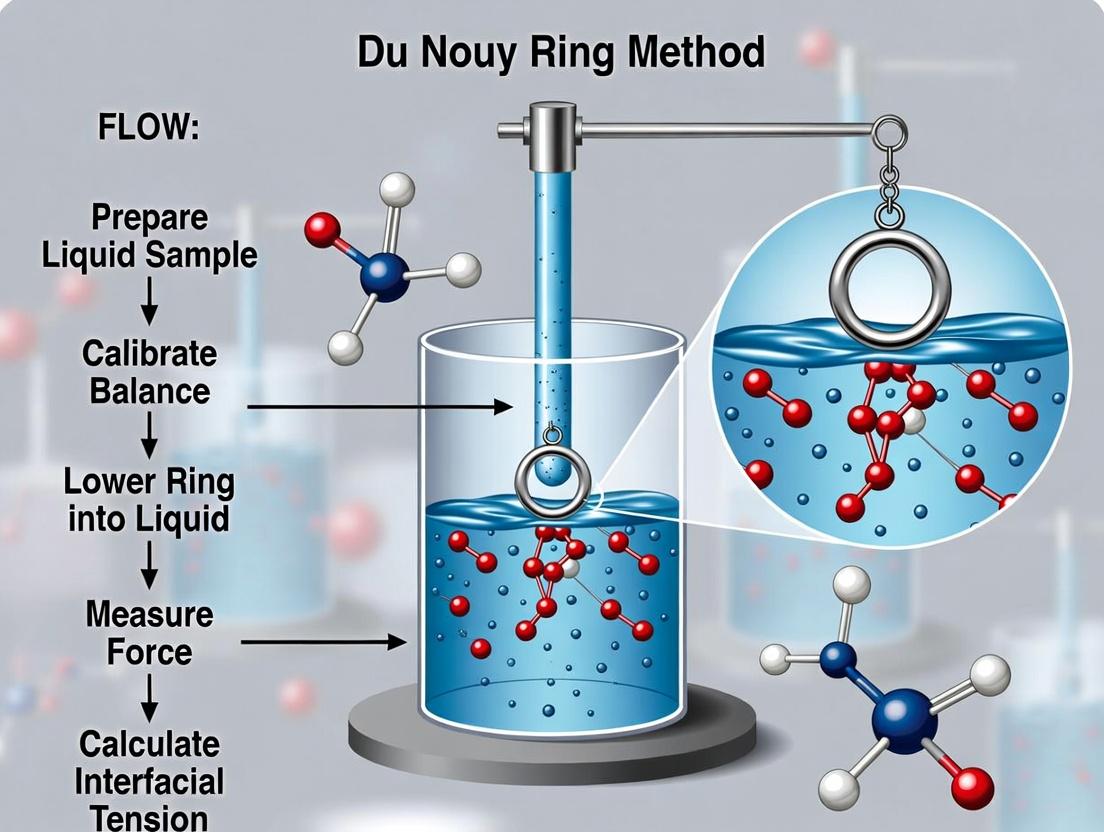
This comprehensive guide explores the Du Noüy ring method for measuring interfacial tension, a critical parameter in pharmaceutical science.
The Du Noüy Ring Method for Interfacial Tension: A Critical Guide for Pharmaceutical Research and Drug Development
Abstract
This comprehensive guide explores the Du Noüy ring method for measuring interfacial tension, a critical parameter in pharmaceutical science. Tailored for researchers, scientists, and drug development professionals, the article covers foundational principles, detailed SOPs for formulation analysis, troubleshooting common experimental pitfalls, and rigorous validation against modern techniques like the Wilhelmy plate. Learn how precise interfacial tension data informs emulsion stability, surfactant efficacy, and bioavailability of complex drug delivery systems.
Understanding Interfacial Tension and the Du Noüy Ring Principle: A Foundation for Pharmaceutical Science
Interfacial tension (IFT) is the contractile force per unit length at the interface between two immiscible phases (e.g., liquid-liquid, liquid-gas). It arises from the imbalance of cohesive forces between molecules at the interface compared to the bulk phases. Within the context of research utilizing the Du Noüy ring method, IFT is a critical quantitative parameter. This technique, based on measuring the maximum force required to detach a platinum ring from an interface, provides precise data essential for understanding and formulating complex multi-phase systems.
Quantitative Impact of IFT Across Systems
Interfacial tension directly dictates the stability, morphology, and performance of dispersed systems. Lowering IFT through surfactants or other amphiphiles is fundamental to their formation and longevity.
Table 1: Target Interfacial Tension Ranges and Functional Impact
| System | Typical Target IFT Range (mN/m) | Critical Role of IFT | Consequence of High/Uncontrolled IFT |
|---|---|---|---|
| Oil-in-Water Emulsions | 1 - 10 | Governs droplet size during homogenization; determines emulsion stability against coalescence. | Large droplet formation, rapid phase separation, poor shelf life. |
| Foams | 20 - 40 (Surface Tension) | Controls bubble size and lamella drainage rate; impacts foamability and foam stability. | Poor foam volume, rapid collapse, coarse bubble structure. |
| Lipid-Based Drug Delivery | < 5 | Enables self-emulsification; dictates droplet size of nanoemulsions for enhanced drug absorption. | Inefficient drug solubilization, slow or incomplete release, variable bioavailability. |
Application Notes & Experimental Protocols
Protocol 1: Evaluating Emulsifier Efficiency using the Du Noüy Ring Tensiometer
Objective: To determine the optimal concentration of a surfactant (e.g., Tween 80) for stabilizing a model mineral oil-in-water emulsion by measuring the equilibrium interfacial tension.
Materials & Reagents:
- Du Noüy Ring Tensiometer (with precision force sensor and temperature control stage).
- Platinum-Iridium Ring: Meticulously cleaned by flame annealing before each measurement.
- Aqueous Phase: Deionized water or buffer solution (e.g., Phosphate Buffered Saline, pH 7.4).
- Oil Phase: High-purity mineral oil.
- Surfactant Stock: Tween 80 in deionized water at varying concentrations (0.01 - 10 mM).
- Cleaning Solvents: Ethanol, acetone, and chromic acid solution for rigorous ring cleaning.
Procedure:
- System Calibration: Calibrate the tensiometer with a standard weight. Ensure the instrument stage is level.
- Sample Preparation: Prepare 20 mL of each Tween 80 solution in a clean glass beaker. Carefully layer an equal volume (20 mL) of mineral oil on top to form a sharp, undisturbed interface. Allow thermal equilibrium (e.g., 25°C) for 10 minutes.
- Measurement: Position the beaker so the ring is immersed in the aqueous (lower) phase. Initiate the automated lift. The instrument records the maximum force ((F_{max})) before the ring detaches from the oil-water interface.
- IFT Calculation: The instrument software calculates IFT ((\gamma)) using the formula: (\gamma = F_{max} / (4\pi R \cdot f)), where (R) is the ring radius and (f) is a correction factor for ring geometry and fluid densities.
- Data Analysis: Plot IFT vs. log(Surfactant Concentration). The critical micelle concentration (CMC) is identified at the inflection point where IFT plateaus.
Protocol 2: Assessing Foam Stability via Surface Tension Dynamics
Objective: To correlate dynamic surface tension reduction with the foamability and stability of a protein (e.g., bovine serum albumin, BSA) solution.
Procedure:
- Dynamic Measurement: Using the Du Noüy ring method in a dedicated mode, measure the surface tension of a 1% w/v BSA solution in a beaker with an air-liquid interface over 1800 seconds (30 minutes). The ring is lifted at set time intervals to capture the adsorption kinetics of BSA at the interface.
- Foam Test Parallel: Simultaneously, generate foam by agitating 10 mL of the same BSA solution in a graduated cylinder for 30 seconds. Record initial foam volume and monitor foam half-life (time for 50% drainage/collapse).
- Correlation: Correlate the rate of surface tension decline and its equilibrium value with the initial foam volume and foam half-life. Rapid reduction to a low equilibrium tension typically indicates good foamability.
Protocol 3: Screening Lipid Excipients for Self-Emulsifying Drug Delivery Systems (SEDDS)
Objective: To screen oil-surfactant combinations for SEDDS by measuring IFT against gastrointestinal fluids.
Procedure:
- Simulated Biorelevant Media: Prepare FaSSIF (Fasted State Simulated Intestinal Fluid) as the aqueous phase.
- Lipid Phase Preparation: Mix a model drug (e.g., fenofibrate) with candidate oils (e.g., soybean oil, medium-chain triglycerides) and surfactants (e.g., Labrasol, Cremophor EL).
- IFT Measurement: Measure the equilibrium IFT between each lipid formulation and FaSSIF at 37°C using the Du Noüy ring method.
- Performance Prediction: Formulations achieving ultralow IFT (< 5 mN/m) are predicted to form fine, stable micro/nanoemulsions upon gentle agitation in the gut, indicating high potential for enhancing drug absorption.
The Scientist's Toolkit: Key Reagents & Materials
Table 2: Essential Research Reagents for IFT Studies
| Item | Function in IFT Research |
|---|---|
| Platinum-Iridium Ring | The probe interfaced with the liquids; its wettability and precise geometry are critical for accurate force measurement. |
| High-Purity Solvents (Chromatography grade) | For cleaning the ring and glassware to eliminate trace contaminants that drastically alter IFT. |
| Model Surfactants (e.g., SDS, Triton X-100, Tween series) | Well-characterized amphiphiles used to calibrate system response and study structure-activity relationships. |
| Biorelevant Media (e.g., FaSSIF/FeSSIF) | Simulated biological fluids for predictive IFT measurements in pharmaceutical development. |
| Standard Weights | For routine calibration of the tensiometer's force sensor, ensuring measurement traceability. |
Experimental and Conceptual Visualizations
Research Workflow from IFT Measurement to Application
IFT Role in Emulsion Stability Pathway
Historical Context and Physical Principle
The Du Noüy ring method, introduced by French physicist Pierre Lecomte Du Noüy in 1925, revolutionized the measurement of surface and interfacial tension (IFT) by providing a practical alternative to the Wilhelmy plate. Its development was driven by the need for a robust technique applicable to liquid-liquid interfaces in burgeoning fields like emulsion science and pharmaceuticals.
The core physical principle relies on measuring the maximum force (F_max) required to detach a platinum-iridium ring from a liquid interface. This force is proportional to the total perimeter of the ring (both inner and outer circumferences) wetted by the liquid. The fundamental equation is:
γ = F_max / (4πR)
where γ is the surface or interfacial tension (mN/m), F_max is the maximum force (mN), and R is the mean radius of the ring (cm). A correction factor (f), dependent on the ring dimensions, liquid densities, and pull volume, is required for accurate absolute measurement, leading to the corrected formula: γcorrected = f * (Fmax / (4πR)).
Application Notes and Key Data
The method is instrumental in drug development for characterizing surfactant efficiency, emulsion stability, and protein behavior at interfaces. Key quantitative parameters and their typical ranges are summarized below.
Table 1: Critical Experimental Parameters and Their Ranges
| Parameter | Typical Range/Value | Significance in IFT Measurement |
|---|---|---|
| Ring Mean Radius (R) | ~0.955 cm (common) | Directly scales the measured force. Must be precisely known. |
| Ring Wire Radius (r) | ~0.03 cm | Affects correction factor; part of R/r ratio. |
| Maximum Force (F_max) | Varies (e.g., 50-100 mN for water) | The primary raw measurement. |
| Correction Factor (f) | 0.75 - 1.15 (Harkins & Jordan) | Corrects for non-vertical force and lifted liquid volume. |
| Liquid Density (ρ) | Required for correction | Difference in phase densities (Δρ) critical for IFT. |
| Measurement Speed | 0.5 - 2 mm/min | Slow speed ensures quasi-static equilibrium. |
Table 2: Example IFT Values in Pharmaceutical Context
| System (Interface) | Approximate IFT (mN/m) | Research Relevance |
|---|---|---|
| Pure Water/Air | 72.8 @ 20°C | Calibration and reference standard. |
| Surfactant Solution/Air (CMC) | 30-40 | Critical micelle concentration determination. |
| Oil/Water (e.g., Paraffin/Water) | ~50 | Baseline for emulsion studies. |
| With 0.1% Span 80 | 5-15 | Evaluating emulsifier efficiency. |
| Protein Solution/Air | Variable, time-dependent | Studying protein adsorption & denaturation kinetics. |
Detailed Experimental Protocols
Protocol 1: Calibration and Validation of the Tensiometer
- Preparation: Clean the ring via rinsing in acetone, then heating in a butane flame until orange-hot to remove all organic contaminants. Ensure the tensiometer is level.
- Standard Measurement: Raise a platform containing ultra-pure water until the ring is fully immersed (~3-5 mm below surface).
- Zeroing: Tare the force sensor with the ring submerged to account for buoyancy.
- Measurement: Initiate a slow, continuous stage descent (e.g., 1 mm/min). Monitor the force until a clear maximum is observed just before the ring detaches from the interface.
- Calculation: Record F_max. Calculate apparent surface tension. Apply the Harkins-Jordan correction factor using known water density, ring dimensions, and pull geometry. The corrected value must match the literature value for water at the experimental temperature (±0.5 mN/m).
Protocol 2: Measuring Dynamic Interfacial Tension of a Surfactant Solution
- Subphase Preparation: Fill a clean glass cuvette with the aqueous buffer solution (the subphase).
- Interface Aging: Puncture the interface with a cleaned ring. Set the initial position precisely at the air/liquid interface (zero immersion depth).
- Surfactant Injection: Using a micro-syringe, carefully inject a concentrated surfactant stock solution into the bulk subphase without disturbing the interface. Use a small magnetic stir bar at very low speed for 30-60 seconds to ensure homogeneous mixing, then stop stirring.
- Data Acquisition: Begin force measurement immediately after stirring stops. Record the force at the interface over time (e.g., for 1800-3600 seconds) without detaching the ring. Periodically perform detachment measurements at key time points (e.g., 5, 30, 300, 1800s) by performing a full pull, then repositioning the ring at the interface.
- Analysis: Plot IFT (corrected) vs. square root of time or log(time). The curve reveals adsorption kinetics, diffusion rate, and equilibrium IFT.
The Scientist's Toolkit: Essential Research Reagents & Materials
Table 3: Key Research Reagents and Materials
| Item | Function & Specification |
|---|---|
| Platinum-Iridium Ring | Primary sensor. Platinum for inertness, iridium for stiffness. Must be perfectly circular and uniform. |
| Ultra-Pure Water | Calibration standard. Resistivity >18 MΩ·cm. |
| Organic Solvents (Acetone, Ethanol) | For preliminary cleaning of rings and glassware to remove grease. |
| Certified Density Standards | Precise liquids for verifying buoyancy corrections and instrument calibration. |
| Model Surfactants (e.g., Triton X-100, SDS) | Well-characterized compounds for method validation and studying adsorption isotherms. |
| Phosphate Buffered Saline (PBS), pH 7.4 | Common physiological buffer for protein or drug formulation studies. |
| High-Purity Oils (e.g., n-Decane, Silicone Oil) | For defined interfacial tension studies in emulsion systems. |
| Glass Cuvettes with High Polishing | Measurement vessels. Must be chemically clean and have low meniscus distortion. |
Visualization of Principles and Workflow
Diagram 1: Historical and Logical Progression
Diagram 2: Core Measurement Workflow
Within the broader thesis on the Du Noüy ring method for interfacial tension research, a critical examination of modern instrumentation is paramount. The evolution from torsion balances to electronically integrated systems has dramatically enhanced precision, reproducibility, and data richness. This note details the three core components—the ring, the force sensor, and the precision stage—that define the capabilities of contemporary tensiometers, framing their function within advanced protocols for pharmaceutical and materials research.
Key Components: Function and Specifications
The Ring
The ring is the defining interfacial probe. Its geometry, material, and cleanliness directly influence the measured force and the accuracy of the calculated interfacial tension (γ).
Critical Parameters:
- Material: Typically platinum or platinum-iridium alloy for optimal wettability and chemical inertness.
- Geometry: A circular wire of radius R, with a wire radius r. The mean radius (R) is precisely known.
- Wettability: Must be meticulously cleaned and flame-annealed to ensure perfect, consistent contact angle (θ ≈ 0°).
The maximum force (F_max) measured during the pull is related to the interfacial tension by: γ = F_max / (4πR) (for ideal conditions with zero contact angle and negligible buoyancy corrections).
The Force Sensor
This component measures the minute forces (typically in the range of µN to mN) on the ring as it is withdrawn from the interface. Modern sensors are high-resolution microbalances or precision strain gauges.
Key Specifications:
- Resolution: ≤ 0.1 µN
- Sampling Rate: High frequency (≥ 10 Hz) for capturing the entire force-distance profile.
- Stability: Low drift for long-term equilibrium studies.
The Precision Staging System
A motorized, digitally controlled stage that provides smooth, precise vertical displacement of the sample vessel or the ring. Its performance dictates the control over the interface approach and separation dynamics.
Key Specifications:
- Resolution: ≤ 0.1 µm
- Speed Range: Wide, adjustable range (e.g., 0.1 µm/s to 10 mm/s) for both gentle interface location and controlled pull-off.
- Accuracy & Repeatability: Essential for reproducible measurements.
Table 1: Quantitative Comparison of Modern Component Specifications
| Component | Key Parameter | Typical Specification | Impact on Measurement |
|---|---|---|---|
| Ring | Mean Radius (R) | 9.55 mm (common) | Direct scaling of measured force. |
| Wire Radius (r) | 0.185 - 0.3 mm | Influences correction factors. | |
| Material Purity | ≥ 99.9% Pt | Ensures consistent wettability. | |
| Force Sensor | Resolution | 0.1 µN | Determines detectability of small γ changes. |
| Measurement Range | ± 100 mN | Accommodates high/low tension samples. | |
| Noise Level | < 1 µN RMS | Affects data smoothness and precision. | |
| Precision Stage | Positioning Resolution | 0.1 µm | Enables precise interface detection. |
| Speed Control | 0.1 µm/s - 50 mm/s | Critical for dynamic/equilibrium studies. | |
| Vertical Run-out | < 5 µm | Ensures level, parallel movement. |
Experimental Protocols
Protocol 1: Critical Micelle Concentration (CMC) Determination of a Surfactant
Application: Drug formulation, characterizing surfactant efficiency.
Materials: See "The Scientist's Toolkit" below.
Procedure:
- Ring Preparation: Clean the platinum ring via immersion in hot piranha solution (CAUTION: Extremely corrosive), rinse exhaustively with ultrapure water, and flame-anneal until red-hot. Allow to cool in air.
- System Calibration: Calibrate the force sensor and stage using certified weights and distance standards.
- Solution Series: Prepare a logarithmic series of surfactant concentrations (e.g., from 0.01 mM to 10 mM) in appropriate buffer.
- Measurement: a. Pour sample into a clean, low-static glass vessel. b. Position vessel on the stage. Use the stage to slowly raise the liquid until the ring is fully immersed (~2-3 mm depth). c. Initiate automatic measurement cycle: The stage descends to detach the ring from the bulk, pauses, then rises very slowly (e.g., 0.5 mm/s). d. The software records the full force-distance profile, identifying F_max. e. Repeat in triplicate for each concentration.
- Data Analysis: Plot interfacial tension (γ) vs. log(concentration). The CMC is identified as the distinct break point where γ plateaus.
Protocol 2: Interfacial Tension Kinetics at an Oil-Water Interface
Application: Studying emulsion stability, protein adsorption at interfaces.
Materials: See "The Scientist's Toolkit" below.
Procedure:
- Interface Creation: Load the denser phase (e.g., aqueous buffer) into the vessel. Carefully overlay the lighter phase (e.g., purified oil) using a syringe to minimize mixing. Allow system to thermally equilibrate.
- Initial Condition: Position the cleaned ring within the upper (oil) phase.
- Kinetic Measurement: a. Initiate a slow stage movement to position the ring at the oil-water interface, indicated by a sharp change in force. b. Once positioned, the stage holds its Z-position. c. The force sensor records continuously at high frequency (e.g., 10 Hz) for a defined period (minutes to hours).
- Data Analysis: Plot γ vs. time. Analyze the decay curve to model adsorption kinetics and infer diffusion coefficients or interfacial rheology.
Diagrams
Diagram 1: CMC Determination Protocol Workflow
Diagram 2: Interfacial Tension Kinetics Measurement
The Scientist's Toolkit
Table 2: Essential Research Reagents & Materials
| Item | Function & Specification | Rationale |
|---|---|---|
| Platinum-Iridium Ring | Interfacial probe. Standard mean radius: 9.55 mm. | Chemically inert, achieves near-zero contact angle when clean, providing the defined geometry for the Du Noüy method. |
| Ultra-Pure Water | Solvent for aqueous phases. Resistivity ≥ 18.2 MΩ·cm. | Minimizes contaminants that adsorb at interfaces and artifactually lower measured tension. |
| HPLC-Grade Organic Solvents | Low-surfactant oils (e.g., decane, octane) or other organic phases. | Ensures consistent, pure organic-aqueous interfaces for fundamental studies. |
| Analytical Grade Surfactants | High-purity (e.g., SDS, Triton X-100, polysorbates). | Essential for quantitative adsorption studies and CMC determination. |
| Piranha Solution | 3:1 v/v concentrated H₂SO₄ : 30% H₂O₂. EXTREME HAZARD. | Effectively removes all organic contaminants from platinum surfaces. |
| Precision Glass Vessels | Low-form, high-quality glass beakers or dishes. | Minimizes meniscus effects at vessel walls and allows easy cleaning. |
| Calibration Weights | Certified, traceable mass set (e.g., 100 mg to 1 g). | For periodic verification of force sensor accuracy and linearity. |
| Buffer Salts | Analytical grade (e.g., PBS, Tris). | Provides controlled ionic strength for biologically relevant interfacial studies. |
The Du Nouy ring method is a classical technique for measuring surface and interfacial tension (IFT). Within a broader thesis on advancing this method for modern interfacial research, particularly in pharmaceutical development (e.g., emulsion stability, protein adsorption, lipid bilayer mechanics), understanding and applying rigorous correction factors is paramount. The raw force measured during a ring pull experiment is not directly equivalent to the IFT due to the complex meniscus shape and the non-uniform distribution of forces acting on the ring. This necessitates two critical corrections: one for the meniscus shape and volume (the meniscus shape correction factor, f_m), and one for the geometry of the ring itself (the Harkins-Jordan factor, F). These corrections transform the observed maximum pull force into an accurate IFT value, crucial for reproducible science in drug formulation and delivery system characterization.
Table 1: Key Parameters for Correction Calculations in the Du Nouy Ring Method
| Parameter | Symbol | Typical Range/Value | Description & Relevance |
|---|---|---|---|
| Ring Radius | R | 0.5 - 1.0 cm | The mean radius of the platinum-iridium ring. Critical for dimension ratios. |
| Wire Radius | r | 0.01 - 0.03 cm | The radius of the ring's cross-sectional wire. |
| Dimension Ratio | R/r | 15 - 50 | A key geometric parameter for the Harkins-Jordan factor (F). |
| Dimensionless Volume | V/R³ | N/A | Derived from meniscus shape, used in modern meniscus correction (f_m). |
| Harkins-Jordan Factor | F | 0.75 - 1.05 (unitless) | Correction factor for ring geometry and meniscus deformation. Depends on R/r and R³/V. |
| Meniscus Shape Factor | f_m | ~1.00 - 1.10 (unitless) | Corrects for the deviation of the meniscus from an ideal shape. |
| Apparent Surface Tension | γ_app | mN/m | Calculated from raw force: γapp = Fmax / (4πR). |
| Corrected IFT | γ_corr | mN/m | Final, accurate value: γcorr = F * fm * γapp = (F * fm * F_max) / (4πR). |
Table 2: Example Harkins-Jordan Factor (F) Values (Adapted from Literature) Note: F is traditionally tabulated as a function of R³/V and R/r.
| R³/V (cm⁻³) | R/r = 15 | R/r = 30 | R/r = 50 |
|---|---|---|---|
| 0.00 | 0.96 | 0.98 | 0.99 |
| 0.10 | 0.97 | 0.99 | 1.00 |
| 0.30 | 0.99 | 1.00 | 1.01 |
| 0.50 | 1.00 | 1.01 | 1.02 |
| 0.70 | 1.02 | 1.02 | 1.03 |
Experimental Protocols
Protocol A: Standard Operation of a Du Nouy Tensiometer with Corrections
Objective: To determine the accurate interfacial tension (liquid-air or liquid-liquid) with full meniscus and Harkins-Jordan corrections.
Materials: See "The Scientist's Toolkit" below.
Procedure:
- Calibration & Setup:
- Calibrate the microbalance or force sensor of the tensiometer using standard weights.
- Thoroughly clean the platinum-iridium ring using a solvent (ethanol, acetone), followed by rinsing with high-purity water and flaming dry (cool before use).
- Level the instrument and the sample stage.
- Pour the test liquid into a clean petri dish or beaker to a sufficient depth (>5 mm). For interfacial tension, carefully add the lighter phase on top.
Measurement of Raw Force (F_max):
- Position the ring above the liquid, ensuring it is parallel to the surface.
- Zero the force sensor.
- Slowly lower the ring until it is fully immersed in the sub-phase (for surface tension) or the lower phase (for IFT).
- Initiate the upward pull at a controlled, slow speed (typically 0.5 - 1.0 mm/min). Modern instruments automate this.
- Record the maximum force (F_max) just before the meniscus ruptures. Perform this in triplicate.
Data Correction & Calculation:
- Calculate the apparent surface tension: γapp = Fmax / (4πR), where R is the mean ring radius.
- Determine the dimensionless volume parameter (V/R³).
Vis the volume of liquid lifted, calculated from the meniscus profile via software or approximated from the pull geometry. - Obtain the meniscus shape correction factor (f_m). For modern instruments, this is often computed in real-time using integrated algorithms based on meniscus imaging or theoretical models (e.g., Young-Laplace fitting).
- Using the known R/r ratio and the calculated R³/V, find the Harkins-Jordan factor (F) from the instrument's software or standard reference tables (see Table 2).
- Calculate the corrected interfacial tension: γcorr = F * fm * γ_app.
- Report the mean and standard deviation of γ_corr from replicates.
Protocol B: Empirical Verification of Correction Factors using Standard Liquids
Objective: To validate the correction protocol by measuring a liquid with known, invariant surface tension.
Materials: Ultra-pure water, certified absolute ethanol, or other reference liquids with published IFT values at a controlled temperature.
Procedure:
- Perform Protocol A using ultra-pure water as the sample. Maintain a constant temperature (e.g., 20°C or 25°C).
- Compare the calculated γ_corr with the literature value for water at that temperature (e.g., 72.75 mN/m at 20°C).
- The percent difference should be <0.5% for a well-calibrated system with proper corrections applied. A significant discrepancy (>2%) indicates potential error in ring geometry constants, calibration, or the application of correction factors.
Visualizations
Data Correction Workflow for Du Nouy Ring Method
Logical Relationship of Corrections to True IFT
The Scientist's Toolkit
Table 3: Essential Research Reagents & Materials for Du Nouy Ring Experiments
| Item | Function & Importance |
|---|---|
| Platinum-Iridium Ring | The primary sensor. Platinum ensures perfect wettability for most liquids; iridium adds rigidity. Must have precisely known radius (R) and wire radius (r). |
| High-Purity Solvents (HPLC-grade Acetone, Ethanol) | For critical ring cleaning to remove any organic contaminants that drastically alter measured IFT. |
| Ultra-Pure Water (Type I, 18.2 MΩ·cm) | The primary calibration standard for surface tension measurements. Temperature must be controlled. |
| Certified Reference Liquds (e.g., DMSO, Toluene) | Used for method validation and periodic instrument performance checks across a range of IFT values. |
| Temperature-Controlled Stage | IFT is highly temperature-dependent. A Peltier stage or water jacket is essential for reproducible results. |
| Optical Meniscus Profiling System (Camera) | Found in advanced tensiometers. Allows direct imaging of the meniscus for software-based shape analysis and volume (V) determination, enabling accurate f_m. |
| Precision Syringes & Pipettes | For accurate preparation of surfactant or drug formulation solutions, where concentration is critical to IFT. |
| Software with Harkins-Jordan & Meniscus Correction Libraries | Modern analysis software automatically applies F and f_m corrections using built-in algorithms and reference data, minimizing manual calculation errors. |
Why Interfacial Tension Matters in Drug Formulation, Pulmonary Surfactants, and Biomaterial Coatings
Interfacial tension (IFT) is a critical physical parameter governing interactions at the boundaries between phases. Its precise measurement, often via the Du Noüy ring method, is essential in applied life sciences. This note, situated within a broader thesis on the Du Noüy ring method, details its application in three key areas: stabilizing complex drug formulations, understanding pulmonary surfactant function, and engineering biocompatible material coatings. Control of IFT directly influences emulsion/droplet stability, alveolar mechanics, and protein adsorption, respectively.
Application Notes & Protocols
Drug Formulation: Nanoemulsion Stability
Nanoemulsions enhance bioavailability of poorly soluble active pharmaceutical ingredients (APIs). IFT between oil and water phases dictates droplet size, stability, and energy required for emulsification. Lower IFT facilitates formation of smaller, more stable droplets.
Key Quantitative Data: Table 1: Interfacial Tension & Nanoemulsion Properties for Common Excipients (Water-Oil System)
| Oil Phase | Surfactant (1% w/v) | IFT (mN/m) | Mean Droplet Size (nm) | PDI | Stability (3 months) |
|---|---|---|---|---|---|
| Miglyol 812 | Tween 80 | 5.2 ± 0.3 | 145 ± 10 | 0.12 | Stable |
| Caprylic/Capric Triglyceride | Lecithin | 7.8 ± 0.5 | 180 ± 15 | 0.15 | Stable |
| Ethyl Oleate | Poloxamer 188 | 10.1 ± 0.7 | 220 ± 20 | 0.18 | Mild Creaming |
| Squalene | SDS | 3.5 ± 0.4 | 110 ± 8 | 0.10 | Stable |
Protocol 1: Formulating & Assessing a Model Nanoemulsion Aim: Prepare an o/w nanoemulsion and correlate initial IFT with final droplet characteristics. Materials: (See Toolkit Table) Method:
- Pre-measure IFT: Using a Du Noüy ring tensiometer, measure the equilibrium IFT between your selected oil and the aqueous surfactant solution. Record value.
- Low-Energy Emulsification (Phase Inversion): a. Mix oil and surfactant in a 20:80 ratio (w/w) at 25°C with magnetic stirring. b. Slowly titrate the aqueous phase (containing any hydrophilic stabilizers) into the oil-surfactant mixture at a rate of 1 mL/min. Increase stirrer speed to 1000 rpm. c. Monitor conductivity. A sudden drop indicates phase inversion to an o/w emulsion. d. Continue stirring for 30 minutes post-inversion.
- Characterization: Determine droplet size distribution and Polydispersity Index (PDI) via Dynamic Light Scattering (DLS). Visually inspect for phase separation over time.
- Analysis: Plot initial IFT against mean droplet size. Lower IFT should correlate with smaller droplet size.
Diagram 1: Nanoemulsion formulation workflow.
Pulmonary Surfactants: Alveolar Mechanics
Pulmonary surfactants reduce surface tension at the air-liquid alveolar interface, preventing collapse at end-expiration. IFT dynamics (minimum and maximum tension during compression/expansion) are critical metrics.
Key Quantitative Data: Table 2: Interfacial Tension Parameters of Pulmonary Surfactant Components & Formulations
| Surfactant Material | Minimum Surface Tension (mN/m) | Maximum Surface Tension (mN/m) | Compression Rate (cm/min) | Key Function |
|---|---|---|---|---|
| Natural (Porcine) Surfactant | < 1 | 45 | 20 | Gold standard, optimal dynamics |
| DPPC (Main Component) | ~10 | 65 | 20 | Provides low minimum tension |
| DPPC:POPG (7:3) | < 5 | 50 | 20 | Mimics fluidity and adsorption |
| Clinical Formulation (Beractant) | < 2 | 40 | 20 | Treats Neonatal RDS |
| Surfactant Protein B (SP-B) | Crucial for rapid adsorption and film stability |
Protocol 2: Simulating Alveolar Dynamics with a Langmuir Trough Aim: Measure IFT dynamics of a surfactant film under cyclic compression to model breathing. Materials: (See Toolkit Table) Method:
- Subphase & Film Preparation: Fill a Langmuir trough with filtered PBS (pH 7.4, 37°C). Clean surface via aspiration. Spread surfactant in volatile solvent dropwise onto the subphase. Wait 15 min for solvent evaporation and film equilibration.
- Initial Measurement: Using a Du Noüy ring (or Wilhelmy plate), measure the static equilibrium IFT.
- Cyclic Compression: Set barriers to cyclically compress and expand the film at a defined area change (e.g., 50% reduction) and speed (e.g., 20 cm/min), simulating tidal breathing.
- Data Recording: Continuously record IFT via the force on the ring/plate over multiple cycles (typically 5-10).
- Analysis: Report minimum surface tension (γmin) achieved at maximum compression and maximum surface tension (γmax) at full expansion. Calculate hysteresis loop area.
Diagram 2: Lung surfactant dynamic tension protocol.
Biomaterial Coatings: Protein Resistance
For implants and devices, minimizing non-specific protein adsorption (fouling) is key to biocompatibility. Coatings that create a hydrophilic, steric barrier achieve this by raising the interfacial tension against protein solutions, making adsorption thermodynamically unfavorable.
Key Quantitative Data: Table 3: Interfacial Tension & Protein Adsorption on Coated Biomaterials
| Coating Material | IFT vs. Water (mN/m) | IFT vs. Fibrinogen Solution (mN/m) | Protein Adsorption Reduction (%) | Coating Method |
|---|---|---|---|---|
| Uncoated PDMS | ~40 | 35 | 0 (Baseline) | N/A |
| PEG-Silane | ~65 | 62 | >90 | Chemical Grafting |
| Poly(HEMA) | ~55 | 52 | ~75 | Spin Coating |
| Phosphorylcholine | ~70 | 68 | >95 | Self-Assembly |
| Pluronic F127 (Adsorbed) | ~50 | 48 | ~70 | Physical Adsorption |
Protocol 3: Assessing Coating Efficacy via IFT and Protein Adsorption Aim: Correlate the IFT of a coated surface against a protein solution with the degree of protein resistance. Materials: (See Toolkit Table) Method:
- Substrate Coating: Coat clean substrate (e.g., glass slide, PDMS) with your chosen anti-fouling polymer (e.g., PEG-silane via chemical vapor deposition).
- Contact Angle/IFT Measurement: Using a pendant drop or Du Noüy ring method, measure the advancing IFT between the coated surface (simulated as a low-energy solid) and a 1 mg/mL fibrinogen in PBS solution. A higher IFT indicates better resistance.
- Protein Adsorption Test (Complementary): Incubate coated and uncoated substrates in the same fibrinogen solution for 1 hour at 37°C.
- Quantification: Rinse substrates thoroughly and quantify adsorbed protein using a colorimetric assay (e.g., Micro BCA).
- Correlation: Plot measured IFT values against quantified protein adsorption.
The Scientist's Toolkit
Table 4: Essential Reagents & Materials for Featured Experiments
| Item | Function/Relevance | Example/Note |
|---|---|---|
| Du Noüy Ring Tensiometer | Core instrument for equilibrium IFT measurement. | Must ensure ring is meticulously cleaned and flame-dried before each measurement. |
| Langmuir-Blodgett Trough | For studying dynamic surface tension of films under compression. | Essential for pulmonary surfactant studies. |
| High-Purity Surfactants (Tween 80, Lecithin, Poloxamer) | Stabilize emulsions by lowering oil-water IFT. | Critical for nanoemulsion formulation. |
| Model Oils (Miglyol 812, Squalene) | Representative oil phases for drug formulation studies. | Well-defined composition ensures reproducibility. |
| DPPC (1,2-dipalmitoyl-sn-glycero-3-phosphocholine) | Primary lipid component of pulmonary surfactant. | Forms stable, low-tension monolayers. |
| PEG-Silane (e.g., (MeO)3-Si-PEG) | Forms covalent anti-fouling coatings on oxide surfaces. | Raises effective IFT against biofluids. |
| Dynamic Light Scattering (DLS) Instrument | Measures droplet/nanoparticle size and PDI. | Correlates initial IFT with final emulsion stability. |
| Micro BCA Protein Assay Kit | Quantifies low levels of adsorbed protein on surfaces. | Validates IFT-based predictions of fouling resistance. |
| Phosphate Buffered Saline (PBS), pH 7.4 | Standard physiological buffer for in vitro tests. | Used in pulmonary and biomaterial protocols. |
Standard Operating Procedure: Applying the Du Noüy Ring Method in Pharmaceutical R&D
Within the framework of a thesis on the Du Nouy ring method for interfacial tension (IFT) research, the reliability of data is paramount. This method, based on measuring the maximum force required to detach a platinum-iridium ring from an interface, is exquisitely sensitive to contamination and physical imperfections. This document establishes detailed application notes and protocols for sample preparation, ring cleaning, and handling to ensure measurement accuracy and reproducibility in applications ranging from surfactant characterization to biopharmaceutical formulation development.
The Scientist's Toolkit: Essential Research Reagent Solutions
| Item | Function & Rationale |
|---|---|
| High-Purity Water (e.g., HPLC-grade, Millipore Milli-Q) | The universal solvent and cleaning agent. Low surface tension (72.8 mN/m at 20°C) must be verified to ensure purity. Used for aqueous phase preparation and final ring rinsing. |
| Chromatography-Grade Organic Solvents (e.g., Methanol, Ethanol, Acetone) | Used in sequential cleaning to dissolve and remove organic contaminants from the ring and glassware through a series of polarity. |
| Plasma Cleaner (or Piranha Solution*) | For ultimate glassware and ring decontamination. Generates a hydrophilic, contaminant-free surface by reactive ion etching or oxidative cleaning. *Extreme hazard; requires specialized training. |
| Analytical Balance (µg sensitivity) | Critical for precise preparation of solution concentrations, especially for surfactants and drug compounds, where molarity directly impacts IFT. |
| Temperature-Controlled Vessel | Interfacial tension is temperature-dependent (≈ -0.1 mN/m per °C for water). A jacketed beaker connected to a circulator is essential for isothermal measurements. |
| Platinum-Iridium Du Nouy Ring (typically ~4-6 cm mean circumference) | The core sensor. Must be perfectly planar, smooth, and homogeneous. Even minor deformation (>0.5% from circularity) invalidates calibration. |
Protocols for Sample Preparation
3.1 Aqueous Solution Preparation
- Materials: High-purity water, analytical-grade solute, volumetric glassware, magnetic stirrer, temperature control bath.
- Protocol:
- Clean all glassware (see Section 4.0).
- Fill the volumetric flask approximately halfway with high-purity water.
- Add the precise mass of solute using an analytical balance.
- Cap and stir gently until complete dissolution, avoiding vortex formation that can introduce bubbles.
- Dilute to the mark with water, ensuring temperature equilibration.
- Allow the solution to rest in a temperature-controlled bath for ≥30 minutes to allow thermal and chemical equilibrium. For surfactant solutions, allow additional time (≥1 hour) for interfacial adsorption equilibrium.
3.2 Organic Phase Preparation (for Liquid-Liquid IFT)
- Follow steps 1-6 above, using the organic solvent as the bulk phase. Conduct all procedures in a fume hood. Pre-saturate the organic and aqueous phases with each other by mutual stirring and separation to prevent composition drift during measurement.
Protocols for Ring and Glassware Cleaning
4.1 Standard Sequential Solvent Cleaning (Daily/Between Samples)
- Objective: Remove adsorbed organic films and residues.
- Protocol:
- Rinse the ring and glassware thoroughly with high-purity water.
- Immerse/rinse in acetone to remove non-polar organics.
- Immerse/rinse in ethanol or methanol.
- Perform a final, extensive rinse with a generous stream of high-purity water.
- Critical Step: Pass the ring briefly through the blue flame of a Bunsen burner (2-3 seconds) to combust any remaining organic residue and ensure complete dryness. Allow to cool in clean air.
4.2 Intensive Cleaning (Weekly or After Contaminated Samples)
- Objective: Achieve atomically clean surfaces.
- Protocol A (Chemical - Extreme Hazard):
- Prepare fresh piranha solution (3:1 v/v concentrated sulfuric acid : 30% hydrogen peroxide) in a clean, compatible container. Warning: Exothermic, highly oxidative, and explosive upon contact with organics.
- Immerse the ring and glassware for 15-30 minutes.
- Remove and perform a minimum of 10 exhaustive rinses with high-purity water.
- Protocol B (Physical - Recommended):
- Place ring and glassware in a plasma cleaner chamber.
- Evacuate chamber and generate an oxygen or argon/oxygen plasma for 5-10 minutes.
- Vent chamber and use components immediately to minimize airborne recontamination.
Ring Handling and Operational Best Practices
- Handling: Always use ceramic-tipped or platinum-tipped forceps. Never touch the ring with bare hands or metal tools.
- Alignment: The ring must be perfectly parallel to the interface prior to measurement. Use the instrument's leveling stage. A tilted ring introduces significant error (>10%).
- Immersion: Lower the ring slowly through the interface to a depth of ~2-5 mm before starting the measurement, ensuring it is fully wetted by the lower phase.
- Measurement: The lift speed must be slow and consistent (typically 1-5 mm/min) to allow the lamella to form quasi-statically. A visual check of the meniscus shape is mandatory.
- Validation: Frequently calibrate the instrument and verify ring geometry by measuring the surface tension of high-purity water at a known temperature. Deviation from the literature value by >0.5 mN/m indicates a problem (see Table 1).
Data Presentation: Validation and Troubleshooting
Table 1: Expected Surface Tension of Pure Liquids at 20°C (for System Validation)
| Liquid | Expected Surface Tension (mN/m) | Tolerance for Acceptance (± mN/m) | Common Cause of Deviation |
|---|---|---|---|
| Ultrapure Water | 72.80 | 0.3 | Contaminated water, dirty ring, or misaligned ring. |
| Methanol | 22.50 | 0.5 | Water contamination, evaporation. |
| Ethanol | 22.10 | 0.5 | Water contamination, evaporation. |
| Toluene | 28.40 | 0.3 | Organic contaminants, humidity. |
Visualization: Experimental Workflow
Diagram Title: Du Nouy Method Quality Assurance Workflow
Within a thesis investigating the Du Nouy ring method for interfacial tension, precise force-displacement data acquisition is paramount. This protocol details the calibration procedures and measurement workflows essential for obtaining reliable data, crucial for researchers in interfacial science and pharmaceutical development where formulation stability is key.
Calibration Protocols for Force-Displacement Systems
Force Sensor Calibration
Objective: To establish a traceable relationship between the sensor's output signal (e.g., voltage) and the applied force (in Newtons or mN).
Protocol:
- Equipment Setup: Mount the force sensor (e.g., from a tensiometer) securely. Connect it to the data acquisition (DAQ) system and ensure thermal equilibration (30 min).
- Zeroing: With no load applied, record the baseline output for 60 seconds. Set this average value as the electronic zero.
- Application of Standard Weights:
- Use a set of certified calibration weights traceable to national standards (e.g., NIST).
- Procedure: Gently hang the weight from the ring attachment point (without the ring) or apply vertically using a weight pan. Ensure no lateral forces.
- Apply weights in ascending order, then descending order to check for hysteresis. Allow 30 seconds of stabilization at each load before recording the DAQ output.
- Cover the expected measurement range, including points near the anticipated interfacial tension force.
- Data Analysis:
- Plot Applied Force (Y-axis) vs. DAQ Output (X-axis).
- Perform a linear regression (Force = m * Output + b). The coefficient
mis the calibration factor. - The R² value must be >0.9999. Hysteresis should be <0.1% of full scale.
Table 1: Example Force Calibration Data
| Certified Mass (g) | Applied Force (mN)* | DAQ Output (V) - Ascending | DAQ Output (V) - Descending |
|---|---|---|---|
| 0.000 | 0.00 | 0.00102 | 0.00110 |
| 0.500 | 4.91 | 0.50115 | 0.50120 |
| 1.000 | 9.81 | 1.00025 | 1.00030 |
| 1.500 | 14.72 | 1.50130 | 1.50135 |
| 2.000 | 19.62 | 2.00040 | 2.00045 |
*Force = mass * 9.81 m/s²
Displacement Encoder/Actuator Calibration
Objective: To verify the accuracy of stage or probe movement relative to its commanded position.
Protocol:
- Laser Interferometer Method (High Precision):
- Align a laser interferometer retroreflector on the moving stage holding the Du Nouy ring.
- Command a series of precise movements (e.g., 10 μm, 100 μm, 1 mm steps) across the working range.
- Record the commanded position vs. the interferometer-measured position.
- Calculate a correction factor or map positional error.
- Gauge Block Method:
- Use a precision height gauge or calibrated gauge blocks.
- Bring the ring into gentle contact with a reference surface and zero the position.
- Command a lift of a specific distance (e.g., 1 mm). Measure the actual lift using a dial indicator or the gauge blocks.
- Repeat at multiple points in the range.
Table 2: Displacement Calibration Check
| Commanded Displacement (mm) | Measured Displacement (mm) | Error (%) |
|---|---|---|
| 0.100 | 0.0998 | -0.20 |
| 0.500 | 0.4995 | -0.10 |
| 1.000 | 0.9990 | -0.10 |
| 2.000 | 1.9988 | -0.06 |
| 5.000 | 4.9975 | -0.05 |
Measurement Protocol for Du Nouy Ring Experiment
Pre-Experiment Calibration Check:
- Perform a one-point force check using a standard weight near the expected maximum pull force.
- Verify the zero position of the displacement system.
Sample and Ring Preparation:
- Clean the platinum-iridium ring thoroughly: Rinse with solvent (e.g., acetone), then pure water, and finally flame in a Bunsen burner until orange-hot to remove organic contaminants.
- Prepare the liquid sample in a clean glass vessel, ensuring it is level and free from vibrations.
- Mount the ring on the calibrated force sensor.
Data Acquisition Workflow:
- Immersion: Lower the ring at a constant speed (typically 1-2 mm/min) until it is fully immersed (just below the interface). Hold for 30 seconds to allow thermal and mechanical equilibrium.
- Initiation: Begin data acquisition at a high sampling rate (≥50 Hz).
- Withdrawal: Retract the ring at a constant, slow speed (e.g., 0.5-1 mm/min). The force increases as the lamella forms, reaches a maximum (
F_max), and then drops abruptly just before rupture. - Capture: Record the entire force-displacement curve until ring detachment.
Critical Data Processing:
- Baseline Subtraction: Subtract the buoyancy-corrected baseline force (ring submerged just below interface).
- Peak Identification: Algorithmically identify the maximum force before rupture.
- Interfacial Tension Calculation: Apply the Du Nouy correction factor (Huh and Scriven, 1969; Zuidema and Waters, 1941) to convert
F_maxto interfacial tension (γ):γ = F_max / (4πR) * fwhereRis the ring radius andfis the correction factor dependent on ring geometry and liquid densities.
Visualizing the Calibration and Measurement Workflow
Title: Force-Displacement Data Acquisition & Calibration Workflow
The Scientist's Toolkit: Key Research Reagent Solutions
Table 3: Essential Materials for Du Nouy Ring Experiments
| Item | Function & Specification |
|---|---|
| Platinum-Iridium Du Nouy Ring | The sensing element. Platinum ensures inertness; iridium adds rigidity. Must be precisely circular with a known mean radius and wire thickness for correction factors. |
| Certified Calibration Weights | For traceable force sensor calibration. Typically Class 1 or better, covering the range of 0.1 to 20 mN. |
| Ultra-Pure Water (HPLC Grade) | Used for ring rinsing, as a control substance, and for preparing aqueous solutions. Its known surface tension (72.8 mN/m at 20°C) validates calibration. |
| Analytical Grade Solvents (Acetone, Ethanol) | For degreasing and pre-cleaning the ring and sample vessels before final flaming. |
| Reference Standard Liquids | e.g., Toluene, Methanol. Liquids with precisely known interfacial tensions against air or water, used for system validation. |
| Precision Glass Sample Vessels | Shallow, wide dishes to minimize meniscus effects from walls. Must be scrupulously clean to avoid surfactant contamination. |
| Temperature Control Bath/Circulator | Maintains sample temperature (±0.1°C), as interfacial tension is highly temperature-sensitive. |
| Data Acquisition (DAQ) Software | Custom or commercial software capable of high-frequency sampling, real-time display, and precise triggering of stage movement. |
Within the broader thesis on the Du Noüy ring method for interfacial tension research, this application note details its critical use in the quantitative screening of surfactant efficacy and the determination of the Critical Micelle Concentration (CMC). The CMC is a fundamental parameter in surfactant science, indicating the concentration at which surfactant monomers begin to self-assemble into micelles, marking a drastic change in solution properties. Accurate CMC determination is vital for researchers and drug development professionals formulating stable emulsions, solubilizing hydrophobic drugs, and designing delivery systems.
Theoretical Background and Significance
Surfactants reduce interfacial tension (IFT) between two phases (e.g., air-water or oil-water). As concentration increases, IFT decreases linearly until the CMC is reached. Beyond the CMC, IFT remains relatively constant as added surfactants form micelles rather than accumulating at the interface. The Du Noüy ring method, which measures the force required to detach a platinum ring from an interface, provides a classical and reliable technique for constructing IFT versus concentration plots to identify the CMC.
Key Research Reagent Solutions & Materials
Table 1: Essential Research Toolkit for Surfactant Screening via Du Noüy Ring Method
| Item | Function & Specification |
|---|---|
| Tensiometer | Instrument equipped with a precision force sensor and a Du Noüy ring holder for measuring interfacial tension. Must be calibrated regularly. |
| Platinum-Iridium Du Noüy Ring | A meticulously cleaned, circular ring (typical circumference 4-6 cm) made of platinum-iridium alloy for optimal wettability and inertness. |
| High-Purity Water | Solvent, typically Type I (18.2 MΩ·cm) deionized water, to prepare surfactant solutions and ensure no interference from impurities. |
| Analytical Balance | For precise weighing of surfactant samples to prepare stock and serial dilution solutions. |
| Surfactant Standards | Pure, well-characterized surfactants (e.g., Sodium Dodecyl Sulfate, Triton X-100) for method validation and calibration checks. |
| Temperature-Controlled Vessel | A jacketed beaker or sample vessel connected to a circulator to maintain constant temperature (e.g., 25.0 ± 0.1°C), as CMC is temperature-dependent. |
| Organic Solvents (e.g., CHCl₃, Ethanol) | For rigorous cleaning of the Du Noüy ring between measurements to prevent contamination. |
| pH Meter & Buffers | For preparing and adjusting surfactant solutions to a specific pH, crucial for ionic surfactants whose CMC can vary with pH. |
Experimental Protocol: CMC Determination via Du Noüy Ring Method
Protocol Title: Determination of Critical Micelle Concentration (CMC) of Aqueous Surfactant Solutions by Static Surface Tension Measurement Using the Du Noüy Ring Method.
Objective: To measure the surface tension of a surfactant at a series of concentrations, plot the data, and determine the CMC from the breakpoint in the curve.
Materials & Equipment: As listed in Table 1.
Procedure:
- Instrument Calibration: Calibrate the tensiometer with a known weight as per manufacturer instructions. Ensure the instrument is level.
- Ring Cleaning: Flame the platinum-iridium ring until red-hot or rinse thoroughly with appropriate solvents (e.g., chloroform, followed by ethanol) and pure water. Allow to dry. Handle only with tweezers.
- Solution Preparation: Prepare a concentrated stock solution of the surfactant under investigation. Perform serial dilutions in high-purity water to obtain a concentration series spanning at least two orders of magnitude across the expected CMC (e.g., from 0.1 mM to 20 mM for SDS). Allow solutions to equilibrate at the target temperature (e.g., 25°C) for at least 30 minutes.
- Measurement:
a. Fill the temperature-controlled sample vessel with the most dilute solution.
b. Position the vessel so the ring is immersed below the air-liquid interface.
c. Initiate the measurement. The stage automatically lowers, pulling the ring through the interface. The instrument records the maximum force (
F_max) required to detach the ring. d. The surface tension (γ) is calculated using:γ = F_max / (4πR * f), whereRis the ring radius andfis a correction factor (Harkins and Jordan) provided by the instrument software. e. Repeat each concentration measurement in triplicate. f. Clean the ring meticulously between each sample using the established protocol. - Data Analysis: Plot the average surface tension (mN/m) against the logarithm of surfactant concentration (log C). Identify the CMC as the concentration at the intersection of the two linear regressions drawn through the pre- and post-micellar regions of the plot.
Data Presentation and Analysis
Table 2: Exemplar Surface Tension Data for Sodium Dodecyl Sulfate (SDS) at 25°C
| Concentration (mM) | Log(Concentration) | Surface Tension, γ (mN/m) [Mean ± SD, n=3] |
|---|---|---|
| 0.10 | -1.00 | 71.2 ± 0.3 |
| 0.50 | -0.30 | 65.4 ± 0.2 |
| 1.00 | 0.00 | 58.1 ± 0.4 |
| 2.00 | 0.30 | 48.3 ± 0.3 |
| 3.00 | 0.48 | 40.5 ± 0.5 |
| 4.00 | 0.60 | 38.1 ± 0.2 |
| 5.00 | 0.70 | 37.9 ± 0.1 |
| 6.00 | 0.78 | 37.8 ± 0.2 |
| 8.00 | 0.90 | 37.7 ± 0.1 |
| 10.00 | 1.00 | 37.6 ± 0.2 |
Analysis: The CMC for SDS under these conditions is identified at approximately 4.0 mM, where the surface tension plateau begins. This value aligns with established literature.
Visualized Workflows and Relationships
Diagram 1: CMC Determination Experimental Workflow
Diagram 2: Surfactant Behavior Relative to CMC
This application note details the use of the Du Noüy ring method within a broader thesis investigating interfacial phenomena. A core hypothesis of the thesis is that equilibrium interfacial tension (IFT), measured via the Wilhelmy plate or Du Noüy ring method, is a critical predictor for emulsion stability and type (O/W vs. W/O). The dynamics of IFT reduction upon surfactant addition further inform the kinetics of emulsifier adsorption, directly correlating with emulsion shelf-life. This protocol provides a standardized approach to validate that thesis link.
Table 1: Interfacial Tension Correlates with Emulsion Type and Stability
| Oil/Water System | Surfactant/Emulsifier | Equilibrium IFT (mN/m) | Predicted & Observed Emulsion Type | Creaming/Separation Time (Days) | Key Stability Indicator |
|---|---|---|---|---|---|
| Paraffin Oil/Water | 1% Tween 80 (HLB 15.0) | 4.2 ± 0.3 | O/W (Confirmed) | >30 | Low IFT, high HLB favors O/W. |
| Paraffin Oil/Water | 1% Span 80 (HLB 4.3) | 22.5 ± 1.2 | W/O (Phase Inversion) | 7 | High IFT, low HLB favors W/O. |
| Silicone Oil/Water | 0.5% SDS (HLB ~40) | 6.8 ± 0.5 | O/W (Confirmed) | >45 | Rapid IFT reduction kinetics. |
| Miglyol/Water | 2% Lecithin (HLB ~7) | 8.5 ± 0.7 | W/O (at high φ_oil) | 14 | Intermediate IFT allows type shift. |
| Water/Octane | None | 50.1 ± 0.5 | Unstable Macroemulsion | <0.1 | High IFT prevents stable dispersion. |
Table 2: Protocol-Specific Calibration & Validation Parameters
| Parameter | Specification / Target Value | Purpose / Rationale |
|---|---|---|
| Ring Constant (Kr) | Determined via certified weight | Ensures accurate force-to-IFT conversion. |
| Ring Perimeter (P) | 40 mm or 60 mm (standard) | Used in IFT calculation: γ = F_corrected / P. |
| Measurement Temperature | 25.0 ± 0.5 °C | Controls thermal kinetic energy and viscosity. |
| Phase Equilibration Time | 30 minutes before 1st measurement | Allows thermal and chemical equilibrium. |
| Du Noüy Correction Factor (f) | Applied for all readings (Harkins-Jordan) | Corrects for lifted liquid volume. |
| Benchmark Fluid (Water/Air) | 72.0 ± 0.5 mN/m at 25°C | Validates instrument and ring calibration. |
Detailed Experimental Protocols
Protocol 1: Baseline Interfacial Tension Measurement for Emulsifier Screening
Objective: Determine the equilibrium IFT of oil-water systems with varying emulsifiers to predict dominant emulsion type (O/W vs. W/O).
Materials: See "Scientist's Toolkit" below. Procedure:
- Sample Preparation: Prepare aqueous phase with emulsifier at target concentration (e.g., 0.1-2% w/v). Filter if necessary. Equilibrate oil and aqueous phases to 25°C in a water bath.
- Instrument Calibration: Calibrate the tensiometer force sensor to zero in air. Perform a standard verification measurement with ultra-pure water against air. The measured value must be within 0.5 mN/m of 72.0 mN/m.
- Measurement Cell Setup: Fill a clean, low-form glass vessel with the aqueous phase. Position the vessel so the Du Noüy ring is immersed in the bulk phase. Carefully layer the oil phase on top using a syringe to minimize pre-mixing.
- IFT Measurement: Initiate the measurement program. The ring is raised from the aqueous phase, forming a lamella at the oil-water interface. The maximum force (F_max) before the lamella ruptures is recorded. Perform minimum of 5 replicates per system.
- Data Analysis: Apply the instrument's Du Noüy correction factor (based on ring geometry and densities) to convert F_max to IFT (mN/m). Report mean ± standard deviation. Correlate low IFT (<10 mN/m) with potential for stable O/W emulsions for high-HLB surfactants.
Protocol 2: Dynamic Interfacial Tension for Emulsion Stability Kinetics
Objective: Monitor the time-dependent reduction of IFT to assess the adsorption kinetics of an emulsifier, correlating with the speed of emulsion stabilization.
Procedure:
- Setup: Follow Protocol 1 steps 1-3, but do not pre-equilibrate the emulsifier at the interface. Prepare the aqueous phase without surfactant.
- Initial Measurement: Measure the IFT of the pure oil-water interface.
- Surfactant Introduction: Without moving the vessel, carefully inject a concentrated surfactant stock solution into the bulk aqueous sub-phase using a micro-syringe and long needle. Gently stir with the needle once.
- Kinetic Tracking: Immediately initiate a time-series measurement, taking IFT readings every 15 seconds for the first 5 minutes, then every minute for 30 minutes.
- Analysis: Plot IFT vs. time^(1/2). A rapid decrease indicates fast adsorption kinetics, predictive of good emulsification efficiency during high-energy homogenization. The final plateau value is the equilibrium IFT used in Table 1.
The Scientist's Toolkit: Essential Materials
Table 3: Key Research Reagent Solutions & Materials
| Item | Function / Rationale |
|---|---|
| Du Noüy Ring Tensiometer | Core instrument for measuring the maximum pull force on a platinum-iridium ring at the interface. |
| Platinum-Iridium Ring | High-density, perfectly wettable ring standard for the method. Must be cleaned by flame annealing before each set. |
| High-Purity Water (HPLC grade) | Minimizes contaminants that skew baseline IFT measurements. |
| Reference Oils (e.g., Paraffin, Octane) | Provide consistent, non-polar phases for standardized testing. |
| Surfactant Series (Span, Tween, SDS) | Cover a wide HLB range to validate the Bancroft rule (emulsifier dissolves in continuous phase). |
| Temperature-Controlled Bath & Jacketed Vessel | Maintains system at constant temperature, critical for reproducible IFT values. |
| Precision Micropipettes & Syringes | For accurate introduction of surfactant and layering of phases. |
| Glass Vessels (low-form) | Provide consistent geometry for the ring lifting procedure. |
Visualized Workflows and Relationships
Diagram 1: Experimental Logic for Thesis Validation
Diagram 2: Du Noüy Ring IFT Measurement Protocol
Application Notes
Interfacial tension (IFT) at the air-liquid interface is a critical quality attribute in the development and manufacturing of biologic formulations. Protein-surfactant interactions directly influence IFT, impacting protein stability, aggregation propensity, and processing (e.g., filling, pumping). This case study, framed within a broader thesis on the Du Noüy ring method, examines the use of a tensiometer to characterize the competitive adsorption and interfacial rheology in model monoclonal antibody (mAb) and polysorbate 80 (PS80) solutions. Controlling IFT is essential to mitigate surface-induced denaturation and ensure product shelf-life.
Protocols
Protocol 1: Sample Preparation for IFT Measurement
- Buffer Preparation: Prepare 20 mM Histidine-HCl buffer, pH 6.0, using ultrapure water (18.2 MΩ·cm). Filter through a 0.22 µm PVDF membrane.
- Stock Solutions:
- Protein: Dilute the model IgG1 mAb into buffer to create a 10 mg/mL stock. Determine exact concentration by UV absorbance at 280 nm.
- Surfactant: Prepare a 10% (w/v) stock of polysorbate 80 (PS80) in buffer. Allow it to equilibrate with mild agitation for 2 hours.
- Test Solutions: Prepare mixtures in 20 mL glass vials to a final volume of 15 mL. Key combinations:
- mAb alone: 1 mg/mL.
- PS80 alone: 0.01% (w/v), 0.05% (w/v).
- mAb (1 mg/mL) with PS80 at 0.01% and 0.05%.
- Equilibration: Allow all prepared solutions to equilibrate at 25°C for at least 30 minutes before measurement.
Protocol 2: Du Noüy Ring Tensiometry Measurement
- Instrument Setup:
- Calibrate the tensiometer (e.g., Krüss K100, Biolin Theta) using a standard weight.
- Perform a blank measurement with ultrapure water to verify calibration (expected IFT ~72.8 mN/m at 20°C).
- Clean the platinum ring via flaming with a Bunsen burner, ensuring it is completely cool before use.
- Measurement:
- Pour 15 mL of sample into a clean, low-form glass sample vessel (diameter ≥ 45 mm).
- Position the vessel so the ring is fully immersed ~3 mm below the interface.
- Initiate the measurement. The platform automatically lowers, and the force required to detach the ring from the interface is measured.
- Apply the Zuidema & Waters correction factor for the ring geometry.
- Perform minimum of five replicates per sample, with a fresh aliquot and ring cleaning between each.
- Kinetic Measurements: For time-dependent IFT, set the instrument to record force at the interface over 1-2 hours without detachment.
Data Presentation
Table 1: Equilibrium Interfacial Tension of mAb and PS80 Solutions
| Solution Composition | Equilibrium IFT (mN/m) ± SD | Time to 95% Equilibrium (min) |
|---|---|---|
| Histidine Buffer | 72.1 ± 0.3 | N/A |
| mAb (1 mg/mL) | 54.2 ± 0.5 | 45 |
| PS80 (0.01% w/v) | 42.8 ± 0.4 | 8 |
| PS80 (0.05% w/v) | 36.5 ± 0.2 | 3 |
| mAb + PS80 (0.01%) | 40.1 ± 0.6 | 12 |
| mAb + PS80 (0.05%) | 36.8 ± 0.3 | 4 |
Table 2: Key Research Reagent Solutions
| Item | Function / Rationale |
|---|---|
| Monoclonal Antibody (IgG1) | Model therapeutic protein. Interfacial behavior correlates with its stability at air-liquid interfaces during processing. |
| Polysorbate 80 (PS80) | Non-ionic surfactant. Competes with protein for the interface, reducing IFT and protecting against surface-induced aggregation. |
| Histidine-HCl Buffer | Common formulation buffer for biologics. Provides controlled ionic strength and pH. |
| Ultrapure Water (18.2 MΩ·cm) | Minimizes ionic contaminants that can affect IFT measurements. |
| Platinum Du Noüy Ring | Precision geometry for force measurement during detachment from the interface. Requires scrupulous cleaning. |
Visualizations
IFT Measurement Workflow
Competitive Adsorption at Interface
Solving Common Challenges: Troubleshooting and Optimizing Du Noüy Ring Measurements
Identifying and Correcting for Ring Deformation, Contamination, and Wetting Errors.
The Du Noüy ring method remains a stalwart technique for measuring surface and interfacial tension (IFT) due to its conceptual simplicity and broad applicability. Within the broader thesis of advancing IFT research for pharmaceutical development—where IFT influences emulsion stability, droplet formation in drug delivery systems, and biomembrane interactions—the absolute accuracy of measurements is paramount. This application note addresses the three most pervasive and critical sources of error in ring tensiometry: ring deformation, surface contamination, and incomplete wetting. We present protocols for identification, quantification, and correction to ensure data integrity in critical research and development workflows.
Quantitative Error Analysis & Correction Factors
Table 1: Magnitude and Impact of Common Error Sources in Ring Tensiometry
| Error Source | Typical IFT Deviation | Primary Impact | Corrective Action |
|---|---|---|---|
| Ring Deformation (Bent, out-of-plane) | +5% to +30% of true value | Overestimation due to altered meniscus geometry & perimeter | Physical inspection, calibration against standard, replacement. |
| Organic Contamination (on liquid surface) | -5 mN/m to -30 mN/m | Drastic underestimation; non-equilibrium values | Rigorous surface cleaning, UV-ozone or plasma treatment of vessel. |
| Aqueous Contamination (surfactants, impurities) | Variable; causes drift | Prevents equilibrium; values drift over time | High-purity solvents, filtration, conductivity checks. |
| Incomplete Wetting (contact angle ≠ 0°) | Significant overestimation | Measured force is a vector sum of IFT and wetting force | Ensure θ=0° via plasma cleaning ring, or apply wetting correction (Zuidema & Waters). |
| Meniscus Volume & Viscosity | Usually <1% for low η | Dynamic effects during pull; lag | Apply Harkins & Jordan correction factor (f), allow for equilibrium. |
Table 2: Harkins & Jordan Correction Factor (f) Parameters (Exemplary Data)
| R/r (Ring Radius / Wire Radius) | f (Correction Factor) | Density Difference (Δρ) [kg/m³] | Typical Application |
|---|---|---|---|
| 50 | ~0.85 | ~1000 (Air/Water) | Standard water-based solutions. |
| 50 | ~0.92 | ~500 (Oil/Water) | Water-oil interfacial tension. |
| 53.5 | 0.945 (reference) | 997 (at 20°C) | Calibration with pure water. |
Note: The exact correction factor *f is a function of R/r and the meniscus volume (V_m), which itself depends on R³/Δρ/γ. Modern instruments compute this automatically using iterative approximation.*
Experimental Protocols for Identification and Mitigation
Protocol 1: Ring Integrity Check and Calibration
- Objective: Detect deformation and verify geometric accuracy.
- Materials: Precision microscope with X-Y stage, calibration certificate ring, pure water (HPLC grade), temperature-controlled chamber.
- Procedure:
- Place the ring under the microscope. Focus on the plane of the ring.
- Rotate the ring 360° while observing. Any deviation from a perfect circle indicates oval deformation.
- View the ring edge-on. The entire circumference must lie in a single focal plane. Any part out-of-focus indicates bending/twisting.
- Functional Calibration: Measure the IFT of pure water at a precisely known temperature (e.g., 20.0°C, γ = 72.75 mN/m). Use a scrupulously clean glass vessel.
- Compare the measured (uncorrected) force value to the theoretical value. A deviation >0.5% after applying standard instrumental corrections suggests ring geometry issues. Repeat with a certified reference liquid (e.g., organic solvents).
- Corrective Action: If deformation is found, the ring must be replaced. Do not attempt manual straightening.
Protocol 2: Systematic Cleaning to Eliminate Contamination
- Objective: Achieve chemically pure surfaces for equilibrium IFT measurement.
- Materials: Glass sample vessels, Du Noüy ring (Platinum or Platinum-Iridium), Piranha solution (or NoChromix solution), UV-ozone cleaner, pure water (Milli-Q grade), solvent rinse sequence (Acetone, Ethanol).
- Procedure for the Ring & Vessel:
- Chemical Cleaning: Immerse ring and glassware in warm Piranha solution (3:1 H₂SO₄:H₂O₂) for 15-30 minutes. EXTREME CAUTION: Highly corrosive, exothermic. Alternatively, use a commercially available, safer alternative like NoChromix in sulfuric acid.
- Rinsing: Rinse exhaustively (≥10 times) with ultra-pure water until rinse water conductivity matches source.
- Drying & High-Energy Cleaning: Dry with particle-free air or nitrogen. Immediately place items in a UV-ozone cleaner for 15 minutes. This removes trace organic contamination and ensures perfect hydrophilicity (wetting).
- Handling: Use powder-free gloves and ceramic-coated tweezers only. Never touch measurement surfaces.
Protocol 3: Verification of Complete Wetting and Correction
- Objective: Ensure contact angle (θ) is 0° or apply appropriate correction.
- Materials: Plasma-cleaned ring, cleaned sample vessel, high-speed camera (optional), tensiometer.
- Procedure:
- Prepare the liquid sample and clean the surface via aspiration or overflow.
- Lower the cleaned ring into the liquid phase. Visually inspect (or use a camera) to ensure the liquid meniscus contacts the ring evenly and above its widest circumference, indicating good wetting.
- Perform a measurement. If the ring is perfectly wetted (θ=0°), the measured force F is due solely to IFT (γ): F = 2 * (2πR) * γ, before correction factors.
- If Perfect Wetting is Uncertain: Use the Zuidema and Waters correction. Measure the IFT of a liquid-liquid system where both phases can wet the ring (e.g., oil/water with a hydrophilic ring). The corrected IFT is: γ_corrected = (F * g) / [4πR * cos(θ)], where θ must be estimated or determined independently. For most aqueous solutions with a properly cleaned platinum ring, cos(θ) is assumed to be 1.
The Scientist's Toolkit: Essential Research Reagent Solutions
Table 3: Key Materials for High-Fidelity Ring Tensiometry
| Item | Function & Rationale |
|---|---|
| Platinum-Iridium (Pt/Ir) Ring | Inert, high surface energy for good wetting, mechanically robust. Standard material. |
| UV-Ozone Surface Cleaner | Removes trace organic contaminants via photo-oxidation from ring and glassware. Essential for achieving clean surfaces. |
| NoChromix Regent | Safer, effective oxidizing acid additive for preparing cleaning solutions as an alternative to Piranha. |
| HPLC-Grade Water | Ultrapure water with minimal organic/ionic contamination for final rinsing and calibration. |
| Certified IFT Standard Liquids | e.g., Pure water, Benzene, Ethanol. Used for periodic validation of the entire system (ring + instrument). |
| Temperature-Controlled Chamber | IFT is temperature-sensitive (Δγ/ΔT ~0.1 mN/m/°C for water). Control to ±0.2°C is critical for reproducibility. |
| High-Speed Camera w/ Macro Lens | For visual diagnosis of meniscus formation, detachment, and wetting behavior during the measurement cycle. |
Visualized Workflows
Title: Comprehensive IFT Measurement and QA Workflow
Title: Error Source to Impact Pathway
The Du Nouy ring method remains a foundational technique for measuring interfacial tension. However, its application within broader interfacial research, particularly for complex fluids like polymer solutions, protein aggregates, and lipid-based drug formulations, presents significant challenges. The core thesis of this research posits that accurate detachment force measurement for viscous and non-Newtonian systems using the ring method requires protocol modifications that account for fluid rheology and meniscus dynamics, moving beyond the standard approximations valid for simple Newtonian liquids. This document provides application notes and detailed protocols to address these challenges.
Key Challenges in Detachment Force Measurement
The primary sources of error when using a Du Nouy ring with complex fluids are:
- Non-Ideal Detachment Geometry: The assumption of a perfect, cylindrical meniscus rupturing at the ring's inner circumference is invalid. Viscous drag leads to elongated, asymmetric fluid threads.
- Shear-Dependent Viscosity: In non-Newtonian fluids (e.g., shear-thinning hydrogels), the apparent viscosity during the slow ascent of the ring differs from that during rapid meniscus rupture, affecting the force profile.
- Viscoelasticity and Stress Relaxation: Elastic components cause time-dependent force decay and can lead to premature or delayed detachment.
- Fluid Entrainment: High-viscosity fluids may not drain completely, leading to an overestimated pulled mass and, consequently, an overestimated interfacial tension.
Table 1: Empirical Correction Factors (f) for Different Fluid Types
| Fluid Type | Example Formulation | Approx. Zero-Shear Viscosity (mPa·s) | Typical Correction Factor (f) Range | Key Rationale |
|---|---|---|---|---|
| Simple Newtonian | Water, Simple Oils | 1 - 100 | 0.98 - 1.00 | Standard Harkins & Jordan corrections apply. |
| Shear-Thinning | 0.5% Xanthan Gum, CMC Solutions | 500 - 5000 | 0.90 - 0.97 | Viscosity lowers during fast detachment, reducing viscous drag error. |
| Shear-Thickening | Concentrated Starch Suspensions | 1000 - 10000 | 1.02 - 1.10 | High detachment-rate viscosity increases drag force. |
| Viscoelastic | 1% PEO, Polymer Melts | 2000 - 20000 | 0.85 - 0.95 | Stress relaxation post-detection requires extended baseline hold. |
| Yield-Stress | Carbopol Microgel, Lotion | N/A (Plastic) | Protocol-Dependent | Must pre-shear to initiate flow; measurement is history-dependent. |
Table 2: Protocol Parameters for Different Fluid Rheologies
| Rheological Class | Optimal Detachment Speed (mm/min) | Pre-Measurement Equilibration Time (s) | Recommended Ring Type | Data Analysis Focus |
|---|---|---|---|---|
| Newtonian (Low η) | 0.2 - 0.5 | 30-60 | Platinum, Standard Ring | Maximum Force (F_max). |
| Shear-Thinning | 0.1 - 0.3 | 60-120 | Platinum, Larger Diameter | Force profile shape, Area under curve. |
| Viscoelastic | 0.05 - 0.2 | 120-300 | Sandblasted/Sintered Ring | Force decay constant post-F_max. |
| Yield-Stress | 0.5 (after pre-shear) | Protocol Specific | Roughened Surface Ring | Consistency across repeated runs. |
Detailed Experimental Protocols
Protocol A: Baseline Measurement for Newtonian Reference Fluids
- Purpose: Establish instrument baseline and verify calibration.
- Materials: Ultra-pure water, HPLC-grade toluene, cleaning solutions.
- Procedure:
- Clean the platinum ring via flaming or plasma treatment.
- Fill temperature-controlled sample vessel to appropriate level.
- Set detachment speed to 0.5 mm/min.
- Immerse ring, then raise to position just below interface. Equilibrate for 60 s.
- Initiate measurement. Record maximum detachment force (Fmax).
- Calculate interfacial tension (γ) using: γ = (Fmax * g) / (4πR) * f, where R is the ring radius, g is gravity, and f is the Harkins-Jordan correction factor.
- Validate against known literature values for water/air (72.8 mN/m at 20°C) or water/toluene.
Protocol B: Adapted Protocol for Non-Newtonian & Viscous Fluids
- Purpose: Accurately measure effective detachment force for complex fluids.
- Materials: Test fluid, temperature bath, in-line viscometer (optional).
- Procedure:
- Fluid Conditioning: Pre-shear the sample at a defined, low shear rate for 60 seconds, then allow a standardized rest period (e.g., 300 s) to ensure reproducible initial structure.
- Ring Selection: Use a ring with a larger radius or wire thickness to increase the signal-to-noise ratio of the force measurement.
- Speed Optimization: Perform a speed sweep (e.g., 0.05 to 1.0 mm/min) to identify a plateau region where measured force becomes independent of speed. Use the speed at this plateau.
- Extended Equilibration: After immersion and positioning at the interface, extend the equilibration period to ≥120 s to allow stress relaxation.
- Measurement & Data Capture: Initiate measurement. Capture the entire force-distance profile, not just Fmax.
- Analysis: Calculate an "Effective Detachment Force" (Feff) by integrating the area under the force-distance curve from baseline rupture initiation to final breakage, then dividing by the elongation distance. This accounts for viscoelastic stretching.
- Iterative Correction: Use F_eff in the standard formula with a rheology-specific correction factor (see Table 1), determined empirically via calibration with known-viscosity standard fluids.
Visualizing the Experimental Workflow and Analysis Logic
Workflow for Accurate Detachment Force Measurement
Effective Force Analysis Logic for Complex Fluids
The Scientist's Toolkit: Research Reagent Solutions
Table 3: Essential Materials for Advanced Du Nouy Ring Studies
| Item | Function & Rationale |
|---|---|
| Platinum-Iridium Du Nouy Rings (Various Radii) | Standard measuring probe. Larger diameters provide greater force signal for viscous fluids. |
| Sandblasted or Sintered Metal Rings | Increased surface roughness promotes earlier, more reproducible pinning and rupture for sticky fluids. |
| Precision Tensiometer with Low Speed Control | Must enable controlled detachment speeds ≤0.05 mm/min for viscoelastic systems. |
| Environmental Chamber / Temperature Bath | Critical for controlling fluid viscosity and interface properties. |
| Rheological Standard Fluids (e.g., Silicone Oils, PEO Solutions) | Used for empirical calibration of correction factors (f) across a viscosity range. |
| Advanced Data Acquisition Software | Enables capture and integration of full force-time or force-distance profiles, not just peak values. |
| Inline Optical Module (or High-Speed Camera) | Visualizes meniscus shape and detachment dynamics to validate assumptions. |
| Controlled Atmosphere Chamber (Glove Box) | For measuring sensitive formulations (e.g., lipid nanoparticles) under inert gas to prevent oxidation. |
This application note details protocols for investigating time-dependent interfacial tension (IFT) phenomena within the context of the Du Noüy ring method. As surfactants, proteins, and complex drug formulations adsorb at interfaces, IFT changes dynamically until equilibrium is reached. Accurate measurement of these kinetics is critical for researchers and drug development professionals in optimizing emulsion stability, foam formation, and biologic drug delivery systems.
Key Concepts and Data
Dynamic interfacial tension arises from the finite time required for surface-active molecules to diffuse to the interface, adsorb, and undergo molecular rearrangement. The equilibrium IFT value is a key parameter for calculating surface excess and thermodynamic properties.
Table 1: Characteristic Dynamic IFT Timescales for Common Systems
| System | Typical Surfactant/Protein | Approx. Equilibration Time (s) | Equilibrium IFT (mN/m) | Key Influencing Factor |
|---|---|---|---|---|
| Air-Water | SDS (1 mM) | 1-10 | 38.5 | Diffusion-controlled adsorption |
| Oil-Water | Tween 80 (0.1% w/v) | 10-100 | 10.2 | Bulk concentration |
| Air-Buffer | BSA (1 mg/mL) | 100-1000 | 55.0 | Molecular rearrangement & unfolding |
| Oil-Buffer | Monoclonal Antibody (1 mg/mL) | 500-5000 | 45.5 | Denaturation kinetics at interface |
Table 2: Comparison of IFT Measurement Methods for Dynamic Studies
| Method | Time Resolution | Suitability for Equilibrium Measurement | Compatibility with Du Noüy Ring Data Correlation |
|---|---|---|---|
| Du Noüy Ring (Standard Mode) | ~10-30 s per point | Good for long-term equilibrium | N/A (baseline) |
| Du Noüy Ring (Continuous Lift) | ~1-5 s per point | Moderate, can track slower dynamics | Excellent, direct measurement |
| Pendant Drop Tensiometry | < 0.1 s per point | Excellent for fast kinetics | Good, but principles differ (shape vs. force) |
| Oscillating/Bubble Pressure | < 0.01 s per point | Excellent for sub-second adsorption | Poor, indirect correlation |
Experimental Protocols
Protocol 3.1: Establishing Equilibrium IFT with the Du Noüy Ring Method
Objective: To determine the equilibrium interfacial tension of a surfactant solution at the air-liquid interface.
Materials: See "The Scientist's Toolkit" below. Procedure:
- Preparation: Clean the platinum ring via flame annealing (heat to red-hot) and allow it to cool. Rinse with copious amounts of deionized water and ethanol. Place the cleaned ring on the tensiometer hook.
- System Setup: Pour approximately 20 mL of the sample solution into a clean, low-form glass sample vessel (≥ 45 mm diameter). Place it on the instrument stage.
- Zeroing: Ensure the instrument is zeroed with the ring in air. Position the stage so the ring is centered and just above the liquid surface.
- Measurement Initiation: Slowly raise the stage to immerse the ring completely (~3-5 mm below surface). Wait for a prescribed aging time (e.g., 300 s) to allow for adsorption.
- Measurement: Initiate the automated lift. The stage descends, pulling the ring through the interface. The maximum force ((F_{max})) required to detach the ring is recorded.
- Calculation: The instrument software calculates IFT ((\gamma)) using the Du Noüy equation: [ \gamma = \frac{F_{max}}{4\pi R} \cdot f ] where (R) is the ring radius and (f) is a correction factor accounting for non-vertical forces and fluid displaced.
- Validation: Repeat measurement at increasing aging times until consecutive readings vary by < 0.1 mN/m to confirm equilibrium.
Protocol 3.2: Time-Dependent IFT Measurement via Continuous Lift Mode
Objective: To capture the kinetic decay of IFT as a function of surface age.
Materials: As in Protocol 3.1. Procedure:
- Initial Setup: Follow steps 1-3 of Protocol 3.1.
- Program Parameters: Set the instrument to "Continuous" or "Kinetic" mode. Define a series of discrete aging times (e.g., 10, 30, 60, 120, 300, 600 s).
- Automated Sequence: For each aging time ((t{age})), the protocol automatically: a. Immerses the ring. b. Holds the ring at the immersion depth for the duration of (t{age}). c. Performs a single detachment measurement to record (\gamma(t_{age})). d. Re-immerses the ring for the next, longer aging time.
- Data Output: The software generates a plot of (\gamma) vs. (t_{age}). Fit the data to a dynamic adsorption model (e.g., Langmuir or diffusion-controlled) to extract kinetic parameters.
Protocol 3.3: Validating Equilibrium with the Wilhelmy Plate Method
Objective: To independently verify the equilibrium IFT value obtained by the ring method using a Wilhelmy plate, which minimizes perturbation.
Materials: Platinum or glass Wilhelmy plate, corresponding tensiometer. Procedure:
- Clean the Wilhelmy plate by rinsing with ethanol and water, then flame if platinum.
- Position the plate so it contacts the surface of the equilibrated sample from Protocol 3.1.
- Allow the system to equilibrate for 10 minutes. The force due to wetting is measured continuously.
- Record the stable force value and calculate IFT using the Wilhelmy equation: (\gamma = F / (2 \cdot (width + thickness) \cdot \cos\theta)), assuming a contact angle (\theta) of 0° for a perfectly wetting plate.
- Compare the equilibrium value to the Du Noüy ring result. Values should agree within ±0.5 mN/m for a well-characterized system.
Visualizations
Title: Dynamic IFT Measurement Workflow
Title: Dynamic Interfacial Adsorption Pathway
The Scientist's Toolkit: Key Research Reagent Solutions & Materials
Table 3: Essential Materials for Dynamic IFT Studies via Du Noüy Ring
| Item | Function & Specification | Critical Notes |
|---|---|---|
| Platinum-Iridium Ring | The sensing element; pulled through the interface. Standard circumference 4-6 cm. | Must be perfectly circular and coaxial. Cleanliness is paramount; flame annealing is recommended. |
| Precision Tensiometer | Measures the force on the ring during detachment. Requires high sensitivity (e.g., ±0.01 mN/m). | Must offer both discrete (equilibrium) and continuous/kinetic (dynamic) measurement modes. |
| Low-Form Glass Vessels | Sample containers with sufficient diameter (≥4x ring diameter) to avoid wall effects. | Must be meticulously cleaned (e.g., Hellmanex wash, rinse, plasma treatment). |
| Ultrapure Water | Solvent for aqueous phases; resistivity >18 MΩ·cm. | Used for cleaning, dilution, and as a subphase reference (γ ~72.8 mN/m at 20°C). |
| HPLC-Grade Organic Solvents | Model oil phases (e.g., n-decane, octane) or cleaning agents (ethanol, chloroform). | Ensure purity to avoid contaminant surfactants affecting IFT. |
| Model Surfactants | Sodium Dodecyl Sulfate (SDS): Anionic, fast-adsorbing standard. Tween 80: Non-ionic, for oil-water systems. | Use high-purity (>99%) grades. Prepare solutions with precise weighing. |
| Protein Standards | Bovine Serum Albumin (BSA): Model protein for slow adsorption kinetics. | Can denature at interfaces; use fresh solutions in appropriate buffers. |
| Buffer Salts (PBS, etc.) | Maintain physiological or controlled ionic strength for biologics studies. | Can screen electrostatic interactions, affecting adsorption kinetics. |
| Validation Standard | Ultrapure water or known organic liquid (e.g., benzene) with published IFT value. | For daily instrument verification and calibration. |
Optimizing Lift Speed and Data Processing for Reliable, Reproducible Results
Within the broader thesis investigating the Du Nouy ring method for quantifying interfacial tension (IFT) in protein-surfactant systems relevant to biotherapeutics, the reproducibility of measurements is paramount. This Application Note addresses two critical, often overlooked variables: the optimization of ring lift speed and the standardization of post-measurement data processing. Inconsistent handling of either factor is a major source of inter-laboratory variance, compromising the reliability of data used in formulation development and stability assessments.
The Impact of Lift Speed on Measured Interfacial Tension
The Du Nouy method measures the maximum force required to detach a platinum ring from a liquid interface. The speed at which the ring is lifted (lift speed) directly influences the measured force due to viscous drag and the kinetics of surface adsorption/desorption for dynamic systems. An optimal speed balances measurement stability with the capture of relevant interfacial dynamics.
Key Experimental Findings
A controlled study was performed using a Krüss K100 force tensiometer, analyzing a model system of 1.0 mg/mL Bovine Serum Albumin (BSA) in phosphate-buffered saline (PBS) against air. The ring (Pt/Ir, mean circumference 60 mm, radius ratio factor R/r = 0.725) was lifted at varying speeds after a constant equilibration time of 300 seconds.
Table 1: Effect of Lift Speed on Measured Surface Tension of BSA Solution
| Lift Speed (mm/min) | Mean Surface Tension (mN/m) | Standard Deviation (mN/m) | Observed Meniscus Behavior |
|---|---|---|---|
| 0.5 | 62.1 | ± 0.8 | Stable, slow deformation |
| 1.0 | 61.8 | ± 0.5 | Stable, ideal detachment |
| 2.0 | 60.5 | ± 1.2 | Slight vibration |
| 5.0 | 58.3 | ± 2.5 | Visible disturbance, premature rupture |
| 10.0 | 55.7 | ± 3.8 | Turbulent, unreliable |
Protocol: Determining Optimal Lift Speed
Objective: To empirically determine the ideal lift speed for a given liquid system using a Du Nouy ring tensiometer. Materials: Tensiometer with lift speed control, Du Nouy ring, temperature-controlled vessel, sample solution. Procedure:
- Clean the ring meticulously via flaming or solvent wash (ethanol followed by water), and calibrate the tensiometer.
- Pour the sample into the vessel, ensuring sufficient depth (>15 mm). Allow thermal equilibration to 25.0 ± 0.5°C.
- Position the ring just below the interface. Allow adsorption time to reach near-equilibrium (e.g., 300-1800 s).
- Set the tensiometer to a slow starting speed (e.g., 0.5 mm/min). Initiate measurement to detach the ring. Record the maximum force.
- Repeat steps 3-4 in fresh sample aliquots, incrementally increasing lift speed (e.g., 1.0, 2.0, 5.0, 10.0 mm/min). Perform ≥5 replicates per speed.
- Plot mean IFT vs. lift speed and standard deviation vs. lift speed. The optimal speed is typically in the plateau region where IFT is speed-independent and standard deviation is minimized (e.g., 1.0 mm/min in Table 1).
Data Processing for Reliable IFT Calculation
The raw force data must be corrected to account for the weight of the liquid lifted by the ring (meniscus) before converting to IFT. The Harkins and Jordan correction factor (F) is universally applied but requires precise input.
Table 2: Critical Parameters for Harkins-Jordan Correction
| Parameter | Symbol | Description | How to Determine Accurately |
|---|---|---|---|
| Ring Radius | R | Mean radius of the ring from center to wire center | Manufacturer specification or precise micrometer measurement. |
| Wire Radius | r | Radius of the platinum wire | Manufacturer specification or precise micrometer measurement. |
| Density Difference | Δρ | Density difference between phases (e.g., ρliquid - ρair) | Measured with densitometer at experimental temperature. |
| Corrected Force | P | Force after buoyancy correction | P = (Maximum Detachment Force) - (Buoyancy on ring). |
| Dimensionless Ratio | X | X = P / (π * (2R) * γ_ref) | Calculated using a reference liquid (e.g., pure water) of known γ_ref. |
| Correction Factor | F | F = γmeasured / γreal | Derived from Harkins-Jordan tables using X and the R/r ratio. |
IFT Calculation Workflow: γ = P / (4πR) * F
Protocol: Standardized Data Processing Workflow
Objective: To apply consistent corrections and calculate final IFT values from raw tensiometer data. Procedure:
- Record Raw Data: Export maximum detachment force (in mN or g), ring parameters (R, r), and experimental temperature.
- Apply Buoyancy Correction: Calculate buoyant force on the ring:
F_b = ρ_fluid * g * V_ring. Subtract from raw force:P = F_raw - F_b. - Determine Correction Factor (F):
a. For the specific ring, perform a calibration measurement using ultrapure water at the experimental temperature. Use literature values for water's surface tension (e.g., 72.0 mN/m at 25°C).
b. Calculate X_water:
X = P_water / (π * (2R) * γ_water). c. Using the ring's R/r ratio, locate F from published Harkins-Jordan tables using the calculated X value. d. (Alternatively, modern software uses a polynomial function approximating the tables.) - Calculate Corrected IFT: Apply the formula
γ = P / (4πR) * F. - Average Replicates: Report the mean and standard deviation of ≥5 independent measurements.
The Scientist's Toolkit: Essential Research Reagents & Materials
Table 3: Key Reagent Solutions and Materials for Du Nouy Ring Experiments
| Item | Function & Importance |
|---|---|
| Platinum-Iridium Du Nouy Ring | The measurement probe. Platinum for inertness, iridium for stiffness. Must be perfectly circular and horizontal. |
| Ultrapure Water (Type I, 18.2 MΩ·cm) | Primary calibration standard. Its well-defined surface tension validates instrument and correction factor. |
| HPLC-Grade Organic Solvents (e.g., Ethanol, Acetone) | For cleaning the ring and glassware to remove trace organic contaminants that drastically alter IFT. |
| Chromatographic-Grade Surfactants (e.g., Triton X-100, SDS) | Used as system controls or to create model dynamic interfaces for method validation. |
| Buffer Salts (e.g., PBS, Citrate) | Prepare consistent aqueous phases for protein or surfactant studies, controlling ionic strength and pH. |
| Certified Density Standard | For calibrating densitometers used to measure precise Δρ, a critical input for the correction factor. |
| Temperature Calibration Standard (e.g., NIST-traceable thermometer) | Temperature control is critical (IFT changes ~0.1 mN/m/°C for water). Ensures bath/stage accuracy. |
Visualized Workflows
Diagram Title: Experimental & Data Processing Workflow for Du Nouy Method
Diagram Title: Data Processing Logic for IFT Calculation
Application Notes
The Critical Role of Temperature Control in the Du Nouy Ring Method
Interfacial tension (IFT) is highly sensitive to temperature, with typical coefficients for aqueous systems ranging from -0.1 to -0.3 mN/(m·°C). In drug development, where formulations often involve surfactants, polymers, or biologics, uncontrolled thermal fluctuations can induce errors exceeding the inherent precision of modern tensiometers.
Key Mechanisms:
- Thermal Gradients: Create density-driven convection currents at the interface, distorting the meniscus profile.
- Molecular Kinetics: Affects adsorption/desorption rates of surfactants, altering dynamic IFT measurements.
- Solvent Volatility: Influences equilibrium vapor pressure, critical for air/liquid measurements.
Table 1: Impact of Temperature Fluctuation on Measured IFT
| System Type | Temp. Fluctuation (± °C) | Typical IFT Error (± mN/m) | Implications for Drug Formulation |
|---|---|---|---|
| Pure Water/Air | 0.5 | 0.05 - 0.15 | Alters baseline for excipient screening. |
| Surfactant Solution/Air | 0.2 | 0.1 - 0.5* | Masks critical micelle concentration (CMC) shifts. |
| Oil/Water (Emulsion) | 1.0 | 0.2 - 0.8 | Obscures stability predictions for lipid-based delivery systems. |
| Protein Solution/Air | 0.1 | 0.3 - 1.0+ | Can misinterpret protein denaturation/aggregation kinetics. |
*Error amplified near the CMC due to shifted equilibrium.
Vibration Isolation: A Precondition for Accurate Force Measurement
The Du Nouy method measures the maximum force required to detach a ring from an interface. Sub-millinewton force resolutions are standard, making measurements susceptible to ambient vibrations (building, HVAC, machinery).
Common Vibration Sources & Effects:
- Low-frequency (<10 Hz): Causes meniscus oscillation, leading to noisy force curves and ambiguous maximum force detection.
- Acoustic/High-frequency: Introduces stochastic noise, reducing measurement precision and repeatability.
Table 2: Vibration Isolation Solution Efficacy
| Isolation Method | Attenuation (dB) | Frequency Range | Cost | Suitability for Lab Environment |
|---|---|---|---|---|
| Passive Sorbothane Pads | 10-15 dB | >10 Hz | Low | Benchtop, general lab. |
| Active Piezoelectric Table | 30-40 dB | 0.7 Hz - 1 kHz | High | Core characterization lab, sensitive biologics work. |
| Inertial Mass Sand Table | 20-30 dB | >5 Hz | Medium | Effective for low-frequency building vibrations. |
| Spring-Based Platform | 15-25 dB | 2-100 Hz | Medium-High | Standard for precise analytical instruments. |
Data Interpretation Pitfalls in Interfacial Tension Research
Beyond instrumental accuracy, systematic errors arise from physicochemical assumptions and model misuse.
Primary Pitfalls:
- Ring Geometry & Correction Factors: The Huh and Mason correction (often applied via software) assumes perfect wettability and zero ring wire thickness. Deviations introduce non-linear errors, especially for viscous or non-Newtonian fluids common in drug formulations.
- Equilibrium Assumption: Assuming IFT is at equilibrium for surfactant systems without verifying via time-series measurement. This leads to incorrect thermodynamic calculations.
- Contamination: Trace surfactants from cleaning agents or airborne organics can dominate the measurement, particularly for aqueous systems expected to have high IFT (>60 mN/m).
Detailed Experimental Protocols
Protocol 1: Validating Temperature Control System for Dynamic IFT
Objective: To quantify the thermal stability of the sample environment and its effect on dynamic interfacial tension measurement of a model surfactant (Polysorbate 80). Materials: See "Scientist's Toolkit" below. Procedure:
- Place the tensiometer and sample vessel within the environmental enclosure. Allow the system to equilibrate to the setpoint (e.g., 25.0°C) for a minimum of 60 minutes.
- Calibrate the ring using a standard weight and the instrument's procedure. Clean the ring via flame annealing (platinum) or solvent wash.
- Prepare a 0.01% w/v solution of Polysorbate 80 in high-purity water (Type I). Pour into the sample vessel to a depth ensuring full immersion of the ring.
- Position the vessel. Lower the ring through the air/liquid interface. Initiate temperature logging from the calibrated probe positioned within 1 cm of the interface.
- Program the tensiometer: Equilibrate for 300 s, then initiate the measurement cycle (ring pull) at time = 0 s, 60 s, 300 s, and 1800 s.
- For each measurement, record the maximum IFT value from the force-displacement curve, the mean temperature, and the temperature range during the pull.
- Analysis: Plot IFT vs. log(time). Superimpose the temperature trace. Calculate the correlation between IFT variability and temperature range.
Protocol 2: Assessing and Implementing Vibration Isolation
Objective: To measure ambient vibration and evaluate the efficacy of an isolation platform for Du Nouy ring measurements. Materials: Triaxial accelerometer/data logger, passive isolation platform, tensiometer. Procedure:
- Place the accelerometer on the lab bench where the tensiometer normally resides. Record vibrational acceleration (in g) in the vertical axis for 300 s. Calculate the root-mean-square (RMS) value.
- Install the tensiometer on the chosen isolation platform per manufacturer instructions.
- Place the accelerometer on the platform's surface, adjacent to the tensiometer base. Record data for 300 s and calculate RMS.
- Perform a standard IFT measurement on pure water (5 replicates) under both conditions (no isolation vs. with isolation).
- Analysis: Compare vibration RMS values. Compare the standard deviation of the five IFT measurements for each condition. Effective isolation should reduce both RMS vibration and the standard deviation of IFT by >50%.
Diagrams
Title: IFT Data Interpretation Pitfalls & Corrections
Title: Experimental Workflow for Precise IFT Measurement
The Scientist's Toolkit: Research Reagent Solutions
Table 3: Essential Materials for Advanced Du Nouy Ring Studies
| Item | Function & Specification | Rationale for Use |
|---|---|---|
| Ultra-Pure Water | Type I (18.2 MΩ·cm), total organic carbon < 5 ppb. | Provides a consistent, high-surface-tension baseline and eliminates interference from ionic/organic contaminants. |
| Platinum-Iridium Du Nouy Ring | Precise geometry (mean circumference, wire radius), chemically inert. | Standard probe for the method. Platinum allows flame annealing to destroy organic contaminants. |
| Certified IFT Standards | e.g., Ultrapure water, HPLC-grade organic solvents with certified IFT values. | Essential for periodic validation of instrument calibration and correction factor accuracy. |
| Peltier-Driven Environmental Enclosure | Active control to ±0.1°C of setpoint, with internal temperature probe. | Actively counters ambient fluctuations, ensuring thermal equilibrium at the interface. |
| Active Vibration Isolation Table | Active damping from <1 Hz to several hundred Hz. | Mitigates both low-frequency (building) and high-frequency (acoustic) vibrational noise. |
| High-Precision Syringe & Filter | Glass syringe, 0.2 μm PTFE or nylon filter. | For accurate, particle-free sample dispensing, preventing artifacts from dust or droplets. |
| UV-Ozone Cleaner | Generates short-wavelength UV light and ozone. | For rigorous cleaning of sample vessels and glassware to remove trace organic films. |
| Traceable Thermometer Probe | High-accuracy probe (e.g., ±0.05°C) with logging capability. | Independent verification of sample temperature, placed near the meniscus. |
Benchmarking Performance: Validating and Comparing the Du Noüy Ring Against Modern Techniques
This analysis, framed within a broader thesis on the Du Noüy ring method for interfacial tension (IFT) research, provides detailed application notes and protocols for two principal tensiometry techniques. It is intended to guide researchers and drug development professionals in method selection based on experimental requirements.
Core Principles and Quantitative Comparison
The Du Noüy ring and Wilhelmy plate methods are both force-based techniques. The Du Noüy ring measures the maximum force required to pull a platinum-iridium ring through an interface. The Wilhelmy plate measures the continuous force (or meniscus wetting force) exerted on a thin plate (typically platinum or glass) partially immersed in the liquid.
Table 1: Comparative Summary of Key Parameters
| Parameter | Du Noüy Ring Method | Wilhelmy Plate Method |
|---|---|---|
| Primary Measurement | Maximum pull force (F_max) |
Continuous wetting force (F) |
| Sensor Requirement | High sensitivity, dynamic range | High sensitivity, stability |
| Sample Volume | Moderate to high (∼20 mL) | Low to moderate (can be <5 mL) |
| Equilibrium IFT | Suitable, but requires careful detachment | Excellent, enables continuous monitoring |
| Dynamic IFT | Limited (single point per cycle) | Excellent (real-time tracking) |
| Contact Angle | Assumes zero (θ=0), a key limitation | Can measure if plate perimeter & θ are known |
| Cleaning/Critical | Very critical; ring geometry must be perfect | Critical, but plate geometry is simpler |
| Common Applications | Pure liquids, stable emulsions/surfactant solutions | Langmuir trough films, adsorption kinetics, complex fluids |
Table 2: Typical Experimental Data Ranges & Accuracy
| Aspect | Du Noüy Ring | Wilhelmy Plate |
|---|---|---|
| Typical IFT Range | 1 - 1000 mN/m | 0.01 - 1000 mN/m |
| Accuracy (with calibration) | ±0.1 to ±0.5 mN/m (subject to correction factors) | ±0.01 to ±0.1 mN/m (for pure liquids) |
| Precision (Repeatability) | Good, but influenced by ring alignment and vibration | Excellent, due to static measurement principle |
| Key Correction Factor | Harkins-Jordan (essential for accurate absolute values) | Generally none for θ=0, or simple cosθ factor |
Experimental Protocols
Protocol A: Du Noüy Ring Method for Surfactant Solution Air-Water IFT
- Objective: Determine equilibrium surface tension of a surfactant solution.
- Materials: See "Scientist's Toolkit" (Table 3).
- Procedure:
- Clean the ring thoroughly: Rinse with pure solvent (e.g., ethanol), then distilled water, and finally flame using a Bunsen burner until red-hot. Allow to cool in air protected from dust.
- Calibrate the tensiometer using a known weight.
- Pour the sample into a clean, smooth-walled glass vessel to a depth ≥6 mm. Ensure the vessel is wide enough to prevent wall effects.
- Position the ring just above the liquid surface. Zero the force sensor.
- Slowly immerse the ring ∼3-5 mm below the interface.
- Initiate the measurement: The stage automatically lowers at a constant, slow speed (e.g., 0.5-1 mm/min), pulling the ring through the interface.
- Record the maximum force (
F_max) just before the meniscus ruptures. - Calculate uncorrected IFT:
γ_uncorrected = F_max / (4πR), where R is the ring's mean radius. - Apply Harkins-Jordan correction factor (f):
γ_corrected = γ_uncorrected * f. The factorfis obtained from published tables based on the ring'sR/rratio (r = wire radius) and the density difference (Δρ). - Repeat 3-5 times, cleaning the ring between measurements.
Protocol B: Wilhelmy Plate Method for Dynamic Interfacial Tension
- Objective: Monitor time-dependent IFT change during surfactant adsorption.
- Materials: See "Scientist's Toolkit" (Table 3).
- Procedure:
- Clean the plate: Use piranha solution (CAUTION: Highly corrosive) or plasma cleaning. For platinum, flaming is also acceptable. Handle with tweezers.
- Calibrate the tensiometer.
- Fill the temperature-controlled sample vessel. The vessel can have a small footprint (e.g., a Petri dish).
- Position the plate and initiate a "force zero" command in air.
- Raise the stage until the plate is immersed to a depth of ∼2-3 mm. Ensure the immersion depth is constant throughout the experiment.
- The instrument measures the downward force (
F) due to meniscus formation. At equilibrium, with contact angle θ=0, IFT is calculated:γ = F / (p * cosθ) = F / p, wherepis the plate's wetted perimeter. - To study dynamics, inject a surfactant concentrate into the subphase (or spread at the interface) and start continuous data logging. The force change is tracked in real-time.
- For insoluble monolayers (e.g., lipids on a Langmuir trough), the plate remains static while barriers compress the film, directly reporting surface pressure (π = γ₀ - γ).
Tensiometry Method Selection Workflow
The Scientist's Toolkit
Table 3: Essential Research Reagent Solutions and Materials
| Item | Function/Criticality | Notes for Use |
|---|---|---|
| Platinum-Iridium Ring | Measurement geometry for Du Noüy method. Must be perfectly circular and co-planar. | Handle with tweezers; clean by flaming. Regularly check for deformation. |
| Platinum or Glass Wilhelmy Plate | Measurement geometry for Wilhelmy method. Provides a defined wetted perimeter. | Platinum is standard; glass can be used for specific bio-compatibility. Clean meticulously. |
| Ultra-Pure Water (e.g., Milli-Q) | Primary solvent and reference liquid for calibration and cleaning. | Resistivity >18 MΩ·cm. Used to check instrument/geometry cleanliness (should give 72.8 mN/m at 20°C). |
| HPLC-Grade Organic Solvents (Ethanol, Acetone) | For degreasing and preliminary cleaning of measurement geometries. | Removes organic contaminants. Always use high-purity grades. |
| Piranha Solution (H₂SO₄:H₂O₂) | Extreme caution. For aggressive cleaning of plates to achieve zero contact angle. | Removes all organic residues. Highly corrosive and exothermic. Use only in dedicated glassware with full PPE. |
| Reference Standards (e.g., Water, Toluene) | For instrument and method validation. Provide known IFT values at specific temperatures. | Crucial for ensuring accuracy. Certificates of analysis should be traceable. |
| Temperature-Controlled Sample Stage | Maintains constant temperature during measurement, as IFT is highly temperature-sensitive. | Essential for accurate and reproducible data, especially for long-term adsorption studies. |
| Vibration Isolation Table | Minimizes mechanical noise affecting force measurement, critical for both methods. | Particularly important for the Wilhelmy plate's continuous, high-resolution measurement. |
Critical Factors for Reliable Tensiometry
Validation with Pendant Drop and Spinning Drop Tensiometry for Extreme Conditions
The Du Noüy ring method has long been a cornerstone of interfacial tension (IFT) measurement for liquids under ambient or moderately controlled conditions. Its principle of measuring the maximum force to detach a platinum-iridium ring from an interface is robust but encounters significant limitations under extreme conditions of temperature, pressure, or when dealing with highly viscous or low-interfacial-tension systems. This note details the application of pendant drop and spinning drop tensiometry as critical validation and extension techniques within this broader research thesis. These methods overcome Du Noüy's limitations, enabling accurate IFT characterization in environments simulating geothermal reservoirs, high-pressure reactors, and supercritical fluid extraction processes.
Table 1: Operational Range and Performance Comparison of Tensiometry Methods
| Parameter | Du Noüy Ring | Pendant Drop | Spinning Drop |
|---|---|---|---|
| Typical IFT Range | 1-100 mN/m | 0.1-1000 mN/m | 10⁻⁶ - 100 mN/m |
| Max Temperature | ~150 °C | > 1000 °C | ~200 °C (standard), higher with specialized cells |
| Max Pressure | 1-2 bar (ambient) | > 1000 bar | ~200 bar (standard) |
| Key Advantage | Standardized, simple | Visual, extreme P/T | Ultra-low IFT |
| Primary Limitation | Viscosity sensitivity, requires density difference | Requires optical access, density difference | Requires density difference, rotation |
Table 2: Validation Data: Crude Oil/Brine IFT at Elevated Conditions
| System | Temperature | Pressure | Du Noüy (mN/m) | Pendant Drop (mN/m) | Deviation |
|---|---|---|---|---|---|
| Crude A / 3% NaCl | 25°C | 1 bar | 28.5 ± 1.2 | 29.1 ± 0.3 | +2.1% |
| Crude A / 3% NaCl | 120°C | 50 bar | N/A (vaporization) | 15.7 ± 0.4 | N/A |
| Crude B / 0.1M Surfactant | 80°C | 10 bar | 1.5 ± 0.5 (unreliable) | 0.8 ± 0.1 | 46.7% |
| Crude B / 0.1M Surfactant | 80°C | 10 bar | N/A | Spinning Drop: 0.08 ± 0.01 | N/A |
Experimental Protocols
Protocol 3.1: High-Pressure/Temperature Pendant Drop Tensiometry
Objective: Measure IFT between crude oil and synthetic brine at reservoir conditions (e.g., 90°C, 200 bar).
Materials: High-pressure view cell with sapphire windows, syringe pump with capillary needle (e.g., Hamilton), high-precision LED light source, temperature-controlled jacket, pressure transducer, high-speed camera.
Procedure:
- Cell Preparation: Clean the view cell and capillary thoroughly with toluene and ethanol. Flush with CO₂ if available to remove volatiles.
- Brine Loading: Fill the cell with the synthetic brine phase using the pump, ensuring no bubbles. Set temperature control to target (90°C).
- Pressurization: Increase system pressure to target (200 bar) using an inert gas (N₂) or a secondary pump.
- Drop Formation: Use a dedicated syringe pump to slowly inject the crude oil through the capillary to form a pendant drop at the tip. Adjust injection rate to avoid drop detachment.
- Image Acquisition: Allow thermal equilibrium (30 min). Capture a high-resolution, back-lit image of the static, axisymmetric drop.
- IFT Analysis: Use software (e.g., ADSA, DSA) to fit the Young-Laplace equation to the drop profile. The fit parameters yield IFT.
- Validation: Capture multiple drops from separate injections. Average at least 5 measurements.
Protocol 3.2: Ultra-Low IFT Measurement via Spinning Drop Tensiometry
Objective: Determine ultra-low IFT (< 10⁻² mN/m) in a surfactant/oil system at elevated temperature.
Materials: Spinning drop tensiometer, glass or quartz capillary tube, micro-syringe, temperature-controlled housing, high-speed camera.
Procedure:
- Tube Loading: Fill the capillary tube ~3/4 full with the denser aqueous phase (surfactant solution).
- Drop Injection: Using a micro-syringe, inject a small volume (0.5-2 µL) of the lighter oil phase into the center of the tube. Ensure a single, coherent drop forms.
- Sealing: Seal the capillary tube ends securely to prevent leakage during rotation.
- Mounting & Rotation: Mount the tube in the instrument. Set temperature (e.g., 60°C). Begin rotation at a low speed (500 RPM).
- Drop Elongation: Gradually increase rotation speed until the drop elongates into a cylindrical shape with a length > 4 times its diameter.
- Image Capture & Measurement: At constant speed, capture an image. Measure the drop's diameter at its midpoint.
- IFT Calculation: Apply the Vonnegut equation: γ = (Δρ * ω² * r³) / 4, where Δρ is density difference, ω is angular velocity, and r is drop radius.
- Speed Variation: Repeat measurements at incrementally higher speeds to confirm equilibrium IFT (constant calculated value).
Diagrams
Diagram Title: Thesis Validation Strategy for Extreme Condition IFT
Diagram Title: Method Selection Workflow for Extreme IFT Measurement
The Scientist's Toolkit
Table 3: Key Research Reagent Solutions & Materials
| Item | Function/Description |
|---|---|
| Synthetic Brine | Simulates reservoir aqueous phase; ionic composition (e.g., Na⁺, Ca²⁺, Cl⁻, SO₄²⁻) must be precisely controlled as it critically impacts IFT. |
| High-Purity Inert Gas (N₂, Ar) | Used for pressurizing view cells to prevent oxidation of samples and for creating inert atmosphere. |
| Optical Cell Cleaning Solvents | Sequential use of toluene (removes organics) and ethanol (polar rinse) is essential for removing contaminants from sapphire windows and capillaries. |
| Density Marker Fluids | Calibrated fluids used to verify density measurements of phases at high T/P, a critical input for accurate IFT calculation. |
| Standard Liquids for Calibration | Ultra-pure water, methanol, or octane with known IFT at specific temperatures for daily instrument validation. |
| Chemical-Resistant Seals & O-Rings | Made from FFKM (Perfluoroelastomer) or PEEK for compatibility with aggressive solvents, high temperatures, and pressures. |
| Micro-Syringes (Hamilton-style) | For precise injection of drop phase (oil) in both pendant and spinning drop methods. Must be chemically compatible. |
| Image Analysis Software License | Enables automated drop profile fitting (Young-Laplace) and diameter measurement, reducing human error. |
Assessing Accuracy, Precision, and Sample Volume Requirements Across Methods
1. Introduction and Thesis Context Within the broader thesis investigating the Du Nouy ring method for interfacial tension (IFT) research, a critical component is benchmarking its performance against modern alternatives. The Du Nouy ring method, a classic tensiometric technique, is valued for its simplicity but is subject to well-documented limitations regarding accuracy (proximity to true value) and precision (reproducibility), particularly due to its requirement for a large meniscus correction (Harkins-Jordan factor) and sensitivity to ring geometry and immersion depth. This application note provides a structured comparison of key IFT methods, focusing on accuracy, precision, and sample volume—a crucial parameter in drug development where novel compounds are often scarce. Detailed protocols are included to enable direct experimental validation.
2. Quantitative Comparison of IFT Methods Table 1: Comparison of Key Interfacial Tension Measurement Methods
| Method | Typical Accuracy (mN/m) | Typical Precision (mN/m) | Minimum Sample Volume (µL) | Key Advantages | Key Limitations |
|---|---|---|---|---|---|
| Du Nouy Ring | ± 0.5 | ± 0.2 | 5,000 - 20,000 | Robust, simple, wide measurement range. | Requires large volume, sensitive to vibration/alignment, needs wetting correction. |
| Wilhelmy Plate | ± 0.1 | ± 0.05 | 2,000 - 10,000 | High accuracy/precision, no meniscus correction, dynamic studies possible. | Plate must be perfectly wettable, sensitive to contamination. |
| Pendant Drop | ± 0.1 | ± 0.05 | 10 - 100 | Very low volume, absolute method (shape analysis), high pressure/temp capability. | Requires precise optics and image analysis, sensitive to vibration. |
| Spinning Drop | ± 0.01 (for ultra-low IFT) | ± 0.005 | 10 - 100 | Excellent for ultra-low IFT (<10^-3 mN/m). | Specialized, requires calibration, limited to low-density contrast systems. |
| Maximum Bubble Pressure | ± 0.2 | ± 0.1 | 500 - 5,000 | Suitable for high-temperature/process monitoring, kinetic studies. | Lower accuracy for static IFT, complex analysis for dynamic data. |
3. Experimental Protocols
Protocol 3.1: Standardized Du Nouy Ring Method for Benchmarking Objective: To measure the equilibrium air-water interfacial tension with high reproducibility. Materials: Tensiometer with ring assembly, high-precision balance, glass sample vessel, ultrapure water (Milli-Q, 18.2 MΩ·cm), chromatographic grade ethanol for cleaning, calibration weight. Procedure:
- Calibration: Calibrate the tensiometer force sensor using a known weight. Record the instrument constant.
- Cleaning: Flame the platinum ring until red-hot. Alternatively, clean via immersion in hot chromic acid, followed by rinsing with copious amounts of ultrapure water and ethanol. Air-dry.
- Sample Preparation: Pour ~15 mL of ultrapure water into a clean glass vessel. Allow temperature equilibration to 25.0 ± 0.1 °C using a jacketed vessel connected to a circulator.
- Measurement: a. Position the vessel so the ring is centered and level. b. Raise the platform until the ring is fully immersed (~2-3 mm below the interface). c. Initiate the measurement. The platform automatically lowers at a constant speed (typically 1-2 mm/min). d. The instrument records the maximum force just before the liquid film detaches from the ring.
- Calculation: The instrument software calculates apparent IFT. Apply the Harkins-Jordan correction factor (F) based on the ring geometry and density of the phases to obtain the true IFT: γ = (F * F_max) / (4πR), where R is the ring radius.
- Replicates: Perform a minimum of 10 replicates, cleaning the ring between each measurement.
Protocol 3.2: Pendant Drop Method for Low-Volume Validation Objective: To measure IFT using sub-100 µL samples, serving as a reference for scarce biological fluid samples. Materials: Pendant drop tensiometer (optical system, light source, syringe with blunt needle), temperature-controlled chamber, sample of interest. Procedure:
- System Setup: Ensure the instrument is level. Calibrate the pixel-to-mm ratio using a calibration sphere of known diameter.
- Cleaning: Rinse the syringe and needle thoroughly with appropriate solvents (e.g., water, ethanol, toluene) and dry with air or inert gas.
- Drop Formation: Load the sample into the syringe. In the temperature-controlled chamber, form a pendant drop at the tip of the needle.
- Image Capture & Analysis: Capture a high-contrast, silhouette image of the static drop. The software fits the Young-Laplace equation to the drop profile, extracting the IFT value directly.
- Replicates: Form and analyze at least 5 new drops from the same sample aliquot.
4. Visualization of Method Selection Workflow
Diagram Title: Interfacial Tension Method Selection Workflow
5. The Scientist's Toolkit: Key Research Reagent Solutions
Table 2: Essential Materials for Interfacial Tension Research
| Item | Function & Importance |
|---|---|
| Ultrapure Water (Milli-Q Grade) | Standard reference liquid for calibrating and validating IFT instruments. High purity ensures consistent baseline (~72.8 mN/m at 20°C). |
| Chromatography-Grade Solvents (Ethanol, Toluene) | Used for meticulous cleaning of rings, plates, needles, and vessels to remove trace surfactants and contaminants that drastically alter IFT. |
| Certified Density Standard Fluids | Critical for accurate meniscus correction in the Du Nouy ring method and for pendant/spinning drop analysis. |
| Precision-Calibrated Mass Set | For direct force sensor calibration in ring and plate tensiometers, ensuring traceable accuracy. |
| Platinum-Iridium Alloy Ring/Wilhelmy Plate | Preferred material for probes due to perfect wetting, chemical inertness, and ease of cleaning by flaming. |
| Interfacial Tension Standard Solutions | Certified surfactant solutions (e.g., aqueous Zonyl FSN) with known IFT values for daily instrument verification and method qualification. |
| Gas-Tight Syringes (Hamilton) | Essential for forming consistent pendant drops and handling volatile or air-sensitive samples without bubble formation. |
| Temperature-Controlled Sample Chamber | IFT is highly temperature-dependent. Precise thermostating (±0.1°C) is mandatory for reproducible and comparable results. |
Within the broader thesis on the Du Nouy ring method for interfacial tension research, this guide provides critical application notes and protocols. Interfacial phenomena are pivotal in pharmaceutical systems, influencing drug solubility, emulsion and suspension stability, pulmonary surfactant function, and protein aggregation. The Du Nouy ring method, a classic technique for measuring surface and interfacial tension (IFT), serves as a foundational tool. However, selecting the appropriate analytical method is crucial for accuracy, relevance, and predictive power in drug development.
Key Techniques for Pharmaceutical Interfacial Analysis
The following table summarizes quantitative performance characteristics and application scopes for primary techniques, based on current industry standards and recent literature.
Table 1: Comparison of Interfacial Analysis Techniques in Pharmaceuticals
| Technique | Typical Measurement Range (mN/m) | Precision (mN/m) | Key Pharmaceutical Application | Key Limitation |
|---|---|---|---|---|
| Du Nouy Ring | 1 - 100 | ±0.1 - 0.5 | Bulk formulation screening (emulsions, syrups), surfactant CMC determination. | Requires correction factors; sensitive to ring alignment/cleanliness; not ideal for dynamic studies. |
| Wilhelmy Plate | 1 - 100 | ±0.01 - 0.05 | Protein film studies, lipid monolayer characterization, dissolution testing. | Requires precise plate immersion; plate must be fully wetted. |
| Pendant Drop | 0.01 - 100 | ±0.01 | Formulation of inhalants (spray dynamics), protein adsorption at interfaces, dynamic IFT of biologics. | Requires high-quality optics and image analysis; small sample volume. |
| Spinning Drop | 10⁻⁵ - 10 | ±0.001 | Ultra-low IFT for microemulsion design, essential for enhanced oil recovery (EOR)-based drug delivery. | Limited to very low IFT systems; complex setup. |
| Bubble Pressure Tensiometer | 10 - 100 | ±0.1 | Dynamic surface tension of injectables, lung surfactant mimetics, foaming studies. | Measures surface age directly; best for fast adsorption kinetics. |
Application Notes & Experimental Protocols
Protocol 1: Determining Critical Micelle Concentration (CMC) of a Novel Surfactant Excipient Using the Du Nouy Ring Method
Objective: To identify the CMC of a new solubilizing agent (e.g., a polysorbate alternative) for a poorly soluble API.
Research Reagent Solutions & Materials:
| Item | Function |
|---|---|
| Tensiometer (Du Nouy ring) | Measures the force required to detach a platinum-iridium ring from the liquid surface. |
| Platinum-Iridium Ring | High surface energy, easily wetted, inert loop pulled through the interface. |
| Glass Sample Vessels | Chemically inert, allow for thorough cleaning to prevent contamination. |
| Precision Balance | Calibrates the tensiometer force sensor. |
| Surfactant Stock Solution | High-purity sample dissolved in relevant solvent (e.g., purified water, buffer). |
| Temperature-Controlled Bath | Maintains consistent temperature (±0.5°C), as CMC is temperature-dependent. |
Procedure:
- Calibration: Calibrate the tensiometer using a standard weight per manufacturer instructions. Ensure the ring is perfectly horizontal and clean (heat to red glow if contaminated).
- Sample Preparation: Prepare a series of surfactant solutions across a logarithmic concentration range (e.g., 1x10⁻⁵ M to 1x10⁻² M) by serial dilution in a purified aqueous buffer.
- Temperature Equilibration: Place each sample in the measurement vessel and allow it to equilibrate in the temperature-controlled bath for 15 minutes.
- Measurement: a. Raise the platform until the ring is fully immersed beneath the surface. b. Slowly lower the platform. The ring will form a lamella of liquid as it passes through the interface. c. Record the maximum force (in mN/m) registered just before the lamella breaks. This is the uncorrected surface tension. d. Perform each measurement in triplicate.
- Data Analysis: Apply the necessary Harkins and Jordan correction factor for the ring geometry. Plot corrected surface tension vs. log(concentration). The CMC is identified as the distinct breakpoint where tension plateaus.
Protocol 2: Dynamic Interfacial Tension of a Protein Therapeutic Using Pendant Drop Analysis
Objective: To assess the adsorption kinetics and surface activity of a monoclonal antibody at the air-liquid interface, relevant to stability during processing.
Procedure:
- Instrument Setup: Initialize the pendant drop tensiometer. Use a high-resolution camera and a U-shaped needle (e.g., 1.5 mm diameter).
- Sample Preparation: Dialyze the protein formulation into the desired buffer. Filter (0.22 µm) to remove particulates.
- Drop Formation: A syringe pump extrudes the protein solution to form a hanging drop at the tip of the needle inside a temperature-controlled, humidity-saturated chamber.
- Image Capture & Analysis: The software captures drop images at high frequency (e.g., 10 fps) for up to 10,000 seconds. The Young-Laplace equation is fitted to the drop profile in each image to calculate interfacial tension.
- Kinetic Modeling: Plot IFT vs. time. Fit data to adsorption kinetic models (e.g., diffusion-controlled, reorientation models) to determine the diffusion coefficient and elastic modulus of the forming protein film.
Visualizing Method Selection Workflows
Decision Tree for IFT Method Selection
Du Nouy Ring CMC Determination Protocol
The Role of the Du Noüy Ring in a Modern, Multi-Method Analytical Laboratory
Within a modern multi-method lab, the Du Noüy ring method, a classical technique for measuring surface and interfacial tension (IFT), persists as a vital tool. This application note positions the method within a broader thesis: while advanced techniques like pendant drop tensiometry and drop volume tensiometry offer advantages, the Du Noüy ring retains unique relevance. Its role is not as a standalone tool but as a complementary, standardized, and high-throughput validation method, particularly in formulation science, drug development, and quality control.
Quantitative Data Comparison: Du Noüy Ring vs. Key Modern Methods
Table 1: Comparative Analysis of Interfacial Tension Measurement Techniques
| Feature | Du Noüy Ring Method (Tensiometer) | Pendant Drop Tensiometry | Drop Volume/Pressure Tensiometry |
|---|---|---|---|
| Core Principle | Measures force to detach a platinum-iridium ring from an interface. | Analyzes shape of a pendant drop via image analysis. | Measures pressure/volume of a growing drop at a capillary tip. |
| Typical Precision | ±0.1 - 0.5 mN/m (with correction factors) | ±0.01 - 0.1 mN/m | ±0.1 mN/m |
| Sample Volume | Moderate (10-100 mL for surface; 5-20 mL for interface) | Very Low (1-10 µL per drop) | Low (1-5 mL for continuous phase) |
| Measurement Speed | Fast (single point). Slower for kinetics. | Medium. Fast for equilibrium, slower for full kinetics. | Fast for single point. Good for kinetics. |
| Key Advantage | High-throughput, robust, ASTM standardized (D971), excellent for QC. | Minimal sample, advanced thermodynamics (surface rheology). | Excellent for dynamic IFT at wide time scales. |
| Primary Limitation | Requires empirical correction (Harkins-Jordan), viscous drag effects. | Requires clear optical path, sensitive to vibrations. | Requires precise pump control, complex for gas-liquid. |
| Ideal Use Case | Batch screening of formulations, QC of surfactants, compliance testing. | Protein adsorption, expensive materials, expanding drop rheology. | Emulsion/foam stability studies, dynamic adsorption measurements. |
Application Notes & Protocols
Protocol 1: High-Throughput Screening of Surfactant Efficacy for Pharmaceutical Emulsions
Objective: To rapidly rank the interfacial activity of candidate surfactants at an oil-water interface. Rationale: The Du Noüy ring’s ability to provide rapid, reproducible single-point measurements makes it ideal for initial screening before detailed kinetic study with pendant drop.
Materials & Reagents:
- Du Noüy ring tensiometer with thermostated vessel.
- Platinum-Iridium ring (standard circumference).
- Aqueous phase: Buffer (e.g., Phosphate Buffered Saline, pH 7.4).
- Oil phase: Model oil (e.g., Miglyol 812) or active pharmaceutical ingredient (API) solution in oil.
- Candidate surfactant solutions at Critical Micelle Concentration (CMC).
Procedure:
- Clean the ring thoroughly by rinsing in acetone, then distilled water, and finally flame-cleaning until red-hot. Allow to cool.
- Fill the thermostated vessel with the aqueous phase.
- Carefully layer the oil phase on top to form a clean interface. Allow thermal equilibration (5-10 min).
- Position the ring in the aqueous phase below the interface.
- Initiate the measurement: slowly raise the platform/vessel until the ring penetrates the oil phase, then reverse until detachment.
- Record the maximum force (F_max) before detachment. The instrument software applies the Harkins-Jordan correction factor to calculate IFT.
- Repeat for each surfactant candidate by adding surfactant to the aqueous subphase, mixing, and allowing equilibrium (time noted).
- Report equilibrium IFT values. A lower IFT indicates higher interfacial activity.
Protocol 2: Quality Control of Poloxamer Bulk Material for Cell Culture
Objective: To verify the surface activity of incoming lots of poloxamer (e.g., P188) against a standard reference material. Rationale: The Du Noüy ring method is specified in many pharmacopeial monographs for surfactant QC, ensuring batch-to-batch consistency critical for cell culture media supplementation.
Procedure:
- Prepare a 0.1% w/v solution of the standard poloxamer in ultrapure water.
- Prepare an identical solution from the test lot.
- Measure the surface tension of each solution in triplicate using the Du Noüy ring, following steps 1, 2, 4-6 from Protocol 1 (using air-liquid interface).
- Calculate the mean and standard deviation for each solution.
- Acceptance Criterion: The mean surface tension of the test lot must be within ±0.5 mN/m of the standard lot value (e.g., ~44 mN/m for P188 at 25°C).
Visualizations
Diagram Title: Multi-Method Workflow Integrating the Du Noüy Ring
Diagram Title: Standardized Du Noüy Ring Measurement Protocol
The Scientist's Toolkit: Essential Research Reagents & Materials
Table 2: Key Reagents and Materials for Du Noüy Ring Experiments
| Item | Function & Importance |
|---|---|
| Platinum-Iridium Ring | The sensing element. Platinum ensures wettability, iridium adds durability. Must be meticulously cleaned to prevent contamination. |
| Certified Calibration Weights | For routine verification of the force measurement system, ensuring traceable accuracy. |
| HPLC-Grade Water | Used for preparing solutions, cleaning, and as a reference liquid for instrument validation. |
| ACS-Grade Organic Solvents (e.g., Acetone, Ethanol) | For effective ring and vessel cleaning to remove hydrophobic contaminants. |
| Standard Surfactant (e.g., SDS, Triton X-100) | Used to create control solutions with known surface tension for method qualification. |
| Thermostated Measurement Vessel | Maintains constant temperature, as IFT is highly temperature-sensitive. |
| Model Oils (e.g., n-Octane, Miglyol, Silicone Oil) | Provide consistent, defined apolar phases for interfacial studies with aqueous systems. |
| Buffer Salts (e.g., PBS) | To mimic physiological conditions when testing formulations for drug delivery or biologics. |
Conclusion
The Du Noüy ring method remains a vital, accessible tool for quantifying interfacial tension in pharmaceutical research, offering a balance of historical reliability and practical utility. Mastering its foundational principles, meticulous application, and awareness of its limitations—as compared to newer techniques—empowers scientists to generate robust data critical for formulating stable emulsions, effective surfactants, and advanced drug delivery systems. Future directions involve increased integration with automated liquid handlers for high-throughput screening and coupling with rheological measurements to provide a holistic view of interfacial rheology in complex biologics, paving the way for more predictive formulation design in clinical development.