The Martian Ballet
How NASA's Rovers Perform the Perfect Landing Exit
Why Getting Off the Lander is the Hardest Part of the Mission
Article Navigation
Imagine the scene: after a seven-month journey and a heart-stopping descent through the thin Martian atmosphere, a rover sits safely on the surface. The world celebrates. But for the engineers at NASA's Jet Propulsion Laboratory (JPL), the most nail-biting moment is yet to come.
The rover must now perform a high-stakes maneuver: egress. This is the delicate process of driving off the landing platform, a move where a single misstep could trap a billion-dollar mission before it even begins. To perfect this Martian ballet, scientists rely on a powerful digital twin: multibody dynamics analysis with flexible wheels.
Why is Egress So Terrifying?
Mars is not a friendly parking lot. The lander might be tilted on a slope or a rock. The soil underneath could be loose, slippery dust or tricky sand traps. The ramps used for descent are narrow and steep. The rover, a complex robot on six wheels, must navigate this obstacle course without tipping over, getting stuck, or damaging its delicate instruments.
This isn't a simple remote-control car drive. Commands take minutes to travel from Earth to Mars, making real-time joystick control impossible. Every move must be pre-programmed and perfect. To ensure success, engineers don't just guess; they simulate every possible scenario millions of times in supercomputers long before the rover ever leaves Earth.
The Stakes
A failed egress could mean a mission-ending event before the rover even begins its scientific exploration, wasting years of work and billions of dollars.
The Digital Playground: Multibody Analysis Explained
At its heart, a multibody dynamics simulation is a virtual physics engine on steroids. It treats the rover not as a single solid block, but as a collection of interconnected "bodies" (wheels, chassis, robotic arm, etc.) linked by "joints" (motors, pivots).
1. The Bodies
Each part of the rover is defined with its exact mass, dimensions, and center of gravity.
2. The Joints
The software understands how these parts can move relative to each other—how a wheel can spin or how a suspension arm can pivot.
3. The Environment
Crucially, the virtual Mars is also created, with accurate gravity (about 38% of Earth's), soil properties, and terrain.
The Twist: Wheels That Breathe
Early rovers had rigid wheels. But modern explorers like Curiosity and Perseverance use sophisticated flexible wheels. Made of rigid aluminum with cleverly slotted, flexible treads, these wheels are designed to:
- Conform to rocks for better grip and reduced jolting.
- Provide buoyancy in soft sand, preventing them from digging in too deeply.
- Act as a built-in suspension system, absorbing shocks.
However, this flexibility adds a massive layer of complexity. Modeling this accurately is the difference between a simulation that predicts success and one that accidentally predicts a catastrophic flip.
In-Depth Look: The Egress Simulation Lab
Let's zoom in on a specific, crucial experiment conducted for the Perseverance rover's egress.
The Mission: Validate the "Go-To" Egress Trajectory
Objective: To confirm that the chosen path and drive commands would safely get the rover from the lander deck onto Martian soil without exceeding any safety limits (like tilt angle or wheel sinkage).
Methodology: A Step-by-Step Digital Rehearsal
1. Build the Digital Twin
Engineers created an ultra-high-fidelity multibody model of the Perseverance rover, paying meticulous attention to the flexible wheel design.2. Recreate the Landing Site
Using images from the lander's cameras, they modeled the exact orientation of the lander and the surrounding terrain, creating multiple "what-if" scenarios.3. Program the Drive Commands
The precise sequence of motor commands was uploaded into the simulation.4. Run the Monte Carlo Simulation
They ran the simulation thousands of times, randomizing key variables each time to account for uncertainty and find hidden failure modes.5. Analyze the Data
For each run, the software recorded terabytes of data on joint angles, part stress, wheel sinkage, and overall stability."The Monte Carlo technique accounts for the inherent uncertainty of Mars and finds hidden, rare failure modes that a single test might miss."

Results and Analysis: Green Light for Mars
The core result was a resounding success. The simulation data showed a high probability of success, identified limiting factors, and validated the flexible wheel design. This gave mission controllers the confidence to send the "begin egress" command.
Stability Analysis
Performance Data
| Performance Metric | Flexible Wheel | Rigid Wheel (Hypothetical) | Improvement |
|---|---|---|---|
| Average Sinkage (mm) | 18 | 35 | 48% |
| Soil thrust (N) | 205 | 168 | 22% |
| Max Obstacle Height (mm) | 250 | 180 | 39% |
Final Egress Parameters
The Scientist's Toolkit: The Egress Simulation Lab
Before a rover ever touches Martian soil, its first steps are perfected in a digital lab. Here are the essential "reagents" and tools used in these critical egress simulations.
The core digital laboratory. This software calculates the motion and forces for all parts of the complex rover system under Martian gravity.
A sophisticated mathematical model that defines how the flexible wheel deforms and interacts with different types of soil.
The muscle. Running thousands of complex physics simulations requires massive parallel processing power.
A 3D model of the exact landing site, built from lander camera images. This is the stage upon which the digital rover performs.
Conclusion: More Than Just a First Step
The egress of a Mars rover is a masterpiece of predictive engineering.
It’s a moment where advanced computer modeling directly enables revolutionary discovery. By perfecting the art of the virtual first step through multibody analysis and flexible wheel design, we don't just avoid disaster; we unlock the potential for rovers to roll farther, climb higher, and reveal the secrets of the Red Planet. The next time you see a breathtaking image from the surface of Mars, remember the silent, digital ballet that made it possible.
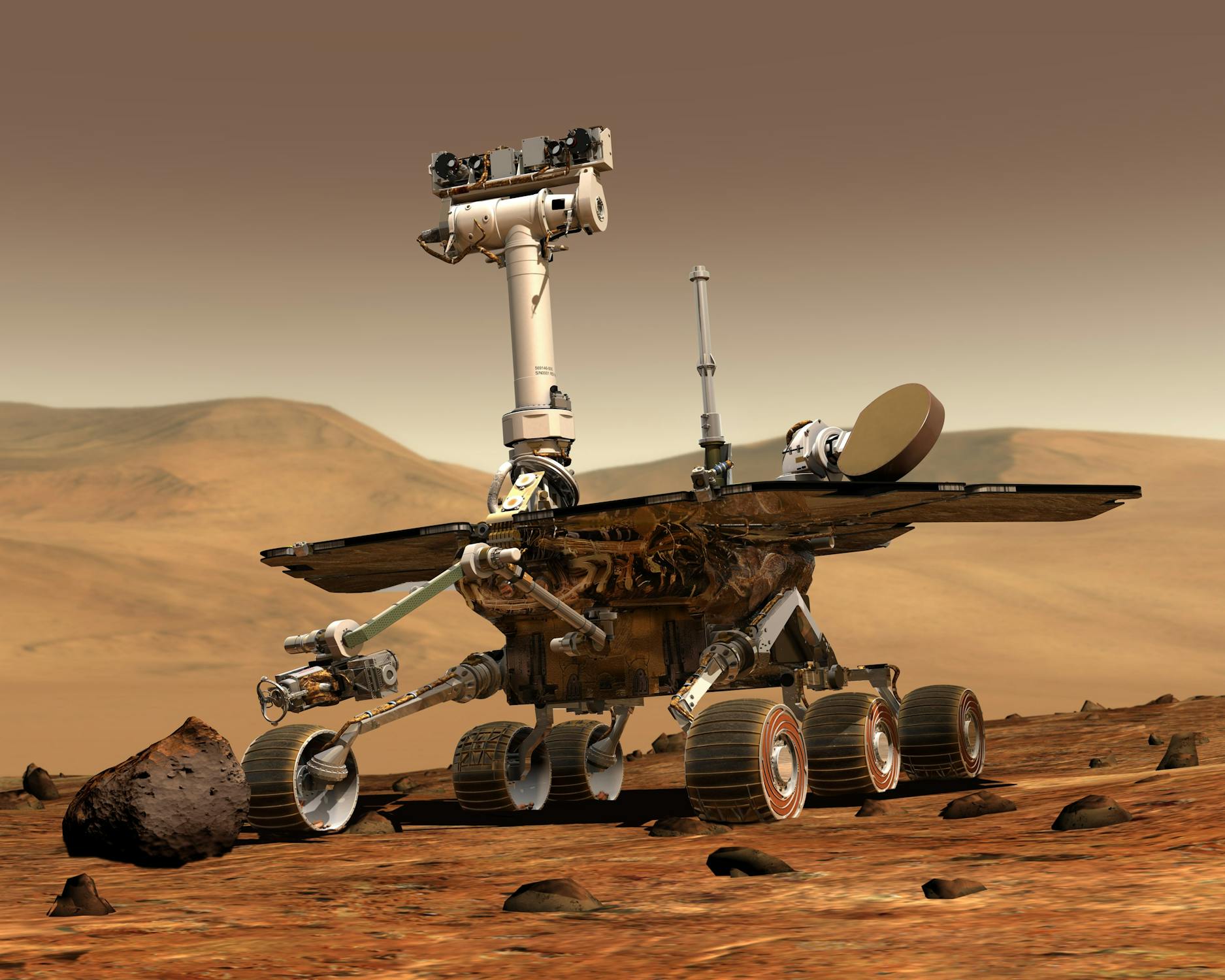
An artist's rendition of a rover successfully egressing onto the Martian surface. (Image credit: Pexels)