Unveiling Active Sites: How NAP-XPS Revolutionizes Real-World Catalyst Characterization
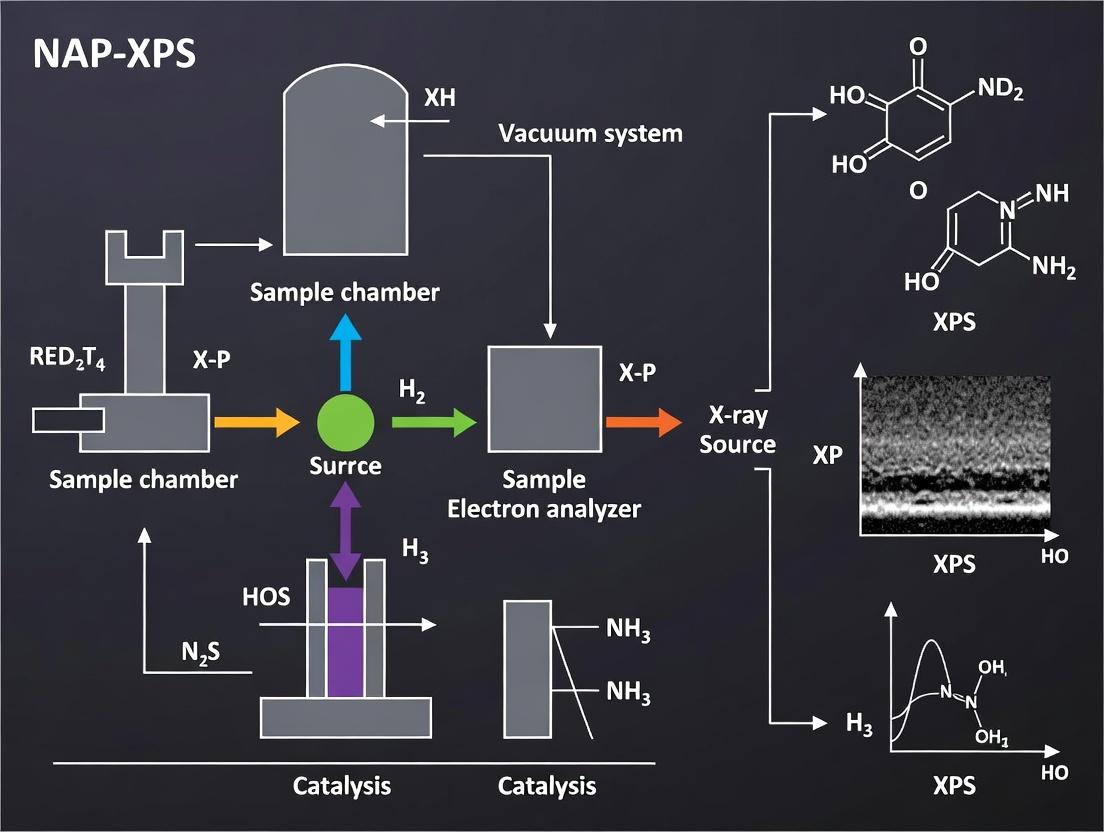
This article provides a comprehensive guide to Near-Ambient Pressure X-ray Photoelectron Spectroscopy (NAP-XPS) for catalysis research.
Unveiling Active Sites: How NAP-XPS Revolutionizes Real-World Catalyst Characterization
Abstract
This article provides a comprehensive guide to Near-Ambient Pressure X-ray Photoelectron Spectroscopy (NAP-XPS) for catalysis research. We explore the fundamental principles bridging the pressure gap, detail cutting-edge methodologies for studying catalysts under operational conditions, address key experimental challenges and optimization strategies, and validate NAP-XPS against complementary techniques. Aimed at researchers and scientists in catalysis and materials science, this review synthesizes current capabilities and future directions for unlocking dynamic catalyst behavior in biomedical and industrial applications.
Bridging the Pressure Gap: NAP-XPS Fundamentals for Catalysis Researchers
Core Principles and Pressure Gap
Near-Ambient Pressure X-ray Photoelectron Spectroscopy (NAP-XPS) is a surface-sensitive analytical technique that allows for the investigation of solid surfaces, thin films, and adsorbed species under operando or near-operando conditions, bridging the critical "pressure gap" between traditional ultra-high vacuum (UHV) XPS and real-world catalytic environments.
Core Principles:
- Differential Pumping: A series of pressure stages with progressively higher vacuum isolate the high-pressure sample chamber from the UHV required by the electron analyzer and X-ray source.
- Electron Detection: Despite gas scattering, specially designed electrostatic lens systems and short working distances collect photoelectrons from the high-pressure region.
- In-situ/Operando Analysis: Enables real-time monitoring of chemical states, adsorbates, and catalyst surfaces during exposure to reactive gases (e.g., H₂, O₂, CO, H₂O) at pressures from ~0.1 Torr to over 25 Torr.
The Pressure Gap Problem: Traditional UHV-XPS requires pressures below 10⁻⁹ mbar, whereas industrial heterogeneous catalysis often occurs at 1-100 bar. This multi-order-of-magnitude discrepancy means surface compositions and intermediate species observed in UHV may not be representative of the active catalyst under working conditions. NAP-XPS directly addresses this by enabling studies in the millibar-to-torr range, closer to realistic catalytic environments.
Table 1: Bridging the Pressure Gap: Comparison of XPS Techniques
| Parameter | Conventional/UHV-XPS | NAP-XPS | Ideal Operando Condition |
|---|---|---|---|
| Operating Pressure | < 10⁻⁹ mbar (10⁻⁷ Pa) | 0.1 mbar – 25 mbar (10 Pa – 2500 Pa) | 1 bar – 100 bar (10⁵ – 10⁷ Pa) |
| Pressure Gap | ~10 orders of magnitude | ~2-4 orders of magnitude | 0 orders of magnitude |
| Sample Environment | Static, UHV | Flowing reactive gases, elevated temperature | Full industrial process stream |
| Surface Relevance | May differ from "working" surface | Closer to active state, adsorbates present | True working surface |
| Primary Challenge | Non-representative surface state | Scattering of electrons, limited pressure range | Technical complexity for photon-in/electron-out techniques |
Key Experimental Protocols for Catalysis Studies
Protocol 1: Baseline NAP-XPS Experiment for Catalyst Characterization
Objective: To establish the chemical state of a fresh catalyst surface and monitor its evolution under gas exposure.
- Sample Preparation: Synthesize catalyst (e.g., supported metal nanoparticles like Pt/CeO₂). Deposit as a thin, uniform layer on a conductive sample stub using drop-casting, spin-coating, or pressing a wafer.
- Load & Pre-clean: Insert sample into NAP-XPS chamber. Evacuate to base pressure (<10⁻⁷ mbar). Optionally perform a pre-cleaning cycle using Ar⁺ sputtering or heating in UHV.
- Initial UHV Spectrum: Acquire high-resolution core-level spectra (e.g., Pt 4f, Ce 3d, O 1s, C 1s) under UHV conditions at room temperature as a baseline.
- Gas Introduction: Introduce reactive gas (e.g., 1 mbar O₂ or H₂) into the sample cell while maintaining analyzer UHV via differential pumping.
- In-situ Measurement: Acquire spectra under gas environment. Monitor changes in oxidation states and adsorbate peaks (e.g., hydroxyl groups, carbonates).
- Temperature Ramps: Increase sample temperature linearly (e.g., 25°C to 500°C at 5°C/min) while continuously or intermittently acquiring spectra under constant gas flow.
Protocol 2:OperandoNAP-XPS during Catalytic Reaction
Objective: To correlate surface chemistry with catalytic activity measured simultaneously.
- Integrated Reactor Cell Setup: Use a NAP cell designed as a plug-flow microreactor with a thin, electron-transparent window (e.g., SiNₓ, graphene).
- Activity Measurement: Connect cell outlet to an online mass spectrometer (MS) or gas chromatograph (GC) to quantify reaction products (e.g., for CO oxidation: CO₂ production).
- Conditioning: Pre-treat catalyst in reactive gas (e.g., 2 mbar O₂ at 400°C for 30 min).
- Reaction Initiation: Introduce reaction mixture (e.g., 1 mbar CO + 1 mbar O₂). Allow flow to stabilize.
- Simultaneous Data Acquisition:
- Continuously monitor reaction products via MS/GC.
- Acquire sequential XPS spectra (e.g., every 5-10 minutes) of relevant core levels.
- Modulation Experiments: Systematically vary one parameter (e.g., temperature, gas partial pressure ratio) while holding others constant to establish structure-activity relationships.
Visualizations
Diagram 1: The Pressure Gap in Catalysis Analysis
Diagram 2: NAP-XPS Experimental Workflow
The Scientist's Toolkit: Essential Research Reagents & Materials
Table 2: Key Research Reagent Solutions for NAP-XPS Catalysis Studies
| Item | Function & Importance | Example Specifications/Notes |
|---|---|---|
| Model Catalyst Wafers | Well-defined, uniform surfaces for fundamental studies. Enables reproducible results. | Single crystals (e.g., Pt(111), CeO₂(111) thin film on substrate) or synthesized powder pressed into wafer. |
| Supported Nanoparticle Catalysts | Realistic catalyst materials mimicking industrial catalysts. | Metal nanoparticles (Pt, Pd, Cu) on oxide supports (TiO₂, Al₂O₃, CeO₂). |
| High-Purity Reaction Gases | Essential for operando studies without contamination. | CO, O₂, H₂, CO₂, H₂O vapor, mixed gases (e.g., CO+O₂). Must be 99.999% pure with proper gas handling. |
| Calibration Reference Samples | For precise binding energy scale calibration and instrument performance verification. | Clean Au foil (Au 4f₇/₂ = 84.0 eV), Cu foil (Cu 2p₃/₂ = 932.67 eV). |
| Electron-Transparent Membranes | For advanced microreactor cells allowing photon in/electron out at higher pressures. | Silicon Nitride (SiNₓ) windows (50-200 nm thick), graphene-coated grids. |
| High-Temperature Sample Holders | Enables studies under catalytically relevant temperatures (up to 1000°C). | With integrated resistive heating and accurate thermocouple (K-type) reading. |
| Dosing/Condensing System for Liquids | Introduces volatile liquids (e.g., H₂O, alcohols) into the gas stream at controlled partial pressures. | Leak valve connected to a cooled reservoir, or vapor saturator/bubbler system. |
| In-situ Plasma Cleaner / Sputter Gun | For sample surface cleaning and preparation within the vacuum system. | Argon ion source (typically 0.5-5 keV) for gentle surface etching. |
Application Notes
X-ray Photoelectron Spectroscopy (XPS) has evolved from a technique confined to Ultra-High Vacuum (UHV, <10⁻⁹ mbar) for studying clean, solid surfaces to one capable of operating at Near-Ambient Pressure (NAP, 0.1-100 mbar) and higher. This evolution has been pivotal for in situ and operando studies in fields like catalysis, where the active state of a material exists only under reactive gas environments. NAP-XPS bridges the "pressure gap" between ideal UHV analysis and real-world catalytic conditions.
Historical Progression and Key Specifications
Table 1: Evolution of XPS Operational Environments and Capabilities
| Era (Approx.) | Operational Regime | Typical Pressure Range | Key Enabling Technology | Primary Application Focus |
|---|---|---|---|---|
| 1970s-1990s | Classic UHV-XPS | < 1 × 10⁻⁹ mbar | High-throughput turbo pumps, bake-out systems | Fundamental surface science, clean interfaces, adsorbates. |
| 1990s-2000s | High-Pressure XPS (HP-XPS) | 0.1 – 10 mbar | Differential pumping on analyzer, specialized apertures. | In situ studies of moderately volatile liquids, higher-pressure gas adsorption. |
| 2000s-Present | Near-Ambient Pressure XPS (NAP-XPS) | 1 – 100 mbar | Advanced multi-stage differential pumping, electrostatic lensing, micrometer-sized apertures (e.g., 0.3 mm Ø). | Operando catalysis, electrochemical interfaces, polymer degradation in relevant gases. |
| 2010s-Present | Ambient Pressure XPS (AP-XPS) | > 100 mbar, up to several bar | Ultra-thin Si₃N₄ or graphene membrane windows separating high-pressure cell from analyzer. | Liquid-vapor interfaces, biological samples in native state, electrocatalysis in liquid cells. |
Table 2: Quantitative Impact of Pressure on Photoelectron Mean Free Path (MEP)
| Pressure (mbar) | Environment | Approximate MEP for Al Kα Photoelectrons (KE ~ 1.4 keV) | Practical Implication for XPS |
|---|---|---|---|
| 1 × 10⁻⁹ | UHV | > 1 km | No scattering, direct signal from surface. |
| 1 | NAP (e.g., water vapor) | ~ 1 mm | Significant scattering; only electrons originating very close to the aperture can be detected. |
| 10 | NAP (e.g., reactant mix) | ~ 100 μm | Extreme scattering necessitates sophisticated signal collection and filtering. |
| 1000 | Ambient (1 bar air) | ~ 10 μm | Requires specialized membrane-sealed cells to protect UHV analyzer. |
Detailed Experimental Protocols
Protocol 1: NAP-XPS for Catalytic CO Oxidation on a Pt/Co₃O₄ Model Catalyst
This protocol outlines an operando study to correlate Pt oxidation state with activity under reactive conditions.
Objective: To measure the chemical state of Pt and Co in a catalyst under flowing CO and O₂ at 100°C and 1 mbar total pressure while simultaneously monitoring reaction products via mass spectrometry.
Materials & Reagents:
- Pt/Co₃O₄ powder catalyst pressed into a pellet.
- High-purity gases: CO (5% in He), O₂ (20% in He), He (99.999%).
- Conductive, heat-resistant sample holder (e.g., Mo or Ta foil).
Procedure:
- Sample Preparation & Loading:
- Press ~20 mg of catalyst powder into a 5 mm diameter pellet.
- Mount the pellet on the Mo foil and secure it to the NAP-XPS sample holder using high-temperature ceramic adhesive.
- Insert the holder into the NAP cell and ensure thermal and electrical contact.
UHV Baseline Measurement:
- Evacuate the analysis chamber to < 5 × 10⁻⁹ mbar.
- Perform a survey scan (0-1200 eV, pass energy 150 eV) to identify elements.
- Acquire high-resolution spectra for Pt 4f, Co 2p, O 1s, and C 1s regions (pass energy 50 eV).
NAP Cell Pressurization & Condition Setup:
- Isolate the analysis chamber using gate valves. The NAP cell remains connected via differentially pumped apertures.
- Introduce a gas mixture of 0.1 mbar CO and 0.9 mbar O₂ into the NAP cell using mass flow controllers. Total pressure = 1.0 mbar.
- Ramp the sample temperature to 100°C using a resistive heater, monitored by a thermocouple.
Operando Data Acquisition:
- Allow the system to stabilize for 30 minutes while a quadrupole mass spectrometer (QMS) monitors the partial pressures of m/z = 28 (CO) and 44 (CO₂).
- Acquire high-resolution spectra for Pt 4f and Co 2p regions repeatedly (e.g., every 15 minutes for 2 hours).
- Simultaneously record QMS data to calculate CO consumption and CO₂ production rates.
Post-reaction Analysis:
- Flush the NAP cell with pure He for 15 minutes.
- Pump down the NAP cell to UHV conditions.
- Acquire a final set of high-resolution spectra of the same regions under UHV for comparison.
Data Analysis:
- Fit Pt 4f spectra using appropriate doublet separations and constraints. Components at ~71.0 eV (Pt⁰) and ~72.5-74.5 eV (Pt²⁺/Pt⁴⁺) indicate metallic and oxidized states.
- Correlate the intensity ratio of Pt⁰/(Pt⁰+Ptⁿ⁺) with the measured CO₂ production rate over time.
Protocol 2: Assessing Sample Damage via X-ray and Reactive Gas Exposure
A critical control experiment for catalysis studies.
Objective: To verify that observed spectral changes are due to the catalytic reaction and not beam-induced damage or incidental heating.
Materials & Reagents: Identical catalyst sample from Protocol 1.
Procedure:
- UHV Stability Test:
- Under UHV, acquire a high-resolution Co 2p spectrum from a fresh spot on the sample.
- Continuously expose the same spot to the X-ray beam for 2 hours.
- Acquire a second Co 2p spectrum from the same spot. Compare for signs of reduction (shift to lower binding energy).
Gas-Only Exposure Test:
- On a fresh spot, introduce 1 mbar of pure O₂ into the NAP cell at room temperature.
- Hold for 2 hours without X-ray exposure.
- Pump down to UHV and acquire Pt 4f and Co 2p spectra. Compare to the initial UHV baseline.
X-ray/Gas Combined Exposure Test:
- On a fresh spot, introduce the reactive gas mix (0.1/0.9 mbar CO/O₂).
- Immediately begin continuous X-ray exposure on a single spot.
- Acquire sequential Pt 4f spectra every 20 minutes for 2 hours.
- The results should be compared against the operando data from Protocol 1, where the sample was heated and the beam was rastered.
Diagrams
Title: Operando NAP-XPS Workflow for Catalysis
Title: Evolution of XPS: Technology and Applications
The Scientist's Toolkit: NAP-XPS for Catalysis Research
Table 3: Essential Research Reagent Solutions & Materials
| Item | Function in NAP-XPS Catalysis Studies |
|---|---|
| Model Catalyst Pellet | The material under study. Must be compatible with pressing into a stable, conductive pellet that can withstand temperature and gas exposure. |
| Conductive Metal Foils (Ta, Mo, Au) | Used as sample holders/substrates. They must be chemically inert under experimental conditions and provide good thermal and electrical conductivity. |
| High-Purity Calibration Gases (CO, O₂, H₂, He, Ar) | Used to create reactive atmospheres and for calibration. Impurities can poison catalysts or create misleading spectral features. |
| High-Temperature Ceramic Adhesive | To securely mount fragile catalyst pellets onto metal holders, ensuring thermal contact and electrical grounding. |
| Mass Flow Controllers (MFCs) | Precisely regulate the flow and mixing ratios of gases entering the NAP cell, enabling controlled reactive environments. |
| Quadrupole Mass Spectrometer (QMS) | Essential for operando studies; monitors reactant consumption and product formation in real-time, correlating gas-phase activity with surface state. |
| Micro-focused X-ray Source with Monochromator | Provides a high-flux, low-dispersion X-ray beam. The small spot size helps minimize radiation damage and enables spatial mapping. |
| Electron Energy Analyzer with NAP Aperture | The core hardware advancement. Features multi-stage differential pumping and electrostatic lenses to transmit photoelectrons from the high-pressure cell to the UHV detector. |
| Resistive Sample Heater with Thermocouple | Enables in situ temperature control to study catalytic reactions at industrially relevant temperatures. |
Application Notes
Context within NAP-XPS for Catalysis Studies
Near Ambient Pressure X-ray Photoelectron Spectroscopy (NAP-XPS) is a transformative technique for in situ and operando studies of catalytic surfaces under realistic pressure conditions (up to ~100 mbar), bridging the "pressure gap" between ultra-high-vacuum (UHV) surface science and practical catalysis. The successful implementation of NAP-XPS hinges on three critical hardware subsystems that work in concert: differential pumping to maintain analyzer integrity, electron lenses to enhance signal collection, and reaction cells to create controlled catalytic environments. This suite enables real-time monitoring of surface composition, oxidation states, and adsorbates during gas-solid interactions.
Differential Pumping
Differential pumping is the engineered pressure gradient that allows a high-pressure sample environment to coexist with the UHV required for electron detection in the analyzer.
- Principle: A series of apertures and independently pumped stages selectively remove gas molecules, reducing the pressure by several orders of magnitude over a short distance. The conductance of each aperture is carefully designed to limit gas flow into subsequent stages.
- Application in Catalysis: Enables the introduction of reactant gases (e.g., CO, O₂, H₂, hydrocarbons) at catalytically relevant pressures (0.1-20 mbar) while keeping the electron energy analyzer and detector at <10⁻⁸ mbar.
Electron Lenses
Electron lenses are electrostatic or electromagnetic optics that collect, guide, and focus photoelectrons emitted from the sample surface into the analyzer's entrance slit.
- Principle: These lenses compensate for the scattering of electrons by gas molecules in the high-pressure region. They typically use a series of biased electrodes to create electric fields that transport electrons efficiently through the differential pumping apertures.
- Application in Catalysis: Essential for maintaining sufficient signal intensity and spatial resolution. Advanced lens systems allow for imaging modes (PEEM) and small-area analysis (microspot XPS), which are crucial for studying non-uniform catalysts or tracking spatial changes during reaction.
Reaction Cells
The reaction cell (or in situ cell) is the sample environment where the catalytic reaction takes place under controlled conditions.
- Principle: A miniaturized, sealed volume in close proximity to the sample that incorporates gas inlets/outlets, heating/cooling, and sometimes optical access. It must be compatible with the X-ray source and electron optical path.
- Application in Catalysis: Provides a well-defined, reproducible environment for exposing model or powder catalysts to reactive gas mixtures. Temperature-programmed and pressure-programmed experiments can be conducted while collecting XPS spectra.
Experimental Protocols
Protocol 1: Baseline NAP-XPS Measurement of a Model Catalyst Under Reactive Gas
Objective: To acquire XPS spectra from a Pt(111) single crystal under 1 mbar of O₂ at 300°C.
Materials & Reagents:
- Single crystal catalyst sample (e.g., Pt(111)).
- UHV-NAP-XPS system with differential pumping stages and electrostatic lenses.
- High-purity reactive gas (O₂, 99.999%).
- Resistive or electron beam sample heater.
- Calibration standards (Au foil for Fermi edge, clean Cu for adventitious carbon check).
Procedure:
- Sample Preparation & Loading:
- Clean the single crystal in UHV via repeated cycles of Ar⁺ sputtering (1 keV, 15 min) and annealing (up to 700°C) until no impurities are detected by XPS.
- Transfer the sample to the analysis position within the reaction cell.
System Preparation:
- Ensure all differential pumping stages are under UHV (<5×10⁻⁸ mbar).
- Set electron lens voltages to standard transmission values (refer to manufacturer specs).
- Align X-ray source (typically Al Kα) to the sample spot.
Gas Introduction & Pressure Stabilization:
- Isolate the main chamber pump from the reaction cell volume.
- Introduce O₂ gas via a leak valve to a pressure of 1.0 mbar in the cell, as read by a Baratron gauge.
- Monitor pressure in the first differential pumping stage; adjust pumping speed if it rises above 1×10⁻⁴ mbar.
Heating & Equilibration:
- Ramp sample temperature to 300°C at a rate of 10°C/min.
- Allow system to equilibrate for 15-20 minutes at target conditions.
Data Acquisition:
- Set analyzer pass energy to 20-50 eV for high-resolution scans.
- Acquire spectra for Pt 4f, O 1s, and C 1s core levels.
- Use a lower pass energy (e.g., 160 eV) for survey scans.
- Record data for a minimum of 3 scans per core level to ensure acceptable signal-to-noise.
Post-experiment:
- Cool sample to near room temperature.
- Pump away reactive gas from the cell.
- Re-establish UHV in the entire system.
Protocol 2: Operando NAP-XPS During CO Oxidation
Objective: To monitor the oxidation state of a CeO₂-supported Pd catalyst during catalytic CO oxidation.
Materials & Reagents:
- Powder catalyst pellet (Pd/CeO₂).
- Gas mixture: 1% CO, 1% O₂, balance He (pre-mixed cylinder).
- Mass flow controllers for gas mixing (if not pre-mixed).
- Quadrupole mass spectrometer (QMS) for gas analysis.
Procedure:
- Catalyst Pretreatment:
- Load catalyst pellet into reaction cell.
- Under UHV, heat to 200°C for 1 hour to desorb water.
- Expose to 0.5 mbar O₂ at 300°C for 30 minutes to oxidize the surface.
- Pump and cool to initial reaction temperature (e.g., 150°C).
Operando Setup:
- Connect QMS to the reaction cell exhaust to monitor m/z = 44 (CO₂), 28 (CO), and 32 (O₂).
- Calibrate QMS signals for semi-quantitative analysis.
Reaction Initiation & Data Collection:
- Introduce the reaction gas mixture at a total pressure of 2.0 mbar.
- Simultaneously start time-resolved acquisition of:
- XPS spectra for Pd 3d, Ce 3d, O 1s regions (cycle time ~5-10 min per set).
- QMS data for product formation (cycle time ~10-30 sec).
- Ramp temperature from 150°C to 300°C in 25°C increments, holding for 30 minutes at each step.
Data Correlation:
- Plot the relative concentrations of Pd⁰ and Pd²⁺ (from Pd 3d deconvolution) and the Ce³⁺/Ce⁴⁺ ratio (from Ce 3d multiplet analysis) as a function of temperature and simultaneous CO₂ yield.
Data Presentation
Table 1: Performance Characteristics of Key NAP-XPS Hardware Components
| Component | Key Parameter | Typical Specification/Range | Impact on Catalysis Experiment |
|---|---|---|---|
| Differential Pumping | Number of Stages | 2-4 stages | Determines maximum operable cell pressure. |
| Pressure Gradient | Sample: 10 mbar → Analyzer: 5x10⁻⁹ mbar | Enables study at catalytically relevant pressures. | |
| Aperture Diameter | 0.3 - 0.8 mm (first aperture) | Balances gas flow restriction with electron collection. | |
| Electron Lenses | Acceptance Angle | ±30 degrees | Defines sampled area and signal intensity. |
| Transmission Efficiency | >50% at 10 mbar (for select systems) | Directly affects count rate and data acquisition speed. | |
| Spatial Resolution | <20 µm (in imaging mode) | Allows mapping of catalyst heterogeneity. | |
| Reaction Cell | Max Operating Temperature | Up to 1000°C | Covers most catalytic ignition temperatures. |
| Gas Delivery | Multiple inlets, mass flow control | Enables precise gas mixing and transient experiments. | |
| Heating Rate | Up to 50 °C/min | Allows for temperature-programmed XPS (TP-XPS). |
Table 2: Example Experimental Conditions for Common Catalytic Reactions
| Reaction | Model Catalyst | Typical NAP-XPS Conditions (Pressure, Gas) | Key Spectra Monitored |
|---|---|---|---|
| CO Oxidation | Pt(111), Pd/CeO₂ | 0.5-5 mbar, (1-2% CO, 1-2% O₂, bal. He) | O 1s, C 1s, Pt/Pd 3d, Valence Band |
| Water-Gas Shift | Cu/ZnO, Pt/CeO₂ | 1-10 mbar, (CO + H₂O) | Cu 2p/Zn 2p, O 1s, C 1s |
| Methanation | Ni/CeO₂, Ru/TiO₂ | 1-5 mbar, (CO₂ + H₂) | Ni/Ru 3d, C 1s, O 1s |
| Olefin Oxidation | V₂O₅, MoO₃ | 0.1-1 mbar, (C₃H₆ + O₂) | V 2p/Mo 3d, O 1s, C 1s |
Visualizations
Title: NAP-XPS Hardware System Workflow for Catalysis
Title: Operando NAP-XPS Protocol for CO Oxidation
The Scientist's Toolkit: Essential Research Reagent Solutions & Materials
Table 3: Key Materials for NAP-XPS Catalysis Experiments
| Item | Function in Experiment | Typical Specification/Example |
|---|---|---|
| Model Single Crystals | Well-defined, reproducible surface for fundamental studies. | Pt(111), Cu(110), CeO₂(111) epitaxial films. Diameter: 10mm, orientation: ±0.1°. |
| Supported Powder Catalysts | Realistic, high-surface-area catalyst models. | Pd/CeO₂, Cu/ZnO/Al₂O₃. Pressed into 5mm diameter pellets. |
| High-Purity Gases | Provide reactive atmospheres without contamination. | O₂ (99.999%), CO (99.997%), H₂ (99.999%), CO₂ (99.995%). Equipped with gas purifiers. |
| Calibration Standards | Energy scale calibration and intensity reference. | Au foil (for Fermi edge), Clean Ag or Cu (for adventitious C 1s = 284.8 eV). |
| Thermocouples | Accurate sample temperature measurement. | K-type (chromel-alumel) or custom-welded for direct sample contact. |
| Sputtering Targets | For in situ sample cleaning via argon ion bombardment. | High-purity Ar gas (99.9999%) and ion gun. |
Near-Ambient Pressure X-ray Photoelectron Spectroscopy (NAP-XPS) has revolutionized the in situ and operando study of catalytic surfaces under realistic gas environments and elevated temperatures. The core spectroscopic information—binding energy (BE), chemical shifts, and their quantitative analysis—forms the fundamental dataset for interpreting catalyst composition, electronic structure, oxidation states, and adsorbate interactions. This application note details protocols for extracting this critical information, enabling researchers to correlate catalyst structure with activity and selectivity within a broader thesis on mechanistic catalysis research.
Core Information: Definitions and Data Presentation
Binding Energy (BE): The kinetic energy of an emitted photoelectron, referenced to the Fermi level, identifying the elemental orbital. Chemical Shift: The variation in BE (ΔBE) due to changes in the chemical environment (oxidation state, bonding partners). A positive ΔBE indicates increased oxidation state or bonding to more electronegative species.
Table 1: Characteristic Core-Level Binding Energies and Chemical Shifts for Catalytic Systems
| Element & Core Level | Typical BE (eV) in Metal State | Oxidized State Example | BE (eV) in Oxidized State | Typical ΔBE (eV) | Catalytic Relevance |
|---|---|---|---|---|---|
| Pt 4f7/2 | 71.0 - 71.2 | PtO₂ | 74.5 - 75.0 | +3.3 to +3.8 | Deactivation, O-covered active sites |
| Cu 2p3/2 | 932.6 | CuO | 933.7 | +1.1 | Methanol synthesis, CO₂ reduction |
| Ce 3d5/2 (v) | 885.0 (Ce³⁺) | CeO₂ (Ce⁴⁺) | 882.5 | -2.5* | Oxygen storage, redox catalyst |
| C 1s (Adventitious) | 284.8 | Carbonate (CO₃²⁻) | 289.5 - 290.0 | +4.7 to +5.2 | Reaction intermediate/poison |
| O 1s (Lattice) | 529.5 - 530.0 | Hydroxyl (OH⁻) | 531.0 - 531.5 | +1.0 to +1.5 | Hydroxylation, water activation |
Note: Ce chemical shifts are complex; the main shift between Ce³⁺ and Ce⁴⁺ multiplets is a decrease in BE for the 3d5/2* v peak.*
Table 2: Quantitative Analysis Parameters from NAP-XPS Spectra
| Parameter | Formula / Method | Information Derived | Key Consideration in NAP-XPS |
|---|---|---|---|
| Atomic % / Ratio | (Aᵢ/Sᵢ) / Σ(Aⱼ/Sⱼ); A=Area, S=Sensitivity Factor | Surface composition, stoichiometry | Pressure-dependent scattering, gas-phase contributions |
| Oxidation State Distribution | Spectral deconvolution (peak fitting) | Relative abundance of redox states | Use of constraints (FWHM, spin-orbit splitting) |
| Adsorbate Coverage | θ = (Iₐdₛ/Iₘₑₜₐₗ) * SF | Monolayer equivalents of adsorbates (O, C, etc.) | Requires clean metal reference spectrum |
| Attenuation Length | I = I₀ exp(-d/λ) | Estimate of overlayer thickness (e.g., coke, oxide) | λ depends on KE, matrix (~1-3 nm for typical oxides) |
Experimental Protocols
Protocol 1: Operando NAP-XPS Study of a Catalyst During CO Oxidation Objective: To correlate Pt oxidation state and adsorbate coverage with catalytic activity.
- Sample Preparation: Sputter-clean a Pt/Al₂O₃ model catalyst pellet in vacuum. Transfer to NAP cell without air exposure.
- Gas Environment Setup: Introduce a 1:1 mixture of CO and O₂ to a total pressure of 1-2 mbar. Use mass spectrometer (MS) to monitor CO₂ production (m/z=44).
- Temperature Program: Use a resistively heated stage. Acquire spectra isothermally from 25°C to 400°C in 50°C increments.
- Spectral Acquisition:
- Measure Pt 4f region (high resolution, pass energy 20-50 eV).
- Measure C 1s and O 1s regions.
- Measure Al 2p or survey for reference.
- Acquisition time: 5-10 min per region to ensure SNR.
- Data Correlation: Record MS CO₂ signal simultaneously with each spectrum. Align BE scale using the Al 2p peak (BE ~74.7 eV) or adventitious C 1s (284.8 eV) with caution under reaction conditions.
Protocol 2: Quantifying Oxidation State Distribution in a Mixed-Valence Catalyst (e.g., CeₓZr₁₋ₓO₂) Objective: To determine the Ce³⁺/Ce⁴⁺ ratio as a function of reducing/oxidizing treatments.
- Spectral Acquisition: Acquire high-resolution Ce 3d region (875-920 eV). Use sufficient steps and dwell time to resolve complex multiplet structure.
- Background Subtraction: Apply a Shirley or Tougaard background.
- Peak Fitting Procedure: a. Define doublets for Ce⁴⁺ components: v (~882.5 eV), v'' (~889 eV), v''' (~898 eV), and their spin-orbit partners u, u'', u'''. b. Define doublets for Ce³⁺ components: v₀ (~885 eV), v' (~880 eV), and their spin-orbit partners u₀, u'. c. Constrain the spin-orbit splitting (ΔBE) to 18.4 eV and area ratios (4f7/2 : 4f5/2) to 1.2-1.5. d. Allow peak widths to vary but constrain them to be equal for all Ce⁴⁺ components and all Ce³⁺ components, respectively.
- Quantification: Calculate Ce³⁺ fraction as: [Area(v₀+v')] / [Area(all Ce 3d v peaks)].
Protocol 3: Adsorbate Coverage Calibration Using a Model System Objective: To establish a coverage calibration for O* on a Ni(111) single crystal.
- Clean Surface: In UHV, sputter and anneal Ni(111) until no O or C is detected.
- Dosing: Expose the crystal to controlled doses of O₂ (Langmuirs, L) at room temperature.
- Measurement: After each dose, acquire Ni 2p3/2 and O 1s spectra in UHV conditions.
- Analysis: Plot the O 1s / Ni 2p peak area ratio (corrected by sensitivity factors) versus exposure.
- Saturation: Identify the exposure where the ratio saturates, corresponding to the p(2x2) or similar well-ordered overlayer (θ = 0.25 ML). Use this point to define the sensitivity factor for converting area ratios to absolute coverage under NAP conditions.
Visualization
Diagram 1: NAP-XPS Catalysis Experiment Workflow
Diagram 2: Chemical Shift Decision Logic for Oxidation State
The Scientist's Toolkit: Research Reagent Solutions & Essential Materials
Table 3: Key Materials for NAP-XPS Catalysis Experiments
| Item | Function & Relevance in NAP-XPS Catalysis Studies |
|---|---|
| Model Catalyst Wafers/Pellets (e.g., Pt/Al₂O₃, CeO₂ nanoparticles on Si) | Well-defined samples for fundamental studies; must be conductive or sufficiently thin to avoid charging. |
| Certified Calibration Gas Mixtures (e.g., 1% CO/He, 10% O₂/He, CO:O₂ blends) | Precise control of reactant partial pressures for operando studies; high purity prevents contamination. |
| Conductive Adhesive Tapes (e.g., Cu foil tape, carbon tape) | For mounting powder samples; must be inert and not interfere with spectral regions of interest. |
| Internal BE Reference Materials (e.g., Au or Ag foil snippets, evaporated films) | For in situ binding energy calibration, critical under changing gas environments where adventitious carbon is unreliable. |
| Sputtering Target (Ar⁺ ion source) | For in situ sample cleaning to prepare a pristine surface prior to NAP studies. |
| Temperature Calibration Sample (e.g., thin thermocouple attached to dummy sample) | To accurately calibrate the sample heater stage temperature under different gas pressures. |
| Mass Spectrometer (QMS) with Capillary Inlet | For simultaneous monitoring of gas-phase reactants and products, enabling direct activity-structure correlation. |
Application Notes
Near-Ambient Pressure X-ray Photoelectron Spectroscopy (NAP-XPS) has revolutionized the study of catalytic systems by enabling in situ and operando analysis under realistic pressure conditions (up to several hundred mbar). This bridges the "pressure gap" between traditional ultra-high vacuum (UHV) XPS and practical catalytic environments.
Probing Adsorbed Species and Reaction Intermediates
NAP-XPS allows direct identification of adsorbates on catalyst surfaces during reaction. This is critical for elucidating reaction mechanisms. For example, in CO₂ hydrogenation over Cu/ZnO catalysts, NAP-XPS can detect formate (HCOO⁻) and carbonate (CO₃²⁻) intermediates adsorbed on the surface, providing evidence for the formate pathway.
Determining Active Oxidation States
Catalysts often undergo dynamic redox changes. NAP-XPS tracks the oxidation states of active metal centers in real-time. During CO oxidation on a Pd catalyst, shifts in the Pd 3d core level can be monitored, showing the transition between metallic Pd⁰ and PdOₓ under varying O₂/CO ratios, identifying the active phase.
Assessing Catalyst Stability and Deactivation
Long-term stability under operando conditions is crucial. NAP-XPS can identify causes of deactivation such as coking (via C 1s spectra showing graphitic carbon), sintering (via changes in metal cluster intensity), or poisoning (via adsorption of S or P species).
Table 1: Quantitative Data from Selected NAP-XPS Catalysis Studies
| Catalyst System | Reaction Condition (T, P) | Key Spectral Shift/Observation | Quantitative Change | Implication |
|---|---|---|---|---|
| Cu/ZnO/Al₂O₃ | CO₂ Hydrogenation, 220°C, 1.2 bar | C 1s peak at 289.0 eV | Formate coverage: 0.15 ML | Key reaction intermediate identified |
| Pd(111) Single Crystal | CO Oxidation, 300°C, 0.1 mbar O₂ | Pd 3d₅/₂ shift from 335.2 to 336.5 eV | PdOₓ surface fraction: 60% | Active phase is partially oxidized Pd |
| Co/CoOₓ Nanoparticles | Fischer-Tropsch, 230°C, 1 bar syngas | Co 2p₃/₂ satellite ratio change | Metallic Co⁰: 75% of total Co | Metallic Co is the active phase |
| Ni/YSZ Anode | Methane Reforming, 700°C, 1 bar CH₄ | C 1s peak at 284.5 eV growth rate | Graphitic C buildup: 2 nm/min | Deactivation by coking quantified |
Experimental Protocols
Protocol 1: NAP-XPS for Monitoring Oxidation State Dynamics
Objective: To determine the active oxidation state of a transition metal catalyst under reaction conditions. Materials: See "The Scientist's Toolkit" below. Procedure:
- Sample Preparation: Synthesize catalyst powder or prepare a model single crystal/film. For powders, deposit uniformly onto a conductive, heatable sample stage (e.g., Si wafer or Au foil) using a slurry or dry-press method.
- Pretreatment: Load sample into NAP-XPS chamber. Evacuate to base pressure (<10⁻⁷ mbar). Reduce surface impurities by heating in 0.1 mbar H₂ at 400°C for 30 minutes.
- Baseline Measurement: Cool to reaction temperature (e.g., 300°C). Acquire high-resolution spectra of the relevant core levels (e.g., Ce 3d, Co 2p, Pd 3d) under UHV to establish initial state.
- Gas Exposure & Measurement: Introduce reactant gas mixture (e.g., 0.05 mbar CO, 0.1 mbar O₂) to the NAP cell. Allow system to stabilize for 10-15 minutes. Acquire spectra under steady-state reaction conditions.
- Titration Experiment: Sequentially vary the partial pressure of one reactant (e.g., O₂) while maintaining temperature. Acquire spectra at each condition. Monitor peak positions, shapes, and satellite structures.
- Data Analysis: Fit spectra using appropriate software (e.g., CasaXPS). Use known binding energy references (e.g., Au 4f₇/₂ at 84.0 eV for calibration). Quantify species ratios based on fitted peak areas, correcting for relative sensitivity factors (RSFs).
Protocol 2: Probing Adsorbates and Reaction Intermediates
Objective: To identify adsorbed species present on a catalyst surface during a catalytic reaction. Materials: As per Toolkit. Procedure:
- Surface Cleaning: Follow steps 1-2 from Protocol 1.
- Background Adsorbate Check: Acquire C 1s and O 1s spectra under UHV at reaction temperature to confirm a clean surface.
- Reaction Conditions: Introduce the full reactant mixture at the desired operating pressure (e.g., 1 bar total pressure for CO₂ hydrogenation). Use differential pumping to enable XPS measurement.
- Time-Resolved Measurement: Initiate a series of rapid scans over the C 1s, O 1s, and relevant metal edges. Use a high-throughput detector to improve temporal resolution (spectrum every 30-60 seconds).
- Post-Reaction Analysis: Quickly pump away reactants and cool the sample in a controlled atmosphere (e.g., inert gas) to "freeze" the surface state. Acquire a final set of high-resolution spectra.
- Identification: Compare spectra under reaction conditions to reference spectra of potential adsorbates (e.g., formate, carbonate, methoxy). Pay attention to subtle chemical shift differences (e.g., 0.5-1.0 eV).
Protocol 3: Stability and Deactivation Study
Objective: To monitor catalyst degradation over extended time under operando conditions. Procedure:
- Initial Characterization: Perform a full NAP-XPS characterization of the fresh catalyst under relevant reaction conditions as per Protocol 1 & 2.
- Long-Term Exposure: Maintain the catalyst at operational temperature and pressure for an extended period (e.g., 5-24 hours).
- Intermittent Sampling: Periodically (e.g., every hour) interrupt the gas flow briefly (if compatible with experiment) to acquire high-resolution spectra of critical regions: C 1s (for coke), metal peaks (for sintering), and poison elements (S 2p, P 2p).
- Post-Mortem Analysis: After the run, cool and vent the chamber. Remove the sample for ex situ analysis (e.g., SEM, TEM) to correlate XPS findings with morphological changes.
- Data Correlation: Plot the intensity or coverage of deactivating species (e.g., graphitic C peak area) versus time on stream to derive deactivation kinetics.
Visualizations
Title: NAP-XPS Workflow for Catalysis Research
Title: NAP-XPS Interrogates Catalytic Cycle Steps
The Scientist's Toolkit
Table 2: Key Research Reagent Solutions & Essential Materials
| Item | Function/Benefit in NAP-XPS Catalysis Studies |
|---|---|
| Calibrated Gas Mixtures (e.g., 5% CO/He, 10% O₂/Ar, 5% H₂/N₂) | Provide precise reactant partial pressures for creating realistic reaction environments and conducting titration experiments. |
| Conductive, Heatable Sample Stage (e.g., Au-coated Si wafer, Pt foil) | Allows resistive heating of powder samples to relevant catalytic temperatures (up to 800°C) while providing electrical conductivity to prevent charging. |
| Certified XPS Reference Samples (Au, Ag, Cu foils) | Essential for binding energy scale calibration before, during, and after NAP experiments to account for work function changes. |
| Model Catalyst Samples (Single crystals: Pd(111), CeO₂(111) thin films) | Provide well-defined surfaces for fundamental studies, simplifying spectral interpretation and mechanism deduction. |
| High-Purity Solvents (Isopropanol, Ethanol) | For preparing catalyst powder slurries for even deposition on sample holders without introducing contaminant peaks. |
| Differential Pumping System | A critical component of the NAP-XPS setup that maintains high vacuum at the electron analyzer while allowing high pressure (up to 1-30 mbar) at the sample. |
| Synchrotron Radiation Access (Beamtime) | Provides tunable, high-flux X-rays for increased sensitivity, better energy resolution, and access to tender X-rays for probing deeper layers or light elements. |
| In Situ Cell with Quartz or SiNx X-ray Window | Contains the high-pressure gas around the sample while being highly transparent to incident X-rays and emitted photoelectrons. |
Operando Insights: NAP-XPS Methodologies and Catalytic Reaction Studies
This protocol is framed within a doctoral thesis investigating the dynamic evolution of catalyst surfaces under operando conditions using Near-Ambient Pressure X-ray Photoelectron Spectroscopy (NAP-XPS). The core thesis posits that traditional ultra-high vacuum (UHV) XPS fails to capture metastable, reaction-relevant surface species present only under realistic gas environments. The experimental design detailed herein is foundational for probing active sites, identifying reaction intermediates, and elucidating deactivation mechanisms in heterogeneous catalysis, with direct implications for catalyst design in energy conversion and chemical synthesis.
Core System Specifications & Pressure Ranges
NAP-XPS systems bridge the "pressure gap" between UHV surface science and technical catalysis. A critical specification is the differential pumping between the sample cell and the electron analyzer, enabling measurements at elevated pressures while maintaining UHV for the detector.
Table 1: Operational Pressure Ranges and Resolutions in NAP-XPS
| Component / Parameter | Typical Range | Notes & Implications |
|---|---|---|
| Sample Chamber (Cell) Pressure | 0.1 mbar to 25 mbar | Common "near-ambient" range for many catalytic reactions (e.g., CO oxidation, methanol synthesis). |
| Analyzer Pressure | < 5 x 10⁻⁶ mbar | Maintained by multiple differential pumping stages to ensure electron mean free path and detector survival. |
| Probed Information Depth | ~1-10 nm | Varies with photoelectron kinetic energy and gas composition/pressure (inelastic mean free path). |
| Gas-dependent Attenuation Length | ~1 mm at 1 mbar (N₂) | Photoelectrons are scattered by gas molecules; heavier gases (e.g., H₂O) cause greater attenuation, requiring careful optimization of working distance. |
Detailed Experimental Protocols
Objective: To establish a precise, stable, and well-defined gas atmosphere around the catalyst sample.
- Gas Supply: Use high-purity gases (≥99.999%) with in-line filters and purifiers to remove residual O₂, H₂O, and hydrocarbons.
- Mass Flow Controllers (MFCs): Employ individually calibrated MFCs for each gas line (e.g., CO, O₂, H₂, inert He/Ar). Typical flow rates range from 1 to 20 sccm.
- Mixing & Delivery: Mix gases in a pre-chamber or a dedicated mixing manifold upstream of the NAP cell. Allow sufficient time for flow stabilization (≥15-30 mins) before introducing the mixture to the sample cell.
- Pressure Control: Use a downstream pressure control valve (often a piezoelectric or all-metal leak valve) in conjunction with the MFCs and a capacitance manometer to maintain constant cell pressure. The valve adjusts conductance to the turbo pumps.
- Safety: For flammable or toxic gases (e.g., H₂, CO), ensure proper venting and gas detection systems are in place.
Protocol 3.2: Temperature Control and Sample Heating
Objective: To conduct experiments at catalytically relevant temperatures (up to 600-800°C) while maintaining sample stability and signal quality.
- Heating Stage: Use a resistively heated sample holder (e.g., with a Ta or Pt filament) or a ceramic heater with electron bombardment capability for higher temperatures.
- Temperature Measurement: Calibrate temperature using a thermocouple (Type K or C) spot-welded to the side or back of the sample plate. Note: Radiative heating of the thermocouple by the heater filament can cause offsets; calibration via a sample-mounted thermocouple or pyrometer is ideal.
- Sample Mounting: For powder catalysts, disperse them on a conductive substrate (e.g., Au foil, Si wafer, or indium foil) to ensure thermal and electrical contact. Single crystals can be mounted directly.
- Thermal Gradient Minimization: Ensure heater design provides uniform heating across the sample. Allow ample time (≥20 mins) for temperature equilibration after each change.
- Gas-Temperature Interplay: Account for increased gas-phase scattering and reduced signal intensity at higher pressures and temperatures. Optimize the sample-to-nozzle distance.
Protocol 3.3: Integrated Experiment for Catalytic CO Oxidation
Objective: To monitor the chemical state of a Pt/CeO₂ catalyst during CO oxidation.
- Baseline: Acquire survey and high-resolution spectra (Pt 4f, Ce 3d, O 1s, C 1s) under UHV at room temperature.
- Gas Exposure: Introduce 0.5 mbar of a 2:1 mixture of O₂:CO into the cell at room temperature. Acquire O 1s and C 1s spectra to monitor adsorption.
- Temperature Programmed Reaction: Ramp temperature to 300°C at 10°C/min under the gas flow. Acquire rapid-scan Pt 4f and O 1s spectra (e.g., every 50°C interval).
- Steady-State Measurement: Hold at 300°C until the reaction reaches steady-state (monitor via possible gas analysis with a connected mass spectrometer). Acquire a full set of high-quality spectra.
- Cool-Down & Post-Reaction: Cool to room temperature under reaction gas, then pump to UHV to acquire a post-mortem spectrum for comparison.
The Scientist's Toolkit: Essential Research Reagent Solutions
Table 2: Key Materials and Reagents for NAP-XPS Catalysis Studies
| Item | Function & Rationale |
|---|---|
| Model Catalyst Wafers (e.g., Pt(111), CeO₂(111) single crystals) | Well-defined surfaces for fundamental mechanistic studies, providing benchmark spectra. |
| Powdered Technical Catalysts (e.g., Pt/Al₂O₃, Cu-ZnO/Al₂O₃) | Real-world materials; must be finely ground and uniformly deposited on conductive substrates. |
| High-Purity Gas Cylinders (CO, O₂, H₂, CO₂, H₂O(vapor), Inert Ar/He) | Create reactive atmospheres. Inerts are used for dilution, pressure balancing, and cooling. |
| Gas Dosing System (with calibrated MFCs & mixing manifold) | Provides precise, reproducible, and stable gas compositions for kinetic studies. |
| Conductive Adhesive Substrates (Indium foil, Au foil, Graphite tape) | To immobilize powder samples, ensuring thermal and electrical conductivity to prevent charging. |
| Calibrated Temperature Measurement Kit (Type K thermocouple, pyrometer) | Accurate temperature knowledge is critical for correlating surface chemistry with activity. |
| In-Situ Cell with Quartz or SiNx X-ray window | Contains the high-pressure gas while allowing incident X-rays and emitted photoelectrons to pass with minimal attenuation. |
Visualization of Experimental Workflow and Relationships
Diagram 1: NAP-XPS experimental design and execution workflow.
Diagram 2: Differential pumping for pressure balance in NAP-XPS.
Probing Oxidation States and Surface Composition During Catalytic Cycles
Application Notes
Operando Near-Ambient Pressure X-ray Photoelectron Spectroscopy (NAP-XPS) is a cornerstone technique for the thesis "Unraveling Dynamic Surface Reconstruction in Catalysis via Operando NAP-XPS." It enables the direct interrogation of catalysts under realistic pressure and temperature conditions, bridging the "pressure gap" between surface science and applied catalysis. This document provides protocols for tracking oxidation state evolution and surface composition changes during catalytic turnover.
Core Principle: By measuring core-level electron binding energy shifts, XPS identifies element-specific oxidation states. Under operando NAP-XPS conditions, the catalyst surface is probed while it is actively participating in the reaction, allowing for the correlation of electronic/surface structure with catalytic activity metrics (e.g., reaction rate, selectivity) measured simultaneously.
Key Quantitative Insights from Recent Studies (2023-2024):
Table 1: Representative NAP-XPS Findings in Catalytic Oxidation & Reduction Cycles
| Catalyst System | Reaction | Key Observation (Oxidation State Change) | Condition (Pressure, Temp) | Correlated Activity Change |
|---|---|---|---|---|
| Pd/LaFeO₃ | CO Oxidation | Pd⁰ Pd²⁺ cycle coupled with Fe³⁺ Fe(4-δ)+ shift in support | 0.5 mbar, 300°C | Pd⁰ surface fraction maxima coincide with peak CO₂ yield |
| Cu-ZnO/Al₂O₃ | CO₂ Hydrogenation | Dynamic Zn²⁺ migration onto Cu forming Zn⁰-Cu⁰ interfaces | 1.0 mbar, 250°C | Zn-Cu interface concentration scales with methanol formation rate |
| Co₃O₄ Nanocubes | Propane Combustion | Surface Co³⁺/Co²⁺ ratio decreases under reaction; lattice oxygen (O²⁻) depletion | 0.2 mbar, 400°C | Initial high activity linked to lattice oxygen participation; deactivation correlates with surface reduction |
| Ni/GDC (Gd-doped Ceria) | Dry Reforming of Methane | Ni⁰ state persistent; Ce³⁺/Ce⁴⁺ ratio oscillates with CH₄/CO₂ feed | 2.5 mbar, 600°C | Ce³⁺ concentration positively correlates with carbon removal rate, suppressing coking. |
Experimental Protocols
Protocol 1: Standard Operando NAP-XPS Experiment for Catalytic Cycle Probing
Objective: To monitor the oxidation states of catalyst surface elements as a function of reaction gas composition and temperature, synchronously with gas chromatograph (GC) activity data.
Research Reagent Solutions & Essential Materials:
Table 2: Key Research Reagents and Materials
| Item | Function |
|---|---|
| Catalyst Pellet (≈5mm diameter) | The solid catalyst sample, pressed for uniform analysis. |
| Calibration Gases (e.g., 1% CO/Ar, 1% O₂/Ar, 10% CH₄/He) | For creating reactive atmospheres and calibrating the mass spectrometer. |
| High-Purity Reaction Gases (CO, O₂, H₂, CO₂, CH₄) | To form the desired operando reaction mixture. |
| Calibrated Leak Valve & Mass Flow Controllers | Precisely control gas introduction and total chamber pressure. |
| Quadrupole Mass Spectrometer (QMS) | Monitors gas phase composition in real-time (reactants and products). |
| Synchrotron X-ray Source or Al Kα / Mg Kα Lab Source | Provides incident X-rays for photoemission. |
| Differential Pumping System | Maintains ultra-high vacuum at detector while sample is at millibar pressures. |
| Heating Stage with Thermocouple | Controls and measures sample temperature (up to 600-1000°C). |
| Gas Chromatograph (GC) | Periodically samples effluent for quantitative product analysis. |
Methodology:
- Sample Preparation & Loading: A pressed catalyst pellet is mounted on a standard sample holder using high-temperature adhesive. The sample is then transferred into the NAP-XPS analysis chamber.
- Pre-Experiment Calibration:
- The gas handling system is calibrated using standard calibration gases.
- The QMS is tuned and calibrated for the mass-to-charge (m/z) ratios of interest (e.g., m/z=44 for CO₂, m/z=15 for CH₄).
- The sample is typically pre-reduced or pre-oxidized in situ in a separate preparation chamber to establish a known initial state.
- Baseline Spectrum Acquisition: With the sample under ultra-high vacuum (UHV) or inert gas (e.g., 0.5 mbar He), acquire high-resolution XPS spectra of all relevant core levels (e.g., Pd 3d, Ce 3d, O 1s, C 1s) at room temperature.
- Operando Measurement Sequence:
- Set the heating stage to the desired reaction temperature (e.g., 300°C) under inert flow.
- Introduce the reaction gas mixture (e.g., 0.25 mbar CO, 0.25 mbar O₂) using the leak valve and flow controllers. Stabilize pressure.
- Initiate a cyclic acquisition protocol: a. Acquire a rapid survey scan to monitor overall composition. b. Acquire high-resolution scans for 2-3 key elemental regions (e.g., metal cation, O 1s). c. Simultaneously, record the QMS signal for reactant and product partial pressures. d. Trigger an external GC sample injection at defined intervals. e. Repeat steps a-d over time (e.g., every 5-10 minutes) until steady-state is observed.
- Perturbation Experiments: To probe dynamics, introduce a step-change in gas composition (e.g., switch from O₂-rich to CO-rich mix) or temperature and repeat the cyclic acquisition protocol to capture transient responses.
- Post-Reaction Analysis: Return the sample to UHV conditions and acquire a final set of spectra at room temperature for comparison with the baseline.
Data Analysis Workflow:
- Spectral Processing: Align spectra to a reference peak (e.g., adventitious C 1s at 284.8 eV). Subtract a Shirley or Tougaard background.
- Peak Fitting: Deconvolute core-level spectra using appropriate software (e.g., CasaXPS). Constrain fitting with known spin-orbit splitting and area ratios. Assign chemical states based on binding energy databases.
- Quantification: Calculate surface atomic ratios and the relative percentages of different oxidation states from fitted peak areas, using relative sensitivity factors.
- Correlation: Plot the temporal evolution of oxidation state percentages (e.g., % Ce³⁺) and surface ratios (e.g., O/Metal) against QMS partial pressures and GC-derived turnover frequencies (TOFs).
Protocol 2: Quasi-In Situ Transfer for Air-Sensitive Catalysts
Objective: To study catalyst pre-cursors or spent catalysts that are air-sensitive without exposing them to atmosphere, linking ex situ synthesis with operando analysis.
Methodology:
- Preparation: Synthesize or pre-treat the catalyst in a dedicated glovebox (Ar or N₂ atmosphere).
- Transfer: Mount the sample on a transfer plate inside the glovebox. Seal the plate in an antechamber and evacuate.
- Introduction: Attach the antechamber to the NAP-XPS system's load-lock and transfer the sample into the preparation chamber without air exposure.
- Analysis: Proceed with in situ treatment (reduction/oxidation) followed by Protocol 1.
Mandatory Visualizations
Title: Operando NAP-XPS Experimental Workflow
Title: NAP-XPS Data Analysis Pathway
This application note details a protocol for investigating the dynamic behavior of Pt/TiO2 catalysts under operando conditions during CO oxidation. It is framed within a broader doctoral thesis on "Advancing In Situ and Operando NAP-XPS for Dynamic Catalysis Studies." The work exemplifies how Near-Ambient Pressure X-ray Photoelectron Spectroscopy (NAP-XPS) bridges the "pressure gap" to correlate catalyst surface state with activity, a critical methodology for rational catalyst design in energy and environmental applications.
Experimental Protocols
Protocol 1: NAP-XPS Operando Experiment for Pt/TiO2 Objective: To correlate the chemical state of Pt and TiO2 with catalytic activity for CO oxidation under reaction conditions.
- Sample Preparation: Synthesize 1 wt% Pt/TiO2 (P25) via incipient wetness impregnation using H2PtCl6·6H2O precursor. Reduce ex situ in 100 mbar H2 at 300°C for 1 hour.
- NAP-XPS Chamber Setup: Load powder onto a conductive, heatable sample holder. Ensure the chamber is equipped with a differential pumping system and a gas dosing manifold.
- Gas Feed & Activity Monitoring: Connect the NAP-XPS cell outlet to a quadrupole mass spectrometer (QMS). Introduce a reactant gas mixture (e.g., 0.25 mbar CO, 0.25 mbar O2, balanced with He to 1.0 mbar total pressure) via precision leak valves.
- Temperature Program: Start at 30°C and ramp to 300°C in steps (e.g., 50°C increments). Allow thermal and catalytic equilibration (15-20 min) at each step.
- Spectral Acquisition: At each temperature, acquire high-resolution spectra of Pt 4f, Ti 2p, O 1s, and C 1s core levels using a monochromatic Al Kα source. Pass energy: 50 eV; step size: 0.05 eV.
- Activity Measurement: Simultaneously, monitor QMS signals for m/z = 44 (CO2), 28 (CO), and 32 (O2) to calculate conversion and turnover frequency (TOF).
Protocol 2: Ex Situ Catalyst Characterization (Pre- and Post-Reaction) Objective: To determine structural properties and confirm stability.
- Transmission Electron Microscopy (TEM): Disperse catalyst powder in ethanol, sonicate, and drop-cast onto a Cu grid. Image at 200 kV to determine Pt nanoparticle size distribution.
- X-ray Diffraction (XRD): Perform in Bragg-Brentano geometry using Cu Kα radiation. Scan 20-80° 2θ to identify crystalline phases of TiO2 and any Pt peaks.
- Inductively Coupled Plasma Optical Emission Spectroscopy (ICP-OES): Digest a known mass of catalyst in aqua regia. Analyze solution to confirm Pt loading.
Data Presentation
Table 1: Correlation of Pt Chemical State with Catalytic Activity
| Temperature (°C) | Pt⁰ / Pt²⁺ Ratio (from Pt 4f) | O 1s OL / OLatt Ratio* | CO Conversion (%) | TOF (s⁻¹) |
|---|---|---|---|---|
| 30 | 0.2 | 0.05 | <1 | 0.001 |
| 100 | 0.8 | 0.12 | 5 | 0.05 |
| 150 | 1.5 | 0.31 | 45 | 0.41 |
| 200 | 2.1 | 0.28 | 98 | 0.89 |
| 250 | 2.3 | 0.25 | 100 | 0.91 |
*OL = Adsorbed Oxygen / Oxygen Lattice.
Table 2: Catalyst Characterization Summary
| Technique | Parameter Measured | Result |
|---|---|---|
| TEM | Pt Nanoparticle Size | 2.3 ± 0.5 nm |
| XRD | TiO2 Phase | 80% Anatase, 20% Rutile |
| ICP-OES | Pt Loading | 0.97 wt% |
| BET | Surface Area | 50 ± 3 m²/g |
Visualization: Experimental and Logical Workflows
Diagram 1: Operando NAP-XPS workflow for catalysis.
Diagram 2: Pt state depends on reaction gas environment.
The Scientist's Toolkit: Research Reagent Solutions
| Item / Reagent | Function in Experiment |
|---|---|
| TiO2 (Degussa P25) | High-surface-area support material; provides metal-support interaction sites. |
| Hexachloroplatinic Acid (H2PtCl6·6H2O) | Standard Pt precursor for catalyst synthesis via impregnation. |
| 5% H2/Ar Gas Mixture | Reducing gas for pre-treatment to form metallic Pt nanoparticles. |
| Research-grade CO (99.997%) | Primary reactant molecule; probe for active sites. |
| Research-grade O2 (99.999%) | Co-reactant for oxidation. |
| Helium (99.9999%) | Inert diluent gas for controlling partial pressures in NAP-XPS. |
| Calibration Sputter Target (Au, Cu) | For binding energy scale calibration of the XPS spectrometer. |
| Conductive Carbon Tape | For mounting powdered catalyst sample in vacuum. |
1. Introduction and Thesis Context Within the broader thesis on Near-Ambient Pressure X-ray Photoelectron Spectroscopy (NAP-XPS) for catalysis studies, this case study demonstrates the technique's pivotal role in elucidating the dynamic surface chemistry of catalysts under operando conditions. Specifically, we apply NAP-XPS to investigate coke formation and the subsequent deactivation mechanisms during methane reforming reactions (e.g., Steam Methane Reforming - SMR, Dry Reforming of Methane - DRM). This direct surface-sensitive approach allows for the identification of carbonaceous species and their evolution from active intermediates to graphitic, deactivating coke, correlating real-time surface composition with catalyst performance metrics.
2. Key Experimental Protocols
Protocol 1: Operando NAP-XPS of Ni/Al₂O₃ Catalyst during DRM Objective: To identify and quantify the evolution of carbon species on a Ni-based catalyst surface under reacting conditions. Materials: Ni/Al₂O₃ catalyst pellet (polished), NAP-XPS system with reaction cell, mass spectrometer. Procedure:
- Mount the catalyst pellet on a resistive heating stage within the NAP-XPS reaction cell.
- Evacuate the system to base pressure (<1 x 10⁻⁸ mbar).
- Heat the sample to 550°C under 0.1 mbar of Ar to clean the surface.
- Introduce the reactant gas mixture (CH₄:CO₂ = 1:1, total pressure 1.0 mbar).
- Initiate time-resolved NAP-XPS acquisition, focusing on the C 1s, Ni 2p, O 1s, and Al 2p core levels. Acquire spectra every 5-10 minutes.
- Simultaneously monitor gas-phase products (H₂, CO) via the integrated mass spectrometer.
- Continue the experiment for 2-4 hours or until a significant drop in CO signal is observed.
- Perform a final spectral acquisition after cooling in the reaction mixture and after evacuating to UHV.
Protocol 2: Post-Reaction Temperature-Programmed Oxidation (TPO) Analysis Objective: To quantify and characterize the reactivity of accumulated carbon species. Materials: Spent catalyst from NAP-XPS or a parallel reactor, TPO system with thermal conductivity detector (TCD), 5% O₂/He gas. Procedure:
- Load 50 mg of spent catalyst into a quartz U-tube reactor.
- Purge with inert gas (He) at 100 ml/min, ramp temperature to 150°C and hold for 30 min to remove physisorbed species.
- Cool to 50°C in He flow.
- Switch gas to 5% O₂/He at 50 ml/min.
- Heat the reactor from 50°C to 900°C at a ramp rate of 10°C/min.
- Monitor effluent gases (CO₂, H₂O) with the TCD/MS to profile carbon oxidation events.
- Integrate the CO₂ signal to calculate total carbon deposit weight.
3. Data Presentation: Carbon Species and Catalyst Performance
Table 1: NAP-XPS C 1s Spectral Deconvolution Data for Ni/Al₂O₃ during DRM (at 550°C)
| Carbon Species | Binding Energy (eV) | Assigned Form | Approx. % of Total C (Initial) | Approx. % of Total C (After 2h) |
|---|---|---|---|---|
| Carbidic/Atomic | 282.8 - 283.2 | NiₓC | 25% | <5% |
| Aliphatic/Amorphous | 284.3 - 284.6 | C-C/C-H | 50% | 30% |
| Polyaromatic | 284.8 - 285.1 | C=C (graphitic precursor) | 15% | 40% |
| Graphitic | 284.4 (main) + shake-up | C sp² (ordered) | 5% | 20% |
| Carbonyl/Carboxyl | 288.5 - 289.0 | C=O (surface intermediates) | 5% | 5% |
Table 2: Catalyst Performance vs. Dominant Carbon Species
| Time-on-Stream (min) | CO Production Rate (μmol/g·s) | Dominant Carbon Species (NAP-XPS) | Ni Oxidation State (Ni 2p) |
|---|---|---|---|
| 10 | 12.5 ± 0.8 | Carbidic, Aliphatic | Metallic (Ni⁰) |
| 60 | 11.8 ± 0.7 | Aliphatic, Polyaromatic | Primarily Ni⁰ |
| 120 | 7.2 ± 1.2 | Polyaromatic, Graphitic | Ni⁰ with traces of Ni²⁺ |
4. Visualization of Pathways and Workflow
Title: Coke Formation Pathways in Methane Reforming
Title: NAP-XPS Workflow for Coke Study
5. The Scientist's Toolkit: Key Research Reagent Solutions & Materials
Table 3: Essential Materials for NAP-XPS Studies of Coke Formation
| Material/Reagent | Function/Explanation |
|---|---|
| Ni/Al₂O₃ Catalyst Pellets | Model catalyst for reforming; Ni provides activity, Al₂O₃ support influences dispersion and metal-support interactions. |
| Calibrated Gas Mixtures | High-purity CH₄, CO₂, H₂O(v), H₂, He, O₂/He for precise reaction control, pretreatment, and calibration. |
| NAP-XPS System with Reaction Cell | Enables XPS analysis under realistic pressure (up to ~25 mbar) and temperature conditions, bridging the pressure gap. |
| E-beam Evaporator (in-situ) | For depositing a thin layer of gold or carbon on a reference substrate for binding energy calibration during operando runs. |
| Mass Spectrometer (QMS) | Online monitoring of gas-phase reactants and products (H₂, CO, H₂O, CO₂), essential for correlating surface and bulk changes. |
| Temperature-Programmed Oxidation (TPO) System | Quantifies total carbon deposit amount and distinguishes between reactive (amorphous) and refractory (graphitic) coke. |
| Spectral Analysis Software | For deconvoluting C 1s spectra to quantify different carbon species (carbidic, amorphous, graphitic) based on BE and line shape. |
Application Notes
Near-Ambient Pressure X-ray Photoelectron Spectroscopy (NAP-XPS) is a cornerstone technique for the operando investigation of catalytic systems under realistic gas environments and elevated temperatures. Within the broader thesis of NAP-XPS for catalysis research, two advanced modalities push beyond standard steady-state analysis: Time-Resolved Studies (TR-NAP-XPS) and Spatially-Resolved NAP-XPS Mapping. These applications transform the technique from a "spectroscopic snapshot" into a dynamic, multidimensional analytical tool.
Time-Resolved NAP-XPS (TR-NAP-XPS) probes the transient states of catalysts, capturing the kinetics of surface reactions, adsorbate evolution, and oxidation state changes during gas switches or temperature ramps. This is critical for identifying rate-limiting steps, metastable intermediates, and the dynamic restructuring of active sites under reaction conditions.
Spatially-Resolved NAP-XPS Mapping combines the chemical specificity of XPS with lateral resolution (typically 10s of micrometers), enabling the visualization of chemical heterogeneity across a catalyst pellet, patterned model catalyst, or within a microreactor. This maps gradients in oxidation states, adsorbate coverage, and coke formation, linking local chemical composition to activity and selectivity patterns.
Together, these advanced applications provide a holistic view of catalytic function, bridging the pressure and materials gap between idealized UHV studies and industrial reactor conditions, which is a central tenet of modern catalysis research.
Table 1: Performance Characteristics of Advanced NAP-XPS Modalities
| Modality | Typical Temporal Resolution | Typical Spatial Resolution | Key Measurable Parameters | Common Catalytic Applications |
|---|---|---|---|---|
| Time-Resolved NAP-XPS | 0.1 - 10 seconds per spectrum | ~500 µm (beam spot size) | Oxidation state kinetics, adsorbate turnover frequency (TOF), transient species lifetime | CO oxidation, NOx reduction, methanol steam reforming, transient pulse experiments. |
| Spatially-Resolved NAP-XPS Mapping | Minutes to hours per map (depends on points/resolution) | 10 - 50 µm | Lateral distribution of elements/oxidation states, coke/carbon deposits, active phase segregation. | Structured catalysts, phosphor/oxide particles, catalyst deactivation studies, microfluidic catalytic reactors. |
Table 2: Example TR-NAP-XPS Data from a CO Oxidation Study on Pd/Co3O4
| Time Point (s) after O2→CO Switch | Pd 3d5/2 BE (eV) | Pd^0 / Pd^δ+ Ratio | O 1s Lattice / Adsorbed O Ratio | C 1s Carbonate Signal (%) |
|---|---|---|---|---|
| 0 (in O2) | 337.1 | 0.2 / 0.8 | 0.85 / 0.15 | 2 |
| 5 | 336.5 | 0.5 / 0.5 | 0.70 / 0.30 | 15 |
| 30 | 335.8 | 0.9 / 0.1 | 0.95 / 0.05 | 8 |
| 120 (steady-state) | 335.7 | 0.95 / 0.05 | 0.97 / 0.03 | 5 |
Experimental Protocols
Protocol 1: Time-Resolved NAP-XPS for Catalyst Redox Kinetics
Objective: To measure the kinetics of catalyst reduction upon switching from an oxidizing to a reducing gas environment.
Materials: See "The Scientist's Toolkit" below.
Procedure:
- Catalyst Preparation & Loading: Synthesize the powder catalyst (e.g., CuO/CeO2) and gently press it into a shallow, electrically conductive sample holder. Load into the NAP-XPS cell.
- Pre-treatment & Initial State: Flush the cell with inert gas (He, 1 mbar). Heat to target reaction temperature (e.g., 300°C). Introduce the oxidizing gas mixture (e.g., 0.25 mbar O2 in 1 mbar He). Acquire high-resolution spectra of relevant core levels (Cu 2p, Ce 3d, O 1s) to establish the initial oxidized state.
- Gas Switching & Rapid Acquisition: Configure the fast-acquisition gas manifold for a rapid valve switch (<1 s). Set the XPS acquisition to a fixed, repeating sequence (e.g., multiplexed scans of Cu 2p and O 1s regions) with the shortest possible dwell time per spectrum (e.g., 0.5-2 s). Initiate acquisition.
- Trigger the Transient: Perform a rapid gas switch from the oxidizing mixture to the reducing mixture (e.g., 0.25 mbar H2 in 1 mbar He). The acquisition software timestamp must be synchronized with the gas switch trigger.
- Data Acquisition: Continue rapid spectral acquisition for a period covering the transient and reaching a new steady state (typically 2-10 minutes).
- Post-Processing & Analysis: Align spectra to a static reference peak (e.g., C 1s adventitious carbon or substrate signal). Fit each core-level spectrum in the time series to quantify species fractions (e.g., Cu^2+, Cu^+, Cu^0). Plot these fractions versus time to extract kinetic parameters.
Protocol 2: Spatially-Resolved NAP-XPS Mapping of a Catalyst Pellet
Objective: To create a 2D chemical map of a spent industrial catalyst pellet to identify deactivation zones.
Materials: See "The Scientist's Toolkit" below.
Procedure:
- Sample Preparation: Carefully section the spent catalyst pellet (e.g., fluid catalytic cracking catalyst) to expose a fresh cross-section. Mount and secure it on a standard NAP-XPS sample holder. If conductive coating is necessary for charge compensation, use a fine, low-density carbon or gold grid.
- Define Mapping Region: Using the sample microscope or a low-energy electron image, identify the region of interest (ROI) on the pellet cross-section (e.g., edge to center). Define the map grid (e.g., 20 x 20 points over a 2 x 2 mm area).
- Set Acquisition Parameters: Choose core levels for mapping (e.g., Al 2p, Si 2p, C 1s, La 3d for zeolite catalysts). Use a medium pass energy (e.g., 50 eV) to balance signal-to-noise and acquisition time. Set dwell time per pixel to achieve sufficient counts (e.g., 1-5 seconds).
- Environmental Control: Introduce a mild inert gas (e.g., 0.5 mbar N2) to the cell to maintain the NAP condition and facilitate charge neutralization of the insulating sample. Do not heat if studying room-temperature state.
- Execute the Map: Initiate the automated raster scan. The focused X-ray beam will move point-by-point across the defined grid, collecting a full spectrum at each pixel.
- Data Reconstruction & Analysis: After acquisition, reconstruct maps by integrating the peak area (after Shirley background subtraction) for each chemical species at every pixel. Use false-color overlays to visualize the co-localization or segregation of elements and oxidation states. Correlate map features with optical or SEM images of the same region.
Visualization Diagrams
Diagram Title: TR-NAP-XPS Kinetic Analysis Workflow
Diagram Title: NAP-XPS Chemical Mapping Workflow
The Scientist's Toolkit
Table 3: Essential Research Reagent Solutions & Materials for Advanced NAP-XPS
| Item | Function & Importance |
|---|---|
| Microreactor-style NAP Cell | A reaction chamber with high-temperature heating, precise gas control, and an X-ray transparent window (e.g., SiNx, graphene). Enables operando conditions. |
| High-Flux Monochromated X-ray Source | (Al Kα, synchrotron beamline). Provides the high photon flux necessary for rapid acquisitions (TR) and small spot sizes (Mapping). |
| Fast-Acquisition Hemispherical Analyzer | An electron energy analyzer with high transmission and a 2D detector capable of rapid spectral sequencing (for TR) or efficient parallel acquisition. |
| High-Speed, Pulse-Capable Gas Manifold | A system of mass flow controllers and fast-switching valves (solenoid/piezo) for reproducible gas composition changes in <1 second (critical for TR). |
| Conductive Sample Holders & Grids | For powder catalysts, a shallow, heated, electrically conductive cup (e.g., Au-coated, Mo). For insulators, a find grid for charge neutralization in NAP. |
| Calibration Reference Materials | Sputter-cleaned Au foil (for Fermi edge/ binding energy calibration), Cu foil (for intensity/transmission function checks). |
| Data Processing Software Suite | Software capable of batch-processing, peak fitting, and chemical state mapping (e.g., CasaXPS, Igor Pro, Synchrotron-specific packages). |
Overcoming Challenges: Practical Troubleshooting for High-Quality NAP-XPS Data
Within the broader thesis on Near-Ambient Pressure X-ray Photoelectron Spectroscopy (NAP-XPS) for catalysis studies, a critical operational challenge is the attenuation and scattering of photoelectrons by the gas phase. This scattering significantly reduces the signal-to-noise ratio (SNR), limiting sensitivity for adsorbates and active site characterization under in-situ or operando conditions. Optimizing SNR is therefore paramount for extracting meaningful chemical-state information. These Application Notes detail practical strategies and protocols to mitigate gas-phase scattering effects.
Core Strategies for SNR Optimization
The primary strategies involve manipulating experimental parameters to minimize the inelastic mean free path (IMFP) of electrons through the gas. The key relationship is described by:
I = I_0 * exp(-d / λ)
where I is detected intensity, I_0 is initial intensity, d is path length in gas, and λ is the IMFP, which is inversely proportional to gas pressure and collision cross-section.
Table 1: Parameter Optimization for Scattering Mitigation
| Parameter | Optimization Principle | Typical Optimal Range for Catalysis Studies | Impact on SNR |
|---|---|---|---|
| Working Distance | Minimize electron path length (d) in gas. |
0.1 - 0.5 mm | Critical. Reducing from 1 mm to 0.2 mm can increase signal by >10x at 1 mbar. |
| Gas Pressure | Lower pressure increases IMFP (λ). |
0.1 - 10 mbar (balance with reaction conditions) | Exponential effect. Halving pressure can nearly double signal for long path lengths. |
| Gas Composition | Use gases with lower scattering cross-section (e.g., He, H₂). | He or H₂ as diluent/carrier gas | He can provide ~3-5x higher signal than N₂ or O₂ at same pressure/distance. |
| Photoelectron Kinetic Energy | Higher KE electrons have longer IMFP. | Use higher KE core levels or synchrotron tuning | Signal from Al Kα (higher KE) can be 2-4x stronger than Mg Kα for same element in gas. |
| Detection Angle | Align analyzer axis to shortest path. | Lens axis perpendicular to sample surface | Minimizes d. Oblique angles increase path length through gas. |
Experimental Protocols
Protocol 3.1: SNR Calibration and Optimization Workflow
Objective: Systematically determine the optimal working distance and pressure for a given catalytic system. Materials: NAP-XPS system, standard Au foil, thermocouple, mass flow controllers, He and reaction gas mixture. Procedure:
- Initial Setup: Insert Au foil sample. Evacuate analysis chamber to UHV (<1×10⁻⁷ mbar).
- Baseline Measurement: Acquire a high-resolution Au 4f spectrum at UHV. Note peak intensity (
I_UHV) and FWHM. - Gas Introduction: Introduce inert gas (e.g., He) to a target pressure (e.g., 1 mbar). Allow pressure to stabilize.
- Distance Series: For each predefined working distance (e.g., 1.0, 0.5, 0.3, 0.1 mm), acquire the Au 4f spectrum under identical analyzer conditions.
- Pressure Series: At the optimal distance from step 4, perform a pressure series (e.g., 10, 5, 1, 0.5 mbar).
- Data Analysis: For each spectrum, measure the peak intensity (
I_gas) and background noise. Calculate SNR (I_gas / σ_noise) and attenuation factor (I_gas / I_UHV). - Plotting: Generate plots of SNR vs. distance and SNR vs. pressure to identify the "knee" of the curve where practical gains diminish.
Protocol 3.2:OperandoCatalysis Study with Dilution
Objective: Monitor the oxidation state of a Cu/ZnO catalyst during CO₂ hydrogenation while maximizing SNR. Materials: NAP-XPS system with in-situ cell, Cu/ZnO catalyst pellet, 5% CO₂/ 20% H₂ / balance He gas mixture, mass spectrometer. Procedure:
- Pre-treatment: Load catalyst, reduce in 1 mbar H₂ at 250°C for 30 minutes. Acquire reference Cu 2p and Zn 2p spectra.
- Reaction Conditions: Switch gas to reaction mixture. Stabilize pressure at 2 mbar and temperature at 220°C.
- Working Distance Optimization: Using Protocol 3.1 as a guide, set the sample at the pre-determined optimal distance (e.g., 0.3 mm).
- Time-Resolved Measurement: Initiate continuous, rapid-scan acquisition of the Cu 2p, C 1s, and O 1s regions.
- Correlative Analysis: Simultaneously monitor reaction products (e.g., CO, CH₃OH) via the integrated mass spectrometer.
- Post-reaction: Evacuate gas and acquire a post-reaction UHV spectrum to compare with initial state.
Visualized Workflows and Relationships
Diagram 1: SNR Optimization Strategy Logic
Diagram 2: NAP-XPS Catalysis Experiment Workflow
The Scientist's Toolkit: Key Research Reagent Solutions
| Item | Function & Relevance to Scattering Mitigation |
|---|---|
| High-Purity Helium (He) Gas | Inert diluent with the lowest electron scattering cross-section. Used to maintain total pressure while dramatically increasing electron transmission compared to heavier gases (N₂, CO₂). |
| Precision Differential Pumping System | Maintains high pressure at the sample while keeping the electron analyzer and detector at UHV. Essential for enabling operation at the optimal short working distance. |
| Micrometer-Controlled Sample Manipulator | Allows precise, reproducible adjustment of the sample-to-aperture working distance (WD) to the sub-0.1 mm level, the single most effective parameter for SNR gain. |
| High-Transmission Electron Lens & Delay-Line Detector (DLD) | Maximizes collection efficiency and count rate of the already attenuated electrons, improving statistical noise characteristics. |
| Synchrotron Radiation or Monochromated Al Kα Source | Provides higher photon flux and the ability to tune photoelectron kinetic energy to higher, less-scattering values (e.g., using higher-energy core levels or tunable X-rays). |
| In-Situ Catalytic Reaction Cell | Integrated heater and gas dosing system that allows the sample to be studied under precise, stable temperature and gas pressure conditions without breaking vacuum. |
| Calibration Samples (Au, Pt, Cu foils) | Used for routine SNR and energy scale calibration under UHV and gas conditions to track system performance and optimize parameters. |
Sample Charging and Conductivity Issues under Reactive Gases
Within the framework of a broader thesis on Near-Ambient Pressure X-ray Photoelectron Spectroscopy (NAP-XPS) for catalysis studies, managing sample charging and conductivity is paramount. Unlike ultra-high vacuum (UHV) XPS, NAP-XPS introduces reactive gases (e.g., O₂, H₂, CO) at pressures up to several tens of mbar, which can significantly alter the electronic properties of catalytic samples, particularly insulating or semi-conducting ones. This application note details the origins, characterization, and mitigation strategies for charging and conductivity issues encountered during in situ and operando NAP-XPS experiments.
Fundamental Challenges in Reactive Environments
Charging occurs when photoelectrons emitted from a sample are not replenished, creating a positive surface potential that shifts and broadens spectral peaks. In NAP-XPS, the presence of a gas phase complicates this further:
- Altered Surface Conductivity: Adsorption of reactive gases can change surface state densities and band bending, especially on metal oxides.
- Gas-Phase Electron Scattering: Photoelectrons collide with gas molecules, losing kinetic energy and reducing the detected signal, which can exacerbate charge compensation needs.
- Dynamic Surface Changes: Reduction/oxidation (redox) cycles can create mixed conducting phases or insulating surface layers in real-time.
Table 1: Common Catalytic Materials and Their Conductivity Challenges under Reactive Gases
| Material Class | Example Catalysts | Typical Conductivity (UHV) | Key Charging Issue under Reactive Gas (e.g., O₂, H₂) | Approximate Binding Energy Shift Observed* |
|---|---|---|---|---|
| Metal Oxides | CeO₂, TiO₂, Al₂O₃ | Insulating / Semiconducting | Increased charging during oxidation; variable conductivity during reduction. | 1 - 10 eV (uncompensated) |
| Supported Metals | Ni/CeO₂, Pt/Al₂O₃ | Metallic (particle), Insulating (support) | Differential charging between support and metal nanoparticle. | 0.5 - 5 eV (on support regions) |
| Zeolites & MOFs | H-ZSM-5, Cu-ZIF-8 | Insulating | Severe charging, highly dependent on gas adsorption and framework stability. | 5 - 15 eV |
| Metals & Alloys | Pd, Pt, CuZn | Metallic (Conductive) | Minimal intrinsic charging. Possible adsorbate-induced work function shifts. | < 0.2 eV (negligible) |
*Shifts are indicative and highly dependent on experimental geometry, gas pressure, and flood gun settings.
Table 2: Comparison of Charge Compensation Methods in NAP-XPS
| Method | Principle | Best For | Typical Settings in NAP-XPS | Limitations |
|---|---|---|---|---|
| Low-Energy Electron Flood Gun | Floods surface with low-energy (~0.1-10 eV) electrons to neutralize positive charge. | Most insulating materials, oxides. | Filament current: 1-3 A; Bias: -0.5 to -5 V; Pressure < 20 mbar. | Can reduce surface species; may not be uniform; interference with gas phase. |
| Low-Energy Ion Flood Gun | Uses inert gas ions (Ar⁺) for neutralization. | Hard, insulating materials where electrons are ineffective. | Current: < 1 μA; Energy: < 20 eV. | Risk of surface sputtering and damage. |
| Sample Biasing | Applies a known bias to the sample to reference the spectrum. | Conductive or grounded samples. | Bias: +5 to +20 V for kinetic energy referencing. | Requires electrical contact; not for fully insulating samples. |
| Ultra-Thin Sample Preparation | Depositing sample as thin film (< 20 nm) on conductive substrate. | Powdered insulating catalysts. | Film thickness: 5-15 nm via drop-cast or spin-coating. | May alter catalytic properties; non-uniform coverage. |
| Mixed Conductivity Substrates | Using conductive yet inert supports (e.g., conductive Si wafers, graphene grids). | Powder samples for operando studies. | N/A | Potential chemical interference from support. |
Experimental Protocols
Protocol 4.1: Assessing and Calibrating for Charging in Reactive Gases
Objective: To establish a reliable charge referencing method during NAP-XPS experiments with reactive gases. Materials: Conductive substrate (e.g., Au foil, highly oriented pyrolytic graphite), sample of interest, NAP-XPS system with charge flood gun. Procedure:
- Substrate Preparation: Attach a strip of conductive substrate (Au) next to or partially underneath the powder sample on the sample holder to ensure electrical contact.
- Initial UHV Reference:
- Evacuate chamber to base pressure (<1×10⁻⁷ mbar).
- Acquire a high-resolution spectrum of the substrate's core level (e.g., Au 4f₇/₂ at 84.0 eV). Confirm no charging.
- Acquire a spectrum of a known adventitious carbon C 1s peak (typically 284.8 eV) from the substrate.
- Introduce Reactive Gas:
- Introduce the reactive gas (e.g., 1 mbar O₂) to the analysis chamber.
- Immediately acquire spectra of the Au 4f and C 1s peaks. Note any shifts due to work function changes or differential pumping effects.
- Charge Neutralization Calibration:
- On an insulating sample region, activate the low-energy electron flood gun.
- Start with low filament current (1.0 A) and a bias of -1.0 V.
- Acquire the C 1s spectrum. Adjust flood gun parameters incrementally until the C-C/C-H peak stabilizes at 284.8 eV relative to the in-situ Au reference.
- Critical: Record the final flood gun settings (filament current, bias voltage, anode voltage) for the specific gas and pressure.
- Data Collection: With optimized flood gun settings, proceed with in situ or operando measurements. Periodically check the charge reference peak position.
Protocol 4.2:OperandoNAP-XPS Study of a Redox Catalyst
Objective: To monitor the chemical state of a metal oxide catalyst (e.g., CeO₂) during alternating H₂ and O₂ exposure while managing conductivity changes. Materials: Thin CeO₂ film on Au substrate, NAP-XPS system with mass spectrometer for gas analysis. Procedure:
- Initial State: Characterize the as-loaded CeO₂ in UHV (Ce 3d, O 1s, C 1s spectra). Apply flood gun settings from Protocol 4.1 for inert gas.
- Oxidation Cycle:
- Introduce 0.5 mbar research-grade O₂.
- Heat sample to 400°C.
- Acquire time-series spectra (Ce 3d, O 1s). The flood gun current may need a slight increase (e.g., +0.2 A) to compensate for increased insulating character of the fully oxidized phase.
- Monitor O 1s for lattice oxygen and adsorbate features.
- Reduction Cycle:
- Switch gas to 0.5 mbar H₂ at 400°C.
- Immediately monitor the Ce 3d spectrum for the growth of Ce³⁺ peaks (indicative of reduction and oxygen vacancy formation).
- Key Adjustment: As CeO₂₋ₓ becomes more conducting due to oxygen vacancy formation, gradually reduce the flood gun current to prevent over-compensation, which can manifest as negative shifts or peak distortion.
- Iterative Cycles: Repeat steps 2 and 3. For each half-cycle, fine-tune the flood gun to keep the C 1s (from adventitious carbon or added reference) or the Au substrate peak position constant. Correlate spectral changes with mass spectrometer data (H₂O production).
The Scientist's Toolkit: Essential Research Reagents & Materials
| Item | Function in NAP-XPS Charging Mitigation |
|---|---|
| Conductive Adhesive Tapes (e.g., Cu, carbon tape) | Provides electrical and thermal contact between sample and holder for powders. |
| Conductive Substrates (Au foil, Pt mesh, HOPG, Si wafers) | Provides a grounded, charging-free reference for binding energy calibration under gas. |
| Low-Energy Electron/Flood Gun | Integral to spectrometer; primary tool for neutralizing positive surface charge on insulators. |
| Sputter Deposition System | For coating ultrathin conductive layers (Pt, Au, C) on sensitive samples, though use with caution. |
| Gas Dosing System (Precision leak valves, mass flow controllers) | Allows precise, reproducible introduction of reactive gases for controlled environment studies. |
| In-situ Sample Heater | Enables studies at catalytic reaction temperatures, where material conductivity often changes. |
| Calibration Reference Materials (Au, Ag, Cu foils, clean graphite) | For periodic verification of spectrometer calibration and charge reference under gas. |
| Ultrasonic Dispersion Tools | For preparing uniform thin films of powder catalysts from suspension onto conductive substrates. |
Visualization of Workflows and Relationships
Diagram 1: Charge Mitigation Decision Workflow (76 chars)
Diagram 2: Causes, Effects & Solutions of Sample Charging (74 chars)
Calibration and Energy Referencing at Elevated Pressures
In operando or Near-Ambient Pressure X-ray Photoelectron Spectroscopy (NAP-XPS) is a pivotal technique for studying catalytic surfaces under realistic reaction conditions. Accurate calibration and energy referencing of the spectrometer are critically challenged at elevated pressures (> 1 mbar) due to changes in the sample work function, surface charging, and altered inelastic mean free paths. This protocol, framed within a thesis on NAP-XPS for catalysis studies, details methodologies to ensure reliable binding energy (BE) scales, which are fundamental for interpreting chemical states during catalytic processes.
Core Challenges at Elevated Pressures
- Sample Work Function Changes: The presence of a gas phase alters the surface dipole and the spectrometer's work function.
- Differential Charging: Non-uniform charging can be exacerbated by poor conductivity of catalysts or insulating supports under gas flow.
- Shifts in Adventitious Carbon (C 1s): The traditional referencing standard (adventitious carbon at 284.8 eV) can be unreliable as its chemical state may change under reactive gas environments.
- Increased Inelastic Scattering: Higher gas pressures attenuate photoelectrons, reducing signal and complicating background subtraction.
Table 1: Common Energy Referencing Methods for NAP-XPS in Catalysis
| Method | Reference Peak | Typical Application Pressure Range | Key Advantage | Major Limitation |
|---|---|---|---|---|
| Adventitious Carbon (C-C/C-H) | C 1s = 284.8 eV | < 10 mbar | Simple, widely applicable. | Chemically unstable under reactive gases (H₂, O₂). |
| Fermi Edge Referencing | Fermi level of a metallic sample = 0 eV | < 100 mbar | Direct, intrinsic reference. | Requires a clean, conductive sample in electrical contact. |
| Gas-Phase Referencing | e.g., N₂ 1s (from N₂ gas) = 409.9 eV* | 0.1 - 25 mbar | In-situ, independent of sample. | Requires a gas with a sharp, well-known peak; signal overlap. |
| Deposited Metal | Au 4f7/2 (deposited islands) = 84.0 eV | < 10 mbar | Stable, sample-specific anchor. | May alter catalytic properties; risk of alloying. |
| Substrate Core Level | e.g., Si 2p (for SiO₂/Si) = 103.3 eV (SiO₂) | < 1 mbar | Stable for supported catalysts. | Not always present or accessible. |
Note: Precise gas-phase peak positions depend on the specific gas mixture and spectrometer.
Table 2: Calibration Parameters for a Representative NAP-XPS Experiment
| Parameter | Typical Value/Range | Instrumental Control | Impact on Referencing |
|---|---|---|---|
| Sample Temperature | 25 - 500 °C (catalytic operando) | Heater/Cryostat | Changes work function; can shift peaks. |
| Gas Pressure (Cell) | 0.1 - 20 mbar (common operando range) | Differential pumping, gas dosing system | Affects scattering, reference gas peak intensity. |
| Electron Flood Gun Energy | 0 - 10 eV | Low-energy electron flood source | Mitigates charging on insulating samples. |
| X-ray Spot Size | 10 - 400 µm | X-ray focusing optics | Affects signal-to-noise; smaller spot may localize charging. |
Experimental Protocols
Protocol 4.1: Combined Fermi Level and Gas-Phase Referencing (Recommended for Metallic Catalysts)
Objective: To establish a robust, in-situ energy reference for a metallic catalyst under reactive gas flow (e.g., 1 mbar H₂ at 300°C).
Materials: See "The Scientist's Toolkit" below.
Procedure:
- Pre-Calibration (UHV):
- Insert a clean, annealed Au foil sample.
- Record a high-resolution Au 4f spectrum and the Fermi edge (valence band region) at ultra-high vacuum (< 10⁻⁸ mbar).
- Set the spectrometer's Fermi edge position to 0.0 eV binding energy (BE).
- Verify that the Au 4f7/2 peak is at 84.00 ± 0.05 eV. Adjust linear calibration if necessary.
Sample Mounting & Electrical Contact:
- Mount the conductive catalyst sample (e.g., Pd nanoparticles on a conductive support) ensuring good electrical contact to the sample holder.
- Introduce the sample into the analysis chamber and achieve UHV base pressure.
Establishing the In-Situ Reference:
- With the sample at UHV and room temperature, record a high-resolution valence band spectrum to locate the Fermi edge. Confirm it is at 0.0 eV (from Step 1).
- Begin flowing ultra-high purity (UHP) N₂ gas into the NAP cell to a pressure of 1.0 mbar. Maintain differential pumping.
- Record a survey spectrum to identify the gas-phase N₂ 1s peak (~409 eV kinetic energy/~409.9 eV BE relative to its vacuum level).
- Simultaneously acquire a high-resolution spectrum of the valence band region of the sample. The gas-phase N₂ peak and the sample's Fermi edge will appear in the same spectrum but on different BE scales.
Referencing Calculation:
- The Fermi edge of the sample defines the BE = 0 eV for all sample core levels.
- The observed kinetic energy (KE) of the gas-phase N₂ 1s peak is measured.
- The absolute BE of the gas-phase N₂ 1s peak, referenced to the sample's Fermi level, is given by: BEN2 (vs. EF) = hν - KEN2 (measured) - Φspec, where Φ_spec is the spectrometer work function (a constant determined during pre-calibration). This calculated BE should be close to 409.9 eV, validating the entire setup.
Operando Experiment:
- Switch the gas from N₂ to the reactive mixture (e.g., 1 mbar H₂).
- Heat the sample to the reaction temperature (e.g., 300°C).
- Acquire spectra of catalyst core levels (e.g., Pd 3d, O 1s, C 1s). All BEs are intrinsically referenced to the sample's Fermi level, ensuring shifts are chemical in origin.
Protocol 4.2: Referencing for Insulating Catalysts Using a Deposited Metal
Objective: To provide a stable energy reference for a powdered oxide catalyst (e.g., Cu/ZnO/Al₂O₃) under CO₂ hydrogenation conditions.
Procedure:
- Sample Preparation:
- Gently press the catalyst powder into a thin foil of a high-purity, inert metal (e.g., indium or gold mesh). Alternatively, deposit a few nanometers of Au via physical vapor deposition (PVD) onto a corner of the pressed pellet.
- UHV Characterization:
- In UHV, locate the Au 4f signal from the deposited islands. Set its Au 4f7/2 peak to 84.0 eV.
- Activate a low-energy electron flood gun. Adjust its energy and current (typically 1-3 eV, < 100 µA) to narrow the Au 4f peak width without shifting its position. This corrects for sample charging.
- Elevated Pressure Referencing:
- Introduce the reaction gas (e.g., 5 mbar CO₂/H₂ mix).
- Acquire spectra where both the Au 4f reference peak and the catalyst core levels (Cu 2p, Zn 2p, O 1s) are measured.
- In software, shift the entire spectrum so that the Au 4f7/2 peak is at 84.0 eV. This corrects for any uniform charging induced by the gas environment.
- Critical Check: Monitor the Au 4f peak FWHM. Any broadening indicates differential charging, requiring further optimization of the flood gun parameters.
Visualization: Workflow and Logical Relationships
Title: NAP-XPS Energy Referencing Decision Workflow
The Scientist's Toolkit
Table 3: Essential Research Reagent Solutions & Materials
| Item | Function/Description | Example Product/C Specification |
|---|---|---|
| Calibration Standard (Au Foil) | Provides a stable, well-defined peak (Au 4f7/2 at 84.0 eV) for initial spectrometer calibration. | 99.999% pure, annealed, sputter-cleaned foil. |
| Inert Referencing Gas | Provides a gas-phase peak (e.g., N₂ 1s) for in-situ, pressure-independent referencing. | Ultra-High Purity (UHP) N₂ or Ar (>99.999%). |
| Conductive Sample Mounting Tape | Ensures electrical contact between powdered catalyst and holder to minimize charging. | High-purity carbon or copper tape. |
| Metal Vapor Deposition Source | For depositing reference metal islands (Au, Ag) onto insulating samples. | PVD filament or sputter coater with 99.99% Au wire. |
| Low-Energy Electron Flood Gun | Neutralizes positive surface charge on insulating samples under gas pressure. | Integrated flood source with adjustable energy (0-10 eV) and current. |
| Gas Dosing System | Precisely controls the composition and pressure of gases in the NAP cell. | Mass flow controllers connected to UHP gas lines (H₂, O₂, CO, etc.). |
| Heated & Biased Sample Stage | Allows for operando conditions (up to 500+ °C) and application of bias for work function studies. | Stage with thermocouple and electrical feedthroughs. |
Managing Contamination and Ensuring Surface Cleanliness in the Cell
1. Introduction and Thesis Context In the context of a broader thesis on Near-Ambient Pressure X-ray Photoelectron Spectroscopy (NAP-XPS) for catalysis studies, managing contamination is not merely a preparatory step but a fundamental requirement for generating reliable data. NAP-XPS enables the investigation of catalytic surfaces under reactive gas environments (e.g., 1-20 mbar), bridging the pressure gap between ultra-high vacuum (UHV) techniques and real-world conditions. However, this capability introduces significant challenges in maintaining surface cleanliness, as the introduction of reactive gases can also introduce contaminants that adsorb onto the active surface, poisoning active sites and leading to misinterpretation of catalytic mechanisms. This application note details protocols to mitigate contamination and validate surface integrity, which are critical for correlating surface composition with catalytic activity measured in situ.
2. Sources and Impact of Contamination in NAP-XPS Catalysis Studies Contaminants originate from the sample history, the UHV system background, gas feed impurities, and sample transfer. Hydrocarbons, sulfur, silicon, and chlorine compounds are common poisons. Their impact is quantifiable through changes in key XPS spectral features and catalytic performance metrics.
Table 1: Impact of Common Contaminants on Catalytic NAP-XPS Studies
| Contaminant Source | Typical XPS Signature | Effect on Catalytic Surface | Observed Impact on NAP-XPS Data |
|---|---|---|---|
| Hydrocarbons (C-C/C-H) | C 1s peak at ~284.8 eV | Blocks active sites, reduces reactant adsorption. | Attenuation of substrate signals, false assignment of reactive carbon species. |
| Sulfur (e.g., H₂S) | S 2p doublet (161-163 eV) | Strongly binds to metals, permanently poisons active sites. | Disappearance of reactant/product peaks (e.g., O 1s from CO₂), shift in metal oxidation state. |
| Siloxanes | Si 2p peak at ~102-103 eV | Forms inert silica layers, inhibits gas-surface interaction. | Continuous increase of Si signal, decrease in reaction rate proportionality. |
| Chlorine | Cl 2p doublet (198-200 eV) | Alters electronic structure, can promote or inhibit reactions. | Changes in metal core-level binding energies, anomalous oxidation state stability. |
3. Experimental Protocols for Contamination Management
Protocol 3.1: Pre-Experiment Surface Preparation and Validation Objective: To obtain a clean, well-defined initial surface state.
- Mechanical & Electrochemical Pre-treatment: For model catalysts (e.g., metal foils, single crystals), perform sequential polishing with diamond paste (down to 0.25 µm), rinsing with ultrapure water (18.2 MΩ·cm) and high-purity ethanol (HPLC grade), followed by drying under Ar stream.
- In-Situ Cleaning within NAP-XPS: a. Sputter-Armeal Cycles: Use an integrated ion source (Ar⁺, 1-3 keV, 15-30 minutes) followed by annealing in UHV (up to 600°C, material-dependent) or in O₂ (1×10⁻⁶ mbar, 500°C) to remove carbonates. Repeat 2-3 times. b. Oxidative/Reductive Treatments: For oxide-supported catalysts, use O₂ plasma (100 W, 5 minutes) or mild reduction in H₂ (0.1 mbar, 300°C for 15 min in the NAP cell).
- Validation: Acquire survey and high-resolution spectra of all expected elements. The C 1s signal (adventitious carbon) should be <5-10% of the primary catalyst metal signal (e.g., Pt 4f, Cu 2p). The absence of Cl, S, and Si peaks must be confirmed.
Protocol 3.2: Contamination-Control During NAP-XPS Gas Exposure Objective: To maintain cleanliness during operando measurements.
- Gas Purification: Pass all reactant gases (CO, O₂, H₂) through inline purifiers (e.g., heated getters for O₂, molecular sieves and oxygen traps for CO/H₂). Use stainless steel or electropolished tubing.
- Leak Checking: Before pressurizing the NAP cell, perform a helium leak check on the entire gas manifold. A base pressure rise rate of <5×10⁻¹⁰ mbar/s is acceptable.
- Background Monitoring: Continuously monitor the quadrupole mass spectrometer (QMS) background for masses 28 (CO, Si), 44 (CO₂), and identified contaminant fragments (e.g., for siloxanes). A sudden rise indicates contamination.
- Sequential Exposure: Start with the lowest reactive gas pressure (e.g., 0.1 mbar) and monitor core-level shifts and contamination peaks for 15 minutes before increasing pressure or changing gas composition.
Protocol 3.3: Post-Reaction Surface Analysis and Decontamination Objective: To assess contaminant buildup and clean the system.
- Post-Reaction Survey: After cooling and pumping down the NAP cell to UHV, immediately acquire a survey spectrum and compare to the pre-reaction state.
- System Bake-Out: After experiments with heavy organics, perform a full system bake-out (80-120°C for 24-48 hours) with turbo pumps running.
- Cell Regeneration: Clean the NAP cell internal surfaces and sample holder by exposure to atomic oxygen (from an RF plasma source) for 1-2 hours.
4. The Scientist's Toolkit: Research Reagent Solutions
Table 2: Essential Materials for Contamination Control in NAP-XPS
| Item | Function & Rationale |
|---|---|
| Inert Gas Purifier (e.g., MicroTorr MC-1) | Removes O₂ and H₂O from Ar/He purge gases to <1 ppb, preventing sample oxidation during transfer. |
| Gas-Specific Getter Purifiers (e.g., SAES) | Selectively removes contaminants (e.g., CO/CO₂ from H₂, H₂O from O₂) from reactant gases to ppm/ppb levels. |
| High-Purity Solvents (HPLC Grade) | Minimize residual organic impurities during ex-situ sample preparation and cleaning. |
| Certified Calibration Gases | Provide known, traceable gas compositions for QMS calibration and contaminant identification. |
| Metal-Sealed Gaskets (Cu, Au) | Provide ultra-high vacuum integrity with lower outgassing and higher temperature tolerance than polymers. |
| In-Situ Plasma Cleaner (Ar/O₂) | Generates reactive species (atomic O, Ar⁺) for cleaning samples and cell interiors without disassembly. |
| Transferrable UHV Suitcase | Allows sample movement from preparation chambers to the NAP-XPS system without air exposure. |
5. Visualization of Workflows
Title: NAP-XPS Sample Preparation and Validation Workflow
Title: NAP-XPS Gas Flow and Contaminant Pathways
Balancing Pressure, Temperature, and Photon Flux to Avoid Beam Damage
Application Notes
Within the thesis on In-situ and Operando NAP-XPS for Unraveling Dynamic Surface Phenomena in Heterogeneous Catalysis, a central practical challenge is the mitigation of beam damage. Near-Ambient Pressure X-ray Photoelectron Spectroscopy (NAP-XPS) enables the study of catalysts under realistic gas environments (typically 0.1–20 mbar), but this also creates a complex interplay between reactive gases, elevated temperatures, and the incident X-ray beam. Uncontrolled, this leads to photon-induced reduction, oxidation, or desorption of critical surface species, corrupting the data and misrepresenting the catalyst's true operando state. Successful experimentation hinges on a balanced equilibrium where the photon flux, sample temperature, and gas pressure are tuned to promote the desired surface reaction while minimizing radiation damage.
The core principle is to manage the rate of X-ray-induced electron-hole pair generation against the rate of surface replenishment from the gas phase. Higher pressures increase the rate of gas-surface collisions, which can replenish desorbed species or counteract reduction processes. Elevated temperatures can accelerate catalytic turnover and surface diffusion, similarly helping to stabilize a steady-state surface composition. However, both parameters are constrained by the experimental design (differential pumping, sample integrity) and the catalytic reaction itself. The photon flux is the primary control variable; its reduction is the most direct way to lower damage, but at the cost of signal-to-noise ratio. The optimal operating point is thus a compromise, determined systematically.
Table 1: Reported Conditions for Mitigating Beam Damage in NAP-XPS Catalysis Studies
| Catalyst System | Critical Surface Species | Typical "Safe" Photon Flux (ph/s) | Pressure Range (mbar) | Temperature Range (°C) | Key Balancing Strategy | Reference Context |
|---|---|---|---|---|---|---|
| Cu/ZnO (CO₂ Hydrogenation) | Cu⁰, Cu⁺, Cu²⁺ | 1 × 10¹¹ – 5 × 10¹¹ | 1 – 5 | 200 – 250 | Higher pressure (5 mbar) stabilizes Cu⁺ against X-ray reduction to Cu⁰. | J. Phys. Chem. C (2023) |
| Co₃O₄ (CO Oxidation) | Co³⁺, Co²⁺ | 2 × 10¹⁰ – 1 × 10¹¹ | 0.5 – 1.0 | 100 – 150 | Low flux (5 × 10¹⁰ ph/s) and 100°C prevent reduction of Co³⁺ to Co²⁺. | ACS Catal. (2022) |
| Pd/CeO₂ (Methane Oxidation) | Pd⁰, PdOₓ, Ce³⁺ | 5 × 10¹⁰ – 2 × 10¹¹ | 1 – 3 | 400 – 500 | High temperature (450°C) ensures rapid re-oxidation of X-ray-generated Ce³⁺. | Nat. Commun. (2023) |
| Pt/TiO₂ (Water-Gas Shift) | Ti⁴⁺, OH groups | ≤ 1 × 10¹¹ | 0.8 – 2 | 180 – 220 | Low flux combined with H₂O pressure (1 mbar) replenishes OH groups. | Surf. Sci. Rep. (2024) |
| V₂O₅/WO₃-TiO₂ (SCR) | V⁵⁺, NH₄⁺ ads. | 3 × 10¹⁰ – 8 × 10¹⁰ | 0.5 – 1.5 | 200 – 220 | Very low flux and NH₃ presence preserve NH₄⁺ surface intermediates. | Catal. Sci. Technol. (2023) |
Table 2: Beam Damage Diagnostic Signs & Corrective Actions
| Observable Spectral Change | Likely Damage Mechanism | Corrective Protocol Adjustment |
|---|---|---|
| Time-dependent reduction of metal cation state (e.g., Cu²⁺ → Cu⁰) | Photon-induced reduction | Decrease photon flux by 50-70%. Increase oxidizing gas partial pressure if possible. |
| Loss of adsorbed intermediates (e.g., -OOH, -COOH) | Photon-stimulated desorption | Increase total pressure (within analyzer limits) to raise replenishment rate. Consider lowering temperature slightly to increase adsorption strength. |
| Growth of a carbonaceous layer | Beam-induced cracking of hydrocarbons | Lower flux drastically. Ensure efficient gas flow across sample. Pre-clean beam path. |
| Shifting peak binding energies without clear redox change | Sample charging or local heating | Verify sample mounting/grounding. Reduce flux and ensure thermal contact. Use lower incident energy if available. |
Experimental Protocols
Protocol 1: Establishing a Beam Damage Threshold for a New Catalytic System
Objective: To determine the maximum photon flux at which the surface composition remains stable for a given (P, T) condition.
Materials: See "The Scientist's Toolkit" below.
Methodology:
- Initial Setup: Mount the catalyst sample. Introduce the reactant gas mixture at the target pressure (e.g., 1 mbar O₂ for oxidation studies). Heat to the desired reaction temperature (T₁) and allow to stabilize for 30 mins.
- Low-Flux Baseline: Set the X-ray source to its lowest achievable flux (F_min, e.g., by using a defocused beam or attenuator). Acquire a core-level spectrum (e.g., Metal 2p, O 1s, C 1s) with high signal-to-noise (long dwell time, e.g., 5 scans).
- Stepwise Flux Increase: Increase the photon flux incrementally (e.g., 50% increase per step). At each new flux level (Fᵢ), immediately acquire the same core-level spectrum with identical parameters.
- Time-Series at High Flux: At the maximum available flux (F_max), perform a time-series experiment: acquire consecutive spectra every 2-5 minutes for 30-60 minutes.
- Data Analysis: Quantify the spectral components (peak areas, ratios, binding energies) from each scan.
- Plot the concentration of key states (e.g., % Metal⁺ⁿ) vs. irradiation time at F_max.
- Plot the final concentration (after 10 mins irradiation) vs. applied photon flux.
- Threshold Determination: The damage threshold flux (Fthresh) is identified as the flux where a statistically significant (>5%) change from the low-flux baseline occurs within a 10-minute exposure. The "safe" operating flux is then defined as Fthresh / 2.
Protocol 2: Optimizing Pressure and Temperature to Stabilize a Sensitive Intermediate
Objective: To find (P, T) conditions that counteract flux-induced damage, enabling study of a reactive adsorbed intermediate.
Materials: See "The Scientist's Toolkit" below.
Methodology:
- Fix Flux: Set the photon flux to a known, moderately damaging level (e.g., 80% of F_thresh from Protocol 1).
- Temperature Series at Constant Pressure: Set the gas pressure to a baseline value (P₁, e.g., 0.5 mbar). Starting at a low temperature (T_low, e.g., 50°C), acquire target spectra. Increase temperature in steps (ΔT=25°C) up to the reaction-relevant maximum, acquiring spectra at each point after a 10-minute stabilization.
- Pressure Series at Optimal Temperature: Analyze data from Step 2. Identify the temperature (Topt) that minimized damage (e.g., highest signal from the intermediate). Fix temperature at Topt. Perform a pressure series, increasing from P₁ to the instrument maximum (P_max) in steps (e.g., 0.5 mbar steps), acquiring spectra at each point.
- Validation: At the determined (Popt, Topt) condition, perform a long-duration time-series to verify surface stability over a typical experiment runtime (>1 hour).
- Equilibrium Modeling: The data can be fitted with a simple kinetic model where the rate of beam-induced depletion is balanced by a pressure-dependent replenishment term with a temperature-dependent rate constant. This model can then extrapolate safe conditions for other reactions.
Diagrams
Diagram 1: The Core Equilibrium for Damage Mitigation
Diagram 2: Workflow for Damage Threshold Determination
The Scientist's Toolkit
Table 3: Essential Research Reagent Solutions & Materials for NAP-XPS Catalysis Studies
| Item | Function & Importance in Damage Mitigation |
|---|---|
| Calibrated X-ray Source with Flux Control | A monochromated Al Kα source with in-line attenuators or defocusing capability is essential for precise, repeatable flux reduction. |
| High-Pressure Cell with Precise Gas Delivery | A reaction cell capable of 0.1-20 mbar operation with mass flow controllers (MFCs) allows fine-tuning of replenishment rates. |
| Sample Stage with Resistive Heating & Cooling | A stage capable of 25-600°C range with precise control and monitoring stabilizes surface kinetics to counteract damage. |
| Temperature-Calibrated Sample Mounts | Foils (Au, Pt) or ceramic plates with embedded thermocouples ensure accurate temperature measurement, critical for reproducibility. |
| Certified Gas Mixtures & Purifiers | High-purity reactive gases (O₂, H₂, CO, etc.) and in-line purifiers prevent spurious carbon deposition exacerbated by the beam. |
| Reference Catalysts (e.g., Cu/ZnO, Pt foil) | Well-characterized materials are used for cross-laboratory validation of damage thresholds and instrument performance. |
| Spectral Analysis Software with Batch Fitting | Enables rapid, quantitative tracking of chemical state changes over time or flux series to identify damage onset. |
| In-situ Sample Cleaning Tools (Sputter gun, heater) | For pre-experiment surface preparation without breaking vacuum, minimizing initial contamination. |
Validating NAP-XPS: Synergy with Complementary In-Situ Characterization Techniques
Within the broader thesis on Near-Ambient Pressure X-ray Photoelectron Spectroscopy (NAP-XPS) for catalysis studies, this application note delineates the critical operational and data characteristics of NAP-XPS versus conventional Ultra-High Vacuum (UHV)-XPS. Catalysis research, particularly for mechanisms like CO oxidation, methane reforming, or photocatalytic water splitting, demands understanding surface chemistry under realistic pressure and temperature conditions. NAP-XPS bridges the "pressure gap," allowing studies from UHV to the mbar regime, while UHV-XPS provides the highest spectral resolution and sensitivity for ex-situ or model catalyst characterization. Their combined use offers a comprehensive picture of catalytic surfaces.
Comparative Analysis: Strengths and Limitations
Table 1: Core Comparison of NAP-XPS and Conventional UHV-XPS
| Feature | NAP-XPS (Near-Ambient Pressure) | Conventional UHV-XPS (Ultra-High Vacuum) |
|---|---|---|
| Operational Pressure Range | 10⁻³ mbar to 30 mbar (typical), up to ~100 mbar in some systems. | < 10⁻⁹ mbar (standard analysis chamber). |
| Sample Environment | In-situ, operando conditions. Gas or vapor can be present during analysis. | Ex-situ or post-mortem. Samples must be vacuum compatible and stable under UHV. |
| Key Strength | Bridges the "pressure gap." Studies realistic catalytic surfaces under reactive gas atmospheres, monitoring adsorbates, reaction intermediates, and oxidation states in situ. | Highest spectral resolution and sensitivity. Superior for quantitative elemental composition, precise chemical state identification, and depth profiling via ion sputtering. |
| Primary Limitation | Reduced signal intensity & resolution due to gas-phase scattering of photoelectrons. Requires sophisticated electron lenses and differential pumping. | Pressure gap artifact. Surface may not reflect the state under realistic conditions due to lack of adsorbates or pressure-induced reconstructions. |
| Information Depth | Limited to ~1-10 nm (varies with gas pressure and composition). | Typically ~5-10 nm for solids (depends on KE and material). |
| Typical Applications | Operando catalysis studies, electrochemical interfaces, polymer degradation in gases, environmental science. | Quality control, failure analysis, thin film characterization, fundamental surface science on model single crystals, ex-situ catalyst characterization. |
| Complementary Role | Provides data on the "working" or "active" surface under reaction conditions. | Provides a pristine, high-resolution baseline of the catalyst pre- and post-reaction. |
Table 2: Quantitative Performance Metrics (Typical Values)
| Parameter | NAP-XPS System | Conventional UHV-XPS System |
|---|---|---|
| Base Pressure (Analysis Chamber) | ~10⁻⁹ mbar | ~10⁻¹⁰ mbar |
| Maximum Operational Pressure | ~10-30 mbar (for analysis) | < 10⁻⁶ mbar (sample intro only) |
| Energy Resolution (Ag 3d₅/₂) | 0.8 - 1.5 eV (at 1 mbar) | 0.4 - 0.6 eV |
| Detectable Element Range | Typically Z ≥ 3 (Lithium) | Z ≥ 3 (Lithium) |
| Sampling Depth (approx.) | 1-3 nm at 1 mbar in N₂ | 5-10 nm |
| Sample Temperature Range | Room temp. to 1000°C (in gas) | Cryogenic to ~1000°C (in UHV) |
Experimental Protocols
Protocol 3.1: NAP-XPS Operando Catalysis Experiment (e.g., CO Oxidation on Pt/TiO₂)
Objective: To identify the chemical state of Pt and surface species during the catalytic oxidation of CO at elevated pressure and temperature.
Key Research Reagent Solutions & Materials:
| Item | Function in Experiment |
|---|---|
| Pt/TiO₂ powder catalyst pellet | Model heterogeneous catalyst system. |
| Calibrated Gas Manifold | Delivers precise mixtures of CO, O₂, and inert gas (e.g., He). |
| Mass Spectrometer (MS) | Monitors gas composition at reactor outlet for correlating XPS data with catalytic activity. |
| NAP-XPS System with "High-Pressure" Cell | Specialized chamber with differential pumping stages and apertures to maintain high pressure at sample while keeping detector at UHV. |
| Al Kα X-ray Source (1486.6 eV) | Standard lab source for core-level excitation. |
| Hemispherical Electron Energy Analyzer | Measures kinetic energy of photoelectrons; equipped with electrostatic lenses for electron collection through gas phase. |
| Sample Heater/Cooler Stage | Controls catalyst temperature during reaction. |
Detailed Methodology:
- Sample Preparation: Press the Pt/TiO₂ powder into a thin, sturdy pellet. Mount it on the NAP-XPS sample holder using a compatible metal foil (e.g., Ta) for electrical contact and heating.
- Pre-Reaction Characterization (UHV Baseline): Evacuate the analysis chamber to base pressure (<10⁻⁸ mbar). Acquire survey and high-resolution spectra (Pt 4f, Ti 2p, O 1s, C 1s) at room temperature to establish the initial state of the catalyst.
- Operando Reaction Conditions: Isolate the high-pressure cell. Introduce the reactant gas mixture (e.g., 1% CO, 4% O₂, balance He) at a total pressure of 1 mbar. Ramp the sample temperature to 300°C. Allow the system to stabilize (~30 mins) while monitoring the MS for CO₂ production, confirming catalytic activity.
- In-Situ Data Acquisition: Acquire XPS spectra (Pt 4f, O 1s, C 1s) under the steady-state reaction conditions. Due to signal attenuation, longer acquisition times or higher incident X-ray flux may be required compared to UHV.
- Post-Reaction Analysis: Cool the sample to room temperature under the gas mixture. Pump out the gases to return to UHV. Acquire a final set of spectra to assess permanent changes to the catalyst surface.
- Data Analysis: Deconvolute the Pt 4f spectra to quantify metallic Pt⁰ and oxidized Pt²⁺/Pt⁴⁺ states. Correlate the ratio with MS activity data. Analyze the O 1s region for lattice oxygen (TiO₂) and adsorbed oxygen species (O⁻, O₂²⁻). Monitor the C 1s peak for adsorbed CO species and adventitious carbon.
Protocol 3.2: Complementary UHV-XPS Analysis of Pre- and Post-Reaction Catalyst
Objective: To obtain high-resolution, quantitative chemical state analysis of the catalyst before and after the NAP-XPS operando experiment.
Detailed Methodology:
- Sample Transfer: Using a UHV-compatible transfer vessel, move the catalyst pellet from the NAP-XPS system to a dedicated UHV-XPS system without exposure to air (inert gas transfer possible, but UHV transfer is ideal).
- High-Resolution Analysis (Pre-Reaction): In UHV (<10⁻⁹ mbar), perform detailed, high-energy-resolution scans (e.g., pass energy 20 eV) of all relevant core levels. Use charge neutralization if the sample is insulating.
- Depth Profiling (Optional): Use a low-energy Ar⁺ ion gun (e.g., 500 eV to 1 keV) to gently sputter the surface, removing adventitious carbon and the outermost layers to probe the subsurface/bulk composition of the catalyst.
- Post-NAP Experiment Analysis: Repeat steps 2-3 on the same sample after the NAP-XPS operando run. This provides a pristine, high-quality spectrum of the "frozen" post-reaction surface, free from gas-phase interference.
- Data Integration: Compare the high-resolution UHV-XPS data from before and after the reaction with the operando NAP-XPS spectra. This allows precise quantification of irreversible changes (e.g., permanent oxidation/reduction, carbon deposition) and validates the chemical states observed under pressure.
Visualization of Complementary Workflow
Diagram Title: NAP & UHV-XPS Complementary Workflow for Catalysis
Correlating with Ambient Pressure Infrared Spectroscopy (AP-IR) and Raman
Application Notes
The integration of Near-Ambient Pressure X-ray Photoelectron Spectroscopy (NAP-XPS) with vibrational spectroscopy techniques, specifically Ambient Pressure Infrared Spectroscopy (AP-IR) and Raman spectroscopy, creates a powerful multi-modal platform for operando catalysis studies. This correlation is central to a broader thesis on elucidating the dynamic surface chemistry, adsorbate identity, and reaction mechanisms under realistic catalytic conditions.
While NAP-XPS provides quantitative information on surface elemental composition, chemical states, and work function, it has limitations in directly identifying molecular adsorbates and reaction intermediates, especially hydrocarbons and oxides. AP-IR and Raman spectroscopy fill this gap by offering molecular "fingerprints" through vibrational modes. AP-IR is highly sensitive to surface-adsorbed species (e.g., CO, carbonyls, formates) and gas-phase products. Raman spectroscopy is particularly valuable for characterizing bulk catalyst phases, metal oxides, carbonaceous deposits (coke), and reactions where IR signals are weak.
The synergistic combination allows for the parallel monitoring of the same catalyst sample under identical pressure and temperature conditions. This enables direct correlation between the oxidation state of an active metal (from NAP-XPS) and the formation of specific reaction intermediates on its surface (from AP-IR), providing a holistic view of the catalytic cycle.
Table 1: Comparison of Complementary Techniques for Operando Catalysis Studies
| Feature | NAP-XPS | AP-IR (DRIFTS or Transmission) | Raman Spectroscopy |
|---|---|---|---|
| Probe Type | X-rays | Infrared light | Visible/NIR laser |
| Information Gained | Elemental composition, chemical states, work function, surface sensitivity (~10 nm) | Molecular vibrations of surface adsorbates & gas phase; functional group identification | Molecular vibrations of bulk/surface species; crystal phase, coke, metal oxides |
| Typical Pressure Range | ≤ 25 mbar (up to 1 bar with specialized cells) | Up to 30+ bar | Up to 100+ bar |
| Key Advantages | Quantitative, surface-specific, chemical state analysis | High sensitivity for adsorbates (e.g., CO), real-time gas analysis | Non-contact, low interference from gases, excellent for oxides/carbon |
| Primary Limitations | Ultra-high vacuum base required, limited molecular specificity | Heavily absorbing media (e.g., water) can obscure signals, less quantitative | Fluorescence interference, inherently weak signal, potential laser-induced heating |
Experimental Protocols
Protocol 1: Design and Alignment of a Combined NAP-XPS/AP-IR (DRIFTS) Setup
Objective: To configure an experimental system for simultaneous data acquisition from a single catalyst sample under reaction conditions.
Materials & Reagents:
- NAP-XPS system with a differentially pumped hemispherical analyzer.
- Custom or commercial AP-IR reaction cell compatible with the NAP-XPS analysis chamber.
- Fourier Transform Infrared (FTIR) spectrometer with external MCT detector.
- High-pressure gas delivery system with mass flow controllers (MFCs).
- Catalytic powder sample (e.g., 5 wt% Pd/Al₂O₃).
- Infrared-transparent windows (e.g., CaF₂, BaF₂) for the reaction cell.
Procedure:
- Cell Integration: Mount the AP-IR reaction cell onto a flange of the NAP-XPS analysis chamber, ensuring a straight-line optical path through the cell's IR windows to the external FTIR bench.
- Sample Preparation: Press the catalyst powder into a shallow, flat-bed sample holder within the cell to maximize the IR reflectance signal (Diffuse Reflectance Infrared Fourier Transform Spectroscopy - DRIFTS mode).
- Optical Alignment (Critical): a. Using the NAP-XPS sample manipulator, position the catalyst surface at the focal point of the X-ray source and analyzer. b. With the cell at atmospheric pressure (N₂), perform a rough alignment of the IR beam using visible laser guides from the FTIR. c. Acquire a single-beam IR background spectrum on the catalyst under inert flow. d. Fine-tune the manipulator position in the Z-axis (height) to maximize the intensity of the interferogram signal at the IR detector.
- Leak Check & Baseline: Evacuate the combined system. Perform a leak check. Acquire baseline NAP-XPS survey and high-resolution spectra, and a DRIFTS background spectrum under high vacuum or inert flow at room temperature.
- Simultaneous Operando Experiment: Introduce reaction gases (e.g., 1% CO, 4% O₂ in He). Ramp temperature (e.g., 30°C to 400°C at 5°C/min). Collect NAP-XPS spectra (e.g., Pd 3d, O 1s, C 1s regions) and AP-IR spectra (e.g., 2400-1800 cm⁻¹ for CO adsorption) sequentially at each temperature point.
Protocol 2: Correlative Study of CO Oxidation on a Pd/Al₂O₃ Catalyst
Objective: To correlate the oxidation state of Pd with the presence of adsorbed CO species during CO oxidation.
Procedure:
- Pre-treatment: Clean the catalyst surface in the combined cell under 20 mbar O₂ at 300°C for 30 minutes, followed by evacuation.
- Reduction Step: Reduce the catalyst in 5 mbar H₂ at 250°C for 20 minutes. Cool to 50°C in H₂, then evacuate.
- Adsorption Baseline: At 50°C, acquire reference NAP-XPS (Pd 3d) and AP-IR spectra.
- CO Exposure: Introduce 1 mbar of pure CO. Acquire AP-IR spectra every 30 seconds until stable, noting the appearance of linear (∼2050-2090 cm⁻¹) and bridged (∼1900-1980 cm⁻¹) CO on Pd. Acquire a corresponding NAP-XPS Pd 3d spectrum.
- Reaction Initiation: Add 1 mbar O₂ (total pressure 2 mbar, CO:O₂=1:1). Start a temperature ramp (5°C/min to 300°C).
- Data Acquisition: At every 25°C interval: a. Acquire a DRIFTS spectrum (32 scans, 4 cm⁻¹ resolution). b. Immediately acquire NAP-XPS spectra: Pd 3d region (pass energy 50 eV) and O 1s/C 1s regions (pass energy 20 eV). c. Monitor gas phase via mass spectrometer (MS) attached to the cell outlet for CO₂ (m/z=44) production.
Analysis: Correlate the decrease in intensity of IR bands for adsorbed CO with the shift of the Pd 3d peak to higher binding energy (indicating oxidation) and the simultaneous increase in MS signal for CO₂.
Diagram Title: Multi-modal Operando Correlation for CO Oxidation
Protocol 3: Complementary NAP-XPS and Raman Study of Coke Formation
Objective: To characterize the nature of carbon deposits (coke) deactivating a catalyst during hydrocarbon reforming.
Procedure:
- Reaction & Deactivation: In a sequential experiment, first expose a Ni-based reforming catalyst to 10 mbar of CH₄ at 600°C for 2 hours in a NAP-XPS system to induce coking.
- NAP-XPS Analysis: Cool to room temperature in CH₄. Acquire C 1s high-resolution spectrum. Deconvolute peaks to identify different carbon species: adventitious carbon (284.8 eV), carbidic carbon (283.3-283.8 eV), and graphitic carbon (284.3-284.6 eV).
- Transfer for Raman: Vent the system and transfer the coked sample, under inert atmosphere if possible, to a Raman spectrometer equipped with a operando cell or a microscope stage.
- Raman Analysis: Using a 532 nm laser at low power (<1 mW on sample) to avoid laser-induced burning. Acquire spectrum (e.g., 1000-2000 cm⁻¹ range). Identify the disorder (D) band (~1350 cm⁻¹) and graphitic (G) band (~1580 cm⁻¹). Calculate the ID/IG ratio to quantify the degree of graphitic order in the coke.
- Correlation: Correlate the relative intensity of the graphitic C 1s component from NAP-XPS with the ID/IG ratio from Raman to classify the coke as more amorphous or more graphitic.
Diagram Title: Sequential NAP-XPS & Raman Workflow for Coke Analysis
The Scientist's Toolkit: Essential Research Reagent Solutions
Table 2: Key Materials for AP-IR/Raman Correlative Experiments with NAP-XPS
| Item | Function & Rationale |
|---|---|
| Custom AP-IR/NAP-XPS Reaction Cell | A central hardware piece that interfaces with the XPS chamber, featuring IR-transparent windows, heating, gas in/lets, and temperature control for operando studies. |
| Infrared-Transparent Windows (CaF₂, BaF₂, ZnSe) | Allow transmission of IR light into and out of the reaction cell. Choice depends on spectral range, pressure rating, and chemical resistance (e.g., CaF₂ is water-resistant). |
| Calibration Gas Mixtures (e.g., 1% CO/He, 1% C₂H₄/Ar) | Certified concentration gases for calibrating mass flow controllers and establishing known adsorbate coverages for spectroscopic calibration. |
| Reference Catalyst Samples (e.g., SiO₂, TiO₂ (P25), Pt/Al₂O₃) | Well-characterized materials for testing and aligning the combined setup, and for use as internal or comparative standards. |
| Thermocouple (K-type, spot-welded) | For accurate sample temperature measurement, crucial for correlating spectral changes with thermal activity. |
| Laser Line Filters (for Raman) | Notch or edge filters to block the intense Rayleigh scattered laser light, allowing the weak Raman signal to be detected. |
| High-Purity Reaction Gases (O₂, H₂, CO, Hydrocarbons) | Ultra-high purity (≥99.999%) gases with dedicated, clean gas lines to avoid contamination of surfaces and poison catalysts. |
| Catalytic Powder Samples (e.g., Supported Metals, Zeolites) | The material under investigation. Must be prepared as thin, uniform beds or pressed into suitable holders for optimal signal across all techniques. |
Integrating with Mass Spectrometry (MS) for Simultaneous Activity Measurement
This application note, framed within a broader thesis on Near-Ambient Pressure X-ray Photoelectron Spectroscopy (NAP-XPS) for catalysis studies, details the integration of mass spectrometry (MS) for the simultaneous measurement of catalytic activity. The combination of NAP-XPS, which provides surface chemical state information under operational conditions, with MS, which offers real-time gas-phase product analysis, creates a powerful tool for elucidating structure-activity relationships in heterogeneous catalysis and relevant biochemical systems.
Core Principle and Advantages
The integration involves a continuous flow reactor within the NAP-XPS system, where the catalyst is probed by X-rays. The effluent gas stream is sampled via a capillary inlet and transferred to a mass spectrometer. This allows for:
- Simultaneous Data Acquisition: Correlating surface composition (from XPS) with product formation rates (from MS) in real-time.
- Quantitative Activity Metrics: Direct measurement of turnover frequencies (TOF), conversion, and selectivity.
- Operando Insight: Observation of active surface states and potential intermediates under true reaction conditions.
Key Experimental Protocols
Protocol 1: Setup and Calibration for Coupled NAP-XPS/MS
Objective: To establish a calibrated connection between the NAP cell and the mass spectrometer for quantitative gas analysis. Materials: Calibration gas mixture (e.g., 1% CO, 1% CO₂ in Ar), certified standard, mass flow controllers, heated capillary transfer line. Procedure:
- Connect the exhaust of the NAP-XPS reaction cell to the MS capillary inlet using a heated transfer line (maintained at 120-150°C to prevent condensation).
- Seal the system and check for leaks using an inert gas (He, Ar) monitored by MS.
- Introduce the calibration gas mixture at a known total flow rate (e.g., 5 sccm) into the NAP cell at the desired operating pressure (e.g., 1-10 mbar).
- Record the MS intensity signals (ion currents) for key masses (e.g., m/z = 28 for CO, 44 for CO₂).
- Repeat with varying concentrations to create a calibration table linking MS signal to partial pressure/concentration for each relevant species.
Protocol 2: Simultaneous Activity and Surface State Measurement during CO Oxidation
Objective: To monitor the oxidation state of a Pt catalyst surface and its activity for CO oxidation concurrently. Reaction: CO + ½ O₂ → CO₂. Materials: Pt nanoparticle catalyst on a conductive substrate, CO (5% in Ar), O₂ (10% in Ar), pure Ar. Procedure:
- Mount the catalyst in the NAP-XPS holder. Preheat the cell to 250°C under Ar flow.
- Simultaneously start two data acquisition streams:
- MS Stream: Monitor m/z = 28 (CO), 32 (O₂), and 44 (CO₂) with a time resolution of <2 seconds.
- XPS Stream: Acquire sequential spectra of the Pt 4f and O 1s regions (e.g., every 60-120 seconds).
- Introduce the reactant mixture (e.g., 2% CO, 1% O₂ in Ar, total pressure 2 mbar).
- Maintain isothermal conditions while collecting data for at least 30 minutes or until steady-state MS signals are achieved.
- Quantify the CO₂ formation rate from the calibrated MS signal. Calculate conversion and TOF based on the known metal site density from XPS survey scans.
- Correlate the temporal evolution of the Pt oxidation state (from Pt 4f peak fitting) with the CO₂ production rate.
Data Presentation
Table 1: Quantitative Activity Data from a Model CO Oxidation Experiment on Pt Catalysts
| Catalyst State | Reaction Temp. (°C) | CO Conversion (%) | CO₂ TOF (s⁻¹) | Dominant Pt Surface State (from XPS) |
|---|---|---|---|---|
| As-prepared | 250 | 45.2 ± 2.1 | 0.15 ± 0.01 | Pt⁰ (71%), Pt²⁺ (29%) |
| After 1h run | 250 | 62.8 ± 1.8 | 0.21 ± 0.01 | Pt⁰ (85%), Pt²⁺ (15%) |
| After O₂ pretreatment | 250 | 12.5 ± 1.5 | 0.04 ± 0.005 | Pt²⁺ (100%) |
| As-prepared | 150 | 5.1 ± 0.5 | 0.017 ± 0.002 | Pt⁰ (68%), Pt²⁺ (32%) |
Table 2: Key m/z Values Monitored for Common Catalytic Reactions
| m/z | Primary Species | Common Interference | Relevant Reactions |
|---|---|---|---|
| 2 | H₂ | - | Hydrogenation, Dehydrogenation |
| 15 | CH₄ | - | Methanation, Methane reforming |
| 18 | H₂O | - | Oxidation, Dehydration |
| 28 | CO, N₂ | C₂H₄ (minor) | CO oxidation, Water-Gas Shift |
| 44 | CO₂ | N₂O, C₃H₈ (minor) | Oxidation, Combustion |
| 30 | NO | C₂H₆ (minor) | NO reduction |
Visualization of Workflows
Diagram 1: NAP-XPS/MS Integrated System Workflow
Diagram 2: Data Correlation Logic for Structure-Activity
The Scientist's Toolkit: Essential Research Reagent Solutions
Table 3: Key Reagents and Materials for NAP-XPS/MS Experiments
| Item | Function & Specification | Example/Catalog Consideration |
|---|---|---|
| Calibration Gas Mixtures | To create quantitative partial pressure vs. MS signal calibration curves for reactants and products. | Certified standards of CO/CO₂/Ar, H₂/CH₄/Ar, etc., at 1-5% concentrations. |
| Mass Flow Controllers (MFCs) | To provide precise, stable flows of reactant and diluent gases to the NAP cell. | Bronkhorst or Alicat MFCs calibrated for specific gas families (inert, oxidizing, reducing). |
| Heated SilicoSteel Capillary | To transfer effluent gas from the NAP cell (at ~mbar) to the MS (at high vacuum) without condensation. | 0.1-0.5 mm inner diameter, heated to 150°C, with vacuum flanges. |
| Model Catalyst Samples | Well-defined surfaces for fundamental studies and method validation. | Pt(111) single crystal, synthesized colloidal nanoparticles of known size on Si/SiO₂ wafers. |
| High-Temperature Adhesive | To mount powder catalysts securely onto sample holders in UHV-compatible manner. | UHV-compatible ceramic adhesives (e.g., AREMCO's Ceramabond series). |
| Differential Pumping Interface | Optional component to enhance pressure differential between NAP cell and MS for sensitivity. | A multi-stage orifice or capillary interface with dedicated pumping. |
Comparison with Environmental TEM and Synchrotron-Based XAS for Bulk vs. Surface
Within the broader thesis on Near-Ambient Pressure X-ray Photoelectron Spectroscopy (NAP-XPS) for catalysis research, understanding the complementary nature of advanced characterization techniques is crucial. This Application Note directly compares Environmental Transmission Electron Microscopy (ETEM) and Synchrotron-based X-ray Absorption Spectroscopy (XAS) in their ability to probe bulk versus surface properties of catalytic materials under operational conditions. NAP-XPS, as the thesis's core technique, provides intrinsic surface-sensitive chemical state information; this document contextualizes its findings against the volumetric data from XAS and the atomic-scale imaging of ETEM.
Core Technique Comparison & Quantitative Data
Table 1: Comparative Analysis of ETEM, Synchrotron XAS, and NAP-XPS
| Feature | Environmental TEM (ETEM) | Synchrotron-Based XAS | NAP-XPS (Thesis Context) |
|---|---|---|---|
| Primary Probe | High-energy electron beam | Tunable X-ray beam | Soft X-ray beam |
| Information Obtained | Atomic-scale real-space imaging, crystallography, morphology | Element-specific electronic structure, local coordination (bond distances, angles) | Surface elemental composition & chemical states (oxidation state, bonding) |
| Spatial Resolution | Sub-Ångström imaging (~0.5 Å) | Typically ~1 µm (micro-XAS) to mm; no direct imaging | ~10s of µm (beam spot size); surface-specific |
| Sampling Depth / Penetration | Sample thickness < 100 nm; bulk-sensitive in transmission mode | Bulk-sensitive (10-1000 µm, depends on element & matrix) | Extreme surface-sensitive (2-10 nm) |
| Pressure Range (Operando) | ≤ 20 mbar (typical) | Up to 1+ bar (flow cells, capillaries) | 1 mbar to 10s of mbar (commercial systems) |
| Key Strength | Direct visualization of dynamic structural changes (reduction, sintering) | Quantitative bulk averaged chemical state & coordination under reaction conditions | Direct measurement of surface species under near-realistic gas environments |
| Key Limitation | Electron beam effects, limited pressure range, poor chemical state quantification | Limited surface sensitivity, complex data analysis for amorphous materials | Lower spatial resolution, requires UHV base pressure, limited to conductive samples |
Experimental Protocols
Protocol 1: Synchrotron-Based XAS for Bulk Catalyst Characterization under Operando Conditions
Objective: To determine the average oxidation state and local coordination environment of a metal catalyst (e.g., Cu/ZnO for methanol synthesis) during reaction.
- Sample Preparation: Finely ground catalyst powder is sieved to uniform particle size (<50 µm). It is diluted with boron nitride (to minimize self-absorption) and packed into a quartz capillary (ID 0.5-1.0 mm) or a dedicated operando flow cell.
- Beamline Setup: At a synchrotron hard X-ray beamline (e.g., Cu K-edge at 8.98 keV), calibrate energy using a metal foil (Cu foil: 8979 eV first inflection).
- Data Collection:
- XANES: Scan from -200 eV to +100 eV relative to the absorption edge with high energy resolution (0.2-0.5 eV steps) to obtain oxidation state information.
- EXAFS: Scan from +30 eV to ~1000 eV above the edge in k-space (k=12-14 Å⁻¹) to extract coordination numbers and bond distances.
- Operando Conditions: Connect the capillary/cell to a gas manifold. Flow reactant gas mixture (e.g., CO₂/H₂) at defined pressure (1-10 bar) and temperature (200-250°C). Acquire spectra continuously or at steady-state intervals.
- Data Analysis: Process data (alignment, background subtraction, normalization) using software (Athena, Demeter). Fit EXAFS spectra to theoretical models to extract structural parameters.
Protocol 2: Environmental TEM for Visualizing Catalyst Dynamics
Objective: To directly observe morphological and structural changes in Pt nanoparticles on a reducible oxide support (e.g., TiO₂) under reducing gas atmospheres.
- Sample Preparation: Dry powder is dry-dispersed onto a MEMS-based E-chip or a conventional TEM grid with a thin SiN window.
- ETEM Loading & Pump Down: The holder/E-chip is inserted into the ETEM column. The system is pumped to high vacuum (<10⁻⁷ mbar).
- Gas Introduction: A high-purity H₂(5%)/N₂ gas mixture is introduced via a leak valve to a desired pressure (1-10 mbar), monitored by a calibrated pressure gauge.
- In Situ Experiment:
- Locate a region of interest at low beam current to minimize damage.
- Heat the sample using the holder's heating stage to the target temperature (e.g., 300°C).
- Acquire high-resolution TEM (HRTEM) images, scanning TEM (STEM) images, and electron energy loss spectroscopy (EELS) data sequentially to track particle size, shape, support interaction, and local chemistry.
- Critical: Use the lowest possible electron dose (dose-rate < 100 e⁻/Ų/s) to mitigate beam-induced artifacts.
- Data Analysis: Measure particle size distributions from image series. Analyze lattice fringes and FFT patterns for structural evolution.
Visualizations
Title: Technique Integration for Catalysis Analysis
Title: ETEM Operando Imaging Protocol
The Scientist's Toolkit: Research Reagent Solutions
Table 2: Essential Materials for Operando Catalyst Characterization
| Item | Function in Experiments |
|---|---|
| MEMS-based E-Chips | Silicon nitride windows with integrated heaters/electrodes for ETEM/NAP-XPS, enabling gas flow, heating, and electrical biasing of samples in situ. |
| High-Purity Gas Mixtures (5% H2/Ar, 1% O2/He, etc.) | Provide controlled reactive atmospheres for operando ETEM, XAS, and NAP-XPS studies without introducing contaminants. |
| Boron Nitride (BN) Powder | Chemically inert diluent for XAS samples to achieve optimal absorption thickness and prevent particle agglomeration. |
| Quartz Capillary Reactors (OD < 1mm) | Enable high-pressure (up to tens of bar) operando XAS measurements with minimal X-ray absorption. |
| Calibration Foils (Cu, Fe, Pt, etc.) | Essential for precise energy calibration of synchrotron XAS beamlines and XPS instruments. |
| Standard Reference Catalysts (e.g., EUROCAT) | Well-characterized materials used to validate and benchmark the performance of new operando setups across different techniques. |
| UHV-Compatible Transfer Chambers (Suitcases) | Allow anaerobic transfer of air-sensitive catalysts (e.g., reduced nanoparticles) between gloveboxes, synthesis rigs, and analysis instruments (XPS, ETEM). |
Application Notes
The comprehensive understanding of catalytic mechanisms at the gas-solid or liquid-solid interface under realistic operating conditions (in situ/operando) remains a central challenge in energy conversion and chemical synthesis. This document, framed within a broader thesis on Near-Ambient Pressure X-ray Photoelectron Spectroscopy (NAP-XPS) for catalysis research, details integrated methodologies for probing electrocatalytic and photocatalytic systems. The synergy between NAP-XPS and complementary techniques provides a multi-dimensional view of catalyst surfaces, their electronic structure, and dynamic evolution during reaction.
Case Study 1: Probing the Electrocatalytic Oxygen Evolution Reaction (OER) on Cobalt Oxides The OER is a kinetic bottleneck in water electrolysis. A multi-technique study on a Co₃O₄ catalyst integrated NAP-XPS, electrochemical impedance spectroscopy (EIS), and online differential electrochemical mass spectrometry (DEMS). NAP-XPS, performed at 1 mbar H₂O vapor pressure, allowed tracking of the Co oxidation state and oxygen species (lattice O, OH, adsorbed H₂O) under applied potential. Key quantitative findings are summarized in Table 1. The data revealed the critical potential for the formation of Co(IV)=O species, which correlated directly with the onset of O₂ evolution measured by DEMS and the decrease in charge transfer resistance from EIS.
Case Study 2: Unveiling Charge Carrier Dynamics in a BiVO₄/WO₃ Heterojunction Photocatalyst For photocatalytic water oxidation, understanding interfacial charge transfer is paramount. An operando study combined NAP-XPS under 0.5 mbar O₂ and H₂O vapor with simultaneous photoluminescence (PL) spectroscopy and activity monitoring. NAP-XPS provided evidence of light-induced surface band bending and the stabilization of V⁴⁺ states under illumination, indicating trapped holes. The quenching of PL intensity correlated with the appearance of these states, signifying reduced electron-hole recombination due to efficient hole transfer across the heterojunction. Quantitative correlations are shown in Table 2.
Data Presentation
Table 1: Multi-Technique Data for Co₃O₄ OER Electrocatalyst
| Technique | Parameter Measured | Condition (vs. RHE) | Key Quantitative Result | Correlation with OER Activity |
|---|---|---|---|---|
| NAP-XPS | Co³⁺/Co²⁺ Ratio | 1.1 V | 1.5 | Pre-catalytic state |
| Co(IV) % | 1.5 V | 12% | Onset of activity | |
| Adsorbed OH/Olat Ratio | 1.7 V | 0.8 | Peak activity | |
| Online DEMS | O₂ Evolution Rate (μmol cm⁻² s⁻¹) | 1.5 V | 0.05 | Direct activity measure |
| 1.7 V | 0.31 | |||
| EIS | Charge Transfer Resistance (Rₑₜ, Ω) | 1.3 V | 4500 | Kinetic barrier |
| 1.7 V | 85 |
Table 2: Operando Data for BiVO₄/WO₃ Photocatalyst under Illumination
| Technique | Parameter Measured | Dark | AM 1.5 Illum. (10 min) | Interpretation |
|---|---|---|---|---|
| NAP-XPS | V⁵⁺/V⁴⁺ Ratio | 95/5 | 70/30 | Hole trapping at V sites |
| Valence Band Edge (eV) | 2.1 | 2.4 | Upward band bending | |
| O 1s Peak (eV) – OHads | 531.5 | 531.8 (↑ intensity) | Hole accumulation at surface | |
| PL Spectroscopy | Peak Intensity (a.u.) @ 550 nm | 1000 | 220 | Reduced recombination |
| Activity Monitor | O₂ Yield (μmol h⁻¹ g⁻¹) | 0 | 185 | Functional output |
Experimental Protocols
Protocol 1: Integrated NAP-XPS and Electrochemical Analysis for OER
Objective: To correlate the surface chemical state of an electrocatalyst with its electrochemical performance and gas evolution under operating conditions.
Key Reagents & Materials: See "The Scientist's Toolkit" below.
Methodology:
- Catalyst Deposition: Drop-cast 20 μL of a well-sonicated catalyst ink (5 mg of Co₃O₄ powder, 975 μL of isopropanol, 25 μL of Nafion solution) onto a 1 cm² conductive fluorine-doped tin oxide (FTO) substrate. Dry in air at 80°C for 30 minutes.
- NAP-XPS/Electrochemical Cell Assembly: Mount the sample as the working electrode in a bespoke electrochemical cell compatible with the NAP-XPS spectrometer. Ensure electrical contact and alignment to the X-ray beam and analyzer. Fill the integrated microfluidic channels with 0.1 M KOH electrolyte. Use a Pt wire counter electrode and a leakless Ag/AgCl reference electrode.
- Pressurization: Introduce high-purity water vapor into the analysis chamber to a stable pressure of 1.0 mbar.
- Operando Data Acquisition: a. Apply a sequence of potentials from 0.9 V to 1.7 V vs. RHE using a potentiostat. b. At each constant potential step (hold for 10 min), acquire high-resolution XPS spectra for Co 2p, O 1s, and C 1s (calibration) regions. c. Simultaneously, record electrochemical current and perform EIS at each potential (100 kHz to 0.1 Hz, 10 mV amplitude).
- Data Correlation: Align all data streams (XPS binding energies, current density, Rₑₜ from EIS) on a common potential/time axis. Use the C 1s peak at 284.8 eV for binding energy correction of XPS data.
Protocol 2: Operando NAP-XPS with Photoluminescence for Photocatalysis
Objective: To simultaneously monitor light-induced chemical and electronic changes and charge carrier recombination dynamics on a photocatalyst surface.
Key Reagents & Materials: See "The Scientist's Toolkit" below.
Methodology:
- Sample Preparation: Spin-coat a thin film of the BiVO₄/WO₃ heterojunction onto a Si wafer (for XPS) and a separate quartz substrate (for parallel PL validation). Anneal in air at 450°C for 2 hours.
- System Integration: Mount the sample in the NAP-XPS chamber equipped with a calibrated solar simulator (AM 1.5G) and a fiber-optic feedthrough for PL collection. Connect the PL spectrometer (500 nm excitation, 550 nm emission collection).
- Gas Environment: Introduce a mixture of 0.3 mbar O₂ and 0.2 mbar H₂O vapor into the chamber to simulate a reactive atmosphere.
- Operando Measurement Sequence: a. Acquire reference XPS (V 2p, O 1s, Bi 4f, Valence Band) and PL spectra in the dark. b. Initiate continuous illumination. Begin synchronized acquisition: collect PL spectra every 30 seconds and acquire XPS survey scans every 2 minutes. c. After 10 minutes of stable illumination, acquire high-resolution XPS spectra. d. Terminate illumination and continue monitoring for 5 minutes to track recovery.
- Data Analysis: Plot PL intensity and XPS-derived parameters (peak positions, ratios) versus time. Correlate the quenching of PL signal with shifts in V 2p and O 1s spectra to establish a causal relationship between reduced recombination and surface hole accumulation.
Mandatory Visualization
Multi-Technique Workflow for Catalysis Studies
Charge Transfer & NAP-XPS/PL Correlation in BiVO₄
The Scientist's Toolkit
| Research Reagent / Material | Function / Rationale |
|---|---|
| Conductive FTO/ITO Substrates | Provides a transparent, conductive support for thin-film catalyst deposition, essential for both electrochemical biasing and photon penetration in photoelectrochemistry. |
| Nafion Perfluorinated Solution | A common ionomer binder for catalyst inks. It facilitates proton transport in the electrode layer while providing mechanical stability, without severely blocking active sites. |
| 0.1 M KOH or Phosphate Buffer (High Purity) | Standard aqueous electrolytes for OER and HER studies. High purity is critical to avoid contamination of the catalyst surface, especially in ultra-high vacuum (UHV)-connected systems. |
| Leakless Ag/AgCl Reference Electrode | A sealed, non-flowing reference electrode mandatory for operando studies in vacuum-connected systems to prevent electrolyte leakage into the analysis chamber. |
| Calibrated Solar Simulator (AM 1.5G) | Provides standardized, reproducible light illumination matching solar intensity for photocatalytic and photoelectrochemical experiments. |
| Vapor-Phase High-Purity H₂O & O₂ | Reactant gases for operando studies. Introduced via precision leak valves to maintain stable millibar pressures in the NAP-XPS chamber, simulating realistic environments. |
| Single-Element XPS Reference Samples (Au, Cu, Graphite) | Used for precise energy calibration of the XPS spectrometer before, during, and after operando experiments to account for any instrumental drift. |
| Standard Catalyst Powders (e.g., Pt/C, RuO₂) | Benchmark materials for validating the performance of experimental setups and protocols in electrocatalysis (HER/OER). |
Conclusion
NAP-XPS has matured from a novel technique into a cornerstone of modern catalysis science, effectively bridging the critical pressure gap to reveal the dynamic nature of catalyst surfaces under realistic conditions. From foundational principles to advanced operando methodologies, it provides unparalleled insights into active site identity, adsorbate coverage, and catalyst degradation mechanisms. While challenges in data interpretation and experimental optimization persist, its growing synergy with complementary spectroscopic and imaging techniques promises a more holistic understanding of complex catalytic systems. The future of NAP-XPS lies in higher spatial and temporal resolution, broader pressure ranges, and its increased application to biomedical catalysis, drug synthesis pathways, and sustainable chemical processes, driving innovation from the laboratory bench to industrial scale.