XPS vs AES: A Comprehensive Guide to Surface Analysis Techniques for Material Science and Biomedical Research
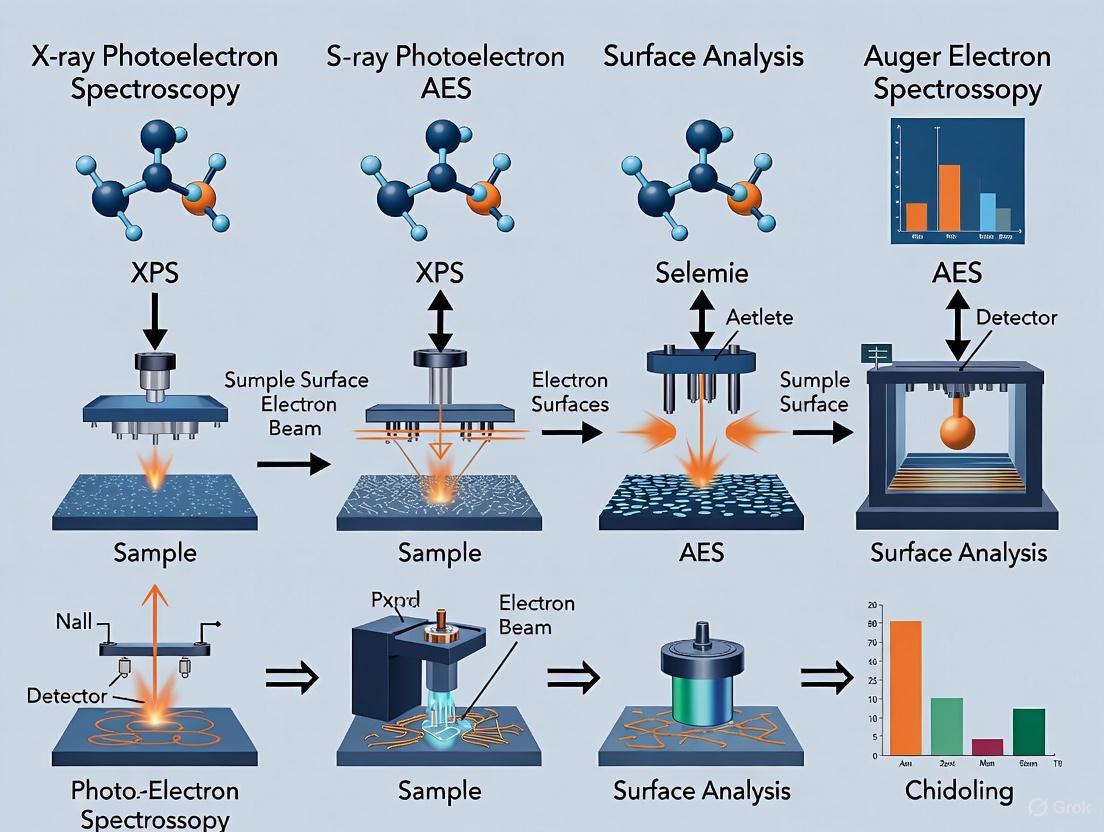
This article provides researchers, scientists, and drug development professionals with a detailed comparison of X-ray Photoelectron Spectroscopy (XPS) and Auger Electron Spectroscopy (AES).
XPS vs AES: A Comprehensive Guide to Surface Analysis Techniques for Material Science and Biomedical Research
Abstract
This article provides researchers, scientists, and drug development professionals with a detailed comparison of X-ray Photoelectron Spectroscopy (XPS) and Auger Electron Spectroscopy (AES). It covers the fundamental principles, methodological applications, and practical troubleshooting for both techniques. The guide explores their specific uses in characterizing biomedical materials, thin films, and semiconductors, supported by current market trends and technological advancements like machine learning and multimodal integration. It concludes with a direct comparison to help professionals select the optimal technique for their specific surface analysis challenges, from foundational research to industrial quality control.
Understanding Surface Analysis: Core Principles of XPS and AES
The fundamental operation of X-ray Photoelectron Spectroscopy (XPS) and Auger Electron Spectroscopy (AES) relies on two distinct electron emission processes: the photoelectric effect and the Auger process. Both techniques are surface-sensitive analytical methods used to determine the elemental composition and chemical state of materials, but they are initiated through different mechanisms and provide complementary information [1] [2]. The photoelectric effect forms the basis for XPS, while the Auger process, which can occur following either X-ray or electron bombardment, is the namesake and primary signal source for AES [3]. Understanding these core principles is essential for researchers and scientists selecting the appropriate technique for specific surface analysis challenges, particularly in fields like drug development and materials science where surface properties critically influence performance and functionality.
The Photoelectric Effect in XPS
Fundamental Mechanism
The photoelectric effect is the fundamental physical process underpinning X-ray Photoelectron Spectroscopy (XPS). This process involves the ejection of a core electron from an atom after it absorbs an X-ray photon with sufficient energy [2] [3]. The interaction is summarized by the equation: m + hν → m+* + e−, where m represents an atom in the material, hν is the incident X-ray photon, m+* is the resulting excited ion, and e− is the ejected photoelectron [3]. The kinetic energy (KE) of this ejected photoelectron is determined by the equation KE = hν - BE, where hν is the known energy of the incident X-ray photon and BE is the binding energy of the electron within its specific atomic orbital [3]. Since the binding energy is characteristic of both the element and the specific electron shell from which it originated, measuring the kinetic energy of the emitted electrons allows for precise elemental identification and chemical state analysis [1] [3].
Information Content and Chemical Shifts
A key strength of the photoelectric effect in XPS analysis is its sensitivity to the chemical environment of the atom. The binding energy of an electron experiences small but measurable shifts depending on the oxidation state and chemical bonding of the atom. This phenomenon, known as the "chemical shift," enables XPS to distinguish between different chemical states of the same element [3]. For example, the binding energy for molybdenum 3d electrons is 227.6 eV in its elemental form, but shifts to 229.6 eV in the +4 oxidation state and 232.7 eV in molybdenum trioxide (+6 oxidation state) [3]. This capability to provide quantitative data on oxidation states makes XPS exceptionally powerful for studying surface chemistry, catalysis, corrosion, and functionalized materials [1].
The Auger Process in AES
Fundamental Mechanism
The Auger process, central to Auger Electron Spectroscopy (AES), is a multi-stage relaxation phenomenon that occurs after an atom has been ionized in one of its inner shells. This initial ionization can be caused by either an incident electron or X-ray, creating an excited ion (m+) [2] [3]. The process unfolds in three distinct steps, as illustrated in Figure 1. First, the creation of a core hole occurs via electron bombardment: m + e− → m+ + 2e− [3]. Second, an electron from a higher-energy level fills the core vacancy, releasing energy. Third, instead of emitting an X-ray, this energy causes the simultaneous ejection of a third electron, known as the Auger electron [1] [3]. Critically, the kinetic energy of this emitted Auger electron is characteristic of the elements involved and is independent of the energy of the initial ionizing beam [3]. This independence distinguishes Auger electrons from the photoelectrons measured in XPS.
Information Content and Analytical Strengths
AES excels at providing high-resolution elemental mapping and depth profiling [1] [3]. Because the primary beam in AES is composed of electrons, which are easily focused, AES can achieve very high spatial resolution, making it ideal for analyzing small surface features and creating detailed maps of elemental distribution across a surface [3]. However, the standard instrumentation for AES prioritizes rapid analysis for surface mapping, which often sacrifices the spectral resolution needed to detect the subtle chemical shifts that are readily observed in XPS [3]. Consequently, AES is primarily used for elemental analysis rather than detailed chemical state identification, though chemical state information is present in the Auger spectra [1].
Comparative Analysis: Photoelectric Effect vs. Auger Process
Direct Comparison of Principles and Capabilities
The following table summarizes the fundamental differences between the photoelectric effect (for XPS) and the Auger process (for AES), highlighting their distinct origins, energy dependencies, and the type of information they provide.
Table 1: Fundamental Comparison Between the Photoelectric Effect and the Auger Process
| Feature | Photoelectric Effect (XPS) | Auger Process (AES) |
|---|---|---|
| Primary Process | Photoionization by X-rays [2] [3] | Relaxation after initial ionization (by electron or X-ray) [3] |
| Initial Excitation | X-ray photon absorption [2] | Electron beam bombardment (typically) [1] [3] |
| Emitted Electron | Photoelectron [2] | Auger electron [1] |
| Kinetic Energy Dependence | Depends on incident X-ray energy [3] | Independent of primary beam energy [3] |
| Key Information | Elemental identity, chemical state, oxidation state [1] [3] | Elemental identity and composition [1] [3] |
| Chemical State Analysis | Excellent (via chemical shifts) [3] | Limited with standard instrumentation [3] |
Practical Technique Comparison: XPS vs. AES
Building on the core physical principles, the practical implementation of XPS and AES reveals distinct advantages and limitations, guiding technique selection for specific research goals.
Table 2: Practical Comparison of XPS and AES Analytical Techniques
| Characteristic | XPS | AES |
|---|---|---|
| Primary Excitation Source | X-rays [1] [2] | Electron beam [1] [2] |
| Detected Particle | Photoelectrons [2] | Auger electrons [1] [2] |
| Spatial Resolution | Lower (X-ray beam is hard to focus) [3] | Very High (electron beam is easily focused) [3] |
| Chemical State Info | Excellent [1] [3] | Limited [1] [3] |
| Best For | Quantitative analysis, oxidation states, thin films [1] | Surface mapping, micro-area analysis, depth profiling [1] [3] |
| Sample Limitations | Suitable for conductors, semiconductors, and insulators [1] | Primarily for conductors and semiconductors (insulators charge) [3] |
| Detection Limit | ~0.1-1 at% [3] | Better for most elements (due to highly focused beam) [3] |
| Depth of Analysis | Top ~10 nm [1] | More surface-sensitive (shorter mean free path of Auger electrons) [2] |
Experimental Protocols and Methodologies
Typical XPS Experimental Workflow
The following diagram outlines the standard workflow for conducting an analysis using X-ray Photoelectron Spectroscopy, from sample preparation to data interpretation.
Figure 2: XPS Experimental Workflow
Detailed XPS Methodology:
- Sample Preparation: Samples must be solid and compatible with ultra-high vacuum (UHV). Preparation involves cleaning to remove surface contaminants and mounting on a suitable holder, often using conductive tape or clamps to minimize charging [1].
- Ultra-High Vacuum (UHV): The analysis must be performed in a UHV environment (typically better than 10⁻⁹ mbar) to minimize scattering of the ejected photoelectrons by gas molecules and to prevent surface contamination during measurement [1].
- X-ray Irradiation: The sample is irradiated with a monochromatic or non-monochromatic X-ray source, such as Al Kα (1486.6 eV) or Mg Kα (1253.6 eV) [1] [4]. This causes the ejection of photoelectrons via the photoelectric effect.
- Energy Analysis and Detection: The kinetic energy of the ejected photoelectrons is measured using a hemispherical electron energy analyzer. The analyzer applies a sweeping voltage to separate electrons by energy, which are then counted by a detector [3].
- Data Interpretation: The resulting spectrum plots electron count versus binding energy. Elemental identification is achieved by matching peak positions to known binding energies. Chemical state information is derived from precise peak position shifts (chemical shifts) and peak shape analysis [3].
Typical AES Experimental Workflow
The standard workflow for Auger Electron Spectroscopy shares some similarities with XPS but differs critically in the source of excitation and its analytical focus.
Figure 3: AES Experimental Workflow
Detailed AES Methodology:
- Sample Preparation: Samples for AES are typically limited to conductors and semiconductors to prevent surface charging from the primary electron beam. Insulators are difficult to analyze without specialized charge neutralization systems [3].
- Ultra-High Vacuum (UHV): Like XPS, AES requires a UHV environment for the same fundamental reasons [1].
- Electron Beam Bombardment: A finely focused, high-energy (typically 3-20 keV) electron beam is scanned across the sample surface. This beam causes the initial ionization that leads to Auger electron emission [1] [3].
- Signal Detection and Enhancement: Auger electron signals are often weak and superimposed on a high background of secondary electrons. To enhance the signal-to-noise ratio, the data is typically presented in the differentiated (derivative) mode [3].
- Spatial Resolution and Mapping: The primary strength of AES is its high spatial resolution (can be down to nanometers). By rastering the focused electron beam and recording the Auger signal intensity at each point, detailed two-dimensional elemental maps can be generated [1] [3]. When combined with ion sputtering, AES is highly effective for three-dimensional depth profiling [3].
The Scientist's Toolkit: Essential Research Reagents and Materials
The following table details key components and consumables essential for conducting XPS and AES analyses.
Table 3: Essential Materials and Reagents for XPS and AES Analysis
| Item Name | Function/Application | Technical Specification & Notes |
|---|---|---|
| Conductive Tape/Mounts | Sample fixing for XPS/AES | Carbon or metallic tapes; crucial for electrical contact to reduce charging effects. |
| Standard Reference Samples | Energy scale calibration | Clean gold (Au 4f₇/₂ at 84.0 eV) or copper (Cu 2p₃/₂ at 932.7 eV) foils for XPS. |
| X-ray Anodes | X-ray source for XPS | Replaceable anodes (Aluminum or Magnesium) generating characteristic Kα X-rays [4]. |
| Electron Guns | Primary beam source for AES | Thermionic (e.g., LaB₆) or field emission guns (FEG) for high spatial resolution. |
| Ion Sputter Gun | Surface cleaning & depth profiling | Argon (Ar⁺) ion source to etch surface layers; requires high-purity argon gas. |
| Hemispherical Analyzer (HSA) | Electron energy analysis | Core component of XPS systems; measures kinetic energy of photoelectrons [3]. |
| Cylindrical Mirror Analyzer (CMA) | Electron energy analysis | Common electron energy analyzer used in many AES systems [3]. |
| UHV-Compatible Materials | Chamber and sample holder construction | Made from stainless steel, high-purity copper, and other low-vapor-pressure materials. |
The photoelectric effect and the Auger process are two fundamental electron emission mechanisms that form the foundation of the powerful surface analysis techniques XPS and AES, respectively. The photoelectric effect provides exceptional chemical state information and quantitative capabilities, making XPS the preferred technique for investigating oxidation states, surface functionalization, and thin film chemistry. In contrast, the Auger process, when harnessed in AES, provides superior spatial resolution and is ideal for high-sensitivity elemental mapping and depth profiling of small surface features. The choice between these techniques is not a matter of superiority but of strategic application. Researchers must align their selection with their specific analytical needs: XPS for detailed chemical bonding information, and AES for high-resolution elemental distribution and micro-area analysis. A comprehensive surface characterization strategy in advanced research and development often leverages both techniques to obtain a complete picture of a material's surface properties.
The evolution of modern surface analysis is rooted in the pioneering work of early 20th-century physicists who discovered the fundamental phenomena underlying today's sophisticated instrumentation. X-ray Photoelectron Spectroscopy (XPS) and Auger Electron Spectroscopy (AES) emerged as two cornerstone techniques for surface characterization, both relying on the detection of electrons emitted from a material's outermost layers (typically 1-10 nm) [1] [5]. While they share ultra-high vacuum requirements and high surface sensitivity, their distinct physical principles and historical development pathways have led to complementary analytical capabilities [1] [5]. The progression from theoretical discovery to commercially viable analytical instruments transformed our ability to understand material composition, chemical states, and elemental distribution at the nanoscale, fueling advancements across semiconductor technology, biomedicine, and materials science [6] [7] [8]. This guide traces the parallel historical development of XPS and AES, providing an objective comparison of their performance, supported by experimental data and methodologies relevant to researchers and drug development professionals.
The Foundational Discoveries and Theoretical Frameworks
The Photoelectric Effect and the Birth of XPS
The genesis of XPS lies in the photoelectric effect, first explained by Albert Einstein in 1905, for which he received the Nobel Prize in 1921. This theory established that light can eject electrons from a material, with their kinetic energy being proportional to the light's frequency. Decades later, in the 195, Kai Siegbahn and his research group at Uppsala University in Sweden developed this principle into a practical analytical technique. Their work on measuring the kinetic energy of these ejected photoelectrons with high precision demonstrated that the technique could determine not only elemental identity but also chemical state [9]. Siegbahn's pioneering contributions, which earned him the Nobel Prize in Physics in 1981, led to the technique being alternatively known as Electron Spectroscopy for Chemical Analysis (ESCA) [7].
The Auger Effect and the Emergence of AES
The foundation for AES was laid independently by Lise Meitner in 1922 and later by Pierre Auger in 1923, who discovered the radiationless transition that now bears his name. The Auger effect occurs when an electron beam strikes a material, creating a core-hole. This unstable state is filled by an electron from a higher energy level, and the released energy causes the emission of a secondary "Auger" electron [1] [5]. Unlike the photoelectric effect, this process is a three-electron phenomenon that depends on the element's internal energy levels, making it independent of the excitation source. While the effect was discovered in the 1920s, it was not until the 1960s, with the work of researchers like Larry Harris at the Bell Telephone Laboratories, that AES was developed into a viable surface analysis technique, particularly with the incorporation of cylindrical mirror analyzers for improved signal detection [1].
Table 1: Key Historical Milestones in XPS and AES Development
| Time Period | XPS Milestone | AES Milestone |
|---|---|---|
| Early 1900s | Einstein explains the photoelectric effect (1905). | Lise Meitner and Pierre Auger discover the Auger effect (1922-1923). |
| 1950s-1960s | Kai Siegbahn develops ESCA; first commercial instruments. | Larry Harris demonstrates AES as a practical surface tool. |
| 1970s-1980s | Widespread commercialization; growth in chemical state analysis. | Incorporation into surface analysis systems; use for depth profiling. |
| 1990s-2000s | Advancements in spatial resolution and monochromatic sources. | High-resolution imaging and small-area analysis capabilities refined. |
| 2010s-Present | Automation, miniaturization (benchtop systems), and AI integration. | Enhanced mapping and integration with multi-technique platforms. |
Evolution of Instrumentation and Key Technological Innovations
The journey from experimental proof-of-concept to modern instrumentation required overcoming significant technical hurdles. Early instruments for both XPS and AES were custom-built in research laboratories, requiring ultra-high vacuum (UHV) conditions to enable the emitted electrons to travel to the detector without scattering [1] [5].
For XPS, a major breakthrough was the development of monochromatic X-ray sources, which replaced simpler anode-based sources. Monochromatic Al Kα X-rays (1486.6 eV) reduced the energy breadth of the excitation source, significantly improving spectral resolution and enabling the detection of subtle chemical state differences [8]. Parallel innovations in electron energy analyzers, particularly the hemispherical capacitor analyzer (HCA), allowed for precise measurement of electron kinetic energy. More recently, the development of focusing X-ray optics has dramatically improved the spatial resolution of XPS from millimetres to tens of microns, and even sub-micron in some advanced systems, bridging a key gap with AES [5] [8].
AES instrumentation evolved around the electron gun, with advances in field emission sources enabling the electron beam to be focused to spot sizes as small as 10 nanometres, making AES a powerful tool for microanalysis and defect review [5]. The cylindrical mirror analyzer (CMA) became a popular choice for its high transmission efficiency. The integration of ion sputtering guns for controlled material removal made both XPS and AES powerful tools for depth profiling, allowing researchers to construct three-dimensional compositional maps of thin films and layered structures [1].
Technical Comparison: XPS vs. AES in Modern Research
Modern XPS and AES instruments offer distinct capabilities and limitations, making each suitable for different analytical scenarios. The choice between them depends on the specific requirements of the analysis, such as the need for chemical state information, spatial resolution, or analysis speed.
Table 2: Performance Comparison of Modern XPS and AES Techniques
| Characteristic | XPS (ESCA) | AES |
|---|---|---|
| Primary Excitation Source | X-ray photons (Al Kα, Mg Kα) | Focused electron beam (typically 3-20 keV) |
| Information Provided | Elemental identity, concentration, chemical state, and oxidation state [1] [5] [9] | Elemental identity, concentration, and elemental mapping [1] [5] |
| Spatial Resolution | 10-100 µm (conventional); sub-µm with modern microprobes [5] | < 10 nm with field emission guns [5] |
| Detection Limit | 0.1 - 1.0 atomic % [1] | 0.1 - 1.0 atomic % [1] |
| Chemical State Sensitivity | Excellent - can distinguish oxidation states (e.g., Fe²⁺ vs. Fe³⁺) [1] [5] [9] | Poor - limited chemical state information [1] [5] |
| Sample Damage | Generally low (X-ray irradiation) | Potentially high (electron beam irradiation) |
| Typical Analysis Depth | 1 - 10 nm [1] [5] [9] | 1 - 10 nm [1] [5] |
| Key Strength | Quantitative chemical state analysis [1] [9] | High-spatial resolution elemental mapping and micro-analysis [1] [5] |
| Primary Limitation | Lower spatial resolution vs. AES; can suffer from charging on insulators [1] [5] | Minimal chemical state information; electron beam can damage sensitive samples [1] [5] |
Experimental Protocols for Comparative Analysis
To objectively evaluate the performance of XPS and AES, standardized experimental protocols are essential. The following methodologies outline a typical workflow for surface characterization, applicable to materials like biomedical implants or semiconductor structures.
Protocol 1: Surface Compositional Analysis of a Biomedical Implant
Objective: To determine the surface composition and chemical states of a titanium-based biomedical implant to assess its oxide layer and potential contamination [7].
- Sample Preparation: The implant is cut to an appropriate size (typically ~1 cm x 1 cm) and mounted on a standard sample holder using conductive tape or clips. It may be ultrasonically cleaned in a solvent like isopropanol to remove adventitious carbon contamination [7].
- Instrument Setup:
- XPS: The instrument is configured with a monochromatic Al Kα X-ray source (1486.6 eV). The analyzer pass energy is set to 20-40 eV for survey scans and 10-20 eV for high-resolution regional scans to maximize signal-to-noise ratio and resolution.
- AES: A electron beam voltage of 10 kV and a beam current of 10 nA are used. The analysis area is selected using secondary electron imaging.
- Data Acquisition:
- XPS: A survey spectrum (0-1100 eV binding energy) is first acquired to identify all elements present. High-resolution spectra are then collected for the Ti 2p, O 1s, and C 1s core levels. The Ti 2p spectrum is critical for identifying TiO₂, which is a passivating and biocompatible oxide [7].
- AES: A survey spectrum (from 0 to 2000 eV kinetic energy) is acquired from a specific spot or region. Point analysis can be performed on visually distinct features, and elemental maps can be acquired for Ti, O, and C to visualize distribution.
- Data Analysis:
- XPS: Peaks are fitted using software to separate different chemical states. The position of the Ti 2p₃/₂ peak at approximately 458.5 eV confirms TiO₂. The atomic concentration of each element is calculated from peak areas and relative sensitivity factors.
- AES: Peak heights in the differential spectrum are used for semi-quantitative analysis. Elemental maps are overlaid to correlate the distribution of elements.
Protocol 2: Failure Analysis of a Semiconductor Device
Objective: To identify the cause of failure in a semiconductor device by locating and characterizing a sub-micrometre conductive bridge between two isolated metal lines [1].
- Sample Preparation: The device is opened mechanically or chemically to expose the area of interest and mounted in a specimen holder that provides a path to electrical ground to minimize charging.
- Instrument Setup:
- AES (Primary Tool): A high-brightness field emission electron gun is used. The beam energy is set to 10 kV with a low beam current (~1 nA) to minimize sample damage. The spot size is minimized for maximum spatial resolution.
- XPS (Follow-up): If needed, a small-spot XPS system with a focused X-ray probe is used on the feature identified by AES for chemical state analysis.
- Data Acquisition:
- AES: The device is first imaged using secondary electrons to locate the suspected bridge. Auger point analyses are performed on the bridge and the surrounding unaffected area. An Auger line scan or elemental map for the bridge material (e.g., Al, Cu) is acquired across the bridge to confirm its composition.
- Data Analysis:
- AES: The Auger spectrum from the bridge is compared to reference spectra to identify the elemental composition of the contaminant causing the short circuit (e.g., migration of a specific metal). The high spatial resolution of AES is crucial for confining the analysis to the narrow bridge structure.
The Scientist's Toolkit: Essential Reagents and Materials
Table 3: Key Research Reagent Solutions for XPS and AES Analysis
| Item | Function | Application Notes |
|---|---|---|
| Conductive Tapes & Mounting Clips | Provides electrical and thermal contact between sample and holder; ensures sample stability. | Crucial for preventing charging, especially for non-conductive samples in both XPS and AES [1]. |
| Standard Reference Materials | Used for instrument calibration and quantification. | Au foil (Au 4f₇/₂ at 84.0 eV) and Cu foil (Cu 2p₃/₂ at 932.7 eV) are common for XPS [9]. |
| Ion Sputtering Source (Ar⁺) | For in-situ sample cleaning and depth profiling by removing surface layers. | Integrated into both XPS and AES systems; parameters (energy, current) must be optimized to avoid sample damage [1]. |
| Monochromated Al Kα X-ray Source | High-energy resolution X-ray excitation for XPS. | Reduces peak full-width, enabling accurate chemical state identification [8]. |
| Field Emission Electron Gun | High-brightness, small-spot electron source for AES. | Essential for achieving <10 nm spatial resolution in AES mapping and microanalysis [5]. |
| Charge Neutralization System | Floods sample with low-energy electrons/ions to compensate for positive charge buildup. | Required for analyzing insulating materials (e.g., polymers, ceramics) in XPS [1] [5]. |
| Hemispherical Analyzer (HCA) | Measures kinetic energy of photoelectrons (XPS) or Auger electrons with high precision. | The core detector in modern XPS and some AES systems [8]. |
The historical development of XPS and AES reveals a journey from the exploration of fundamental physical phenomena to the creation of indispensable analytical tools for modern science and industry. While their core principles remain unchanged, the instrumentation has seen continuous refinement. The current market and technological trends indicate a promising future shaped by miniaturization, with the development of benchtop XPS systems [8], automation for higher throughput, and the integration of artificial intelligence (AI) and machine learning (ML) for advanced data interpretation and spectral analysis [10]. Furthermore, the combination of XPS and AES into multi-technique vacuum clusters is becoming more common, allowing researchers to leverage the complementary strengths of both techniques on the same sample without exposure to the ambient environment [8]. As materials science continues to push into the nanoscale, particularly in fields like semiconductor manufacturing (with nodes below 7 nm) and advanced biomaterials, the demand for the precise chemical and elemental surface analysis provided by XPS and AES will only intensify, ensuring their continued evolution and relevance [6] [8].
Surface analysis is a critical component of materials science, chemistry, and various industrial research fields, where the top few atomic layers of a material often dictate its performance and properties. Among the most powerful techniques for surface characterization are X-ray Photoelectron Spectroscopy (XPS) and Auger Electron Spectroscopy (AES). While both techniques provide elemental information from the outermost surface of materials, they differ significantly in their underlying physical principles, operational parameters, and the specific information they deliver. For researchers, scientists, and drug development professionals, understanding these distinctions is essential for selecting the appropriate analytical method for specific research challenges. This guide provides a detailed comparison of XPS and AES, focusing on three fundamental physical parameters: analysis depth, spatial resolution, and range of detectable elements, supported by experimental data and methodological protocols.
Fundamental Principles and Technical Comparison
Physical Mechanisms
The operational principles of XPS and AES, while both involving electron emissions, originate from distinct physical processes that fundamentally shape their applications and limitations.
XPS is based on the photoelectric effect. When a sample is irradiated with X-rays (typically Al Kα or Mg Kα), core-level electrons absorb the photon energy and are ejected as photoelectrons. The kinetic energy of these photoelectrons is measured, and their characteristic binding energy is calculated using the relationship: Kinetic Energy = Photon Energy - Binding Energy - Work Function [3] [11]. This binding energy is not only elemental-specific but is also sensitive to the chemical environment of the atom, resulting in measurable chemical shifts that provide information about oxidation states and chemical bonding [3] [12].
AES relies on the Auger effect, a multi-step process initiated by a high-energy electron beam. This beam creates a core-hole vacancy. When an electron from a higher energy level fills this vacancy, the released energy can either be emitted as an X-ray or can eject a third electron, known as an Auger electron. The kinetic energy of this Auger electron is characteristic of the element from which it was emitted and is generally independent of the incident beam energy [3] [13] [11].
A key practical difference lies in the primary excitation source: XPS uses X-rays, while AES uses an electron beam. This difference is primarily responsible for their divergent capabilities in chemical state analysis and spatial resolution [3].
Comparative Technical Specifications
The table below summarizes the key physical parameters for XPS and AES, providing a direct comparison of their analytical capabilities.
Table 1: Comparison of Key Physical Parameters for XPS and AES
| Parameter | XPS (ESCA) | AES |
|---|---|---|
| Analysis Depth | ~5 nm or less [14] | ~5 nm [15] [16] |
| Lateral Spatial Resolution | ≥ 7.5 μm [14] | < 10 nm, can be as small as 8 nm [15] [16] |
| Detectable Elements | All elements except Hydrogen (H) and Helium (He) [3] | All elements higher than Helium (He) [16] |
| Primary Excitation Source | X-rays (e.g., Al Kα) [11] | Electron Beam (0.1 – 25 keV) [16] |
| Primary Information | Elemental identity, concentration, and chemical state [3] [14] | Elemental identity and distribution [15] [13] |
| Quantitative Accuracy | ±5-30% (with or without standards) [3] | ~10% with standards; ~50% without standards [13] |
| Sample Compatibility | Conductors, Semiconductors, and Insulators [3] | Primarily Conductors and Semiconductors [3] |
Critical Parameter Analysis
Analysis Depth
Both XPS and AES are highly surface-sensitive techniques with average analysis depths of approximately 5 nanometers [15] [14]. This shallow information depth is a consequence of the inelastic mean free path of the emitted electrons (photoelectrons for XPS and Auger electrons for AES), which is the average distance an electron can travel in a solid without losing energy. Only electrons that originate within this short distance from the surface can escape and be detected, making both techniques ideal for studying thin films, surface contaminants, and oxidation layers [13].
Spatial Resolution
Lateral spatial resolution is the most differentiating parameter between these two techniques. AES excels in this area, achieving a spatial resolution of <10 nm, with state-of-the-art systems reaching down to 8 nm [15] [16]. This high resolution is possible because the primary electron beam can be focused to a very fine spot. In contrast, the lateral resolution in XPS is typically on the micrometer scale (e.g., 7.5 μm), limited by the difficulty in focusing X-ray beams [3] [14]. This makes AES the preferred technique for mapping elemental distributions at the nanoscale, such as in semiconductor devices or nanoparticle analysis [15].
Detectable Elements
Both techniques can detect all elements from Lithium (Li) to Uranium (U), with AES also capable of detecting elements heavier than Helium [16] [3]. A notable difference is that XPS cannot effectively detect Hydrogen and Helium [3]. The detection limits for both techniques are in the range of 0.1 to 1 atomic percent, though sensitivity can be higher for certain elements with AES due to the ability to use a more intense, focused primary beam [16] [3] [13].
Experimental Protocols and Methodologies
Standard Operational Workflows
The following diagrams illustrate the standard experimental workflows for XPS and AES analysis, from sample preparation to data interpretation.
Diagram 1: AES Experimental Workflow
Diagram 2: XPS Experimental Workflow
The Scientist's Toolkit: Essential Instrumentation and Reagents
Successful surface analysis requires specific instrumentation and materials. The table below details key components of a typical XPS or AES analysis system.
Table 2: Essential Research Reagent Solutions for Surface Analysis
| Item | Function/Description | Technical Notes |
|---|---|---|
| High Vacuum Chamber | Maintains ultra-high vacuum (UHV) environment (< 5x10⁻⁹ Torr for AES) to prevent surface contamination and allow electron detection without scattering. | Essential for both XPS and AES [13]. |
| Conductive Sample Mounts | Provides a stable, electrically conductive platform for mounting samples. | Crucial for AES to prevent charging; important for XPS on insulators [3]. |
| Mono-energetic X-ray Source (Al Kα, Mg Kα) | Primary excitation source for XPS. Ejects photoelectrons from the sample. | Energy is 1486.6 eV for Al Kα [14]. |
| Field Emission Electron Gun | Primary excitation source for AES. Generates a finely focused, high-intensity electron beam. | Enables high spatial resolution (< 10 nm) [15] [13]. |
| Hemispherical/Cylindrical Mirror Analyzer (CHA/CMA) | Measures the kinetic energy of emitted electrons with high resolution. | CHA is standard in modern XPS and AES systems [13] [12]. |
| Ion Sputtering Gun (Ar⁺) | Removes surface layers for depth profiling and sample cleaning. | Can cause artifacts like preferential sputtering [17] [13]. |
| Reference Materials (Au, Cu, Ag Foils) | Used for energy scale calibration and quantification. | Ensures accuracy and comparability of data [13]. |
Advanced Applications and Integrated Protocols
AES for Nanoscale Particle Analysis
Objective: To determine the elemental composition of micro-scale or sub-micrometer particles, such as solder joints or contaminants. Protocol:
- Sample Preparation: The sample, such as a polished cross-section of lead-free solder, is mounted on a conductive stub to prevent charging [15].
- SEM Imaging: The area of interest is located using a high-resolution Scanning Electron Microscope (SEM) integrated with the AES system [15].
- AES Point Analysis & Mapping: A focused electron beam (e.g., 20 kV, 5 nA) is rastered over the particle. Emitted Auger electrons are collected to create elemental maps (e.g., Sn (blue), Ag (red), Cu (green)) [15].
- Data Interpretation: The distinct colors in the overlay map reveal the spatial distribution of elements, identifying phases and potential contaminants.
XPS Chemical State Analysis for Catalysts
Objective: To identify not only the presence of an element but also its chemical state, as in the case of molybdenum on a catalyst surface. Protocol:
- Sample Preparation: The catalyst sample is securely mounted in the UHV chamber.
- Spectrum Acquisition: A monochromatic X-ray beam is focused on the sample, and high-resolution spectra are acquired over a narrow energy range covering the Mo 3d photoelectron peaks.
- Peak Fitting & Chemical Shift Analysis: The resulting spectrum is deconvoluted. The binding energy for elemental Mo is found at 227.6 eV, while Mo in the +6 oxidation state (MoO₃) shows a peak at 232.7 eV [3].
- Quantification: The relative areas under the peaks for different chemical states are calculated to determine their abundance on the surface.
Depth Profiling with Sputtering
Objective: To determine the in-depth composition of a thin film structure. Protocol (Common to both XPS and AES):
- Initial Surface Analysis: A spectrum is acquired from the as-received surface.
- Cyclic Sputtering and Analysis: An ion beam (often Ar⁺) sputters the surface for a predetermined time to remove a thin layer. The newly exposed surface is then analyzed by XPS or AES. This cycle is repeated multiple times [17] [13].
- Data Reconstruction: The elemental concentrations from each cycle are plotted against sputter time or estimated depth to create a depth profile. Techniques like Zalar rotation can be employed to minimize artifacts like differential sputtering [13].
XPS and AES are powerful, complementary surface analysis techniques with distinct strengths dictated by their fundamental physical parameters. AES is unparalleled for high lateral resolution mapping at the nanoscale, making it ideal for failure analysis in semiconductors and investigating heterogeneous materials. Its requirement for conductive samples, however, can be a limitation. XPS provides superior chemical state information and is applicable to a wider range of materials, including insulators, but with lower spatial resolution.
The choice between them hinges on the specific research question. If the goal is to identify oxidation states or analyze insulating materials, XPS is the definitive choice. If the problem requires mapping elemental distributions with nanoscale precision on a conductive sample, AES is the superior tool. Often, a combined approach, utilizing the strengths of both techniques, provides the most comprehensive understanding of a material's surface properties.
Essential Instrumentation Components and Operational Requirements
Surface analysis is a critical field in materials science, chemistry, and drug development, where the outermost layers of a material often determine its properties and performance. Two powerful techniques for surface characterization are X-ray Photoelectron Spectroscopy (XPS), also known as Electron Spectroscopy for Chemical Analysis (ESCA), and Auger Electron Spectroscopy (AES). Both techniques provide information about the elemental composition and chemical state of the top few nanometers of a material surface, but they differ significantly in their instrumentation, operational requirements, and application suitability [18] [19].
Understanding the essential components and operational parameters of these techniques is crucial for researchers selecting the appropriate method for their specific analytical needs. This guide provides a detailed comparison of XPS and AES instrumentation, focusing on their key components, performance characteristics, and optimal application scenarios to inform method selection in research and development environments.
Fundamental Principles and Instrumentation
X-ray Photoelectron Spectroscopy operates by irradiating a sample with X-rays and measuring the kinetic energy of ejected photoelectrons. According to the photoelectric effect, the binding energy of these electrons is calculated using the relationship: Ebinding = Ephoton - Ekinetic - φ, where Ephoton is the incident X-ray energy, Ekinetic is the measured electron kinetic energy, and φ is the work function of the spectrometer [18]. This binding energy serves as a fingerprint for elemental identification and chemical state determination.
The essential components of an XPS instrument include:
- X-ray source: Typically monochromated Al Kα radiation (1486.6 eV) generated by electron bombardment of an aluminum anode. Monochromation using quartz crystals improves energy resolution by providing a narrow spread of X-ray energies [20] [21].
- Electron analyzer: A hemispherical analyzer acts as a band-pass filter, allowing electrons of specific kinetic energies to reach the detector. Electron lenses focus and steer emitted photoelectrons into the analyzer [20].
- Ultra-high vacuum (UHV) system: Maintains pressure below 10-9 Torr to prevent scattering of photoelectrons by gas molecules and to maintain surface cleanliness [20] [18].
- Charge neutralization system: An electron flood gun compensates for surface charging on insulating samples by providing low-energy electrons [20] [18].
- Ion source: Typically an argon ion gun for sample cleaning and depth profiling through sputter removal of surface layers [20] [18].
- Detection and data system: Electron detectors count arriving electrons, and sophisticated software controls instrumentation and processes data [20].
Auger Electron Spectroscopy utilizes a focused electron beam to excite atoms in the sample, resulting in the emission of Auger electrons during the relaxation process. The kinetic energy of these electrons is characteristic of the emitting element and is independent of the incident beam energy. AES instrumentation shares some similarities with XPS but has distinct differences in key components:
- Electron source: A focused electron gun (typically 3-20 keV) provides the primary excitation, allowing for much smaller analysis areas compared to XPS [19].
- Electron analyzer: Similar hemispherical analyzer as used in XPS, but often optimized for different energy ranges and spatial resolution.
- UHV system: Similarly requires ultra-high vacuum conditions for electron mean free path preservation and surface cleanliness.
- Detection system: Electron detectors similar to those in XPS, but often coupled with scanning capabilities for elemental mapping.
A key advantage of AES is its superior spatial resolution, as electron beams can be focused to spot sizes approximately an order of magnitude smaller than X-ray beams [19]. However, the high-energy electron beam can cause sample damage, particularly to sensitive organic materials and polymers.
Operational Workflow Comparison
The following diagram illustrates the fundamental operational principles and logical relationships between components in XPS and AES systems:
Performance Comparison and Experimental Data
Technical Specifications Comparison
Table 1: Instrumentation and performance comparison between XPS and AES
| Parameter | XPS | AES |
|---|---|---|
| Primary Excitation Source | X-rays (Al Kα, Mg Kα) [20] [18] | Focused electron beam (3-20 keV) [19] |
| Spatial Resolution | ~10-100 μm [19] | ~10 nm - 1 μm (order of magnitude better than XPS) [19] |
| Information Depth | Top 1-10 nm [20] [18] | Few nm (similar to XPS) [19] |
| Elemental Range | All elements except H and He [19] | All elements except H and He [19] |
| Chemical Bonding Information | Excellent (chemical shifts ~0.1 eV resolution) [18] | Limited (fewer reference databases) [19] |
| Quantitative Accuracy | ±10% with standard sensitivity factors [18] | Similar to XPS with proper calibration [22] |
| Sample Conductivity Requirements | Suitable for both conductors and insulators (with charge compensation) [20] [19] | Primarily for conducting samples (charging issues with insulators) [19] |
| Typical Analysis Time | Minutes to hours (depending on elements and resolution) | Generally faster than XPS for comparable data [19] |
| Sample Damage Potential | Lower (X-ray induced damage possible but less severe) | Higher (electron beam can damage sensitive materials) [19] |
| Depth Profiling Capability | Yes (with monatomic or gas cluster ion beams) [20] | Excellent (high sputtering rates with precise control) [19] |
Quantitative Analysis Capabilities
Both XPS and AES provide quantitative elemental composition data through the measurement of peak intensities and application of sensitivity factors. The general expression for quantitative analysis in XPS is:
Cx = (Ix/Sx) / (ΣIi/Si)
where Cx is the concentration of element x, Ix is the measured intensity, Sx is the elemental sensitivity factor, and ΣIi/Si is the sum of intensity/sensitivity factor ratios for all detected elements [18].
For accurate quantification, both techniques require careful calibration of the electron spectrometer transmission function and detector sensitivity energy dependencies [22]. Modern instruments incorporate standardized calibration procedures to ensure quantitative accuracy of approximately ±10% for most elements [18].
Table 2: Analytical capabilities for different material types
| Material Type | Preferred Technique | Key Considerations |
|---|---|---|
| Polymers & Organic Materials | XPS | Minimal radiation damage; effective charge neutralization available [20] [19] |
| Inorganic Semiconductors | Both | AES for high spatial resolution; XPS for chemical state information [19] |
| Metals & Alloys | Both | AES for grain boundary analysis; XPS for oxide layer characterization [18] [19] |
| Ceramics & Oxides | XPS | Better charge compensation; superior chemical state information [20] [18] |
| Powders & Porous Materials | XPS | Less susceptible to charging issues; better for insulating materials [20] |
| Multilayer Thin Films | AES | Superior depth resolution for thin layer structures [19] |
| Biomaterials | XPS | Lower damage potential; better for radiation-sensitive biological materials [20] |
Detection Limits and Sensitivity
Both XPS and AES offer similar detection limits typically in the range of 0.1-1.0 atomic percent for most elements. The fundamental limitations arise from the electron emission cross-sections, analyzer transmission efficiencies, and background noise levels. For XPS, monochromated X-ray sources provide better signal-to-noise ratios and higher energy resolution, enabling more precise chemical state identification [20] [21]. AES generally offers faster data acquisition, particularly for elemental mapping applications, due to the higher brightness of electron sources compared to X-ray sources.
Experimental Protocols and Methodologies
Sample Preparation Procedures
Proper sample preparation is critical for both XPS and AES analysis. The following protocols ensure reliable and reproducible results:
Universal Preparation Steps:
- Sample Cleaning: Remove adventitious carbon and other contaminants using appropriate solvents. For AES, note that the electron beam may vaporize volatile organic compounds during analysis [19].
- Mounting: Secure samples to appropriate holders using conductive tapes or clips. For insulating samples in XPS, specialized mounting may be required for optimal charge compensation.
- Electrical Contact: Ensure good electrical connection between sample and holder to minimize charging effects. For XPS analysis of insulators, this is less critical due to the electron flood gun [20].
- Load-Lock Introduction: Transfer samples via a load-lock chamber to maintain the ultra-high vacuum in the analysis chamber [20].
Material-Specific Considerations:
- Powders: Press into indium foil or spread as thin layer on conductive tape
- Non-conducting materials: For XPS, use thin sections and ensure proper charge neutralization system calibration [20]
- Air-sensitive materials: Use inert atmosphere transfer vessels to prevent surface oxidation
- Biological specimens: May require freeze-drying or special fixation to preserve structure under vacuum
Data Acquisition Protocols
XPS Survey Scans:
- Set pass energy to 100-200 eV for optimal sensitivity
- Acquire spectrum over binding energy range of 0-1100 eV
- Use step size of 0.5-1.0 eV with dwell times of 50-100 ms
- Identify all detectable elements from characteristic photoelectron peaks [18]
XPS High-Resolution Scans:
- Set pass energy to 20-50 eV for better energy resolution
- Use step size of 0.05-0.1 eV with longer dwell times (100-200 ms)
- Acquire regions for each detected element with sufficient range to observe chemical shifts
- Collect multiple scans to improve signal-to-noise ratio for trace elements [18]
AES Survey Scans:
- Set primary beam energy appropriate for the sample (typically 5-10 keV)
- Acquire spectrum in differential mode (dN(E)/dE) for better peak visibility
- Scan kinetic energy range from 0-2000 eV
- Identify elements from characteristic Auger peaks [19]
AES Mapping:
- Set primary beam parameters for desired spatial resolution
- Select specific Auger transitions for each element of interest
- Raster the electron beam across the sample area
- Acquire peak intensity maps at each pixel location [19]
Depth Profiling Methodologies
XPS Depth Profiling:
- Alternate between ion sputtering and data acquisition cycles
- Use monatomic ion beams (Ar+) for inorganic materials or gas cluster ion beams (GCIB) for organic materials to minimize damage [20]
- Select key photoelectron peaks to monitor as function of sputtering time
- Convert sputtering time to depth using calibrated sputter rates for similar materials [18]
AES Depth Profiling:
- Use simultaneous sputtering and analysis for faster profiling
- Employ lower energy ions for better depth resolution
- Monitor selected Auger peaks during continuous sputtering
- Optimize sputter rate based on material properties and depth resolution requirements [19]
The following diagram illustrates the standard workflow for surface analysis experiments:
The Researcher's Toolkit: Essential Instrument Components
Table 3: Essential components and their functions in XPS and AES instrumentation
| Component | Function | XPS | AES |
|---|---|---|---|
| Excitation Source | Generates primary radiation/particles for sample excitation | X-ray gun (Al/Mg anode) [20] [18] | Electron gun (thermal or field emission) [19] |
| Monochromator | Filters excitation source to narrow energy distribution | Quartz crystal monochromator [20] [21] | Not typically used |
| Hemispherical Analyzer | Energy discrimination of emitted electrons | Standard (FAT or FRR modes) [21] | Standard (similar to XPS) [19] |
| UHV System | Maintains low pressure for electron mean free path | Essential (<10⁻⁹ Torr) [20] [18] | Essential (<10⁻⁹ Torr) [19] |
| Ion Source | Surface cleaning and depth profiling | Argon ion source (monatomic or cluster) [20] | Argon ion source (typically monatomic) [19] |
| Charge Neutralizer | Compensates charging on insulating samples | Low-energy electron flood gun [20] [18] | Limited effectiveness [19] |
| Sample Stage | Positions sample for analysis | Multi-axis manipulator with heating/cooling | Multi-axis manipulator, often with higher precision |
| Detection System | Counts electrons transmitted by analyzer | Electron multipliers or position-sensitive detectors [21] | Similar to XPS detectors [19] |
| Optical Microscope | Sample viewing and area selection | Integrated with stored navigation views [20] | Often integrated with SEM capabilities |
| Load-Lock Chamber | Sample introduction without breaking vacuum | Standard feature [20] | Standard feature [19] |
Application-Specific Methodology Selection
Chemical State Analysis - XPS Protocol
For detailed chemical state analysis, XPS is unequivocally superior due to well-established chemical shift databases and higher energy resolution. The experimental protocol includes:
High-Resolution Regional Scans:
- Use monochromated X-ray source for optimal energy resolution [20]
- Set pass energy to 20 eV or lower for high spectral resolution
- Acquire multiple scans to improve statistics while minimizing radiation damage
- Use step sizes of 0.05-0.1 eV to adequately sample peak shapes
Energy Referencing:
- For conductive samples: reference to Fermi edge or known metallic peak
- For insulating samples: use adventitious carbon (C 1s at 284.8 eV) as reference [18]
- Document reference method in all reports for reproducibility
Peak Fitting Procedure:
- Use appropriate background subtraction (Shirley, Tougaard, or linear)
- Employ chemically realistic peak models with proper constraints
- Maintain consistent full-width-at-half-maximum (FWHM) for similar chemical states
- Report all fitting parameters and uncertainties
High-Spatial-Resolution Mapping - AES Protocol
When spatial resolution below 1 μm is required, AES provides significant advantages:
Optimal Instrument Conditions:
- Use field emission electron source for smallest probe size
- Select primary beam energy based on sample properties and desired resolution
- Optimize beam current for adequate signal while minimizing damage
Mapping Acquisition:
- Select characteristic Auger transitions for each element
- Define raster area and pixel density based on feature size
- Acquire peak-minus-background maps for quantitative interpretation
- Use multiplex acquisition for multiple elements to ensure registration
Data Interpretation:
- Correlate AES maps with secondary electron images for morphological context
- Account for potential sample damage during extended acquisitions
- Use multivariate analysis techniques for complex spectral datasets
The choice between XPS and AES depends primarily on the specific analytical requirements of the investigation. XPS is generally preferred when chemical state information, analysis of insulating materials, or minimal sample damage are primary concerns. Its strengths in quantitative analysis and comprehensive databases make it invaluable for polymer characterization, oxide film analysis, and biological interface studies [20] [18] [19].
AES excels in applications requiring high spatial resolution, rapid depth profiling, and analysis of conductive materials. Its superior mapping capabilities and faster acquisition times make it ideal for semiconductor device analysis, grain boundary segregation studies, and failure analysis of microelectronic components [19].
For comprehensive surface characterization, many research facilities utilize both techniques in a complementary approach, leveraging the chemical specificity of XPS with the high spatial resolution of AES. Understanding the essential instrumentation components and operational requirements outlined in this guide enables researchers to select the optimal technique for their specific surface analysis challenges and correctly interpret the resulting data within the limitations of each method.
The Role of Surface Analysis in Modern Materials Science and Biomedical Research
Surface analysis techniques are indispensable tools for characterizing the chemical and elemental composition of material surfaces, with X-ray Photoelectron Spectroscopy (XPS) and Auger Electron Spectroscopy (AES) standing as two of the most prominent methods. The choice between them is critical, as it dictates the type of information that can be obtained, the kinds of samples that can be studied, and the ultimate success of a research project. This guide provides an objective comparison of XPS and AES to help researchers select the optimal technique for their specific applications in materials science and biomedical research.
Analytical Principle and Information Depth
At their core, both XPS and AES are electron spectroscopy techniques that probe the outermost layers of a solid sample. However, their excitation mechanisms and the fundamental information they provide differ significantly.
XPS Principle
XPS, also known as Electron Spectroscopy for Chemical Analysis (ESCA), uses a beam of X-rays to irradiate the sample surface [23]. This irradiation causes photoelectrons to be emitted from the core levels of atoms within the top 1–10 nm of the material [23]. The measured kinetic energy of these photoelectrons is used to determine their binding energy, which is characteristic of the parent element and its chemical state [23] [9]. This chemical state sensitivity is a key strength of XPS, allowing researchers to distinguish, for example, between metallic silicon and silicon dioxide, or between different oxidation states of a metal.
AES Principle
AES, in contrast, uses a finely focused electron beam as the primary excitation source [24]. This beam causes atoms to undergo a process known as the Auger effect, resulting in the emission of Auger electrons. The kinetic energy of these Auger electrons is measured and is also characteristic of the emitting element [24]. While AES can sometimes provide chemical state information from peak shape and position, it is generally considered less straightforward for this purpose than XPS. The average depth of analysis for AES is approximately 5 nm [24].
The following diagram illustrates the fundamental processes and information pathways for both techniques:
Technical Comparison and Experimental Data
The fundamental differences in the principles of XPS and AES lead to distinct performance characteristics, making each technique better suited for specific types of analysis. The table below summarizes their key technical parameters for direct comparison.
Table 1: Technical Comparison of XPS and AES
| Parameter | XPS (ESCA) | AES |
|---|---|---|
| Primary Excitation Source | X-ray beam [23] | Focused electron beam (typically 3-25 keV) [24] |
| Detected Particle | Photoelectrons [23] | Auger electrons [24] |
| Information Depth | Top 1-10 nm [23] | ~5 nm (average) [24] |
| Lateral Resolution | Typically > 10 µm (can be ~3 µm with μ-XPS) [23] | As small as 8 nm [24] |
| Elemental Range | All elements except H and He [25] | All elements except H and He |
| Chemical State Info. | Excellent - via chemical shifts in binding energy [23] [9] | Moderate - via peak shape and position changes [24] |
| Quantitative Analysis | Excellent - inherently quantitative with sensitivity factors [25] | Good - requires standards and is less straightforward than XPS |
| Sample Damage | Generally low (X-ray induced damage possible for sensitive materials) | Higher risk due to focused electron beam, especially on polymers and organics |
Supporting Experimental Data and Reproducibility
The reliability of data from both techniques is paramount. The National Institute of Standards and Technology (NIST) provides critical databases to support quantitative analysis:
- NIST XPS Database (SRD 20): Contains over 33,000 data records for peak identification, binding energies, and chemical shifts [26].
- NIST Electron Inelastic-Mean-Free-Path Database (SRD 71): Provides values essential for quantitative depth analysis in both XPS and AES [26].
- NIST Database for the Simulation of Electron Spectra (SESSA) (SRD 100): Can simulate both XPS and AES spectra for complex nanostructures to aid in interpretation and method validation [26].
A significant challenge noted in the literature is the potential for poor reporting and misinterpretation of XPS data by inexperienced users, which can contribute to a "reproducibility crisis" in scientific literature [25]. To ensure reliable results, researchers are encouraged to follow established practical guides and standards [25].
Experimental Protocols and Workflows
A successful surface analysis experiment requires careful planning and execution. The workflow, from sample preparation to data interpretation, is critical for obtaining meaningful results.
Protocol 1: Standard XPS Analysis for Surface Chemical State Identification
This protocol is designed to determine the elemental composition and chemical states on a material's surface, ideal for studying oxide layers, functionalized surfaces, or contaminants [23] [9].
- Sample Preparation: For solid samples, secure them on a holder using double-sided conductive tape or metal clamps. For powders, press them into an indented sample holder or onto a sticky tape. Critical Note: Handle samples with gloves and tweezers to avoid contamination from fingerprints. If the sample is an electrical insulator, charge compensation using a low-energy electron flood gun is essential [23].
- Instrument Setup and Calibration: Insert the sample into the ultra-high vacuum (UHV) chamber. Verify the energy scale calibration of the spectrometer using a standard material, such as clean gold (Au 4f7/2 at 84.0 eV) or copper (Cu 2p3/2 at 932.67 eV).
- Preliminary Survey Spectrum: Collect a wide energy range (e.g., 0-1100 eV binding energy) survey scan with a low energy resolution (high pass energy). This identifies all elements present on the surface [25].
- High-Resolution Regional Spectra: For each element of interest identified in the survey, collect a high-energy-resolution spectrum (narrow energy window) of its core-level peaks (e.g., C 1s, O 1s, N 1s, Si 2p). Use appropriate step sizes and dwell times to ensure good counting statistics.
- Data Processing and Interpretation:
- Charge Referencing: If the sample is an insulator, reference the spectra to the adventitious carbon C 1s peak (typically set to 284.8 eV).
- Background Subtraction: Apply a suitable background (e.g., Shirley or Tougaard).
- Peak Fitting: Deconvolute complex peaks using synthetic components representing different chemical states. Reference databases like NIST SRD 20 should be used for chemical shift identification [26].
- Quantification: Calculate atomic concentrations using the peak areas and relative sensitivity factors (RSFs) provided by the instrument software.
Protocol 2: AES Depth Profiling for Thin Film Interface Analysis
This protocol is used to determine the compositional variation as a function of depth, crucial for analyzing multilayer thin films, coatings, and diffusion at interfaces [24].
- Sample Preparation and Initial Analysis: Prepare and introduce the sample as in the XPS protocol. First, acquire a survey AES spectrum from the as-received surface to confirm the initial composition.
- Sputter Source Setup: Select an appropriate ion source (e.g., Ar+ ions) and set the ion energy and current density to achieve the desired sputter rate for the material. The sputter rate must be calibrated for a known standard (e.g., SiO₂ on Si) under identical conditions.
- Cyclic Sputtering and Analysis:
- Sputter Cycle: Remove a thin layer of material (e.g., 1-10 nm) by ion bombardment for a predetermined time.
- Analysis Cycle: Move the sample back to the analysis position. Acquire either survey spectra or high-resolution spectra for specific elements of interest. High lateral resolution AES can be used to analyze small features [24].
- Repetition: Repeat the sputter-and-analyze cycle until the substrate material or the full layer structure has been profiled.
- Data Compilation and Analysis: Plot the atomic concentration of each element (derived from the peak-to-peak heights in the differentiated AES spectra or from peak areas) as a function of sputter time or estimated depth.
The following flowchart visualizes the decision-making process for selecting and applying these techniques:
Application Performance in Key Research Fields
The suitability of XPS and AES varies dramatically across different application domains, driven by their inherent strengths and weaknesses.
Materials Science and Nanotechnology
- XPS Applications: XPS is the go-to technique for studying oxide layers on metals, corrosion products, catalyst surfaces, and the chemical composition of polymers [27] [9]. Its ability to provide chemical state information is critical for understanding surface reactions and functionality. For example, it can distinguish between Si, Si₂O, SiO, and SiO₂ in a growing oxide layer [27]. Angle-Resolved XPS (ARXPS) is uniquely powerful for analyzing the thickness and composition of ultra-thin films without the need for sputtering [23].
- AES Applications: AES excels in failure analysis and microelectronics due to its high spatial resolution. It is ideal for identifying sub-micron contamination particles, analyzing grain boundary segregation, and characterizing thin film structures in semiconductor devices with nanometer-scale features [24]. Its strength lies in high-resolution elemental mapping and depth profiling of small, defined areas.
Biomedical Research
In biomedical applications, XPS is the dominant technique due to its lower propensity for damaging sensitive organic materials and its superior ability to characterize chemical states.
- Surface Functionalization: XPS is used to verify the success of surface modifications on biomaterials, such as the introduction of amine or carboxyl groups, by identifying the specific chemical bonds formed [7].
- Implant and Device Analysis: It characterizes the surface chemistry of implants, assessing coatings, corrosion, and the nature of biofouling layers [27] [7].
- Cell-Material Interactions: XPS helps understand the chemical state of adsorbed proteins and other biomolecules on material surfaces, which is crucial for studying biocompatibility and host responses [7].
AES is rarely used for direct analysis of organic or biological surfaces because the focused electron beam causes rapid degradation and damage to the sample.
Table 2: Application-Based Technique Selection Guide
| Research Field | Exemplary Use Case | Recommended Technique | Rationale |
|---|---|---|---|
| Catalysis | Identifying chemical states of active sites on a catalyst surface [27]. | XPS | Superior chemical state information and quantification. |
| Microelectronics | Analyzing a sub-100 nm defect on a semiconductor wafer [24]. | AES | Superior spatial resolution for small feature analysis. |
| Polymers & Biomaterials | Verifying the presence of a specific functional group on a drug-eluting stent [27] [7]. | XPS | Excellent for organic chemistry and low damage potential. |
| Metals & Corrosion | Measuring the composition and thickness of a passive oxide film on steel [27]. | XPS | Non-destructive depth profiling (ARXPS) and chemical state analysis. |
| Thin Film Coatings | Depth profiling of a multilayer optical coating (e.g., on glass) [23] [27]. | Both | XPS for chemistry of each layer, AES for higher depth resolution. |
Essential Research Reagent Solutions
Successful surface analysis relies on more than just the spectrometer. The following table lists key materials and tools essential for preparing and analyzing samples.
Table 3: Essential Research Reagent Solutions for Surface Analysis
| Item | Function/Description | Critical Application Notes |
|---|---|---|
| Conductive Tapes & Adhesives | Mounting powder or insulating samples to a sample stub. | Use high-purity carbon tapes to minimize contamination for trace analysis. |
| Reference Materials (Au, Cu, Ag) | Calibrating the binding energy scale of the XPS spectrometer [25]. | Regular calibration is essential for accurate and reproducible binding energy values. |
| Charge Neutralization Flood Gun | Supplies low-energy electrons/ions to neutralize positive charge buildup on insulating samples [23]. | Critical for non-conductive samples like polymers, ceramics, and biological specimens. |
| Gas Cluster Ion Source (GCIS) | A source of Arn+ clusters (n=1000-5000) for sputtering organic and polymeric materials [23] [27]. | Enables depth profiling of soft materials without the damage caused by monatomic ion beams. |
| NIST Standard Databases | Provide reference spectra, binding energies, and cross-section data for peak identification and quantification [26]. | SRD 20 (XPS Database) and SRD 100 (SESSA) are invaluable for data interpretation and validation [26]. |
The decision between XPS and AES is not a matter of one technique being universally superior to the other, but rather of matching the technique's strengths to the specific analytical question.
- Choose XPS when your primary need is for quantitative elemental analysis, detailed chemical state information, and the analysis of a wide range of materials, including electrical insulators and sensitive organic/biological layers. Its value is highest in applications like catalyst characterization, polymer surface modification, biocompatibility studies, and corrosion science [27] [9] [7].
- Choose AES when your analysis requires high spatial resolution (nanometer-scale) for elemental mapping or point analysis on electrically conductive samples. Its niche is in the failure analysis of microelectronic devices, the study of grain boundary segregation in metals, and high-resolution depth profiling of inorganic thin films [24].
For the most complex problems, the techniques are complementary. A combined XPS and AES approach can provide a comprehensive picture, marrying the high chemical sensitivity of XPS with the high spatial resolution of AES. By understanding their fundamental principles and performance characteristics, researchers can effectively leverage these powerful tools to advance discovery in both materials science and biomedical research.
Practical Applications: When and How to Use XPS and AES in Research
XPS for Chemical State Analysis and Quantitative Composition
X-ray Photoelectron Spectroscopy (XPS) stands as a premier analytical technique for determining both the chemical state and quantitative composition of material surfaces. As a surface-sensitive method, XPS probes the top 1-10 nanometers of a sample, making it indispensable for understanding surface chemistry in fields ranging from materials science to biomedical device development [9] [27]. This guide examines the specific capabilities of XPS for chemical state analysis and quantification, framing these strengths within a comparative context with Auger Electron Spectroscopy (AES), another fundamental surface analysis technique.
The fundamental principle underlying XPS is the photoelectric effect, where a sample irradiated with X-rays emits photoelectrons whose kinetic energies are characteristic of the elements from which they originated and their chemical environments [1] [11]. This emission process differs fundamentally from AES, where the initial ionization leads to the emission of an Auger electron [11]. It is this fundamental difference that grants XPS its distinctive capabilities in chemical state identification.
Comparative Technique: XPS vs. AES
While both XPS and AES are surface-sensitive techniques operating under ultra-high vacuum conditions, their differing physical principles and experimental approaches lead to distinct analytical strengths [1]. The choice between them hinges on the specific information required from a sample.
Key Analytical Differences
The table below summarizes the core distinctions between XPS and AES relevant to chemical state analysis and quantification:
Table 1: Comparison of XPS and AES for Surface Analysis
| Analytical Feature | XPS (X-ray Photoelectron Spectroscopy) | AES (Auger Electron Spectroscopy) |
|---|---|---|
| Fundamental Principle | Photoelectric effect [1] [11] | Auger effect [1] [11] |
| Primary Excitation Source | X-ray photons [1] | Energetic electron beam [1] |
| Chemical State Information | Excellent; provides direct data on oxidation states and chemical bonding via chemical shifts [1] [28] | Limited; indirect inference from line shape changes, often less definitive [1] |
| Quantitative Capability | Good; based on scaling intensities by relative sensitivity factors [29] [25] | Possible, but historically less straightforward, especially with differential spectra [29] |
| Typical Depth of Analysis | Top 1-10 nm [9] [27] | Slightly deeper than XPS, but still surface-sensitive [11] |
| Spatial Resolution | Good (typically micron-scale) [1] [11] | Excellent (can be nanometer-scale with focused beams) [1] |
| Detection of Light Elements | Excellent, including lithium [27] | Effective, but XPS is often preferred for light elements [1] |
Choosing the Right Technique
The decision to use XPS or AES depends entirely on the analytical question:
- Use XPS when: The primary goal is to identify chemical states or oxidation states (e.g., distinguishing Si, SiO₂, and Si₃N₄), perform quantitative analysis of surface composition, or detect light elements like lithium in battery materials [1] [27] [28].
- Use AES when: The requirement is for high-spatial resolution mapping of elemental distributions or analysis of very small features on the nanometer scale, and detailed chemical state information is secondary [1].
For the remainder of this guide, we will focus on the specific methodologies and applications of XPS for chemical state analysis and quantitative composition.
XPS for Chemical State Analysis
The power of XPS to reveal chemical state information stems from the chemical shift—a small change in the measured binding energy of a photoelectron caused by the element's chemical environment [28].
The Chemical Shift Phenomenon
When the oxidation state or chemical bonding of an atom changes, the electron density around it is altered. For example:
- Oxidation: An atom losing electron density (e.g., a metal being oxidized) experiences a decrease in shielding of its core electrons by the valence electrons. This results in an increase in the binding energy of the emitted photoelectrons [28].
- Reduction: Conversely, an atom gaining electron density experiences an increase in shielding and a consequent decrease in binding energy.
This shift allows researchers to distinguish between, for instance, elemental silicon (Si⁰), silicon carbide (Si-C), silicon nitride (Si₃N₄), and silicon dioxide (SiO₂) based on the precise binding energy of the Si 2p photoelectron peak [28].
Experimental Protocol: Chemical State Analysis by High-Resolution XPS
Obtaining meaningful chemical state information requires a meticulous experimental and data analysis workflow.
Diagram 1: XPS chemical state analysis workflow.
Step-by-Step Methodology:
- Sample Preparation: Introduce the sample into the ultra-high vacuum (UHV) chamber. Ensure the surface is clean and representative of the material to be studied. Surface cleaning by Ar⁺ ion sputtering may be employed if contamination is present [25].
- Survey Spectrum Acquisition: Collect a wide energy range scan (e.g., 0-1100 eV binding energy) to identify all elements present on the surface [25] [28].
- High-Resolution Spectrum Acquisition: For each element of interest, collect a high-resolution spectrum over a narrow energy window (e.g., 10-30 eV). This requires a sufficient number of scans and appropriate step size to achieve good signal-to-noise ratio [28].
- Charge Correction: Correct for specimen charging by referencing a known peak position. A common method is to set the C 1s peak from adventitious carbon to 284.5 eV [28]. Metallic samples can be referenced to their own Fermi edge.
- Background Subtraction: Remove the inelastically scattered electron background from the high-resolution spectrum. The Shirley background is a standard method for this purpose [28].
- Peak Fitting: Decompose the complex spectrum into its individual chemical components using non-linear least squares fitting with mixed Gaussian-Lorentzian line shapes (e.g., Voigt function) [28].
- The Full Width at Half Maximum (FWHM) of component peaks should be consistent and chemically reasonable.
- The number of peaks used in the fit should be justified by the chemistry of the system.
- Interpretation: Identify the chemical states corresponding to each fitted component by comparing their binding energies to established databases and literature values [28].
Table 2: Example Chemical Shifts for Common Elements
| Element & Transition | Chemical State | Approximate Binding Energy (eV) | Notes |
|---|---|---|---|
| C 1s | C-C / C-H (adventitious carbon) | 284.5 | Common charge reference [28] |
| C-O (alcohol/ether) | 286.1 - 286.5 | ||
| O-C=O (carbonyl/carboxyl) | 288.1 - 289.0 | ||
| O 1s | Metal Oxide (O²⁻) | 529 - 531 | |
| C-OH / Adsorbed H₂O | 532.5 - 533.5 | [28] | |
| Si 2p | Elemental Silicon (Si⁰) | ~99 | |
| Silicon Dioxide (SiO₂) | 103 - 104 | Shift of ~4 eV from Si⁰ |
Quantitative Composition with XPS
XPS is not merely a qualitative tool; it can provide reliable quantitative data on the atomic concentration of elements within the analysis volume [29] [25].
Fundamentals of XPS Quantification
The intensity of a photoelectron peak from an element A in a homogeneous material is given by simplified equation below. In practice, quantification uses Relative Sensitivity Factors (RSFs) to scale measured intensities [29]. The atomic fraction of element A is calculated as:
[ XA = \frac{IA / SA}{\sumi (Ii / Si)} ]
Where:
- ( X_A ) is the atomic fraction of element A.
- ( I_A ) is the measured peak intensity (area) for element A.
- ( S_A ) is the relative sensitivity factor for element A.
- The denominator is the sum of the intensity/RSF ratios for all detected elements.
These RSFs, which account for factors like photoionization cross-section and spectrometer transmission, are typically provided by instrument manufacturers or derived from standard databases [29] [28].
Experimental Protocol: Quantitative XPS Analysis
Accurate quantification depends on careful data collection and processing.
Diagram 2: XPS quantitative analysis workflow.
Step-by-Step Methodology:
- Instrument Calibration: Ensure the XPS instrument is properly calibrated for energy and intensity response. This is a prerequisite for accurate quantification and allows for inter-laboratory reproducibility [29] [25].
- Data Acquisition: Acquire spectra at the "magic angle" (54.7°) between the X-ray source and analyzer to negate the effects of photoelectron emission anisotropy, making the intensity dependent only on the cross-section [29]. Use consistent acquisition parameters for all elements on a given sample.
- Peak Area Measurement: For quantification, the integral area under the photoelectron peak must be used, not the peak height [29]. This requires careful and consistent background subtraction (e.g., Shirley or Tougaard background) for all peaks [29] [30].
- Application of Sensitivity Factors: Apply the appropriate set of Relative Sensitivity Factors (RSFs) to the measured peak areas. These factors are typically instrument-specific but are often based on standard databases [29] [28].
- Calculation and Reporting: Calculate atomic concentrations using the formula above. Report the results along with an estimate of uncertainty, which can arise from counting statistics, background subtraction, and the RSFs themselves.
Limitations and Considerations
- Homogeneous Assumption: Standard quantification assumes a homogeneous material within the analysis depth. Inhomogeneous samples (e.g., thin layers, islands) require more complex modeling [29].
- Matrix Effects: Factors like the inelastic mean free path (λ) and the backscattering factor (r) can, in theory, vary with the matrix composition, introducing minor errors. These are often accounted for within the RSF approach for common materials [29].
- Overlapping Peaks: Accurate peak fitting is a prerequisite for reliable quantification when peaks from different elements or chemical states overlap.
Essential Tools for XPS Analysis
A successful XPS analysis relies on both specialized equipment and software tools.
Table 3: The Scientist's Toolkit for XPS Analysis
| Tool / Reagent | Function / Description | Application Note |
|---|---|---|
| Al Kα / Mg Kα X-ray Source | Standard laboratory X-ray sources for ejecting core-level photoelectrons. | Al Kα (1486.6 eV) is most common; some systems offer dual anodes for flexibility [28]. |
| Hemispherical Analyzer | Measures the kinetic energy of emitted photoelectrons with high resolution. | Must be calibrated for intensity/energy response for quantitative work [29]. |
| Charge Neutralization System | Floods the sample with low-energy electrons/ions to counteract charging on insulating samples. | Essential for analyzing polymers, ceramics, and other non-conductive materials [27]. |
| Gas Cluster Ion Source | Sputters the surface with large Argon clusters (e.g., Arₙ⁺, n=1000-5000) for gentle depth profiling. | Crucial for profiling organic and polymeric materials without damaging the chemical information [27]. |
| Reference Materials | Certified standard samples for instrument calibration and method validation. | e.g., Clean Au, Ag, Cu foils for energy scale calibration [25]. |
| Peak Fitting Software | Software for spectral processing, background subtraction, and peak deconvolution. | Requires user expertise to avoid erroneous or physically meaningless fits [30] [28]. |
| XPS Databases | Databases of standard spectra and binding energies (e.g., NIST XPS Database). | Essential for peak identification and chemical state assignment [28]. |
XPS provides an unmatched combination of quantitative surface composition data and detailed chemical state information, solidifying its role as a cornerstone technique in surface analysis. Its ability to detect all elements except hydrogen and helium, coupled with its sensitivity to chemical bonding, makes it particularly powerful for research on thin films, coatings, catalysts, batteries, and functionalized biomaterials [27].
While AES offers superior spatial resolution for elemental mapping, XPS remains the unequivocal technique of choice when the analytical questions revolve around understanding what chemical species are present and in what proportion at the surface. Proper application of the experimental protocols outlined in this guide—including meticulous sample preparation, instrument calibration, careful data processing, and informed interpretation—is critical to obtaining reliable and reproducible results that advance scientific and industrial research [30] [25].
AES for High-Resolution Surface Mapping and Elemental Distribution
Within the field of surface science, Auger Electron Spectroscopy (AES) stands as a powerful technique for high-resolution elemental mapping and compositional analysis. Its utility is often evaluated in comparison to X-ray Photoelectron Spectroscopy (XPS), as both techniques probe the top few nanometers of a material but offer different strengths [1]. This guide provides an objective comparison of AES and XPS, focusing on the specific capabilities of AES for determining lateral elemental distribution with exceptional spatial resolution. For researchers in disciplines ranging from semiconductors to drug development, understanding the distinct applications of these tools is crucial for selecting the optimal method for their specific analytical challenges.
AES operates on the principle of the Auger effect, where a focused, high-energy electron beam (typically 3-25 keV) ejects a core-level electron from a surface atom [31]. The excited atom relaxes by filling the vacancy with an electron from a higher energy level, and the excess energy is released by emitting a third electron—the "Auger electron" [11]. The kinetic energy of this emitted Auger electron is characteristic of the element from which it originated, providing a fingerprint for elemental identification [31]. The technique is highly surface-sensitive, deriving information from the top 3-10 nm of the sample [31] [32].
The following diagram illustrates the fundamental physical process behind AES and its detection.
AES Process: Diagram of the Auger Electron Spectroscopy process, from initial electron excitation to Auger electron detection.
Comparative Analysis: AES vs. XPS
While both AES and XPS are surface-sensitive analytical techniques, their fundamental differences in excitation sources and information output make them suitable for distinct applications. The table below provides a quantitative comparison of their core specifications.
Table 1: Technical Comparison of AES and XPS [1] [31] [33]
| Feature | Auger Electron Spectroscopy (AES) | X-ray Photoelectron Spectroscopy (XPS) |
|---|---|---|
| Basic Principle | Auger effect | Photoelectric effect |
| Excitation Source | Focused electron beam (3-25 keV) | X-ray beam |
| Primary Information | Elemental composition & distribution | Elemental composition, chemical state, & empirical formula |
| Spatial Resolution | ≥10 nm (can be <25 nm for particles) | 10-200 μm (typical lab source); down to 200 nm with synchrotron |
| Sampling Depth | Top 3-10 nm | Top 5-10 nm |
| Chemical State Info | Minimal; limited to certain elements (e.g., Al, Mg, Si) | Excellent; a key strength of the technique |
| Detection Limits | 0.1-1 atomic % (sub-monolayer possible) | ~0.1-1 atomic % (ppm achievable in some cases) |
| Ideal Applications | High-resolution mapping, defect/particle analysis, small-area depth profiling | Chemical bonding analysis, oxidation states, thin film studies, empirical formula determination |
| Sample Limitations | Difficult with insulators (charging); must be vacuum compatible | Less sensitive to insulating samples with charge compensation; must be vacuum compatible |
AES excels in applications requiring high spatial resolution. The primary electron beam can be focused to a diameter as small as 10 nm, allowing for the analysis of exceedingly small features such as sub-micrometer particles, defects in electronic devices, and grain boundary contamination [31]. This focused beam can be rastered across the sample surface to create detailed, high-magnification elemental maps showing the lateral distribution of elements, a technique known as Scanning Auger Microscopy (SAM) [32]. Furthermore, when combined with an ion beam for sputtering, AES can perform depth profiling, revealing the composition as a function of depth for thin film stacks up to a micron or more [31].
XPS, on the other hand, is the undisputed superior technique when information on chemical state and bonding environment is required [1] [34]. It can identify oxidation states and the specific bonds elements are forming (e.g., metal vs. oxide, different carbon functional groups). While XPS can also create elemental maps, its spatial resolution is generally lower than that of AES, making it less suitable for analyzing nanoscale features [35].
Experimental Protocols and Applications
Representative Workflow for AES Analysis
The power of AES is best demonstrated through a concrete experimental protocol. A study investigating the thermal degradation of methylammonium lead iodide (MAPbI3) perovskite crystals provides an excellent example of AES applied to a real-world research problem [35].
Objective: To understand the nanoscale physical and chemical changes in perovskite crystals upon long-term exposure to heat (85°C), a critical hurdle for the commercial viability of perovskite solar cells [35].
Experimental Workflow:
- Sample Preparation: Fresh MAPbI3 perovskite crystals are prepared and placed on an 85°C hotplate. Samples are extracted at specific time intervals (0, 7, 14, 21, 28 days) for analysis [35].
- Multi-Technique Initial Characterization: The bulk crystallinity is analyzed by X-ray diffraction (XRD), and surface chemistry is examined over a large area (~200 x 200 µm²) using XPS to confirm compositional changes and the formation of new species like PbI2 [35].
- AES Small-Spot Analysis: Using a finely focused electron beam, point spectra are acquired from specific, visually identified aging positions on the crystal surface. This targets areas of initial degradation at the nanometer scale, which is beyond the practical spatial resolution of XPS [35].
- Scanning Auger Microscopy (SAM): The electron beam is rastered across the sample surface to generate high-spatial-resolution elemental maps for carbon, nitrogen, lead, and oxygen. This directly visualizes the evolution of morphology and elemental distribution over time [35].
- Data Correlation: The results from AES (nanometer-scale composition and mapping) are correlated with data from XRD, XPS, and FT-IR to build a comprehensive understanding of the thermal degradation pathway [35].
The logical flow of this multi-technique experiment is summarized in the workflow below.
AES Workflow: Experimental workflow for studying material degradation using AES with other techniques.
Key Findings from AES Data: The AES analysis revealed that the perovskite crystal's orientation distorted into a needle-like structure with holes over time. Crucially, the nitrogen signal in the AES point spectra significantly decreased during heat treatment, indicating the loss of methylammonium iodide and the reversion to PbI2. The high-resolution AES maps directly visualized this decomposition process and the associated changes in elemental distribution at the nanoscale, identifying the precise initial degradation positions that other techniques could not resolve [35].
Essential Research Toolkit for AES
Successfully performing AES analysis requires specific instrumentation and sample preparation. The following table details the key components of an AES research toolkit.
Table 2: Research Reagent Solutions and Essential Materials for AES [31] [32]
| Item | Function & Specification |
|---|---|
| High-Energy Electron Gun | Provides the primary excitation source (typically 3-25 keV); a finely focused gun (<10 nm) is essential for high-spatial-resolution mapping. |
| Hemispherical Sector Analyser (HSA) | Measures the kinetic energy of emitted Auger electrons with high resolution, enabling elemental identification and quantification. |
| Inert Gas Ion Gun (e.g., Ar⁺) | Used for sputtering to clean sample surfaces, remove contaminants, and perform depth profiling by alternately sputtering and acquiring spectra. |
| Conductive Mounting/Tape | Essential for minimizing sample charging, especially for non-conductive or semi-conductive materials. |
| Turbomolecular Pumped UHV System | Maintains the necessary ultra-high vacuum (UHV) conditions (e.g., p < 10⁻⁷ Pa) to prevent surface contamination and allow for the detection of low-energy electrons. |
| Standard Reference Materials | Samples with known composition used to calibrate the instrument and obtain more accurate quantitative results, moving beyond semi-quantitative analysis. |
Guidelines for Technique Selection
Choosing between AES and XPS is not a matter of which technique is "better," but which is more appropriate for the specific analytical question.
Choose AES when:
- Your primary goal is high-resolution elemental mapping or analysis of features smaller than 1 µm, such as particles, defects, or grain boundaries [31].
- You need to perform small-area depth profiling on a specific, localized surface feature [31] [32].
- The material is electrically conductive or semi-conductive. While insulating samples can be analyzed, it is more challenging [31].
- Detailed chemical state information is not a primary requirement [1].
Choose XPS when:
- Your analysis requires definitive information on chemical states, oxidation states, or empirical formulas [1] [34].
- You are working with a wide range of materials, especially insulating samples like polymers, where XPS's charge compensation systems are more robust [1].
- The features of interest are larger than the typical X-ray spot size (tens of micrometers), and you need quantitative data from a homogeneous area [33].
For complex problems, the techniques are highly complementary. The perovskite study exemplifies a strategic approach: using XPS for broad-area chemical state analysis and then employing AES to zoom in on the nanoscale degradation mechanisms [35]. This synergy provides a more complete understanding of material behavior than either technique could offer alone.
Within the broader field of surface analysis, the debate between X-ray Photoelectron Spectroscopy (XPS) and Auger Electron Spectroscopy (AES) often centers on their individual merits for probing material composition. XPS is renowned for its ability to provide detailed chemical state information and quantitative data from the top few nanometers of a material [11] [1]. In contrast, AES offers superior lateral resolution, making it highly effective for high-resolution surface imaging and elemental mapping at a micron or sub-micron scale [1]. However, for complex analytical challenges—particularly those involving buried features or requiring precise cross-sectional analysis—neither technique alone is sufficient.
This is where the integration of multiple techniques becomes powerful. Combining the high-surface sensitivity of AES with the precise milling capabilities of a Focused Ion Beam (FIB) and the broader elemental analysis of Energy-Dispersive X-ray Spectroscopy (EDS) creates a synergistic workflow [36]. This triad addresses a critical gap in materials characterization: the need to detect, identify, and image micro- or nano-sized defects that reside just beneath the sample surface, which are difficult to characterize with surface or bulk techniques alone [36]. This guide explores this integrated approach, framing its advantages within the context of surface analysis research typically served by XPS or AES individually.
Technique Comparison: XPS, AES, and the Role of EDS
To understand the value of an integrated approach, one must first grasp the core strengths and limitations of the individual techniques. The following table provides a direct comparison of XPS and AES, the two primary surface analysis methods.
Table 1: Core differences between XPS and AES surface analysis techniques
| Feature | XPS (X-ray Photoelectron Spectroscopy) | AES (Auger Electron Spectroscopy) |
|---|---|---|
| Fundamental Principle | Based on the photoelectric effect; measures kinetic energy of emitted photoelectrons [11]. | Based on the Auger effect; measures kinetic energy of emitted Auger electrons [11]. |
| Primary Information | Elemental composition, chemical states, and oxidation states [11] [1]. | Elemental composition and surface mapping [11] [1]. |
| Spatial Resolution | High lateral and depth resolution [11]. | Excellent lateral resolution, ideal for micron-scale mapping [1]. |
| Depth of Analysis | Top few nanometers (highly surface-sensitive) [11]. | Top few nanometers, can probe slightly deeper than XPS [11]. |
| Key Strength | Quantitative analysis and chemical bonding information [1]. | High-spatial resolution imaging and elemental mapping [1]. |
While XPS and AES are excellent for surface analysis, EDS provides complementary information. EDS is a bulk analysis technique that detects characteristic X-rays emitted from a sample, typically during analysis in a Scanning Electron Microscope (SEM) or FIB. Its key distinction from AES and XPS is its larger sampling depth (micrometers versus nanometers) and poorer spatial resolution [36]. However, it is highly effective for rapid elemental identification and is often integrated into FIB-SEM systems.
The Integrated Workflow: AES, FIB, and EDS in Concert
The true power of these techniques is realized when they are combined to compensate for their individual limitations. The workflow is often iterative, as visualized below.
Diagram 1: Integrated analysis workflow for buried structures.
Workflow Breakdown and Experimental Protocol
The integrated analysis follows a logical sequence, where each technique addresses a specific step in the analytical process:
- Initial Location and Bulk Analysis: The process often begins with using the SEM or FIB's EDS capability to perform a broad-area scan. While EDS suffers from poor spatial resolution for nano-scale defects, it can identify elemental anomalies that suggest the general location of a buried particle or feature [36].
- Site-Specific Cross-Sectioning: Once a region of interest is identified, the FIB is used as a microscopic milling machine. A finely focused beam of gallium ions is used to sputter away material, creating a precise cross-section that exposes the buried feature [37] [38]. This step is critical, as it transforms a sub-surface defect into a surface-accessible one.
- High-Resolution Surface Characterization: The freshly exposed cross-section face is then analyzed using AES. Because AES is a surface-sensitive technique, it can yield elemental information from the top ~1-10 nm of the FIB-cut face at high lateral resolution [37]. This allows for the creation of high-resolution elemental maps of the defect and its interface with the surrounding matrix, something EDS cannot achieve at the same resolution.
- Further Analysis (Optional): The workflow can be extended. For instance, the FIB can be used to prepare an electron-transparent thin membrane from the same site for even higher-resolution analysis in a Transmission Electron Microscope (TEM) [37] [38].
Experimental Data and Comparative Analysis
The combined AES-FIB-EDS approach is particularly valuable for failure analysis in industries like semiconductors and metallurgy. For example, this methodology is directly applicable for characterizing a buried metallic particle in an aluminum sheet metal sample [36].
Table 2: Role of each technique in analyzing a buried metallic particle
| Technique | Function in the Analysis | Outcome |
|---|---|---|
| EDS | Initial bulk spectral imaging to locate the general area of the particle. | Provides a rapid, initial elemental signature but with poor spatial resolution, struggling to clearly define the particle [36]. |
| FIB | Site-specific cross-sectioning to mill away material and expose the buried particle. | Creates a pristine, cross-sectional surface for analysis, revealing the particle's size, shape, and position relative to the matrix [36] [37]. |
| AES | High-spatial resolution elemental analysis and mapping of the FIB-cut face. | Identifies the elemental composition of the particle and its interface with the aluminum matrix with nanometer-scale precision [36] [37]. |
This synergistic use of techniques overcomes the fundamental challenge that "bulk spectral imaging techniques such as EDS suffer from poor spatial resolution, while surface analysis techniques such as AES struggle to locate the particles across a sample surface" [36]. The FIB bridges this gap by delivering the sub-surface feature to the AES probe.
The Scientist's Toolkit: Essential Research Reagents and Materials
Successful implementation of this integrated methodology requires access to sophisticated instrumentation and an understanding of the key components involved.
Table 3: Essential components for integrated AES-FIB-EDS analysis
| Item | Function | Key Consideration |
|---|---|---|
| Dual-Beam FIB/SEM System | Combines a focused ion beam for milling and a scanning electron microscope for imaging. Often includes an EDS detector. | The foundational platform that enables site-specific sample preparation and initial characterization [38]. |
| Auger Electron Spectrometer | Provides high-sensitivity elemental analysis and mapping of the top few atomic layers of a sample. | Must be compatible with transferring FIB-prepared samples, ideally within an ultra-high vacuum (UHV) system [36] [37]. |
| Gallium Ion Source | Standard source in an FIB; provides the ions for precise sputtering and milling of the sample. | High-beam currents for milling; low-beam currents for imaging [38]. |
| Manipulator & Lift-Out System | Micro-manipulation needle used to extract thin sections (e.g., for TEM) or position a sample for analysis. | Critical for in-situ lift-out and preparation of TEM samples [38]. |
| Ultra-High Vacuum (UHV) System | A necessary environment for AES (and often FIB) to prevent electron and ion beam scattering and sample contamination. | Essential for maintaining surface cleanliness and achieving high-quality AES data [1] [37]. |
In the context of the XPS vs. AES debate, this integrated approach highlights a distinct advantage of AES: its compatibility with FIB-based sample preparation for sub-surface analysis. While XPS excels at providing chemical state information from a prepared surface, the combination of AES with FIB and EDS creates a more versatile toolkit for solving complex three-dimensional problems involving buried interfaces, particles, and defects.
The complementary nature of these techniques allows researchers to overcome the inherent limitations of any single method. FIB provides the surgical access, EDS offers rapid bulk elemental screening, and AES delivers high-resolution surface-sensitive chemical mapping. This powerful synergy makes the AES-FIB-EDS combination an indispensable strategy for comprehensive material characterization in advanced fields ranging from semiconductor failure analysis to the study of geological and astromaterials [39] [38].
In semiconductor technology, where device performance is governed by nanoscale surface and interface properties, X-ray Photoelectron Spectroscopy (XPS) and Auger Electron Spectroscopy (AES) stand as indispensable analytical techniques. Both methods are highly surface-sensitive, probing the top 1-10 nanometers of a material, but they offer complementary strengths for failure analysis and thin film characterization [1] [11]. The evolution of semiconductor manufacturing toward thinner films and more complex materials has intensified the need for techniques that can provide both elemental composition and chemical state information [40]. This guide objectively compares the performance of XPS and AES through specific experimental case studies and supporting data, providing a framework for researchers to select the optimal technique for their analytical challenges in semiconductor R&D.
Technical Comparison: XPS vs. AES Fundamentals
Core Principles and Analytical Capabilities
XPS and AES, while both electron spectroscopy techniques, operate on fundamentally different physical principles and provide different types of information, as summarized in Table 1.
Table 1: Fundamental Comparison of XPS and AES Techniques
| Parameter | XPS (X-ray Photoelectron Spectroscopy) | AES (Auger Electron Spectroscopy) |
|---|---|---|
| Primary Excitation | X-ray photons [1] | High-energy electron beam (3-25 keV) [31] |
| Measured Signal | Photoelectrons [1] | Auger electrons [1] |
| Primary Information | Elemental identity, chemical state, and oxidation state [1] | Elemental composition and distribution [1] |
| Chemical Bonding | Excellent; can distinguish oxidation states (e.g., Fe²⁺ vs. Fe³⁺) [5] | Limited; primarily elemental analysis [1] |
| Spatial Resolution | Typically 10-100 μm; modern systems: ≥1 μm [40] [41] | High; can be focused to 10-20 nm spot size [31] |
| Detection Limits | ~0.1-1 at% [1] | ~0.1-1 at% [31] |
Instrumentation and Sample Requirements
Both techniques require ultra-high vacuum (UHV) conditions to enable the emitted electrons to travel to the detector without scattering [1]. XPS instrumentation has evolved to handle full 200 mm and 300 mm wafers, with high degrees of automation for mapping and data reduction [40]. A significant advancement in XPS is the development of Near-Ambient Pressure XPS (NAP-XPS), which allows for analysis in reactive environments, beneficial for studying corrosion, catalysis, and biological samples [41]. AES instruments excel in high-spatial resolution imaging and can also analyze wafer samples up to 300 mm [31].
Regarding sample limitations, both techniques can struggle with insulating samples due to surface charging, though modern charge neutralization systems help mitigate this issue [5]. AES is particularly affected when analyzing insulators, whereas XPS generally handles them better [41]. Neither technique can directly detect hydrogen (H) or helium (He), though the influence of hydrogen on other elements can sometimes be indirectly observed [41].
Case Study 1: Thin Film Characterization and Metrology
Experimental Protocol for Ultra-Thin High-κ Dielectric Analysis
Background: The semiconductor industry's transition to high-κ dielectric materials (e.g., HfO₂) for gate oxides in advanced transistors requires precise characterization of films that are often less than 20 Å thick [40]. These films' properties are heavily influenced by surface and interface reactions, consuming a significant fraction of the film and affecting overall performance.
Methodology:
- Sample Preparation: P-type silicon substrates with a 15 Å HfO₂ layer deposited via atomic layer deposition (ALD) are used. Samples include as-deposited wafers and wafers subjected to post-deposition annealing.
- XPS Analysis: Analysis is performed using an XPS system equipped with a monochromated Al Kα X-ray source and a hemispherical analyzer.
- Data Acquisition:
- Survey Spectra: Acquired over 0-1100 eV binding energy to determine elemental composition.
- High-Resolution Scans: Recorded for Hf 4f, O 1s, Si 2p, and C 1s core levels to determine chemical states.
- Angle-Resolved XPS (ARXPS): Data collected at take-off angles of 15°, 30°, 45°, and 60° relative to the surface normal to non-destructively profile the distribution of chemical species through the film thickness [40].
- Data Interpretation: The Hf 4f peak position and spin-orbit splitting are used to confirm the HfO₂ phase. The Si 2p peak is scrutinized for evidence of a sub-stoichiometric SiOₓ interlayer or silicate (Hf-Si-O) formation at the HfO₂/Si interface. ARXPS data is modeled to determine the thickness of the HfO₂ layer and the interlayer.
Table 2: XPS Data for Ultra-Thin HfO₂ Film Characterization
| Sample Condition | Hf 4f Binding Energy (eV) | Observed Si 2p Component | Calculated HfO₂ Thickness (Å) | Interlayer Thickness (Å) |
|---|---|---|---|---|
| As-deposited | 17.2 (Hf 4f₇/₂) | SiO₂ (103.5 eV) | 14.8 | 8.2 |
| Annealed (450°C) | 17.2 (Hf 4f₇/₂) | SiO₂ + Silicate (102.0 eV) | 15.1 | 9.5 |
Results and Technique Performance
The XPS data successfully identified the chemical state of hafnium and revealed the formation of a silicate interlayer upon annealing, which can impact the dielectric constant and electrical performance of the film [40]. The thicknesses calculated from ARXPS were consistent with ellipsometry measurements. In this application, XPS is unparalleled because it provides simultaneous chemical state information and non-destructive depth profiling for films whose total thickness is comparable to the XPS probing depth [40]. While AES could perform elemental depth profiling after sputtering, the ion bombardment can alter chemical states and introduce artifacts, making it less suitable for characterizing pristine ultra-thin films and their delicate interfaces [40].
XPS Workflow for Thin Film Analysis
Case Study 2: Semiconductor Device Failure Analysis
Experimental Protocol for Sub-Micron Particle Contamination
Background: Contamination by sub-micron particles during wafer processing can lead to electrical shorts, open circuits, or device degradation. Identifying the elemental composition of these particles is crucial for pinpointing the contamination source in the fabrication line.
Methodology:
- Sample Identification: A failed semiconductor device is inspected using Scanning Electron Microscopy (SEM) to locate a suspicious particle (~200 nm in diameter) on the surface.
- AES Analysis: The sample is transferred under vacuum to an AES instrument. A focused electron beam (10 keV, 10 nA) is rastered over the particle and the surrounding area.
- Data Acquisition:
- Point Analysis: A high-resolution Auger spectrum is acquired from the center of the particle.
- Elemental Mapping: The electron beam is rastered across the area, and maps for specific Auger transitions (e.g., C KLL, O KLL, F KLL, Al KLL) are generated to visualize the spatial distribution of elements.
- Depth Profiling: If the particle is covered by a layer, a focused ion beam (e.g., Ar⁺) may be used to sputter the surface intermittently while performing AES analysis to determine the composition as a function of depth.
- Data Interpretation: The Auger spectrum from the particle is compared to standard spectral libraries to identify the elements present. The elemental maps show whether the contamination is localized to the particle.
Table 3: AES Data from Device Failure Analysis
| Analysis Location | Major Elements Detected | Minor/Trace Elements | Probable Contamination Source |
|---|---|---|---|
| Particle | Fluorine (F), Carbon (C) | Oxygen (O), Aluminum (Al) | Chamber component (e.g., O-ring) |
| Clean adjacent area | Silicon (Si), Oxygen (O) | Carbon (C) | Native oxide and adventitious carbon |
Results and Technique Performance
AES analysis quickly identified the particle as primarily composed of fluorine and carbon, suggesting degradation of a fluoropolymer component (e.g., an O-ring) in the process tool [31]. The high spatial resolution of AES (≥10 nm) was critical for isolating the signal from the tiny particle and not the underlying substrate [31]. In this failure analysis scenario, AES is the superior technique due to its superior lateral resolution and efficient mapping capabilities, which allow for rapid identification and elemental characterization of microscopic defects. While lab-based XPS could analyze the scribe lines between dies on a patterned wafer, it generally lacks the resolution to probe specific device structures or small particles effectively [40].
The Scientist's Toolkit: Essential Research Reagents and Materials
Table 4: Key Materials and Solutions for Surface Analysis
| Item | Function/Application |
|---|---|
| Monochromated Al Kα X-ray Source | High-energy resolution excitation for XPS, minimizing satellite peaks [40]. |
| Electron Gun (3-25 keV) | Primary beam source for exciting Auger electrons in AES [31]. |
| Hemispherical Analyzer | Measures the kinetic energy of emitted photoelectrons or Auger electrons [40]. |
| Argon Gas Ion Gun | Sputters the sample surface for depth profiling and surface cleaning [40]. |
| Charge Neutralization System | Low-energy electron/ion flood gun to counteract charging on insulating samples [41]. |
| Reference Materials (Au, Cu, Ag) | Used for energy scale calibration and instrument performance verification. |
| UHV-Compatible Sample Holders | Holds wafers or sample fragments without compromising vacuum. |
Advanced Applications: Probing Working Devices
In-Operando XPS for Junction Analysis
A powerful emerging application is in-operando XPS, which probes devices under electrical bias. In one study, a segmented silicon p-n-p photodetector was analyzed using a micro-focused X-ray source [42]. By mapping the Si 2p binding energy under different bias conditions, researchers could directly visualize shifts in the electrical potential and locate the working p-n and n-p junctions with a lateral resolution of 30 μm. The Si 2p peak from biased regions shifted by several eV, faithfully following the applied voltage, while the grounded regions remained unchanged [42]. This demonstrates XPS's unique ability to correlate chemical information with electrical function in operating devices, a capability not readily available with AES.
In-Operando XPS Analysis Workflow
The case studies presented herein clearly delineate the application domains where XPS or AES provides superior analytical performance.
- Choose XPS when your analysis requires detailed chemical state information, such as identifying oxidation states in a gate oxide or studying interface reactions in ultra-thin films (<10 nm). It is also the preferred technique for non-destructive depth profiling via ARXPS and for in-operando studies of electrically active devices [40] [42].
- Choose AES when the primary need is high-spatial resolution elemental analysis, such as identifying sub-micron contamination particles, performing failure analysis on specific device features, or creating high-resolution elemental maps [43] [31].
For the most comprehensive surface characterization, particularly with complex and novel semiconductor materials, the synergistic use of both XPS and AES provides a complete picture, combining the exquisite chemical speciation of XPS with the high-resolution elemental mapping of AES.
Emerging Applications in Nanotechnology, Catalysis, and Battery Research
X-ray Photoelectron Spectroscopy (XPS) and Auger Electron Spectroscopy (AES) are cornerstone techniques for surface analysis, providing critical information about the elemental composition and chemical states of material surfaces within the top 1-10 nanometers [9] [1]. In the context of emerging fields like nanotechnology, catalysis, and battery research, understanding surface properties at this scale is paramount, as they directly influence material performance, reactivity, and functionality. While both techniques are surface-sensitive and operate under ultra-high vacuum conditions, their fundamental principles and analytical strengths differ significantly, making them complementary tools in the researcher's arsenal [1] [44].
XPS operates by irradiating a sample with X-rays, causing the emission of photoelectrons whose kinetic energies are measured to determine elemental identity and chemical state [1]. Its key strength lies in providing detailed chemical state information and quantitative compositional data. AES, in contrast, uses a focused electron beam to excite the sample, resulting in the emission of Auger electrons [44]. Its primary advantage is superior spatial resolution for elemental mapping and analysis of small features. The choice between them depends on the specific analytical question, particularly in advanced applications where both elemental distribution and chemical bonding are critical. This guide provides a structured comparison of their performance in cutting-edge research applications, supported by experimental methodologies and data.
Analytical Characteristics at a Glance
The following table summarizes the core technical specifications and capabilities of XPS and AES, providing a foundation for their comparison in specific applications.
Table 1: Fundamental Comparison of XPS and AES Analytical Characteristics
| Characteristic | XPS (X-ray Photoelectron Spectroscopy) | AES (Auger Electron Spectroscopy) |
|---|---|---|
| Primary Excitation Source | X-ray photons [1] | Focused electron beam [1] [44] |
| Detected Signal | Photoelectrons [1] | Auger electrons [1] [44] |
| Information Depth | < 10 nm [9] [1] | < 10 nm [1] |
| Best For | Chemical state identification, quantitative analysis, oxidation states [1] | High-resolution spatial imaging, elemental mapping, surface contamination [1] |
| Spatial Resolution | Typically micrometer-scale [44] | Nanometer-scale (superior to XPS) [1] [44] |
| Chemical State Info | Excellent (core-level shifts) [1] | Limited, but possible via line shape analysis [1] |
| Quantitative Ability | Good, with sensitivity factors [29] | Good, with standards/sensitivity factors [29] |
| Conducting Samples | Not required, but charge compensation needed for insulators [44] | Preferred, as charging can be an issue [1] |
Performance Comparison in Emerging Applications
Nanotechnology and Thin Films
In nanotechnology, the precise characterization of nanostructures, thin films, and quantum dots is essential. XPS excels in determining the chemical composition and bonding states of ultrathin films and surface coatings, providing data on oxidation states and chemical environment that are crucial for understanding nanomaterial properties [9]. For instance, Angle-Resolved XPS (ARXPS) is a powerful method for determining the thickness and composition of ultra-thin films without destructive sputtering [44]. AES, with its high spatial resolution, is ideal for creating detailed elemental maps of nanostructures and analyzing specific, small features like nanoparticles or surface defects [1] [44].
Experimental Protocol: Thin Film Thickness and Composition
- Method: Combine XPS depth profiling with ARXPS for a non-destructive analysis [44].
- Procedure: First, acquire XPS spectra at multiple emission angles (e.g., 0°, 30°, 60° relative to surface normal). The intensity variation with angle provides depth distribution information for the top ~5 nm. Subsequently, perform depth profiling using a gas cluster ion source (e.g., Argon clusters) for controlled layer-by-layer etching of organic or inorganic films, with XPS data acquisition at each interval [44].
- Data Analysis: Use software like NIST's SESSA (Simulation of Electron Spectra for Surface Analysis) to model the ARXPS data and calculate film thickness. For depth profiles, plot elemental concentrations versus sputter time to visualize the layer structure [26].
Catalysis Research
Catalysis research relies on understanding surface reactions, active sites, and oxidation states. XPS is the definitive tool for identifying the chemical states of catalytic elements (e.g., reduced vs. oxidized metal species like Ce³⁺/Ce⁴⁺ in CeO₂) and quantifying surface composition [45]. Its ability to probe the outermost surface makes it ideal for studying adsorbates and reaction intermediates. While AES provides less chemical state data, it is valuable for determining the elemental composition of catalyst surfaces and mapping the distribution of components across a catalyst support, which is critical for evaluating homogeneity and locating active sites [1].
Experimental Protocol: Identifying Chemical States in Catalysts
- Method: Use high-resolution XPS scans to detect chemical shifts [45].
- Procedure: Prepare a powdered catalyst sample by pressing it onto an indium foil or a suitable stub. Acquire high-resolution spectra of the relevant core levels (e.g., Cu 2p, Ce 3d, O 1s) with a monochromated X-ray source for enhanced energy resolution. Charge compensation is essential for insulating catalyst supports [44].
- Data Analysis: Process spectra by subtracting a Tougaard or Shirley background. Fit the peaks with multiple components corresponding to different chemical states (e.g., metallic, oxide, sulfide) based on known binding energy values from databases like NIST SRD 20 [45] [26]. The Wagner plot (using both photoelectron and Auger lines) can further aid in chemical state identification [44].
Battery and Energy Materials
For batteries and energy storage materials, analyzing electrode-electrolyte interfaces (solid-electrolyte interphase - SEI) and mapping ion distributions are key challenges. XPS is extensively used to determine the chemical composition of the SEI layer, identifying compounds like LiF, Li₂O, and organic lithium species, which is vital for understanding battery performance and degradation [9]. Hard X-ray photoelectron spectroscopy (HAXPES) is an emerging variant that uses higher energy X-rays to probe deeper into the interface, beyond the traditional 10 nm limit [44]. AES finds a niche in high-resolution mapping of elemental distributions (e.g., lithium, transition metals) across electrode surfaces, helping to study dendrite formation or phase segregation [1].
Experimental Protocol: Analyzing Buried Interfaces with HAXPES
- Method: Utilize synchrotron or lab-based HAXPES to probe beyond the top surface [44].
- Procedure: Transfer an electrode sample from a cycled battery to the XPS system in an inert atmosphere to prevent air exposure. Use a Cr Kα or synchrotron X-ray source with photon energies >2 keV to excite higher kinetic energy photoelectrons, which have a longer inelastic mean free path, thus increasing the analysis depth.
- Data Analysis: Similar to conventional XPS, but the deeper probing depth allows for differentiating between the outermost surface and the subsurface interface region. This is crucial for quantifying gradients in composition and oxidation state at the electrode-electrolyte interface.
The application-specific performance of these techniques is consolidated in the table below.
Table 2: Application-Based Performance Comparison of XPS and AES
| Application Field | XPS Strengths | AES Strengths |
|---|---|---|
| Nanotechnology & Thin Films | Chemical composition & bonding in ultrathin films [9]; Film thickness via ARXPS [44] | High-resolution mapping of nanostructures [44]; Analysis of small particles and defects [1] |
| Catalysis Research | Identifying oxidation states of active sites (e.g., Ce³⁺/Ce⁴⁺) [45]; Surface composition quantification | Elemental mapping across catalyst supports; Determining surface homogeneity [1] |
| Battery & Energy Materials | SEI layer chemistry identification (e.g., LiF, Li₂O) [9]; Deeper interface probing with HAXPES [44] | High-resolution mapping of element distribution (e.g., Li, transition metals) [1] |
Experimental Workflows and Data Interpretation
A logical workflow for selecting and applying XPS and AES in a materials development project is outlined in the following diagram.
For reliable data interpretation, accurate background subtraction and peak fitting are critical. In XPS, the inelastic background is often subtracted using methods like Shirley or Tougaard to isolate the primary excitation signal [45]. For quantitative analysis, measured peak intensities are scaled using relative sensitivity factors to determine atomic concentrations [29]. The NIST databases (SRD 20, SRD 100) are invaluable resources for reference spectra, sensitivity factors, and simulation tools to validate experimental data [26]. In AES, while peak-to-peak heights in the differential spectrum were historically used, modern quantification relies on measuring peak areas in the direct spectrum and applying sensitivity factors that account for the backscattering correction factor [29] [26].
Essential Research Tools and Reagents
A well-equipped surface science laboratory requires more than just the core spectrometer. The table below lists key resources and software essential for conducting high-quality XPS and AES analyses.
Table 3: Essential Research Reagent Solutions and Resources for Surface Analysis
| Item / Resource | Function / Description | Example Use Cases |
|---|---|---|
| NIST XPS Database (SRD 20) | Comprehensive database of reference binding energies, Auger energies, and sensitivity factors [26]. | Identification of unknown spectral lines; chemical state verification. |
| SESSA (SRD 100) | Software for simulating AES and XPS spectra from model structures [26]. | Predicting spectra from nanostructures; quantifying film thicknesses; educational tool. |
| QUEELS-XPS Software | A freely available package for interpreting electron energy loss features and extracting primary excitation spectra [45]. | Quantitative analysis of shake-up and multiplet structures; background modeling. |
| Conductive Tapes/Foils | Sample mounting substrates (e.g., indium foil). | Providing electrical contact for insulating powders to minimize charging. |
| Gas Cluster Ion Source (GCIS) | Ion source using clusters of atoms (e.g., Ar₁₀₀₀⁺) for sputtering. | Depth profiling of soft materials (polymers, organics) with minimal damage [44]. |
| Charge Neutralizer | Source of low-energy electrons or ions. | Compensating for surface charge buildup during analysis of insulating samples [44]. |
| UHV-Compatible Transfer Vessel | Sealed container for moving samples between instruments or from gloveboxes. | Analyzing air-sensitive samples (e.g., battery electrodes, pyrophoric catalysts). |
XPS and AES are powerful, complementary surface analysis techniques whose value is magnified in fast-growing fields like nanotechnology, catalysis, and battery research. The choice between them is not a matter of which is superior, but which is the most appropriate tool for the specific analytical question.
XPS is the unequivocal choice when the research goal requires detailed chemical state information, quantitative composition of the top few nanometers, or analysis of insulating materials. Its application in identifying oxidation states in catalysts or the complex chemistry of a battery's SEI layer is indispensable.
AES should be selected when the priority is high-spatial-resolution elemental mapping, analysis of small features, or high-throughput surface screening of conductive samples. Its ability to provide nanoscale elemental maps is critical for understanding material homogeneity and locating defects.
The ongoing development of these techniques, such as the integration of AI for data analysis [46], the use of HAXPES for buried interfaces [44], and advanced background subtraction methods based on dielectric theory [45], ensures that both XPS and AES will continue to be vital for driving innovation in materials science and engineering.
Overcoming Challenges: Optimization Strategies for XPS and AES
Addressing Sample Charging and Beam Damage Effects
For researchers selecting between X-ray Photoelectron Spectroscopy (XPS) and Auger Electron Spectroscopy (AES), understanding how to mitigate sample charging and beam damage is critical for obtaining accurate data. This guide provides a detailed comparison of these effects in XPS and AES to inform your experimental design.
Fundamental Charging and Damage Mechanisms in XPS and AES
In both techniques, charging refers to the buildup of electrical charge on a sample surface, which can shift the energy of emitted electrons and distort spectra [47]. Beam damage encompasses physical and chemical alterations to the specimen caused by the incident radiation, potentially destroying the information sought [48].
The fundamental mechanisms, however, differ due to the nature of the primary excitation source.
- In XPS, the sample is irradiated with X-ray photons. The emission of photoelectrons leads to a net positive charge on insulating samples [47]. The primary damage mechanisms often involve breaking chemical bonds through the ionization process or by the energy deposited from the X-rays [47].
- In AES, a focused beam of high-energy electrons bombards the sample. Charging results from a competition between the implantation of incident electrons (causing negative charge) and the emission of secondary electrons (causing positive charge) [47]. The electron beam is generally more damaging than X-rays, as it can cause local heating, desorption, and decomposition through electronic and kinetic energy transfer [47] [48].
The diagram below illustrates the primary mechanisms leading to charging and damage in both techniques.
Comparative Analysis: XPS vs. AES
The table below summarizes the key characteristics of charging and beam damage in XPS and AES, providing a direct comparison to guide technique selection.
| Feature | XPS | AES |
|---|---|---|
| Primary Cause of Charging | Emission of photoelectrons creating a positive charge [47]. | Competition between implanted electrons (negative) and secondary electron emission (positive) [47]. |
| Typical Charging Magnitude | Often a stable, uniform potential that can be easier to compensate [47]. | Can be severe and unstable, especially on insulators; may require specialized compensation [1]. |
| Primary Damage Mechanisms | Bond breaking via core-hole creation and X-ray energy deposition; degradation of sensitive species [47] [48]. | Local heating, electron-stimulated desorption, and decomposition; can rapidly alter surface chemistry [47] [48]. |
| Spatial Extent of Damage | Broader, more diffuse area due to X-ray illumination. | Highly localized to the focused electron beam spot size. |
| Effect on Quantitative Analysis | Charging shifts binding energies, requiring reliable charge referencing. Peak degradation complicates quantification [47] [29]. | Severe charging and beam damage can render differential peak-to-peak heights unreliable; peak area measurements are preferred for quantification [29]. |
Experimental Protocols for Mitigation
Protocol 1: Charge Neutralization in XPS
A standard method for compensating surface potential on insulating samples involves the use of a low-energy electron flood gun.
- Setup: The sample is introduced into the ultra-high vacuum (UHV) analysis chamber. For powdered samples, consider mounting them on a conductive substrate like indium foil.
- Flood Gun Activation: A broad, low-energy (typically 0.1 - 10 eV) electron beam is directed onto the sample surface. The exact energy and current must be optimized empirically.
- Optimization: The flood gun parameters are adjusted while monitoring a known spectral peak (e.g., adventitious carbon C 1s at 284.8 eV or a substrate peak) until the peak position stabilizes and achieves its narrowest width. The goal is to provide just enough low-energy electrons to neutralize the positive charge without causing negative charging.
- Data Acquisition: Spectra are collected with the flood gun active. Consistent and stable peak positions indicate successful charge compensation [47].
Protocol 2: Minimizing Beam Damage in AES
The key to AES analysis of sensitive materials is to minimize the electron dose.
- Parameter Selection:
- Beam Energy: Use the lowest possible beam energy that still provides a sufficient Auger signal.
- Beam Current: Use the lowest beam current that yields an acceptable signal-to-noise ratio.
- Scan Rate: Use faster scan rates to reduce exposure time on a specific energy range.
- Beam Defocusing: Defocus the electron beam to spread the current over a larger area, reducing the power density and local damage.
- Sample Rotation: If available, continuously rotating the sample under the beam can help distribute the dose and prevent localized degradation.
- Validation: Acquire successive scans of the same area to check for changes in peak shape or intensity. A stable spectrum indicates minimal damage [47] [48].
The Scientist's Toolkit: Essential Reagents & Materials
The following table lists key solutions and materials used to manage charging and damage in surface analysis.
| Item | Function | Application Notes |
|---|---|---|
| Low-Energy Electron Flood Gun | Neutralizes positive surface charge on insulating samples by supplying low-energy electrons [47]. | Essential for XPS analysis of polymers, ceramics, and oxides. Requires careful optimization of electron energy and flux. |
| Conductive Substrates (e.g., Indium Foil, Metal Stubs) | Provides a conductive path to ground for charge dissipation. | Used for mounting powdered or insulating samples in both XPS and AES. |
| Sputter Coater (Gold/Palladium) | Deposits an ultra-thin, conductive metal layer onto insulating samples. | Primarily used for AES and SEM to prevent charging. Can contaminate the surface and is often avoided for XPS. |
| Calibration Standards (e.g., Au, Ag, Cu Foils) | Provides a reference for binding energy and instrumental resolution. | Used to verify the performance of the charge neutralization system and spectrometer calibration [29]. |
| Low-Dose AES Software Scripts | Automates the use of minimal beam parameters and fast scanning. | Crucial for analyzing beam-sensitive materials like organic films or certain polymers in AES. |
Optimizing Data Acquisition Parameters for Different Material Types
X-ray Photoelectron Spectroscopy (XPS) and Auger Electron Spectroscopy (AES) are two powerful surface analysis techniques essential for characterizing the outermost layers of materials. XPS, also known as Electron Spectroscopy for Chemical Analysis (ESCA), uses X-rays to eject photoelectrons from a material's surface, measuring their kinetic energy to determine elemental composition and chemical state information from the top 1–10 nm [23]. AES employs a focused electron beam to excite atoms, causing the emission of Auger electrons whose energies are characteristic of specific elements, providing high-resolution elemental mapping with a probing depth of 1–5 nm [49]. Both techniques require ultra-high vacuum conditions to prevent electron scattering and adsorption of contaminants on the surface being analyzed [18] [49].
The fundamental difference in their excitation sources—X-rays for XPS and electrons for AES—leads to distinct advantages and limitations. XPS excels at providing quantitative chemical state information and is less damaging to sensitive materials, while AES offers superior spatial resolution down to the nanometer scale, making it ideal for detailed surface imaging and elemental mapping [1]. Understanding these core differences is essential for selecting the appropriate technique and optimizing acquisition parameters for different material types, which forms the focus of this comparison guide.
Fundamental Principles and Technical Comparison
XPS Physical Principles and Data Acquisition
XPS operates on the photoelectric effect principle, where incident X-rays cause the emission of photoelectrons from core energy levels. The kinetic energy of these photoelectrons is measured by the instrument and relates to their original binding energy through the equation: Ekinetic = Ephoton (ℎν) - Ebinding - φ, where φ is the work function of the material [18]. This binding energy serves as a "fingerprint" for element identification and chemical state determination, as changes in chemical environment cause measurable "chemical shifts" in the binding energy [18]. XPS instruments typically use aluminum or magnesium X-ray sources, an electron energy analyzer (usually a Concentric Hemispherical Analyzer), an argon ion gun for depth profiling, and charge neutralization capability for insulating samples [23] [18].
Quantitative analysis in XPS is achieved through measurement of peak areas and application of elemental sensitivity factors, typically providing atomic concentrations with ±10% accuracy [18]. The technique is particularly valuable for studying surface-mediated processes such as sorption, catalysis, corrosion, and for analyzing thin films and coatings [18]. Modern XPS systems offer specialized capabilities including small-area spectroscopy, angle-resolved measurements for depth profiling, and parallel imaging for mapping chemical distributions across surfaces [23].
AES Physical Principles and Data Acquisition
AES relies on the Auger effect, a three-electron process initiated by a high-energy electron beam that creates inner-shell vacancies in surface atoms. When outer-shell electrons fill these vacancies, the excess energy is transferred to another electron (the Auger electron) that escapes from the atom [49]. The kinetic energy of these Auger electrons is characteristic of the elements from which they originated, enabling elemental identification. Since the energy of Auger electrons depends on the electronic structure of the atom rather than the incident beam energy, AES is particularly effective for identifying elemental composition and detecting surface contaminants [1] [49].
AES instrumentation includes a high-energy electron gun, an electron energy analyzer, a secondary electron detector for imaging, and often an ion sputtering gun for depth profiling [1]. The technique provides exceptional surface sensitivity with a probing depth of only 1–5 nm, equivalent to just a few atomic layers, making it ideal for studying thin films, coatings, interfaces, and surface modifications [49]. With lateral resolutions better than 10 nm achievable in scanning AES mode, the technique enables detailed analysis of fine particles, localized contaminants, and grain boundary chemistry [49].
Technical Comparison Table
Table 1: Fundamental Technical Comparison Between XPS and AES
| Parameter | XPS | AES |
|---|---|---|
| Primary Excitation Source | X-ray beam (Al Kα or Mg Kα) [23] | Focused electron beam (typically 3-20 keV) [1] |
| Information Obtained | Elemental composition, empirical formula, chemical state, electronic state [23] | Primarily elemental composition, some chemical state information [1] |
| Sampling Depth | 1-10 nm [23] | 1-5 nm [49] |
| Spatial Resolution | Typically micrometers, can be sub-micrometer with modern systems [23] | <10 nm for scanning AES [49] |
| Detection Limits | ~0.1-1.0 atomic % [23] | ~0.1-1.0 atomic % [49] |
| Quantitative Capability | Excellent (±10%) with sensitivity factors [18] | Semi-quantitative, requires standards [49] |
| Chemical State Information | Excellent, with clear chemical shifts [1] | Limited compared to XPS [1] |
| Vacuum Requirements | Ultra-high vacuum (<10-9 Torr) [18] | Ultra-high vacuum (<10-9 Torr) [49] |
| Typical Analysis Time | Minutes to hours | Seconds to minutes |
Parameter Optimization for Material Types
Conducting Materials (Metals, Alloys, Semiconductors)
For conducting materials, charge accumulation is generally not a concern, allowing for straightforward parameter optimization. For XPS analysis, high power settings (300-400W) can be used with monochromatic X-ray sources to maximize signal-to-noise ratio without risking damage to the sample. Pass energies of 20-50 eV are suitable for high-resolution scans to identify chemical states, while survey spectra can be acquired at 100-160 eV pass energy for efficient data collection [23]. When analyzing semiconductor devices, small-area XPS (SAXPS) is particularly valuable for analyzing specific features down to micrometer-scale regions [23].
For AES analysis of conductors, the primary advantage is the ability to use high beam currents (10-100 nA) with small spot sizes (≤10 nm) for exceptional spatial resolution in elemental mapping [49]. This is particularly valuable for semiconductor failure analysis where identifying sub-micrometer contaminants or defects is crucial. Electron beam energies of 10-20 keV provide good excitation for most elements, while lower energies (3-10 keV) can be used to improve surface sensitivity for thin oxide layer characterization [1].
Table 2: Optimal Parameters for Conducting Materials
| Parameter | XPS Settings | AES Settings |
|---|---|---|
| Charge Compensation | Generally not required [18] | Generally not required |
| Source Power/Current | 300-400W X-ray power [23] | 10-100 nA beam current [49] |
| Spatial Resolution | 10-200 µm (standard), <10 µm (SAXPS) [23] | <10 nm possible [49] |
| Depth Profiling | Lower energy ions (1-2 keV) for better depth resolution [23] | Higher energy ions (3-5 keV) for faster sputtering |
| Key Applications | Oxidation states, thin film composition, interface chemistry [1] | Defect analysis, grain boundary segregation, micro-contaminants [49] |
Insulating Materials (Polymers, Ceramics, Oxides)
Insulating materials present significant challenges due to surface charge accumulation, requiring specialized approaches for both techniques. For XPS analysis of insulators, charge compensation using a low-energy electron flood gun is essential to stabilize the surface potential and obtain meaningful binding energy data [23] [18]. Using a lower X-ray power (100-200W) with a non-monochromatic source can help minimize charging, though modern instruments with sophisticated charge neutralization systems can often handle standard power settings. Referencing the C 1s peak of adventitious carbon at 284.8 eV is a common practice for energy calibration when analyzing insulators [18].
For AES analysis of insulators, charge compensation becomes even more challenging due to the focused electron beam, which can create severe localized charging. Lower beam currents (0.1-1 nA) and energies (3-5 keV) help reduce charging effects, but may compromise spatial resolution and signal intensity [1]. Conductive coating with ultrathin carbon or metal films may be necessary for severe cases, though this approach compromises the analysis of light elements.
Table 3: Optimal Parameters for Insulating Materials
| Parameter | XPS Settings | AES Settings |
|---|---|---|
| Charge Compensation | Essential; use electron flood gun [23] [18] | Challenging; lower beam currents, conductive coatings |
| Source Power/Current | 100-200W or optimized for charge neutralizer [23] | 0.1-1 nA beam current [1] |
| Energy Referencing | Adventitious C 1s at 284.8 eV [18] | Problematic due to charging |
| Special Considerations | Use charge neutralization mode; wider analysis area | Conductive coatings often necessary |
| Key Applications | Polymer surface modification, functional groups, biomedical coatings [23] | Dielectric films, insulating coatings, ceramic interfaces |
Hybrid and Beam-Sensitive Materials
Advanced materials such as organic-inorganic hybrids, metal-organic frameworks, biological specimens, and some nanomaterials require special consideration due to their sensitivity to irradiation damage. For XPS analysis of beam-sensitive materials, using a monochromatic X-ray source with lower power (100-150W) and defocused beam can significantly reduce damage [23]. Rapid data acquisition and cooling the sample to cryogenic temperatures can further minimize degradation. The technique's broader analysis area distributes the radiation damage over a larger region compared to AES.
For AES analysis of sensitive materials, the focused electron beam presents greater challenges for potential damage. Very low beam currents (<0.1 nA), faster scan rates, and lower beam energies (1-3 keV) are necessary to reduce damage [1] [49]. In many cases, AES may be unsuitable for extremely sensitive organic materials, and XPS is preferred despite its lower spatial resolution.
Experimental Protocols and Methodologies
Standardized Experimental Workflow
The following diagram illustrates the systematic decision process for selecting and optimizing XPS and AES parameters based on material properties:
Parameter Selection Workflow for XPS and AES
Sample Preparation Protocol
Proper sample preparation is critical for obtaining reliable surface analysis data. The following protocol outlines standardized preparation methods:
- Sample Handling: Always use powder-free gloves and clean tweezers to prevent surface contamination. Handle samples at the edges to preserve areas of interest [49].
- Cleaning Procedures: For metals and stable inorganic materials, use solvent cleaning (sequential rinses with acetone, ethanol, and deionized water in an ultrasonic bath for 5 minutes each) followed by drying under nitrogen gas [18]. For sensitive organic and biological materials, gentle argon gas blowing may be the only suitable cleaning method.
- Mounting Techniques: Mount samples with double-sided conductive carbon tape or specially designed sample holders. Ensure good electrical contact for conducting materials. For powders, press into indium foil or use specialized powder holders [18].
- Vacuum Compatibility: Ensure samples are vacuum-compatible and degas appropriately. Hydrated samples may require special preparation such as freeze-drying or cryogenic stages [49].
- Charge Reference Standards: For XPS analysis of insulators, include a charge reference standard such as a gold grid or adventitious carbon patch when possible [18].
Data Acquisition and Quality Control
Implementing consistent data acquisition protocols ensures reproducible and comparable results:
- XPS Survey Scans: Acquire initial survey spectra with wide energy range (0-1100 or 0-1400 eV), pass energy of 100-160 eV, and step size of 1.0 eV to identify all present elements [18].
- High-Resolution Regions: Collect high-resolution spectra for identified elements with pass energy of 20-50 eV and step size of 0.1 eV for accurate chemical state determination [23].
- AES Survey Scans: Perform initial survey scans from 0-2000 eV with high beam current to identify elements quickly, then optimize for specific regions of interest [49].
- Spectral Calibration: Regularly calibrate XPS instruments using clean gold, silver, or copper standards according to manufacturer specifications. For AES, verify energy calibration using pure metal standards [18].
- Quality Metrics: Monitor signal-to-noise ratios, full width at half maximum (FWHM) of known peaks, and agreement with reference spectra to ensure data quality [18].
The Scientist's Toolkit: Research Reagent Solutions
Table 4: Essential Research Reagents and Materials for XPS and AES Analysis
| Item | Function/Purpose | Application Notes |
|---|---|---|
| Conductive Carbon Tape | Sample mounting with electrical contact | Provides conductivity path for insulating samples; may outgas in UHV [18] |
| Indium Foil | Mounting medium for powder samples | Malleable metal that accommodates powders without chemical pretreatment [18] |
| Argon Gas Supply | Ion source for depth profiling/sputtering | High purity (99.999%) required to prevent surface contamination [23] |
| Charge Reference Standards | Energy scale calibration for XPS | Gold grids or adventitious carbon patches for insulators [18] |
| Certified Reference Materials | Instrument calibration/validation | Pure metal foils (Au, Ag, Cu) or standard samples with known compositions [18] |
| Ultrasonic Cleaner | Sample surface preparation | Sequential solvent cleaning for contamination removal [49] |
| Cryogenic Sample Stage | Analysis of volatile/beam-sensitive materials | Prevents degradation or desorption under irradiation [23] |
| Electron Flood Gun Source | Charge neutralization for insulating samples | Essential for XPS analysis of polymers, ceramics, and biological materials [23] |
Advanced Applications and Future Outlook
The surface analysis market, valued at approximately $6 billion in 2024, is expected to grow to $9.38 billion by 2029, reflecting increasing adoption of XPS, AES, and related techniques across multiple industries [50]. This growth is particularly driven by semiconductor and electronics manufacturing, which demands increasingly sophisticated surface characterization as device architectures shrink to nanoscale dimensions [51].
Leading instrument manufacturers are developing increasingly automated and sophisticated systems to address evolving research needs. For example, ULVAC-PHI's recent introduction of the PHI GENESIS automated, multi-function scanning XPS system represents the trend toward integrated solutions that combine high-speed, high-sensitivity micro-XPS analysis with automated multi-sample capabilities [50]. Such systems make advanced surface analysis accessible to researchers across experience levels while enabling sophisticated measurements previously possible only at large synchrotron facilities.
The integration of artificial intelligence and machine learning for data interpretation represents another significant trend, enhancing analytical precision and efficiency while reducing operator dependency [51] [46]. These technological advancements, coupled with growing applications in pharmaceutical development, nanotechnology, and renewable energy materials, ensure that both XPS and AES will remain indispensable tools for surface characterization across scientific disciplines.
Advanced Peak Fitting and Data Interpretation in XPS
Within the field of surface science, X-ray Photoelectron Spectroscopy (XPS) and Auger Electron Spectroscopy (AES) stand as two cornerstone analytical techniques for determining surface composition and chemistry. While both provide valuable information about the outermost layers of a material (typically the top 1-10 nm), they differ fundamentally in their excitation sources and the type of information they yield best [1] [52]. XPS uses X-rays to eject core-level electrons, providing exceptional quantitative and chemical state information, making it the more widely used technique for comprehensive surface chemical analysis [41]. AES, conversely, employs an electron beam, offering superior spatial resolution for elemental mapping and imaging [1] [53].
The accurate interpretation of data from both techniques, but particularly from XPS, hinges on advanced peak fitting procedures. This process involves deconvoluting complex spectral envelopes into their individual chemical components, a task that is both an art and a science. The reliability of any surface analysis conclusion depends critically on the correctness of these fitting protocols. Despite its importance, a significant challenge in the field is that a substantial portion of published research (estimated at nearly 40%) contains errors in peak fitting, often due to improper handling of peak shapes and constraints [41]. This guide details the advanced methodologies that underpin accurate peak fitting and data interpretation in XPS, framing them within a comparative context with AES to highlight the unique strengths of each technique.
Fundamental Principles and a Comparative Framework
The choice between XPS and AES is application-dependent. The following table summarizes their core characteristics to guide technique selection.
Table 1: Fundamental Comparison of XPS and AES
| Feature | X-ray Photoelectron Spectroscopy (XPS) | Auger Electron Spectroscopy (AES) |
|---|---|---|
| Primary Excitation Source | X-ray photons (e.g., Al Kα, Mg Kα) [1] | Focused electron beam (typically 3-10 keV) [1] [53] |
| Information Detected | Kinetic energy of photoelectrons [1] | Kinetic energy of Auger electrons [1] |
| Primary Strength | Quantitative chemical state analysis, oxidation states, bonding [1] [41] | High spatial resolution imaging and elemental mapping [1] [53] |
| Spatial Resolution | ~10 µm (lab sources); down to 150 nm (synchrotrons) [41] | As low as 7 nm [53] |
| Detection Limits | ~0.1 - 1.0 at% [1] | ~0.1 - 1.0 at% [1] |
| Sample Damage | Generally low (X-ray induced damage possible for sensitive materials) | Can be high due to focused electron beam, leading to charging or decomposition [1] |
The following diagram illustrates the core physical processes and the subsequent analytical workflow that leads from raw data to interpreted results for both techniques.
Figure 1: Core analytical workflows for XPS and AES surface analysis techniques.
Experimental Protocols for Quantitative Analysis
XPS Quantification Methodology
The standard methodology for quantifying elemental concentrations from XPS spectra relies on the relative sensitivity factor (RSF) approach. The atomic fraction ( Cx ) of an element ( x ) is calculated from its spectral peak area ( Ix ) using the formula:
[ Cx = \frac{Ix / Sx}{\sumi (Ii / Si)} ]
where ( Ix ) is the background-subtracted peak area for element ( x ), ( Sx ) is its relative sensitivity factor, and the summation is over all detected elements ( i ) [29]. Sensitivity factors are typically provided by instrument manufacturers and are derived from experimental databases or theoretical calculations.
Detailed XPS Peak Fitting Protocol:
- Sample Preparation: Mount the sample to ensure good electrical contact to minimize charging. Clean the surface using appropriate methods (e.g., solvent cleaning, in-situ argon cluster ion sputtering) to remove adventitious carbon and other contaminants [54] [41].
- Data Acquisition: Acquire survey scans to identify all elements present. Collect high-resolution regional scans for elements of interest with sufficient pass energy and step size to ensure good signal-to-noise ratio and energy resolution. The analysis is typically performed under ultra-high vacuum (UHV) conditions (e.g., < 10⁻⁸ mbar) to maintain surface purity [1].
- Background Subtraction: Apply a suitable background model to remove the inelastically scattered electron signal. The Shirley background (proportional to the total spectral intensity) or the Tougaard background (more physically accurate, using a defined loss function) are commonly used [55] [29].
- Peak Model Definition:
- Identify the number of chemical components contributing to the spectral envelope.
- Select an appropriate line shape for each component. A mix of Gaussian and Lorentzian functions (Voigt profile or product form) is standard. For metallic species, use an asymmetric line shape [41].
- For spin-orbit split doublets (e.g., p, d, f orbitals), constrain the peak area ratio (e.g., 2p₃/₂:2p₁/₂ = 2:1, 3d₅/₂:3d₃/₂ = 3:2) and the spin-orbit splitting energy to known values [41].
- Curve Fitting & Optimization: Use a non-linear least squares algorithm to optimize the fit. The full width at half maximum (FWHM) for peaks from the same chemical environment should be constrained to similar values, but should not be forced to be identical for doublet components where natural differences exist (e.g., the Ti 2p₁/₂ FWHM is ~20% larger than the Ti 2p₃/₂ FWHM) [41].
- Validation: The final fit must be chemically and physically reasonable. Check that the resolved components align with expected chemical states and that the residual (difference between data and fit) is minimal and random.
Machine Learning in Advanced XPS Analysis
Recent advances are leveraging machine learning (ML) to overcome traditional peak fitting challenges. Supervised ML models, particularly artificial neural networks (ANNs), can be trained to correlate subtle spectral features with material properties.
Experimental Protocol for ML-Enhanced XPS [55]:
- Database Creation: A large and consistent database of XPS spectra from well-characterized samples is required for training. For example, a study on HfO₂ thin films alloyed with F, La, and N used XPS quantitative analysis on specific peaks (N 1s, F 1s, La 3d) to establish ground-truth concentrations for the training set.
- Feature Selection: Input features for the model are typically the intensity values across the binding energy range of a photoelectron peak sensitive to the property of interest (e.g., p or d orbitals sensitive to crystal structure distortion).
- Model Training: An ANN is trained to find the functional correlation between the input spectrum and the target output (e.g., alloying element concentration). The model learns to recognize how lattice distortions induced by dopants manifest as subtle changes in the XPS spectrum.
- Prediction and Interpretation: The trained model can predict composition or other properties from new spectra. Methods like SHapley Additive exPlanation (SHAP) can be applied to interpret the model's predictions and identify which spectral regions were most influential, addressing the "black box" concern [55].
Comparative Performance and Application Data
The theoretical strengths of XPS and AES translate into distinct performance profiles in practical applications. The following tables consolidate experimental data from semiconductor and pharmaceutical research to provide a quantitative comparison.
Table 2: Application-Based Performance Comparison in Semiconductor Metrology [53]
| Application | Technique | Key Performance Metric | Experimental Finding |
|---|---|---|---|
| SAM Film Pattern Imaging | AES | Spatial Resolution | Successfully mapped FDTS SAM patterns via fluorine Auger electrons, leveraging its superior spatial resolution. |
| SAM Film Pattern Imaging | XPS | Chemical State Specificity | Reconstructed FDTS SAM patterns by mapping chemical state peaks, providing chemical identification. |
| 3D Material Profiling | XPS (with GCIB) | Depth Resolution | Reconstructed 3D FDTS SAM patterns layer-by-layer using Gas Cluster Ion Beam (GCIB) etching and XPS analysis. |
Table 3: Quantitative XPS Analysis of a Pharmaceutical Formulation [54]
| Formulation Component | Elemental Marker | Surface Concentration (Atomic %) | Derived Surface API/Excipient Ratio | Bulk Target Loading |
|---|---|---|---|---|
| Indomethacin (API) | Nitrogen (N) or Chlorine (Cl) | 45% (from N/Cl) | 45% API | 25% API |
| Sodium CMC (Excipient) | Sodium (Na) | Quantified via Na | - | - |
| Poloxamer 407 (Excipient) | - | - | Balance (by difference) | - |
The pharmaceutical data in Table 3 highlights a key application of quantitative XPS: measuring surface enrichment. The active pharmaceutical ingredient (API) was present at 45 at% on the surface despite a 25% bulk target, revealing significant surface segregation critical to the product's performance and stability [54].
The Scientist's Toolkit: Essential Reagents and Materials
Successful surface analysis relies on a suite of well-defined materials and calibration standards.
Table 4: Key Research Reagent Solutions for Surface Analysis
| Item / Reagent | Function / Purpose | Example in Context |
|---|---|---|
| Certified Reference Materials | Calibration of instrument intensity/energy response; validation of quantification procedures [29]. | Pure, sputter-cleaned metal foils (e.g., Cu, Ag, Au) used to build calibrated sensitivity factor databases [29]. |
| Self-Assembled Monolayer (SAM) Precursors | Creating highly uniform, well-defined model surfaces for method validation and as metrology standards [53]. | FDTS (1H,1H,2H,2H-perfluorodecyltrichlorosilane) used to create micro-patterned SAMs for evaluating AES/XPS analytical capabilities [53]. |
| Gas Cluster Ion Beam (GCIB) Source | Sputter etching for depth profiling with minimal damage to organic and inorganic materials, preserving chemical state information [53]. | Arn+ cluster ions used to etch FDTS SAM patterns for 3D profiling via XPS without destroying the organic molecular structure [53]. |
| Standardized Peak Fitting Software | Deconvoluting complex spectral envelopes into constituent chemical components using defined algorithms and constraints [41]. | Software enabling the application of Voigt line shapes, doublet constraints, and correct asymmetric peak models for metals. |
| Ultra-High Vacuum (UHV) Components | Maintaining surface purity during analysis by minimizing re-contamination from the residual gas phase [1]. | UHV chambers, pumps, and feedthroughs essential for achieving a base pressure < 1 × 10⁻⁸ mbar, a prerequisite for reliable surface analysis. |
Advanced peak fitting and data interpretation are the cornerstones of extracting meaningful chemical information from XPS data. While AES provides unparalleled spatial resolution for elemental mapping, XPS remains the dominant technique for quantitative chemical state analysis due to its simpler spectral interpretation and robust quantification protocols [41]. The field is evolving with the integration of machine learning, which shows great promise for automating quantification and extracting hidden information from spectral features, potentially inferring structural data like lattice distortions [55].
However, these advanced methods demand a rigorous approach. The prevalence of peak-fitting errors in the literature underscores the need for careful application of constraints and chemically realistic models [41]. The future of XPS analysis lies in the convergence of standardized, validated experimental protocols, the development of high-quality calibration samples like engineered SAMs [53], and the judicious application of AI-powered tools. This powerful combination will enable researchers to unlock even deeper insights from surface chemistry, driving innovation in fields from semiconductor fabrication to pharmaceutical sciences.
Managing Surface Contamination and Preparation Artifacts
In surface science research, the accurate characterization of material surfaces is fundamentally dependent on effective management of surface contamination and a thorough understanding of preparation artifacts. X-ray Photoelectron Spectroscopy (XPS) and Auger Electron Spectroscopy (AES) represent two cornerstone techniques for surface analysis, both exploiting the photoelectric effect to probe the top few nanometers of a material [44] [11]. Despite their common goal of elucidating surface composition, these techniques differ significantly in their excitation sources, information domains, and susceptibility to analytical artifacts, making them complementary tools in the researcher's arsenal.
The presence of surface contamination is not merely an inconvenience; it can drastically alter experimental outcomes and lead to erroneous conclusions. Adventitious carbon, a ubiquitous contaminant from ambient exposure, exhibits a complex and variable composition dependent on substrate chemistry and environmental conditions [56]. For researchers in drug development and materials science, controlling these variables is essential for generating reproducible, high-quality data. This guide provides a systematic comparison of XPS and AES for identifying, quantifying, and mitigating surface contamination and preparation artifacts, supported by experimental data and standardized protocols.
Fundamental Principles and a Direct Comparison
Core Operational Principles
XPS (X-ray Photoelectron Spectroscopy): XPS operates on the principle of the photoelectric effect. When a sample is irradiated with X-rays, core-level electrons are ejected. The kinetic energy of these photoelectrons is measured, allowing for the determination of their original binding energy, which is characteristic of both the elemental identity and chemical state of the atom [44] [11]. The analysis depth is typically limited to the top 1-10 nm [9].
AES (Auger Electron Spectroscopy): AES also begins with the creation of a core-hole vacancy, typically by a focused electron beam. The relaxation process that follows often results in the emission of an Auger electron. The measured kinetic energy of this Auger electron is used for elemental identification and can also provide some chemical state information [44] [11]. While also surface-sensitive, AES can probe slightly deeper into the material compared to XPS [11].
Technique Comparison Table
The following table summarizes the key characteristics of XPS and AES for surface analysis, particularly in the context of contamination studies.
Table 1: A direct comparison of XPS and AES techniques for surface analysis.
| Feature | XPS (X-ray Photoelectron Spectroscopy) | AES (Auger Electron Spectroscopy) |
|---|---|---|
| Fundamental Principle | Photoelectric effect [11] | Auger effect [11] |
| Primary Excitation Source | X-ray photons [44] | Focused electron beam [44] |
| Information Obtained | Elemental composition, chemical states, electronic states [11] | Elemental composition, some chemical state information [44] |
| Typical Depth of Analysis | Top 1-10 nm [11] [9] | Top few nm, slightly deeper than XPS [11] |
| Lateral Resolution | Typically tens of micrometers; can be micron-scale with SAXPS [44] | High (nanometer to sub-micrometer) due to focused e-beam [44] |
| Quantitative Analysis | Excellent, using relative sensitivity factors [29] [57] | Good, but complicated by peak shape changes [29] |
| Key Strength for Contamination | Chemical state identification of contaminants [56] | High-resolution mapping of particulate contamination [44] |
| Main Artifact/Challenge | Potential for X-ray induced damage [29] | Electron beam damage and surface charging [29] |
Experimental Protocols for Contamination Assessment
Standardized Protocol for XPS Analysis of Surface Cleanliness
A well-established methodology for assessing metal surface cleanliness using XPS involves calculating the relative atomic carbon surface concentration (at.% C). This semi-quantitative approach is widely used in ultra-high vacuum (UHV) technology to evaluate the efficiency of cleaning procedures [57].
Sample Preparation and Loading: Samples should be handled with cleanroom gloves and precision tweezers to avoid introduction of new contaminants from human skin or packaging materials [56]. Transfer into the XPS instrument should be performed as rapidly as possible to minimize airborne molecular contamination.
Data Acquisition: Acquire wide energy range survey spectra to identify all elements present on the surface. Follow with high-resolution scans of the C 1s, O 1s, and relevant substrate core-level peaks (e.g., Cu 2p, Al 2p, Fe 2p). Standard parameters include an Al Kα X-ray source (1486.6 eV) and a pass energy of 20-100 eV for surveys and 20-50 eV for high-resolution scans.
Data Processing and Quantification:
- Determine the integrated peak area (
Ix) for each elemental peak after subtracting a suitable background (e.g., Shirley or Tougaard background [29]). - Calculate the relative atomic concentration (
cx) for each element using the formula:cx = (Ix / Sx) / Σ(Ii / Si) * 100whereSxis the relative sensitivity factor for the element [57]. - The at.% C value is used as the primary metric for hydrocarbon contamination. Studies on copper have shown an almost linear relationship between the absolute C 1s peak area and the calculated at.% C value in the range of 15–80 at.% C [57].
- Determine the integrated peak area (
Chemical State Analysis: Deconvolute the high-resolution C 1s spectrum to identify different carbon species. A typical adventitious carbon spectrum contains components for C-C/C-H (~285.0 eV), C-O (~286.5 eV), C=O (~288.0 eV), and O-C=O (~289.0 eV) [56].
Complementary Technique: AES for Contamination Mapping
AES provides high spatial resolution, making it ideal for investigating localized contamination such as particles, residues, or surface blemishes [44].
Analysis Setup: Utilize a focused electron beam (typically 3-20 keV) with a spot size that can be reduced to the nanometer scale. Select a beam energy that optimizes signal and minimizes damage.
Data Acquisition Modes:
- Point Analysis: For quantifying contamination on a specific feature.
- Line Scan: To profile contamination across a boundary.
- Elemental Mapping: To visualize the spatial distribution of carbon and other contaminants over a larger area.
Quantification Challenges: Unlike XPS, traditional AES often uses peak-to-peak heights in differential spectra, which are difficult to relate to theory and are sensitive to chemical state changes that alter peak shape [29]. Modern instruments measuring peak areas in direct spectra provide more reliable quantitative data, though the underlying background in AES is more intense than in XPS [29].
Workflow and Strategic Application
The following diagram illustrates the logical decision process for selecting and applying XPS and AES in a surface contamination study, integrating the concepts of complementary techniques and data interpretation.
The Scientist's Toolkit: Essential Reagents and Materials
Successful surface analysis requires not only sophisticated instrumentation but also carefully selected materials to ensure sample integrity and data validity.
Table 2: Key research reagents and materials for surface contamination studies.
| Item | Function & Importance |
|---|---|
| Cleanroom Gloves (Powder-free) | Essential for sample handling to prevent contamination from salts, oils, and particulates on human skin [56]. |
| Precision Tweezers (Ceramic or Electropolished) | For manipulating samples without introducing metallic transfer or scratches that can act as contamination sites. |
| Aluminum Foil (High Purity) | Provides a less contaminating storage environment compared to plastics; shown to slow re-contamination of cleaned surfaces [57]. |
| Argon Gas (Research Grade) | Used for ion sputtering (depth profiling, cleaning) and for maintaining an inert atmosphere in gloveboxes or during sample transfer. |
| Standard Reference Materials | Surfaces with known composition (e.g., pure Au, Cu, Si wafers) are critical for instrument calibration and verifying analytical performance [29]. |
| Charge Compensation Flood Gun | A necessity for analyzing insulating samples (e.g., polymers, ceramics) to neutralize surface charge and obtain meaningful XPS data [44]. |
Managing surface contamination and preparation artifacts is a non-negotiable aspect of rigorous surface science. XPS and AES, while both highly surface-sensitive, offer distinct advantages. XPS excels in providing quantitative chemical state information, making it the preferred technique for overall contamination level assessment via metrics like at.% C. AES shines in its ability to map contamination with high spatial resolution, pinpointing localized defects or particulate matter. The most robust studies strategically employ both techniques in a complementary fashion. By adhering to standardized protocols, understanding the strengths and limitations of each method, and utilizing appropriate materials, researchers in drug development and materials science can derive accurate, reproducible surface compositional data crucial for advancing their work.
Leveraging Machine Learning for Automated Quantitative Analysis
Surface analysis techniques are fundamental to advancements in materials science, semiconductor development, and pharmaceutical research. Among the most prominent techniques are X-ray Photoelectron Spectroscopy (XPS) and Auger Electron Spectroscopy (AES), both providing critical data on the elemental composition and chemical state of a material's topmost layers (1-10 nm) [1] [5]. The drive for greater precision, speed, and objectivity in interpreting the complex data generated by these techniques has catalyzed the integration of Machine Learning (ML). This guide provides an objective comparison of XPS and AES within the context of leveraging ML for automated quantitative analysis, complete with experimental data and protocols to inform researchers and drug development professionals.
The core difference between the techniques lies in their excitation mechanism and resultant analytical strengths. XPS uses X-rays to eject core-level photoelectrons, whose kinetic energy is measured to determine the elemental identity and chemical state of the atoms, providing detailed chemical bonding information [1] [5]. AES employs a focused electron beam to stimulate the emission of Auger electrons, which is highly effective for elemental mapping and analysis of very small surface features with superior spatial resolution [5] [58]. For quantitative analysis, both methods traditionally rely on scaling measured intensities by empirically derived sensitivity factors to determine atomic concentrations, a process ripe for automation and enhancement through ML [29].
Technical Comparison: XPS and AES Performance in Quantitative Analysis
The selection between XPS and AES hinges on the specific requirements of the analysis. The following table summarizes their key performance characteristics, which directly influence how ML models must be tailored for each technique.
Table 1: Performance Comparison of XPS and AES for Quantitative Surface Analysis
| Feature | XPS (X-ray Photoelectron Spectroscopy) | AES (Auger Electron Spectroscopy) |
|---|---|---|
| Excitation Source | X-ray photons [1] [5] | Focused electron beam [1] [5] |
| Primary Output | Photoelectron energy spectrum [5] | Auger electron energy spectrum [5] |
| Chemical State Information | Excellent; can distinguish oxidation states (e.g., Fe²⁺ vs. Fe³⁺) [1] [5] | Poor; primarily for elemental identification [1] [5] |
| Spatial Resolution | Conventional: 10-100 μm; Advanced: sub-μm [5] | High: down to tens of nanometers [5] [58] |
| Detection Sensitivity | ~0.1 at% (surface layer) [1] | ~0.1-1 at% (varies with element and matrix) [58] |
| Primary Quantitative Challenge | Complex background subtraction, peak overlap in complex materials [29] | Strong background from secondary electrons, peak shape changes with chemistry [29] |
| Ideal for ML Automation | Chemical state identification, quantification of complex mixtures [8] | High-resolution elemental mapping, defect analysis automation [58] |
The quantitative analysis of homogeneous materials by both XPS and AES has historically been based on equations that scale measured intensities by relative sensitivity factors [29]. This process involves critical steps like background subtraction and peak area determination, which are often complex and operator-dependent. For AES, the traditional use of peak-to-peak intensities in differential spectra is particularly difficult to relate to first-principles theory, creating a significant opportunity for ML to establish more robust, theory-informed quantification models [29].
Machine Learning Integration: Experimental Data and Protocols
The adoption of AI and machine learning in surface analysis is a definitive market trend, with AI-enabled spectral analytics seeing a 27% year-over-year growth [8]. The following experimental data and protocols illustrate how ML is applied to the quantitative challenges of XPS and AES.
Supporting Experimental Data
Recent market analyses and technological reports highlight the measurable impact of automation and ML on surface analysis throughput and accuracy.
Table 2: Documented Impact of Automation and ML on Surface Analysis Techniques
| Parameter | Impact of Automation/ML | Technique | Source |
|---|---|---|---|
| Analysis Turnaround Time | Reduced by 42% in high-volume testing centers [8] | XPS | Market Trend Report [8] |
| Adoption of AI-enabled Analytics | Year-over-year growth of 27% [8] | XPS/AES | Market Analysis [8] |
| Spectral Acquisition Speed | 18% faster in recent instrument releases [8] | XPS | Market Analysis [8] |
| Multi-Technique Platform Integration | 22% expansion for cross-correlation needs [8] | XPS & AES | Market Trend Report [8] |
Detailed Experimental Protocol for ML-Augmented Quantitative Analysis
This protocol outlines a general workflow for developing an ML model for automated quantitative analysis of XPS or AES data, based on the validated analytical procedures described in the literature [29] [8].
1. Sample Preparation & Data Acquisition:
- Sample Selection: Prepare a set of standard samples with known, homogeneous compositions. For XPS, these could be pure metal foils (e.g., Cu, Ag, Au) or stoichiometric crystals (e.g., SiO₂) [29]. For AES, polycrystalline metal foils are suitable.
- Instrument Calibration: Ensure the spectrometer (XPS or AES) is calibrated for its intensity/energy response function. This is critical for creating a consistent database and for inter-instrument comparisons, improving precision from a factor of 2 to as good as 1% [29].
- Data Collection: Acquire spectra from all standard samples under consistent conditions (e.g., X-ray source, beam energy, analyzer pass energy, and "magic angle" for XPS to negate anisotropy effects) [29]. The raw data forms the foundational database.
2. Data Pre-processing & Curation:
- Background Subtraction: Apply a consistent background subtraction model to the raw spectra. For XPS, a Tougaard background (e.g., with B=3006 eV²) is often used [29]. For AES, the intense secondary electron background must be removed, for which ML can later learn to optimize parameters.
- Peak Identification & Area Integration: Manually or using conventional algorithms, identify the relevant photoelectron or Auger peaks and integrate their areas. This curated dataset of "peak areas" versus "known composition" serves as the ground-truth labeled data for training the ML model.
3. Machine Learning Model Training & Validation:
- Feature Selection: The input features (X) for the model can include the full spectral data (after preprocessing) or derived features like integrated intensities over specific energy windows.
- Model Selection: For quantification (a regression task), models like Random Forest, Support Vector Regression, or Neural Networks can be trained. For chemical state identification (a classification task), a Convolutional Neural Network (CNN) that treats the spectrum as a 1D image can be highly effective.
- Training: The model is trained on a large portion of the curated dataset to learn the complex relationship between spectral features and elemental concentrations or chemical states.
- Validation: The model's performance is tested on a hold-out portion of the dataset not seen during training. Metrics such as Mean Absolute Error (MAE) for quantification or accuracy for classification are used to evaluate performance.
4. Deployment & Continuous Learning:
- The trained model is deployed as a software tool integrated into the spectrometer's analysis suite.
- The model can be designed for continuous learning, where new, user-validated results are fed back to further refine and improve the model's accuracy over time.
The workflow for this protocol, highlighting the ML feedback loop, is visualized below.
The Scientist's Toolkit: Essential Research Reagent Solutions
The experimental workflow for ML-driven surface analysis relies on several key materials and software solutions. The following table details these essential components.
Table 3: Key Research Reagent Solutions for ML-Augmented XPS/AES Analysis
| Item Name | Function / Description | Role in ML-Driven Analysis |
|---|---|---|
| Certified Reference Materials | Pure element foils (Cu, Ag, Au) and stoichiometric crystals (SiO₂, TiN) with known composition [29]. | Provides ground-truth data for training and validating ML quantification models. Essential for ensuring model accuracy. |
| Calibrated Electron Spectrometer | An XPS or AES instrument with a characterized intensity/energy response function [29]. | Ensures that spectral data is consistent and traceable, a prerequisite for building robust, generalizable ML models. |
| Standardized Data Format | A consistent, instrument-agnostic format for storing spectral data and metadata. | Enables the creation of large, unified databases necessary for training powerful ML models and for collaborative research. |
| AI-Enabled Spectral Analysis Software | Software incorporating ML algorithms for peak fitting, background subtraction, and quantification [8]. | Automates the most subjective and time-consuming steps of analysis, improving reproducibility and throughput. |
| High-Performance Computing Cluster | Local or cloud-based computing resources for model training. | Handles the significant computational load required to train complex models like deep neural networks on large spectral datasets. |
The objective comparison between XPS and AES reveals a complementary relationship: XPS is unparalleled for quantitative chemical state analysis, while AES excels in high-resolution elemental mapping. The integration of Machine Learning is transforming both techniques, automating complex analysis steps and enabling more accurate, reproducible quantification. As the market trends indicate a strong push towards AI-enabled analytics and automated multi-technique platforms [8], researchers in pharmaceuticals and materials science are poised to benefit significantly. By adopting the experimental protocols and tools outlined in this guide, scientists can leverage ML to unlock deeper, faster, and more reliable insights from their surface analysis data, thereby accelerating innovation in drug development and advanced material design.
Direct Comparison: Selecting Between XPS and AES for Your Research Needs
Surface analysis is a fundamental requirement in material science, chemistry, and drug development, providing critical insights into the composition, structure, and properties of a material's outermost layers. Two prominent techniques in this field are X-ray Photoelectron Spectroscopy (XPS) and Auger Electron Spectroscopy (AES). Both methods examine surface chemistry by detecting electrons emitted from a sample, but they differ significantly in their excitation mechanisms, analytical capabilities, and practical applications [1]. Understanding their respective strengths and limitations is essential for selecting the appropriate technique for specific research questions.
This guide provides a detailed, objective comparison of XPS and AES, framing their capabilities within the broader context of surface analysis research. We present experimental data, methodologies, and practical protocols to enable researchers to make informed decisions based on their specific analytical needs.
Fundamental Principles and Instrumentation
Basic Principles
XPS operates on the photoelectric effect, where a sample is irradiated with X-rays, causing the emission of photoelectrons from core atomic orbitals. The kinetic energy of these photoelectrons is measured, allowing calculation of their binding energy, which is element-specific and sensitive to chemical environment [59]. The fundamental equation governing this process is: [ Ek = h\nu - Eb - \phi ] where (Ek) is the photoelectron kinetic energy, (h\nu) is the incident X-ray energy, (Eb) is the electron binding energy, and (\phi) is the spectrometer work function [59].
AES relies on the Auger effect, which occurs after initial ionization of a core electron, typically by an incident electron beam. This creates an excited ion that decays through a radiationless process, emitting a secondary "Auger" electron [1]. The kinetic energy of the Auger electron is characteristic of the element but independent of the excitation source, governed by the energy differences between three electronic energy levels involved in the process.
Both techniques require ultra-high vacuum conditions (typically better than 10⁻⁹ Torr) to minimize surface contamination and allow electron detection without scattering [59]. Key components of a typical XPS system include an X-ray source (commonly Mg Kα at 1253.6 eV or Al Kα at 1486.6 eV), an electron energy analyzer (hemispherical or cylindrical mirror), electron detectors, and a high-vacuum chamber [59]. Modern AES instruments share similar vacuum and detection systems but use focused electron beams (typically 3-20 keV) as excitation sources and may include additional capabilities for scanning electron microscopy.
Figure 1: Comparative experimental workflows for XPS and AES techniques
Analytical Capabilities Comparison
Elemental Analysis and Detection Limits
Both XPS and AES can identify elements present on a sample surface, but with different sensitivities and detection limits. The table below summarizes their key analytical capabilities based on experimental data from the literature [29] [1] [59].
Table 1: Analytical capabilities comparison between XPS and AES
| Parameter | XPS | AES |
|---|---|---|
| Elements Detected | All except H and He [59] | All except H and He [1] |
| Detection Sensitivity | ~0.1 at% [59] | ~0.1-1 at% [1] |
| Spatial Resolution | 10-100 μm (standard); <10 μm (microfocus) [1] | <10 nm (high-resolution systems) [1] |
| Analysis Depth | 5-10 nm [1] [59] | 2-5 nm [1] |
| Chemical State Information | Excellent (chemical shifts ~0.1-10 eV) [59] | Limited (line shape changes) [1] |
| Quantitative Accuracy | ±5-10% (with standards) [29] | ±10-15% (with standards) [29] |
| Typical Analysis Area | 35 μm to 1 mm [59] | 10 nm to 1 μm [1] |
Chemical State Information and Quantification
A key distinction between the techniques lies in their ability to provide chemical state information. XPS excels in this area, detecting binding energy shifts (chemical shifts) that reveal oxidation states, chemical bonding, and functional groups [59]. These shifts, typically ranging from 0.1 to 10 eV, arise from variations in the electrostatic potential on atoms in different chemical environments [59]. For example, the carbon 1s spectrum can distinguish between C-C, C-O, C=O, and O-C=O bonds with shifts of approximately 1.5-4 eV.
AES provides limited chemical state information primarily through changes in peak shape and position in the Auger spectrum, though these changes are often more subtle and difficult to interpret than XPS chemical shifts [1]. The Auger process involves three energy levels, complicating the relationship between chemical environment and spectral features.
For quantification, both techniques typically use sensitivity factors derived from standard databases. XPS quantification employs relative sensitivity factors based on photoionization cross-sections, while AES uses factors incorporating Auger transition probabilities [29]. With proper calibration and standards, XPS can achieve accuracy of ±5-10%, while AES typically achieves ±10-15% accuracy [29].
Experimental Protocols and Methodologies
Sample Preparation and Handling
Proper sample preparation is critical for both techniques. Samples must be compatible with ultra-high vacuum conditions and appropriately sized for the instrument. The table below outlines essential research reagent solutions and materials used in XPS and AES analysis.
Table 2: Essential research reagent solutions and materials for XPS/AES analysis
| Item | Function/Purpose | Application Notes |
|---|---|---|
| Conductive Adhesive Tabs | Mounting powdered samples | Essential for non-conducting samples to prevent charging [59] |
| Argon Gas Supply | Ion source for depth profiling | High purity (99.9995%) required for clean sputtering [59] |
| Standard Reference Foils | Instrument calibration | Au, Ag, Cu foils for energy and intensity calibration [29] |
| Charge Neutralization System | Compensation for sample charging | Low-energy electron flood gun for insulating samples [59] |
| Ultrasonic Cleaner | Sample surface preparation | Removal of atmospheric contaminants with solvents [59] |
| Sample Fracture Device | In-situ exposure of fresh surfaces | For analysis of grain boundaries or internal interfaces [1] |
Quantitative Analysis Methodology
Accurate quantification requires careful calibration and standardized procedures. The methodology for determining relative sensitivity factors involves:
Spectrometer Calibration: The electron spectrometer's intensity/energy response function must be characterized using reference materials. This can be achieved by measuring standard foils of Ag, Au, and Cu with known spectral characteristics [29] [22].
Peak Area Determination: For XPS, the inelastically scattered photoelectron background must be removed using algorithms such as Tougaard's background, typically with parameter B = 3006 eV² for broad energy scans [29]. For AES, the peak area is typically integrated after multiplying the direct spectrum by E (kinetic energy) to compensate for the analyzer transmission function [29].
Sensitivity Factor Calculation: Relative sensitivity factors (RSF) are determined by measuring peak intensities from standard samples of known composition. The atomic fraction (XA) of element A in a homogeneous sample is calculated using: [ XA = \frac{IA/SA}{\sum Ii/Si} ] where (IA) and (SA) are the measured intensity and sensitivity factor for element A, respectively [29].
Matrix Factor Correction: For improved accuracy, matrix factors accounting for differences in electron mean free paths and backscattering effects between the standard and sample matrix should be applied [29].
Limitations and Practical Considerations
Technical Limitations
Both techniques share certain limitations due to their reliance on electron detection and surface sensitivity:
- Vacuum Requirements: Ultra-high vacuum (UHV) conditions (<10⁻⁹ Torr) are necessary to maintain surface cleanliness and enable electron detection without scattering [1] [59].
- Sample Compatibility: Samples must be UHV-compatible (not outgassing or volatile) and withstand X-ray or electron beam exposure [59].
- Charging Effects: Non-conductive samples accumulate charge, requiring special compensation techniques such as electron flood guns [1] [59].
Technique-Specific Limitations
XPS limitations include:
- Lower spatial resolution compared to AES (typically micrometers versus nanometers) [1]
- Potential sample damage from X-ray exposure, particularly for radiation-sensitive materials
- Longer data acquisition times for high-resolution spectra
- Limited depth resolution without sputtering, which may induce chemical changes [59]
AES limitations include:
- Limited chemical state information compared to XPS [1]
- Electron beam damage, particularly for organic materials and polymers
- Difficulty analyzing insulating materials due to charging effects
- More complex quantification due to the involvement of three energy levels in Auger transitions [29]
Application Scenarios and Selection Guidance
Technique Selection Matrix
The choice between XPS and AES depends on specific analytical requirements. The following matrix provides guidance based on common research scenarios:
Table 3: Technique selection guide for common research scenarios
| Research Focus | Recommended Technique | Rationale |
|---|---|---|
| Oxidation States/Chemical Bonding | XPS | Superior chemical shift information [59] |
| Surface Contamination Mapping | AES | Higher spatial resolution for particulate identification [1] |
| Thin Film Composition (<10 nm) | XPS | Better quantification and chemical state analysis [59] |
| Interface Analysis (Depth Profiling) | AES | Superior spatial resolution in combination with sputtering [1] |
| Polymer Surface Characterization | XPS | Less beam damage and better chemical information [59] |
| Semiconductor Device Failure Analysis | AES | Nanoscale mapping of compositional variations [1] |
| Catalyst Surface Studies | XPS | Oxidation state identification of active sites [59] |
| Corrosion Product Analysis | XPS | Chemical state information for corrosion mechanisms [59] |
Combined Approach
For complex materials characterization, a combined XPS/AES approach provides complementary information. Modern instruments often incorporate both techniques, allowing sequential analysis on the same sample area [29]. This approach leverages XPS for chemical state identification and AES for high-resolution mapping of elemental distributions.
XPS and AES offer powerful but distinct capabilities for surface analysis. XPS provides superior chemical state information and more straightforward quantification, making it ideal for investigating oxidation states, functional groups, and surface chemistry. AES offers exceptional spatial resolution and is particularly valuable for high-resolution mapping and analysis of small features. The choice between techniques should be guided by specific research objectives, with XPS preferred for chemical characterization and AES for high-spatial-resolution elemental analysis. When feasible, a combined approach leveraging both techniques provides the most comprehensive surface characterization strategy.
In the field of surface science, researchers often face a fundamental trade-off: obtaining detailed chemical state information versus achieving high spatial resolution. This challenge is particularly evident when selecting between two powerful surface analysis techniques: X-ray Photoelectron Spectroscopy (XPS) and Auger Electron Spectroscopy (AES). Both methods provide valuable surface composition data, but they excel in fundamentally different areas, making the choice between them critical for research outcomes.
XPS, also known as Electron Spectroscopy for Chemical Analysis (ESCA), has grown to become the most widely used surface analysis method due to its exceptional ability to provide chemical state information [12]. Meanwhile, AES offers superior spatial resolution, enabling the analysis of much smaller surface features [44] [11]. The decision between these techniques hinges on understanding their complementary strengths and limitations within the context of specific research objectives in materials science, chemistry, and drug development.
This guide provides an objective comparison of XPS and AES performance characteristics, supported by technical specifications and experimental data, to help researchers make informed decisions about which technique best addresses their specific surface analysis challenges.
Fundamental Principles: How XPS and AES Work
X-ray Photoelectron Spectroscopy (XPS)
XPS operates based on the photoelectric effect, where a sample is irradiated with X-rays, causing the emission of photoelectrons from the sample surface [11]. The kinetic energy of these emitted photoelectrons is measured, allowing researchers to determine the electron binding energy using the equation:
Ebinding = Ephoton - (E_kinetic + φ)
where Ebinding is the binding energy of the electron, Ephoton is the energy of the X-ray photons, E_kinetic is the kinetic energy of the electron as measured by the spectrometer, and φ is the work function of the spectrometer [33]. This relationship enables the identification of elemental composition and chemical states because the binding energy is characteristic of specific elements and shifts measurably depending on the chemical environment [25] [33].
Auger Electron Spectroscopy (AES)
AES relies on the Auger effect, which occurs when an electron beam strikes a sample, ejecting a core-level electron [44] [11]. When this vacancy is filled by an electron from a higher energy level, the excess energy can cause the emission of another electron - the Auger electron [44]. The energy of these Auger electrons is characteristic of the element from which they originated, enabling elemental identification [11]. While AES primarily provides elemental composition, some chemical state information can be derived from changes in the Auger line shape and position [44].
Technical Comparison: XPS vs AES Capabilities
Table 1: Technical Comparison Between XPS and AES
| Parameter | XPS | AES |
|---|---|---|
| Primary Probe | X-ray beam [11] | Electron beam [11] |
| Detection Mechanism | Photoelectron emission [11] | Auger electron emission [11] |
| Typical Analysis Depth | 5-10 nm [14] [33] | Slightly deeper than XPS [11] |
| Spatial Resolution | 7.5-200 μm [14] [33] | 10-50 nm [44] |
| Chemical State Information | Excellent - direct measurement via binding energy shifts [33] | Limited - mainly from line shape changes [44] |
| Elemental Detection | All elements except H and He [33] | All elements except H and He [44] |
| Detection Limit | 0.1-1.0 atomic % (1000-100 ppm) [33] | Similar to XPS [44] |
| Quantitative Accuracy | Excellent (90-95% for major peaks) [33] | Good, but matrix effects can complicate [60] |
| Sample Damage | Low for most materials (monochromatic X-rays) [33] | Higher potential due to focused electron beam [33] |
Table 2: Application-Based Technique Selection
| Research Goal | Recommended Technique | Rationale |
|---|---|---|
| Chemical Bonding Analysis | XPS | Direct measurement of chemical states via binding energy shifts [33] |
| Surface Contamination Identification | XPS | Excellent chemical specificity for identifying organic contaminants [44] |
| High-Resolution Mapping | AES | Superior spatial resolution for feature-specific analysis [44] |
| Thin Film Characterization | Both (Complementary) | XPS for chemistry, AES for high-resolution interface analysis [14] |
| Electronic Structure Studies | XPS with UPS/REELS | Combined approaches for complete electronic picture [44] |
| Depth Profiling | Both | XPS with cluster ions for organic materials; AES with monatomic ions for inorganic [44] |
Experimental Protocols: Methodology and Best Practices
XPS Experimental Workflow
Sample Preparation: Solid samples are introduced into an ultra-high vacuum (UHV) chamber with pressure <10⁻⁷ Pa to minimize surface contamination and allow electron detection without scattering [61] [33]. Samples must be compatible with UHV environment and appropriately sized for the sample holder.
Charge Compensation: For insulating samples, charge compensation counteracts positive charge accumulation using an external electron source [44]. This critical step stabilizes the surface to a nearly neutral state, ensuring accurate binding energy measurements [44].
Data Acquisition:
- Survey Spectra: Broad energy range scans (typically 0-1100 eV binding energy) identify all detectable elements [25]. Acquisition time: 1-20 minutes [33].
- High-Resolution Spectra: Narrow energy regions of interest provide detailed chemical state information [25]. Acquisition time: 1-15 minutes per region [33].
- Imaging: Either through serial acquisition (mapping) or parallel acquisition [44].
Depth Profiling: Alternating between ion beam etching and XPS analysis to characterize composition as a function of depth [44]. Cluster ion sources enable profiling of organic materials previously inaccessible to this technique [44].
Figure 1: XPS Experimental Workflow
AES Experimental Workflow
Sample Preparation: Similar to XPS, samples must be UHV-compatible. Conductive samples are preferred to minimize charging effects, though charge compensation methods exist.
Data Acquisition:
- Survey Spectra: Identify elemental composition through characteristic Auger peaks.
- High-Resolution Scans: Detailed examination of specific elemental peaks for line shape analysis.
- Mapping: Using a focused electron beam to raster across the surface while monitoring specific Auger transitions to create elemental distribution maps.
Depth Profiling: Similar to XPS, using ion sputtering to remove material progressively while performing AES analysis to characterize depth composition.
Figure 2: AES Experimental Workflow
The Scientist's Toolkit: Essential Research Reagents and Materials
Table 3: Essential Materials for Surface Analysis Experiments
| Material/Equipment | Function | Technique |
|---|---|---|
| Monochromatic Al Kα X-ray Source | Produces 1486.7 eV photons for exciting photoelectrons | XPS [33] |
| Field Emission Electron Gun | Provides finely focused electron beam for excitation | AES [14] |
| Charge Neutralization System | Supplies electrons to counteract charging on insulating samples | XPS [44] |
| Gas Cluster Ion Source | Enables depth profiling of delicate organic materials | XPS [44] |
| Double-Focusing Electron Analyzer | Measures kinetic energy of emitted electrons with high resolution | Both [12] |
| Ultra-High Vacuum System | Maintains pressure <10⁻⁷ Pa for uncontaminated surfaces | Both [61] [33] |
| Conductive Adhesive Tapes | Mounting samples while minimizing charging effects | Both |
| Standard Reference Materials | Quantification and instrument calibration | Both [25] |
Advanced Applications and Integrated Approaches
Correlative Workflows for Comprehensive Analysis
Modern surface analysis increasingly employs correlative approaches that combine the strengths of multiple techniques. The Thermo Scientific Correlative Imaging and Surface Analysis (CISA) Workflow integrates datasets from scanning electron microscopy (SEM) and XPS instruments [44]. This combination bridges the gap between high-resolution imagery and detailed surface chemistry, enabling comprehensive sample understanding [44].
Specialized XPS Modalities
Angle-Resolved XPS (ARXPS) collects photoelectrons at varying emission angles, enabling non-destructive depth profiling of ultra-thin films (1-5 nm) [44]. This technique is particularly valuable for investigating the thickness and composition of native oxide layers, self-assembled monolayers, and functional coatings without the potential damage associated with ion beam etching.
Hard X-ray Photoelectron Spectroscopy (HAXPES) employs higher energy X-ray sources (typically Cr Kα or Ga Kα) to probe deeper into materials (up to 20-30 nm) compared to conventional XPS [44]. This approach also enables access to core levels that are otherwise inaccessible with standard Al Kα sources and can be combined with X-ray induced Auger features to generate Wagner plots for enhanced chemical state interpretation [44].
Complementary Techniques
Reflected Electron Energy Loss Spectroscopy (REELS) probes the electronic structure of material surfaces by measuring energy losses in incident electrons resulting from electronic transitions [44]. REELS allows measurement of properties like electronic band gaps and relative energy levels of unoccupied molecular orbitals, and has the advantage of detecting hydrogen in some cases, which is not possible with XPS [44].
UV Photoelectron Spectroscopy (UPS) utilizes UV photons instead of X-rays to excite photoelectrons from the surface [44]. As UV photons have lower kinetic energy, the detected photoelectrons are from the lower binding energy levels involved in bonding, providing complementary information about the highest occupied molecular orbitals (HOMO) and work function measurements [44].
The choice between XPS and AES ultimately depends on the specific research questions being addressed. XPS is unequivocally superior when chemical state information, quantitative accuracy, and analysis of insulating materials are the primary requirements [33]. Its ability to identify chemical bonding states and provide reliable quantitative composition makes it invaluable for understanding surface reactivity, functionalization, and contamination analysis.
Conversely, AES excels in applications requiring high spatial resolution mapping and analysis of small features [44] [11]. Its superior lateral resolution (typically 10-50 nm) makes it the technique of choice for failure analysis, microelectronic device characterization, and investigations requiring correlation with microscopic surface features.
For the most challenging materials characterization problems, a combined approach utilizing both techniques often provides the most comprehensive understanding. By leveraging the chemical specificity of XPS with the high spatial resolution of AES, researchers can overcome the inherent limitations of either technique used in isolation. This strategic integration enables both micro-scale chemical mapping and nano-scale feature analysis, providing a complete picture of surface composition and structure.
Market Trends and Adoption Rates Across Different Industries
Surface analysis is a critical discipline in material science, providing essential insights into the composition, structure, and properties of a material's topmost layers. Within this field, X-ray Photoelectron Spectroscopy (XPS) and Auger Electron Spectroscopy (AES) stand as two prominent techniques for elemental and chemical characterization. XPS utilizes X-rays to eject photoelectrons from a sample surface, providing detailed information about elemental composition, empirical formula, and chemical state [1]. AES employs an electron beam to excite atoms, leading to the emission of Auger electrons that are characteristic of elements present, making it particularly effective for high-resolution surface mapping and detecting contaminants [1]. This guide objectively compares the performance of XPS and AES within the context of their current market trends, adoption rates across different industries, and specific application strengths, providing researchers and drug development professionals with a data-driven framework for technique selection.
Technical Performance Comparison: XPS vs. AES
The choice between XPS and AES depends heavily on the specific analytical requirements of a project. The table below provides a structured, point-by-point comparison of their core technical capabilities, instrumental requirements, and performance characteristics to guide this decision.
Table 1: Technical and Performance Comparison of XPS and AES
| Parameter | XPS (X-ray Photoelectron Spectroscopy) | AES (Auger Electron Spectroscopy) |
|---|---|---|
| Primary Excitation Source | X-ray beam [1] | Electron beam [1] |
| Primary Detected Signal | Photoelectrons [1] | Auger electrons [1] |
| Information Provided | Elemental composition, chemical state, and empirical formula [1] | Primarily elemental composition and surface contaminants [1] |
| Chemical State Information | Excellent [1] | Limited [1] |
| Spatial Resolution | High [1] | Very High (superior for mapping) [1] |
| Detection Limit | ~0.1 atomic percent [62] | Not specified in results |
| Typical Analysis Depth | Top 1-10 nanometers [17] [1] | Top few nanometers (similar scale) [1] |
| Quantitative Analysis | Excellent for elemental concentrations [1] | Effective for elemental composition [1] |
| Sample Compatibility | Conductors and insulators (though charging can be an issue) [62] | Primarily conductors; insulators susceptible to charging [1] |
| Vacuum Requirement | Ultra-high vacuum (UHV) [1] | Ultra-high vacuum (UHV) [1] |
Key Performance Differentiators
- Chemical State vs. Spatial Resolution: The most significant differentiator is that XPS excels at determining the chemical state and oxidation state of elements (e.g., distinguishing between SiO₂ and Si), while AES provides superior spatial resolution for detailed surface imaging and elemental mapping [1].
- Quantitative Analysis: XPS is generally considered more readily quantitative for elemental concentrations, providing data on atomic percentages with high accuracy [1] [62].
- Sample Damage: The electron beam used in AES can be more damaging to sensitive surfaces, such as organic materials or polymers, compared to the X-ray beam used in XPS.
The global market for surface analysis is experiencing strong growth, driven by technological advancements and increasing demand across industrial sectors. The broader surface analysis market, valued at $6.0 billion in 2024, is projected to reach $9.38 billion by 2029 at a Compound Annual Growth Rate (CAGR) of 9.1% [63]. Within this market, the XPS segment specifically was valued at $658.2 million in 2025 and is expected to grow to $1,059.3 million by 2032 at a CAGR of 7.0% [62]. Another report anticipates the XPS market to advance from $12.91 billion in 2025 to $22.5 billion by 2033 at a CAGR of 9.7% [64], indicating robust investment and adoption. The AES market, while distinct, is part of this same ecosystem, with its size estimated at $2.5 billion in 2024 and expected to reach $6.1 billion by 2033 [65].
Regional Adoption Patterns
Adoption rates and growth potential for surface analysis techniques vary significantly by region, influenced by local industrial bases, research funding, and government policies.
Table 2: Regional Analysis of the Surface Analysis Market
| Region | Market Share / Size (2024-2025) | Projected Growth & Key Drivers |
|---|---|---|
| North America | Leader, 37.5% share of surface analysis market [46]. XPS market share of 33.8% in 2025 [62]. | Driven by advanced R&D infrastructure, presence of key players (e.g., Thermo Fisher Scientific), and strong semiconductor, aerospace, and healthcare industries [46] [62]. |
| Europe | Significant player, 28.6% share of XPS market in 2025 [62]. Germany is a key national market [46] [66]. | Supported by EU funding programs (e.g., Horizon Europe), stringent quality standards, and a strong automotive and manufacturing base [46] [62]. |
| Asia-Pacific | Fastest-growing region [64] [46] [62]. | Growth is fueled by rapid industrialization, government initiatives (e.g., "Made in China 2025"), and massive expansion of electronics and semiconductor manufacturing in China, Japan, and South Korea [46] [62]. |
Industry-Specific Adoption and Application Analysis
The adoption of XPS and AES is not uniform across industries. Their application is tailored to leverage the specific strengths of each technique to solve industry-critical problems.
Table 3: Adoption and Application of XPS and AES by Industry
| Industry | Primary Techniques & Applications | Market & Adoption Drivers |
|---|---|---|
| Semiconductors & Electronics | XPS: Thin film analysis, interface chemistry, contamination identification [1] [62].AES: Failure analysis, surface contamination studies, high-resolution mapping of micro-features [1]. | This segment dominates the surface analysis market (29.7% share) [46]. Driven by miniaturization, demand for quality assurance, and the need to analyze ultra-thin layers [63] [62]. |
| Materials Science & Polymers | XPS: Corrosion studies, catalyst surface analysis, polymer surface chemistry, adhesion evaluation [1] [62].AES: Coatings and adhesion properties [1]. | A key application segment (23.8% share) [46]. Fueled by the development of advanced alloys, composites, and nanomaterials requiring detailed surface characterization [64] [46]. |
| Life Sciences & Pharmaceuticals | XPS: Analysis of biomaterials, medical device surfaces, and drug-polymer interactions [62]. | Growing demand for surface analysis in healthcare and pharmaceuticals is a key forecast driver [63]. Used to ensure safety and efficacy of medical devices and pharmaceuticals [66]. |
| Energy | XPS: Analysis of catalysts, battery materials, and solar cell components (e.g., CIGS thin films) [62]. | Expanding due to focus on renewable energy and environmental sustainability. Critical for developing more efficient solar cells and energy storage solutions [62]. |
| Automotive & Aerospace | XPS & AES: Coating quality, corrosion resistance, and material integrity analysis [66]. | Driven by the need for lightweight, durable materials and stringent safety and performance standards [66]. |
Experimental Protocols for Technique Evaluation
Protocol for XPS Depth Profiling of Thin Films
XPS depth profiling is a fundamental technique for characterizing multilayer structures and interface chemistry. The following workflow details a standard protocol using ion sputtering, highlighting critical steps to mitigate artefacts.
Sample Preparation: Mount the sample securely on a holder using conductive tape or clips to minimize charging. Ensure the sample is clean and free of visible contamination [17].
Instrument Setup: Load the sample into the ultra-high vacuum (UHV) chamber. The chamber must be pumped down to a base pressure of approximately 10⁻⁹ mbar or lower to prevent surface contamination and allow electron detection [1]. Select an X-ray source (typically Al Kα or Mg Kα) and a suitable analyzer pass energy for the desired resolution.
Initial Surface Analysis: Acquire a survey spectrum (e.g., 0-1100 eV binding energy) to identify all elements present on the surface. Follow with high-resolution scans of key elemental peaks to determine their initial chemical states [1].
Depth Profiling via Ion Sputtering: Configure a focused ion gun (e.g., Ar⁺). Cluster ion sources are preferred for organic materials to reduce damage [17]. Key parameters include ion energy (typically 0.5 - 5 keV), ion current, and raster size over a large, uniform area. The sample surface is sputtered for a fixed time to remove a known thickness of material. The sputter rate should be calibrated using a standard sample of known thickness [17].
Cyclic Analysis: After each sputtering cycle, move the sample to position the newly exposed crater bottom for analysis. Acquire high-resolution XPS spectra for specific elements of interest. This cycle of sputtering and analysis is repeated until the substrate or a desired depth is reached [17].
Data Evaluation: Process the acquired spectra, which may involve background subtraction, peak fitting, and quantification to determine atomic concentrations as a function of sputter time/depth. Be aware of and correct for ion-induced artefacts such as preferential sputtering, atomic mixing, and surface roughening [17].
Protocol for AES Elemental Mapping for Contamination Analysis
AES is exceptionally powerful for identifying and locating sub-micron surface contaminants, a common requirement in failure analysis.
Sample Preparation: For insulating samples, a thin, uniform conductive coating (e.g., carbon) may be necessary to dissipate charge from the electron beam. The sample must be handled with care to avoid introducing new contaminants.
Instrument Setup: Load the sample into the UHV chamber and pump down to ~10⁻⁹ mbar. Use the integrated Scanning Electron Microscope (SEM) to navigate to the area of interest, such as a visible defect or particle.
Initial Spectral Acquisition: Focus the electron beam on a specific feature suspected of being a contaminant and acquire a survey AES spectrum. Acquire a second survey spectrum on a known "clean" area of the sample for comparison.
Contaminant Identification: Identify the elements present in the contaminant spectrum that are absent in the clean area spectrum. Common contaminants include carbon, oxygen, sulfur, chlorine, and sodium.
High-Resolution Mapping: Select the Auger electron peak energy for the identified contaminant element. Configure the electron beam for high spatial resolution (small spot size, typically keV range). Raster the focused beam over the defined area of interest while synchronously recording the intensity of the selected Auger peak.
Data Analysis: Construct an elemental map where the brightness at each pixel corresponds to the concentration of the contaminant element. Overlay maps of different elements to study co-location. Line scans can also be acquired to show concentration profiles across specific features.
The Scientist's Toolkit: Essential Research Reagent Solutions
The following table details key components and consumables essential for operating and maintaining XPS and AES instrumentation, ensuring data quality and instrument longevity.
Table 4: Essential Research Reagents and Materials for XPS/AES
| Item | Function / Application | Technical Considerations |
|---|---|---|
| Reference Samples | Calibration of binding energy (XPS) and energy scale (AES), sputter rate calibration for depth profiling. | Gold (Au 4f₇/₂ at 84.0 eV) and copper (Cu 2p₃/₂ at 932.67 eV) are common for XPS. Certified reference materials with known thin film thickness are used for depth profile calibration [17]. |
| Ion Sputter Sources | Depth profiling and surface cleaning. | Argon Gas (Ultra-high purity): Standard for monoatomic sputtering of inorganic materials [17]. C₆₀⁺ or Argon Cluster Sources: For depth profiling organic and polymeric materials to minimize damage [17]. |
| Conductive Mounting | Sample preparation for charge compensation. | Conductive carbon tapes, copper tapes, and specialty sample holders. Crucial for analyzing insulating samples to provide a path for charge neutralization. |
| Charge Neutralizer | Compensates for surface charging on insulating samples. | Low-energy electron flood gun and low-energy ion source. Standard in modern XPS and essential for AES on non-conductors to obtain meaningful data [1] [62]. |
| UHV Components | Maintaining required operating environment. | UHV pumps (ion, turbomolecular), seals, and gauges. Essential for maintaining pressure below 10⁻⁸ mbar to prevent sample contamination and allow electron detection without scattering [1]. |
| Anode Sources | Source of X-rays for XPS. | Aluminum (Al Kα = 1486.6 eV) and Magnesium (Mg Kα = 1253.6 eV) anodes. These are standard, monochromatic X-ray sources for exciting photoelectrons [1]. |
Surface analysis is a critical component in materials science, chemistry, and drug development research, providing essential information about the outermost layers of a material. Among the various analytical techniques available, X-ray Photoelectron Spectroscopy (XPS) and Auger Electron Spectroscopy (AES) have emerged as two of the most widely used methods for determining surface composition and chemical state. The choice between these techniques represents a significant investment decision for research facilities, with implications for analytical capabilities, operational costs, and research outcomes. While both techniques measure the kinetic energies of electrons emitted from a surface, they differ fundamentally in their excitation sources and operational characteristics [41]. XPS uses X-rays to eject electrons from the sample, while AES employs an incident electron beam [41]. This fundamental difference drives variations in their applications, performance, and total cost of ownership. For research institutions and industrial laboratories, understanding the technical capabilities and financial implications of each technique is essential for making informed equipment investment decisions that align with both scientific objectives and budgetary constraints.
Technical Comparison: XPS vs. AES
Fundamental Operating Principles
The operational principles of XPS and AES dictate their respective applications and limitations in surface analysis. XPS functions by irradiating a sample with X-rays, causing the emission of photoelectrons whose kinetic energies are characteristic of specific elements and their chemical environments. This process provides exceptional chemical state information, making XPS particularly valuable for analyzing oxidation states, functional groups, and chemical bonding [19]. The technique generates relatively simple spectra that are generally easier to quantify compared to other surface analysis methods [41]. Additionally, XPS performs well with non-conducting surfaces, as the positive charge buildup that can occur on insulating samples produces a uniform shift in all peak energies that can be readily corrected during data analysis [19].
In contrast, AES utilizes a focused electron beam to excite the sample, resulting in the emission of Auger electrons that provide elemental identification. The primary advantage of AES lies in its superior spatial resolution, as electron beams can be focused to spot sizes approximately an order of magnitude smaller than X-ray beams [19]. This makes AES particularly suitable for analyzing small particles and conducting high-resolution mapping of surface heterogeneity. However, AES faces significant limitations with non-conducting samples due to negative charge buildup that can eventually stop the flux of emitted Auger electrons [19]. Both techniques operate under high vacuum conditions and cannot directly detect hydrogen or helium, though the presence of hydrogen can sometimes be inferred through its effects on other elements in the spectrum [41].
Analytical Performance Specifications
Table 1: Technical performance comparison between XPS and AES
| Performance Parameter | XPS | AES |
|---|---|---|
| Spatial Resolution | 1-10 μm (lab equipment); ~150 nm (synchrotrons) [41] | Approximately 10x better than XPS [19] |
| Chemical Speciation | Excellent; extensive database of "fingerprints" [19] | Possible but less developed databases [19] |
| Sample Compatibility | Conductors and non-conductors [19] | Primarily conductors [19] |
| Detection Limits | ~0.1-1 at% (typical) [29] | ~0.1-1 at% (typical) [29] |
| Analysis Depth | ~1-10 nm [41] | Few nm [19] |
| Adventitious Carbon Effects | Requires reference samples for accurate interpretation [19] | Incident electron beam vaporizes volatiles [19] |
| Depth Profiling | Requires argon ion sputtering [41] | Excellent with ion etching; standard feature [19] |
The technical specifications in Table 1 highlight the complementary strengths of XPS and AES. XPS excels in chemical speciation and can handle a wider variety of sample types, including insulating materials. The availability of extensive databases for XPS facilitates chemical state identification, making it particularly valuable for characterizing organic materials, polymers, and metal oxides [19]. The development of Near Ambient Pressure XPS (NAP-XPS) systems has further expanded application possibilities by allowing analysis of surfaces in reactive environments, opening new avenues for corrosion studies, catalytic reactions, and biological interfaces [41].
AES demonstrates clear advantages in spatial resolution and depth profiling capabilities. The ability to focus electron beams to nanometer-scale spot sizes enables characterization of fine surface features, grain boundaries, and small particulate contaminants [19]. When combined with argon ion sputtering, AES provides excellent depth profiling with high spatial resolution, making it indispensable for analyzing thin film structures, interface reactions, and diffusion processes. For semiconductor and metals research, these capabilities have established AES as a mainstay technique for failure analysis and quality control [19].
Experimental Protocols and Methodologies
Quantitative Analysis Procedures
The quantification approaches for XPS and AES share common principles but differ in implementation details due to their distinct excitation mechanisms. For both techniques, quantitative analysis relies on measuring characteristic peak intensities and scaling them with appropriate sensitivity factors. The general quantitative expression for XPS can be represented as:
IA∞A(theor, hν) = secα NA ∑i QA(EAXi) nAXi σAXi(hν) λA(EAXi)
Where the terms represent the photoelectron intensity, take-off angle, atomic density, correction factors, orbital occupancy, photoionization cross-section, and electron escape depth, respectively [29]. The relative simplicity of XPS spectra, with well-defined peak shapes and minimal background contributions, facilitates quantification with relative standard deviations of approximately 20% when using standard sensitivity factor databases [29].
AES quantification must account for additional factors including the primary beam energy, backscattering contributions, and matrix-dependent electron mean free paths. The Auger electron yield can be calculated accounting for ionization cross-sections, backscattering factors, and electron escape depths [29]. Historically, AES quantification has employed differential spectra and peak-to-peak height measurements, which are difficult to relate to fundamental theoretical parameters. However, measurements of Auger peak areas in direct spectra have shown improved correlation with theory, with scatter factors of approximately ×/÷1.64 [29]. For both techniques, accurate quantification requires proper background subtraction, with Tougaard's method being particularly effective for removing inelastically scattered electron contributions [29].
Sample Preparation and Analysis Workflows
Table 2: Standard experimental protocols for XPS and AES analysis
| Protocol Step | XPS Methodology | AES Methodology |
|---|---|---|
| Sample Preparation | Mounting on appropriate holder; minimal cleaning to preserve surface chemistry | Conductive coating may be required for insulating samples; ultrasonic cleaning |
| Instrument Calibration | Energy scale calibration using Au, Ag, Cu standards; transmission function determination [29] | Energy scale and intensity response calibration; beam alignment and current measurement [29] |
| Data Acquisition | Survey scans followed by high-resolution regional scans; typical acquisition times: 5-30 minutes | Point analysis, line scans, or elemental mapping; typical acquisition times: 1-10 minutes per point |
| Background Subtraction | Linear, Shirley, or Tougaard background removal [29] | Linear or derivative methods; Tougaard for quantitative analysis [29] |
| Peak Fitting | Voigt or Gaussian-Lorentzian profiles; constraints for spin-orbit doublets [41] | Often uses derivative spectra; direct spectra for quantitative analysis [29] |
| Depth Profiling | Alternating data acquisition with argon ion sputtering [41] | Simultaneous sputtering and analysis; superior depth resolution [19] |
Proper experimental design is crucial for obtaining reliable surface analysis data. For XPS, particular attention must be paid to peak fitting procedures, as studies indicate that approximately 40% of published papers contain incorrect peak fitting, often due to improper use of symmetrical peaks for asymmetric metal peaks or incorrect application of constraints for doublet separations and intensity ratios [41]. For AES, careful optimization of electron beam parameters is essential to minimize sample damage while maintaining sufficient signal intensity, especially when analyzing organic contaminants or delicate surface layers.
Operational Considerations and Implementation
Equipment Investment and Infrastructure
The capital investment required for surface analysis equipment represents a significant consideration for research facilities. XPS instruments generally have a lower cost than AES systems, making them more accessible for financially constrained laboratories [41]. A complete XPS laboratory setup requires substantial investment, with total costs potentially reaching $2 million when accounting for instrumentation, facility preparation, ancillary equipment, and initial personnel [67]. The technical infrastructure must support high vacuum systems, stable electrical power, vibration isolation, and appropriate environmental controls. Modern XPS instruments offer increasing automation, allowing remote operation and queued analysis sequences, which improves instrument utilization and productivity [41].
AES systems command higher initial costs due to the complexity of electron optics and the need for precise beam control systems. Additionally, AES typically requires more sophisticated sample handling capabilities to accommodate the positioning accuracy needed for utilizing its superior spatial resolution. Facilities must also consider the operational costs associated with each technique, including consumables (cooling water, liquid nitrogen, detector gases), replacement parts (X-ray anodes, filaments, ion gun cathodes), and regular maintenance contracts. The total cost of ownership should be evaluated over the expected instrument lifetime, typically 7-10 years, accounting for potential downtime and repair costs.
Operational Workflow and Data Analysis
The implementation of effective operational workflows significantly impacts research productivity and data quality. For both XPS and AES, standard operating procedures should be established for sample handling, instrument calibration, data acquisition, and processing. The following diagram illustrates a generalized workflow for surface analysis projects:
Modern surface analysis laboratories benefit from advanced software tools for data processing, though challenges remain in automated peak identification and quantification. Manufacturers are increasingly implementing sophisticated algorithms for peak identification, but these systems do not always successfully identify all peaks or verify relative intensities of peaks from the same element [41]. This underscores the need for trained analysts who can apply appropriate data processing techniques and validate automated results. For XPS, proper peak fitting requires understanding of peak shapes, with careful application of constraints for doublet separations and area ratios [41]. AES data analysis must account for the complex background contributions from inelastically scattered electrons, with Tougaard background subtraction providing improved quantitative accuracy [29].
Essential Research Reagent Solutions
Laboratory Equipment and Consumables
Table 3: Essential equipment and consumables for surface analysis laboratories
| Item Category | Specific Items | Function and Application |
|---|---|---|
| Reference Materials | Au, Ag, Cu foils for energy calibration [29] | Instrument calibration and performance verification |
| Sample Preparation | Conductive tapes, metal foils, sample mounts | Secure and proper electrical contact for analysis |
| Vacuum Components | Ion pump oils, gasket sets, filament replacements | Maintaining ultra-high vacuum environment |
| Charge Compensation | Low-energy electron flood guns, argon ion guns | Neutralizing surface charge on insulating samples |
| Data Analysis Software | Peak fitting, quantification, and mapping software | Data processing, interpretation, and visualization |
| Sputtering Sources | Argon ion guns, gas supplies, cathode replacements | Surface cleaning and depth profiling capabilities |
The selection of appropriate reference materials and consumables directly impacts measurement accuracy and reproducibility. Certified reference materials with known surface composition are essential for validating quantitative analysis procedures and ensuring consistent performance across different instruments and operators. For XPS analysis of insulating materials, charge compensation systems are critical for obtaining accurate binding energy values, while AES analysis of non-conductors may require specialized sample mounting or thin metal coating to prevent charge buildup [19]. The availability of reliable sputtering sources is particularly important for depth profiling studies, where consistent ion beam current density and uniform etching are necessary for obtaining accurate depth distributions.
Cost-Benefit Decision Framework
Investment Analysis and Strategic Planning
The decision between implementing XPS or AES capabilities requires careful consideration of both technical requirements and financial constraints. The following diagram outlines a systematic approach to this investment decision:
The decision framework highlights how sample characteristics and information requirements should drive the selection process. XPS represents the more versatile choice for laboratories analyzing diverse sample types, particularly when chemical state information is prioritized [19] [41]. Its lower instrument cost and simpler quantification make it accessible for facilities with limited budgets or those new to surface analysis [41]. AES becomes the preferred option when spatial resolution below 1 μm is required or when the sample base consists primarily of conducting materials [19]. For well-funded laboratories with diverse analytical needs, combined XPS/AES instruments provide complementary capabilities, though at a premium cost.
Implementation Planning and ROI Considerations
Successful implementation of surface analysis capabilities requires strategic planning beyond the initial equipment purchase. Facilities must account for space requirements, utility infrastructure (stable power, cooling water, compressed gases), and personnel requirements for both operation and maintenance. The specialization required for proficient operation of either technique necessitates investment in training programs or recruitment of experienced analysts. The return on investment for surface analysis equipment extends beyond direct financial metrics to include research outcomes, publications, grant funding, and collaborative opportunities. For core facilities serving multiple research groups, utilization rates and user fees become important considerations for sustainable operation. The growing application of surface analysis in emerging fields such as biomaterials, nanotechnology, and advanced electronics suggests increasing demand for these capabilities, potentially enhancing the long-term value of the investment.
Surface analysis is a cornerstone of modern materials science, providing critical insights into the composition, structure, and properties of a material's outermost layers, which dictate performance in applications ranging from catalysis to microelectronics. For decades, X-ray Photoelectron Spectroscopy (XPS) and Auger Electron Spectroscopy (AES) have been two of the most prominent techniques in this field [1]. XPS excels in providing detailed chemical state information and quantitative analysis, making it ideal for studying oxidation states and surface chemistries. In contrast, AES offers superior spatial resolution, down to tens of nanometers, making it more appropriate for high-resolution surface imaging and elemental mapping of small features [5]. The choice between them has traditionally been dictated by the specific analytical question: chemical state information (XPS) versus high-resolution elemental mapping (AES).
However, the field is not static. The integration of Artificial Intelligence (AI) and machine learning is beginning to transform data acquisition, processing, and interpretation for both techniques. Furthermore, the recognition that XPS and AES are often complementary has spurred the development of integrated and hybrid systems. These emerging approaches promise to overcome the inherent limitations of individual techniques, providing a more comprehensive and correlated understanding of surface properties. This guide explores these future directions, objectively comparing the performance of XPS and AES within the context of AI-enhanced methodologies and hybrid techniques, supported by experimental data and detailed protocols.
AI Integration in XPS and AES
Artificial Intelligence is poised to address some of the most persistent challenges in surface analysis, including time-intensive data processing, subjective spectral interpretation, and the optimization of complex experimental parameters.
AI-Enhanced Data Processing and Interpretation
A primary application of AI is in the automated identification of chemical states and the deconvolution of complex spectral features, a task that typically requires significant expert knowledge.
Table 1: Comparison of AI Applications in XPS and AES
| Application Area | XPS AI Integration | AES AI Integration |
|---|---|---|
| Spectral Analysis | Machine learning for peak fitting and chemical state identification [25]. | Automated elemental identification from complex Auger spectra. |
| Quantification | Improved quantitative accuracy through models that account for peak overlaps and background signals. | Standard-based quantification enhanced by AI for more accurate results [68]. |
| Data Reproducibility | Mitigation of reproducibility crisis by reducing subjective interpretation [25]. | Increased consistency in analysis of similar materials. |
| Lateral Resolution | AI-driven image enhancement for XPS mapping data. | Superior inherent spatial resolution (≥10 nm) enhanced by AI for feature recognition [68]. |
| Chemical State Sensitivity | High chemical state sensitivity is augmented by AI databases for rapid identification. | Limited inherent chemical state sensitivity; AI primarily aids elemental analysis. |
Experimental data from interlaboratory studies highlights the reproducibility issues in XPS, where automated or semi-automated tools without intelligent interpretation can lead to misidentification and poor replication [25]. AI models trained on vast, curated databases of reference spectra can standardize this process. For instance, an experiment protocol for AI-assisted XPS analysis might involve:
- Data Acquisition: Collect high-energy-resolution core-level spectra from a tribological coating containing multiple oxidation states of titanium (e.g., Ti, TiO, Ti₂O₃, TiO₂).
- Model Application: Process the acquired spectra using a trained neural network. The model is pre-trained on a validated database containing thousands of standard spectra from known titanium compounds.
- Output: The AI provides a preliminary fit, identifying the positions, full-widths-at-half-maximum (FWHM), and relative areas of individual chemical components within the Ti 2p spectrum.
- Validation: The researcher, often in an interactive AI "assistant" role, validates the fit against known physical principles and reference data.
This human-AI collaborative protocol significantly reduces analysis time and minimizes subjective errors, particularly for analysts with less experience.
AI in Experimental Automation and Optimization
AI also plays a role in automating the instrumentation itself. For example, AI algorithms can optimize data collection parameters in real-time to achieve a target signal-to-noise ratio or to minimize beam damage for sensitive samples. In AES, where the primary electron beam can cause damage, an AI controller can adjust the beam energy, current, and dwell time to obtain sufficient signal while preserving the surface chemistry. The workflow for such an automated experiment is outlined in the diagram below.
(AI-Optimized AES Workflow)
Emerging Hybrid Techniques
While AI enhances individual techniques, the combination of XPS and AES with each other and with other analytical methods provides a more powerful solution for tackling complex material problems.
Correlative XPS-AES Analysis
The complementary nature of XPS and AES makes them ideal for correlative analysis. A hybrid workflow can leverage the strengths of both on a single sample.
Table 2: Experimental Data from Correlative XPS-AES Analysis of a Microelectronic Defect
| Analysis Technique | Data Type | Key Findings on Defect | Key Findings on Surrounding Area |
|---|---|---|---|
| AES | Elemental Map & Point Analysis | High concentration of Fluorine (~15 at%) and Carbon (~40 at%) [68]. | Base material composition (Si, O) with low C contamination. |
| XPS | Chemical State Analysis | Fluorine is present as a metallic fluoride (F 1s BE ~684.5 eV); Carbon is adventitious hydrocarbon [69]. | Silicon is in fully oxidized state (SiO₂). |
| Conclusion | The defect is caused by a residual fluoride-based etching compound, not organic contamination. |
The experimental protocol for such a correlative study is critical:
- Sample Transfer: The sample containing the defect is first analyzed in the AES instrument. Using a focused electron beam (diameter ~20 nm), high-resolution secondary electron images are acquired to locate the specific defect [68].
- AES Analysis: An AES point analysis and elemental map are acquired from the defect and the surrounding area, identifying the elemental signature of the contaminant.
- Vacuum Transfer: The sample is transferred under ultra-high vacuum (UHV) to an interconnected XPS instrument to prevent the formation of surface contamination that could obscure the analysis.
- XPS Analysis: The defect area, now located via correlative coordinates, is analyzed by XPS. A small-area XPS spectrum (spot size of 10-100 μm) is acquired to determine the chemical state of the elements identified by AES [23].
- Data Correlation: The elemental maps from AES and the chemical state information from XPS are superimposed to create a complete picture of the defect's composition and chemistry.
This hybrid approach is indispensable in failure analysis, where knowing both what elements are present and how they are chemically bonded is key to identifying the root cause.
Enhanced Depth Profiling with Cluster Ion Beams
Depth profiling is a common application for both XPS and AES, traditionally performed using monatomic argon (Ar⁺) ion sputtering. However, this method can create artefacts like atomic mixing, preferential sputtering, and roughening, which degrade depth resolution and alter chemical information [17]. This is a significant limitation for both techniques.
The emergence of gas cluster ion beams (GCIB), such as Arₙ⁺ clusters (where n can be hundreds or thousands of atoms), represents a major advancement. The experimental protocol compares the two methods:
- Traditional Method (Monatomic Ar⁺): A polymer sample is profiled using 1-5 keV Ar⁺ ions. Data shows a rapid loss of the oxygen signal and a gradual broadening of the interface, due to chemical degradation and atomic mixing induced by the high-energy ions.
- Advanced Method (Gas Cluster Arₙ⁺): The same polymer is profiled using a 10-20 keV Ar₅₀₀⁺ cluster ion beam. The individual argon atoms in the cluster have low energy per atom, leading to a "soft" sputtering process that removes material layer-by-layer without damaging the underlying chemistry. Experimental results demonstrate a preserved chemical state throughout the profile and sharper interface resolution [23].
This advancement is equally beneficial for XPS and AES, but it is particularly critical for XPS, as it allows its superior chemical state sensitivity to be utilized throughout the entire depth of a thin film, not just at the surface.
The Scientist's Toolkit: Essential Reagent Solutions
Successful surface analysis relies on more than just the spectrometer. Below is a table of key reagents, standards, and materials used in the preparation and analysis of samples for XPS and AES studies.
Table 3: Essential Research Reagent Solutions for Surface Analysis
| Item | Function | Application Notes |
|---|---|---|
| Ultra-High Vacuum (UHV) Compativable Adhesives | Mounting powdered or irregular samples without outgassing. | Double-sided carbon or copper tape is standard; specialist ceramic adhesives are used for insulating samples. |
| Argon Gas Supply (High Purity) | Source for ion guns used for sample cleaning and depth profiling. | Essential for both monatomic and gas cluster ion sources [23]. |
| Charge Neutralization Flood Gun | Provides low-energy electrons to neutralize positive charge buildup on insulating samples. | Critical for analyzing non-conductive materials like polymers or oxides in XPS [18] [23]. |
| Certified Reference Materials | Calibration of binding energy scale and verification of instrument performance. | Sputtered gold or copper foils for XPS; known oxide layers for AES quantification [25] [68]. |
| In-Situ Cleavage/ Fracture Stage | Creating clean, fresh surfaces inside the UHV chamber, avoiding ambient contamination. | Vital for studying interfaces, grain boundaries, or air-sensitive materials. |
| Adventitious Carbon Reference | Internal standard for charge correction in XPS. | The C 1s peak from hydrocarbon contamination (at 284.8 eV) is used to calibrate the binding energy scale [18]. |
The future of surface analysis is not solely defined by the competition between XPS and AES, but by their evolution and integration through AI and hybrid techniques. AI addresses critical challenges in data reproducibility and interpretation, enhancing the inherent strengths of both techniques—whether it's the chemical sensitivity of XPS or the high spatial resolution of AES. Meanwhile, hybrid approaches like correlative XPS-AES analysis and advanced depth profiling with cluster ion beams provide a more holistic and less destructive view of material surfaces and interfaces. For researchers and drug development professionals, these advancements translate to more reliable data, faster turnaround times, and the ability to solve increasingly complex material challenges with greater confidence. The ongoing integration of these intelligent and complementary methodologies will undoubtedly solidify the role of surface analysis as an indispensable tool in scientific innovation.
Conclusion
XPS and AES remain indispensable, complementary tools for surface analysis, each with distinct strengths. XPS excels in providing detailed chemical state information and quantitative analysis, while AES offers superior spatial resolution for elemental mapping. The growing integration of both techniques with other methods like FIB and EDS, coupled with advancements in machine learning for data analysis, is enhancing their capabilities and accessibility. For biomedical and clinical research, these developments promise more precise characterization of biomaterial surfaces, drug delivery systems, and implant interfaces, ultimately contributing to improved material performance and therapeutic outcomes. Future progress will likely focus on increasing automation, enhancing resolution, and developing more sophisticated multimodal analysis platforms to meet evolving research and industrial demands.
References
- 1. XPS vs AES (Auger Electron Spectroscopy) for Surface ... [https://eureka.patsnap.com/article/xps-vs-aes-auger-electron-spectroscopy-for-surface-analysis]
- 2. Difference between Auger electron spectroscopy and XPS? [https://rockymountainlabs.com/difference-between-auger-electron-spectroscopy-and-xps/]
- 3. Surface analysis - XPS, AES, Auger [https://www.britannica.com/science/surface-analysis/X-ray-photoelectron-spectroscopy-and-Auger-electron-spectroscopy]
- 4. X-Ray Photoelectron Spectrometers (XPS) Market Trends ... [https://www.linkedin.com/pulse/x-ray-photoelectron-spectrometers-xps-market-trends-2025-3mtuc]
- 5. Difference between XPS Analysis and AES - WordPress.com [https://xpsanalysis.wordpress.com/2025/07/23/difference-between-xps-analysis-and-aes/]
- 6. Market Trend Report 2025 - XPS Instrument Consultants (XIC) [https://xpsinstruments.com/market-trend-report-2025/]
- 7. XPS Analysis for Biomedical - Rocky Mountain Labs [https://rockymountainlabs.com/xps-analysis-for-biomedical/]
- 8. X-ray Photoelectron Spectroscopy (XPS) Market Trends [https://www.360researchreports.com/market-reports/x-ray-photoelectron-spectroscopy-xps-market-202271]
- 9. Review on surface-characterization applications of X-ray ... [https://www.sciencedirect.com/science/article/pii/S2666523922001222]
- 10. X-Ray Photoelectron Spectroscopy Market Size, Share [2032] [https://www.fortunebusinessinsights.com/x-ray-photoelectron-spectroscopy-market-113298]
- 11. Difference between XPS Analysis and AES Analysis [https://rockymountainlabs.com/xps-analysis-and-aes-analysis/]
- 12. Perspective on the development of XPS and the pioneers ... [https://www.frontiersin.org/journals/analytical-science/articles/10.3389/frans.2024.1509438/full]
- 13. Auger Electron Spectroscopy [https://www.semitracks.com/reference-material/failure-and-yield-analysis/failure-analysis-materials-characterization/auger-electron-spectroscopy.php]
- 14. X-Ray Photoelectron Spectroscopy (XPS) Surface Analysis ... [https://www.phi.com/surface-analysis-techniques/xps-esca.html]
- 15. State-of-the-Art Applications of Auger Electron Spectroscopy [https://www.phi.com/news-and-articles/aes-nanoscale-spotlight.html]
- 16. AES (Auger Electron Spectroscopy) [https://www.hui-nano.com/technique/aes-auger-electron-spectroscopy/]
- 17. Evaluation methods for XPS depth profiling; A review [https://www.sciencedirect.com/science/article/pii/S2666523925001825]
- 18. X-Ray Photoelectron Spectroscopy (XPS; aka Electron ... [https://serc.carleton.edu/msu_nanotech/methods/xps.html]
- 19. XPS or AES? (Part II) - Research & Development World [https://www.rdworldonline.com/xps-or-aes-part-ii/]
- 20. X-Ray Photoelectron Spectroscopy Instrumentation Features [https://www.thermofisher.com/us/en/home/electron-microscopy/products/xps-instruments/features.html]
- 21. XPS Instrumentation [http://www.casaxps.com/help_manual/XPSInformation/XPSInstr.htm]
- 22. Quantitative AES and XPS: Determination of the electron ... [https://www.semanticscholar.org/paper/Quantitative-AES-and-XPS%3A-Determination-of-the-and-Seah-Smith/65261b569fc970bb0ba8f5aba41ce17d3d5a9887]
- 23. X-Ray Photoelectron Spectroscopy | Learning Center [https://www.thermofisher.com/us/en/home/materials-science/learning-center/surface-analysis.html]
- 24. Auger Electron Spectroscopy (AES) Surface Analysis ... [https://www.phi.com/surface-analysis-techniques/aes.html]
- 25. Practical Guides for X-Ray Photoelectron Spectroscopy ... [https://pmc.ncbi.nlm.nih.gov/articles/PMC6774202/]
- 26. Surface Data | NIST [https://www.nist.gov/srd/surface-data]
- 27. X-Ray Photoelectron Spectroscopy Applications | XPS ... [https://www.thermofisher.com/us/en/home/electron-microscopy/products/xps-instruments/applications.html]
- 28. XPS High-Resolution Spectra: Tool for Chemical State ... [https://www.neware.net/news/xps-high-resolution-spectra-tool-for-chemical-state-analysis/230/72.html]
- 29. Quantitative AES and XPS: convergence between theory ... [https://www.sciencedirect.com/science/article/abs/pii/S0368204899000407]
- 30. Avoiding common errors in X-ray photoelectron ... [https://www.sciencedirect.com/science/article/pii/S266652392300168X]
- 31. Auger Electron Spectroscopy (AES) [https://www.eag.com/techniques/spectroscopy/auger-electron-spectroscopy/]
- 32. AES / SAM and Auger Depth Profiling [https://www.lpdlabservices.co.uk/analytical_techniques/surface_analysis/aes.php]
- 33. X-ray photoelectron spectroscopy [https://en.wikipedia.org/wiki/X-ray_photoelectron_spectroscopy]
- 34. X-Ray Photoelectron Spectroscopy | Learning Center [https://www.thermofisher.com/us/en/home/materials-science/learning-center/surface-analysis.html.html]
- 35. Auger Electron Spectroscopy Analysis of the Thermally ... [https://pmc.ncbi.nlm.nih.gov/articles/PMC8697411/]
- 36. AES, EDS, and FIB to Detect, Identify, and Image Buried ... [https://www.phi.com/news-and-articles/FIBAppNote.html]
- 37. Application of FIB in Combination with Auger Electron ... [https://link.springer.com/chapter/10.1007/0-387-23313-x_15]
- 38. Research | Laboratories | Focused Ion Beam [https://ares.jsc.nasa.gov/research/laboratories/focused-ion-beam.html]
- 39. Applications of surface analytical techniques in Earth ... [https://www.sciencedirect.com/science/article/abs/pii/S0167572915000035]
- 40. Characterization and metrology control of ultra-thin films [https://www.sciencedirect.com/science/article/abs/pii/S0368204810000538]
- 41. Challenges in surface analysis [https://www.frontiersin.org/journals/analytical-science/articles/10.3389/frans.2023.1234943/full]
- 42. Location and Visualization of Working p-n and/or n-p ... [https://www.nature.com/articles/srep32482]
- 43. AES Analysis for Microelectronics - Rocky Mountain Labs [https://rockymountainlabs.com/aes-analysis-for-microelectronics/]
- 44. Surface Analysis | Techniques | Thermo Fisher Scientific - US [https://www.thermofisher.com/us/en/home/materials-science/surface-analysis/techniques.html]
- 45. Determination of the Primary Excitation Spectra in XPS and ... [https://pmc.ncbi.nlm.nih.gov/articles/PMC9865875/]
- 46. Surface Analysis Market Size, Trends & Forecast, 2025-2032 [https://www.coherentmarketinsights.com/industry-reports/surface-analysis-market]
- 47. Mechanisms of charging in electron spectroscopy [https://www.sciencedirect.com/science/article/abs/pii/S0368204899000687]
- 48. Beam Effects During AES and XPS Analysis (Book) [https://www.osti.gov/biblio/965633]
- 49. Auger Electron Spectroscopy (AES) Analytical Service [https://www.mtoz-biolabs.com/auger-electron-spectroscopy-aes-analytical-service.html]
- 50. Market Report Surface - Analysis and Markets 2025 Research [https://www.researchandmarkets.com/reports/5980501/surface-analysis-market-report]
- 51. Exploring the Growth and Trends in the Surface Market in... Analysis [https://www.linkedin.com/pulse/exploring-growth-trends-surface-analysis-market-2025-bobby-singh-odk0f]
- 52. Why is surface analysis important? [https://www.kratos.com/helpful-article/why-is-surface-analysis-important/]
- 53. Auger Electron Spectroscopy (AES) and X-ray ... [https://www.mdpi.com/2076-3417/12/3/1245]
- 54. Quantification of Active Pharmaceutical Ingredients by XPS [https://www.eag.com/app-note/quantification-of-active-pharmaceutical-ingredients-by-xps/]
- 55. Application of machine learning on quantitative XPS ... [https://www.sciencedirect.com/science/article/abs/pii/S2468023025013240]
- 56. Surface Contamination - The XPS Library [https://xpslibrary.com/contamination-2/?srsltid=AfmBOooZo-MwoEqoaeuJZZtIhxw-roaqRZfMNB_McCzNcHhthd7ZW0ao]
- 57. The assessment of metal surface cleanliness by XPS [https://www.sciencedirect.com/science/article/abs/pii/S0169433205009566]
- 58. Auger Electron Spectroscopy AES Market Report [https://dataintelo.com/report/global-auger-electron-spectroscopy-aes-market]
- 59. XPS测试原理与数据处理教程详解 [https://www.huasuankeji.com/news/?p=368167]
- 60. Quantitative surface microanalysis by Auger and x-ray ... [https://www.sciencedirect.com/science/article/pii/104458039090020K]
- 61. Surface Analysis Applications [https://www.phi.com/surface-analysis-applications.html]
- 62. X-ray Photoelectron Spectroscopy Market Size & Forecast, ... [https://www.persistencemarketresearch.com/market-research/xray-photoelectron-spectroscopy-market.asp]
- 63. Surface Analysis Global Market Report 2025 [https://www.thebusinessresearchcompany.com/report/surface-analysis-global-market-report]
- 64. X-Ray Photoelectron Spectrometers (Xps) Market Trends ... [https://www.linkedin.com/pulse/x-ray-photoelectron-spectrometers-xps-market-4vc7f]
- 65. Global AES Market Outlook And Segmentation Analysis 2025 [https://www.linkedin.com/pulse/global-aes-market-outlook-segmentation-analysis-2025-vrnhe/]
- 66. Surface Analysis Market Size 2025 Report | CAGR & ... [https://www.linkedin.com/pulse/surface-analysis-market-size-2025-report-cagr-industry-outlook-le6bf/]
- 67. Costs of Setting Up a NEW XPS Lab [https://xpsinstruments.com/costs-of-setting-up-a-new-xps-lab/]
- 68. Auger Electron Spectroscopy (AES) - Eurofins Scientific [https://www.eurofins.cn/en/materials-and-engineering/technology/aes/]
- 69. X-ray photoelectron spectroscopy (XPS) is a ... [https://www.brighton-science.com/blog/using-an-xps-to-understand-surfaces-critical-to-adhesion]